
I’m still at Spring Grove Cemetery & Arboretum in Cincinnati, Ohio. Today I’ll share the stories of three different families with striking monuments that match their histories. This first one is actually not a monument but a mausoleum.
When you first see the Dexter family mausoleum as I did in 2013, you might mistake it for a chapel. This commanding edifice is the final resting place for 20 members of the Dexter family. And it does contain a small chapel.

Built in 1870, the Dexter mausoleum was never fully completed.
Edmund Dexter’s Grand Visions
Born in 1801 in England, Edmund Dexter, Sr. came to America in the 1820s. He married New Yorker Mary Ann Dellinger in 1829 and they had a large family: five sons and four daughters. Dexter became a prosperous businessman as a liquor distributor.
The Dexters purchased land on the corner of Fourth and Broadway in 1838 but the grand mansion they built there was not fully completed until 1858. Some sources I found say that the Dexters entertained author Charles Dickens there in 1842. Later, it would be purchased by the Western & Southern Life Insurance Company. It was torn down around 1914.

Completion of the Dexter Mansion was in 1858, only a few years before Edmund Dexter, Sr. died. (Photo source: The Enquirer Magazine, Sept. 28, 1924)
When Edmund Dexter, Sr. died in 1862 at age 61, he left his widow and heirs a considerable sum. He was buried at Spring Grove but in 1870, the grand mausoleum that would eventually contain the remains of most of his family was built. Cincinnati architect James Keys Wilson was in charge of designing the Gothic Revival masterpiece, which may have been inspired by the famous Parisian church, Sainte-Chapelle.

Edmund Dexter, Sr. died in 1862 at the age of 61.
The mausoleum’s locked lower level has 12 marble catacombs where four generations of Dexters reside. Behind the locked door to the top level is a marble-lined chapel that is 12 feet wide, 30 feet long, and 34 feet high.
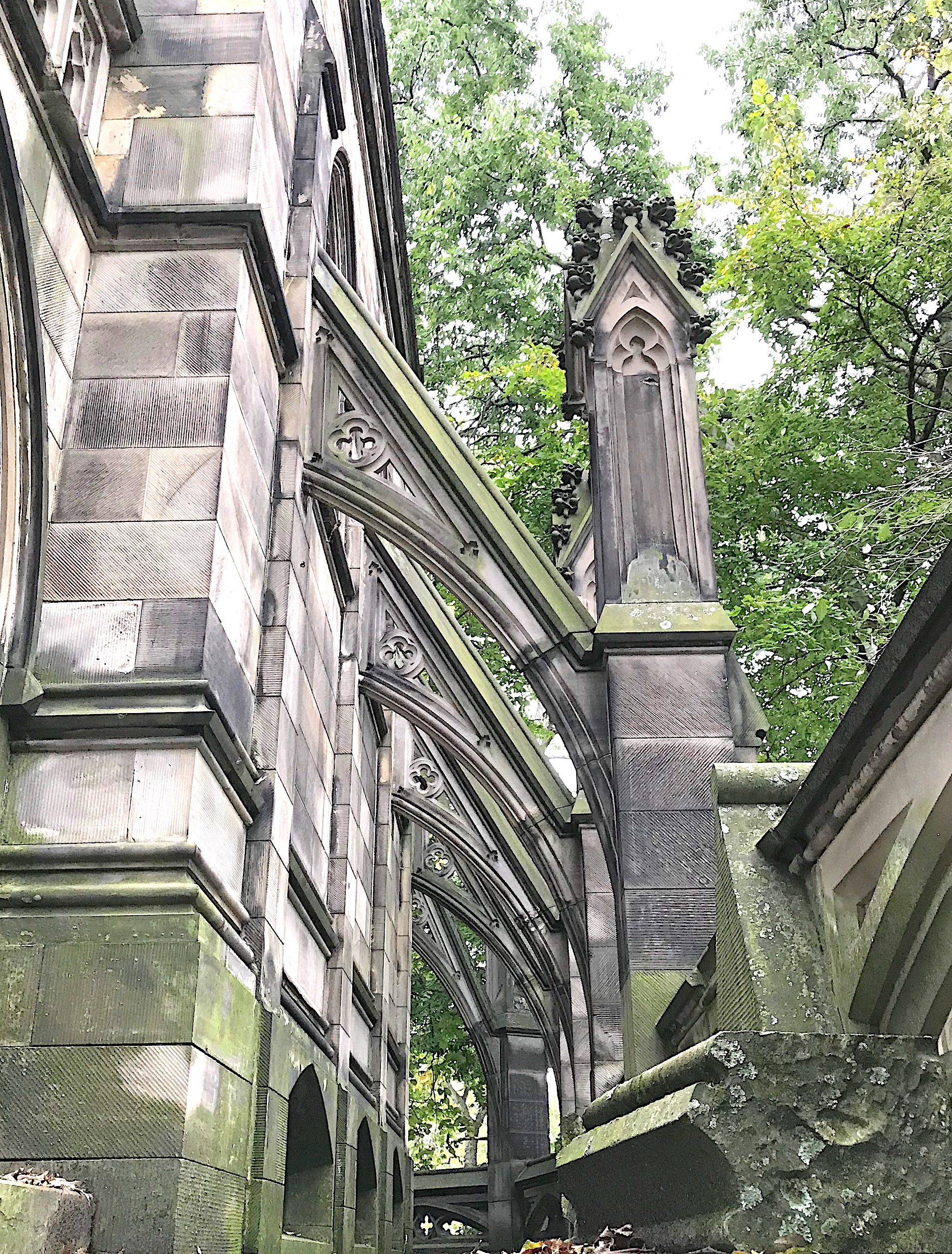
The Dexter mausoleum cost about $100,000, which would equal about $1.7 million today.
The $100,000 it cost to build the family mausoleum equals about $1.7 million in today’s money. But the Dexter mausoleum was never finished by builder Joseph Foster. Unknown financial issues left it without its planned stained glass windows and a manual elevator that was to reach down into the catacombs.
So how many people are inside the Dexter Mausoleum besides Edmund Sr. and Mary Ann (who died in 1875)? According to a newspaper article, there are thought to be a total of 20 people. That list includes Edmund Dexter Jr. (1835-1879), the second of the Dexter sons, who helped took over running the family business after his father’s death. He would die in 1879 at age 43 of “tuberculosis of the bowels.”
A Contested Will
Also interred within the Dexter Mausoleum is Annie L. Dexter (1856-1916), the eldest of Charles Dexter’s four daughters and Edmund Sr.’s granddaughter. Annie, who was single and died of pneumonia in 1916 in Quebec, left her younger sister, Alice Dexter Walker, out of her will. Annie’s estate was around $700,000. Alice challenged Annie’s will and settled out of court. “She had never shown me any affection,” Annie said of Alice in her will.
Granddaughter Alice (1863-1944) was married to University of Cincinnati Spanish professor Paul F. Walker. She had one son, Carroll “Deck” Dexter Walker, (1906-1960) who had to change his name to Charles Dexter in order to collect a $20,000 inheritance from his Aunt Annie. He is buried elsewhere at Spring Grove with his wife, Dorothy.
The Eyes Have It
My next story involves another prosperous Cincinnati businessman but his story is much more troubling than the Dexter family’s.

If you walk by C.C. Breuer’s monument, his eyes may be following you.
What drew me to Charles Breuer (thanks to Ken’s guidance) was the fact that the bust of the man himself that’s on the side of his monument contains a pair of glass eyes. There are a few stories behind why he requested that his bust’s eyes have real glass eyes inserted in them. One was because he wanted to “keep an eye on things” after he was gone.
But the more I read about C.C. Breuer’s past, the more I realized this man had issues that went way beyond requests like this one. He apparently thought about his eventual demise quite a bit, purchasing plots at Spring Grove years in advance.
From Butcher to Real Estate Baron
Born in 1845 in Germany, Charles C. Breuer made his way to America sometime before the Civil War. Settling in Cincinnati, he married Annie Burkart in the 1860s and worked as a butcher in the 1870s. As he prospered, the couple had at least seven children together.
By the time Charles divorced Annie in the 1880s, he had switched from operating a butcher shop to dabbling in real estate. He married Katherine Grotenkemper in 1889. Together, they had two daughters, Ruth (1893) and Helen (1895). It was only about six months after Helen’s birth that Katherine died of pneumonia at the age of 36. Charles was amassing several properties and gaining wealth rapidly.

Charles C. Breuer went from simple butcher to wealthy real estate mogul but he was often at odds with his business associates.
It was in 1904 that Charles’ name began hitting the newspapers for various court cases, including a charge of assault against him when he cut a tenant he disagreed with. He also began entrusting his housekeeper, Georgia Lee Gholson (who was from Cobb County, Ga., where I once lived), with some of his properties and guardianship of Ruth and Helen, who were none too keen on their father’s new love interest.
Sleeping on His Casket
By 1905, Charles had married Georgia and his two teenage daughters were living in an apartment across the Ohio River in Covington, Ky., being cared for by neighbors. Charles had the girls brought into juvenile court under the charge of “incorrigibility” and the family’s dirty laundry was aired.
During this time, Breuer became obsessed with his own death. The story of how he purchased two copper-lined caskets (costing $500 each) for he and Georgia and then stored them under their bed made headlines in several newspapers.

The article got his daughters’ names wrong but the story of C.C. Breuer sleeping on his own coffin was true. (Photo source: St. Louis Post-Dispatch, April 26, 1908)
Eventually, Charles dropped the case against the girls but the judge ruled that Charles had to provide his daughters with a living via the rental of one of his many buildings. While this was being finalized, an infuriated Breuer plotted to blow up the building to keep his daughters from receiving it. Fortunately, he was discovered before he could complete the job. The story even made headlines in the New York Times.

Charles C. Breuer attempted to burn down his own building to keep his daughters from getting the income from its rental. (Photo source: Chillicothe (Ohio) Gazette, Jan. 18, 1908.)
Beginning of the End
In court, Charles was judged insane and put in the custody of Georgia. One article noted he was reunited with Ruth and Helen in court, their legal matters resolved. But his mental state continued to rapidly deteriorate. By July, Georgia had reached her limit and Charles was taken to Longview Hospital, a Cincinnati mental institution. He died on August 20, 1908.
According to newspaper accounts, Charles was embroiled in 50 different court cases at the time of his death so I have a feeling there wasn’t much money left to leave his family.
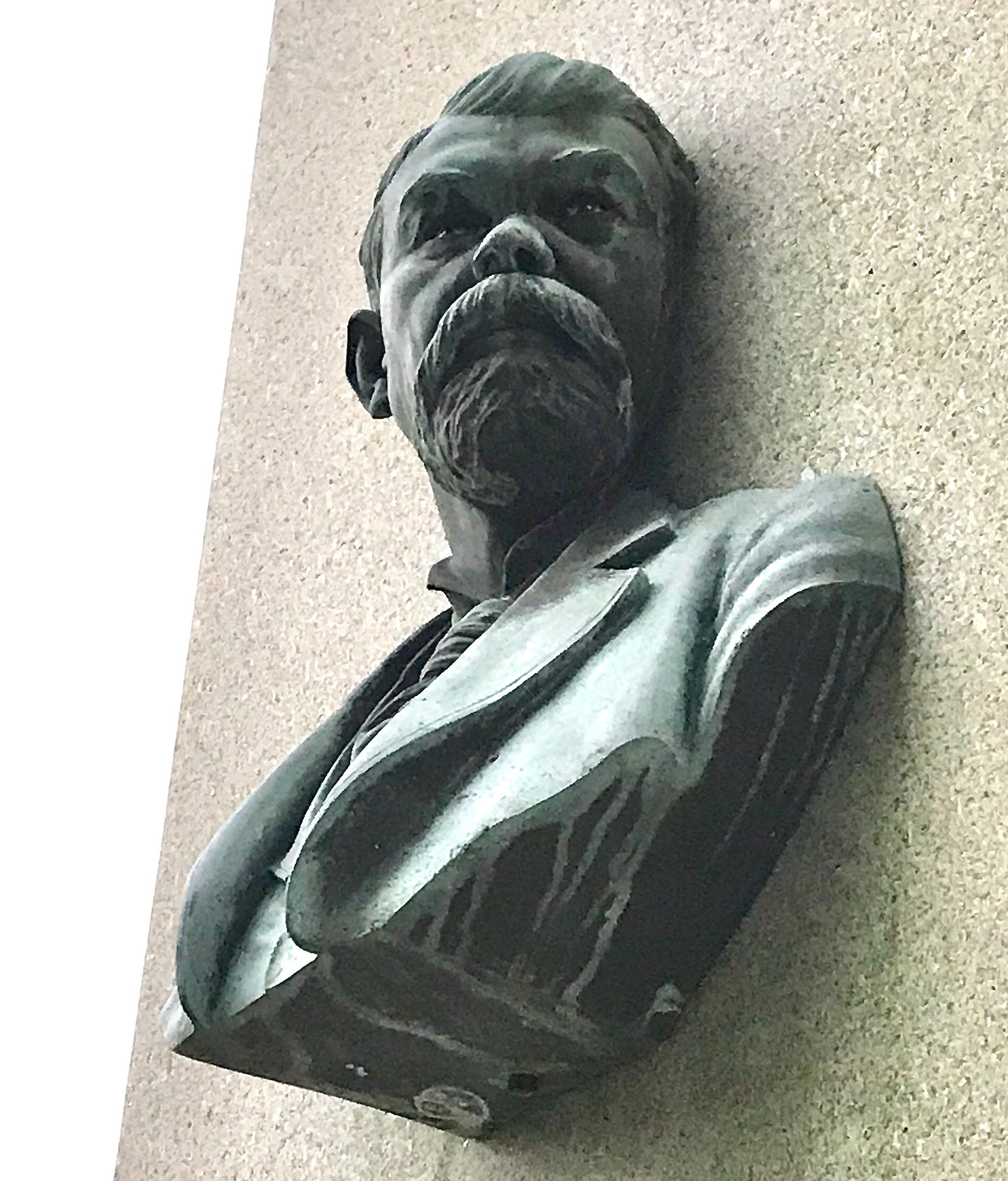
One story claims that Charles Breuer requested that his own eyes be removed from his corpse and placed within the glass eyes inserted in his bust.
I traced Ruth and Helen to 1910 when they were boarding in a home in Cincinnati. Ruth was working as a stenographer and Helen as a bookkeeper. I lost track of Ruth but Helen married and eventually moved to Tennessee where she died in 1966.
Georgia lived to the age of 77 and died in 1948. She is buried beside Charle, along with some of his children from his first wife, Annie. But I don’t know if Georgia was buried in that $500 copper-lined casket.
A Young Family on the Rise
Fortunately, the Emery family wasn’t nearly as dysfunctional as the Breuers. But they did know their fair share of tragedy, which resulted in the creation of one of Spring Grove’s most beautiful statues.
Born in Wales in 1830, Thomas J. Emery came to America with his family at the age of 6. Thomas was the eldest son of the founder of a soon-to-be developed empire built on candle manufacturing, real estate, and housing construction. Around 1865, he married accomplished New Yorker Mary Muhlenberg Hopkins.

Photo of the Emery boys in their childhood. (Photo source: http://www.findagrave.com)
The couples’ fortunes rose as their family grew, with Sheldon arriving in 1867 and Albert being born in 1868. Eventually, both boys were sent to St. Paul’s School in Concord, N.H. to continue their education.
Tragedy Strikes
On Feb. 6, 1884, Albert went sledding with some classmates and was in an accident. Sadly, he died a few days later on Feb. 11, 1884 at the age of 15.

This newspaper clipping is the only mention I could find related to Albert Emery’s death. (Photo source: The Dayton Herald, Feb. 6, 1884)
One source I found said that Sheldon graduated from Harvard Law School but I wasn’t able to find anything to support that. City directories place him living with his parents until his early 20s when he began to work as a clerk in his father’s thriving real estate business. Thomas also owned a candle-making factory that employed many people.
Sheldon died of pneumonia on Oct. 26, 1890, leaving his parents childless. They were understandably devastated.

The original statue held a clamshell in its hands.
In response, the Emerys commissioned a baptismal statue in memory of their sons, Sheldon and Albert. The bronze angel, which originally held an elaborate clamshell, served the congregation of Christ Church Cathedral until 1955, when the statue was then moved to Spring Grove Cemetery.
In its new home, the Emery Angel is often referred to as “The Weeping Angel” due to her striking tear-stained face.

The effects of aging makes it appear that the Emery angel is weeping.
It was only six years later that Thomas Emery would die of pneumonia on Jan. 5, 1906 at the age of 75 while visiting Cairo, Egypt. The news must have hit Mary hard back in Cincinnati, especially since newspaper reports said she had begged him not to go. His remains were sent home to Ohio for burial at Spring Grove.

The Emery family cross bears the names of Thomas Emery’s parents on the front. Thomas, Mary, Sheldon, and Albert Emery’s names are on the back. (Photo courtesy of Ken Naegele.)
Thomas’ will included many bequests to various charitable organizations, including the Cincinnati Orphan Asylum he’d established 30 years previous and severak employees of his candle factory.
Mary reportedly inherited $20 million. Not a woman to rest on her laurels, she used the money to continue several philanthropic projects begun by Thomas and started many new ventures. She supported the Cincinnati Zoo, was the force behind the creation of Children’s Hospital, and donated a wing to the Cincinnati Art Museum to showcase the art she had collected and bequeathed to the museum.

Mary Emery was as committed to charitable causes as her late husband. (Photo source: http://www.findagrave.com)
Mary’s biggest project was the creation of the model town of Mariemont. Shocked by the unsanitary housing conditions in downtown Cincinnati, she used her funds to create a template for a community planned in every detail to provide its residents with a high quality of life.
Mary and her business manager hired John Nolen, an internationally known town planner, who developed the plan for the Village of Mariemont (named after the Emery family’s summer home in Rhode Island). Mariemont is one of relatively few planned communities in the U.S., and was designated a National Historic Landmark in 2007.
I knew nothing about Mary’s involvement in Mariemont so when later that day my sister suggested we drive through it before heading to Dayton, I didn’t make the connection. It’s still a beautiful development with Tudor-style homes and tree-lined streets. This was the only photo I took, unfortunately.

After her husband’s death in 1906, Mary Emery poured her energies into creating the Village of Mariemont. Her sister, Isabella, inherited must of her estate when Mary died in 1927.
When Mary died of pneumonia at age 82 in 1927, she left much of her estate (after many charitable bequests) to her sister Isabella, with whom she was very close in her last years.
I’ve still got plenty of stories to share from Spring Grove Cemetery & Arboretum. Stay tuned for Part III!

The only child of confectioner Alexander M. Day and Mary Johnson Day, six-year-old Alice Day died 10 months after her father on April 27, 1864. The Days were a wealthy family that included Alex’s brother, Ohio Congressman Timothy Day.
 Adventures in Cemetery Hopping