• About Me
  • Cemeteries I Have Visited
  • Have questions?
  • Photos

Adventures in Cemetery Hopping

~ A blog by Traci Rylands

Adventures in Cemetery Hopping

Monthly Archives: June 2023

Oklahoma Road Trip 2019: Paying a Call at Meridian, Miss.’s Rose Hill Cemetery, Part I

30 Friday Jun 2023

Posted by adventuresincemeteryhopping in General

≈ 1 Comment

After leaving Jackson’s Greenwood Cemetery, we wearily headed for Meridian to spend the night. That’s about an hour and a half drive. The plan was to get a good night’s sleep, stop at Rose Hill Cemetery in Meridian, see Live Oak Cemetery in Selma, Ala., and then head to Atlanta where she would drop me off at Hartsfield-Jackson International Airport. I would then join my family at Folly Beach, S.C. to enjoy the last few days of our annual beach vacation with my husband’s family.

The entrance to Meridian’s Rose Hill Cemetery.

The next morning, we headed to Meridian’s Rose Hill Cemetery for our next to last “hop” before driving east to Selma. The oldest recorded marker has a death date of 1853 but as with many old burial grounds, there are likely folk that were interred there earlier. Find a Grave lists about 3,525 memorials for Rose Hill.

The cemetery was being mowed when we arrived. I owe one of the gentleman mowing a debt of gratitude. He saw me wandering around, turned off his mower, and came over to ask if I was looking for someone in particular. I explained my strange hobby and he offered to lead me to a grave worth seeing. A cemetery hopper doesn’t turn down a kindness like that. I’m also sure I wouldn’t have noticed it on my own.

The Competing Founders of Meridian

Buried off to the side with his wife in a humble grave is John T. Ball, born in New York in 1821. He married Virginia native Sarah Elizabeth Page Smith in 1848 and by 1850, they were living in Mississippi.

Ball was keen to get in on the railroad construction going on and so was Alabaman (and lawyer) Lewis A. Ragsdale. Both men sought to make a profit from the planned crossing of the Mobile and Ohio Railroad with the Vicksburg and Montgomery Railroad, but Ragsdale is said to have beat Ball to the area by a few days.

I’m not sure I would have noticed John T. Ball’s grave it someone had not kindly pointed it out to me.

Ragsdale bought area settler Richard McLemore’s farm, east of present-day 27th Avenue. It included much of what would become the central business district. Ball purchased only 80 acres west of 27th Avenue. McLemore and his family moved north out of the city, and Ragsdale moved into McLemore’s log home, turning it into a tavern.

Ragsdale and Ball had differing views on the city name, too. Ball believed the word “meridian” was synonymous to “junction”. He and the more industrial-minded residents preferred that name. Meanwhile, the more agrarian population liked “Sowashee,” which means “mad river” in a Native American language and is the name of a nearby creek. Ragsdale wanted to name the new settlement Ragsdale City after himself. Clearly, Meridian won out. The town was officially incorporated as Meridian on Feb. 10, 1860.

Ball operated a dry goods business and his family remained in Meridian until his death in 1890 at age 69. Sarah died in 1877. The few articles I found about his death were brief and said little beyond the fact he was one of the city’s oldest settlers and considered a founder.

By comparison, Lewis A. Ragsdale has a much larger monument that I photographed before I even knew who he was.

The Ragsdale family monument is one of the tallest in the cemetery.

Unlike John T. Ball, Lewis Ragsdale had a lengthy obituary that detailed his life. I won’t go into all those details, but he had his fair share of failures before his success in Meridian. He married Sarah Ann McCoy around 1855 in Mississippi and they had several children, many dying in childhood.

If Lewis Ragsdale’s wishes had been fulfilled, Meridian would have been called Ragsdale City.

Ragsdale was a prosperous merchant and landowner. Interestingly, his obituary in the Jackson, Miss. Clarion (Dec. 16, 1886) dryly noted, “He was a man of great public spirit, and was very wealthy, notwithstanding his investments in a number of unprofitable projects.” He died on Dec. 10, 1886 in Memphis, Tenn. Wife Sarah died three years later.

Sarah and Lewis Ragsdale died about three years apart.

“Erected By His Lady Friends“

It’s not every day you pass by a monument that has the words “Erected By His Lady Friends” inscribed on it. But such is the case of Dr. Leonidas Shackelford.

A native of Greensboro, Ala., Lee (as he was called) grew up and married Virginia Newman in 1867, having served as a surgeon in the Confederate Army during the Civil War. I’m not sure where he attended medical school. He and Virginia had three children together: Thomas (who died as a toddler in 1871), Lee, and Mary.

Dr. Shackelford’s monument has a curious inscription.

According to what I could find at the time, a yellow fever epidemic hit Meridian in 1878, much like the one that hit Shreveport, La. in 1873. It affected almost 500 residents, leaving at least 86 dead. In fear of the lives of his wife and two children, Dr. Shackelford quickly sent them out of town before a city quarantine was imposed.

Dr. Shackelford died while tending the sick during a yellow fever epidemic.

Dr. Shackelford died on May 19, 1878 while tending to the sick. His family did not find out about it until they returned to Meridian. Some have said Dr. Shackelford’s marker was already up when the family came home. It is suggested that the inscription was from the nurses with whom he tended the sick, but nobody knows for sure. I have no doubt that had it meant anything but something of that nature, his wife would not have let it remains standing.

Virginia, who outlived her husband by 45 years, did not remarry. She died in 1923 and is buried beside him. Their son, also named Lee, grew up to become a bookkeeper. He married and settled in Meridian, passing away in 1942. Daughter Mary did not wed but shared a home with her mother, brother, and sister-in-law for a time, becoming a teacher. She died in 1954 at age 81. Both Lee and Mary are buried with their parents in the Shackelford plot at Rose Hill.

“None Knew Thee But To Love Thee”

The grave of Janie M. Akin doesn’t tell us much in terms of facts but the symbolism it provides speaks without words. A Heavenly hand reaches down from the clouds and grasps three flowers, signifying a young life taken too soon from the mortal world.

Janie McCormick Akin died about two years after her marriage to Charles V. Akin.

I could find very little about Janie McCormick, who married Meridian resident Charles Vivian Akin on July 3, 1889. She would have been 23 and Charles 29. Janie gave birth to a son, Charles Jr., on May 23, 1890. For reasons unknown, she died on Sept. 6, 1891. Below her birth and death dates are inscribed the words, “None Knew Thee But To Love Thee.”

Charles, who owned a local dry goods store, remarried to Alice Trudchen Hyer in 1893. The couple had two daughters, Gladys and Lois. Alice died on Dec. 31, 1900 at age 29. Charles died at age 66 in 1927. They are both buried at Rose Hill Cemetery.

In Part 2, I’ll share the story of the Gyspy Queen buried at Rose Hill and the Confederate burial mound containing the remains of over 100 soldiers.

Monument to John T. Quarles, who died on Jan. 21, 1889 at the age of 31. I could find no information about him.

Oklahoma Road Trip 2019: Visiting the Old and the Young at Jackson, Miss.’ Greenwood Cemetery, Part II

23 Friday Jun 2023

Posted by adventuresincemeteryhopping in General

≈ Leave a comment

I told you in Part I that Jackson, Miss.’s Greenwood Cemetery has a number of stirring monuments. I’m going to start with this one and when I first saw this image, I immediately wanted to know more.

Rosa Farrar Petrie was left with her five children to mourn the loss of her husband, Lemuel.

Born around 1813 in Portland, Maine, Lemuel Weeks Petrie married Virginia native Rosa Mahalah Farrar in Rankin County, Miss. in 1842. He was from a fairly well to do family and a successful planter. In 1842, Lemuel owned over 2,500 acres worth over $17,500 plus a brick home worth $2,000. It appears that a substantial amount of his wealth was inherited and he was a slave owner.

The Petrie/Hunter family plot at Greenwood Cemetery.

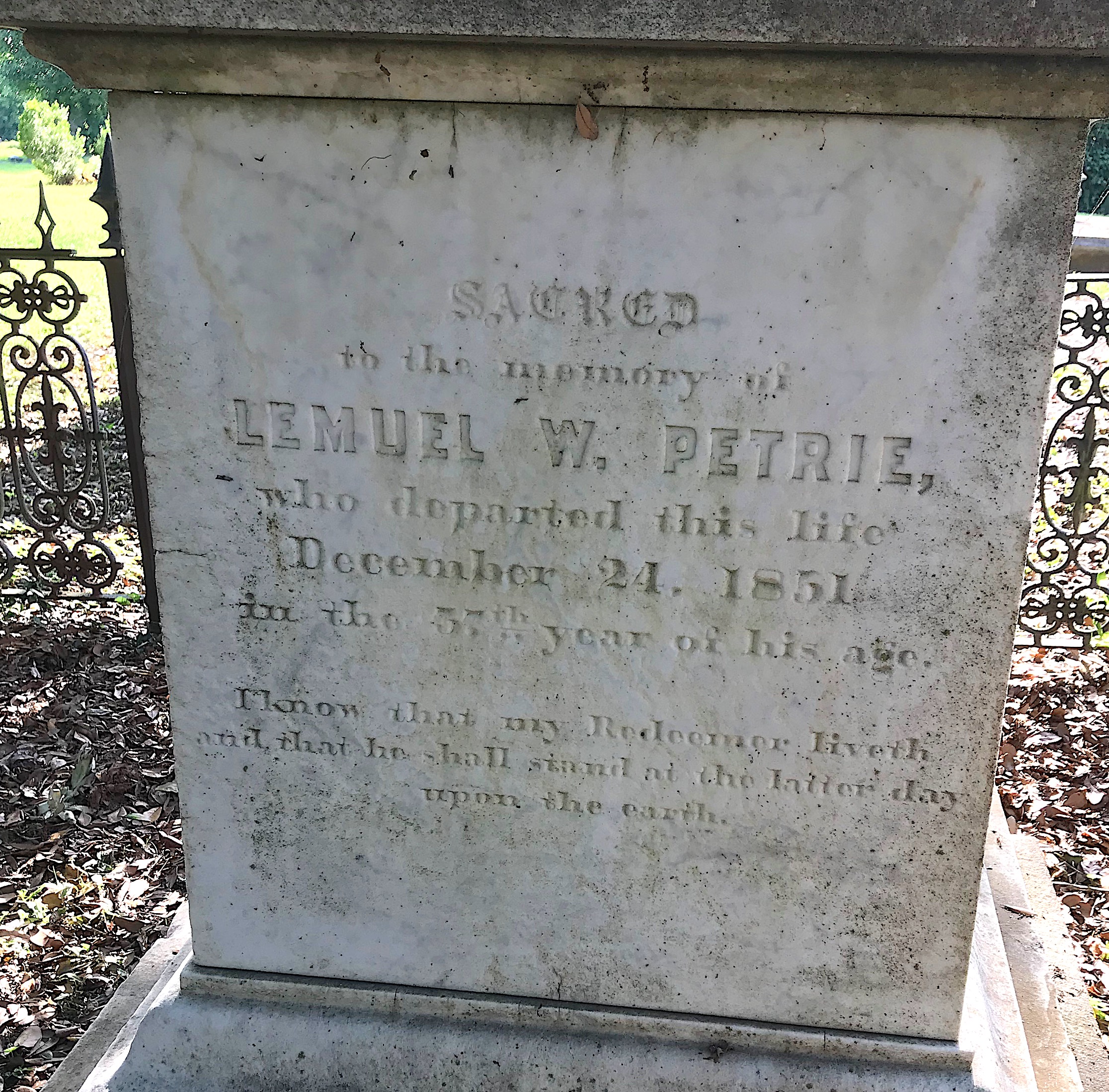
Lemuel and Rosa had five children together. For reasons unknown, he died on Christmas Eve 1851 at the age of 37. At the time of his death, his property included two large plantations located a few miles from Edwards, Miss., and a smaller one in the same general area. The total appraised value of the three plantations was a little over $143,000.

Lemuel Petrie died at age 37 in 1851.

Lemuel’s monument is a testament to his family’s grief. Sitting beneath a large weeping willow (a symbol of mourning in cemetery iconography), a mother bent over in dejected sadness is surrounded by her children. The scale is a little off in that the mother looks rather like a giant compared to the children. But the sentiment comes through quite strongly.

“I know that my Redeemer liveth”

Rosa eventually remarried to Irish-born Presbyterian minister, the Rev. John Hunter, in 1858. Together, they would have five children of their own.

Two of Lemuel and Rosa’s children are buried in the plot with them. Their firstborn (1843), Herbert, attended the University of Mississippi and became a doctor. He died in 1875 at age 25 from “malarial fever and heart disease”. Beside him is his brother, Henry, born in 1844. His marker states he died on Aug. 10, 1861 in Culpepper, Va.

Brothers Herbert (left) and Henry are buried next to each other at Greenwood Cemetery.

Henry served in the Confederate Army during the Civil War, he would have been around 17 at the time. There is a record for a Henry F. Petrie enlisting in Corinth, Miss. on May 24, 1861 and serving in the 18th Infantry, Co. K. The 18th did fight at the First Battle of Manassas (Bull Run) on July 21, 1861. It’s possible Henry was wounded there and died later in Culpepper. Disease, however, may have claimed him as well.

The Gardner Held His Peace

Rosa gave birth to a daughter, Rosabell on Oct. 8, 1861. Her splendid wedding to George Yates Freeman on Feb. 28, 1883 in Jackson was reported in more than one Southern newspapers. Rev. Hunter united the couple in holy wedlock that day. Rosabell and George had one daughter, Yates, in 1885 but she only lived seven months. Son Edward, born in September 1886, was their only child who lived to adulthood.

Many times a tree marker signifies a life cut short. Rosabell Hunter Freeman, who died at 28, is such a case.

Rosabell died on Sept. 21, 1890 at age 28. Her husband, George, died on April 20, 1895 at age 44. They are buried together in the Petrie/Hunter family plot.

Rosa died on Jan. 31, 1895 at age 80. Her obituary noted, “Her life was sweet and peaceful, filled with good deeds and kind words, and her death was in keeping with that life.” Rev. Hunter died at age 74 in 1899.

Rosa Farrar Petrie Hunter is buried between her first and second husbands.

“Cotton King”

In almost every cemetery, there is one monument that tends to dominate the landscape. In the case of Greenwood, that would be the one for “Cotton King” Edmund Richardson. When we were there, it was nearing dusk so the quality of these photos is not the greatest.

The monument for Edmund Richardson and his wife, Margaret, is the tallest in the cemetery.

Born in North Carolina in 1818, Edmund settled in Jackson, Miss. where he formed a mercantile partnership with branch stores in neighboring communities. In 1848, Richardson married Margaret Elizabeth Patton of Huntsville, Ala. with whom he had seven children. Several are buried in the Richardson plot at Greenwood.

Five of the seven Richardson children are buried at Greenwood. Two are interred at Metairie Cemetery in New Orleans, La. Most of them lived to adulthood.

Despite the hardships most merchants faced during the Civil War, Richardson rebounded within a year after it ended and held onto the five plantations owned. In 1868, Richardson exploited the abundance of ex-slave prison labor by making a deal with Federal authorities in Mississippi (still under the rule of postwar Reconstruction) to use inmates to work his farms in the Mississippi-Yazoo Delta.

Convict Labor

Richardson agreed to provide supervisory guards and treat the prisoners well by providing food and clothing. The state paid Richardson $18,000 per year for maintenance, plus the cost of transporting prisoners to and from his plantation camps.

The Richardson monument features two crossed and lit torches. If the inverted torch has a flame, it symbolizes the flame of eternal life and the Christian belief in resurrection.

Richardson used prison laborers to build levees, clear trees from swamps, and plow fields. Production of cotton using the convict lease system enabled Richardson to amass a fortune. By the 1880s, he had a mansion in New Orleans and another in Jackson. He also acquired the Griffin-Spragins mansion in Refuge, Miss.

Edmund Richardson earned the moniker of “Cotton King”.

When the World’s Industrial and Cotton Centennial Exposition came to New Orleans in 1884–1885, Richardson served as chairman of the board of management, donating $25,000 to the event. In the mid-1880s, Richardson was one of the largest cotton growers in the world with 25,000 acres in cultivation. This earned him the nickname “Cotton King”.

These are flower bouquets adorning the side columns.
Here’s another glimpse of the downcast flower bouquets.

On Jan. 11, 1886, Richardson died at age 67 after an attack of apoplexy. His obituary described him as “the richest man in the South and the largest cotton planter in the world, second only to the Khedive of Egypt”. At the time of his death, his estate was estimated to be worth $10,000,000 to $15,000,000. I don’t know who carved his impressive monument, but it was imported from Italy.

His wife, Margaret, died almost a year later on Dec. 17, 1887.

Headless angel with a lit, inverted torch on the side of the Richardson monument.

Man (And Woman’s) Best Friend

I’m going to finish up at Greenwood with this story, and as is common in such things, there are not many facts to support it. But the sweet sentiment behind it remains for those who encounter it while wandering through Greenwood Cemetery as we did.

Located near the graves of Mary Hill “Mamie” Simms and her mother is a statue of a dog. If you look behind it to the left in the photo below, you can get a glimpse of Mamie’s marker.

The unnamed faithful companion of Mary Hill “Mamie” Simms waits for her still.

Mamie was the daughter of Anne Tapley Simms and J.T. Simms. Her maternal grandfather was Judge Colin S. Tarpley. Mamie died of typhoid fever at age 15 on June 21, 1877 in Oxford, Miss. Anne died in 1913.

According to local legend, Mamie’s beloved dog is said to have spent every day lying on the grave of his young mistress from when she died until his own death. I don’t know what the precious pup’s name was or when he died. But his memory lives on in this marker made in his honor.

There’s two more stops left on the Oklahoma Road Trip 2019. I hope you’ll hang on for the last chapters of this memorable adventure.

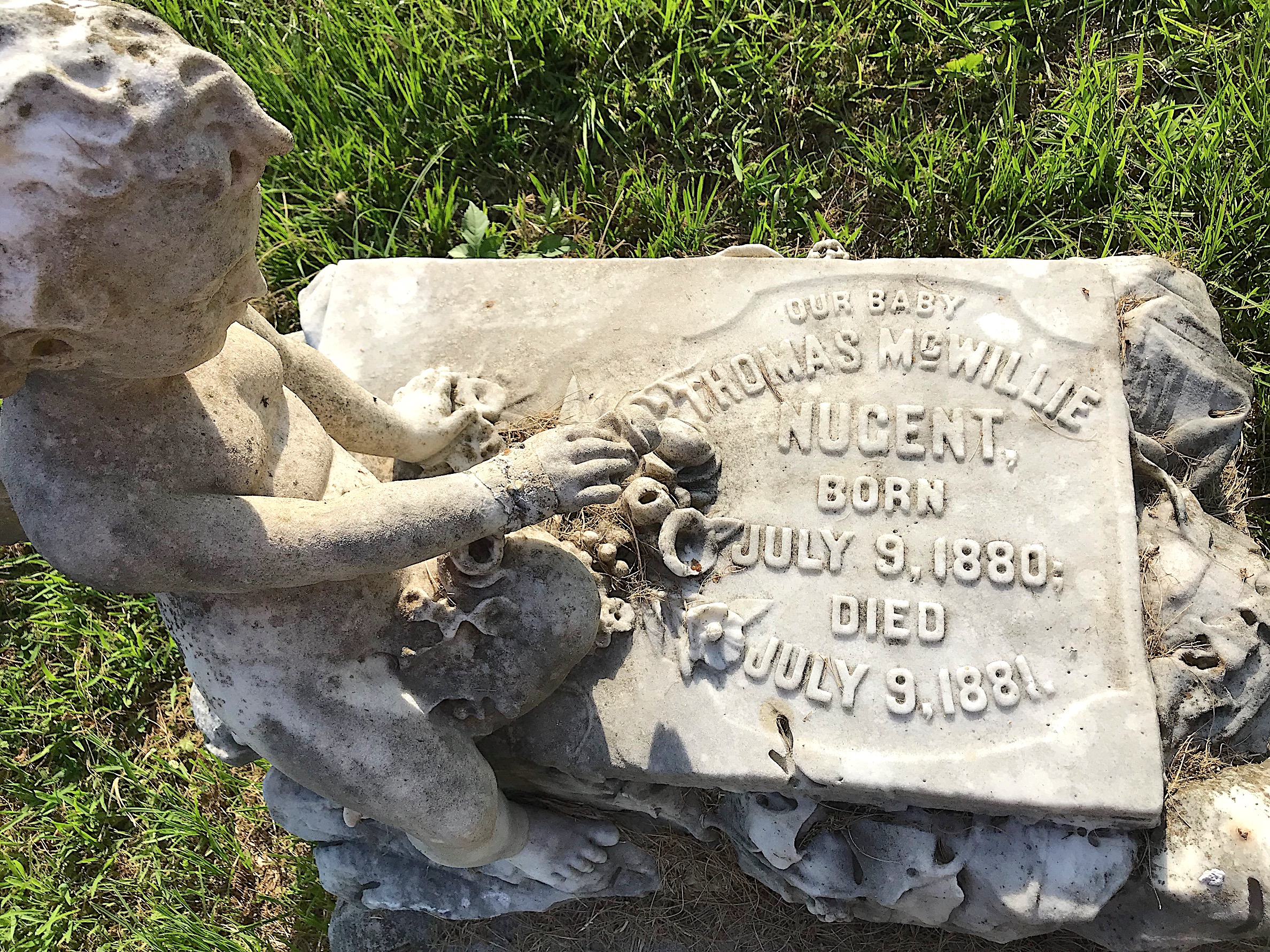
Born on July 9, 1880 to attorney William Lewis Nugent and Aimee Webb Nugent, Thomas McWillie Nugent died exactly a year later. His younger sister, Aimee, born on May 18, 1882, died on Sept. 29, 1883. She has an exact replica of this marker for her grave near Thomas at Greenwood.

Oklahoma Road Trip 2019: Visiting the Old and the Young at Jackson, Miss.’ Greenwood Cemetery, Part I

09 Friday Jun 2023

Posted by adventuresincemeteryhopping in General

≈ Leave a comment

After leaving Vicksburg, we headed east for our next destination of Greenwood Cemetery in Jackson, Miss. It’s about 45 minutes away. The main reason was to visit the grave of one of my favorite authors as a girl, Eudora Welty.

Growing up in the South is different than growing up any place else in the world. It has its unique weather, landscapes, and ways of expressing oneself. I was not born in the South but I’m as close to a native as it gets. They’ve kindly taken me in.

When I read Eudora Welty, I felt like she was speaking from my “place” and spoke my language. The first thing I ever read by her was the short story “Why I Live at the P.O.” and I’ve been a fan ever since.

Greenwood Cemetery is located in Jackson, Miss.

The Graveyard

The information I found about Greenwood was somewhat conflicting. A sign there says Greenwood Cemetery was established by a federal land grant on Nov. 21, 1821. The Greenwood Cemetery Association web page states that it was established by an act of the Mississippi State Legislature, which was approved Jan. 1, 1823. It also notes that Greenwood has grown from the original six acres to its current 22 acres.

Something in me likes knowing that it was originally known simply as “The Graveyard”. Later, people called it City Cemetery.

In 1899, the Ladies Auxiliary Cemetery Association submitted the name Greenwood Cemetery to city leaders and the name was adopted in 1900. In 1909, the city declared Greenwood Cemetery “full” and stopped selling plots. But burials are still taking place there today.

Eudora Welty

I’m not going to write a long bio about Welty, much has been written about her already. She was born and raised in Jackson, Miss. by her parents Christian Webb Welty and Mary Chestina Andrews Welty. Her mother, a teacher, encouraged her children to not only read but embrace it in their home. I was raised the same way.

Welty not only wrote, but took many photographs for the Works Progress Administration (WPA) during the 1930s.

Photo taken in 1962 of Eudora Welty from Wikipedia.

Her first publication in 1936 was a short story, “Death of a Traveling Salesman”. Her first book was published five years later and it was called A Curtain of Green, containing 17 stories. Welty’s debut novel, The Robber Bridegroom, came in 1942. Her recognition as a talented Southern author began to build and she was able to travel to Europe. In 1960, she returned home to Jackson to care for her elderly mother and two brothers.

In 1972, Welty’s novel The Optimist’s Daughter won a Pulitzer Prize. In 1980, she was awarded the Presidential Medal of Freedom by fellow Southerner President Jimmy Carter. Welty was a charter member of the Fellowship of Southern Writers, founded in 1987. She also taught creative writing at colleges and in workshops. She lived near Jackson’s Belhaven College and was a common sight among the people of her hometown.

Welty died on July 23, 2001 at age 92 in Jackson. I am just one of many who have come to visit her grave over the last 22 years.

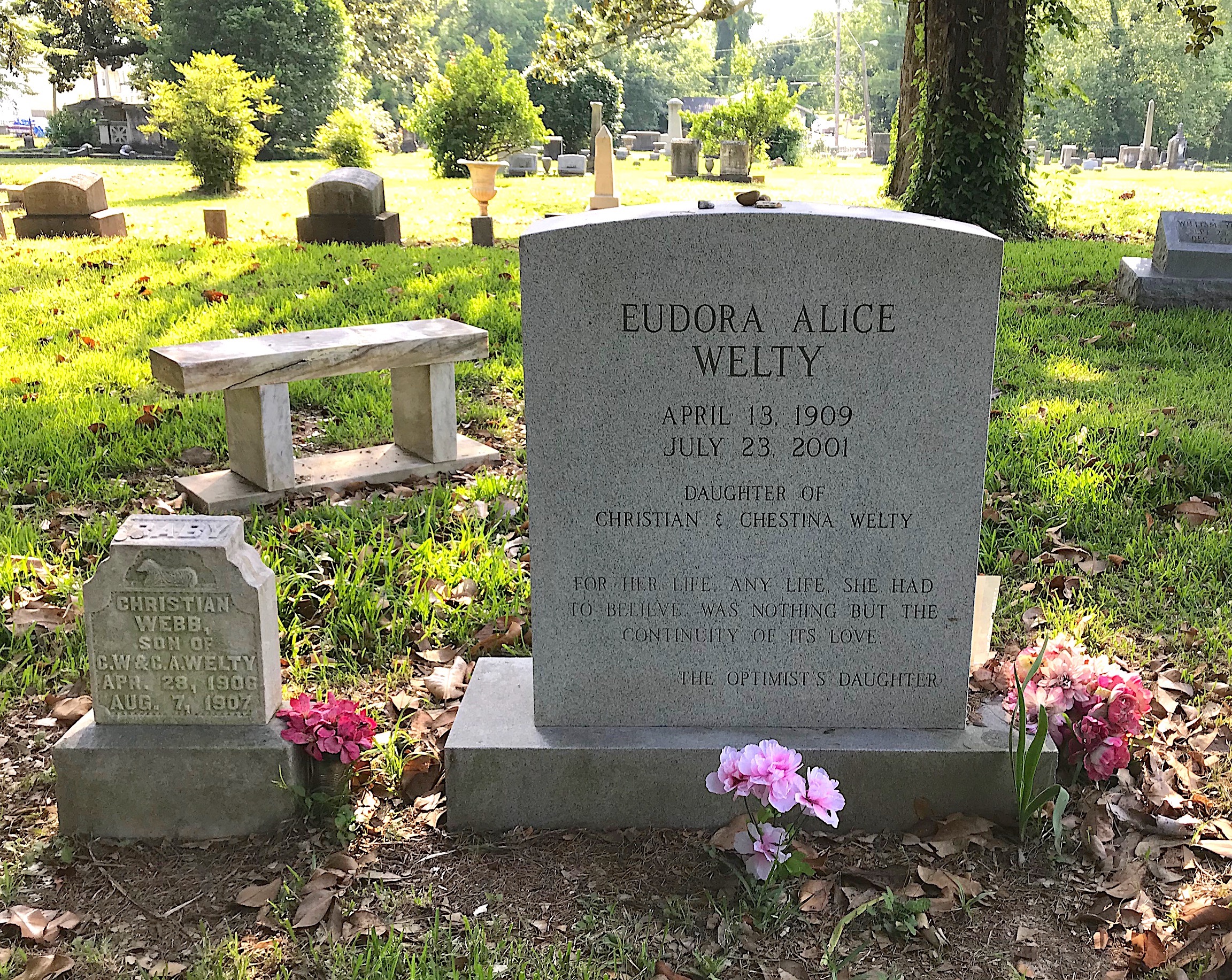
Eudora Welty is buried beside her brother, Christian Webb Welty, who died before she was born.

The epitaph on the front of Welty’s simple marker comes from her novel, The Optimist’s Daughter:

For her life, any life, she had to believe, was nothing but the continuity of its love.

I sometimes forget to photograph the back of markers but thankfully, this time I did not. There is another quote on the back of Welty’s gravestone, which I am writing out because my photo has sun splotches on the last words. It comes from her three-part memoir called One Writer’s Beginnings.

The memory of a living thing. It too is in transit, but during its moment. All that is remembered joins. And lives — the old and the young. The past and the present. The living and the dead.

As you have seen, I am a writer who came of a sheltered life. A sheltered life can be a daring life as well. For all serious daring comes from within.

The back of Eudora Welty’s marker has a quote from her memoir, One Writer’s Beginnings.

Yonder, Up Yonder

Greenwood has a few of the most gripping grave markers I’ve seen. One of them is for Louisa “Lula” Lemly Hines and the other is for two of her sons.

Born in 1841, Lula was the daughter of Samuel and Elizabeth Furr Lemly. Samuel was a master carpenter, contractor, and planter in Rowan County, N.C. He was responsible for several building projects, including a major bridge over the South Yadkin River (1825) and the first eight buildings at Davidson College. He and Elizabeth moved to Jackson, Miss. around the time of Lula’s birth. They had at least 10 children together. Samuel died in 1848.

The Hines family plot is a testament to love and loss.

Lula married bookkeeper and Confederate veteran Henry Hunter Hines in May 1867. Their son, Hallie, was born 10 months later on March 15, 1868. His brother, Willie, was born on May 15, 1870. Sadly, Hallie died of measles on May 24, 1870 at age two. Willie died seven months later on Dec. 28, 1870. Lula and Samuel must have been heartbroken. The two boys share this marker.

Brothers Willie and Hallie Hines share this poignant marker.

Lula gave birth to another son, Claude, on Nov. 21, 1871. He lived a long life, becoming a dentist. He died in 1945 and is buried in Forest Hill Cemetery Midtown in Memphis, Tenn.

Home, Heaven, Happiness

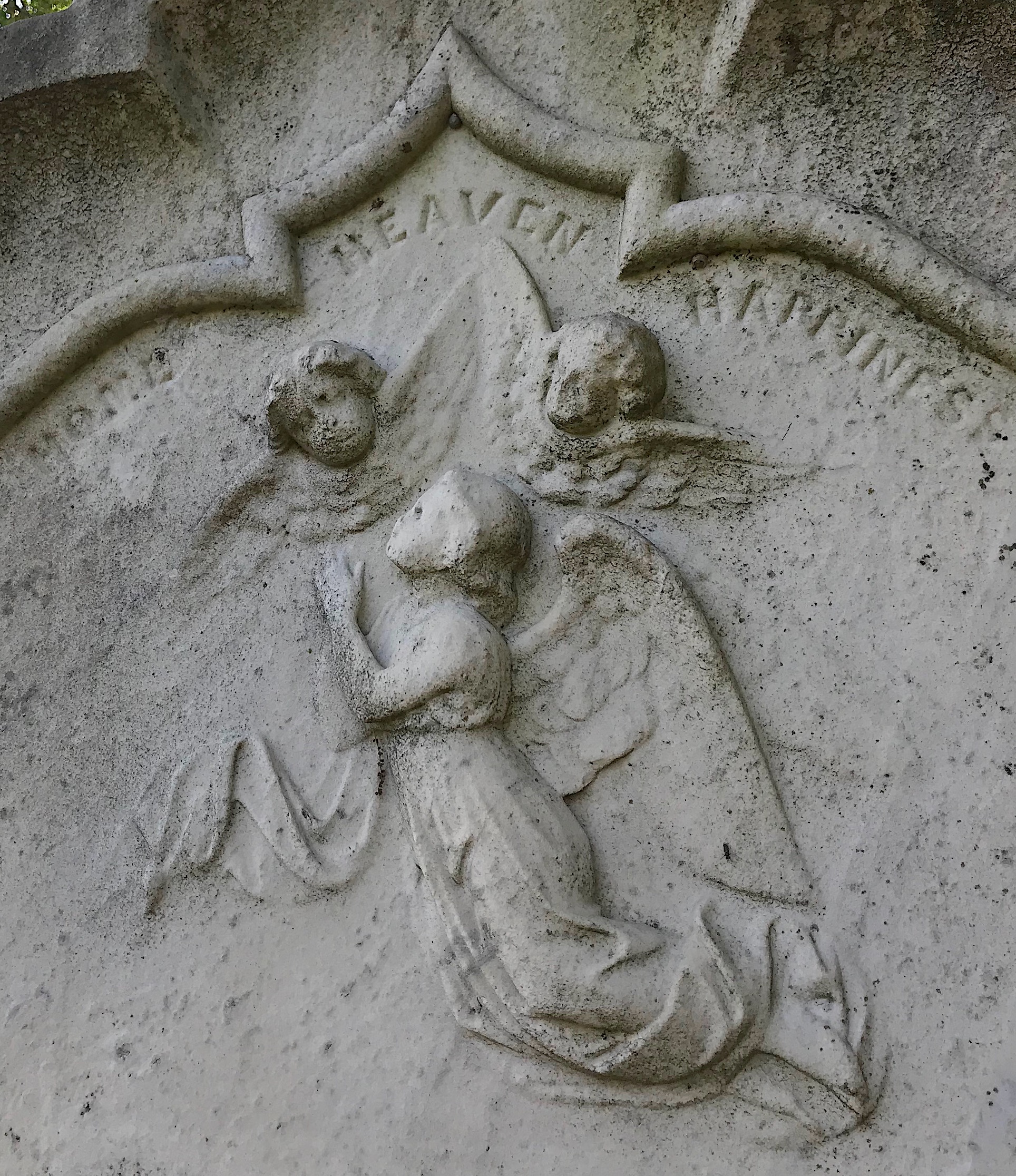
Lula died of typhoid fever on June 16, 1872 at age 30. Her marker shows an angel with two little faces, those of her boys, flying above her.

Did Lula look forward to the day she would join her beloved boys? It came much sooner than anyone dreamed.
Home, Heaven, Happiness

Henry Hines remarried to Myrtle Windley in 1886. He died in 1890 at age 64. Myrtle died in 1917 at age 61. Henry and Myrtle are buried to the left of Willie and Hallie in the Hines plot at Greenwood.

“But An All-wise Providence Otherwise Decreed“

I’ll close for now with this marker for Mollie Sullivan Bussey and her son, Edwin. I see these mother/son gravestones from time to time, and they never cease to give me pause.

Born around 1850, Mollie Sullivan married Nathan J. Bussey, Jr. on Dec. 9 or 10, 1874 in Mississippi. Their son, Edwin Virden was born about a year later. The exact date is not known. According to her obituary, Mollie died on Dec. 3, 1875 after a short illness. Edwin died on April 29, 1876 and their shared marker states he was five months old. I can only conclude that Mollie died shortly after he was born.

Mollie Sullivan Bussey died soon after her son, Edwin, was born.

Little Edwin is not mentioned in Mollie’s obituary. But it states that:

Deceased was a native of Missouri, was in her twenty-fifth year, and bid fair to see many years of earthly joy and happiness. But an all-wise Providence otherwise decreed. To its orderings, we must submit.

Mother and son reunited in Heaven.

I’m not sure what happened to Nathan after Mollie died. He is not buried at Greenwood Cemetery as far as I can tell.

I’ll have more stories behind the stones next time in Part II.

Amanda Stewart Yerger was the wife of James D. Stewart. They had at least 9 children together. She died at age 41 in 1873.

Recent Posts

  • More Pensacola, Fla. Cemetery Hopping: Taking a Ramble Through Saint John’s Cemetery, Part III
  • More Pensacola, Fla. Cemetery Hopping: Taking a Ramble Through Saint John’s Cemetery, Part II
  • More Pensacola, Fla. Cemetery Hopping: Taking a Ramble Through Saint John’s Cemetery, Part I
  • The City of Five Flags: Stepping back in time at Pensacola, Fla.’s Saint Michael’s Cemetery, Part V
  • The City of Five Flags: Stepping back in time at Pensacola, Fla.’s Saint Michael’s Cemetery, Part IV

Archives

  • December 2025
  • November 2025
  • August 2025
  • July 2025
  • June 2025
  • May 2025
  • April 2025
  • March 2025
  • February 2025
  • January 2025
  • October 2024
  • August 2024
  • July 2024
  • June 2024
  • May 2024
  • April 2024
  • March 2024
  • February 2024
  • January 2024
  • December 2023
  • November 2023
  • October 2023
  • September 2023
  • August 2023
  • July 2023
  • June 2023
  • May 2023
  • April 2023
  • March 2023
  • February 2023
  • January 2023
  • December 2022
  • November 2022
  • October 2022
  • September 2022
  • August 2022
  • July 2022
  • June 2022
  • May 2022
  • April 2022
  • March 2022
  • February 2022
  • January 2022
  • December 2021
  • November 2021
  • October 2021
  • September 2021
  • August 2021
  • July 2021
  • May 2021
  • April 2021
  • March 2021
  • February 2021
  • January 2021
  • December 2020
  • November 2020
  • October 2020
  • September 2020
  • August 2020
  • July 2020
  • June 2020
  • May 2020
  • April 2020
  • March 2020
  • February 2020
  • January 2020
  • December 2019
  • November 2019
  • October 2019
  • September 2019
  • August 2019
  • July 2019
  • June 2019
  • May 2019
  • April 2019
  • March 2019
  • February 2019
  • January 2019
  • December 2018
  • November 2018
  • October 2018
  • September 2018
  • August 2018
  • May 2018
  • April 2018
  • March 2018
  • February 2018
  • January 2018
  • December 2017
  • November 2017
  • October 2017
  • September 2017
  • August 2017
  • July 2017
  • June 2017
  • May 2017
  • April 2017
  • March 2017
  • February 2017
  • January 2017
  • December 2016
  • November 2016
  • October 2016
  • September 2016
  • August 2016
  • July 2016
  • June 2016
  • May 2016
  • April 2016
  • March 2016
  • February 2016
  • January 2016
  • December 2015
  • November 2015
  • October 2015
  • September 2015
  • August 2015
  • July 2015
  • May 2015
  • April 2015
  • March 2015
  • February 2015
  • January 2015
  • December 2014
  • November 2014
  • October 2014
  • September 2014
  • August 2014
  • July 2014
  • June 2014
  • May 2014
  • April 2014
  • March 2014
  • February 2014
  • January 2014
  • December 2013
  • November 2013
  • October 2013
  • September 2013
  • August 2013
  • July 2013
  • June 2013
  • May 2013
  • April 2013
  • March 2013
  • February 2013
  • January 2013

Categories

  • General

Blogroll

  • A Grave Interest
  • Cemetery Photography by Chantal Larochelle
  • Cemetery Tours of Berlin by Matti
  • Confessions of a Funeral Director (Caleb Wilde)
  • Find a Grave
  • Hunting and Gathering (cool photography site)
  • Save Our Cemeteries (New Orleans, La.)
  • The Cemetery Club
  • The Graveyard Detective
  • The Rambling Muser
  • Westminster Abbey Tours by Grace

Meta

  • Create account
  • Log in
  • Entries feed
  • Comments feed
  • WordPress.com

Blog at WordPress.com.

  • Subscribe Subscribed
    • Adventures in Cemetery Hopping
    • Join 402 other subscribers
    • Already have a WordPress.com account? Log in now.
    • Adventures in Cemetery Hopping
    • Subscribe Subscribed
    • Sign up
    • Log in
    • Report this content
    • View site in Reader
    • Manage subscriptions
    • Collapse this bar
 

Loading Comments...