
After leaving Vicksburg, we headed east for our next destination of Greenwood Cemetery in Jackson, Miss. It’s about 45 minutes away. The main reason was to visit the grave of one of my favorite authors as a girl, Eudora Welty.
Growing up in the South is different than growing up any place else in the world. It has its unique weather, landscapes, and ways of expressing oneself. I was not born in the South but I’m as close to a native as it gets. They’ve kindly taken me in.
When I read Eudora Welty, I felt like she was speaking from my “place” and spoke my language. The first thing I ever read by her was the short story “Why I Live at the P.O.” and I’ve been a fan ever since.

The Graveyard
The information I found about Greenwood was somewhat conflicting. A sign there says Greenwood Cemetery was established by a federal land grant on Nov. 21, 1821. The Greenwood Cemetery Association web page states that it was established by an act of the Mississippi State Legislature, which was approved Jan. 1, 1823. It also notes that Greenwood has grown from the original six acres to its current 22 acres.
Something in me likes knowing that it was originally known simply as “The Graveyard”. Later, people called it City Cemetery.
In 1899, the Ladies Auxiliary Cemetery Association submitted the name Greenwood Cemetery to city leaders and the name was adopted in 1900. In 1909, the city declared Greenwood Cemetery “full” and stopped selling plots. But burials are still taking place there today.
Eudora Welty
I’m not going to write a long bio about Welty, much has been written about her already. She was born and raised in Jackson, Miss. by her parents Christian Webb Welty and Mary Chestina Andrews Welty. Her mother, a teacher, encouraged her children to not only read but embrace it in their home. I was raised the same way.
Welty not only wrote, but took many photographs for the Works Progress Administration (WPA) during the 1930s.

Her first publication in 1936 was a short story, “Death of a Traveling Salesman”. Her first book was published five years later and it was called A Curtain of Green, containing 17 stories. Welty’s debut novel, The Robber Bridegroom, came in 1942. Her recognition as a talented Southern author began to build and she was able to travel to Europe. In 1960, she returned home to Jackson to care for her elderly mother and two brothers.
In 1972, Welty’s novel The Optimist’s Daughter won a Pulitzer Prize. In 1980, she was awarded the Presidential Medal of Freedom by fellow Southerner President Jimmy Carter. Welty was a charter member of the Fellowship of Southern Writers, founded in 1987. She also taught creative writing at colleges and in workshops. She lived near Jackson’s Belhaven College and was a common sight among the people of her hometown.
Welty died on July 23, 2001 at age 92 in Jackson. I am just one of many who have come to visit her grave over the last 22 years.
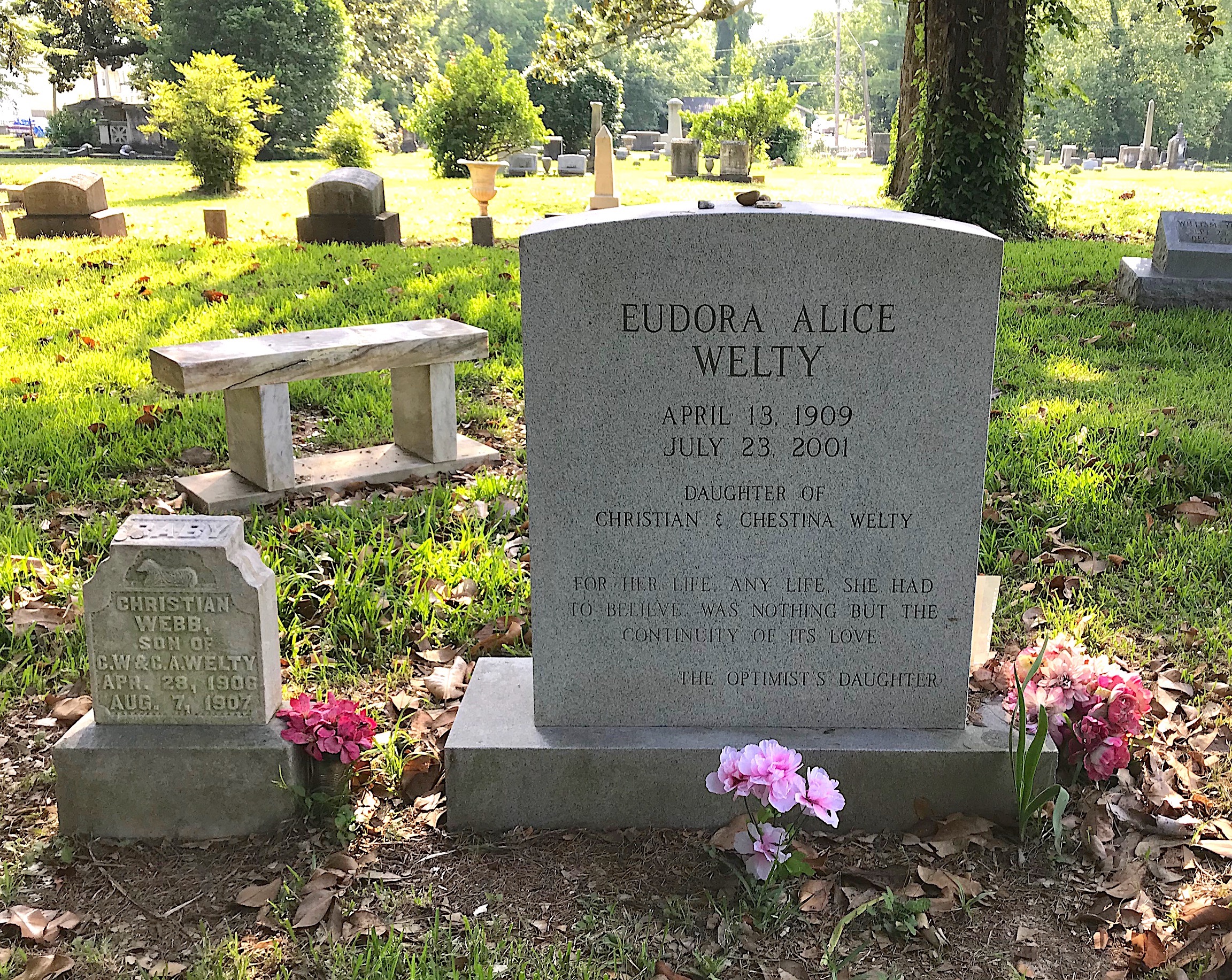
The epitaph on the front of Welty’s simple marker comes from her novel, The Optimist’s Daughter:
For her life, any life, she had to believe, was nothing but the continuity of its love.
I sometimes forget to photograph the back of markers but thankfully, this time I did not. There is another quote on the back of Welty’s gravestone, which I am writing out because my photo has sun splotches on the last words. It comes from her three-part memoir called One Writer’s Beginnings.
The memory of a living thing. It too is in transit, but during its moment. All that is remembered joins. And lives — the old and the young. The past and the present. The living and the dead.
As you have seen, I am a writer who came of a sheltered life. A sheltered life can be a daring life as well. For all serious daring comes from within.

Yonder, Up Yonder
Greenwood has a few of the most gripping grave markers I’ve seen. One of them is for Louisa “Lula” Lemly Hines and the other is for two of her sons.
Born in 1841, Lula was the daughter of Samuel and Elizabeth Furr Lemly. Samuel was a master carpenter, contractor, and planter in Rowan County, N.C. He was responsible for several building projects, including a major bridge over the South Yadkin River (1825) and the first eight buildings at Davidson College. He and Elizabeth moved to Jackson, Miss. around the time of Lula’s birth. They had at least 10 children together. Samuel died in 1848.

Lula married bookkeeper and Confederate veteran Henry Hunter Hines in May 1867. Their son, Hallie, was born 10 months later on March 15, 1868. His brother, Willie, was born on May 15, 1870. Sadly, Hallie died of measles on May 24, 1870 at age two. Willie died seven months later on Dec. 28, 1870. Lula and Samuel must have been heartbroken. The two boys share this marker.

Lula gave birth to another son, Claude, on Nov. 21, 1871. He lived a long life, becoming a dentist. He died in 1945 and is buried in Forest Hill Cemetery Midtown in Memphis, Tenn.
Home, Heaven, Happiness
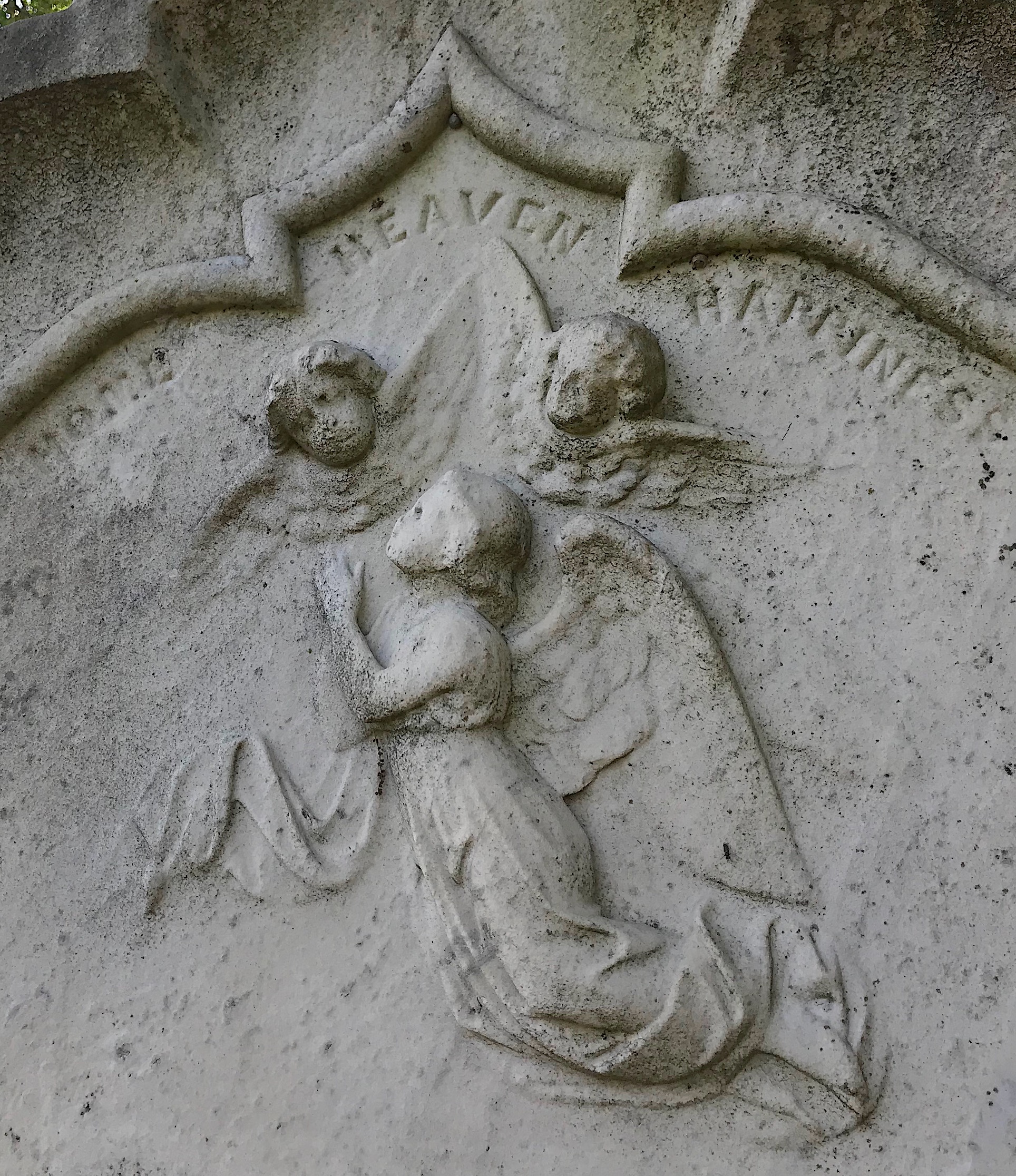
Lula died of typhoid fever on June 16, 1872 at age 30. Her marker shows an angel with two little faces, those of her boys, flying above her.

Henry Hines remarried to Myrtle Windley in 1886. He died in 1890 at age 64. Myrtle died in 1917 at age 61. Henry and Myrtle are buried to the left of Willie and Hallie in the Hines plot at Greenwood.
“But An All-wise Providence Otherwise Decreed“
I’ll close for now with this marker for Mollie Sullivan Bussey and her son, Edwin. I see these mother/son gravestones from time to time, and they never cease to give me pause.
Born around 1850, Mollie Sullivan married Nathan J. Bussey, Jr. on Dec. 9 or 10, 1874 in Mississippi. Their son, Edwin Virden was born about a year later. The exact date is not known. According to her obituary, Mollie died on Dec. 3, 1875 after a short illness. Edwin died on April 29, 1876 and their shared marker states he was five months old. I can only conclude that Mollie died shortly after he was born.

Little Edwin is not mentioned in Mollie’s obituary. But it states that:
Deceased was a native of Missouri, was in her twenty-fifth year, and bid fair to see many years of earthly joy and happiness. But an all-wise Providence otherwise decreed. To its orderings, we must submit.

I’m not sure what happened to Nathan after Mollie died. He is not buried at Greenwood Cemetery as far as I can tell.
I’ll have more stories behind the stones next time in Part II.

 Adventures in Cemetery Hopping