
I told you in Part I that Jackson, Miss.’s Greenwood Cemetery has a number of stirring monuments. I’m going to start with this one and when I first saw this image, I immediately wanted to know more.

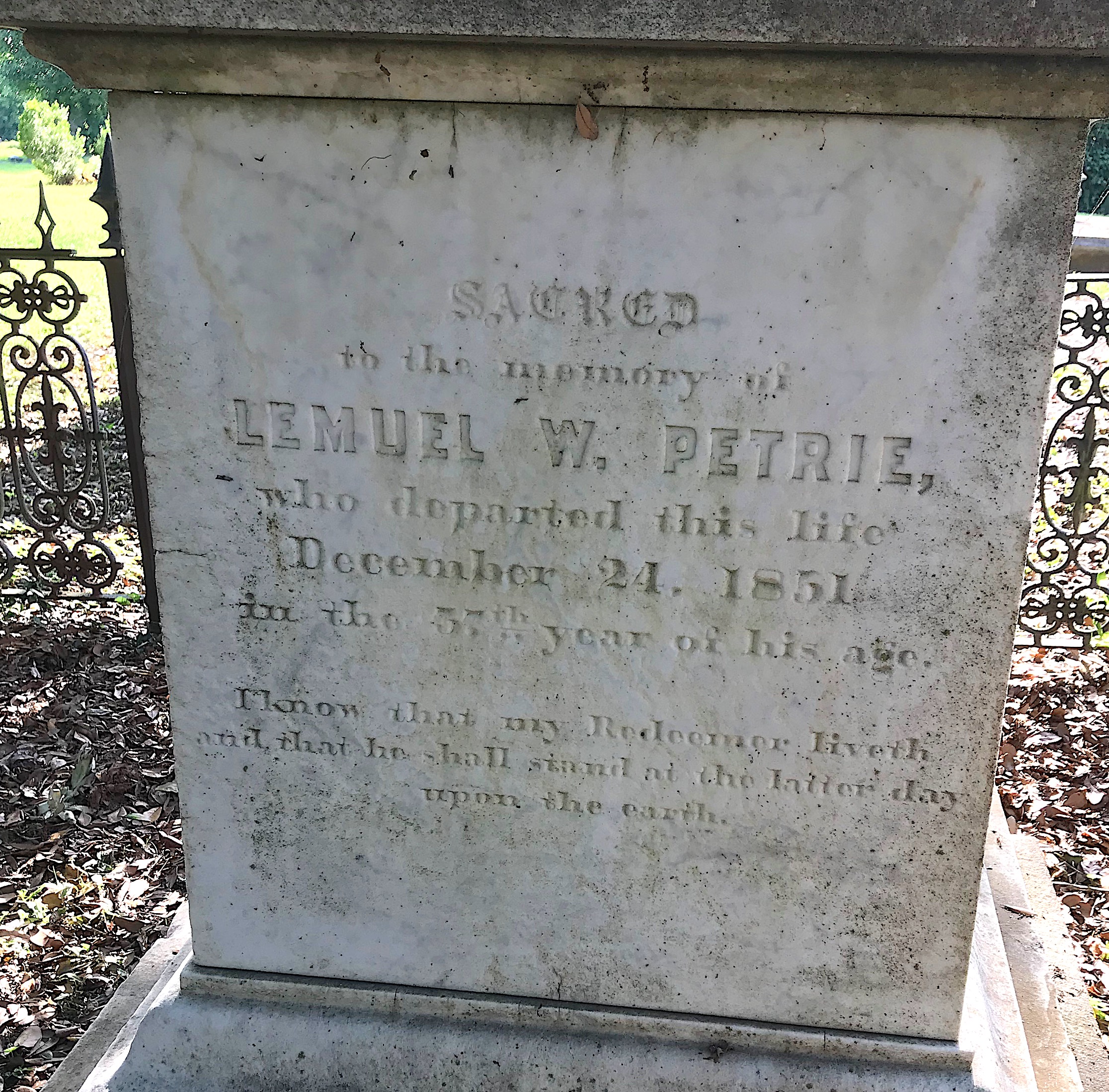
Born around 1813 in Portland, Maine, Lemuel Weeks Petrie married Virginia native Rosa Mahalah Farrar in Rankin County, Miss. in 1842. He was from a fairly well to do family and a successful planter. In 1842, Lemuel owned over 2,500 acres worth over $17,500 plus a brick home worth $2,000. It appears that a substantial amount of his wealth was inherited and he was a slave owner.

Lemuel and Rosa had five children together. For reasons unknown, he died on Christmas Eve 1851 at the age of 37. At the time of his death, his property included two large plantations located a few miles from Edwards, Miss., and a smaller one in the same general area. The total appraised value of the three plantations was a little over $143,000.

Lemuel’s monument is a testament to his family’s grief. Sitting beneath a large weeping willow (a symbol of mourning in cemetery iconography), a mother bent over in dejected sadness is surrounded by her children. The scale is a little off in that the mother looks rather like a giant compared to the children. But the sentiment comes through quite strongly.
Rosa eventually remarried to Irish-born Presbyterian minister, the Rev. John Hunter, in 1858. Together, they would have five children of their own.
Two of Lemuel and Rosa’s children are buried in the plot with them. Their firstborn (1843), Herbert, attended the University of Mississippi and became a doctor. He died in 1875 at age 25 from “malarial fever and heart disease”. Beside him is his brother, Henry, born in 1844. His marker states he died on Aug. 10, 1861 in Culpepper, Va.

Henry served in the Confederate Army during the Civil War, he would have been around 17 at the time. There is a record for a Henry F. Petrie enlisting in Corinth, Miss. on May 24, 1861 and serving in the 18th Infantry, Co. K. The 18th did fight at the First Battle of Manassas (Bull Run) on July 21, 1861. It’s possible Henry was wounded there and died later in Culpepper. Disease, however, may have claimed him as well.
The Gardner Held His Peace
Rosa gave birth to a daughter, Rosabell on Oct. 8, 1861. Her splendid wedding to George Yates Freeman on Feb. 28, 1883 in Jackson was reported in more than one Southern newspapers. Rev. Hunter united the couple in holy wedlock that day. Rosabell and George had one daughter, Yates, in 1885 but she only lived seven months. Son Edward, born in September 1886, was their only child who lived to adulthood.

Rosabell died on Sept. 21, 1890 at age 28. Her husband, George, died on April 20, 1895 at age 44. They are buried together in the Petrie/Hunter family plot.
Rosa died on Jan. 31, 1895 at age 80. Her obituary noted, “Her life was sweet and peaceful, filled with good deeds and kind words, and her death was in keeping with that life.” Rev. Hunter died at age 74 in 1899.

“Cotton King”
In almost every cemetery, there is one monument that tends to dominate the landscape. In the case of Greenwood, that would be the one for “Cotton King” Edmund Richardson. When we were there, it was nearing dusk so the quality of these photos is not the greatest.

Born in North Carolina in 1818, Edmund settled in Jackson, Miss. where he formed a mercantile partnership with branch stores in neighboring communities. In 1848, Richardson married Margaret Elizabeth Patton of Huntsville, Ala. with whom he had seven children. Several are buried in the Richardson plot at Greenwood.

Despite the hardships most merchants faced during the Civil War, Richardson rebounded within a year after it ended and held onto the five plantations owned. In 1868, Richardson exploited the abundance of ex-slave prison labor by making a deal with Federal authorities in Mississippi (still under the rule of postwar Reconstruction) to use inmates to work his farms in the Mississippi-Yazoo Delta.
Convict Labor
Richardson agreed to provide supervisory guards and treat the prisoners well by providing food and clothing. The state paid Richardson $18,000 per year for maintenance, plus the cost of transporting prisoners to and from his plantation camps.

Richardson used prison laborers to build levees, clear trees from swamps, and plow fields. Production of cotton using the convict lease system enabled Richardson to amass a fortune. By the 1880s, he had a mansion in New Orleans and another in Jackson. He also acquired the Griffin-Spragins mansion in Refuge, Miss.

When the World’s Industrial and Cotton Centennial Exposition came to New Orleans in 1884–1885, Richardson served as chairman of the board of management, donating $25,000 to the event. In the mid-1880s, Richardson was one of the largest cotton growers in the world with 25,000 acres in cultivation. This earned him the nickname “Cotton King”.


On Jan. 11, 1886, Richardson died at age 67 after an attack of apoplexy. His obituary described him as “the richest man in the South and the largest cotton planter in the world, second only to the Khedive of Egypt”. At the time of his death, his estate was estimated to be worth $10,000,000 to $15,000,000. I don’t know who carved his impressive monument, but it was imported from Italy.
His wife, Margaret, died almost a year later on Dec. 17, 1887.

Man (And Woman’s) Best Friend
I’m going to finish up at Greenwood with this story, and as is common in such things, there are not many facts to support it. But the sweet sentiment behind it remains for those who encounter it while wandering through Greenwood Cemetery as we did.
Located near the graves of Mary Hill “Mamie” Simms and her mother is a statue of a dog. If you look behind it to the left in the photo below, you can get a glimpse of Mamie’s marker.

Mamie was the daughter of Anne Tapley Simms and J.T. Simms. Her maternal grandfather was Judge Colin S. Tarpley. Mamie died of typhoid fever at age 15 on June 21, 1877 in Oxford, Miss. Anne died in 1913.
According to local legend, Mamie’s beloved dog is said to have spent every day lying on the grave of his young mistress from when she died until his own death. I don’t know what the precious pup’s name was or when he died. But his memory lives on in this marker made in his honor.
There’s two more stops left on the Oklahoma Road Trip 2019. I hope you’ll hang on for the last chapters of this memorable adventure.
 Adventures in Cemetery Hopping