• About Me
  • Cemeteries I Have Visited
  • Have questions?
  • Photos

Adventures in Cemetery Hopping

~ A blog by Traci Rylands

Adventures in Cemetery Hopping

Monthly Archives: July 2023

Oklahoma Road Trip 2019: Making the Last Stop at Selma, Ala.’s Old Live Oak Cemetery, Part II

28 Friday Jul 2023

Posted by adventuresincemeteryhopping in General

≈ Leave a comment

Welcome back to Old Live Oak Cemetery! If you’re hoping to find lots of Spanish moss (which isn’t really a moss at all or from Spain) and some beautiful monuments, this is the place you want to visit.
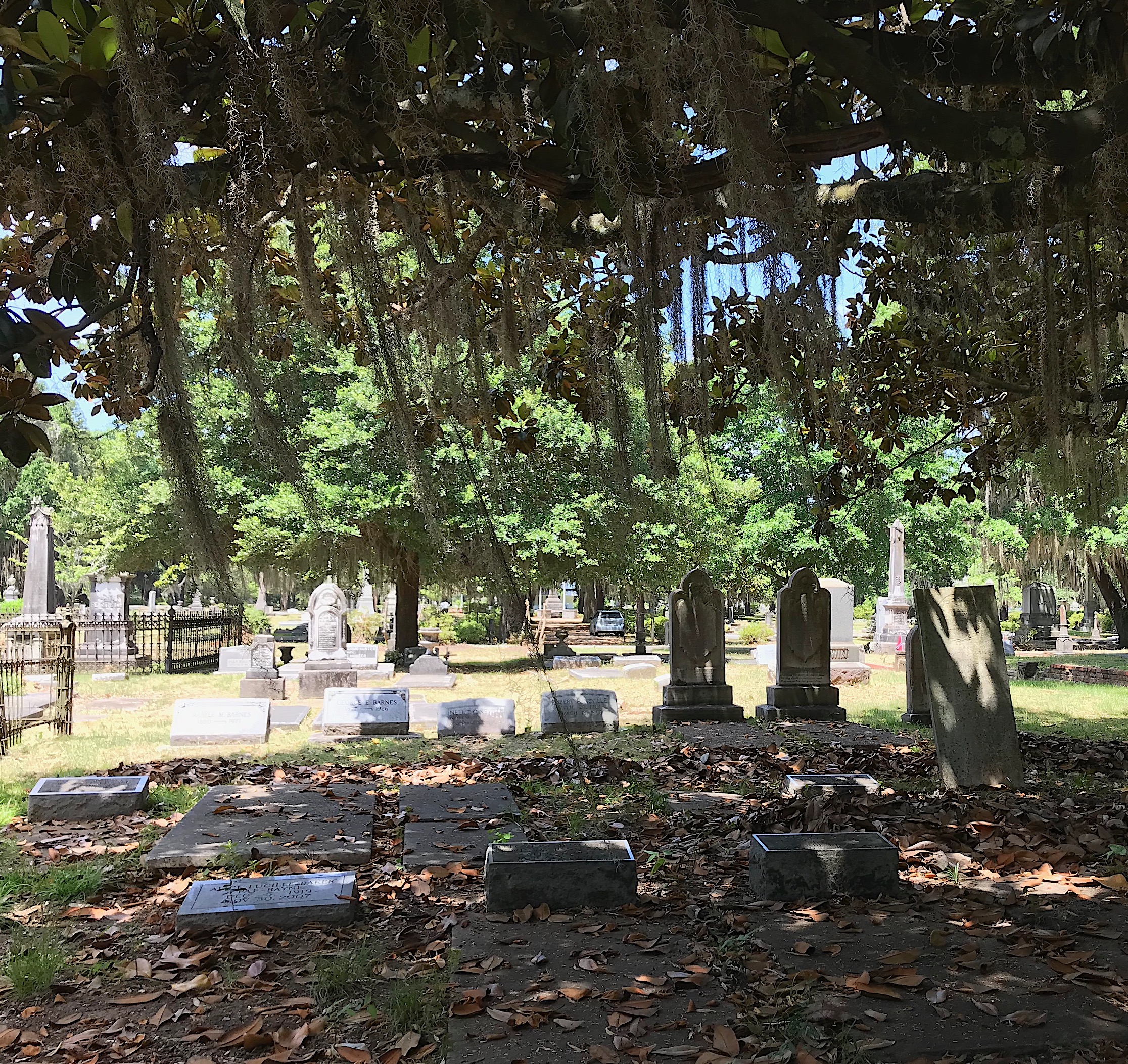
Most people are unaware that Spanish moss is actually a bromeliad (not a moss) and not from Spain.

Last week, I shared with you the final resting place of U.S. Vice President William Rufus Devane King, who only served in that capacity for six weeks before his death in 1853. There’s a resident of Old Live Oak that also has presidential ties.

Sister-in-Law to a President

Born in Lexington, Ky. in 1840, Elodie Breck Todd was the daughter of Robert S. Todd and Elizabeth L. Humphreys. Elodie was the half sister of Mary Todd Lincoln and half sister-in-law of U.S. President Abraham Lincoln. In 1862, Elodie became the third wife of Nathaniel Henry Rhodes Dawson.

A native of Charleston, S.C., Dawson moved to Selma after his second marriage to Mary Tarver. She died in 1860. Dawson was also a member of the Alabama legislature and served as speaker of the house. Many of the magnolia and live oak trees in Old Live Oak Cemetery are ones Dawson obtained from Mobile in 1879.

Two of Elodie’s brothers died while serving in the Confederate Army during the Civil War. Capt. Samuel Todd was killed at the Battle of Shiloh and Capt. Alexander Todd died at the Battle of Baton Rouge.
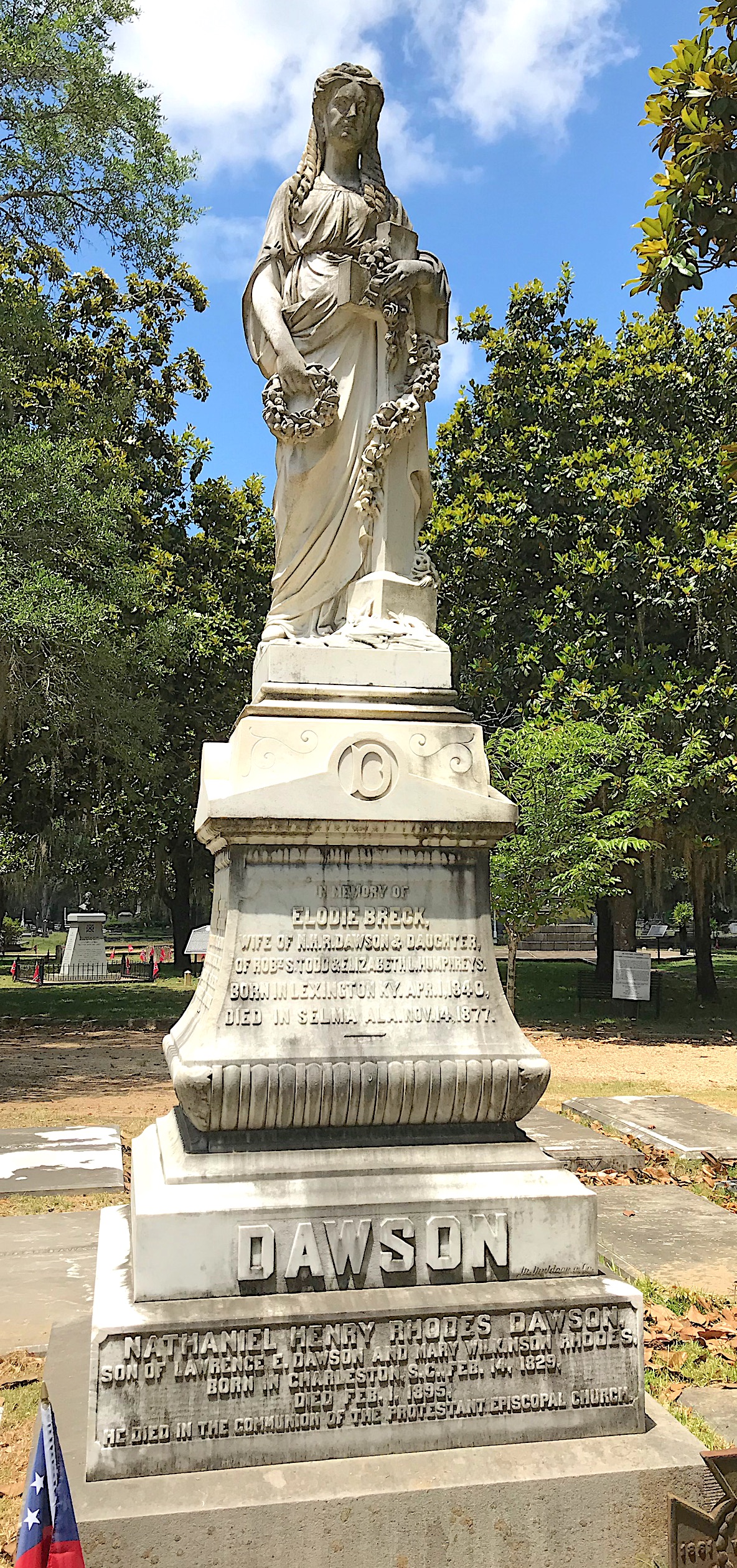
Elodie Breck Todd Dawson was the sister-in-law of President Abraham Lincoln.

Elodie and Nathaniel would have three children together. Alex Todd Dawson, born on Jan. 9, 1863, only lived for four days before passing away. Son Henry Rhodes Dawson, born in 1864, died in 1903 at age 39. He never married. Son Lawrence Percy Dawson, born in 1869, died in 1925. I’ll talk about him shortly.

“Death Loves a Shining Mark”

When I read about Elodie’s death on Nov. 14, 1877, all I could learn was that it was sudden and unexpected. Her obituary stated, “Again have we an illustration that death ever loves a shining mark.” She was only 37 when she died.

Nathaniel Dawson was determined to have a monument erected that reflected his love for his wife. So he ordered a monument from Italy. According to a brochure produced by the cemetery, he was not satisfied with the way the resulting monument’s hair looked. Dawson had it sent back and corrected to his satisfaction.
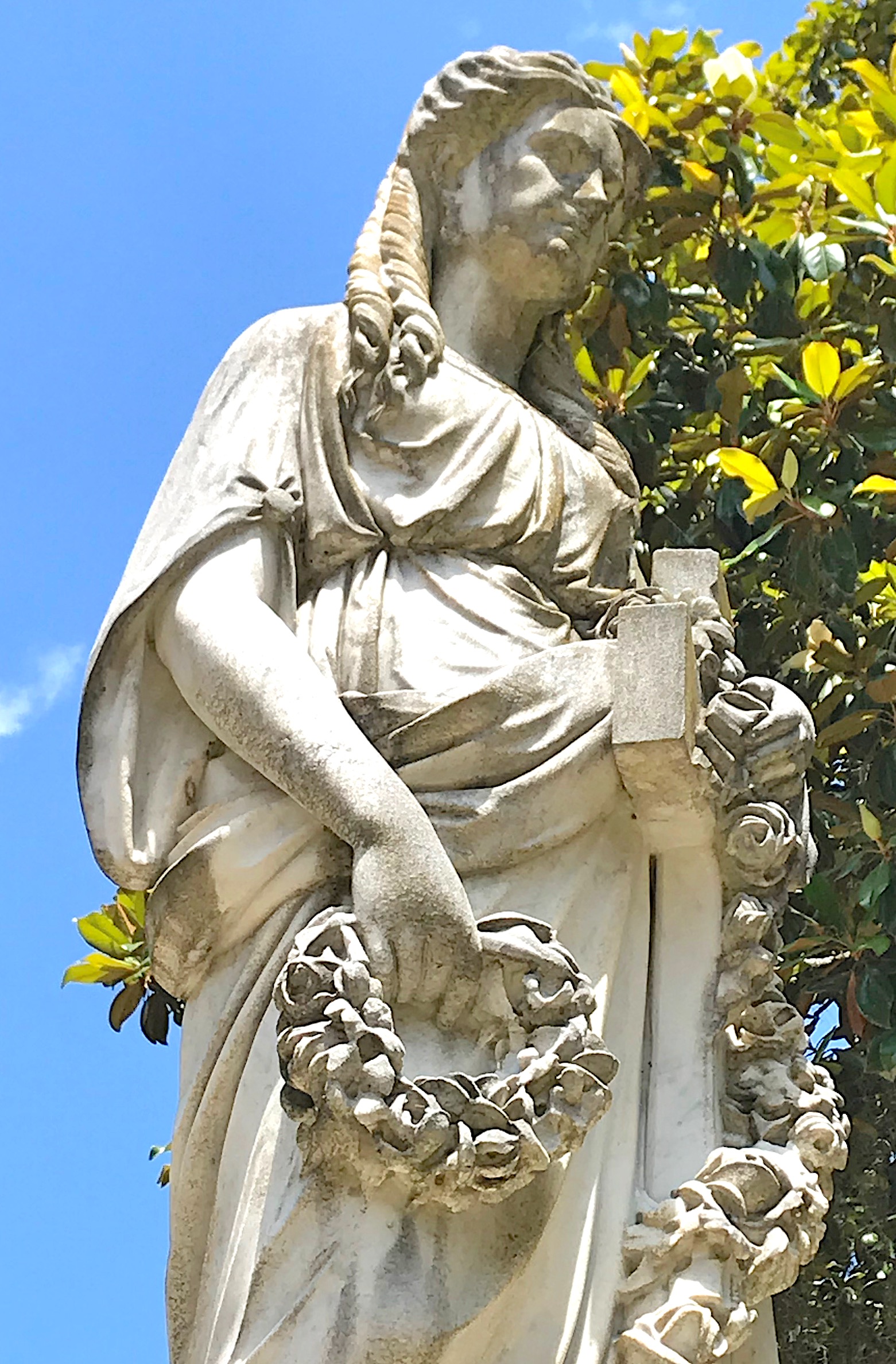
Elodie’s husband reportedly had the monument sent back to Italy so improvements to the statue’s hair could be made.

Nathaniel did not remarry after Elodie’s death. He passed away at age 65 in 1895. Son Henry died in 1903 of erysipelas, a bacterial skin infection.

Sadly, youngest son Percy died a violent, senseless death. By 1925, he had achieved the rank of sheriff in the Dallas County police department. Wealthy landowner Deans Weaver was involved in a heated dispute with the Alabama Power Company, who intended to install power lines on his plantation.
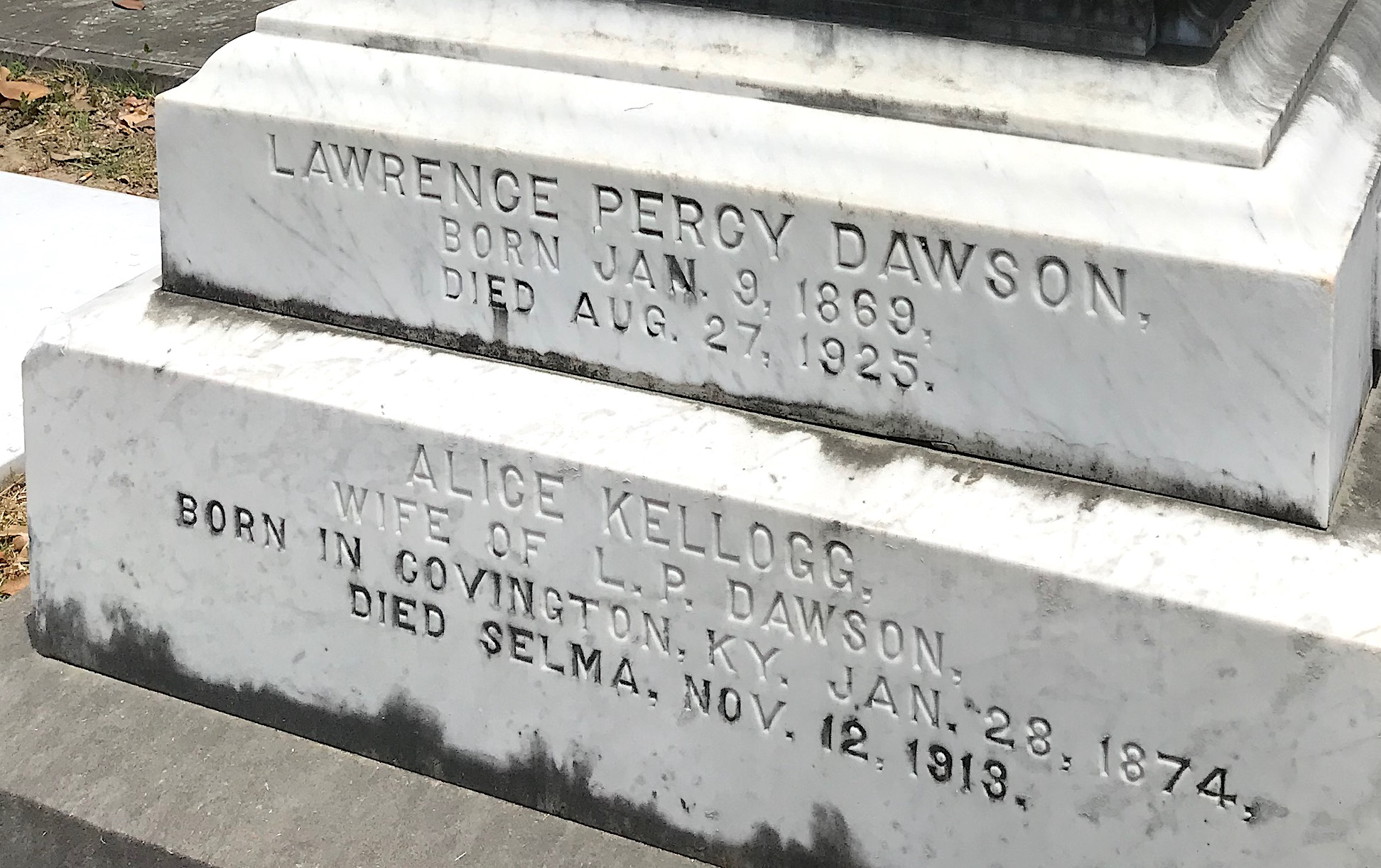
Dallas County Sheriff Lawrence P. Dawson was shot and killed in a land dispute with plantation owner Deans Weaver.

On the afternoon of Aug. 27, 1925, Percy and four deputies arrived to escort 12 linemen onto the property, backed by a court order. Weaver suddenly appeared and shot Percy directly in the heart. He was killed instantly. Deputy Hugh Sinclair, who had accompanied Dawson, then shot and killed Weaver.

Percy was laid to rest beside his wife, Alice Kellogg Dawson, who had died in 1913 at age 39. They are both interred in the Dawson plot at Old Live Oak Cemetery with the other Dawsons.

“A Friend to All”

The death of 28-year-old mother Mattie O. Blunt Keith was not exactly a surprise to those who knew her.

Born in Selma in 1858 to Edward Blunt and Mary Orr Blunt, Mattie wed John Moses Keith in 1878. She gave birth to their daughter, Mary, in 1884.

But it wasn’t very long after Mary’s birth that Mattie’s health began to fail. She visited Hurricane Spring, Tenn. but it did not improve her health. She went to visit her sister in Clarksville, Tenn. and died at her home on Aug. 18, 1886.
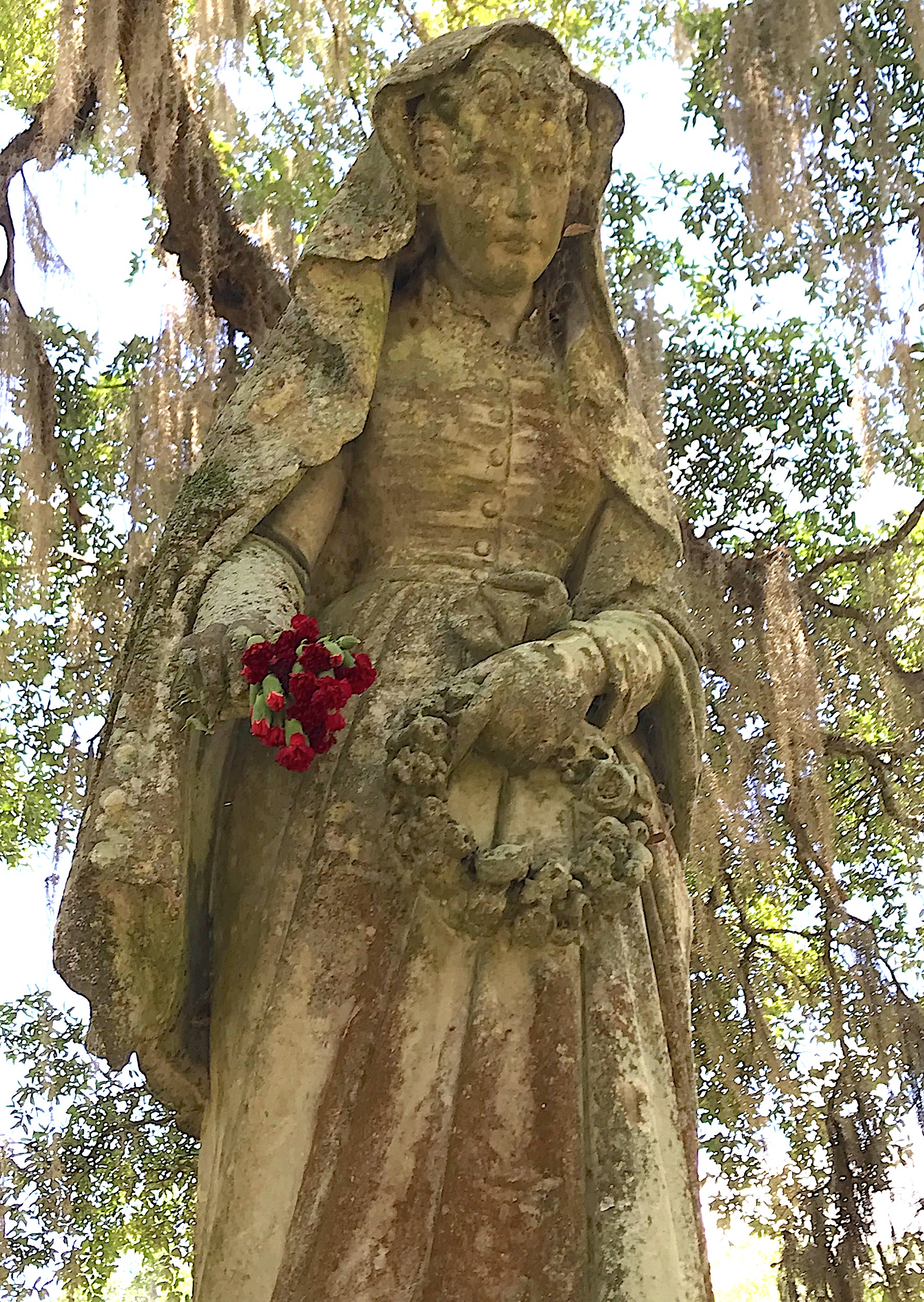
Someone had placed some flowers in the hand of Mattie Keith’s monument.

John Keith remarried to Josie Selden Ruffin in 1895. He died in 1910 at age 62. He is buried at Old Live Oak with Josie, who died in 1915. John and Mattie’s daughter, Mary, never married but became a nurse. She died in 1951 at age 67.

A Brother and Sister

These last two monuments I want to feature are for siblings. They are quite different but equally beautiful.

Martha Rebecca Smith wed Richard Starkey Jones around 1853 in Clarke, Ala. They would have a son, Drury Fair Jones, in 1854 and a daughter, Sarah Ann “Sallie” Jones, in 1856. Richard died in 1858 and Martha remarried to Albert Rixey.
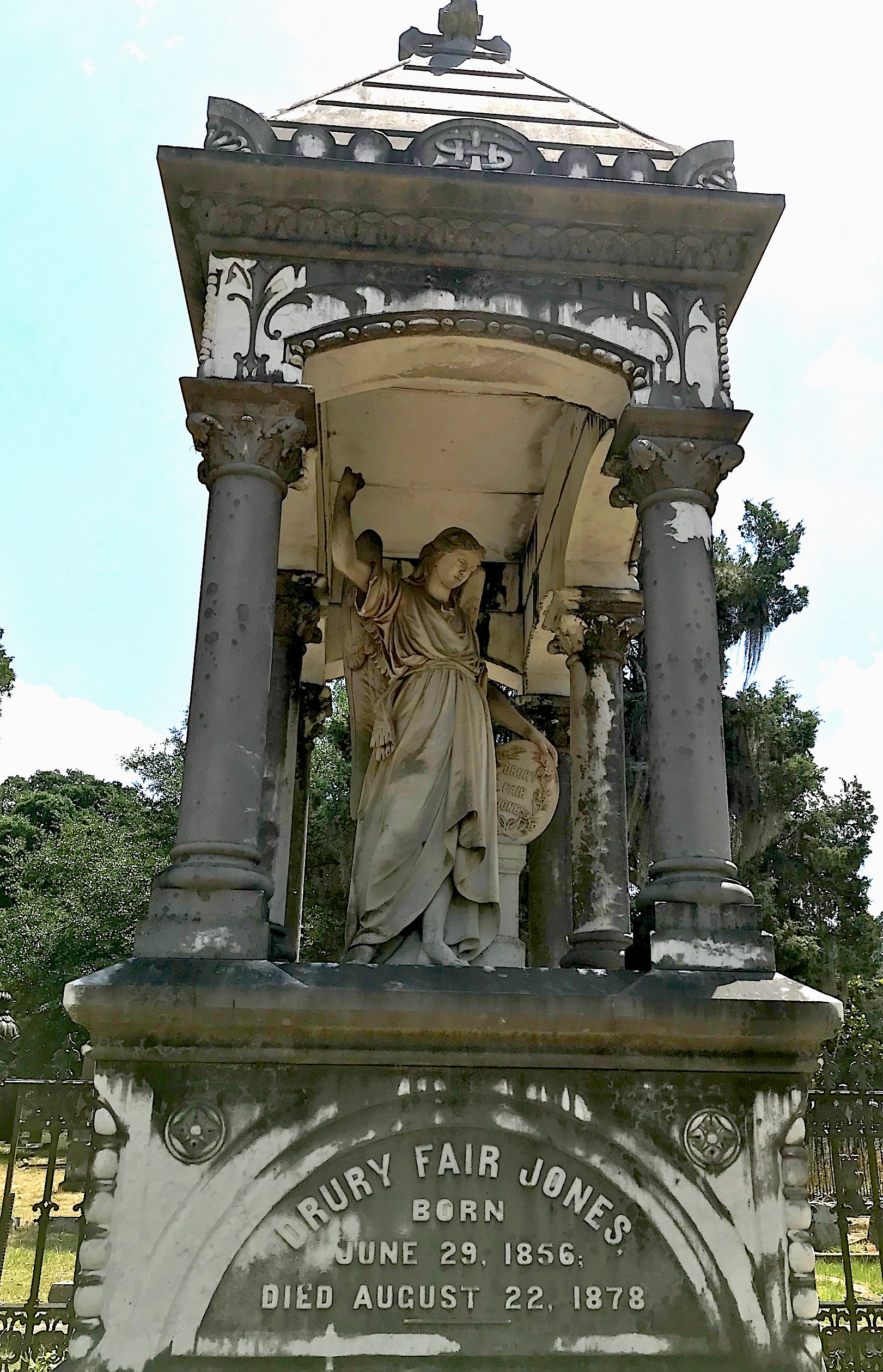
I suspect Drury Fair Jones died of yellow or malarial fever in 1878.

While the cause of death for Drury was not reported, I suspect he died from either yellow or malarial fever. When I found his very brief death notice in an edition of Selma’s Southern Argus, it was surrounded by a few articles on how both diseases were causing deaths in the city at that time. Drury was only 22 when he died on Aug. 22, 1878.

Drury’s monument features an angel leaning on a round medallion with his name on it. It’s rather unusual.
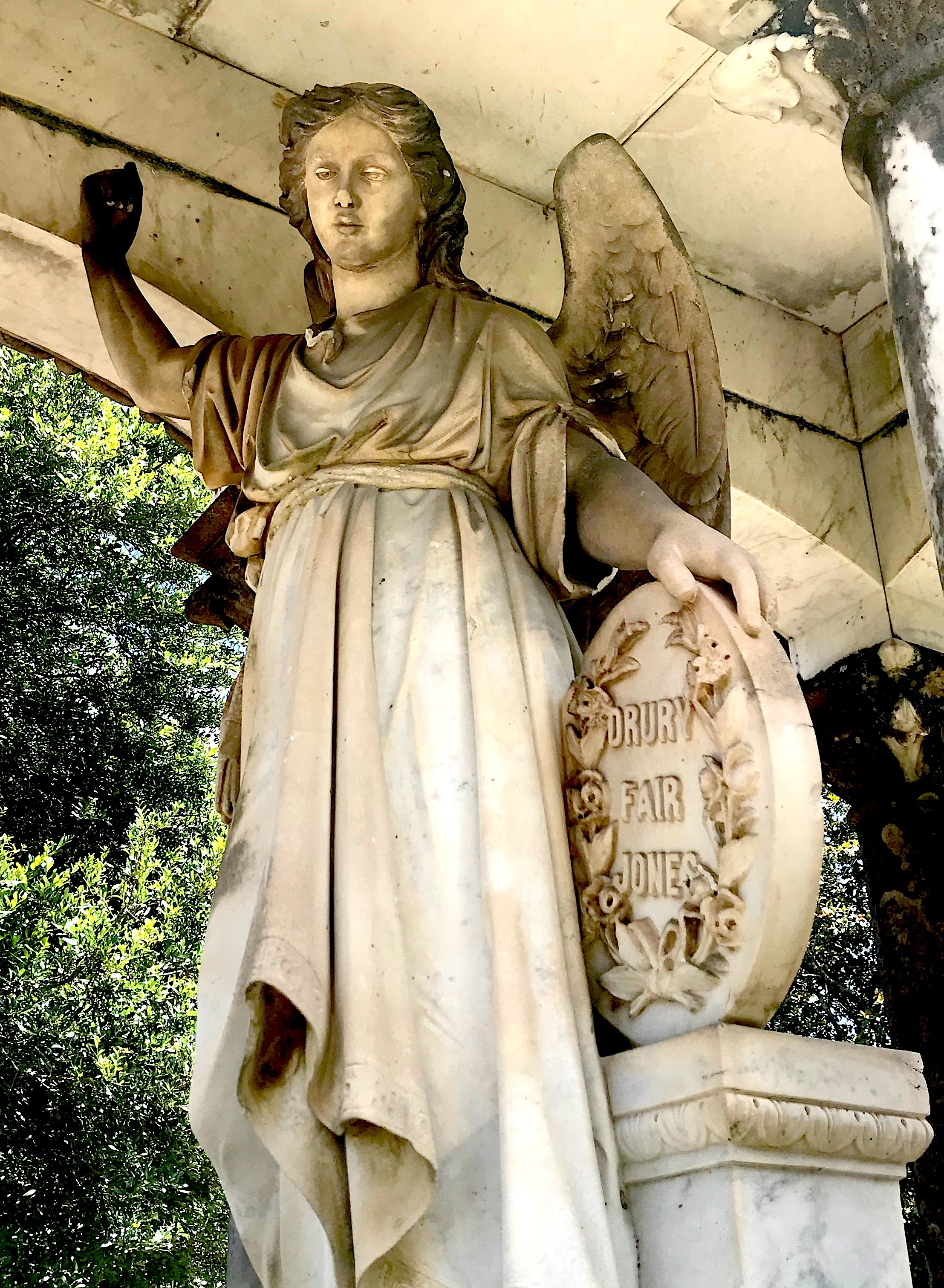
Drury Fair Jones died at age 22.

I suspect he was close with his sister because she published an administratrix notice about his estate in the Oct. 28, 1878 edition of the Southern Argus.

Sallie met successful Rome, Ga. attorney Charles Nicholas Featherston sometime in the mid 1880s. A Confederate veteran , Charles was 48 when he asked 34-year-old Sallie to marry him. They were wed on July 9, 1888 in Asheville, N.C.

Some records indicate that three of their children died in infancy. But son Charles Neal Featherston, born in 1891, survived. The marriage was a happy one, it appears. Eventually, Charles retired from practicing law.

In the summer of 1909, Charles and Sallie took an extended trip of the Western states and arrived in Seattle, Wash. to attend the Alaska–Yukon–Pacific Exposition, a type of world’s fair. Charles caught pneumonia and died there on Aug. 29, 1909. He was 69. He is buried at Myrtle Hill Cemetery in Rome, Ga.
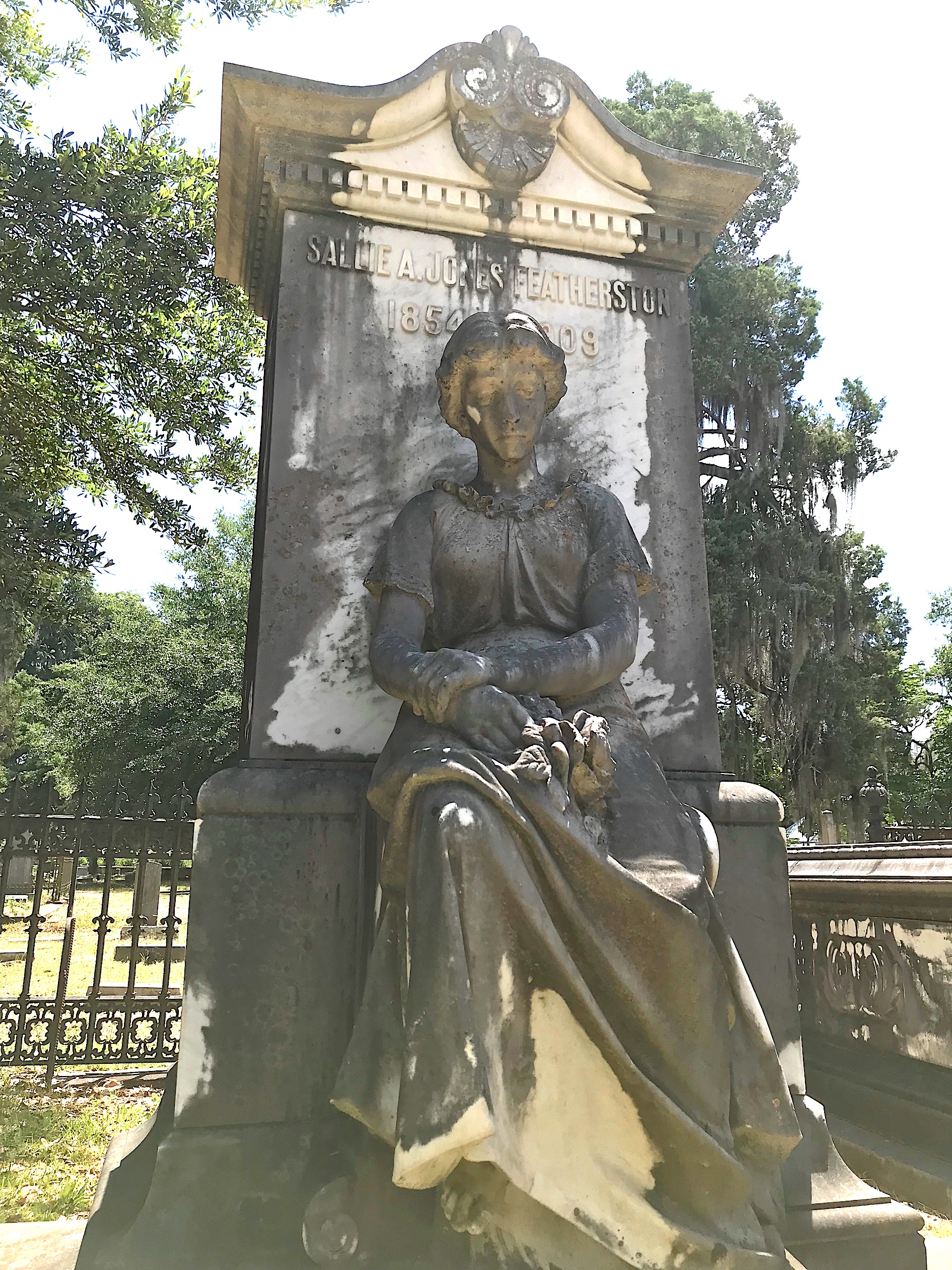
Sallie Jones Featherston was grief-stricken when her husband died in August 1909.

Sallie returned to Rome, but she was heartbroken and overcome with grief. She died only four months later on Dec. 11, 1909. Her remains were brought home to Selma where she is interred beside her brother and parents at Old Live Oak Cemetery.
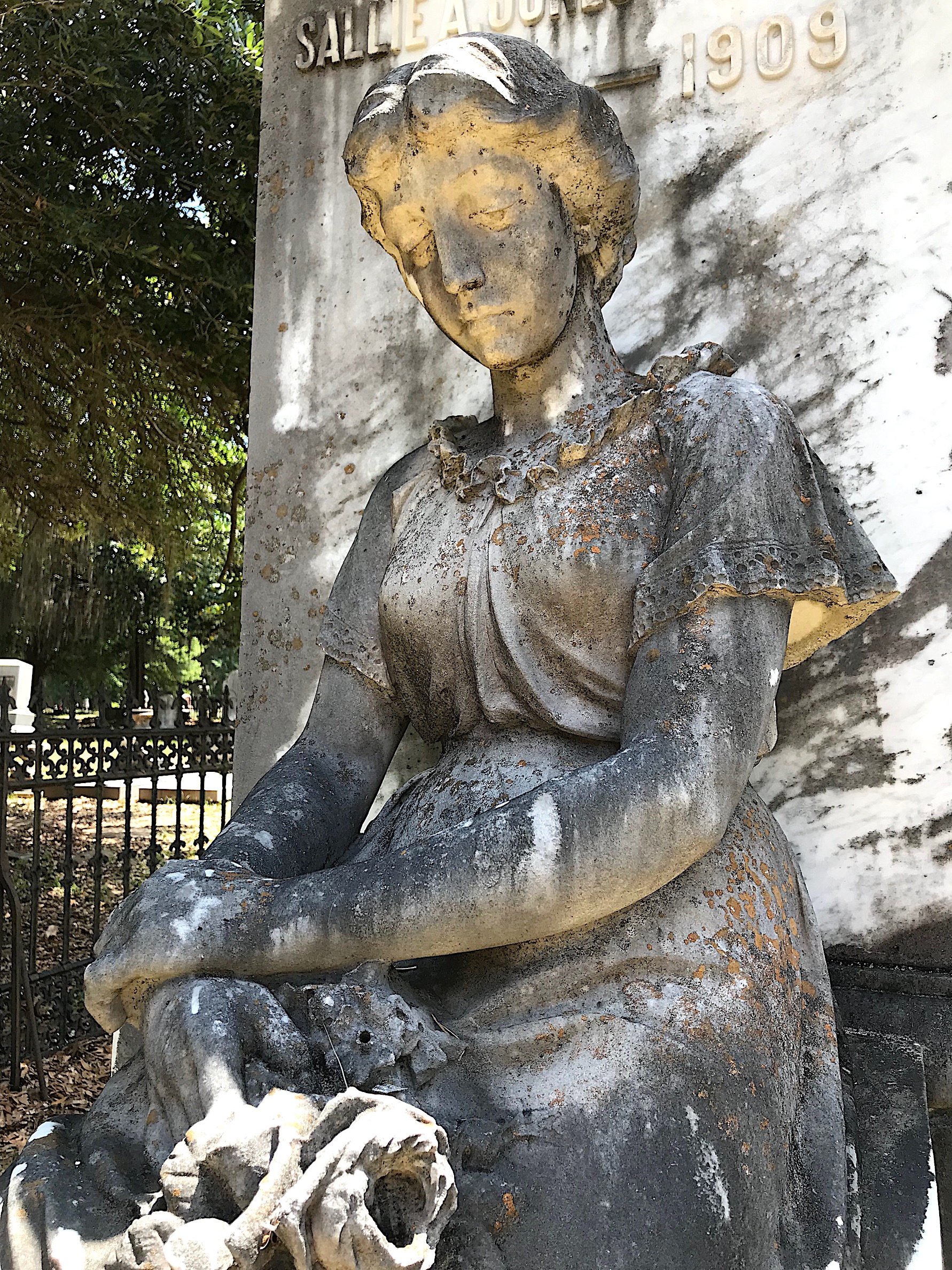
Sallie’s monument was created by Muldoon Monument Co. of Louisville, Ky.

Sallie’s monument is quite unlike that of her brother’s or any other I have seen before. A young woman wearing a simple gown sits, here eyes cast down, with a bouquet of flowers in her lap. I don’t know if it resembles Sallie but I suspect it does.

I didn’t know it until I looked at a photo of the monument’s base on Find a Grave that it was signed. The monument was created by the Muldoon Monument Co. of Louisville, Ky. It’s always a pleasure to encounter a Muldoon monument, which is not very often for me. You can read more about Muldoon in this 2017 post I did including one of his monuments at Augusta, Ga.’s Magnolia Cemetery. Now known as Muldoon Memorials, the company is still in business today.

Sadly, Charles and Sallie’s son, Charles Neal, did not live past his 30s. He died on Nov. 27, 1927 from a heart ailment at age 36. He is buried with his father at Myrtle Hill Cemetery in Rome, Ga.

Heading Home

As we left Selma, Sarah and I talked about what a wonderful time we had experienced on our road trip. When we reflect on it now, we always comment on how good it was that we didn’t wait to do it since less than a year later, Covid would have made the trip impossible for quite a while. We did go on a mini roadtrip to Middle Georgia in November 2020 that you can look forward to reading about, though.

We’re talking about taking another interstate trip in the future, once Sarah is retired. Maybe in New England. We don’t know exactly where yet.

But I think it’ll be hard to top the Oklahoma Roadtrip 2019.
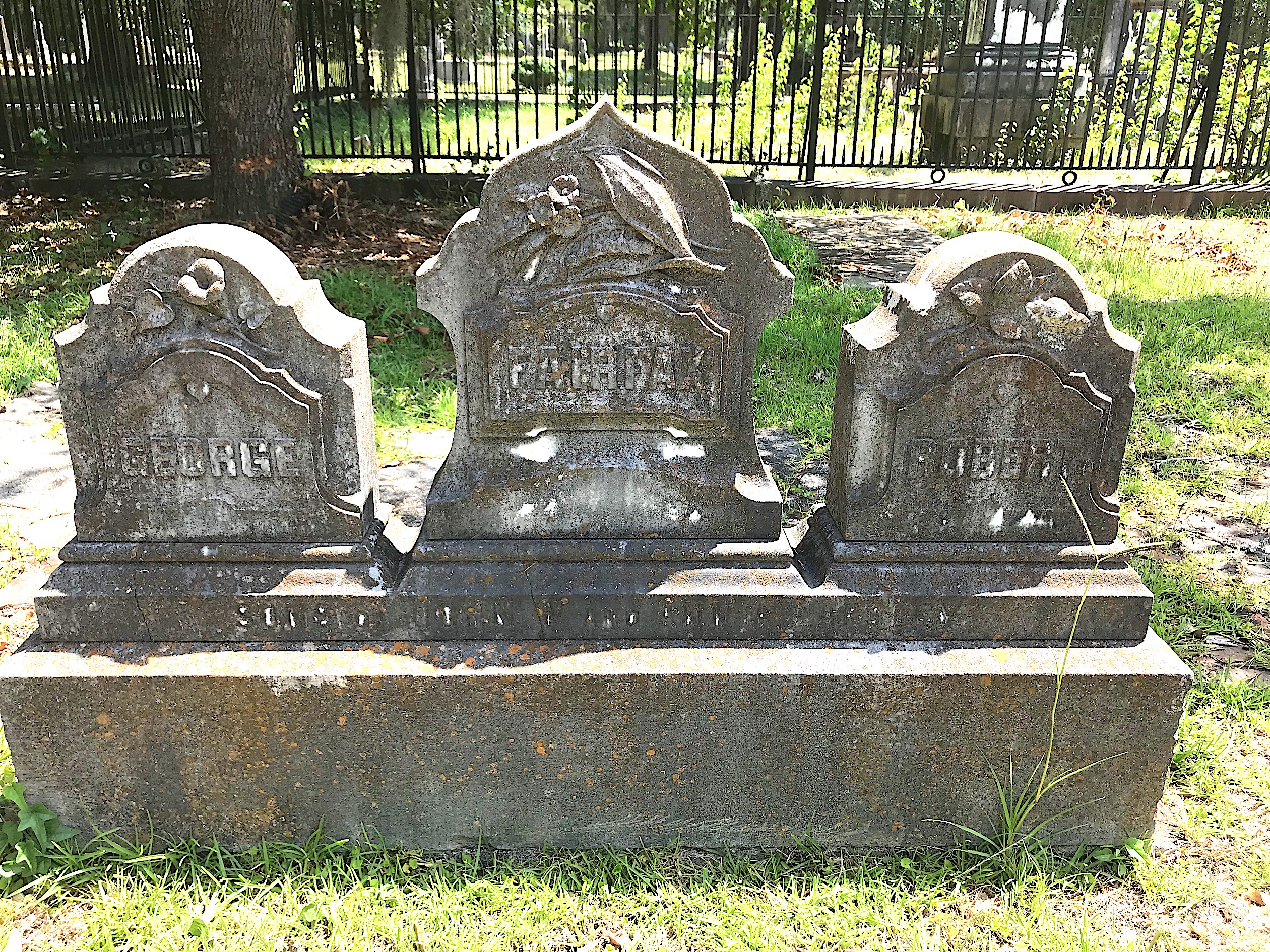
George, Joseph Fairfax, and Robert Lapsley were the sons of John Whitfield Lapsley and Ann Amelia King Lapsley. They all died in infancy/childhood between 1847 and 1857. John and Ann had three children who lived well into adulthood.

Oklahoma Road Trip 2019: Making the Last Stop at Selma, Ala.’s Old Live Oak Cemetery, Part I

21 Friday Jul 2023

Posted by adventuresincemeteryhopping in General

≈ Leave a comment

All good things must come to and end. Today starts the beginning of the end of the Oklahoma 2019 Road Trip.

When I looked back this week, I was surprised to see that this series began on May 26, 2022. It took me a little over a year to write about what we encountered over a seven-day period (May 22-May 28, 2019). That’s a bit mind blowing! In all, we stopped by 14 cemeteries in six states (Alabama, Mississippi, Arkansas, Oklahoma, Texas, and Louisiana).

Our last stop on the Oklahoma Road Trip 2019 was Selma’s Ala.’s Live Oak Cemetery. It’s about an hour and 45 minutes east of Meridian, Miss. After that, we would head back to Atlanta where Sarah was going to drop me off at the airport so I could catch a flight to join my family in Folly Beach, S.C.

Old Live Oak Cemetery, Selma, Ala.

Founded in 1829, Old Live Oak Cemetery was expanded in 1877. The newer portion is sometimes called New Live Oak Cemetery and the cemetery is collectively known as Live Oak Cemetery. We were on a tight time schedule so we decided to focus on Old Live Oak. As a result, there are some well-known graves I did not photograph because I simply didn’t have time to look for them and it was very hot outside.

Jeff Davis Chair Stolen and Recovered

As you can imagine, there are several Confederate graves and monuments at Old Live Oak. There’s a monument to controversial Confederate Lt. General Nathan Bedford Forrest (who is not buried there), a large Confederate monument, a Jefferson Davis chair, and two mass graves of Confederate soldiers (similar to the burial mound at Meridian, Miss.’s Rose Hill Cemetery). The mass graves combined hold the remains of about 156 soldiers that were later moved from other burial sites to Old Live Oak Cemetery.

This is the second of two mass graves of Confederate soldiers who were died in Selma hospitals during the Civil War but were first buried elsewhere before being moved to Old Live Oak Cemetery.

I thought I’d share the story of the Jefferson Davis chair for its novelty and because it made headlines in 2021, after I’d photographed it.

The 500-lb. limestone chair was donated by the Ladies of Selma in May of 1893 as a way of honoring the president of the Confederacy Jefferson Davis Davis for his previous visits to Selma in 1863 and 1871. You can see the words “Here We Rest” on it.

The Jefferson Davis chair, made of limestone, was stolen in March 2021, found in New Orleans, and returned to the United Daughters of the Confederacy (UDC) a few weeks later.

I didn’t photograph the chair because I’m a fan of Jefferson Davis (or the Confederacy). But the style of this chair caught my eye for other reasons. The wood themes and fern accents reminded me of other chairs I have seen in cemeteries with no connection to the Confederacy whatsoever. The 1893 date fits right in with the Arts & Craft movement in which this style thrived. The Woodmen of the World (WOW) tree-shaped grave monuments were also starting to appear in cemeteries across America.

Months after we saw it, the Jefferson Davis chair was stolen. On March 20, 2021 the Selma chapter of the United Daughters of the Confederacy (UDC) reported to local police that the carved limestone monument shaped like a chair was missing.

It was eventually recovered intact a few weeks later in New Orleans, La. and returned to the Selma UDC. Three people were arrested and charged by New Orleans police for illegal possession of an item valued at more than $1,000. I was unable to find out the resolution of their cases. I don’t know if the UDC decided to keep the chair under wraps or returned it to Old Live Oak Cemetery.

Tomb of a Vice President

One of the reasons I wanted to visit Old Live Oak was to see the mausoleum of U.S. Vice President William Rufus Devane King. Never heard of him? Neither had I.

Portrait of U.S. President William Rufus Devane King (1786-1853) by George Esten Cooke.

King’s main distinction is for holding the record as the shortest term of office for any U.S. vice president, having held the position for almost five weeks. He never presided over any legislative session as vice president.

Born in Sampson County, N.C. to William King and Margaret Devane King, his family was wealthy and well-connected. He graduated from the University of North Carolina at Chapel Hill in 1803. Admitted to the bar in 1806 after reading the law with judge William Duffy of Fayetteville, N.C., he began practice in Clinton, N.C. He was elected to the North Carolina House of Commons and then the U.S. House of Representatives.

After serving in diplomatic posts overseas, King followed his brother, Thomas Devane King, to the Alabama territory in 1818. King bought 750 acres of land on the Alabama River in Dallas County where he built a plantation named Chestnut Hill that operated mainly on slave labor.

Sign detailing the life of U.S. Vice President William Rufus Devane King.

After Alabama became a state in 1819, King helped draft the state’s constitution. He was then elected to the U.S. Senate, serving four terms representing Alabama. King served as president pro tempore of the Senate from 1836-1841 before being appointed by President John Tyler as U.S. Minister to France. He came back to the Senate upon his return, serving until 1852.

Mausoleum of U.S. Vice President William R. King.

In 1852, Alabama Democrats made a big effort for King to be nominated for the vice presidency on the same ticket as New Hampshire’s Franklin Pierce. It came at a bad time for King, who was suffering from tuberculosis. He traveled to Cuba in an effort to regain his health. Unable to return to Washington, D.C. to take the oath of office, King received special Congressional permission to take his oath outside the U.S. He was sworn in as America’s 13th vice president on March 24, 1853.

King returned to Chestnut Hill where he died one day later on April 18, 1853 at age 67. He was buried there first. In 1882, Selma built a mausoleum for him and his remains were re-interred at Old Live Oak Cemetery.

If you look to the bottom right of the inscription over the door of King’s mausoleum, you can glimpse the name of J.T. Allen. Born in 1814, Josiah Tingley “J.T.” Allen hailed from Attleboro, Mass. but moved to Cahaba, Ala. where he married Barbara Somers in 1839. He owned and operated Cahaba Marble Works.

King’s mausoleum was signed by Josiah Tingley “J.T.” Allen (1814-1855)

Because Allen died in November 1855, I don’t think Allen himself was involved in the creation of the King mausoleum. However, it could be that the stone with the inscription bearing his name was taken from the stone of King’s original grave. Or the mausoleum was produced by whomever took over Allen’s firm after he died. Census records don’t indicate any of his sons were stone carvers, but perhaps one of them was.

On Sept. 23, 2022, the King mausoleum was defaced when someone poured black paint on it. Fortunately, the damage was not difficult to remove. I don’t think the culprits were ever caught.

Waxahatchee Train Accident

Sometimes a monument can share an event that history has forgotten. That’s the case of the monument to judge William McKendree Byrd.

Born in Perry County, Miss., Byrd attended Mississippi College and later graduated from LaGrange College in 1838. After reading law in Holly Springs, Miss., he moved to Alabama and was admitted to the bar in 1841. He began practicing law in Linden and was elected in 1851 to represent Marengo County in the state legislature. Two years later, he moved to Selma to continue his law practice.

Judge William M. Byrd died in a train accident on Waxahatchie Creek on Sept. 24, 1874.

Byrd’s judicial career began in 1863, when he was elected chancellor of the middle division of Alabama. Two years later, the legislature elected him associate justice of the Supreme Court, and he assumed
the office on Jan. 2, 1866. He was removed from that post in 1868 as a result of Reconstruction legislation passed by Congress. Byrd then returned to Selma to practice law. He wed Mariah H. Massie, of Tennessee.

In the early hours of Sept. 24, 1874, Byrd was traveling home to Selma on the Selma, Rome, and Dalton Railroad near Columbiana, Ala. when the train plunged through the Waxahatchie (also spelled Waxahachee and Waxahatchee) bridge. He and three members of the train’s crew were killed. While many were injured, the rest of the passengers and crew survived. Judge Byrd was 56 at the time of his death.

“The Waxahatchie disaster” of 1874 is lost to time and other events. The only information I found was from
newspaper articles.

“With Large Brain and Iron Will…”

The only information I could find about the train accident was from newspaper reports. Some surmised that because the bridge was of fairly new construction, it had been tampered with. But no reasons as to why it would have been were given.

I did not get a good photo of the other inscription on Judge Byrd’s monument but the one on Find a Grave got my attention. I can’t say I’ve ever seen the words “large brain” in an epitaph before. It reads:

A genuine Saxon, he was. Always faithful to his people. A just judge. And an honest man. A loving husband and a father kind, yet just he governed his household with large brain and iron will, he was a rule of men. A humble Christian, he feared God, and only Him.

Judge Byrd’s wife, Maria, lived on for another 20 years. After she died in 1907, she was buried beside him at Old Live Oak.

“Enshrined in Their Hearts”

The grave of John Mitchell Purnell is not close to Judge Byrd’s monument, but they are connected. Judge Byrd’s daughter, Martha Elizabeth Byrd, married Purnell on April 20, 1859 in Dallas County, Alabama. She was 21 at the time, Purnell was also 21.

John Mitchell Purnell was only 23 when he died.

Born in 1838, Purnell was the son of Dr. John Robbins Purnell and Mary Mitchell Purnell. Dr. Purnell had died in 1854. John and Martha lived with Mary. Martha gave birth to a daughter, Mattie, on June 6, 1860.

For reasons unknown, John died on April 11, 1861 at age 23. Martha gave birth to their son, Jean, on Dec. 10, 1861. He died at age four on August 11, 1866. Martha remarried to Thomas Henry Price in 1872. She died in 1914 and is buried in Magnolia Cemetery in Mobile, Ala. Her daughter, Mattie, married Franklin Glass in 1884. She died in 1933 and is buried in Oakwood Cemetery in Montgomery, Ala.

I’ll have more stories from Selma’s Old Live Oak Cemetery soon.

Oak leaves decorate this wood-themed iron archway of the Jones family plot.

Oklahoma Road Trip 2019: Paying a Call at Meridian, Miss.’s Rose Hill Cemetery, Part II

14 Friday Jul 2023

Posted by adventuresincemeteryhopping in General

≈ 2 Comments

Over the years, I’ve been asked if I’ve ever visited a particular “queen or king of the gypsies” grave. The problem with that question, likely unbeknownst to the person who asked it, is that there are several such graves across the country and around the world. This is no ONE queen or king that represents them all.

I’ve visited one such plot in Dayton, Ohio’s Woodland Cemetery for Owen and Harriet (also known as Matilda) Stanley. According to new reports, crowds came from several states to witness her elaborate funeral procession when she died in 1878. You can read about the Stanleys here.

Truth be told, there are many different groups of “travelers” as they are sometimes known, often of Romani and Irish descent. Rose Hill Cemetery happens to have a gypsy queen buried there that draws many people to visit.

Kelly Mitchell, Gypsy Queen

Born around 1868, Kelly Mitchell is thought to be the descendant of a group of Romani people who, expelled from Europe, had migrated to South America. From there, they made their way into the U.S. A document found in the Lauderdale (Miss.) County Department of Archives and History notes that Kelly was born in Brazil, and that her mother was a native Brazilian who married into a Romani family.

Kelly left for America and married Emil Mitchell, who in 1909 became a king of the Gypsies after the death of his father.

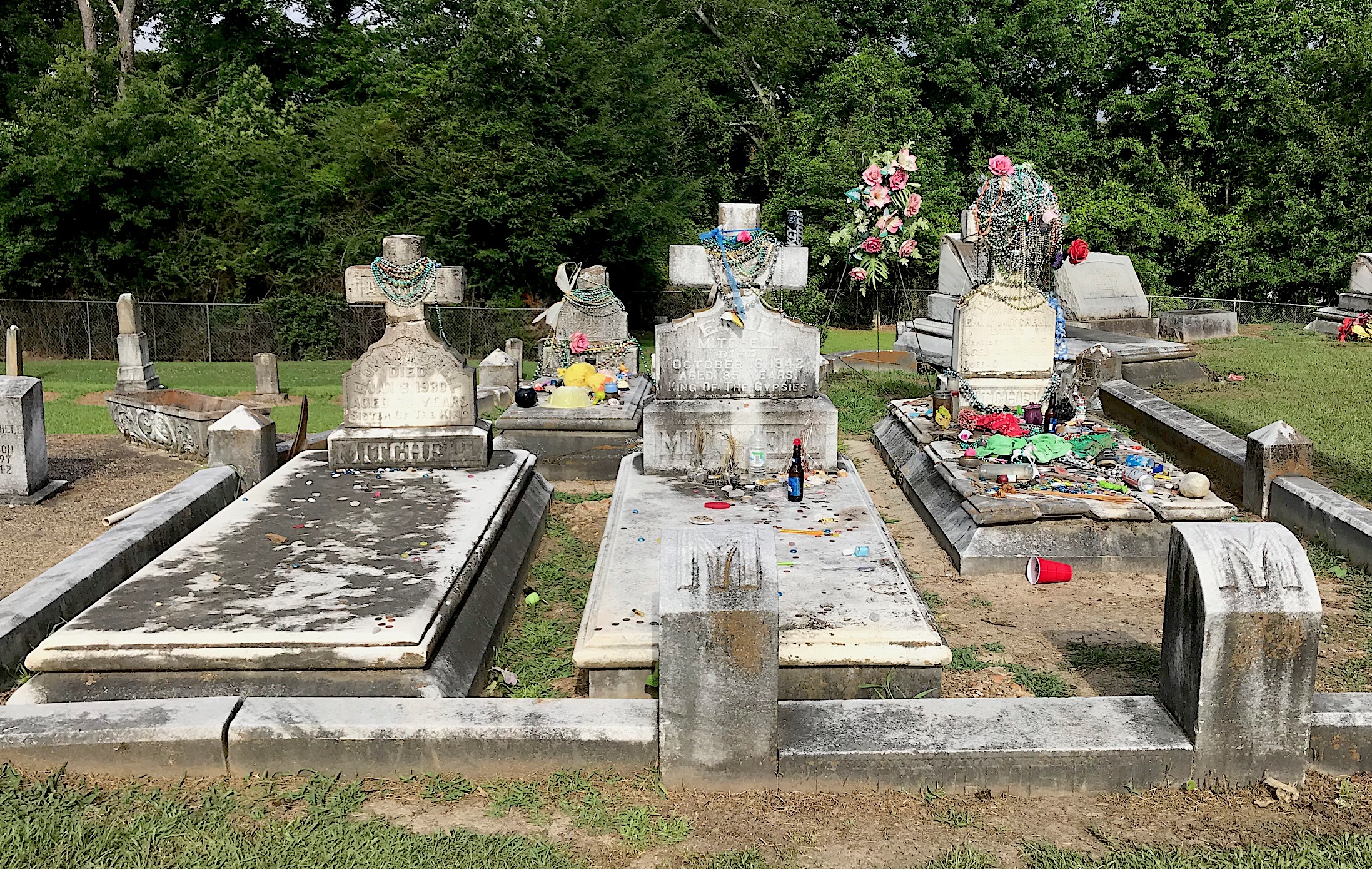
One of the Mitchell plots. Emil Mitchell, a king of the gypsies, is located in the center. His wife and queen, Kelly Mitchell, is to his right. His sister, Flora, is to the left.

On Jan. 31, 1915, Kelly died due to complications during the birth of her 14th or 15th child. At the time, the tribe was camped near the Mississippi-Alabama state line in Coatopa, Ala. I’ve read that her body was kept on ice for about six weeks, to allow for the news to be disseminated to various groups of Romani in the Southeast and give them time to come to Meridian for her burial. That sounds about right because when Matilda Stanley died, the funeral was delayed for some time for the same reason.

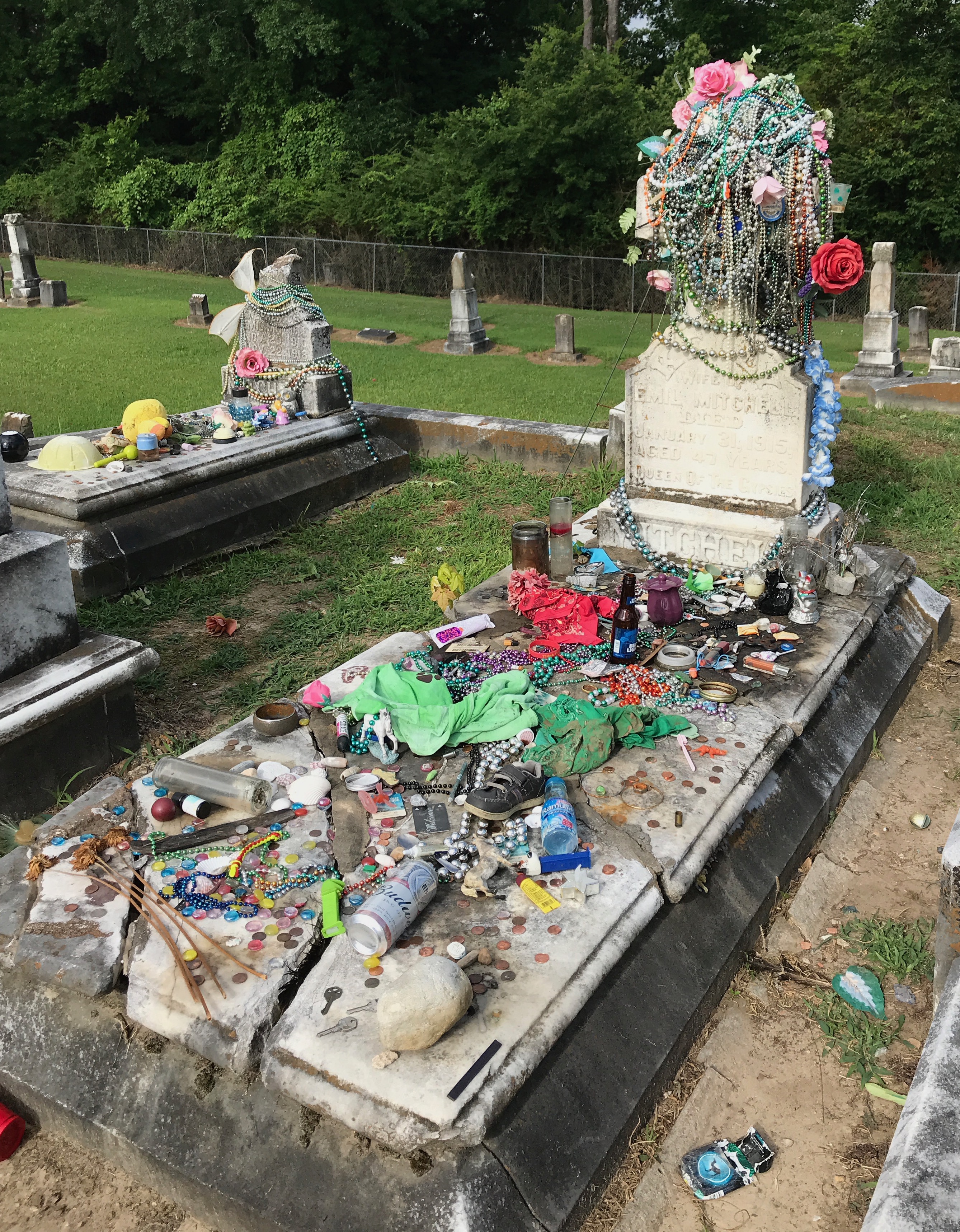
Kelly Mitchell’s grave is decorated with everything from beaded necklaces to flowers to empty beer cans.

A service was held in Meridian’s St. Paul’s Episcopal Church, and an estimated 20,000 people attended her funeral. More than 5,000 followed the body to the cemetery to witness last rites. She was said to have been buried with many jewels and personal valuables, and her grave was heavily concreted to discourage vandals. Descriptions of the colorfully costumed mourners were written about in the newspapers. I don’t think Meridian had ever seen anything like it before.

To the back left of Kelly’s grave is the one for Mehill Mitchell, her eight-year-old nephew who died in 1918. It was possibly due to Spanish Flu. He was the second burial in the Mitchell plot.

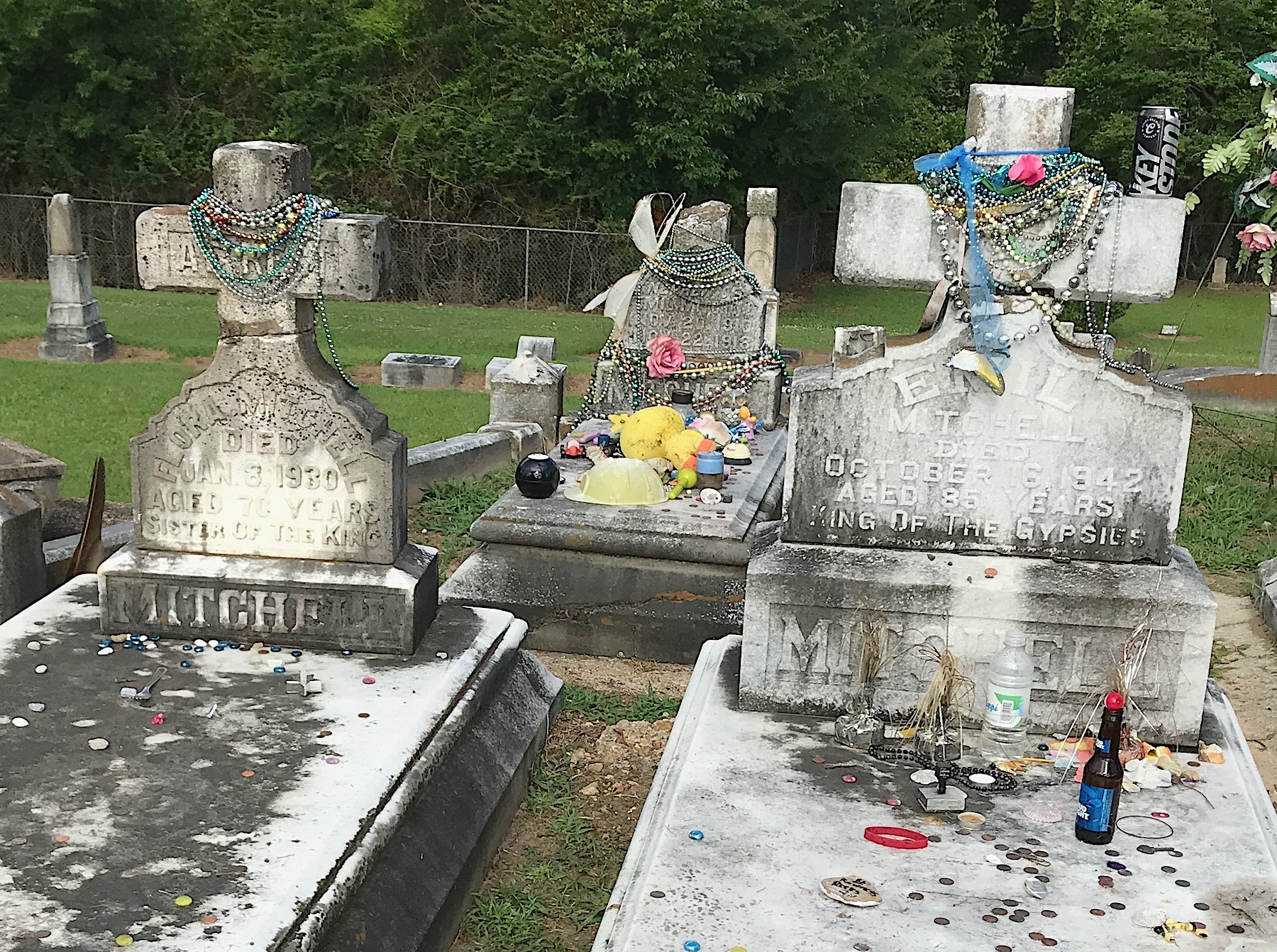
Flora Mitchell and her brother, Emil Mitchell, who was king of the gypsies.

Emil’s sister, Flora Mitchell, took over the role of queen after Kelly’s demise. Flora died in Yazoo City, Miss. on Jan. 8, 1930 at age 70. She is buried to Emil’s left. Emil remarried to a woman named Lapa. I’m not sure where she is buried.

Emil Mitchell died on Oct. 16, 1942 in Albertville, Ala. at age 85. His nephew, Slatcho, died the following day (he was 45). Also known as Mike Wilson, Slatcho was the leader of a small tribe of gypsies in Mississippi. It’s possible he died en route to his uncle’s funeral. They were buried on the same day at Rose Hill.

Gypsy Princess

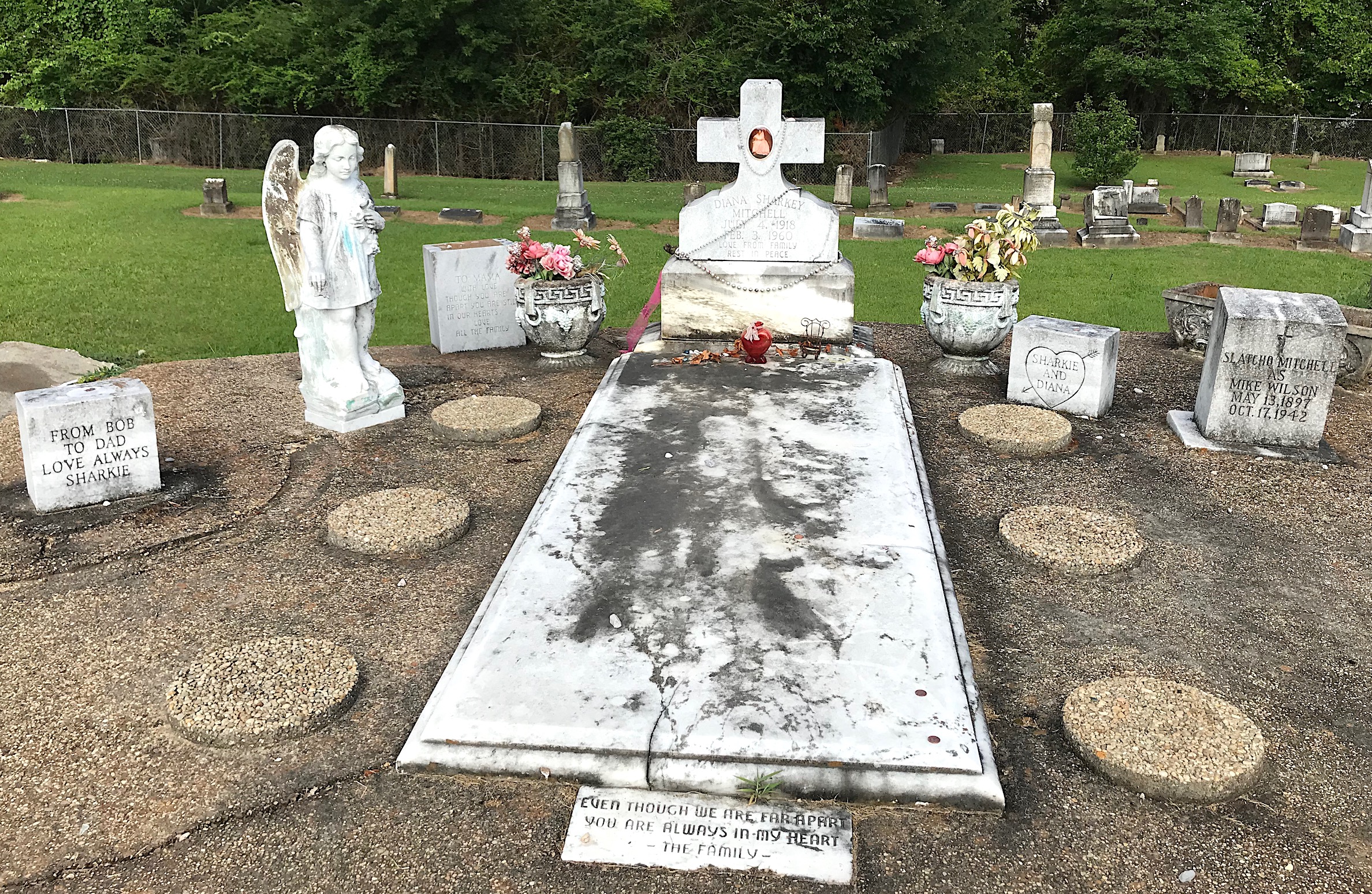
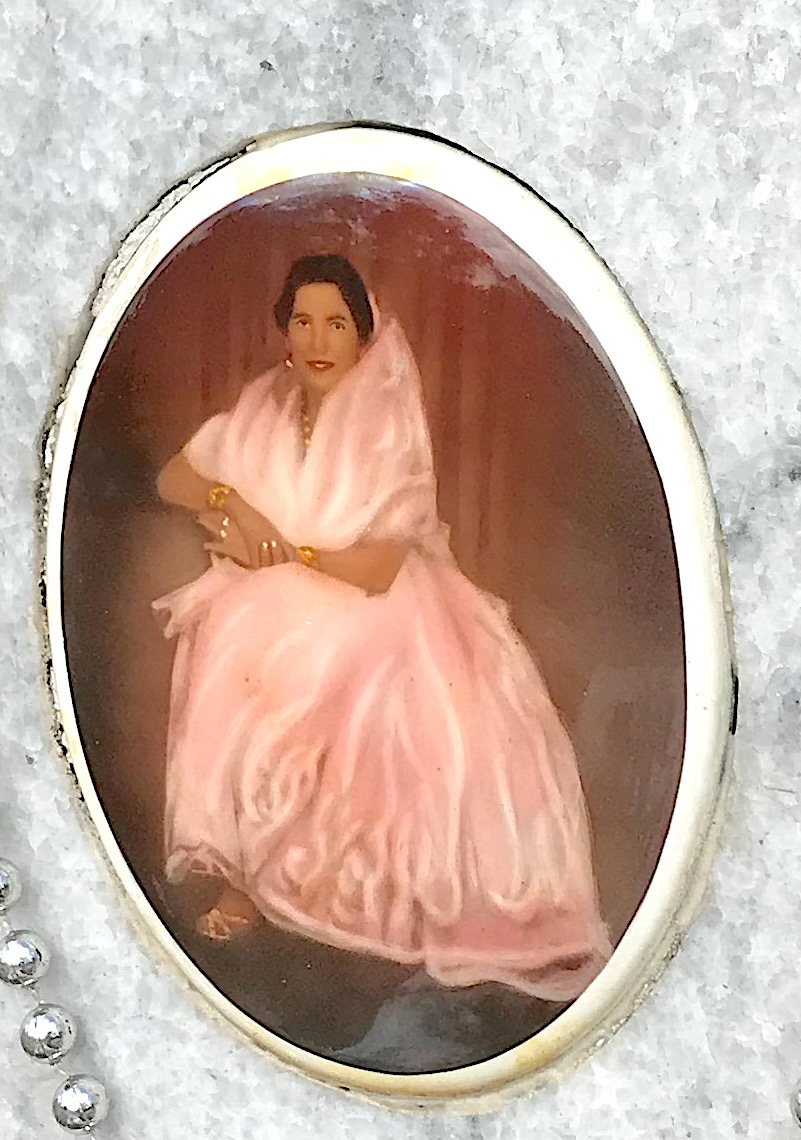
I’m not exactly sure where Diana Sharkey Mitchell fits into the family, but she is regarded as a gypsy princess. Born on July 4, 1918, she was married to Joseph “Joe” Sharkie Mitchell. I somehow missed getting a photo of his grave. He died in 1993. Diana’s grave is also decorated with beads and flowers.

Grave of Diana Sharkey Mitchell, a gypsy princess. She died in 1960 at age 41. You can see Slatcho Mitchell’s grave to her right.
Ceramic portrait of Diana Sharkey Mitchell, gypsy princess.

There are several other gypsies buried at Rose Hill that are connected to the Michells. I read that some practiced fortunetelling in Meridian at one time. I don’t know how many descendants of Emil and Kelly might still be living in the area today.

Sea Wolf of the Confederate Navy

When you think about the American Civil War (1861-1865), the thought of both sides having a navy is not something most of us consider. Especially the Confederates, who didn’t have nearly the resources that the Union Army did.

But over the years, I have encountered the graves of Confederate sailors. One of the best known is buried at Meridian and his name is Charles William “Savez” Read. He became known as the Sea Wolf of the Confederate Navy.

Charles William “Savez” Read when he was a cadet at the U.S. Naval Academy.

Born in 1840 in Mississippi, Read was not exactly who you’d envision as a dashing Navy man when you looked at him. He was short, spoke with a lisp, and graduated last among the 25 members of his 1861 U.S. Naval Academy class.

Read hated to study. Among difficult academic subjects, he found French the hardest to comprehend. The only word he could pronounce correctly was “savez,” a form of the verb “to know,” which he repeated frequently. He even ended sentences with it. For the rest of his life, Read would answer to the nickname “Savez.”

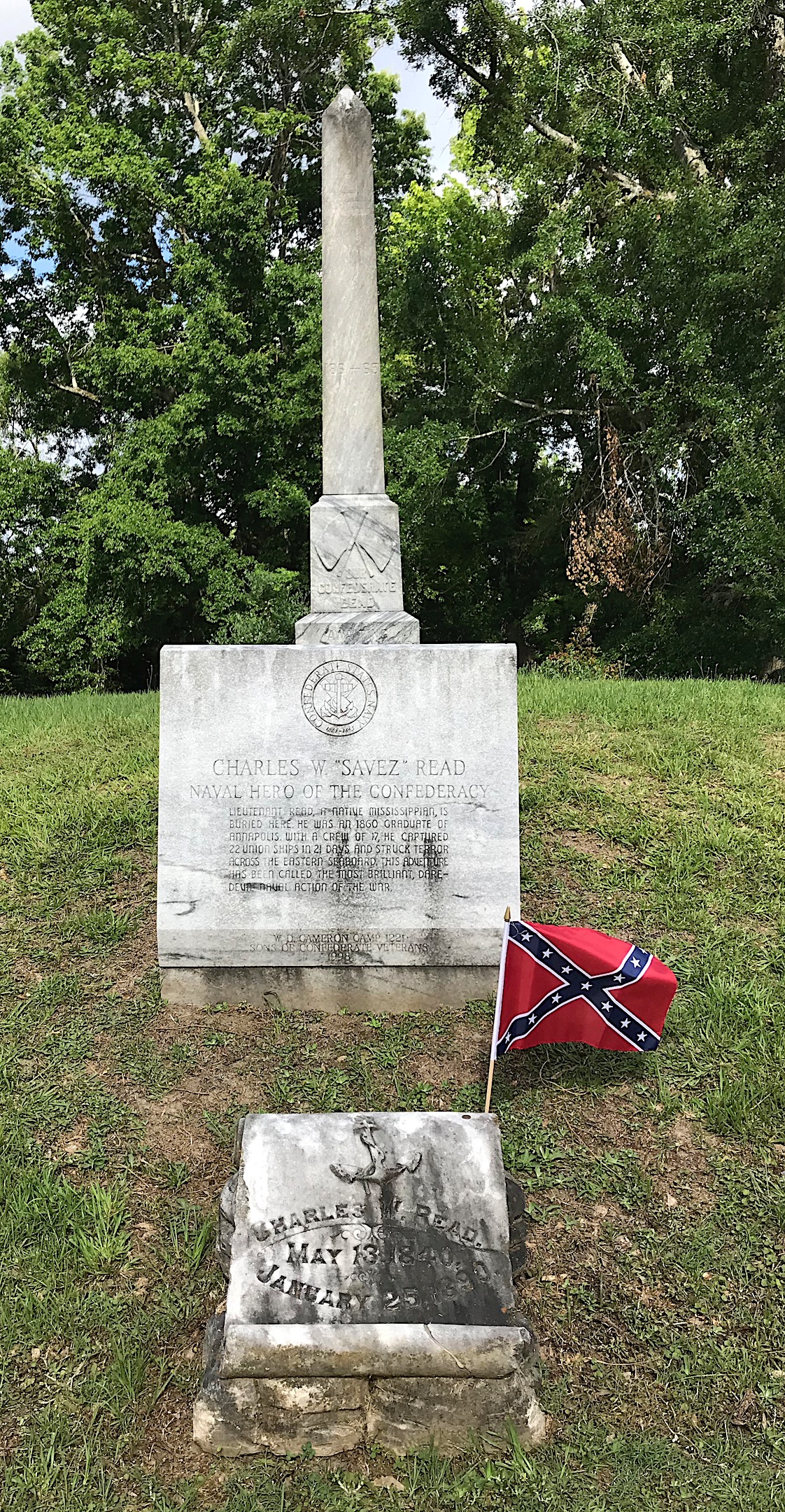
Read’s grave marker is on the hillside of a mass grave of about 100 Confederate soldiers.

In 1861, Read resigned his Union commission and joined the Confederate Navy. His first naval victory he participated in was on the CSS McRae at New Orleans. He commanded the ironclad CSS Arkansas during the battle near Vicksburg on July 13, 1862 and Baton Rouge on August 6, 1862. He also served on the CSS Florida from in 1863. Savez received the Confederate Medal of Honor during a raiding mission that lasted from June 6 to June 27, 1863.

On June 27, 1863, Read and his crew were captured in Portland, Maine and sent to Fort Warren, in Boston Harbor, Mass. He was released in October 18, 1864 but would be captured again, with release in June 1865. As a Confederate raider, he helped capture or destroy 22 Union ships in 21 days.

A historical marker detailing “Savez” Read’s exploits.

In 1867, Read was second officer aboard a ship involved in an effort to help Cuban rebels overthrow the Spanish government of the island. He and others were arrested by the U.S. government but were quickly released.

Read married Rosa Hall in December 1867 and together they had six children. Rosa died in 1878 at age 36 and is buried in Mississippi’s Biloxi City Cemetery. Read remarried in 1884 to Nebraska Carter, and they had one daughter, Mary, in 1885.

Confederate Burial Mound

About a hundred soldiers who died at Meridian’s Confederate hospital are buried in a large mound at Rose Hill. This was not their original resting place. They were moved here when their graves were discovered during the construction of Meridian’s first high school.

Charles Read was added to the burial mound after he died on Jan. 25, 1890. His wife, Nebraska, who wanted to be buried beside her husband, is the only woman in the mound. She died in 1928 at age 73.

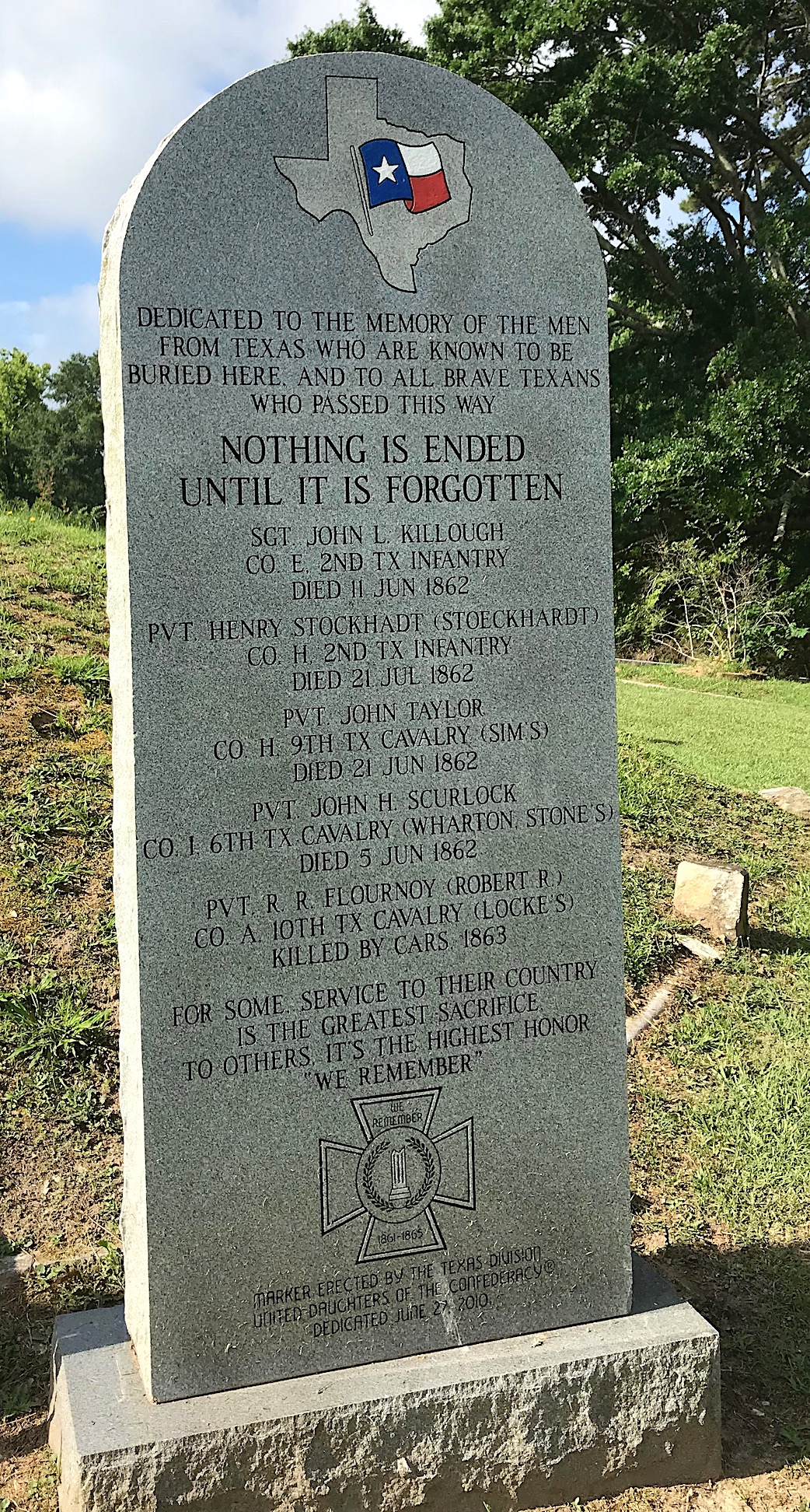
Memorial to six of the Confederate soldiers who are inside Rose Hill’s burial mound who were from Texas.

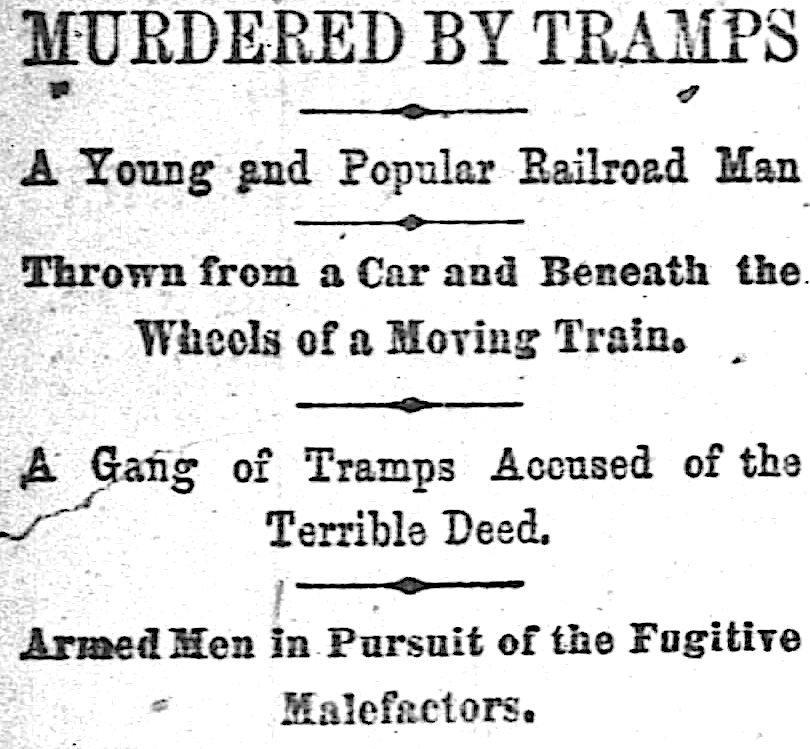
“Murdered By Tramps”

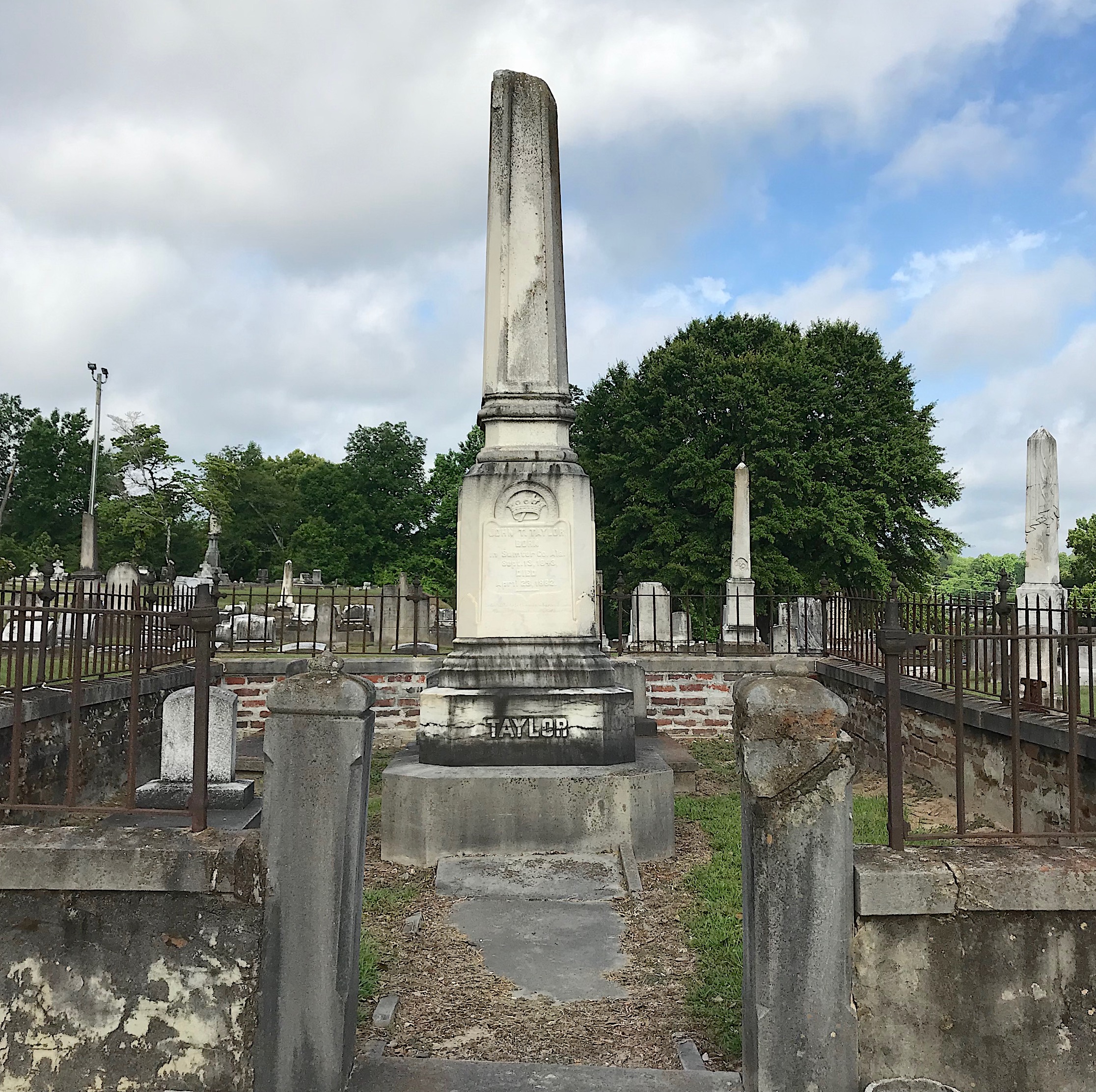
This last story came about by chance. I was perusing my photos and saw this one for the Taylor family plot. Railroad conductor/agent John Taylor has a large obelisk in the center. Her served as mayor of Meridian from April 1878 until his death in 1882 at age 38, leaving behind a wife (Annie) and three children.

The Taylor family plot at Rose Hill Cemetery.

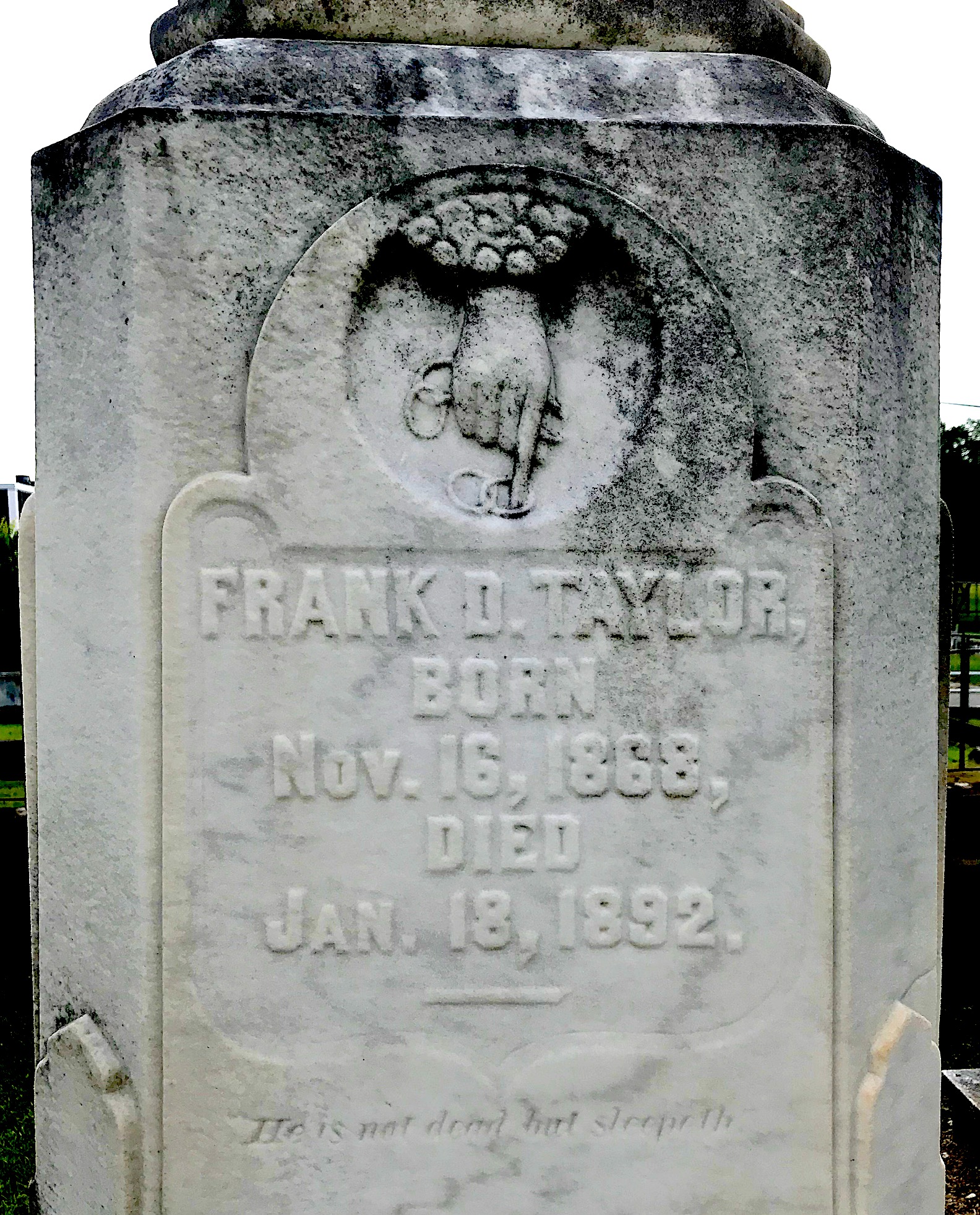
One of his children was Frank D. Taylor, who died in 1898 at age 23. The image of a hand reaching from Heaven to remove a link in a chain is one I had seen before, but it is not a common one. It signifies that someone important in the family chain has been taken too soon. Find a Grave had nothing about him but Newspapers.com yielded a sad tale.

The Taylor family was financially comfortable, but Frank wanted to follow in his father’s footsteps. He found employment with the Mississippi Valley Railroad, working as a brakeman.

Frank D. Taylor died a terrible death. His murderers were never caught.

On the evening of Jan. 18, 1892, Frank was assisting with the journey of a shortened train that was traveling slowly to Meridian via Southport and Kenner, La. A number of tramps had stolen passage onto the train in Southport. As the train neared Kenner, Frank encountered a group of them on top of one of the rail cars. He got into a scuffle with them (as evidenced by muddy footprints found later) and was pushed between the cars, resulting in Frank being crushed to death beneath the train’s wheels.

“He is not dead but sleepeth.”

Frank’s body was brought back to Meridian for burial at Rose Hill Cemetery. His mother, Annie, must have been devastated by the news. She died at age 74 in 1924, and is buried with her husband, son, and daughter, Mamie.

It was time for our last stop (and hop) on the Oklahoma Road Trip 2019: Live Oak Cemetery in Selma, Ala.

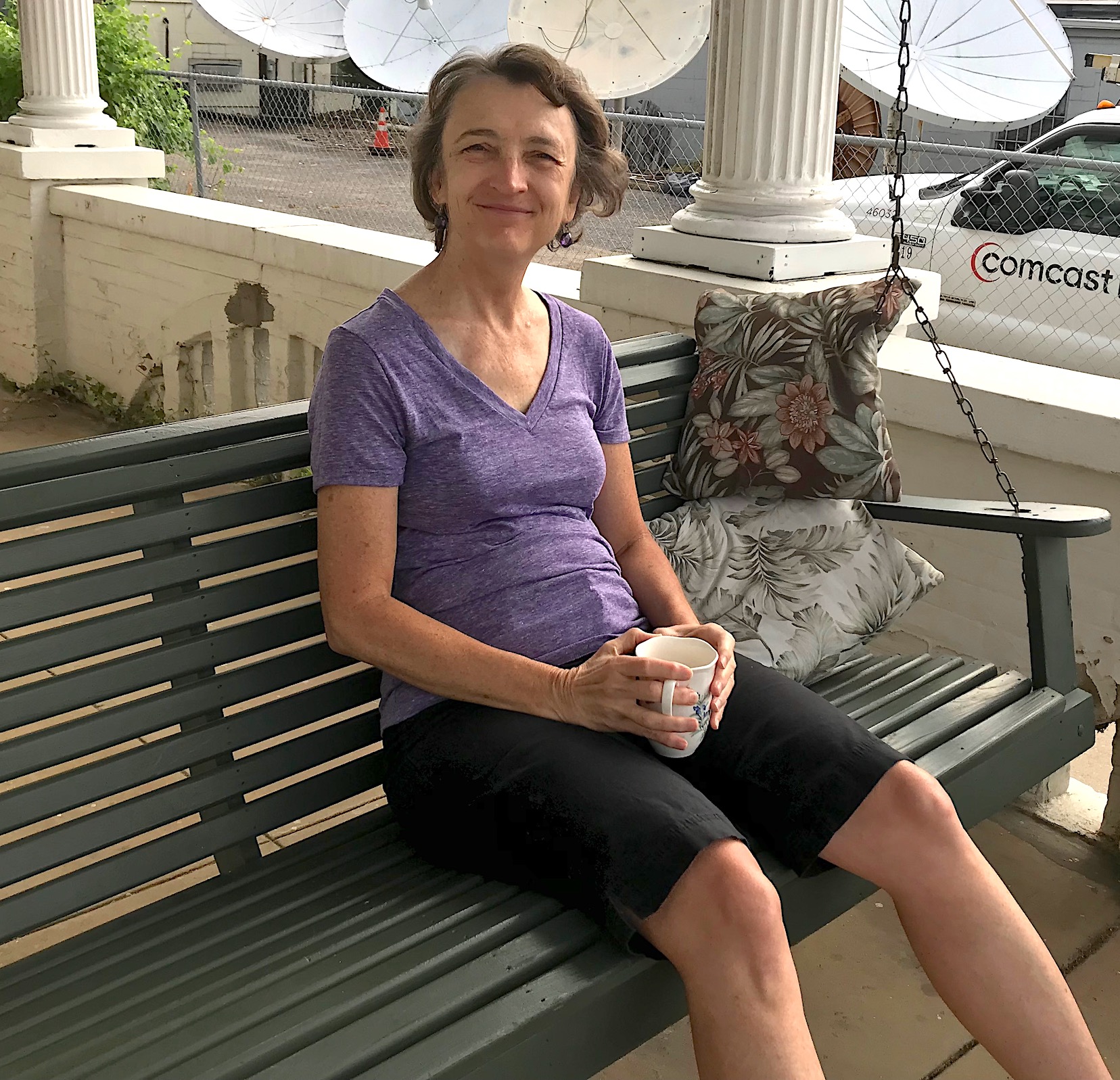
My travel buddy Sarah enjoys a morning cup of coffee (or tea) at the lovely Century House bed and breakfast we stayed at in Meridian, Miss.

Recent Posts

  • More Pensacola, Fla. Cemetery Hopping: Taking a Ramble Through Saint John’s Cemetery, Part III
  • More Pensacola, Fla. Cemetery Hopping: Taking a Ramble Through Saint John’s Cemetery, Part II
  • More Pensacola, Fla. Cemetery Hopping: Taking a Ramble Through Saint John’s Cemetery, Part I
  • The City of Five Flags: Stepping back in time at Pensacola, Fla.’s Saint Michael’s Cemetery, Part V
  • The City of Five Flags: Stepping back in time at Pensacola, Fla.’s Saint Michael’s Cemetery, Part IV

Archives

  • December 2025
  • November 2025
  • August 2025
  • July 2025
  • June 2025
  • May 2025
  • April 2025
  • March 2025
  • February 2025
  • January 2025
  • October 2024
  • August 2024
  • July 2024
  • June 2024
  • May 2024
  • April 2024
  • March 2024
  • February 2024
  • January 2024
  • December 2023
  • November 2023
  • October 2023
  • September 2023
  • August 2023
  • July 2023
  • June 2023
  • May 2023
  • April 2023
  • March 2023
  • February 2023
  • January 2023
  • December 2022
  • November 2022
  • October 2022
  • September 2022
  • August 2022
  • July 2022
  • June 2022
  • May 2022
  • April 2022
  • March 2022
  • February 2022
  • January 2022
  • December 2021
  • November 2021
  • October 2021
  • September 2021
  • August 2021
  • July 2021
  • May 2021
  • April 2021
  • March 2021
  • February 2021
  • January 2021
  • December 2020
  • November 2020
  • October 2020
  • September 2020
  • August 2020
  • July 2020
  • June 2020
  • May 2020
  • April 2020
  • March 2020
  • February 2020
  • January 2020
  • December 2019
  • November 2019
  • October 2019
  • September 2019
  • August 2019
  • July 2019
  • June 2019
  • May 2019
  • April 2019
  • March 2019
  • February 2019
  • January 2019
  • December 2018
  • November 2018
  • October 2018
  • September 2018
  • August 2018
  • May 2018
  • April 2018
  • March 2018
  • February 2018
  • January 2018
  • December 2017
  • November 2017
  • October 2017
  • September 2017
  • August 2017
  • July 2017
  • June 2017
  • May 2017
  • April 2017
  • March 2017
  • February 2017
  • January 2017
  • December 2016
  • November 2016
  • October 2016
  • September 2016
  • August 2016
  • July 2016
  • June 2016
  • May 2016
  • April 2016
  • March 2016
  • February 2016
  • January 2016
  • December 2015
  • November 2015
  • October 2015
  • September 2015
  • August 2015
  • July 2015
  • May 2015
  • April 2015
  • March 2015
  • February 2015
  • January 2015
  • December 2014
  • November 2014
  • October 2014
  • September 2014
  • August 2014
  • July 2014
  • June 2014
  • May 2014
  • April 2014
  • March 2014
  • February 2014
  • January 2014
  • December 2013
  • November 2013
  • October 2013
  • September 2013
  • August 2013
  • July 2013
  • June 2013
  • May 2013
  • April 2013
  • March 2013
  • February 2013
  • January 2013

Categories

  • General

Blogroll

  • A Grave Interest
  • Cemetery Photography by Chantal Larochelle
  • Cemetery Tours of Berlin by Matti
  • Confessions of a Funeral Director (Caleb Wilde)
  • Find a Grave
  • Hunting and Gathering (cool photography site)
  • Save Our Cemeteries (New Orleans, La.)
  • The Cemetery Club
  • The Graveyard Detective
  • The Rambling Muser
  • Westminster Abbey Tours by Grace

Meta

  • Create account
  • Log in
  • Entries feed
  • Comments feed
  • WordPress.com

Blog at WordPress.com.

  • Subscribe Subscribed
    • Adventures in Cemetery Hopping
    • Join 402 other subscribers
    • Already have a WordPress.com account? Log in now.
    • Adventures in Cemetery Hopping
    • Subscribe Subscribed
    • Sign up
    • Log in
    • Report this content
    • View site in Reader
    • Manage subscriptions
    • Collapse this bar
 

Loading Comments...