• About Me
  • Cemeteries I Have Visited
  • Have questions?
  • Photos

Adventures in Cemetery Hopping

~ A blog by Traci Rylands

Adventures in Cemetery Hopping

Monthly Archives: August 2023

A Beautiful View: Zipping through Prospect Hill Cemetery in Front Royal, Va.

25 Friday Aug 2023

Posted by adventuresincemeteryhopping in General

≈ 2 Comments

Continuing on our Shenandoah/D.C. family summer vacation, we made a stop at Prospect Hill Cemetery in Front Royal, Va. It was on our way to our hotel, where we were due to check in that evening before heading toward Washington, D.C.
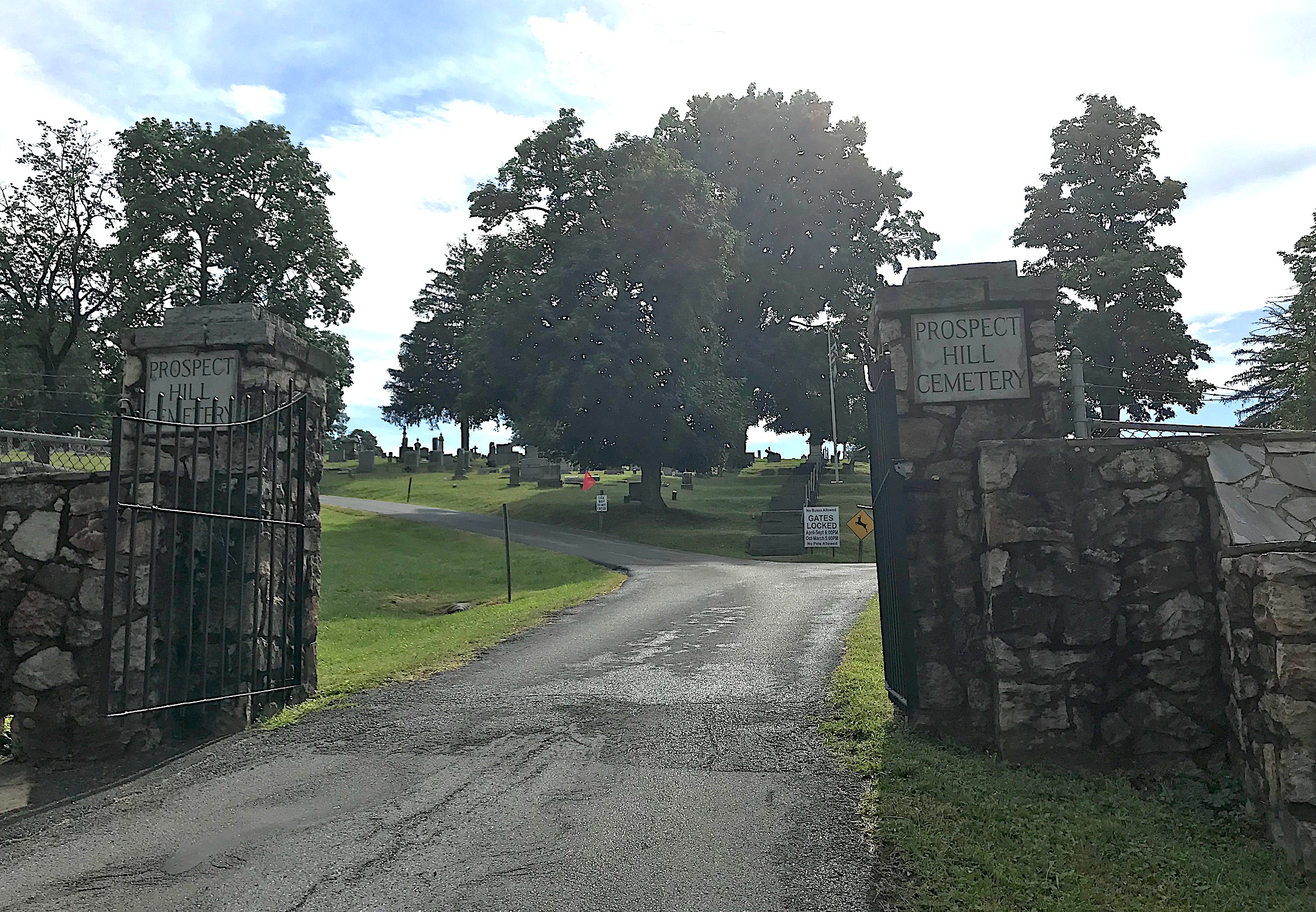
The gates of Prospect Hill Cemetery in Front Royal, Va.

Covering about 31 acres, Prospect Hill Cemetery’s oldest marked grave is from 1802. Find a Grave.com lists about 11,400 burials (not all are marked).

One thing I noticed right away was that I didn’t have much time to look around. The gates were due to be locked at 6 p.m. and it was 5:30 p.m. when we pulled in. Time to start hopping before we got locked inside! That’s I why I call this post “Zipping Through Prospect Hill Cemetery”.
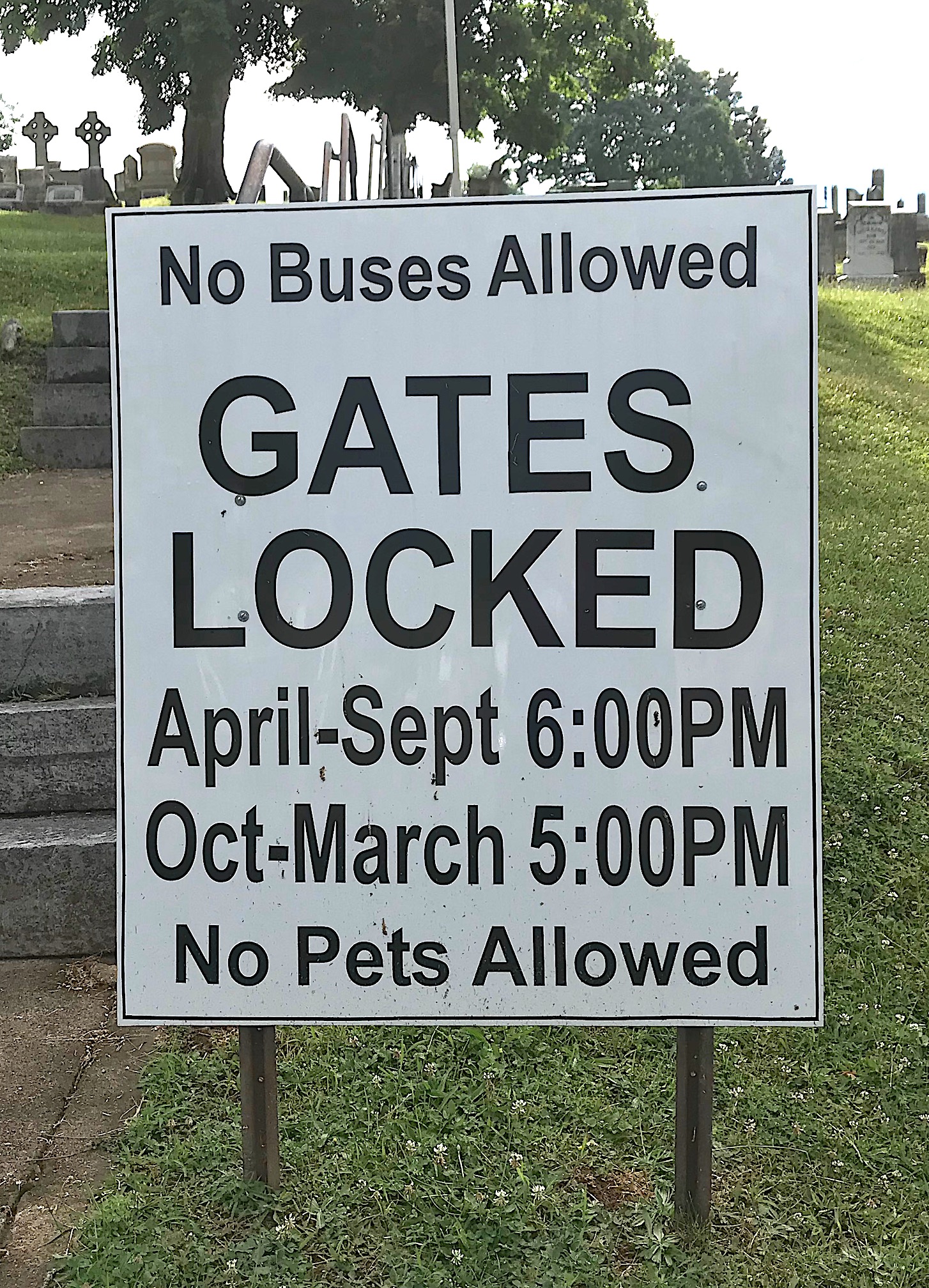
Nobody wants to get locked in the cemetery. Well, maybe there are but not me!

A Strategic Vantage Point

A large interpretive plaque explained that during the Civil War, Prospect Hill didn’t have any trees on it. As a result, it provided an ideal view of what was happening with the Union troops. Confederate commanders could watch the battle unfold beneath them. Prospect Hill does have a beautiful view of the Shenandoah Mountains.

View near the top of Prospect Hill Cemetery.

In 1862, Stonewall Jackson’s troops brought cannons up to Prospect Hill to form a battery at one point but they discovered the ones they brought didn’t have the range to reach Union guns on nearby Richardson’s Hill. So they were moved elsewhere.

It took the Ladies Warren Memorial Association several years to oversee the discovery and re-interment of all the Warren County Confederate graves moved to Prospect Hill.

After the war in 1868, the Ladies Warren (County) Memorial Association was tasked with locating the graves of the Confederate dead in the county and relocating them all for burial at Prospect Hill. A total of 276 bodies were brought there. About 90 were buried in graves marked with veterans’ headstones, surrounding about 186 unidentified soldiers that were placed in the center of the circular lot.

On Aug. 24, 1882, the 18-foot high monument was erected over the center burial mound.

This monument was erected to honor Warren County’s Confederate dead on Aug. 24, 1882.

I noticed how intact the iron fence was that surrounds the graves and got a picture of the gate. It was produced locally by the F.R. Snapp Foundry, located 20 miles away in Winchester, Va. Francis R. Snapp established the foundry after the Civil War and operated it until his death in 1872. His wife, Theodora, took over running it after he died. I think his sons were key to keeping it going.
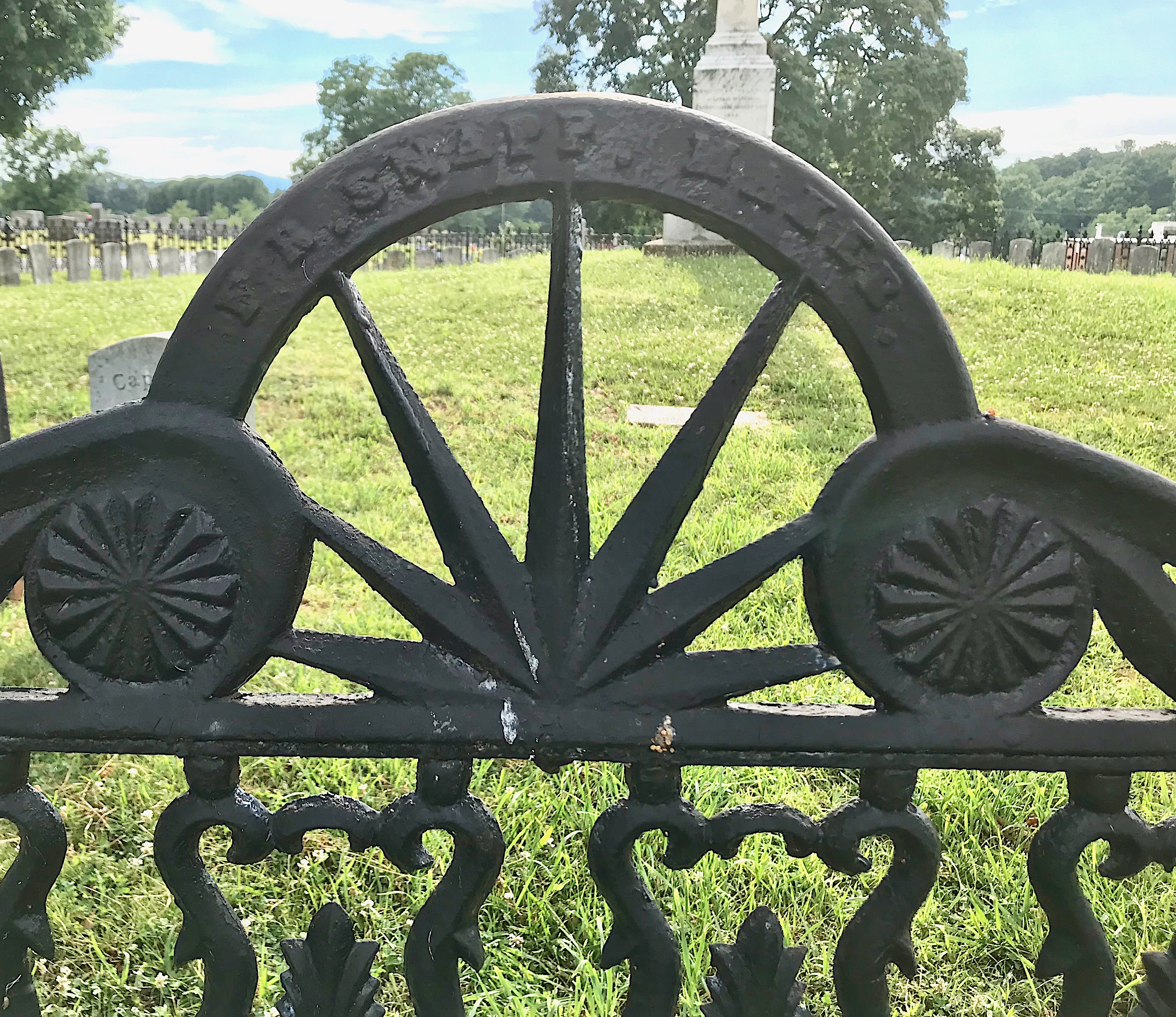
The F.R. Snapp Foundry produced the fencing around the Confederate circle.

I learned that the Snapp Foundry building in Winchester is still intact and was renovated back in 2010 to be used as offices for the local Department of Social Services. I don’t know if it is still serving that purpose, but it was nice to see the Snapp family name still on it.

F.R. Snapp’s foundry building is still being used.

Slave To Servant: Aunt Mary Thompson

I found two interesting grave markers (one is actually a monument) at Prospect Hill that I wanted to share. I do run into this kind of thing on occasion but to see two in the same cemetery is rare.

First, I found this marker for an “Aunt Mary Thompson” among the Boone family plot. Family patriarch Abraham Boone (1812-1899) was first a tavern owner and later a watchmaker in Front Royal. He is surrounded by the graves of his wife, Elizabeth, and their children (adult and those that died young).

Martha Thompson’s grave is the same size/shape as the Boone graves. But the inscription on it tells a story:

Aunt Martha Thompson: A servant who died April 22, 1925 aged about 80 years. She requested to live in death with those whom in life she and her people had served so faithfully for generations.

Martha was buried with the Boone family, for whom she worked most of her life.

So how do we interpret this? It would be easy to romanticize such a marker’s words but facts tell us a harsher truth.

After the Civil War, many enslaved families continued living and working for the families that had previously owned them. It was usually not a matter of loyalty but one of practicality. They had no money or property that enabled them to go elsewhere. In Martha’s case, she and “her people” likely remained with the Boones because they had nowhere else to go.

I located Martha’s death certificate, which confirmed she was black. Her mother’s name was Elizabeth Boone, likely a slave for the Boone family since she carried their last name. Martha did marry but her husband’s name is not on her death certificate. She was widowed at the time she died in Charlottesville, Va. at age 78.

Since Abraham Boone died in 1902, I don’t know what family members Martha might have been working for after his demise. His daughter, Kathleen, did marry and remained in the Front Royal area until her death in 1925. I don’t know if Prospect Hill was a segregated cemetery in 1925 when she died and if the Boones had to ask permission for Martha to be buried with them. But they clearly wanted her with them.

I do know of a similar situation at a cemetery in my own hometown of Fayetteville, Ga. where a former slave who remained with her owners as a servant for the rest of her life is buried with the family and the inscription on her grave indicates the same type of situation.

Old Aunt Edy

The next situation is a little different. Instead of a marker, the name of the servant is actually on one side of a monument, something I’ve never seen before. I know much less about her. But as I started to dig into the family, things got interesting quickly.

One of the largest monuments in the cemetery is for the Bayly family. A native of Virginia, George Bayly (1781-1860) was the son of Pierce Bayly of Loudon County, Va.. A Revolutionary War veteran and slave owner, Pierce established Diamond Hill Farm there in the 1770s with his wife, Mary. George and his wife, Elizabeth, had 11 children together, including a son named Robert Henry, born in 1808.

Interestingly, the 1850 U.S. Census notes that George Bayly was deaf.

The Baylys were a well established Virginia farming family.

Born in 1808 in Front Royal, Robert moved to Natchez, Miss. at the age of 21 and became a bank clerk. By saving his salary, he was able to open his own dry goods store. Later, he moved to New Orleans to start a wholesale grocery business with his brother, George (known as G.M.). The enterprise thrived and Robert eventually retired in 1850, letting G.M. to take over. He continued investing and building wealth, even after the Civil War. He never married.

Robert Bayly was one of the many children of George and Mary A. Bayley.

When Robert died at age 63 on Feb. 15, 1872 of tuberculosis, his will spelled out his wishes. Newspapers reported he left $70,000 in cash to Washington and Lee University in Lexington, Va. to establish a professorship in his name. But my eyes were drawn to the paragraphs concerning his burial wishes, which you can see below.

Robert Bayly’s will specifically requests that the “ashes” (which may be remains) of his parents and “old Aunt Edy” be moved from Kentucky to Front Royal, Va.

Robert was quite direct in writing that he wanted to erect a tomb for the Bayly family. Originally, he wanted it placed at “Happy Creek Church” (Happy Creek is an area of Front Royal) where his parents had worshiped before moving to Kentucky where they died. That is crossed out and a monument was erected instead at Prospect Hill Cemetery. Robert wanted there to be space enough for his three sisters (including Mary whose name is on the monument below his) to be interred there. He requested this his sister Rebecca (who lived in Kentucky) to carry out these wishes for him.

Little is known about “Old Aunt Edy” beyond the fact she was likely a slave who worked for the Bayly family.

You will note (and I have circled her name) that Robert specifically asked that the “ashes” of his parents and “my old faithful friend, old Aunt Edy” be moved from Kentucky to the new Bayly tomb. He does not refer to Aunt Edy as a servant or a slave in his will.

Rebecca did not forget Aunt Edy. On one panel of the monument are inscribed the words “Here lieth the remains of Old Aunt Edy, a faithful servant and friend died 1853”. I can only conclude she was a slave who had meant a great deal to the family, enough that Robert wanted her remains to stay with the family.

Susan Payne Bayly Blakemore, his sister, is not buried at Prospect Hill but is interred at Lake View Cemetery in Cleveland, Ohio. But there are a number of other Baylys and their spouses buried in the large plot that Robert provided for in his will.

I was curious to know what happened to G.M., the brother in New Orleans who took over the wholesale grocery business from Robert. He expanded his business to start a cotton brokerage that he operated with his son, George M. Bayly, Jr. G.M. died in 1886. I don’t know where he is buried. Another brother, Thomas, is buried in Montgomery Cemetery in Montgomery County, Pa.

And Then There Was One

As members of a family pass away, there’s sometimes only one person left surviving. That’s the case for Landora “Dora” Williams Smith.

Born in 1876 in Rappahannock County, Va., Dora married fellow Virginian James Smith before 1900. Their son, Carroll, was born in 1902. Daughter Lucy Gladys followed in 1904.

Sadly, Lucy died on March 29, 1913 at age nine of bronchial pneumonia and typhoid fever. Daughter Evelyn was born in 1915.

Lucy Gladys Smith was only nine when she died in 1913.

Carroll died on Oct. 17, 1918 at age 15 of Spanish Flu (listed as influenza but I suspect it was Spanish Flu).

Carroll Smith died at age 15 of Spanish Flu in 1918.

Tragedy struck again in 1932 when James died of a cerebral hemorrhage at age 59. Evelyn died two years later in 1934 from bronchial pneumonia, she was 18. Dora was now left all alone.

I photographed another Smith grave nearby that is not connected to this family on Find a Grave but I am fairly sure it is the first child of Dora and James. J. Lennie Smith was born on May 20, 1901 and died on Feb. 8, 1908. Because the child was born between census years, there is no other record I could find. However, the 1910 U.S. Census shows that Dora and James reported that she had given birth to three children but only two were living. I don’t know what caused little Lennie to die.

J. Lennie Smith was likely the first child of Dora and James Smith. She died at age six.

Dora died on Nov. 11, 1955 of bowel cancer at age 78. She shares a marker with husband James at Prospect Hill but I did not get a photo of it. She had outlived James by 23 years and all of her children had died young. It had to have been difficult for her to somehow go on without them. And yet, she did.

It was getting close to 6 p.m. so I wrapped things up and sprinted toward our rental car where Chris and Sean were waiting. Everyone was ready to put their feet up for the night, including me.

Next time, I’ll be visiting Arlington National Cemetery outside of Washington, D.C. You won’t want to miss it.

Sean gives Shenandoah National Park a thumbs up.

All in the Family: Taking a Break at Shenandoah National Park’s Dean Cemetery

11 Friday Aug 2023

Posted by adventuresincemeteryhopping in General

≈ 2 Comments

About three weeks after finishing the Oklahoma Road Trip 2019, I was ready for our family vacation. Our goal was to spend a few days in Virginia’s Shenandoah National Park (SNP) then head to Washington, D.C. As a family, we enjoy exploring the national parks and Shenandoah was no different.

We flew into Charlottesville, Va. and after lunch, stopped by the University of Virginia to stretch our legs. Then we headed into the park to enjoy the views.

Skyline Drive is a 100-mile scenic road that goes through the center of the 80,000-acre park. SNP’s elevation is 550 feet at its lowest to over 4,049 feet at its highest, with over 500 miles of trails. There are waterfalls, a part of the Appalachian Trail, and endless beautiful scenery.

In 1935, the government used eminent domain to displace over 450 families to build SNP. They took their lands and, with it, their burial grounds. I was surprised to learn that the National Park Service (NPS) knows of about 100 cemeteries in the park, but there could be many other unmarked burial grounds, too.

I knew I wanted to stop at least one of these cemeteries off Skyline Drive and picked out Dean Cemetery since it was on our way.

Those buried at Dean Cemetery are descended from the family of James Dean (1797-1862).

Located close to the middle of the SNP, Dean Cemetery is a well-kept family burial ground that is maintained by the Deans and local volunteers. As a flyer posted at the cemetery explains, Dean Cemetery is not taken care of by the NPS. Volunteer efforts and funds are solely responsible for its upkeep. From what I could tell, they do a wonderful job.

The Dean Family

Of the 200 memorials listed on Find a Grave, about 118 bear the last name of Dean. The man at the center of it all is James Dean. A book by Gloria Dean, “The Dean Mountain Story”, details the family history but I didn’t have enough time to get a copy before writing this post. However, I did find a summary of the book that helped.

The grave of James Dean is the oldest marked grave in the cemetery.

The Dean family’s story began in England in the mid-1750s when two brothers, John and William Deane, sailed to Pennsylvania. They went south to Orange County, Va., and settled east of the North Mountain, now known as the Blue Ridge.

Rockingham County records show that in 1816, James Dean, son of John (who dropped the “e” from his last name), married Susanne Harness. In the early 1820s, Susanne and the couple’s two young daughters died in an epidemic, leaving James and his son Jeremiah. Susanne’s grave is thought to be marked by one of the many field stones at Dean Cemetery.

In 1824, James married his second wife, Sarah Monger, and built a two-story brick house for the family in the valley beside Elk Run. The story of how James and Sarah Dean (and their children) left the valley and lived out their lives on Dean Mountain, now a part of SNP, is detailed in the book.

Grave of James Dean’s second wife, Sarah, who died in 1877.

James and Sarah had an estimated 10 to 12 children together, which may seem like a lot today. One of them was William Franklin Dean, Sr., born in 1828. He married Frances “Fannie” Meadows, who died in 1896 at age 63. William died in 1907 at age 79. William’s obituary states that he and Fannie had 23 children! Some died in childhood, but it appears many of them lived long lives.

William Franklin Dean is thought to have fathered 23 children with his wife, Fannie.

Double Murder

One might think living in the beauty of the Shenandoah Mountains would be an idyllic setting with few worries. But tragedy can happen anywhere. That’s what happened on the night of May 11, 1925.

Wealthy lumberman Lloyd Gruver Meadows, 34, owned a large home near the top of Dean Mountain, employing many. He was married to Serena Dean, 32, and they had six children. Working for them as a handyman was R. Stanton Dean, 20, who was Lloyd’s cousin. Only two months before, Stanton had wed Carrie Dean. But that night, he was staying over at the Meadows house in a downstairs bedroom.

While respected for his business acumen, Lloyd was sometimes whispered about for being “flighty” and having fits of temper. While the handyman slept, Lloyd was upstairs arguing with Serena and accusing her of having an affair with Stanton. Later, Lloyd would later claim that Serena confessed she had been untrue to him.

Headline from the May 15, 1925 Shenandoah Herald.

Lloyd went downstairs with his pistol, quietly opened the door, and shot Stanton twice in the head as he slept. Then he turned to the stairs and saw Serena standing at the top. Lloyd shot and killed her as well.

After locking his five younger children in a room for their safety, Lloyd took oldest child Cecil and the two walked through the night to Harrisonburg to visit Lloyd’s attorney. The lawyer wisely advised him to turn himself in to the local sheriff, which he did, and confess his crimes.

“I lost my nerve or I would never be here,” he said. “For I fully intended to kill myself.”

Lloyd went on trial for double murder in July and despite an insanity defense, narrowly missed being sent to the electric chair. He was sentenced to life in prison at the Virginia State Penitentiary in Richmond. Census records indicate that by 1930, he had been moved to Southern State Hospital and judged insane. He was still there in 1950. He died in 1970 of heart failure. I do not know where he is buried.

R. Stanton Dean was shot in his sleep, unable to defend himself.

Serena is buried in Hensley Community Cemetery, not far from Dean Cemetery. Stanton is buried at Dean Cemetery. I don’t know if his new bride, Carrie, remarried. I personally think Lloyd was lying about Serena’s confession, but had convinced himself in his deluded mind that they were cheating together behind his back. Sadly, his delusions convinced him to commit murder.

Tragedy Strikes Again

Stanton’s family was not done with suffering, unfortunately. Six years later, tragedy would strike again. Stanton’s younger brother, George Robert Dean (who went by Robert), went north to take a job at an aircraft plant in Baltimore, Md.

Robert died on Sept. 25, 1931 when the car he was driving was struck by the passenger train known as the Congressional Limited near the Middle River. He was only 22.

Robert Dean was killed instantly when his car was hit by a train near Baltimore, Md.

Three Little Ones

It’s common for me to encounter many graves of children in rural cemeteries like Dean Cemetery. When I saw the graves for Chancel, Lonnie, and Hazel, then did the math, I knew that was likely the case.

Stanton Dean’s brother Elijah Dyche Dean (1897-1959) was married to Daisy Lee Dean Dean (that’s not a typo, by the way). They had a total of nine children. Their first son, Randal, lived well into adulthood. But Chancel, born in 1920, died of diphtheria on Nov. 22, 1922. Zelda, Delmar, and Junior came next. Lonnie, born in 1928, died on Nov. 4, 1933 at age five. His death certificate notes that no doctor was present when he died but the cause of death was thought to be “membranous croup.”

Chancel, Lonnie, and Hazel Dean all died far too soon.

Hazel, born in 1930, died on July 6, 1937 at age 7. I was expecting another childhood illness to be the cause of death but I was taken by surprise. According to her death certificate, little Hazel suffered a fractured skull when she was “run over by father’s truck.” I can only imagine that it was some horrible freak accident.

Not Afraid of the Devil

There are quite a few graves from the last 20 years, indicating that Dean Cemetery is still quite active. I wish I had been able to meet Clinton Harris Dean. His main marker isn’t out of the ordinary, per se.

Clinton Dean served in the Civilian Conservation Corps and the U.S. Army, then the Merchant Marine.

But it’s the extra plaque that goes with it that caught my eye. It reads, “Here lies Clinton, son of Claud, who wasn’t afraid of the Devil, but he was of the Lord.”

I think Clinton Dean would have been interesting to know.

As I read Clinton’s obituary, I could see why he might have earned that inscription. Born in 1921, he served in the U.S. Army during World War II. Later, he retired after serving in the merchant marine. For a man from a small, mountain town, Clinton had saw quite a bit of the world.

God’s Handiwork

As we prepared to get back on Skyline Drive, I thought about the changes the Deans have witnessed in the decades that have passed since settling in these stunning mountains. While world wars and other major events have impacted and changed society, the stark beauty and evidence of God’s handiwork around them remains the same.

I hope you’ll join me for more adventures in Virginia.

Sunset in the Shenandoah Mountains of Virginia.

Recent Posts

  • More Pensacola, Fla. Cemetery Hopping: Taking a Ramble Through Saint John’s Cemetery, Part III
  • More Pensacola, Fla. Cemetery Hopping: Taking a Ramble Through Saint John’s Cemetery, Part II
  • More Pensacola, Fla. Cemetery Hopping: Taking a Ramble Through Saint John’s Cemetery, Part I
  • The City of Five Flags: Stepping back in time at Pensacola, Fla.’s Saint Michael’s Cemetery, Part V
  • The City of Five Flags: Stepping back in time at Pensacola, Fla.’s Saint Michael’s Cemetery, Part IV

Archives

  • December 2025
  • November 2025
  • August 2025
  • July 2025
  • June 2025
  • May 2025
  • April 2025
  • March 2025
  • February 2025
  • January 2025
  • October 2024
  • August 2024
  • July 2024
  • June 2024
  • May 2024
  • April 2024
  • March 2024
  • February 2024
  • January 2024
  • December 2023
  • November 2023
  • October 2023
  • September 2023
  • August 2023
  • July 2023
  • June 2023
  • May 2023
  • April 2023
  • March 2023
  • February 2023
  • January 2023
  • December 2022
  • November 2022
  • October 2022
  • September 2022
  • August 2022
  • July 2022
  • June 2022
  • May 2022
  • April 2022
  • March 2022
  • February 2022
  • January 2022
  • December 2021
  • November 2021
  • October 2021
  • September 2021
  • August 2021
  • July 2021
  • May 2021
  • April 2021
  • March 2021
  • February 2021
  • January 2021
  • December 2020
  • November 2020
  • October 2020
  • September 2020
  • August 2020
  • July 2020
  • June 2020
  • May 2020
  • April 2020
  • March 2020
  • February 2020
  • January 2020
  • December 2019
  • November 2019
  • October 2019
  • September 2019
  • August 2019
  • July 2019
  • June 2019
  • May 2019
  • April 2019
  • March 2019
  • February 2019
  • January 2019
  • December 2018
  • November 2018
  • October 2018
  • September 2018
  • August 2018
  • May 2018
  • April 2018
  • March 2018
  • February 2018
  • January 2018
  • December 2017
  • November 2017
  • October 2017
  • September 2017
  • August 2017
  • July 2017
  • June 2017
  • May 2017
  • April 2017
  • March 2017
  • February 2017
  • January 2017
  • December 2016
  • November 2016
  • October 2016
  • September 2016
  • August 2016
  • July 2016
  • June 2016
  • May 2016
  • April 2016
  • March 2016
  • February 2016
  • January 2016
  • December 2015
  • November 2015
  • October 2015
  • September 2015
  • August 2015
  • July 2015
  • May 2015
  • April 2015
  • March 2015
  • February 2015
  • January 2015
  • December 2014
  • November 2014
  • October 2014
  • September 2014
  • August 2014
  • July 2014
  • June 2014
  • May 2014
  • April 2014
  • March 2014
  • February 2014
  • January 2014
  • December 2013
  • November 2013
  • October 2013
  • September 2013
  • August 2013
  • July 2013
  • June 2013
  • May 2013
  • April 2013
  • March 2013
  • February 2013
  • January 2013

Categories

  • General

Blogroll

  • A Grave Interest
  • Cemetery Photography by Chantal Larochelle
  • Cemetery Tours of Berlin by Matti
  • Confessions of a Funeral Director (Caleb Wilde)
  • Find a Grave
  • Hunting and Gathering (cool photography site)
  • Save Our Cemeteries (New Orleans, La.)
  • The Cemetery Club
  • The Graveyard Detective
  • The Rambling Muser
  • Westminster Abbey Tours by Grace

Meta

  • Create account
  • Log in
  • Entries feed
  • Comments feed
  • WordPress.com

Blog at WordPress.com.

  • Subscribe Subscribed
    • Adventures in Cemetery Hopping
    • Join 402 other subscribers
    • Already have a WordPress.com account? Log in now.
    • Adventures in Cemetery Hopping
    • Subscribe Subscribed
    • Sign up
    • Log in
    • Report this content
    • View site in Reader
    • Manage subscriptions
    • Collapse this bar
 

Loading Comments...