• About Me
  • Cemeteries I Have Visited
  • Have questions?
  • Photos

Adventures in Cemetery Hopping

~ A blog by Traci Rylands

Adventures in Cemetery Hopping

Monthly Archives: September 2023

A Final Salute: Paying Our Respects at Virginia’s Arlington National Cemetery, Part V

29 Friday Sep 2023

Posted by adventuresincemeteryhopping in General

≈ 1 Comment

This week in Part V, I’m going to share some of the memorials I saw while I was at Arlington National Cemetery (ANC). You can find them all over the place, for various groups of people for various events. Some of them were for particular military groups. A few surprised me, though. Some of these I came across on my return visit when I was wandering around ANC by myself.

I’m also going to tell the story of three astronauts, two of whom are buried at ANC.

Beautiful old trees are plentiful at Arlington National Cemetery.

Lockerbie Memorial

While looking for Abner Doubleday over in Section 1, I came upon this memorial. It looked like a little tower to me.

This “cairn” is a memorial to the 270 lives lost in on Pan Am Flight 103 when it exploded due to a bomb planted on board.

The Lockerbie Memorial Cairn memorializes the 270 lives lost in the terrorist bombing of Pan American Airlines Flight 103 on Dec. 21, 1988, over Lockerbie, Scotland.

Flight 103 was en route from Frankfurt, Germany to New York via London’s Heathrow Airport. At 7:02 p.m., 27 minutes after leaving London, the plane exploded, raining fragments on the city of Lockerbie. Eleven of the 270 dead were on the ground. The 259 passengers and crew included citizens of 21 countries. Among them were 190 Americans, including 15 active duty military personnel and 10 veterans.

The Lockerbie crash is one of the deadliest terrorist attacks in the history of the United Kingdom, as well as its deadliest aviation disaster ever.

In 1993, Congress designated ANC as the site of the memorial cairn, and President Bill Clinton signed the bill into law on Nov. 24, 1993. On Dec. 21, 1993, the fifth anniversary of the disaster, President Clinton delivered the keynote address at the groundbreaking ceremony.

Thirty-five of the passengers were Syracuse University students, who participated in the university’s Division of International Programs Abroad and were returning home for Christmas.

Consisting of 270 blocks of red Scottish sandstone, the cairn was a gift from the people of Scotland to the people of the United States, paid for through private donations. A cairn is a traditional Scottish monument honoring the dead.

Battle of the Bulge Memorials

I saw two different memorials for the Battle of the Bulge. Small ones like this for specific events are common at ANC.

This memorial is to honor those who fought in the Battle of the Bulge during World War II on Dec. 16, 1944 through Jan. 25, 1945.

This particular memorial was placed by the Veterans of the Battle of the Bulge on Dec. 16, 1986.

The Battle of the Bulge took place in the Ardennes Forest region of Belgium and Luxembourg from Dec. 16, 1944 to Jan. 25, 1945. The last major German counteroffensive on the Western Front, it ended in victory for Allied forces but at great cost. Soldiers fought in brutal winter conditions, and the U.S. Army lost approximately 19,000 men (and suffered some 75,000 total casualties) in what became the United States’ deadliest single World War II battle.

In Section 21, I came across another Battle of the Bulge memorial near one for Spanish American War veterans/nurses. This memorial was provided by the people of Belgium and Luxembourg.

This Battle of the Bulge memorial was provided by the people of Belgium and Luxembourg where the battle was fought during World War II.

This memorial was dedicated on May 8, 2006, in a ceremony attended by 300 veterans and family members, along with prime minister Guy Verhofstadt of Belgium, and Luxembourg’s secretary of state for culture, Octavie Modert.

Its main inscription reads, “To World War II American soldiers who fought in the Battle of the Bulge — the greatest land battle in the history of the United States Army.” Text on the base of the memorial reads, “From the grateful people of the Kingdom of Belgium and Grand Duchy of Luxembourg”.

Iran Rescue Memorial

Several memorials can be found in Section 46. One of them was for an event that is often forgotten but made headlines when it occurred.

The Iran Rescue Mission Memorial commemorates the role of U.S. service members during a hostage crisis that took place amid the Iranian Revolution of 1979. In January 1979, Iranian leader Mohammed Reza Shah Pahlavi (the Shah) went into exile. Iran’s new leader, the Ayatollah Khomeini, declared the country an Islamic republic, and his regime encouraged anti-American sentiment. 

On Nov. 4, 1979, a group of several hundred Iranian students seized the U.S. embassy in Tehran, taking 66 of its employees hostage. The captors released women and African-American hostages during the next two weeks, but 53 Americans remained captive.

The Iran Rescue Memorial was dedicated in 1983.

President Jimmy Carter authorized a secret military operation to begin on April 24, 1980 to rescue the remaining hostages. A helicopter collided with a transport plane, killing eight American service personnel and the rescue was stopped. Iran did not release the hostages until Jan, 20, 1981.

Dedicated in 1983, the Iran Rescue Mission Memorial consists of a white marble column with a bronze plaque listing the names and ranks of those who lost their lives during the mission. Three of the men — Maj. Richard Bakke, Maj. Harold Lewis Jr., and Sgt. Joel Mayo — are buried in a grave marked by a common headstone, located about 25 feet from the group memorial. 

Space Shuttle Memorials

Also in Section 46 are memorials dedicated to the 1986 Space Shuttle Challenger and the 2003 Space Shuttle Columbia disasters.

On May 20, 1986, the co-mingled cremated remains of the seven Challenger astronauts were buried at ANC. Two of them also have individual grave sites.

The Space Shuttle Challenger memorial was dedicated in March 1987.

Approximately 400 people attended the dedication ceremony of the Space Shuttle Challenger memorial on March 21, 1987, including Vice President George Bush. The astronauts’ faces and names are carved into the memorial marker: commander Michael J. Smith; commander Francis R. “Dick” Scobee; Ronald E. McNair, mission specialist; Ellison Onizuka, mission specialist; S. Christa McAuliffe, payload specialist; Gregory B. Jarvis, payload specialist; Judith A. Resnik, mission specialist. 

The Space Shuttle Columbia memorial was dedicated in February 2004.

In April 2003, President George W. Bush signed into law the Columbia Memorial Act, authorizing placement of a memorial to the Columbia crew in ANC. NASA administrator Sean O’Keefe, accompanied by more than 400 family members, former astronauts, and friends, dedicated the memorial on Feb. 2, 2004.

Standing just a few feet away from the Space Shuttle Challenger Memorial, the marker features a silhouette of the space shuttle imprinted with the names of the astronauts and surrounded by seven stars. They were Richard “Rick” Husband, commander; William C. McCool, pilot; Michael P. Anderson, payload commander; David M. Brown, mission specialist; Kalpana Chawla, mission specialist; Laurel Blair Salton Clark, mission specialist; and Ilan Ramon, mission specialist.

In addition to the memorial, three of the Columbia astronauts whose remains were identified individually have individual grave sites nearby.

Apollo 1 Fire Victims

Many years before the Space Shuttle disasters, there was the Apollo 1 fire on Jan. 27, 1967. It’s a haunting tragedy that is often overshadowed by NASA’s many triumphs that followed.

I was aware that two of the three astronauts that died that day are buried at ANC. When I went back by myself, I set out to find them to pay my respects.

If not for the accident, Apollo 1 astronauts Virgil “Gus” Grissom, Ed White, and Roger Chaffee would likely have gone to the moon.

Apollo 1, originally designated AS-204, was planned to be the first crewed mission of the Apollo program, America’s attempt to land the first man on the Moon. The launch was planned for Feb. 21, 1967, as the first low Earth orbital test of the Apollo command and service module.

Command pilot Virgil “Gus” Grissom and senior pilot Edward “Ed” H. White were no strangers to space travel. Grissom had already been up twice and White once. But pilot Roger Bruce Chaffee would be on his inaugural flight.

Sadly, it as not meant to be. A cabin fire during a launch rehearsal test at Cape Kennedy Air Force Station Launch Complex 34 in Florida on January 27 killed all three crew members and destroyed the command module. The name Apollo 1, chosen by the crew, was made official by NASA in their honor after the fire.

Virgil “Gus” Grissom was a veteran of both World War II and the Korean War.

A 2016 Smithsonian Magazine article I found quoted former launch pad technician Stephen Clemmons (from a 2009 essay). Clemmons died in 2014.

“No matter how hard I try to forget, I still see the smoke and flames. I can still hear the cries of my teammates as we try to get the hatches open. I can still see the flames reaching up toward the Solid Booster Rocket mounted on top of the spacecraft. I can remember my hopes that the astronauts’ suits would just hold until we could get in.”

Rogert Chaffee never had a chance to pursue his dream of going into space.

While it was later concluded that several factors contributed to the fire, the biggest culprit was clear. At the time of the fire, the command module was pressurized with pure oxygen at 16.7 pounds per square inch. Studying Apollo 1’s scorched interior, investigators saw that once the fire started, likely ignited by an electrical arc from damaged wires below and to the left of Grissom’s seat, it grew quickly, spread by nylon nets used for catching dropped objects and by strips of Velcro attached to the cabin walls.

I found both Grissom and Chaffee buried beside each other in Section 3. Ed White is buried at West Point Cemetery in West Point, N.Y.

Gus Grissom and Roger Chaffee are buried next to each other at Arlington.

There is a memorial to the Apollo 1 astronauts at ANC in Section 3 near Grissom and Chaffee’s graves, but it was placed after my visit on June 2, 2022. Family and friends of the fallen Apollo 1 crew came together with NASA officials to dedicate the new monument. The photo of it below is from the ANC web site.
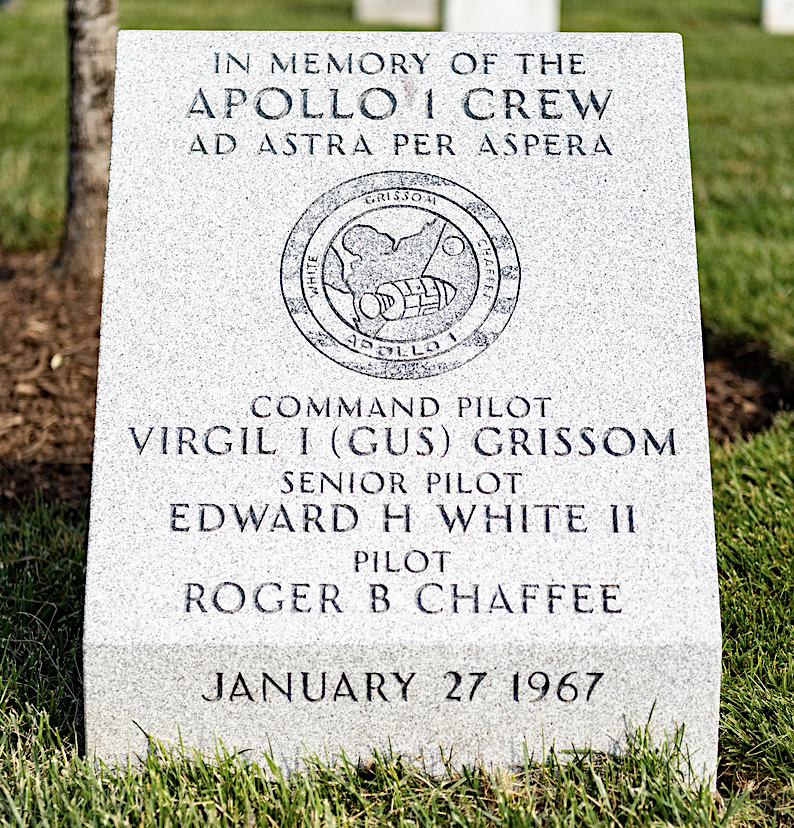
This memorial stone dedicated to the lives of Chaffee, Grissom, and White was placed on June 2, 2022. (Photo source: http://www.arlingtoncemetery.mil)

I’ve got one more post to write about ANC, with some bits and piece that I don’t want you to miss.

This plaque was placed by the National Society of the Colonial Dames of America.

A Final Salute: Paying Our Respects at Virginia’s Arlington National Cemetery, Part IV

21 Thursday Sep 2023

Posted by adventuresincemeteryhopping in General

≈ 2 Comments

Arlington National Cemetery (ANC) is first and foremost a military cemetery. But several members of the U.S. Supreme Court are buried there as well. Most are buried in Section Five, just below the grave of President John F. Kennedy.

View of the U.S. Capitol Building from Arlington National Cemetery.

Most of the justices were eligible to be buried at ANC because they met the cemetery’s military service requirement, but others were given special permission to be buried there.

Justices By The Numbers

Since it was established in 1789, 114 persons have served as a justice (associate justice or chief justice) on the Supreme Court. Of these, 103 have died. Four chief justices and 10 associate justices are buried at ANC.

The first death of a justice was that of James Wilson on Aug. 21, 1798, and the most recent was that of Ruth Bader Ginsburg on Sept. 18, 2020. Pres. William Howard Taft, chief justice from 1921 to 1930 after serving as president from 1909 to 1913, was the first justice for whom a state funeral has been held. Ginsburg, who served as an associate justice from 1993 to 2020, was the second to receive this honor.

I photographed the graves of six justices buried at ANC. That doesn’t include Pres. Taft, whose grave I’ve already shared here in a previous installment.

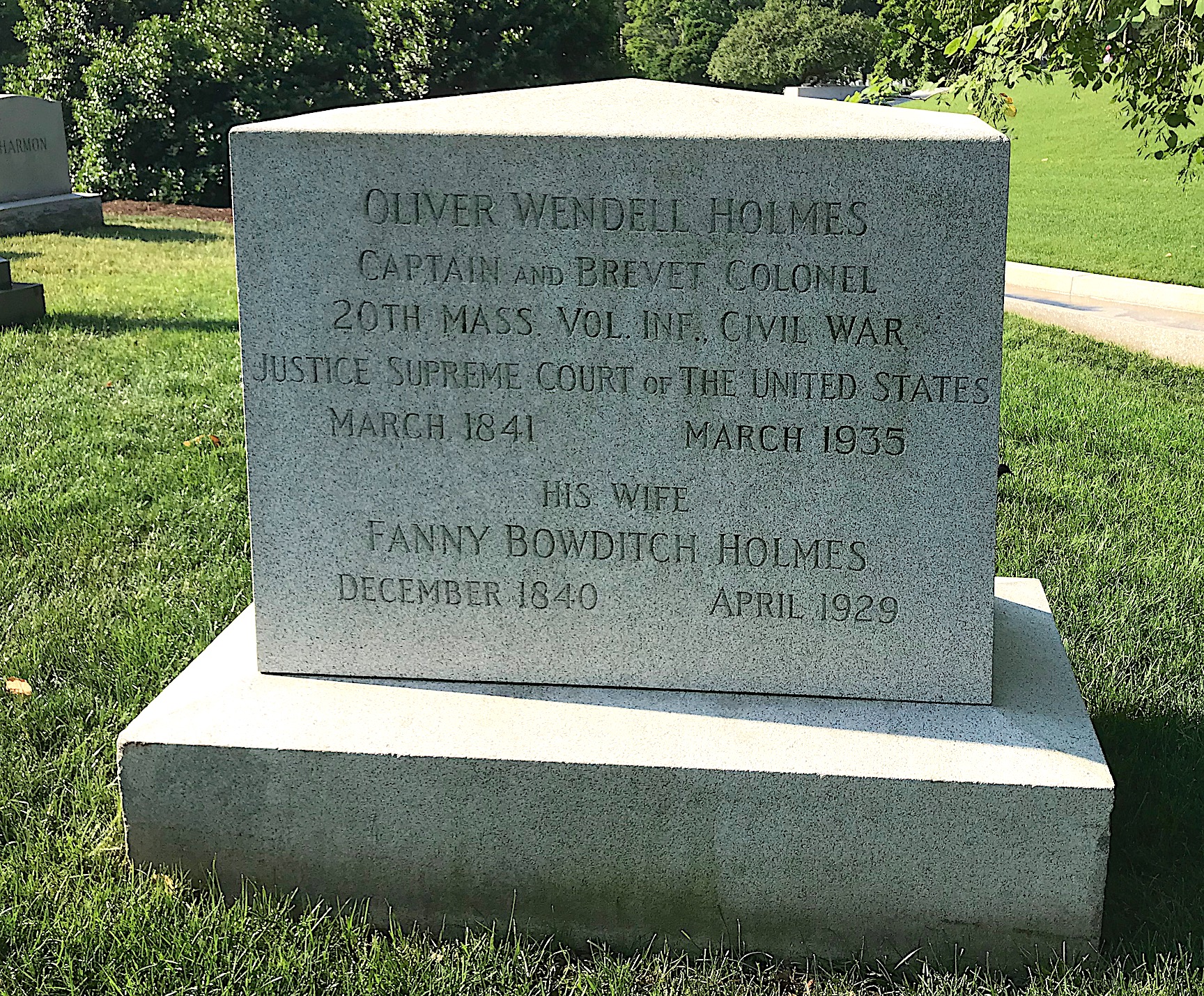
Oliver Wendell Holmes, Jr.

The first associate justice buried at ANC was Oliver Wendell Holmes, Jr. (1841-1935). After graduating from Harvard, Holmes served in the Union Army during the Civil War, wounded three times in battle. He entered Harvard Law School in 1864 and was admitted to the Massachusetts bar in 1867. For the next 14 years, he practiced law in Boston, but his love for legal scholarship became evident during this time.

Supreme Court Justice Oliver Wendell Holmes, Jr. became known as “The Great Dissenter”.

Holmes was offered a post teaching law at Harvard, but after teaching only one semester, he resigned to accept an appointment to the Supreme Judicial Court of Massachusetts, the state’s highest court. Holmes served on the Supreme Judicial Court for 20 years, eventually becoming its Chief Justice.

In 1902, Holmes was appointed by President Theodore Roosevelt to the U.S. Supreme Court. It might never have happened, except that Roosevelt and Holmes were both friends with Massachusetts Senator, Henry Cabot Lodge. He convinced Roosevelt that Holmes was favorable towards Roosevelt’s progressive policies.

Roosevelt would come to regret that decision after Holmes participated in striking down some of those initiatives. Holmes served on the Supreme Court longer than any other person up to that date, 30 years.

Oliver Wendell Holmes, Jr. served in the Union Army during the Civil War.

Holmes was called “the Great Dissenter” because he was often at odds with his fellow justices and eloquently expressed his dissents. Holmes resigned due to poor health in 1932, at age 90, at which point he was the oldest justice ever to have served on the Court. He died in March 1935, two days short of his 94th birthday.

William Orville Douglas

Born in Minnesota, William Orville Douglas (1898-1980) attended Columbia University where he received his law degree in 1925. After graduation, he practiced corporate law and taught part time at Columbia Law School. He joined the faculty at Yale Law School where he taught from 1928 to 1934. While at Yale, he became known for his work in bankruptcy law.

He accepted a position with the Securities and Exchange Commission (SEC) in 1934 and became chairman of the SEC (1937-1939), replacing Joseph P. Kennedy after he became ambassador to Great Britain. President Franklin Roosevelt appointed Douglas to the Supreme Court in 1939 to replace Justice Louis D. Brandeis.

Justice William O. Douglas was married four times and divorced three times.

Many thought Douglas would be pro-business. Instead, he became a strong individualist and an activist interpreter of the guarantees of the Bill of Rights. He opposed censorship and maintained a powerful distrust of government power.

As Supreme Court justice, Douglas wrote many dissenting opinions. He often faced critics who demanded his impeachment. The first came in 1952 when he granted a stay of execution to Julius and Ethel Rosenberg, found guilty of passing atomic secrets to the Soviet Union.

There were more calls for his impeachment in the late 1960s because of his criticism of the Vietnam War. In 1970, congressman (later President) Gerald R. Ford organized yet another attempt to impeach Douglas, which failed.

Douglas served as a Supreme Court Justice for 36 years.

On Dec. 31, 1974, Douglas suffered a stroke. He returned to the Supreme Court but his health was fragile. Douglas retired on Nov, 12, 1975, after 36 years on the Supreme Court, a record not likely soon to be broken. He died on Jan. 19, 1980 at age 81.

In 1918, Douglas took part in a U.S. Army Reserve Officers’ Training Corps training encampment at the Presidio of San Francisco. That fall, he joined the Student Army Training Corps at Whitman as a private. He served from October to December, and was honorably discharged because the Armistice of Nov. 11, 1918 ended the war.

Potter Stewart

Potter Stewart (1915-1985), son of the Republican mayor of Cincinnati, graduated from Yale University in 1937, graduated from Yale Law School in 1941, and was editor of the Yale Law Journal.

During Stewart’s tenure, he made major contributions to criminal justice reform, civil rights, access to the courts, and Fourth Amendment jurisprudence.

After serving in the Navy in World War II, Stewart entered private practice and local politics in Cincinnati. He was appointed to the U.S. Court of Appeals as judge for the Sixth Circuit in 1954. President Dwight D. Eisenhower appointed him to the U.S. Supreme Court in 1958. As a conservative, he followed a moderate approach that defied easy categorization. In 1968, Stewart removed himself from consideration for the position of chief justice, when other members of the court previously had sought the position.

He went on to play a significant role in formulating the court’s unanimous opinion in 1974, which ordered President Richard Nixon to surrender to the special prosecutor the tape recordings whose disclosure later led Nixon to resign. He retired from the bench in 1981.

Potter Stewart was appointed to the U.S. Supreme Court by President Dwight D. Eisenhower in 1958.

After his retirement, Stewart appeared in a series of public television specials. He died of a stroke at age 70 on Dec. 7, 1985.

Thurgood Marshall, Sr.

Born in Baltimore, Md., Thurgood Marshall, Sr. (1908-1993) attended segregated public schools. Marshall attended Howard University Law School, graduating first in his class in 1933. After graduation, Marshall practiced law in Baltimore. In his first major court victory, in 1935, he successfully sued the University of Maryland Law School for denying admission to a black applicant on the grounds of race.

Justice Thurgood Marshall was the first African-American appointed to the U.S. Supreme Court.

In 1940, he founded and served as executive director of the NAACP Legal Defense and Educational Fund. In that position, he argued numerous cases before the Supreme Court — including Brown vs. Board of Education (1954), which held that the racial segregation of public schools violated the Constitution. Marshall won 29 of the 32 cases that he argued before the Supreme Court.

In 1961, President John F. Kennedy appointed Marshall to the U.S. Court of Appeals for the Second Circuit. In 1965, President Lyndon B. Johnson appointed him as Solicitor General. This made Marshall (at the time) the highest-ranking black government official in U.S. history. 

President Johnson nominated him to the Supreme Court on June 13, 1967. Marshall’s nomination was confirmed by the U.S. Senate on August 30, 1967.

Justice Marshall served on the Supreme Court from 1967 to 1991.

On the Supreme Court, Marshall consistently defended the constitutional protection of individual rights, including the rights of criminal defendants. He also continued advocating for the civil rights of African-Americans and other minorities. He described his legal philosophy as, “You do what you think is right, and the law will catch up.”

Marshall did not wish to retire. He often said “I was appointed to a life term, and I intend to serve it.” But due to ill health, he announced on June 27, 1991, that he would retire. He died on Jan. 24, 1993.

Warren Burger

Warren Earl Burger (1907-1995) served as the 15th Chief Justice of the United States from 1969 to 1986. The longest-serving Chief Justice of the 20th century, his court delivered ground-breaking decisions on abortion and school desegregation.

A native of Minnesota, Burger attended night school at the University of Minnesota, while selling insurance to support himself. He enrolled at what became William Mitchell College of Law, receiving his degree in 1931. He took a job at the firm which became Faricy, Burger, Moore & Costello. He also taught for 12 years at St. Paul College of Law.

In 1956, President Eisenhower appointed him to a judgeship on the U.S. Court of Appeals for the District of Columbia Circuit, where he remained for 13 years.

In 1969, President Nixon appointed Burger to succeed Warren. It became apparent that Burger was not going to turn the clock back on the rulings of the Warren court. In the early 1970s, the Court issued rulings supporting busing to remedy de facto racial segregation in schools and invalidating all U.S. death penalty laws (although Burger dissented from the latter decision).

In the most controversial ruling of his term, Roe vs. Wade, Burger voted with the majority for the legalization of abortion. Burger also wrote the landmark 1973 decision that supplied the still-used legal definition of obscenity. In 1974 Burger ruled against Nixon’s attempt to keep several memos and tapes relating to the Watergate scandal private, prompting Nixon to resign the presidency in order to avoid impeachment.

Chief Justice Burger succeeded Earl Warren in 1969.

Overall, Burger did not dominate the court. He generally wrote only uncontroversial opinions, where the Court was not evenly divided. Instead, he concentrated on the other role of the Chief Justice, administering the nation’s legal system.

Burger retired on Sep. 26, 1986 and died on June 25, 1995 of congestive heart failure at age 87. Burger’s casket was displayed in the Great Hall of the U.S. Supreme Court Building, an honor previously bestowed only on Chief Justice Earl Warren and Justice Thurgood Marshall.

Harry Blackmun

A native of Nashville, Ill., Harry Andrew Blackmun moved to Minnesota as a boy. He received his undergraduate degree in math from Harvard University in 1929, and earned his law degree also from Harvard in 1932. He returned to Minnesota to practice law. His career included nine years as resident counsel for the Mayo Clinic.

In 1959, President Eisenhower appointed him to the U.S. Court of Appeals. In 1969, Justice Abe Fortas was forced to resign from the Supreme Court. President Richard Nixon then appointed Clement Haynsworth but he was rejected by the Senate. Nixon then appointed G. Harold Carswell, who was also rejected by the Senate.

Justice Blackmun championed the separation of church and state.

Blackmun was recommended to Nixon by Chief Justice Warren Burger, who was Blackmun’s childhood friend. He was confirmed by the Senate without opposition. Because Blackmun was Nixon’s third choice to the court, he jokingly called himself “Ol’ Number 3” and said it kept him humble.

Blackmun had been on the court just three years when he wrote the majority opinion in the landmark case of Roe v. Wade. Two causes he championed were the strict separation of church and state, and freedom of speech.

He resigned from the Court on Aug. 3, 1994, having served for 24 years. He continued to come daily to the Court, where he kept up his habit of going to breakfast in the cafeteria with his clerks. In 1997, he played Justice Joseph Story in the film “Amistad,” becoming the first Supreme Court justice to appear in a motion picture.

Justice Blackmun is viewed by some as the most liberal member of the Supreme Court.

On February 22, 1999, Blackmun fell at his home and the next day underwent hip replacement surgery. He died on March 4, 1999.

Please join me soon for Part IV when I share some ANC stories from beyond the stars.

Admiral Hyman George Rickover (1900-1986), known as the “father of the nuclear navy”, is buried to the right of Justice Douglas.

A Final Salute: Paying Our Respects at Virginia’s Arlington National Cemetery, Part III

15 Friday Sep 2023

Posted by adventuresincemeteryhopping in General

≈ Leave a comment

Understably, just about every person who visits Arlington National Cemetery (ANC) wants to visit the Tomb of the Unknown Soldiers (yes, there’s more than one) and witness the changing of the guard. We did so during our Tours By Foot tour. As I’ve told you, it was an incredibly hot day. At one point, my phone gave me the “phone too hot to function” message and I couldn’t take photos for a short time.

The Tomb of the Unknowns has been guarded 24 hours a day, seven days a week, since 1937.

Tomb of the Unknowns Facts

On Veterans Day 1921, President Warren G. Harding presided over an interment ceremony at ANC for an unknown soldier who died during World War I. After that, three more soldiers were added to the Tomb of the Unknowns memorial but one of them has since been disinterred and moved.

Thanks to the folks over at Mental Floss, I have some facts about the Tomb of the Unknown Soldiers that I think you’ll find interesting.

First, four random unknown soldier candidates were selected for the World War I crypt, exhumed from four different WW I American cemeteries in France. U.S. Army Sgt. Edward F. Younger, wounded in combat and a Distinguished Service Medal recipient, selected a soldier for burial at the Tomb of the Unknowns.

After the four identical caskets were lined up for his inspection, Younger picked the third casket from the left by placing a spray of white roses on it. The chosen soldier was transported to the U.S. on the USS Olympia, while the other three were reburied at Meuse Argonne American Cemetery in France.

Sgt. Edward Younger on the day of the selection ceremony. (Photo source: Army Heritage and Education Center)

In choosing two unknown soldiers to represent World War II, one served in the European Theater and the other served in the Pacific Theater. The Navy’s only active-duty Medal of Honor recipient, Hospitalman First Class William R. Charette, chose one of the identical caskets to go on to Arlington. The other was given a burial at sea.

For the Korean War, the soldiers were disinterred from the National Cemetery of the Pacific in Hawaii. Army Master Sgt. Ned Lyle chose the casket. Along with the unknown soldier from WWII, the unknown Korean War soldier lay in the Capitol Rotunda from May 28 to May 30, 1958.

Photo of the unknown soldiers from World War II and the Korean War in the Capitol Rotunda, as they lay in state from May 28 to May 20, 1958.

In 1984, Medal of Honor recipient U.S. Marine Corps Sgt. Maj. Allan Jay Kellogg, Jr. chose the Vietnam War representative during a ceremony at Pearl Harbor. But in this case, he would not remain unknown.

Because of advances in DNA testing, in 1998 scientists identified the remains of the Vietnam War soldier as Air Force First Lt. Michael Joseph Blassie. He was shot down near An Loc, Vietnam in 1972. After his identification, Blassie’s family had him moved to Jefferson Barracks National Cemetery in St. Louis, Mo. for burial.

Unknown no more. Vietnam casualty Air Force First Lt. Michael J. Blassie’s remains were identified through DNA testing.

Instead of adding another unknown soldier to the Vietnam War crypt, the crypt cover was replaced with one bearing the inscription, “Honoring and Keeping Faith with America’s Missing Servicemen, 1958-1975”.

Becoming a Tomb Guard

Our guide shared with us that members of the Tomb Guard who watch over the Tomb of the Unknowns must apply for the position. If chosen, the applicant must pass tests on weapons, ceremonial steps, cadence, military bearing, uniform preparation, and orders.

Soldiers who apply to be Tomb guards must pass many tests to be chosen.

Tomb guards must also pass a knowledge test on their memorization — including punctuation — of 35 pages on the history of the tomb. Once chosen, guards “walk the mat” in front of the tomb for anywhere from 30 minutes to two hours. They work in 24-hour shifts. However, when they aren’t walking the mat, they’re in the living quarters beneath it. This gives them time to complete training and prepare their uniforms, which can take up to eight hours. Tomb guards serve for an average of 18 months.

War Hero Turned Actor

Our tour included a visit to Audie Murphy’s grave, buried near the Tomb of the Unknowns. His heroic actions in battle eventually led him to a place among the Hollywood stars.

Born in Texas in 1925, Audie Leon Murphy became one of the most famous American field combat soldiers to emerge from World War II. He served in Europe in the U.S. Army as a second lieutenant of Company B, 15th Infantry, Third Infantry Division. He was awarded the Congressional Medal of Honor for his bravery near Holtzwihr, France, on Jan. 26, 1945.

I won’t go into the details of how he won his Medal of Honor. But his war-time efforts won him promotions up to major in the U.S. Army. When he was discharged, he was the most decorated American soldier of the war, garnering 27 different medals (five each from France and Belgium). Murphy received every U.S. military combat award for valor available from the U.S. Army.

Maj. Audie Murphy found it hard returning home a World War II hero.

Murphy returned home a hero and ended up in Hollywood. He played himself in “To Hell and Back” in 1955, which detailed his exploits. He starred in the critically acclaimed 1951 movie version of author Stephen Crane’s “The Red Badge of Courage”. In all, he appeared in 47 films, most of them either Westerns or war movies.

Murphy died in a plane crash on May 28, 1971 in Virginia after completing his last film, ironically called “A Time for Dying”. Buried with full military honors near the Tomb of the Unknowns, his grave attracted so many visitors that a special walkway was built. When all the Medal of Honor recipients buried in ANC had their headstones replaced with the now-standard gold leaf inlay Medal of Honor marker, his family asked that his be kept plain and inconspicuous, in accordance with his wishes.

Audie Murphy’s grave is visited so often, it has its own walkway.

Championing Veterans

I want to talk about Audie Murphy’s second wife, Pam Archer Murphy. To me, she is an unsung hero few know about.

At the time of her husband’s death, he was broke due to gambling and bad investments. Pam went from a comfortable California home with their two sons to living in a small apartment. She took a clerk’s job at the nearby Veteran’s Administration hospital to support herself and start paying off her husband’s debts.

Pam Murphy quietly built a 35-year career working as a patient liaison at the Sepulveda VA Hospital, treating every veteran who visited as if they were a VIP. She worked there until 2007.

Pam Archer Murphy worked tirelessly for more than three decades to help veterans get the medical help they needed.

One article I read said:

“Nobody could cut through VA red tape faster than Mrs. Murphy,” said veteran Stephen Sherman, speaking for thousands of veterans she befriended over the years. “Many times I watched her march a veteran who had been waiting more than an hour right into the doctor’s office. She was even reprimanded a few times, but it didn’t matter to Mrs. Murphy. Only her boys mattered. She was our angel.”

Pam died on April 8, 2010. She is buried at Forest Lawn Memorial Park in Hollywood Hills, Calif.

General John Joseph “Black Jack” Pershing

I’m going to finish up with a well-known but somewhat controversial military figure: General John Joseph “Black Jack” Pershing.

Much has been written about Pershing so I’m not going to make this longer than it needs to be. But he is best known for serving from 1917 to 1918 as the commander of the American Expeditionary Forces on the Western Front during World War I. That’s just a small portion of his military career, however.

Before entering West Point in 1882, Pershing taught African-American students at Prairie Mound School in Missouri. A few years later, he became one of the first white officers to command African-American soldiers in the 10th Cavalry. His nickname came from his command of the segregated regiment, but later came to represent his stern demeanor.

General John Joseph “Black Jack” Pershing (Photo source: Library of Congress)

In 1898, Pershing led 10th Cavalry soldiers up San Juan Hill during the Spanish-American War. This caught the attention of Theodore Roosevelt, who also fought there with his “Rough Riders”. After Roosevelt became president, he promoted Pershing to brigadier general over 800 more senior officers. This ruffled some feathers.

Pershing served in the Philippines. Before Pershing returned to the U.S. in 1913, he was military governor of the southern Philippines’ Moro Province.

Tragedy Strikes

In 1915, Pershing’s wife, Frances, and their three daughters perished in a fire at their home in San Francisco. At the time, Pershing was patrolling the Mexican border against a rumored invasion by Mexican revolutionary Francisco “Pancho” Villa. Only son Warren survived.

President Woodrow Wilson, on the advice of military attaché Major Douglas McArthur named Pershing to command the American Expeditionary Forces being sent to France after America’s declaration of war on Germany. Some of his tactics have been criticized. His reliance on costly frontal assaults, long after other allied armies had abandoned such tactics, has been blamed for causing unnecessarily high American casualties.

After World War I, Congress conferred upon him the special rank of “General of the Armies of the United States”. With this rank, he was given the option of five stars, but declined the offer, sticking with four stars. He served as U.S. Army chief of staff from 1921 until his retirement in 1924. He died on July 15, 1948.

Pershing’s marker is simple, per his final wishes. His son, Warren, is buried nearby.

Pershing’s funeral cortege was led by the President Harry S. Truman, himself a veteran “doughboy” from World War I. After the funeral service in the memorial amphitheater, one of only nine to ever be held there, his last request to be buried with the men he had led and fought beside was honored. His grandson, Second Lt. Richard Pershing, who died in 1968 while serving in the Vietnam War, is buried beside him.

Pershing’s funeral was held in ANC’s memorial amphitheater, one of only nine to ever be held there.

Yes, I’ve got a Part IV planned. It’s coming soon. Hope you’re enjoying this series.

The USS Maine memorial overlooks the remains of 230 service members who died when the battleship exploded off the coast of Havana, Cuba on February 15, 1898.

A Final Salute: Paying Our Respects at Virginia’s Arlington National Cemetery, Part II

08 Friday Sep 2023

Posted by adventuresincemeteryhopping in General

≈ Leave a comment

Last week, I filled you in on some of the history behind Arlington National Cemetery (ANC). This time, we’re going to visit some folks that you might not have expected to find buried here.

Arlington National Cemetery boasts an estimated 400,000 interments.

The Brown Bomber

Near the end of our Tours by Foot tour, our group stopped in Section 7A by the grave of boxer Joe Louis (Barrow). I had no idea he’d been in the military but it turns out he served in the U.S. Army during World War II. Realizing Louis’s potential for raising moral among the troops, the Army placed him in its special services division rather than sending him into combat. Louis went on a celebrity tour with other notables, including fellow boxer Sugar Ray Robinson. He traveled more than 22,000 miles and staged 96 boxing exhibitions before two million soldiers.

Joe Louis Barrow (his full name) was eventually promoted to the rank of technical sergeant on April 9, 1945.

Nicknamed “the Brown Bomber”, Louis is regarded as one of the greatest boxers of all time. He reigned as the world heavyweight champion from 1937 until his temporary retirement in 1949. He was victorious in 25 consecutive title defenses, a record for all weight classes. Louis had the longest single reign as champion of any boxer in history.

Joe Louis Barrow died on April 12, 1981.

Louis died of cardiac arrest near Las Vegas on April 12, 1981, just hours after his last public appearance viewing the Larry Holmes–Trevor Berbick heavyweight championship fight.

While Louis did serve in the U.S. Army, he technically did not meet the requirements for burial at ANC. President Ronald Reagan waived the eligibility rules in his case, and Louis was buried there with full military honors on April 21, 1981. His funeral was paid for in part by former boxing competitor and friend, Max Schmeling, who also acted as a pallbearer.

Joe Louis is buried with his third wife, Martha Jefferson. She died in 1991.

PFC Lee Marvin

While I enjoyed our Tours by Foot tour of ANC, I was left a little irritated by one thing. It wasn’t until after we got back to our hotel and I was looking online that I realized actor (and former U.S. Marine) Lee Marvin is buried only a few feet from Joe Louis. Because of the direction we were standing at the time, you couldn’t see the front of Marvin’s marker. Our guide didn’t even mention it. That’s a pretty glaring omission, in my opinion.

When I went back on my own a few days later, I photographed Lee Marvin’s grave. If you’ve ever watched a movie he was in and thought what a tough guy he was, it’s because he earned it in real life.

In August 1942, Marvin, 18, enlisted in the U.S. Marines in New York. He trained at Parris Island in South Carolina and a base at New River, N.C.

Lee Marvin was a Marine before he was an actor in Hollywood.

Marvin went to quartermaster school in North Carolina and was promoted to corporal, then ordered to Camp Elliot in San Diego, Calif. He was demoted to private after Marvin, known for being a troublemaker, caused some issues.

In January 1944, Marvin was shipped to the Marshall Islands. He was part of the 22nd Marines, which would survey the area before the attack, specifically Kwajalein. Once the Marines had taken Eniwetok and Kwajalein, Marvin was sent to Hawaii for training and then was sent to Saipan in June 1944. In the invasion of Saipan, Marvin was one of six out of 247 men in his unit who wasn’t killed, according to a Sept. 27, 1968, Life magazine article.

Marvin was treated for 13 months in Navy hospitals for a severed sciatic nerve and was awarded the Purple Heart in a hospital on Guadalcanal. He was nearly permanently paralyzed by his injury. Marvin wanted to get back into combat but his injury kept him in the hospital, preventing that.

Lee Marvin earned his toughness while serving as a Marine in World War II.

Back in the U.S., Marvin worked odd jobs until he got into acting in New York. He was in off-Broadway plays from 1948 to 1950 until he started in television and films in 1950. In 1968, Marvin returned to the Pacific to be in the movie “Hell in the Pacific,” co-starring Toshirô Mifune, about an American pilot during World War II who is on a deserted uninhabited Pacific island with a Japanese Naval captain. During World War II, Mifune was a Japanese officer.

Marvin appeared in at least 10 war movies during his acting career, including the classic 1967 film, “The Dirty Dozen”. He won an Oscar for his role as a drunken gunfighter in “Cat Ballou” in 1965.

After Marvin died of a heart attack at age 63 on Aug. 29, 1987, he was buried with full military honors at ANC.

Polio Vaccine Pioneer Lt. Col. Albert Sabin

Another surprise to me was learning that Dr. Albert Bruce Sabin, inventor of the oral polio vaccine, is buried at ANC. His grave was not on our tour so I looked for it on my return visit.

Born Abram Saperstejn (later Albert Sabin) in 1906 in Białystok, Poland to Polish-Jewish parents, he emigrated New York in 1921. In 1930, he became a naturalized citizen of the United States and changed his name to Sabin. He began college in a dentistry program, but changed majors. He received a bachelor’s degree in science in 1928 and a medical degree in 1931 from New York University.

Dr. Albert Sabin’s oral polio vaccine was licensed in 1961, about six years after Jonas Salk’s injection polio vaccine.

Dr. Sabin trained in internal medicine, pathology, and surgery at Bellevue Hospital in New York City from 1931 to 1933. In 1934, he conducted research at the Lister Institute for Preventive Medicine in England, then joined the Rockefeller Institute for Medical Research (now Rockefeller University). During this time, he developed an intense interest in research, especially in the area of infectious diseases.

Dr. Sabin’s military involvement came in World War II, when he served as a lieutenant colonel in the U.S. Army Medical Corps and helped develop a vaccine against Japanese encephalitis.

Dr. Jonas Salk developed an inactivated poliovirus vaccine (IPV), a “dead” vaccine given by injection, which was released for use in 1955. It was effective in preventing most of the complications of polio, but did not prevent the initial intestinal infection.

Dr. Sabin’s oral polio vaccine was licensed in 1961, based on mutant strains of polio virus that seemed to stimulate antibody production but not to cause paralysis. The Sabin vaccine worked in the intestines to block the poliovirus from entering the bloodstream.

A native of Poland, Dr. Albert Sabin served in the U.S. Army Medical Corps during World War II.

Dr. Sabin’s oral vaccine proved easier to administer than Salk’s, and its effects lasted longer. The Sabin vaccine became the predominant method of vaccination against polio in the United States for the next three decades. Dr. Sabin also developed vaccines against other viral diseases, including encephalitis and dengue.

Sabin, who did not patent his vaccine, never earned a dime it. He died on March 3, 1993 from congestive heart failure. He is buried with his wife, Heloisa, in Section 3.

North Pole Explorer Rear Admiral Robert Edwin Peary

Before I go any further, I preface my words about explorer Robert Peary with this caveat. I’m well aware that the claim that Peary was the first to discover the North Pole in 1909 is hotly disputed. There is strong evidence that Dr. Frederick A. Cook did so a full year before Perry did.

Born in 1856, Peary served in the U.S. Navy Civil Engineering Corps. While in the Navy, Peary made four trips to Greenland, his first expeditions into the Arctic region. Joining him was Matthew Henson, an African American explorer he hired as an assistant. These exploratory journeys earned Peary fame and prepared the way for his most ambitious journey to the North Pole.  

There’s some question as to whether or not Peary made it to the North Pole first.

Granted a leave of absence from the Navy, Peary first attempted to reach the North Pole in 1898, but returned four years later without having reached his destination. In 1905, Peary and Henson set again, pushing their way northward on sledges over the icebound Arctic Ocean. In April 1906, Peary set a new “farthest north” record, which the National Geographic Society recognized by awarding him its highest honor, the Hubbard Medal. But due to a shortage of supplies, he turned back before reaching the North Pole. 

In February 1909, Peary and six teams left Cape Columbia, on the northern coast of Canada’s Ellesmere Island. Peary, Henson, and four Inuit companions made up one team, and together they inched their way northward until, on April 6, they stood where no human had ever stood before — the North Pole. In 1911, the U.S. Congress officially recognized Peary’s achievement. In March of that year, the Navy promoted him to the rank of rear admiral.

Peary’s monument at ANC. The star at the top of the globe marks the North Pole.

Peary died on Feb. 20, 1920 in Washington, D.C. He was buried with full military honors at ANC three days later.

As plans proceeded for erecting a monument to Robert Peary, the National Commission of Fine Arts began a study for a more accessible grave site. The original site proved too difficult to develop because of its location on a hillside.

Peary’s remains were later disinterred from Section 3 and re-interred in Section 8. On April 6, 1922, the National Geographic Society unveiled a monument at Peary’s grave site, featuring a large, white granite globe. A bronze star on the globe, pointing north, marks the North Pole.

Unsung Hero: Arctic Explorer Matthew Henson

Peary’s assistant Matthew Henson was never famous in his own lifetime. But he’s just as important as Peary and I want to share it here.

Matthew Henson was born in Charles County, Md. in 1866. His parents, who were sharecroppers, died during Henson’s childhood. At age 12, he went to work as a cabin boy on a merchant ship. Aboard the ship for six years, he learned how to read, write, and navigate.

Later, while working as a clerk in a Washington, D.C. hat shop, he met Peary, who was planning a surveying expedition to Nicaragua. Upon learning of Henson’s sailing and navigation experience, Peary hired him as a valet. On the 1888 Nicaragua expedition, Henson impressed Peary, and subsequently accompanied him on seven Arctic expeditions between 1891 and 1909.

Unlike Robert Peary, Matthew Henson’s role in the discovery of the North Pole was not well publicized.

In 1912, Henson published an account of his experiences, “A Negro Explorer at the North Pole,” and he gave lectures across the country. But he received relatively little immediate recognition for his part in the 1909 expedition. He spent the remainder of his career in obscurity, working as a clerk at the U.S. Customs House in New York City.

Later, Henson received some long-overdue accolades. The prestigious Explorers Club finally admitted him as a member in 1937, Congress awarded him the Peary Polar Expedition Medal in 1944, and Presidents Harry S. Truman and Dwight D. Eisenhower welcomed him to the White House.

After his death in 1955, Matthew Henson was buried at New York’s Woodlawn Cemetery. In 1987, at the request of Dr. S. Allen Counter of Harvard University, President Ronald Reagan granted an exception to Arlington National Cemetery’s burial policy, allowing for the bodies of Henson and his wife, Lucy Ross Henson, to be re-interred at Arlington with full military honors.

Matthew Henson should have received the notoriety Peary did in 1909 but he saw little of it in his lifetime.

On April 6, 1988, the remains of Matthew Henson and his wife were transported to Washington, D.C., where they were buried near the gravesite of Admiral Peary and his wife, Josephine Deibitsch Peary. That same year, the National Geographic Society posthumously awarded Henson the Hubbard Medal, its highest honor.

The monument on Henson’s gravesite features an inset bronze plaque commemorating the North Pole discovery. At the top sits a large bas relief bust of Henson in Arctic gear. Immediately below, an inscription describes his part in reaching the North Pole. Globes of the world, tilted with the Pole in view, sit at either side.

On one side, an inscription quotes Henson’s book, “A Negro Explorer at the North Pole”:

“The lure of the Arctic is tugging at my heart. To me the trail is calling! The old trail. The trail that is always new.”

There’s still more to cover at Arlington so Part III is coming soon.

Monument to Corporal Claude Christman, who died of typhoid on Dec. 21, 1899 in the Philippines while serving in the Spanish American War. He was 21.

A Final Salute: Paying Our Respects at Virginia’s Arlington National Cemetery, Part I

01 Friday Sep 2023

Posted by adventuresincemeteryhopping in General

≈ 1 Comment

I visited Arlington National Cemetery (ANC) twice during the D.C. portion of our trip. Once with my family, and again by myself on the morning of the day we left.

ANC is not in Washington, D.C. proper but is located in Arlington, Va. across the Potomac River from D.C. It was quite easy for us to get to because our hotel was near the Pentagon and one easy Metro stop away.

Arlington’s visitor’s center is worth stopping at before you visit the cemetery.

Instead of taking the tour provided at ANC, I decided we’d take a tour with Free Tours by Foot. The premise is that you sign up, show up, take the tour, and then give your guide what you thought it was worth. We met our guide (along with about 10 other people) and headed off. It was a HOT day so we were all guzzling water.

One of the reasons I had opted for the Free Tours by Foot was because it is indeed “on foot” and not on the trams that Arlington uses. There’s nothing wrong with taking a tram but I wanted to be able to stop at anything I wanted to along the way. You can only drive a car into ANC if you have permission ahead of time to visit the grave of a loved one.

Origins of Arlington National Cemetery

Long before it was a cemetery, the land that is now ANC was Arlington Estate. It was established by President George Washington’s adopted grandson, George Washington Parke Custis, to be a living memorial to the first president.

ANC may be a huge cemetery but I think walking it on foot is the ideal way to see it.

Custis’s daughter, Mary, married U.S. Army 1st Lieutenant Robert E. Lee in 1831. Yes, THAT Robert E. Lee who later became overall commander of the Confederate Army. When he died, Custis left the estate to Mary Custis Lee for the duration of her life. Upon her death, her eldest son would inherit the property. Robert E. Lee served as executor of his father-in-law’s will and never owned the property.

After the Lees abandoned the property at the start of the Civil War, the U.S. Army seized Arlington Estate on May 24, 1861 to defend Washington, D.C. From the property’s heights, rifled artillery could range every federal building in the nation’s capital.

According to ANC’s web site, the estate was seized not to punish the Custis-Lee family, but rather for its strategic value. Three forts were built on the property during the Civil War: Fort Cass/Rosslyn, Fort Whipple/Fort Myer, and Fort McPherson (currently Section 11). Beginning in June 1863, a large Freedman’s Village, established for freed and escaped slaves, was established in what today are Sections 3, 4, 8, 18, and 20.

One of the many signs at ANC directing you where to go.

Our guide said the Lees were told they had to pay taxes in person to get their property back from the government but that every time Mrs. Lee attempted to do so in Washington, D.C., nobody would allow them to get an audience with an official to do so. So the taxes were never paid.

On May 13, 1864, the first military burial was conducted for Private William Christman. Brigadier General Montgomery Meigs, quartermaster general of the U.S. Army, who was responsible for the burial of soldiers, ordered Arlington Estate be used for a cemetery. The two existing D.C.-area national cemeteries (Soldiers’ Home and Alexandria National Cemeteries) were running out of space — both closed on the day that burials began at ANC.

ANC officially became a national cemetery on June 15, 1864, by order of Secretary of War Edwin Stanton. The original cemetery was 200 acres, and has since grown to 639 acres (as of early 2020).

British Field Marshal Sir John Dill (1881-1944) is the highest-ranking foreign military officer buried at ANC. Knighted in 1937, Dill served in the South African War and World War I, and commanded British forces in Palestine during the interwar years.

In 1874, Lee’s eldest son, George Washington Custis Lee, sued the U.S. government for the return of the Arlington property, claiming it was illegally confiscated. In December 1882, the Supreme Court ruled in Lee’s favor. A few months later, in March 1883, the federal government purchased the property from Lee for $150,000 (over $4 million today). Arlington House is still there today but it was under renovations so we could not tour it when we were there.

Arlington became a segregated cemetery, just like all national cemeteries at the time, and remained segregated by race and rank until 1948, when President Harry S. Truman desegregated the military. The primary burial ground for white Civil War soldiers became Section 13. Meanwhile, Section 27 became the area for African American soldiers and freed people; more than 3,800 freed African Americans are buried in Section 27.

If you decided to walk around ANC on foot in the summer,
take plenty of water.

Today, approximately 400,000 veterans and their eligible dependents are buried at ANC. Service members from every one of America’s major wars, from the Revolutionary War to today’s conflicts, are interred at ANC.

President William Howard Taft

ANC is the final resting place for two U.S. Presidents. One served in the military and the other did not.

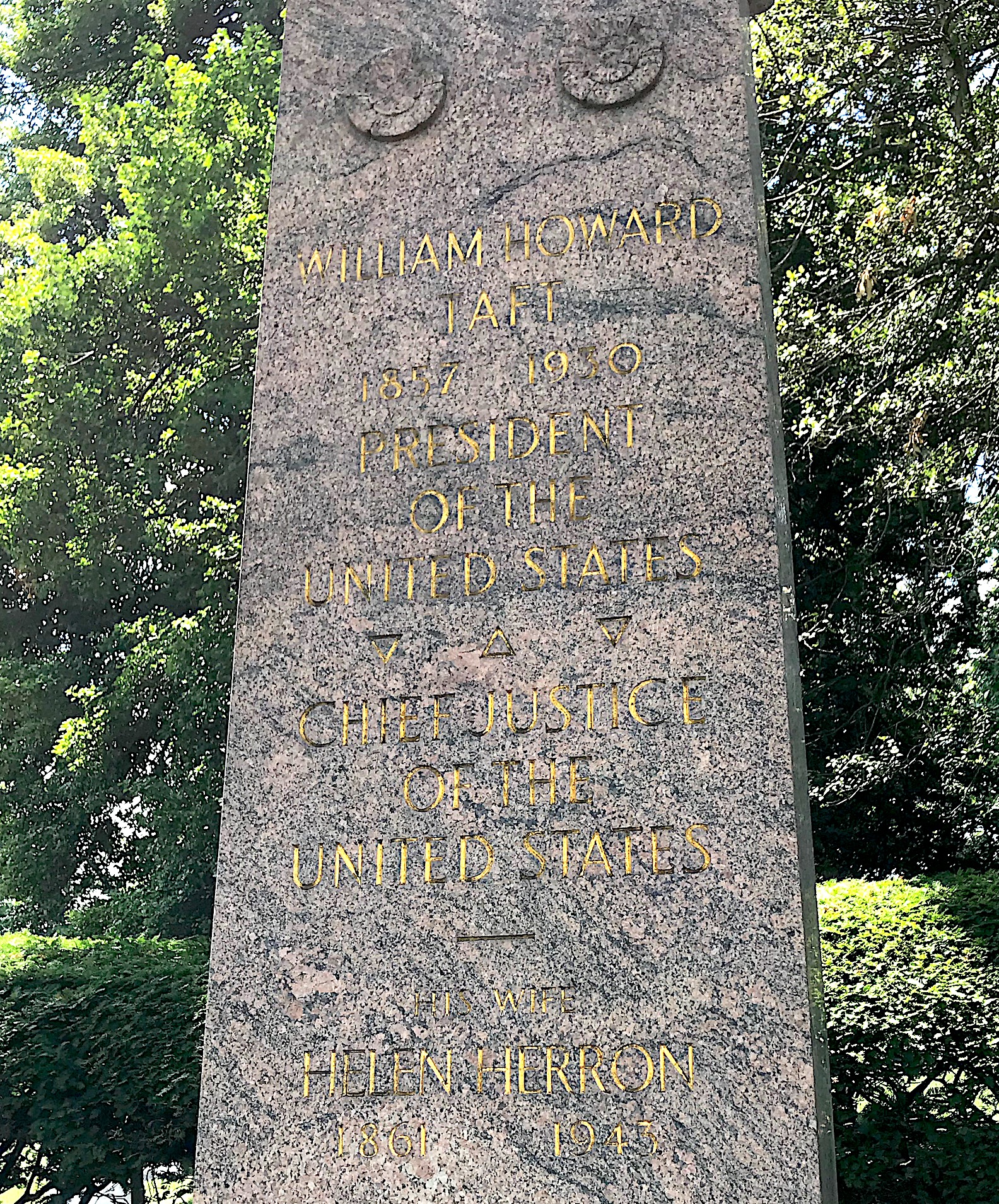
The first president buried at ANC was the 27th president, William Howard Taft, who died in 1930. He served from 1909-1913. He had the distinction of being the only U.S. president to go on to be the chief justice of the U.S. Supreme Court. Not too shabby! While he never served in the U.S. military, Taft was Secretary of War from 1904 to 1908 under President Theodore Roosevelt.

We did not see Taft’s grave as part of our tour, so we visited him on our own afterward.

Taft is the only president to serve as chief justice of the U.S. Supreme Court after being president.

After his death on March 8, 1930, Taft lay in state at the U.S. Capitol Rotunda for three days. The Taft family chose a large plot in Section 30 of ANC, which was relatively undeveloped then. Taft requested a simple ceremony with no eulogies, insisting instead upon poetry by Wordsworth and Tennyson. His burial service, too, was simple, although an elaborate procession from the Capitol preceded it, with a funeral escort provided by the 3rd Infantry Regiment.

Although Taft never served in the military, he received a funeral with full military honors.

Taft’s widow, Helen Herron Taft (buried beside him on May 25, 1943), commissioned American sculptor James Earle Fraser to design the headstone. It was finished in 1932 at a cost of $10,000, paid for by the Tafts. Made from dark mahogany granite from Stony Creek, Conn., the 14-foot-tall monument resembles classical Greek designs, and features gold-leafed inscriptions and a carved apex. Two granite benches flank the sides of the monument, and the cemetery later added a brick plaza and walkway to the site.

Taft’s wife, Helen, was buried with him after she died in 1943.

Civil Rights Leader

Civil rights leader Medgar Evers is buried right across the street from Taft in Section 36. I was unaware of this on our first visit but found out later. I made sure to stop by on my visit on our last day.

Medgar Evers served in World War II in Normany, France.

I was unaware until then that Evers had served in the U.S. Army. What he experienced there was a catalyst for his future civil rights work.

In 1943, Evers dropped out of high school at 17 to get a full-time job. Later, he volunteered for service in the U.S. Army and was inducted at Camp Shelby. During World War II, the vast majority of African Americans in the segregated U.S. military were relegated to support units because white officers regarded black men as inferior combat soldiers.

Evers was assigned to an all-black port battalion in the Quartermaster Corps. Evers’ battalion was likely charged with unloading weapons, supplies, and vehicles from allied ships onto trucks that then transported them to the front lines via convoys such as the Red Ball Express.

While serving in England and France, Evers grew frustrated with the demeaning treatment that he and other black service members received. Shortly after being discharged in 1946, he and his brother led a group of black veterans to the Newton County courthouse in Decatur, Miss. to register to vote. Evers’ small group was met by armed white men who threatened the veterans with violence if they did not leave. Undeterred, Evers continued to advocate for the full citizenship rights of African Americans.

Medgar Evers with his wife Myrlie, their son Darrell, and their daughter Reena. Evers’ third child, James, was born in 1960.(Photo source: The City University of New York.)

On the night of June 11, 1963, Evers was returning to the home he shared with his wife and three young children. As he made his way to the front door, he was shot in the back by a sniper concealed in a grove of trees several hundred feet away. Evers died less than one hour later on June 12 at the University of Mississippi Medical Center. He was only 37 years old.

Evers was laid to rest with full military honors at ANC on June 19. An estimated 3,000 people attended the ceremony. On June 28, the cover of Life magazine bore the image of Evers’ wife Myrlie comforting their son at the funeral.

President John F. Kennedy

Unlike Taft, President John F. Kennedy’s grave was included in our tour. Unlike Taft, Kennedy did serve in the military. Despite poor healthy, Kennedy was assigned as an ensign in the Naval Reserves serving in intelligence. Ensign Kennedy’s next big break came when he was able to attend officers training school in the late summer of 1942. You can read all about his military history here, including his command of the Patrol Torpedo (PT) boat 109.

President John F. Kennedy’s official posthumous presidential portrait, by Aaron Shikler. I photographed it when we took a tour of the White House the same week we toured ANC.

After Kennedy’s assassination in Dallas, Texas, on Nov. 22, 1963, a decision had to be made. At the time, many believed that he would be buried in Brookline, Mass. where he was born and raised. However, first lady Jacqueline Kennedy wanted her husband’s grave site to be widely accessible to the American public.

In selecting a location, she consulted with the president’s brother, Robert F. Kennedy, and secretary of defense Robert S. McNamara — both of whom are now also buried at Arlington. The original grave site was located on a sloping hillside along an axis line between Arlington House and the Lincoln Memorial. 

The initial plot was 20 feet by 30 feet, and surrounded by a white picket fence. During the first year after Kennedy’s death, up to 3,000 people per hour visited his gravesite. Onn weekends, an estimated 50,000 people visited. Three years after Kennedy’s death, more than 16 million people had visited the grave site. 

The Kennedy plot includes President John F. Kennedy, Jacqueline Bouvier Kennedy Onassis, daughter Arabella who was stillborn, and son Patrick who only lived two days after his birth.

Because of the large crowds, cemetery officials and members of the Kennedy family decided that a more suitable site should be constructed. Construction began in 1965 and was completed on July 20, 1967. An eternal flame, lit by Mrs. Kennedy, burns from the center of a five-foot circular granite stone at the head of the grave.

Quote from President John F. Kennedy’s inaugural speech given on Jan. 20, 1961.

The Kennedy family paid actual costs in the immediate grave area, while the federal government funded improvements in the surrounding area that accommodated the visiting public. The 1965 public works appropriation included $1,770,000 for this purpose.

John F. Kennedy’s younger brother, Joseph Jr., was killed in action on Aug. 12, 1944 during World War II. His remains were never recovered. There is a cenotaph (memorial marker) for him at ANC in the Kennedy plot.

John F. Kennedy’s older brother, Joseph Jr., was a U.S. Navy pilot who was killed in action during World War II. This is a cenotaph.

When John F. Kennedy’s brother, senator Robert F. Kennedy, died in Los Angeles, Calif. on June 6, 1968 after being shot the previous evening, he was buried at ANC in the Kennedy plot. Like John and Joseph Jr., Robert served in the U.S. Navy during World War II.

Robert Kennedy’s burial turned out to be rather unusual due to unforeseen circumstances.

Robert F. Kennedy’s Unique Burial

Robert Kennedy’s funeral took place on June 8, 1968 at St. Patrick’s Cathedral in New York City and his body was then taken by train to Washington, D.C. for burial at ANC. However, the number of mourners getting close to the tracks along the journey caused lengthy delays. The train finally arrived at Union Station just after 9 p.m.

The procession stopped at the Lincoln Memorial, where the U.S. Marine Corps Band played “The Battle Hymn of the Republic”.

When the motorcade finally arrived at Arlington, it was 10:24 pm. The burial ceremony, due to begin at 5:30 pm, actually began at 10:30 pm in the dark. Although this was not part of the original plan, organizers quickly adapted and handed out candles to mourners. The candlelight helped illuminate the graveside and mourners in a beautiful display. 

Years later, John, Joseph and Robert Kennedy’s brother senator Edward “Ted” Kennedy died of brain cancer on Aug. 25, 2009 in Hyannis Port, Mass. Ted served in the U.S. Army from 1951 to 1953. He was buried beside near his brothers at ANC.

Senator Edward “Ted” Kennedy served in the U.S. Army for two years.

There’s much more ground to cover at ANC. I’ll have more for you next time.

Monument to U.S. Army nurses who died while serving in the Spanish American War.

Recent Posts

  • More Pensacola, Fla. Cemetery Hopping: Taking a Ramble Through Saint John’s Cemetery, Part III
  • More Pensacola, Fla. Cemetery Hopping: Taking a Ramble Through Saint John’s Cemetery, Part II
  • More Pensacola, Fla. Cemetery Hopping: Taking a Ramble Through Saint John’s Cemetery, Part I
  • The City of Five Flags: Stepping back in time at Pensacola, Fla.’s Saint Michael’s Cemetery, Part V
  • The City of Five Flags: Stepping back in time at Pensacola, Fla.’s Saint Michael’s Cemetery, Part IV

Archives

  • December 2025
  • November 2025
  • August 2025
  • July 2025
  • June 2025
  • May 2025
  • April 2025
  • March 2025
  • February 2025
  • January 2025
  • October 2024
  • August 2024
  • July 2024
  • June 2024
  • May 2024
  • April 2024
  • March 2024
  • February 2024
  • January 2024
  • December 2023
  • November 2023
  • October 2023
  • September 2023
  • August 2023
  • July 2023
  • June 2023
  • May 2023
  • April 2023
  • March 2023
  • February 2023
  • January 2023
  • December 2022
  • November 2022
  • October 2022
  • September 2022
  • August 2022
  • July 2022
  • June 2022
  • May 2022
  • April 2022
  • March 2022
  • February 2022
  • January 2022
  • December 2021
  • November 2021
  • October 2021
  • September 2021
  • August 2021
  • July 2021
  • May 2021
  • April 2021
  • March 2021
  • February 2021
  • January 2021
  • December 2020
  • November 2020
  • October 2020
  • September 2020
  • August 2020
  • July 2020
  • June 2020
  • May 2020
  • April 2020
  • March 2020
  • February 2020
  • January 2020
  • December 2019
  • November 2019
  • October 2019
  • September 2019
  • August 2019
  • July 2019
  • June 2019
  • May 2019
  • April 2019
  • March 2019
  • February 2019
  • January 2019
  • December 2018
  • November 2018
  • October 2018
  • September 2018
  • August 2018
  • May 2018
  • April 2018
  • March 2018
  • February 2018
  • January 2018
  • December 2017
  • November 2017
  • October 2017
  • September 2017
  • August 2017
  • July 2017
  • June 2017
  • May 2017
  • April 2017
  • March 2017
  • February 2017
  • January 2017
  • December 2016
  • November 2016
  • October 2016
  • September 2016
  • August 2016
  • July 2016
  • June 2016
  • May 2016
  • April 2016
  • March 2016
  • February 2016
  • January 2016
  • December 2015
  • November 2015
  • October 2015
  • September 2015
  • August 2015
  • July 2015
  • May 2015
  • April 2015
  • March 2015
  • February 2015
  • January 2015
  • December 2014
  • November 2014
  • October 2014
  • September 2014
  • August 2014
  • July 2014
  • June 2014
  • May 2014
  • April 2014
  • March 2014
  • February 2014
  • January 2014
  • December 2013
  • November 2013
  • October 2013
  • September 2013
  • August 2013
  • July 2013
  • June 2013
  • May 2013
  • April 2013
  • March 2013
  • February 2013
  • January 2013

Categories

  • General

Blogroll

  • A Grave Interest
  • Cemetery Photography by Chantal Larochelle
  • Cemetery Tours of Berlin by Matti
  • Confessions of a Funeral Director (Caleb Wilde)
  • Find a Grave
  • Hunting and Gathering (cool photography site)
  • Save Our Cemeteries (New Orleans, La.)
  • The Cemetery Club
  • The Graveyard Detective
  • The Rambling Muser
  • Westminster Abbey Tours by Grace

Meta

  • Create account
  • Log in
  • Entries feed
  • Comments feed
  • WordPress.com

Blog at WordPress.com.

  • Subscribe Subscribed
    • Adventures in Cemetery Hopping
    • Join 402 other subscribers
    • Already have a WordPress.com account? Log in now.
    • Adventures in Cemetery Hopping
    • Subscribe Subscribed
    • Sign up
    • Log in
    • Report this content
    • View site in Reader
    • Manage subscriptions
    • Collapse this bar
 

Loading Comments...