
This week in Part V, I’m going to share some of the memorials I saw while I was at Arlington National Cemetery (ANC). You can find them all over the place, for various groups of people for various events. Some of them were for particular military groups. A few surprised me, though. Some of these I came across on my return visit when I was wandering around ANC by myself.
I’m also going to tell the story of three astronauts, two of whom are buried at ANC.

Lockerbie Memorial
While looking for Abner Doubleday over in Section 1, I came upon this memorial. It looked like a little tower to me.

The Lockerbie Memorial Cairn memorializes the 270 lives lost in the terrorist bombing of Pan American Airlines Flight 103 on Dec. 21, 1988, over Lockerbie, Scotland.
Flight 103 was en route from Frankfurt, Germany to New York via London’s Heathrow Airport. At 7:02 p.m., 27 minutes after leaving London, the plane exploded, raining fragments on the city of Lockerbie. Eleven of the 270 dead were on the ground. The 259 passengers and crew included citizens of 21 countries. Among them were 190 Americans, including 15 active duty military personnel and 10 veterans.

In 1993, Congress designated ANC as the site of the memorial cairn, and President Bill Clinton signed the bill into law on Nov. 24, 1993. On Dec. 21, 1993, the fifth anniversary of the disaster, President Clinton delivered the keynote address at the groundbreaking ceremony.

Consisting of 270 blocks of red Scottish sandstone, the cairn was a gift from the people of Scotland to the people of the United States, paid for through private donations. A cairn is a traditional Scottish monument honoring the dead.
Battle of the Bulge Memorials
I saw two different memorials for the Battle of the Bulge. Small ones like this for specific events are common at ANC.

This particular memorial was placed by the Veterans of the Battle of the Bulge on Dec. 16, 1986.
The Battle of the Bulge took place in the Ardennes Forest region of Belgium and Luxembourg from Dec. 16, 1944 to Jan. 25, 1945. The last major German counteroffensive on the Western Front, it ended in victory for Allied forces but at great cost. Soldiers fought in brutal winter conditions, and the U.S. Army lost approximately 19,000 men (and suffered some 75,000 total casualties) in what became the United States’ deadliest single World War II battle.
In Section 21, I came across another Battle of the Bulge memorial near one for Spanish American War veterans/nurses. This memorial was provided by the people of Belgium and Luxembourg.

This memorial was dedicated on May 8, 2006, in a ceremony attended by 300 veterans and family members, along with prime minister Guy Verhofstadt of Belgium, and Luxembourg’s secretary of state for culture, Octavie Modert.
Its main inscription reads, “To World War II American soldiers who fought in the Battle of the Bulge — the greatest land battle in the history of the United States Army.” Text on the base of the memorial reads, “From the grateful people of the Kingdom of Belgium and Grand Duchy of Luxembourg”.
Iran Rescue Memorial
Several memorials can be found in Section 46. One of them was for an event that is often forgotten but made headlines when it occurred.
The Iran Rescue Mission Memorial commemorates the role of U.S. service members during a hostage crisis that took place amid the Iranian Revolution of 1979. In January 1979, Iranian leader Mohammed Reza Shah Pahlavi (the Shah) went into exile. Iran’s new leader, the Ayatollah Khomeini, declared the country an Islamic republic, and his regime encouraged anti-American sentiment.
On Nov. 4, 1979, a group of several hundred Iranian students seized the U.S. embassy in Tehran, taking 66 of its employees hostage. The captors released women and African-American hostages during the next two weeks, but 53 Americans remained captive.

President Jimmy Carter authorized a secret military operation to begin on April 24, 1980 to rescue the remaining hostages. A helicopter collided with a transport plane, killing eight American service personnel and the rescue was stopped. Iran did not release the hostages until Jan, 20, 1981.
Dedicated in 1983, the Iran Rescue Mission Memorial consists of a white marble column with a bronze plaque listing the names and ranks of those who lost their lives during the mission. Three of the men — Maj. Richard Bakke, Maj. Harold Lewis Jr., and Sgt. Joel Mayo — are buried in a grave marked by a common headstone, located about 25 feet from the group memorial.
Space Shuttle Memorials
Also in Section 46 are memorials dedicated to the 1986 Space Shuttle Challenger and the 2003 Space Shuttle Columbia disasters.
On May 20, 1986, the co-mingled cremated remains of the seven Challenger astronauts were buried at ANC. Two of them also have individual grave sites.

Approximately 400 people attended the dedication ceremony of the Space Shuttle Challenger memorial on March 21, 1987, including Vice President George Bush. The astronauts’ faces and names are carved into the memorial marker: commander Michael J. Smith; commander Francis R. “Dick” Scobee; Ronald E. McNair, mission specialist; Ellison Onizuka, mission specialist; S. Christa McAuliffe, payload specialist; Gregory B. Jarvis, payload specialist; Judith A. Resnik, mission specialist.

In April 2003, President George W. Bush signed into law the Columbia Memorial Act, authorizing placement of a memorial to the Columbia crew in ANC. NASA administrator Sean O’Keefe, accompanied by more than 400 family members, former astronauts, and friends, dedicated the memorial on Feb. 2, 2004.
Standing just a few feet away from the Space Shuttle Challenger Memorial, the marker features a silhouette of the space shuttle imprinted with the names of the astronauts and surrounded by seven stars. They were Richard “Rick” Husband, commander; William C. McCool, pilot; Michael P. Anderson, payload commander; David M. Brown, mission specialist; Kalpana Chawla, mission specialist; Laurel Blair Salton Clark, mission specialist; and Ilan Ramon, mission specialist.
In addition to the memorial, three of the Columbia astronauts whose remains were identified individually have individual grave sites nearby.
Apollo 1 Fire Victims
Many years before the Space Shuttle disasters, there was the Apollo 1 fire on Jan. 27, 1967. It’s a haunting tragedy that is often overshadowed by NASA’s many triumphs that followed.
I was aware that two of the three astronauts that died that day are buried at ANC. When I went back by myself, I set out to find them to pay my respects.

Apollo 1, originally designated AS-204, was planned to be the first crewed mission of the Apollo program, America’s attempt to land the first man on the Moon. The launch was planned for Feb. 21, 1967, as the first low Earth orbital test of the Apollo command and service module.
Command pilot Virgil “Gus” Grissom and senior pilot Edward “Ed” H. White were no strangers to space travel. Grissom had already been up twice and White once. But pilot Roger Bruce Chaffee would be on his inaugural flight.
Sadly, it as not meant to be. A cabin fire during a launch rehearsal test at Cape Kennedy Air Force Station Launch Complex 34 in Florida on January 27 killed all three crew members and destroyed the command module. The name Apollo 1, chosen by the crew, was made official by NASA in their honor after the fire.

A 2016 Smithsonian Magazine article I found quoted former launch pad technician Stephen Clemmons (from a 2009 essay). Clemmons died in 2014.
“No matter how hard I try to forget, I still see the smoke and flames. I can still hear the cries of my teammates as we try to get the hatches open. I can still see the flames reaching up toward the Solid Booster Rocket mounted on top of the spacecraft. I can remember my hopes that the astronauts’ suits would just hold until we could get in.”

While it was later concluded that several factors contributed to the fire, the biggest culprit was clear. At the time of the fire, the command module was pressurized with pure oxygen at 16.7 pounds per square inch. Studying Apollo 1’s scorched interior, investigators saw that once the fire started, likely ignited by an electrical arc from damaged wires below and to the left of Grissom’s seat, it grew quickly, spread by nylon nets used for catching dropped objects and by strips of Velcro attached to the cabin walls.
I found both Grissom and Chaffee buried beside each other in Section 3. Ed White is buried at West Point Cemetery in West Point, N.Y.

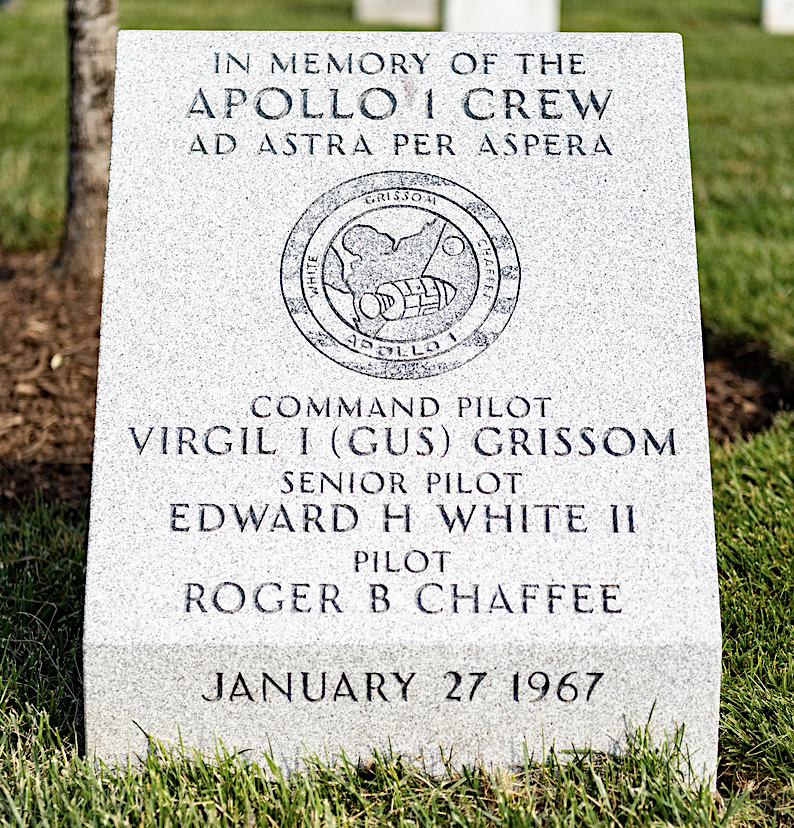
There is a memorial to the Apollo 1 astronauts at ANC in Section 3 near Grissom and Chaffee’s graves, but it was placed after my visit on June 2, 2022. Family and friends of the fallen Apollo 1 crew came together with NASA officials to dedicate the new monument. The photo of it below is from the ANC web site.
I’ve got one more post to write about ANC, with some bits and piece that I don’t want you to miss.

 Adventures in Cemetery Hopping
Thank you, Traci. Though I live about 95 miles south of Arlington, your series on this important and hallowed place reminds me that it has been many years since I trod the grounds there, and that perhaps it is time I made a return visit. Those memorials are beautiful…and sombering.