
My apologies for taking a few weeks off. Today I’m wrapping up my July 2019 visit to Arlington National Cemetery (ANC).
I want to take this final post to do something I occasionally do here, and that’s feature some monuments/markers that caught my eye. You’ll likely only recognize one of the names, the rest I just happened to like and wanted to know more about.
A Life On the Sea
If you find yourself wandering around ANC, Section 1 is worth your time. This monument for Capt. Nathan Sargent is stunning to me. I have no idea who created it but for a man of the Navy, it seems quite appropriate.

Born in 1848, Capt. Sargent served as executive officer of the U.S.S. Yosemite during the Spanish American War. At the time of his death, he was a member of the General Board of the U.S. Navy. He is buried alongside his wife, Isabell Hill Sargent, who died in 1924.
Sargent spent much of his life in Washington, D.C. He graduated from Gonzaga College (which today is a high school and college preparatory school) and from the U.S. Naval Academy in Annapolis, Md. in 1870.
After 35 years in the Navy, Sargent lived in Washington until his death in 1907.
Abner Doubleday: A San Francisco Treat Not Baseball
Although Major General Abner Doubleday achieved minor fame as a combat general with experience in many important Civil War battles, he is more widely known as the supposed inventor of the American game of baseball, in Elihu Phinney’s cow pasture in Cooperstown, N.Y., in 1839. Unfortunately, it’s not true.
While the myth that Doubleday invented baseball was debunked long ago, many folks still believe it. While watching Ken Burns’ documentary series Baseball, I learned that the mad scramble to find someone to attach the origins of America’s favorite pastime to landed squarely on Doubleday.

My family and I visited the National Baseball Hall of Fame and Museum in Cooperstown in 2022, and the baseball field they have there is called Doubleday Field. So it’s not surprising to me that the myth persists. I’m told none of Doubleday’s papers even mention baseball nor did his obituary when he died. His military career is what we know most about.
On the first day of the Battle of Gettysburg, Pa. (July 1, 1863), Doubleday was Senior Division Commander in the Army of the Potomac’s I Corps. When I Corps Commander Major General John F. Reynolds was killed early in the fighting, Doubleday took command of the troops and held the federal left flank during much of rest of the day’s fighting.

Although his troops were eventually pushed back to Cemetery Hill in retreat, Doubleday held the Confederates off long enough to allow substantial amounts of the Union Army come onto the scene of the battle and take strong defensive positions. Despite his performance under extreme conditions, he was not given credit for his defense and was replaced as Corps Commander at the end of the day.
Doubleday died at age 73 of heart disease in Mendham Township, N.J. on Jan. 26, 1893. Doubleday’s body lay in state in New York’s City Hall and was then taken to Washington by train for burial at ANC.
In 1908, the Mills Commission declared that Doubleday invented the game of baseball, although Doubleday never made such a claim. The only thing we do know in that for the morale of the men Doubleday commanded, he is said to have provisioned balls and bats for the men to play the game.
I did learn an interesting tidbit about Doubleday. While stationed in San Francisco, Calif. from 1869 through 1871, he took out a patent for the cable car railway that still runs there, receiving a charter for its operation. But he ended up signing away his rights when he was reassigned. So it was the city by the bay’s cable car railway, not baseball, that we have to thank him for! Not baseball.
Lady Sculptor
When I was looking for Albert Sabin’s grave in Section 3, I stumbled upon this monument marking the grave of Brig. Gen. Richard Hoxie and his wives, Lavinia “Vinnie” Ream and Ruth Norcross.

Vinnie Ream was born in Madison, Wisc., on Sept. 25, 1847. At an early age, she showed artistic interests and talents, which she explored as a student at the Academy, a division of the Christian College of Columbia, Mo.
During the Civil War, Ream’s family settled in Washington, D.C., and she studied with sculptor Clark Mills. Later, when she was in Europe for the carving of her statue of Abraham Lincoln, Ream studied in Rome with Luigi Majoli and in Paris with Léon Bonnat.

Ream took her full-size model of Lincoln, which she created in her studio, to Rome, and there the statue was carved from a block of Carrara marble. Ream was among the group of American female sculptors working there who were known as the White Marmorean Flock. As was the practice of both male and female sculptors, Ream had her model carved in marble by skilled Italian stonecarvers.
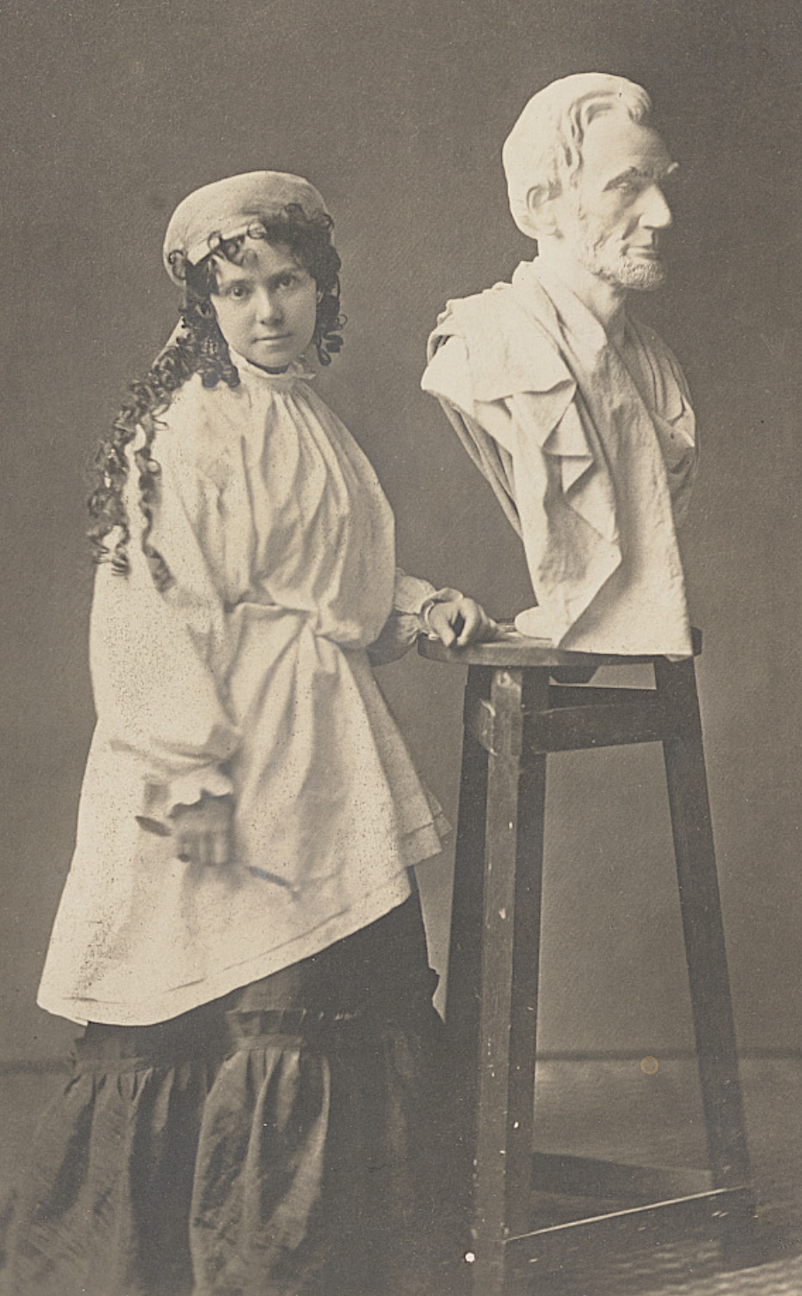
More than 40 years later, two bronze statues by Ream were placed in the Capitol. The first was the statue of Iowa governor and U.S. senator Samuel Jordan Kirkwood, donated in 1913 to the National Statuary Hall Collection. In 1906, she was commissioned to create a statue of Kirkwood. The second work, commissioned in 1912, is the statue of Sequoyah, the Native American recognized for inventing the written alphabet for the Cherokee language.

The 40-year gap between the unveiling of the statue of Lincoln and the completion of the one of Kirkwood, as well as her sporadic sculptural production, was the result of Ream’s focusing on her obligations as a wife and mother. She married then-Lieutenant Richard Hoxie in 1878.
In addition, Ream’s sculptures include her statue of Admiral David G. Farragut (1881) at Washington’s Farragut Square.

Ream died at age 67 in 1914 in Washington, D.C. Her grave and that of Hoxie is marked by a replica of her sculpture “Sappho” that is in the Smithsonian American Art Museum. By now a brigadier general, Hoxie remarried to Ruth Norcross and died in 1930 at age 85. Ruth died in 1959 at age 89. The three are buried together at ANC.

“The Offering of His Comrades”
The last grave I want to mention , located in Section 13, is a humble one. It is not the usual white government-issued military marker, but one provided by this young man’s comrades in arms.
Private Edward Bowman enlisted in the 21st Regiment, New York Volunteers, on May 1, 1862 in Buffalo, N.Y. On May 20, 1861, he mustered into service in Company H of the regiment.
Edward died of disease on Dec. 26, 1861 in Hunter’s Chapel, Va. I found a letter written in Feb. 1862 by one of the officer’s of the 21st Regiment to the Buffalo, N.Y. newspaper “The Advocate” whilst staying at Camp Niagara, Upton’s Hill, Va.
It mentions that the men saw in a wagon the marker and footstone they had purchased for their fallen friend. Even though it is likely that this band of men had only known him and each other for about six months, they cared enough about Edward to buy a stone for him themselves.

The wording is slightly different in the article than what is on the stone (company instead of comrades) but it’s interesting to find a newspaper account about a grave marker written in 1862 that I saw in person in July 2019. It definitely stood out to me among sea of markers.
In the end, the smaller, humbler grave markers are truly at the heart of Arlington National Cemetery. The huge monuments and memorials are certainly worthy of talking about. But every single grave marker, even those of the unknown dead, are important and should be remembered.
They must never be forgotten.

Next time, I’ll be back in Nebraska.
 Adventures in Cemetery Hopping