• About Me
  • Cemeteries I Have Visited
  • Have questions?
  • Photos

Adventures in Cemetery Hopping

~ A blog by Traci Rylands

Adventures in Cemetery Hopping

Monthly Archives: November 2023

Nebraska Pioneers: Visiting Omaha’s Prospect Hill Cemetery, Part II

17 Friday Nov 2023

Posted by adventuresincemeteryhopping in General

≈ Leave a comment

I’m still at Omaha’s Prospect Hill Cemetery. This week, the folks I’m writing about are not necessarily prominent pioneers like the people in Part 1. But their stories are still worth telling, and I think you’ll agree after you’ve read them.

Prospect Hill Cemetery has a lovely tree-lined road running down the center.

From time to time, I feature photos of children’s graves on my Facebook page. It is not uncommon for them to be buried without with one or both of their parents. Inevitably, I will get someone who comments, “I could NEVER be buried away from my babies!” or something similar.

I understand where this sentiment comes from. However, sometimes life presents us with circumstances we cannot control or did not plan for. Such is the case with the Benson family, as I discovered when I started researching a single small monument I photographed.

The Benson Family

A small white bronze (zinc) monument represents the lives of four children that died in the 1880s. But they were all cousins, the children of two brothers who were born in states that were not Nebraska.
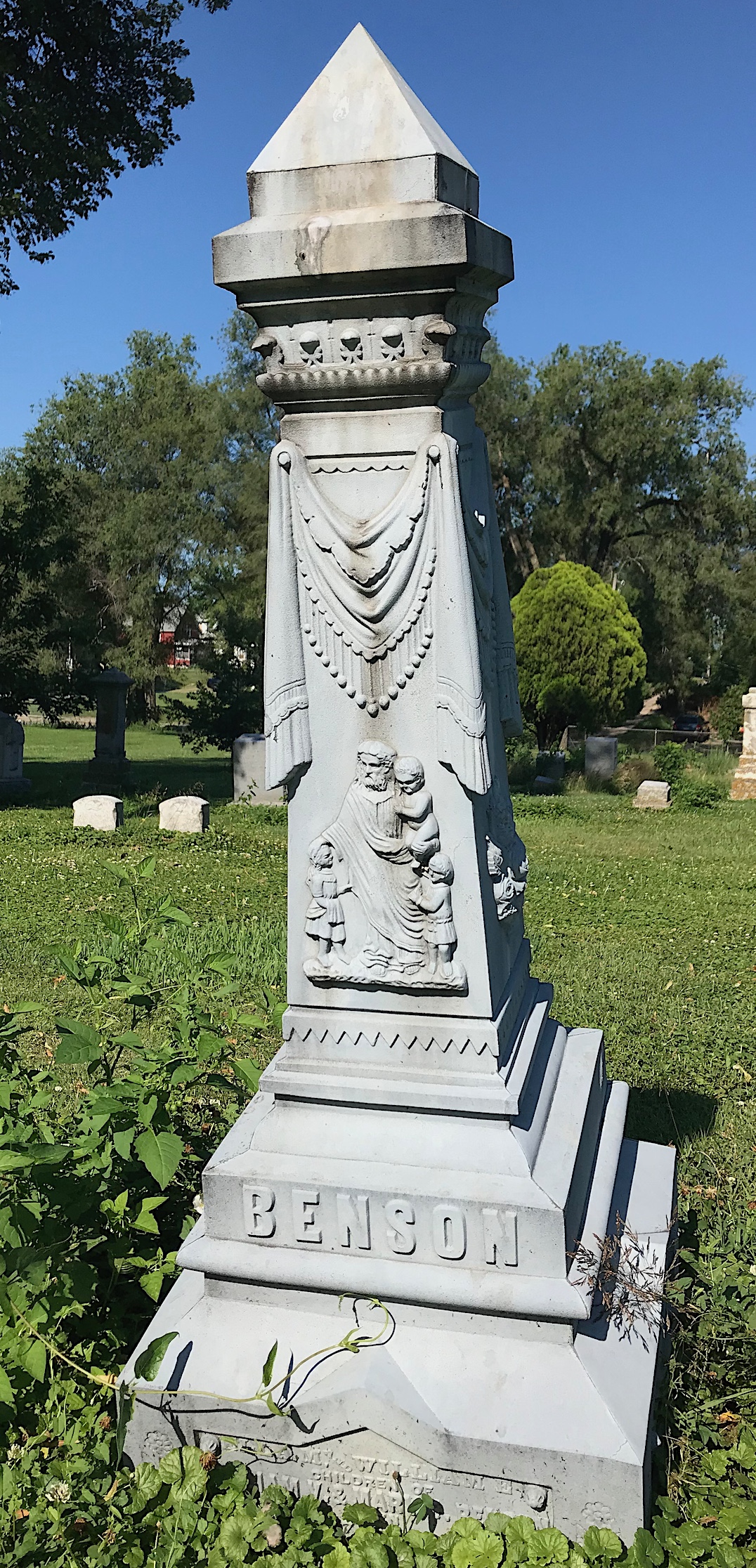
For reasons unknown, the Benson family came to Omaha for about 20 years and then moved to Oregon.

Born of British parents who emigrated to America, William V. Benson (born in Illinois) and Edwin Benson (born in Minnesota) were from a rather nomadic family who lived in a number of states. The brothers were five years apart in age. The Benson family moved to Omaha at some point in the 1870s.

William married Mary Abold, working as a carpenter. Their daughter, Ella, was born in June 1877 and William followed in March 1880. Sadly, William died on Dec. 17, 1880 and Ella died on Nov. 3, 1881. I do not know their causes of death. Mary gave birth to three more daughters in the following years, who all lived to adulthood.

Siblings William and Ella Benson died about a year apart.

Edwin married Emma Louise Schmick in 1882, employed as a painter/paper hanger. Son Edwin was born 10 months later. Lulu Ellen followed in September 1884 and Mabel in May 1886. On Nov. 7, 1887, Lulu died and only three days later, Mabel died. I do not know their causes of death. The couple would have four more children who all lived to adulthood.
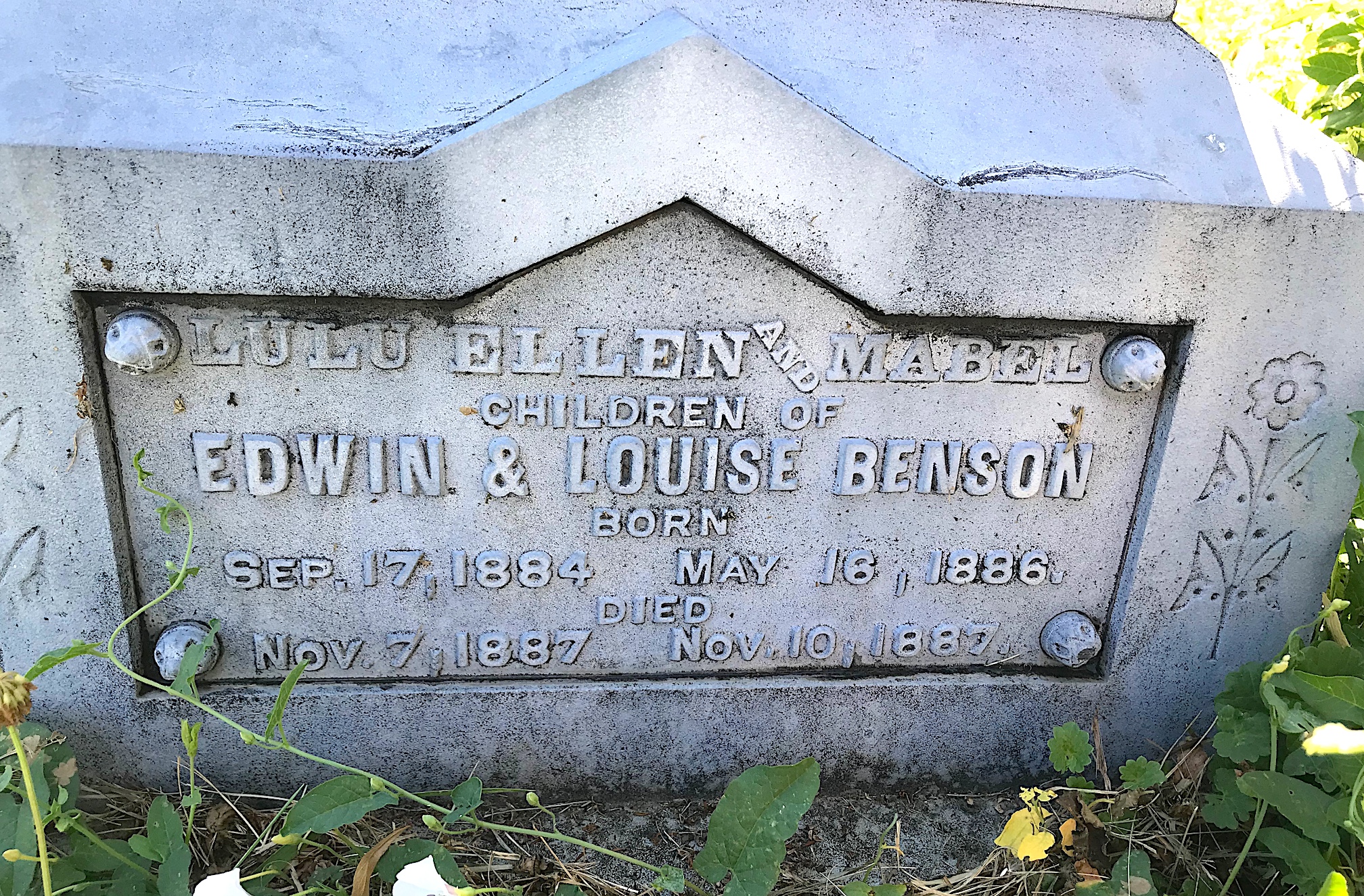
Sisters Lulu and Mabel Benson died within three days of each other.

I can’t pinpoint exactly when the Bensons decided to pull up stakes and move to the Portland, Oreg. area. But by that time, William and Edwin’s youngest sister Effie had been living there since 1892 when she wed Edward Laughlin. By 1900, most of the Bensons (including their parents) had moved to Oregon to start new lives there.

William Benson died tragically on Nov. 7, 1910 at age 56. After attending a union meeting that ended late, he tried to catch a ride on the streetcar but fell. At first, foul play was suspected because his brother (likely Edwin) believed he was robbed of $60 and a pocketwatch. A subsequent article solved that mystery when William’s wife Mary reported that the hospital where William was taken had given the money and watch to her. William is buried with Mary at Portland’s Riverview Cemetery.

At first, William Benson’s death was thought to be the result of foul play.

Edwin died on Oct. 28, 1925 at age 67 of heart disease. He is also buried at Riverview Cemetery with his wife, Emma Louise (who died in 1940).

I have little doubt that none of the Bensons ever forgot the four little ones buried back in Omaha. Had they been able to be buried with them, I’m sure they would have done so.

The Gambler and The Madam

This next story is one of the more unique I’ve run across. I would start it with “Once upon a time” but this tale is real.

In 1867, a young woman named Anna Wilson came to Omaha and nobody knew where she was came. Rumor had it she was from the South but it was never confirmed. She established a brothel, and became the city’s most noted madam. Some called her the “Queen of the Underground”.

Anna met riverboat gambler Daniel “Dan” Allen and became his common law wife. They became a sort of Omaha “power couple”. Anna continued to operate her business and reportedly assumed the role of a parent if one of the prostitutes that worked for her got married, including paying the wedding expenses. Dan operated a gambling house in Omaha for 13 years. Together, Anna and Dan’s fortunes grew, and the couple was devoted to each other.

Monument erected by Anna Wilson to honor her beloved companion Dan Allen.

Dan died of pneumonia at age 54 in 1884 and according to his funeral notice, his burial was very well attended. Even his expensive casket was described in detail. Anna reportedly supplied his monument. Dan left his entire estate to Anna, which was considerable.

After Dan died, Anna began investing in real estate. She amassed a large amount of money, and according to one account, half of her fortune was made in the last ten years of her life from the purchase and sale of real estate.

By 1886, she had enough money to build a 25-room mansion at 912 Douglas Street. It was a three-story, 25-room building with reportedly racy artwork. In 1906, she closed the brothel and moved to Wirt Street where she lived out the rest of her life.

Anna Wilson’s brothel would live a second life as Omaha’s

Anna proposed that her mansion be used as a hospital and tried to give it to the city of Omaha. Despite hesitation on the city’s part due to the building’s prior purpose, they agreed to rent it from her for $125 a month beginning in about 1910. The hospital finally became a reality in 1911, used as an emergency hospital for contagious diseases. Having suffered from poor health in her last years, Wilson died six months later of a stroke on October 27, 1911. She was 76. The building was razed in the 1940s.

Anna’s philanthropy before her death had been notable, but it took on jaw dropping proportions after she passed. The equivalent of her estate would be worth about a million dollars today. She left almost all of it to Omaha institutions, much of it being to the Creche Home for Children, the Old People’s Home, and the City Mission. She even left $10,000 to Prospect Hill Cemetery.

Anna’s last wish was to be buried with her beloved Dan. The monument statue of Nebraska senator John Paulsen (1837-1889) over on the right watches over them nearby.

I read that in Anna’s will, she instructed that she should be buried under nine feet of concrete so that the “respectable” society women of the town didn’t disinter her body from her resting place by Allen and move it out of Prospect Hill. Did her donation to Prospect Hill ease the way for her wishes to be carried out?

Following Anna’s death, on each Memorial Day, a wreath was laid on Wilson’s grave by Mrs. Thomas L. Kimball because of Anna’s generosity over the years toward the Creche Home for Children. Mrs. Kimball’s son, Thomas Rogers Kimball, continued the tradition after her death. He was the architect who designed the Megeath mausoleum at Propsect Hill that I told you about in Part I. You can see it in the above photo next to Sen. Paulsen’s monument.

Dan and Anna were reunited at last.

I found a sad little footnote in this newspaper article. In Anna’s last lonely years, she was comforted by the presence of her pets. She had a dog and a bird to keep her company, whom she taught tricks. Her dog is reported to have died the day after she did.

From the Evening World-Herald (Omaha), Oct. 30, 1911.

“At Rest With Her Soldier Boy”

Finally, I want to end with a monument whose epitaph was what drew me to it first. I wanted to know the story behind this mother and son.

Sarah Forby died only a few years after her son. I’m not sure why there’s an indentation where her death year it located.

Born in Indiana in 1871, Lee Forby came to Omaha in 1885 with his parents, trunk maker Charles and Sarah Forby. He was among the first to join the Thurston Flambeau Club. It later merged with the Thurston Rifles, a volunteer militia organization named after senator John Thurston.

After the outbreak of the Spanish-American War in 1898, Lee was mustered in as adjutant of the First Regiment, Nebraska Volunteers. When called to active duty, the former Company L was redesignated as Company G of the First Regiment, Nebraska Volunteers. That December, at age 27, Lee was
promoted to captain, commanding Company G.

This Find a Grave.com photo is the only image I could find of Capt. Lee Forby.

Sent into combat in the Philippines, Lee earned a reputation as a fearless fighter and popular officer, a man of high character and ability. His parents missed him and worried about his fate.

The Forby monument used to have an eagle on top of it.

Leading Company G in the battle of San Francisco del Monte against the Moros outside of Manila, Lee was wounded in hand-to-hand combat on March 25, 1899. He died the following day, and his body was
returned to Omaha for burial in the family plot at Prospect Hill Cemetery.

This monument was erected to honor Capt. Forby and the other Omaha soldiers who fought in the Spanish-American War.

In 1900, veterans of the Thurston Rifles arranged with the cemetery to provide a special section for members of Company G, pledging to erect a granite monument costing not less than $600 by May 1 of that year. While the Lee Forby Encampment #1 of the Spanish-American War Veterans officially presented the statue on the west side of the circle, Nebraska senator John T. Paulsen (also buried at Prospect Hill) is said to have actually paid for it.

Several of Lee Forby’s comrades are buried at the base of this monument. Unfortunately, the statue of a soldier that once topped it was stolen in 2005 and never recovered.

Lee’s parents took the news of his death hard. Sarah died on Oct. 9, 1902. His father, Charles, died three months later from typhoid pneumonia. They were indeed reunited with their “soldier boy”.

Next time, I’ll be writing about Calvary Cemetery in Van Horne, Iowa.
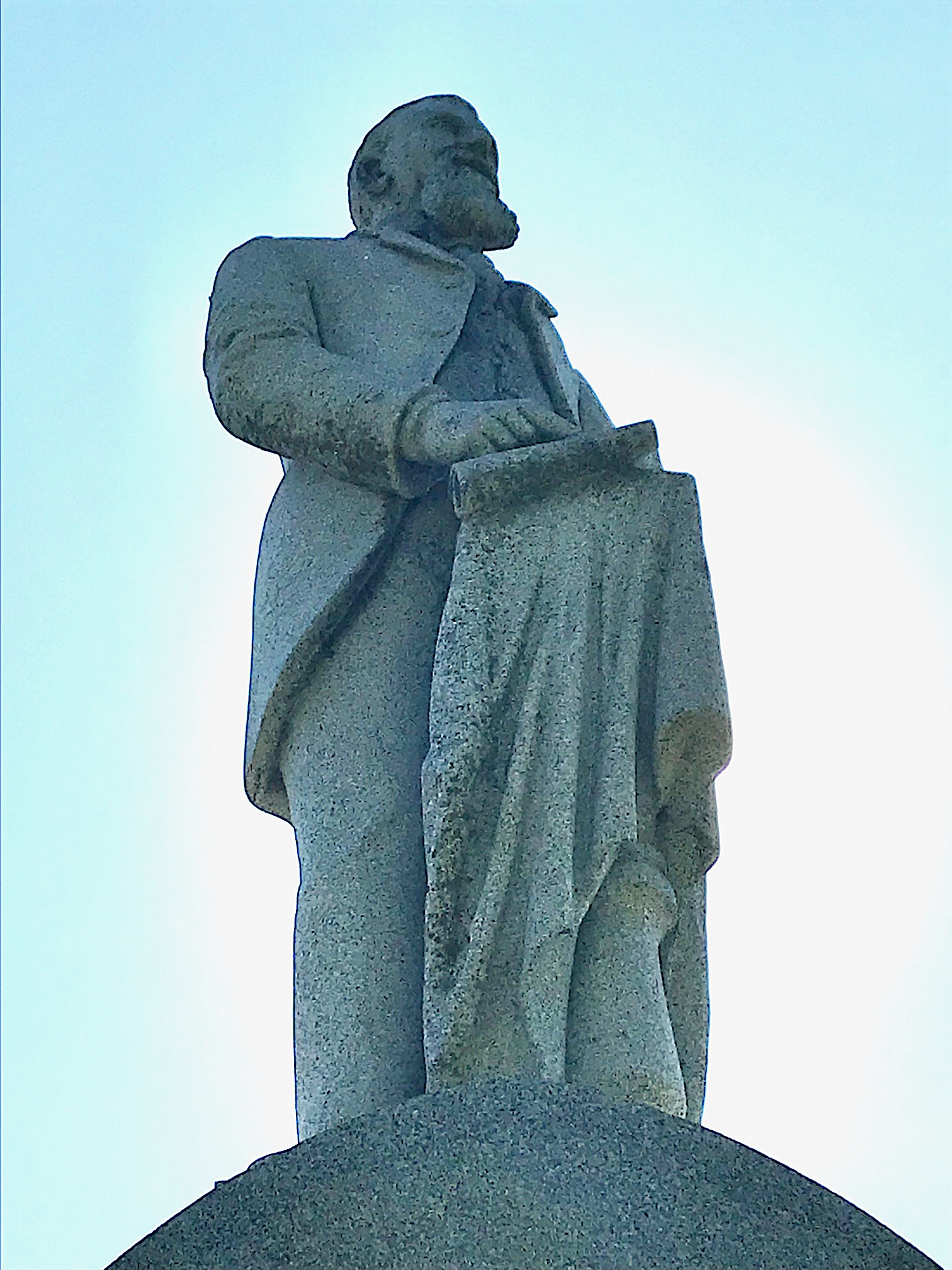
The statue topping Nebraska state senator Johannes Theodore “John” Paulsen’s grave monument looks out over Prospect Hill Cemetery. Born in 1837 in Germany, he was a tinsmith in Wisconsin before coming to Omaha in 1857. He died in 1889.

Nebraska Pioneers: Visiting Omaha’s Prospect Hill Cemetery, Part I

03 Friday Nov 2023

Posted by adventuresincemeteryhopping in General

≈ 1 Comment

In July 2019, I went out to visit Christi in Omaha for our last true road trip. I would visit her two more times after that, but we stayed in the Omaha/Council Bluffs, Iowa area on those occasions.

Before we headed east, we went to an Omaha cemetery I’d read about but never visited. It’s thought to be the oldest one in Omaha. One thing you’ll notice right away if you visit is that many of the graves of Omaha’s founders are accompanied by interpretive signs. It was incredibly helpful.

Prospect Hill Cemetery was founded in 1858 by Byron Reed, an early developer of Omaha property.

Origins of Prospect Hill Cemetery

Nebraska didn’t officially become America’s 37th state until 1867. Before then it was considered a territory and was governed as one.

Prospect Hill’s web site explains that after Nebraska’s territorial legislature authorized cemeteries in 1858, Prospect Hill Cemetery officially began with Burial Permit #1 for Alonzo F. Salisbury. Byron Reed, an early Omaha real estate developer and financier, was the founder. However, many folks were already buried there, including several Native Americans in unmarked graves. Since then, there have been approximately 15,000 burials recorded here.

The inscription is obscured, but Alonzo F. Salisbury (1808-1858) is buried here.

You can’t make out Salisbury’s inscription in the photo due to the grass. His story intrigues me. A native of Vermont, Alonzo was a stagecoach driver who came to Omaha in 1855 and he operated a mill soon after. In 1856, Salisbury was elected to represent Douglas County in the lower house of the Nebraska territorial legislature. He died on Oct. 4, 1858, likely 50 years old. His cause of death is unknown.

The historical sign also shares:

There are veterans from every American war beginning with the War of 1812. Also interred here are nearly 100 soldiers who died on active duty during the Civil War or while serving at Omaha Barracks (Fort Omaha) from 1863-1887. In 1887, administrative affairs were taken over by Forest Lawn Cemetery. However, in the 1890s, lot owners formed an association to operate Prospect Hill.

In 1979, Prospect Hill was designated an Historic Site by the Landmarks Commission of Omaha and by the Omaha City Council.  The Prospect Hill Cemetery Historical Site Development Foundation was formed to aid in the development of historical/educational aspects of the cemetery. Burials are still taking place there.

Landscaping

One thing I didn’t quite understand was what the landscaping plan was here. I don’t know if it was intentional that they mowed but left the areas around the markers untrimmed so that a number of the inscriptions were hidden. The picture below can give you an idea of what I mean.

Some areas were neatly mowed but the areas around many markers were not.
Perhaps some weed whacking was scheduled for later?

In visiting the current web site this week, I learned that Prospect Hill now has what they call Weed Whackers and ShrubBubs programs as part of their volunteer outreach. I’m thinking that somebody mows and another group takes care of the trimming around the markers. We probably visited on a day in between those efforts. It’s impressive to me that they have a number of volunteers helping to take care of the place.

Millard Family

It’s hard to read any history of early Omaha without encountering the last name Millard. There are 11 Millards buried at Prospect Hill. This large obelisk is for Ezra Millard (1833-1886). One of several siblings, his family emigrated to America from Canada and settled in Omaha in 1856 after a some years in Sioux City, Iowa.

The Millard family made its mark in Omaha.

Along with young brother Joseph, Ezra started a banking business in 1856. In 1866, Ezra left that bank to found the Omaha National Bank, now part of the U.S. Bank system.

Ezra and Joseph Millard founded the Barows, Millard & Company Bank.

Ezra served as Omaha’s mayor from 1869 to 1871. He and his wife, Anna, had at least six children together. Several are buried at Prospect Hill.

The town of Millard was laid out in 1870 by Ezra, and named for him. A post office was established in Millard in 1873, and remained in operation until it was discontinued in 1967. The town was incorporated in 1881. After much legal wrangling, the town of Millard was annexed by the city of Omaha in 1971.

Ezra Millard served as mayor of Omaha from 1869 to 1871.

In 1886, Ezra died in Saratoga Springs, N.Y. of heart complications. At the time of his death, he was employed as the treasurer of the Omaha Cable Tramway Company. He was only 50 years old.

Born in 1836, Joseph Millard was in the land business in Omaha before moving to Montana to open a bank there. He returned to Omaha in 1866 and became director, president, and cashier of the Omaha National Bank that brother Ezra started. He was also one of the incorporators of the Omaha & Northwestern Railroad Company in 1869.

Like his older brother, Joseph Millard was mayor of Omaha.

Joseph followed his brother into politics, serving as Omaha’s mayor from 1871 to 1872. For 15 years, he was a director of the Union Pacific Railroad Company, six years of which he served in the capacity of a government director.

The marker for the Joseph Millard family plot has an Egyptian theme to it.

Joseph was elected as a Republican to the Senate in 1901, to fill the vacancy in the term beginning March 4, 1901, serving from March 28, 1901 to March 3, 1907. During his term, he served as chairman of the Committee on Inter-Oceanic Canals (Fifty-ninth Congress). He was not a candidate for re-election in 1906. He returned to banking in Omaha after that.

Joseph Millard outlived his wife, Caroline, by 21 years.

Joseph’s wife, Caroline Grover Millard, was a native of New Jersey. She and Joseph had two children together. She died on Jan. 3, 1901 after a long illness at age 64. Joseph died on Jan. 13, 1922 at age 85. Their daughter, Jessie, never married and died in 1950 at age 85. She is buried with her parents. Son Willard, who also became a banker, died in 1930 and is buried in California.

Prospect Hill’s Only Mausoleum

Prospect Hill’s only mausoleum was built for the Megeath family at the direction of James G. Megeath in 1897. His son, Charles, who died in 1893 at age 32 of dropsy, was buried at Prospect Hill. His remains were moved into the mausoleum after its completion.

The Megeath family mausoleum is the only mausoleum at Prospect Hill Cemetery, completed in 1897. This photo was taken in 2019 before the bronze gate was stolen.

With Gothic and Roman architectural themes, the Megeath mausoleum was designed by noted Omaha architect Thomas R. Kimball. He designed many buildings and mansions in Omaha. Weighting 210 tons, it was constructed in Barre, Vt. and transported to Omaha where it was reconstructed in the cemetery. With a roof made of three 22 ft.-long slabs of granite, the inside of the mausoleum is lined with marble and has nine crypts.

Born in 1824 in Virginia, James Gabriel Megeath arrived in Omaha in 1854, having spent time in California operating a mercantile during the gold rush days. Successful in retail and freight operations, he amassed a number of holdings. His construction of portable warehouses as the Union Pacific Railroad’s track was being laid capitalized on favorable circumstances. James was also active in Omaha government and politics.

James’ wife, Virginia, died in 1898 at age 68. James died in Salt Lake City, Utah in 1906 at age 81. Some of the Megeath children are interred with James and Virginia.

Photo of Mary Megeath from the Omaha Daily Bee, Aug. 17, 1913. She was engaged to be married when she died in 1919.

A Young Bride To Be Dies

Sadly, one of the Megeath grandchildren is also interred in the mausoleum. Born in 1859 to George and Ida Megeath (James and Virginia’s son), Mary Elizabeth Megeath was a well-educated and popular young lady who loved animals and being outdoors. In 1916, she was crowned Queen of Ak-Sar-Ben (Nebraska spelled backwards) at their coronation ball, a major society event.

Engaged to marry Herbert Connell, son of a local physician and nephew of a state senator, Mary was excited about her future. But near the time of her wedding, she contracted typhoid fever after a bout of influenza. She died on May 6, 1919 at the age of 23. One source I found said she was buried in her elaborate Ak-Sar-Ben coronation robes, while another stated she wore her wedding gown.

There’s a disappointing postscript I must add. In early October 2022, someone cut off the bronze gate of the Megeath mausoleum and gained entrance. It was discovered that several chunks of marble had also been stolen. It will cost between $3,000 to $6,000 to make repairs and replace the gate. Fundraising efforts are underway to cover those costs.

It saddens and angers me that people do things like this, but it’s becoming more frequent at cemeteries these days.

I’ll have more stories from Prospect Hill Cemetery in Part II.

Albert Loveland, 33, died on June 3, 1876 of tuberculosis. He left behind a wife and child.

Recent Posts

  • More Pensacola, Fla. Cemetery Hopping: Taking a Ramble Through Saint John’s Cemetery, Part III
  • More Pensacola, Fla. Cemetery Hopping: Taking a Ramble Through Saint John’s Cemetery, Part II
  • More Pensacola, Fla. Cemetery Hopping: Taking a Ramble Through Saint John’s Cemetery, Part I
  • The City of Five Flags: Stepping back in time at Pensacola, Fla.’s Saint Michael’s Cemetery, Part V
  • The City of Five Flags: Stepping back in time at Pensacola, Fla.’s Saint Michael’s Cemetery, Part IV

Archives

  • December 2025
  • November 2025
  • August 2025
  • July 2025
  • June 2025
  • May 2025
  • April 2025
  • March 2025
  • February 2025
  • January 2025
  • October 2024
  • August 2024
  • July 2024
  • June 2024
  • May 2024
  • April 2024
  • March 2024
  • February 2024
  • January 2024
  • December 2023
  • November 2023
  • October 2023
  • September 2023
  • August 2023
  • July 2023
  • June 2023
  • May 2023
  • April 2023
  • March 2023
  • February 2023
  • January 2023
  • December 2022
  • November 2022
  • October 2022
  • September 2022
  • August 2022
  • July 2022
  • June 2022
  • May 2022
  • April 2022
  • March 2022
  • February 2022
  • January 2022
  • December 2021
  • November 2021
  • October 2021
  • September 2021
  • August 2021
  • July 2021
  • May 2021
  • April 2021
  • March 2021
  • February 2021
  • January 2021
  • December 2020
  • November 2020
  • October 2020
  • September 2020
  • August 2020
  • July 2020
  • June 2020
  • May 2020
  • April 2020
  • March 2020
  • February 2020
  • January 2020
  • December 2019
  • November 2019
  • October 2019
  • September 2019
  • August 2019
  • July 2019
  • June 2019
  • May 2019
  • April 2019
  • March 2019
  • February 2019
  • January 2019
  • December 2018
  • November 2018
  • October 2018
  • September 2018
  • August 2018
  • May 2018
  • April 2018
  • March 2018
  • February 2018
  • January 2018
  • December 2017
  • November 2017
  • October 2017
  • September 2017
  • August 2017
  • July 2017
  • June 2017
  • May 2017
  • April 2017
  • March 2017
  • February 2017
  • January 2017
  • December 2016
  • November 2016
  • October 2016
  • September 2016
  • August 2016
  • July 2016
  • June 2016
  • May 2016
  • April 2016
  • March 2016
  • February 2016
  • January 2016
  • December 2015
  • November 2015
  • October 2015
  • September 2015
  • August 2015
  • July 2015
  • May 2015
  • April 2015
  • March 2015
  • February 2015
  • January 2015
  • December 2014
  • November 2014
  • October 2014
  • September 2014
  • August 2014
  • July 2014
  • June 2014
  • May 2014
  • April 2014
  • March 2014
  • February 2014
  • January 2014
  • December 2013
  • November 2013
  • October 2013
  • September 2013
  • August 2013
  • July 2013
  • June 2013
  • May 2013
  • April 2013
  • March 2013
  • February 2013
  • January 2013

Categories

  • General

Blogroll

  • A Grave Interest
  • Cemetery Photography by Chantal Larochelle
  • Cemetery Tours of Berlin by Matti
  • Confessions of a Funeral Director (Caleb Wilde)
  • Find a Grave
  • Hunting and Gathering (cool photography site)
  • Save Our Cemeteries (New Orleans, La.)
  • The Cemetery Club
  • The Graveyard Detective
  • The Rambling Muser
  • Westminster Abbey Tours by Grace

Meta

  • Create account
  • Log in
  • Entries feed
  • Comments feed
  • WordPress.com

Blog at WordPress.com.

  • Subscribe Subscribed
    • Adventures in Cemetery Hopping
    • Join 402 other subscribers
    • Already have a WordPress.com account? Log in now.
    • Adventures in Cemetery Hopping
    • Subscribe Subscribed
    • Sign up
    • Log in
    • Report this content
    • View site in Reader
    • Manage subscriptions
    • Collapse this bar
 

Loading Comments...