• About Me
  • Cemeteries I Have Visited
  • Have questions?
  • Photos

Adventures in Cemetery Hopping

~ A blog by Traci Rylands

Adventures in Cemetery Hopping

Monthly Archives: January 2024

Getting A Final Glimpse: A Visit to Iowa’s Springville Cemetery, Part II

26 Friday Jan 2024

Posted by adventuresincemeteryhopping in General

≈ 4 Comments

Last week, I shared a number of white bronze (zinc) monuments at Springville Cemetery in Linn County, Iowa. Today I’m going to share some additional monuments that got my attention (made of other materials).

In reviewing my photos, I came across one that caught my eye because it has a Georgia connection. A native of Iowa, Isaac E. Robinson was only 21 when he died far from home in Rome, Ga. during the Civil War.

An estimated 76,242 Iowa men (out of a total population of 674,913 in 1860) served in the military during the Civil War, many in combat units attached to the Western armies. About 13,000 died of wounds or disease (two-thirds of whom were of the latter).

Far From Home

Isaac was born in Iowa around 1843 to George H. Robinson and Sarah Butler Robinson. His father died in 1847 and his mother remarried to Samuel Starry around 1850.

Isaac was living in Onion Grove, Iowa (now called Clarence), which is about 33 miles east of Springville. He enlisted in the Union Army on Aug. 30,1861 and was assigned to the Ninth Iowa Infantry, Company B. Issac was 18 at the time.

Private Isaac Robinson was only 21 when he died from a thigh wound on Aug. 28, 1864.

According to his military records, Isaac’s service included battles of Pea Ridge, Ark. (March 1862), Chickasaw Bayou (December 1862), Fort Hindman (January 1863), assault and siege of Vicksburg (May – Apr 1863), siege of Jackson, Miss. (July 1863), Chattanooga, Lookout Mountain, Missionary Ridge, Ringgold Gap (November 1863), and Resaca and Dallas, Ga. (May-June 1864).

Like many young soldiers, Private Robinson died from his wounds weeks after he was injured.

Isaac received a severe wound in his thigh on May 27, 1864 in Dallas, Ga. He died on Aug. 28, 1864 in Rome, Ga, most likely of sepsis. His remains were eventually sent back to Iowa for burial in Springville Cemetery. I don’t think he was married. Unfortunately, his inscription is very worn and faded.

Isaac’s mother, Sarah, remarried in 1850 to Samuel Starry. He is buried beside them.

Isaac is buried beside his father, George, and his mother, Sarah, who died in 1872. She shares a marker with her second husband, Samuel, who died in 1880.

Rock of Ages

It’s hard to not be drawn to the Jordan monument with its combination of stone and mosaic tile. I’m always curious by how these were made and who made them.
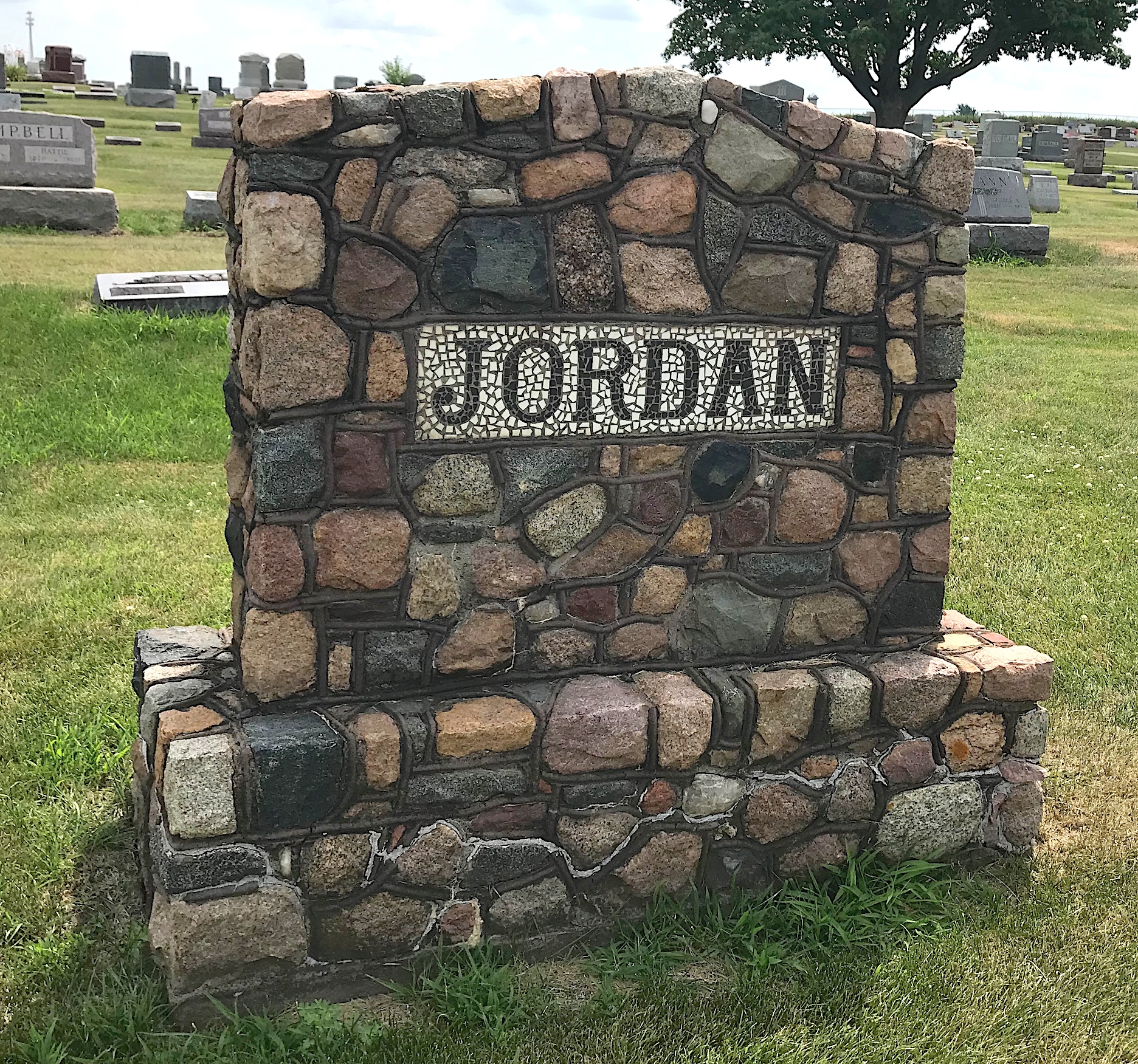
The Jordan family monument is definitely different.

Lemuel Dyer Jordan and his wife, Nancy, came to Iowa sometime in the 1840s from Maine. Their eldest son, George, was born in 1846. He worked as a stock buyer (cattle) and married Emily Alice Gilliland around 1865. The couple had several children.

George died in Springville on March 24, 1921 at age 75. Emily died on Dec. 16, 1926 at age 77 but she does not have a marker.

George Jordan died in Springville on March 24, 1921.

George and Emily’s youngest son, Frank, was born in 1886. He, too, was a stock buyer. He married twice and served in World War I as a private. In later years, he operated a drug store in Springville. He spent the last three years of his life at the Veterans Administration Hospital in Knoxville, Tenn. where he died on Jan. 27, 1947.
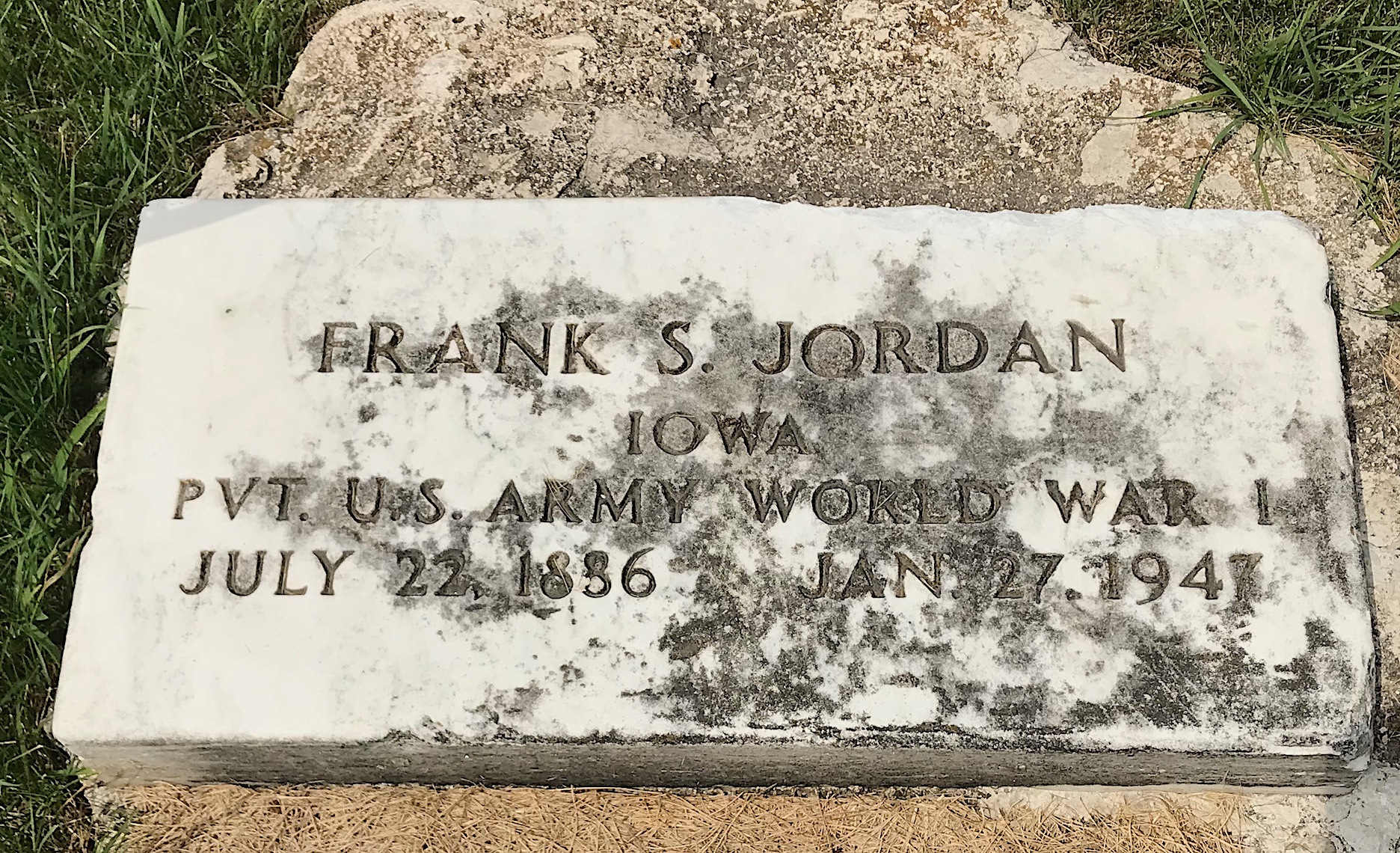
WW I veteran Frank Jordan died on Jan. 27, 1947.

Danish Blacksmith

Probably the most unique grave marker at Springville Cemetery is this one for Danish immigrant Christian “Chris” Nielsen. In 1887, he married Inger Marie Nielsen (not related). They emigrated to Iowa from Denmark around 1890. Together, they had three daughters. One of them, Tevvedora, died in infancy but the other two lived long lives.

It’s easy to see what Chris Nielsen’s profession was.

As you can see, Chris was employed as a blacksmith. The anvil and hammer make that apparent. I have no idea who made it for him, but it’s very cleverly done.

Chris died on Thursday, Oct. 15, 1936 after a long illness. He was 78. Marie died in 1945. She has her own marker and a shared one with Chris and Tevvedora.

Fort Dearborn Massacre Survivor

When I photographed Susan Millhouse Simmons’ grave, I knew nothing about her. Frankly, I was stunned when I began reading what happened to her before she ever arrived in Iowa.

Born in 1777 in Pennsylvania, Susan married John Simmons in Ohio in 1808. In 1810, John enlisted in the First United States Infantry and was assigned for duty to Fort Dearborn in Illinois. He was soon made a non-commissioned officer. The couple’s son, David, was born that same year. A daughter, also named Susan, was born Feb. 12, 1812 at Fort Dearborn.

Fort Dearborn was located on the south bank of the main stem of the Chicago River in what is now the Loop community area of downtown Chicago. At the time, the area was basically wilderness.
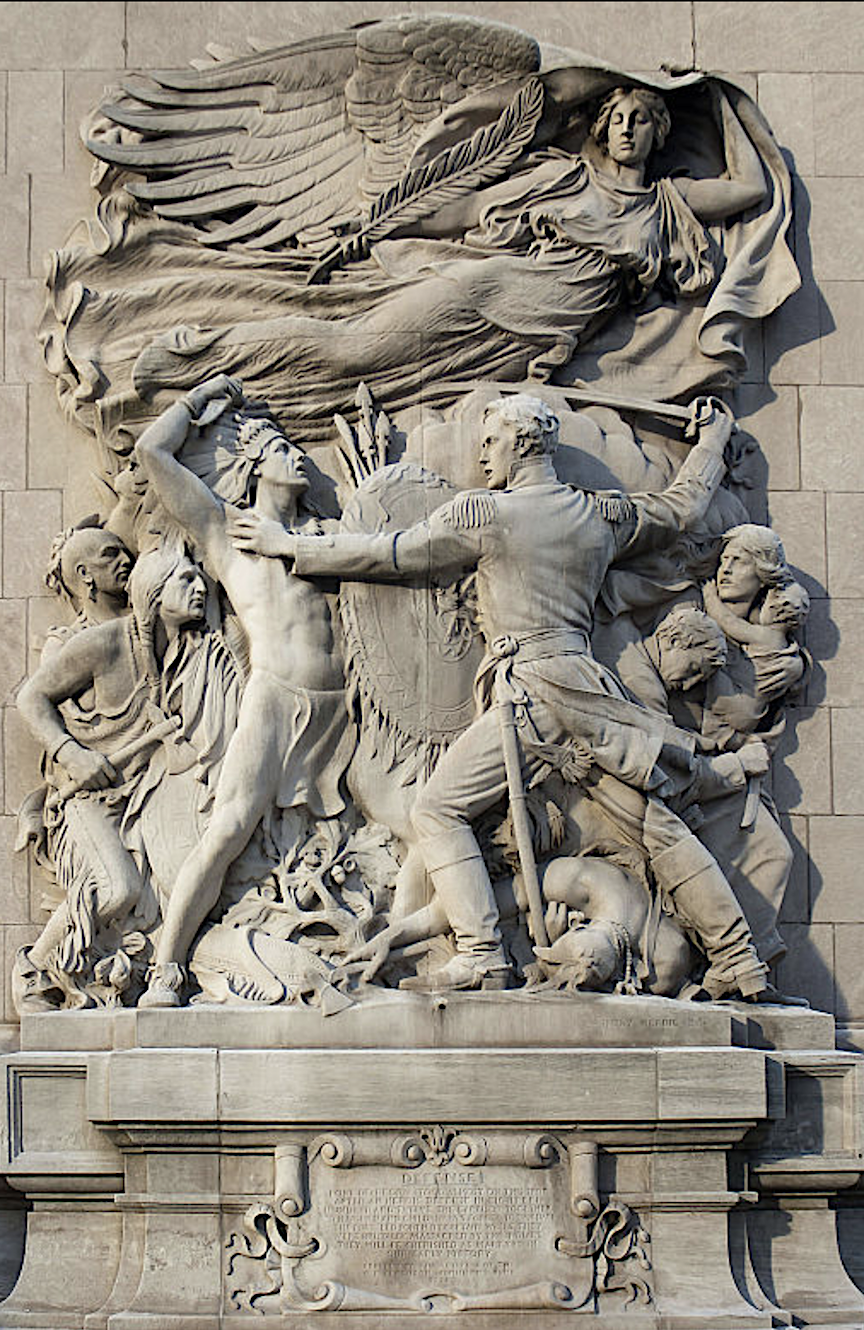
The Fort Dearborn Massacre is depicted in Defense by Henry Herring, 1928. The sculpture adorns the wall of the southwestern bridge tender’s house on Michigan Avenue Bridge in Chicago, Ill.

On Aug. 15, 1812, soldiers and settlers evacuating Fort Dearborn were massacred by Pottawatomie Indians in a surprise attack, killing 53 soldiers, women, and children. Among them were John Simmons and his little son, David. John died defending the wagon his wife and children were in. He was buried much later in a mass grave on the battle site.

Survivors were taken prisoner by the Pottawatomie and were held captive as long as two years before making their way to freedom. Susan and her daughter were taken to Green Bay, Wisc. On the march, she walked and carried her baby, the entire distance being over two hundred miles. She was a captive for eight months. One narrative I read stated that many times, she was told to hand over little Susan to them but she adamantly refused.

Drawing of Susan Millhouse Simmons in later years.

In fall 1812, the Pottawatomie, with their prisoners, left Green Bay, and marched to the ruins of Fort Dearborn, then around the end of Lake Michigan and up to Mackinas, to Fort Meigs. In April 1813, negotiations for the prisoners were opened. Susan and little Susan were set free and returned to Ohio.

Susan married widower John Redenbaugh in 1820. Daughter Susan married Moses Winans in 1828. They had nine children. John Redenbaugh died in 1847. When Moses and Susan Winans moved with their family to Springville, Iowa in 1853, her mother went with them.

Susan Millhouse Simmons Redenbaugh spent the last four years of her life in Springville.

Susan Millhouse Simmons Redenbaugh died in Springville on Feb. 27, 1857 at age 79.

Moses Winans died on Aug. 24, 1871 at age 63. Susan Winans moved to California with some of her adult children after 1885. She died in Santa Ana, Calif. at age 88 on April 27, 1900. She is buried in Santa Ana Cemetery along with her adult children Lewis, William, and Amy. Some of her other adult children (Hiram, John, Esther, David) who remained in Iowa are buried in Springville Cemetery with their father.

Our next stop was Anamosa, Iowa, where we visited the Anamosa State Penitentiary museum and the prisoner cemetery located nearby. You won’t want to miss that!

(Right) Bethel Smith (born and died in 1915) and (left) Theone Smith (born 1919, died 1921) were the children of Eva Hart Smith and Sharon Stanley Smith.

Restoring a White Bronze Wonder: A Visit to Iowa’s Springville Cemetery, Part I

19 Friday Jan 2024

Posted by adventuresincemeteryhopping in General

≈ Leave a comment

After leaving Cedar Rapids, we headed northeast 30 miles to Springville Cemetery. Springville Cemetery has an estimated 2,350 memorials on Find a Grave. Adjoining St. Isidore Cemetery seems to have between 50 to 100 graves.

Springville Cemetery is located about 30 miles northeast of Cedar Rapids.

Springville’s earliest graves date from the 1840s, before Iowa became the 29th state in 1846. But one of the reasons I put Springville on our itinerary was to see for myself one of the largest white bronze (zinc) monuments I’d ever come across online. It has quite a story of the family it represents and how it was brought back to its former glory after our visit.

The Brown Family

The Brown monument was erected in 1886 to honor Revolutionary War veteran Nathan Brown (1761-1842) and his family. It was commissioned by Brown’s son, Horace Nathan Brown (1822-1893). The base was made of granite but the majority of the monument is white bronze (zinc). In many articles I read, it was incorrectly reported that it was made of granite and marble.

This is how the Brown monument looked in July 2019. Note that the base is in need of repair.

One of the panels lists a lengthy history of Nathan Brown that I’ve included here:

Nathan Brown was born at White Plains, N.Y., July 22, 1761. At the age of 14, he began to drill in preparation to joining the American Army, and at 16 he entered the service in the Revolutionary War. His first battle was at Harlem Flats and his second one on the present site of Greenwood Cemetery. He was wounded but not seriously in some of the many battles in which he participated.

Seven brothers served in the same army and his captain was an uncle. After the war he removed to South Hallow and afterwards to Buffalo, N.Y., where he remained a short time and then removed to Pennsylvania. April 1, 1838, removed to Geneva, Kane County, Ill. Afterwards settled one mile southwest of Springville, Ia. May 17, 1839. Died Nov. 25, 1842.

After the Revolutionary War, Nathan married his first wife, Sarah Bailey, in in 1781. Their son, John, stayed behind when Nathan moved to Onondaga County, N.Y. After Sarah died, he married second wife Tamar Sammons in 1807. They had four daughters, Maria, Betsey, Amanda, and Harriet. The family moved to Erie County, Pa. It was there that their son, Horace, was born in 1822.

The Browns continued their journey west in 1838, settling in Kane County, Ill., where Nathan’s married daughters, Maria and Betsey remained, before the rest of the family moved to Linn County in Iowa Territory. Nathan died in 1842.

Nathan Brown was buried in Paralta Cemetery before Horace moved his father´s grave to Springville, probably when his mother Tamar died in 1868.

Horace Brown was 20 when his father Nathan died in1842.

Horace expanded the 1839 Brown farm to more than 600 acres. He wed Julia Chapman in 1853. He served the county as its third treasurer and held several offices in the township, including justice of the peace.

After Horace died from tuberculosis at age 71 in 1893, Julia continued running the Brown farm until her death in 1904. She was 80. The plot now holds Nathan, Tamar, Horace, and Julia Brown.

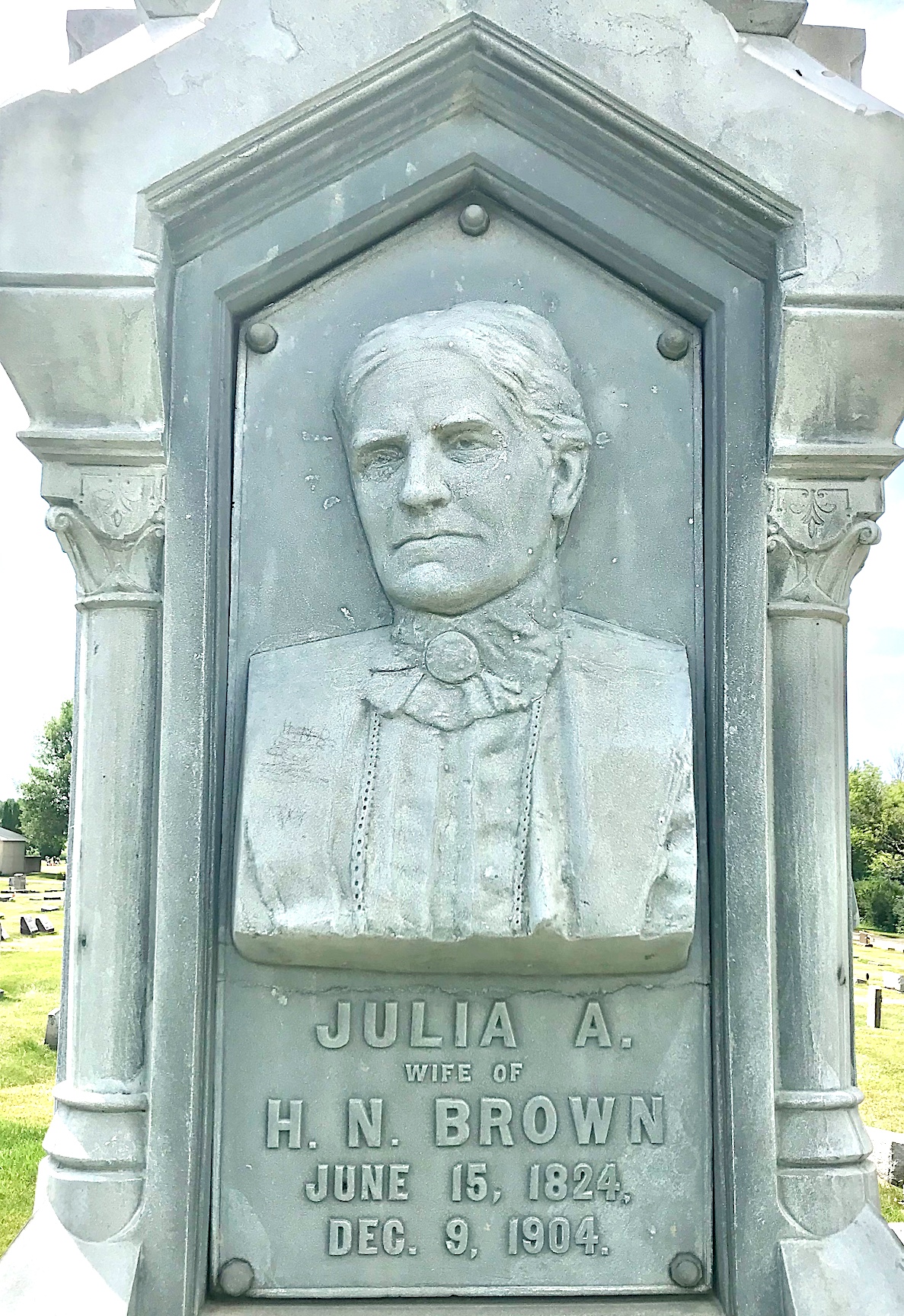
Julia Brown continued to run the family farm after Horace passed away.

History of a Monument

When I started researching the Brown monument, I got some surprises. All I really knew when I saw it in 2019 was that it was in desperate need of repair and that the local chapters of the Daughters of the American Revolution and Sons of the American Revolution were raising funds to do so. They had reached a little over half their goal of $40,000 then.

When Horace Brown contacted Cedar Rapids’ Krebs Bros. in 1886 to obtain the monument, the dealer was well known for its white bronze monuments. I’ve written about these before but Iowa has more than most. That’s because the Western White Bronze factory was located in Des Moines and produced many of them.

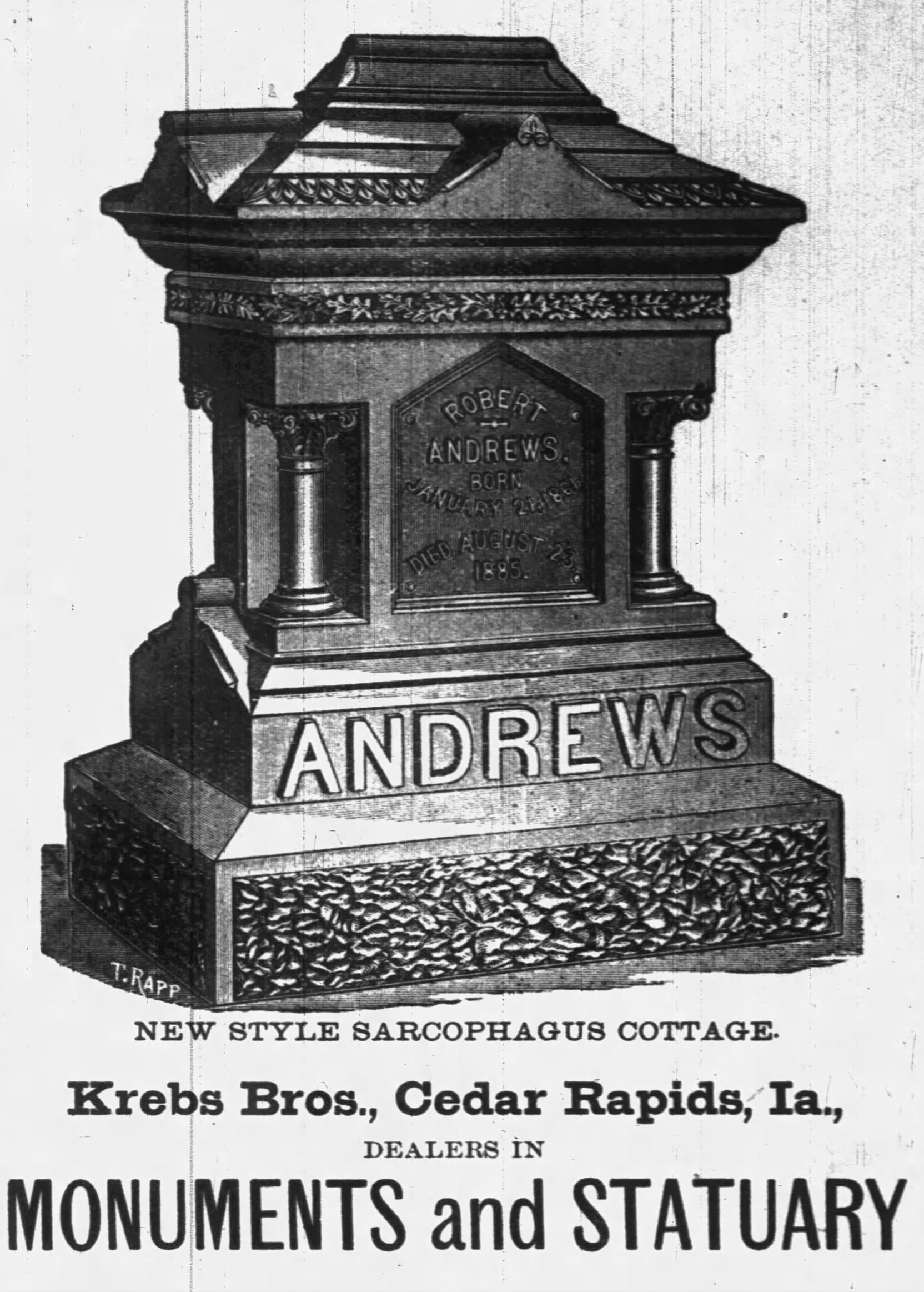
This ad in the Cedar Rapids Gazette from April 7, 1886 was part of a full spread paid for by Krebs Bros. touting the long-lasting qualities of white bronze monuments.

In looking for newspaper clippings for Krebs Bros., I was stunned to find one of their ads that included a drawing of the Bever monument at Oak Hill Cemetery in Cedar Rapids that I featured a few weeks ago. I learned that the 24 ft. tall Bever monument cost $5,000. In contrast, the 16 ft. tall Brown monument cost about $1,000 when it was erected.

Oak Hill Cemetery’s Bever monument was installed around the same time the Brown monument was at Springville Cemetery. (Photo source: Cedar Rapids Gazette, June 17, 1887)

The plates featuring bas relief busts of Horace and Julia Brown’s faces and birth/death dates were likely added after Julia died in 1904. I’ve only seen one other monument with a portrait on it and that was in New Orleans, La.

A storm in 1977 damaged the monument when a structure blew across the road into the cemetery and broke the spire into several pieces. Three local men worked to repair it and realized it wasn’t made of stone but metal. They poured a concrete base and bolted the metal together.

Individual white bronze marker for Horace Brown.

The monument was restored beginning in August 2020 after a several-year fundraising campaign by area Daughters of the American Revolution groups (the Mayflower Chapter, the Ashley Chapter, and the Marion Linn Chapter) and local donations. Memorials by Michel in Solon, Iowa completed the restoration work, which included replacing the fractured base.

The Brown monument was rededicated at a ceremony May 22, 2021. While it is shorter now because of the new base, I think it looks wonderful. This photo is a screenshot from a video I found on YouTube.

Repaired Brown monument at Springville Cemetery.

The Pherrin Family

Since we’re already on the white bronze track, let’s keep going. Springville Cemetery has several great examples. But one of them puzzled me at first.

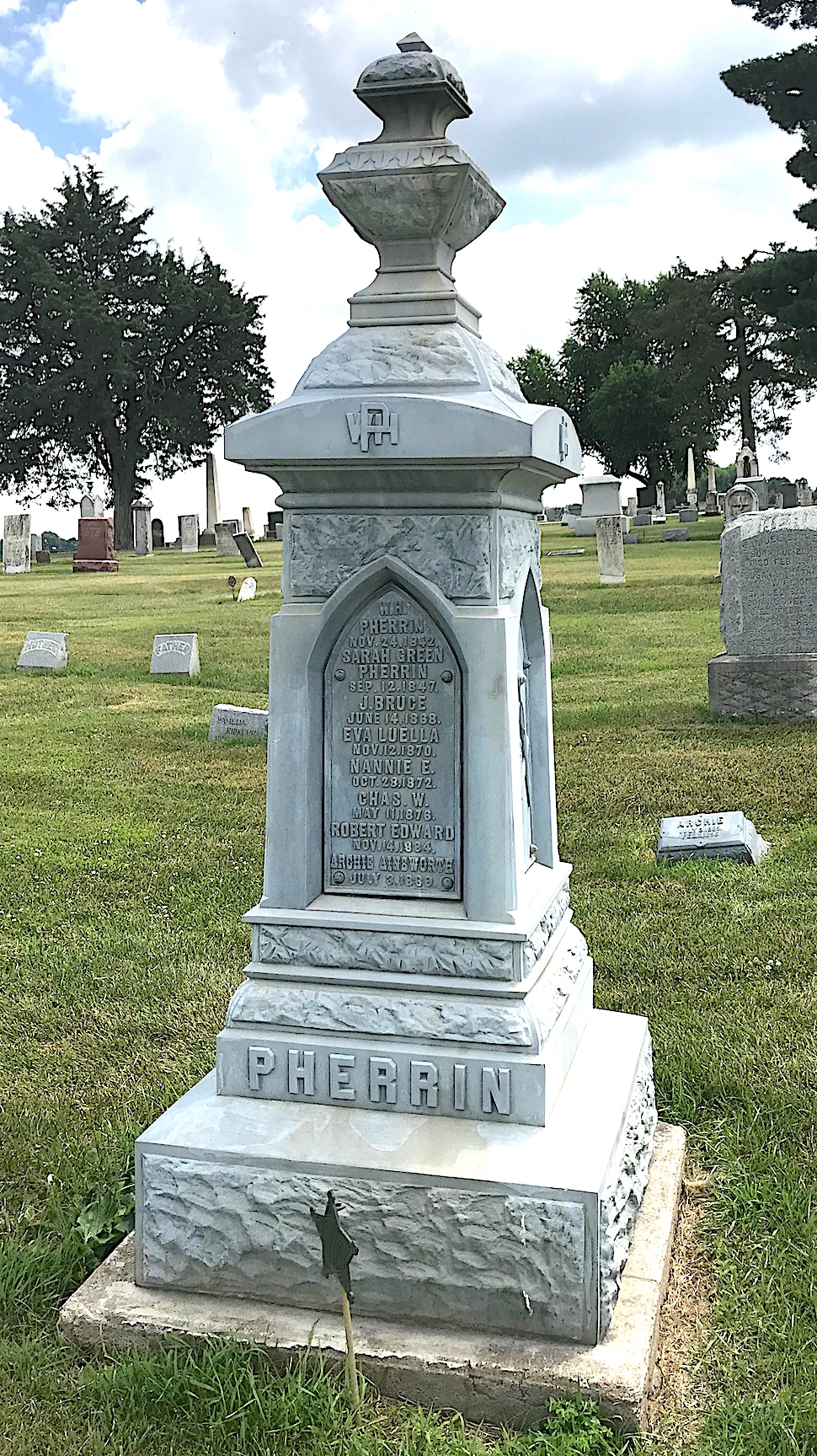
The Pherrin white bronze monument has eight names with only birth dates, no death dates.

The Pherrin monument has eight names on it. That’s a long list but not strange. What’s different is that all the dates are birth dates with no death dates.

The Pherrin family was headed by William Harrison Pherrin (born in Erie, Pa. in 1842) and his wife, Sarah Green Pherrin (born in 1847). William’s family moved from Pennsylvania to Iowa sometime in the 1850s. He served in the 24th Iowa Infantry, Co. H., during the Civil War. He wed Sarah in 1867 and they started a family with the birth of John Bruce Perrin in 1868.

More children would follow with the births of Luella (1870), Nancy “Nannie” (1872), Charles (1876), Edward (1884) and Archie (1896). All of them, except for Archie, would live well into adulthood.

William and Sarah Pherrin had six children together.

You might be asking yourself why it was done this way. I have some theories.

The first Pherrin family member to die, sadly, was little Archie. Born on July 3, 1889, he died on Feb. 11 1896 at the age of 6. Death records indicate he died from “inflammation of the bowels”. He is also the only Pherrin family member to have an individual white bronze marker.

Archie Pherrin was only six when he died from “inflammation of the bowels” in 1896.

The Western White Bronze Co. in Des Moines was in full operation from 1886 to 1908. The government took over the plant in 1914 for manufacturing munitions during World War I. After the war, demand for the monuments faded. However, they continued to make individual panels for family members who died after the monuments were ordered. The company turned to making castings for automobiles and radios until it closed in 1939.

I think when Archie died in 1896, someone in the family consulted with a monument company (probably Krebs. Bros.) who advised them on creating a monument not just for Archie but for the entire family. They would only put the birth dates to save space, adding individual markers later as family members died. What they didn’t know at the time was that Western White Bronze would end up closing.

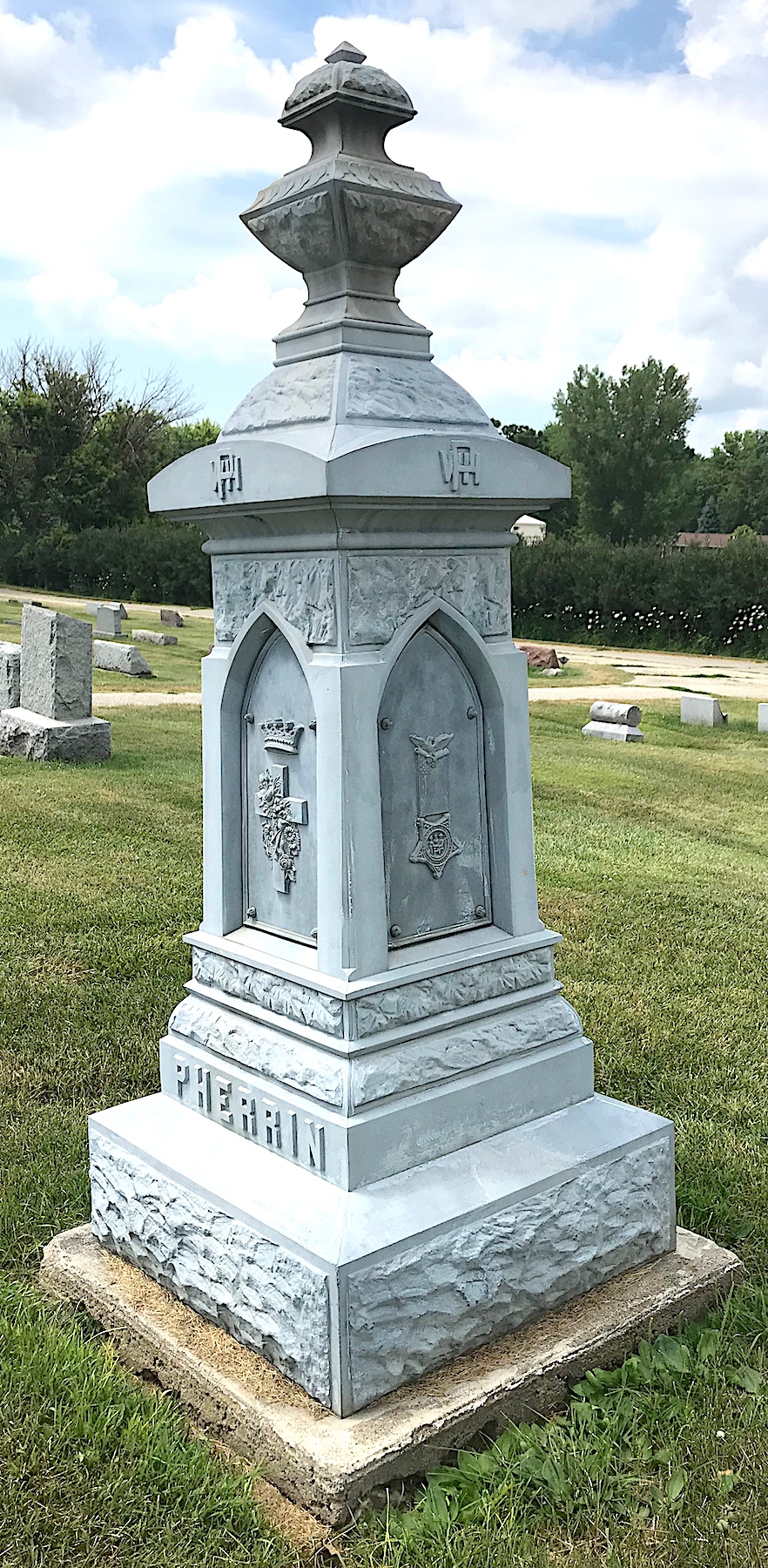
Notice the interlocking “WHP” initials for William Harrison Pherrin and a panel featuring a war medallion honoring his Civil War service.

You’ll notice that one of the panels features a war medallion on a ribbon, a symbol of William’s Civil War service. Also, you can see the interlocking initials “WHP”.

Eldest Pherrin son, Dr. John B. Pherrin (he was a dentist), died in 1937. He has his own individual stone marker.

There wasn’t another death in the Pherrin family until Nancy “Nannie” Pherrin Smith died in 1917 at age 45. William H. Pherrin died in 1924 at age 81 and Sarah Pherrin died in 1938. John died in 1937, he has an individual stone marker. Eva Luella died in 1943, Charles died in 1946, and Robert died in 1975.

Now a good question to ask is are all of the Perrin children actually buried at Springville? The answer is no.

I can safely say that John, Luella, and Archie are really there. Robert is definitely not because I found his Find a Grave memorial at Woodlawn Memorial Park in Gotha, Fla. He moved to Florida 49 years before his death. I suspect Charles is buried in the Seattle, Wash. area because he died there in 1946. I could not find an obituary for him. Nor could I find an obituary for Nannie, who had married Charles Wesley Smith and moved to North Dakota. Like Robert and Charles, it’s possible she is buried there as well.

The Chapman Siblings

I always think it’s special when I find a brother/sister pair of markers. That’s the case for Daniel T. Chapman and Ellen Chapman. You might remember that last name. Horace Brown’s wife was their sister, Julia Chapman Brown.

Daniel and Ellen Chapman died 57 years apart.

Daniel, born in 1818, was the son of Lemuel Chapman and Betsy Smouse. He died on Jan. 9, 1846 at age 27. I don’t know what his cause of death was. Ellen was the daughter of Lemuel and his second wife, Ruth Hardinger. She was born in 1837. So she was only nine when Daniel died. She never married. She lived with her mother, Ruth, in Indiana.

The back of the Chapman markers feature a wreath and an anchor (which often signifies faith).

I learned that when Ruth died in 1872, Ellen moved to Springville and moved in with her half-sister Julia and her husband, Horace. She remained there until her death at age 64 on April 13, 1903.

It’s my guess that Julia, having already perhaps been involved in the ordering of the Brown monument years before, ordered these two markers to honor her siblings. It’s the exact same style as the individual ones that she and Horace have.

“Earth Has No Sorrows That Heaven Cannot Heal”

Finally, I want to include this marker for Myrtle May Dennis McAtee. Born in 1882 to James Dennis and Axie Hahn Dennis, May was one of several children. She married Dwight Asa McAtee on Feb. 9, 1902 in Springville. They had a daughter named Ruby on April 4, 1903.

Myrtle May Dennis McAtee died at age 21 of tuberculosis.

But their happiness was short lived. May died on Feb. 37, 1904 at age 21 of consumption, today known as tuberculosis. Ruby was not even a year old at the time.

“Earth Has No Sorrows That Heaven Cannot Heal”.

Dwight remarried to Edythe Gertrude Carr in 1926. Ruby grew up and became a teacher, marrying Fordis Clifton in 1935. She died in 1962 of ovarian cancer. Dwight died in 1951 at age 73. The marker he shares with Edythe, who died in 1950, is beside May’s white bronze marker.

I’ll be back with more stories from Springville Cemetery next time.

White bronze marker for Dora Gibson, who died on July 3, 1885 at age four.

A Doctor and Two Lion Hearts: Lingering at Cedar Rapids, Iowa’s Oak Hill Cemetery, Part IV

12 Friday Jan 2024

Posted by adventuresincemeteryhopping in General

≈ Leave a comment

Happy New Year! Let’s start 2024 right by getting a last look around Cedar Rapids, Iowa’s Oak Hill Cemetery. There are a few stories left to tell at this venerable burial ground.

Cedar Rapids’ First Doctor

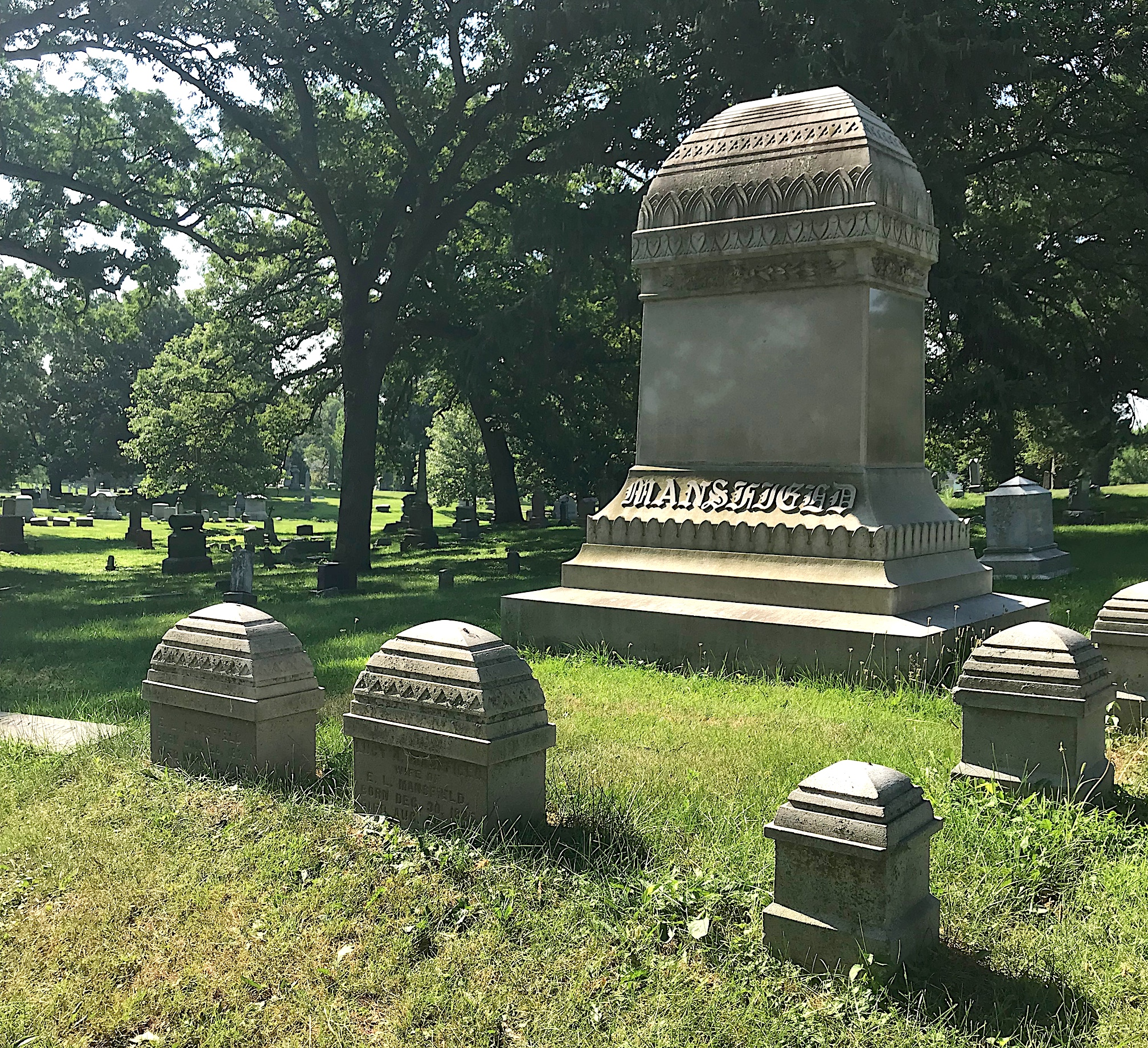
One family plot that got my attention was this one for the Mansfields. The surname monument and individual markers were of an unusual design I hadn’t seen before. I was curious to know more about them.

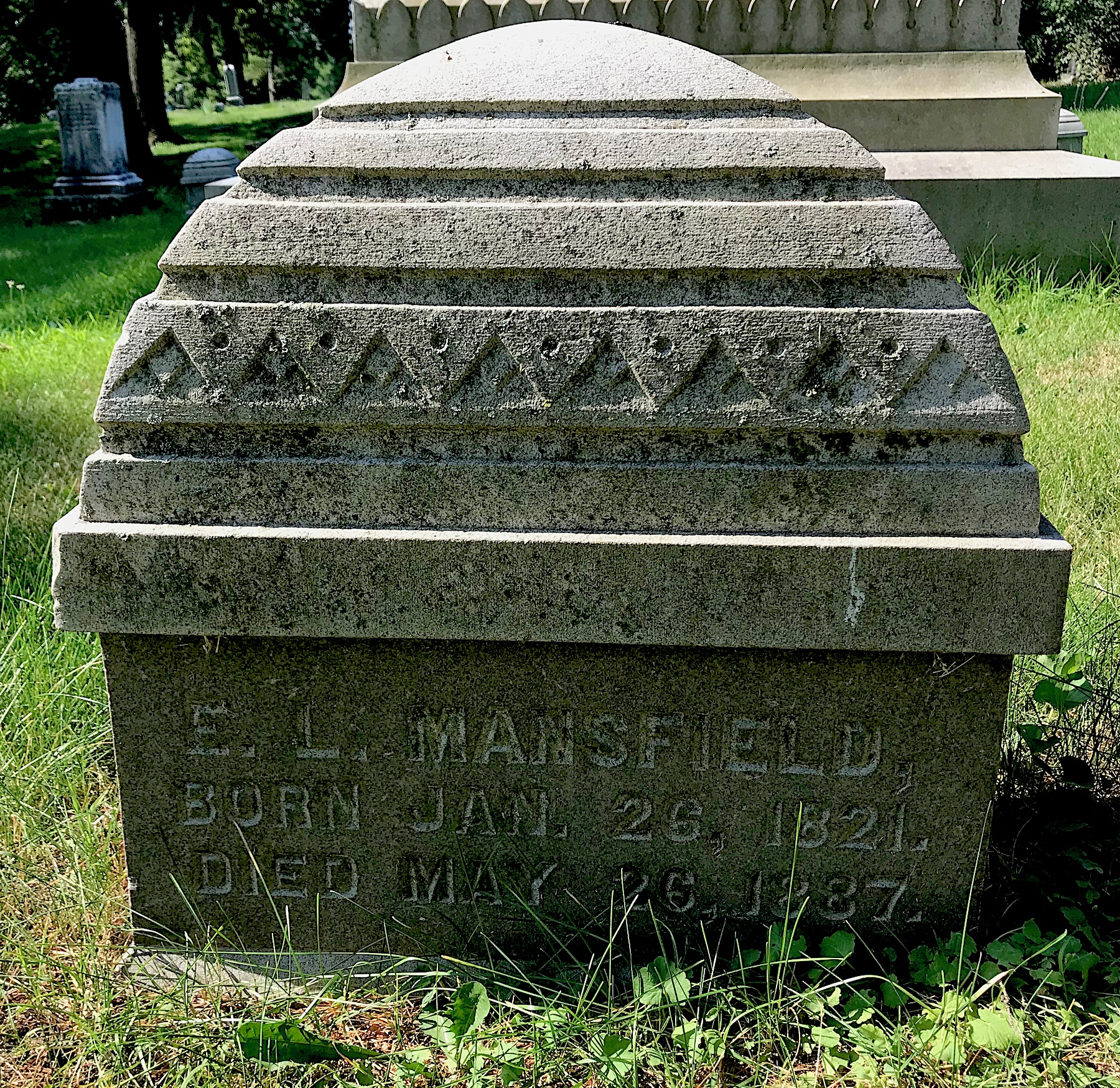
The individual Mansfield markers are of a style that intrigues me.

The head of the family was Dr. Eber Lewis Mansifled, originally of Athens, Ohio. Born in 1821, Eber’s education was of a hit or miss nature. I’ve found this to be the case for many doctors back in the day who came from hardscrabble backgrounds. He got his medical education when and where he could find it, learning from other physicians, and finishing up at Western Reserve Medical College in Cleveland, Ohio.

Dr. Mansfield arrived in Cedar Rapids around 1847, becoming the town’s first physician. He left temporarily in 1850 to travel to California during the Gold Rush, combining medicine and mining. But he returned in 1851 to settle permanently in Cedar Rapids.

Photo of Dr. Eber L. Mansifled from Pioneer Days In Cedar Rapids, by Charles A. Laurance, Laurance Press Co., Cedar Rapids, Iowa, 1936.

At 26, Dr. Mansfield wed Indiana native Lucy Ann Warriner in 1852. They had several children over the next years. Daughters Lizzie (born in 1854) and Irene (born in 1859) would die in infancy. But Sylvia (born in 1853), Lura (born in 1857) and Lewis (born in 1861) lived long lives.

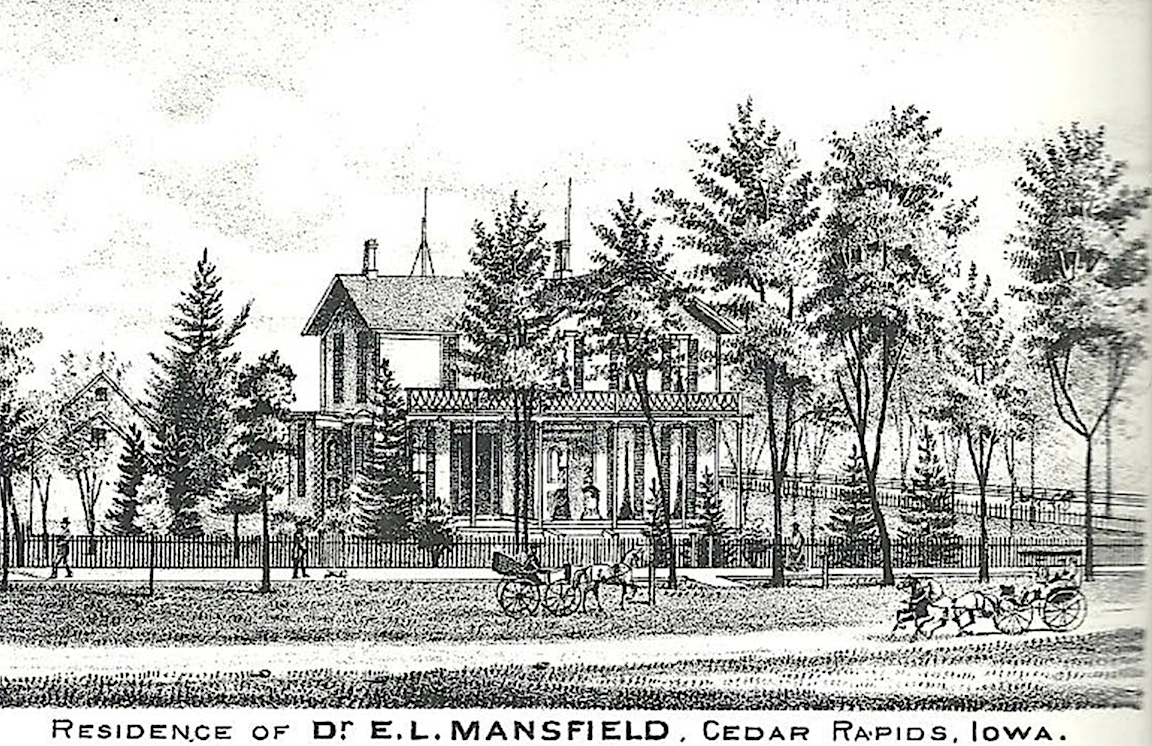
The family prospered and Dr. Mansfield’s practice flourished. They owned this fine home (see illustration below).

An illustration of the Mansfield home from A. T. Andreas’ “Illustrated Historical Atlas of the State of Iowa 1875”.

Lucy died on Aug. 26, 1868 at age 42 after a long illness, according to her death notice. She was buried at OHC with her infant daughters.

Dr. Mansfield remarried to Mary Elizabeth Warriner in 1870. She was Lucy’s second cousin.

Lucy Warriner Mansfield died in 1868 after a long illness. She was buried with her two daughters that died in infancy.

Died in His Buggy

When Dr. Mansfield died on May 26, 1877, his manner of death was reported on because of how it transpired. He was on his way to visit his farm out of town, according to the Cedar Rapids Gazette article:

He left the city this morning to go to his farm, which is 19 miles from this city and three miles from Urbana, a short distance from the Benton county line. It had been his custom to visit his farm once every week or two. When at Hunter’s corner his horse stopped in the road and remained there several minutes, the doctor sitting upright with the lines in his hands without moving.

Mr. Hunter and his daughter were sitting on their porch and saw the doctor’s horse stop. As he made no movement, one of them went down to the buggy to see what might be wrong, if anything, and found him dead. There was no sign of life whatever except that as when they first approached him they noticed a slight groan. He was holding the lines in his hands and appeared as if he were alive and sitting upright. His face had not changed color and his head was slightly inclined forward.

Dr. Eber Mansfield died while going to his farm from a fit of apoplexy. He was 66.

The same article reported that, “He had recently had an attack of neuralgia of the stomach, but had fully recovered from that. He had frequently told a physician here that he expected to died from apoplexy.” Today, apoplexy would mostly likely be considered some kind of stroke.

Dr. Mansfield is buried with his first wife and three of his children.

Dr. Mansfield was buried at OHC with Lucy and his infant daughters.

Wife Mary died of pleurisy at age 58 on Feb. 3, 1889. While her Find a Grave memorial says she is buried at OHC, the cemetery online records do not have record of her being buried there. According to Iowa death records, she was placed in the Oak Hill vault. The articles I found about her death reported her funeral but none mention where exactly she was buried. There is no marker for her in the plot as far as I could tell. So I cannot say for sure exactly where Mary ended up!

The only other Mansfield child in the plot, besides Irene and Lizzie, was son Lewis and his wife, Margaret. Lewis died in 1933 at age 71. Daughter Sylvia, who married Charles Deacon, is buried with him in another area of OHC. Daughter Lura, who married twice, is buried with her second husband in Elmwood Cemetery in Kansas City, Mo.

Mayor of Cedar Rapids

The reason I photographed the Carmody plot is also because I thought it looked different. John T. Carmody’s signature is on the surname monument, which is held up by what appear to be lion’s feet.

That might tell you a bit about the character of John T. Carmody.

John and Mary Carmody had no children. Ellen Buckingham was Mary’s mother.

Born in 1859, Irishman John T. Carmody left Lima, Ohio and arrived in Cedar Rapids around 1885. He started working for Whiting Bros. foundry as a foreman and became the sole owner of the factory in 1889, renaming it J.T. Carmody Foundry & Machine Co. In 30 years, the company would become Iowa Steel & Iron Works.

John wed local Irish girl Mary Buckingham in 1887. They had no children.

The main building of Carmody’s company caught fire on April 22, 1902, totally destroying it. Despite the setback, Carmody was determined to start over and his new building, with all new equipment, was completed in 1904.

Carmody’s success led to his election as Cedar Rapids mayor on March 30, 1908. Unfortunately, his tenure as mayor would not last long.

The death of Cedar Rapids’ mayor John Carmody shook the town.

Death of a Lion Heart

On May 23, Mary Carmody was awakened by the sound of a burglar in the bedroom. She called out to her husband, and the intruder struck her in the neck. She called out again and Carmody awoke. He sprang up and wrestled the intruder into the hallway. When the intruder managed to get free on the stairs, he turned, firing two shots, one of which hit Carmody.

Police ran to the Carmody home, where they found Carmody shot in the stomach. Carmody was taken to St. Luke’s Hospital. Although his doctor expected him to recover, Carmody never left the hospital. He contracted typhoid fever and died Aug. 7, 1909. He was 49.

On Dec. 24, Arthur Johnson, alias J.A. Harris, a career criminal from Chillicothe, Mo., was given a life sentence for the murder of John Carmody.

Mayor John T. Carmody fought like a lion to protect his wife from a burglar.

Carmody’s death weighed greatly on his wife, Mary. She continued to live with her mother, Ellen. She died four years later on Aug. 13, 1913. She was only 37. Ellen Buckingham died on Jan. 22, 1920. John, Mary, and Ellen are buried together at OHC.

Medal of Honor Recipient

I’d like to end my visit to Oak Hill Cemetery with the story of another lion-hearted fellow buried there.

Charles Amory Clark, right, with his brothers James William Clark, left, and Whiting Stevens Clark, center, sat for their portrait in Mathew Brady’s Washington, D.C., studio on April 27, 1863.

Born in Sangerville, Maine on Jan. 26, 1841, Charles Amory Clark enlisted with the 6th Maine Infantry in July 1861, and was commissioned as a lieutenant in February 1862. He later served as captain and assistant adjutant general of volunteers from May to October 1864.

Three of Charles’ brothers (see photo above) also served in the Civil War. While Whiting Steven Clark and Frank A. Clark (not pictured) would survive, their brother James William Clark died on July 31, 1864 from wounds he suffered at Petersburg, Va.

Lt. Col. Clark received the Medal of Honor for his actions at Brooks Ford, Va. on May 4, 1863 during the Battle of Salem Church in the Chancellorsville Campaign. He was honored with the award on May 13, 1896:

Having voluntarily taken command of his regiment in the absence of its commander, at great personal risk and with remarkable presence of mind and fertility of resource led the command down an exceedingly precipitous embankment to the Rappahannock River and by his gallantry, coolness, and good judgment in the face of the enemy saved the command from capture or destruction.

Lt. Col. Charles Clark practiced law in Cedar Rapids after the Civil War. (Photo Source: History of Iowa From the Earliest Times to the Beginning of the Twentieth Century, Volume IV, 1903)

Lt. Col. Charles Clark was awarded in the Medal of Honor in 1896.

After the war, Clark worked as a lawyer in Cedar Rapids. He was active in the Grand Army of the Republic (GAR), and was elected its national judge advocate general in 1905 and the department commander of Iowa in 1906. He was also a companion of the Iowa Commandery of the Military Order of the Loyal Legion of the United States. He was named a regent of the University of Iowa in 1907.

If you’re interested in Clark’s friendship with fellow soldier Solomon Russell, read this.

Clark died at age 72 on Dec. 22, 1913. He is buried with his wife, Helen Brockway Clark, who died in 1929.

It wasn’t easy to leave Oak Hill Cemetery. But now it was time to head east for Springville Cemetery.

White bronze (zinc) marker for Elisabeth Smith, wife of J.M. Smith. She died on Dec. 21, 1880 of typhoid pneumonia. She was 31.

Recent Posts

  • More Pensacola, Fla. Cemetery Hopping: Taking a Ramble Through Saint John’s Cemetery, Part III
  • More Pensacola, Fla. Cemetery Hopping: Taking a Ramble Through Saint John’s Cemetery, Part II
  • More Pensacola, Fla. Cemetery Hopping: Taking a Ramble Through Saint John’s Cemetery, Part I
  • The City of Five Flags: Stepping back in time at Pensacola, Fla.’s Saint Michael’s Cemetery, Part V
  • The City of Five Flags: Stepping back in time at Pensacola, Fla.’s Saint Michael’s Cemetery, Part IV

Archives

  • December 2025
  • November 2025
  • August 2025
  • July 2025
  • June 2025
  • May 2025
  • April 2025
  • March 2025
  • February 2025
  • January 2025
  • October 2024
  • August 2024
  • July 2024
  • June 2024
  • May 2024
  • April 2024
  • March 2024
  • February 2024
  • January 2024
  • December 2023
  • November 2023
  • October 2023
  • September 2023
  • August 2023
  • July 2023
  • June 2023
  • May 2023
  • April 2023
  • March 2023
  • February 2023
  • January 2023
  • December 2022
  • November 2022
  • October 2022
  • September 2022
  • August 2022
  • July 2022
  • June 2022
  • May 2022
  • April 2022
  • March 2022
  • February 2022
  • January 2022
  • December 2021
  • November 2021
  • October 2021
  • September 2021
  • August 2021
  • July 2021
  • May 2021
  • April 2021
  • March 2021
  • February 2021
  • January 2021
  • December 2020
  • November 2020
  • October 2020
  • September 2020
  • August 2020
  • July 2020
  • June 2020
  • May 2020
  • April 2020
  • March 2020
  • February 2020
  • January 2020
  • December 2019
  • November 2019
  • October 2019
  • September 2019
  • August 2019
  • July 2019
  • June 2019
  • May 2019
  • April 2019
  • March 2019
  • February 2019
  • January 2019
  • December 2018
  • November 2018
  • October 2018
  • September 2018
  • August 2018
  • May 2018
  • April 2018
  • March 2018
  • February 2018
  • January 2018
  • December 2017
  • November 2017
  • October 2017
  • September 2017
  • August 2017
  • July 2017
  • June 2017
  • May 2017
  • April 2017
  • March 2017
  • February 2017
  • January 2017
  • December 2016
  • November 2016
  • October 2016
  • September 2016
  • August 2016
  • July 2016
  • June 2016
  • May 2016
  • April 2016
  • March 2016
  • February 2016
  • January 2016
  • December 2015
  • November 2015
  • October 2015
  • September 2015
  • August 2015
  • July 2015
  • May 2015
  • April 2015
  • March 2015
  • February 2015
  • January 2015
  • December 2014
  • November 2014
  • October 2014
  • September 2014
  • August 2014
  • July 2014
  • June 2014
  • May 2014
  • April 2014
  • March 2014
  • February 2014
  • January 2014
  • December 2013
  • November 2013
  • October 2013
  • September 2013
  • August 2013
  • July 2013
  • June 2013
  • May 2013
  • April 2013
  • March 2013
  • February 2013
  • January 2013

Categories

  • General

Blogroll

  • A Grave Interest
  • Cemetery Photography by Chantal Larochelle
  • Cemetery Tours of Berlin by Matti
  • Confessions of a Funeral Director (Caleb Wilde)
  • Find a Grave
  • Hunting and Gathering (cool photography site)
  • Save Our Cemeteries (New Orleans, La.)
  • The Cemetery Club
  • The Graveyard Detective
  • The Rambling Muser
  • Westminster Abbey Tours by Grace

Meta

  • Create account
  • Log in
  • Entries feed
  • Comments feed
  • WordPress.com

Blog at WordPress.com.

  • Subscribe Subscribed
    • Adventures in Cemetery Hopping
    • Join 402 other subscribers
    • Already have a WordPress.com account? Log in now.
    • Adventures in Cemetery Hopping
    • Subscribe Subscribed
    • Sign up
    • Log in
    • Report this content
    • View site in Reader
    • Manage subscriptions
    • Collapse this bar
 

Loading Comments...