
Happy New Year! Let’s start 2024 right by getting a last look around Cedar Rapids, Iowa’s Oak Hill Cemetery. There are a few stories left to tell at this venerable burial ground.
Cedar Rapids’ First Doctor
One family plot that got my attention was this one for the Mansfields. The surname monument and individual markers were of an unusual design I hadn’t seen before. I was curious to know more about them.
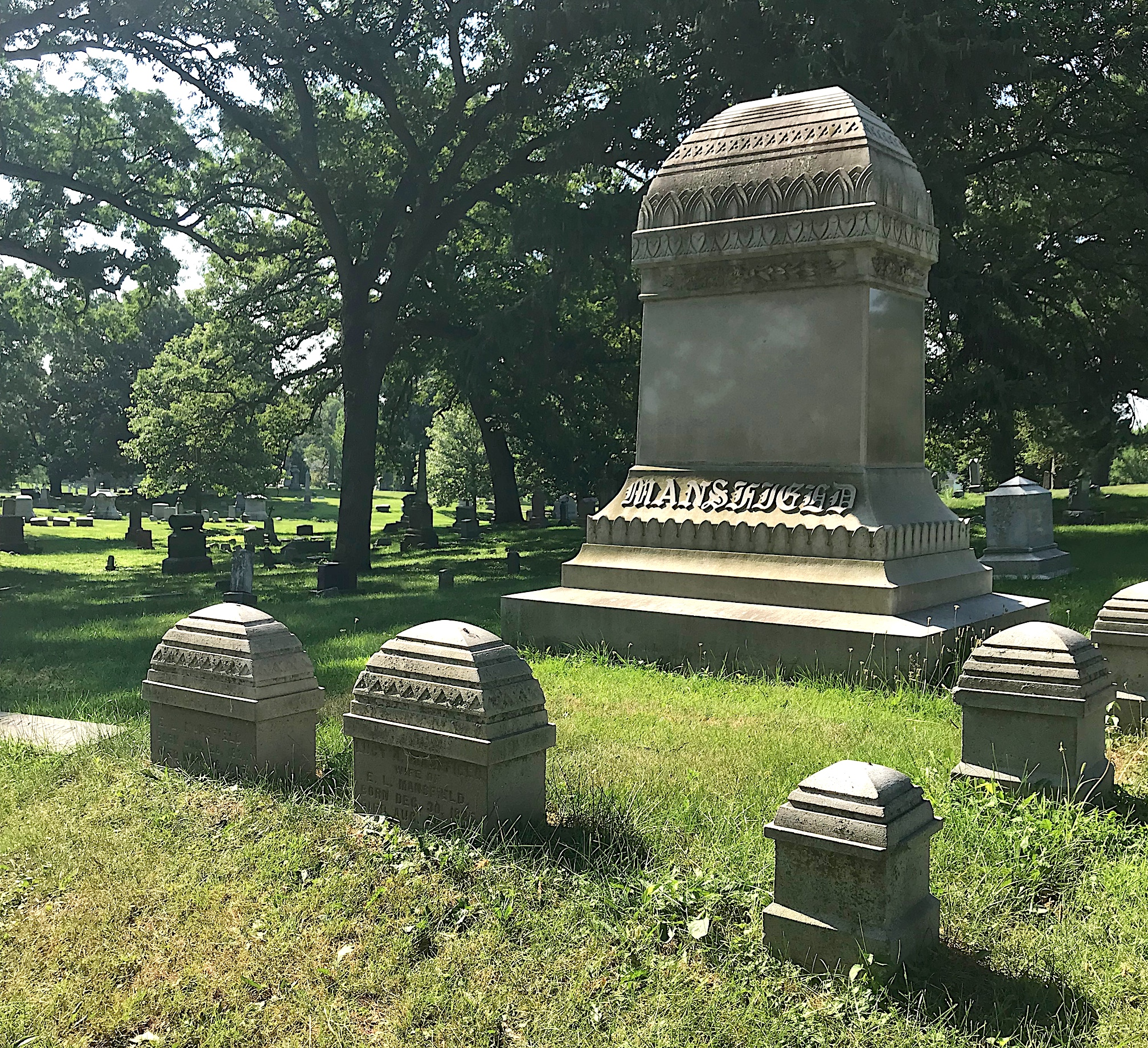
The head of the family was Dr. Eber Lewis Mansifled, originally of Athens, Ohio. Born in 1821, Eber’s education was of a hit or miss nature. I’ve found this to be the case for many doctors back in the day who came from hardscrabble backgrounds. He got his medical education when and where he could find it, learning from other physicians, and finishing up at Western Reserve Medical College in Cleveland, Ohio.
Dr. Mansfield arrived in Cedar Rapids around 1847, becoming the town’s first physician. He left temporarily in 1850 to travel to California during the Gold Rush, combining medicine and mining. But he returned in 1851 to settle permanently in Cedar Rapids.

At 26, Dr. Mansfield wed Indiana native Lucy Ann Warriner in 1852. They had several children over the next years. Daughters Lizzie (born in 1854) and Irene (born in 1859) would die in infancy. But Sylvia (born in 1853), Lura (born in 1857) and Lewis (born in 1861) lived long lives.
The family prospered and Dr. Mansfield’s practice flourished. They owned this fine home (see illustration below).
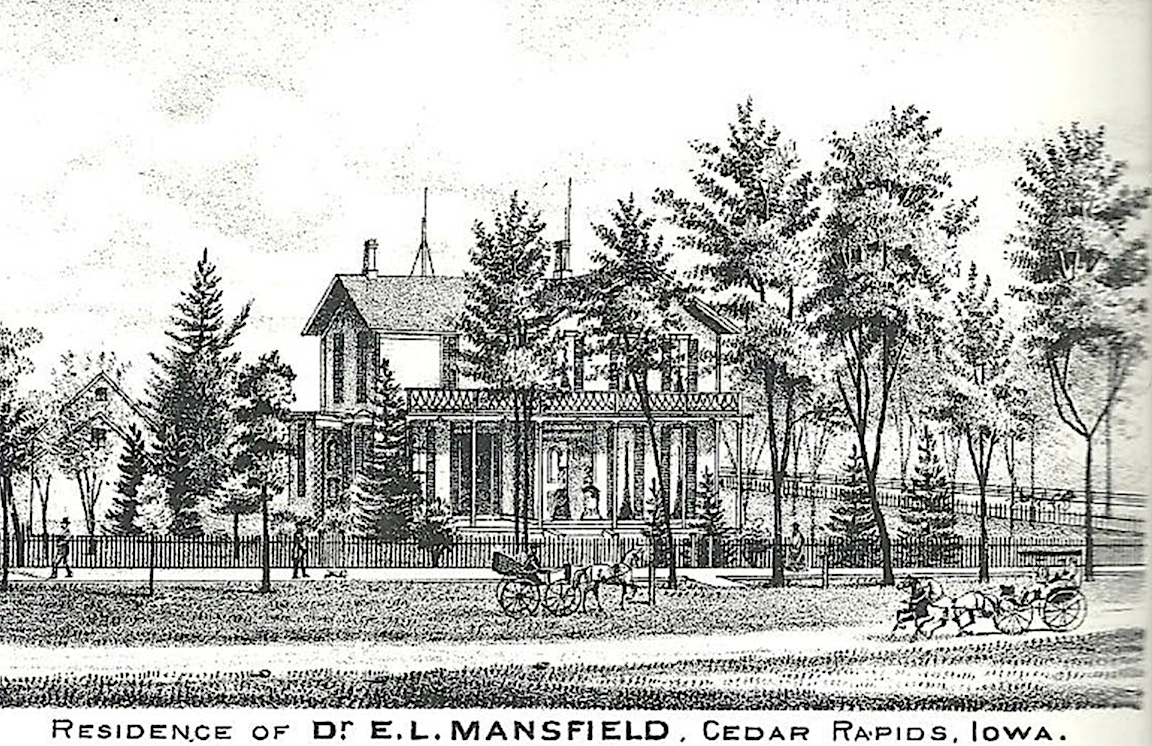
Lucy died on Aug. 26, 1868 at age 42 after a long illness, according to her death notice. She was buried at OHC with her infant daughters.
Dr. Mansfield remarried to Mary Elizabeth Warriner in 1870. She was Lucy’s second cousin.

Died in His Buggy
When Dr. Mansfield died on May 26, 1877, his manner of death was reported on because of how it transpired. He was on his way to visit his farm out of town, according to the Cedar Rapids Gazette article:
He left the city this morning to go to his farm, which is 19 miles from this city and three miles from Urbana, a short distance from the Benton county line. It had been his custom to visit his farm once every week or two. When at Hunter’s corner his horse stopped in the road and remained there several minutes, the doctor sitting upright with the lines in his hands without moving.
Mr. Hunter and his daughter were sitting on their porch and saw the doctor’s horse stop. As he made no movement, one of them went down to the buggy to see what might be wrong, if anything, and found him dead. There was no sign of life whatever except that as when they first approached him they noticed a slight groan. He was holding the lines in his hands and appeared as if he were alive and sitting upright. His face had not changed color and his head was slightly inclined forward.

The same article reported that, “He had recently had an attack of neuralgia of the stomach, but had fully recovered from that. He had frequently told a physician here that he expected to died from apoplexy.” Today, apoplexy would mostly likely be considered some kind of stroke.
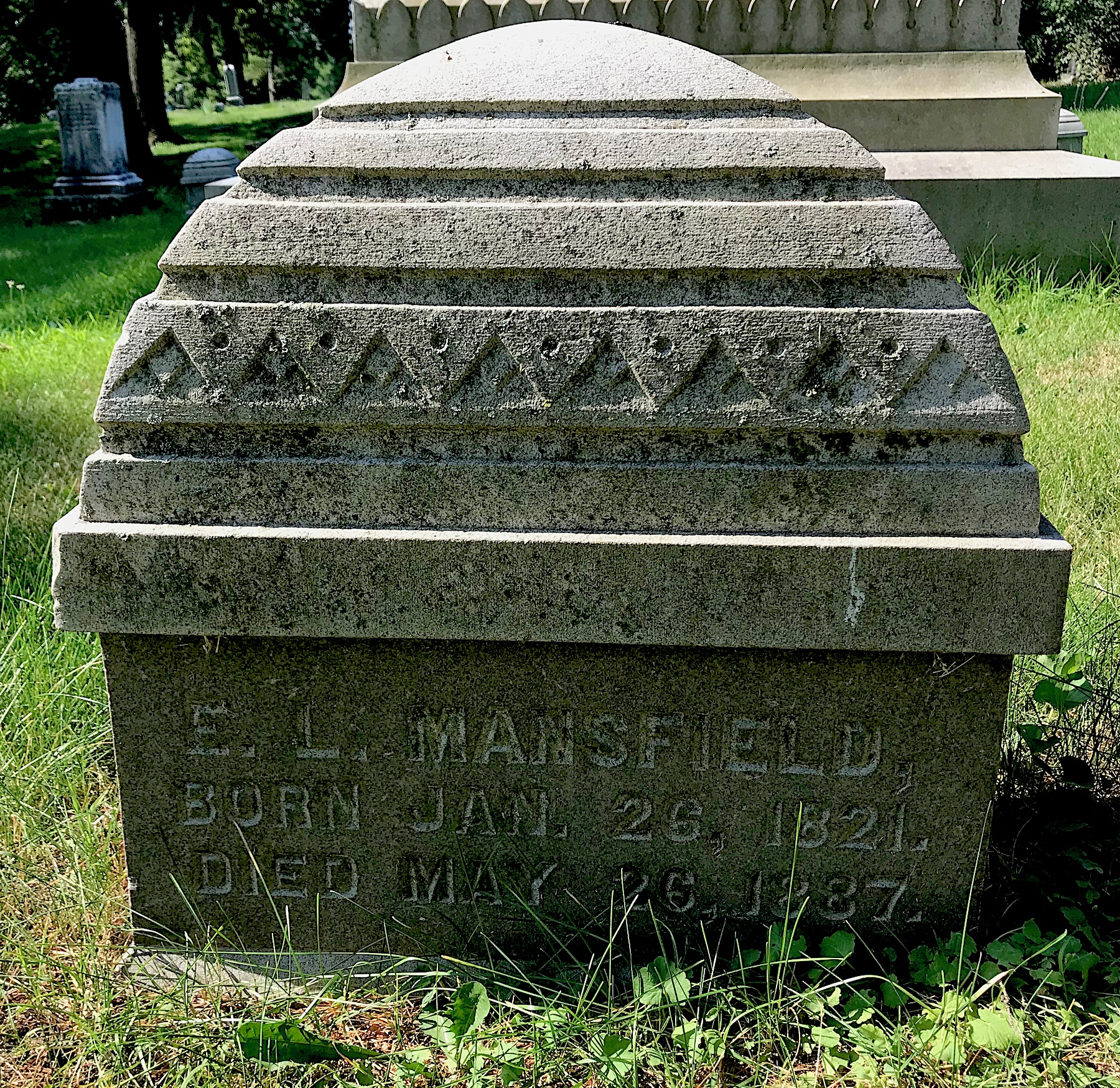
Dr. Mansfield was buried at OHC with Lucy and his infant daughters.
Wife Mary died of pleurisy at age 58 on Feb. 3, 1889. While her Find a Grave memorial says she is buried at OHC, the cemetery online records do not have record of her being buried there. According to Iowa death records, she was placed in the Oak Hill vault. The articles I found about her death reported her funeral but none mention where exactly she was buried. There is no marker for her in the plot as far as I could tell. So I cannot say for sure exactly where Mary ended up!
The only other Mansfield child in the plot, besides Irene and Lizzie, was son Lewis and his wife, Margaret. Lewis died in 1933 at age 71. Daughter Sylvia, who married Charles Deacon, is buried with him in another area of OHC. Daughter Lura, who married twice, is buried with her second husband in Elmwood Cemetery in Kansas City, Mo.
Mayor of Cedar Rapids
The reason I photographed the Carmody plot is also because I thought it looked different. John T. Carmody’s signature is on the surname monument, which is held up by what appear to be lion’s feet.
That might tell you a bit about the character of John T. Carmody.

Born in 1859, Irishman John T. Carmody left Lima, Ohio and arrived in Cedar Rapids around 1885. He started working for Whiting Bros. foundry as a foreman and became the sole owner of the factory in 1889, renaming it J.T. Carmody Foundry & Machine Co. In 30 years, the company would become Iowa Steel & Iron Works.
John wed local Irish girl Mary Buckingham in 1887. They had no children.
The main building of Carmody’s company caught fire on April 22, 1902, totally destroying it. Despite the setback, Carmody was determined to start over and his new building, with all new equipment, was completed in 1904.
Carmody’s success led to his election as Cedar Rapids mayor on March 30, 1908. Unfortunately, his tenure as mayor would not last long.

Death of a Lion Heart
On May 23, Mary Carmody was awakened by the sound of a burglar in the bedroom. She called out to her husband, and the intruder struck her in the neck. She called out again and Carmody awoke. He sprang up and wrestled the intruder into the hallway. When the intruder managed to get free on the stairs, he turned, firing two shots, one of which hit Carmody.
Police ran to the Carmody home, where they found Carmody shot in the stomach. Carmody was taken to St. Luke’s Hospital. Although his doctor expected him to recover, Carmody never left the hospital. He contracted typhoid fever and died Aug. 7, 1909. He was 49.
On Dec. 24, Arthur Johnson, alias J.A. Harris, a career criminal from Chillicothe, Mo., was given a life sentence for the murder of John Carmody.

Carmody’s death weighed greatly on his wife, Mary. She continued to live with her mother, Ellen. She died four years later on Aug. 13, 1913. She was only 37. Ellen Buckingham died on Jan. 22, 1920. John, Mary, and Ellen are buried together at OHC.
Medal of Honor Recipient
I’d like to end my visit to Oak Hill Cemetery with the story of another lion-hearted fellow buried there.

Born in Sangerville, Maine on Jan. 26, 1841, Charles Amory Clark enlisted with the 6th Maine Infantry in July 1861, and was commissioned as a lieutenant in February 1862. He later served as captain and assistant adjutant general of volunteers from May to October 1864.
Three of Charles’ brothers (see photo above) also served in the Civil War. While Whiting Steven Clark and Frank A. Clark (not pictured) would survive, their brother James William Clark died on July 31, 1864 from wounds he suffered at Petersburg, Va.
Lt. Col. Clark received the Medal of Honor for his actions at Brooks Ford, Va. on May 4, 1863 during the Battle of Salem Church in the Chancellorsville Campaign. He was honored with the award on May 13, 1896:
Having voluntarily taken command of his regiment in the absence of its commander, at great personal risk and with remarkable presence of mind and fertility of resource led the command down an exceedingly precipitous embankment to the Rappahannock River and by his gallantry, coolness, and good judgment in the face of the enemy saved the command from capture or destruction.


After the war, Clark worked as a lawyer in Cedar Rapids. He was active in the Grand Army of the Republic (GAR), and was elected its national judge advocate general in 1905 and the department commander of Iowa in 1906. He was also a companion of the Iowa Commandery of the Military Order of the Loyal Legion of the United States. He was named a regent of the University of Iowa in 1907.
If you’re interested in Clark’s friendship with fellow soldier Solomon Russell, read this.
Clark died at age 72 on Dec. 22, 1913. He is buried with his wife, Helen Brockway Clark, who died in 1929.
It wasn’t easy to leave Oak Hill Cemetery. But now it was time to head east for Springville Cemetery.

 Adventures in Cemetery Hopping
