
After leaving Cedar Rapids, we headed northeast 30 miles to Springville Cemetery. Springville Cemetery has an estimated 2,350 memorials on Find a Grave. Adjoining St. Isidore Cemetery seems to have between 50 to 100 graves.

Springville’s earliest graves date from the 1840s, before Iowa became the 29th state in 1846. But one of the reasons I put Springville on our itinerary was to see for myself one of the largest white bronze (zinc) monuments I’d ever come across online. It has quite a story of the family it represents and how it was brought back to its former glory after our visit.
The Brown Family
The Brown monument was erected in 1886 to honor Revolutionary War veteran Nathan Brown (1761-1842) and his family. It was commissioned by Brown’s son, Horace Nathan Brown (1822-1893). The base was made of granite but the majority of the monument is white bronze (zinc). In many articles I read, it was incorrectly reported that it was made of granite and marble.

One of the panels lists a lengthy history of Nathan Brown that I’ve included here:
Nathan Brown was born at White Plains, N.Y., July 22, 1761. At the age of 14, he began to drill in preparation to joining the American Army, and at 16 he entered the service in the Revolutionary War. His first battle was at Harlem Flats and his second one on the present site of Greenwood Cemetery. He was wounded but not seriously in some of the many battles in which he participated.
Seven brothers served in the same army and his captain was an uncle. After the war he removed to South Hallow and afterwards to Buffalo, N.Y., where he remained a short time and then removed to Pennsylvania. April 1, 1838, removed to Geneva, Kane County, Ill. Afterwards settled one mile southwest of Springville, Ia. May 17, 1839. Died Nov. 25, 1842.
After the Revolutionary War, Nathan married his first wife, Sarah Bailey, in in 1781. Their son, John, stayed behind when Nathan moved to Onondaga County, N.Y. After Sarah died, he married second wife Tamar Sammons in 1807. They had four daughters, Maria, Betsey, Amanda, and Harriet. The family moved to Erie County, Pa. It was there that their son, Horace, was born in 1822.

The Browns continued their journey west in 1838, settling in Kane County, Ill., where Nathan’s married daughters, Maria and Betsey remained, before the rest of the family moved to Linn County in Iowa Territory. Nathan died in 1842.
Nathan Brown was buried in Paralta Cemetery before Horace moved his father´s grave to Springville, probably when his mother Tamar died in 1868.

Horace expanded the 1839 Brown farm to more than 600 acres. He wed Julia Chapman in 1853. He served the county as its third treasurer and held several offices in the township, including justice of the peace.
After Horace died from tuberculosis at age 71 in 1893, Julia continued running the Brown farm until her death in 1904. She was 80. The plot now holds Nathan, Tamar, Horace, and Julia Brown.
History of a Monument
When I started researching the Brown monument, I got some surprises. All I really knew when I saw it in 2019 was that it was in desperate need of repair and that the local chapters of the Daughters of the American Revolution and Sons of the American Revolution were raising funds to do so. They had reached a little over half their goal of $40,000 then.
When Horace Brown contacted Cedar Rapids’ Krebs Bros. in 1886 to obtain the monument, the dealer was well known for its white bronze monuments. I’ve written about these before but Iowa has more than most. That’s because the Western White Bronze factory was located in Des Moines and produced many of them.
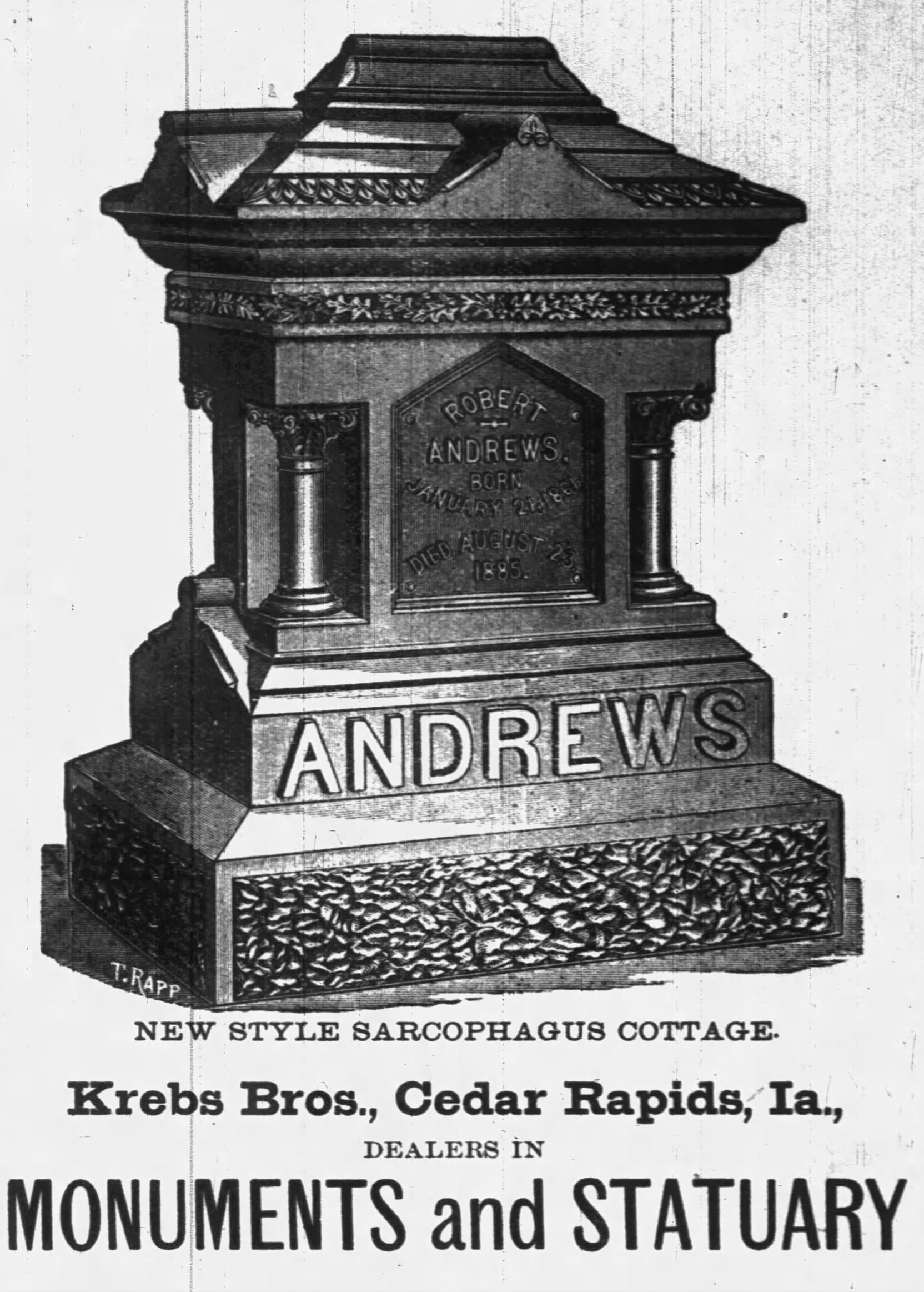
In looking for newspaper clippings for Krebs Bros., I was stunned to find one of their ads that included a drawing of the Bever monument at Oak Hill Cemetery in Cedar Rapids that I featured a few weeks ago. I learned that the 24 ft. tall Bever monument cost $5,000. In contrast, the 16 ft. tall Brown monument cost about $1,000 when it was erected.

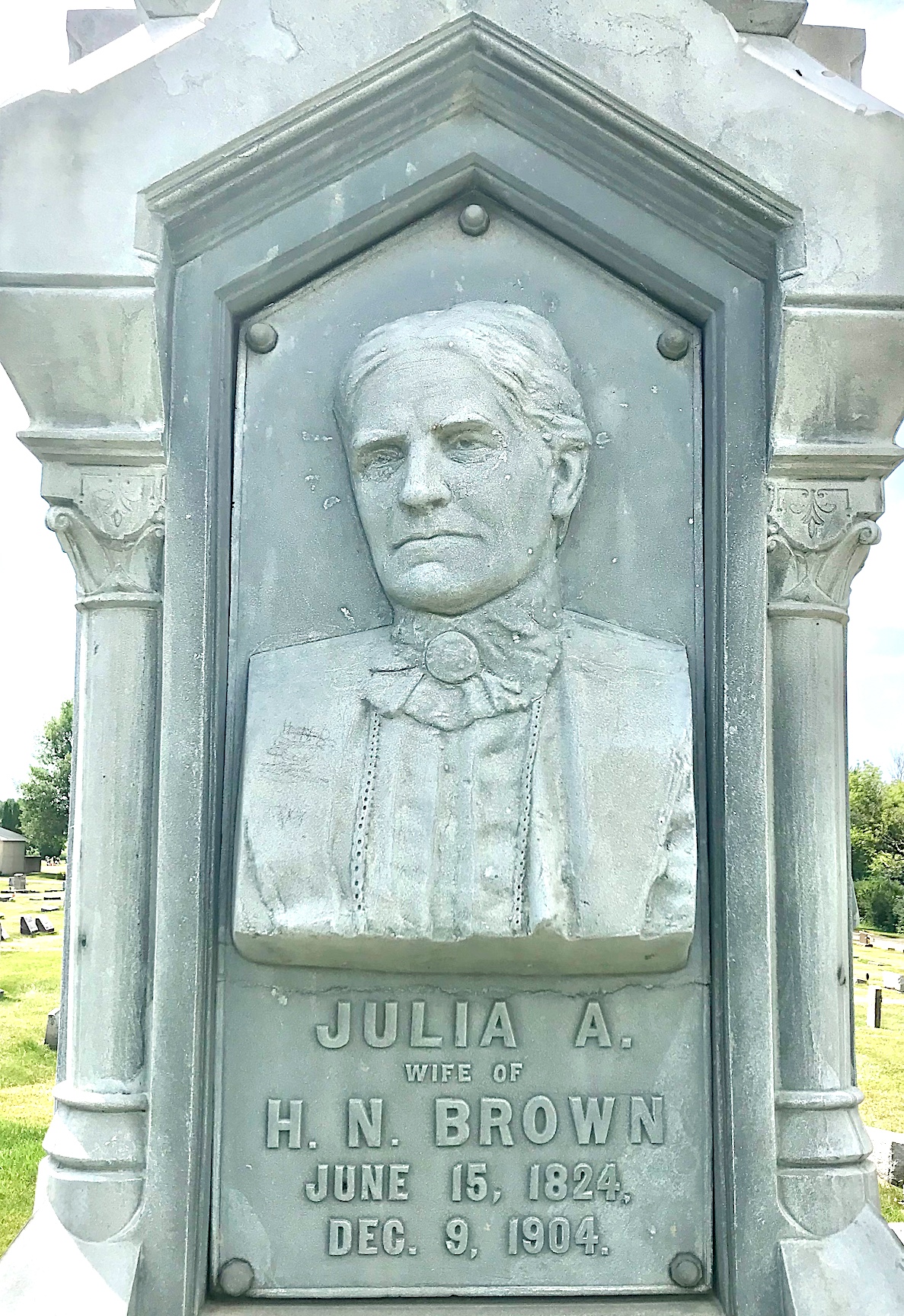
The plates featuring bas relief busts of Horace and Julia Brown’s faces and birth/death dates were likely added after Julia died in 1904. I’ve only seen one other monument with a portrait on it and that was in New Orleans, La.
A storm in 1977 damaged the monument when a structure blew across the road into the cemetery and broke the spire into several pieces. Three local men worked to repair it and realized it wasn’t made of stone but metal. They poured a concrete base and bolted the metal together.

The monument was restored beginning in August 2020 after a several-year fundraising campaign by area Daughters of the American Revolution groups (the Mayflower Chapter, the Ashley Chapter, and the Marion Linn Chapter) and local donations. Memorials by Michel in Solon, Iowa completed the restoration work, which included replacing the fractured base.
The Brown monument was rededicated at a ceremony May 22, 2021. While it is shorter now because of the new base, I think it looks wonderful. This photo is a screenshot from a video I found on YouTube.

The Pherrin Family
Since we’re already on the white bronze track, let’s keep going. Springville Cemetery has several great examples. But one of them puzzled me at first.
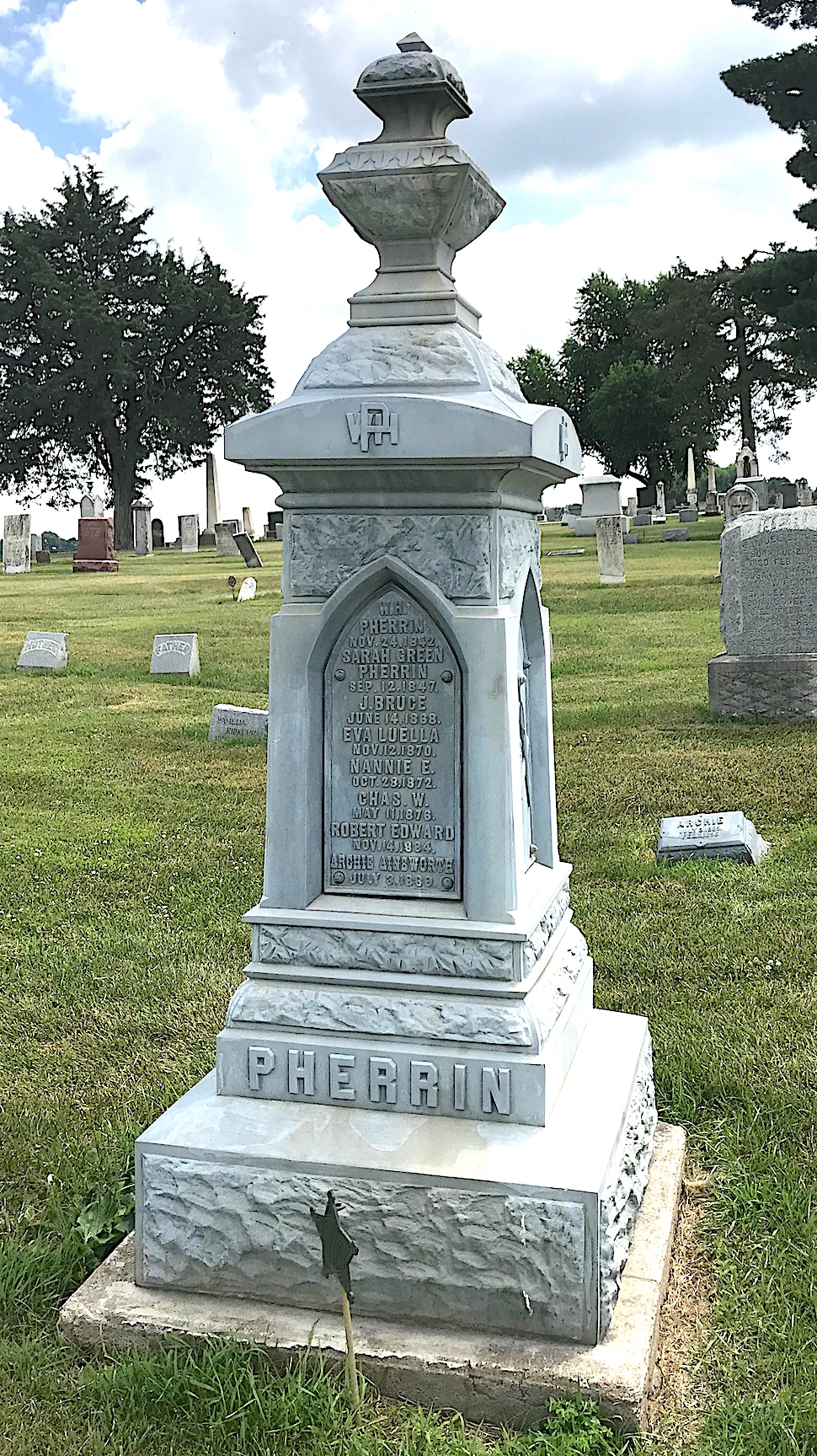
The Pherrin monument has eight names on it. That’s a long list but not strange. What’s different is that all the dates are birth dates with no death dates.
The Pherrin family was headed by William Harrison Pherrin (born in Erie, Pa. in 1842) and his wife, Sarah Green Pherrin (born in 1847). William’s family moved from Pennsylvania to Iowa sometime in the 1850s. He served in the 24th Iowa Infantry, Co. H., during the Civil War. He wed Sarah in 1867 and they started a family with the birth of John Bruce Perrin in 1868.
More children would follow with the births of Luella (1870), Nancy “Nannie” (1872), Charles (1876), Edward (1884) and Archie (1896). All of them, except for Archie, would live well into adulthood.

You might be asking yourself why it was done this way. I have some theories.
The first Pherrin family member to die, sadly, was little Archie. Born on July 3, 1889, he died on Feb. 11 1896 at the age of 6. Death records indicate he died from “inflammation of the bowels”. He is also the only Pherrin family member to have an individual white bronze marker.

The Western White Bronze Co. in Des Moines was in full operation from 1886 to 1908. The government took over the plant in 1914 for manufacturing munitions during World War I. After the war, demand for the monuments faded. However, they continued to make individual panels for family members who died after the monuments were ordered. The company turned to making castings for automobiles and radios until it closed in 1939.
I think when Archie died in 1896, someone in the family consulted with a monument company (probably Krebs. Bros.) who advised them on creating a monument not just for Archie but for the entire family. They would only put the birth dates to save space, adding individual markers later as family members died. What they didn’t know at the time was that Western White Bronze would end up closing.
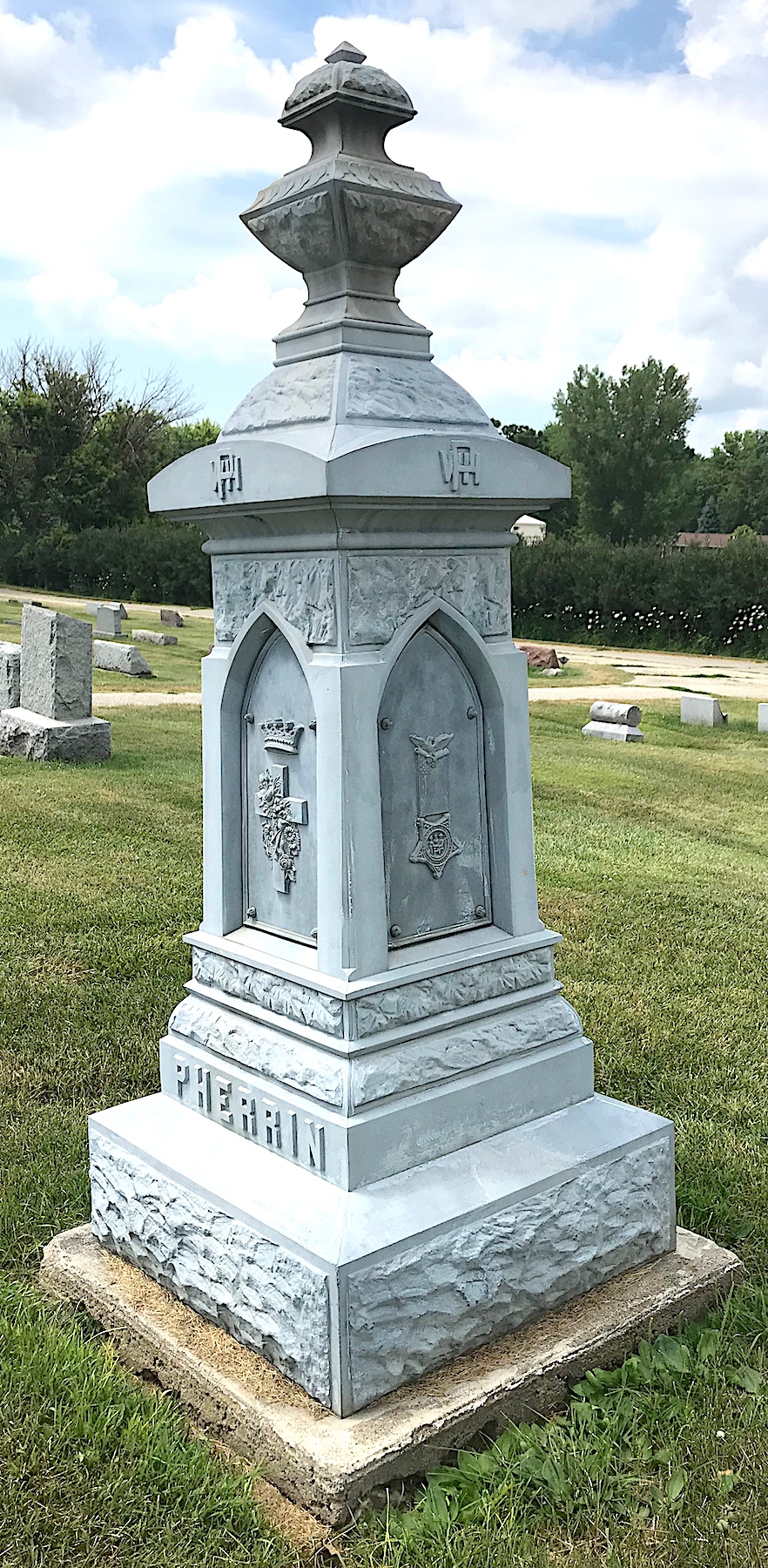
You’ll notice that one of the panels features a war medallion on a ribbon, a symbol of William’s Civil War service. Also, you can see the interlocking initials “WHP”.

There wasn’t another death in the Pherrin family until Nancy “Nannie” Pherrin Smith died in 1917 at age 45. William H. Pherrin died in 1924 at age 81 and Sarah Pherrin died in 1938. John died in 1937, he has an individual stone marker. Eva Luella died in 1943, Charles died in 1946, and Robert died in 1975.
Now a good question to ask is are all of the Perrin children actually buried at Springville? The answer is no.
I can safely say that John, Luella, and Archie are really there. Robert is definitely not because I found his Find a Grave memorial at Woodlawn Memorial Park in Gotha, Fla. He moved to Florida 49 years before his death. I suspect Charles is buried in the Seattle, Wash. area because he died there in 1946. I could not find an obituary for him. Nor could I find an obituary for Nannie, who had married Charles Wesley Smith and moved to North Dakota. Like Robert and Charles, it’s possible she is buried there as well.
The Chapman Siblings
I always think it’s special when I find a brother/sister pair of markers. That’s the case for Daniel T. Chapman and Ellen Chapman. You might remember that last name. Horace Brown’s wife was their sister, Julia Chapman Brown.

Daniel, born in 1818, was the son of Lemuel Chapman and Betsy Smouse. He died on Jan. 9, 1846 at age 27. I don’t know what his cause of death was. Ellen was the daughter of Lemuel and his second wife, Ruth Hardinger. She was born in 1837. So she was only nine when Daniel died. She never married. She lived with her mother, Ruth, in Indiana.

I learned that when Ruth died in 1872, Ellen moved to Springville and moved in with her half-sister Julia and her husband, Horace. She remained there until her death at age 64 on April 13, 1903.
It’s my guess that Julia, having already perhaps been involved in the ordering of the Brown monument years before, ordered these two markers to honor her siblings. It’s the exact same style as the individual ones that she and Horace have.
“Earth Has No Sorrows That Heaven Cannot Heal”
Finally, I want to include this marker for Myrtle May Dennis McAtee. Born in 1882 to James Dennis and Axie Hahn Dennis, May was one of several children. She married Dwight Asa McAtee on Feb. 9, 1902 in Springville. They had a daughter named Ruby on April 4, 1903.

But their happiness was short lived. May died on Feb. 37, 1904 at age 21 of consumption, today known as tuberculosis. Ruby was not even a year old at the time.

Dwight remarried to Edythe Gertrude Carr in 1926. Ruby grew up and became a teacher, marrying Fordis Clifton in 1935. She died in 1962 of ovarian cancer. Dwight died in 1951 at age 73. The marker he shares with Edythe, who died in 1950, is beside May’s white bronze marker.
I’ll be back with more stories from Springville Cemetery next time.

 Adventures in Cemetery Hopping