• About Me
  • Cemeteries I Have Visited
  • Have questions?
  • Photos

Adventures in Cemetery Hopping

~ A blog by Traci Rylands

Adventures in Cemetery Hopping

Monthly Archives: March 2024

The Black Angel of Iowa City, Iowa: Stopping by Oakland Cemetery, Part I

29 Friday Mar 2024

Posted by adventuresincemeteryhopping in General

≈ 4 Comments

Iowa City is only about 15 miles west of West Branch and is the home of the University of Iowa. We stayed in a hotel there overnight and headed for Oakland Cemetery the next morning.
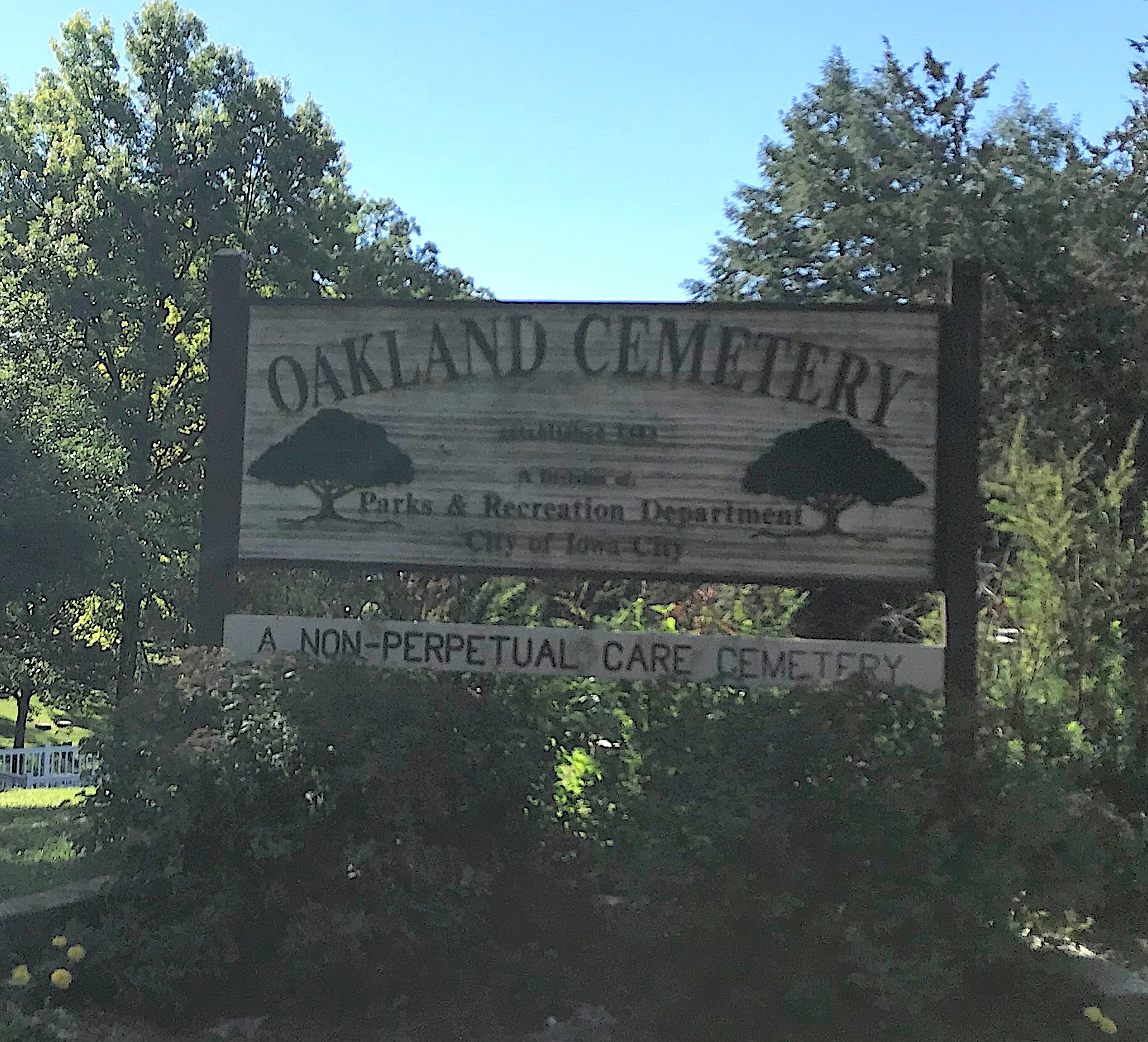
Oakland Cemetery is managed by the Iowa City Parks & Recreation Department.

According to its website, Oakland Cemetery was deeded to the people of Iowa City by the Iowa territorial legislature on Feb. 13, 1843. The original plot was one block square. The cemetery now encompasses 40 acres. Oakland Cemetery is a non-perpetual care cemetery supported by city taxes. The staff is committed to the maintenance and preservation of privately-owned lots and accessories. It is still an active cemetery and you can purchase a plot there if you so desire.

According to Find a Grave, Oakland Cemetery has around 16,000 graves recorded there. However, I’m sure there are more than that.

Teresa Karasek Dolezal Pica Feldervert

Most people visit Oakland Cemetery for one reason and that’s to see the Black Angel. This is the second Black Angel I’ve encountered in Iowa. The first was the statue in memory of Ruth Anne Dodge by sculptor Daniel Chester French that’s adjacent to Fairview Cemetery in Council Bluffs, Iowa. I wrote about that one in 2017.

The story surrounding Iowa City’s Black Angel is a bit sketchy in places and some of the specifics are unknown. But when it comes to a haunted statue, that’s kind of the norm. Right?

We do know that Terezie “Teresa” Karasek was born around 1836 in Czechoslovakia (then known as Bohemia). It was only after her death that it was discovered that she’d studied at the University of Vienna, earning the equivalent of a degree in gynecology and becoming a midwife. She reportedly delivered more than 100 babies.

Her son, Eduard, or “Eddie”, was born in 1873. He was her son by Dr. Frantizek Dolezal, whom she married in 1865. She arrived with Eddie in Iowa City sometime around 1877. I’m not sure what became of Dr. Dolezal.
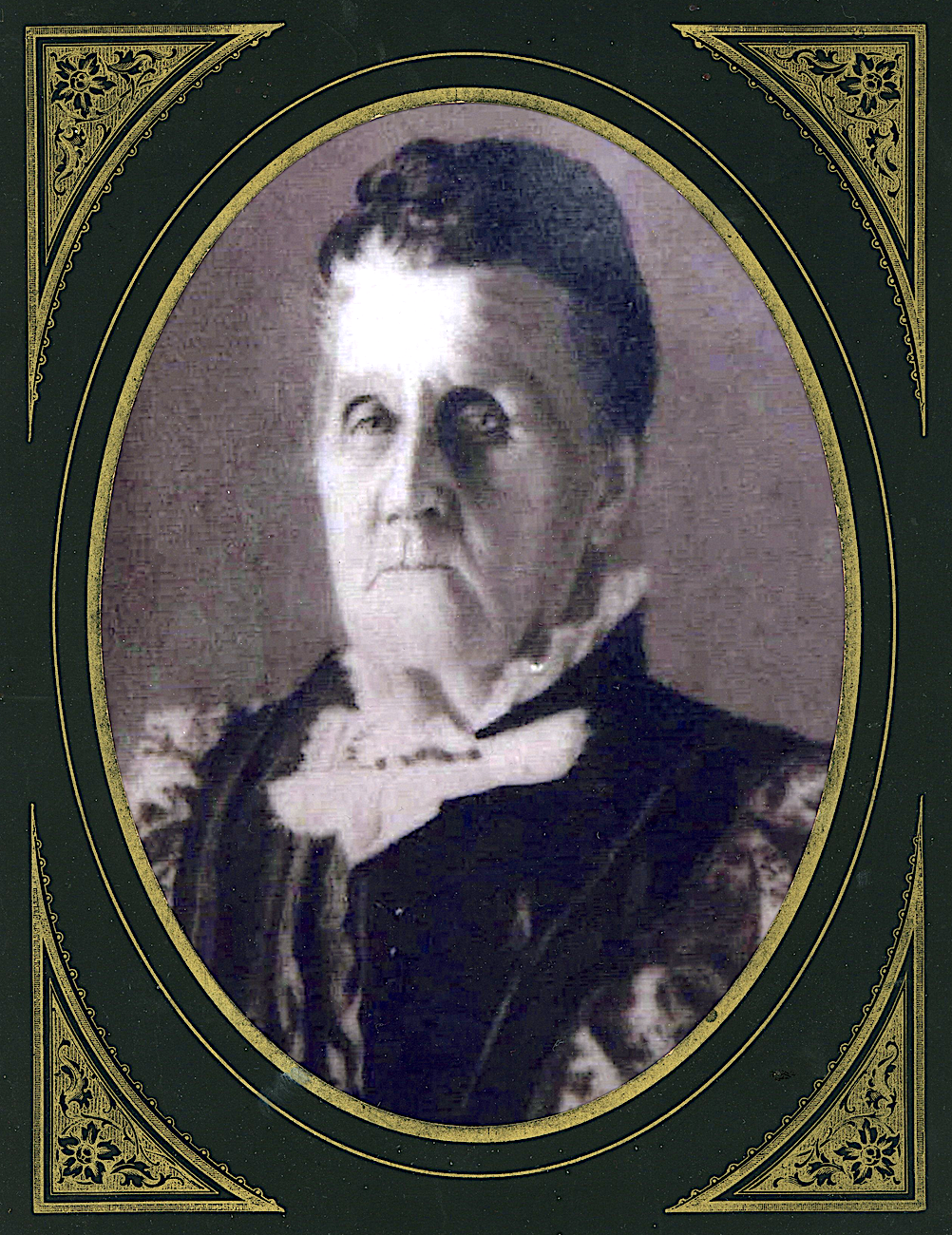
Undated picture of Teresa Feldevert in her later years.

Eddie died in 1891 at age 17 of meningitis. He was buried in a crypt in a different plot in the cemetery than where he is now and a tree-shaped monument was erected in his honor. His body (and the tree marker) were later moved to the site of the Black Angel monument around 1913.
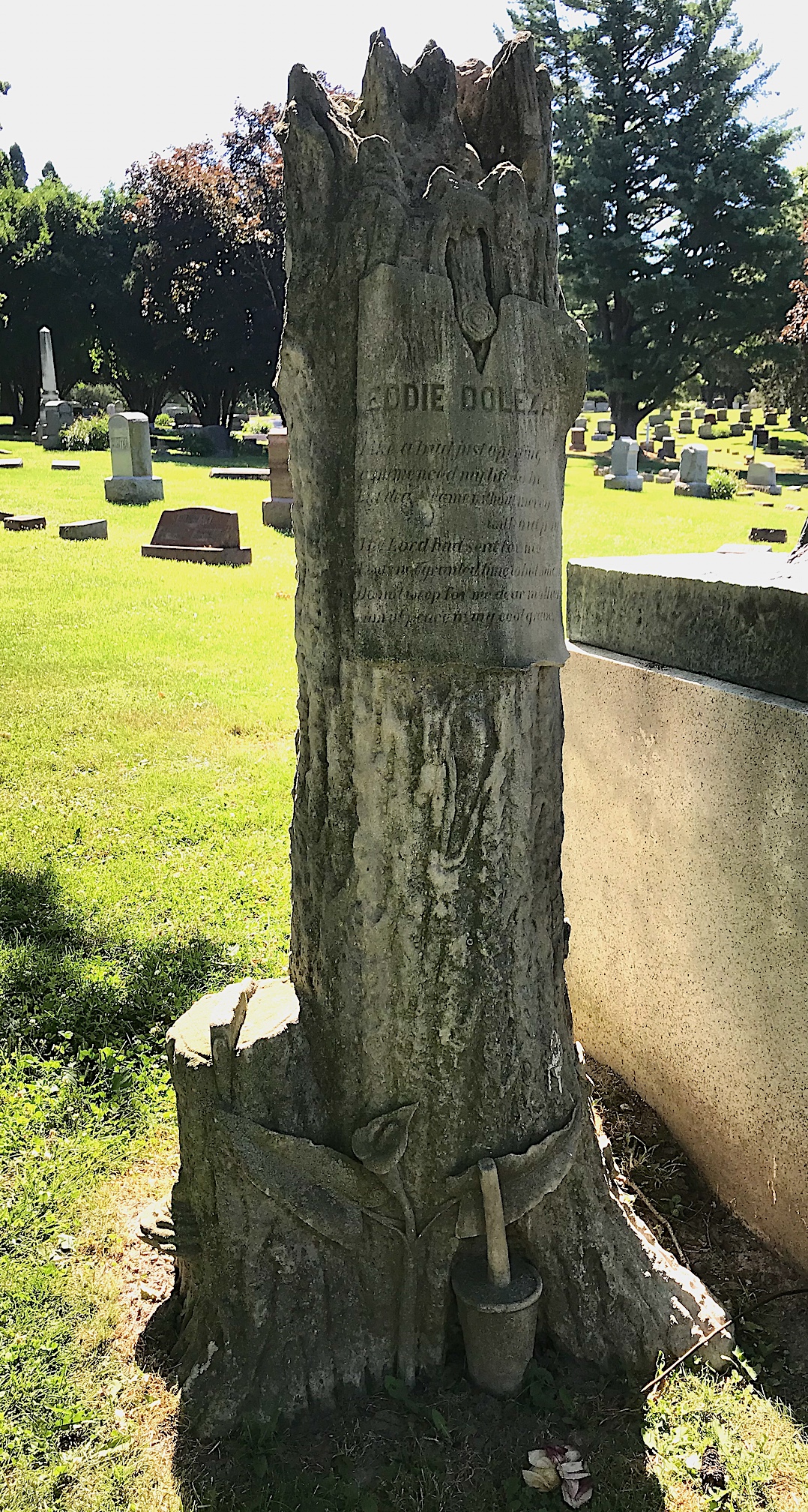
The tree-shaped marker for Eddie Dolezal signifies a life cut short.

Overwhelmed with grief, Teresa moved to Chicago then to Minnesota where she married Joseph Pica. She would divorce him and move to Eugene, Ore. where she met and married wealthy ranch owner Nicholas Feldevert in 1897. He was of German heritage.

At the base of the monument, you can see the words “Rodina Feldevertova”. The word “rodina” means “family” in Czech. Both Teresa and Nicholas shortened it to Feldevert at some point.

When Nicholas died in 1911, he left Teresa a wealthy widow. Much of the money went to fund projects back in her hometown of Strmilov in Czechoslovakia.

But Teresa also wanted to honor her third husband and son, so she began making plans to commission a statue that would eventually be placed by their graves at Oakland. It would eventually be her final resting place as well.

Mario Korbel

On the advice of friends, Teresa contacted up and coming Czech sculptor Mario Korbel in Chicago to create a statue. She also wanted him to incorporate Eddie’s tree monument into his design. His model in clay at the Art Institute of Chicago caused a stir and Teresa gave him the green light to cast it in bronze. In July 1911, he stopped in Iowa City on his way west to check the site where it would eventually be placed.
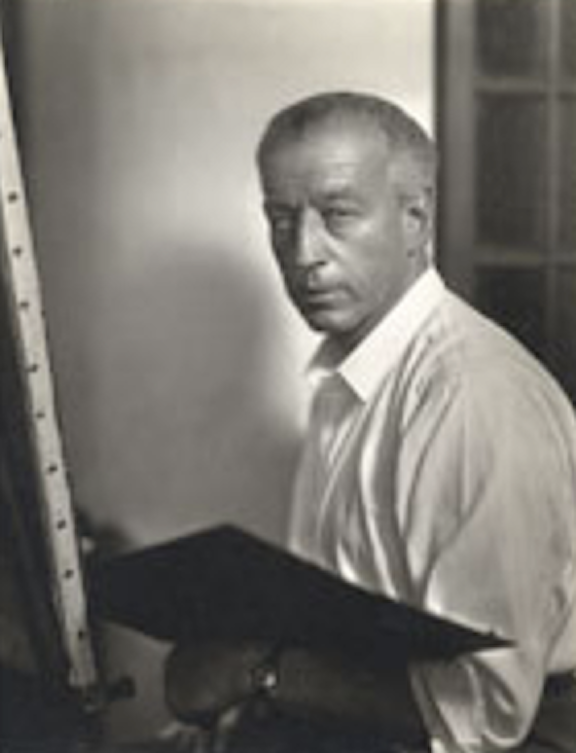
Even in 1911, sculptor Mario Korbel was attracting a lot of attention for his work.

While waiting for Korbel to finish, Teresa had Nicholas’ remains disinterred in February 1912 and sent to Portland, Ore. to be cremated before having them sent on to Oakland Cemetery in Iowa.

Korbel’s eight and a half foot statue arrived in Iowa City in November 1912. Unfortunately, Teresa didn’t like what she saw and refused to pay Korbel for his hard work. He hadn’t incorporated Eddie’s tree monument as she had requested. She also did not like the dark patina on the bronze at all.
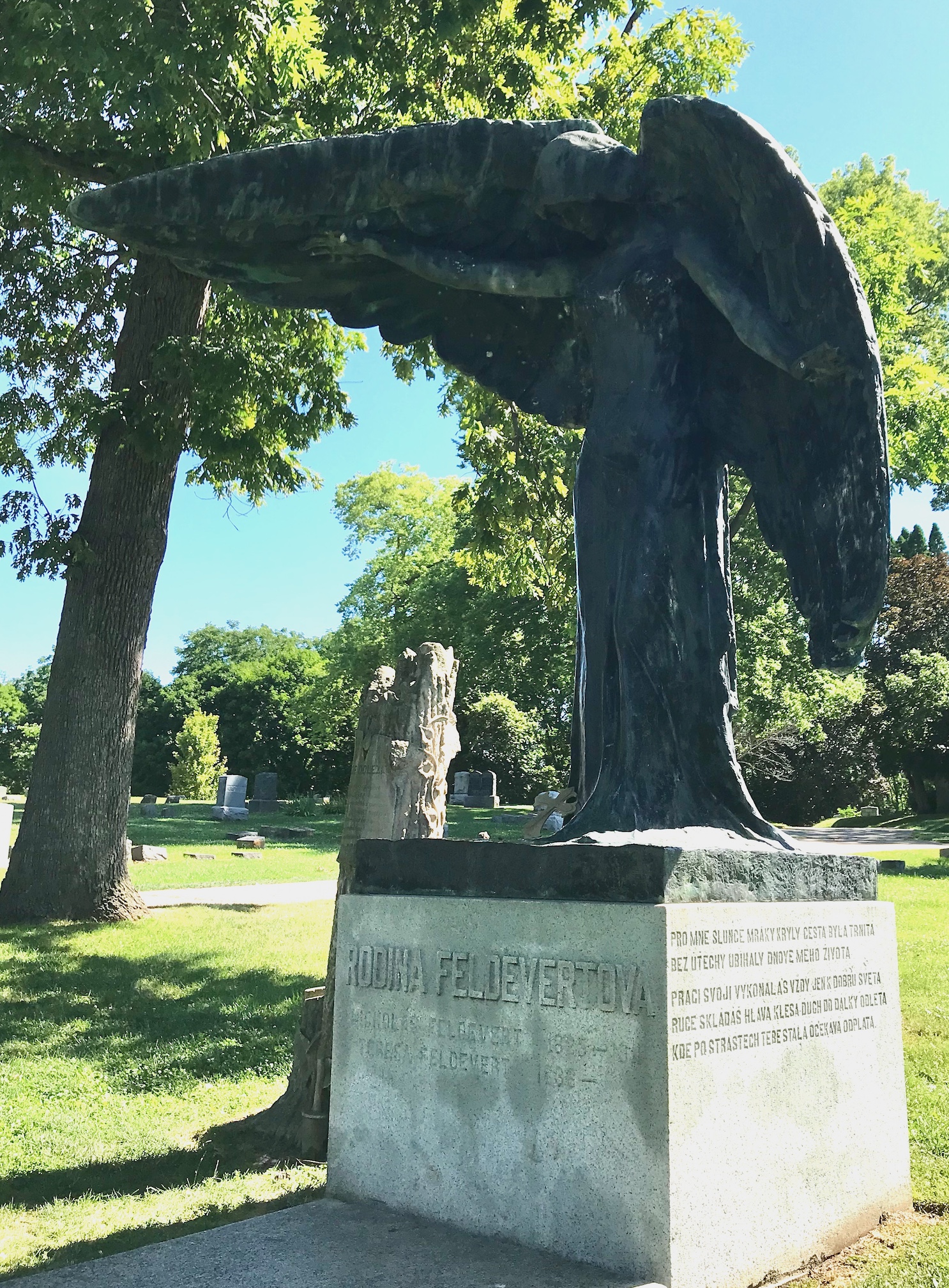
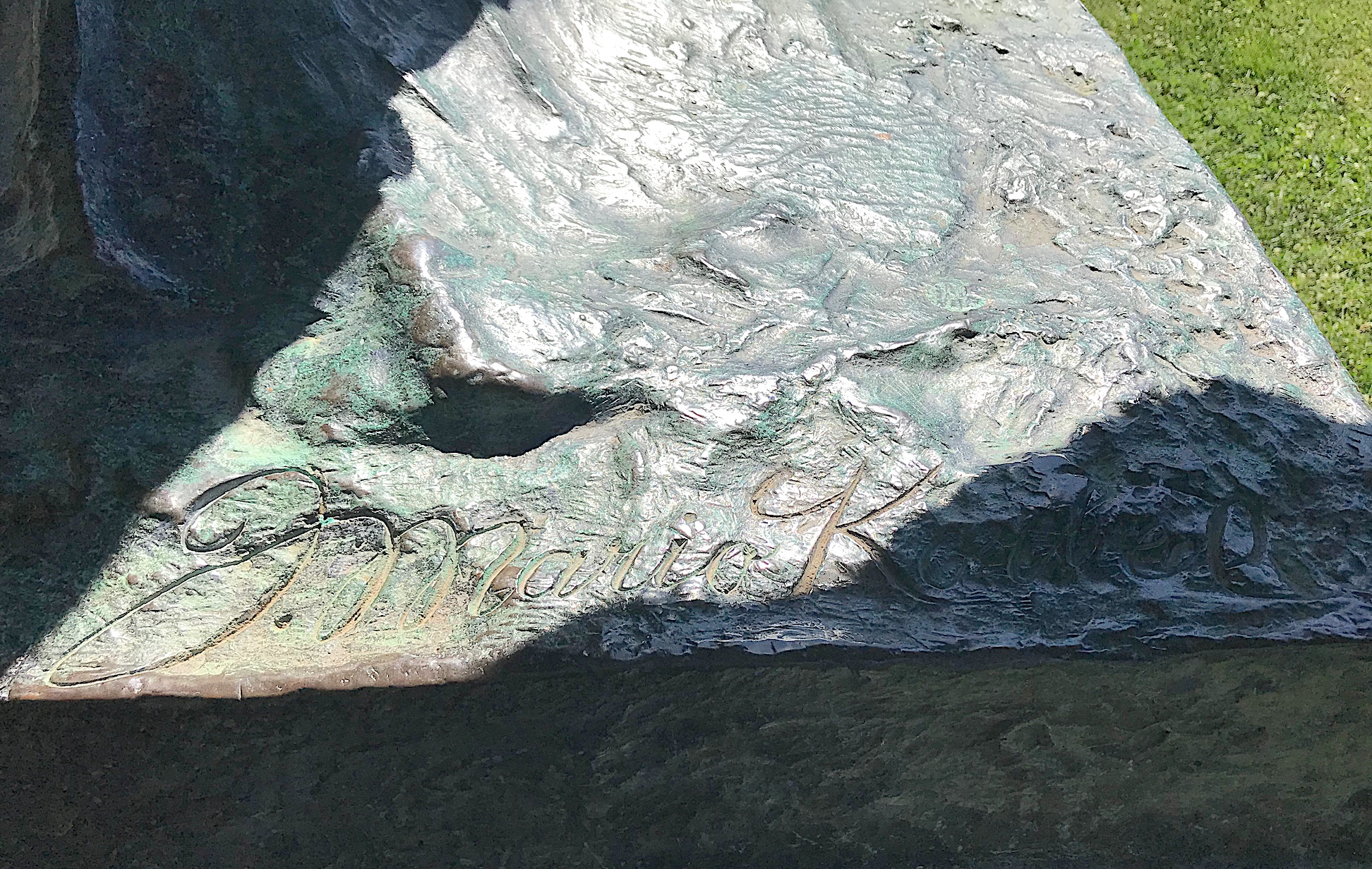
Teresa was not pleased with the final look of the statue Mario Korbel had made and refused payment.
Mario Korbel’s signature is on the base of the statue.

A lawsuit ensued and Teresa ended up paying for it after all. The statue was placed on its four-foot tall base. An inscription in Czech is on the side of it.
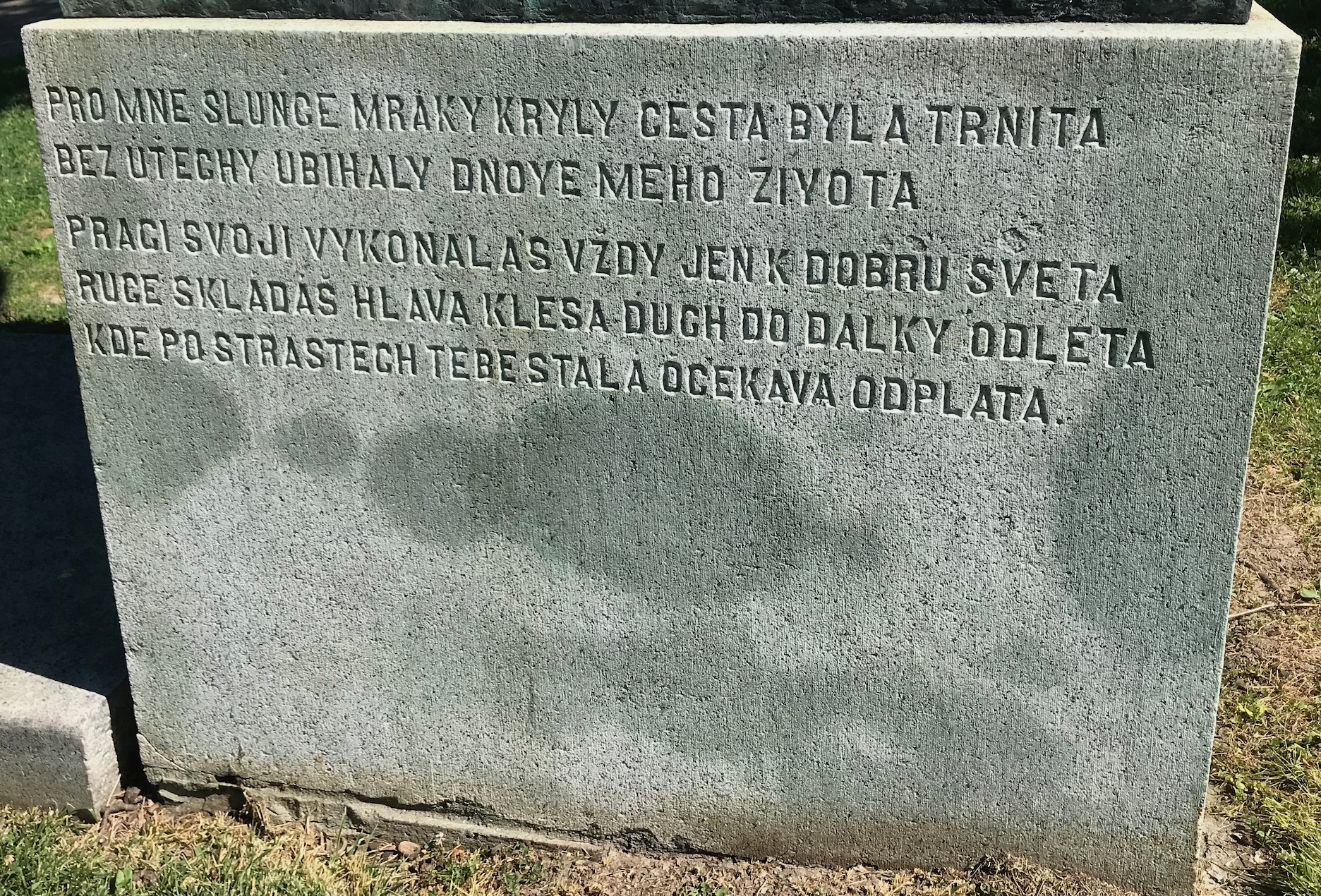
The inscription on the side of the Black Angel’s base is in Czech.

The inscription translated reads:

The sun and clouds stood above my journey/There were tough and joyful days in my life./ You did my work just to make the world better./ You fold your hands and your head goes down./ Your spirit flies away where everlasting reward/ Is waiting for you after hardship.

Teresa died on Nov. 18, 1924 in Iowa City. Her remains were cremated in Davenport, Iowa, and her ashes were buried with her husband and son beside the Black Angel. She was 88 and had little money left. Her death year was never carved into the base because there was nobody left in her family to pay for it.
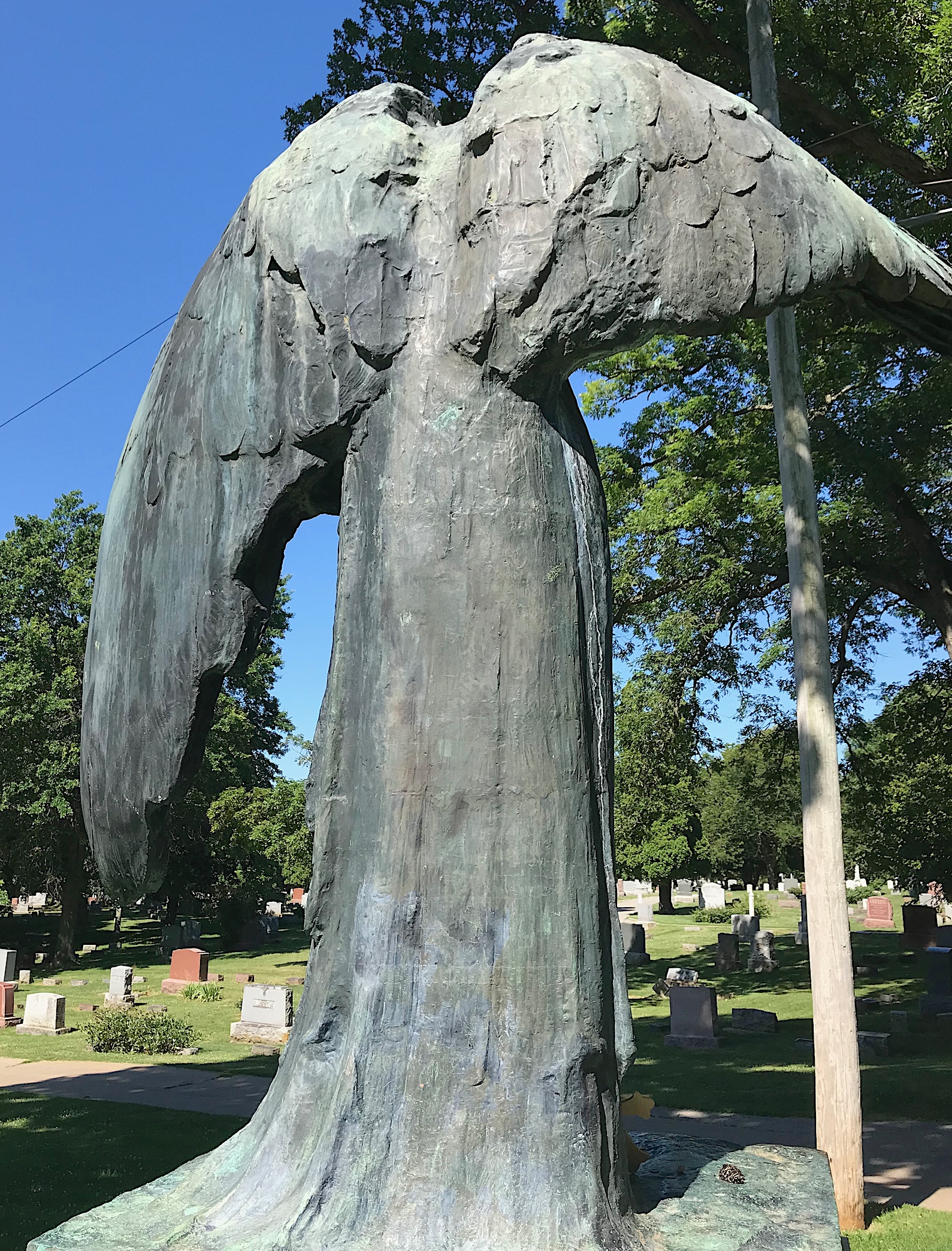
Back view of the Black Angel.

The Black Angel only darkened more over the years, causing people to talk. But according to an NPR article bout the statue that I found, that’s not unusual:

Bronze is an alloy made up of copper and zinc and sometimes even other metals like aluminum, manganese, nickel or zinc. So that metal combination can change the color. Also chemical combination called a patina is added to the surface of Bronze sculptures and that can create some interesting color changes.

Paul Benson is an art conservator for the Nelson Atkins Museum of Art and he also says the environment can play a big role.

“Put a sculpture out in Kansas City, put another one out in New York City they may turn completely different colors,” says Benson.

The Myths of the Black Angel

There are quite a few myths and stories surrounding the Black Angel. Many students and other Iowa City residents visit the statue, along with interested travelers like me.

The biggest night of attraction is on Halloween where visitors gather around the statue, and some test their luck by touching or kissing the statue. It’s said that if someone touches or kisses the statue they will be struck dead unless that person is a virgin.

It is also rumored that if a pregnant woman walks beneath the statue’s stretched wings that she will miscarry. Some have seen mysterious ghostly figures walking nearby. It goes on from there.

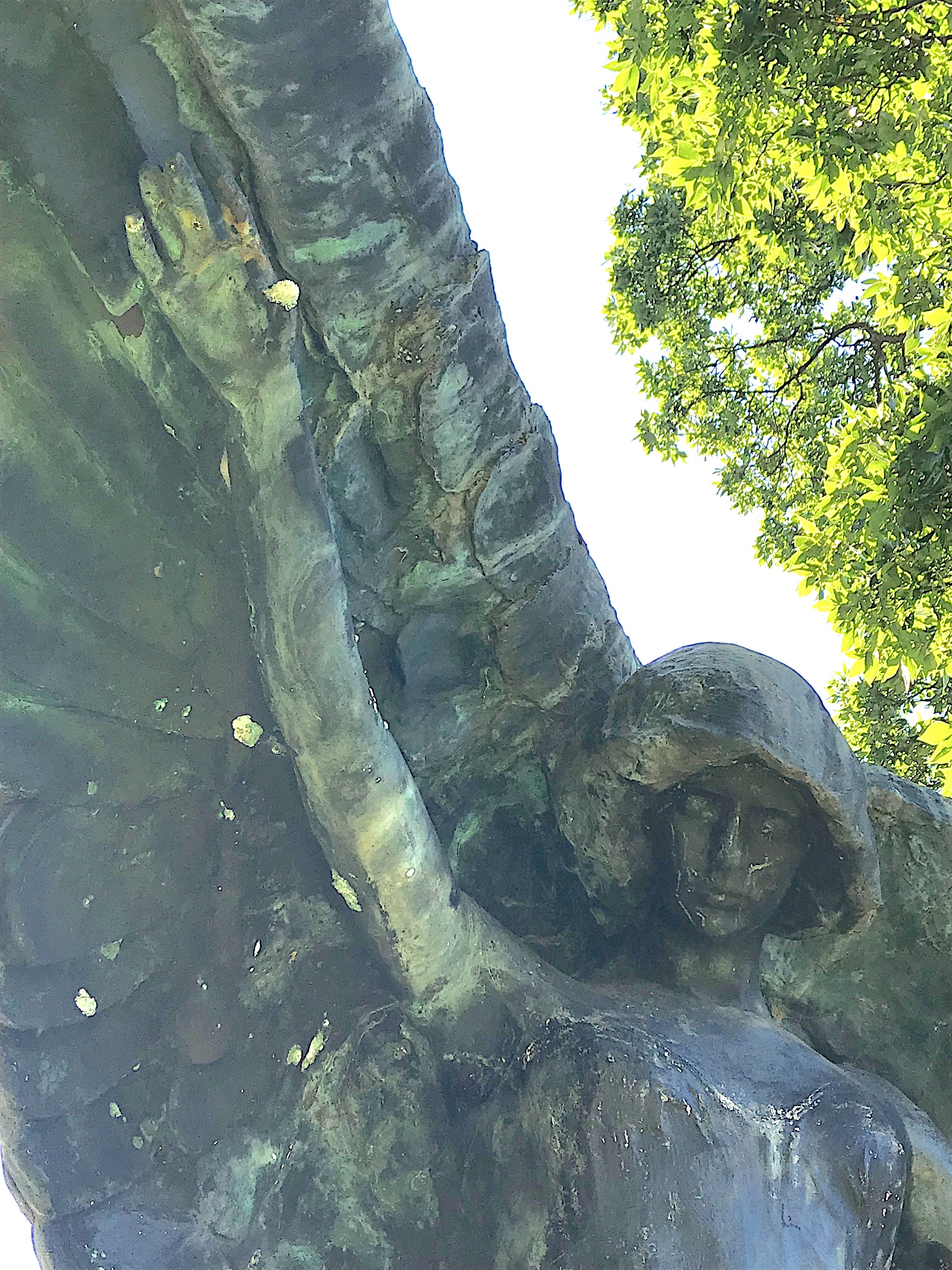
The Black Angel has been vandalized several times over the years. Her outstretched fingers have been damaged. Paint has been applied many times. It’s rather amazing that she is still intact after all these years.
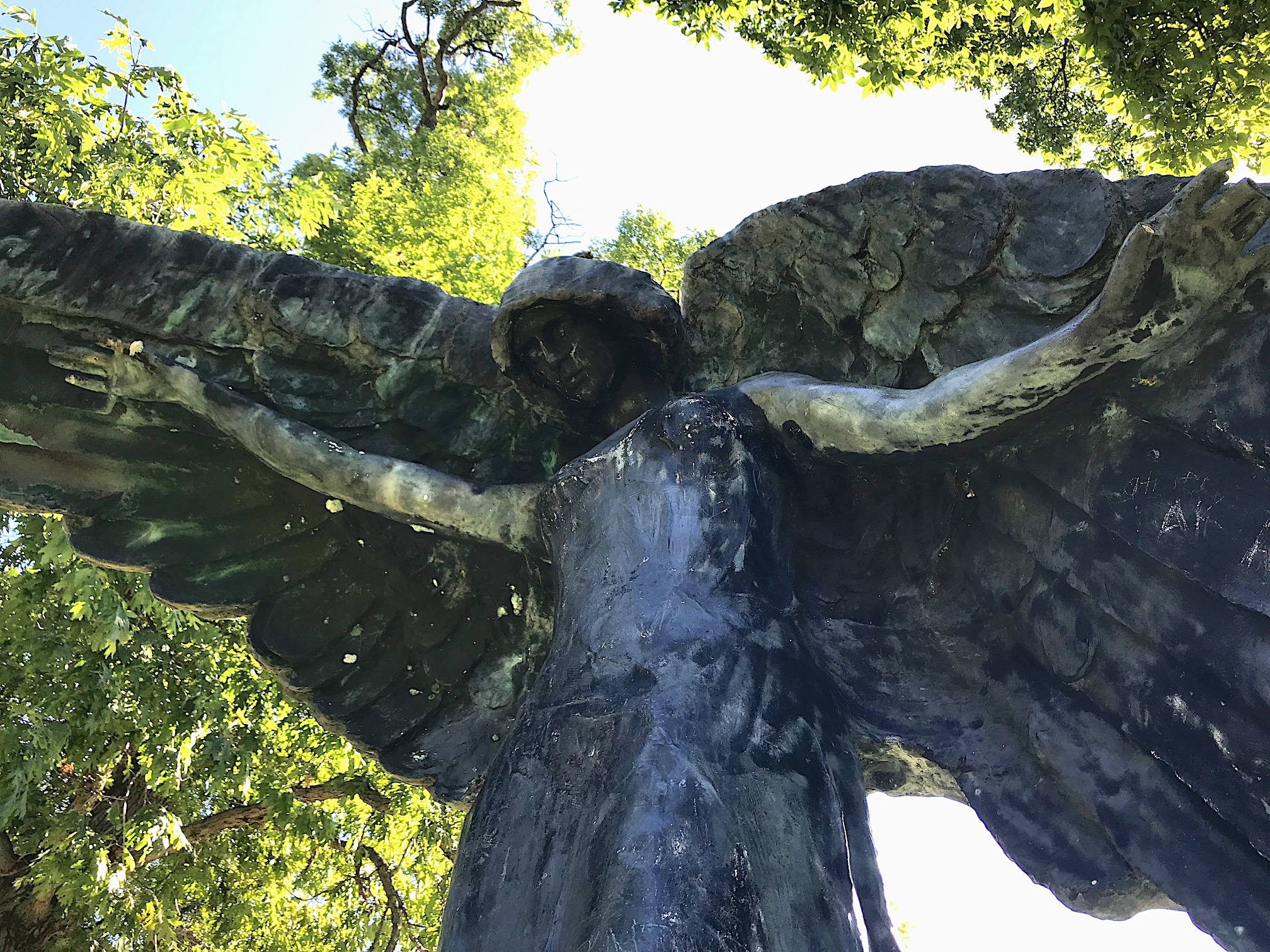
You can see from this angle that some of the Black Angel’s fingers have been damaged.

The Black Angel appears in W.P. Kinsella’s 1986 novel “The Iowa Baseball Confederacy” in which the statue plays right field for the Confederacy. She also makes an appearance in Andrea Lawlor’s 2017 novel “Paul Takes the Form of a Mortal Girl,” in which the titular Paul seduces a graduate student under its wings. Footage of the Black Angel is included in the music video for “Alive Twice” by the band Friendship.

More recently, a new restaurant called The Black Angel opened in Iowa City in August 2023.

The NPR article said Oakland’s grounds keeper Russell Buffington noted that people leave money and flowers for the angel. He’s found bottles of liquor given as offerings, and a lot of people have been married in front of it.

Teresa’s Legacy

In the end, the ghost stories aren’t what really matter. It’s always been about one woman’s wish to keep the memories of her beloved son and her husband alive.

Author Tim Parrot wrote a book called “The Black Angel A Centennial History 1913 – 2013”. He said Teresa didn’t care about the whispers about the statue, according to interviews with her that he’s read.

“Her concern wasn’t for the Black Angel. It wasn’t about anything except her son and her last husband. She seemed very concerned about people knowing who they were.”

I’ll be back next week with more stories from Oakland Cemetery.
Our 31st President: Paying My Respects to Herbert & Lou Hoover in West Branch, Iowa

22 Friday Mar 2024

Posted by adventuresincemeteryhopping in General

≈ 2 Comments

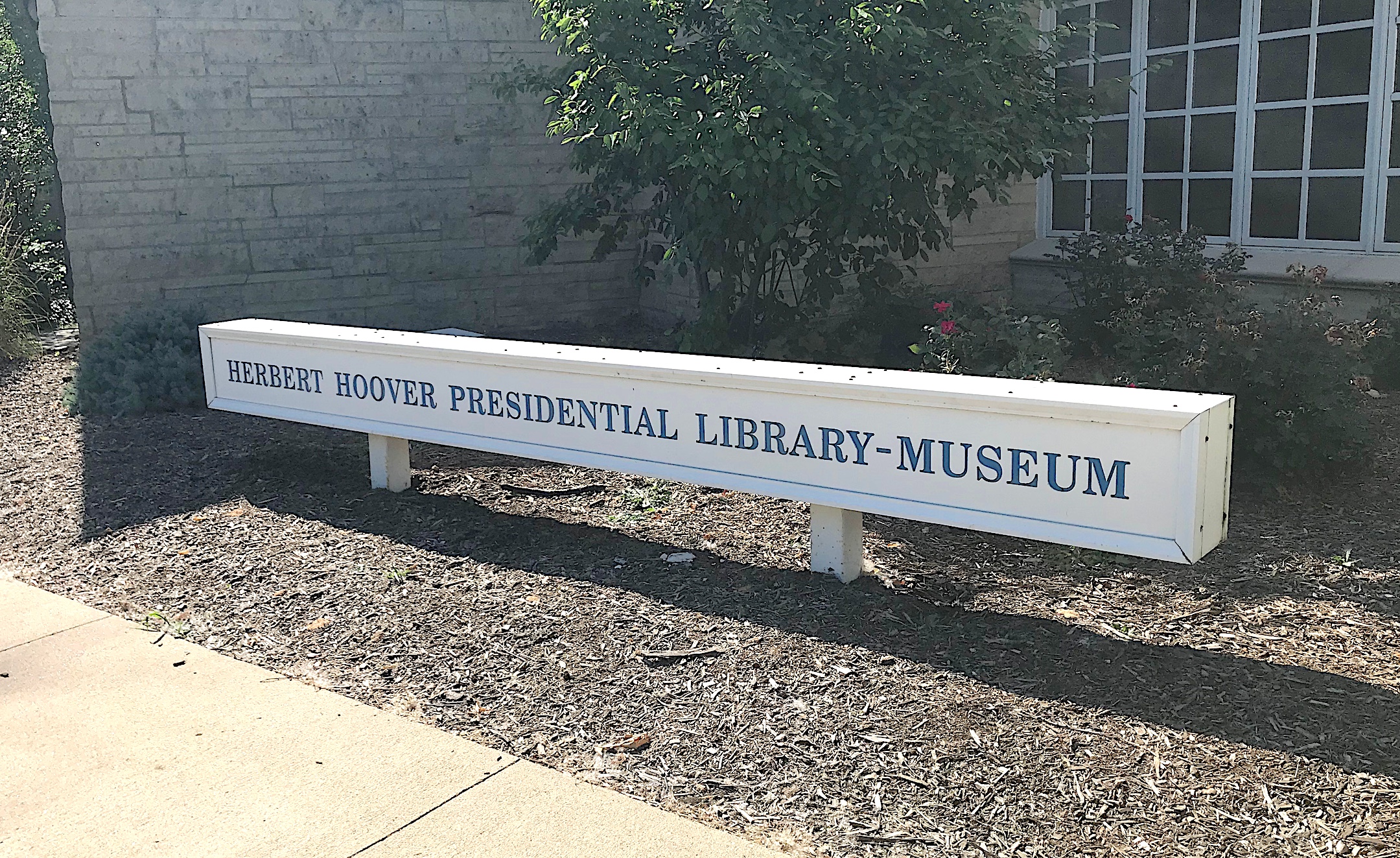
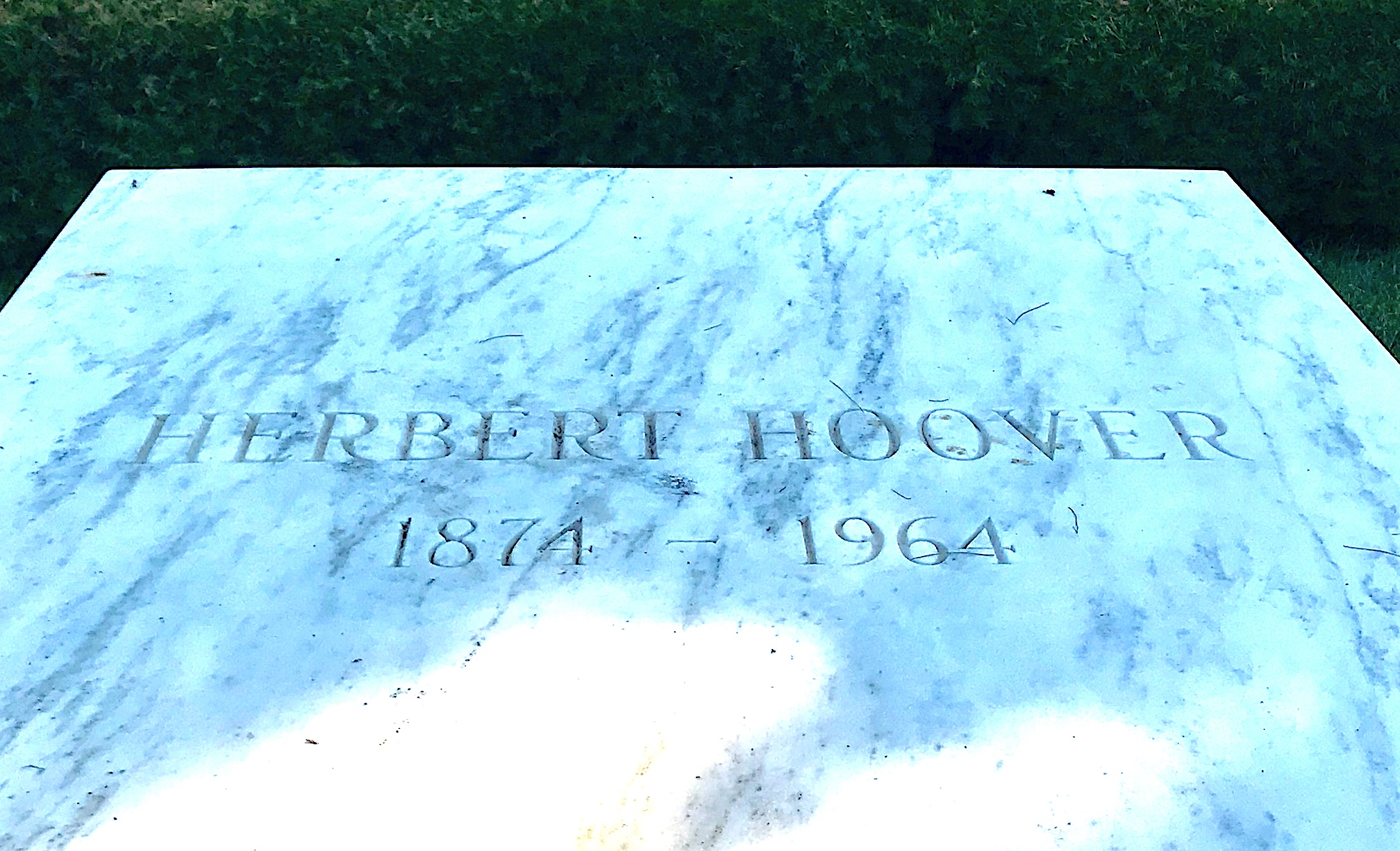
When I realized we would be driving right past the Herbert Hoover Presidential Library in West Branch, Iowa on our journey back to Omaha, I was determined that we’d stop. We wouldn’t have time to visit the library itself, but if it was possible to get a glimpse of Hoover’s grave, I was going to try.

This was my first official U.S. presidential grave! I’ve seen 10 more since, but seeing Hoover’s was special to me.

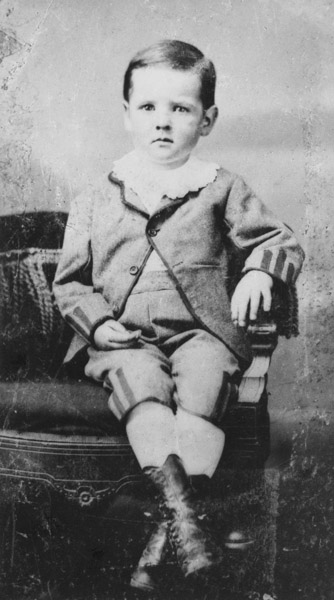
Picture of Herbert Clark Hoover in 1877. (Photo Source: Herbert Hoover Library)

Born in West Branch, Iowa

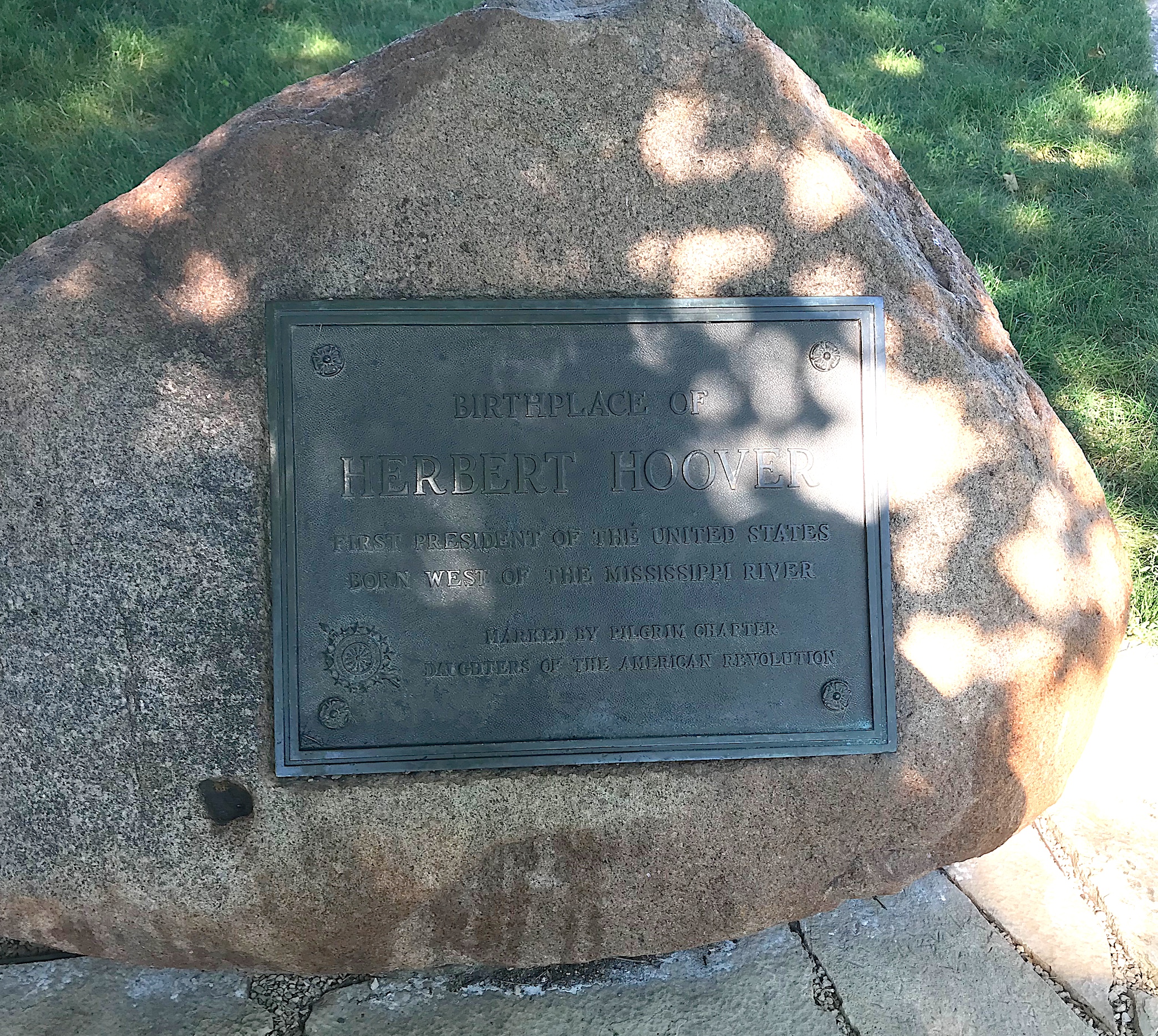
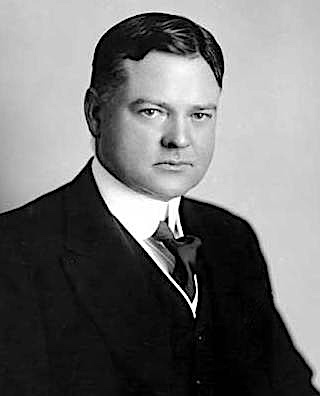
Herbert Clark Hoover was born in West Branch, Iowa on Aug. 10, 1874, making him the first American president to be born west of the Mississippi River.

Herbert Hoover was the first American president born west of the Mississippi River.

His father, Jesse Hoover, was a blacksmith and farm implement store owner. His mother, Hulda Randall Minthorn Hoover, raised in Canada, moved to Iowa in 1859. They were Quakers. From what I’ve read, he had a happy early childhood.

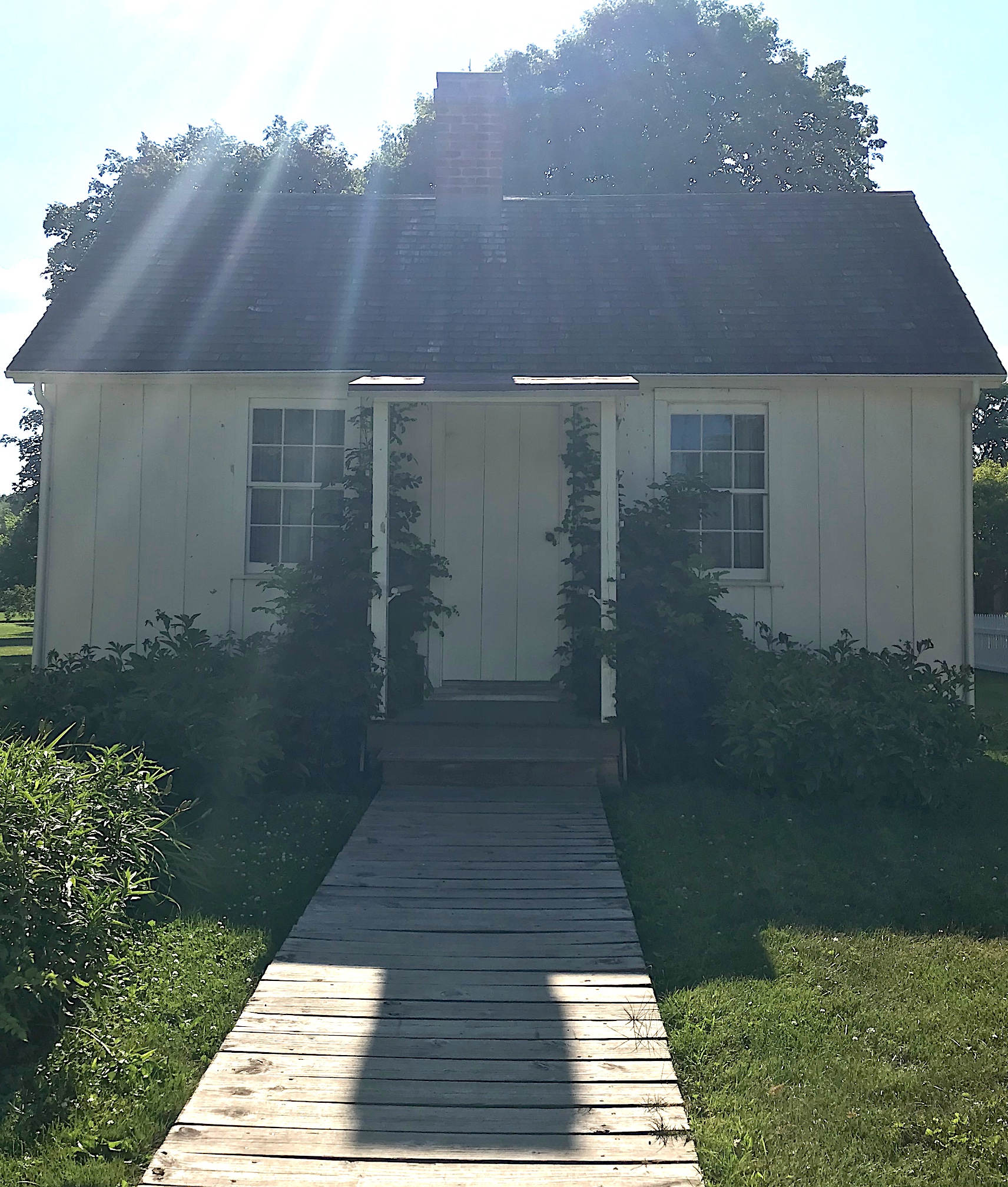
Herbert Hoover was born in this cottage in 1874. He and his wife, Lou, purchased it in 1930s and restored it.

Jesse died in 1880 at age 34 of a sudden heart attack and Hulda died in 1884 of typhoid, leaving Herbert and his two siblings orphans. Hoover lived the next 18 months with his paternal uncle Allen Hoover at a nearby farm.

In November 1885, Hoover went to Newberg, Ore., to live with his maternal uncle John Minthorn, a Quaker physician and businessman. The Minthorn household was considered cultured and educational, and imparted in Herbert a strong work ethic.

While the museum at West Branch was still under construction, Hoover decided to expand it and to make it his Presidential Library. It opened in 1962.

We did watch a film at the visitor’s center before they closed. I was curious to know why, since Hoover only lived in West Branch nine years, did he choose it as the site for his presidential library? Apparently, Hoover always had fond memories of his childhood in West Branch, when his parents were still living, so that’s where he wanted it.

The library and museum are located within the Herbert Hoover National Historic Site, which contains Hoover’s birthplace, a reconstruction of Hoover’s father’s blacksmith shop, a one-room schoolhouse, and a Quaker meeting house. We had time to briefly visit Hoover’s birthplace cottage then hoofed it down a long path up a hillside to his grave. The National Park Service manages the site.

Early Days

Plenty of authors have written about the Hoovers, so I’m going to try to hit the highlights.

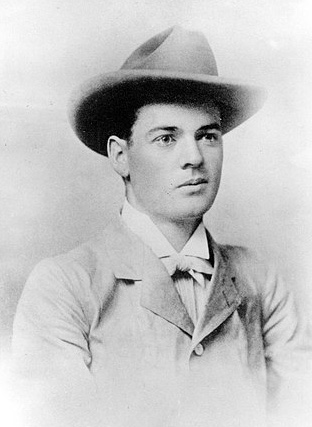
Photo of Herbert Hoover in 1898, three years after he graduated from Stanford University.

Herbert Hoover was part of the inaugural class at Stanford University in Palo Alto, Calif. He graduated in 1895 with a degree in geology and became a mining engineer, working on a wide variety of projects on four continents.

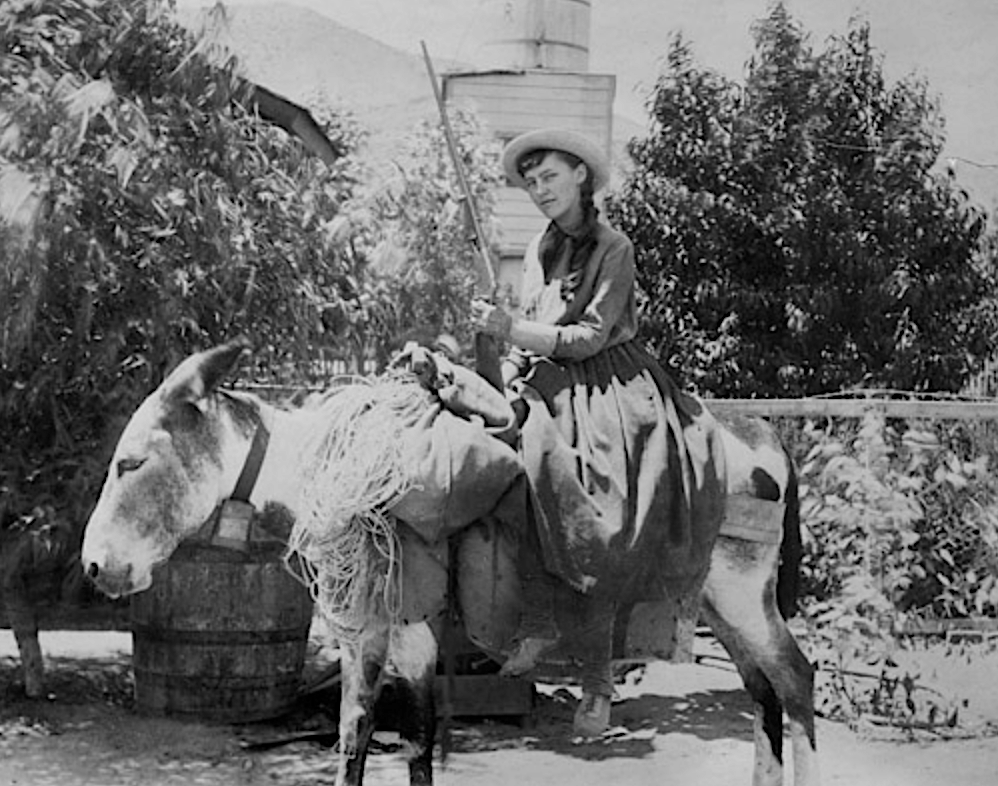
While a senior at Stanford, Hoover met his future wife, Waterloo, Iowa native Lou Henry. Born in 1874, Lou grew up something of a tomboy in the Monterey, Calif. area. She loved the outdoors as much as Herbert did.

Photo of Lou Henry on a burro in 1891. She had a love of the great outdoors from an early age.

Lou got a teaching credential in 1893 from San Jose State University (then San Jose Normal School) and worked at her father’s bank. The following year, she enrolled at Stanford to pursue a degree in geology. In 1898, Lou became the first woman to receive a bachelor’s degree in geology from Stanford, one of the first women in America to hold such a degree.

Married Life

In 1897, Hoover took an engineering job in Australia. Lou and Herbert were engaged before he left. They were married in her family’s home on Feb. 10, 1899. Herbert was hired as chief engineer of the Chinese Engineering and Mining Company in Tianjin, China, where they went after their honeymoon.

Caught in China during the Boxer Rebellion in 1900, Hoover organized relief for trapped foreigners. Lou, who learned Chinese, treated gunshot wounds, built barricades, and rode through the area on her bicycle with a pistol patrolling with Western troops. I have to say, Lou was no slouch!

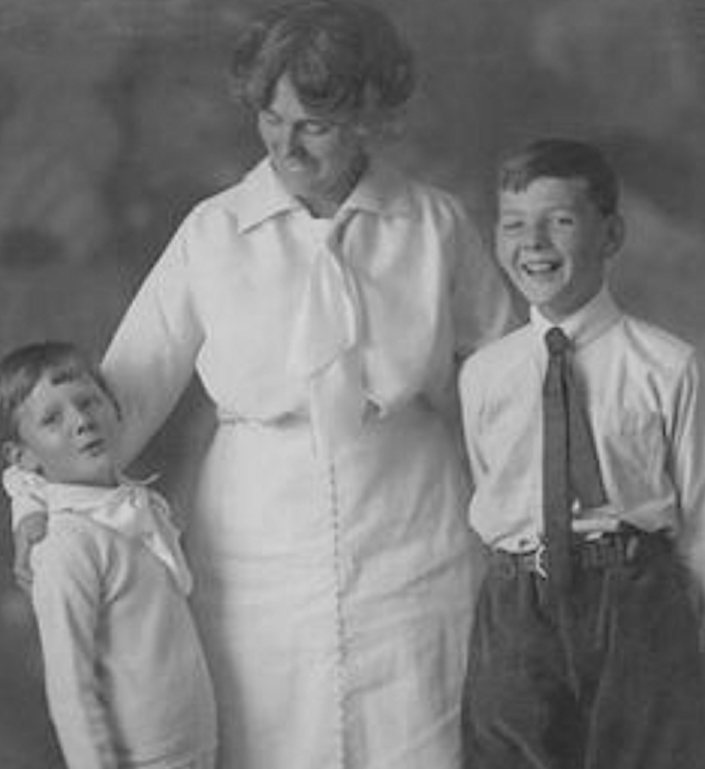
Lou Hoover with sons, Allan and Herbert Jr.

The Hoovers made their home in London in November 1901 after Herbert was offered a partnership with a British mining company. His work took them all over the world. The Hoovers had two sons who joined them as they traveled. Herbert Hoover Jr. was born in 1903, and Allan Hoover was born in 1907. The family became wealthy after Herbert’s decision to become an independent consultant in 1908.

In 1914, Hoover helped Americans stranded in Europe at the outbreak of World War I. For the next three years, he headed the Commission for Relief in Belgium, helping find food for some nine million people. His skills impressed Pres. Woodrow Wilson so much that he appointed him U.S. food administrator for the duration of the war.

The Hoovers returned to America in January 1917. When the U.S. entered World War I three months later, Herbert was appointed head of the Food and Drug Administration, and the family made their home in Washington, D.C.

After World War I

Herbert Hoover as a mining executive in 1917.

Hoover was tapped to head the American Relief Administration. The ARA sent food and supplies to war-ravaged Europe. The outreach to Soviet Russia garnered Hoover much criticism, but he defended his actions by saying, “Twenty million people are starving. Whatever their politics, they shall be fed.”

In 1921, President-elect Warren G. Harding chose Hoover to serve as secretary of commerce. Continuing as commerce secretary under Pres. Calvin Coolidge, Hoover spearheaded efforts that ultimately led to construction of Hoover Dam and the St. Lawrence Seaway.

When Coolidge decided not to run for another term in 1928, Hoover received the Republican presidential nomination. Hoover and running mate Charles Curtis ran against New York Gov. Alfred E. Smith and vice presidential candidate Joseph T. Robinson in a contest that focused on Prohibition and religion. Hoover captured more than 21 million popular votes to Smith’s approximately 15 million, and he received 444 electoral votes to his Democratic opponent’s 87.

Lou Hoover was a troop leader, a member of the Girl Scout Council in Washington, and twice served as GSA president. (Photo Source: Hoover Presidential Library)

Presidential Years

Lou was her husband’s frequent adviser while he was president. Throughout her tenure, she refused to give interviews to the press, seeing them as intrusive. Instead, she gave speeches over the radio, the first president’s wife to do so.

The stock market cash of 1929 plunged the country into the worst economic collapse in its history. Hoover parted ways with leaders of the Republican Party who thought there was nothing for the government to do but wait for the next phase of the business cycle.

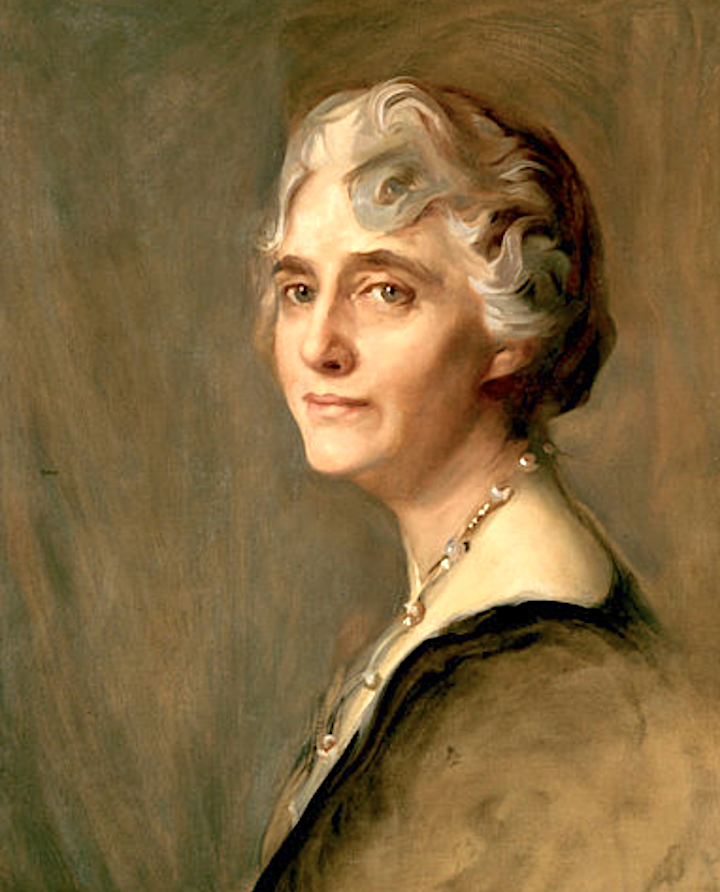
Oil on canvas portrait of First Lady Lou Henry Hoover by Richard Marsden Brown (Photo Source: White House)

Hoover called business leaders to the White House to urge them not to lay off workers or cut wages. He urged state and local governments to join private charities in caring for Americans made destitute by the Depression. He asked Congress to appropriate money for public works projects to expand government employment. He established new agencies such as the Federal Farm Board, the Federal Drought Relief Committee, and the Reconstruction Finance Corporation.

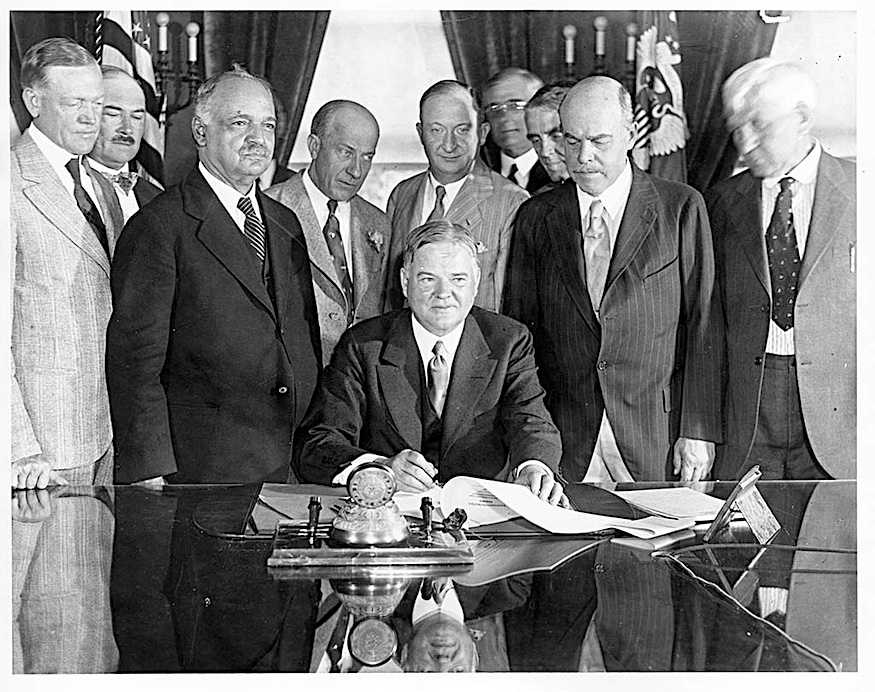
Herbert Hoover signs the Farm Relief Bill on June 15, 1929. (Photo source: Hoover Presidential Library)

But Hoover would not provide direct federal relief to the unemployed. Instead, he promoted indirect relief through public works projects and loans to states. His programs proved inadequate as the number of unemployed workers increased from 7 million in 1931 to 11 million in 1933.

Hoover’s political reputation as the “master of emergencies” collapsed in the face of rising unemployment. Although he mounted a vigorous campaign for re-election in 1932, Hoover lost to Franklin D. Roosevelt. The Hoovers departed Washington on March 4, 1933. He was only 58.

Back to Private Life

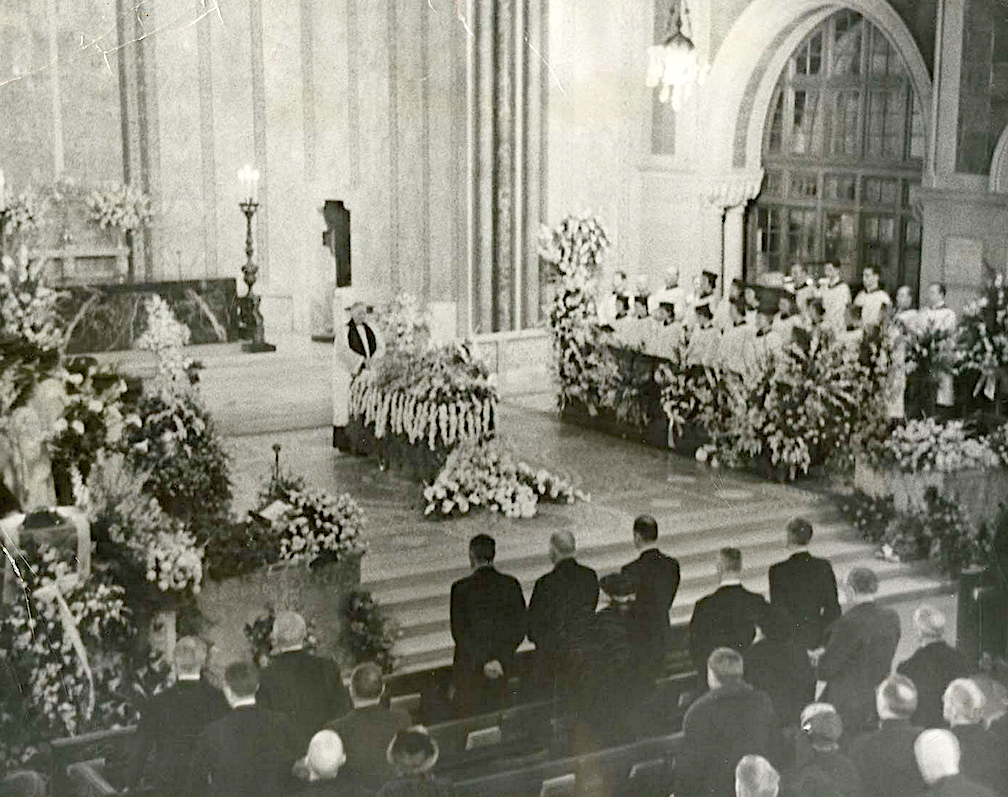
While Hoover considered going back into politics after his defeat, the Hoovers were understandably bitter about what happened. He and Lou lived in Palo Alto until her death after a heart attack in New York City at the Waldorf Astoria Hotel on Jan. 7, 1944. Her funeral was held at St. Bartholomew’s Church in New York.

Lou Henry Hoover passed away Jan. 7, 1944. Her funeral was held in St. Bartholomew’s Church in New York. Hoover, Herbert Jr., and Allan in the front row.

Hoover was a constant critic of Roosevelt. In response to continued attacks on his character and presidency, Hoover wrote more than two dozen books, including The Challenge to Liberty (1934). At the 1940 Republican National Convention, Hoover hoped for the presidential nomination, but it went to the Wendell Willkie, who lost to Roosevelt in the general election.

After World War II, Hoover befriended President Harry Truman despite their differences. Because of Hoover’s experience with Germany at the end of World War I, Truman selected him in 1946 to tour Allied-occupied Germany and Rome, Italy to ascertain the food needs of the occupied nations. On Hoover’s initiative, a school meals program in the American and British occupation zones of Germany began on April 14, 1947. It served 3,500,000 children.

The architectural firm of Eggers and Higgins of New York drew the plans for the original building.

In 1954, a group of Hoover’s friends incorporated the Herbert Hoover Birthplace Foundation to raise money for preservation of his birthplace, and to plan for site improvements. One of their ideas was to build a small museum, and with Hoover’s approval work began in the late 1950s. The architectural firm of Eggers and Higgins of New York drew the plans for the original building. While the museum at West Branch was still under construction, Hoover decided to expand it and make it his Presidential Library.

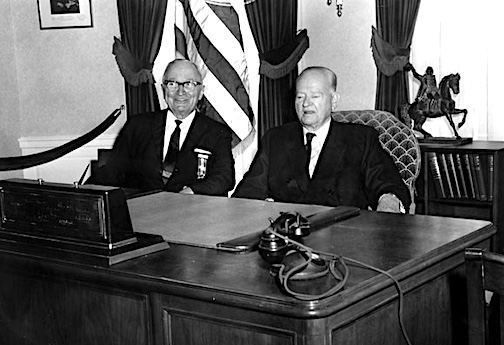
The Library and Museum was officially dedicated on Aug. 10, 1962, Hoover’s 88th birthday. Hoover and former President Truman were present at the dedication.

Presidents Harry Truman and Herbert Hoover at the dedication of the Herbert Hoover Presidential Library and Museum on Aug. 10, 1962.

Herbert Hoover died in New York City on Oct. 20, 1964, following massive internal bleeding. Two months earlier, Hoover reached the age of 90, only the second U.S. president (after John Adams) to do so. At the time of his death, Hoover had been out of office for over 31 years. This was the longest retirement in presidential history until Jimmy Carter broke that record in September 2012. Hoover was honored with a state funeral in which he lay in state in the U.S. Capitol rotunda.

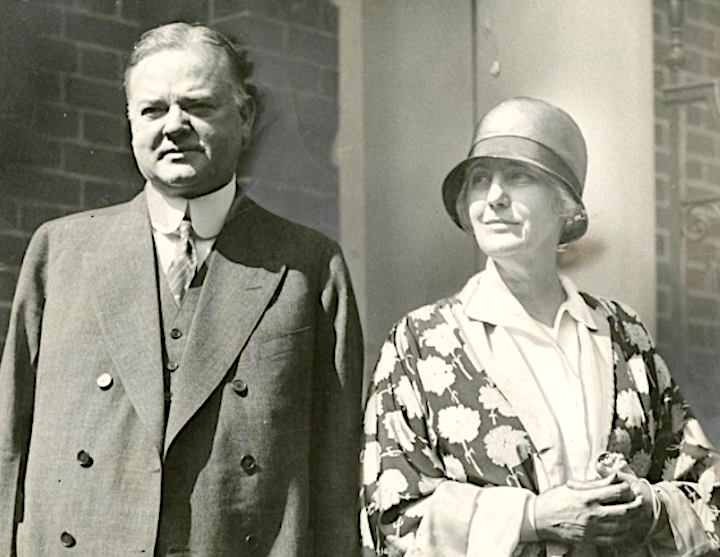
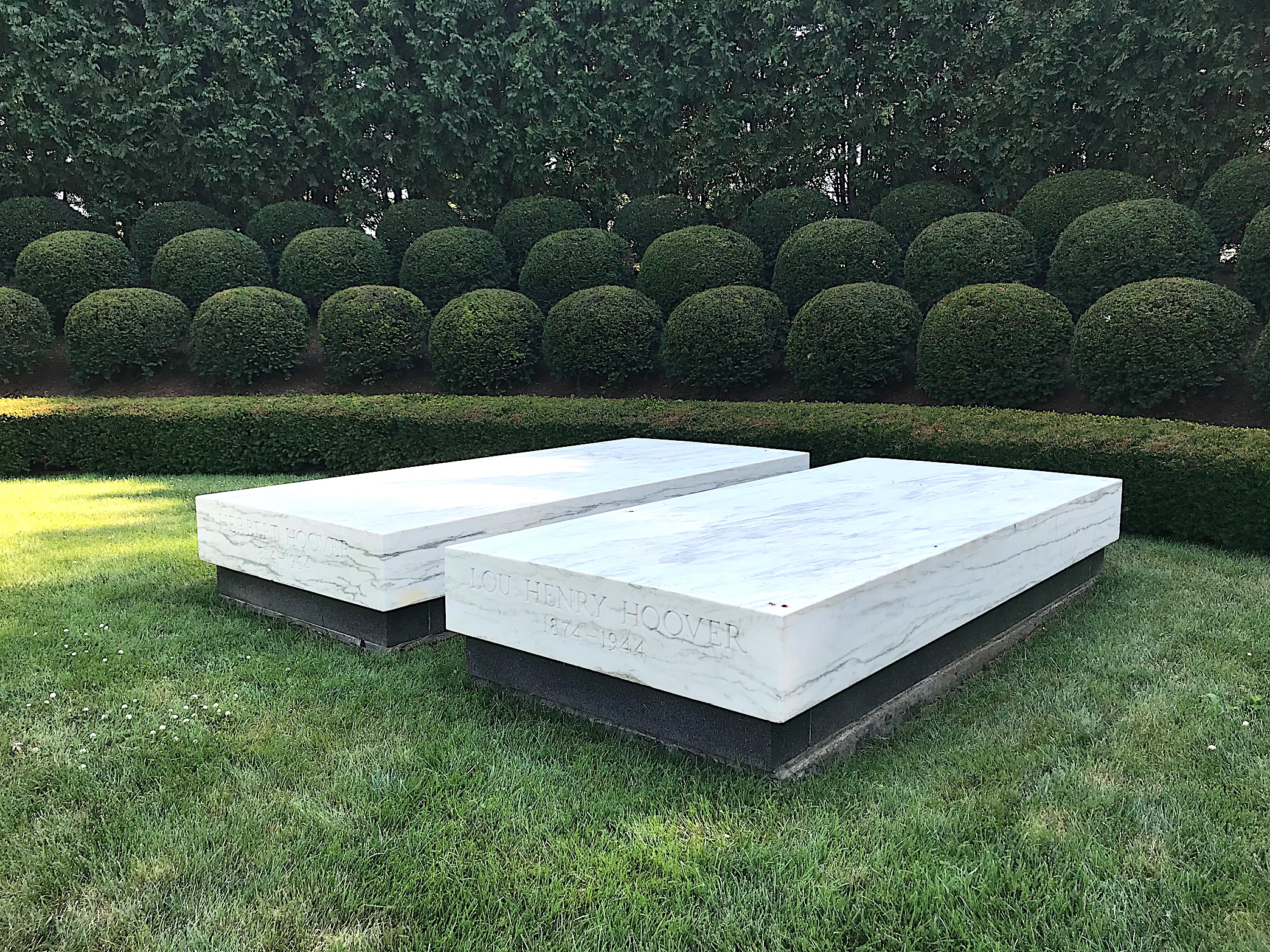
After her husband’s death in 1964, Lou Hoover was moved from her burial site in Palo Alto, Calif. to join him at the Hoover Presidential Library in Iowa.

On October 25, Hoover was buried in West Branch. Lou Hoover, buried in Palo Alto following her death in 1944, was re-interred beside him soon after.

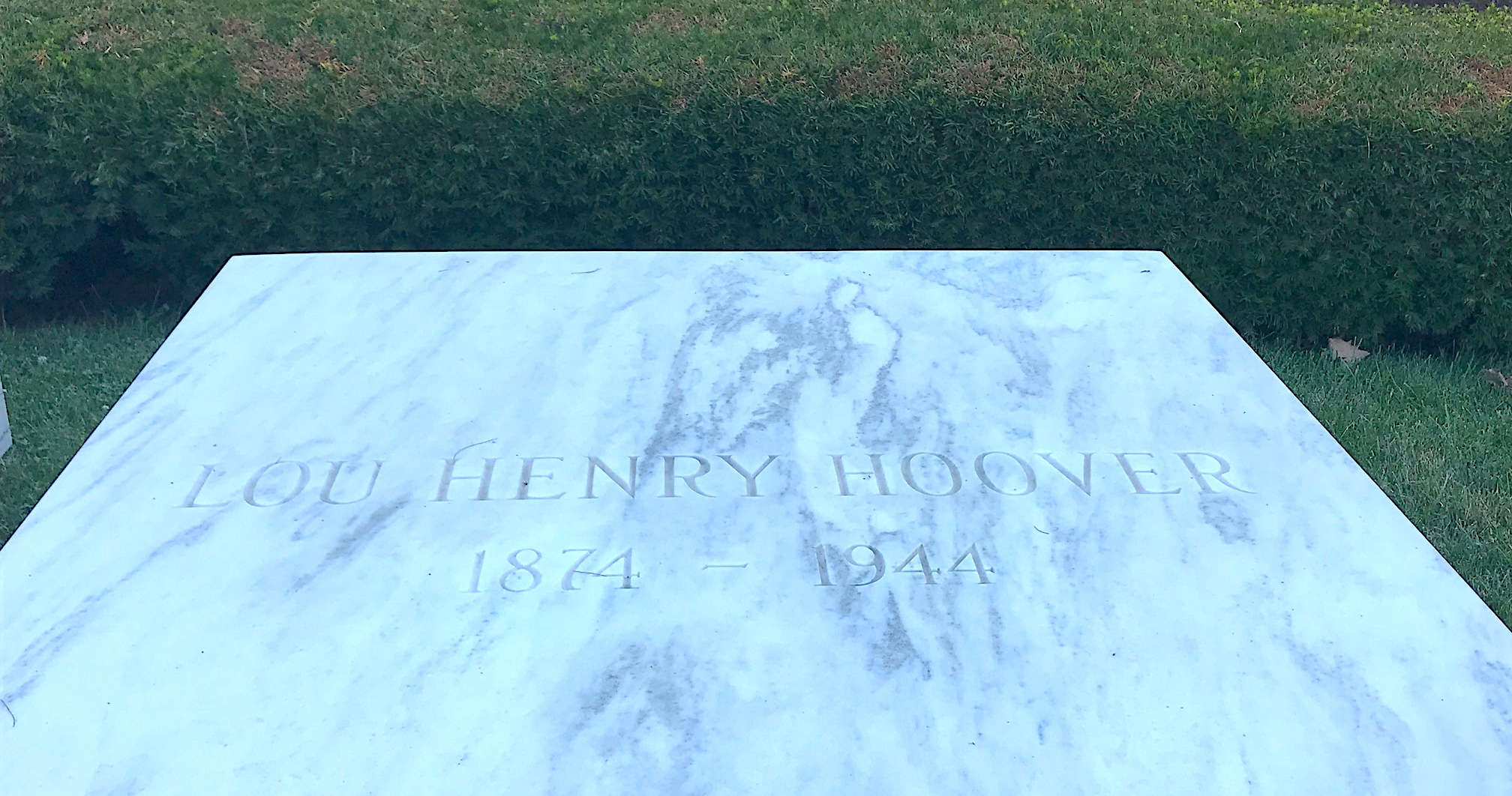
Lou Henry Hoover died 20 years before her husband in 1944.

The original Library and Museum building was expanded several times. On Aug. 8, 1992, former President Ronald Reagan rededicated the Library and Museum. The $6.5 million renovation/expansion was a public–private partnership, with Washington supplying $5 million for bricks and mortar, supplementing $1.5 million raised by the Herbert Hoover Presidential Library Association for new exhibits.

At the time of his death in 1964, Herbert Hoover had been out of office for over 31 years.

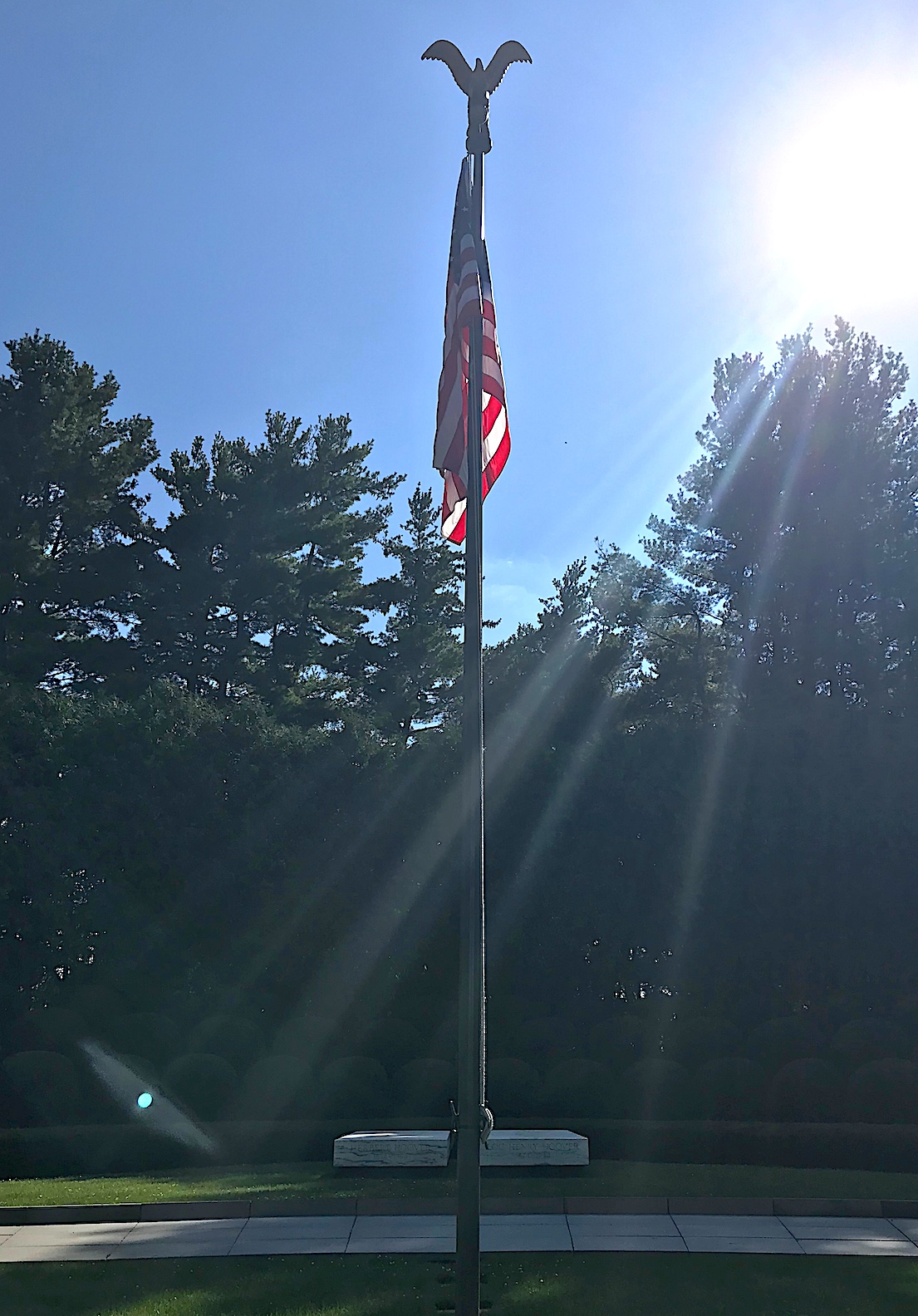
Iowa architect William Wagner designed the memorial. Two plainly inscribed ledger stones of Vermont white marble mark the Hoover graves.

Across the curved walkway, an American flag waves. Hoover signed the congressional resolution making “The Star Spangled Banner” the national anthem during his term as president in 1931. My picture of it isn’t very good but it gives you an idea of what it looks like.

Hoover signed the congressional resolution making “The Star Spangled Banner” the national anthem during his term as president in 1931.

It would be easy to sink into the debate over how much Herbert Hoover was out of touch and inept as a president, as many scholars opine. But as we were heading back to our car, I thought how more interested I was in the Hoover marriage. They were both outdoor enthusiasts, highly intelligent, shared a love of geology, and were devoted to each other. I don’t doubt that they had some lively debates in their private moments. More than some presidential marriages, I think the Hoovers respected and loved each other deeply.

It was time to head to Iowa City to check into our hotel for the night. We had another Iowa cemetery stop before we returned to Nebraska.

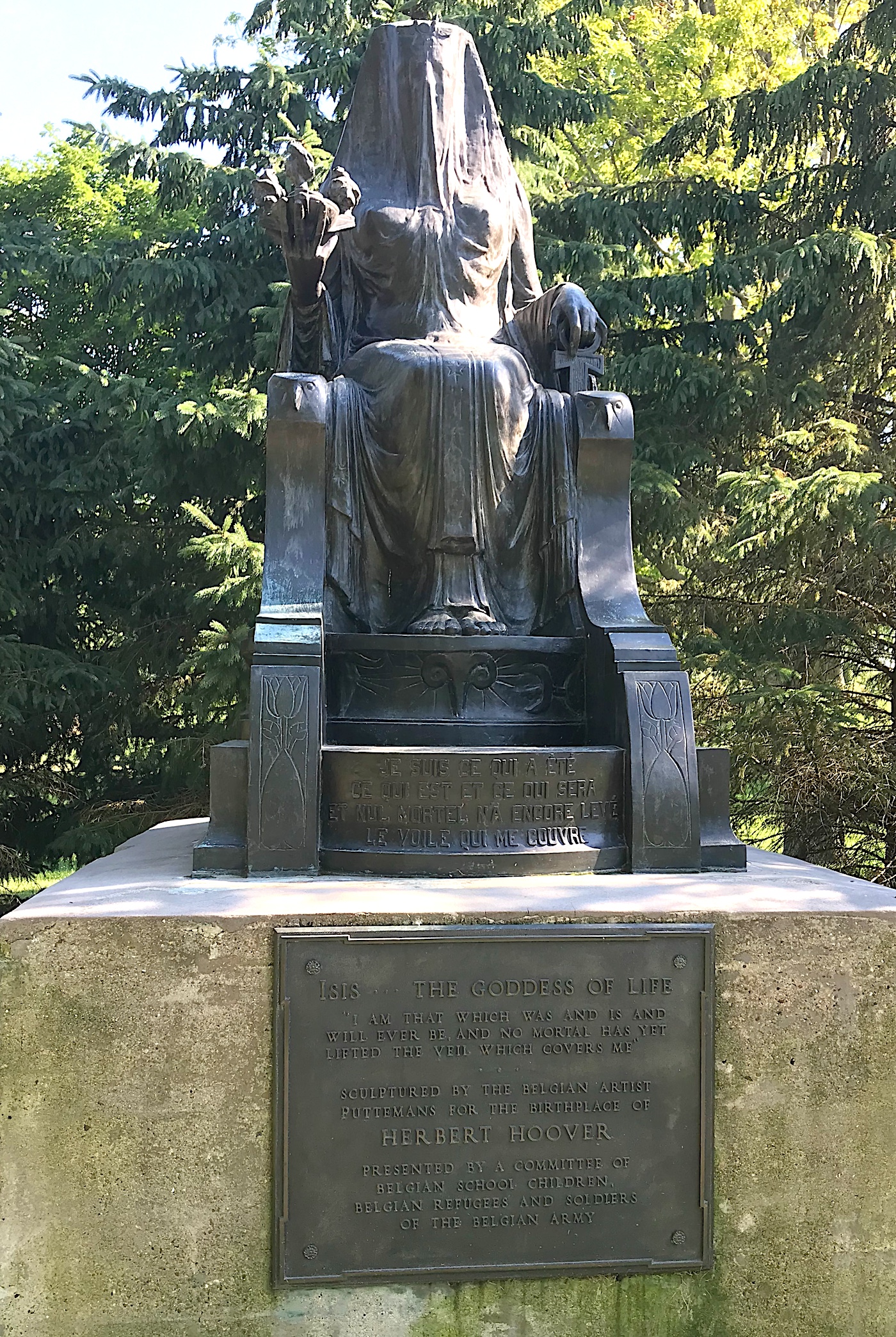
The bronze allegorical statue of Isis, the ancient Egyptian goddess of life, was a gift to Herbert Hoover from the Belgian people in gratitude for his work directing the Commission for Relief in Belgium during World War I.

Saying Hi to Grant Wood: A Quick Stop at Anamosa, Iowa’s Riverside Cemetery

01 Friday Mar 2024

Posted by adventuresincemeteryhopping in General

≈ Leave a comment

It’s not often I visit a large cemetery and only visit a few graves, then take off. But in the case of Anamosa, Iowa’s Riverside Cemetery, that is exactly what I did. Sometimes time is not on my side.

You might remember that I talked about artist Grant Wood a few months ago when I was writing about Cedar Rapids’ Oak Hill Cemetery because Dr. Byron McKeeby is buried there. A dentist in real life, he stood is as the model for the farmer in Wood’s classic “American Gothic” painting.

In a nutshell, Riverside Cemetery has about 4,720 memorials listed on Find a Grave with the earliest death date listed in the 1840s. It’s an active cemetery with burials taking place. That’s about all I know about it.

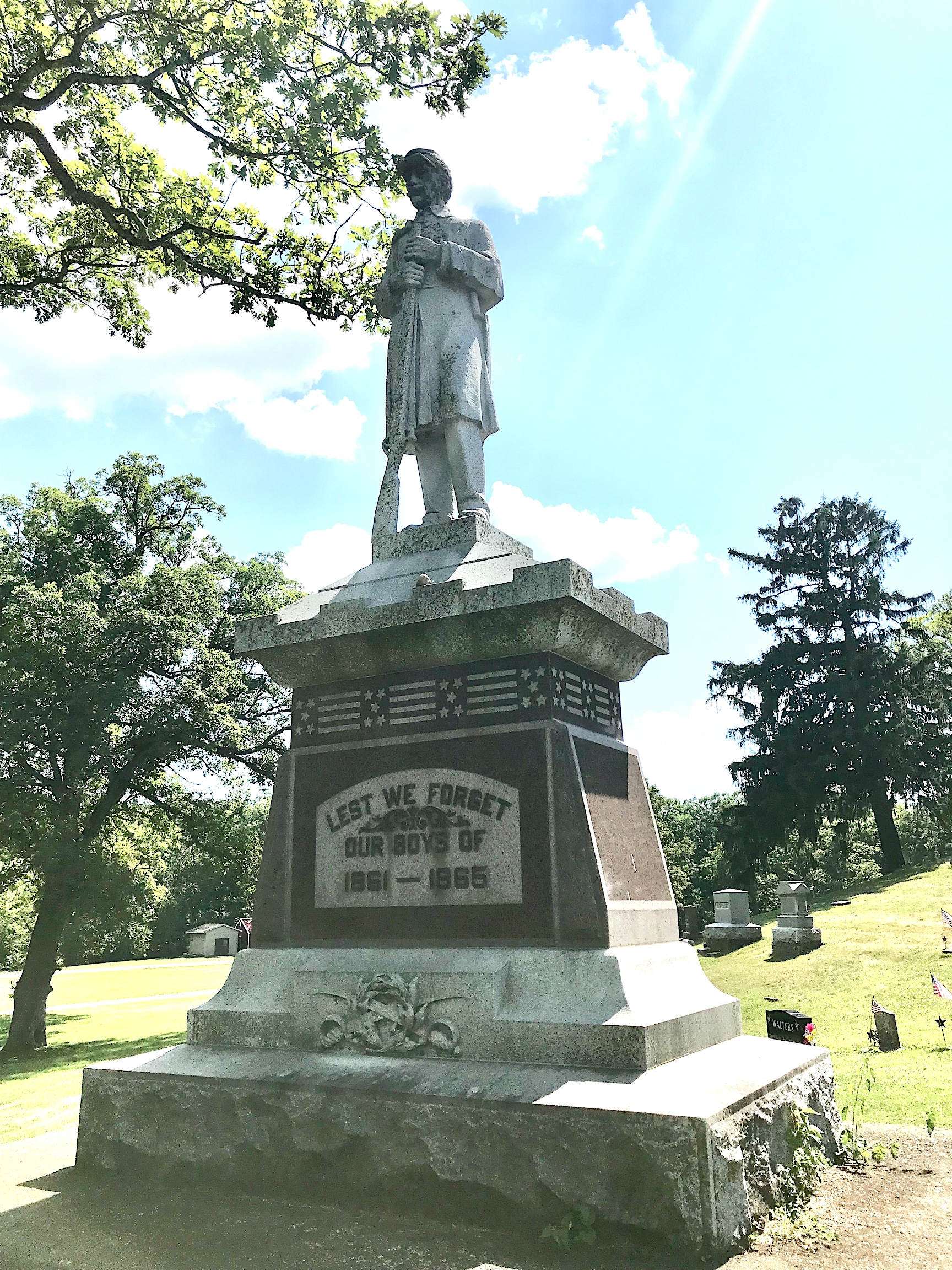
“Our Boys of 1861-1865”: Riverside Cemetery’s monument to their Civil War dead.

Grant Wood’s Home Town

Born in Anamosa in 1891 to Francis Maryville Wood and Hattie DeEtte Weaver Wood, Grant Devolson Wood and his mother moved to Cedar Rapids, Iowa after Francis passed away in 1901. Soon after, Wood began as an apprentice in a local metal shop. After graduating from high school, Wood enrolled in the Handicraft Guild, an art school run entirely by women in Minneapolis, Minn. in 1910.

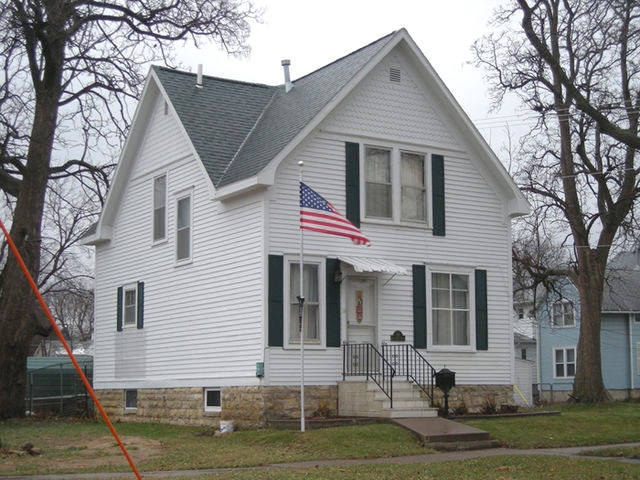
Grant Wood’s boyhood home in Cedar Rapids, Iowa. (Photo Source: Iowa Historic Preservation Alliance)

In 1913, Wood enrolled at the School of the Art Institute of Chicago and performed some work as a silversmith. Near the end of World War I, Wood joined the military, working as an artist designing camouflage scenes as well as other art.

Grant Wood was only 50 when he died of
pancreatic cancer in 1942.

From 1919 to 1925, Wood taught art to junior high school students in the Cedar Rapids public school system. From 1922 to 1935, Wood lived with his mother in the loft of a carriage house in Cedar Rapids, which he turned into his personal studio.

Between 1922 and 1928, Wood made four trips to Europe, where he studied many styles of painting. But it was the work of the 15th-century Flemish artist Jan van Eyck that influenced him to take on the clarity of this technique and incorporate it in his new works.

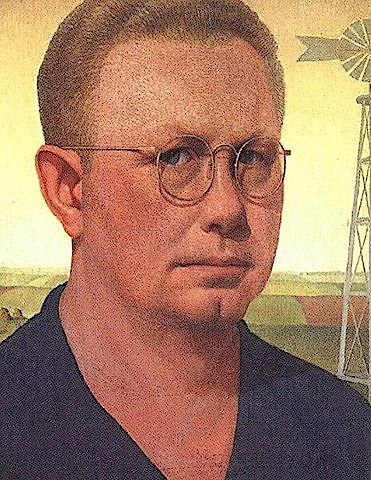
A 1925 self portrait of Grant Wood.

In 1932, Wood helped found the Stone City Art Colony near Anamosa to help artists get through the Great Depression. He became a great proponent of Regionalism in the arts, lecturing throughout the country on the topic.

From 1934 to 1941, Wood taught painting at the University of Iowa’s School of Art. During that time, he supervised mural painting projects, mentored students, produced a variety of his own works, and became a key part of the university’s cultural community.

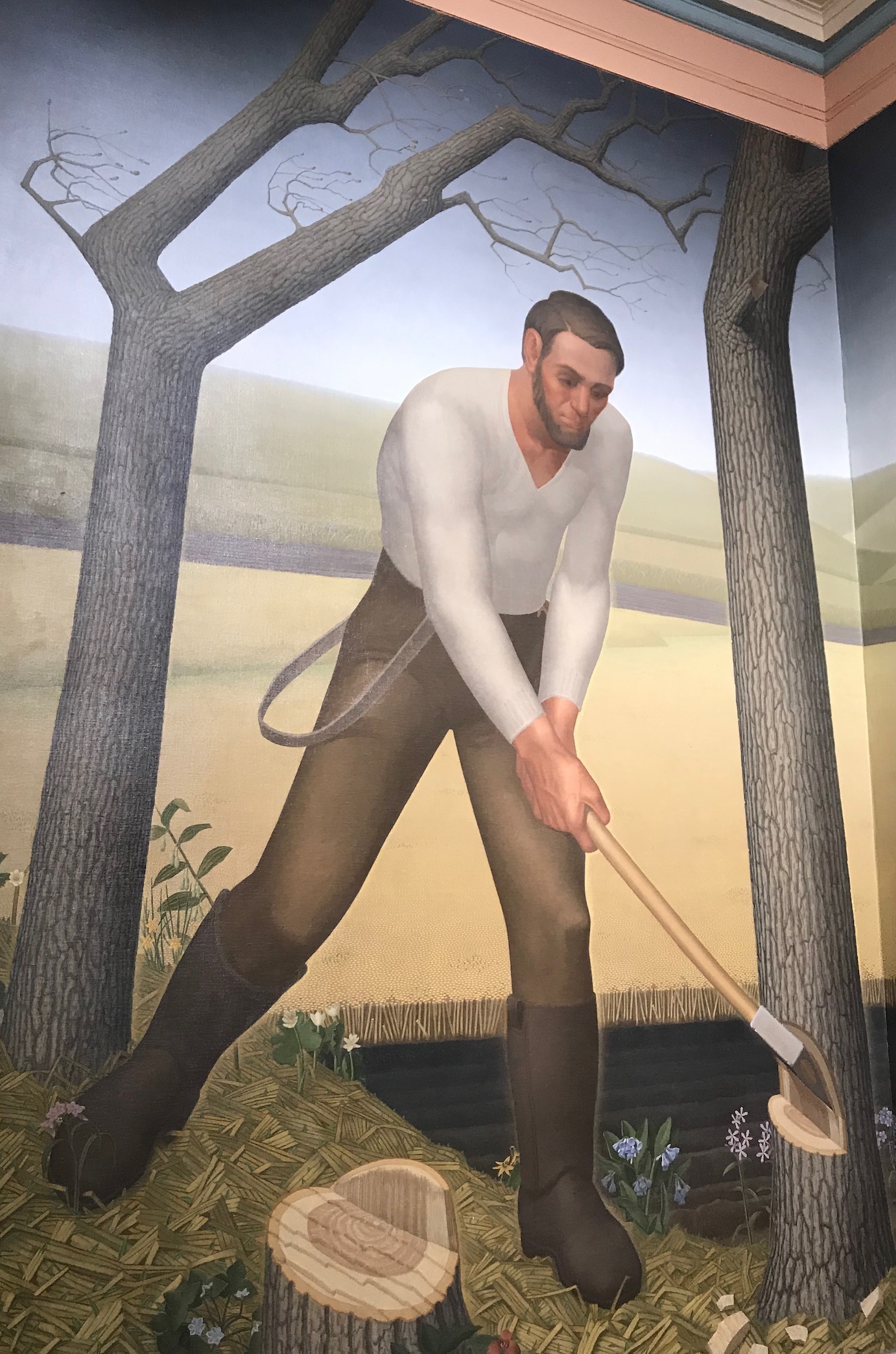
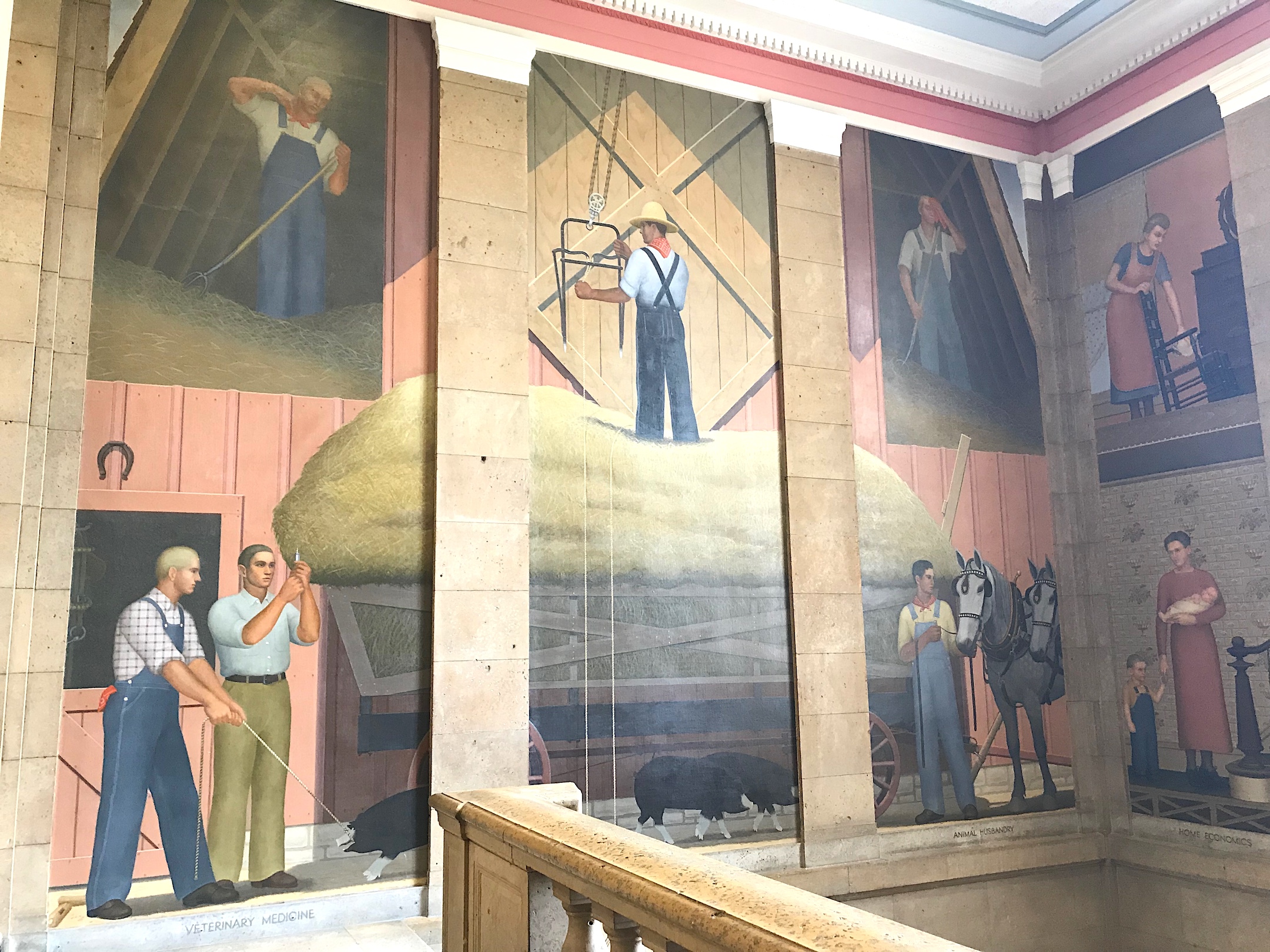
One of Grant Wood’s murals from the Iowa State University Parks Library, Ames, Iowa.

On our journey east, we stopped at Iowa State University and visited the Parks Library to see some of the murals Wood did there. According to a sign, the murals illustrate the theme put forth by Daniel Webster: “When tillage begins, other arts follow.” The murals were restored in 1974.

Another Grant Wood mural from the Parks Library at Iowa State University in Ames, Iowa.

Regionalism

Wood is associated with the American movement of Regionalism, primarily situated in the Midwest, and advanced figurative painting of rural American themes in an aggressive rejection of European abstraction.

Wood was one of three artists most associated with the movement. The others, John Steuart Curry and Thomas Hart Benton (a favorite of mine), returned to the Midwest in the 1930s due to Wood’s encouragement and assistance with locating teaching positions for them at colleges in Wisconsin and Missouri, respectively.

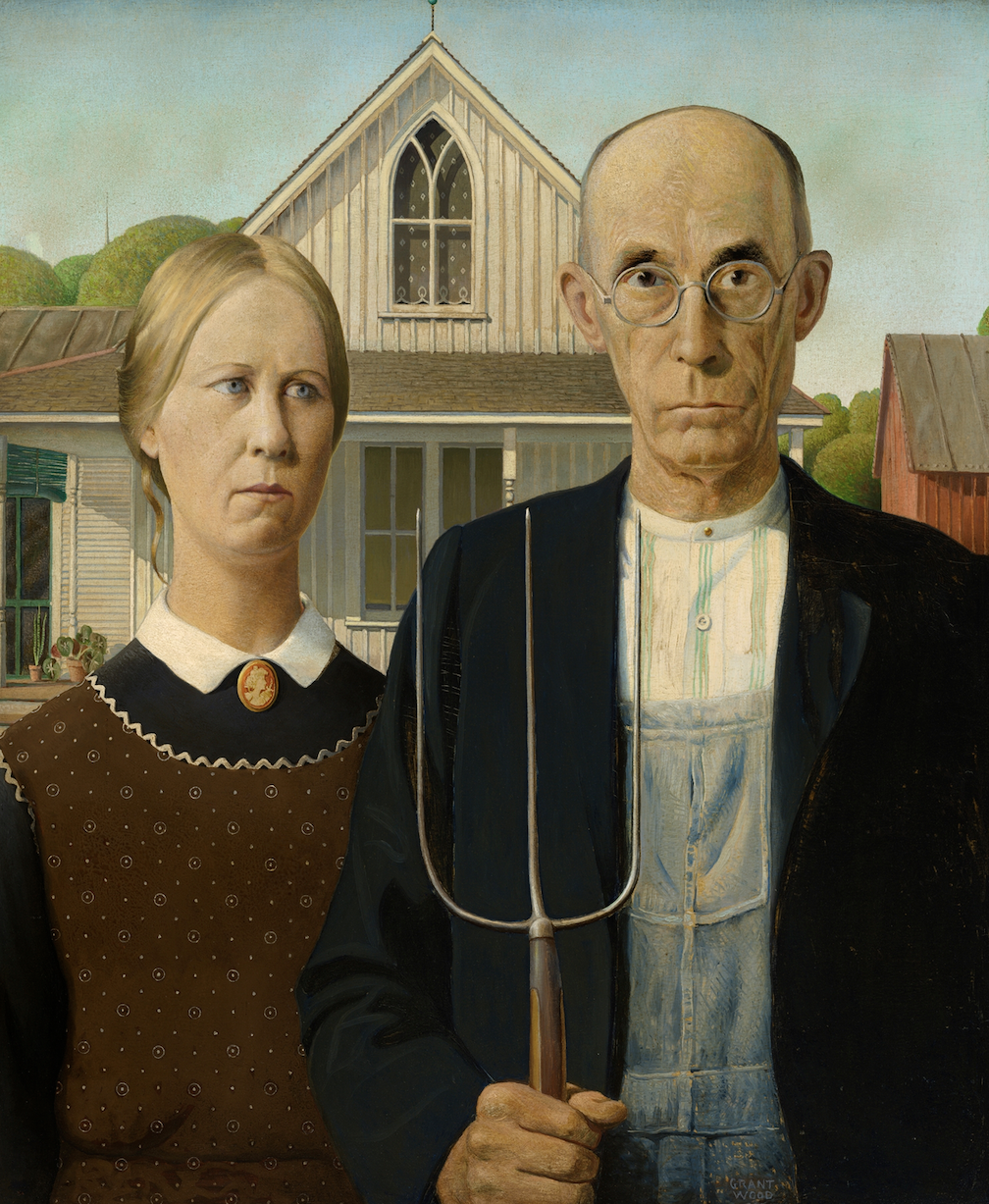
Completed in 1930, Graham Wood’s “American Gothic” put him on the art world map. His sister, Nan Wood Graham, posed for the figure of the farmer’s daughter on the left. She is buried with her parents and her brothers at Riverside Cemetery.
A portrait of the Wood’s mother, “Woman With Plants” (1929), is regarded as Wood’s stylistic breakthrough, but it was “American Gothic” in 1930 that put him on the art world map and has kept him there. Alternately interpreted as a hymn to Middle American values or a spoof of them, it caused a sensation when it first appeared at the Art Institute of Chicago and has since been endlessly reproduced and parodied in all kinds of media.

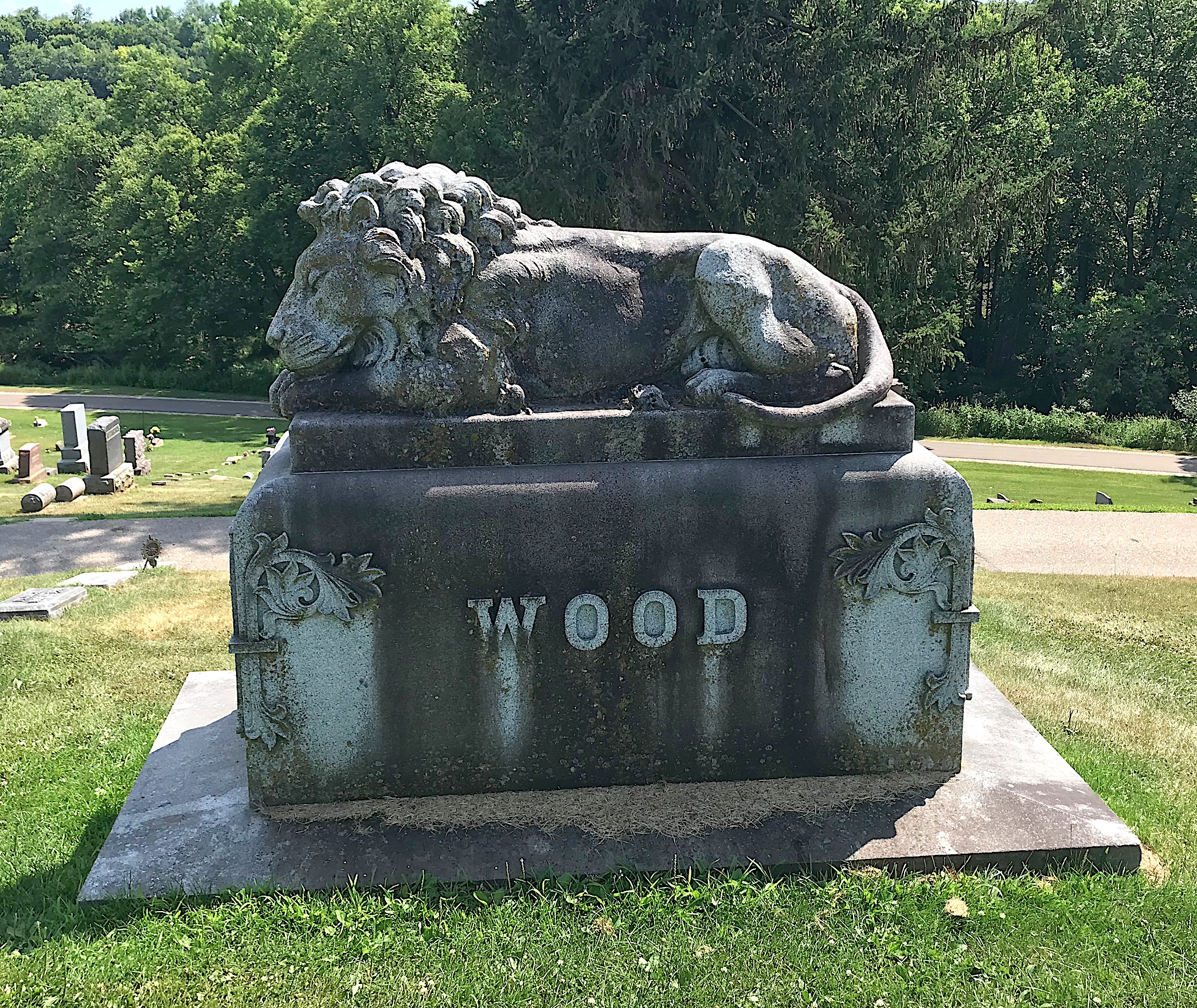
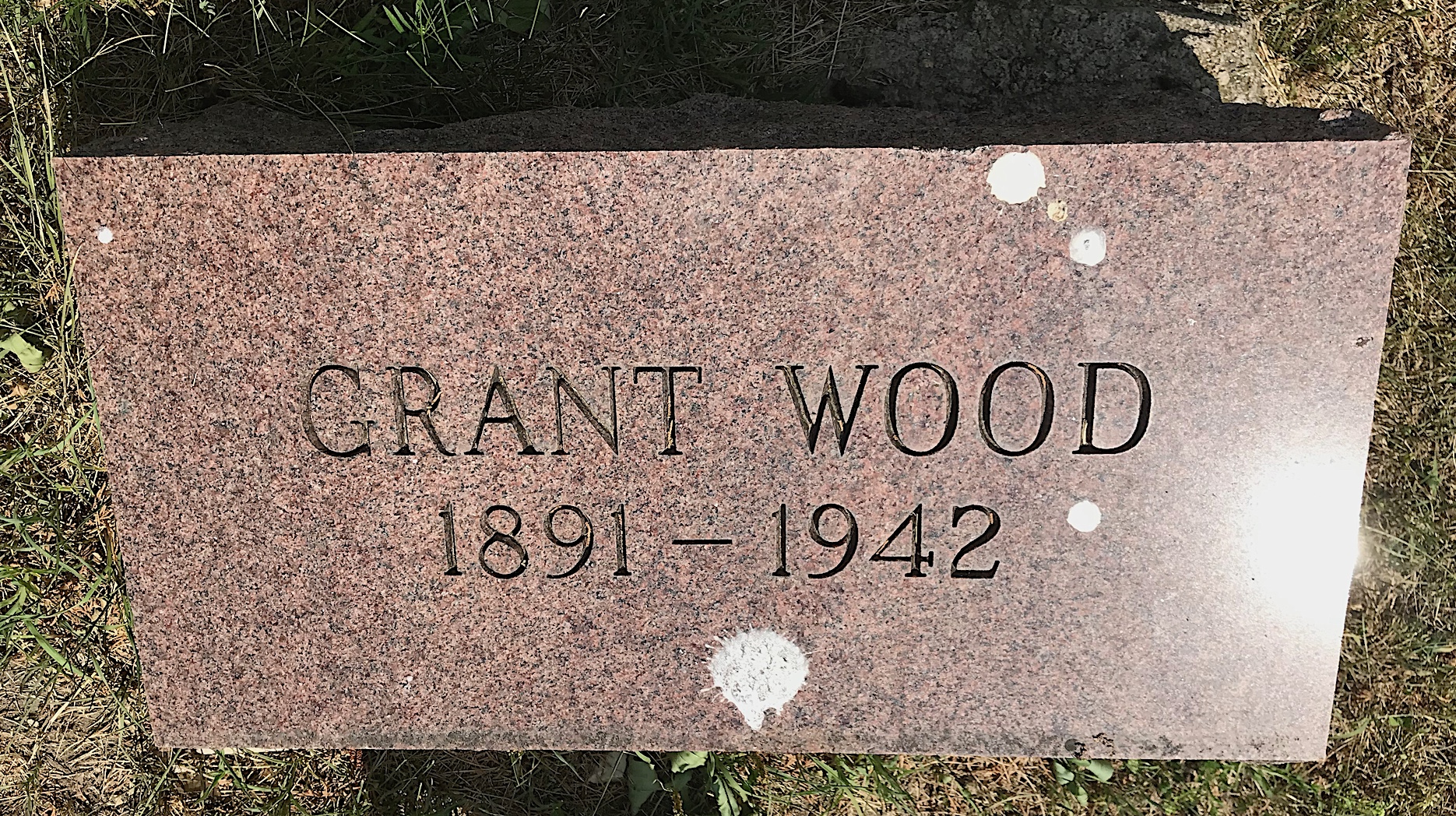
Wood died of pancreatic cancer one day before his 51st birthday on Feb. 12, 1942. A lounging lion dominated the family stone in the middle of the plot.

The Wood family lion could use a good cleaning, truth be told.

Grant is buried with his parents, his brother, John (who died in 1935), and his sister, Nan (who was the farmer’s daughter in “American Gothic”). Nan died in 1990 and spent the last decades of her life promoting her famous brother’s work. I did not get a picture of her marker, unfortunately.

Grant Wood is considered Anamosa’s most famous native.

White Bronze Beauty

It was a delight to find a few white bronze markers scattered about Riverside Cemetery. This one for Adeline Spaulding Smith caught my eye due to the fact it was in such good condition. The clam shell on top is still intact as well. I’d never seen one up close before.
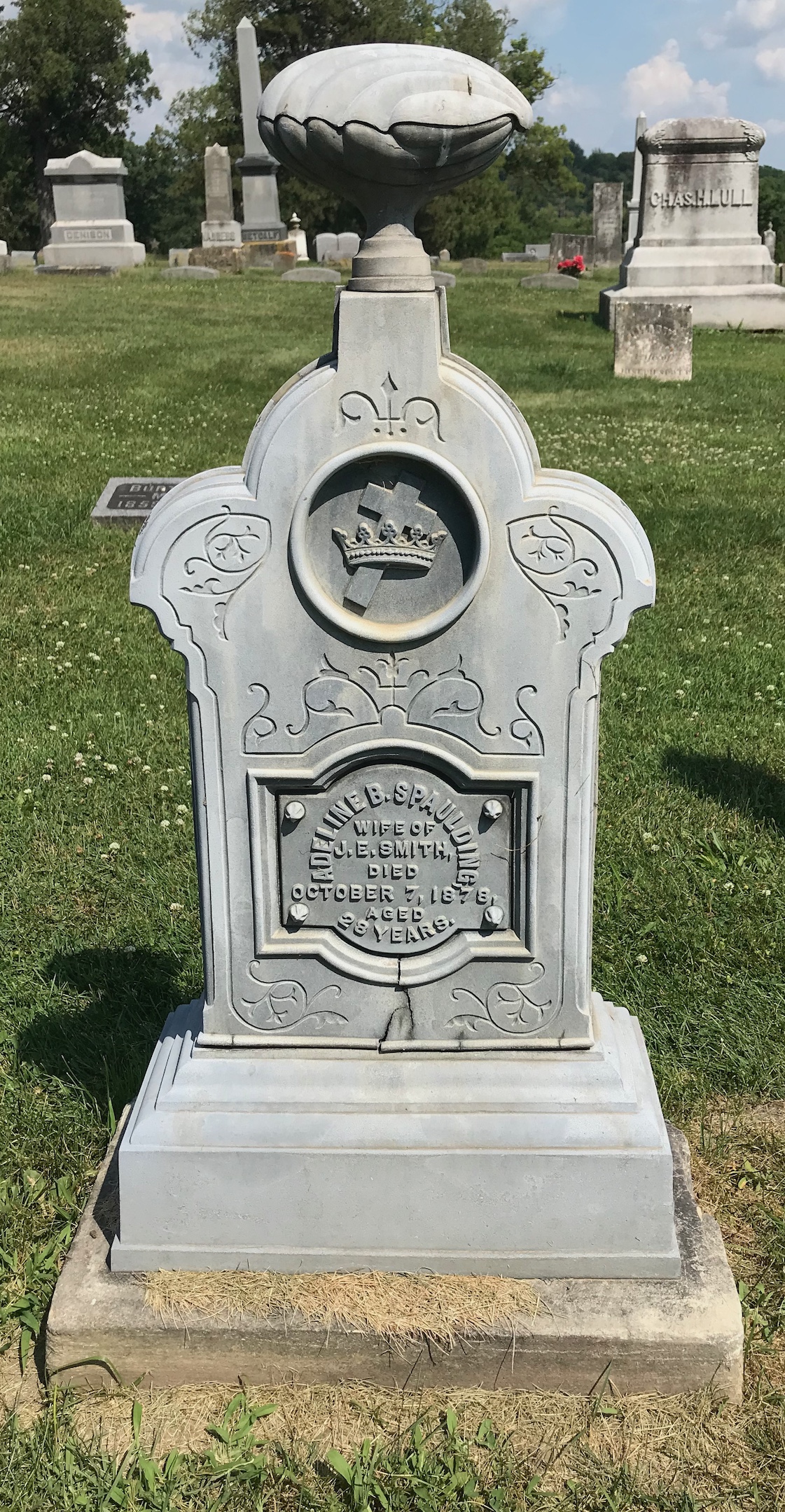
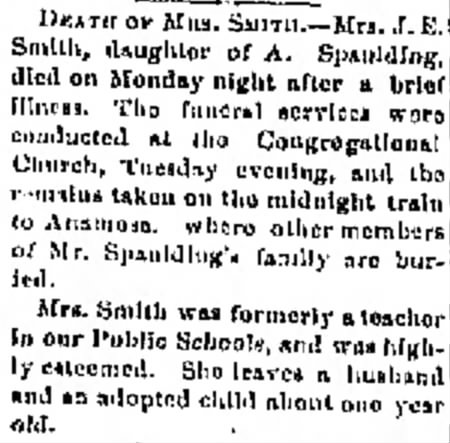
Born in Maquoketa, Iowa in 1850 to master carpenter Alonzo Spaulding and Mary Sheerer Spaulding, Adeline Brown Spaulding was one of four children the couple had. On Nov. 4, 1873, she married Scottish immigrant James E. Smith in Cedar Falls, Iowa. Before that time, her death notice told me, she had been a school teacher in the Cedar Falls, Iowa public schools.

Adeline Spaulding Smith was a school teacher before she married in 1873.

Adeline died on Oct. 7, 1878 after a short illness at age 28. Her body was returned to Anamosa so she could be buried with grandmother in Riverside Cemetery. Adeline’s husband, James, moved to Vermont to be near his mother and died there in 1933. I don’t know what became of the little child they adopted before Adeline died.
The white bronze (zinc) marker for Adeline Spaulding Smith features a two-piece shell on top of it.

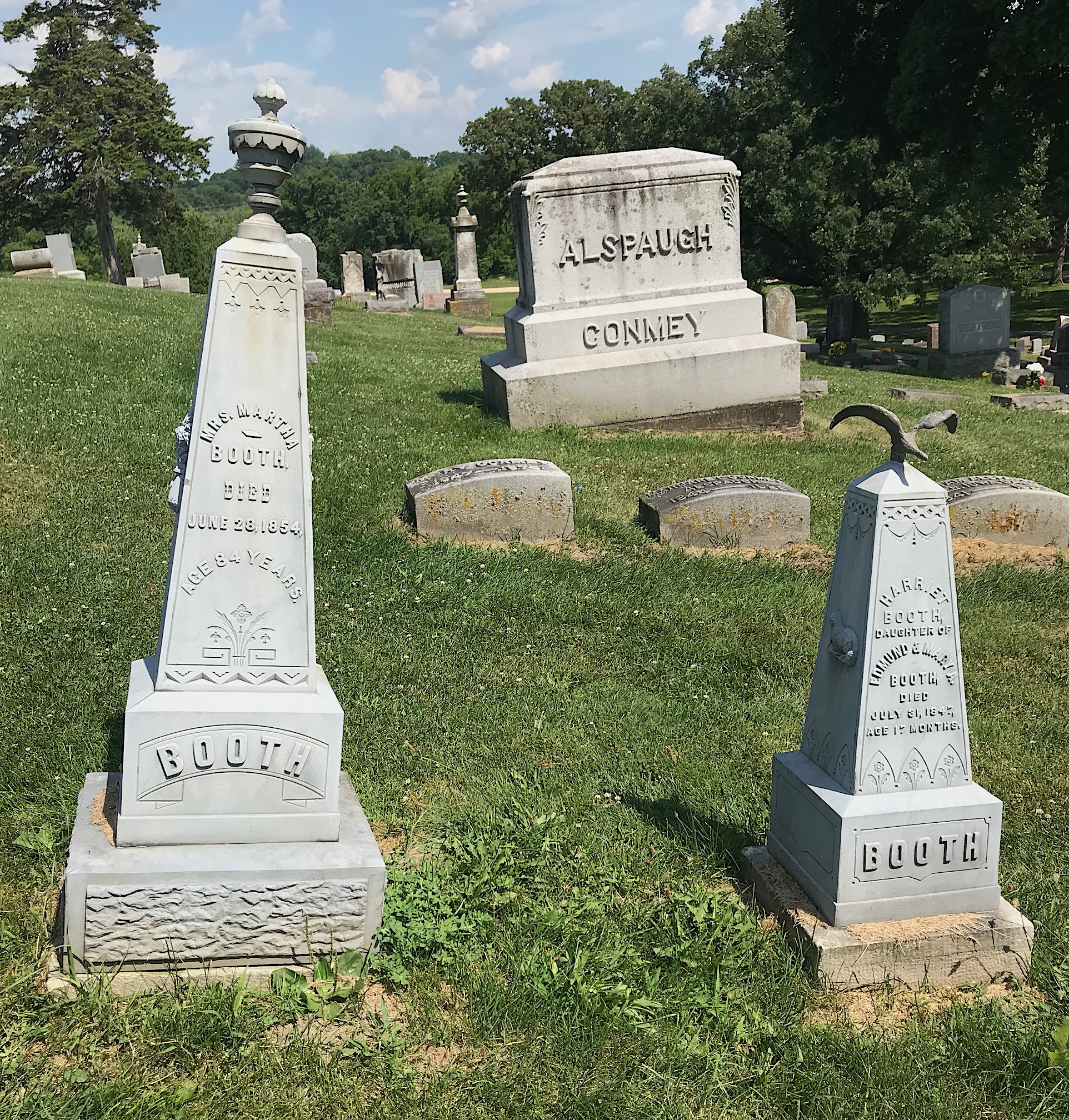
The next two white bronze markers, I later learned, are cenotaphs. That means the people they represent are not actually buried there.

On the left is the cenotaph for Martha “Patty” Eyre Booth. According to her Find a Grave memorial:

She is listed on the cemetery records as “Mrs. Martha Booth,” but she was the widow of Peter Booth, and had married a second time, to Levi Rumrill. But Rumrill also predeceased her by a number of years. Where Martha actually is buried is not known. After Rumrill’s death, she came to Anamosa, Iowa, in June 1840, where several of her children were, and she reverted to the “Booth” name. It is believed that she was buried in Wilcox Cemetery near Fairview, Iowa — where her son Edmund’s first daughter — who died at age 17 months — was buried. But the location of the graves was lost. Thus the cenotaphs in the Anamosa cemetery with the rest of the family.

Mrs. Booth died on June 28, 1854, many years before white bronze markers were being made. So it was placed much later.

These two white bronze markers are cenotaphs. The people they represent are not buried there.

On the right is a smaller marker for Harriet Booth, the daughter of Edmund and Mary Ann Booth. Born on Feb. 22, 1846, Harried died on July 31, 1847 at the age of 14 months.

Her father, Edmund (1810-1905), was a bit of a legend as a deaf pioneer and abolitionist. His Find a Grave memorial notes:

Born in 1810, Edmund Booth epitomized virtually everything that characterized an American legend of the 19th century. He taught school in Hartford, Conn., then went west to Anamosa, Iowa, where he built the area’s first frame house. He left in 1849 to travel the Overland Trail on his way to join the California Gold Rush. After he returned to Iowa in 1854, he became the owner and editor of the Anamosa EUREKA, the local newspaper. Edmund Booth fit perfectly the mold of the ingenious pioneer of 19th-century America, except for one unusual difference – he was deaf.

Edmund is buried at Riverside Cemetery with his wife (and Harriet’s mother), Mary Ann Walworth Booth. Also deaf, Mary Ann was one of Edmund’s former pupils in Connecticut. I did not get a photo of either of there graves.

Time to Go

We had one more stop to make before checking in at our Iowa City hotel that night. We had a Presidential grave to visit!

Back of the white bronze (zinc) monument for Adeline Brown Spaulding Smith, who died in 1878.

Recent Posts

  • More Pensacola, Fla. Cemetery Hopping: Taking a Ramble Through Saint John’s Cemetery, Part III
  • More Pensacola, Fla. Cemetery Hopping: Taking a Ramble Through Saint John’s Cemetery, Part II
  • More Pensacola, Fla. Cemetery Hopping: Taking a Ramble Through Saint John’s Cemetery, Part I
  • The City of Five Flags: Stepping back in time at Pensacola, Fla.’s Saint Michael’s Cemetery, Part V
  • The City of Five Flags: Stepping back in time at Pensacola, Fla.’s Saint Michael’s Cemetery, Part IV

Archives

  • December 2025
  • November 2025
  • August 2025
  • July 2025
  • June 2025
  • May 2025
  • April 2025
  • March 2025
  • February 2025
  • January 2025
  • October 2024
  • August 2024
  • July 2024
  • June 2024
  • May 2024
  • April 2024
  • March 2024
  • February 2024
  • January 2024
  • December 2023
  • November 2023
  • October 2023
  • September 2023
  • August 2023
  • July 2023
  • June 2023
  • May 2023
  • April 2023
  • March 2023
  • February 2023
  • January 2023
  • December 2022
  • November 2022
  • October 2022
  • September 2022
  • August 2022
  • July 2022
  • June 2022
  • May 2022
  • April 2022
  • March 2022
  • February 2022
  • January 2022
  • December 2021
  • November 2021
  • October 2021
  • September 2021
  • August 2021
  • July 2021
  • May 2021
  • April 2021
  • March 2021
  • February 2021
  • January 2021
  • December 2020
  • November 2020
  • October 2020
  • September 2020
  • August 2020
  • July 2020
  • June 2020
  • May 2020
  • April 2020
  • March 2020
  • February 2020
  • January 2020
  • December 2019
  • November 2019
  • October 2019
  • September 2019
  • August 2019
  • July 2019
  • June 2019
  • May 2019
  • April 2019
  • March 2019
  • February 2019
  • January 2019
  • December 2018
  • November 2018
  • October 2018
  • September 2018
  • August 2018
  • May 2018
  • April 2018
  • March 2018
  • February 2018
  • January 2018
  • December 2017
  • November 2017
  • October 2017
  • September 2017
  • August 2017
  • July 2017
  • June 2017
  • May 2017
  • April 2017
  • March 2017
  • February 2017
  • January 2017
  • December 2016
  • November 2016
  • October 2016
  • September 2016
  • August 2016
  • July 2016
  • June 2016
  • May 2016
  • April 2016
  • March 2016
  • February 2016
  • January 2016
  • December 2015
  • November 2015
  • October 2015
  • September 2015
  • August 2015
  • July 2015
  • May 2015
  • April 2015
  • March 2015
  • February 2015
  • January 2015
  • December 2014
  • November 2014
  • October 2014
  • September 2014
  • August 2014
  • July 2014
  • June 2014
  • May 2014
  • April 2014
  • March 2014
  • February 2014
  • January 2014
  • December 2013
  • November 2013
  • October 2013
  • September 2013
  • August 2013
  • July 2013
  • June 2013
  • May 2013
  • April 2013
  • March 2013
  • February 2013
  • January 2013

Categories

  • General

Blogroll

  • A Grave Interest
  • Cemetery Photography by Chantal Larochelle
  • Cemetery Tours of Berlin by Matti
  • Confessions of a Funeral Director (Caleb Wilde)
  • Find a Grave
  • Hunting and Gathering (cool photography site)
  • Save Our Cemeteries (New Orleans, La.)
  • The Cemetery Club
  • The Graveyard Detective
  • The Rambling Muser
  • Westminster Abbey Tours by Grace

Meta

  • Create account
  • Log in
  • Entries feed
  • Comments feed
  • WordPress.com

Blog at WordPress.com.

  • Subscribe Subscribed
    • Adventures in Cemetery Hopping
    • Join 402 other subscribers
    • Already have a WordPress.com account? Log in now.
    • Adventures in Cemetery Hopping
    • Subscribe Subscribed
    • Sign up
    • Log in
    • Report this content
    • View site in Reader
    • Manage subscriptions
    • Collapse this bar
 

Loading Comments...