
It’s not often I visit a large cemetery and only visit a few graves, then take off. But in the case of Anamosa, Iowa’s Riverside Cemetery, that is exactly what I did. Sometimes time is not on my side.
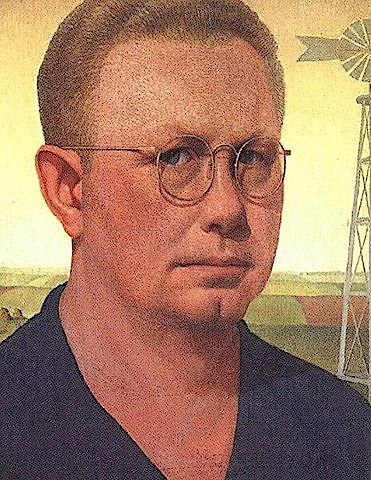
You might remember that I talked about artist Grant Wood a few months ago when I was writing about Cedar Rapids’ Oak Hill Cemetery because Dr. Byron McKeeby is buried there. A dentist in real life, he stood is as the model for the farmer in Wood’s classic “American Gothic” painting.
In a nutshell, Riverside Cemetery has about 4,720 memorials listed on Find a Grave with the earliest death date listed in the 1840s. It’s an active cemetery with burials taking place. That’s about all I know about it.
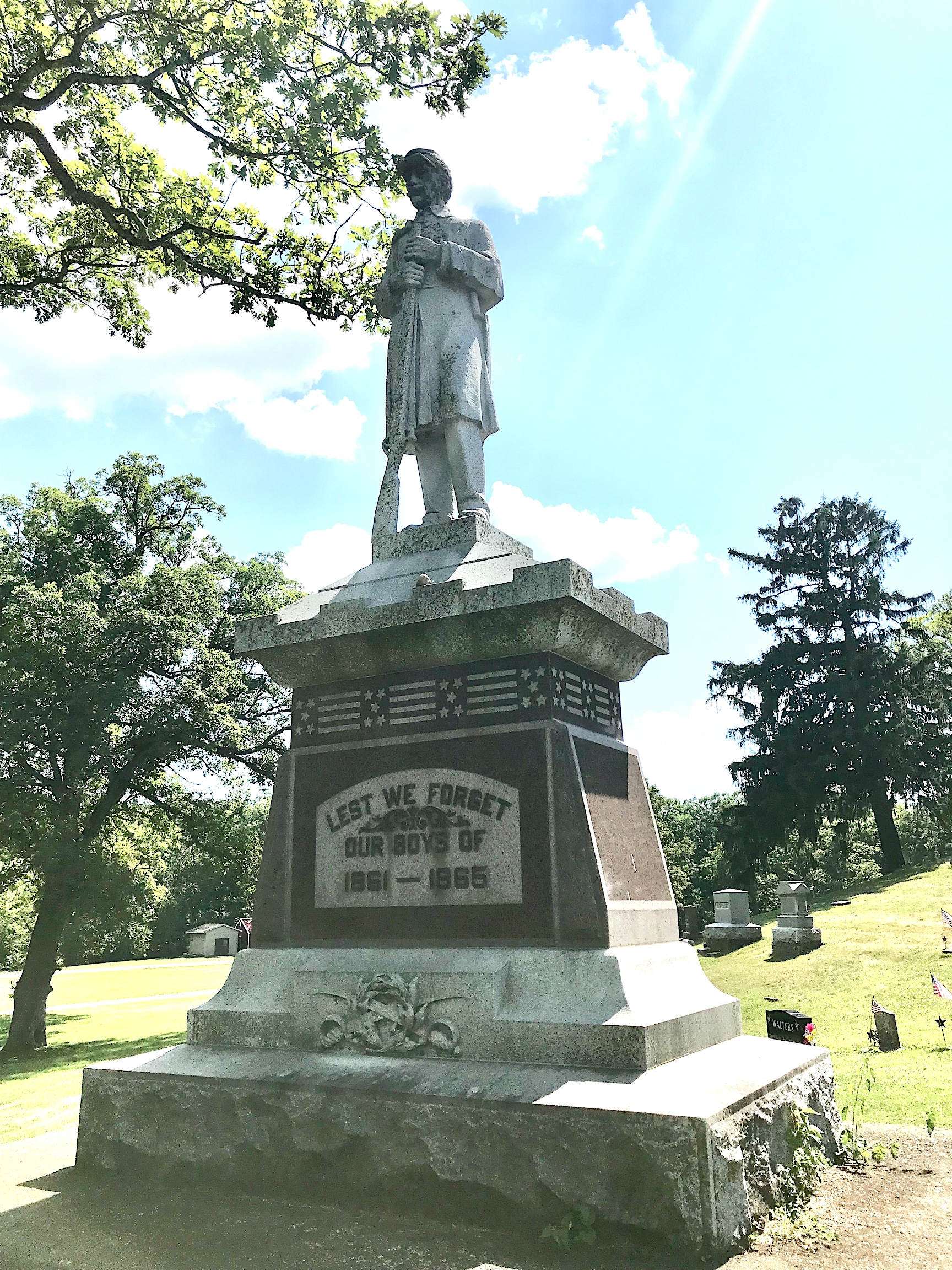
Grant Wood’s Home Town
Born in Anamosa in 1891 to Francis Maryville Wood and Hattie DeEtte Weaver Wood, Grant Devolson Wood and his mother moved to Cedar Rapids, Iowa after Francis passed away in 1901. Soon after, Wood began as an apprentice in a local metal shop. After graduating from high school, Wood enrolled in the Handicraft Guild, an art school run entirely by women in Minneapolis, Minn. in 1910.
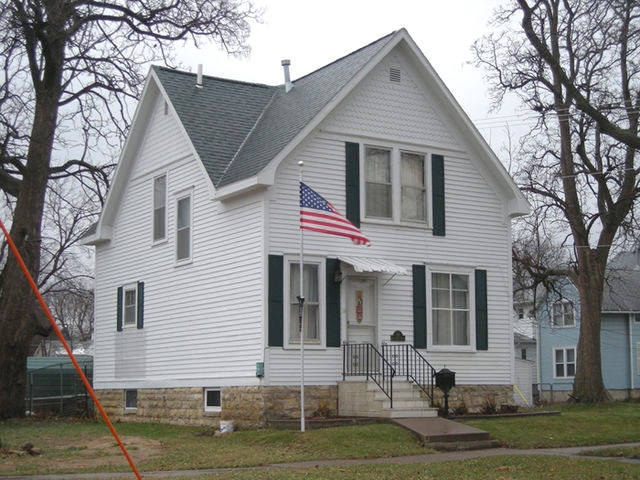
In 1913, Wood enrolled at the School of the Art Institute of Chicago and performed some work as a silversmith. Near the end of World War I, Wood joined the military, working as an artist designing camouflage scenes as well as other art.
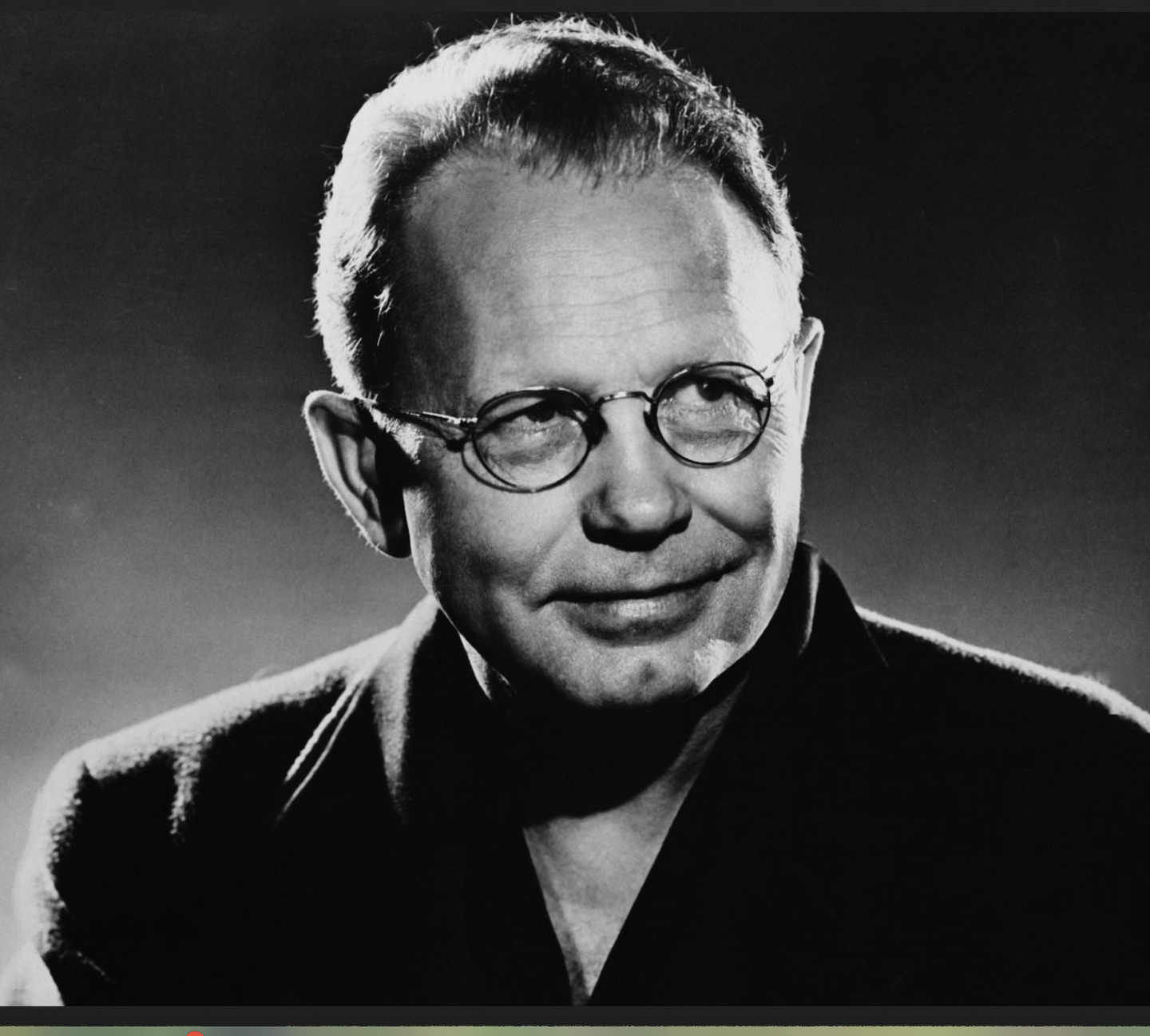
pancreatic cancer in 1942.
From 1919 to 1925, Wood taught art to junior high school students in the Cedar Rapids public school system. From 1922 to 1935, Wood lived with his mother in the loft of a carriage house in Cedar Rapids, which he turned into his personal studio.
Between 1922 and 1928, Wood made four trips to Europe, where he studied many styles of painting. But it was the work of the 15th-century Flemish artist Jan van Eyck that influenced him to take on the clarity of this technique and incorporate it in his new works.
In 1932, Wood helped found the Stone City Art Colony near Anamosa to help artists get through the Great Depression. He became a great proponent of Regionalism in the arts, lecturing throughout the country on the topic.
From 1934 to 1941, Wood taught painting at the University of Iowa’s School of Art. During that time, he supervised mural painting projects, mentored students, produced a variety of his own works, and became a key part of the university’s cultural community.
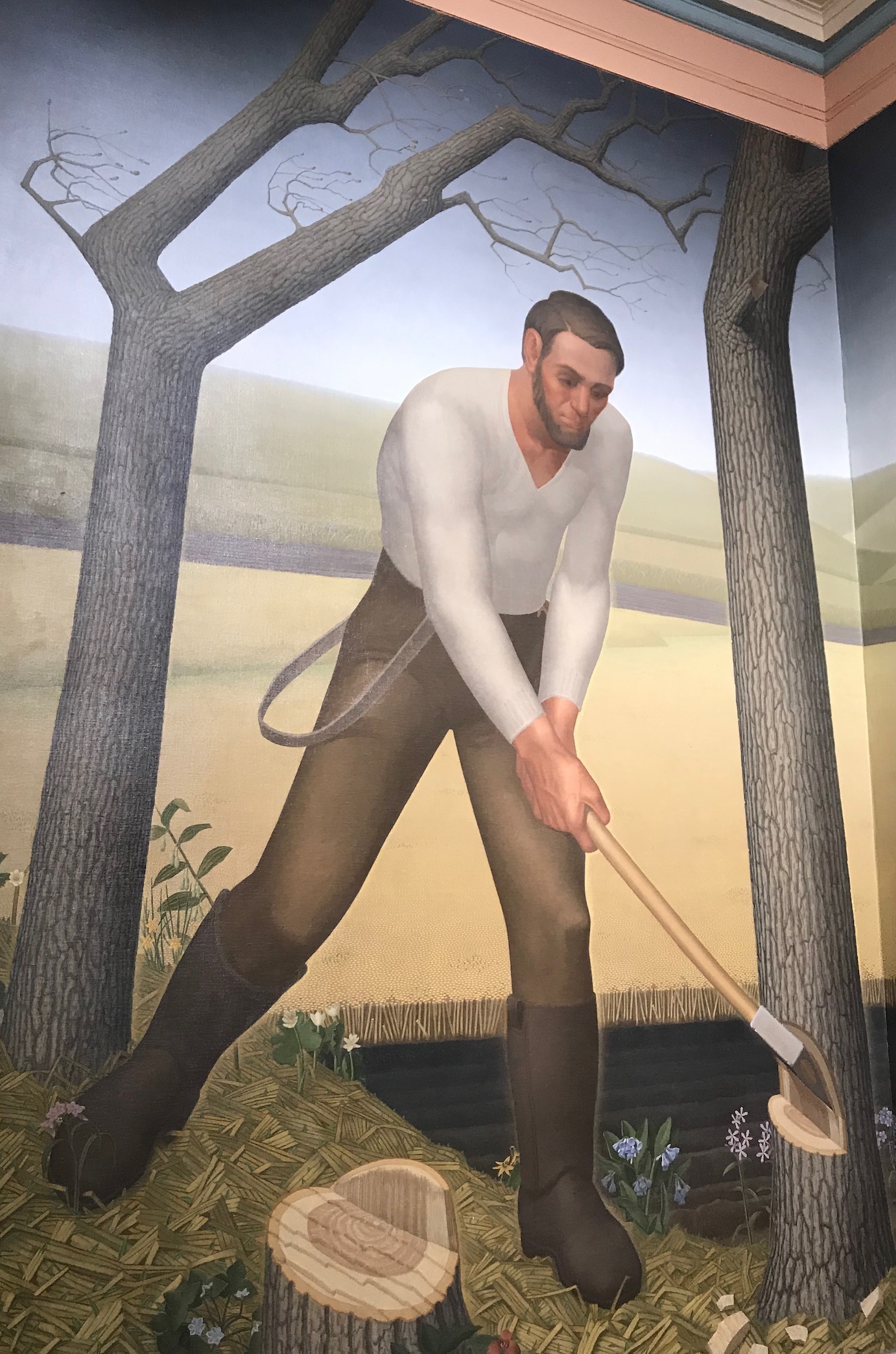
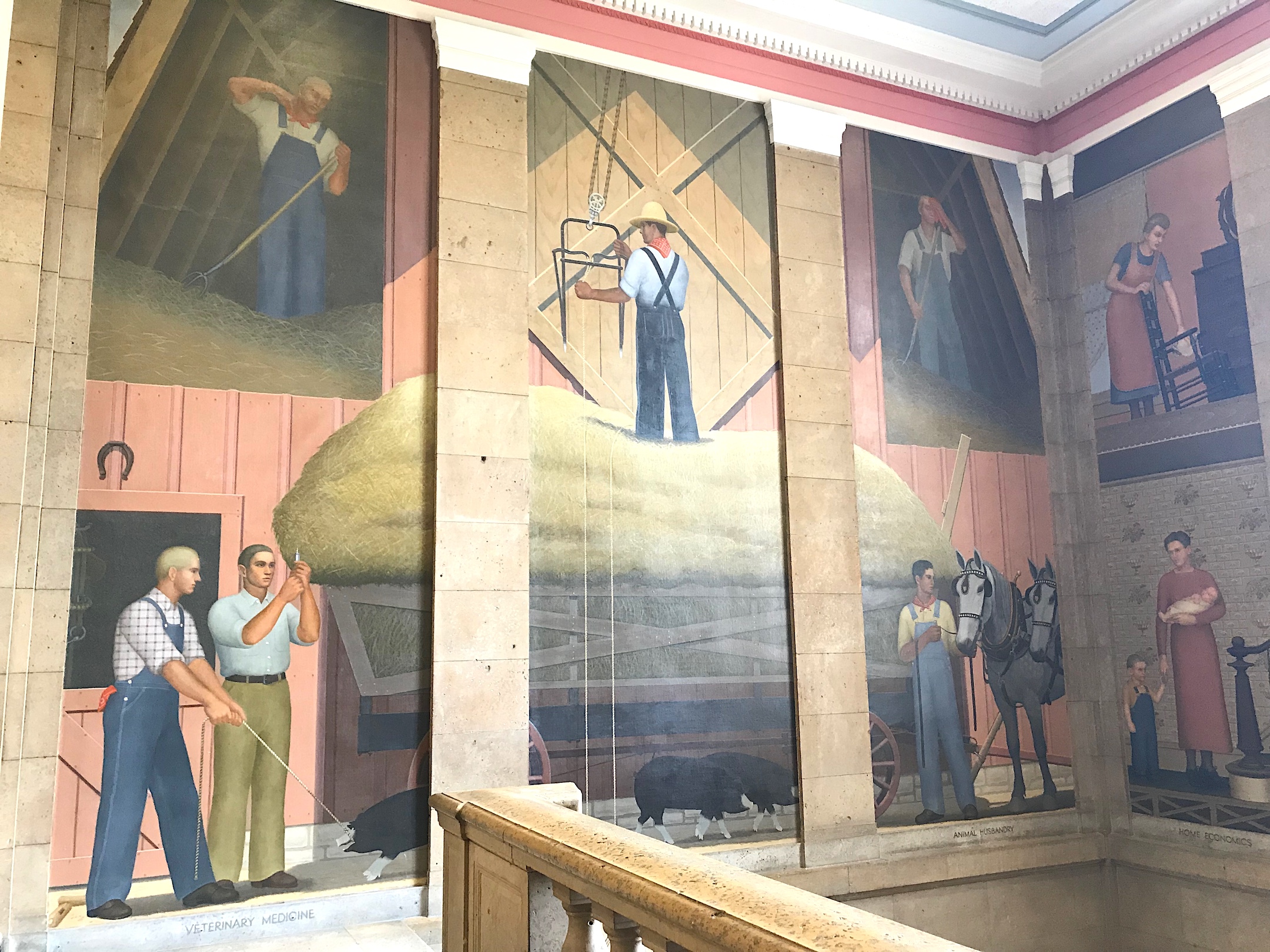
On our journey east, we stopped at Iowa State University and visited the Parks Library to see some of the murals Wood did there. According to a sign, the murals illustrate the theme put forth by Daniel Webster: “When tillage begins, other arts follow.” The murals were restored in 1974.
Regionalism
Wood is associated with the American movement of Regionalism, primarily situated in the Midwest, and advanced figurative painting of rural American themes in an aggressive rejection of European abstraction.
Wood was one of three artists most associated with the movement. The others, John Steuart Curry and Thomas Hart Benton (a favorite of mine), returned to the Midwest in the 1930s due to Wood’s encouragement and assistance with locating teaching positions for them at colleges in Wisconsin and Missouri, respectively.
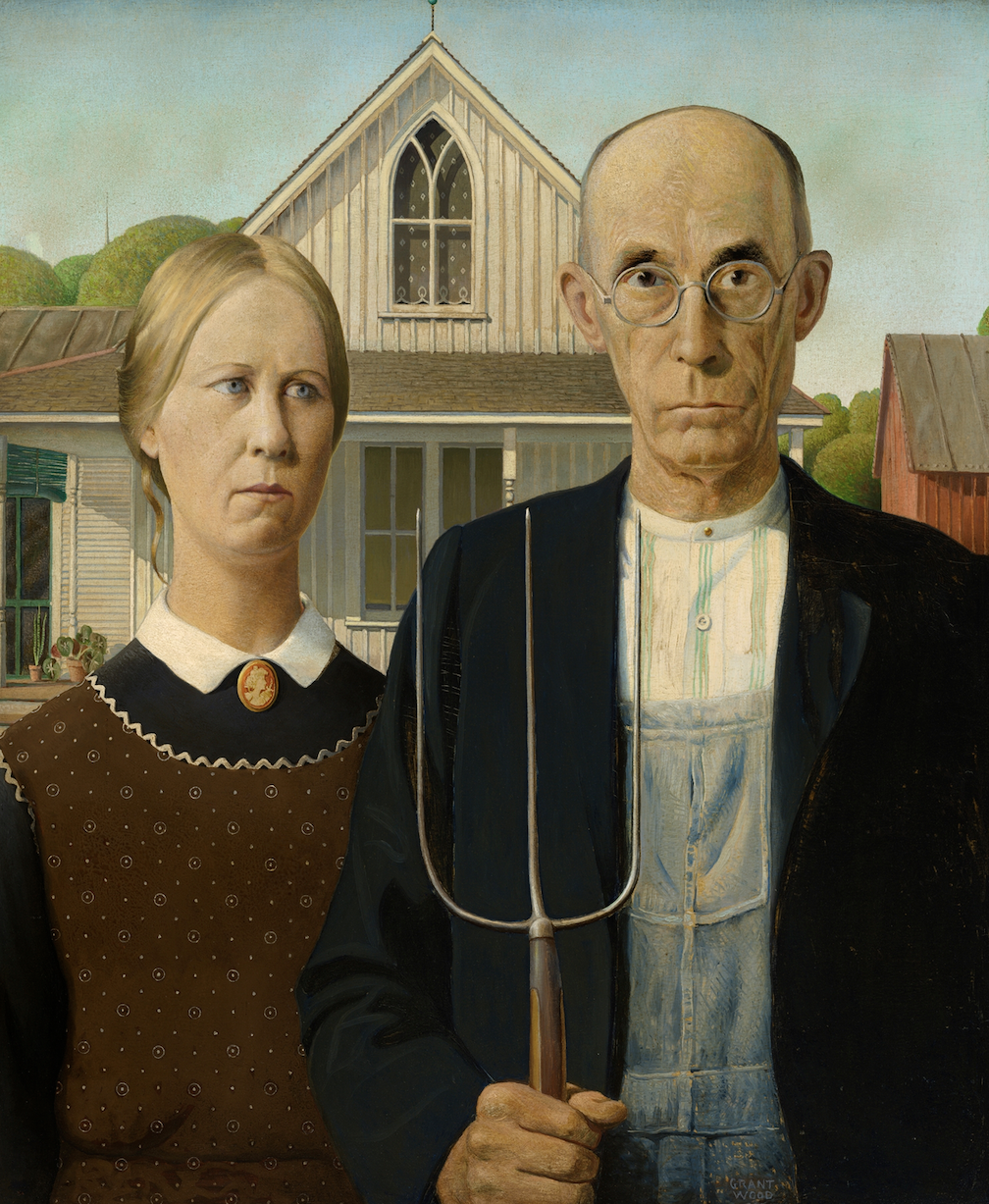
A portrait of the Wood’s mother, “Woman With Plants” (1929), is regarded as Wood’s stylistic breakthrough, but it was “American Gothic” in 1930 that put him on the art world map and has kept him there. Alternately interpreted as a hymn to Middle American values or a spoof of them, it caused a sensation when it first appeared at the Art Institute of Chicago and has since been endlessly reproduced and parodied in all kinds of media.
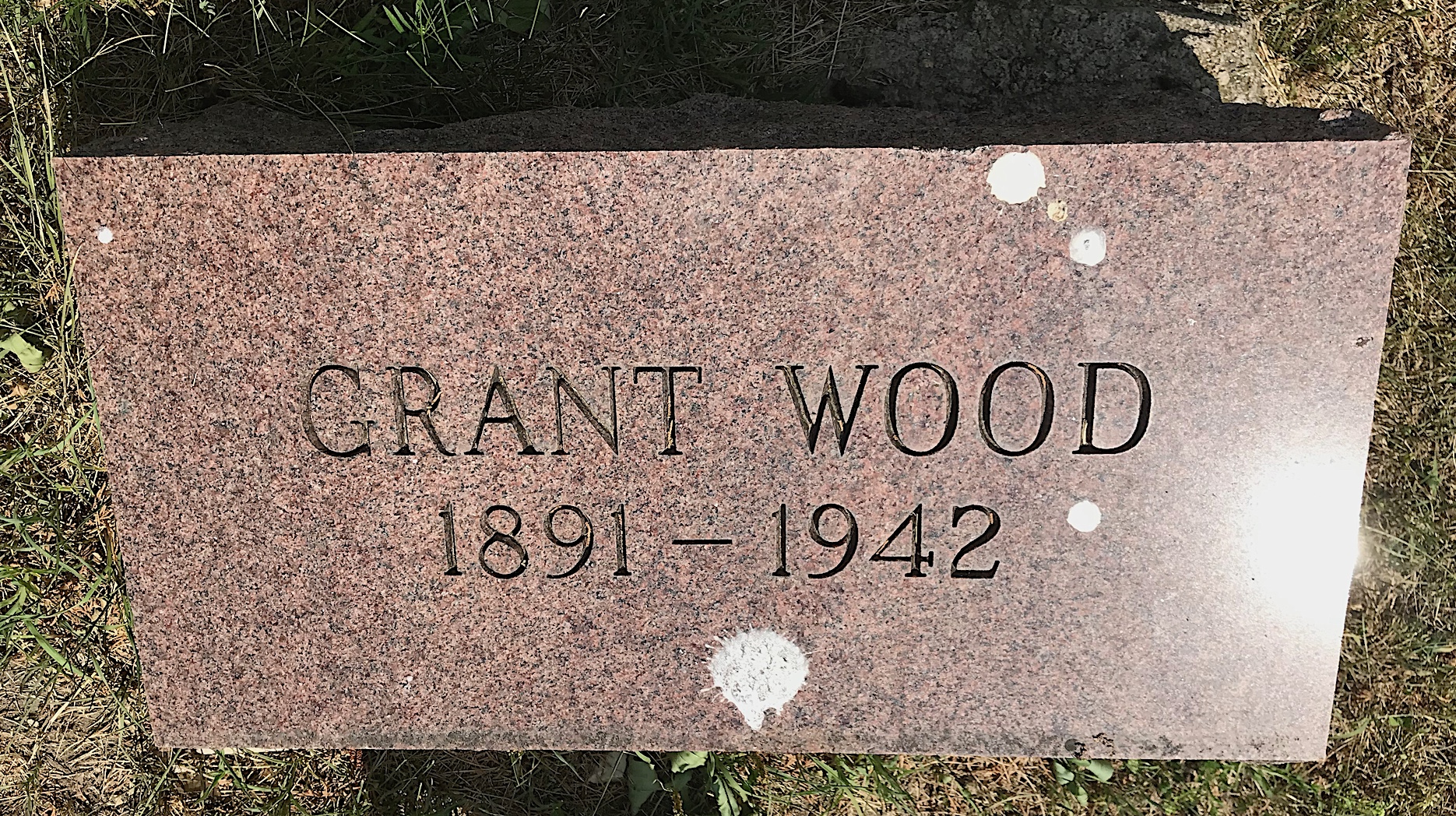
Wood died of pancreatic cancer one day before his 51st birthday on Feb. 12, 1942. A lounging lion dominated the family stone in the middle of the plot.
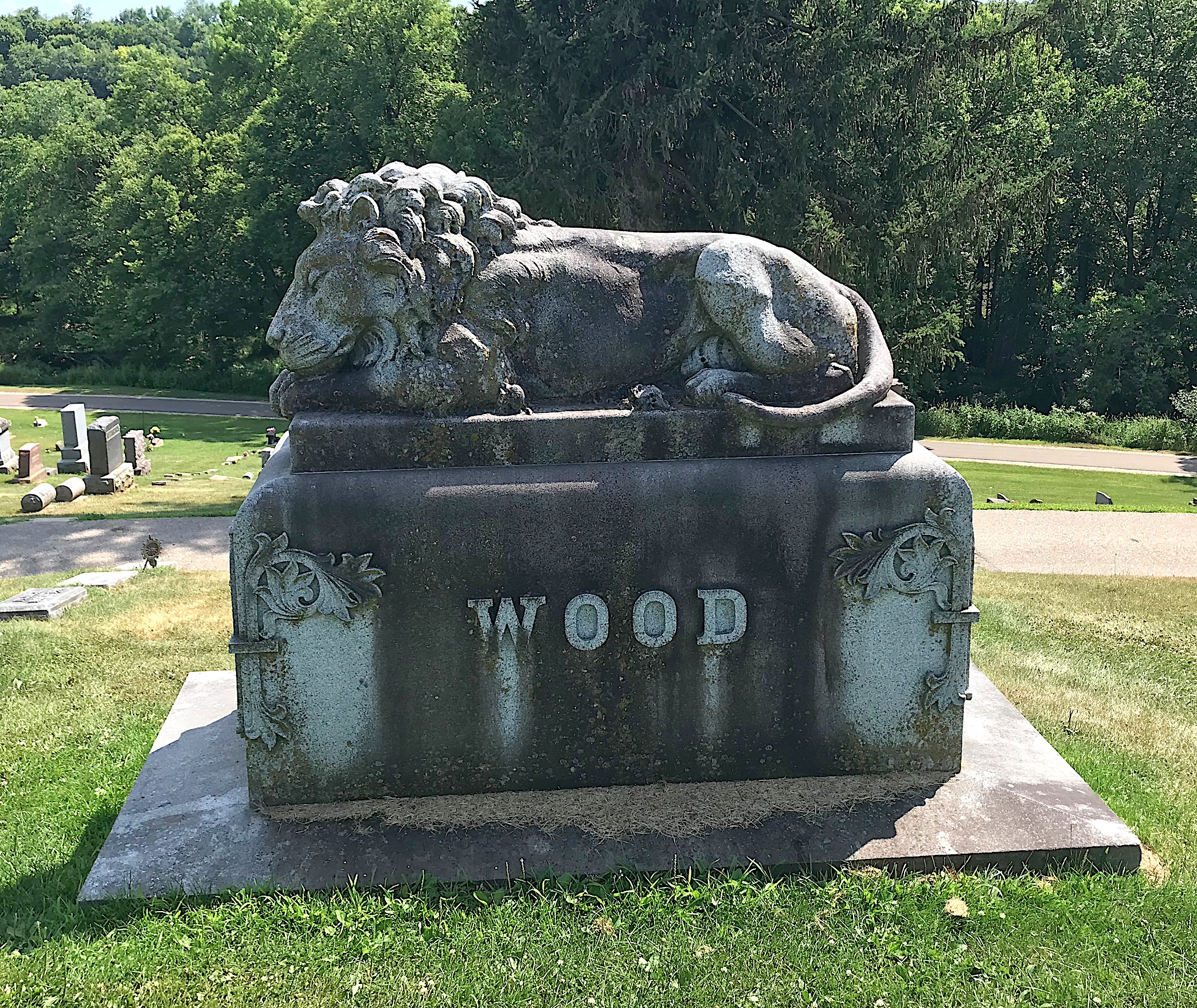
Grant is buried with his parents, his brother, John (who died in 1935), and his sister, Nan (who was the farmer’s daughter in “American Gothic”). Nan died in 1990 and spent the last decades of her life promoting her famous brother’s work. I did not get a picture of her marker, unfortunately.
White Bronze Beauty
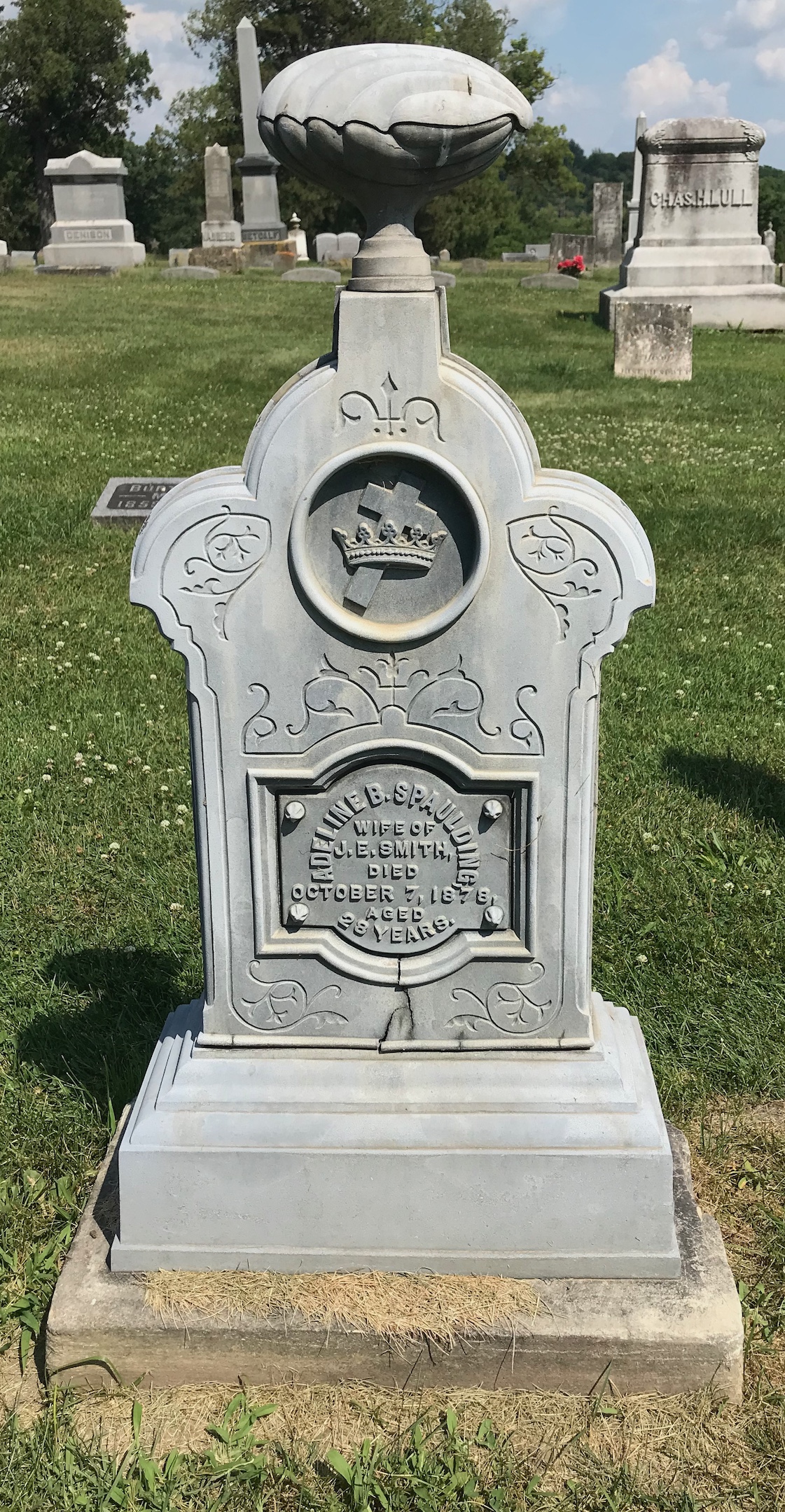
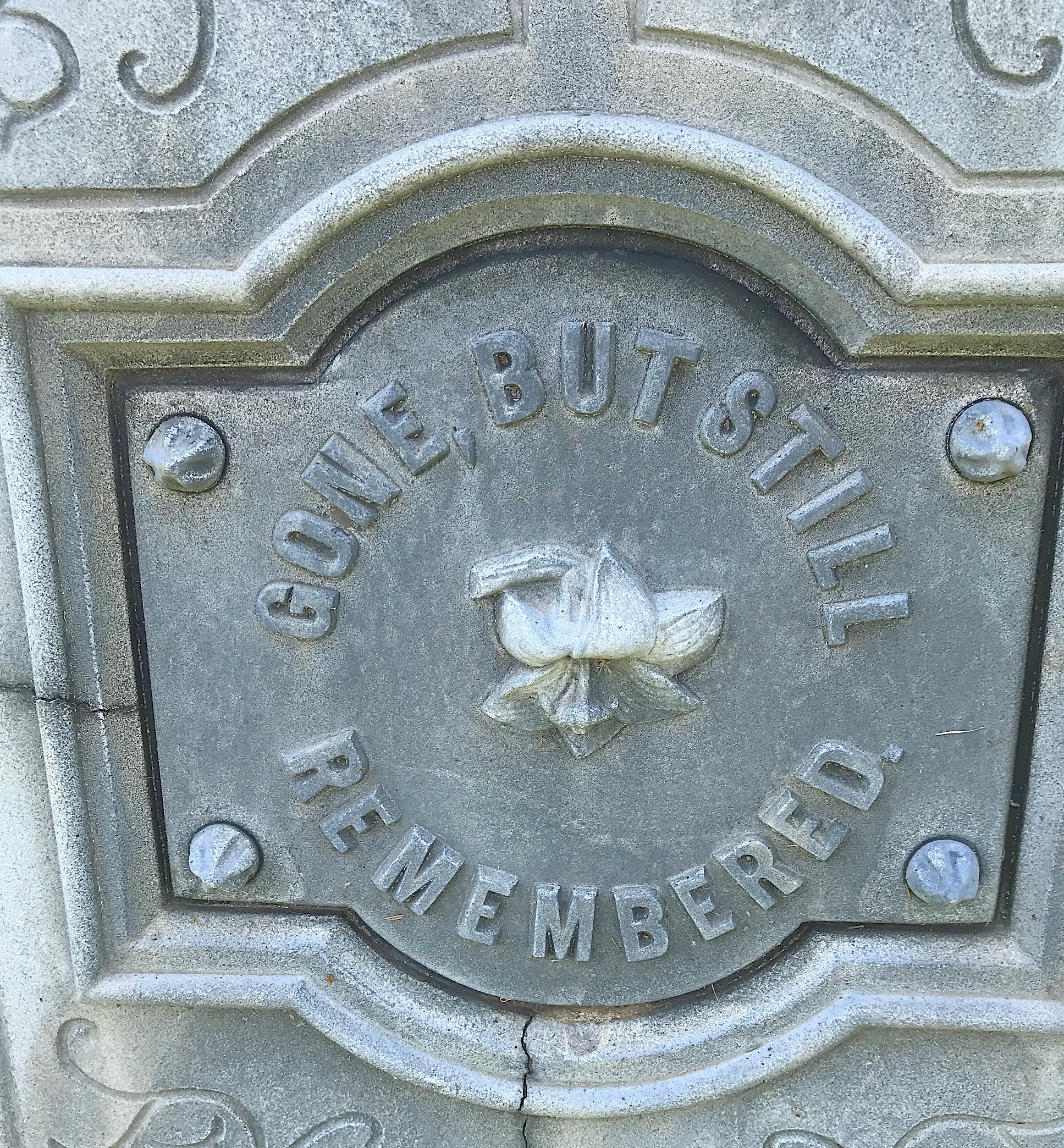
It was a delight to find a few white bronze markers scattered about Riverside Cemetery. This one for Adeline Spaulding Smith caught my eye due to the fact it was in such good condition. The clam shell on top is still intact as well. I’d never seen one up close before.
Born in Maquoketa, Iowa in 1850 to master carpenter Alonzo Spaulding and Mary Sheerer Spaulding, Adeline Brown Spaulding was one of four children the couple had. On Nov. 4, 1873, she married Scottish immigrant James E. Smith in Cedar Falls, Iowa. Before that time, her death notice told me, she had been a school teacher in the Cedar Falls, Iowa public schools.
Adeline died on Oct. 7, 1878 after a short illness at age 28. Her body was returned to Anamosa so she could be buried with grandmother in Riverside Cemetery. Adeline’s husband, James, moved to Vermont to be near his mother and died there in 1933. I don’t know what became of the little child they adopted before Adeline died.
The next two white bronze markers, I later learned, are cenotaphs. That means the people they represent are not actually buried there.
On the left is the cenotaph for Martha “Patty” Eyre Booth. According to her Find a Grave memorial:
She is listed on the cemetery records as “Mrs. Martha Booth,” but she was the widow of Peter Booth, and had married a second time, to Levi Rumrill. But Rumrill also predeceased her by a number of years. Where Martha actually is buried is not known. After Rumrill’s death, she came to Anamosa, Iowa, in June 1840, where several of her children were, and she reverted to the “Booth” name. It is believed that she was buried in Wilcox Cemetery near Fairview, Iowa — where her son Edmund’s first daughter — who died at age 17 months — was buried. But the location of the graves was lost. Thus the cenotaphs in the Anamosa cemetery with the rest of the family.
Mrs. Booth died on June 28, 1854, many years before white bronze markers were being made. So it was placed much later.
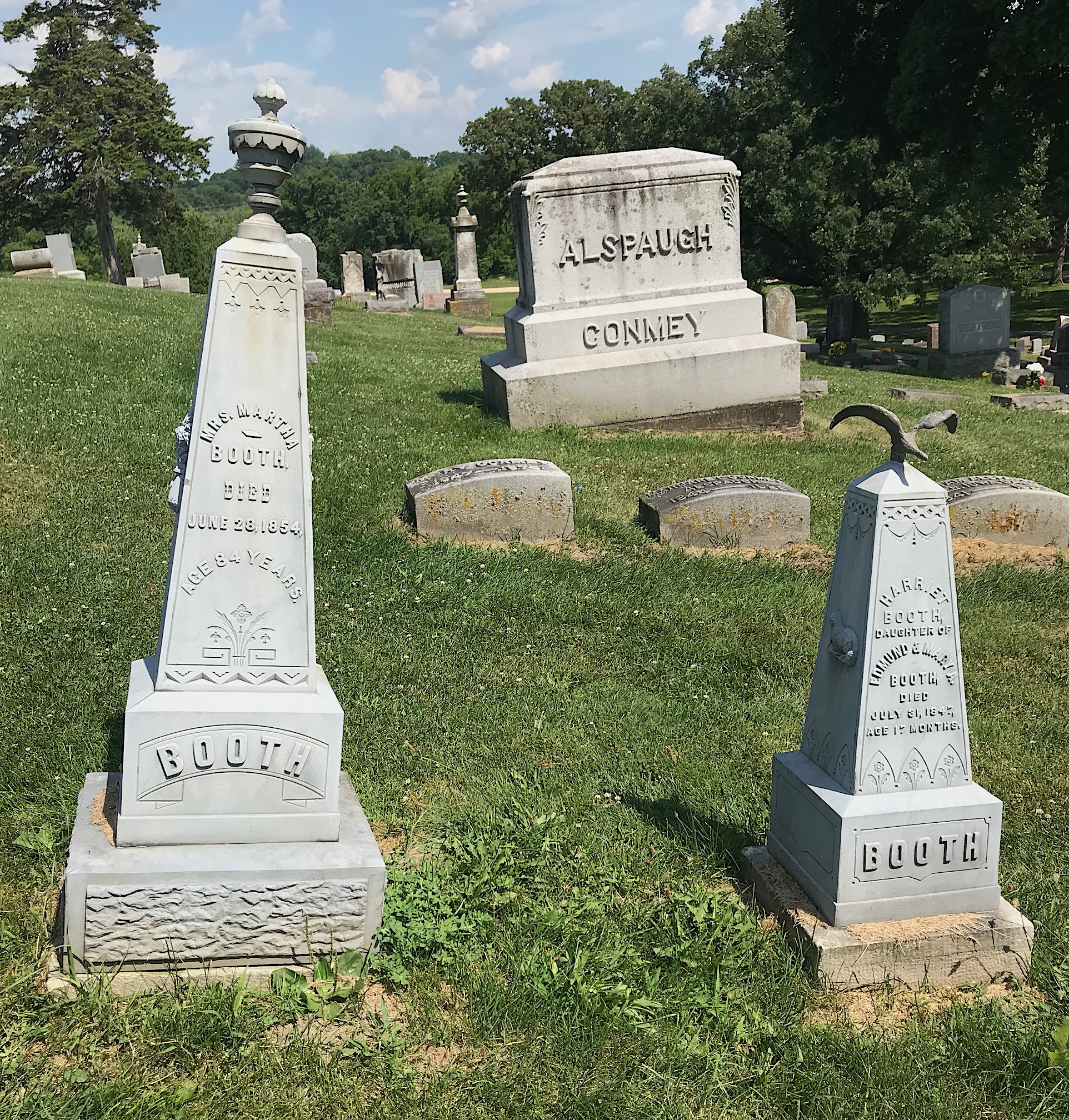
On the right is a smaller marker for Harriet Booth, the daughter of Edmund and Mary Ann Booth. Born on Feb. 22, 1846, Harried died on July 31, 1847 at the age of 14 months.
Her father, Edmund (1810-1905), was a bit of a legend as a deaf pioneer and abolitionist. His Find a Grave memorial notes:
Born in 1810, Edmund Booth epitomized virtually everything that characterized an American legend of the 19th century. He taught school in Hartford, Conn., then went west to Anamosa, Iowa, where he built the area’s first frame house. He left in 1849 to travel the Overland Trail on his way to join the California Gold Rush. After he returned to Iowa in 1854, he became the owner and editor of the Anamosa EUREKA, the local newspaper. Edmund Booth fit perfectly the mold of the ingenious pioneer of 19th-century America, except for one unusual difference – he was deaf.
Edmund is buried at Riverside Cemetery with his wife (and Harriet’s mother), Mary Ann Walworth Booth. Also deaf, Mary Ann was one of Edmund’s former pupils in Connecticut. I did not get a photo of either of there graves.
Time to Go
We had one more stop to make before checking in at our Iowa City hotel that night. We had a Presidential grave to visit!
 Adventures in Cemetery Hopping