• About Me
  • Cemeteries I Have Visited
  • Have questions?
  • Photos

Adventures in Cemetery Hopping

~ A blog by Traci Rylands

Adventures in Cemetery Hopping

Monthly Archives: May 2024

Westminster Abbey 2023: The Life (and Death) of Mary, Queen of Scots, Part III

25 Saturday May 2024

Posted by adventuresincemeteryhopping in General

≈ Leave a comment

Many thanks to the amazing Grace Barrett of Tours by Grace for leading us through Westminster Abbey!

This week, I’m going to tackle the story (and tomb) of Mary, Queen of Scots. That’s rather a tall order because her history is tragic and her monument/grave is even grander than that of her cousin, Queen Elizabeth I (whom I talked about a few weeks ago).
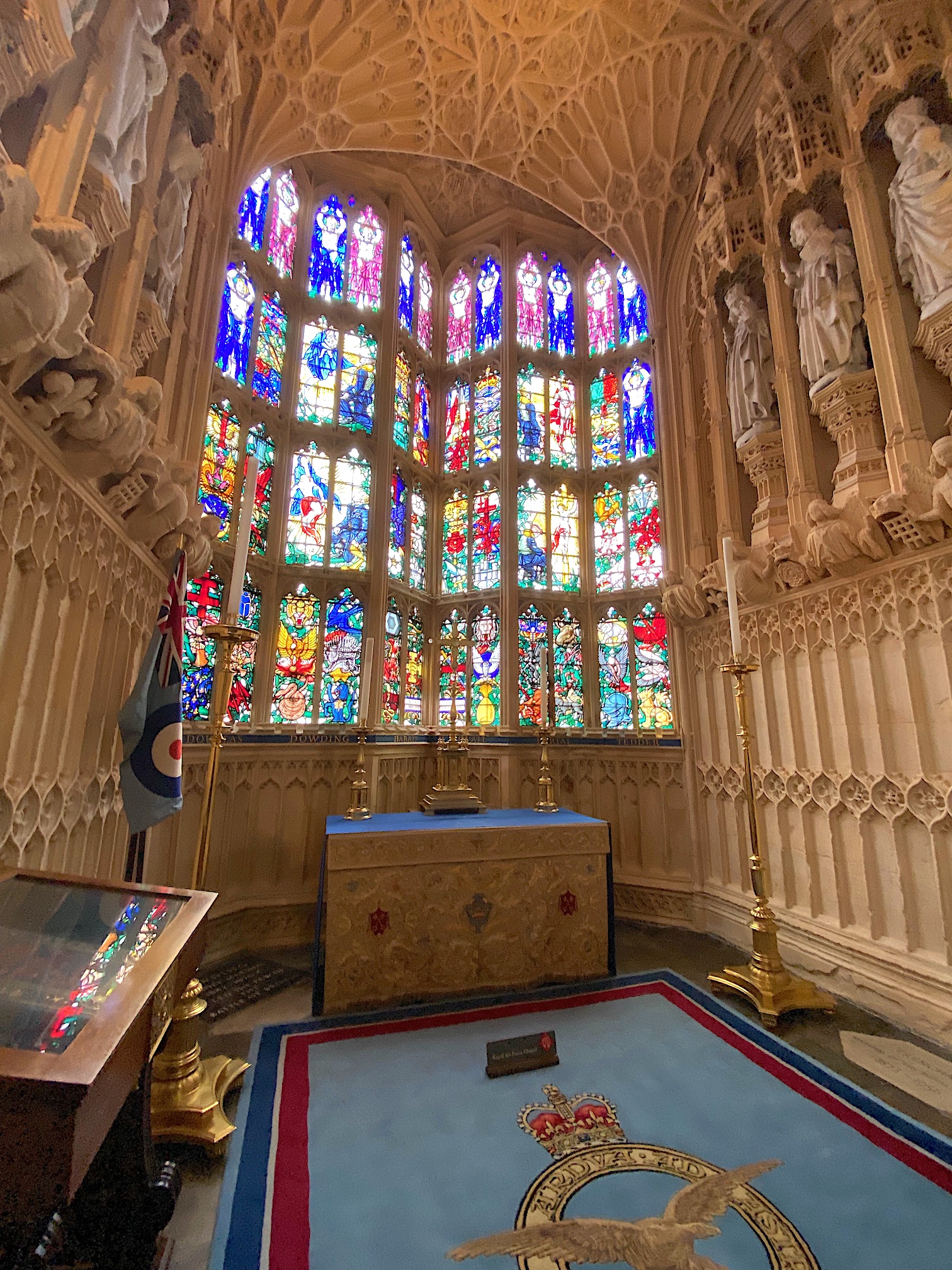
At the eastern end of the Lady Chapel built is a chapel dedicated to the men of the Royal Air Force who died in the Battle of Britain between July and October 1940. This chapel received damage from bombs which fell in that year and a hole made in the stonework has been preserved and covered with glass. The Tudor glass in the window had also been blown out at the same time.

First, let’s talk about Mary and how she fits into the complex history of the British/Scottish monarchy.

Royal Heir

Mary, Queen of Scots, was born on Dec. 8, 1542 in Linlithgow Palace in Scotland. She was the daughter of King James V of Scotland and Mary of Guise. Her father died just a week after her birth.

Incidentally, Mary of Guise was first married to Louis D’Orleans, duc de Longueville in 1534, by whom she had two sons. After the duc’s death in 1537, she was sought for marriage by Henry VIII and James V. She allegedly refused Henry VIII’s proposal by saying “I fear my neck is too small.”

Enthroned as Scotland’s ruler at just six days old, Mary spent her early years at the French court, where she was raised alongside future husband Francis II. They wed in 1558 but he died within a year of his accession and Mary left France in 1560 never to return.
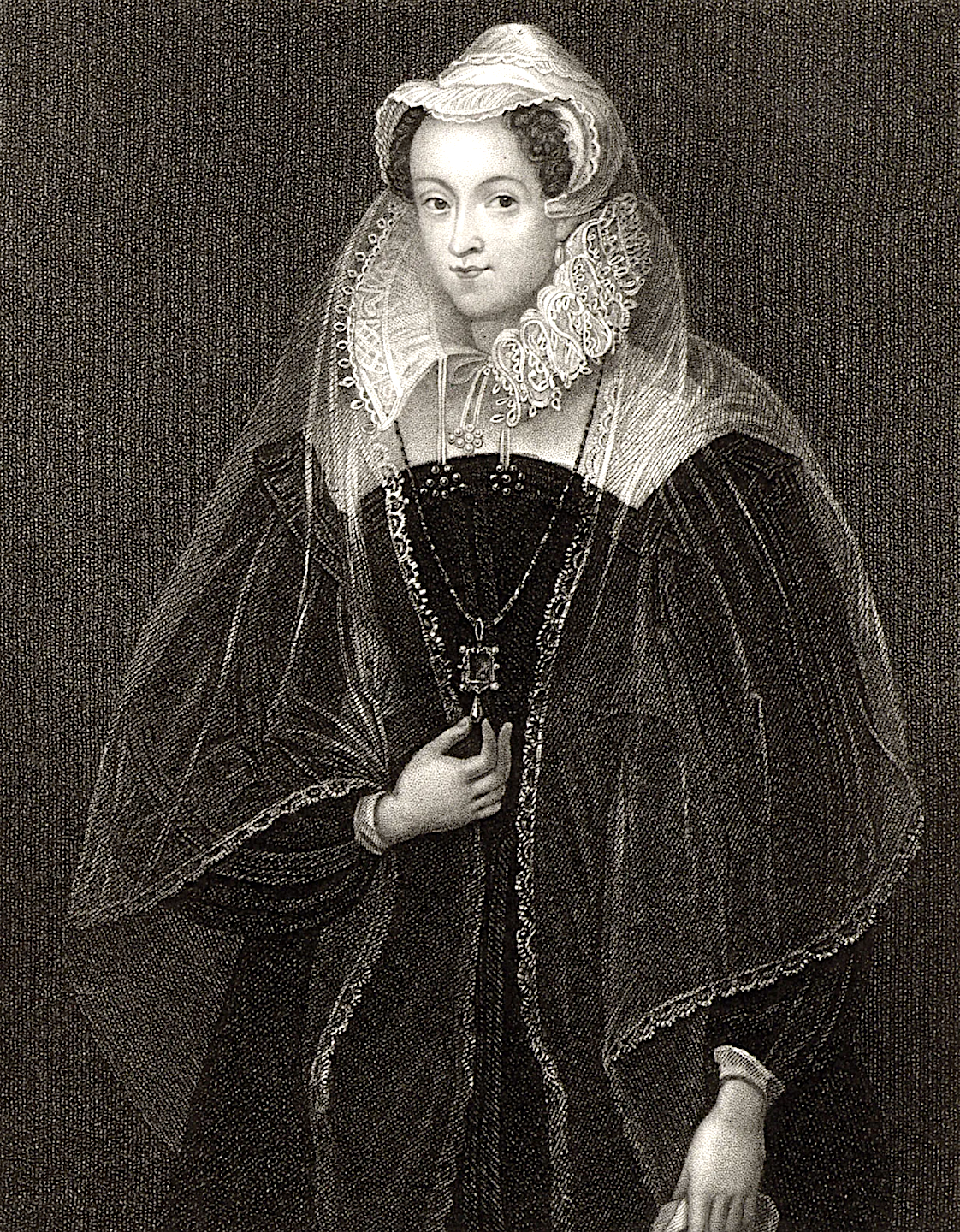
Engraving of Mary, Queen of Scots, from 1849. (Photo Source: Encyclopedia Brittanica.)

In November 1558, Henry VIII’s elder daughter, Mary I, was succeeded by Elizabeth I. Under the Third Succession Act, Elizabeth was recognized as her sister’s heir, and Henry VIII’s last will and testament had excluded the Stuarts from succeeding to the English throne. Yet, in the eyes of many Catholics, Elizabeth was illegitimate and Mary Stuart was the rightful queen of England. Mary’s claim to the English throne was a continual sticking point between her and Elizabeth.
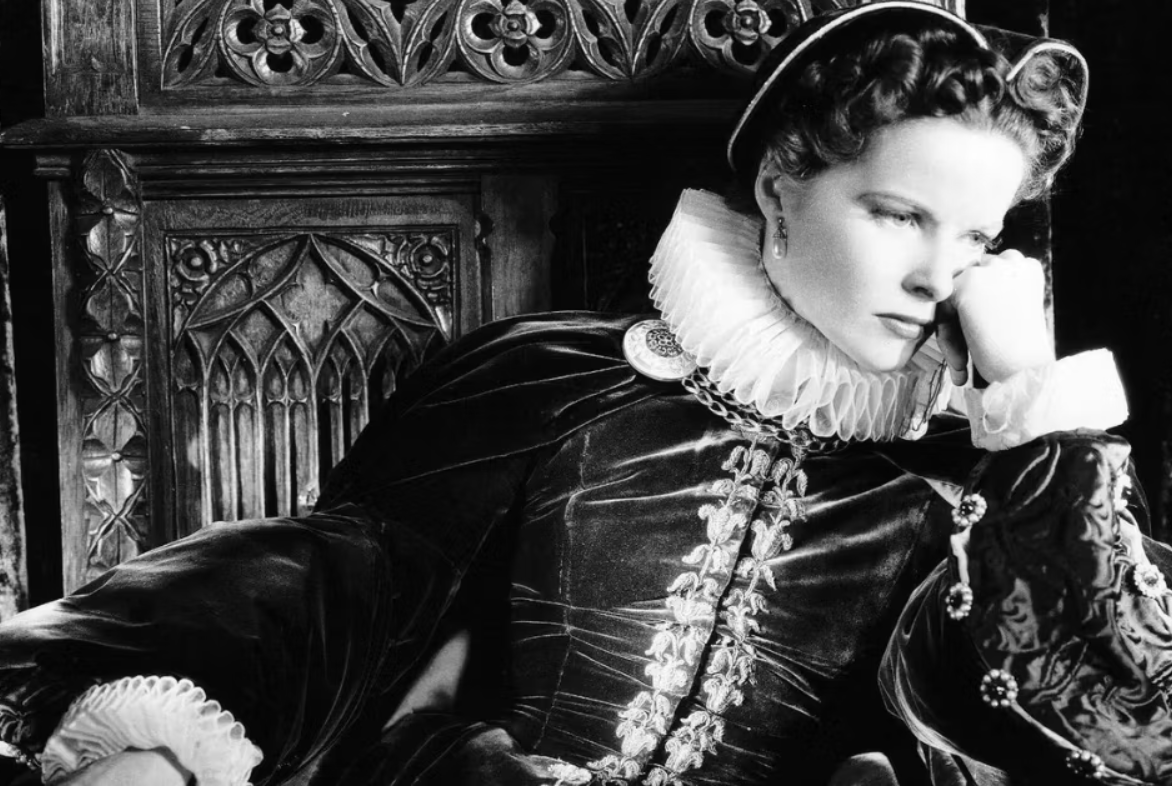
Katharine Hepburn was one of the many to portray Mary, Queen of Scots, in the 1936 film “Mary of Scotland”. The film is not regarded well by critics today, and in its time, it was a box office flop. (Photo Source: RKO Studios)

Second Marriage

Mary wed a second time in 1565 to Henry, Lord Darnley, son of Margaret Stewart, Countess of Lennox. They had one son in 1566 who later became King James VI of Scotland and I of England. The marriage soured but the couple was reportedly working toward reconciliation when on the night of Feb. 9, 1567, an explosion devastated Kirk o’ Field. Darnley was found dead in the garden, apparently smothered. There were no visible marks of strangulation or violence on the body.

Between April 21 and 23, 1567, Mary visited her son at Stirling for the last time (he was only 10 months old). On her way back to Edinburgh on April 24, Mary was abducted, willingly or not, by James Hepburn (Lord Bothwell) and his men, and was taken to Dunbar Castle. On May 6, Mary and Bothwell returned to Edinburgh. On 15 May 15, at either Holyrood Palace or Holyrood Abbey, they were married according to Protestant rites. Bothwell and his first wife, Jean Gordon, had divorced 12 days previously. It was not received well since many believed Bothwell was the one who had worked to have Darnley killed.
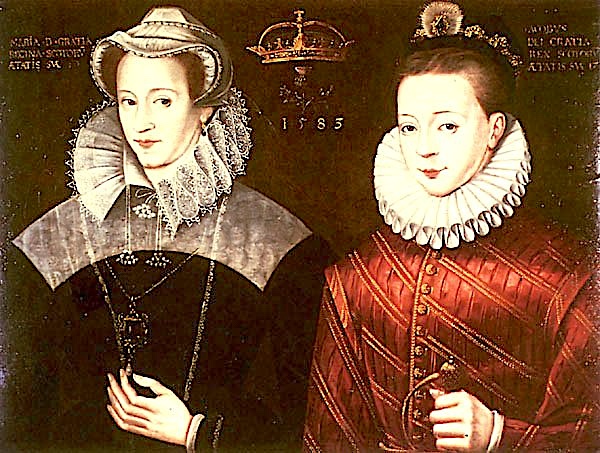
Mary depicted with her son, James VI and I. In reality, Mary saw her son for the last time when he was 10 months old.

Mary and Bothwell were parted forever at Carberry Hill on June 15, 1567, Bothwell to exile and imprisonment where he died in 1578, and Mary to incarceration on the island of Loch Leven, where she was formally deposed in favor of her son James.

Imprisoned and Executed

After a brief stint of liberty the following year, defeat of her supporters at a battle at Langside put her once more to flight. Mary sought refuge in England with her cousin Elizabeth. But Elizabeth, with all the political cunning Mary lacked, used a series of excuses connected with the murder of Darnley to hold Mary in English captivity in a series of prisons for the next 18 years of her life.

It was the discovery in 1586 of a plot to assassinate Elizabeth and bring about a Roman Catholic uprising that convinced Elizabeth that, while she lived, Mary would always constitute too dangerous a threat to her own position.
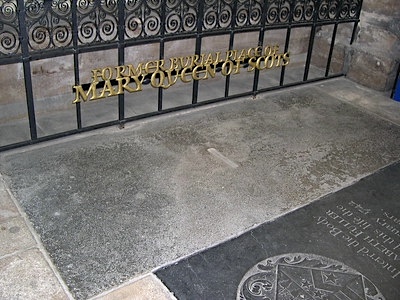
Mary was originally buried five months after her death on Aug. 5, 1587 in Peterborough Cathedral. There was already had one queen buried there, namely Katharine of Aragon, buried in 1536. (Photo Source: Kathleen Foskett, via Flickr)

Mary was tried by an English court and condemned. James, who had not seen his mother since infancy and now had his sights fixed on succeeding to the English throne, raised no objections. Mary, now 44, was executed in 1587 in the great hall at Fotheringhay Castle, near Peterborough.

Repairing Mary’s Reputation

Mary was buried five months after her death on Aug. 5, 1587 in Peterborough Cathedral. There was already had one queen buried there, namely Katharine of Aragon, buried in 1536.
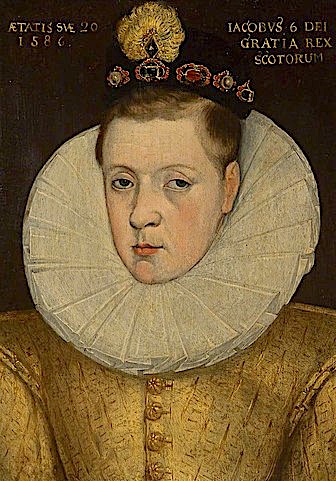
Portrait of Mary’s son, the future James I of England, in 1586. (Photo Source: National Trust for Scotland at Falkland Palace, Fife, Scotland)

When Mary’s son, James VI, became James I of England in 1603, he did not immediately take action to move his mother. However, he did encourage rehabilitating his mother’s reputation via portraiture. A well-recognized portrait of Mary, Queen of Scots, was painted between 1610 and 1615. The portrait (see below) is held by the National Galleries of Scotland, and depicts Mary wearing a black gown and white veil; perhaps an allusion to what she wore on the day of her death.
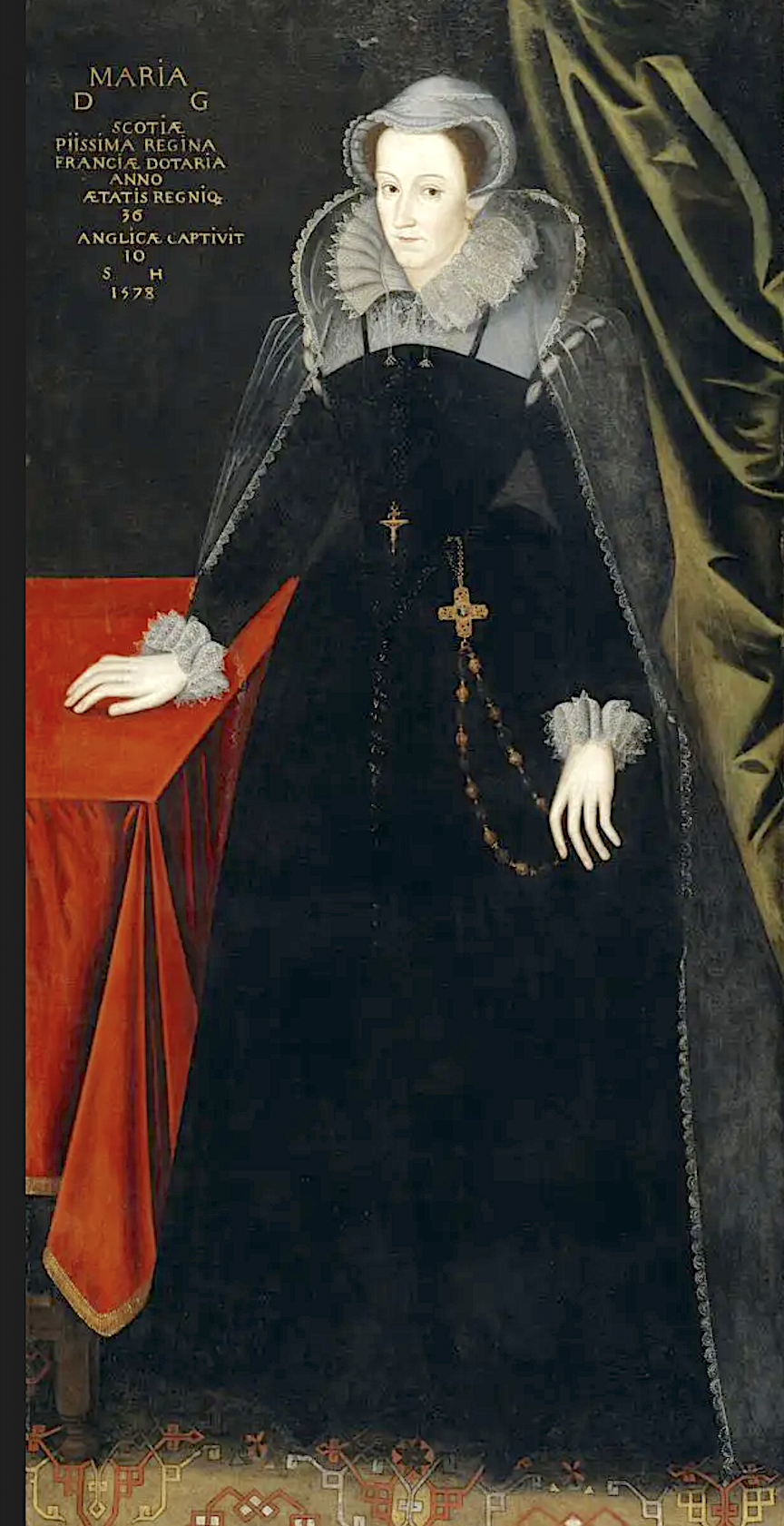
Mary, Queen of Scots, was no petite flower. She was nearly six feet tall.

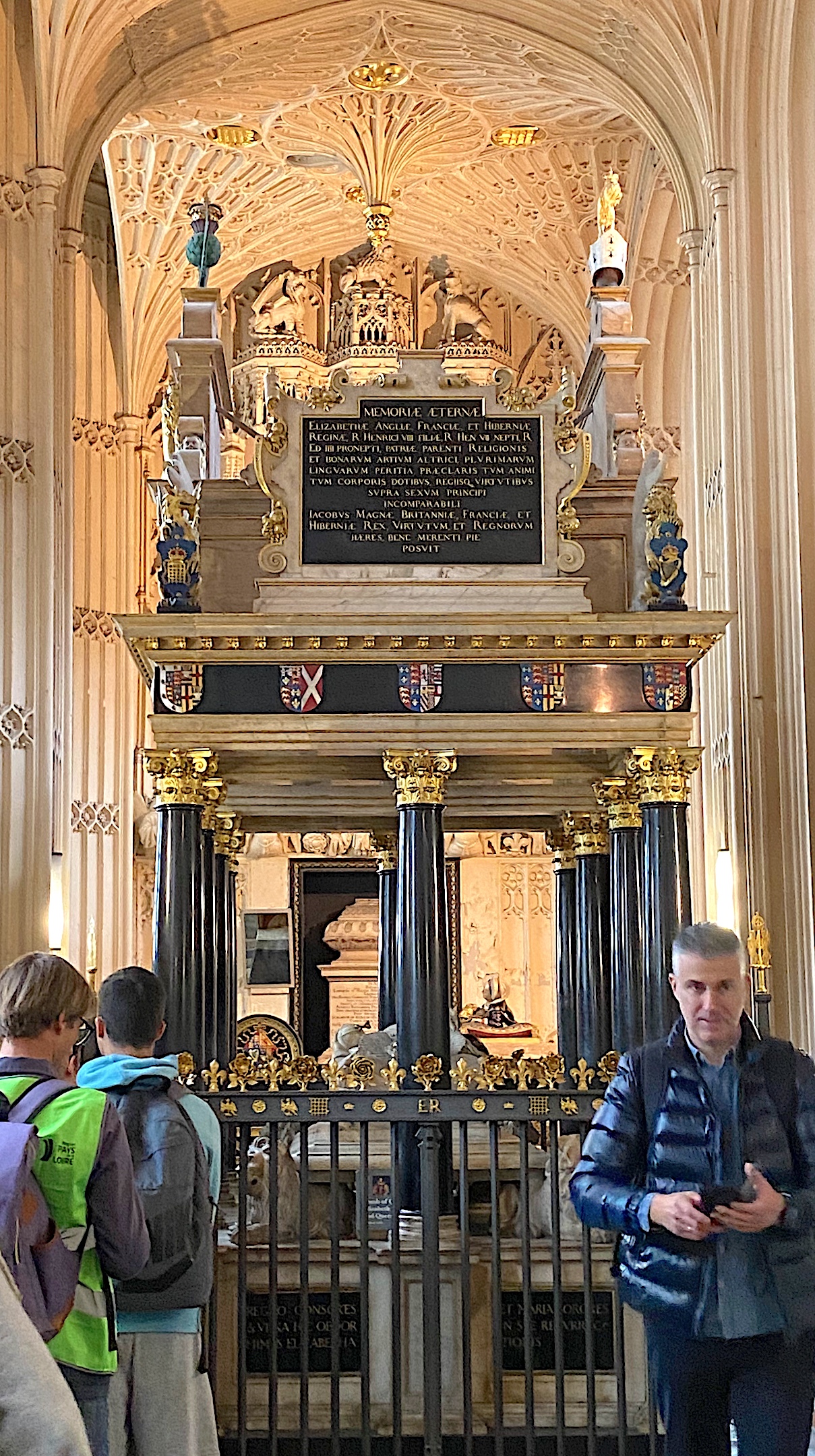
By 1612, James had a marble tomb created for his mother in the south aisle of the Lady Chapel of Westminster Abbey. Her body was exhumed and moved from Peterborough to Westminster Abbey in October 1612. It is quite something to behold. The Scottish thistle is embedded in the arch over Mary’s effigy, I noticed.
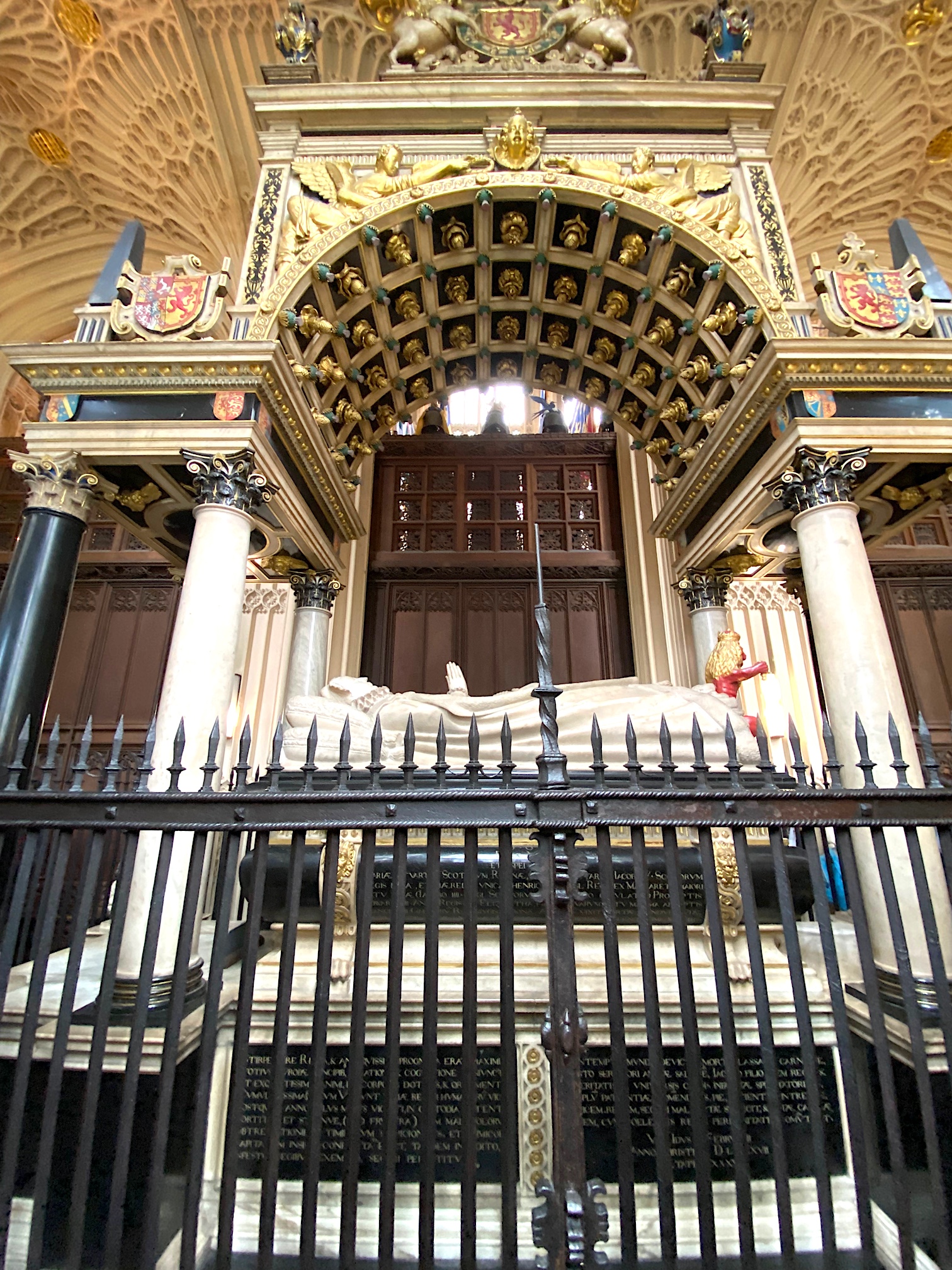
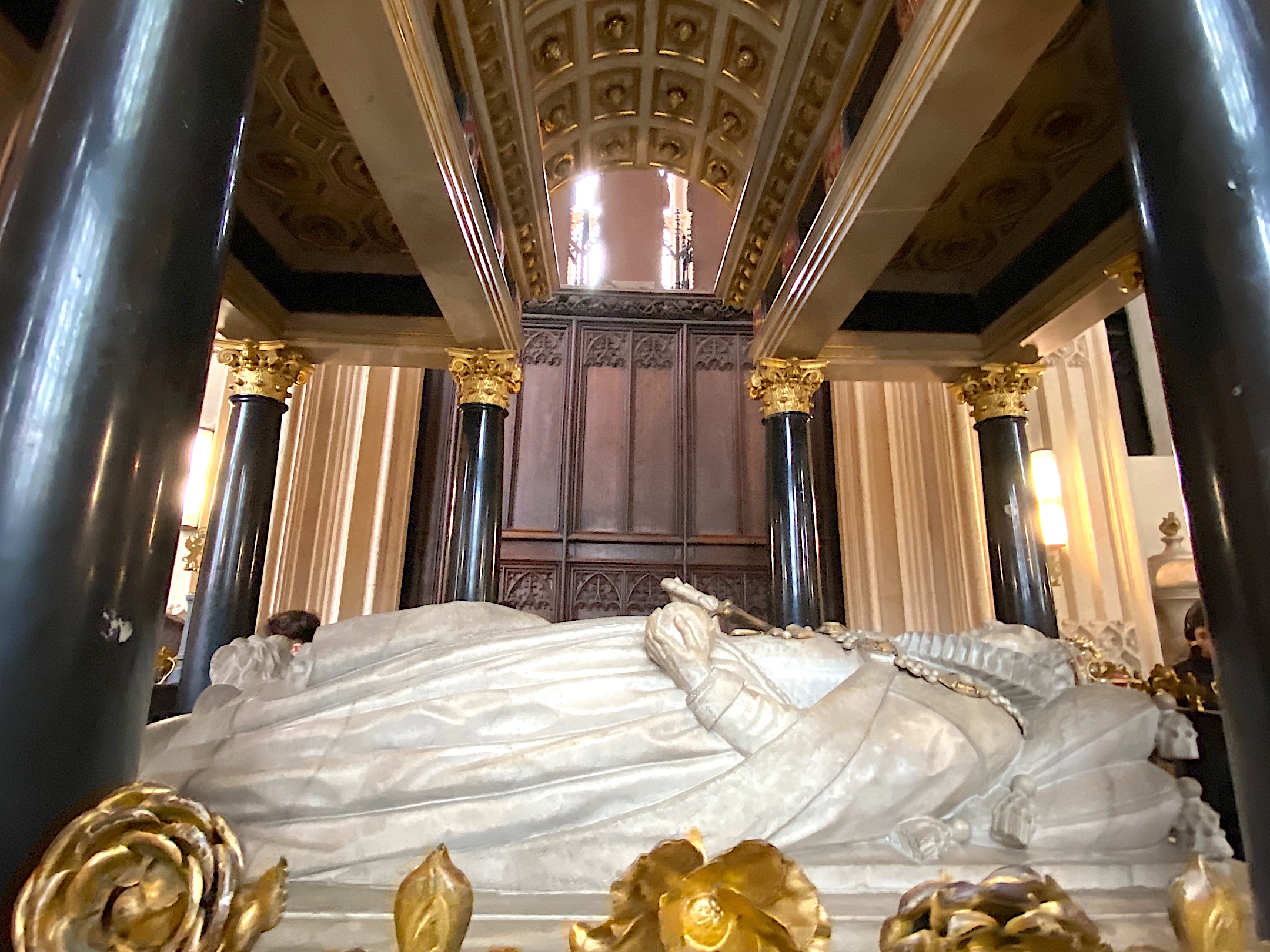
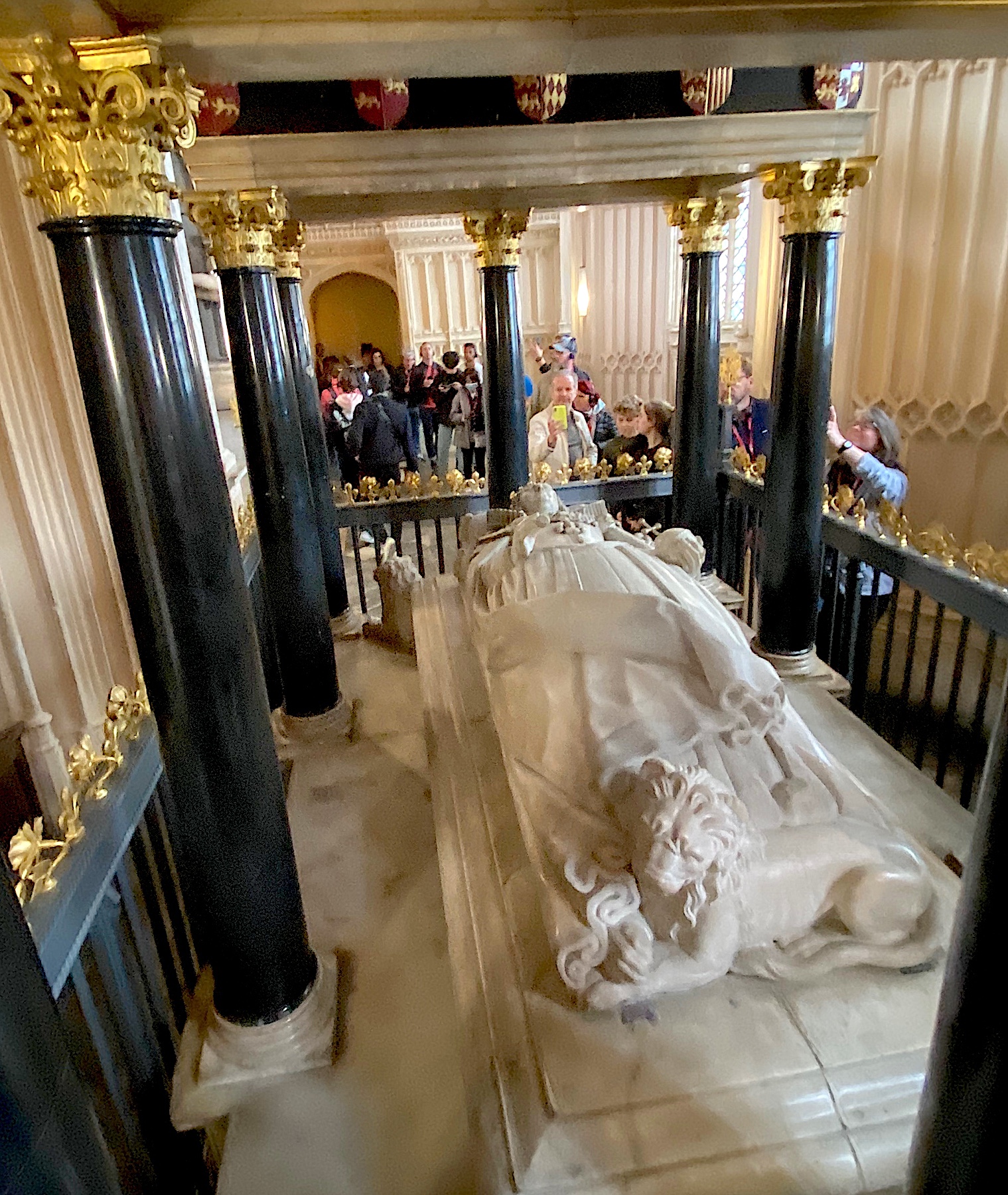
James erected a magnificent marble tomb for his mother on which there is a fine white marble effigy under an elaborate canopy. She wears a close-fitting coif, a laced ruff, and a long mantle fastened by a brooch. The sculptors were father and son, Cornelius and William Cure. Cornelius died before it was finished to William completed it. A red crowned Scottish lion stands at her feet.
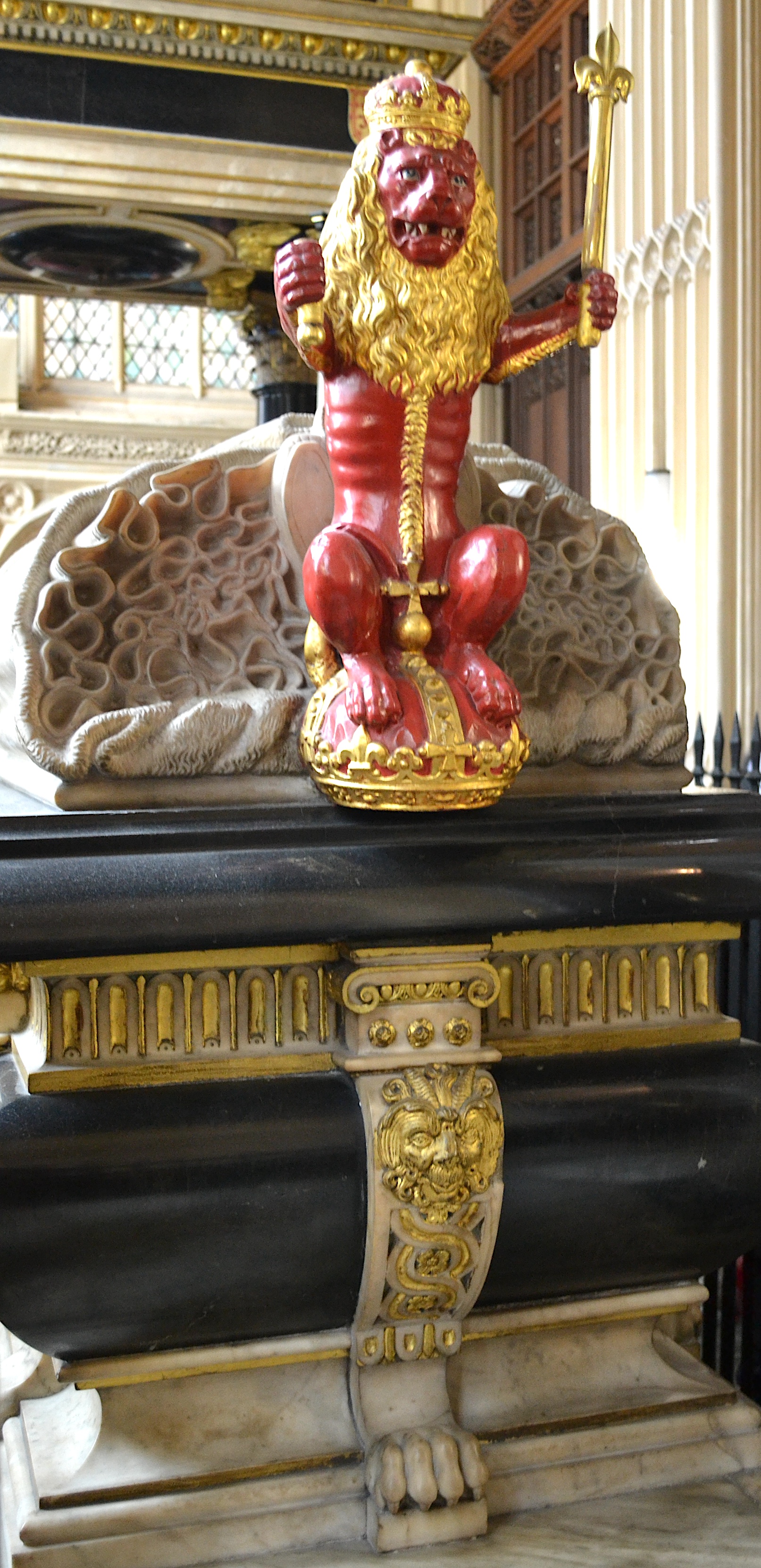
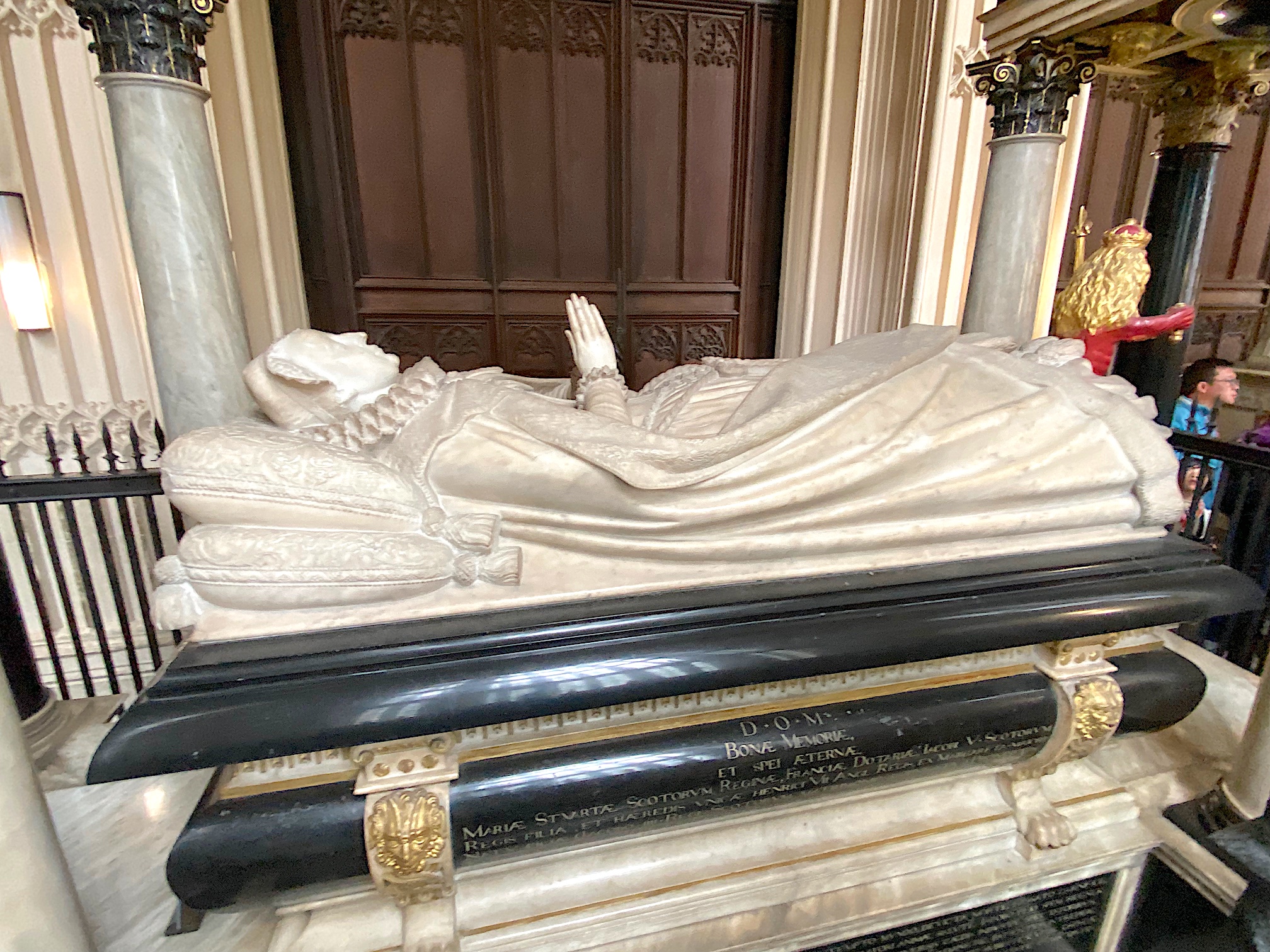
A red Scottish lion stands at the foot of Mary, Queen of Scots’ grave.
The nearby shared tomb of Mary I and Elizabeth I almost pales in comparison to the sheer magnificence and care put into Mary’s tomb.

According to Westminster Abbey’s website, the Cures received 825 pounds for their work.

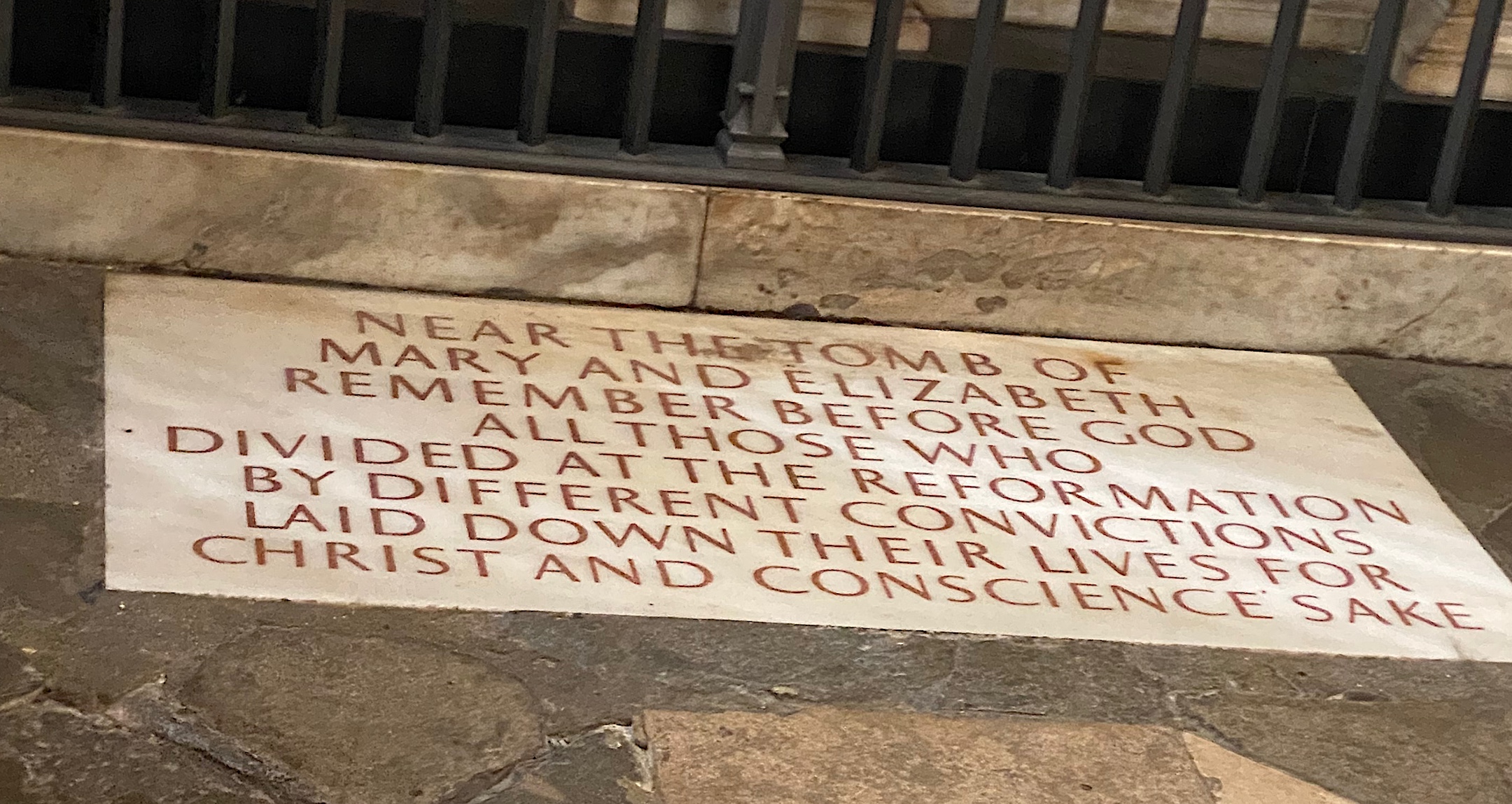
On the side of the tomb is a long inscription in Latin. Certain excerpts from the inscription show what some think is an attempt to rehabilitate Mary’s legacy:

Mistress of Scotland by law, of France by marriage, of England by expectation, thus blest, by a three-fold right, with a three-fold crown; happy, ah, only too happy, had she routed the tumult of war, and, even at a late hour, won over the neighbouring forces… here lies buried the daughter, bride and mother of kings. God grant that her sons, and all who are descended from her, may hereafter behold the cloudless days of eternity….
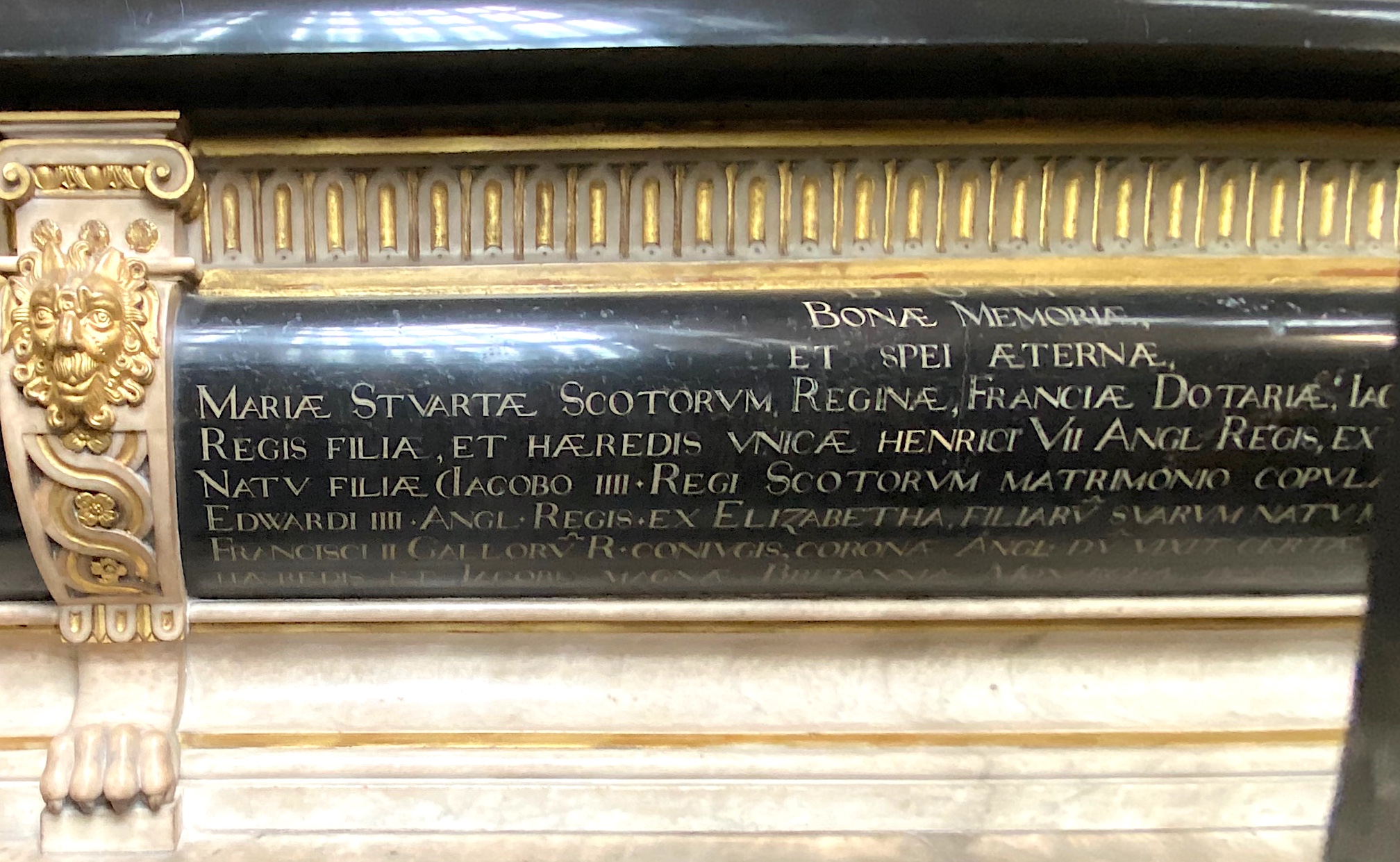
A small portion of the inscription on Mary, Queen of Scots’ tomb at Westminster Abbey.

Perhaps by making such a statement with his mother’s tomb, James was taking further steps to redeem Mary’s public image. I do find it a bit strange that for a son who had put up no form of resistance to his mother’s execution back in 1587, he was doing quite a bit to make a show of creating such an elaborate tomb. But in looking at how things played out, I’m sure he was trying to pave the way with Elizabeth to becoming her successor when the time came.

Mary’s Mother-In-Law

I don’t know if it was by design or accident that Mary, Queen of Scots’s tomb is beside that of the mother of her second husband, Lord Darnley. Margaret Douglas’ mother was Margaret Tudor (1489-1541), daughter of Henry VII and widow of James IV of Scotland, who had married Archibald Douglas, the sixth Earl of Angus in 1514 (they divorced in 1527).

Born in 1515, the young Margaret lived for a time with her aunt Princess Mary and then became a lady-in-waiting to Anne Boleyn and led an eventful life, being imprisoned in the Tower of London on several occasions.
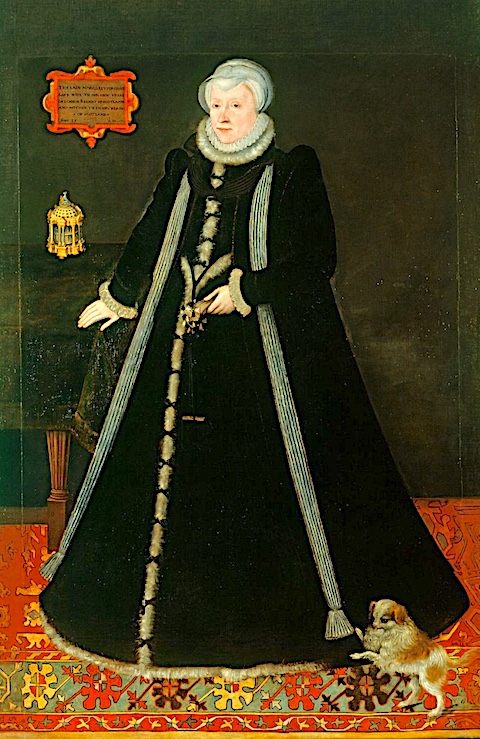
Margaret, the Countess of Lennox, had a colorful life as a lady-in-waiting to Anne Boleyn.

On July 6, 1544, she married Matthew Stewart, 13th Earl of Lennox, a descendant of James I of Scotland. Matthew died after being shot in the back in a skirmish at Stirling Castle in 1571. None of her eight children survived her and she died, in poverty, on March 19, 1578 (New Style dating).

Margaret was buried, at the expense of Elizabeth I, in the south aisle of Henry VII’s chapel in Westminster Abbey, in the same grave as her son, Charles.
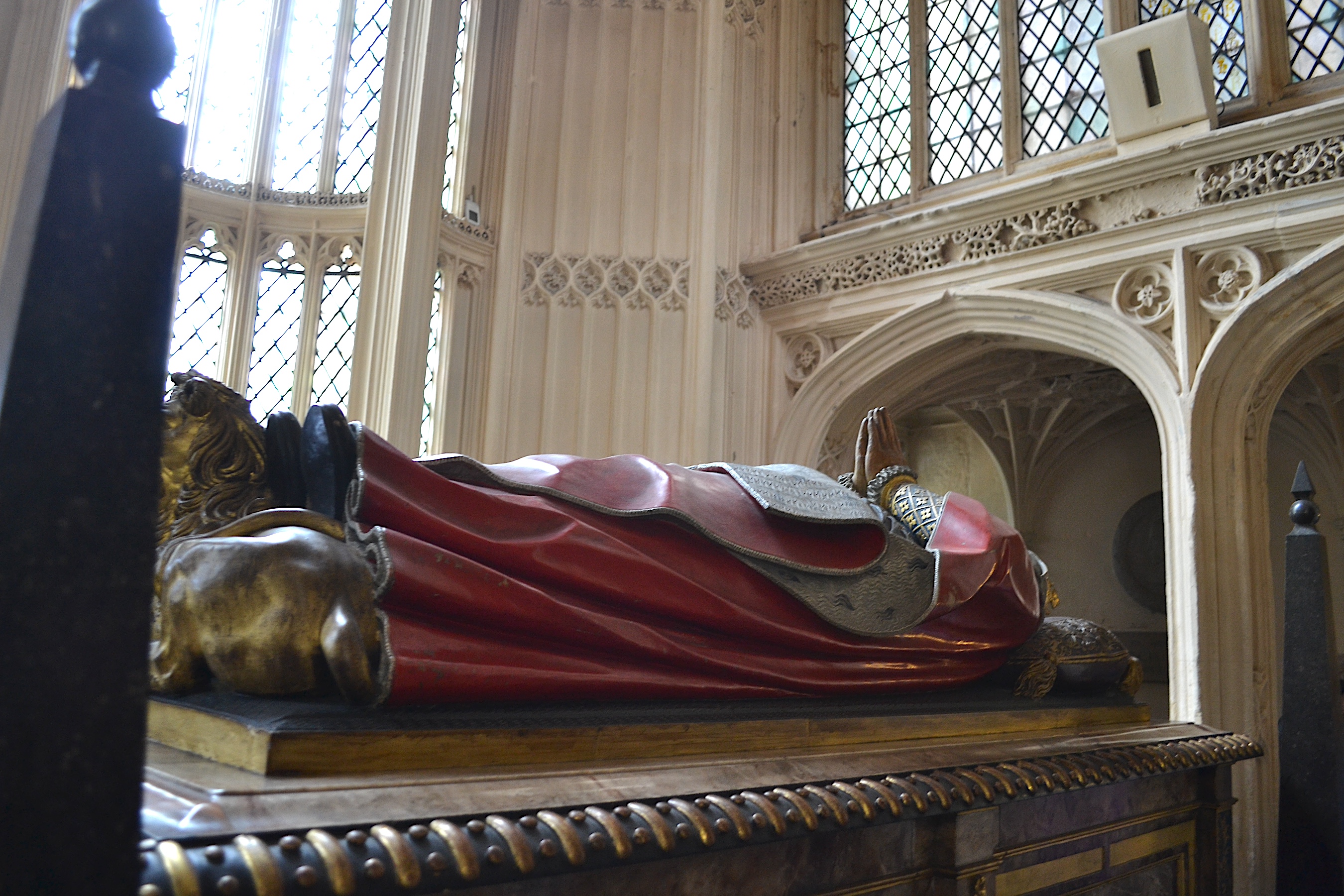
This is the best picture we got of the effigy of Margaret, Countess of Lennox (1515-1578).

The monument was completed in 1578 by her executor Thomas Fowler. The sculptor is not known. Her effigy, made of alabaster, wears a French cap and ruff with a red fur-lined cloak, over a dress of blue and gold. On either side of the tomb chest are “weepers” (small kneeling statues) of her four sons (Charles and Henry and two who died young) and four daughters (all died young).

I did unwittingly take a photo of the side where the weepers are. Darnley, Mary’s second husband, is the one with the crown over his head. He’s not actually buried there but is in the Abbey of Holyrood in Edinburgh, Scotland.
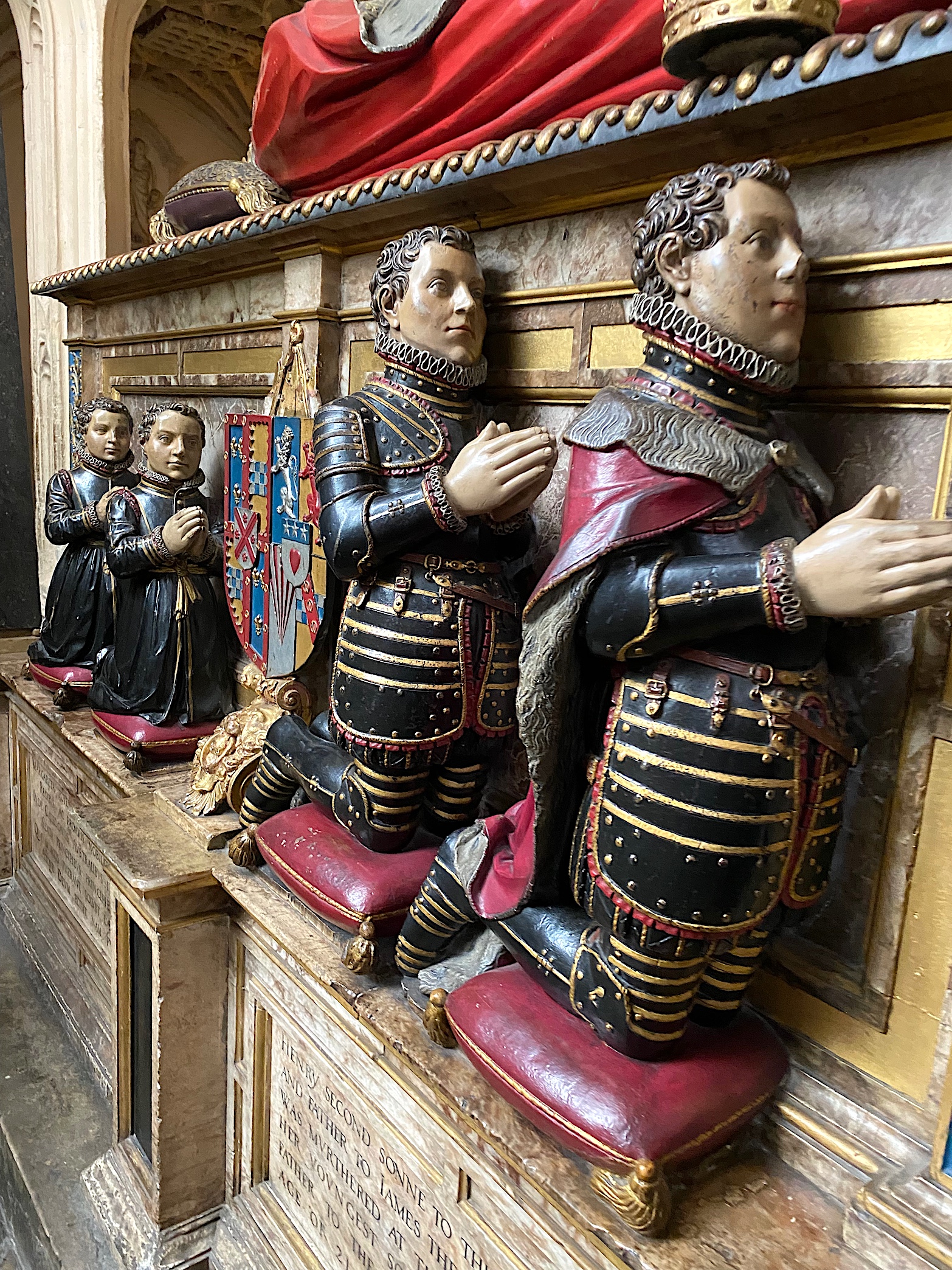
A “weeper” meant to represent Henry Stuart, Lord Darnley, is on the side of his mother Margaret, Countess of Lennox’s tomb beside that of his wife, Mary, Queen of Scots.

James I and Anne of Denmark

James I would eventually wed Anne of Denmark in 1589 and they had seven children together. You’ll recall the tombs of Sophia and Mary that I shared a few weeks ago that are with Queens Elizabeth and Mary. Those are two of those children. Anne died in 1619, and James I died of a stroke at age 58 in 1625.

Considering the grandness of his mother’s tomb, you might think James’s tomb would be equally grand. But that did not happen. Like Queen Mary I, he ended up being interred with someone else.
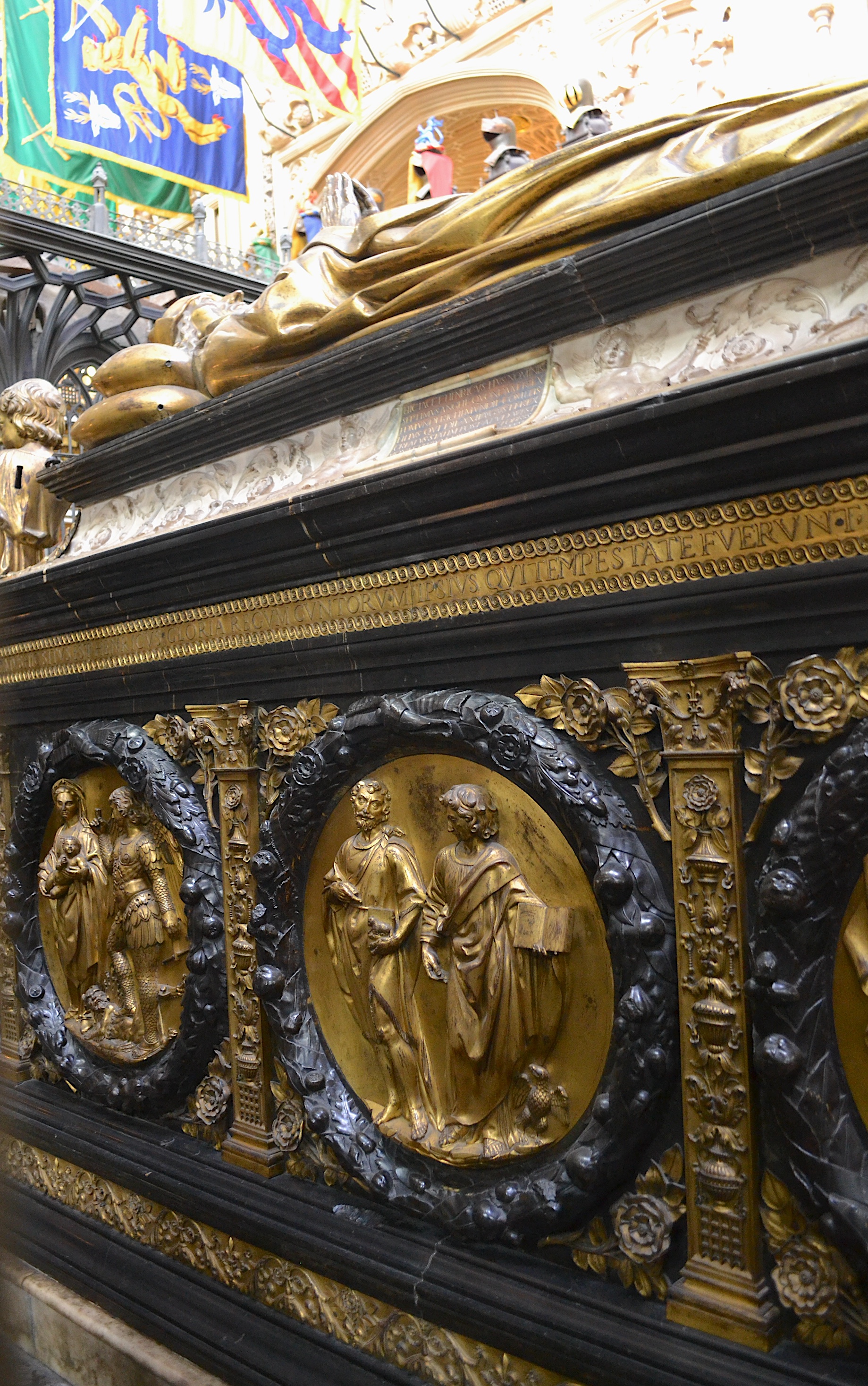
This is the best picture we could get of King Henry VII and Elizabeth of York’s tomb. Chris took it. There were so many people around it, taking photos was not easy.

The place of his interment was rediscovered by Dean Stanley in February 1869 in the vault containing the coffins of Henry VII of England and Elizabeth of York. The body of his wife, Anne of Denmark, had been buried nearby on May 13, 1619. The antiquary John Dart saw a labelled urn containing the embalmed organs of Anne of Denmark in 1718, which he thought had been moved in 1674 during the reburial of the Princes in the Tower.

We didn’t get a very good photo of Henry VII (the king responsible for the Lady Chapel’s construction) and Elizabeth of York’s vault, sadly. There were too many people milling around it to do so. But Chris did the best he could. I did like this one he took of the angel sitting on it.
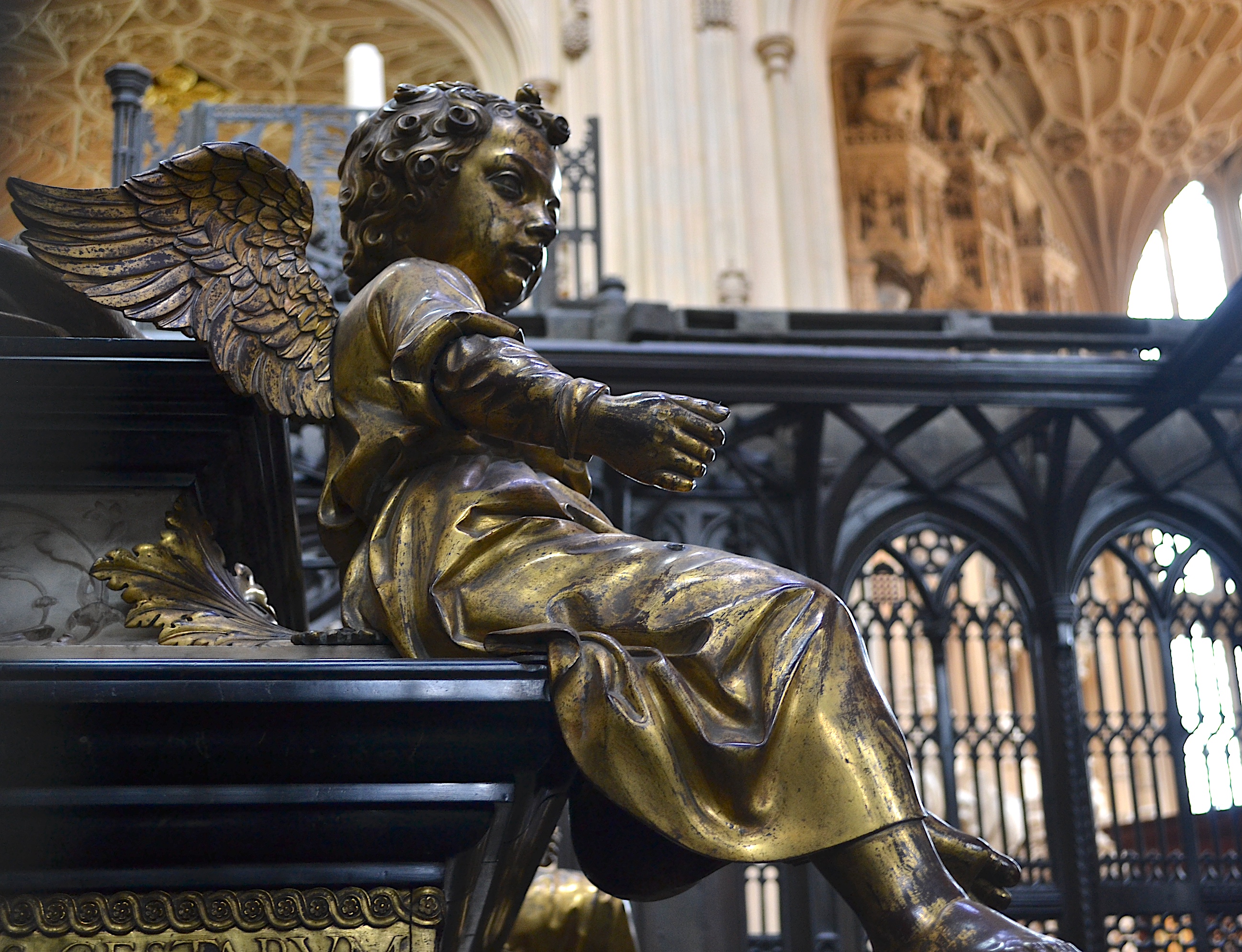
Angel sitting on the edge of the tomb of King Henry VII and Elizabeth of York.

There’s so much more to see at Westminster Abbey. I’ll have more for you in Part IV.
Westminster Abbey 2023: Visiting the Royal Half-Sisters, Queen Mary I and Queen Elizabeth I, Part II

10 Friday May 2024

Posted by adventuresincemeteryhopping in General

≈ 3 Comments

Many thanks to the amazing Grace Barrett of Tours by Grace for leading us through Westminster Abbey!

Now that we’ve gotten the history of Westminster Abbey out of the way, what better time than now to start visiting some royalty?

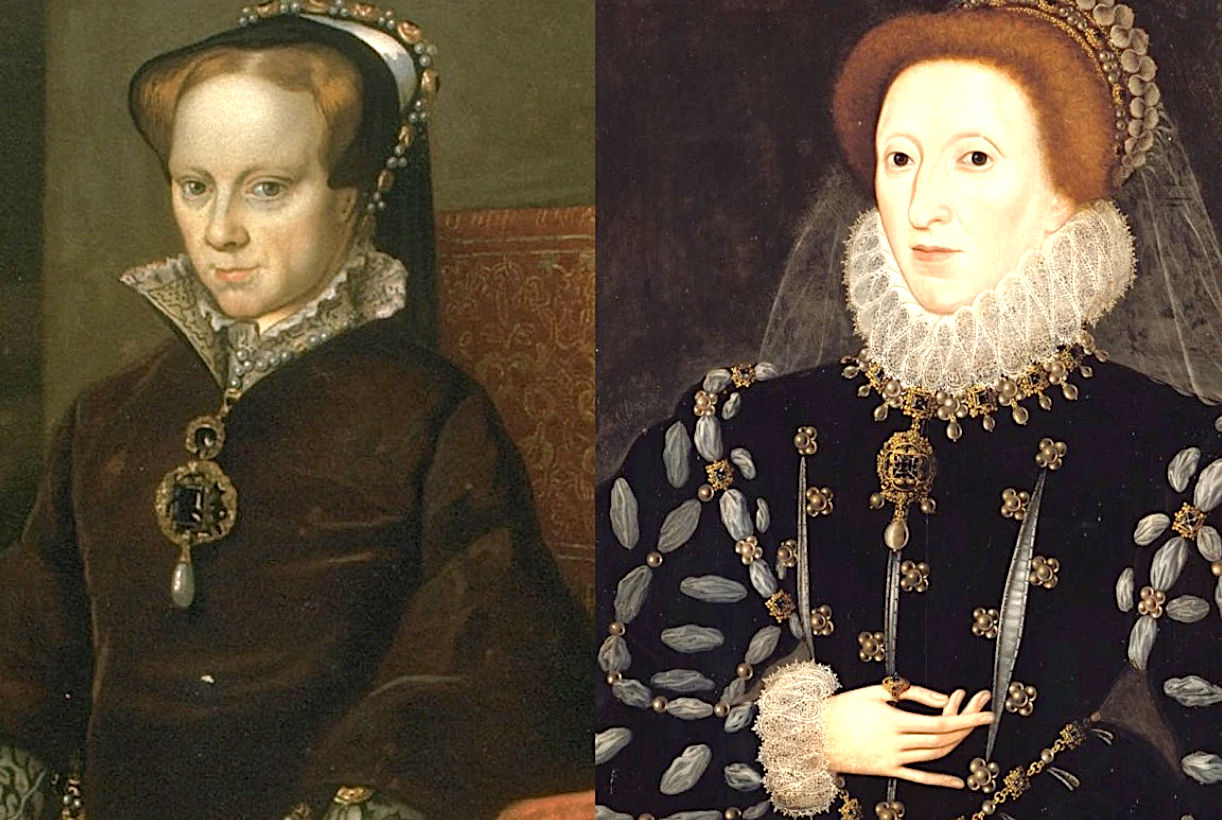
There plenty to talk about when it comes to Queen Mary I (1516-1558) and her half-sister, Queen Elizabeth I (1533-1603).

Born 17 years before her half sister, Mary did have pity for Elizabeth after her mother, Anne Boleyn, was beheaded in 1535. She knew what it was like to be ignored by her father.

Queen Mary I

Born on Feb. 18, 1516 at Greenwich Palace (which no longer exists), Mary was the only surviving child of Henry VIII and his first wife, Catherine of Aragon of Spain. People tend to forget that Henry and Catherine were married for more than 20 years before divorcing her to wed Anne Boleyn.

After her parents’ divorce around 1533 and Henry’s break with the Catholic Church, Mary eventually lived at Hatfield with half-sister Elizabeth. She did have some pity for Elizabeth after Anne Boleyn was beheaded in 1535. At that time, Elizabeth was ousted from favor and had little contact with her father. It was thanks to Mary that Elizabeth became closer with him.

During her father’s final marriage to Catherine Parr, Mary was brought back to court and named in her father’s will in the line of succession.

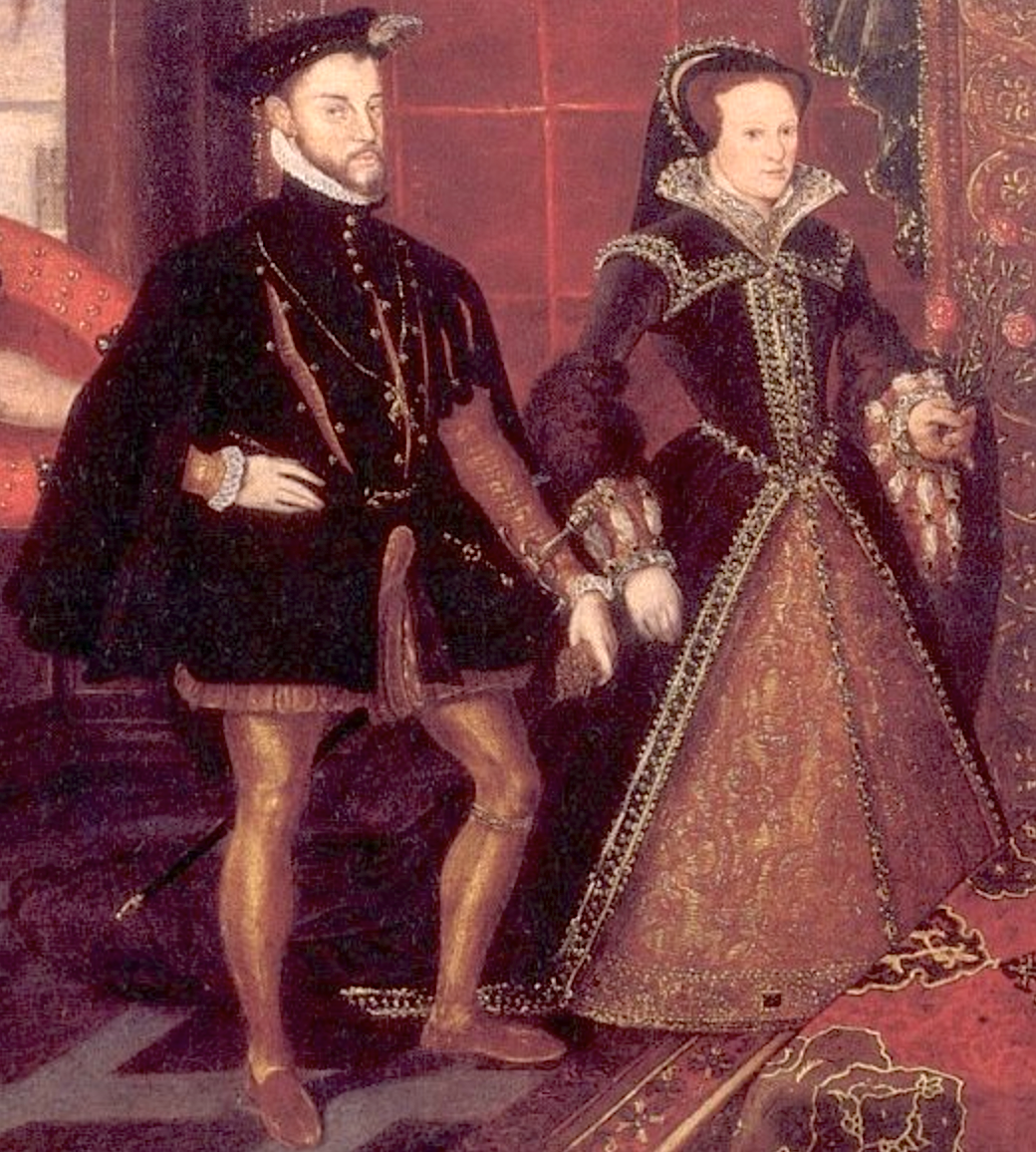
Mary wed Prince Philip of Spain in 1554. She was 10 years older than he was and they met only two days before the wedding.

Mary succeeded to the throne on the death of her brother Edward VI in 1553. Once in power, Mary took action to return England to Catholicism. She also resurrected the laws against heresy, and as a result, nearly 300 Protestants were burned at the stake. Her moniker “Bloody Mary” was well earned.

Mary married Prince Philip of Spain in 1554, which didn’t please her subjects. At age 37, she was 10 years older than her new husband. She insisted that he be given the title of king consort and all official documents bear their joint names. However, Philip left England to return to Spain a few years later when he realized he would have no heir with her.

Death of Queen Mary I

Dying childless on Nov. 15, 1558 at age 42, Mary was buried in a vault in the north aisle of Henry VII’s Lady Chapel in a coffin, above which the large monument we see today was later erected. Most of the monarchs at Westminster Abbey are buried beneath the Lady Chapel. Henry VII spent a great deal of money on it, which was begun in 1503 but not completed until 1516, nearly six years after his death.

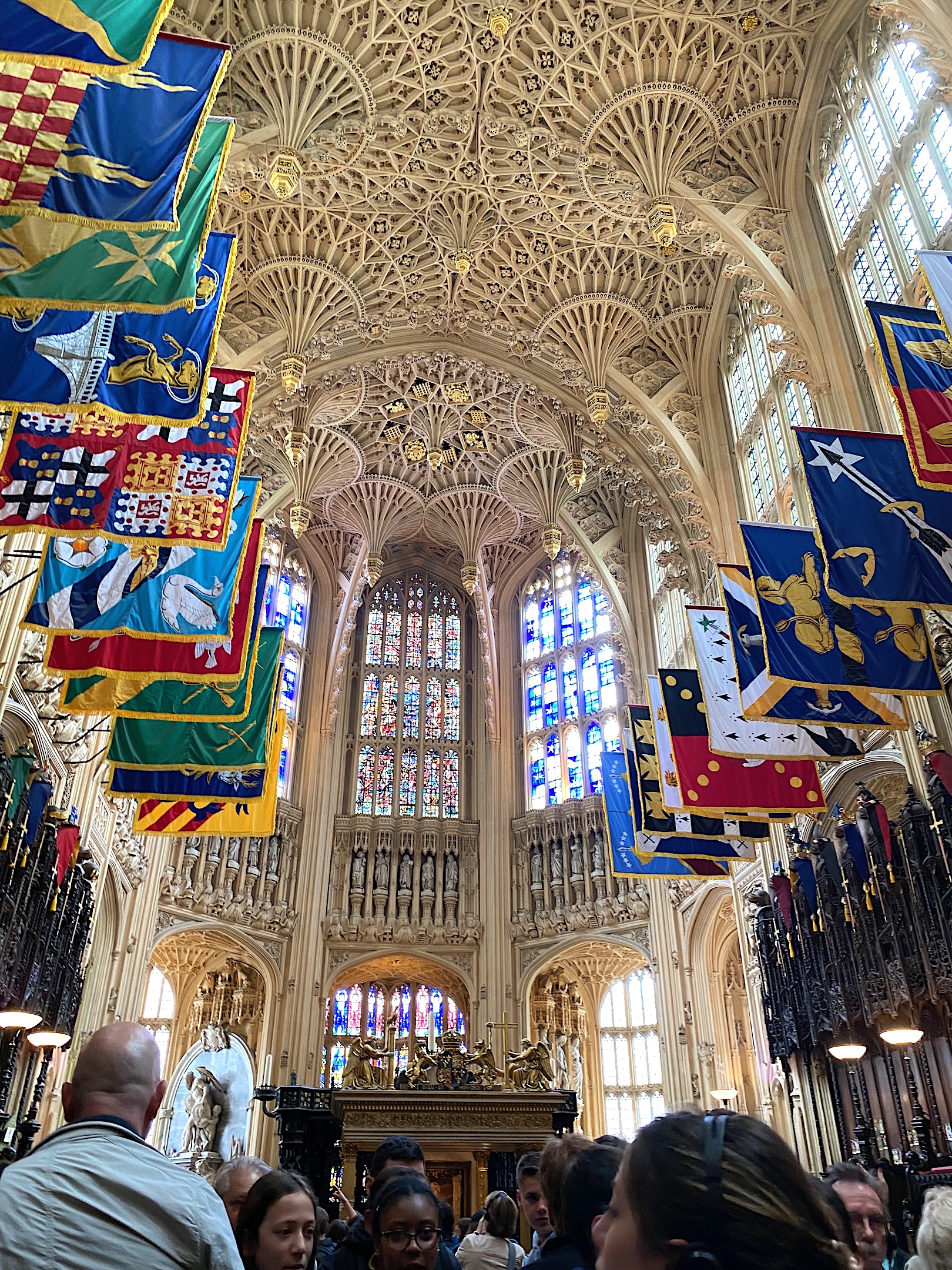
Finished in 1516, Henry VII and his wife, Elizabeth of York, are interred beneath the splendid monument at the bottom center of the picture. The ceiling is amazing!

Queen Elizabeth I

Queen Elizabeth I was the daughter of Henry VIII and Anne Boleyn and like her half-sister, she was born at Greenwich Palace on Sept. 7, 1533. When Henry tired of Anne and had her beheaded so he could marry Jane Seymour, Elizabeth was unceremoniously tossed aside. Her household was allotted little money but she did receive a good education.

From time to time, depending on her father’s mood, Elizabeth was brought to the English court where she impressed Henry VIII with her intellectual prowess. She developed a relationship with her stepmother, Henry’s fifth wife, Katherine Howard, only to see her beheaded. It’s small wonder that Elizabeth had little trust in marriage by this time.

By now, Elizabeth and Mary were not exactly “bosom friends” for many reasons. The largest bone of contention was their religious differences. Not surprisingly, Mary was staunchly Catholic like her mother Catherine and had married a Catholic. Elizabeth favored her father’s Church of England, which had replaced the Catholic Church when he divorced Catherine of Aragon.

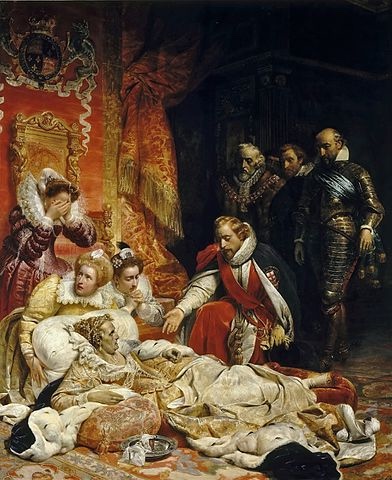
Queen Elizabeth I died on March 24, 1603 at age 69 at Richmond Palace.

When Mary died in 1558, Elizabeth was crowned queen at Westminster Abbey on Jan. 15, 1559. She ruled for 44 years until her death on March 24, 1603 at age 69. She never married and had no children.

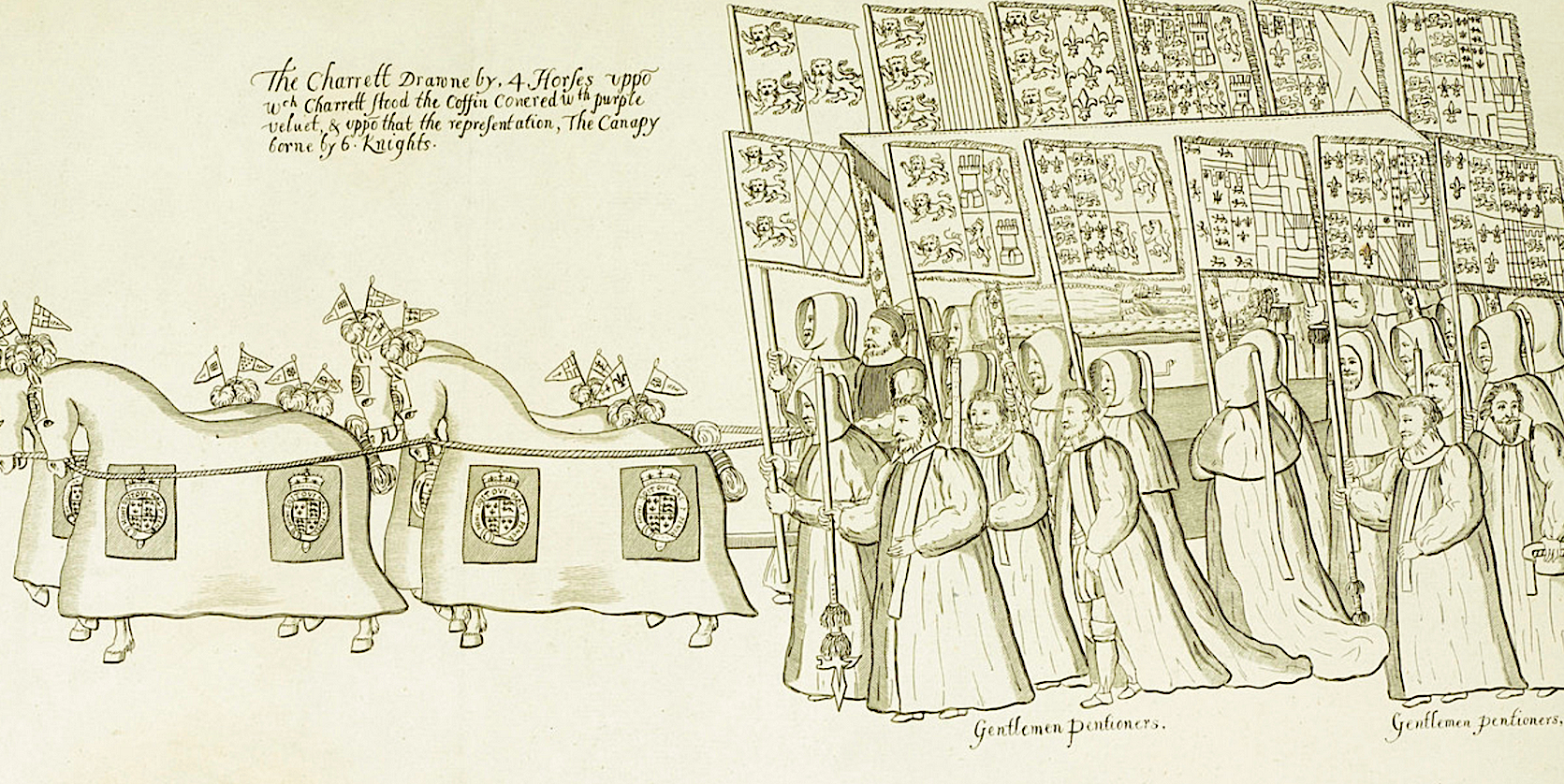
The funeral procession of Queen Elizabeth I to Westminster Abbey, April 28, 1603. (Photo Source: The British Library)

Two Sisters, One Monument

Here’s where it gets interesting!

As I noted earlier, Mary’s coffin was placed in a vault in the north aisle of Henry VII’s Lady Chapel. After Elizabeth died, the monarch who replaced her, James I, had Elizabeth’s coffin placed on top of Mary’s in the vault. I don’t think that was an accident.

Grace, our tour guide, shared with us that what came next was rather fitting considering how much the two sisters couldn’t stand each other.

When you walk into the north aisle, this is what you see. Made of white marble, the monument is massive. Commissioned by James I, it was made by sculptor Maximilian Colt and painted by John de Critz. The recumbent effigy resembles portraits of Elizabeth in old age. According to Westminster Abbey’s web page, the cost was £1,485 at the time.

The monument to Queen Elizabeth takes up much of the north aisle.

As you get closer, you’ll notice something. There’s only one effigy resting on top of the base enclosed under the canopy, and that’s of Elizabeth I. Mary is nowhere to be seen! Below is a photo of the only mention of Queen Mary I.

Where’s Mary? Under the floor in the vault, in a coffin beneath Elizabeth’s. Her younger half-sister ended up on top in the end.
The effigy of Queen Elizabeth I holds an orb and scepter, symbols of her power.
Another view from above. Chris or Sean must haven taken this photo, I’m too short!

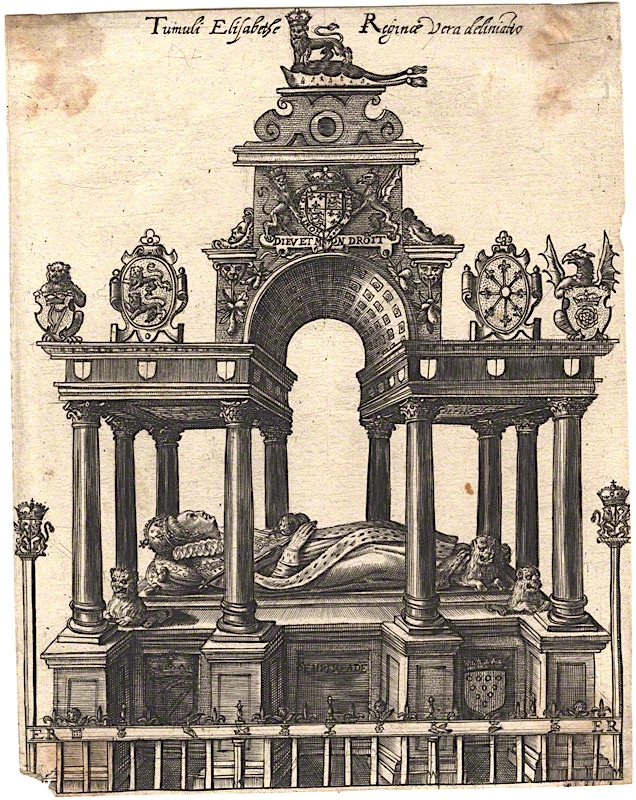
To get some idea of what the monument looked like in its earlier days, this is a 1620 engraving of it from London’s National Gallery.

This 1620 engraving was made by either Magdalena de Passe or her brother Willem de Passe, members of a well-known family of engravers.(Photo Source: National Gallery, London)
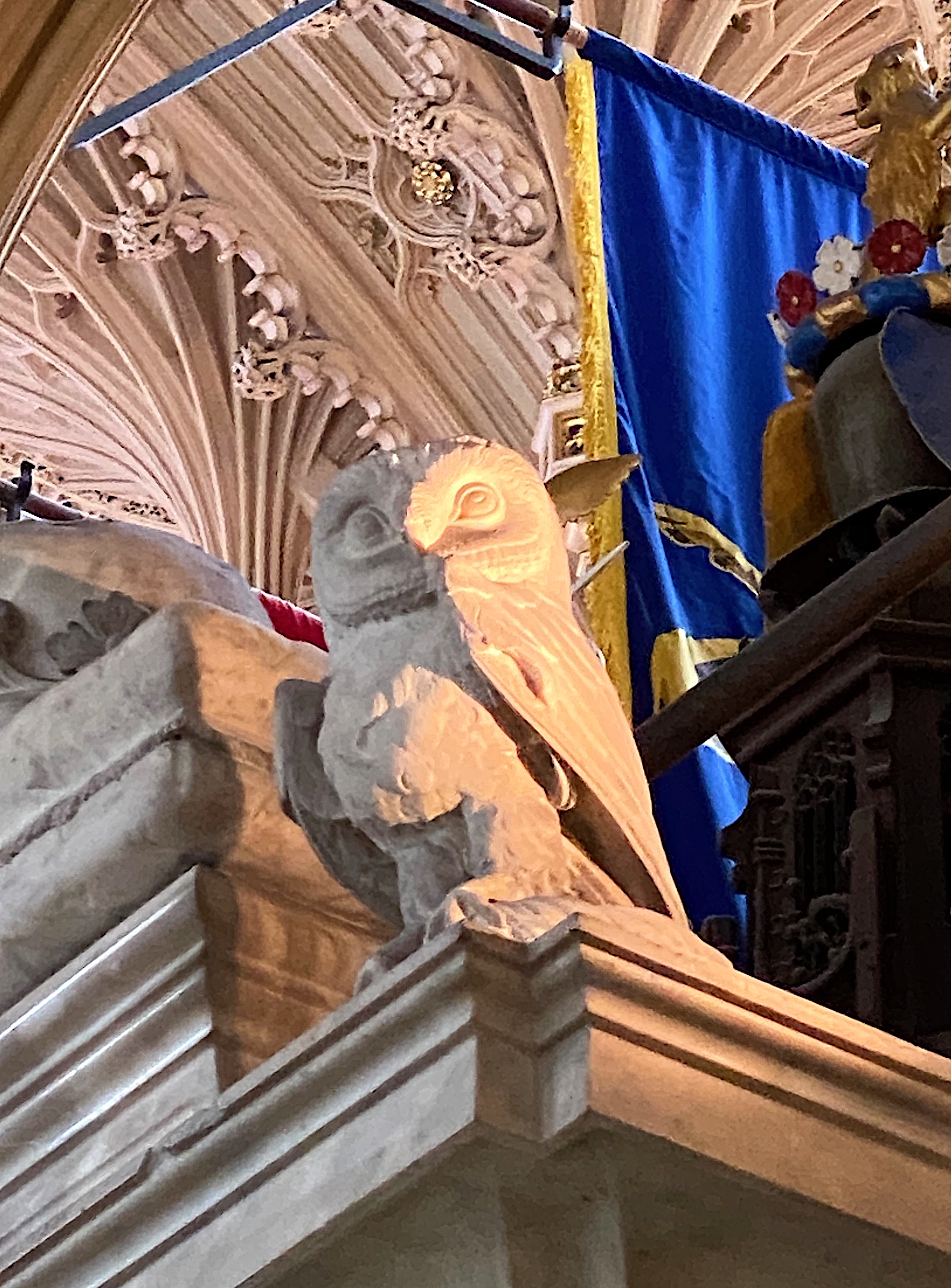
I particularly liked this carved owl!

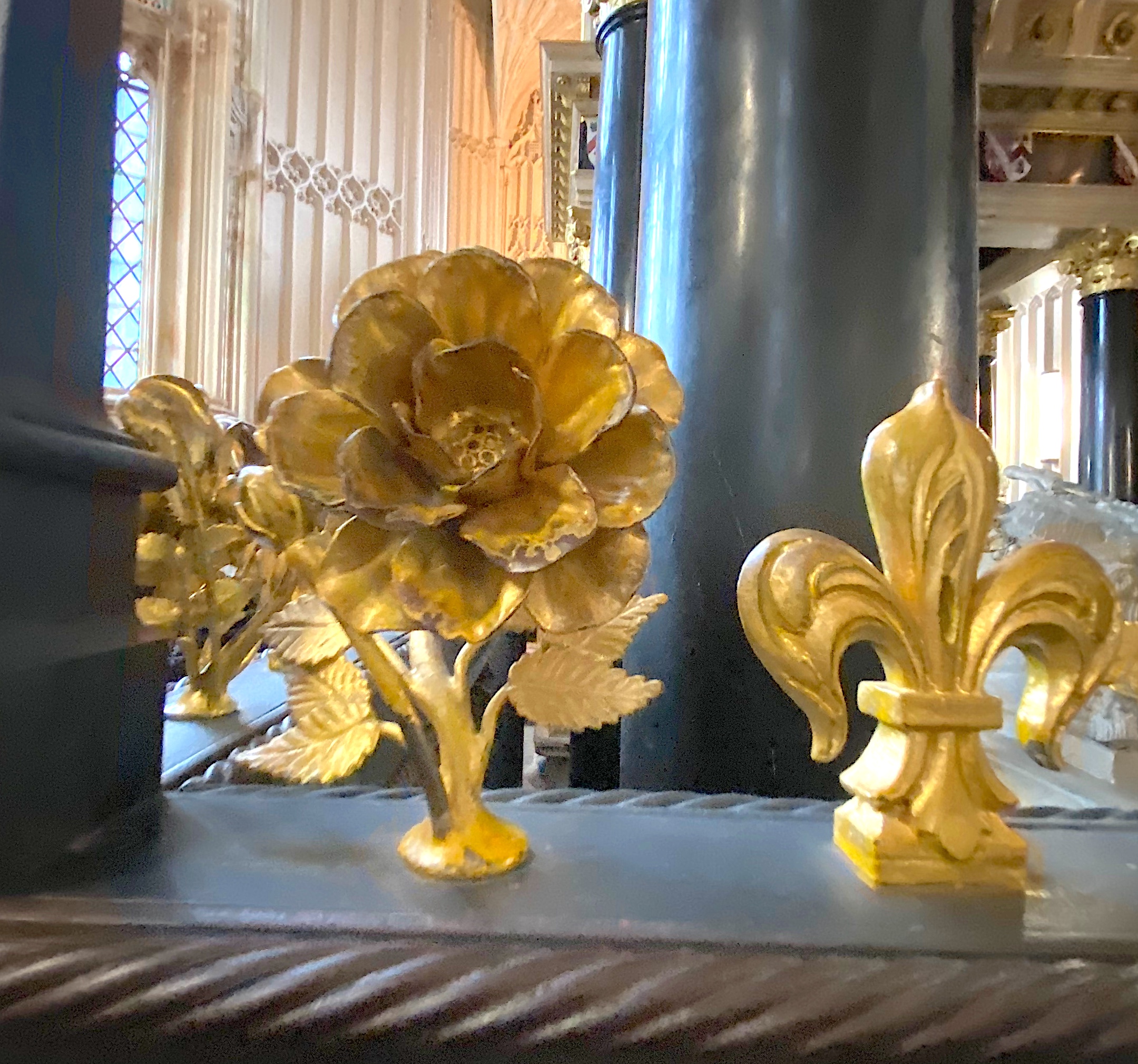
The roses and fleur-de-lis were prominently placed on the railings around the monument.

The golden ornaments around the monument are lovely.

Princess Sofia

After you’ve seen Queen Elizabeth I (and pondered poor Queen Mary I’s lack of presence), you’ll notice at the end of the north aisle there are monuments to some royal children worth mentioning.

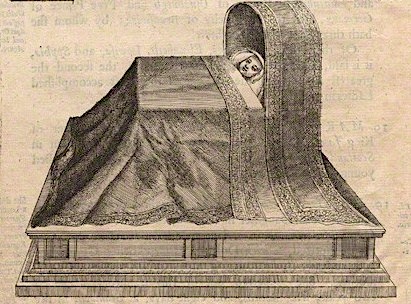
To the left is Princess Sofia, born on June 23, 1606 and died the next day at Greenwich Palace. She was the fourth daughter of James I and Anne of Denmark. Below is an engraving of her monument.

Engraving of Princess Sofia’s monument by Richard Gaywood.

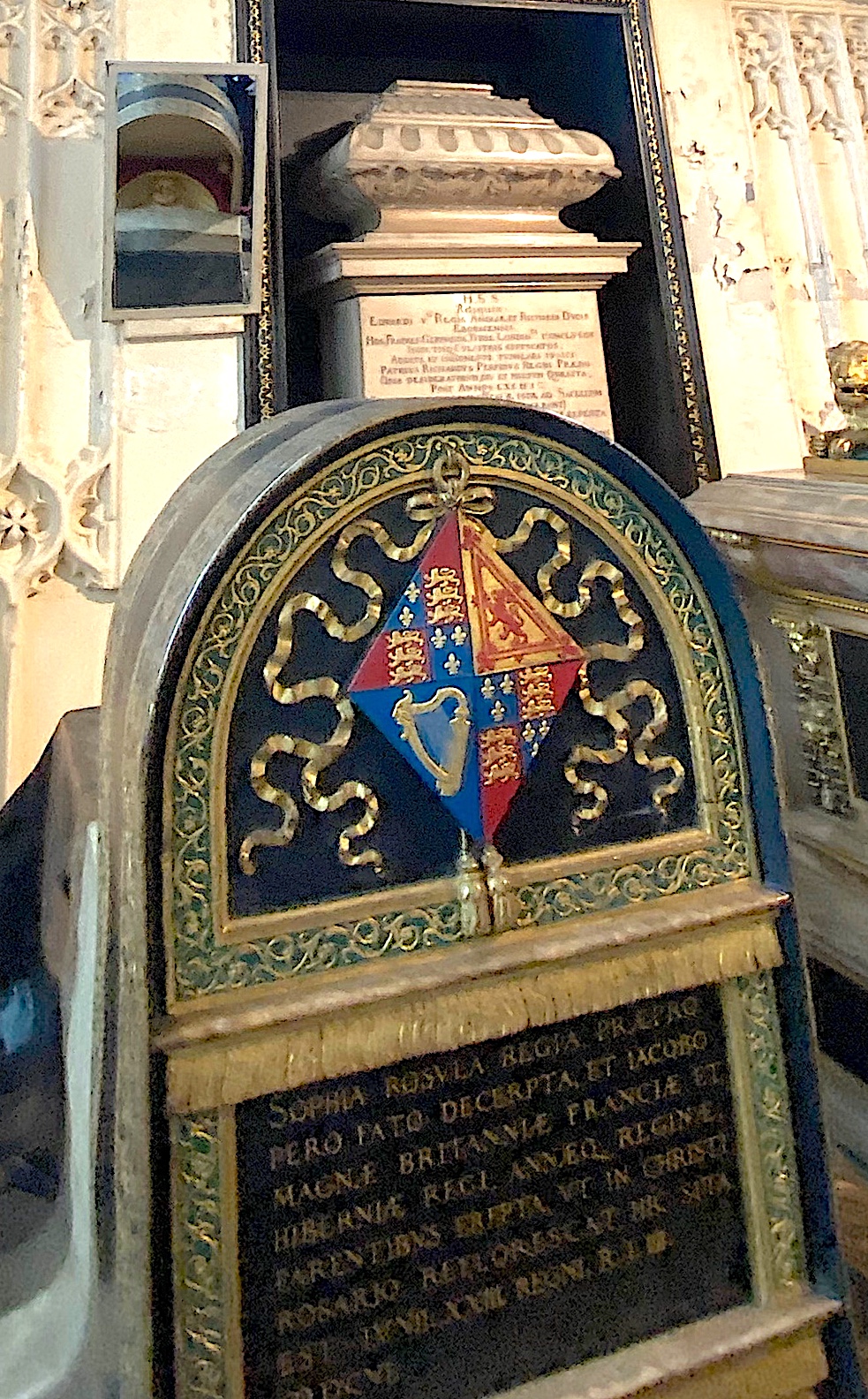
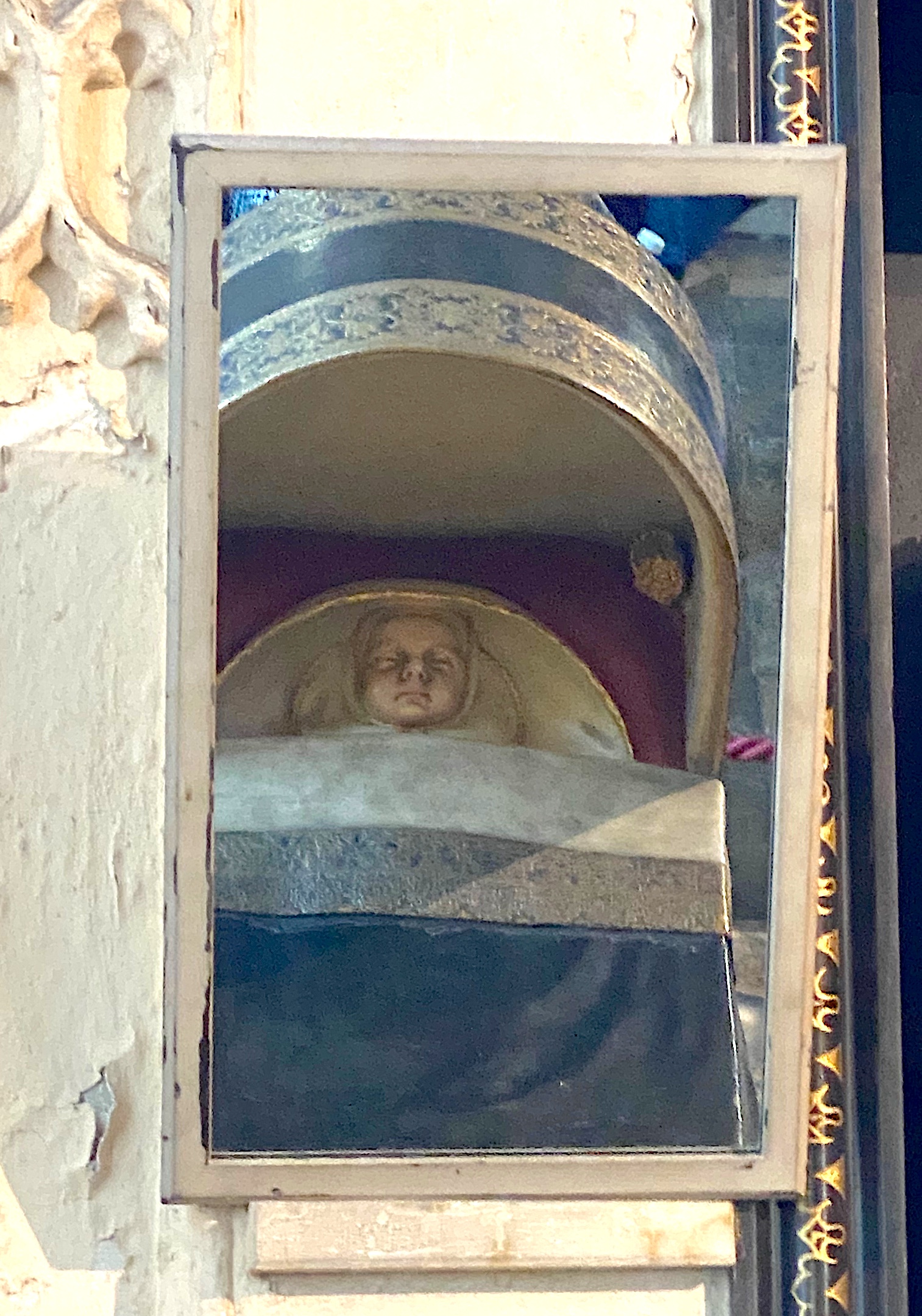
Sophia’s monument resembling a stone crib was designed by Maximilian Colt, and painted and gilded by John de Critz (they created Elizabeth I’s monument). The tomb is carved with lacework and an embroidered velvet cover. I didn’t get a very good photo of it. The angle at which it is placed makes it impossible for you to see the effigy’s face, so they have a mirror in place.

Princess Sofia only lived one day.
Above you can see the infant Princess Sofia’s little face in the mirror.

The Latin inscription on the end of the monument is translated below:

Sophia, a royal rosebud untimely plucked by Fate and from James, King of Great Britain, France and Ireland, and Queen Anne her parents, snatched away, to flower again in the rose garden of Christ, lies here. 23rd June, 4th year of the reign of King James 1606.

Princess Mary

To the right of Princess Sophia is her older sister, Princess Mary. Born on April 8, 1605 at Greenwich Palace, she was the third daughter of James I and Anne of Denmark. She lived 17 months before succumbing to pneumonia on Sept. 16, 1608.

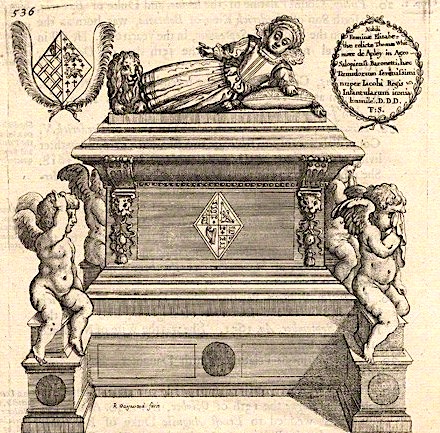
Richard Gaywood also drew this engraving of Princess Mary’s tomb.

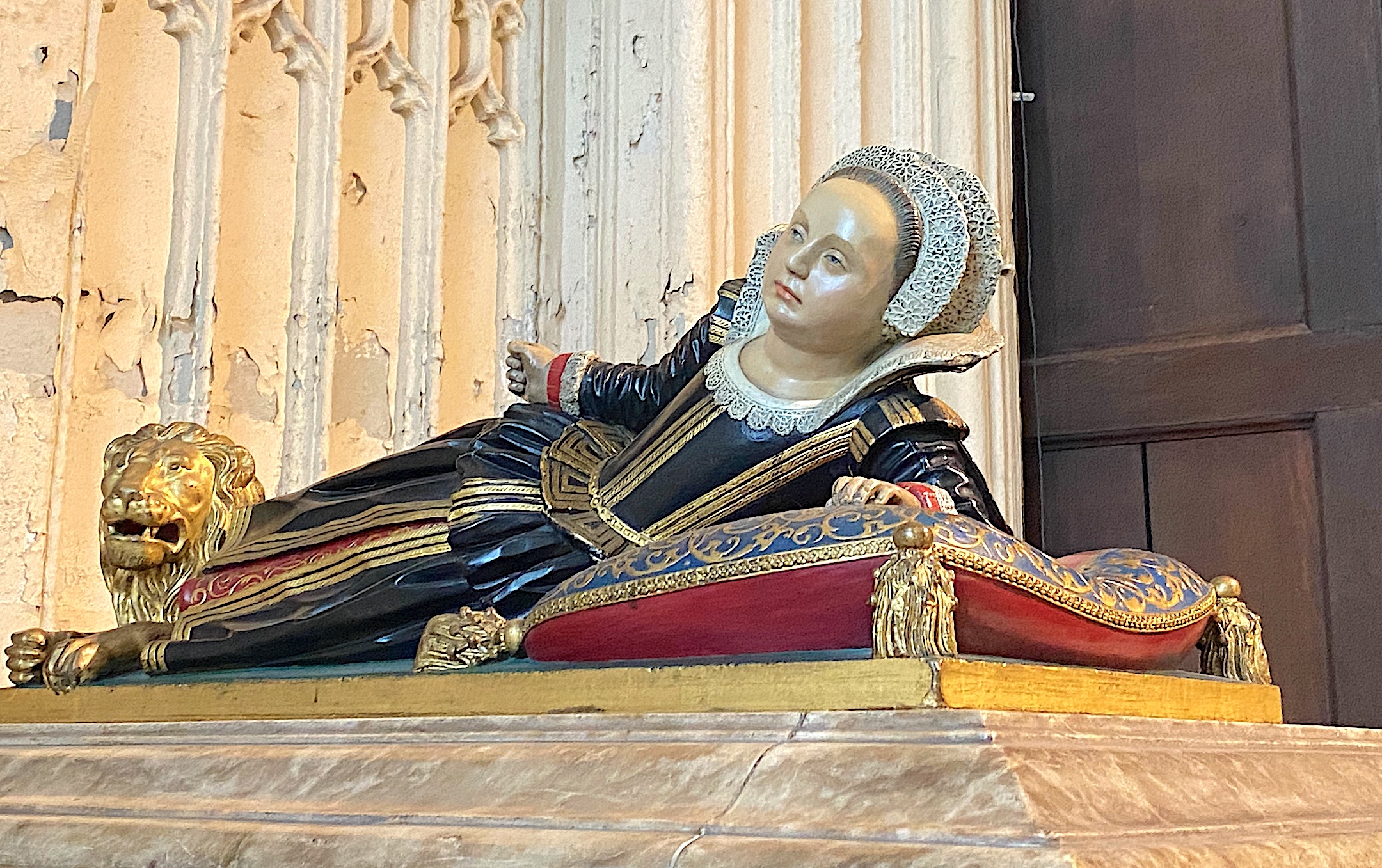
Her effigy, created by Maximilian Colt, represents a young girl wearing a mature dress, with the traditional ruff, carved in ivory.

Princess Mary’s effigy looks much older than a child who was 17 months old.
Princess Mary lived longer than her little sister, Sophia, but died of pneumonia in 1608.

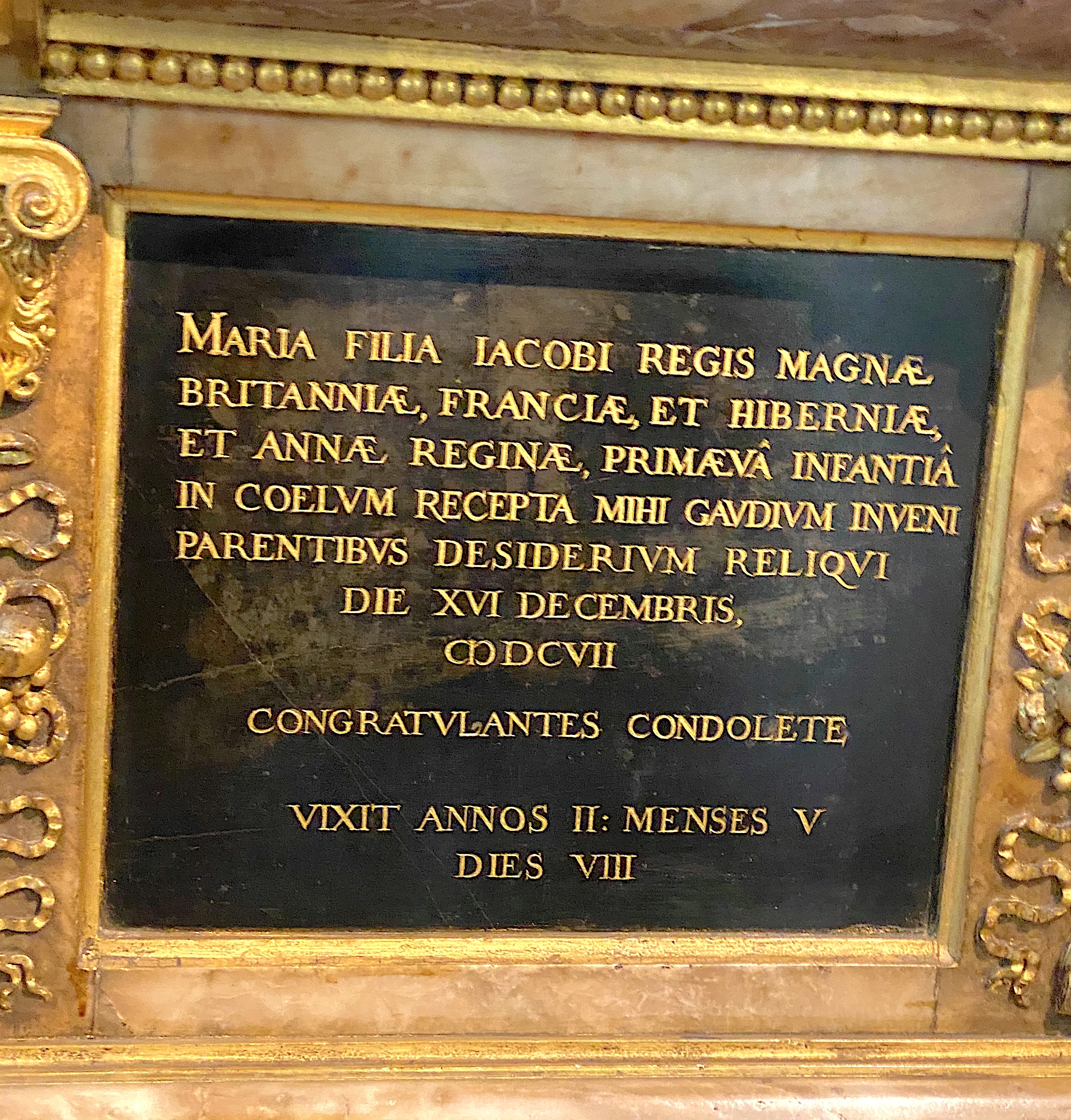
It reads:

I, Mary, daughter of James, King of Great Britain, France and Ireland and of Queen Anne, received into heaven in early infancy, found joy for myself, but left longings for my parents, on the 16th of September, 1607. Ye congratulators, condole: she lived only 1 year [sic, according to Everett Green] 5 months and 88 days.

Princes in the Tower?

You may be wondering what this item is located behind Princess Sophia and Princess Mary. I admit that I didn’t pay much attention to it at the time.

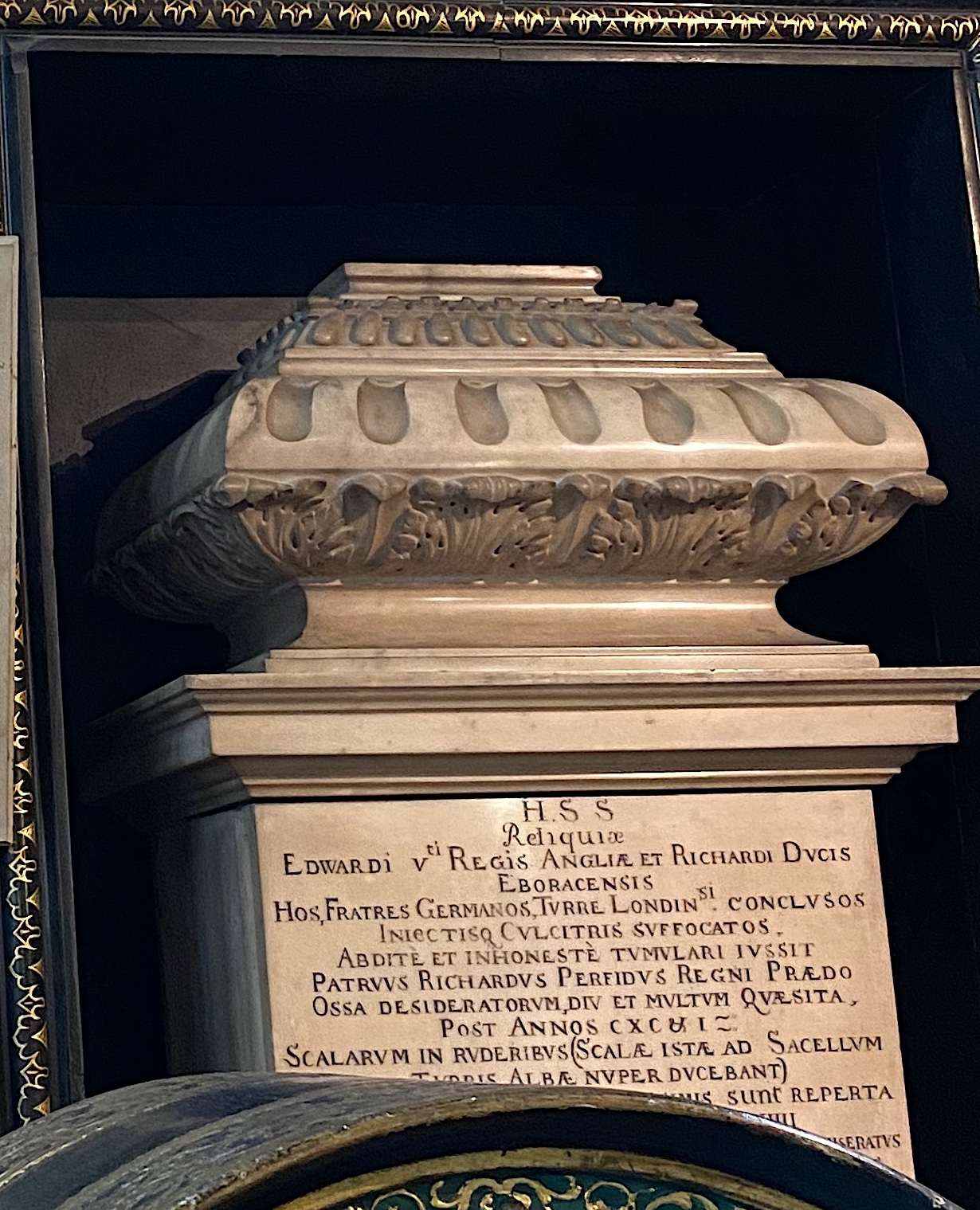
Are these the remains of the alleged murdered princes in the Tower of London?

I learned this was a monument created for the so-called Princes in the Tower, Edward and Richard. Their story is long and complicated. William Shakespeare wrote about them in his play, “Richard III”.

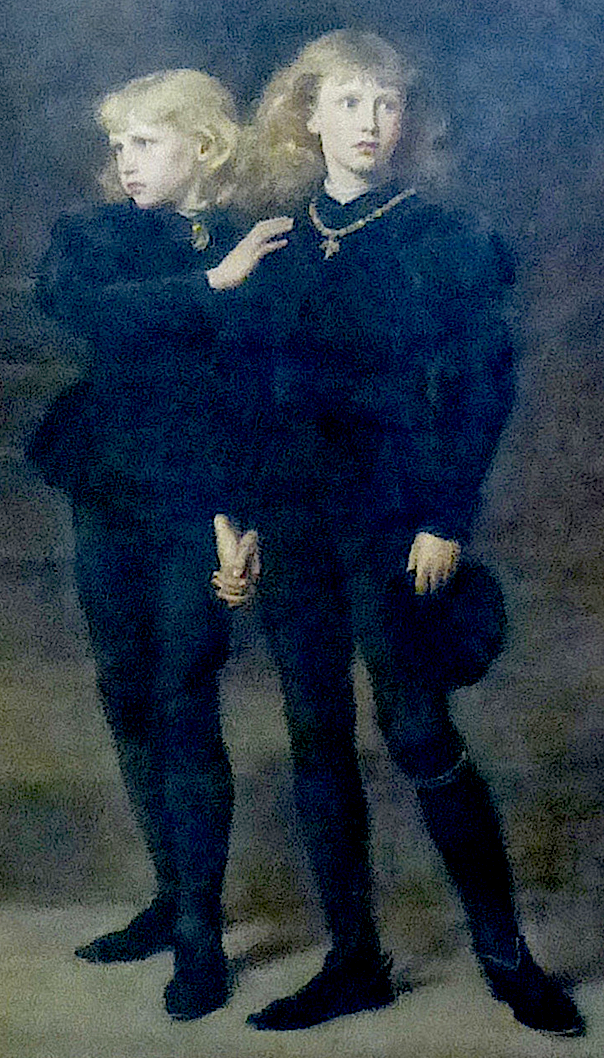
The princes, sons of Edward IV and Elizabeth Woodville, were born during the Wars of the Roses. After Edward IV’s death in 1483, his brother the Duke of Gloucester (later Richard III) became Lord Protector of Edward’s son and heir, the 12-year-old Edward V. The Duke immediately placed Edward in the Tower of London, closely followed by his nine-year-old brother Richard, for “their protection”.

What became of these two boys remains a mystery but they were never seen alive again. It’s long been believed that Richard III, who was crowed king in 1483, had them murdered. This has been debated for centuries with many theories having been put forth about it..

Did Richard III have his own nephews murdered so he could be crowned king?

Nearly 200 years later, in 1674, King Charles II ordered the demolition of what remained of the royal palace to the south of the White Tower. The location included a turret that once contained a privy staircase leading into St. John’s Chapel.

Beneath the foundations of the staircase, some 10 feet below the ground, workmen found a wooden chest containing two skeletons. It was concluded that they were the bones of children. Charles II had them interred at Westminster Abbey in the later 1670s and they’ve been there ever since in the monument you see today.

In 1933, the remains were forensically examined and thought to be the bones of two boys between 10 and 12. But testing was not exactly precise in those days, so doubts remain still today if it truly is Richard and Edward. We’ll likely never know.

I’ve got more royal tombs for you so come back for more in Part III!

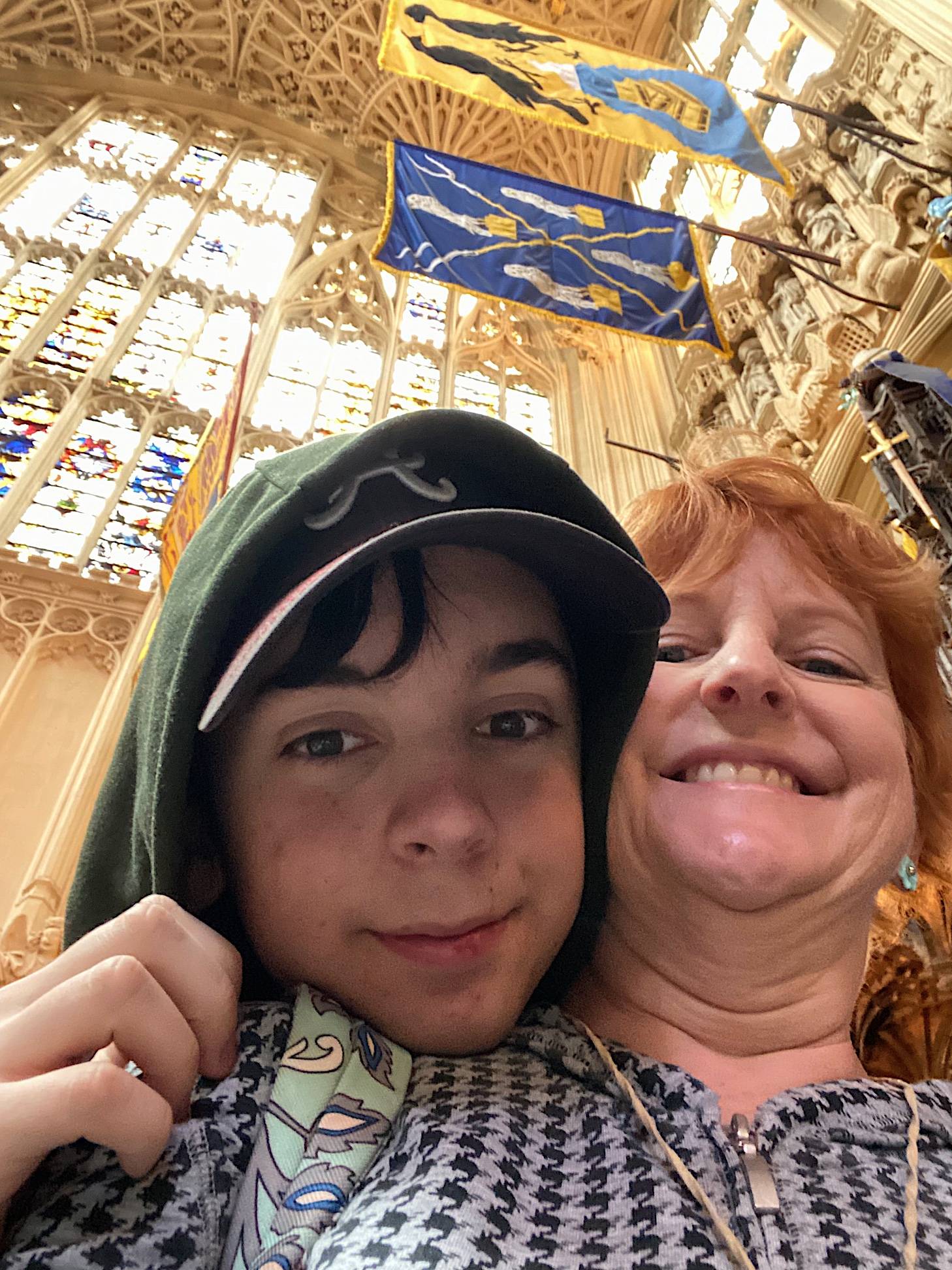
One of my favorite photos of me and my son, Sean, in the Lady Chapel at Westminster Abbey. Pardon my multiple chins.

Westminster Abbey 2023: Third Time’s the Charm, Part I

03 Friday May 2024

Posted by adventuresincemeteryhopping in General

≈ 2 Comments

[Note: For more information on Tours by Grace, visit: https://www.toursbygrace.com/]

Last week, I told you I planned to feature some local (to me) cemeteries in my next blog posts. But this week, I realized I didn’t want to do that.

In the past, I’ve tried to write about my adventures chronologically. However, sometimes I get the urge to do something different.

When you make the rules, you can do that.

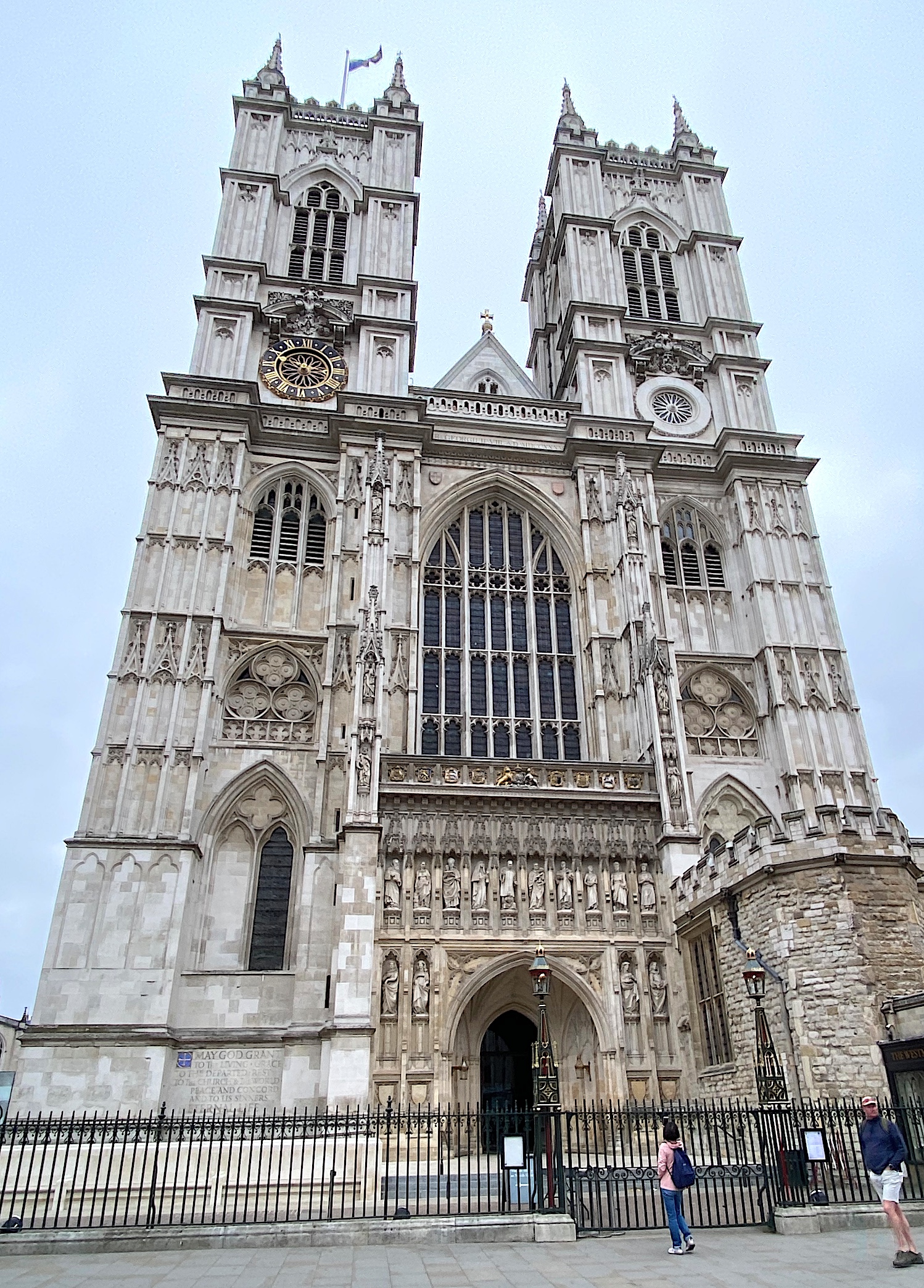
Today I’m starting a new series on London’s Westminster Abbey, which I visited in June 2023. There’s a bit of a story behind my relationship with this place, but I’ll try to keep it brief.

It was my third visit to London, but my first visit inside Westminster Abbey.

Disappointed in 1998

It started in July 1998 when I visited London for the first time with my college roommate and dear friend Megan. While I was not yet a cemetery hopper, I wanted to see Westminster Abbey. So one day we headed over there and to my disappointment, it was closed for an event.

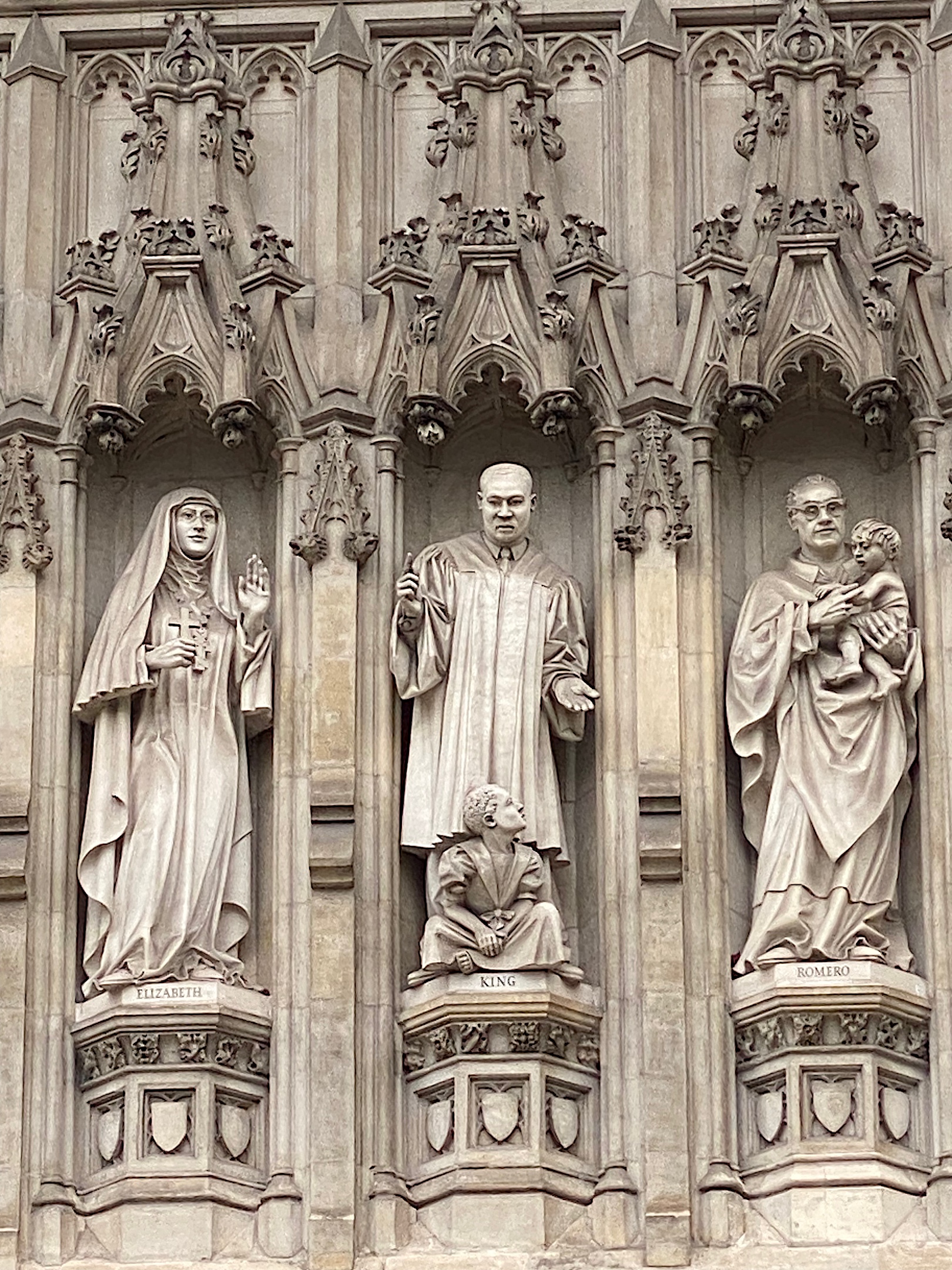
I didn’t see the statues of the 20th-century martyrs that Queen Elizabeth and Prince Phillip came to dedicate that day in July 1998 until June 2023. In the center is Atlanta’s own Dr. Martin Luther King, Jr.

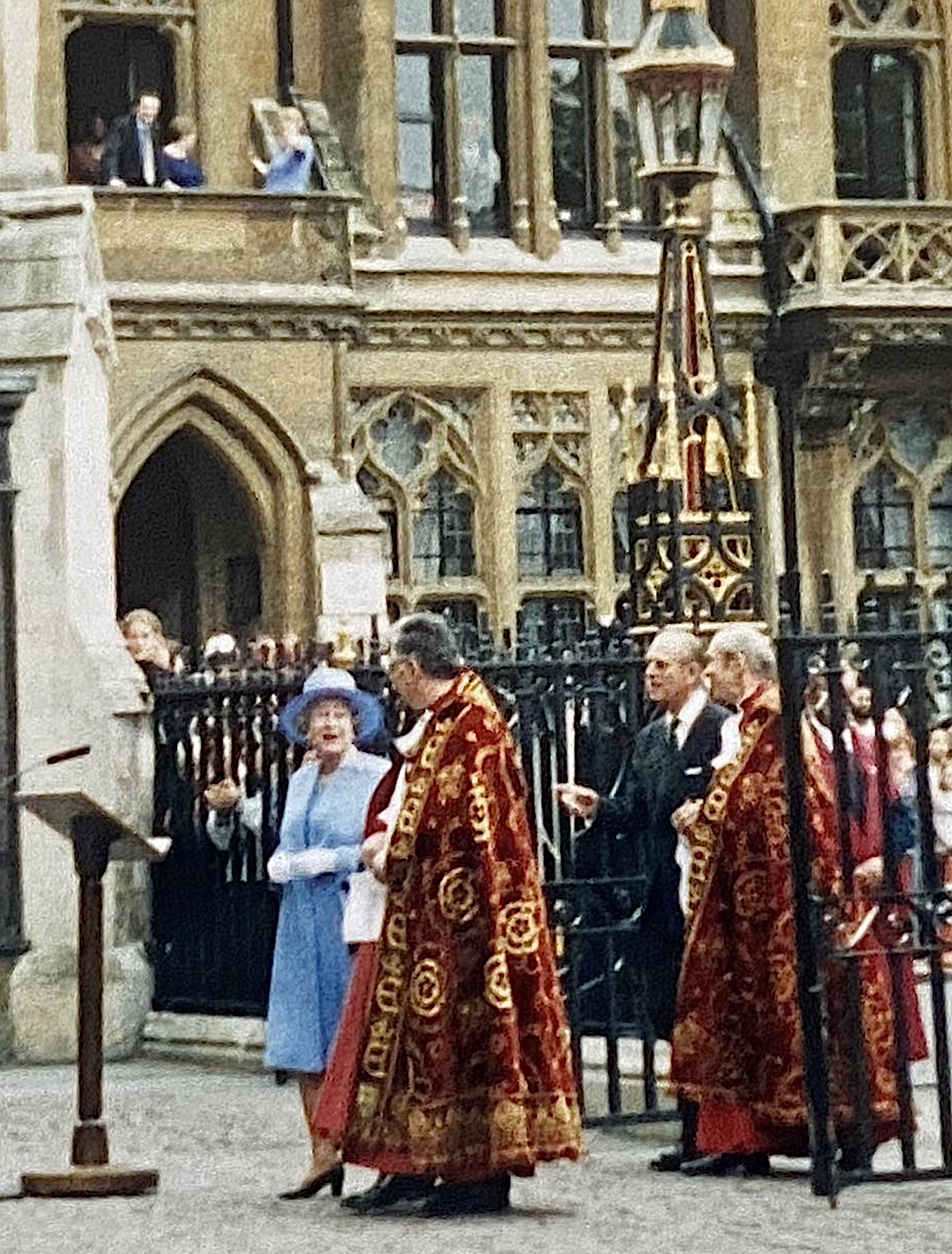
However, that event turned out to be a visit from Queen Elizabeth II and Prince Phillip! They were due to arrive in a few hours. We decided to settle down and wait, getting a prime place to watch near the gates. They were going to be part of a ceremony in which some new statues of 20th-century martyrs were to be unveiled.

Needless to say, seeing the royal couple walk in was worth the wait! But that meant we missed out on going inside.

We didn’t get to tour the Abbey that day in July 1998 but we did see the Queen and the Prince! Sorry the photo is rather blurry. She was even wearing my favorite color.

My second opportunity came in September 2000 after a week-long tour of Scotland. I spent a few days in London after the tour before heading west to Swindon to stay with a couple I knew. I planned to go back to the Abbey, but I ran into a fellow tourist in my hotel’s Internet cafe who was catching a bus to see St. Paul’s Cathedral and he invited me to tag along. So I did.

Fast forward to January 2020 as my family and I prepared to visit London and Paris, my husband and son had been to neither. I’d never been to Paris. Covid rudely put that off until June 2023 and we made new plans. I was determined to not only visit Westminster Abbey, but to hire a guide who could show us around to make the most of it.

Hopefully, the third time would be the charm.

Tours By Grace

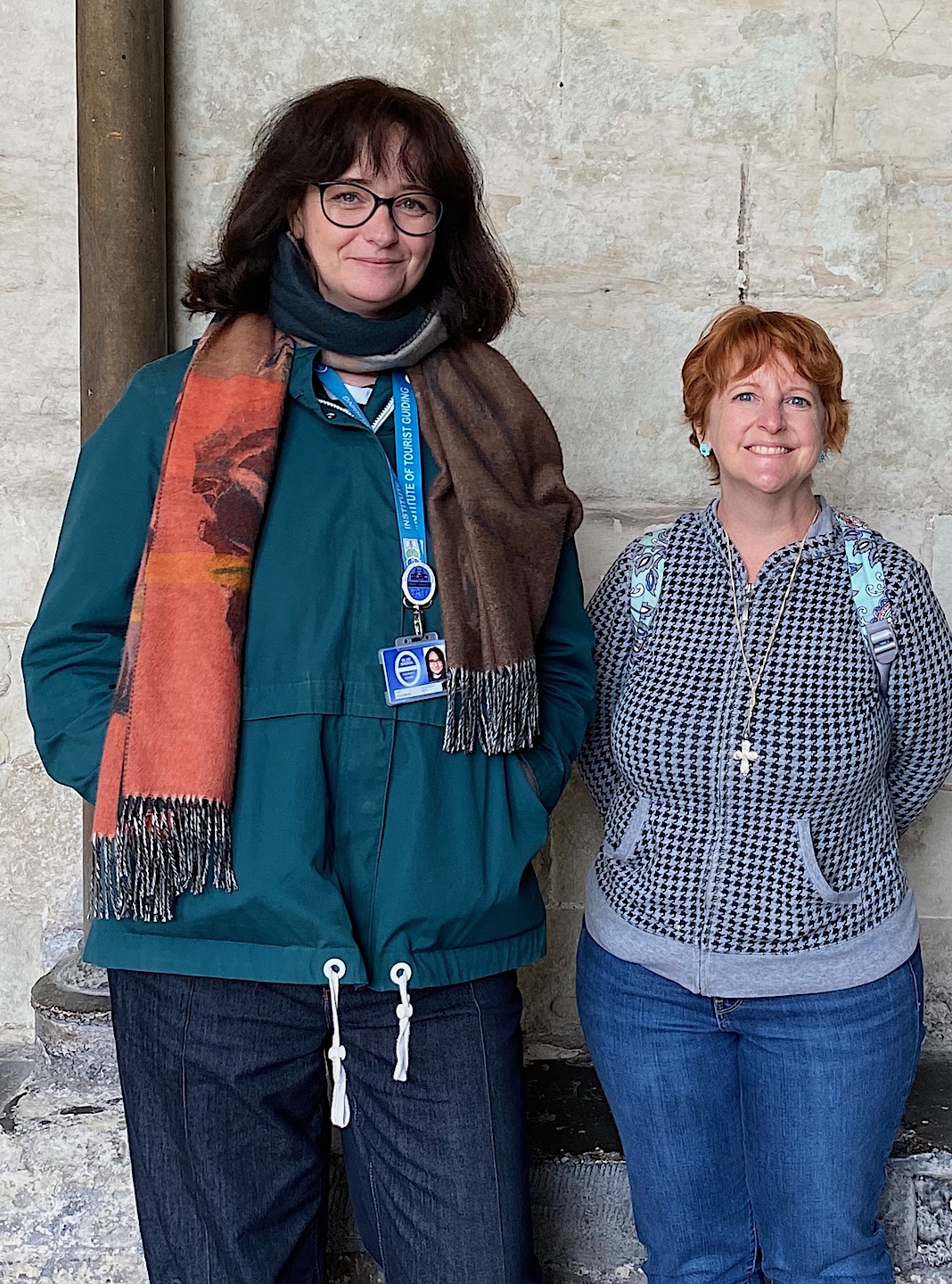
There are plenty of guides eager to show you around Westminster Abbey. You can also rent an audio tour if you prefer. But when I found Grace (of Tours by Grace) online, I got the feeling right away that she was exactly the right person for us. And she was!

Grace proved to be the perfect tour guide for us. She capably guided us through the crowds while telling some amazing stories.

Grace is a certified Blue Badge London Tourist Guide and that’s nothing to sneeze at. It takes two years of training and passing strict qualifications to become one. These are not folks reciting a list of facts out of a guidebook while glancing at their watch. They tailor your tour to what you specifically want to see. Even if what you want to see most are graves.

There’s an awesome benefit to having waited until 2023 to visit. You couldn’t take pictures inside the Abbey until October 2020. Photography is still not allowed during services. But had I visited before, I wouldn’t have been able to take a picture of a single grave or tomb.

Britain’s Oldest Door

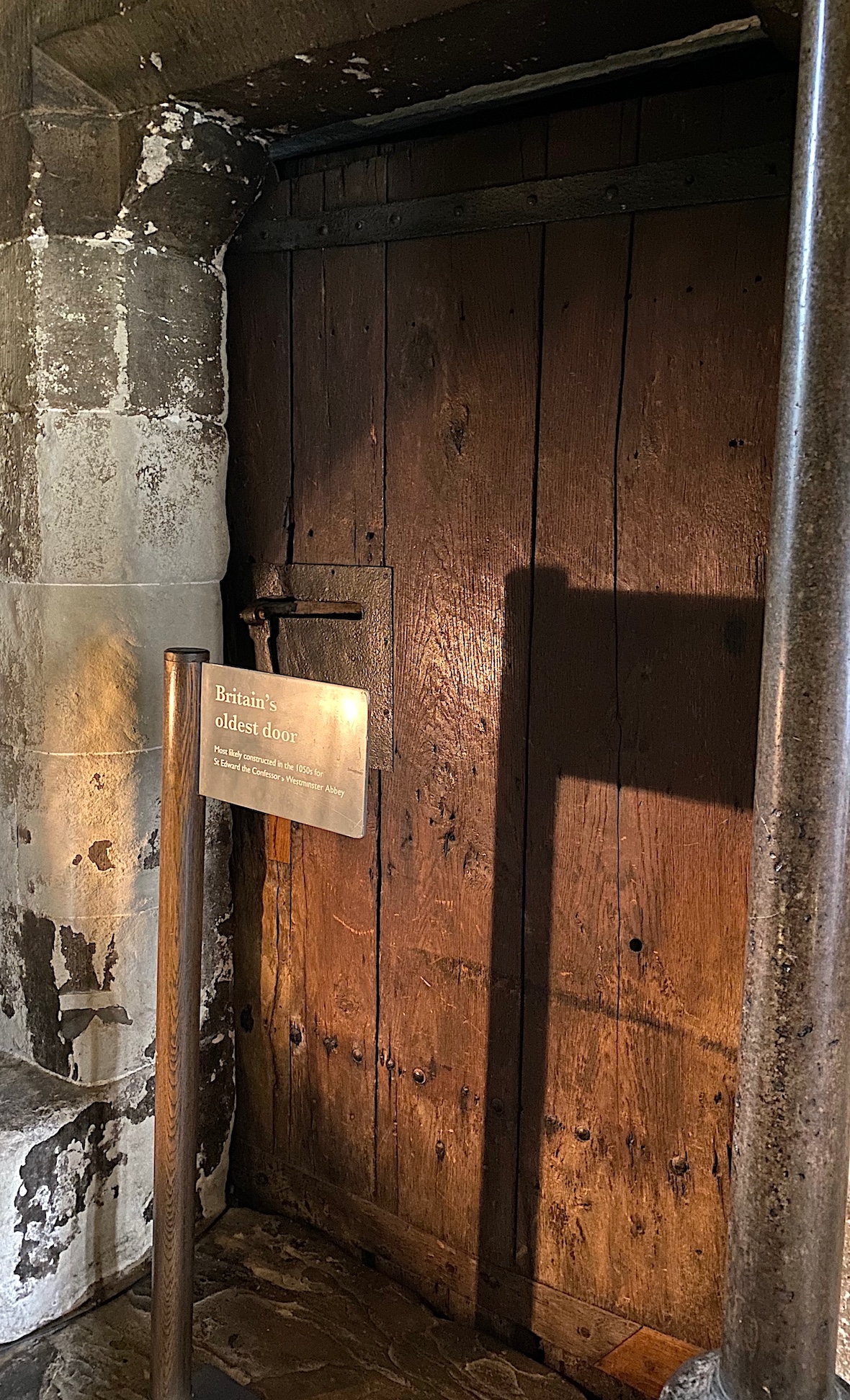
If it hadn’t been for Grace pointing it out, I’m not sure we would have seen Britain’s oldest door.

The door was dated for the first time in 2005 by a process called dendrochronology. A detailed study of the wooden door (in the vestibule leading to the Chapter House), showed that the wood came from a tree chopped down after 1032 A.D. The door was constructed sometime in the 1050s. This was during the reign of King Edward the Confessor.

The door is made of five vertical oak planks held together with three horizontal battens and iron straps.

According to the Westminster Abbey web site:

The door was obviously retained when Henry III rebuilt the Abbey and Chapter House from 1245 but cut down to be put in a new position. In the 19th century, the fragments of cow hide were first noted and a legend grew up that this skin was human. It was supposed that someone had been caught committing sacrilege or robbery in the church and had been flayed and his skin nailed to this door as a deterrent to others.

A Few Facts

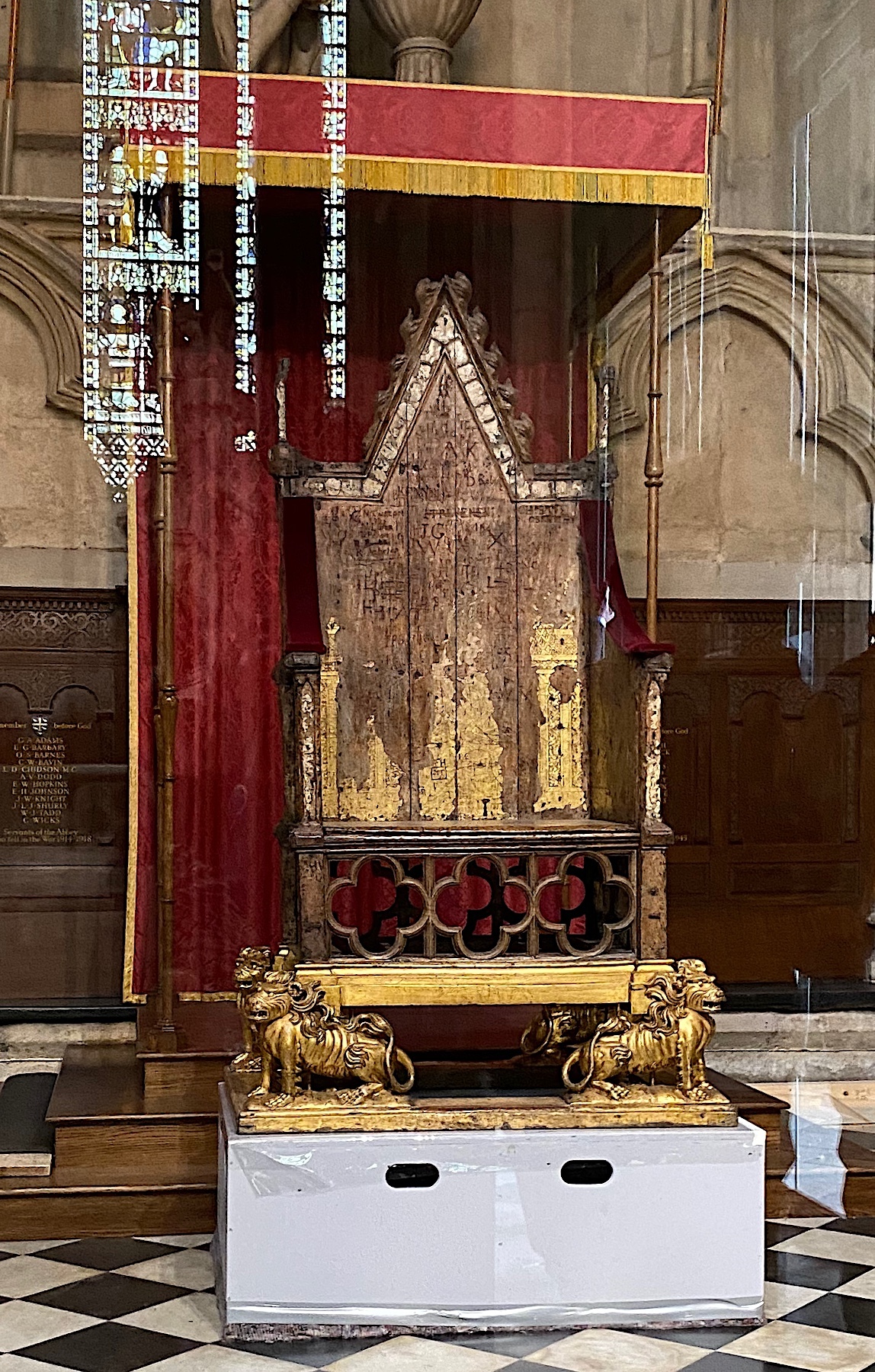
I’m not going to spend much time on the history of Westminster Abbey, which is over 1,000 years old. With only two exceptions, every monarch since 1066 has been crowned there. The Abbey had just hosted the coronation of King Charles less than a month before our visit. We saw the Coronation Chair, pictured below, that he sat in. It has plexiglass in front of it, thus the reflection of the stained glass.

The Coronation Chair was made by order of Edward I to enclose the famous Stone of Scone, which he brought from Scotland to the Abbey in 1296, where he placed it in the care of the Abbot of Westminster.

The Abbey has never had a bishop, except for a brief time during the 1540s (before then, it was presided over by an abbot). Upon its re-founding by Elizabeth I in 1560, it was established as a royal peculiar. Ever since, it’s been outside the hierarchy and jurisdiction of the Church of England.

Westminster Abbey is among many monasteries founded in the Catholic Church, although it was later repurposed as a powerful symbol of Protestant national identity. Although much of the architecture is French in origin, the Abbey is widely regarded as quintessentially English.

How Many People Are Buried in Westminster Abbey?

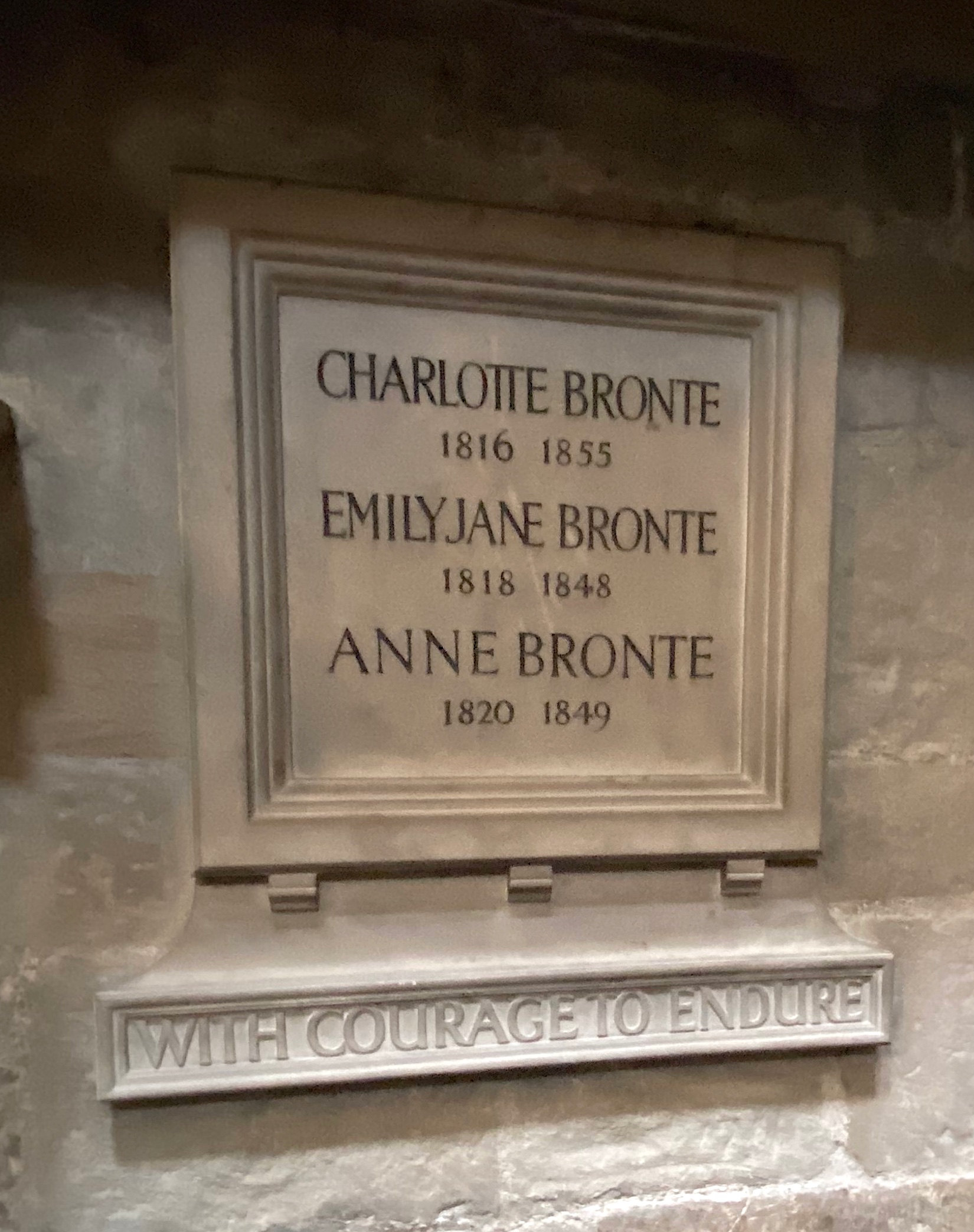
Over 3,300 people are buried or commemorated in the Abbey. Many are not buried there but have a cenotaph placed in their honor, such as Victorian authors (and sisters) Charlotte, Emily, and Anne Bronte. They’re actually buried in Haworth in Yorkshire.

Victorian authors Charlotte, Emily, and Anne Bronte are actually buried in Haworth, Yorkshire. This is a cenotaph.

An estimated total of 18 English, Scottish and British monarchs are buried in the Abbey, including Edward the Confessor, Henry III, Edward I, Edward III, Richard II, Henry V, Edward V, Henry VII, Edward VI, Mary I, Mary Queen of Scots, Elizabeth I, James I, Charles II, Mary II, William III, Queen Anne, and George II.

During the early 20th century, for reasons of space, it became more common to bury cremated remains (ashes). In 1905, actor Sir Henry Irving became the first person to have their ashes interred at the Abbey.

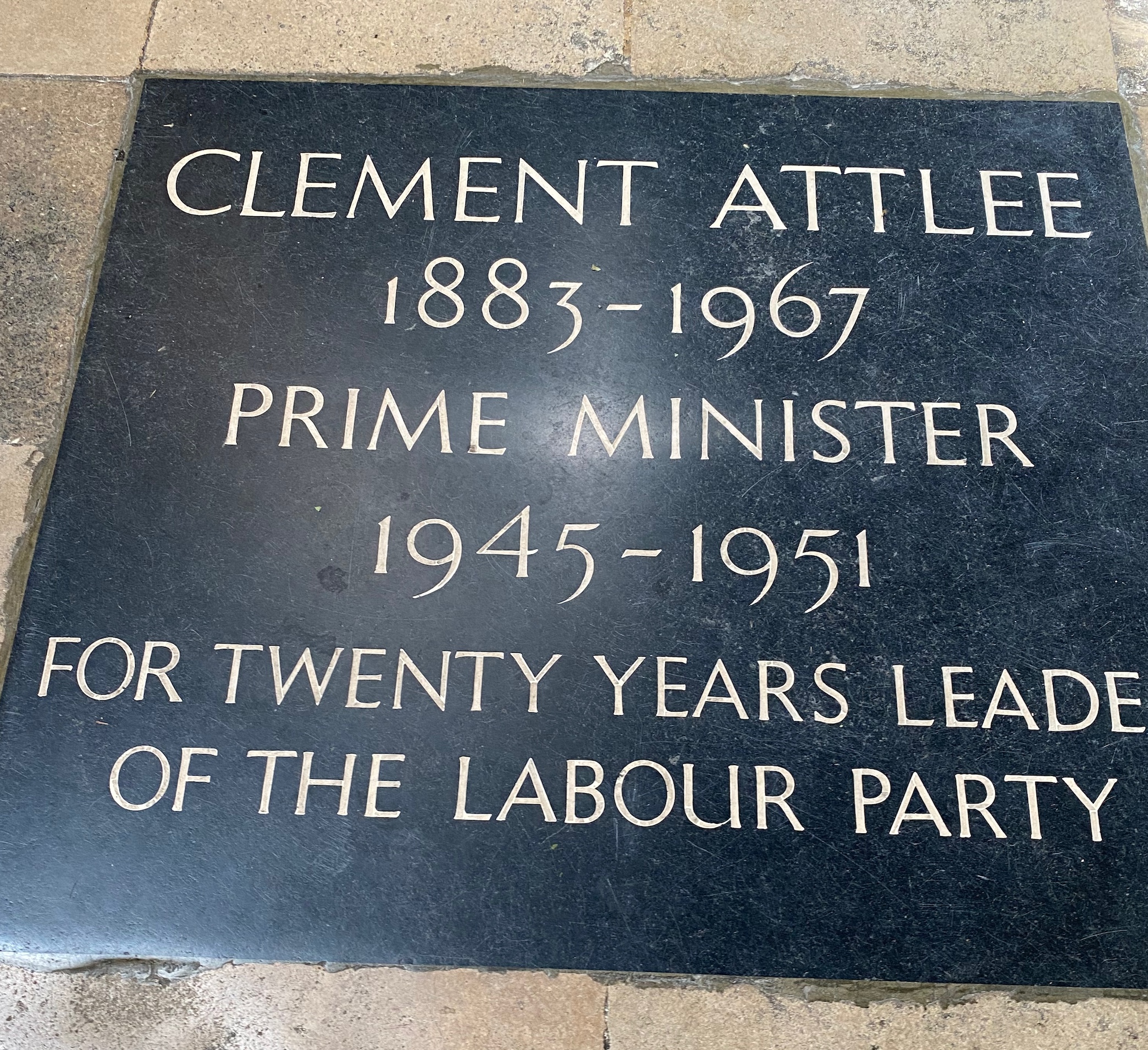
Eight British prime minister are buried in the Abbey, and I happened to notice a few of them as I was walking around (and over) them. That’s the tricky thing about walking around Westminster Abbey. You might be stepping on a king or a poet or a prime minister and not even realize it!

Clement Attlee, (1883-1967), was a British statesman and Labour Party politician who served as prime minister from 1945 to 1951, and leader of the Labour Party from 1935 to 1955.

The Unknown Warrior

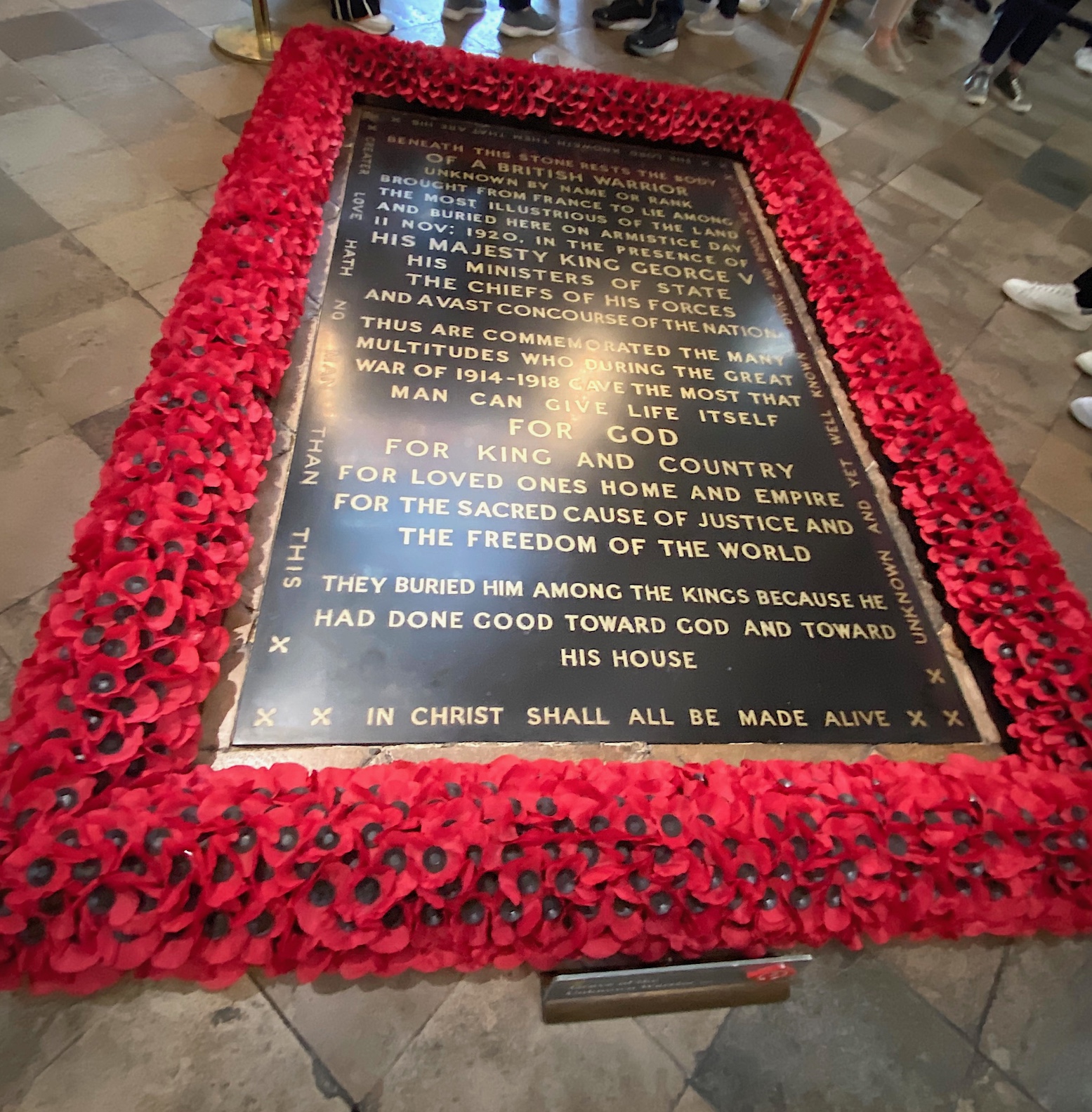
At the west end of the Nave, you’ll find the grave of the Unknown Warrior, whose body was brought from France to be buried at the Abbey on Nov. 11, 1920. The grave, which contains soil from France, is covered by a slab of black Belgian marble from a quarry near Namur.

Where did the idea come from? In 1916, a chaplain at the Front, the Rev. David Railton (1884-1955), noticed something in a back garden at Armentières. It was a grave with a rough cross on which were written the words “An Unknown British Soldier”. In August 1920, Rev. Railton wrote to the dean of Westminster, Herbert Ryle, who took up the cause of creating a memorial. The body was chosen from unknown British servicemen exhumed from four battle areas, the Aisne, the Somme, Arras, and Ypres. (some sources say six bodies but confirmed accounts say four).

The Tomb of the Unknown Warrior is surrounded by poppies, an important symbol of World War I.

General John J. “Black Jack” Pershing, on behalf of the United States, conferred the Congressional Medal of Honor on the Unknown Warrior on Oct. 17, 1921, which hangs in a frame on a pillar near the grave.

First Impressions

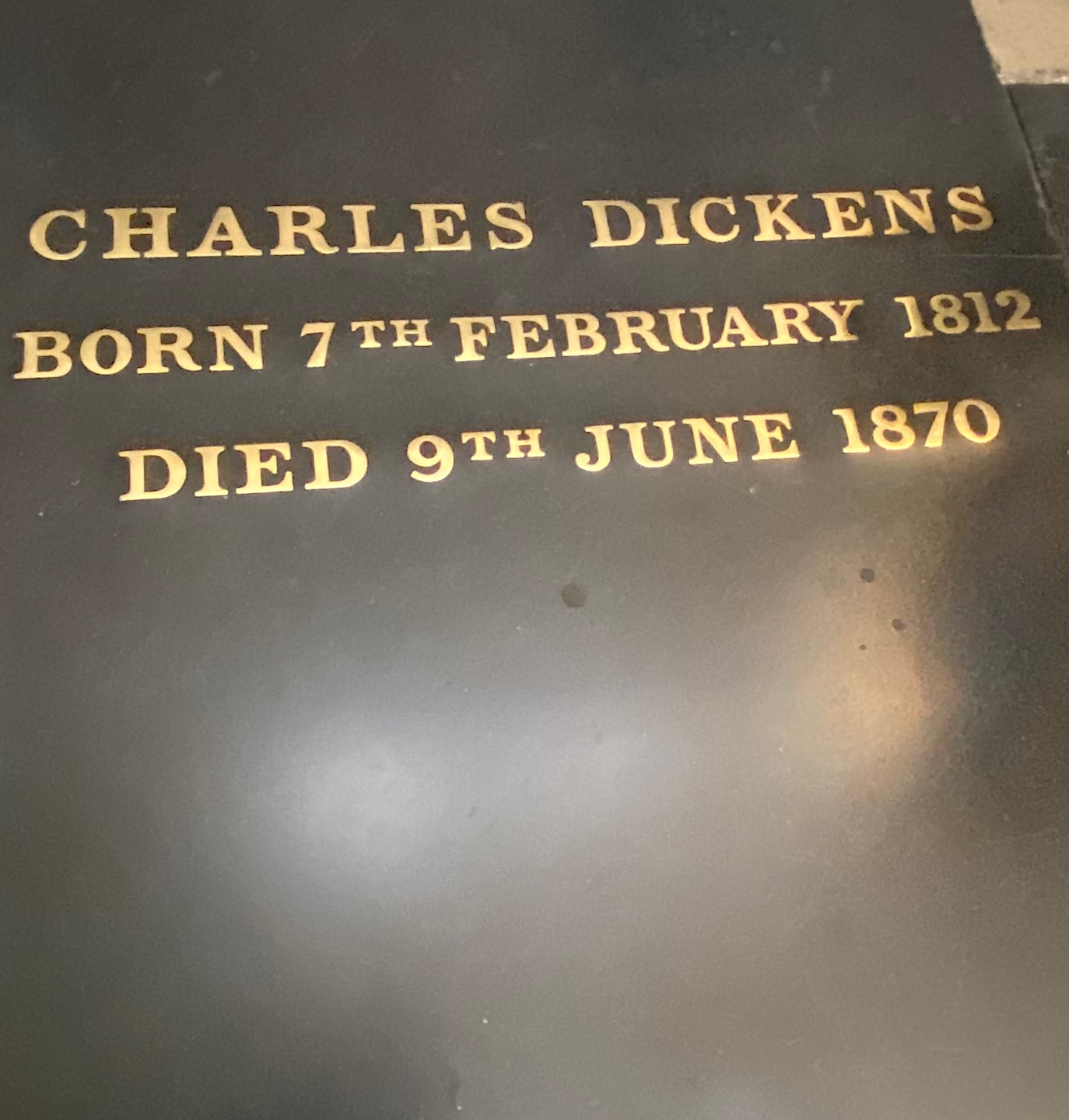
As an American accustomed to outdoor cemeteries, I found the tombs/graves of Westminster Abbey overwhelming and amazing all at once. The range of materials, along with the different sizes of monuments and memorials, had my head spinning. A single rectangle represented the author Charles Dickens, while an admiral I’d never heard of merited an enormous monument that could fill a small house.

Some feel that Dickens actually wanted to be buried in Rochester Cathedral, near where he died in 1870. But public opinion at the time demanded that Westminster Abbey was the only place for the burial of someone of his distinction.

Some say Charles Dickens wanted to be buried in Rochester, but he was interred in the Poets’ Corner of Westminster Abbey after a private funeral.

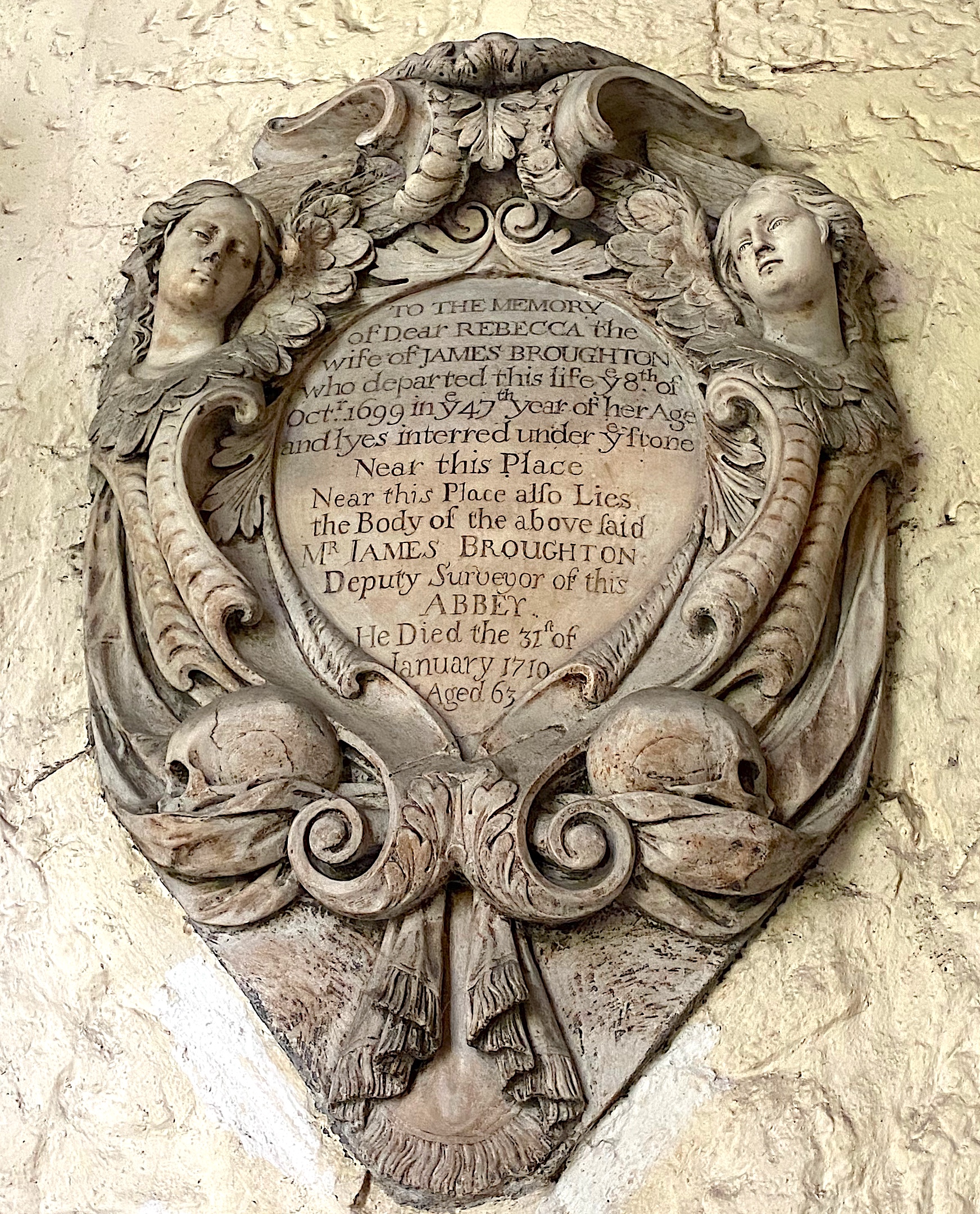
Also, you can look up at a wall in the East Cloister and see a memorial that just happens to include some skulls. While I’ve seen skulls on grave markers in New England cemeteries, that’s not something I’ve ever seen inside an American church.

Born around 1637, James Broughton was surveyor to the dean and chapter of Westminster, and was a deputy (under surveyor) to Sir Christopher Wren. He died in 1710 and is interred with his first wife, Rebecca, who died in 1699 at age 47.

There’s a great deal more to see at Westminster Abbey. So much more. I hope you’ll join me.

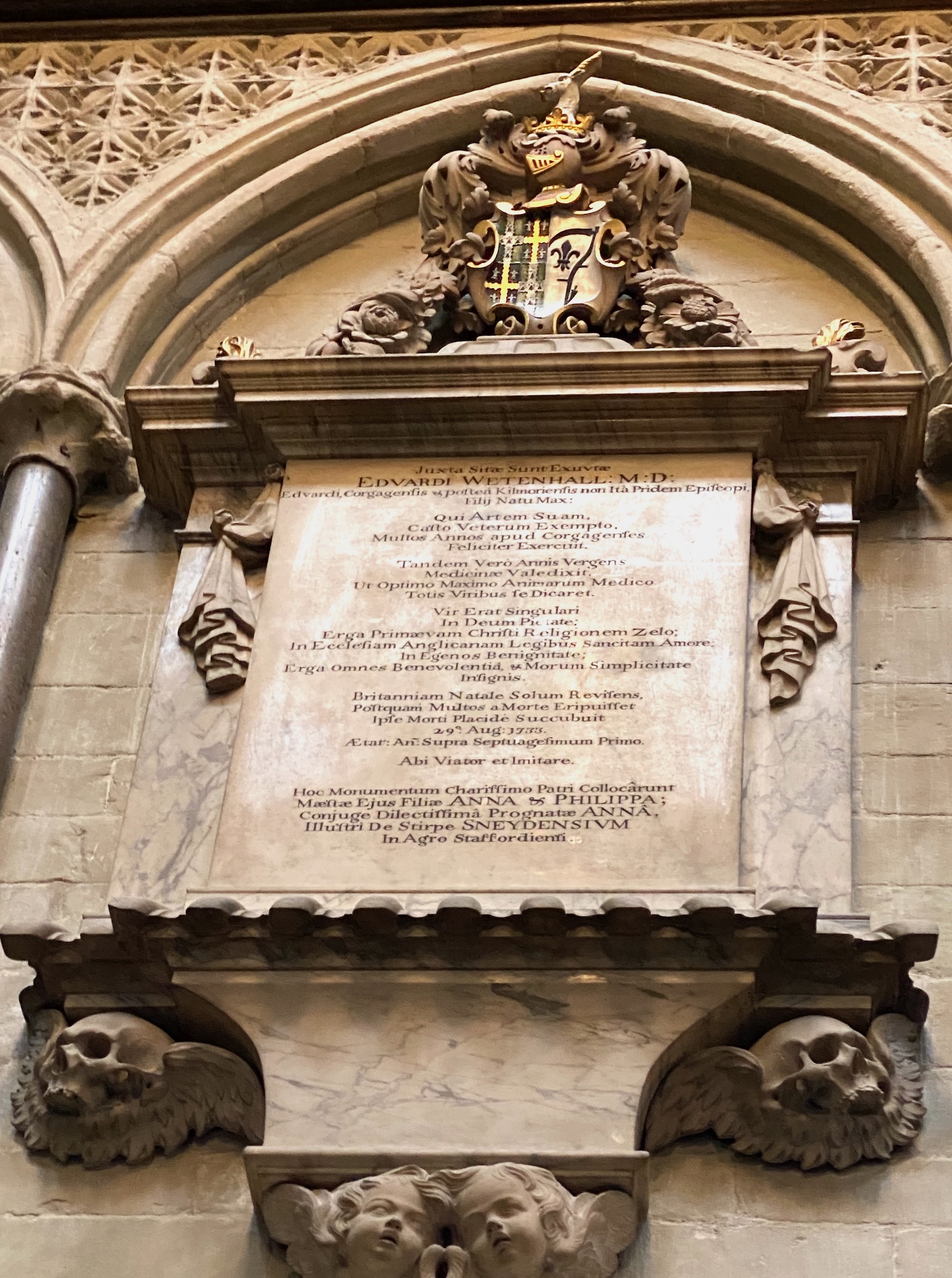
Located in the South Transept are the graves of Bishop Edward Wetenhall (1636-1713) and his son, Dr. Edward (1662-1733). Note the two winged skulls on the base.

Recent Posts

  • More Pensacola, Fla. Cemetery Hopping: Taking a Ramble Through Saint John’s Cemetery, Part III
  • More Pensacola, Fla. Cemetery Hopping: Taking a Ramble Through Saint John’s Cemetery, Part II
  • More Pensacola, Fla. Cemetery Hopping: Taking a Ramble Through Saint John’s Cemetery, Part I
  • The City of Five Flags: Stepping back in time at Pensacola, Fla.’s Saint Michael’s Cemetery, Part V
  • The City of Five Flags: Stepping back in time at Pensacola, Fla.’s Saint Michael’s Cemetery, Part IV

Archives

  • December 2025
  • November 2025
  • August 2025
  • July 2025
  • June 2025
  • May 2025
  • April 2025
  • March 2025
  • February 2025
  • January 2025
  • October 2024
  • August 2024
  • July 2024
  • June 2024
  • May 2024
  • April 2024
  • March 2024
  • February 2024
  • January 2024
  • December 2023
  • November 2023
  • October 2023
  • September 2023
  • August 2023
  • July 2023
  • June 2023
  • May 2023
  • April 2023
  • March 2023
  • February 2023
  • January 2023
  • December 2022
  • November 2022
  • October 2022
  • September 2022
  • August 2022
  • July 2022
  • June 2022
  • May 2022
  • April 2022
  • March 2022
  • February 2022
  • January 2022
  • December 2021
  • November 2021
  • October 2021
  • September 2021
  • August 2021
  • July 2021
  • May 2021
  • April 2021
  • March 2021
  • February 2021
  • January 2021
  • December 2020
  • November 2020
  • October 2020
  • September 2020
  • August 2020
  • July 2020
  • June 2020
  • May 2020
  • April 2020
  • March 2020
  • February 2020
  • January 2020
  • December 2019
  • November 2019
  • October 2019
  • September 2019
  • August 2019
  • July 2019
  • June 2019
  • May 2019
  • April 2019
  • March 2019
  • February 2019
  • January 2019
  • December 2018
  • November 2018
  • October 2018
  • September 2018
  • August 2018
  • May 2018
  • April 2018
  • March 2018
  • February 2018
  • January 2018
  • December 2017
  • November 2017
  • October 2017
  • September 2017
  • August 2017
  • July 2017
  • June 2017
  • May 2017
  • April 2017
  • March 2017
  • February 2017
  • January 2017
  • December 2016
  • November 2016
  • October 2016
  • September 2016
  • August 2016
  • July 2016
  • June 2016
  • May 2016
  • April 2016
  • March 2016
  • February 2016
  • January 2016
  • December 2015
  • November 2015
  • October 2015
  • September 2015
  • August 2015
  • July 2015
  • May 2015
  • April 2015
  • March 2015
  • February 2015
  • January 2015
  • December 2014
  • November 2014
  • October 2014
  • September 2014
  • August 2014
  • July 2014
  • June 2014
  • May 2014
  • April 2014
  • March 2014
  • February 2014
  • January 2014
  • December 2013
  • November 2013
  • October 2013
  • September 2013
  • August 2013
  • July 2013
  • June 2013
  • May 2013
  • April 2013
  • March 2013
  • February 2013
  • January 2013

Categories

  • General

Blogroll

  • A Grave Interest
  • Cemetery Photography by Chantal Larochelle
  • Cemetery Tours of Berlin by Matti
  • Confessions of a Funeral Director (Caleb Wilde)
  • Find a Grave
  • Hunting and Gathering (cool photography site)
  • Save Our Cemeteries (New Orleans, La.)
  • The Cemetery Club
  • The Graveyard Detective
  • The Rambling Muser
  • Westminster Abbey Tours by Grace

Meta

  • Create account
  • Log in
  • Entries feed
  • Comments feed
  • WordPress.com

Blog at WordPress.com.

  • Subscribe Subscribed
    • Adventures in Cemetery Hopping
    • Join 402 other subscribers
    • Already have a WordPress.com account? Log in now.
    • Adventures in Cemetery Hopping
    • Subscribe Subscribed
    • Sign up
    • Log in
    • Report this content
    • View site in Reader
    • Manage subscriptions
    • Collapse this bar
 

Loading Comments...