Many thanks to the amazing Grace Barrett of Tours by Grace for leading us through Westminster Abbey!
This week, let’s explore that area of Westminster Abbey known as Poet’s Corner. More than 100 poets/writers are buried or have memorials there. Some of the memorial “squares” on the floor indicate where the person is actually buried if they are not interred in the Abbey. But not all of them.
There are also several clergymen and actors buried in this transept, and composer George Frederick Handel.
I’ll warn you that you’re going to see a lot of feet in these pictures simply because it was very crowded and it couldn’t be helped.
Poet’s Corner is in the eastern aisle, the ‘corner’, of the south transept, although over time graves and memorials have spread across the whole transept. Chris took this picture.
Westminster Abbey’s First Poet Interment
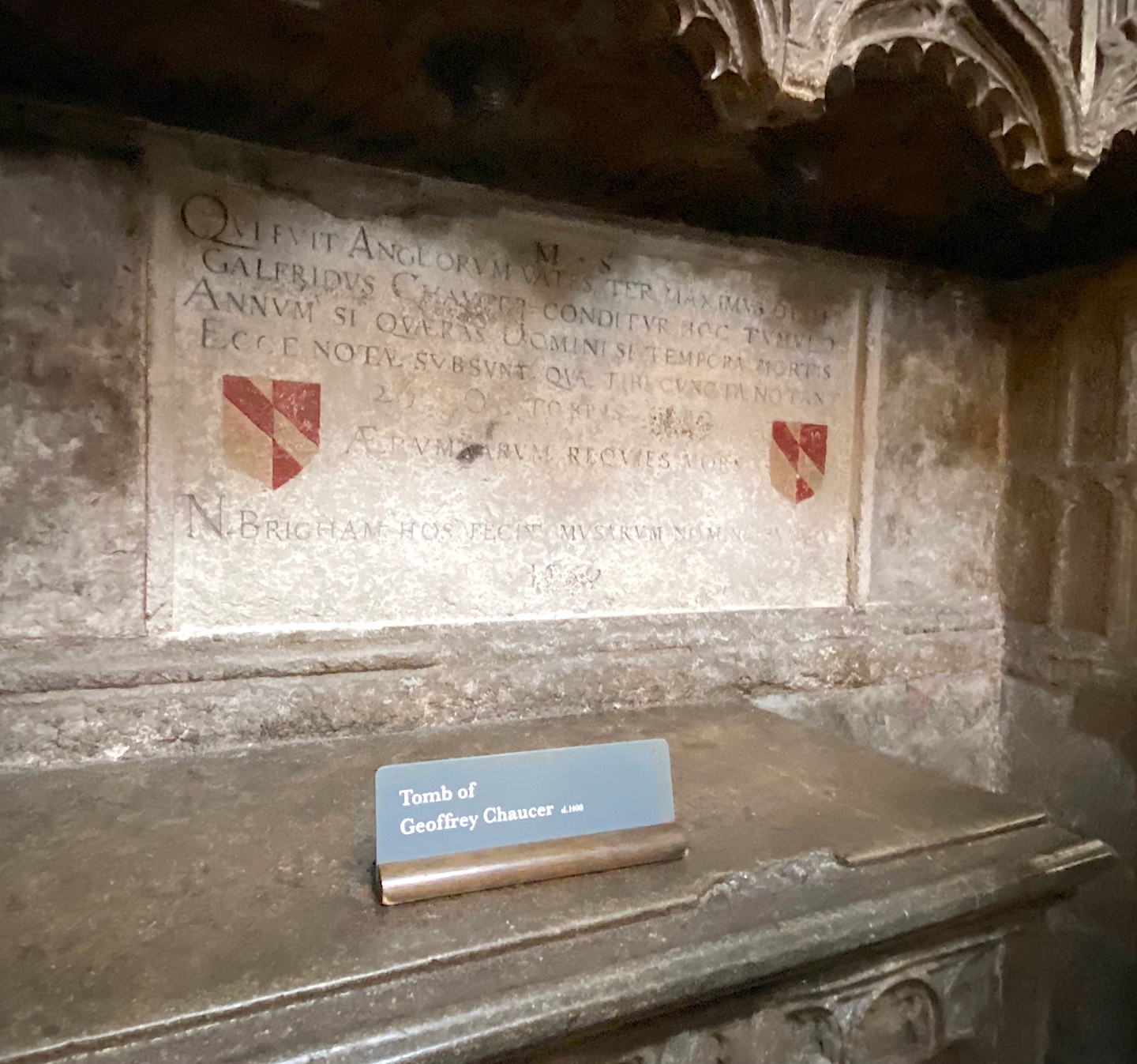
The first poet buried at Westminster Abbey in 1400 was Geoffrey Chaucer, author of “The Canterbury Tales”. However, it wasn’t due to his status as a writer but because because he was Clerk of the King’s Works. That means he organized most of King Richard II’s building projects.
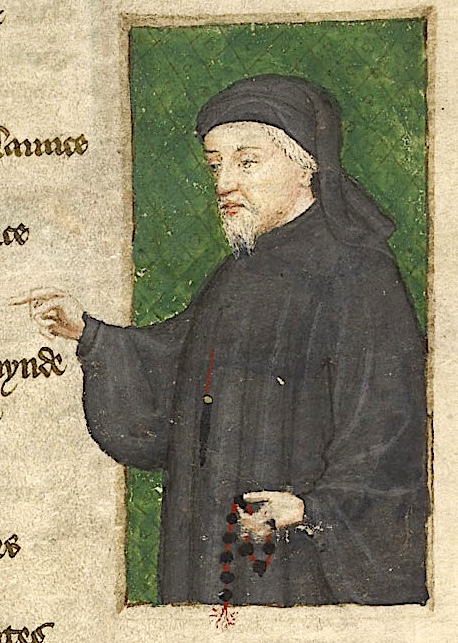
Portrait of Chaucer by Thomas Hoccleve in the Regiment of Princes (1412), who claimed to have personally known Chaucer.
No major works were begun during his tenure, but Chaucer oversaw repairs on Westminster Palace, St. George’s Chapel, Windsor, and continued building the wharf at the Tower of London. Chaucer was also comptroller of the customs for the port of London from 1374 to 1386. To have had that job for 12 years indicates he was quite good at it.
Chaucer obtained the job of comptroller of the customs for the port of London, which he began on June 8, 1374. He continued in that role for 12 years, a long time in such a post at that time.
It would be 200 years later when Edmund Spencer (1553-1598) was interred at Westminster Abbey. He wrote “The Faerie Queen” for Queen Elizabeth I, one of the longest poems in the English language. He asked to be buried near Chaucer. I did not get a photo of his memorial, unfortunately.
So how does one get included in Poet’s Corner? The Deans of Westminster decide who receives a place based on merit, although they consult widely. Poets’ Corner proper is in the eastern aisle, the ‘corner’, of the south transept, though over time graves and memorials have spread across the whole transept.
Graham Jones designed a new window above Chaucer’s tomb in Poets’ Corner to allow memorials to poets and writers to be added to it in the future.
In the picture above that Chris took, you can see more recent memorials to Alexander Pope, Robert Herrick, A.E. Housman, Oscar Wilde, Christopher Marlowe, Fanny Burney and Elizabeth Gaskell. There is room for more to be added in the future. None of them are actually interred at Westminster Abbey.
Who’s Really Here?
I’m glad you asked! I’m going to show you photos of memorials of those folks who are truly interred at the Abbey. It’s just a sampling, mind you. I’ve included some that stand out for various reasons. I’ve already shared the grave of Charles Dickens, so I won’t talk about him again.
A recording of Olivier reading an extract from Act 4 of Shakespeare’s Henry V was played during the service, the first time the voice of the deceased had been heard during their memorial service in the Abbey.
Actor Sir Laurence Olivier died on July 11, 1989 but his ashes were not buried there until Sept. 16, 1991, at a private ceremony. He was 82. A memorial service was held in the Abbey on Oct. 20, 1989.
A recording of Olivier reading an extract from Act 4 of Shakespeare’s Henry V was played during the service, the first time the voice of the deceased had been heard during their memorial service in the Abbey.
His memorial stone was unveiled on Sept. 23, 1991 by Sir John Gielgud. The stone of Westmorland green slate was cut by Ieuan Rees. Gielgud’s ashes (he died in 2000) were buried beside him. (See photo below.) Gielgud specifically requested that no memorial service be held for him.
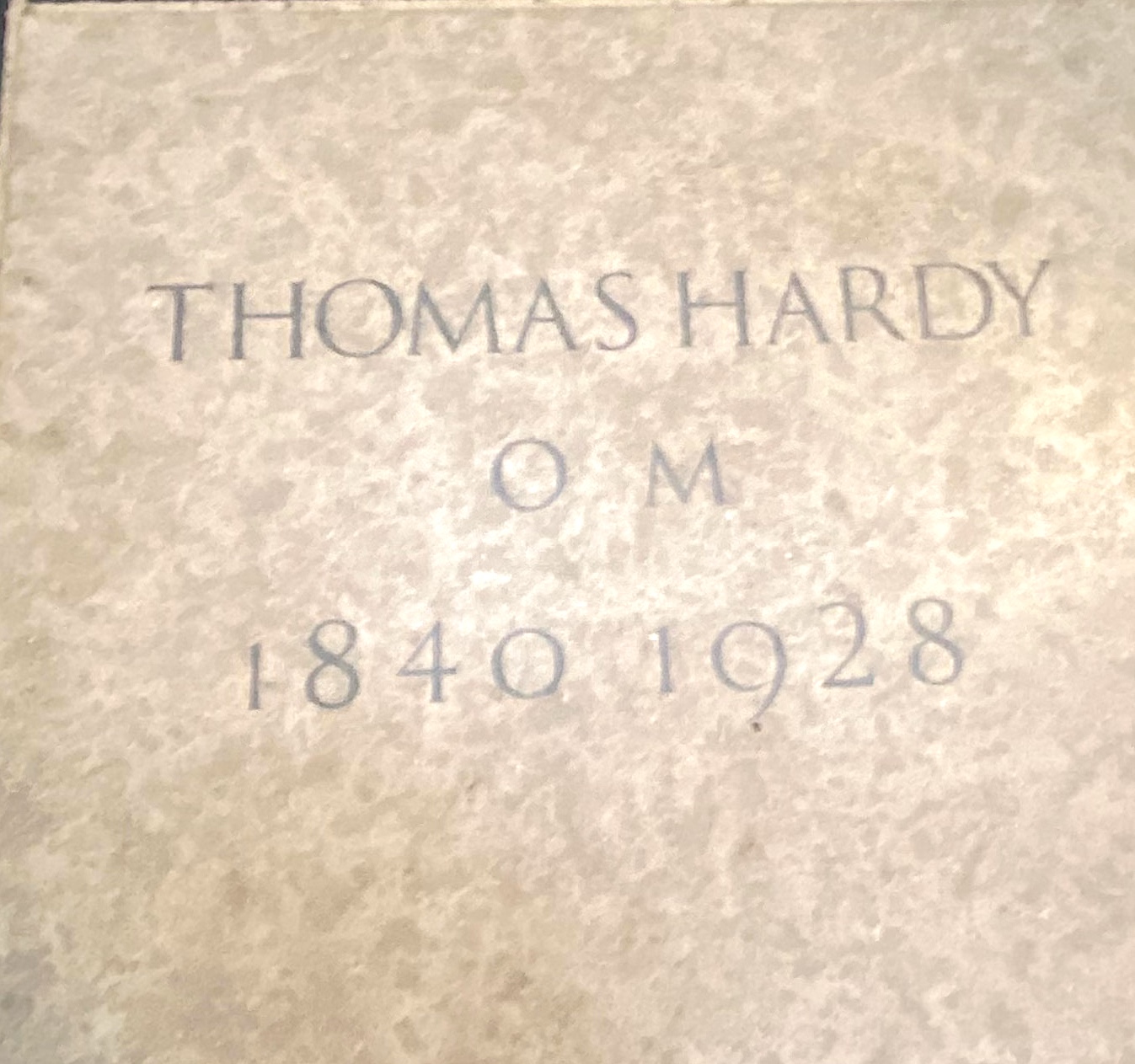
The “OM” stands for Order of Merit.
Sir John Gilgud died on May 21, 2000 and was cremated at Oxford. He specifically requested that no memorial service be held for him.
Alfred, Lord Tennyson
At last an actual poet!
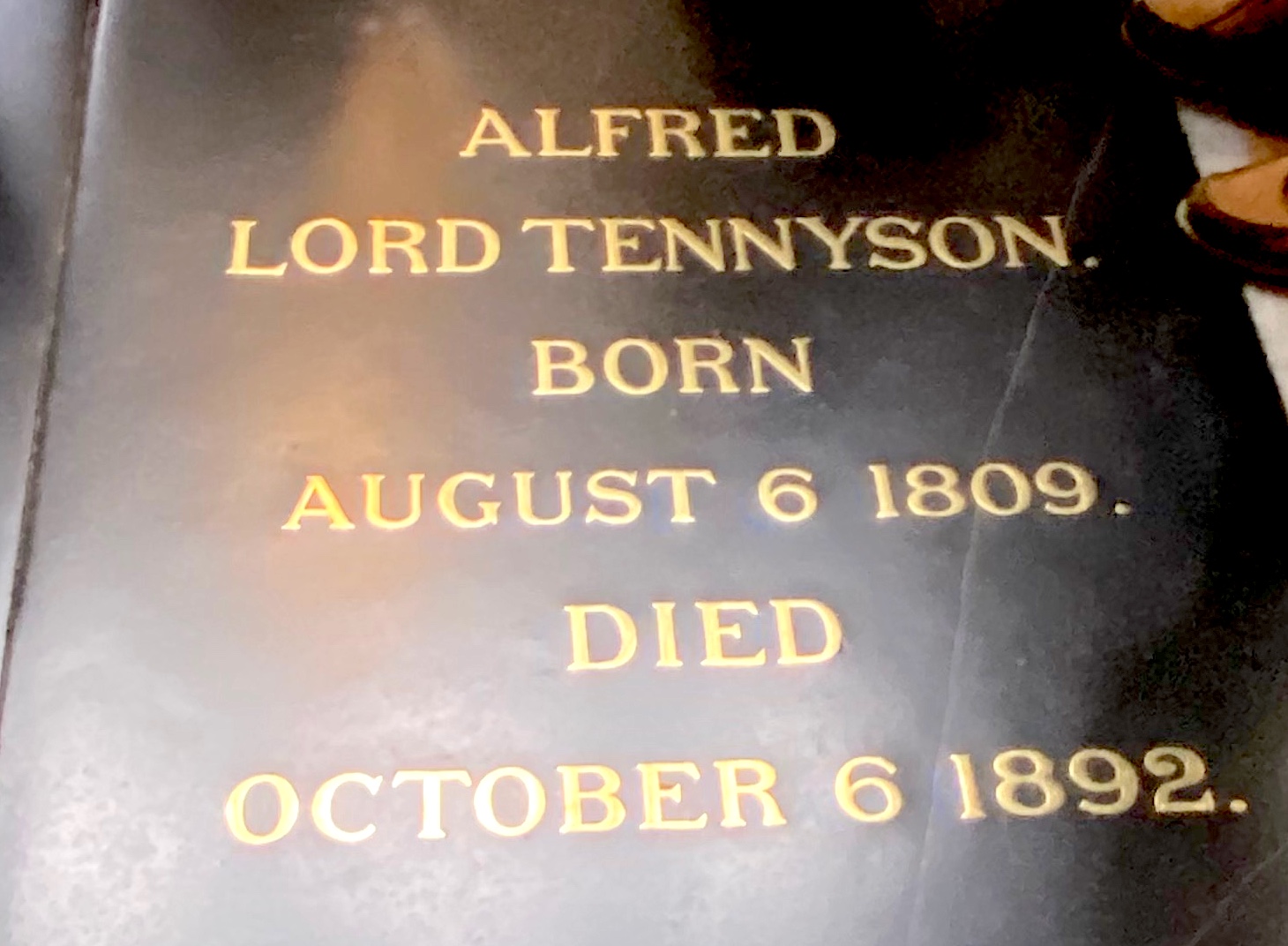
Alfred, Lord Tennyson, Poet Laureate, died on Oct. 6, 1892. On Oct. 11, his coffin was brought to Westminster Abbey and lay overnight in St. Faith’s chapel (just off the south transept). The chapel was hung with purple and the Union Flag covered the coffin. Queen Victoria’s tribute was a laurel wreath containing an inset lyre.
The funeral held the next day was attended by thousands of mourners. The Abbey organist, Frederick Bridge, set to music words from Tennyson’s poem “Crossing the Bar”. It’s one of my favorites and I see quotes from it on a number of grave markers I’ve photographed
In 1895, a bust of the poet, by Thomas Woolner, was placed on a pillar nearby. I didn’t get a picture of it but you can see it here.
Rudyard Kipling
Most people remember writer/poet Joseph Rudyard Kipling (1865-1936) because he wrote The Jungle Book in 1894. But he also wrote Plain Tales from the Hills, Soldiers Three, Kim, and Wee Willie Winkie.
His poems include “Mandalay” (1890), “Gunga Din” (1890), “The Gods of the Copybook Headings” (1919), “The White Man’s Burden” (1899), and “If—” (1910).
In 1907, Kipling was the first English writer to receive the Nobel Prize for literature. He was one of the first members of the Imperial (now Commonwealth) War Graves Commission. He died at age 70 on Jan. 18, 1936 after an operation for a perforated ulcer.
Rudyard Kipling was born in Bombay, India in 1907.
Thomas Hardy
Located just below Kipling is the grave marker of author/poet Thomas Hardy (1840-1928). I imagine many people remember having to read his book Return of the Native in English back in high school
In my case, I started reading Hardy’s books out of curiosity as a teenager and fell in love with how he wrote. I’ve read every one of them. Many, such as Far from the Madd’ing Crowd, Tess of the D’urbervilles, Jude the Obscure, and yes, Return of the Native, have been made into films over the years.
Hardy’s “square” is located just below that of Rudyard Kipling.
Most of Thomas Hardy is interred at the Abbey, but not his heart.
Hardy’s funeral at the Abbey was on Jan. 16, 1928. It caused quite a stir because he’d wanted his ashes to be interred at Stinsford in the same grave as his first wife, Emma. His family and friends agreed. However, his executor, Sir Sydney Carlyle Cockerell, insisted that he be placed in Poets’ Corner. A compromise was reached whereby his heart was buried at Stinsford with Emma, and his ashes in Poets’ Corner.
I didn’t know this when I was reading his novels years ago, but there’s another reason I must have felt a kinship to Hardy. In the mid-1860s, he was in charge of the excavation of part of the graveyard at Old Church St. Pancras in London in the course of the construction of the Midland Railway’s London terminus, St. Pancras station. So he spent a lot of time in a cemetery just like me!
Samuel Johnson
Samuel Johnson (1809-1784) is not a name that might ring a bell to you but for English majors like me, it does. We have Johnson to thank for his great Dictionary of the English Language.
I studied Johnson while getting my master’s in English literature at the University of Georgia, and he led a rather roller coaster life of many ups and downs.
The inscription reads: “Samuel Johnson, Doctor of Laws, died 13 December in the year 1784, aged 75.”
After failing at being a schoolmaster, he came to London in 1737, with his friend David Garrick (the famous actor buried next to him). In 1735, he married widow Elizabeth Porter (she died in 1752). After periods of poverty and ill health, he made his name with essays entitled The Rambler and published his great Dictionary of the English Language in 1755. One of his last great works was The Lives of the Poets. He died on Dec. 13, 1784 at age 75.
In 1790, the Dean and Chapter gave permission for erection of a monument to Johnson but this was never actually put up. According to Westminster Abbey’s web page, a statue was erected at St. Paul’s cathedral in 1796 and this might have been the monument which had been intended for the Abbey.
Later on in the day that we visited Westminster Abbey, we visited the crypt at St. Paul’s Cathedral (which I will be writing about later). I got to see the very monument they mentioned (pictured below).
This statue of Samuel Johnson at St. Paul’s Cathedral may have been meant for Westminster Abbey.
George Frederick Handel
I certainly can’t leave out German-born composer George Frederick Handel (1685-1759).
Born at Halle in Saxony in 1685, Handel made his first visit to London in 1710. In 1727, he was naturalized as an Englishman by Act of Parliament.
Handel was blind at the time of his death in 1759.
Handel started three commercial opera companies to supply the English nobility with Italian opera. In 1737, after a physical breakdown, he transitioned to English choral works. After his success with Messiah (1742), he never composed an Italian opera again.
His orchestral Water Music and Music for the Royal Fireworks remain popular today. One of his four coronation anthems, Zadok the Priest, has been performed at every British coronation since 1727.
Monument to Geore Frederich Handel, created by Louis Francois Roubiliac).
Three days before he died in 1759, Handel signed a codicil to his will saying he hoped to be buried in the Abbey and desired that his executor erect a monument for him. He got his wish. The Abbey’s web site describes it like this:
On the wall above his grave is a fine monument by the sculptor Louis Francois Roubiliac (with the same inscription as on the stone but with the dates in Roman numerals). The life-size statue, unveiled in 1762, is said to be an exact likeness as the face was modeled from a death mask. Behind the figure, among clouds, is an organ with an angel playing a harp. On the left of the statue is a group of musical instruments and an open score of his most well-known oratorio Messiah, composed in 1741. Directly in front of him is the musical score I know that my Redeemer liveth. The index finger of his left hand had been missing for a long time and a new one has recently been sculpted to replace it.
Who’s NOT Buried at Westminster Abbey(But Has a Memorial)
You can get a glimpse of a bust of Samuel Johnson in this picture (lower left) of this wall of poets/playwrights. He’s the only one in that group interred at Westminster Abbey.
Notably, Shakespeare is buried at Holy Trinity Church, Stratford upon Avon in Warwickshire. Robert Burns is buried in St Michael’s churchyard, Dumfries, Scotland. Poet John Keats died of tuberculosis in Rome in 1821 and was buried in the Protestant cemetery there. Poet Percy Shelley died in 1822 in Italy, drowned while sailing and his body washed ashore at Viareggio. His ashes were placed in the Protestant cemetery in Rome.
Shakespeare, Burns, Keats, Shelley, Austen, Thomson, and Southey are not interred at Westminster Abbey. But Samuel Johnson is.
Author William Makepeace Thackeray (1811-1863), best known for his novel Vanity Fair, is not buried at Westminster Abbey. But he has a bust done by sculptor Carlo, Baron Marochetti. A petition to the Dean of Westminster for permission to erect a memorial was signed by Charles Dickens and many other authors and artists of the day. The monument was paid for in 1865.
Vanity Fair author William Thackeray (1811-1863) is buried at Kensal Green Cemetery in London.
Thackeray is actually buried in Kensal Green cemetery in London.
There are many, many more poets/composers/playwrights/artists and such that I could talk about with memorials at the Abbey, but you can look them up if you’re curious.
Next week, I will try to wrap things up at the Abbey with Part VIII, but there are no guarantees.
Author/theologian C.S. Lewis is probably best known for his Narnia series of books. This is a memorial stone unveiled at the Abbey 50 years after his death in 2013. He is buried in the cemetery at Holy Trinity Church in Headington, Oxford. We did visit his grave earlier in the week and I’ll write about it later.







 Adventures in Cemetery Hopping