• About Me
  • Cemeteries I Have Visited
  • Have questions?
  • Photos

Adventures in Cemetery Hopping

~ A blog by Traci Rylands

Adventures in Cemetery Hopping

Monthly Archives: August 2024

Close to Home: Visiting Fayette County, Ga.’s Antioch Baptist Church Cemetery

28 Wednesday Aug 2024

Posted by adventuresincemeteryhopping in General

≈ 2 Comments

The next stop on my Fayette County, Ga. cemetery hopping adventure was Antioch Baptist Church Cemetery. Just down the rode from Woolsey Cemetery. The Sams surname is also here, along with Spurlin, Morris, Callaway, and Whitaker.

This cemetery stands out because it has two parts. When Antioch Baptist Church was established on March 5, 1829, five of the 19 charter members were black. The rest were white. While the cemetery is now integrated, it was segregated at the time of the church’s formation.

I found online the original list of charter members of the church and the first names of those five black members are listed, and who they are a “servant” of. No last names. I assume that means they were slaves unless they were free persons of color (FPOC), who did exist at that time. But most FPOC at would have had their last names listed and they wouldn’t have been servants for whites. They also lived in large cities like Savannah and Charleston, S.C. A few lived in Atlanta. Not in a tiny town like Woolsey.

Antioch Baptist Church, established in 1829, is unique in that some of its charter members were slaves.

From what I can tell, black and white members were buried separately. It looks like someone had done ground penetrating radar (GPR) and crosses were placed on unmarked graves. I don’t know what the different colors signify (blue/red/white). Among them are a handful of stone markers with names/dates. According to the sign (see above), the first person of color was buried there in 1848.

Sadly, I could find very little information about the few people who do have stones here. One example is Clifford Watkins. She was the daughter of Lizzie and John Tombs. She died on Sept. 30, 1911. So she was only 18 when she died. Her grandparents (and possibly her parents) were likely slaves.

Clifford Watkins was only 18 when she died in 1911.

I had better luck with Pinkie Ray, the wife of Charles Ray, whom she married at 15. According to the 1910 Census, the couple had seven children. Pinkie died at at age of 32 in December 1918. Her cause of death may have been Spanish Flu.

Pinkie Ray was a mother of seven children when she died in 1918.

Because there are no dates on this stone, I could find nothing about Charaty Whitaker. I only know that she was 60 when she died.

Charaty Whitaker was 60 when she died.

As you might imagine, the number of white grave markers was much higher. Find a Grave has about 600 memorials recorded, with the earliest being an infant grave from 1830.

Antioch Baptist Church Cemetery appeared to be in “mid mow” when we visited in October 2019. Some parts were and others were not.

The Sams Family

The grave marker for Julia Sams got my attention because it is cross-shaped and has that woodsy Arts and Crafts style that was common during the era. The daughter of Christopher Columbus “Lum” Sams and Sarah Martha Ozborn Sams, Julia was born on Feb. 4, 1867.

Julia Sams was only 30 when she died in 1997.

Julia’s obituary explained that she had long suffered from consumption (tuberculosis) and this it was the cause of her death on Nov. 4, 1897.

Julia died on tuberculosis, although it was called consumption at that time.

Her father’s large marker is nearby and it made me curious to know more about the man who had been named after the famous Italian explorer. As I began to look at the family tree, it got interesting quickly.

Julia’s mother, Sarah Martha Ozborn, first married Lum’s older brother Lt. William Joseph Sams. They had five children together before William died at age 29 in Virginia during the Civil War in 1862. A first lieutenant in the Confederate Army, he served in the the Georgia 27th Infantry, Co. E. He is buried at Antioch Cemetery but I did not get a photo of his grave marker.

Lum’s first wife was Martha Whitaker Sims, and they wed in 1858. She died on Oct. 5, 1860 after giving birth to their second son, Matthew. Lum then married his brother’s widow, Sarah, in July 1865. The couple had six children together, with Julia being the eldest. So not only were their combined children half-siblings, they were also cousins.
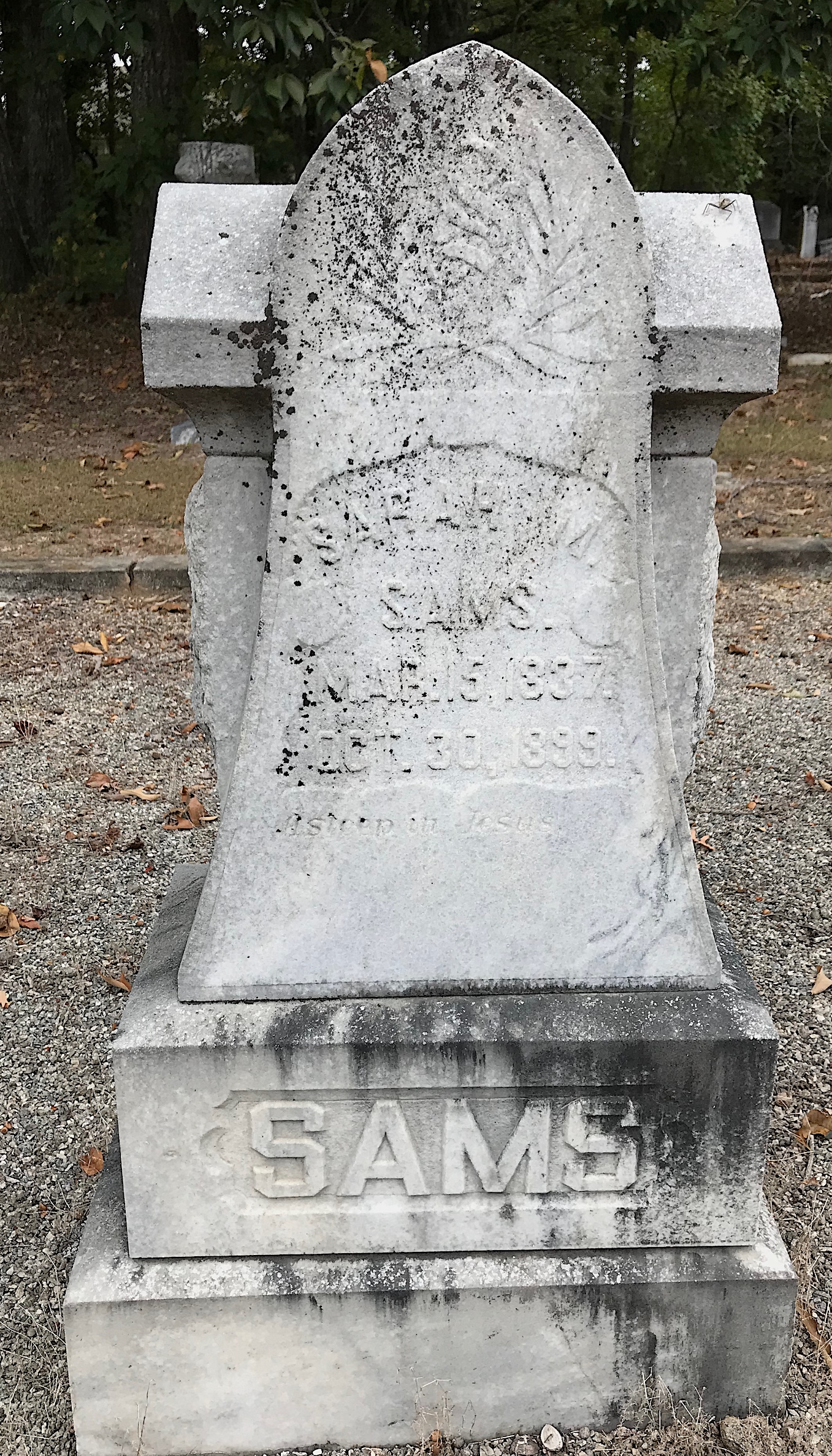
Sarah Ozborn Sams Sams (yes, that’s correct) died at age 62 in 1899.

Like his brother, Lum served in the Confederacy during the Civil War but with the Second Battalion of the Georgia Infantry. From what I can tell, he amassed a good bit of property over the years in Fayette, Clayton, and Coweta Counties.

Sarah died at age 62 in 1899. There may have been a third Mrs. Sams but I do know that his last wife was Eliza Connelly, who he married in 1908. Lum died on March 16, 1910, according to his obituary. He was 74. The obituary also said Lum was married four times, which is why I mentioned a potential third Mrs. Sams.
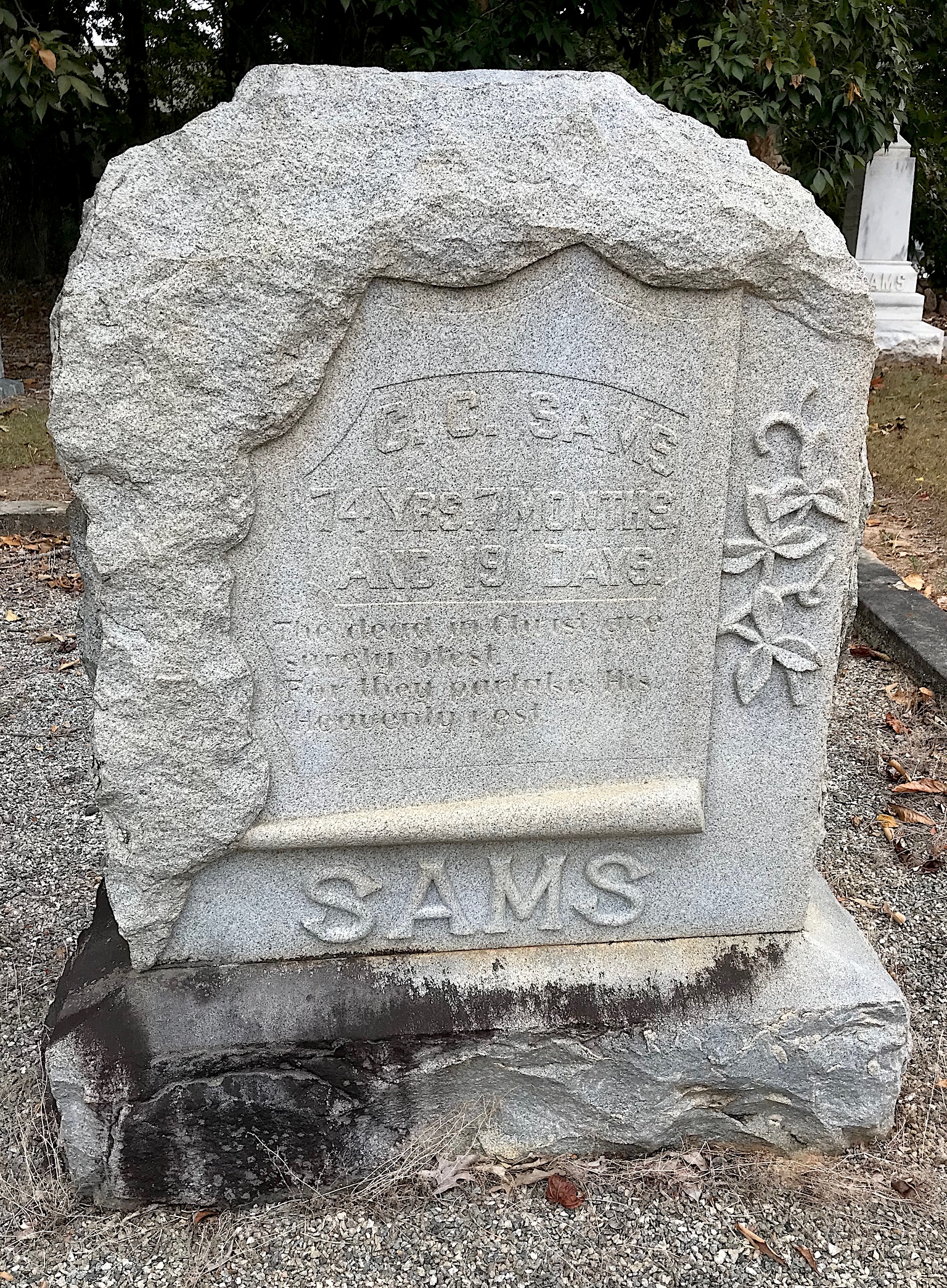
Was Lum Sams married four times?

I noticed there was a tree-shaped marker for a Lum Ballard and wondered if he was connected to Lum Columbus. He is. Lum’s step-daughter (and niece) Ada Elvira (born in 1855), named her son after him.

The son of Ada and her husband, Washington Augustus Ballard, Lum Ballard born on Feb. 3, 1879. He married Lois Wallace in July 1901. They had a son, whom was also named Christopher Columbus “Lummie” Ballard. Lum (his father) died on Dec. 6, 1902 at age 23. His obituary did not mention his cause of death.
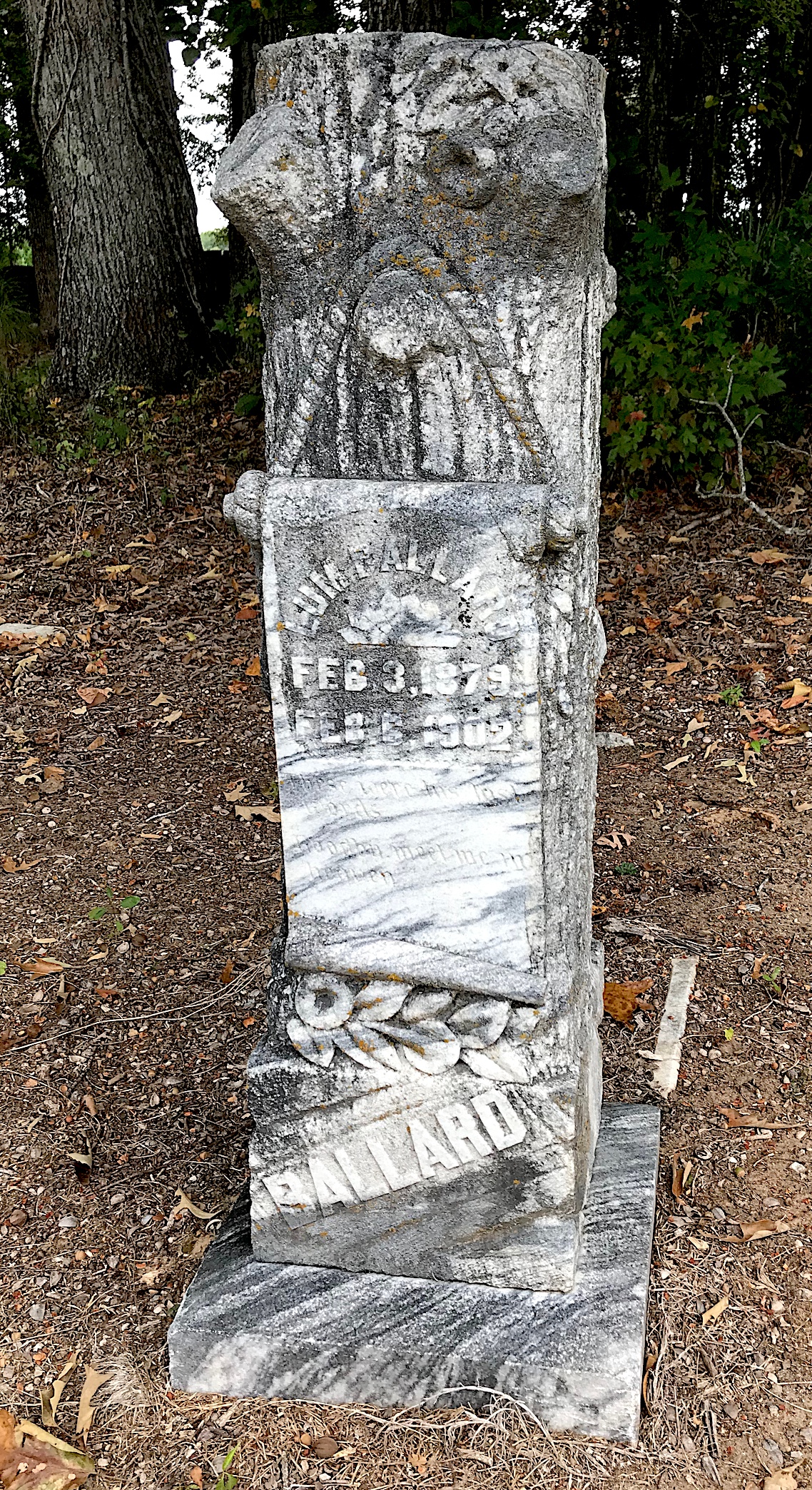
Lum Ballard’s cause of death is unknown. He was only 23.

Ada’s brother, Matthew, born in 1853, has one of the handsomest monuments in the cemetery. That often indicates wealth or a remarkable death. I was right about that, as I soon learned.

An Abrupt Death

Matthew was a much-respected farmer in Fayette County. He married Ida Gay in 1873 and the couple had several children together. His nickname was Babe. Then I found this article about his death, which happened on Dec. 6, 1900.

Matthew “Babe” Sams life ended abruptly on Dec. 6, 1900.

I don’t know what happened to Will Patterson or if he was charged in any way. He may have claimed self defense in the matter.

You might recognize the last name of Gay. Ida, Matthew’s wife, was the niece of the Gay siblings I wrote about last week that are buried at Woolsey Cemetery. She did not remarry after her husband’s death. She died at age 77 in 1933 and is buried with Matthew.

Ida Gay Sams did not remarry after her husband’s violent death in 1900.

Rev. James Spurlin

Born in North Carolina in 1802, James M. Spurlin wed Mary “Polly” Ann Williams in Jasper, Ga. in 1826. They moved to Chambers, Ala. and began raising a family. According to his Find a Grave memorial, James was a missionary to the Creek Indians at some point. He was ordained in the ministry in 1842 and served as pastor of High Pine Baptist Church in Randolph County, Ala.

By the 1850s, the Spurlins had moved to Troup County, Ga. and Rev. Spurlin was pastor of State Line Baptist Church. Sometime in the 1850s, they moved to Fayette County. According to minutes I found, Rev. Spurlin was appointed the superintendent of Antioch Baptist Church’s Sunday School in 1859.

Rev. James M. Spurlin was 85 at the time of his death.

He served as a private in the 13th Georgia Infantry, Co. F, during the Civil War. Some of his sons also served. I believe at some point, he became pastor of Antioch Baptist Church. But he was also a farmer.

Rev. Spurlin died on July 30, 1887 at age 85. I was not surprised to find that the Rev. Isaac G. Woolsey, pastor of Woolsey Baptist Church, preached the sermon at his funeral. I have no doubt the two men were likely good friends.

Rev. Spurlin is buried beside his youngest son, Reuben, who died just a few months later on Oct. 16, 1887 at age 36. Polly Spurlin died at age 84 on April 6, 1892. She is buried with her husband and son.

Confederate Widow

I was taken with the style of Keziah Callaway’s marker and had to find out more about her.

Born in Hancock County in 1832, Keziah was the daughter of Elijah and Edna Turner. She grew up in Dekalb County and married William Monroe Callaway at some point before 1856, when their son Thomas Jefferson Callaway was born. The couple had a daughter, Mary Jane, in 1859. They settled in Webster County.

During the Civil War, William served in the Seventh Georgia Infantry, Co. K. His stone says he was a sergeant but records indicate he was a private. He died on Jan. 7, 1862 in a hospital in Richmond, Va. He is buried in Oakwood Cemetery in Richmond. He was 25 when he died.

Keziah Turner Callaway became a young widow in 1862. S

I’m guessing that Keziah had family in Fayette County and moved her children from Webster County to Woolsey be closer to them. There is a marker for a Keziah Malinda “Kissie” Morris Turner (1847-1922) at the cemetery. Turner was Keziah Callaway’s maiden name.

When I looked at the 1870 U.S. Census, Keziah Callaway was living next door to the J.G. Morris family. J.G. Morris was Kissie Turner’s father. His wife was Sarah J Callaway Morris. Perhaps Sarah was related to Keziah’s late husband William Callaway.

Keziah Callaway died on March 9, 1877 at the age of 44. That same year, her son Thomas married Telitha Preston. Her daughter, Mary Jane, wed Telitha’s brother Oliver Preston in 1882.

I’ve got a few more stops to make on my Fayette County “hop” so join me for another next week.

The child of Mattie Barfield Peoples (Peeples) and Leonard E. Peeples was born Dec. 1, 1903 and died 10 days later. Mattie died two years later on Jan. 11, 1905 at age 27.

Close to Home: Exploring Fayette County, Ga.’s Woolsey Cemetery

16 Friday Aug 2024

Posted by adventuresincemeteryhopping in General

≈ Leave a comment

After spending eight posts talking about London’s prestigious Westminster Abbey, I’m downshifting to a much smaller burial ground that’s much closer to home.

On Oct. 9, 2019, I spent a day cemetery hopping around Fayette County, Ga. with my mother, Jenny. You may recall that I wasn’t born in Georgia but in Ohio. We moved to Fayette County in the 1970s when I was a child due to a job transfer my Dad took because it was move or lose his job. But I wasn’t interested in cemeteries in my younger days, so I hadn’t visited that many. It was time to remedy that.

Historic Woolsey Church Cemetery

The first place we stopped was Woolsey Cemetery. Woolsey’s always been a tiny town and these days, it has about 200 or so residents. The surnames of Woolsey, Ballard, Gay, Sams, and Peeples, sprinkled throughout the cemetery, can be found in all of my school yearbooks.

This is an undated photo of the Woolsey Church that belongs to the Fayette County Historical Society. It was taken before 1950 when they replaced the two separate doors with a centered double door.

The cemetery is located next to Historic Woolsey Church. It began as Harmony Grove Missionary Baptist Church on Aug. 26, 1888 with 23 charter members. On Oct. 2, 1904, they changed the name to Woolsey Baptist Church. It’s now called Historic Woolsey Baptist Church to avoid confusion with another Woolsey Baptist Church, which opened later.

I didn’t get a good photo of the church when I was there. This one below was taken in February 2023 by Gary Laggis. Just a month after I visited in 2019, locals formed a group called Friends of Historic Woolsey, Inc. This week, I explored their web site, and learned much more about the cemetery and community.

Here’s what Historic Woolsey Church looked like in February 2023. The annex (on the right) was added in 1963. (Photo Source: Gary Laggis)

The Friends of Historic Woolsey are doing a bang up job getting the church building restored and making improvement to the cemetery. They’ve done GPR (ground-penetrating radar) on the grounds and discovered about 40 unmarked graves. Find a Grave currently lists about 186 memorials.

According to the Friends, the cemetery was originally called Thomas Bolling Gay Burial Ground, based on genealogical research and personal journals. Two of Thomas’ children were buried there in the 1830s. In 1875, Gay’s heirs sold the land to Dr. Isaac G. Woolsey who permitted members of the community to be interred in the cemetery.

Who was Dr. Isaac Woolsey?

When I dove into the life of Dr. Woolsey, I was surprised to find what a unique fellow he was. It’s not often you encounter a man who was a doctor AND a pastor. He cared for both bodies and souls.

Born in 1828 in Kentucky, Isaac was raised in Fentress County, Tenn. After teaching school there for a time, he graduated from the Cincinnati College of Medicine and Surgery, and practiced medicine in Fentress County until 1861.

Dr. Woolsey was married in 1852 to Clemanza Reagan, who died in 1862, leaving five children. She is buried in Beaty Cemetery in Moody, Tenn. Three of their adult children are buried at Woolsey Cemetery.

During the Civil War, Dr. Woolsey enlisted in the Confederacy as a quartermaster, and served until August 1862, when he organized Company C, 8th Tennessee Confederate Cavalry, in which company he served as captain in Gen. Nathan Bedford Forrest’s division until the Battle of Chickamauga in September 1863. It was there he was severely wounded and resigned his commission. He wed his second wife Arvazena “Arva” Hutchinson Wood the same year.

The tiny town of Woolsey, Ga. was named after Dr. Isaac G. Woolsey. He was both a physician and a pastor.

The Woolseys moved to Henry County, Ga. and he practiced medicine in Locust Grove. In 1864, Dr. Woolsey also became an ordained minister. Over the years, he usually served three or four churches at a time. In the 1870s, he returned to Cincinnati to improve upon his early medical training.

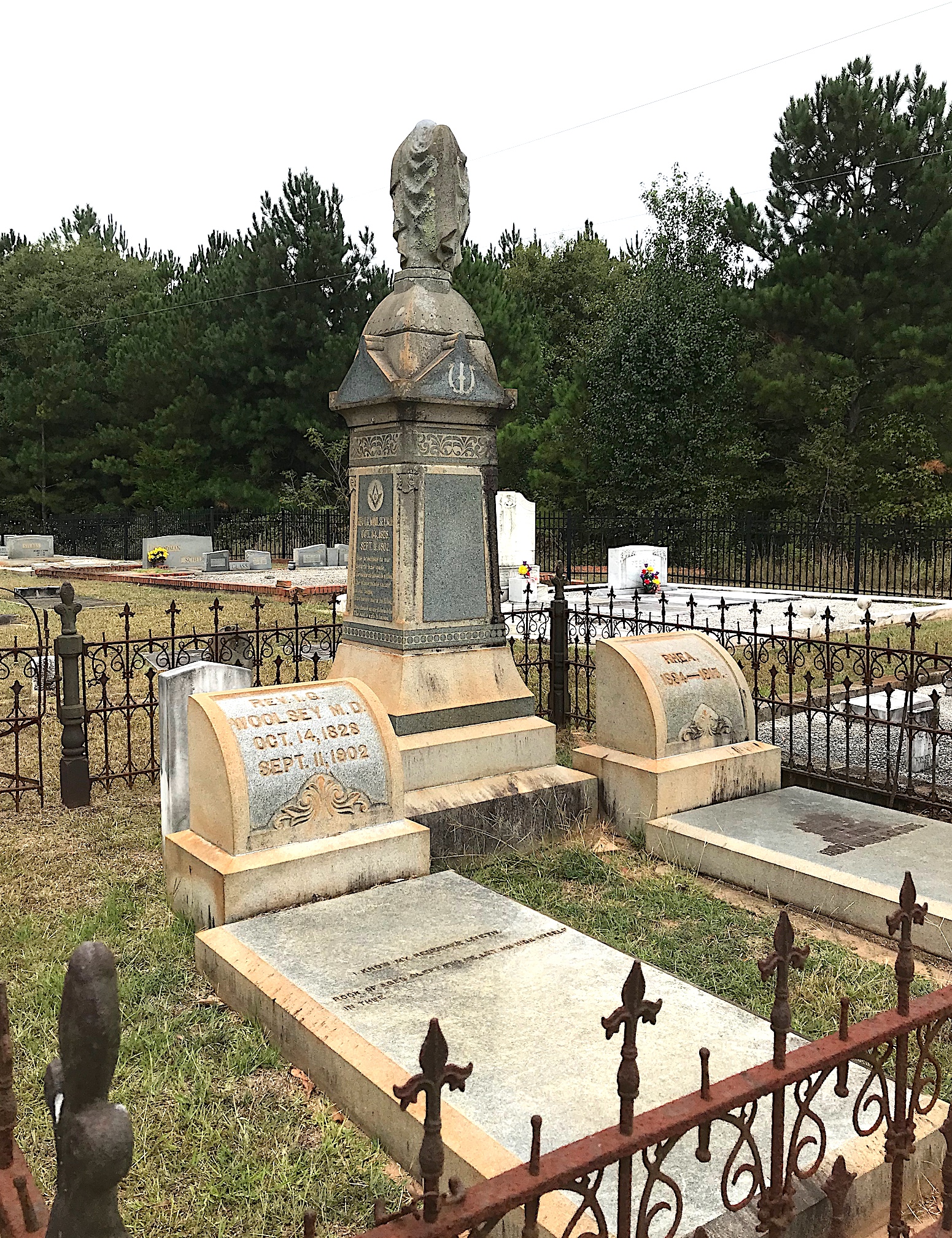
Dr. Woolsey’s plot is surrounded by a handsome fence. His second wife, Arva, who died in 1915, is buried to his right.

The community in Fayette County in which he lived in his later years was incorporated as Woolsey in his honor in 1893. When his health began to decline, he limited his pastoral duties to Woolsey Baptist Church. He died on Sept. 11, 1902 of heart failure at age 73. Arva died in 1915 and is buried beside him.

Dr. Woolsey is one of the few doctors I know of that was also a pastor.

Dr. Woolsey’s daughter Isabella married James Lewis in 1872. She died in 1934 and is buried with her husband in front of her father’s plot.

Dr. Woolsey’s daughter, Isabella Clemanza Woolsey Lewis, died at age 78 in 1934 in Sarasota, Fla.

The Gay Family

I mentioned Thomas Bolling Gay earlier as having buried some of his children at the cemetery. Thomas and his wife Martha’s daughter, Nancy, is buried at Coweta County’s Tranquil Cemetery (not far from where my sister lives). Nancy married Dr. George H. Page, whose story of how he treated two dying Union soldiers during the Civil War, is one I will save for another time.

Thomas, born in 1797, owned property worth $30,000 according to the 1850 Census. He married Martha Bridges in 1818. They had 10 children together. Some died in childhood while three died in their 20s and 30s within a three-year span. Martha died on May 6, 1860 at age 55.

Did the death of his wife in 1860 and three of his adult children not long after hasten the death of Thomas Gay?

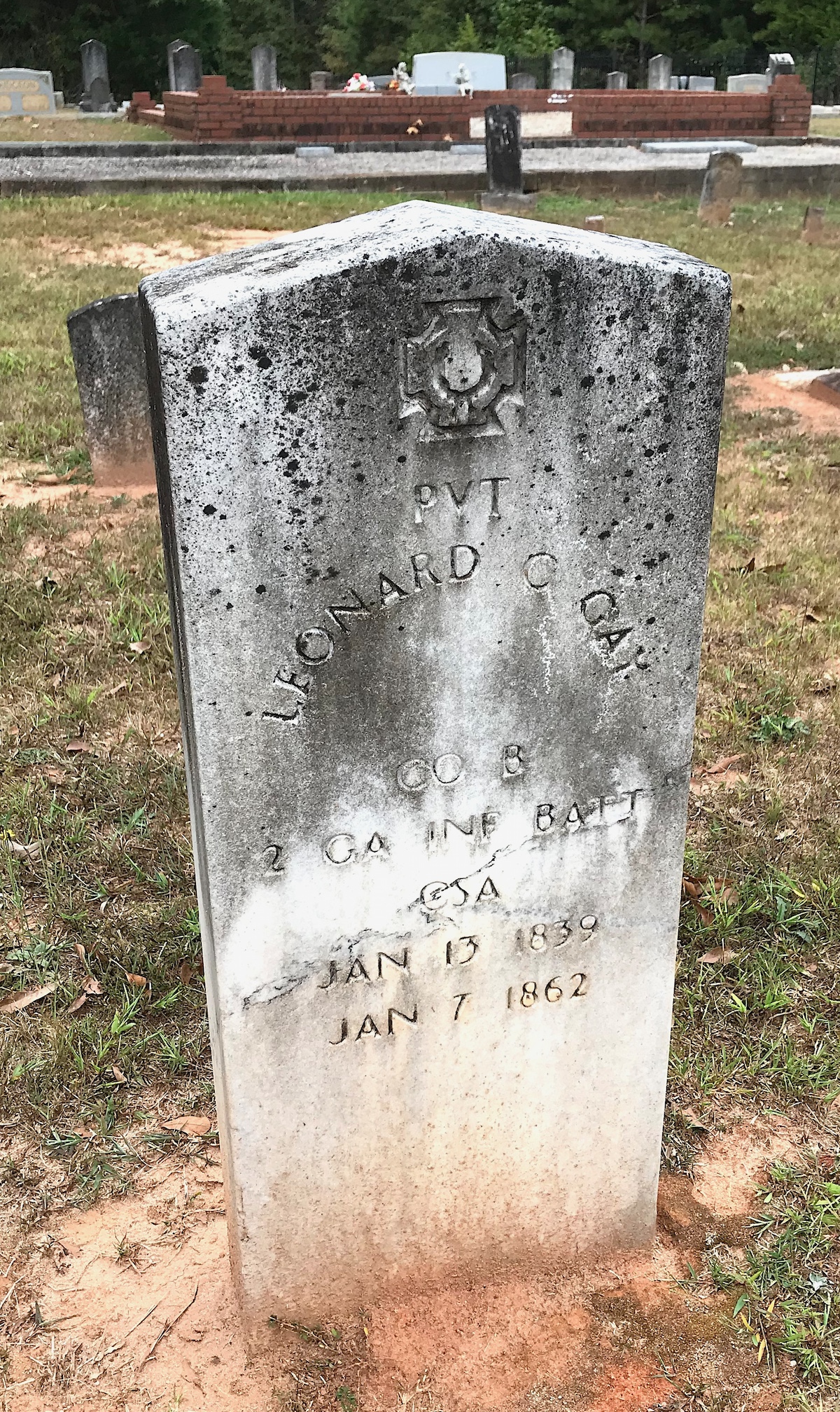
Son Leonard, who enlisted in the Confederacy on April 20, 1861, served in the Second Georgia Infantry Battalion, Co. B. He died at age 22 on Jan. 7, 1862 at a hospital in Norfolk, Va. His remains were brought back to Woolsey Cemetery for burial.

Pvt. Leonard Clark died in a Norfolk, Va. hospital in January 1862 at age 22.

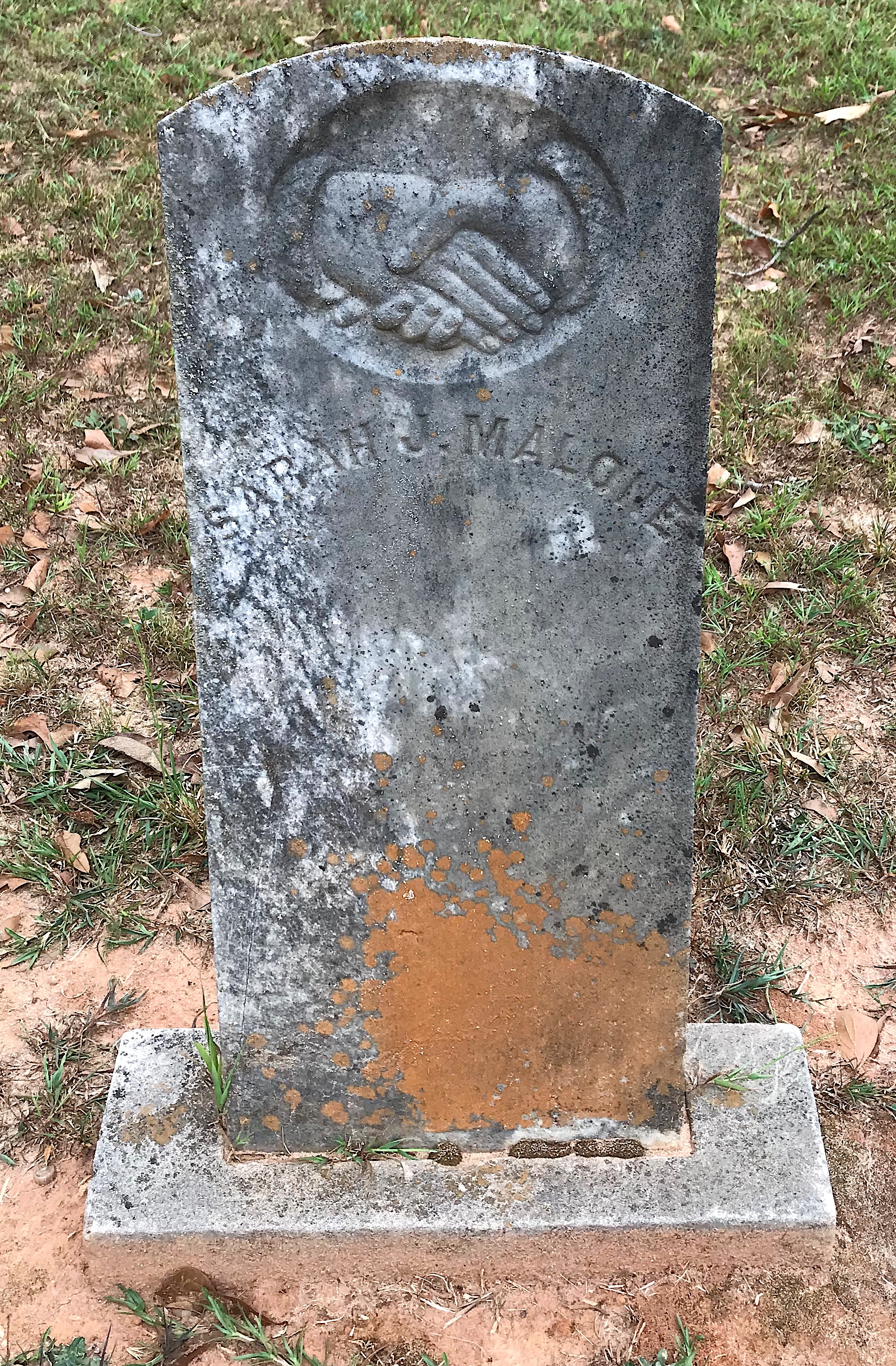
Daughter Sarah Jane, born in 1826, married William Malone in 1845. They had at least three children. Sarah died in February 1862 at age 35. She is buried at Woolsey Cemetery near her parents.

The cause of Sarah Gay Malone’s death in February 1862 is unknown.

Son John died on Nov. 4, 1862 at age 36 but I could not find a military record for him, so I suspect it was not Civil War-related. He may have had some medical training. He is buried at Tranquil Cemetery near his older sister, Nancy Gay Page.

Thomas Gay, perhaps burdened by his sorrow over the death of his wife and three of his children, died on Oct. 1, 1864 at age 67.

Cpl. Archibald Preston

It’s always a thrill to see a photo of the person whose grave I’ve photographed.

During my 2019 visit, I took this photo of the grave of Corp. Archibald “Archie” Gray Preston. Born in 1840 in Monroe County, Ga., he was the son of James and Permelia Preston.

During the Civil War, Archie enlisted in September 1861 and attained the rank of corporal in the 30th Regiment, Georgia Volunteer Infantry. He served in Company A, also known as “Butts’ Invincibles” because many of the men were from Butts County (southeast of Fayette County) where he lived in his early years. It became Company I after reorganization in 1862.

According to records, Archie saw plenty of battle action in Georgia and Tennessee in the 30th. He was imprisoned in Nashville, Tenn. in December 1864. He was also imprisoned at Camp Chase, a prison camp for Confederate soldiers, in Columbus, Ohio. He was released in June 1865. Camp Chase has a Confederate cemetery of its own that I visited in 2021.

Archibald, also known as “Archie” or “A.G.”, Preston ran a blacksmith shop in Woolsey. I found this photo of him on the Friends of Historic Woolsey web page. (Photo Source: Virginia Bailey)

In 1867, he married Martha Emily Mayo and the couple had nine children together. The family settled in Fayette County.

Thanks to the Friends of Historic Woolsey’s Facebook page, I learned that Archie played an important role in the community since he operated a blacksmith shop, and locals enjoyed congregating there to chat and share news.

Archie died on Feb. 28, 1905 at age 59. His obituary described him as “an honorable and upright man,” highlighting his sterling character.

Archie Preston’s wife, Martha, died 10 years after he did.

Archie shares a marker with his wife, Martha, who died on Dec. 29, 1919 at age 71. There’s a touching inscription on the back that I’m glad I did not miss.


This inscription is on the back of Archie and Martha Preston’s shared grave marker.

Run with the Horsemen

Finally, I’d like to talk about someone buried here that I personally knew. Like Dr. Woolsey, Dr. Sams had two professions. He was both a doctor and an author.

Born on Sept. 26, 1922, Dr. Ferrol Aubrey Sams, Jr. (known by many as “Sambo”) and his wife, Dr. Helen Fletcher Sams, were the only two doctors I ever saw as a child. They were the healthcare of Fayette County at their office on Jeff Davis Drive for many years, which featured enormous goldfish in an indoor fountain/pond that diverted many a child waiting to be seen.

Dr. Sams published his first book in 1982 at the age of 60. He kept serving the residents of Fayette County while writing more books. (Photo Source: Billy Howard Photography)

While I saw “Dr. Helen” the most, I did see Dr. Sams from time to time. They were both kind, salt of the earth people who were regarded with great affection and respect by everyone.

In 1982, Dr. Sams dove into his childhood memories of Fayette County when he wrote Run with the Horseman. It was the start of a trilogy of works featuring Porter Osborne Jr., a character largely based on Dr. Sams himself. The buzz around Fayette County was enormous as people tried to figure out who the other characters might be based on.

In 1991, Sams was awarded the Townsend Prize for fiction for his publication of When All the World Was Young. He wrote a total of eight books.

Run With the Horsemen was Dr. Ferrol Sams’ first book, published in 1982.

My most vivid memory of Dr. Sams is when I finished my master’s degree at the University of Georgia in 1992. I was having difficulty finding a job and my training was as a journalist. My father, one of his patients, thought Dr. Sams might have some words of wisdom. So we went to his office to have a chat.

Dr. Sams was kind and asked me a few questions. He told me about his current publisher, Longstreet Press, and suggested I contact them. While I didn’t end up getting hired by them, I was grateful that he took time out of his busy day to see me.

Dr. Sams retired in 2006. He died on Jan. 29, 2013 at age 96. Dr. Helen died only a few weeks later on Feb. 23, 2013 at age 89.

Drs. Ferrol and Helen Sams served the Fayette community faithfully for decades.

The Sams’ legacy can still be felt today in their children. W. Ferrol Sams is a Superior Court judge and Dr. Ferrol Sams, III, is a physician. Dr. Sams (the younger) was incredibly helpful in assisting my mother in making the decision to bring my father out of a nursing home so he could spend his last days in home hospice care. I will always be grateful to him for that.

I’m thrilled that the folks of Woolsey are working together to preserve the heritage of the community and the cemetery, which are an integral part of Fayette County’s rich history.

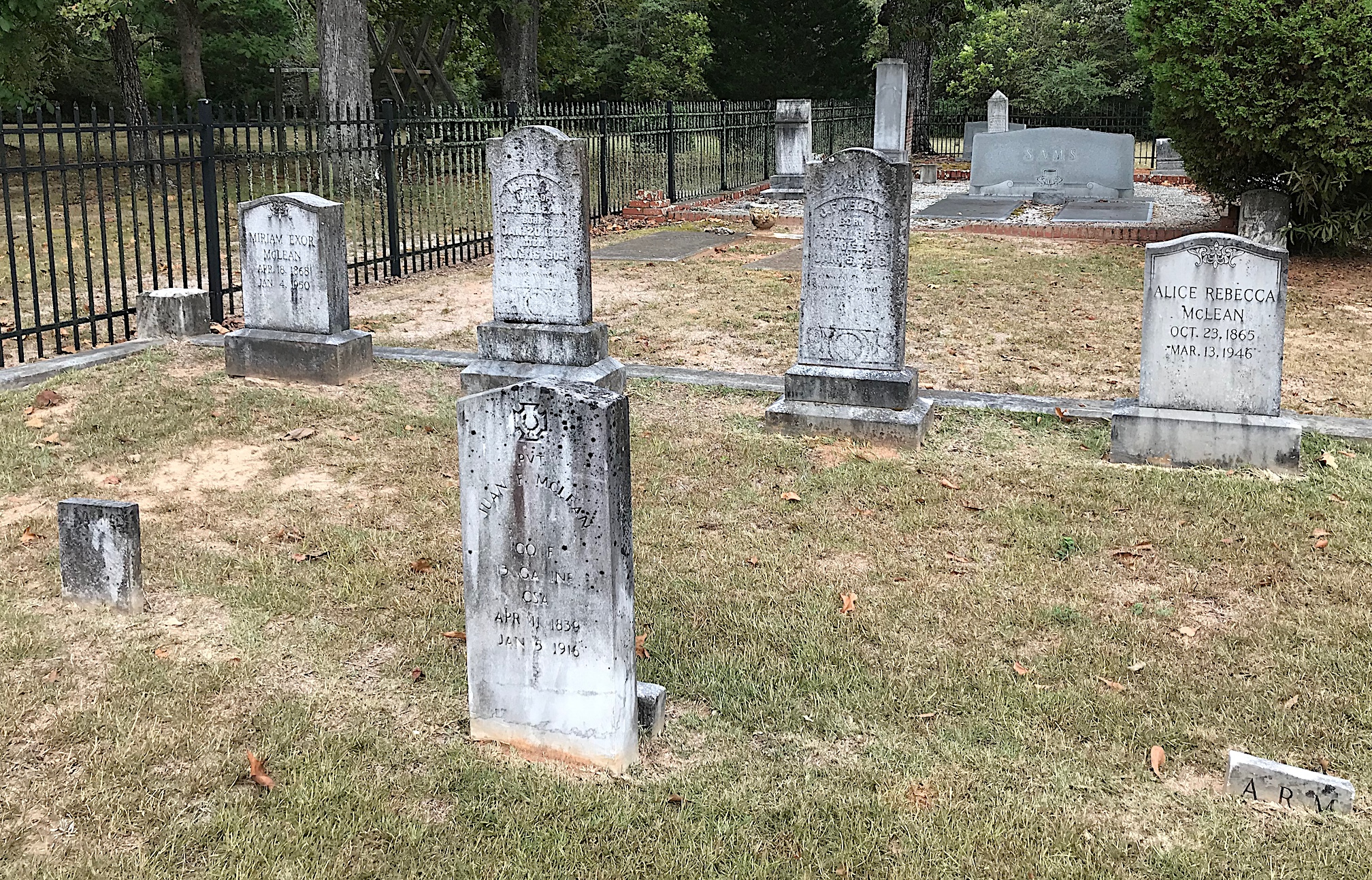
Juan Fernandez McLean (1839-1916), whose marker is front and center, purchased the original fence for the cemetery from Stewart Ironworks in 1907. It was later replaced with a more modern one. To preserve the fence’s history, the original has been incorporated into the Friends of Historic Woolsey’s logo (see below).

For more information on the Friends of Historic Woolsey’s work and how you can get involved, click here.

Westminster Abbey 2023: Saying Farewell – Bits and Pieces, Part VIII

09 Friday Aug 2024

Posted by adventuresincemeteryhopping in General

≈ 2 Comments

Many thanks to the amazing Grace Barrett of Tours by Grace for leading us through Westminster Abbey! She was fabulous!

This is my eighth and final blog post about Westminster Abbey. I think that’s a new record for me!

Today I’m rounding up the last bits and pieces that I haven’t gotten to talking about just yet that I think are worth mentioning.

Meet the Russells

In my opinion, the monument to John Russell, and the one for his daughter Elizabeth (which is beside) it), are two of the most fascinating in the Abbey. They are located in the Chapel of St. Edmund.

The monument to John Russell (sometimes called Baron Russell) is stunning. All of the inscriptions were composed by his wife Elizabeth, except for one written by John’s son-in-law. They are in English, Latin, and Greek.

Born in 1553, John Russell was the son of Francis, second Earl of Bedford. John was summoned to Parliament in January 1581 as Lord Russell. He died on July 24, 1584.

Elizabeth, his wife, was born in 1528 and moved in exclusive circles. She was the daughter of Sir Anthony Cook (who tutored Edward VI) and widow of Sir Thomas Hoby. By her first husband, she had two sons and two daughters.

After Sir Thomas died in France, she commissioned Dutch sculptor William Cure to create a very handsome alabaster tomb at Bisham Church in Marlow on which repose the effigies Sir Thomas and his half-brother, Sir Phillip Hoby. This William Cure was the father of Cornelius Cure, who carved Queen Elizabeth I’s monument at Westminster Abbey. William Cure II was his grandson.

There’s a reason I’m mentioning all this that I’ll get to shortly.

She married John Russell on December 23, 1574 and had two daughters (Elizabeth and Anne), as well as a son Francis who died in infancy.

I have some issues with the dates. Elizabeth would have been 25 years John’s senior when they married. This would mean Elizabeth was having children in her late 40s. So I’m not at all sure if those dates are correct. Elizabeth is thought to have died in 1609 at age 81. She is interred at Bishan Church with her first husband.

The effigy at the feet of John Russell represents his son Francis, who died in infancy.

Here’s how the Westminster Abbey web page describes John Russell’s monument:

His large monument of alabaster and marble shows his effigy reclining in his ermine-lined red Parliamentary robes, with his head supported on his elbow. There are columns and many shields of arms (including those of Russell, De la Tour, Meschems, Herring, Froxmere, Wise, Sapcote, Semark and Cook). Two female bedeswomen support the achievement of arms. The monument was redecorated by order of the Earl of Bedford in the 19th century and the most recent re-painting was done in the 1960s.

“Bedeswoman” is from the Old English biddan, “to pray”; literally  ”a man of prayer”; and from the Anglo-Saxon bed), was generally a pensioner or almsman whose duty was to pray for his benefactor.

Two female bedeswomen support the achievement of arms.

The inscriptions were written by his John’s wife, Elizabeth, who was thought to be one of the most accomplished women of her day. One of them was written by their son-in-law. They are in English, Latin, and Greek.

There’s a reason Elizabeth chose this pose and it goes back to the Bisham Church monument she designed. The effigies of her first husband and his half-brother are situated in a very similar position. She was likely inspired by a monument she saw in the Celestine convent in Paris. I suspect Elizabeth had a hand in designing John’s monument, too. She was very much a hands on kind of woman.

John Russell looks a bit bored to me.

Before Elizabeth died in 1609, she designed another monument at Bishan Church that represents herself and her five children. The web site for Bisham Church describes it like this:

In the form of a tableau, we see her kneeling at a prayer desk. Behind her kneel her three daughters who predeceased her: Elizabeth Russell (daughter to Elizabeth and Lord John Russell, her second husband), Elizabeth Hoby and Anne Hoby. Lying beneath her is the effigy of her infant son Francis Russell, who sadly died shortly after birth. Facing her outside the canopy is her only surviving daughter, Anne. At the opposite end of the monument and outside the canopy are her two sons, Sir Edward Hoby and Sir Thomas Posthumous Hoby, the latter having been born in Paris shortly after the death of his father.

That’s Elizabeth Russell in the center in the blue gown with her five children kneeling behind her. I believe the Cures likely carved this one as well. (Photo source: www.bishanchurchfriends.org/monuments)

Back to Westminster Abbey. Let’s take a look at the monument to John and Elizabeth Russell’s daughter, Elizabeth. Notice she’s also resting her chin on her hand. And she’s got a skull under her foot!

In doing research for my blog post, I learned that Elizabeth has not only a statue (at the Abbey) at an effigy (at Bisham Church) in her honor.

Elizabeth was born in the precincts of London’s Westminster Abbey and baptized in the Abbey. Queen Elizabeth I and the Countess of Sussex were her godmothers and Robert Dudley, Earl of Leicester, her godfather. She was a maid of honor to the queen but died young of tuberculosis in 1601. We don’t know her exact age but she was unmarried.

Her monument consists of an alabaster and marble pedestal, on which is her statue, seated in a wicker chair with her right foot resting on a skull. As I mentioned, her head reclines on her right elbow and her left arm points down to the skull.

This led to the idea that she died by pricking her finger. But the skull is simply a symbol of mortality. The pedestal is decorated with ribbons, swags, ox heads and an eagle. Hers was the first memorial in England to depict a seated figure on a free-standing monument.

I like to think Elizabeth and Anne Russell were very close for Anne to have commissioned such a monument.

The Latin inscription can be translated:

“She is not dead, but sleepeth. Sacred to the happy memory of Elizabeth Russell, her afflicted sister Anne has erected this monument.”

Anne, her sister, married Henry Somerset, the first Marquees of Worcester, in 1600. Queen Elizabeth I, who had been close to their mother Elizabeth, attended the wedding. That’s only a year before Elizabeth (the sister) died. Anne had nine sons and four daughters with the Marquees, who was a prominent Royalist during the early years of the English Civil War.

The Talbots

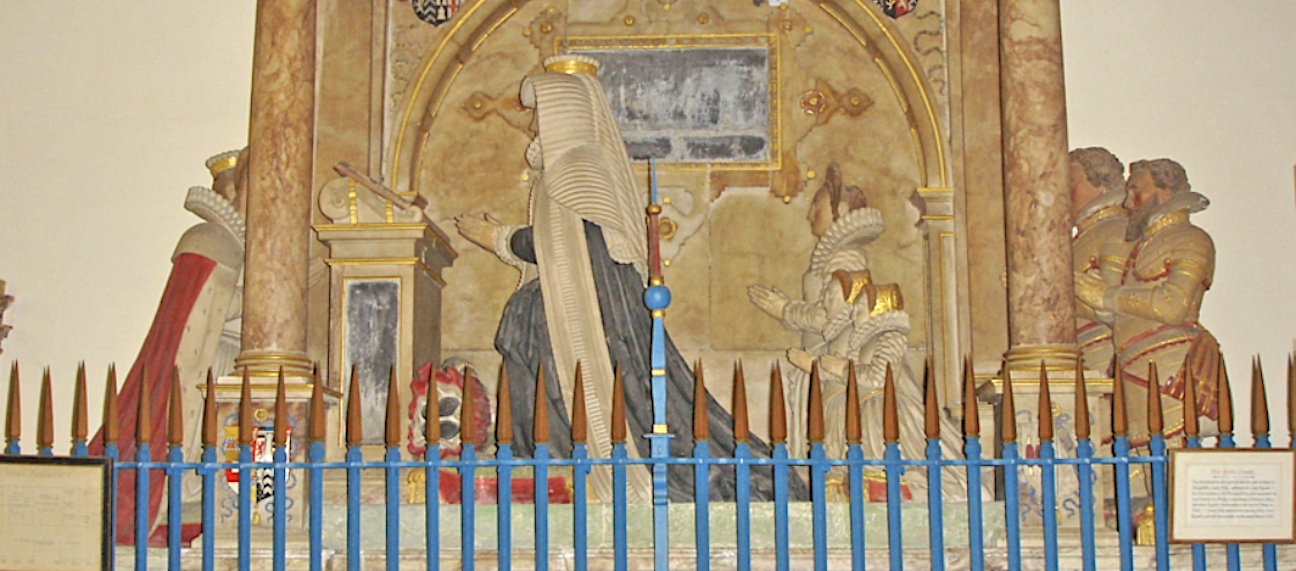
Also located in the Chapel of St. Edmund is a large monument to Edward Talbot (1561-1618), the eighth Earl of Shrewsbury, and his wife, Jane (died 1626), the eldest daughter and co-heiress of Cuthbert, seventh Baron Ogle, by his wife, Catharine Carnaby. We don’t have an exact birth year for her but she did outlive her husband. The couple wed in 1583.

Chris took this photo of the jaw-dropping Talbot monument. Made of alabaster, it was completed by sculptor William Wright.

In 1616, Edward succeeded his brother Gilbert as eighth Earl of Shrewsbury. He was a member of Parliament for Northumberland and member of the Council of Wales. He died on Feb. 8, 1618.

A kneeling figure of a child, dressed in blue, is shown near the feet of the effigies. They had one son who predeceased his father so this is probably him although dressed as a girl, which was usual for small children at this period. There is no record of them ever having a daughter.

Although dressed like a girl, this figure likely represents a son the Talbots had that died.

After Edward died, Jane had the monument designed in his honor. She died in January 1626 and was interred with him.

Here’s a closer look at the Talbot effigies. Unlike Lord Russell’s, the Talbots are lying flat on their backs and looking up.

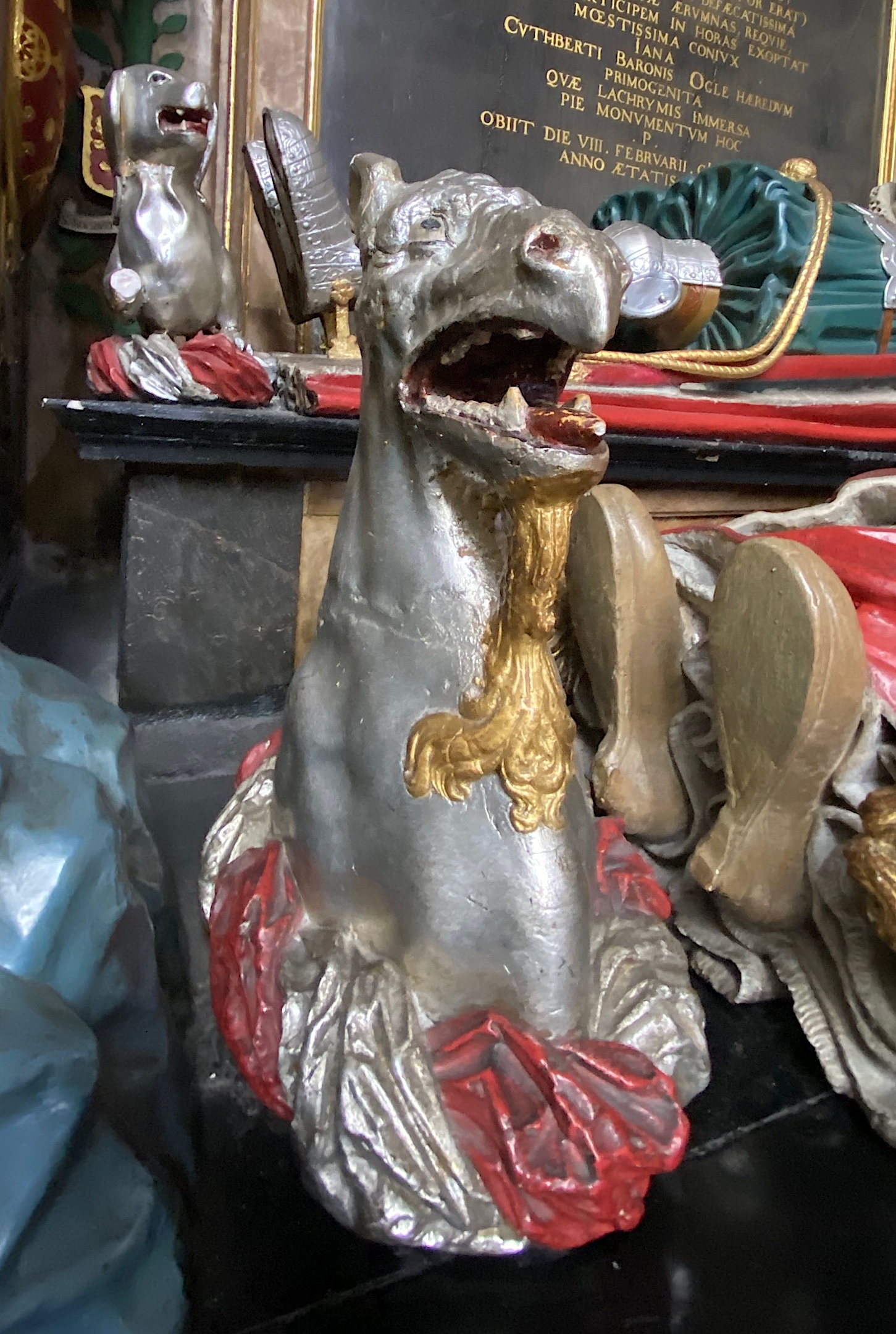
Edward’s effigy is attired in armor, with a talbot (a medieval hunting dog) at his feet. You can see it in the photo below. I’m glad the Abbey web page explained this because I wasn’t sure exactly what it was. Jane, who wears an ermine-lined red mantle, has a griffin at her feet.

There always seems to be something interesting resting at the foot of these effigies. Here there’s a talbot (hunting dog) and a griffin.

The recess is ornamented with 13 shields of arms connected with the family, with names underneath. At the top of the monument is a large achievement of arms, with two talbot supporters and the motto Prest d’accomplir (ready to accomplish). The monument was repainted and missing hands replaced during the late 1950s cleaning of the Abbey.

Oliver Cromwell’s Brief Abbey Rest

The last person I’m going to talk about had a brief “rest” at the Abbey that only lasted a few years.

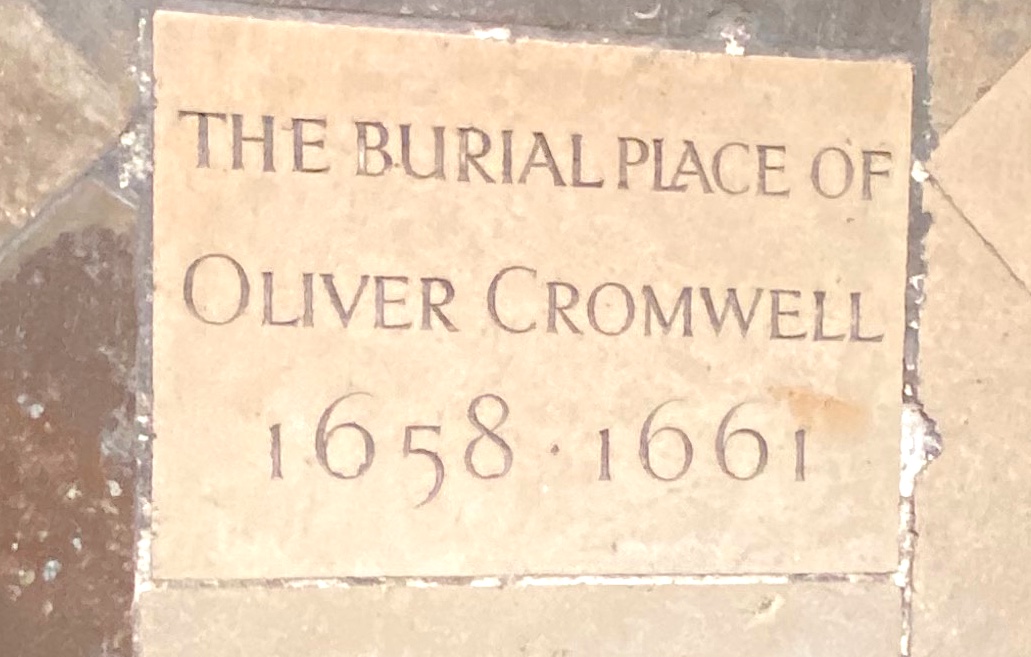
When we came upon a small marker in the Lady Chapel with his name on it, Chris and I looked at Grace (our lovely tour guide) with hopes of an explanation and she gave it.

I’m not going to give you a long-winded version of the history of the Reformation, you can find plenty of information on that elsewhere.

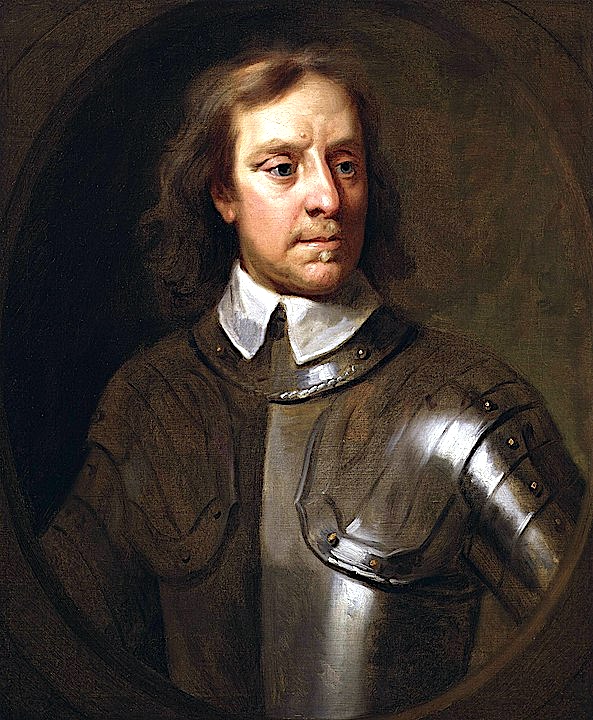
Portrait of Oliver Cromwell, painted by Samuel Cooper.

Oliver Cromwell (1599-1658) was a country squire and Member of Parliament for Huntingdon, and then for Cambridge. He became a Puritan and came to prominence while serving in the Parliamentary army fighting against the Royalists.

When he defeated Charles I, Cromwell had the king executed in 1649 and became Lord Protector of the Commonwealth of England, Scotland, and Ireland in 1653. Charles II fled across the Channel. This was the only time in English history that the monarchy had been ousted.

For his second investiture as Protector in 1657, the 14th-century Coronation Chair was taken from Westminster Abbey to Westminster Hall, and Cromwell sat in it arrayed in royal robes. After his death at Whitehall on Sept. 3, 1658, his son Richard, who had little interest in politics, gave up the government and lived abroad. This paved the way for the Restoration of Charles II to the throne in 1660.

One might say this was the last span of years that Oliver Cromwell’s remains literally rested in peace. It was all downhill after that.

After being embalmed and lying in state for a few weeks, Cromwell was buried privately without ceremony (according to contemporary sources) in a vault at the east end of Henry VII’s chapel in the Abbey on the night of Nov. 10, 1658. But he didn’t stay there long. Charles II was out for revenge. The Westminster Abbey web page explains the gruesome activities like this:

When Charles II was restored to the throne, the House of Commons voted on Dec. 4, 1660 that the coffins of regicides Oliver Cromwell, Henry Ireton, and John Bradshaw should be dug up from the Abbey, drawn on a hurdle to Tyburn and the bodies hung up on the gallows there. So on Jan. 26, 1661 Cromwell and Ireton were removed and taken to the Red Lion Inn at Holborn, where they were joined a few days later by Bradshaw’s coffin (the delay was caused by the fact that Bradshaw’s body had not been embalmed like the others and smelt badly).

On January 30, the anniversary of the execution of Charles I, the hangings took place and then the heads were cut off and stuck on spikes outside Westminster Hall. The bodies were buried under Tyburn gallows (near the modern Marble Arch). Cromwell’s head is believed to [now] be buried at Sidney Sussex College [Cambridge].

There are a great many stories/theories concerning what exactly happened to Cromwell’s head over the years but that’s a rabbit hole you can go down on your own.

A fond farewell to Westminster Abbey…

As we made out way to the exit and bid goodbye to Grace, I felt exhilarated and exhausted at the same time. One of my biggest Bucket List items had finally been crossed off. I almost floated down the steps toward the obligatory Westminster Abbey gift shop.

As a taphophile, it will remain a highlight of my cemetery hopping career. I hope you enjoyed reading about it (all eight parts!).

Recent Posts

  • More Pensacola, Fla. Cemetery Hopping: Taking a Ramble Through Saint John’s Cemetery, Part III
  • More Pensacola, Fla. Cemetery Hopping: Taking a Ramble Through Saint John’s Cemetery, Part II
  • More Pensacola, Fla. Cemetery Hopping: Taking a Ramble Through Saint John’s Cemetery, Part I
  • The City of Five Flags: Stepping back in time at Pensacola, Fla.’s Saint Michael’s Cemetery, Part V
  • The City of Five Flags: Stepping back in time at Pensacola, Fla.’s Saint Michael’s Cemetery, Part IV

Archives

  • December 2025
  • November 2025
  • August 2025
  • July 2025
  • June 2025
  • May 2025
  • April 2025
  • March 2025
  • February 2025
  • January 2025
  • October 2024
  • August 2024
  • July 2024
  • June 2024
  • May 2024
  • April 2024
  • March 2024
  • February 2024
  • January 2024
  • December 2023
  • November 2023
  • October 2023
  • September 2023
  • August 2023
  • July 2023
  • June 2023
  • May 2023
  • April 2023
  • March 2023
  • February 2023
  • January 2023
  • December 2022
  • November 2022
  • October 2022
  • September 2022
  • August 2022
  • July 2022
  • June 2022
  • May 2022
  • April 2022
  • March 2022
  • February 2022
  • January 2022
  • December 2021
  • November 2021
  • October 2021
  • September 2021
  • August 2021
  • July 2021
  • May 2021
  • April 2021
  • March 2021
  • February 2021
  • January 2021
  • December 2020
  • November 2020
  • October 2020
  • September 2020
  • August 2020
  • July 2020
  • June 2020
  • May 2020
  • April 2020
  • March 2020
  • February 2020
  • January 2020
  • December 2019
  • November 2019
  • October 2019
  • September 2019
  • August 2019
  • July 2019
  • June 2019
  • May 2019
  • April 2019
  • March 2019
  • February 2019
  • January 2019
  • December 2018
  • November 2018
  • October 2018
  • September 2018
  • August 2018
  • May 2018
  • April 2018
  • March 2018
  • February 2018
  • January 2018
  • December 2017
  • November 2017
  • October 2017
  • September 2017
  • August 2017
  • July 2017
  • June 2017
  • May 2017
  • April 2017
  • March 2017
  • February 2017
  • January 2017
  • December 2016
  • November 2016
  • October 2016
  • September 2016
  • August 2016
  • July 2016
  • June 2016
  • May 2016
  • April 2016
  • March 2016
  • February 2016
  • January 2016
  • December 2015
  • November 2015
  • October 2015
  • September 2015
  • August 2015
  • July 2015
  • May 2015
  • April 2015
  • March 2015
  • February 2015
  • January 2015
  • December 2014
  • November 2014
  • October 2014
  • September 2014
  • August 2014
  • July 2014
  • June 2014
  • May 2014
  • April 2014
  • March 2014
  • February 2014
  • January 2014
  • December 2013
  • November 2013
  • October 2013
  • September 2013
  • August 2013
  • July 2013
  • June 2013
  • May 2013
  • April 2013
  • March 2013
  • February 2013
  • January 2013

Categories

  • General

Blogroll

  • A Grave Interest
  • Cemetery Photography by Chantal Larochelle
  • Cemetery Tours of Berlin by Matti
  • Confessions of a Funeral Director (Caleb Wilde)
  • Find a Grave
  • Hunting and Gathering (cool photography site)
  • Save Our Cemeteries (New Orleans, La.)
  • The Cemetery Club
  • The Graveyard Detective
  • The Rambling Muser
  • Westminster Abbey Tours by Grace

Meta

  • Create account
  • Log in
  • Entries feed
  • Comments feed
  • WordPress.com

Blog at WordPress.com.

  • Subscribe Subscribed
    • Adventures in Cemetery Hopping
    • Join 402 other subscribers
    • Already have a WordPress.com account? Log in now.
    • Adventures in Cemetery Hopping
    • Subscribe Subscribed
    • Sign up
    • Log in
    • Report this content
    • View site in Reader
    • Manage subscriptions
    • Collapse this bar
 

Loading Comments...