
Many thanks to the amazing Grace Barrett of Tours by Grace for leading us through Westminster Abbey! She was fabulous!
This is my eighth and final blog post about Westminster Abbey. I think that’s a new record for me!
Today I’m rounding up the last bits and pieces that I haven’t gotten to talking about just yet that I think are worth mentioning.
Meet the Russells
In my opinion, the monument to John Russell, and the one for his daughter Elizabeth (which is beside) it), are two of the most fascinating in the Abbey. They are located in the Chapel of St. Edmund.

Born in 1553, John Russell was the son of Francis, second Earl of Bedford. John was summoned to Parliament in January 1581 as Lord Russell. He died on July 24, 1584.
Elizabeth, his wife, was born in 1528 and moved in exclusive circles. She was the daughter of Sir Anthony Cook (who tutored Edward VI) and widow of Sir Thomas Hoby. By her first husband, she had two sons and two daughters.
After Sir Thomas died in France, she commissioned Dutch sculptor William Cure to create a very handsome alabaster tomb at Bisham Church in Marlow on which repose the effigies Sir Thomas and his half-brother, Sir Phillip Hoby. This William Cure was the father of Cornelius Cure, who carved Queen Elizabeth I’s monument at Westminster Abbey. William Cure II was his grandson.
There’s a reason I’m mentioning all this that I’ll get to shortly.
She married John Russell on December 23, 1574 and had two daughters (Elizabeth and Anne), as well as a son Francis who died in infancy.
I have some issues with the dates. Elizabeth would have been 25 years John’s senior when they married. This would mean Elizabeth was having children in her late 40s. So I’m not at all sure if those dates are correct. Elizabeth is thought to have died in 1609 at age 81. She is interred at Bishan Church with her first husband.

Here’s how the Westminster Abbey web page describes John Russell’s monument:
His large monument of alabaster and marble shows his effigy reclining in his ermine-lined red Parliamentary robes, with his head supported on his elbow. There are columns and many shields of arms (including those of Russell, De la Tour, Meschems, Herring, Froxmere, Wise, Sapcote, Semark and Cook). Two female bedeswomen support the achievement of arms. The monument was redecorated by order of the Earl of Bedford in the 19th century and the most recent re-painting was done in the 1960s.
“Bedeswoman” is from the Old English biddan, “to pray”; literally ”a man of prayer”; and from the Anglo-Saxon bed), was generally a pensioner or almsman whose duty was to pray for his benefactor.

The inscriptions were written by his John’s wife, Elizabeth, who was thought to be one of the most accomplished women of her day. One of them was written by their son-in-law. They are in English, Latin, and Greek.
There’s a reason Elizabeth chose this pose and it goes back to the Bisham Church monument she designed. The effigies of her first husband and his half-brother are situated in a very similar position. She was likely inspired by a monument she saw in the Celestine convent in Paris. I suspect Elizabeth had a hand in designing John’s monument, too. She was very much a hands on kind of woman.

Before Elizabeth died in 1609, she designed another monument at Bishan Church that represents herself and her five children. The web site for Bisham Church describes it like this:
In the form of a tableau, we see her kneeling at a prayer desk. Behind her kneel her three daughters who predeceased her: Elizabeth Russell (daughter to Elizabeth and Lord John Russell, her second husband), Elizabeth Hoby and Anne Hoby. Lying beneath her is the effigy of her infant son Francis Russell, who sadly died shortly after birth. Facing her outside the canopy is her only surviving daughter, Anne. At the opposite end of the monument and outside the canopy are her two sons, Sir Edward Hoby and Sir Thomas Posthumous Hoby, the latter having been born in Paris shortly after the death of his father.
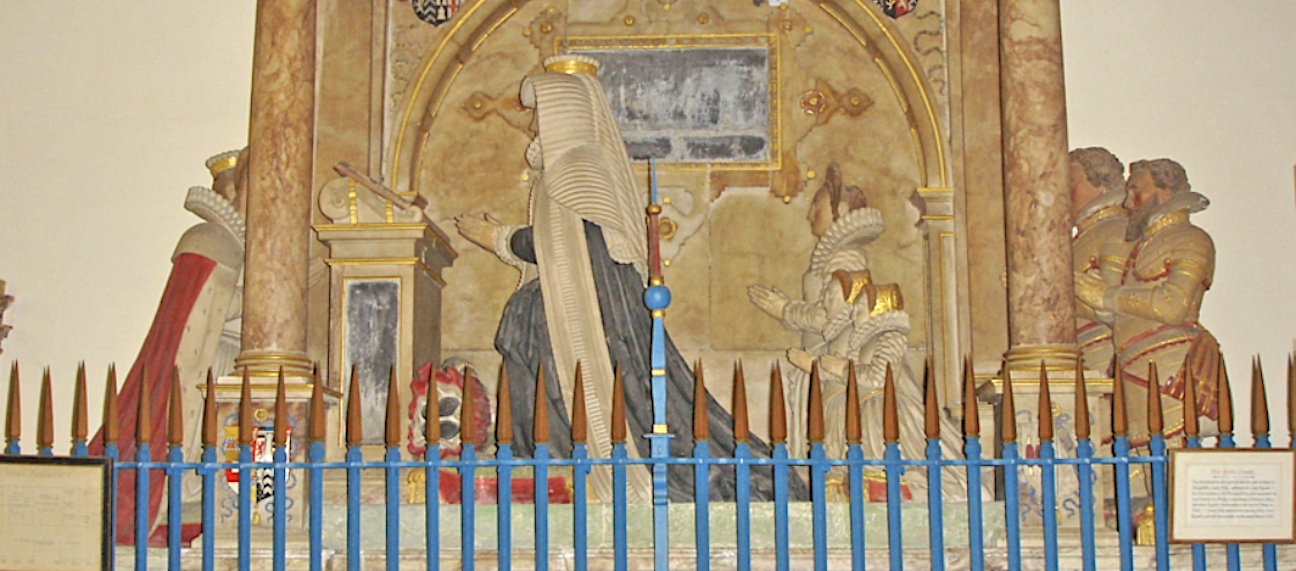
Back to Westminster Abbey. Let’s take a look at the monument to John and Elizabeth Russell’s daughter, Elizabeth. Notice she’s also resting her chin on her hand. And she’s got a skull under her foot!

Elizabeth was born in the precincts of London’s Westminster Abbey and baptized in the Abbey. Queen Elizabeth I and the Countess of Sussex were her godmothers and Robert Dudley, Earl of Leicester, her godfather. She was a maid of honor to the queen but died young of tuberculosis in 1601. We don’t know her exact age but she was unmarried.
Her monument consists of an alabaster and marble pedestal, on which is her statue, seated in a wicker chair with her right foot resting on a skull. As I mentioned, her head reclines on her right elbow and her left arm points down to the skull.
This led to the idea that she died by pricking her finger. But the skull is simply a symbol of mortality. The pedestal is decorated with ribbons, swags, ox heads and an eagle. Hers was the first memorial in England to depict a seated figure on a free-standing monument.

The Latin inscription can be translated:
“She is not dead, but sleepeth. Sacred to the happy memory of Elizabeth Russell, her afflicted sister Anne has erected this monument.”
Anne, her sister, married Henry Somerset, the first Marquees of Worcester, in 1600. Queen Elizabeth I, who had been close to their mother Elizabeth, attended the wedding. That’s only a year before Elizabeth (the sister) died. Anne had nine sons and four daughters with the Marquees, who was a prominent Royalist during the early years of the English Civil War.
The Talbots
Also located in the Chapel of St. Edmund is a large monument to Edward Talbot (1561-1618), the eighth Earl of Shrewsbury, and his wife, Jane (died 1626), the eldest daughter and co-heiress of Cuthbert, seventh Baron Ogle, by his wife, Catharine Carnaby. We don’t have an exact birth year for her but she did outlive her husband. The couple wed in 1583.

In 1616, Edward succeeded his brother Gilbert as eighth Earl of Shrewsbury. He was a member of Parliament for Northumberland and member of the Council of Wales. He died on Feb. 8, 1618.
A kneeling figure of a child, dressed in blue, is shown near the feet of the effigies. They had one son who predeceased his father so this is probably him although dressed as a girl, which was usual for small children at this period. There is no record of them ever having a daughter.

After Edward died, Jane had the monument designed in his honor. She died in January 1626 and was interred with him.

Edward’s effigy is attired in armor, with a talbot (a medieval hunting dog) at his feet. You can see it in the photo below. I’m glad the Abbey web page explained this because I wasn’t sure exactly what it was. Jane, who wears an ermine-lined red mantle, has a griffin at her feet.
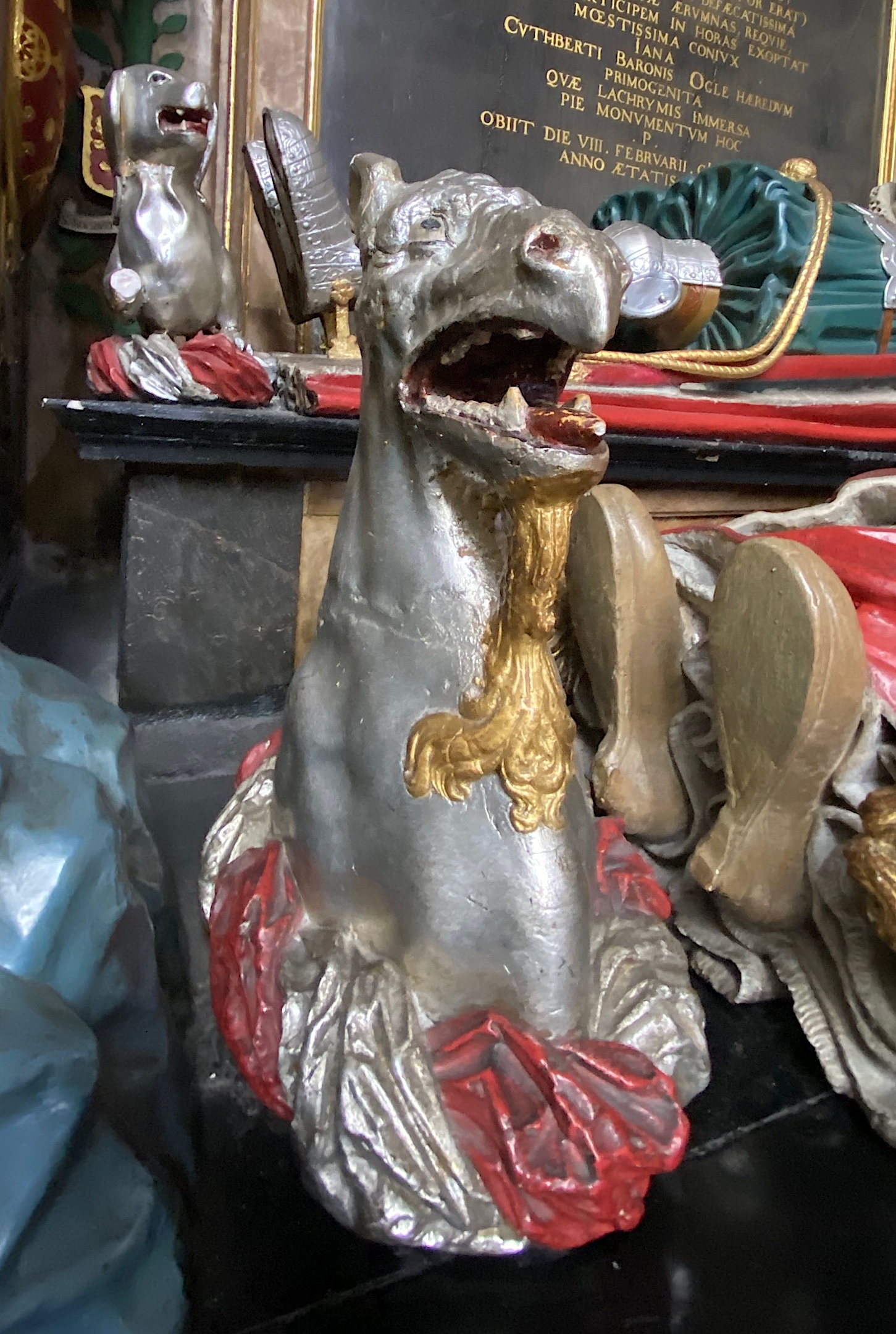
The recess is ornamented with 13 shields of arms connected with the family, with names underneath. At the top of the monument is a large achievement of arms, with two talbot supporters and the motto Prest d’accomplir (ready to accomplish). The monument was repainted and missing hands replaced during the late 1950s cleaning of the Abbey.
Oliver Cromwell’s Brief Abbey Rest
The last person I’m going to talk about had a brief “rest” at the Abbey that only lasted a few years.
When we came upon a small marker in the Lady Chapel with his name on it, Chris and I looked at Grace (our lovely tour guide) with hopes of an explanation and she gave it.
I’m not going to give you a long-winded version of the history of the Reformation, you can find plenty of information on that elsewhere.
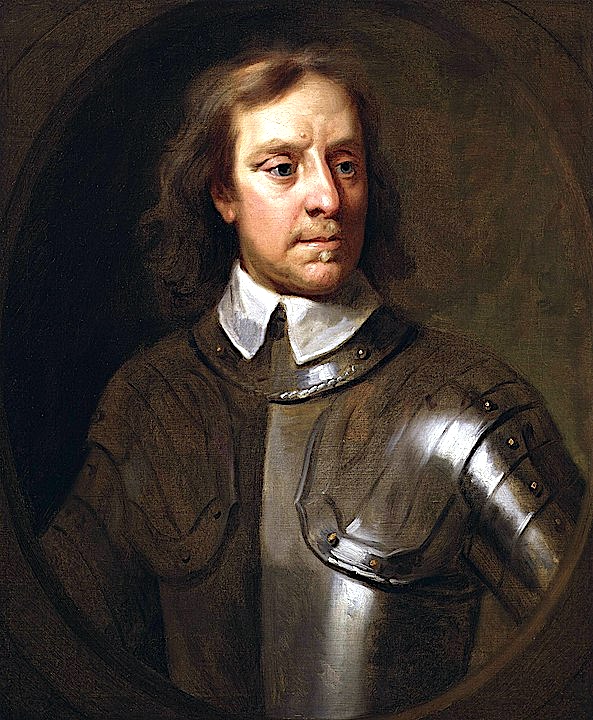
Oliver Cromwell (1599-1658) was a country squire and Member of Parliament for Huntingdon, and then for Cambridge. He became a Puritan and came to prominence while serving in the Parliamentary army fighting against the Royalists.
When he defeated Charles I, Cromwell had the king executed in 1649 and became Lord Protector of the Commonwealth of England, Scotland, and Ireland in 1653. Charles II fled across the Channel. This was the only time in English history that the monarchy had been ousted.
For his second investiture as Protector in 1657, the 14th-century Coronation Chair was taken from Westminster Abbey to Westminster Hall, and Cromwell sat in it arrayed in royal robes. After his death at Whitehall on Sept. 3, 1658, his son Richard, who had little interest in politics, gave up the government and lived abroad. This paved the way for the Restoration of Charles II to the throne in 1660.
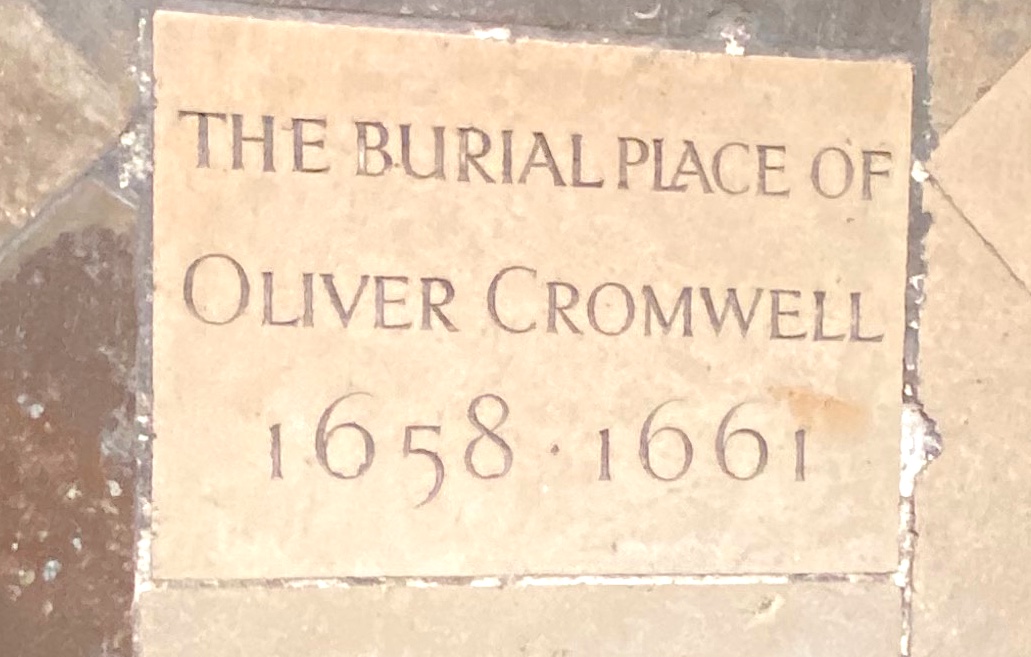
After being embalmed and lying in state for a few weeks, Cromwell was buried privately without ceremony (according to contemporary sources) in a vault at the east end of Henry VII’s chapel in the Abbey on the night of Nov. 10, 1658. But he didn’t stay there long. Charles II was out for revenge. The Westminster Abbey web page explains the gruesome activities like this:
When Charles II was restored to the throne, the House of Commons voted on Dec. 4, 1660 that the coffins of regicides Oliver Cromwell, Henry Ireton, and John Bradshaw should be dug up from the Abbey, drawn on a hurdle to Tyburn and the bodies hung up on the gallows there. So on Jan. 26, 1661 Cromwell and Ireton were removed and taken to the Red Lion Inn at Holborn, where they were joined a few days later by Bradshaw’s coffin (the delay was caused by the fact that Bradshaw’s body had not been embalmed like the others and smelt badly).
On January 30, the anniversary of the execution of Charles I, the hangings took place and then the heads were cut off and stuck on spikes outside Westminster Hall. The bodies were buried under Tyburn gallows (near the modern Marble Arch). Cromwell’s head is believed to [now] be buried at Sidney Sussex College [Cambridge].
There are a great many stories/theories concerning what exactly happened to Cromwell’s head over the years but that’s a rabbit hole you can go down on your own.

As we made out way to the exit and bid goodbye to Grace, I felt exhilarated and exhausted at the same time. One of my biggest Bucket List items had finally been crossed off. I almost floated down the steps toward the obligatory Westminster Abbey gift shop.
As a taphophile, it will remain a highlight of my cemetery hopping career. I hope you enjoyed reading about it (all eight parts!).
 Adventures in Cemetery Hopping
I appreciate your great photos and research. When I was there our tour guide whisked us to the royals’ tombs, totally bypassing everything else. Wish we had your guide! Thank you!
We had a wonderful guide! Grace was superb. I wanted to make the most of our visit to the Abbey and she did not disappoint. I am so grateful we had Grace to show us around.