
Leaving Fayette County behind, I went on a weekend getaway to the Carolinas with a few of my friends. We stayed at Table Rock State Park. Naturally, my friends Sarah, Beverly, and Lisa knew I’d want to visit a cemetery and were game. I already had a specific one in mind.
Oakdale Cemetery is located in Hendersonville, N.C. and covers about 22 acres. I found conflicting information on how many burials are there. The 2013 application seeking to put Oakdale on the National Register of Historic Places (NRHP) noted there are about 5,400 buried here. But Find a Grave has over 8,000 memorials recorded.

Established in 1885, Oakdale had a section for whites and a section for blacks. Acreage was added in 1913 and 1943. Some grave markers were moved to Oakdale Cemetery from other cemeteries. Some from Hendersonville’s Methodist Episcopal Church were moved in 1923 (now First United Methodist Church) and First Presbyterian Church (1955) when they built new church buildings in the areas where their cemeteries were located. So that explains why you’ll see graves that pre-date the 1885 establishment date of Oakdale.
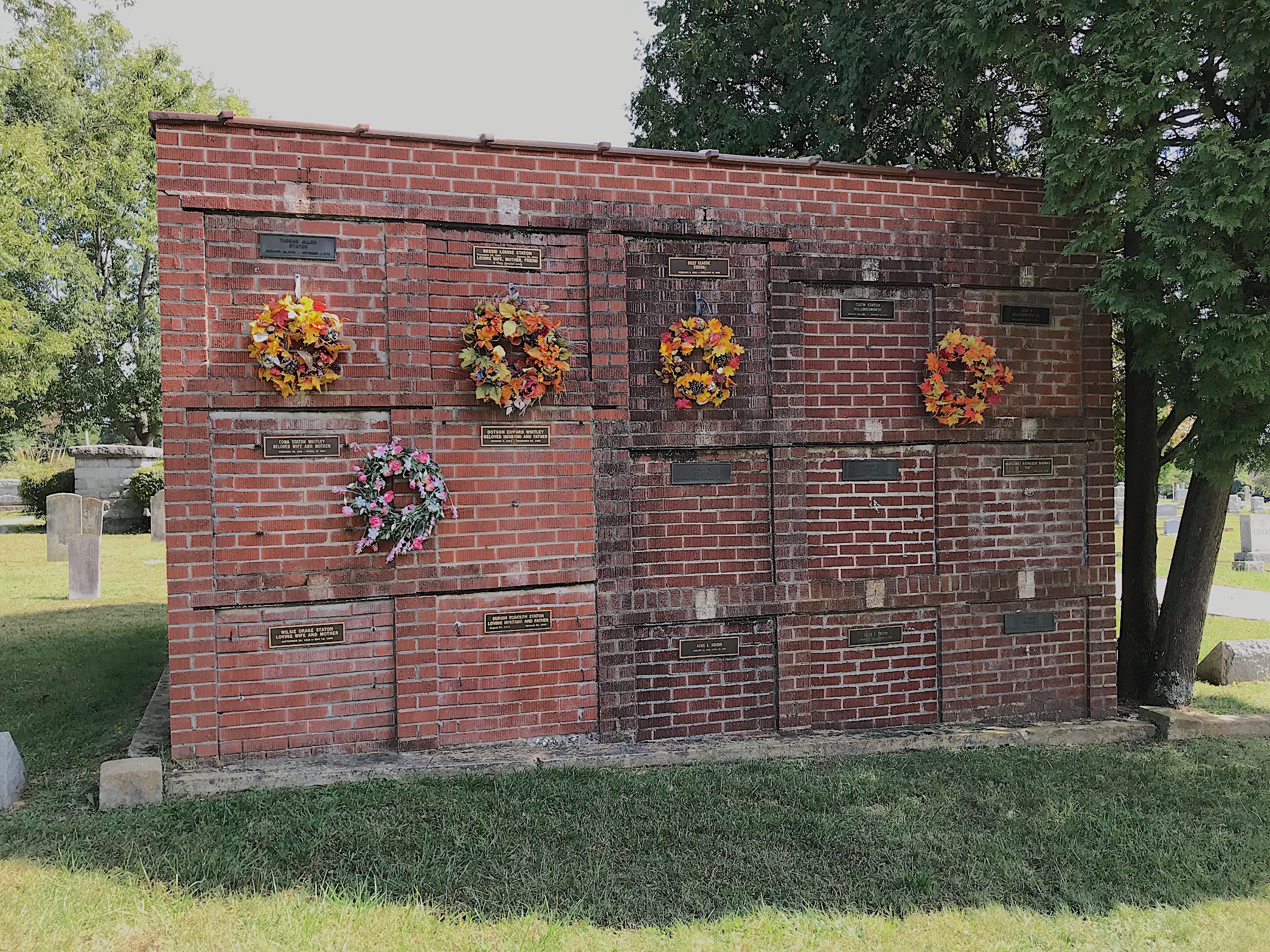
There are also some intriguing vaults at this cemetery. This brick one for the Staton family was built in the 1940s.
Then there is this large rectangular-shaped, classical style concrete block structure built in 1951 near the 1943 section’s southwest corner to house burial vaults.

But what most people want to see when they visit Oakdale is the angel that inspired an author in writing a bestselling novel that is still read by many today.
Thomas Wolfe’s Inspiring Angel
This particular area of Western North Carolina is notable for two authors that called it home. The best known is Carl Sandburg, who was a poet and an author. He won three Pulitzer Prizes: two for his poetry and one for his biography of Abraham Lincoln. Sandburg was widely regarded as a major figure in contemporary literature, especially for volumes of his collected verse, including Chicago Poems (1916), Cornhuskers (1918), and Smoke and Steel (1920).

The second is Thomas Wolfe (1900-1938), who was born in Asheville, N.C. Wolfe wrote four novels as well as many short stories, dramatic works, and novellas. His best known novel, Look Homeward Angel, was published in 1929 right before the stock market crash. Set in the fictional town of Altamont, Wolfe’s coming-of-age novel is closely based on his family, neighbors, and upbringing in Asheville.
Wolfe’s father, William Oliver Wolfe, was a stone carver and operated a successful grave stone business in Asheville. Although an accomplished artisan, Wolfe did not have the skill to carve an angel’s face. The stone angel that inspired the novel’s angel was actually carved in Carrara, Italy and ordered from New York. His business used an angel in the window to attract customers.
Thomas Wolfe described the angel in great detail in a short story and in Look Homeward, Angel. While there was controversy over which one was the actual angel, the location of the Thomas Wolfe angel was determined in 1949 to be at Oakdale Cemetery.
The title of Wolfe’s book comes from John Milton’s Poem “Lycidas”:
Look homeward Angel now, and melt with ruth:
And, O ye Dolphins, waft the hapless youth.

Although records indicate that Wolfe sold at least a dozen Italian marble angels as grave markers, the angel in Oakdale Cemetery most closely matches the description in the novel.

W.O. Wolfe sold the angel to the Johnson family in 1906. It marks the grave of Margaret Bates Johnson, wife of Dr. Henry Johnson. Dr. Johnson was president of Whitworth Female College in Brookhaven, Miss. Although Margaret died on May 26, 1905, in Brookhaven, she was reinterred in the Oakdale Cemetery since Hendersonville was her hometown. Dr. Johnson is buried beside her.
Wolfe was diagnosed with tuberculosis not long before he died at age 38 on Sept. 15, 1938. He is buried in Asheville’s Riverside Cemetery, which I visited in 2023. So you’ll get to see his grave here eventually.
Sadly, Wolfe’s fans visiting the grave caused damage to the statue that required repair. A wrought iron fence now encloses the Johnson graves to keep them safe from further harm. So I couldn’t get too close to her. But I was able to photograph her through the bars. If you find yourself in the Hendersonville area, it’s well worth the time to visit the angel.
Tragic Train Accident
One of Oakdale’s most heartbreaking monument is for Lewis Littleberry Tunstall. His tree-shaped monument has a train engine and coal car carved into it below his name and birth/death dates.

Lewis was the engineer on a railroad engine that pulled a train from Hendersonville to Spartanburg, S.C., when the train’s brakes failed and it jumped the tracks. It then slammed into a large chestnut oak tree. The impact killed Tunstall immediately. The cause of this accident was the lack of safety switches on the Saluda Grade. After this tragedy, the railroad built safety switches between Saluda and Melrose to prevent further accidents. So Lewis’ death was no in vain, but actually saved future lives.

Masonic and Brotherhood of Locomotive Engineer (see the interlocking B and E) markings can be seen on the “tree,” along with a skillful carving of a locomotive engine and coal car. It’s possible that the Brotherhood paid for his marker.
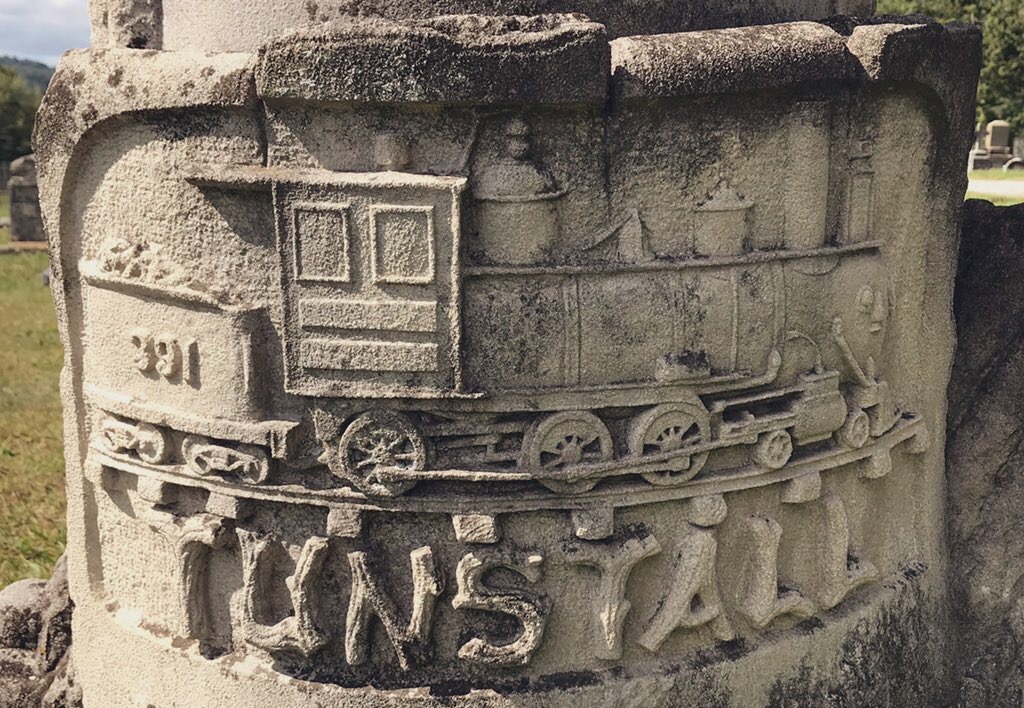
Lewis, who was only 32 when he died, left behind a wife and daughter.
Gentlewoman, Philosopher, Author, Composer, and Artiste
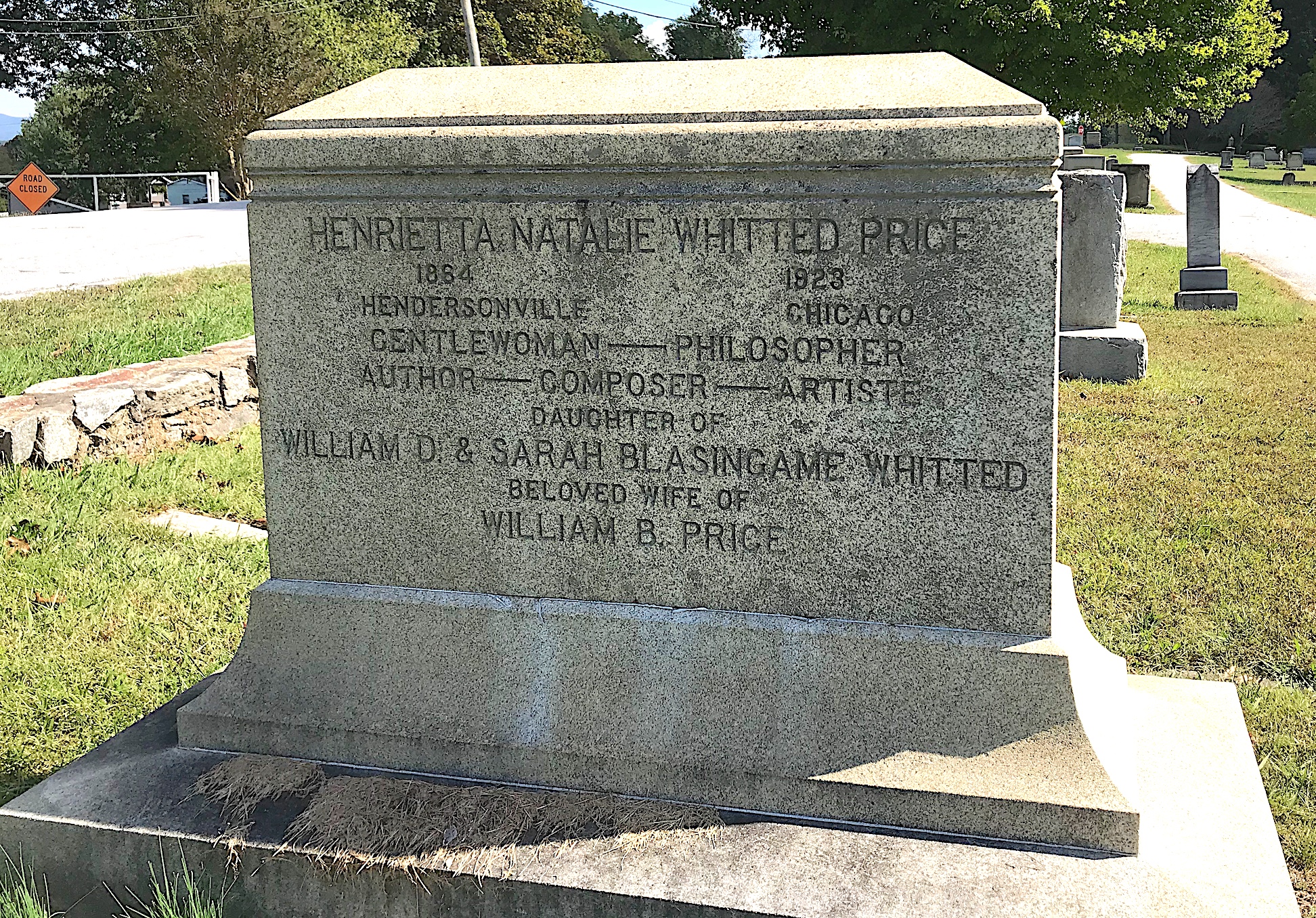
I’m going to close Part I by including a grave stone I found for Henrietta Natalie “Hennie” Whitted Price. I had no idea who she was and I’m guessing you don’t either. But it appears she was a minor lady of note in Hendersonville back in her day.
Born in Hendersonville in 1865, Hennie was the daughter of Dr. William Davis Whitted and Sara Earle Yancy Blasingame Whitted. She married William Bates Price in Chicago in 1893 at age 28. Henry was president of the Price-Teeple Piano Company. William had two children from his first marriage, Albert and Kathleen, who lived with their mother, Lucy. The couple made their home in Chicago and had no children of their own.
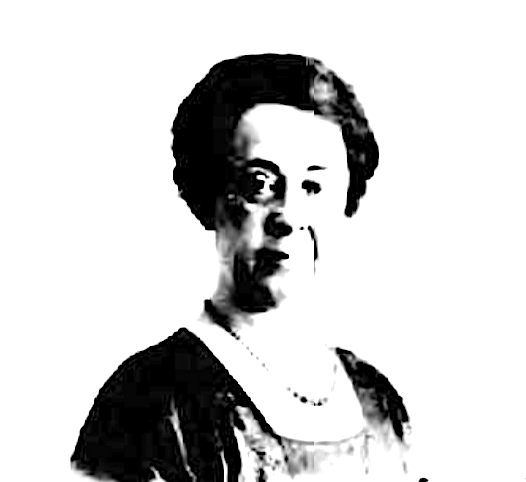
To be honest, I couldn’t find much about Hennie. She did write two books, “Sketches in Lyric Prose and Verse” in 1920 and “Ravelings in Rhyme” in 1910. I can see how ladies of that era might have enjoyed reading them. I could not track down any of her musical compositions.
When she died on Feb. 4, 1923 at age 58, this was her obituary in the Hickory (North Carolina) Daily Record.

While her funeral was held at the chapel at Chicago’s Graceland Cemetery, Hennie’s body was brought home to Oakdale Cemetery for burial beside her parents. Her husband, William, died in 1936.

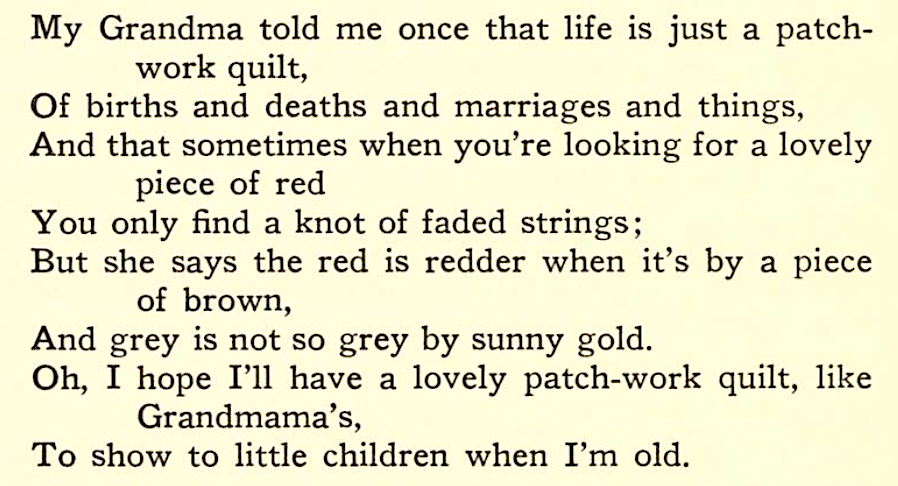
Life is Just a Patchwork Quilt
There’s a bit of verse written by Hennie on the back of her grave marker. But I found this one from her poem “The Patchwork Quilt” that I particularly liked.
I’ll be back next time with more stories from Oakdale Cemetery.

 Adventures in Cemetery Hopping
Anyone who has taken a high school or college American literature course should be familiar with Thomas Wolfe’s works. “Angel” is among his most famous novels….and to find that his father’s shop was responsible for creating the one in Oakdale that was his inspiration for it is really something. Wolfe’s “You Can Never Go Home Again” is yet another favorite….published posthumously.
The final resting place for locomotive engineer Lewis Tunstall is especially poignant, with the broken tree trunk signifying a life cut short. Rail buffs (and I’ll admit to being one ) are familiar with the Saluda grade not far from Asheville, that was once the steepest mainline section of railroad track in the nation. It was the site of numerous accidents over the years. In the 1900s, the Southern Railway installed several “turnouts” along its steep path to allow runaway trains to take a (somewhat) safe exit. One can see these on mountainous interstate highways to allow semi-trucks that have lost brakes to safely ‘turnout’ from the highway and roll to a stop. The Saluda grade was closed to rail traffic nearly 25 years ago, and a hiking trail is now planned for that route.
The carving of the steam locomotive and tender near the base is quite a work of art. I have seen such railroad related monuments in other cemeteries over the years.
Keep up the great work, Traci.
Greg and June H.
Thank you so much! I’m glad you enjoyed it. So many hardworking folk died in railroad accidents back in the day, I don’t think people realize how many. Lewis Tunstall’s monument is proof of that.
beauteous! 20 2025 Look Homeward, Angel: Visiting Thomas Wolfe’s Inspiration at Hendersonville, N.C.’s Oakdale Cemetery, Part I enthralling