• About Me
  • Cemeteries I Have Visited
  • Have questions?
  • Photos

Adventures in Cemetery Hopping

~ A blog by Traci Rylands

Adventures in Cemetery Hopping

Monthly Archives: May 2025

The City of Five Flags: Stepping back in time at Pensacola, Fla.’s Saint Michael’s Cemetery, Part II

16 Friday May 2025

Posted by adventuresincemeteryhopping in General

≈ Leave a comment

Last week, I introduced you to Saint Michael’s Cemetery (SMC) in Pensacola, Fla. Now let’s delve into more about some of the people buried there.

Welcome to Saint Michael’s Cemetery!

The Woman Behind the Man

Had there not been a sign next to her grave, I might have walked on by Dorothy Camber Walton’s humble box grave.

Born in 1760 in Georgia, Dorothy Camber had British parents of means. She caught the eye of attorney and Georgia congressman George Walton. On July 2, 1776, he voted in favor of the Declaration of Independence for Georgia, along with Button Gwinnett and Lyman Hall. The couple wed in 1778.

George Walton not only signed the Declaration of Independence, he later became governor of Georgia twice.

On Jan. 9, 1778, Walton received a commission as colonel of the First Georgia Militia. Despite being wounded and taken prisoner, he was released in late 1779. Soon after, Walton was elected governor of Georgia for the first time, a position he held for only two months.

Dorothy got caught up in the turmoil as well during her husband’s capture. George used his connections to have her sent to sea, arriving at the port of Charles Town. Her ship was captured by a British frigate and sent instead to the West Indies. Dorothy was eventually exchanged for two British colonels and sent back to join her family, according to the book “The Walton House” by Leora M. Sutton.

Had I not seen this sign, I might have passed up Dorothy. That’s why signs like this are so helpful.

During the 1780s, Walton devoted himself almost exclusively to Georgia state politics. He served as chief justice and negotiated a treaty with the Cherokee. Walton was elected to a second term as governor in 1789 and served for one year.

During his term, Georgians adopted the new Georgia Constitution, moved the capital to Augusta, and concentrated on settling the western frontier. After his tenure as governor, Walton served as a judge of the superior court from 1790 to his death. He also filled the unexpired term of James Jackson in the U.S. Senate in 1795 to 1796.

During the last years of his life, George suffered from continued attacks of gout. He died on Feb. 2, 1804 in Augusta at age 62. He was initially buried at Rosney, home of his nephew Robert Watkins. He was re-interred in 1848 beneath the Signers Monument in front of the courthouse on Greene Street in Augusta.

George Walton is buried with Lyman Hall beneath the founders’ monument in Augusta, Ga. Button Gwinnett is buried in Savannah’s Colonial Cemetery. All three signed the Declaration of Independence. (Photo Source: TripAdvisor.com)

George and Dorothy had two sons, Thomas (1782-1803) and George Jr. (1787-1863). George Jr. was a graduate of Princeton and served several terms in the Georgia General Assembly. He was practicing law in Augusta in 1821 when his wife’s uncle, senator Freeman Walker, recommended to Georgia’s secretary of state that George Jr. be appointed secretary of the West Florida Territory.

George Walton Jr., the son of George and Dorothy Walton, was an attorney and political figure much of his life.

George Jr. received his commission from President James Monroe on June 27, 1821 and served under Gen. Andrew Jackson, the appointed commissioner to receive the Floridas from Spain, and to serve as acting governor of east and west Florida until a civil government could be established. He and his family moved to Pensacola, Fla. and Dorothy accompanied them.
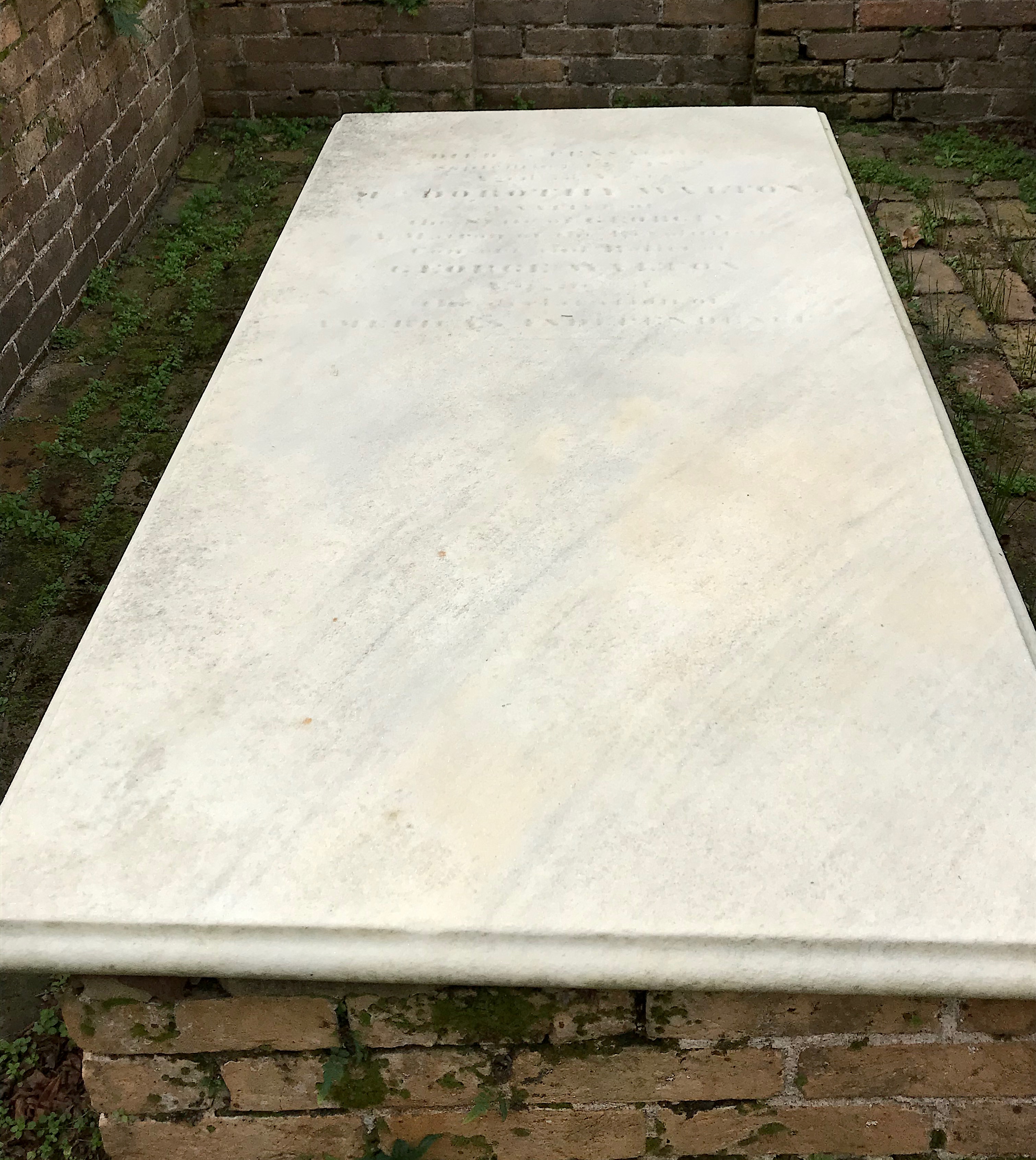
You would never know that the wife of the signer of the Declaration of Independence was buried here.

After a long illness, Dorothy died in Pensacola on Sept. 12, 1832 at age 71. George Jr., who moved to Mobile, Ala. in 1835 with his family, later became mayor of that city. He died on Jan. 3, 1863 and is buried in Blandford Cemetery in Virginia. So Dorothy remains alone at SMC.

The Kelly Family Plot

Unlike Dorothy Walton, the Kelly family has no signs. But their three monuments indicate they had money and I found myself drawn to them.

The Kelly plot got my attention.

Let’s start on the far right with Hanson Kelly, who was possibly married more than once. Shortly after arriving in Pensacola, Hanson became the Pensacola port master and got involved in the timber trade. He also served as the city’s mayor in 1847.

Hanson and Susan Kelly’s oldest son, William, was a lawyer, judge, soldier, and statesman. I suspect it may have been his wealth that provided these handsome markers.

Hanson Kelly died at the age of 81 on May 11, 1855. According to the Pensacola Gazette:

We are called upon to chronicle the death of Mr. HANSON KELLY, one of our oldest and most esteemed citizens. He died at 12 past 11 o’clock A. M., after a lingering sickness, during which he manifested great patience and fortitude. Mr. Kelly has been identified with our community for a long time, maning faithfully and creditably posts of honor and usefulness. His amiable spirit–unobtrusive modesty, strict integrity and generosity have won for him an enviable reputation; and his loss is no unimportant one to our city. He was a native of North Carolina–about 80 years of age, and leaves a large family.

Hanson and Susan Kelly share a monument. I believe it had been cleaned shortly before I saw it. That made reading the epitaphs much easier.

Hanson Kelly shares a marker with his wife Susan.

There are two epitaphs at the bottom. The first comes from Psalm 90:10. The second one, which is better known, comes from Psalms 23:4.

Hanson and Susan Kelly’s epitaphs are both Biblically based.

Susan Kelly died a few weeks later on June 25, 1855 at age 72 (according to the monument).

In the center is the grave for Mary Kelly, Hanson and Susan’s daughter. We don’t know her exact date of birth. Because she died in the 1840s, census records are of little help because women were rarely mentioned by name.

Little is known about Mary Jane Kelly beyond her death date and cause of death.

I especially like the two inverted torches with flames on each side. This often symbolizes the eternal flame of the soul.

Mary Jane died on Sept. 1, 1844 in Cincinnati, Ohio of consumption (tuberculosis) and her remains were brought back to Pensacola for burial. Perhaps she was attending a boarding school at the time of her death.

Why was Mary Kelly in Cincinnati when she died? (Photo source: Pensacola Gazette, Sept. 14, 1844)

Mary Jane’s epitaph is small but powerful.

“All who knew her weep her absence/Whilst they are consoled that she is in Heaven.”

I noted a signature on the base of her marker that indicates the firm of John Struthers & Son of Philadelphia, Pa. provided it. I was not familiar with them but the carving is beautiful.

The firm of John Struthers & Son of Philadelphia. Pa. provided Mary Jane Kelly’s stone. You can also find there work in Philadelphia’s Laurel Hill Cemetery.

A native of Scotland, Struthers came to America in 1816. He was the marble mason for Strickland’s Second Bank of the United States and the Philadelphia Exchange. He also worked as a mason on St. Stephens Episcopal Church, the steeple of Independence Hall, as well as the U.S. Naval Home and the New Almshouse.

It’s rare that I can share a photo of the person attributed with a firm that carved a specific marker but here he is.

John Struthers had quite a reputation as a stone mason and on occasion, an architect.

So what does this tell us? I think Mary Jane’s family thought a great deal of her and were more than willing to spend a lot of money to express that.

To the left of Mary Jane’s monument is one for Sarah Eugenia Van Braun. Even less is known about her beyond the fact she died on Dec. 15, 1836.

How does Sarah Eugenia Van Braun fit into the Kelly family?

Her epitaph reads:

Calm on the bosom of thy God/Fair Spirit! rest thee how!

E’en while with us they footsteps trod/His seal was on they brow.

Dust to its narrow home beneath/Soul to its home on high.

They that have seen they look in death/No more may fear to die.

These words come from a hymn called “Calm on the Bosom of Thy God” by British poet Felicia Brown Hamans (1795-1835). Married to a sea captain, Hamans was quite popular in her day for her writings.

Sarah Eugenia Van Braun’s epitaph comes from a hymn written by Felicia Hemans.

But who was Sarah Eugenia Van Braun? I did a little digging and discovered that a Sarah Kelly married Blidon Van Braun on May 11, 1833 in Escambia County, Fla. where Pensacola is located. So she was likely one of the daughters of Hanson and Susan Kelly.

On the 1850 U.S. Census, a Blidon Van Buren is shown to be living in the Hanson Kelly household in Pensacola and working as a clerk. It notes he was born in Pennsylvania. Is it possible he had Philadelphia connections to assist in attaining Mary Kelly’s marker? We don’t know.

“Thou Art Gone to Rest”

The Abercrombie family plot left me with some questions. It’s quite large with a handsome fence but is covered in concrete with only two markers on top. The one you notice from the start is the small one for Evalina “Evie” Abercrombie. It’s a heartbreaker for sure.

Evie was the daughter of Alabama-born lumber manufacturer James Abercrombie, Jr. Born in 1819, James was the son of James Abercrombie, Sr., who had a distinguished political career as an Alabama congressman. James Jr. married a cousin, Sarah “Sallie” Abercrombie, on March 27, 1840. After living in Alabama, they moved to Florida in the 1850s. James managed his family’s brick making business in Pensacola, which supplied the U.S. government with bricks for its forts.

Undated photo of Sen. James Charles Abercrombie, Jr. (Photo source: Find a Grave)

Over the course of their marriage, I believe James and Sallie had eight children. Evie was next to last, born on Jan. 18, 1859.

Sarah “Sallie” Abercrombie must have been devastated when little Evie died. (Photo source: Find a Grave)

Evie died on Oct. 18, 1860 in Pensacola. Her father had just been elected a Florida senator 10 days before and served for five years. Sallie gave birth to their last child, Lula, on Aug. 2, 1866.

The epitaph on Evie’s grave reads:

Thou art gone to rest in a lonely bed
Sweet form of my precious child
In the silent grave rest thy little head
And hushed by cries so mild
And at Jesus feet thou dost worship now
with a lovely infant throng
and soft music swells from thy little harp
and sweet is thy lisping song.

Little Evie Abercrombie died only 10 days after her father was elected to the Florida Senate.

James Abercrombie Jr. died on Jan. 3, 1871 at age 51. I don’t know his cause of death.

According to the 1880 U.S. Census, Sallie was living in Pensacola with her three adult sons and Lula, who was 13. Daughters Bella and Lizzie had both married. Sallie died in 1882, the exact date is unknown. I found no funeral notice for her anywhere.

Are all of these people buried in this plot?

I don’t know why there are no individual markers for James, Sarah, or their sons. William, 33, died on Jan. 19, 1883 of pneumonia. John, 28, died of “hematuria” (which basically means blood in the urine) on Dec. 6, 1884. James “Jessie” Abercrombie, who died in 1924, was Pensacola’s harbormaster for many years and his obituary noted that he was to be buried at SMC.

Perhaps after Sallie, John, and William died (only a year apart), the remaining siblings couldn’t make a decision on how to mark their graves. Or perhaps they did have markers and they were damaged. It leaves me very curious.

Lula, who married Brigadier General William S. Pierce, died at age 63 in 1929. She is buried nearby at St. John’s Cemetery (which I will right about next). Her husband died in 1923 and is buried in Vermont, so she is alone. Her sisters, Bella and Lizzie, are both buried with their husbands in SMC.

I’ll be back soon with Part III.

Leonard Craig, a fishing schooner engineer, was found dead by his brother Marian at the end of a Pensacola wharf on July 7, 1937. Leonard was 32 when he drowned.

The City of Five Flags: Stepping back in time at Pensacola, Fla.’s Saint Michael’s Cemetery, Part I

09 Friday May 2025

Posted by adventuresincemeteryhopping in General

≈ 2 Comments

When I look back at my visit to Florida in February 2020, I have mixed emotions. While I didn’t know it then, it would be the last time I visited Blue Mountain Beach with my best friend. She ended our friendship for reasons I still don’t understand a year and a half later. I miss her a lot.

Second, the “hop” I took in two Pensacola cemeteries then would be the last before the Covid-19 pandemic took hold. It didn’t keep me out of the cemetery but things did change.

A few weeks later, I was sitting in my car waiting for my son to get out of school when I listened to a news report about this strange new illness. I had just booked a bed and breakfast in New Orleans for spring break and was wondering if I was going to have to cancel.

I wouldn’t make it to New Orleans for another three years.

At the same time, I’m very glad I did make it to Pensacola! Although it was a two-hour drive one way from Blue Mountain Beach through construction traffic, to me it was well worth the effort. In addition, cemetery hopping in NW Florida in February means a comfortable temperature!

St. Michael’s Cemetery only covers eight acres, but it is well worth the time to walk through it and explore.

St. Michael’s Cemetery (SMC) is wedged in next to Interstate 110 and the roar of cars going by is ever present. But as you walk amid the graves, you can step back a few hundred years as you read the markers. Today, primary stewardship for the cemetery is provided by St. Michael’s Cemetery Foundation of Pensacola, Inc., a nonprofit.

The history of SMC alone makes it a stand out, but the fact that it’s documented so well by interpretive signs throughout makes it even better. Quite an effort has been made to help visitors learn more about Pensacola’s rich history and the people that helped create it.

St. Michael’s Cemetery is one of the two oldest extant cemeteries in the state of Florida. It’s also on the National Register of Historic Places.

SMC’s self-guided walking tour is documented with this helpful map. It certainly helped me find some of the more notable graves.

When you are pressed for time, a map like this of the graves of interest is especially helpful.

The City of Five Flags

Pensacola is often referred to as the City of Five Flags due to the five governments that have ruled it during its history: Spain (Castile), France, Great Britain, the United States, and the Confederate States of America. So when you glance at the names on the grave markers at SMC, that heritage is reflected in them.

Pensacola was the first multi-year European settlement in the continental United States, established at by conquistador Don Tristán de Luna y Arellano in 1559. Two years later, in 1561, the settlement and its fleet were destroyed by a hurricane and the site was abandoned. Pensacola was permanently reestablished by the Spanish in 1698 and became the largest city in Florida, and the capital of the colony of West Florida.

St. Michael’s Cemetery is full of helpful interpretive signs to guide you. Note that behind this sign, you can see the underside of Interstate 110 close by.

Since Pensacola was destroyed and abandoned only two years after it was first founded, many people regard St. Augustine, Fla. as the first permanent European settlement in what would become the United States. The City of Pensacola, however, still occasionally refers to the area as “America’s First Settlement” in advertisements, signs, and travel brochures.

The city and its bay were named after the Panzacola Indians, a tribe that lived near the bay when the Spanish arrived. They spoke a Muskogean language. The name was changed to Pensacola to make it easier to pronounce. Later, both the French and the British would wrest it away but the Spanish had three different periods of possession until 1821. It was later under Confederate control during the Civil War until 1865.

St. Michael’s Cemetery Established

According to the cemetery web site:

Historical research and early maps indicate that the land in and around the modern cemetery was in use as a burying ground beginning in the mid to late 18th century. The earliest surviving above ground markers in St. Michael’s Cemetery, however, are associated with Pensacola’s Second Spanish Period (1781-1821).

Pensacola drew immigrants from around the world. There are approximately 3,200 marked graves in the cemetery, and with subsurface anomalies, possibly several thousand unmarked graves. Tombstones in the cemetery reflect not only status and ethnicity of individuals but also reflect society as a whole on the Florida Gulf Coast frontier.

Looking on Find a Grave, I see that the oldest marked grave is for George Oseola Commyns, an infant who died on May 2, 1812. We only know this due to a 1938 book of transcriptions of the cemetery, the inscription on George’s grave is now impossible to read.

The Sullivan Brothers

The largest monument at SMC is for Irishman Daniel Francis Sullivan (1833-1884). The plot is surrounded by a well-maintained fence. Daniel is the only occupant as far as I know. Perhaps plans were originally for his wife and daughters (along with their spouses) to be buried with him later.

Irishman Daniel Sullivan’s monument is the largest one in the cemetery.

Born in Ireland in 1833, Daniel moved to Pensacola with his younger brother Martin when they were young. He married Alabaman Emily S. Cropp in 1868. The brothers were very successful in the lumber business, purchasing several mills and wharves on Pensacola Bay, and large areas of timber in other parts of Escambia County. Later, Daniel was president of Pensacola’s First National Bank.

A plaque in Daniel Sullivan’s plot shares his history.

The town of Century was founded around the lumber industry the Sullivan brothers brought to the area. A colorful personality, Daniel also built the Pensacola Opera House that opened in 1883. Two hurricanes in 1916 and another the next year caused so much damage that it was demolished in 1917.

Daniel Sullivan was only 50 when he was found “dead in his bed” on June 14, 1884.

According to a 2019 article in the Pensacola News Journal:

Sullivan’s life was like Horatio Alger, for he had begun with a modest career, then extended into insurance investing and beyond the lumber industry itself. There, by the 1880s, he had become a millionaire, a true first for that time and within Pensacola itself. Observers of those years labeled Sullivan as flamboyant, perhaps because he set a standard in bringing “the unusual” to the community. With capital to invest, Sullivan focused his eyes upon the arts, then in 1883 he began establishment of the Pensacola Opera House.

Situated on the left, the Pensacola Opera House once loomed proudly over Plaza Ferdinand VII. (Photo Source: Detroit Publishing Co, 1905)

Daniel and Emily had two daughters, Mary and Katie. His lumber business, operated with his brother, was thriving and his wealth increased by the year.

I suspect that the fence around the Sullivan plot has been restored at some point. If that’s not the case, it has withstood the test of time very well.

So it came as a shock when on the morning of June 14, 1884 that (according to his obituary) Daniel Sullivan was found “dead in his bed”. His family and the community were shocked. He was only 50 years old.

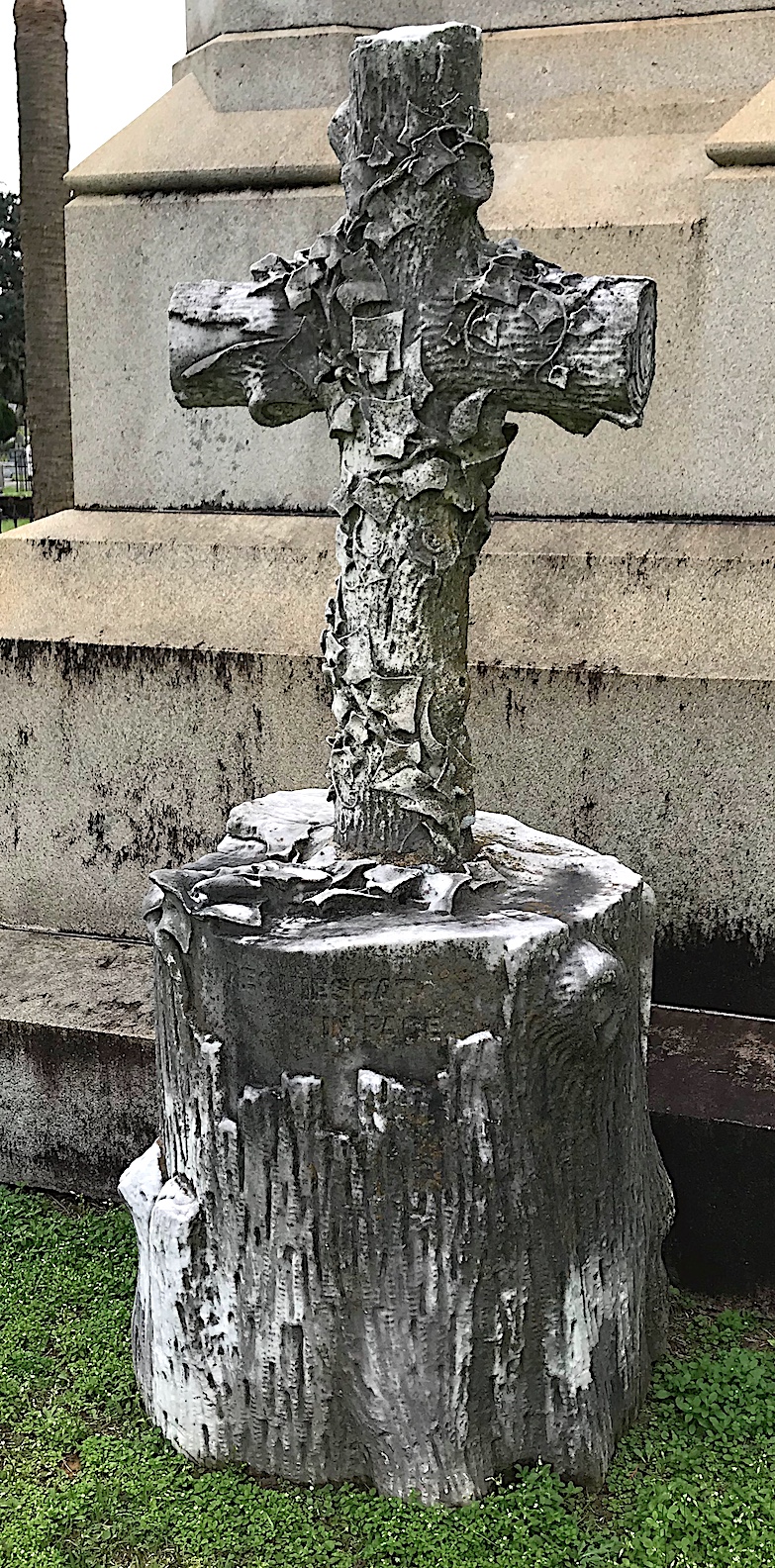
This tree-shaped cross is at the foot of Daniel Sullivan’s monument.

I don’t know how long Emily and her daughters remained in Pensacola. But by 1910, census records show they were all living comfortably in the same Manhattan household in New York City. Katie married promoter Malcolm Anderson and had three children, while Mary remained unwed.

Daniel Sullivan’s log-shaped footstone, topped by an urn for flowers, is unique.

When Emily died in 1919, she was buried in River Bend Cemetery in Westerly, R.I. Mary and Katie are buried in the same cemetery.

Daniel’s brother Martin continued with the lumber and banking business in the years that followed. He and his wife, Kate, had five children together. Martin, who had recently traveled back to Ireland, felt his health beginning to decline in 1911. He traveled to Baltimore, Md. for medical treatment in the fall of that year. He died on Oct. 15, 1911 at age 73. Katie made it to his side only a few hours before his death, one article said.

Martin is also interred in SMC, but not in the Sullivan plot. He and his family have their own handsome mausoleum.

Tragedy was not done with the Sullivan family. Son Charles Russell, 25, died in Colorado Springs, Colo. only a month later on Nov. 16, 1911. A cashier in his father’s bank, he had traveled west in hopes of improving his health.

Daughter Marie Sullivan Read, only 37, died during or after giving birth on Jan. 1, 1912. Her infant daughter, Marie Ellen, died the next day.

Martin, Russell, Marie, and the baby were the first four interments in the mausoleum. Katie died at age 86 in 1937. She is interred in the mausoleum along with the other adult children (Julia, Martin, and John).

There’s so much more I have to show you at St. Michael’s Cemetery. Part II is coming soon.

A gowned mourner looks down from the top of the Williams family mausoleum. John Williams was the long-time owner of a restaurant and “coffee saloon” in Pensacola.

Recent Posts

  • More Pensacola, Fla. Cemetery Hopping: Taking a Ramble Through Saint John’s Cemetery, Part III
  • More Pensacola, Fla. Cemetery Hopping: Taking a Ramble Through Saint John’s Cemetery, Part II
  • More Pensacola, Fla. Cemetery Hopping: Taking a Ramble Through Saint John’s Cemetery, Part I
  • The City of Five Flags: Stepping back in time at Pensacola, Fla.’s Saint Michael’s Cemetery, Part V
  • The City of Five Flags: Stepping back in time at Pensacola, Fla.’s Saint Michael’s Cemetery, Part IV

Archives

  • December 2025
  • November 2025
  • August 2025
  • July 2025
  • June 2025
  • May 2025
  • April 2025
  • March 2025
  • February 2025
  • January 2025
  • October 2024
  • August 2024
  • July 2024
  • June 2024
  • May 2024
  • April 2024
  • March 2024
  • February 2024
  • January 2024
  • December 2023
  • November 2023
  • October 2023
  • September 2023
  • August 2023
  • July 2023
  • June 2023
  • May 2023
  • April 2023
  • March 2023
  • February 2023
  • January 2023
  • December 2022
  • November 2022
  • October 2022
  • September 2022
  • August 2022
  • July 2022
  • June 2022
  • May 2022
  • April 2022
  • March 2022
  • February 2022
  • January 2022
  • December 2021
  • November 2021
  • October 2021
  • September 2021
  • August 2021
  • July 2021
  • May 2021
  • April 2021
  • March 2021
  • February 2021
  • January 2021
  • December 2020
  • November 2020
  • October 2020
  • September 2020
  • August 2020
  • July 2020
  • June 2020
  • May 2020
  • April 2020
  • March 2020
  • February 2020
  • January 2020
  • December 2019
  • November 2019
  • October 2019
  • September 2019
  • August 2019
  • July 2019
  • June 2019
  • May 2019
  • April 2019
  • March 2019
  • February 2019
  • January 2019
  • December 2018
  • November 2018
  • October 2018
  • September 2018
  • August 2018
  • May 2018
  • April 2018
  • March 2018
  • February 2018
  • January 2018
  • December 2017
  • November 2017
  • October 2017
  • September 2017
  • August 2017
  • July 2017
  • June 2017
  • May 2017
  • April 2017
  • March 2017
  • February 2017
  • January 2017
  • December 2016
  • November 2016
  • October 2016
  • September 2016
  • August 2016
  • July 2016
  • June 2016
  • May 2016
  • April 2016
  • March 2016
  • February 2016
  • January 2016
  • December 2015
  • November 2015
  • October 2015
  • September 2015
  • August 2015
  • July 2015
  • May 2015
  • April 2015
  • March 2015
  • February 2015
  • January 2015
  • December 2014
  • November 2014
  • October 2014
  • September 2014
  • August 2014
  • July 2014
  • June 2014
  • May 2014
  • April 2014
  • March 2014
  • February 2014
  • January 2014
  • December 2013
  • November 2013
  • October 2013
  • September 2013
  • August 2013
  • July 2013
  • June 2013
  • May 2013
  • April 2013
  • March 2013
  • February 2013
  • January 2013

Categories

  • General

Blogroll

  • A Grave Interest
  • Cemetery Photography by Chantal Larochelle
  • Cemetery Tours of Berlin by Matti
  • Confessions of a Funeral Director (Caleb Wilde)
  • Find a Grave
  • Hunting and Gathering (cool photography site)
  • Save Our Cemeteries (New Orleans, La.)
  • The Cemetery Club
  • The Graveyard Detective
  • The Rambling Muser
  • Westminster Abbey Tours by Grace

Meta

  • Create account
  • Log in
  • Entries feed
  • Comments feed
  • WordPress.com

Blog at WordPress.com.

  • Subscribe Subscribed
    • Adventures in Cemetery Hopping
    • Join 402 other subscribers
    • Already have a WordPress.com account? Log in now.
    • Adventures in Cemetery Hopping
    • Subscribe Subscribed
    • Sign up
    • Log in
    • Report this content
    • View site in Reader
    • Manage subscriptions
    • Collapse this bar
 

Loading Comments...