
Today I’m wrapping up my visit to Pensacola’s St. Michael’s Cemetery (SMC) and if you’ve read this blog for long, you know I call this the “bits and pieces” part of the series. It has no rhyme or reason, it’s just what I found interesting enough to mention that’s left to share.
On a Distant Shore
Finding a grave marker that details the life of the deceased is always a jackpot to me. That’s the case for Pennsylvania-born Midshipman James Biddle Lardner of the U.S. Navy, who died at age 21 on March 8, 1829. His marker, at first glance, is nothing out of the ordinary. The front inscription sticks to the facts.

But if you read the epitaph on the back, you learn about the short life he led. I didn’t see it until some months later while looking at my pictures. This is why I take pictures of just about everything!
At the age of fourteen years he left the shelter of his father’s house and the delights of home for the toilsome and adventurous service of the Navy, participating in the dangers and sharing largely the ills of a sickly climate, he became the victim of disease just at the dawn of honorable usefulness.
This stone is placed as a mark where rests his remains on a distant shore and the last tribute of affection to a much loved brother.

James’ epitaph is far more informative than the brief newspaper item I found in Philadelphia’s U.S. Gazette on April 7, 1829.

I did learn a little about the USS Erie, the three-masted, wooden-hulled sloop-of-war launched in 1813 on which James served. I don’t know if he served on it from the start of his career, which would have been around 1822. The Erie sailed from New York in November 1823 to serve in the Mediterranean until 1826.

From 1827 to 1832, the ship was based at Pensacola, returning north for repairs. The Erie patrolled in the West Indies and off the coast of Mexico, protecting American citizens and property, suppressing the slave trade, and convoying merchantmen.
The author of James’ epitaph attributes the illness that led to his demise as due to the “sickly climate”. It’s hard to know what did him in, as it could have been anything from typhoid to tuberculosis. But his death clearly left a hole in the hearts of his family members, as this marker attests to.
Murder or Suicide?
Then you see a marker like the one for the Fudge sisters that leaves you with more questions than answers. Researching their deaths was quite a journey.
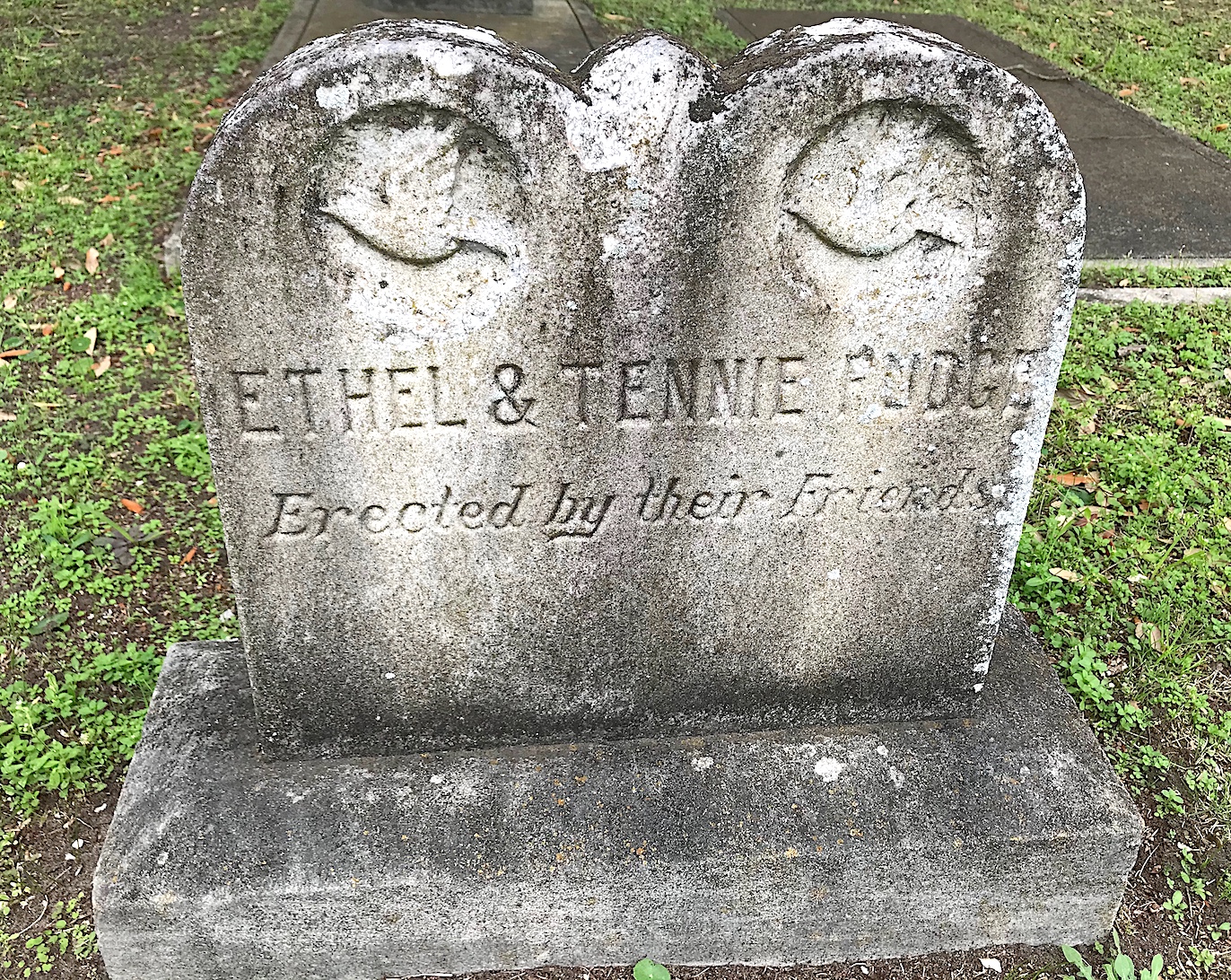
A native of Nashville, Tenn., Elijah Joseph (E.J.) Fudge married Josie Woods in 1904. They had three children together: Tennie, Bascom, and Ethel. At age 36, Josie died on Jan. 23, 1916 in a Nashville hospital. E.J. was now a widower with three little ones to raise.
E.J. and the children moved to Pensacola sometime in April 1916 to live near an aunt. From what I’ve read, life was hard for the Fudge family. E.J. rented a home for them and supposedly sought work with little success. Neighbors later said he was too busy drinking and chasing women to do much work. There was also talk that he was considering taking the children to an orphanage.

The exact facts are cloudy. But on June 27, 1916, E.J. went out that morning with Bascom (now 8) while Tennie (12) and Ethel (7), were left at home. Bascom supposedly went out earlier that morning to sell a horse bit/brace to a neighbor. E.J. was thus alone with his daughters.
Later that day, when father and son returned home, they found the two girls dead. Both had been shot in the chest with a rifle E.J. owned. Three suicide notes, supposedly written by the girls, were found. He believed Tennie had shot Ethel, then turned the gun on herself. The deaths shocked Pensacola residents and made headlines across the state.
E.J. wound up in jail while Bascom was in the care of local officials.

On June 30, the funeral of Tennie and Ethel was held at a local funeral parlor. Hundreds attended to pay their respects and leave flowers, which were later taken to SMC to be placed by the double grave. Several children, some of them former playmates of the children, attended the funeral.
On the same day, E.J. Fudge was charged with murder and eventually faced trial. It was discovered that he had two separate insurance policies for the girls that he had purchased shortly before the move to Florida. The death of his wife, Josie, was rumored to have been a suicide. Her death had netted him insurance money then.
Little Bascom testified that he never believed that the rifle was loaded and he also never saw his sisters handle the weapon. Only their father. He also testified that E.J. had often beaten them and provided little in the way of food.
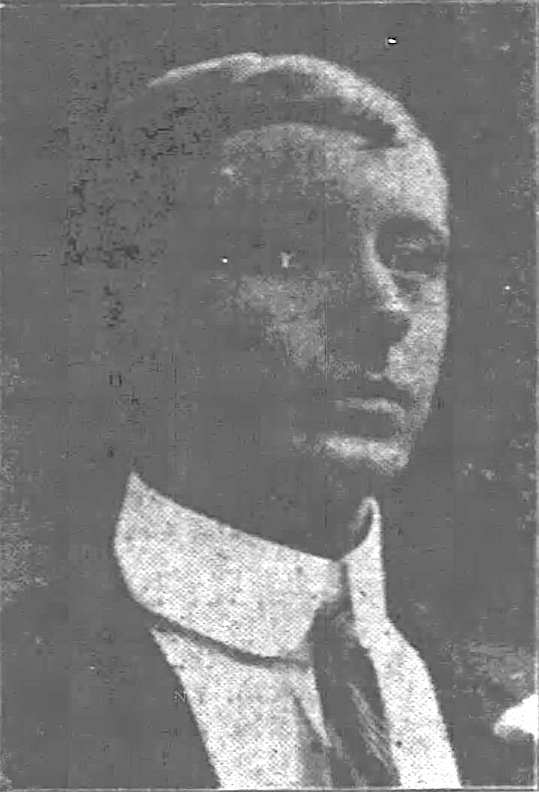
It was also stated that there was no way Tennie or Ethel could have used the gun to shoot themselves in the chest. Their arms were too short.
E.J. Fudge was convicted of murder in late June 1916. But in March 1918, the conviction was overturned by the Florida Supreme Court for lack of evidence and all charges were dropped. E.J. returned to Nashville with Bascom and remarried. E.J. died of tuberculosis on March 14, 1930 at age 52. Because he was a veteran of the Spanish American War, he was buried at Nashville National Cemetery.
Bascom grew up and married a woman named Hettie. They had four children but later divorced. Bascom died after a heart attack on April 9, 1960. He is buried in Nashville’s Spring Hill Cemetery.
It saddens me that these two little girls met such a violent end and their father was never punished for what I believe was their murder.
Iron and Wood
You’ve seen me post about cast iron grave covers in the past but this is different. These markers for two Swedish sailors are made of cast iron and definitely stand out.

Gunner Andresen and Christian Pharo were both sailors from Sweden who worked aboard the ship Gertrude. Their ages are unknown. However, a yellow fever epidemic (there were many back then) gripped Pensacola in 1867. The two men were brought to a local hospital for treatment and died there sometime in September 1867.
Perhaps their shipmates paid for the markers, we don’t know. They are all that remain of two sailors who died a long way from their native land.
Then you have one of the rarest finds I’ve ever run across in a cemetery. A wood marker that survived almost 100 years! It had to be too good to be true. As I later learned, in a way it was.

Born in Griefswald, Germany in 1883, Wilhelm Voss emigrated to the United States around 1910 to work as a boiler maker. He became a naturalized U.S. citizen in 1916. He registered for the draft during World War I but he did not serve. This is his 1922 passport photo. Records indicate he applied for the passport in order to visit his father, Carl, in Germany. I don’t know if he ever made the trip.

Wilhelm died on March 6, 1926 at age 42. I don’t know his cause of death. I don’t know who provided his wooden marker, which was possibly made of cypress.
After Googling my heart out, I stumbled upon a web site for the University of West Florida Trust, which had a photo of Wilhelm’s original marker. Apparently, it was restored and returned to its original place in SMC at some point. As you can see, it was in danger of falling apart. I have no idea when it happened or how.

After asking some of my taphophile friends, I think it is pretty rare for such markers to remain intact due to the vagaries of Florida’s coastal climate. But thankfully, Wilhelm’s marker shows that efforts can be made to successfully bring them back to life, so to speak.
Last But Not Least
Finally, I’d like to share the grave marker of Tomas Posse De Rioboo. He has one of the oldest graves at SMC and I think it’s lovely.

Born in Galicia, Spain, Tomas married Marianna and Joseph Bonifay’s third child, Josephine Bonifay. In 1815, he was given 400 arpents of land near the headwaters of Carpenter’s Creek/Bayou Texar. That’s the equivalent of about 337 acres. By this point, Tomas and Josephine already had six children ranging in age from 17 to two.
Tomas died on Nov. 27, 1832. We don’t know his age. His marker, originally upright, is signed by Pensacola stone carver Elihu Purvis. It features a weeping willow and a cross. The inscription is in Spanish.
Saying Goodbye
St. Michael’s Cemetery was a hard cemetery to leave. There are many more stones I could have written about. But it was time to head to Pensacola’s other large historical cemetery, Saint John’s Cemetery. Many of the people there are related to folks buried at SMC
I hope you’ll join me there.

 Adventures in Cemetery Hopping