
I’m still in Pensacola, Fla. and it’s still February 2000. But I’m in a different cemetery now!
Saint Michael’s Cemetery(SMC) is about two miles away from Saint John’s Cemetery (SJC), so not far. But the neighborhood in which Saint John’s is located in has a decidedly different feel. I did like the fact that it’s not right beside a busy interstate freeway ramp!

While the neighborhood is more working class, I didn’t feel unsafe when I visited. A mother was walking with her giggling baby in a stroller down the paths for exercise. A boy rode his bike through on his way somewhere, talking on a cellphone. Life going on amid the dead, as it were.
With about 13,000 recorded memorials (SJC’s web site says there are closer to 20,000 people actually buried there) on Find a Grave on 26 acres, SJC is larger than SMC and has about four times the number of burials. SMC consists of eight acres.
SJC is also “younger” in its existence than SMC. So if you were someone of note in Pesacola that wasn’t buried at SMC, it’s highly likely you’re at SJC.

Established by Masons
When SJC was established in 1876 by the Masons of Escambia Lodge, No. 15, F. & A.M., it was because SMC was getting a bit too crowded. Another cemetery was needed. The web page for SJC describes it like this:
Located on a gradually sloping hill, filled with native magnolia, oak, sycamore, and pine trees, the cemetery eventually was plotted to cover some 26 acres within 10 city blocks. Proceeds from plots sold initially went to pay off the mortgage acquired to purchase the land, to cover improvements, and to establish a perpetual endowment. While the trustees were drawn from the Lodge, neither the organization or any member would receive any financial benefit from this endeavor.
Later, in 1908, at its entrance on “G” Street, a gate house [see above photo] was constructed, which consisted of a chapel on one side and offices and storage rooms on the other. A fish fountain was also installed near the gate house. It was the largest cemetery yet constructed for a city that many Masons speculated would grow into needing such place.
After you enter through the archway of the gate house, you’ll find this handsome sign to assist you in locating graves. Funded by a grant, it features prominent graves and their locations, a cemetery map, and the history of SJC. You can also look up grave locations on their web site.

I especially appreciated the “symbol decoder” on SJC’s sign. It describes what many carvings you can find on a grave marker mean, such as the anchor and the clasped hands. This is something I wish more cemeteries provided so visitors can understand what they are seeing better.

Like SMC, there are also several signs indicating various historic/important burials in SJC along with some facts about the place. These little things are always appreciated by this cemetery hopper!

First Burial at SJC
There’s a sign for SJC’s first known burial, which is something always handy to know.
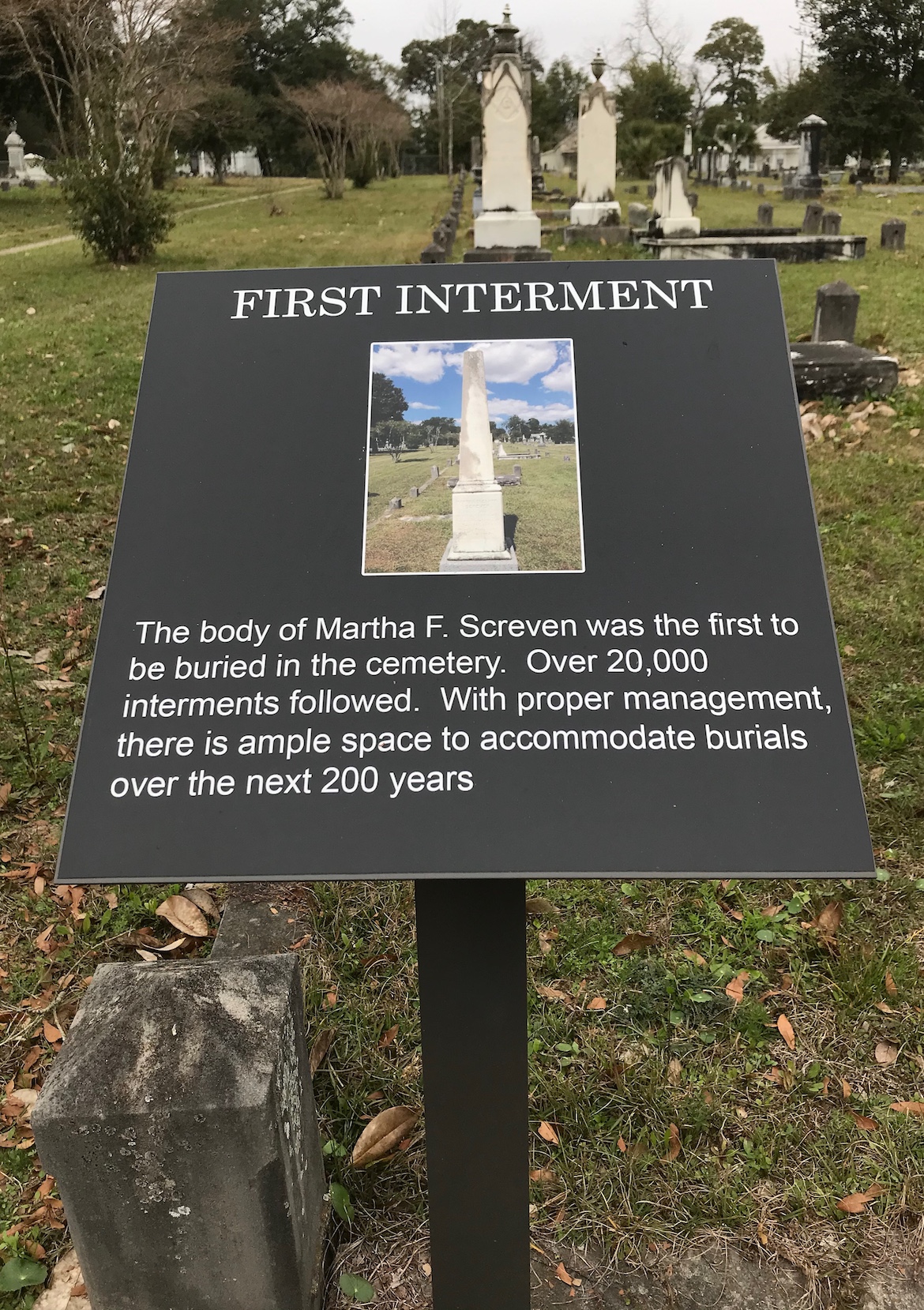
In researching the Frierson family, I came across another case of a man marrying sisters. It truly was common back then, despite the number of raised eyebrows it causes today.
Born in Charleston, S.C. in 1808, George Frierson graduated from South Carolina College (later the University of South Carolina) as a physician. He married Mary Ann Susanna Screven in 1830 and the couple had five children. Three of their sons served in the Confederate Army, one dying at the Battle of Chancellorsville in 1863. Mary Ann died at age 40 in 1844.
In 1846, Dr. Frierson married Mary Ann’s younger sister Martha Eleanor Screven. Two years later, they moved to Louisiana and helped found the town of Frierson. He and Martha had several children together. After living in Honduras for a period, they moved to Pensacola, Fla. where Martha died on Aug. 10, 1876.

Dr. Frierson lived out his final days back in Frierson, La. until he died in 1883 at age 74. He and Martha’s oldest son, William, became a doctor and served as an assistant surgeon in the Confederate Army during the Civil War. Dr. Frierson and his first wife, Mary Ann, are buried together in Evergreen Cemetery in Frierson.
Kursheedt & Bienvenu
Forgive me but I’m going to chase a rabbit now. Come along with me!
There’s another thing that’s special about Martha Frierson’s stone. It is marked with the name of the firm who created it, Kursheedt & Bienvenu, and includes their address. I’d never heard of them before. But I love finding out more about the people who made the stones I find in cemeteries.
It didn’t surprise me that Dr. Frierson purchased Martha’s marker from a New Orleans-based firm because Louisiana was his home for most of his life.

Fortunately, thanks to Emily’s Ford web page (she’s the owner of Oak and Laurel Cemetery Preservation, LLC), I was able to learn more about Edwin Kursheedt.
Born in 1838 in Kingston, Jamaica, Edwin came from a prestigious Jewish family and was raised in New Orleans, La. When the Civil War began, he joined the Confederate Army as a member of the Washington Artillery, where he rose to the rank of colonel (although this might have been an honorary title, a common thing in Southern circles).

After the war, Kursheedt went into business with his father, a stonework merchant since at least 1857. The firm was operated jointly with J.G. Bienvenu, who was also a notary public in New Orleans.

According to Emily Ford, Kursheedt & Bienvenu were successful in providing not only cemetery stonework and tombs but also hardware, commercial stonework, mantels, grates, and other items. By the 1880s, they owned a large showroom on Camp Street (the street mentioned on Martha’s marker) with marble yard next door at which at least 30 men were employed.
J.G. Bienvenu left the business after 1888 and Kursheedt operated Kursheedt’s Marble Works until 1901. He died in 1906 and is buried in Dispersed of Judah Cemetery (its congregation was established by his brother, Gershon) in New Orleans, which I visited in April 2025.
Okay, got that rabbit chased down. Back to SJC..
Grand Niece of Pres. George Washington
Another SJC resident who merits a sign is Mary Lewis Willis (1782-1834), the grand niece of U.S. President George Washington. How did she end up in Pensacola?

George Washington had only one sister who lived to adulthood, Elizabeth “Betty” Washington Lewis. Born in 1733, she married Col. Fielding Lewis in 1750. Betty gave birth to Capt. George Lewis in 1857. Capt. Lewis wed Catherine Daingerfield and she gave birth to a daughter, Mary, in 1782 in Millwood, Va.
According to SJC’s web site, Mary Willis Lewis was a socialite who rubbed elbows with the likes of Andrew Jackson at the famous Virginia Jockey Club race track owned by her husband, Col. Byrd Charles Lewis. Lewis was a brickmaker and the couple eventually moved to Pensacola. They would have at least seven children together.

One of their daughters, Catherine Daingerfield Willis (1803-1867), married Frenchman Charles Lewis Archille Murat in 1836 after her first husband died a year after they wed. Because Murat was the nephew of Napoleon Bonaparte, this made her a princess. They settled in Tallahassee, Fla. Murat died in 1847, leaving Catherine a wealthy widow. She died in 1867. The couple is buried in Saint John’s Episcopal Church Cemetery in Tallahassee.
Mary Willis Lewis died of yellow fever on Oct. 7, 1834 at age 52 in Pensacola. She was originally buried in Cantonment Clench Cemetery. The burial ground eventually fell into disrepair after Mary’s husband, Col. Byrd Willis, returned to Virginia in 1836. Mary’s remains were moved to SJC in March 1899 and the stone that marks her grave was placed in 2005 by the Sons and Daughters of the American Revolution, Pensacola Bay Area chapter.

One of Mary’s children is also buried at SJC, Dr. Louis Byrd Willis, who was born in 1801 in Virginia. Dr. Willis received his medical education and after his graduation in 1825, went with his parents to Florida. He practiced medicine in Tallahassee for 10 years, but in 1835 he moved to Pensacola. In the autumn of that same year, he died in a fall from a horse into a swollen stream while crossing. He is buried behind his mother.

I’m guessing his remains were moved when hers were, but his original marker was brought with him. According to his Find a Grave memorial, records indicate that his first name was actually spelled “Lewis”, not “Louis”. The dates of birth and death are also incorrect on the stone. He was born in 1801 and died in 1835.
Next week, I’ll cover more than two graves in my post. I apologize for that. But sometimes setting the scene of a cemetery takes time and when I have the information to do so, I like to share it with you all.
I hope you’ll return for Part II.

 Adventures in Cemetery Hopping