
I don’t think I’ve ever let two months elapse between blog posts before. But it happened.
My son started college, I did a good bit of traveling, and life…was busy. So I humbly apologize for keeping you all waiting for the next installment.
Last time, I introduced you to Saint John’s Cemetery in Pensacola, Fla. In this post, we’ll visit some more of SJC’s residents.
Babyland
If you’ve ever visited a cemetery that’s on the larger side like SJC, you may notice a section often referred to as “Babyland”. Many modern cemeteries actually label it as such. What it means is that a particular area is dedicated to the burial of infants and young children, always a heartbreaking thing.
SJC has a fenced off area for such graves. They even have a sign explaining it. Some of the graves have detailed markers but those without them (often unknown) are represented by numbers.


One of Babyland’s residents is Kenneth Anthony “Kenny” Hodgson. The son of Kenneth and Mary Hodgson, little Kenny was born on Jan. 20, 1960. He died on April 9, 1961 in a Boston, Mass. hospital. He was only 15 months old.

Florida State University’s Tomahawk Chop
While doing preliminary research before visiting this cemetery, I was surprised to learn that the inventor of Florida State University’s “tomahawk chop” was buried there. I had no idea it was attributed to one person since the chop’s been adopted by a number of sports teams (including the NFL’s Kansas City Chiefs, MLB’s Atlanta Braves, and the English rugby team, the Exeter Chiefs).

The tomahawk chop is a hot button for many. Controversy has been following it for years as many Native Americans have stated that they feel it mocks their culture. Some teams have stopped “officially” using it. FSU officials have said the university’s board does not endorse the action stating, “Some traditions we cannot control…It’s a term we did not choose and officially do not use”.”
In other words, Seminoles fans are still doing it. I can attest to the fact Braves fans are still doing it at baseball games. Since I don’t watch the Kansas City Chiefs or the Exeter Chiefs play, I can’t attest to their current use of the chop.

Which brings me to Wallace S. “Wally” Odom, an FSU alumnus who is said to have invented the tomahawk chop while attending games in the 1980s. I’ve also read that members of the FSU marching band supposedly invented it during the 1980s as well. Which is true? I don’t know. Maybe it’s a bit of both.
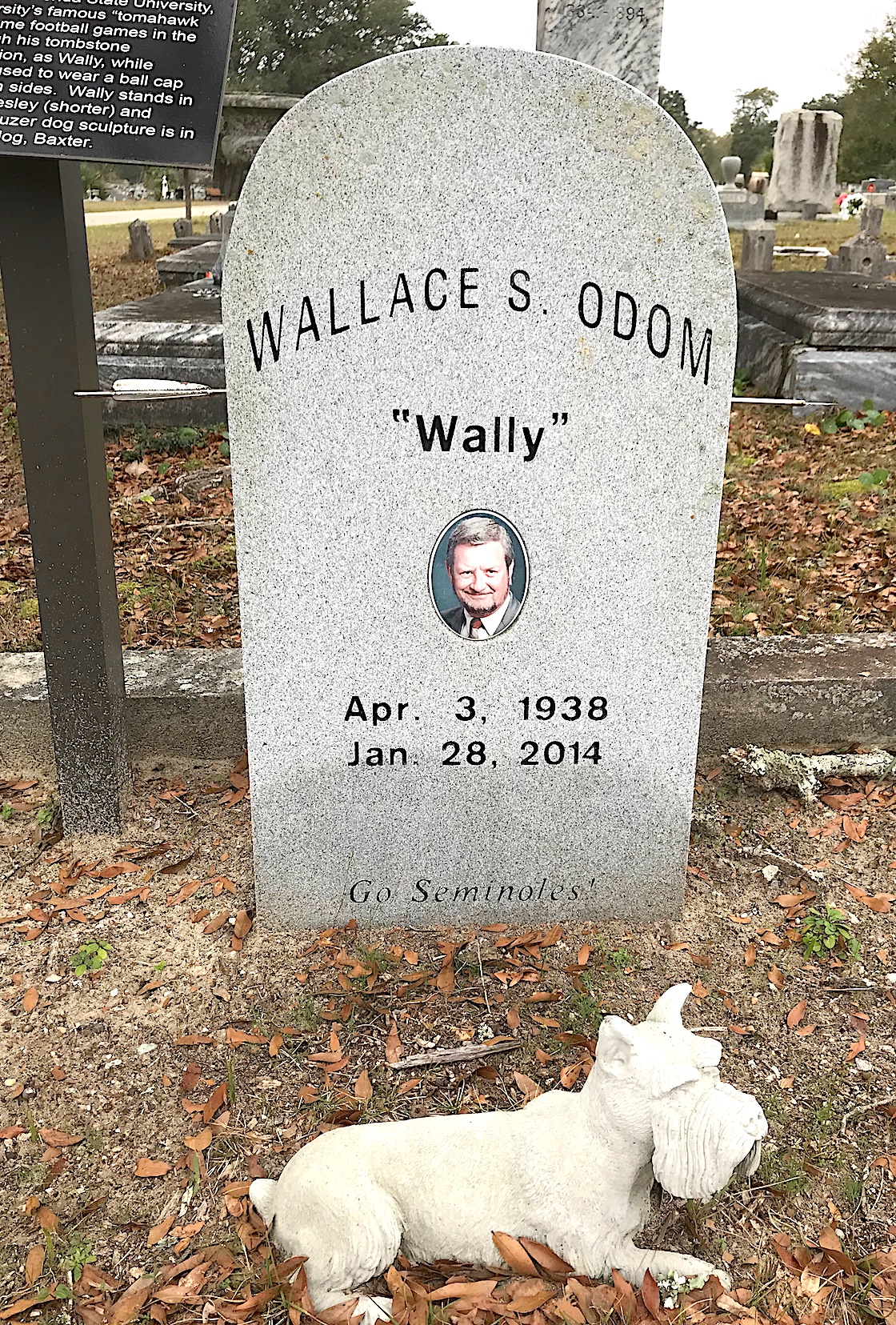
What I do know is that Wally was apparently a lively fellow with a great love for his alma mater who enjoyed having a good time with his friends and family. Oddly enough, his obituary doesn’t mention the tomahawk chop at all. He died at age 75 on Jan. 28, 2014.
Gabriel’s Horn
One of the most beautiful monuments in SJC is the one for German-born Johan “John” Michael Pfeiffer and his wife, Kate Biersdorfer Pfeiffer. There are more than 60 Pfeiffers buried at SJC. The monument, made of Westerly granite, features the angel Gabriel holding his horn.

Born in Ermershausen, Germany in 1845, John came to America in 1867 and joined his brother, George, in Pensacola to help operate his grocery business. In 1870, he wed Eva Margaret Hepp and they had one son, Ernest, in 1871. Eva died of yellow fever in 1873 at age 30. John remarried in 1874 to Kunigunda “Kate” Biersdorfer and they had a daughter, Eva, in 1875.

John started his own grocery business and did well. The family was active in the local Lutheran church. John served as acting mayor of Pensacola at one point, and was director of a bank. Son Ernest married Pauline Ibach in 1894 and worked with John in the family business. He and Pauline had several children together, five of whom survived to adulthood.
Sadly, John would die at age 71 only nine days after his grandchild, Maynard, died on Dec. 20, 1906 at seven months old. Ernest, who took over his father’s business, died at age 37 on Aug. 5, 1909. All three are buried at SJC. Ernest’s mother, Eva, is buried to the left of John.


Kate and Eva (who never married) lived with Ernest’s oldest daughter, Ernestine, for a time. Kate died on March 4, 1928 and was buried beside John. Eva died in 1953 at age 78.
The Johnson Family Tragedies
There are times when I see a family plot in which the dates cause me to wonder what happened. Such is the case for the Johnson family.
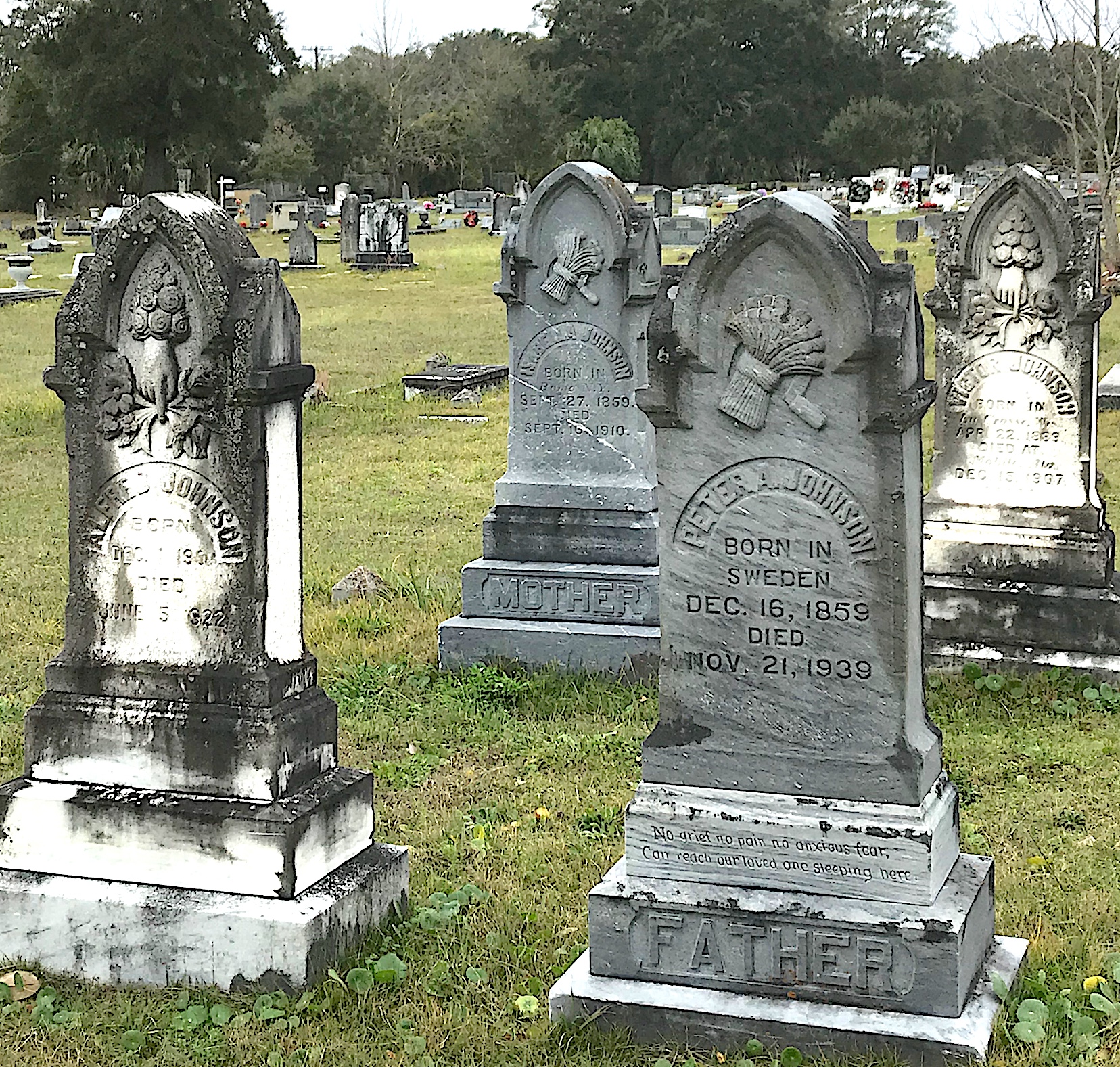
A native of Sweden, Peter A. Johnson was born in 1859 and emigrated to America in 1879. He married New Yorker Isabella Gates in 1887. They would have four children together: Ruby, Victor, Alice, and Alfred. The family lived in Wisconsin and Minnesota before settling in Pensacola, where Peter worked as a carpenter and later, a wheelwright at a buggy works.
In 1907, Victor was 18. He and his friend, John Delmar, decided to move to Mobile, Ala. and get jobs. They moved into a boarding house. It was there that tragedy struck.

On Dec. 15, 1908, the two friends were in John’s room when he opened his trunk to get some money. His pistol lay in the top tray and he picked it up to unload it. Thinking he had removed all the bullets, he pulled the trigger and to his horror, fired a bullet into Victor’s head. He did not flee and was arrested by police. When informed five hours later that Victor had died, he was devastated.
A coroner’s jury cleared John of any wrongdoing and released him from jail. That was little comfort to his family, who had lost Victor forever.
Isabella died only three years later at age 50 on Sept. 16, 1910. Victor’s younger brother, Alfred, was only nine at the time.
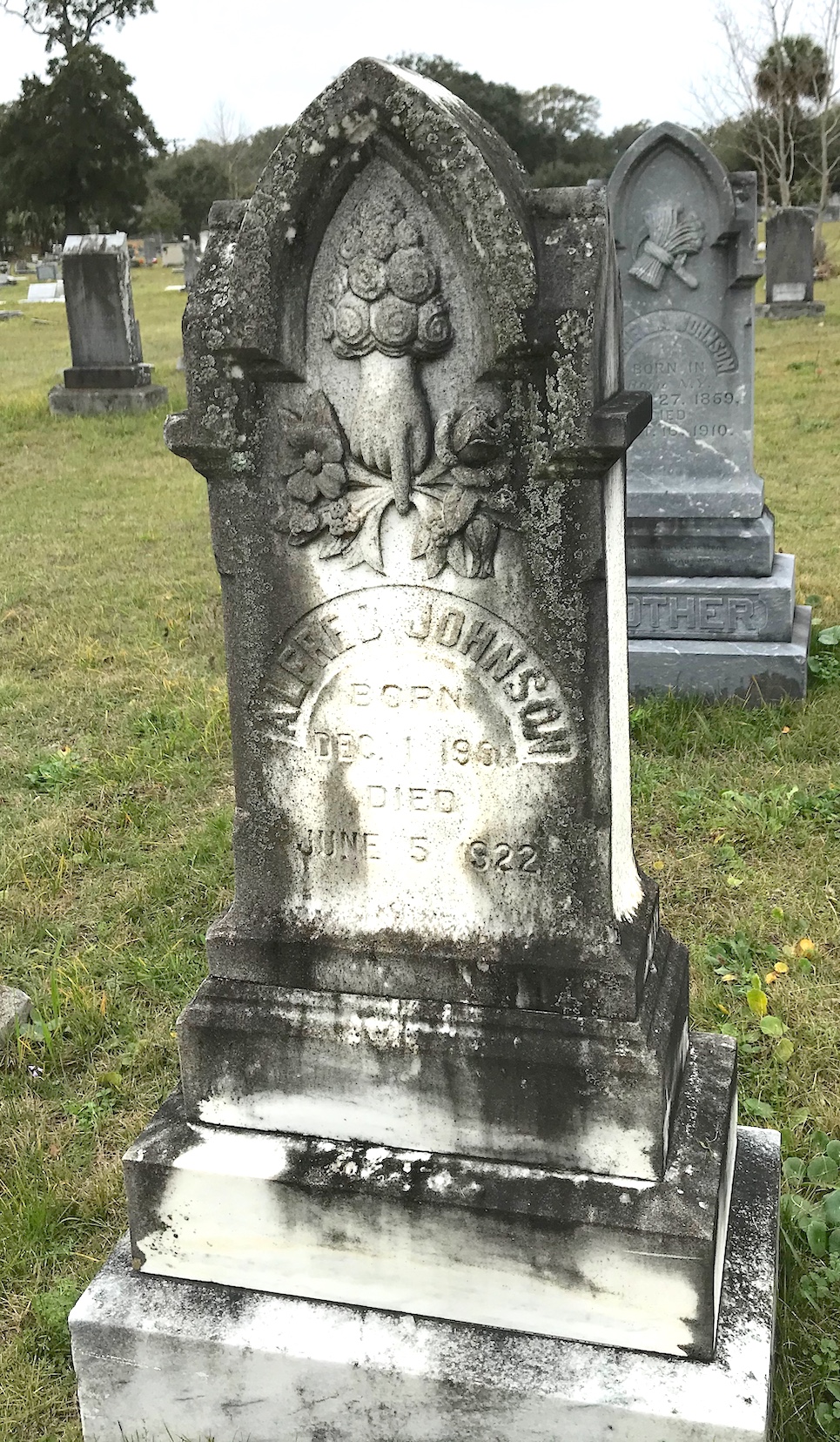
When Alfred was 20, he became sick with what newspapers would call “a lingering illness” and died on June 5, 1922. Peter had now lost two sons and a wife. He clung to his daughters, who had both married. Alice, who married Arthur May, died on Oct 13, 1930 at age 35. She is buried at SJC.
Peter died at age 79 on Nov. 21, 1939. His marker and Isabella’s markers both feature a wheat sheaf and a sickle. This can symbolize the cycle of life, going from resurrection or rebirth (when the seeds are planted) to death, when they are harvested.
I’ve got more to share with you from Saint John’s Cemetery. I promise it won’t be two months before I return.

 Adventures in Cemetery Hopping