• About Me
  • Cemeteries I Have Visited
  • Have questions?
  • Photos

Adventures in Cemetery Hopping

~ A blog by Traci Rylands

Adventures in Cemetery Hopping

Author Archives: adventuresincemeteryhopping

Volunteer State Hopping: Taking the Last Lap at Knoxville, Tenn.’s Asbury Cemetery, Part II

24 Friday Sep 2021

Posted by adventuresincemeteryhopping in General

≈ Leave a comment

In my last post, I introduced you to Knoxville’s Asbury Cemetery. My focus was on the Kreis family, including the death of racecar driver A.J. “Pete” Kreis. But now I want to return to the Pickles. Or Pickels. Take your pick. Different people chose different spellings of it over the years. So you might see it both ways, even within the same family. As I mentioned before, Asbury Cemetery used to be called Pickle/Pickel Cemetery. Again, spellings varied.

“The Icy Arms of Death“

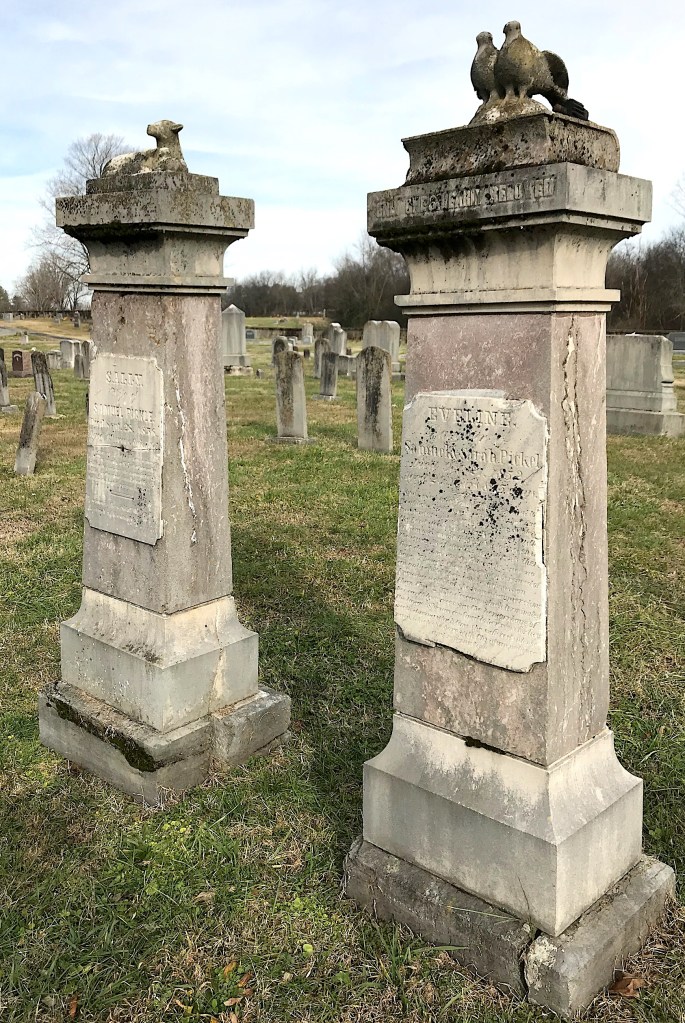
It’s not that common for a person’s cause of death to appear on their marker. But in the case of mother and daughter Sally and Eveline Pickle, both of their monuments share some details about how they died.

Born in 1807, Samuel Pickel was a native Tennessean. A farmer, he married Sarah “Sally” Dowell on Feb. 14, 1828. They had a daughter, Eveline, in 1832. She would be their only child. Eveline died on Oct. 21, 1852. After reading the inscription on her monument, it’s my guess that she died from tuberculosis or possibly pneumonia.

This image has an empty alt attribute; its file name is asburyevelinesallymonuments.jpg
Mother Sally Pickle and daughter Eveline Pickel (spelled differently on the markers) are buried beside each other.

Eveline’s inscription reads:

She was a kind and affectionate daughter, kind to the afflicted, zealous in the pursuit of knowledge, loved and esteemed by all who knew her. She loved the Lord Jesus Christ and through faith in Him was enabled to cry victory even in the icy arms of death. Her parents therefore do not sorrow as those who have no hope. Though they have been bereaved of an only child they bow in submission, knowing well that she is is in a happier time than this. The desease(sic) which terminated her earthly career was the hemorrage of the lungs. She was confined to her room for five weeks during which time she suffered intense pain which she bore with Christian patience and resignation.

At the top of her monument are two doves with the words “Only One & Dearly Beloved”.

This image has an empty alt attribute; its file name is asburytwodoves.jpg
“Only One & Dearly Beloved”: Eveline Pickel was only 20 when she died after a five-week illness.

Eveline’s mother, Sally, would die only four years later on Sept. 28, 1856 at the age of 49. If you read her briefer inscription, you might wonder if part of what led to her death was grief for her beloved daughter.

She honored her Christian profession by her general walk,but especially also by the patience she manifested in enduring the most painful sufferings during the last 4 years of her life.

This image has an empty alt attribute; its file name is asburysallypickleupclose.jpg
Did grief for her daughter play a role in Sally’s death? Notice that her husband’s last name is spelled Pickle here but Pickel on his own marker.

I do find it interesting that Sally’s monument has a lamb on top of it. I would have thought the younger Eveline’s monument would have been more appropriate for that symbol, not the two doves.

This image has an empty alt attribute; its file name is asburysamuelpickel.jpg
Samuel Pickel’s last name is spelled differently on his marker than that of his wife.

Samuel Pickel remarried on Aug. 2, 1857 to Cornelia Armstrong, who was 30 years his junior. Together, they had six children. At least three lived well into adulthood. Samuel died in 1883 at the age of 76. He is buried not far from his first wife and child. Cornelia remarried to Samuel Giffin in 1884 and died in 1887 at age 42. She is buried beside Samuel.

Samuel’s epitaph reads:

Amiable and beloved husband, farewell. Thy years were few but thy virtues were many. They are not recorded on this perishing stone but on the book of life and in the hearts of thy afflicted friends.

Mother and Child

I photographed the grave of one of Samuel’s grandchildren, Alva Mae Pickel. Born on Dec. 28, 1895, Alva was the daughter of Charles and Minnie Pickel. At age 23, she married farmer Ben Neubert in April 1919.

One March 6, 1920, Alva gave birth to a stillborn daughter that she and Ben named Gladys Elaine. The death date on her marker is damaged but I was able to find it on her records.

Gladys Elaine Neubert was stillborn. Her mother would die a few days later.

Alva died only three days later on March 9. According to her death certificate, the cause of death was “acute myocarditis.” She may have been suffering from peripartum cardiomyopathy, a rare type of heart failure. It occurs during pregnancy or not long after delivery. She was only 24.

Alva Mae Pickel Neubert was only 24 when she died.

Ben remarried to Leona Williams. They would have five children together. Ben died in 1972 and is buried with Leona in Roseberry Cemetery in nearby Mascot, Tenn.

Tragedy on the Tracks

There are 12 Huskissons buried at Asbury Cemetery. Two of their markers stood out to me. The first belongs to George Washington Huskisson, born on April 19, 1874 to John Wiley Huskisson and Mary Armstrong Huskisson. John would die at the age of 43 in 1890.

George married Eliza Huffaker in July 1893. They had two children, John and Miles. George found work with the railroad. That profession would eventually cost him his life.

I found this photo of George W. Huskisson and his wife, Eliza, and their son (most likely John Carl Huskisson). The person who posted it noted that she believed the two women standing behind them were two of Eliza’s sisters. Photo taken around 1895. (Photo source: Ancestry.com)

George was working as a fireman on the Knoxville & Ohio (K & O) Railroad on Jan. 8, 1899 near Elk Valley when a freight train had a head end collision with a mixed local passenger train at 11:30 a.m. The collision was blamed on the freight train not “side tracking” for the oncoming passenger train as a result of engineers misreading their time cards. Regardless, five men died that day. George was pulled alive from the wreckage and taken to the hospital. But he died the next day from the serious burns he received in the crash.

George Huskisson was severely burned in the horrific train wreck on Jan. 8, 1899 and died the next day.

George’s monument includes a locomotive engine with the number 157 on it. Perhaps this was an engine George had ridden and worked on during his life. One article I read noted that George was a member of the Brotherhood of Locomotive Firemen, who assisted his wife, Eliza, after his death.

George’s monument features a locomotive engine.

Eliza remarried to Samuel Felts in 1902. She died in 1956 at the age of 81 and is buried in Asbury Cemetery with Samuel, who died in 1955. Eliza and George’s two sons, lived well into adulthood and are buried in other states.

Tools of His Trade

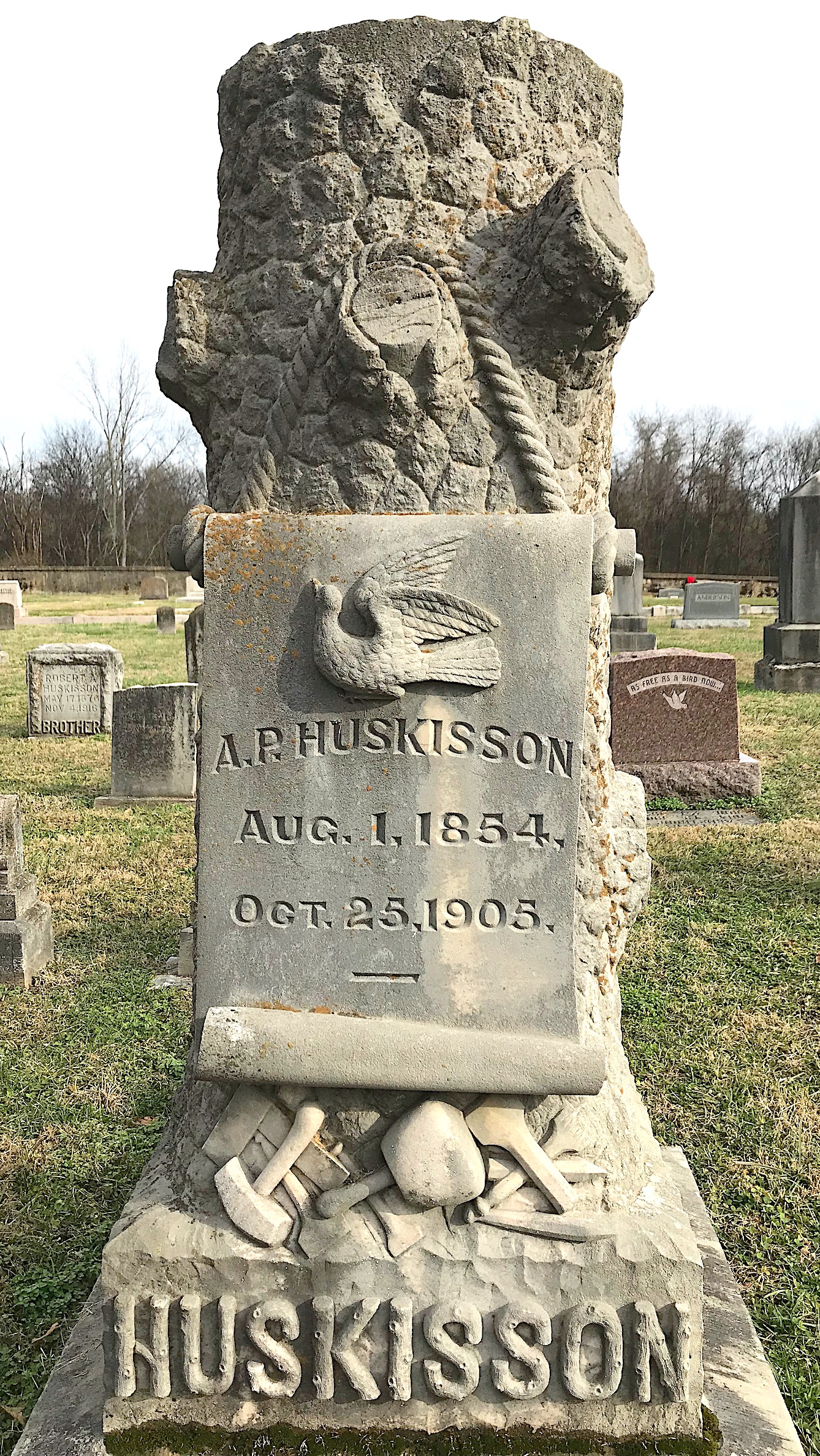
George’s uncle, Alfred Patrick Huskisson, also has an eye-catching monument as Asbury Cemetery. He was in the monument trade for much of his life, which is reflected in his own marker.

Born on Aug. 1, 1854, A.P. Huskisson married Lucinda “Lucy” Barlow around 1880. They had one daughter, Cora, born in 1886. A.P. was employed as a stone cutter for none other than G.W. Callahan & Bro. for some years. I wrote about George Callahan recently in my post about Calvary Cemetery.

Sometime around 1901, A.P. entered into a partnership with W.F. Berne in Augusta, Ga. to become cement sidewalk contractors. The next year, Cora and Lucy joined him in Augusta. He died on Oct. 25, 1905 at the age of 51.

The different tools at the base of A.P. Huskisson’s monument make it clear what his profession was.

A.P.’s body was returned by train to Knoxville and he was buried at Asbury Cemetery. His monument is in the shape of a tree, a very popular trend at the time. But I don’t think I’ve seen on that ever had stone mason’s tools at the base as this one does. It is a testament to his profession and his craftsmanship.

Lucy did not remarry and died in 1946. She is buried in Knoxville’s Lynnhurst Cemetery. Cora married Charles Mauk in 1907 and died in 1978. I was unable to find out where she is buried.

As I left, this sign did make me curious. In the Victorian era, cemeteries were known destinations for picknickers who would visit their loved ones before tucking into some lunch nearby on a blanket. I occasionally buzz through a drive-thru for a snack to eat at a cemetery. But I usually eat it in my car before walking around. Not on the grass.

Then again, maybe the sign is aimed more at folks loitering with less than honorable intentions. It’s possible they’ve had issues with vandalism or leaving trash. It’s a sadly common cemetery problem.

Don’t linger too long.

Next time, I’ll be stopping by Concord Masonic Cemetery.
Volunteer State Hopping: Taking the Last Lap at Knoxville, Tenn.’s Asbury Cemetery, Part I

17 Friday Sep 2021

Posted by adventuresincemeteryhopping in General

≈ 3 Comments

Just down the road from Knoxville’s Lebanon in the Fork Cemetery is another gem worth visiting. Although its tucked away among a mix of warehouses and industrial parks, Asbury Cemetery has a lot to offer.

The history of Asbury Cemetery is hard to find but I cobbled together a few facts. Up until the 1920s, Asbury Cemetery was more often called Pickle’s Cemetery or the Pickle Burying Ground. You can find it in the obituaries in the local newspapers written as such. That’s probably because many of the first people buried there had the last name of Pickle or Pickel.

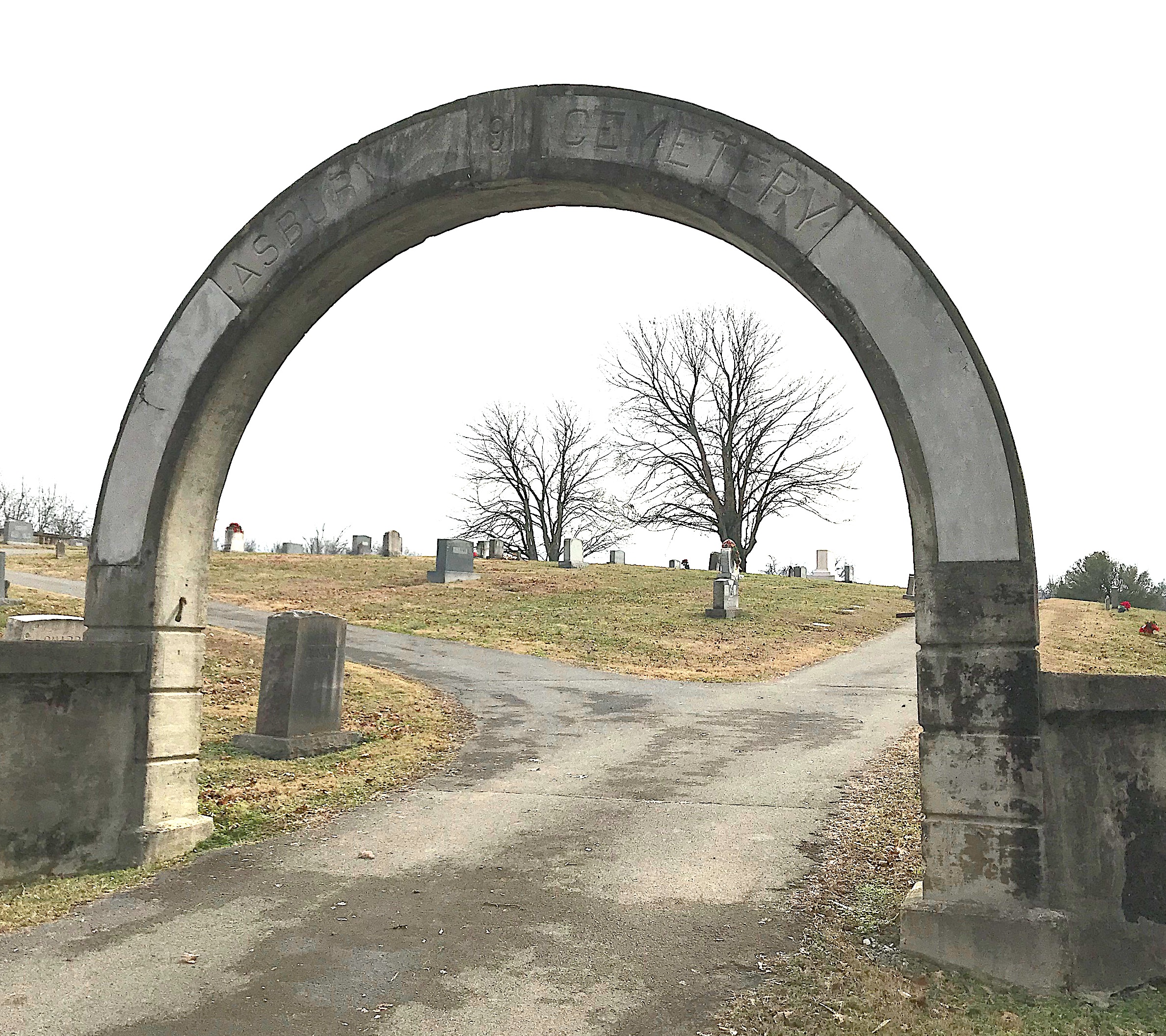
The arch at Asbury Cemetery says “91” at the top but burials have been taking place here as early as 1832.

The first burial recorded is for an infant, R.J.L. Wilson, born and died on Aug. 28, 1832. He was the son of Mr. and Mrs. Fred Wilson, who are not buried there. But the second oldest burial was Jesse Pickle, who died at the age of 28 in 1848. There are a total of 41 Pickles and 42 Pickels buried in the cemetery, which has a total of about 4,200 memorials recorded on Find a Grave. In many cases, Pickle and Pickel were used interchangeably on some markers. For whatever reason, the burial ground began to be called Asbury Cemetery in the 1930s and the sign (and arch) reflect that.

A Knoxville Dynasty

I plan to dive into more stories from the Pickle/Pickel family in Part II. But this week, I’m going to explore the Kreis family. When I arrived at Asbury, one of the first monuments I saw was for race car driver A.J. “Pete” Kreis and it literally blew my socks off. Some of the Kreis markers are impactful because the family had deep roots in the local monument trade.

Born on Jan. 19, 1900, Pete Kreis was the son of John Abby Kreis and Ida Jane Mays Kreis. His Swiss immigrant grandfather, Harmon Kreis, was among the estimated 31,000 Union soldiers that came from East Tennessee. Afterward, Harmon worked at the Knoxville Marble Company before he going into the quarry business for himself.

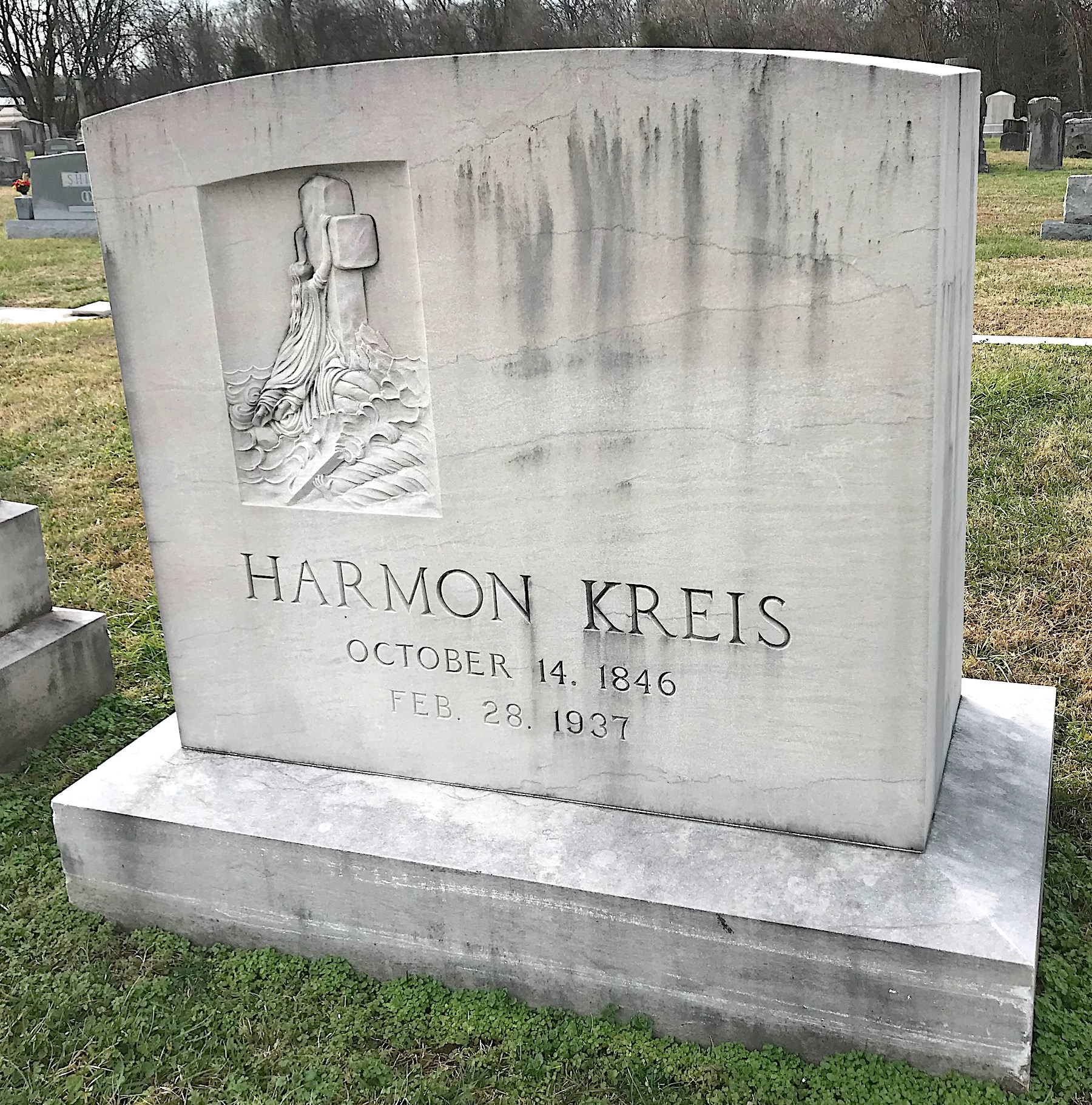
After developing several quarries, Harmon and a partner established the Appalachian Marble Quarry Company, which floated huge blocks of marble on rafts down the Tennessee River to Knoxville mills, known then as “Marble City.” Harmon would later serve two years as the reformist sheriff of Knox County, dying in 1937 at age 91. On the back of his marker are the words, “Last Survivor of Troop L, 9th Tenn Cavalry, Civil War.“

Harmon Kreis’s monument features a “Rock of Ages” motif on the left. Note the hand rising from the waves. He died three years after his grandson, Pete Kreis.

Pete’s father, John A. Kreis, owned one of the area’s largest dairy farms, Riverside Dairy and Hatchery. He also owned a national engineering and contracting company, which specialized in large railroad, levee and bridge jobs. His list of customers included the Southern, L&N and Missouri Pacific railroads. Pete would later work with his father and older brothers in construction when he wasn’t tearing up the racetrack.

Pete Kreis at the wheel of his race car. (Photo source: Los Angeles Times Photographic Collection.)

Having raced since he was 15, Pete was known around Knoxville for his skill behind the wheel and flirting with disaster. On Feb. 22, 1924, Pete had an accident while on a test drive which killed his passenger, 23-year-old car salesman Carroll McCall. The roadster missed a curve and hit a bridge abutment, rolling over and pinning Pete and McCall. The steering wheel had to be removed to free Pete, who went to the hospital with cuts and a shoulder injury.

Pete made his first Indianapolis 500 field in 1925. Driving a Duesenberg, he finished eighth. He didn’t actually complete the race, suffering from exhaustion and being replaced on lap 136. The pace car that year was driven by World War I ace Eddie Rickenbacker (whose grave I visited last week in Columbus, Ohio). At the race’s end, Kreis was congratulated for his prowess by Henry Ford.

The following year, Kreis had to back out of the race due to pneumonia. But he lent his car (a Miller Special) to friend Frank Lockhart, who won the race. Kreis continued racing but the Depression forced him to cut back in the 1930s and help his father in his contracting business. He finished 15th at Indy in 1932.

Pete eluded death yet again in June 1933 when the airplane he was flying in faltered after takeoff and crashed into the Tennessee River. He pulled his friend and fellow passenger Carl “Sonny” Rissing, Jr. from the water. Rissing broke several bones and lost part of a finger.

Pete’s Luck Runs Out

On May 25, 1934, Pete and his mechanic, Robert Hahn, were practicing for the Indianapolis 500. The pair was coming around the turn when in front of them a car went into a broadside skid. Kreis made an abrupt maneuver to avoid the collision, which sent his car up on to the wall and over the top. The “Miller-Hartz 2” fell off the south wall and tumbled down the 16-foot banking, hitting a tree and breaking in half. Pete was killed instantly and Hahn died before the ambulance arrived.

Pete and his mechanic, Robert Hahn, were killed while practicing for the Indy 500 on May 25, 1934. Hahn is buried in an unmarked grave at Forest Lawn Memorial Park in Glendale, Calif.

Several hundred people attended the funeral at Mann’s Chapel with more than 100 floral offerings that included a 12-foot diameter floral steering wheel. The funeral procession to Asbury Cemetery included more than 100 cars.

An Italian Craftsman

The Kreis family wanted a special monument for Pete that matched the person he was. It took an entire year for them to find the right stone. The block of grey Tennessee marble came from the Kreis family’s Appalachian Marble Quarry Co. When it was completed, the entire monument (including the concrete base) would weigh about nine tons.

The job of carving the monument fell to Italian carver Albert Milani, who came to America at age four to join his father, who was working for the Blue Ridge Marble Company of Georgia. Upon returning to Italy, Milani attended the Art Academy of Carrara, training in design and sculpture from age 9 to 14.

In 1906, he came back to America and traveled the country with his father, conducting on-site sculpturing. Eventually, he settled in Knoxville, where he married Lurley Lee Hickman in 1911 and had four children before her death in 1931. Milani received U.S. citizenship in 1931. He married again in 1934 to Thelma Margaret Hodges and raised two more children.

Italian carver/sculptor Albert Milani with a marble eagle.(Photo source: McClung Historical Collection)

Milani spent the rest of his life working primarily for Craig Day Marble Company and Candoro Marble Company as a foreman. He made numerous decorative statues for buildings across the country, often in a modern Art Deco style. In Knoxville, you can find his work on the Tennessee Supreme Court on Main Street and the 1912 Holston Building, among others.

Pete Kreis worked with his father and brothers, but found his true home behind the wheel of a racecar.

Milani worked non-stop for nine weeks to complete Pete’s monument. One article I found said the figure on the left side strongly resembles AAA steward Eddie Edenburn as he displays the checkered flag.

More Tragedy to Come

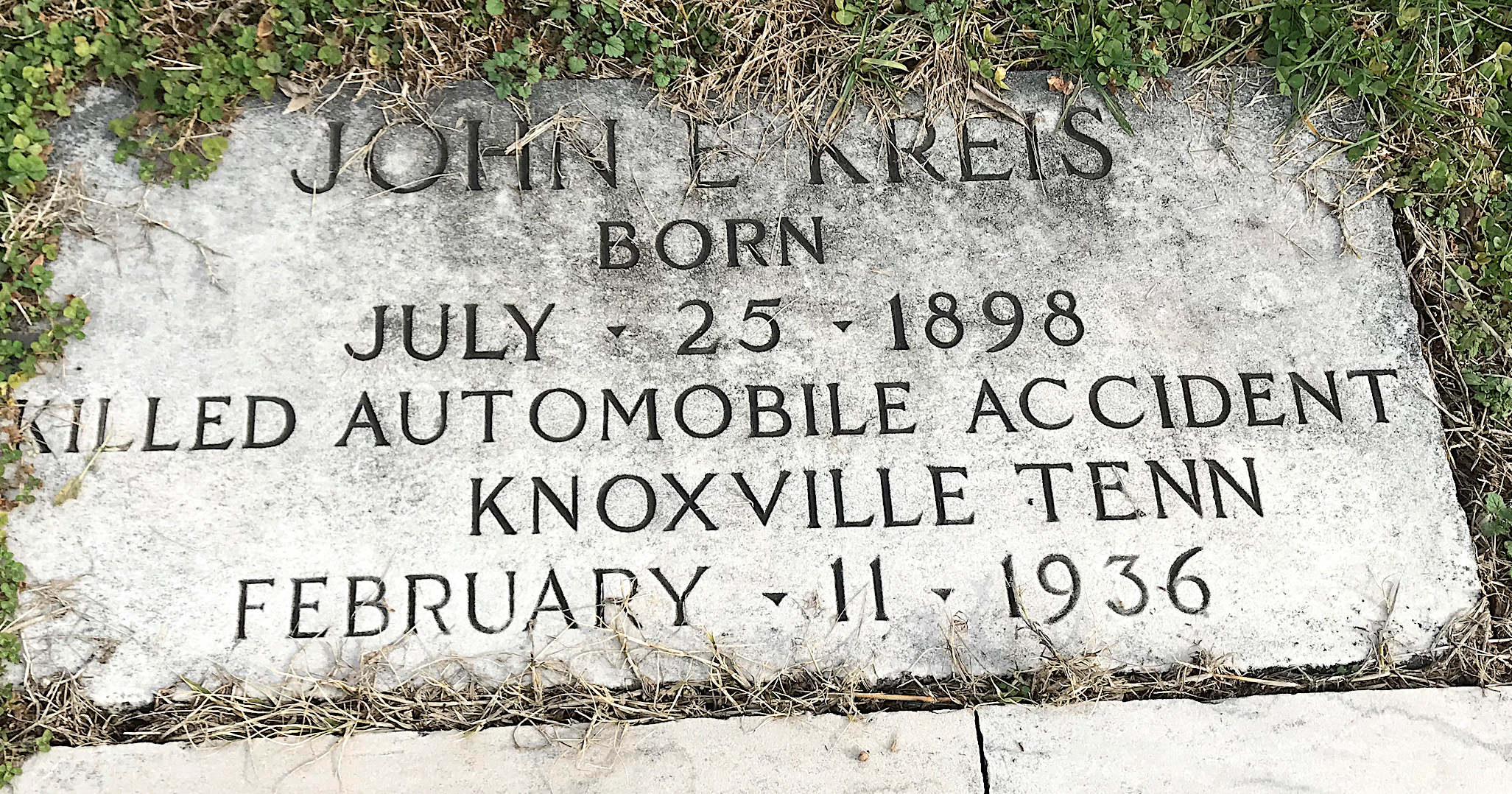
Tragedy would continue to haunt the Kreis family over the next several years. Pete’s older brother, John E. Kreis, died in the early hours of Feb. 11 1936 in a car crash that occurred near Knoxville’s Central Street underpass. The driver, his friend Robert Simpson, was jailed on a manslaughter charge but I wasn’t able to find out what happened to him. John, 37, left behind a widow and a young son.

John Kreis would die less than two years after his younger brother Pete, also in a car accident.

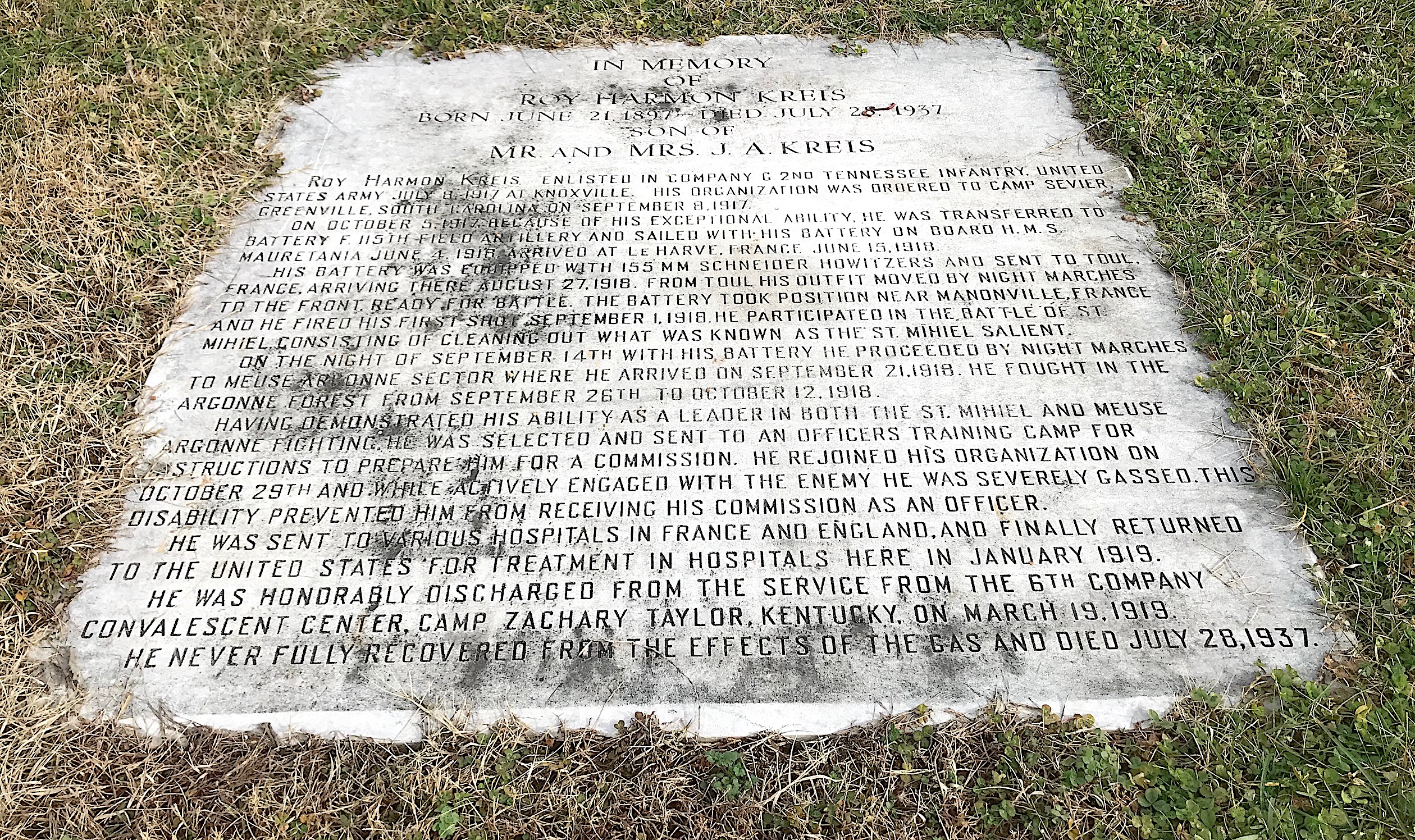
Eldest Kreis son Roy Harmon Kreis (I have seen “Ray” used in some instances) would die the following year. His cause of death is spelled out in detail on his marker. While serving in France with the U.S. Army’s 31st Division during World War I, Roy showed strong leadership abilities. But during fighting in October 1918, Roy was severely gassed. After being treated in hospitals in France and England, he returned home for further convalescence in March 1919. He married a woman named Kate and worked with his father as first vice president of J.A. Kreis & Son, Inc. from 1926 to 1931. But he was never the same after the war.

Roy Harmon Kreis served with distinction in World War I but his exposure to gas changed his life forever. He was never the same.

On July 28, 1937, after years of declining health and a heart ailment, Roy died in his sleep. He was buried in the Kreis plot with his brothers Pete and John, and his grandparents.

Roy Kreis came home to America after World War I, married, and worked with his father. But he died in his sleep in 1937 at age 40.

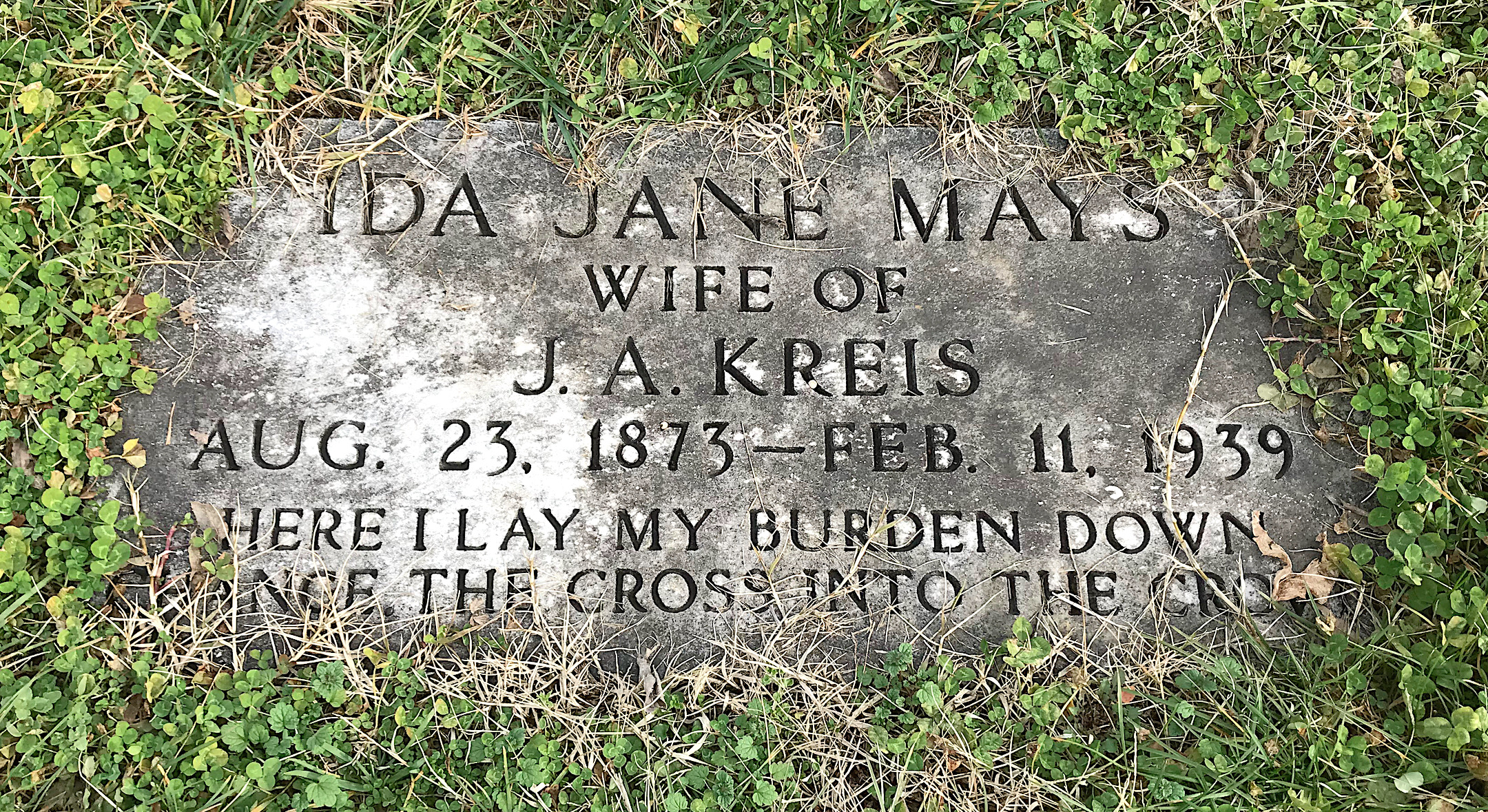
I cannot fathom the agony Ida Jane Kreis endured over the passage of the 1930s. Daughter Edith Kreis Williams was her only surviving child now. Ida’s health was already poor at the time. She died on Feb. 11, 1939 at age 65.

Ida Kreis endured the deaths of three of her four children during the 1930s.

Kreis family head John A. Kreis carried on as best he could after Ida’s death. His farm fell victim to the Tennessee Valley Authority’s Fort Loudoun Dam project. When the dam was built during 1941, it claimed half of a nearby state-owned farm and the Riverside farms fell under imminent domain. Kreis managed to strike a deal with the state. In addition to receiving payment for his farm, he acquired some land off what is now Pellissippi Parkway. He got out of the diary business and started a successful turkey hatchery.

John was also a champion skeet shooter, dominating the Tennessee competition and winning the Kentucky Open title so many times that he was awarded a permanent trophy. He and Pete had often competed together.

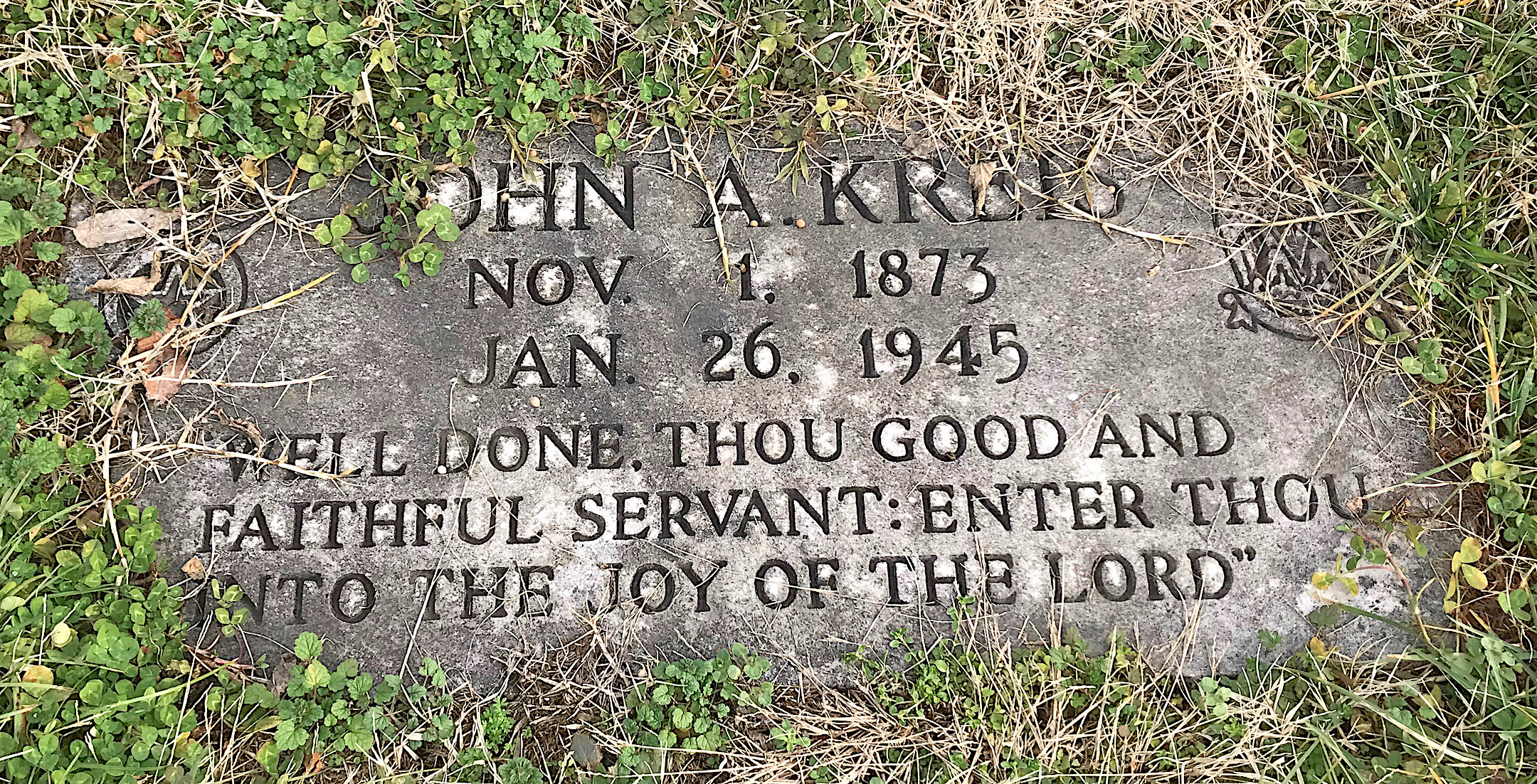
John A. Kreis died after falling out of a barn loft in 1945.

John Kreis died in 1945 at age 72. While inspecting the loft of a large turkey barn, he stumbled through an open trap door and fell 10 feet onto a concrete floor. He died from his injuries.

The last Kreis family member, Edith, married Ernest Ralph Williams. They moved to Florida where she died on Jan. 25, 1990 at age 93. She is buried at Woodlawn Park Cemetery South in Miami, Fla.

Next time, I’ll bring more stories from Asbury Cemetery.

Volunteer State Hopping: Going Around the Bend at Knoxville, Tenn.’s Lebanon in the Fork Cemetery, Part II

02 Thursday Sep 2021

Posted by adventuresincemeteryhopping in General

≈ Leave a comment

In my last post, I introduced you to Knoxville, Tenn.’s Lebanon in the Fork Cemetery and some of the history surrounding its establishment in the 1790s. Tennessee was just emerging as a state and coming into its own.

Out of the 77 recorded memorials on Find a Grave.com for this cemetery, 18 of them are Ramseys. It’s not surprising, considering how many Knoxville pioneers are buried here. The Ramsey family is up there with the Whites, Blounts, and Seviers.

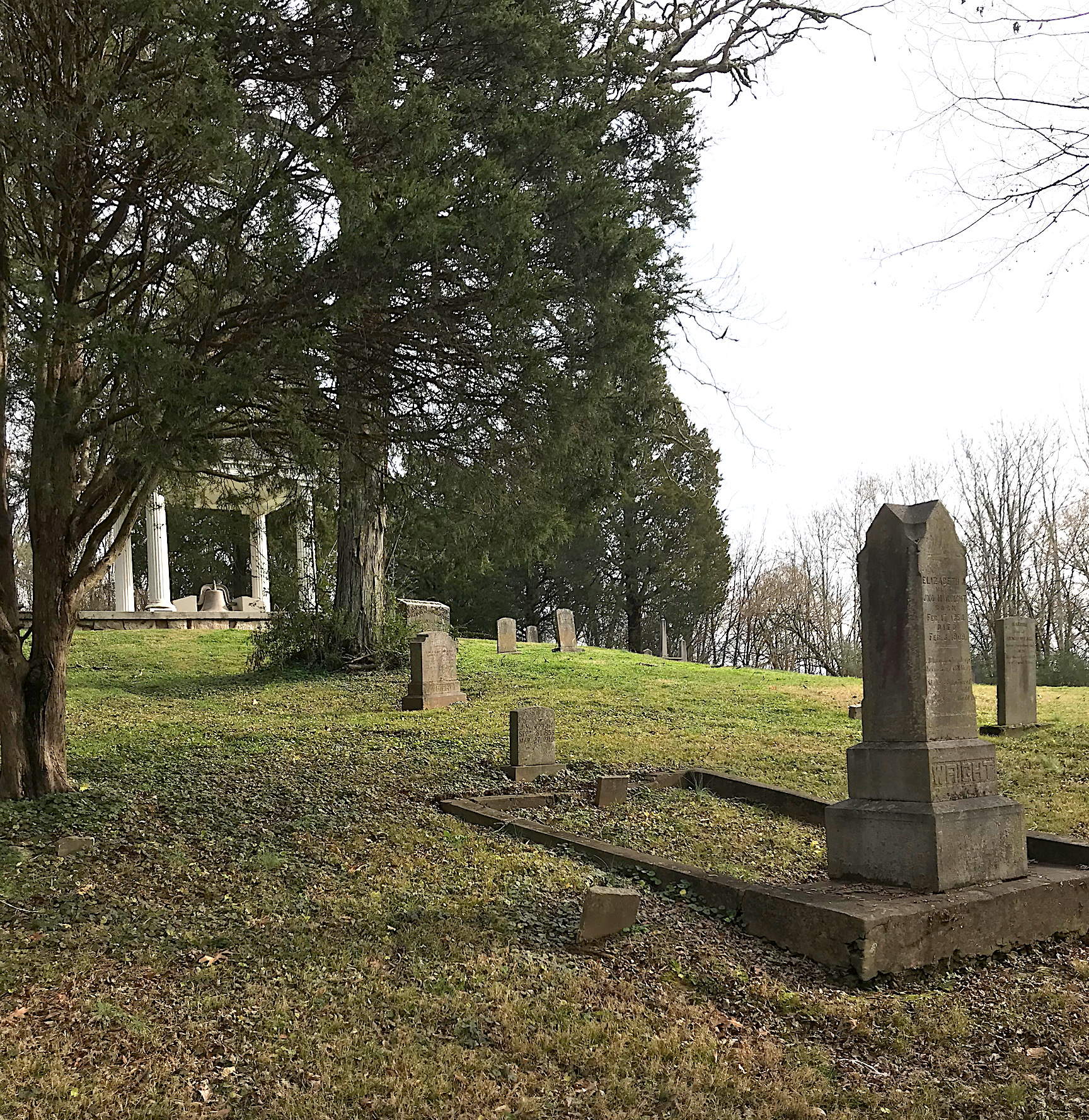
Lebanon in the Fork Cemetery, view from the bottom of the hillside. Dr. Joseph Gettys McReady Ramsey’s monument is the tallest one in the center of the photo.

Francis Ramsey Builds a Home

Born in Pennsylvania in 1764, Francis Alexander Ramsey was the son of Reynolds and Naomi Alexander Ramsey. Reynolds Ramsey took part in the French and Indian War, serving with George Washington at Trenton, Princeton, and Valley Forge. His mill on Marsh Creek supplied the Continental Army with food. He joined his nephew James Gettys in founding the town of Gettysburg in 1806 and became the first village treasurer.

Son Francis is thought to have fought alongside Washington during the Revolutionary War. He moved to Greene County in what would become Tennessee in 1783. He and other pioneers began surveying and exploring the Knoxville area. He discovered a game-rich beaver dam pond which he named Swan Pond. He was issued a grant for Swan Pond and its surrounding land in November 1786.

Col. Ramsey (his military title was honorary) didn’t move to Swan Pond until 1792, after being appointed clerk for the newly formed Southwest Territory. By then, he had married Margaret “Peggy” McKnitt Alexander in 1789. Ramsey built their house on a peninsula in the pond, although due to malaria concerns, he drained the pond before construction began. London-trained architect Thomas Hope designed the house and it was built between 1795 and 1797.

Historic Ramsey House still stands today and is located very close to the cemetery, something I found out later. The house is made of Tennessee Marble (from a nearby quarry) and Blue Limestone.

Ramsey House was designed by London architect Thomas Hope. The property is managed by the Association for the Preservation of Tennessee Antiquities (APTA) and includes the Ramsey House, a visitor’s center, and gardens.

One of Col. Ramsey’s claims to fame was being a founding trustee of Blount College, later called the University of Tennessee. The Rev. Samuel Carrick (he’s in Part I) was the first president. Ramsey also donated the land where the first Lebanon-in-the-Fork Presbyterian Church building was built and the cemetery.

Around 1808, his parents Reynolds Ramsey and Naomi moved to Knox County to be with their sons. Naomi died on Sept. 10, 1813 at age 76. Reynolds would die in March 1816. They share a marker at Lebanon in the Fork Cemetery.

Reynolds and Naomi Alexander Ramsey share a marker at Lebanon in the Fork Cemetery.

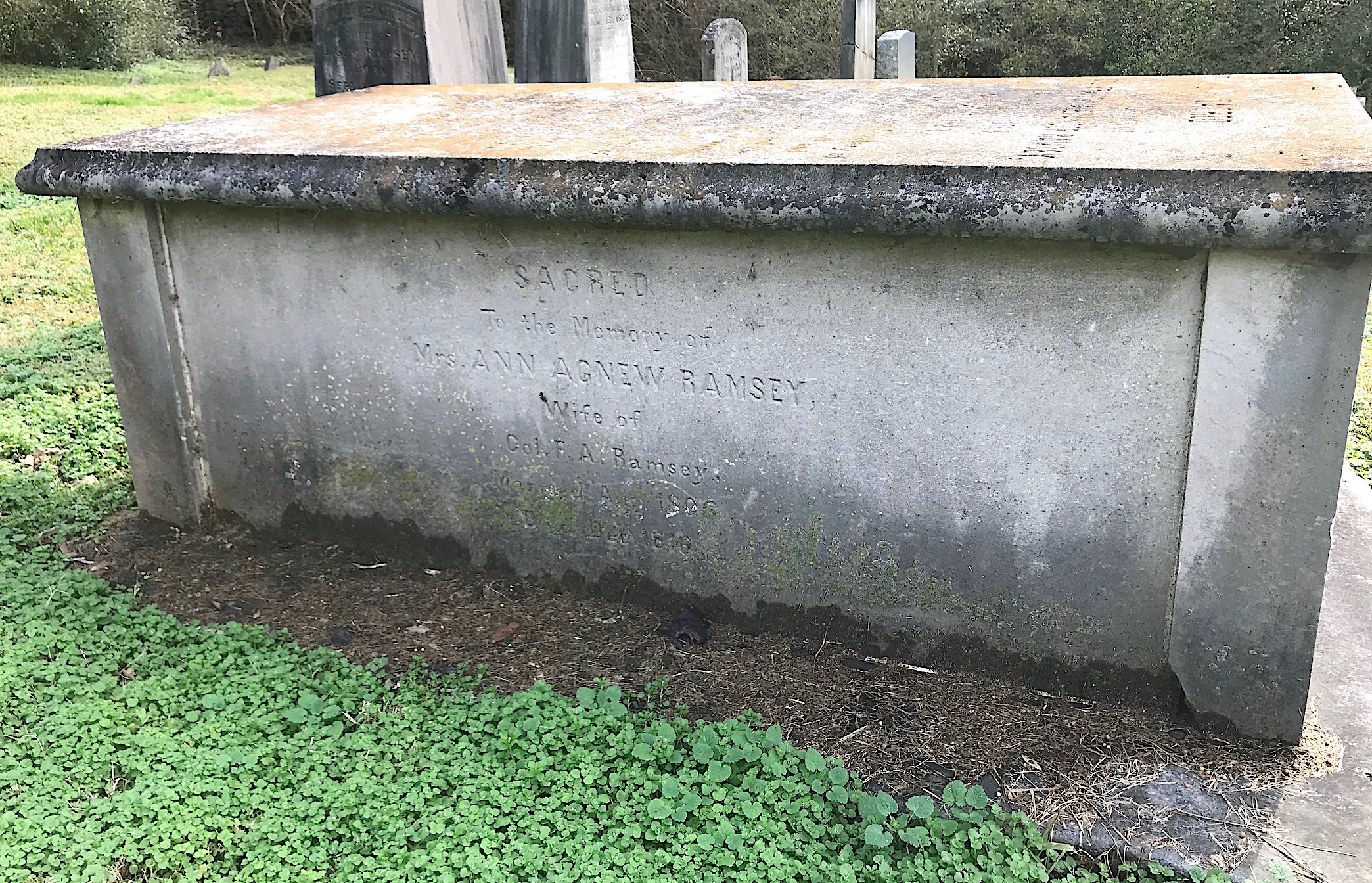
Several of the Colonel and Peggy’s children died before reaching adulthood. All of their surviving children were college educated including his daughter, Eliza Jane. Peggy died in 1805 at the age of 39, having suffered poor health the last 18 months of her life. Ramsey remarried in 1806 to Ann Agnew, who gave him one son, John. She died in 1815 at age 43. Her name is inscribed on one side of the box grave of Col. Ramsey.

Ann Agnew Ramsey died at age 43 in 1816. Peggy McKnitt Alexander Ramsey, Col. Ramsey’s first wife, has her name and dates on the other side of his box grave.

Col. Ramsey would marry a third time to Margaret Christian Russell Ramsey on April 13, 1820. Like Ramsey, she had also buried two spouses before marrying him. Col. Ramsey died almost seven months later on Nov. 5, 1820 at the age of 56. Margaret lived another 34 years, dying in 1854 at age 76. She is buried at the First Presbyterian Church Cemetery in downtown Knoxville.

Col. Francis Alexander Ramsey died on Nov. 5, 1820 at the age of 56.

The top of Col. Ramsey’s box grave reads:

Sacred to the Memory of Col. Francis Alexander Ramsey, in his 20th year he was Secretary of the Franklin Convention and held civil and military appointments under that and the Succeeding Federal and State Governments till his death.

He was one of the founders and Elders of Lebanon Church. The old stone church was erected by munificence and consecrated by his prayers. These grounds were his gift to the Presbyterian Congregation which in commemoration of his liberality and his private and public virtues, has erected this monument to his memory.

Dr. J.G.M. Ramsey’s “Annals of Tennessee”

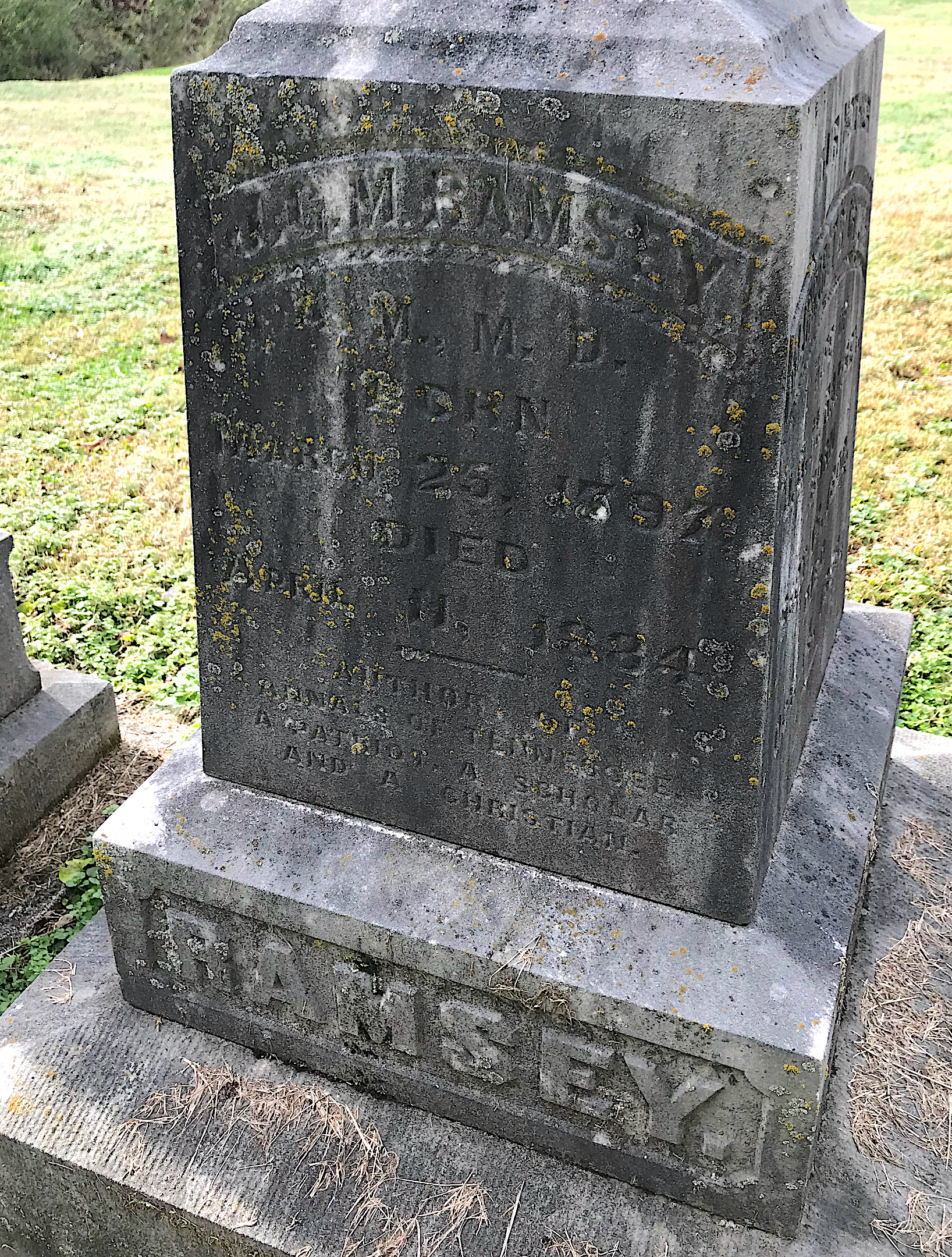
Col. Ramsey and Peggy’s fourth son was Dr. James Gettys McGready (J.G.M) Ramsey. Born at Swan Pond in 1797, Dr. Ramsey received his education at Washington College near Jonesboro, Tenn. and later the University of Pennsylvania, where he attended medical lectures. Dr. Ramsey married Margaret “Peggy” Crozier in 1821. He is best known for writing “The Annals of Tennessee,” a historical documentation of the state’s early years. It was published in 1853.

A doctor, farmer, bank president and poet, Dr. James Gettys McGready Ramsey promoted railroad development and wrote a history of Tennessee.

Dr. Ramsey joined his father and younger brother William Blaine Alexander Ramsey in banking, and was an early advocate for building railroads to connect Knoxville with Charleston, S.C. over developing water transportation routes from Knoxville to New Orleans. William became the first citizen-elected mayor of Knoxville in 1838 and later served as the secretary of state for Tennessee (1847-1855). He died in 1874 and is buried in Nashville City Cemetery.

Dr. Ramsey built his own home, which he called Mecklenburg, near Ramsey House. His wife, Peggy, was born in Mecklenburg, N.C. He was a secessionist and a friend of Jefferson Davis. Ramsey became treasury agent for the Confederacy and served as an Army surgeon during the Civil War. His sons were Confederate soldiers as well.

When Union troops advanced on East Tennessee in 1863, Ramsey fled. Mecklenburg was ransacked and burned to the ground. Along with the house, 4,000 books in Dr. Ramsey’s library that included his journals of Europe and historical documents about the state were destroyed. Dr. Ramsey was devastated by the loss. Judy LaRose, executive director of the Historic Ramsey House, said, “I think he was a beaten man after that.”

Youngest son of Dr. J.G.M. and Peggy Ramsey, Arthur Crozier Ramsey died at age 18 from battle wounds suffered during the Civil War.

The Ramseys suffered other tragic losses. Their youngest son, Arthur, died from battle wounds in 1864. Daughter Charlotte died in 1863 at age 24 from typhus fever she contracted while traveling through Knox and Sevier counties gathering supplies for the Confederacy. Federal authorities banished daughter Susan, 16, from Knoxville for “disloyal” actions. Those acts, her father said, included refusing to walk under an American flag or sign an oath of allegiance to the U.S. government.

Charlotte Barton Ramsey, who died at age 24 in 1863, contracted typhus. Her epitaph reads: “An Angel too pure for Earth. She early took her
flight to Heaven
.”

“My Child of Promise and of Hope”

There are two Ramsey brothers that are on a marker but are not buried at Lebanon in the Fork. The first is William Wilberforce Alexander Ramsey, born in 1826 at Swan Pond. He became an attorney and was close to his father, Dr. Ramsey. In 1850, Dr. Ramsey sent him and his brother, Francis Alexander Ramsey, out west with the East Tennessee Gold Mining Company. William, already ill from a lung infection, died during excavation efforts in Volcano, Calif. on Nov. 16, 1850. Dr. Ramsey wrote this about his death and burial there:

He (Wilberforce) sank quietly to his grave in peace with his God and his fellowmen. He was the first man buried in a coffin at Volcano Diggings, Calif. Strange to say, poor Wilberforce had a Christian burial in these wilds. A Presbyterian minister, Reverend Davidson, originally from Mecklenburg County, North Carolina, performed for him the last funeral rites. He was, if I had a favorite, my favorite son, my child of promise and of hope.

Son Francis Alexander Ramsey made it home to Tennessee safely. He would later marry Nancy Presley, and moved to Texas in later years. He died in Lake Victor, Texas in 1925 at the age of 96.

Already ill, William W.A. Ramsey died at the age of 24 in California while traveling with his brother Francis on a gold mining expedition. He is buried there. This is a cenotaph in his memory.

I could not find a memorial for William on Find a Grave in the three Volcano, Calif. cemeteries, although there are burials of other men who died during these gold mining quests. But he is remembered on this cenotaph at Lebanon in the Fork Cemetery.

Gen. John Crozier Ramsey’s name is also inscribed on the same marker with William. But I don’t think he’s actually buried at Lebanon in the Fork. He died in Knoxville on Jan. 1, 1869 at the age of 44. Newspaper articles indicate his funeral was held at First Presbyterian Church and burial at Old Gray Cemetery. But no memorial exists for him there on Find a Grave. I believe this is a cenotaph as well.

Death of Dr. Ramsey

Dr. Ramsey and Peggy spent most of the rest of the war in the Charlotte, N.C., area. President Andrew Johnson pardoned him in 1865 but the family didn’t return to Knoxville until the early 1870s. When Dr. Ramsey died in 1884 at age 87, the flag over the state capitol flew at half mast. He shares a monument with Peggy, who died five years later at age 87.

Dr. J.G.M. Ramsey died on April 11, 1824 at the age of

Next time, I’ll be moving down the road to Asbury Cemetery. I hope you’ll join me for more stories from the Volunteer State.

The grandson of Dr. J.G.M. Ramsey, 27-year-old Richard Howard Dickson was killed in action on Sept. 29, 1918 near Bellicourt, France during World War I. He served with the 115th Infantry.

Volunteer State Hopping: Going Around the Bend at Knoxville, Tenn.’s Lebanon in the Fork Cemetery, Part I

27 Friday Aug 2021

Posted by adventuresincemeteryhopping in General

≈ 5 Comments

The next stop on my Knoxville cemetery adventure turned out to be a big step back in time. The truth of it is, I looked on Google maps and noticed it was only six miles from Calvary Catholic Cemetery. It’s located on a tight bend on Asbury Road. If you blink, you’ll miss it.
I didn’t know when I picked out Lebanon in the Fork Cemetery that I would be going to one of Knoxville’s oldest burial grounds. It’s likely the oldest in Knox County. With only 77 recorded memorials on Find a Grave.com, Lebanon in the Fork is not a a very big cemetery. But what it lacks in size it makes up for in historical significance.

Situated on nine acres, Lebanon in the Fork Cemetery is also known as Three Rivers Cemetery.

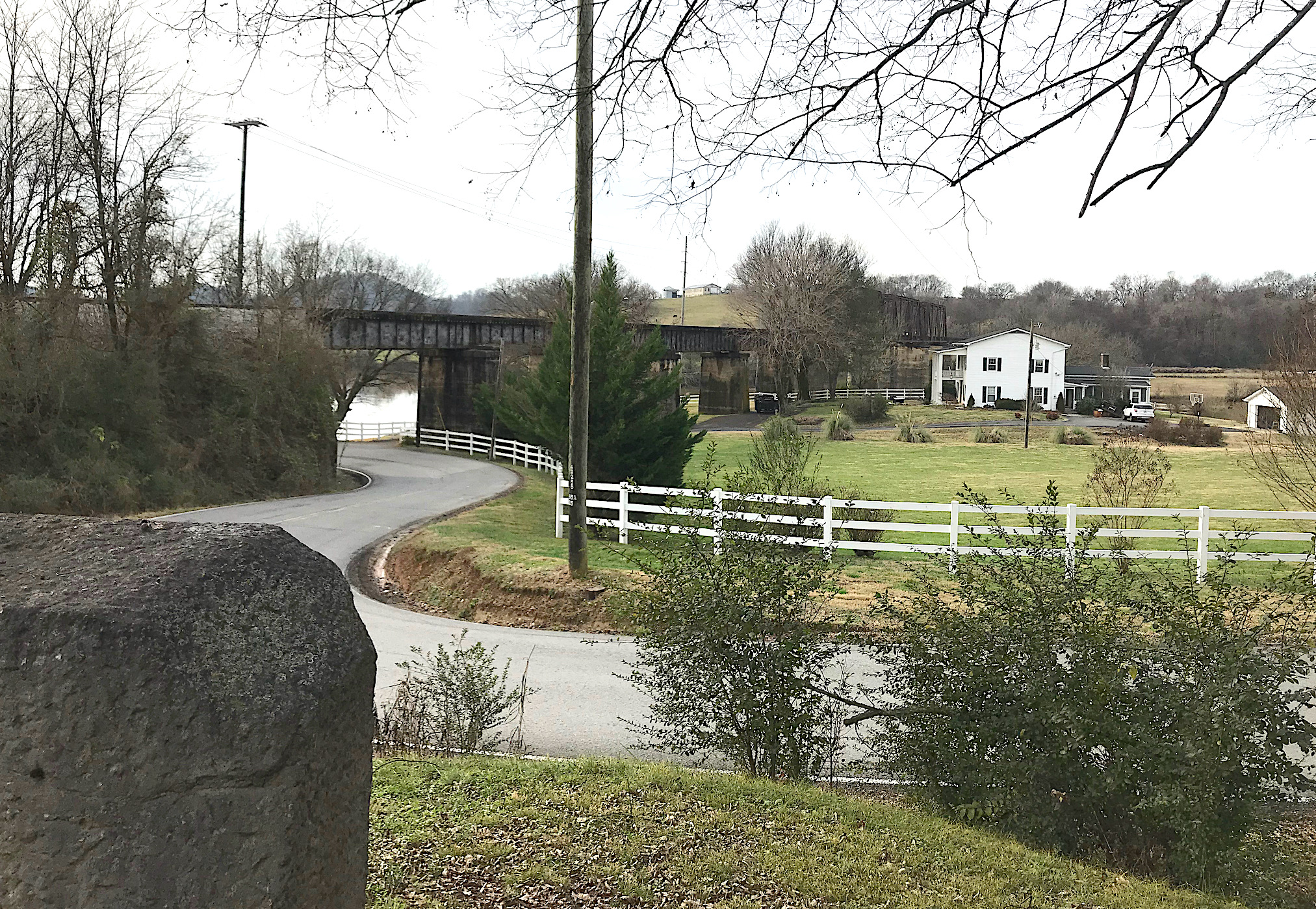
Lebanon in the Fork Cemetery is also known as Three Rivers Cemetery. That’s because it’s located on land overlooking the confluence of the Holston River with the French Broad River, where the “fork” and beginning of the Tennessee River is formed. The picture I took with my back to the cemetery (below) enables you to catch a glimpse of the water beneath the railroad bridge.

You can glimpse the confluence of the three rivers under the railroad bridge. Lebanon in the Fork Cemetery faces that intersection of waters.

Tennessee Not Yet a State

As the first Presbyterian church in Knox County, Lebanon In The Fork Presbyterian Church was founded around 1791 by the Rev. Samuel Carrick. Tennessee wouldn’t officially become a state for another five years so things were still a bit untamed. William Blount, a Revolutionary War veteran from eastern North Carolina and signer of the U.S. Constitution, was appointed governor of the Southwestern Territory.

As President George Washington’s representative, Blount came to White’s Fort in 1791 to negotiate the Treaty of the Holston with a convention of about 41 Cherokee leaders to determine the future of U.S.-Cherokee relations, at least for the time being. Blount established his permanent capital at White’s Fort. Its location on top of a bluff provided a defensive advantage and kept it safe from flooding. He named it Knoxville, in honor of his immediate superior and a former general in the Revolution, Secretary of War Henry Knox. I visited Knox’ grave in Thomaston, Maine back in 2017.

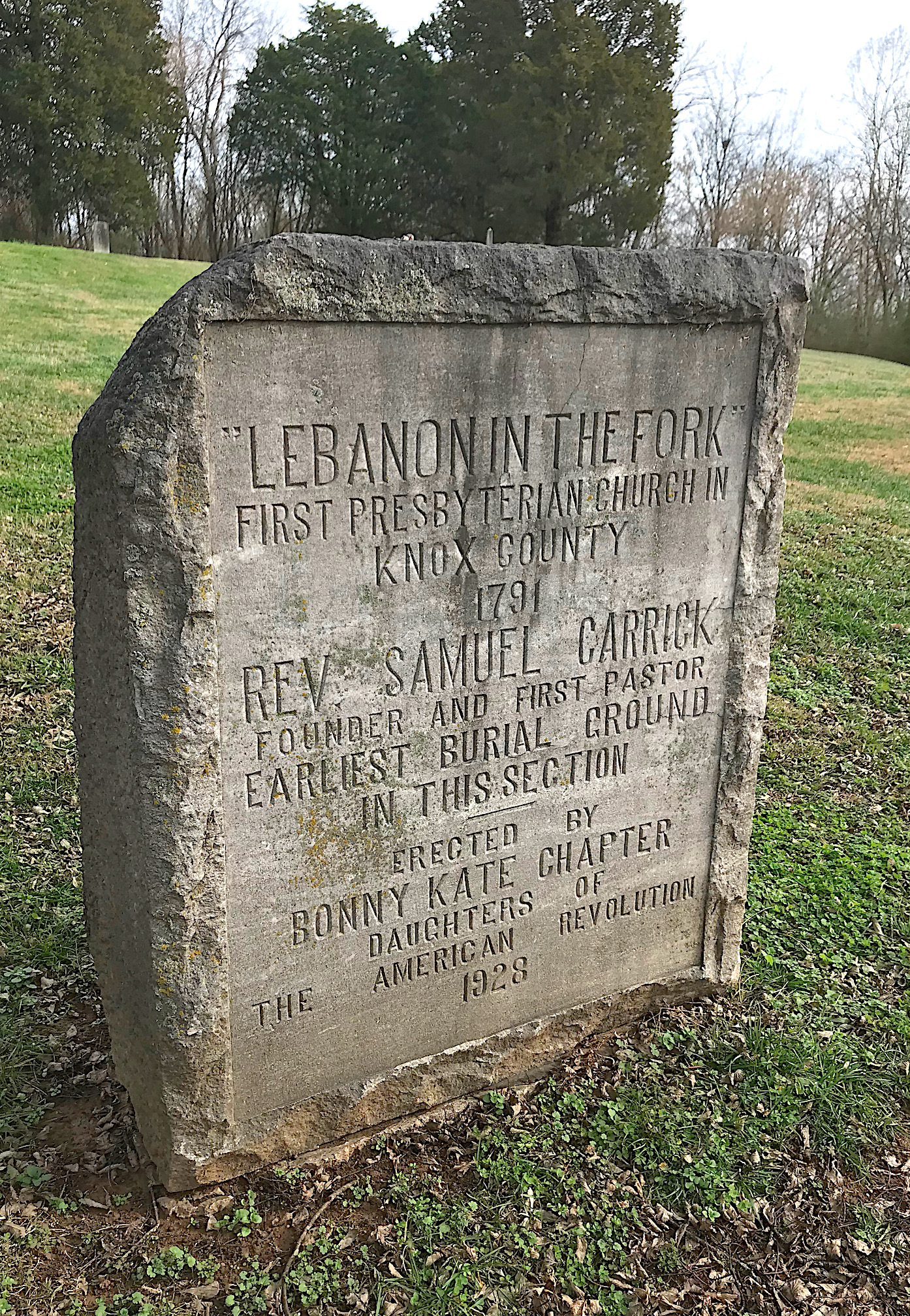
This stone gives you a little bit of the cemetery’s history, thanks to the Bonny Kate chapter of the Daughters of the American Revolution. Bonny Kate Sevier was the wife of Tennessee’s first governor, John Sevier.

While the Lebanon in the Fork Presbyterian Church was pastored by Rev. Samuel Carrick, he isn’t buried in the cemetery.

From what I’ve read, the land that the cemetery is situated on was already being used for burials before 1791. Not only for people but for hunters burying animals. So I have no doubt there’s far more people (and game) buried here than the 77 memorials on Find a Grave. Tennessee pioneer Francis Alexander Ramsey, father of historian Dr. J. G. M. Ramsey, donated the nine acres of land the church was on (now gone) and where the cemetery remains. I’ll get to those gentlemen in Part II.

The first Lebanon In The Fork Presbyterian Church at this site was constructed near the crest of the hill and made of rough logs. This structure was replaced by a larger building in 1903, which served the church until it burnt down due to a fire in 1981.

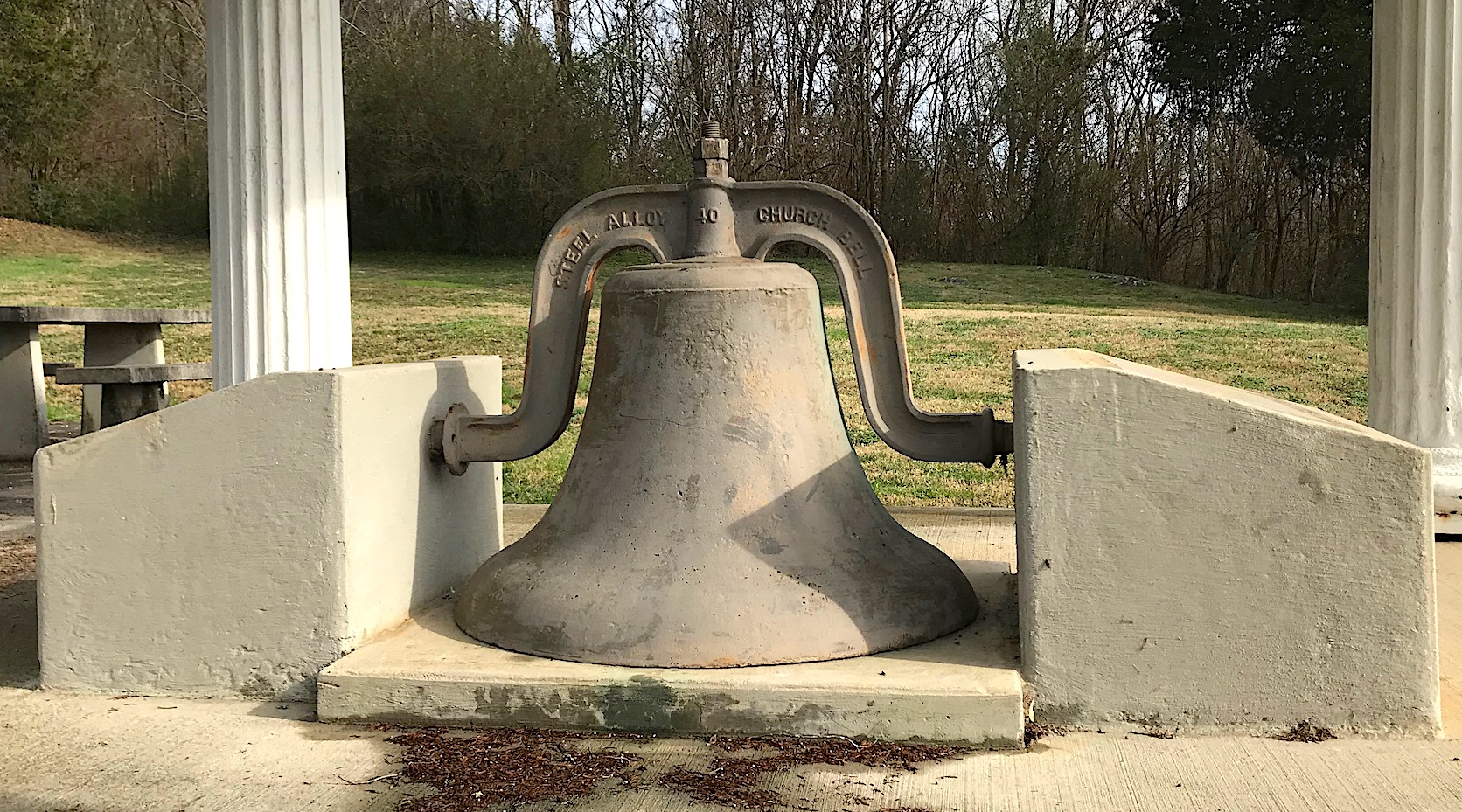
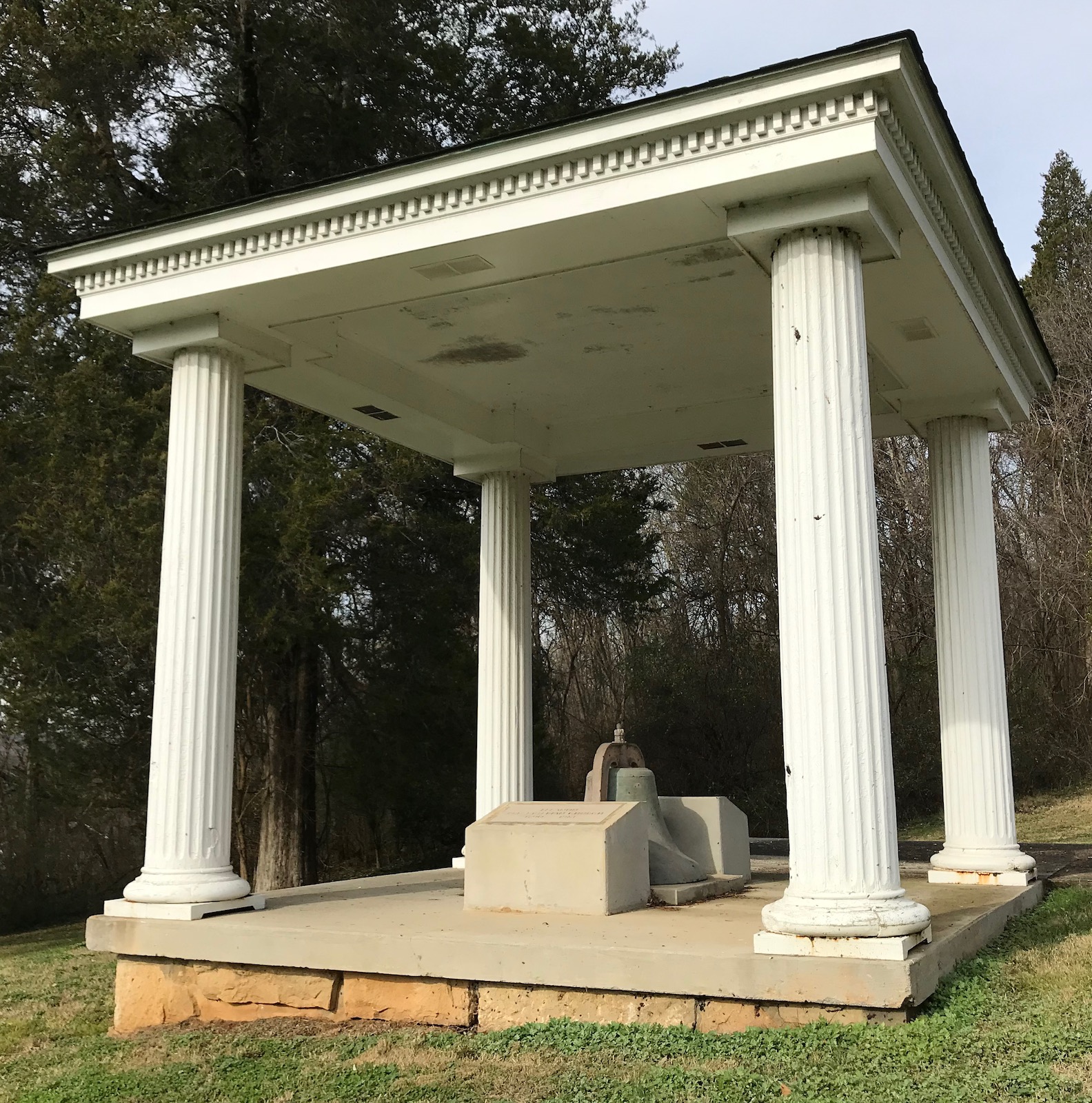
The bell and some columns from the 1903 church were recovered and are in the cemetery, which was listed on the National Register of Historic Places on November 29, 2010.

The Lebanon in the Fork Presbyterian Church’s 1903 building burned down in 1981 but some columns and the bell were saved.
Original bell from the 1903 Lebanon in the Fork Presbyterian Church.

The Carricks Come to Knoxville

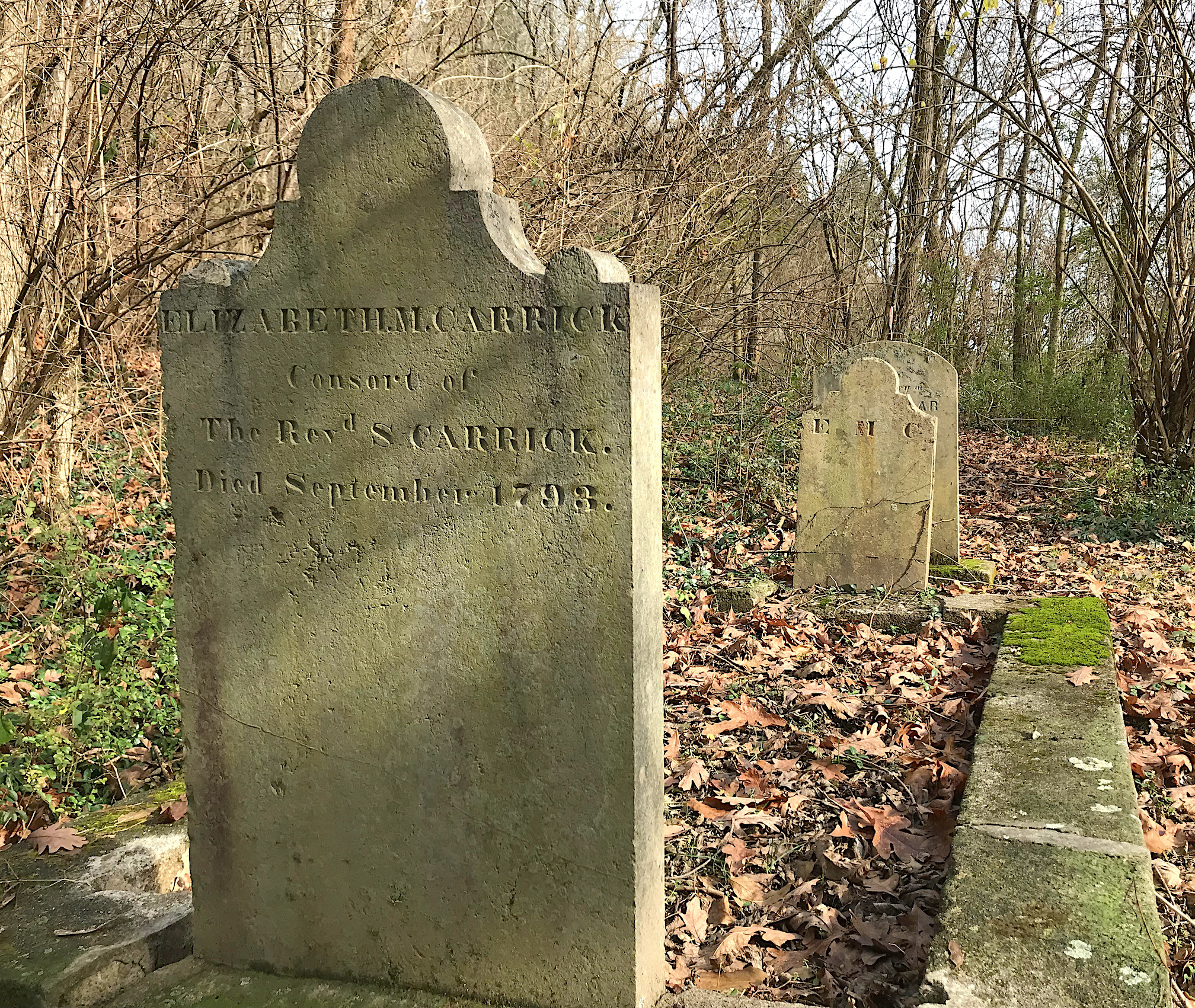
Let me back up and return to Rev. Carrick, who founded the church. He’s not buried in the cemetery but his first wife is. A native of Pennsylvania, Rev. Carrick married Elizabeth Moore in Virginia in 1779. The couple had their first child, Elizabeth, in 1783. They would move to Tennessee in 1791 when he helped establish the church.

Rev. Carrick was also president of Blount College, formed when Carrick opened a seminary in his home for Knoxville students seeking a classical education in 1792. The school would become East Tennessee College and eventually the University of Tennessee. So Rev. Carrick is known as the University’s first president. He would also serve as the first pastor of the First Presbyterian Church of Knoxville, located downtown. Rev. Carrick’s congregation included such notables as Knoxville’s founder James White, Tennessee’s founding father John Sevier, and William Blount (whom I mentioned earlier).

Sadly, Elizabeth Carrick did not live to see her children grow up. After suffering poor health for some time, she died on Sept. 24, 1793 at the age of 33. Her death and burial are written about in a book by Dr. J.G.M. Ramsey (I mentioned him earlier), and it reminds us how unsettled Tennessee still was at the time. Rev. Carrick and the men of the community were in the city trying to hold back an Indian attack so he was not with her when she passed away.

A Funeral Amid an Impending Attack

It occurred on the day of the contemplated attack upon the infant Knoxville by the Indians, Sept., 1793.  All the inhabitants who would bear arms had gone to its defense, and relations and remains of Mrs. Carrick were brought down in a canoe, on the Holston River and deposited in the church yard, attended and buried by women only.

Elizabeth Moore Carrick died in 1793 at age 33. Her remains were brought to the cemetery by canoe on the Holston River. The term “consort” meant “wife” and often it was a wife who had preceded her spouse in death.

Rev. Carrick remarried four months later to Annis McClellan, who was 26. They would have several children together. His first daughter, Elizabeth, went on to marry Hugh Lawson White and he became a Tennessee congressman from 1825 to 1840. Rev. Carrick, Elizabeth, and some of his other children are buried at the First Presbyterian Church’s cemetery in downtown Knoxville. If second wife Annis is there, her grave is unmarked.

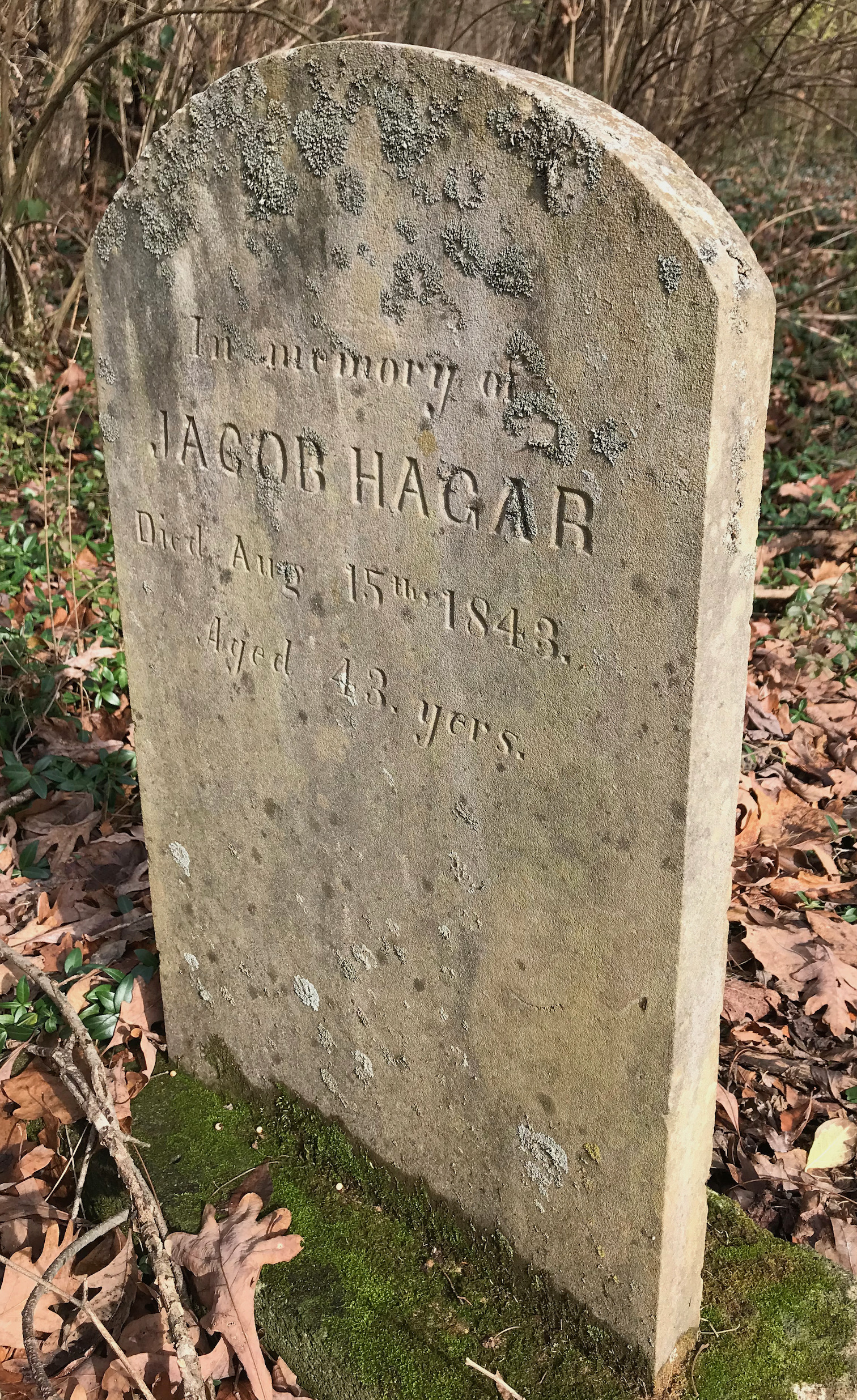
Who was Jacob Hagar and why is he buried so closely to Elizabeth Carrick?

An interesting side note. There’s a marker right beside the footplate of Elizabeth Carrick’s grave for a man named Jacob Hagar. Little is known about him beyond the fact he lived from about 1800 and died on Aug. 15, 1843. He lived in Knox County in the 1830s and 1840s with his wife, Christina. In his will, he left to her “one cow, one bed, one bedsted (sic), & furniture, one big wheel, and cards, and the cotton on hand & one flax wheel.” He left each of his two sisters $1 each.

Did Rev. Kennedy Pastor the Church?

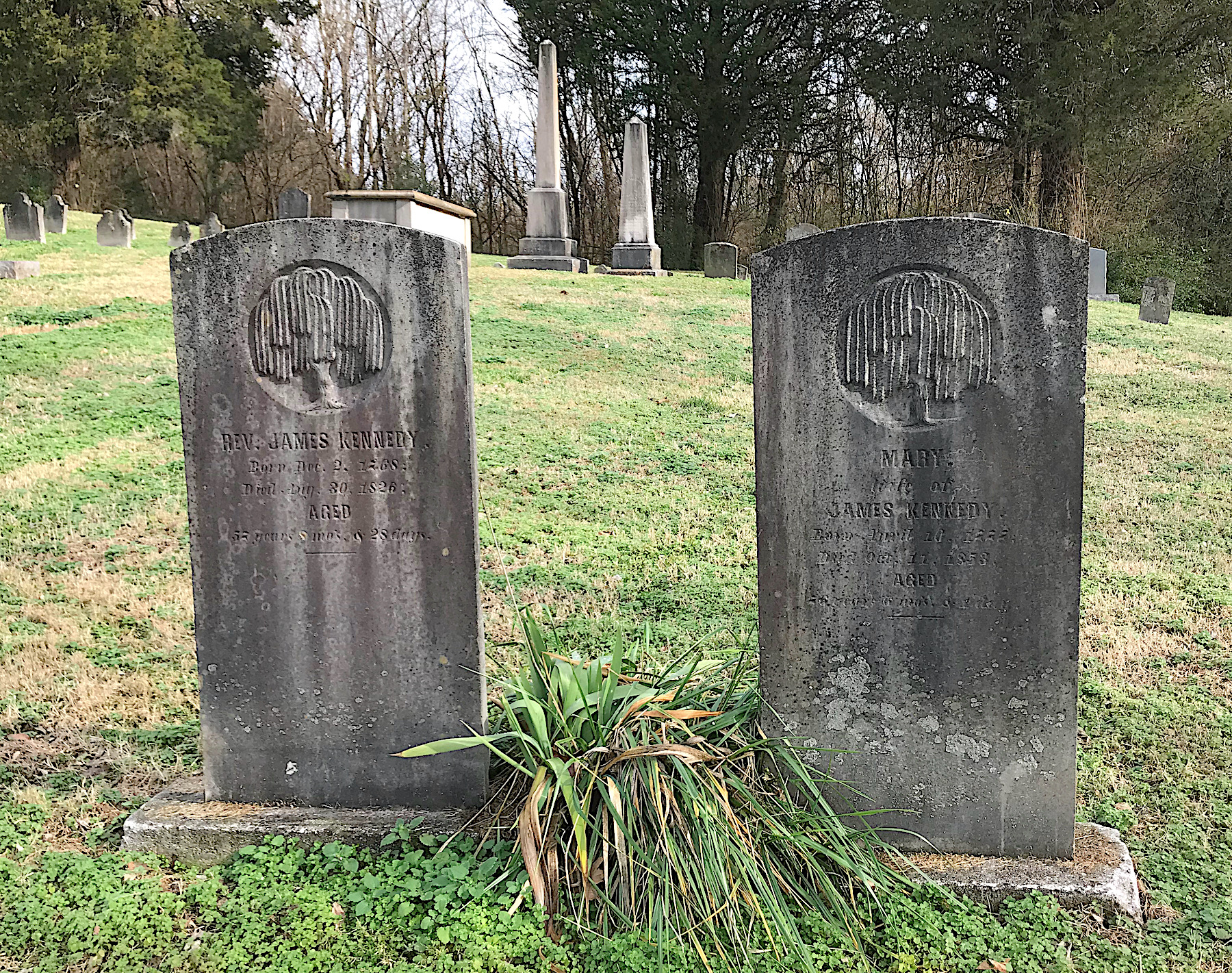
Two markers for the Rev. John Kennedy and his wife, Mary Smith Kennedy, raised a few questions for me. Born in Ireland in 1768, Rev. Kennedy emigrated to America with his mother and six siblings. His father is thought to have died during the crossing. They settled in Pennsylvania, where Rev. Kennedy married Mary Smith of East Noddingham, Chester County, Penn. They moved to Tennessee and would have 10 children over the course of their marriage.

Was Rev. James Kennedy a pastor of the Lebanon in the Fork Presbyterian Church? It’s possible but not certain.

Their appearance in the cemetery made me think he might have pastored the Lebanon in the Fork Presbyterian Church at one point but I was unable to confirm or discard that idea. The list of pastor for the church does not include his name but research by others indicates a gap in that list between 1813 to 1836. Regardless, the Kennedys amassed property about five miles from the church according to research done by others that I found. In 1819, Rev. Kennedy also bought 80- and 90-acre tracts on Swan Pond Creek, bringing his holdings up to 444 acres.

Rev. Kennedy died on Aug. 30, 1826 at the age of 57. I did find an obituary for him in the Knoxville Enquirer, which does not mention what (if any) churches he pastored.

Rev. Kennedy’s death notice says nothing about what churches he might (or might not) have pastored.

The Widow Files Suit

Some family-written research I found cast some light on some unhappiness that transpired between Mary Kennedy and one of her sons. She filed a suit against third child, Samuel, in 1841. The Rev. Kennedy’s will required James (21 at the time) and Samuel (then 37) to support their mother, Mary. She claimed in the suit: “Now may it please your Honour, the aforesaid Samuel Kennedy has in his possession all the most valuable part of the said Plantation, and has never contributed anything for the support of your oratrix and utterly refuses so to do.”

I’m not sure how Mary’s suit was resolved. She did not remarry and died on Oct. 11, 1853. I think she must have patched up her differences with Samuel because she did include him and her still living children, along with two grandchildren, in the will she wrote not long before her death.

Next time, I’ll have stories about the Ramsey family and the roles they played in shaping Knoxville history.

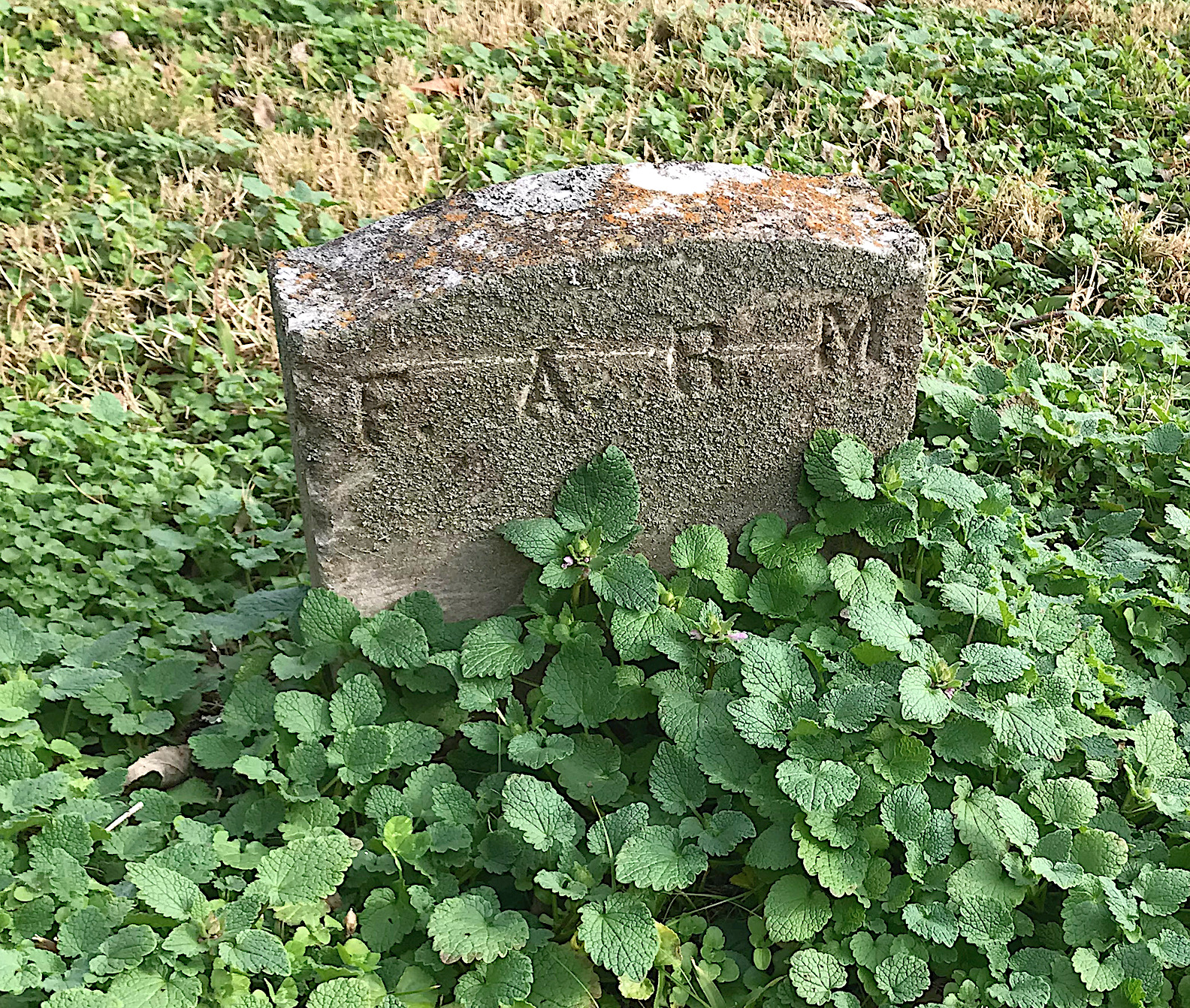
Footplate for the grave of Francis Alexander Ramsey McNutt (1818-1877).

Volunteer State Hopping: Exploring Knoxville, Tenn.’s Calvary Catholic Cemetery, Part II

20 Friday Aug 2021

Posted by adventuresincemeteryhopping in General

≈ 2 Comments

It’s time for a few more stories from Knoxville, Tenn.’s Calvary Catholic Cemetery.

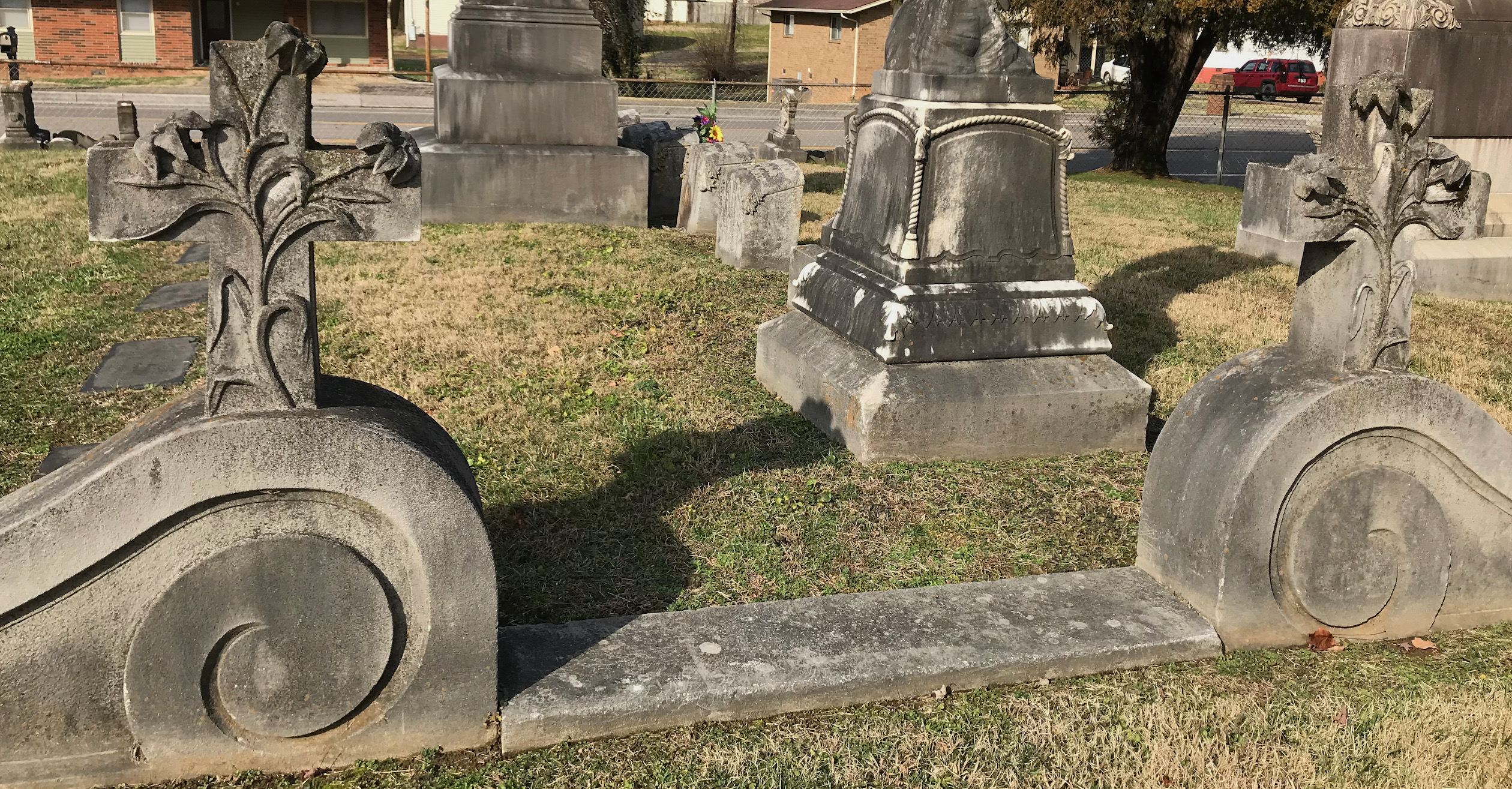
As I wandered down toward the front of the cemetery, I noticed one of the larger plots had Easter lilies carved into the side of the entrance. They were, I thought, in remarkably good shape. It made me curious to know if George W. Callahan’s firm had created them. I wrote about him in Part I.

The Easter lily has long been associated with Christianity, commonly referred to as “White-Robed Apostles of Christ.” Early Christians believed that lilies sprouted where Jesus Christ’s sweat fell to the ground in the Garden of Gethsemane.

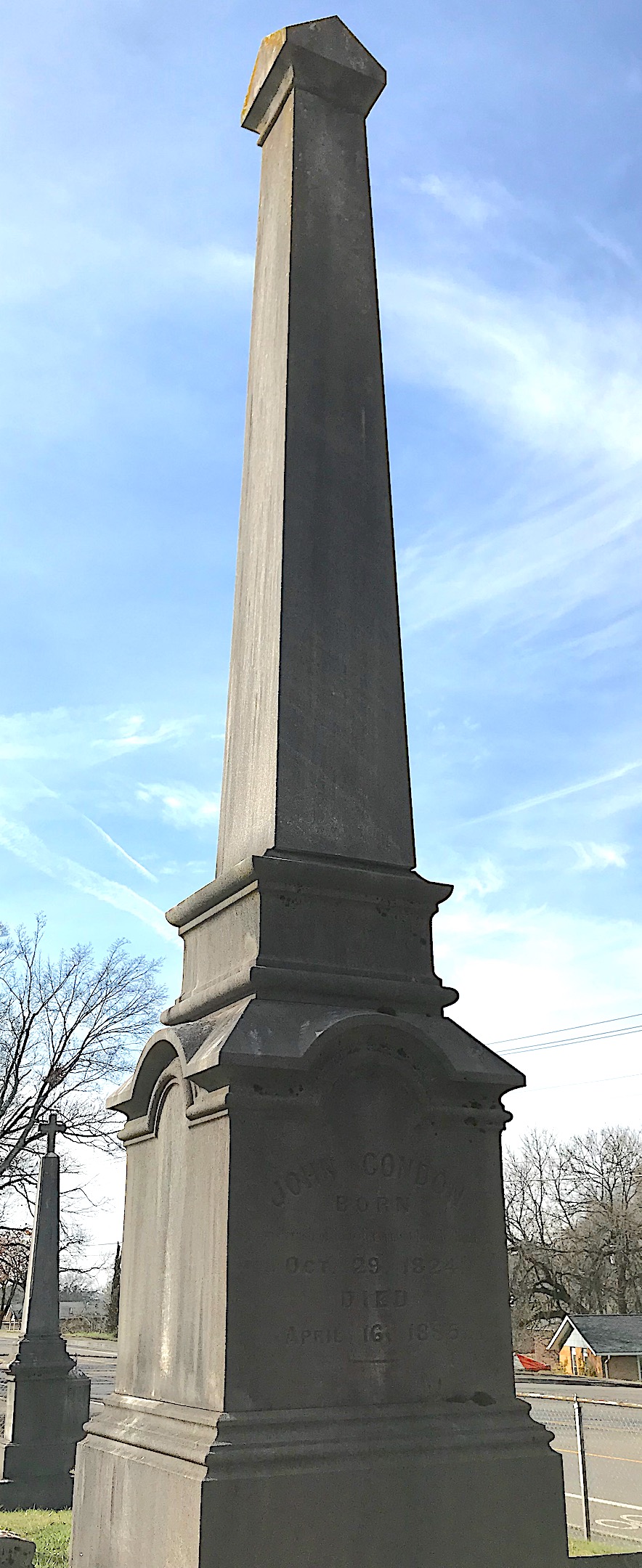
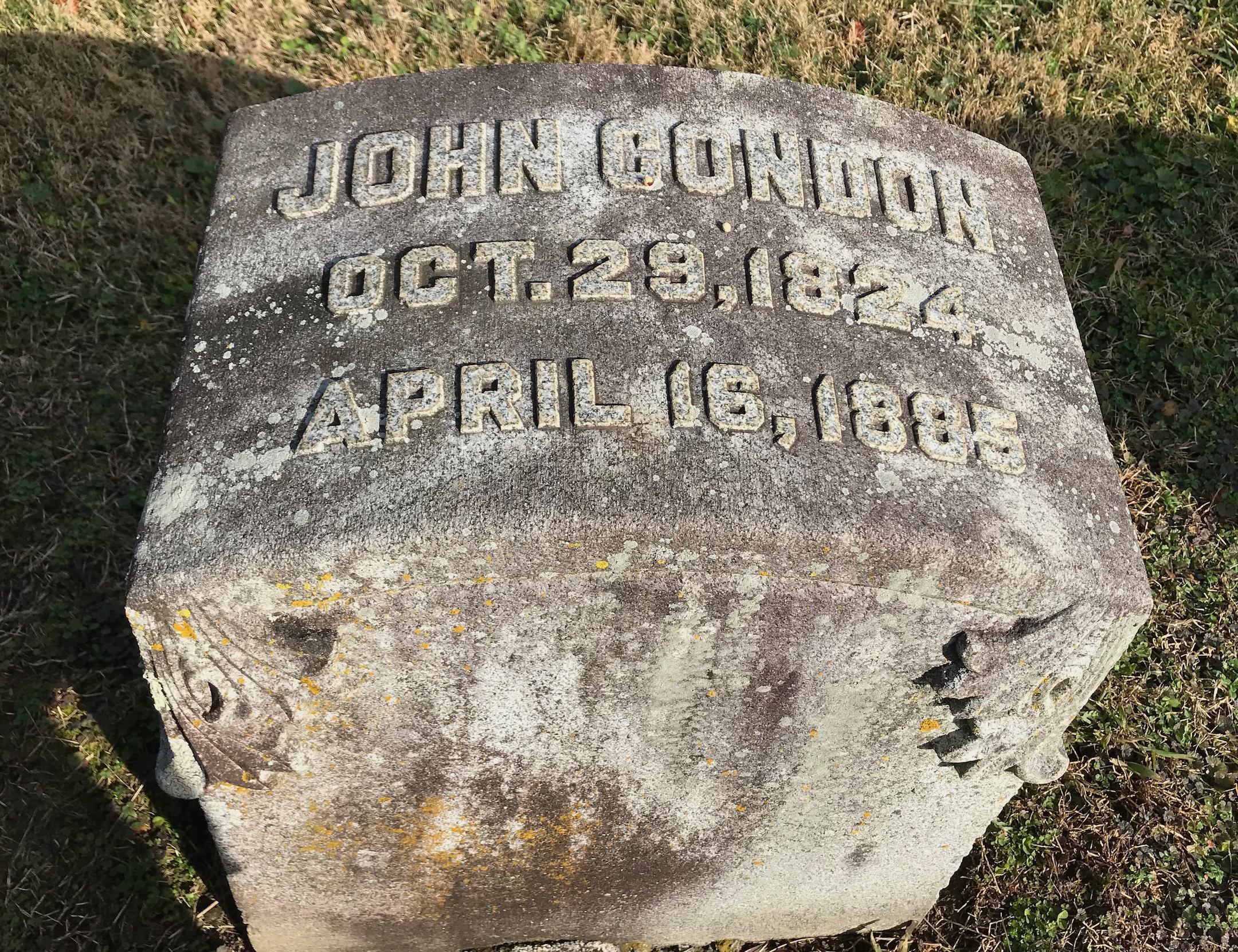
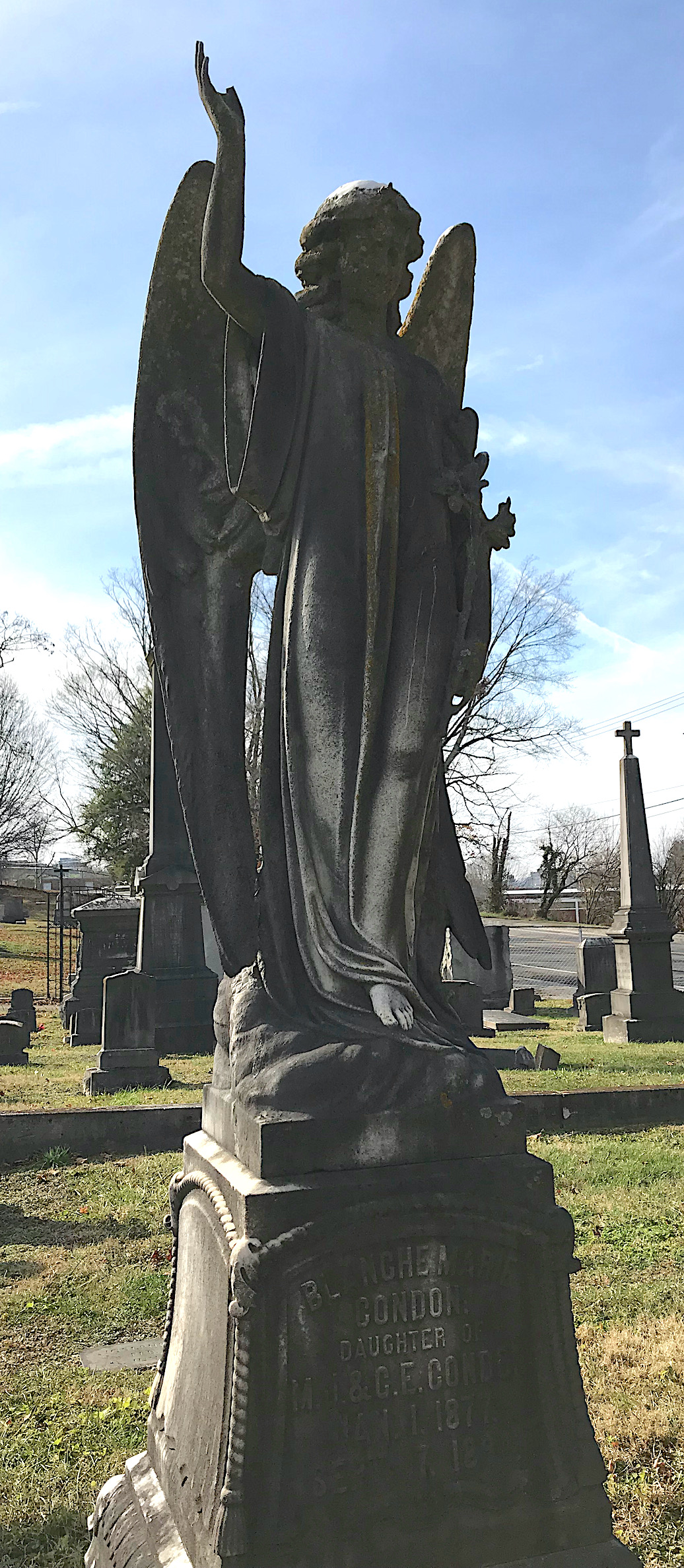
I regret that I didn’t photograph all the markers in this plot because the Condon family that occupies much of it has a great deal of history. But it was one of those days where I was photographing more randomly than usual. The most eye-catching monument in the plot is the one for Blanche Condon. Her grandfather, John Condon, is buried beside her. His obelisk is equally impressive. So I started looking more closely into the family.

From Ireland to America

A native of County Clare, Ireland, John Condon was born in 1824. He arrived in America sometime in the 1840s. He married Bridgett Gray in 1852 in Syracuse, N.Y. They would have seven children together. Eldest son Michael was born in 1846 in Springfield, Mass.

The family would settle in Rogersville, Tenn, in the 1850s. From information I found on Ancestry, it appears John Condon joined the Confederate Army to fight in the Civil War. One article I found said his fellow comrades in arms in the Third Tennessee Confederate Regiment, Engineer Corps called him the Irish Johnny Reb. John was wounded on more than one occasion. As an accomplished stone mason, his responsibilities were essentially those of a construction foreman. 

As a prisoner of war, John was sent to Camp Chase in Columbus, Ohio for 10 months before being released as part of the exchange that followed the fall of Vicksburg on July 4, 1863. 

It’s not surprising that with John Condon’s history as a stone mason that he would have a handsome obelisk to mark his grave.

After the war, the Condons moved to Knoxville. There they founded a successful family railroad construction contracting business, with Michael learning quickly from his father. He would prove to be the most successful of the Condon children. John would continue to list himself as a stone mason in the 1880 U.S. Census.

John died in 1885 at the age of 60. Records indicate his cause of death was due to “softening of the brain.” That could have been a stroke or from some kind of trauma. Newspaper articles indicate he hadn’t been well in the weeks that led up to his death.

John Condon shared what he’d learned about railroad construction with eldest son, Michael.

Michael married Catherine Moore in 1869. They would have 13 children over the course of their marriage. Their fifth child was Blanche Marie, born on Jan. 1, 1877. You can find her name in the Knoxville newspapers, reporting her travels and her attendance of various convent schools with her elder sister, Katie. They were often accompanied by their father, Michael, who is often referred to as “Col. Condon”. By now he was also an Alderman. Blanche also appears to have attended Knoxville’s Girls High School at some point.

“She Was a Rose Most Fair”

But Blanche was attending the Notre Dame Convent’s school in Baltimore, Md. when she contracted typhoid fever. She died there on Sept. 17, 1894 at the age of 17. Her death and funeral were written about extensively in the Knoxville papers. Her father, a member of the local board of education, closed schools for the day. The cortege was said to have been one of the longest Knoxville residents had ever seen.

I found this tribute to Blanche in a Knoxville newspaper:

Blanche Condon’s death was greatly mourned in Knoxville. This poem was written by “a friend” as a tribute to her.

Blanche’s monument is beside that of her grandfather, John Condon. Unfortunately, the sun was shining so brightly behind it that it appears darker in the photo than it is.

Blanche Condon was attending the Notre Dame convent school in Baltimore, Md. when she died in 1894.

Tragedy Revisits the Condons

Unfortunately, tragedy revisited the Condon family just six years later in 1900. On May 10, Michael Condon, his friend and work colleague, Mortimer Shea, along with their wives, were enjoying a ride in the Condon’s surrey near their home. Apparently the horses became unruly and in their distress, took a curve too fast. The surrey was thrown violently against a telephone and electric light post. The men, who took the brunt of the impact, were killed. Catherine Condon and Mrs. Shea, while injured, survived. Michael Condon was only 52 at the time of his death.

I did not photograph Michael Condon’s marker but he is buried in the Condon family plot. I noticed an article stating that following his death, Michael’s son Edward Condon and George W. Callahan would be taking over Michael’s business affairs.

Capt. John “Jonnnie” Condon died at age 31 10 months after serving in the Spanish-American War with the Third U.S. Volunteer Infantry in Cuba.

The Condons’ eldest son, John “Johnnie” Condon married Fannie Crenshaw in 1893. She gave birth to a son, Robert, in 1895 a few months after the couple had moved to Macon, Ga. She died only five weeks later. Johnnie married again to Minnie Bannon in Savannah, Ga. in 1898, by then a lieutenant in the U.S. Army. He fought in the Spanish American War and according to newspaper reports, and had contracted malaria during his service. His health compromised, he died at age 31 on March 3, 1901. Robert went to live with his grandmother, Kate, in Knoxville.

Ed Condon, who was 24 when his father died, was quite successful in the railroad construction trade. But over the next few years, his mental state deteriorated. On Dec. 7, 1905, he disappeared from his mother’s home. His body was later found on Jan. 24, 1906 in the Tennessee River in nearby Concord. He is buried in Calvary Catholic Cemetery in the Condon plot.

Johnnie Condon’s son with Fannie, Robert, died from meningitis at the age of 13 on March 3, 1909. Despite facing so many family tragedies, Kate held on for many more years. At age 86, she died in 1937. Both she and her grandson are buried at Calvary Catholic Cemetery.

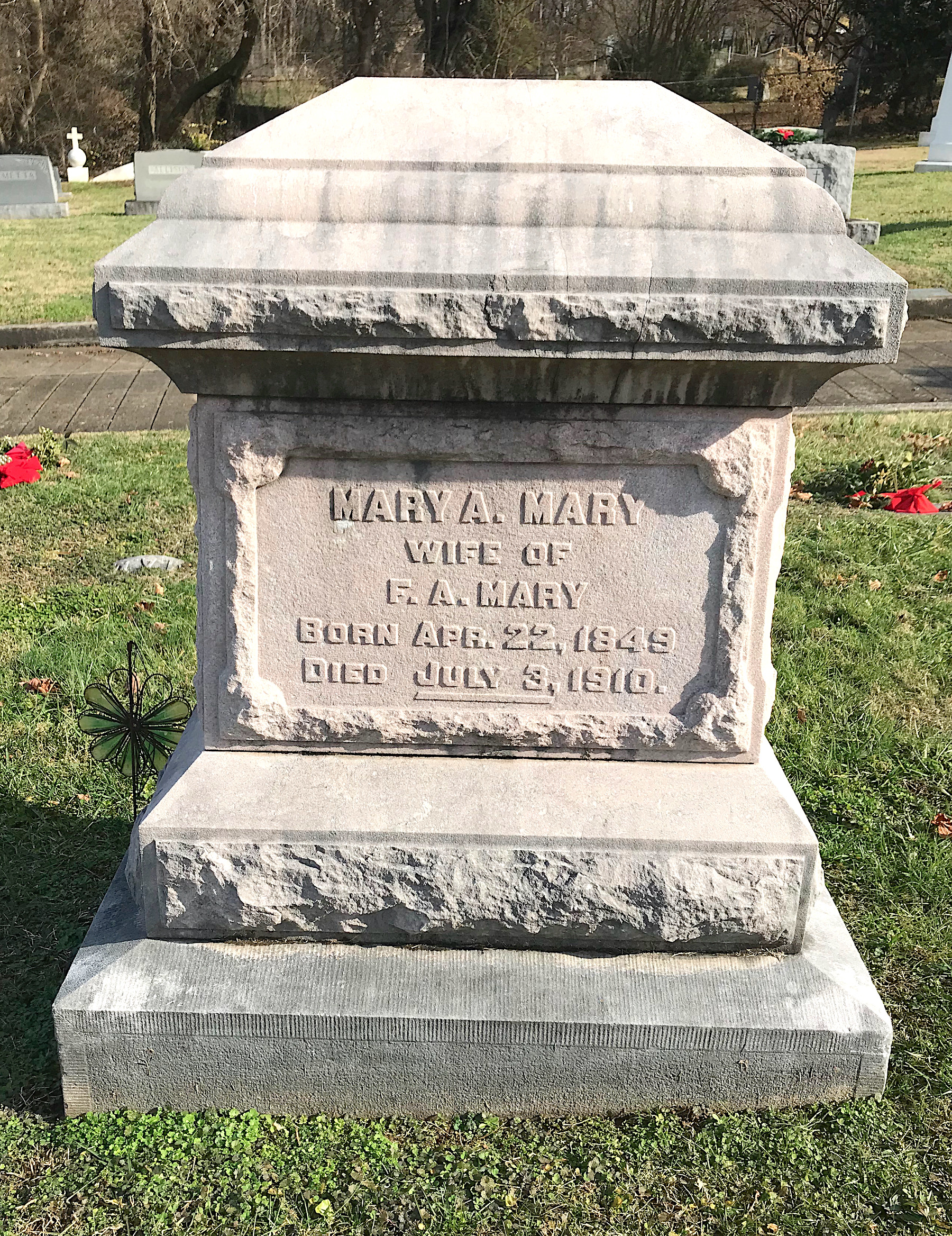
Mary Mary?

Some names will make you look twice at a grave marker. When I saw the name of Mary A. Mary, I admit I did a doubletake.

Mary Ann Huhn became Mary Ann Mary when she married German immigrant Frank Mary in 1869.

A native of New York, Mary Ann Huhn married German immigrant Frank Mary around 1869. That’s when she became Mary Ann Mary. When I looked into the family’s background, I discovered that Frank had a sister back in Germany who was also named Mary Mary. Frank died at age 56 in 1906. His name and dates are on the other side of Mary’s marker. She died in 1910 at age 61.

There’s also a Mary D. Mary buried at CCC but I’m not sure how she’s related to the family. She was married to a man named Joseph Mary. I’m sure the teasing they both got could be intense.

Following in His Father’s Footsteps

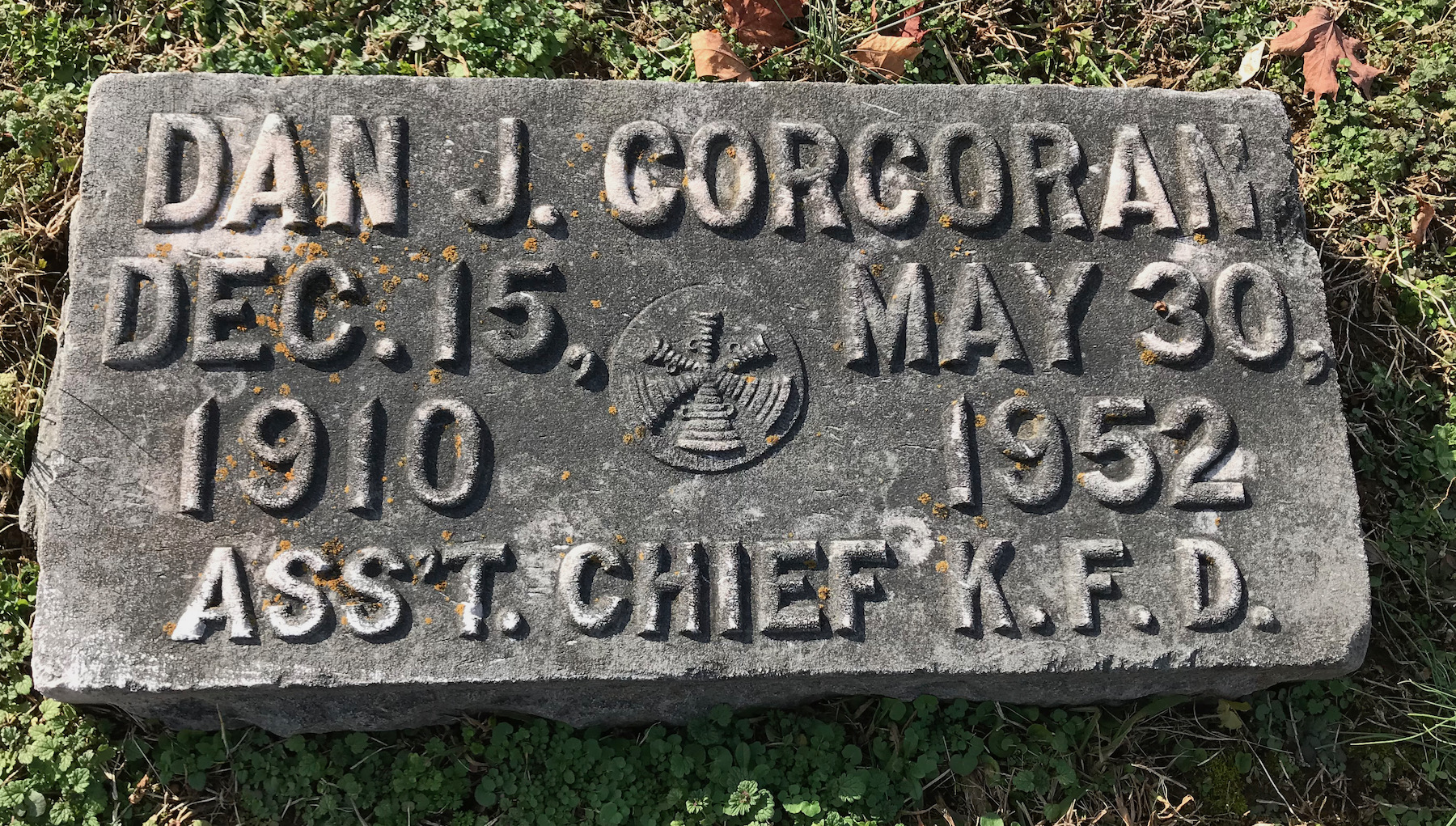
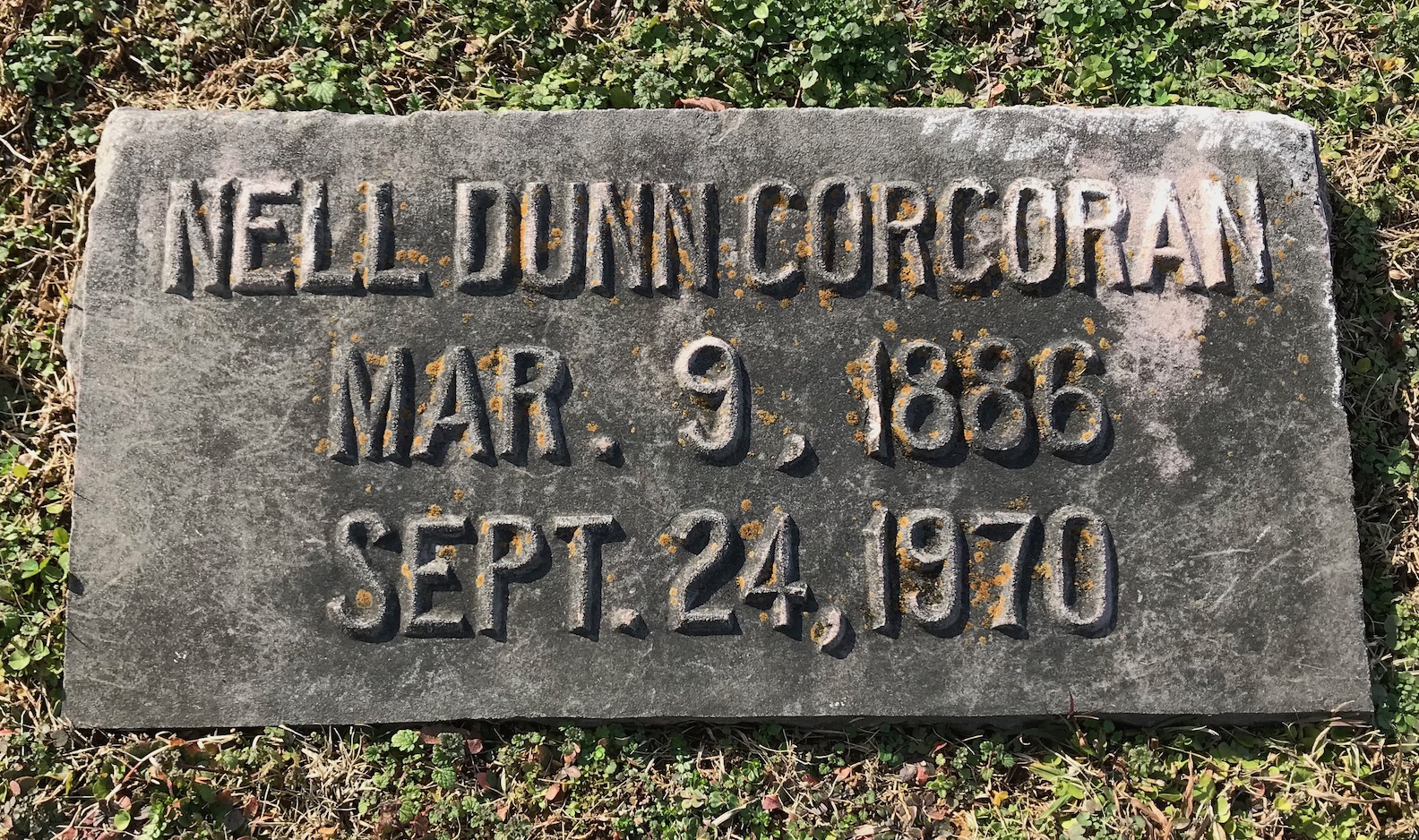
Two graves I randomly photographed were for Daniel Joseph Corcoran and his mother, Nell. I learned later Daniel’s father and Nell’s husband, Thomas, is buried there, too. I don’t know if I just didn’t photograph his grave or he doesn’t have a marker. He didn’t have a memorial on Find a Grave, so I made one for him.

A native of Knoxville, Thomas was born in 1880 and married Ellen Margaret “Nell” Dunn in 1907. Daniel was the third of the four children they had together. Thomas joined the fire department in the days of steam-powered fire engines. He worked as a fireman for 33 years, retiring around 1935. He had been suffering from an illness near the time of his death. But it was a cigarette that caught his clothing on fire while he lay in bed that was the cause of his demise. He died at the age of 56 from his extensive burns.

Daniel Corcoran followed in his father’s footsteps when he joined the fire department at age 20.

Born in 1910, Daniel would follow in his father’s footsteps. He joined the fire department at age 20 around 1930. He served as battalion chief at No. 3 Fire Hall in North Knoxville. At the time of his death, he was acting assistant chief of the Knoxville Fire Dept.

Never married, Daniel lived with his mother, Nell. His brother, John “Ed” Corcoran, was a policeman. Daniel had a heart attack and died at the age of 41 on May 30, 1952. According to newspaper reports, Nell and other family members were at his bedside at the hospital when he passed away.

Daniel Corcoran was greatly respected by his colleagues in the Knoxville Fire Dept.

I am sure Nell was heartbroken when Daniel died. She outlived all but one of her children, Mildred “Aggie” Corcoran. Nell died at the age of 84 on Sept. 24, 1970. She is buried with Daniel and her husband, Thomas.

Nell lived another 18 years after the death of her son Daniel.

Next time, I’ll visit nearby Lebanon in the Fork Cemetery. It’s a much smaller cemetery than Calvary Catholic Cemetery but still full of great stories behind the stones.

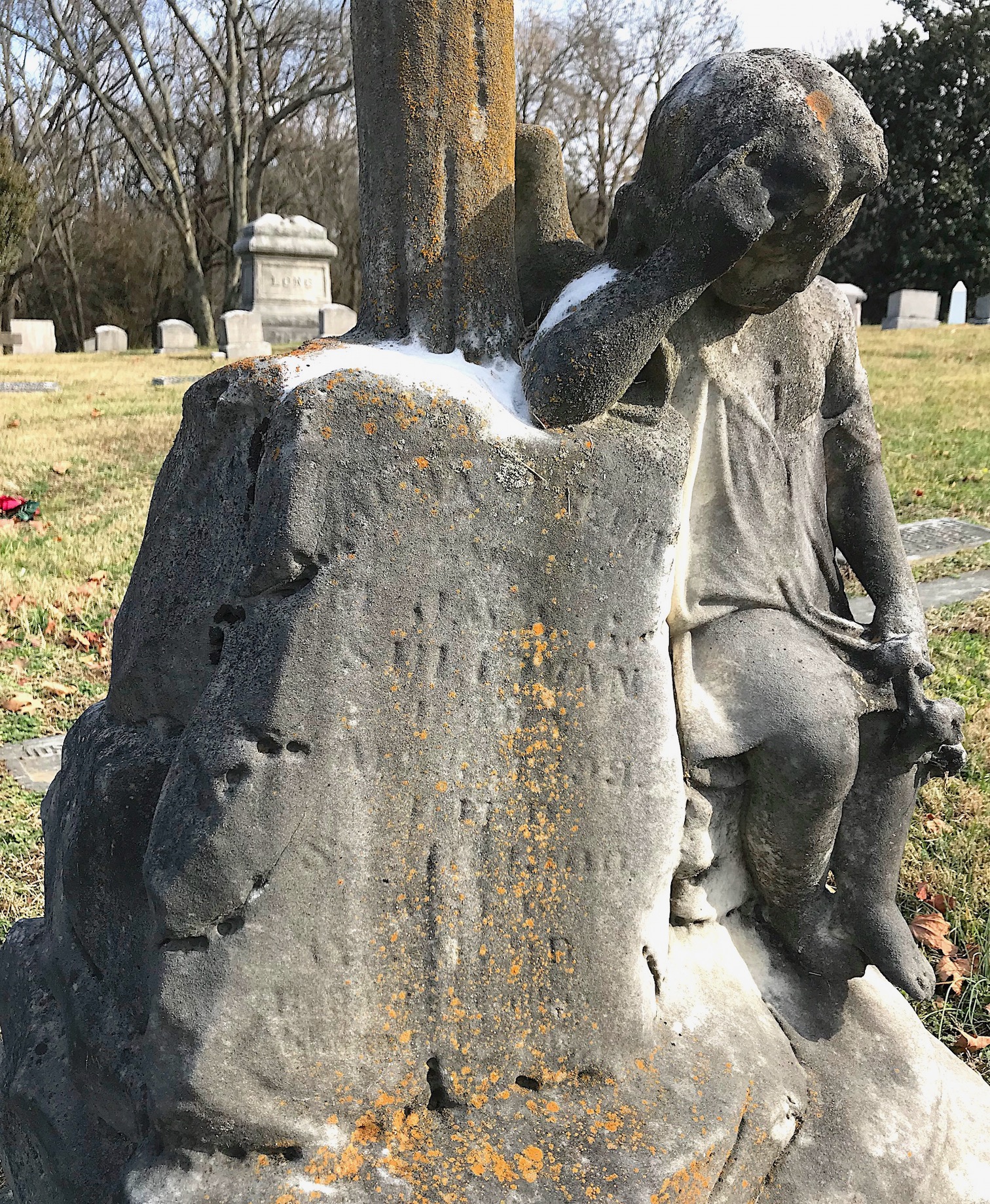
Little Alma Sullivan died from “cerebral effusion” when she was 17 months old on Sept. 18, 1900.

Volunteer State Hopping: Exploring Knoxville, Tenn.’s Calvary Catholic Cemetery, Part I

06 Friday Aug 2021

Posted by adventuresincemeteryhopping in General

≈ 4 Comments

During the Christmas season of 2018, we visited Knoxville, Tenn. to spend time with my husband’s family. On the days between Christmas and New Year’s, I made time to do a bit of cemetery hopping. I visited four cemeteries, each a bit different from the other.

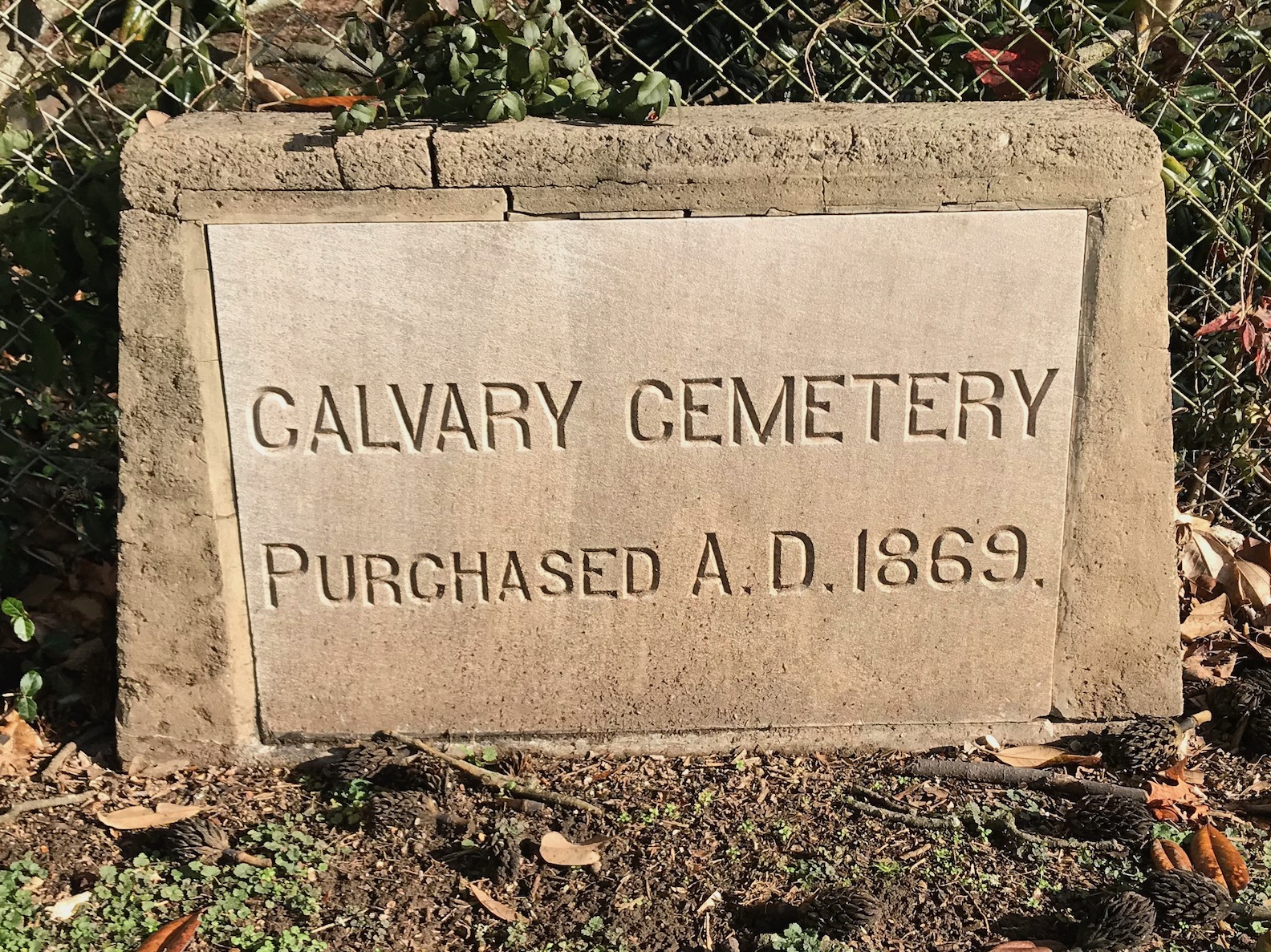
My first jaunt was to Knoxville’s only Catholic cemetery, Calvary Catholic Cemetery (CCC). Consecrated on Feb. 3, 1869, the cemetery is cared for by the Immaculate Conception of the Blessed Virgin Mary Catholic Church. Founded in 1855, the church is located downtown while the cemetery, about two miles away, is in the residential Morningside Park neighborhood. According to Find a Grave, Calvary covers about six acres with about 2,300 memorials recorded.

Coincidentally, Bethel Confederate Cemetery is located next to Calvary. It is fenced and locked but visits can be made by appointment. Bethel contains more than 1,600 Confederate dead, including roughly 100 killed in the battle of Fort Sanders. In addition, around 50 Union soldiers who died as prisoners of war, 40 Civil War veterans, and several widows are interred there. It’s been privately owned since 1873. One of CCC’s residents has a tie to Bethel that I’ll share in a moment.

Calvary Catholic Cemetery is one of only two cemeteries that serve the Diocese of Knoxville. The other is in Chattanooga.

According to a 2017 article, Calvary is one of only two Catholic cemeteries that serve the Diocese of Knoxville. The other, Mount Olivet Cemetery, is located in Chattanooga and opened 20 years after Calvary. Together, these two cemeteries serve the 65,000-plus members of the diocese.

Immaculate Conception Parish pastor Father Ron Franco, CSP, said there are only about 50 gravesites remaining in Calvary. While Calvary is near capacity, Mount Olivet has a lot more room for future burials.

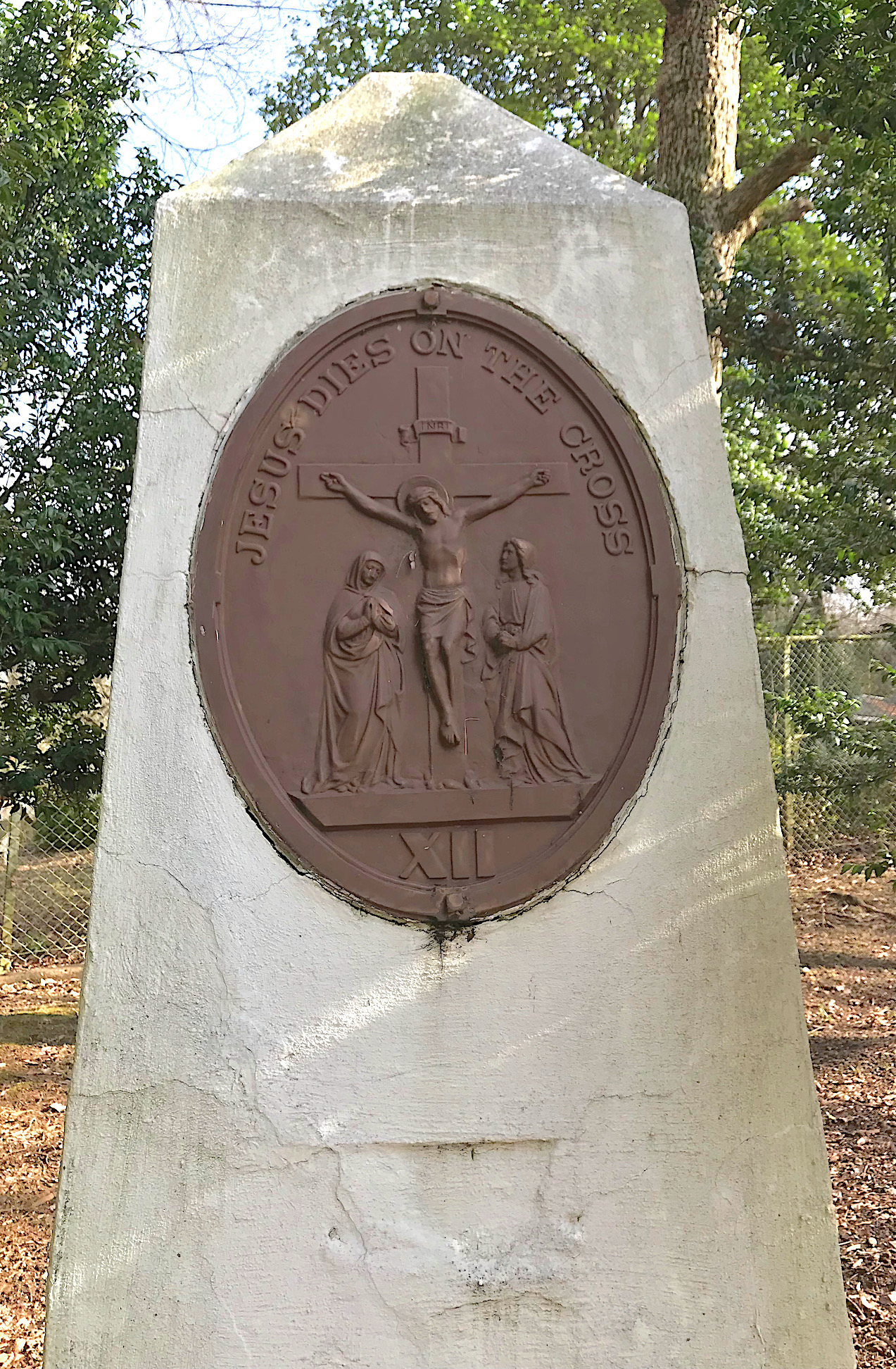
The article also pointed out that a major grounds improvement project had occurred at Calvary, including refurbishing the Stations of the Cross. I saw evidence of that myself. The Stations of the Cross are a series of 14 pictures or carvings portraying events in the Passion of Christ, from his condemnation by Pontius Pilate to his entombment.

The Stations of the Cross at Calvary Catholic Cemetery were redone sometimes around 2017.

Every Memorial Day, the priests of Immaculate Conception and Holy Ghost parishes celebrate an outdoor Mass at CCC to remember the Catholics who have died. In addition, on the first Sunday of November, the priests lead a rosary service and blessing of the graves. A number of priests dating to the earliest days of the Catholic Church in East Tennessee are laid to rest in both Calvary and Mount Olivet.

A Beloved Priest

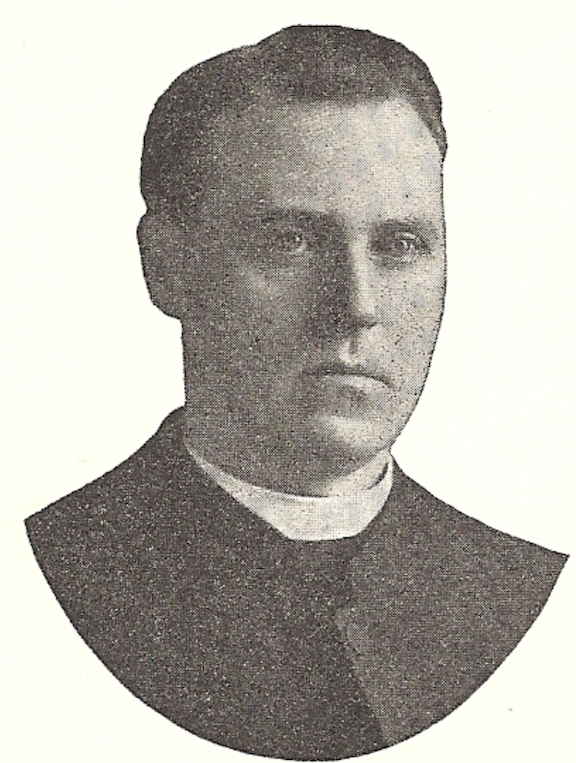
One of those priests was Father John Joseph Graham (1855-1916). A native of Ireland, Graham came to America when he was about 14. He studied with the Holy Cross Brotherhood at Notre Dame, Ind., becoming a member and teacher of the order. He answered the call to the priesthood in 1884 and studied at a few different seminaries. He was ordained in the cathedral at Nashville in 1891.

Father John Joseph Graham served Knoxville’s Church of the Immaculate Conception for 14 years.

It was in 1902 that Father Graham came to Knoxville to become parish priest of the Church of the Immaculate Conception. He became a much beloved member of the community, and his congregants held him in great affection and respect. His death notice in the Knoxville Sentinel expounded on this.

Father Graham’s life was detailed in the April 11, 1916 edition of the Knoxville Sentinel.

In February 1915, Father Graham’s health began to fail. He suffered from heart issues and was also diagnosed with Bright’s Disease, a kidney disorder that was often fatal in those days. He sought treatment in Nashville and rallied for a time. He returned to Knoxville in May 1915 and tried to resume his duties. He was eventually confined to bed and died on April 11, 1916. He was 61.


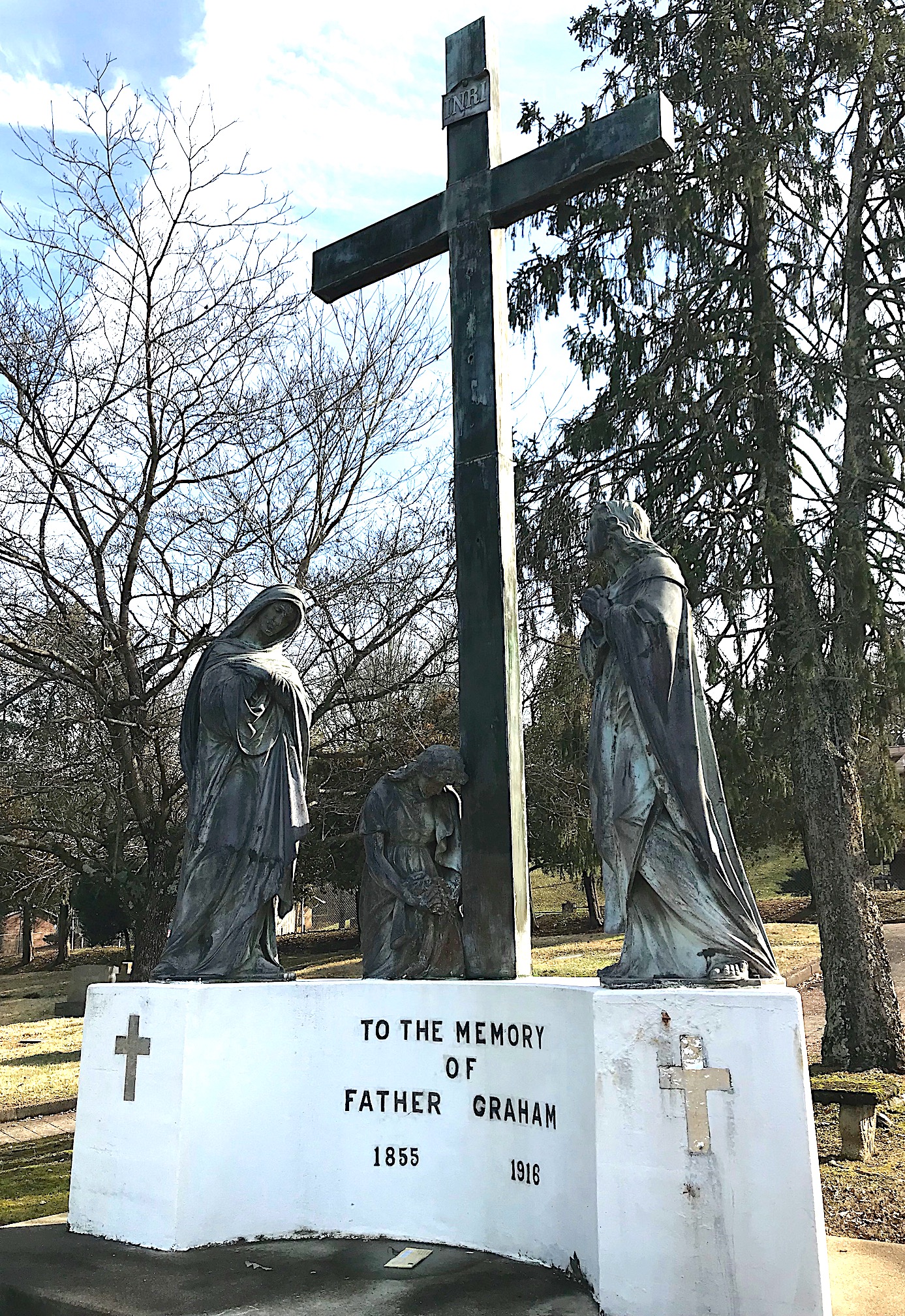
Father John Joseph Graham died from a heart ailment and Bright’s Disease. This tribute was erected in his honor.

Father Graham does have a separate marker but I did not get a photo of it, unfortunately.

From Stone Cutter to Railroad Builder and Banker

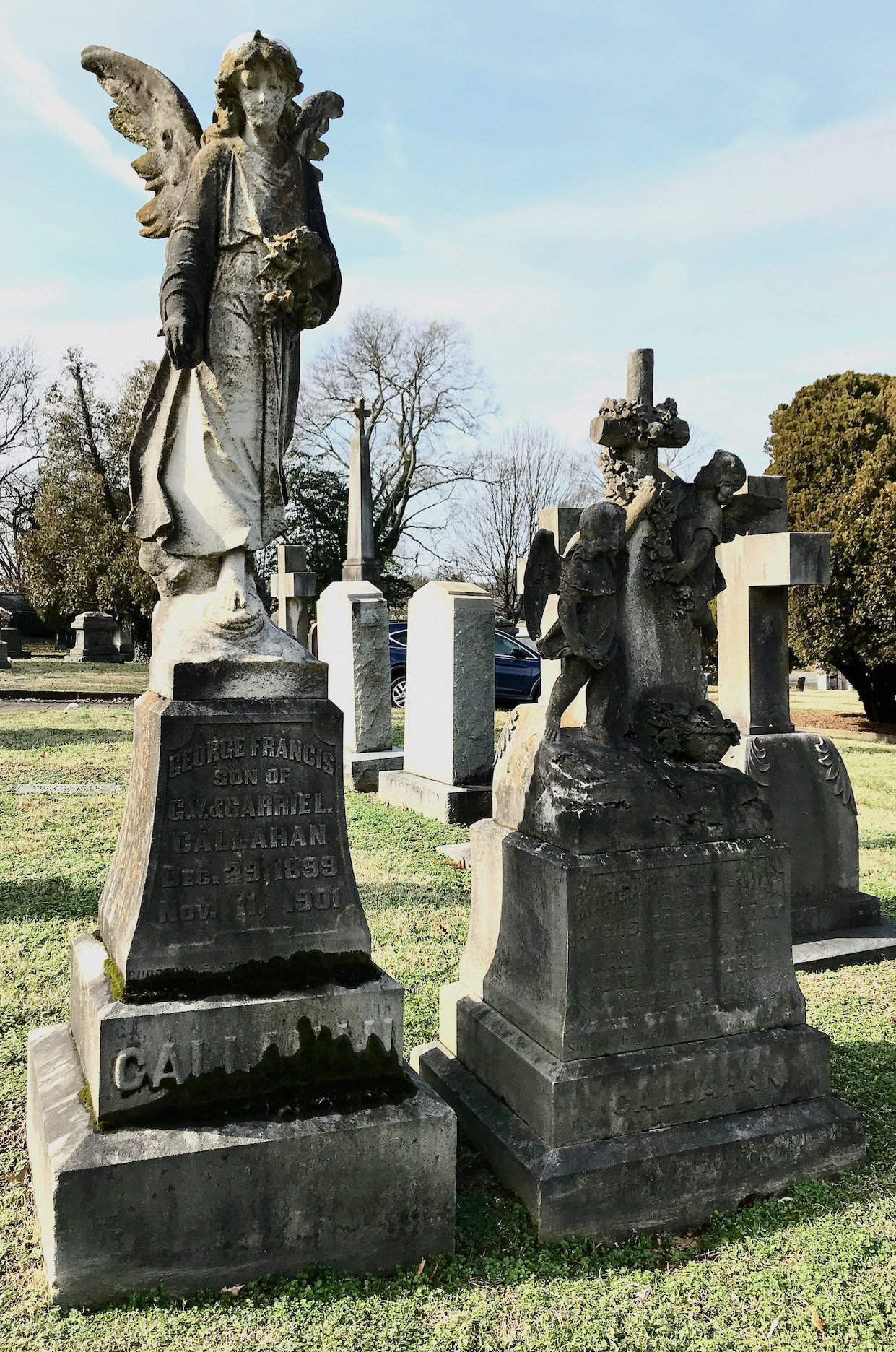
Two monuments standing side by side got my attention early into my stroll. I noticed a tall monument topped by a female statue and was surprised to find that it was for an infant. The one beside it was for his two sisters, twins, who died on the day of their birth. I wanted to know how their story.

The monuments for the children of George Washington Callahan and Carrie Callahan, George, Margaret, and Mary.

The children were born to George Washington Callahan and his wife, Carrie. A native of Penn., George was born to James and Susan Evey Callahan in 1862 and came with his parents to Knoxville as a child. One of his first jobs was working as an apprentice stone cutter for George Fenton, president of Fenton Construction Co. and vice president of the Gray Knox Marble Co. The two Georges went into the monument business together in 1880.

Around 1890, Fenton sold his half and it became Geo. W. Callahan & Brothers with his siblings John and Simon. The firm actually provided the Confederate monument that still stands next door in the Bethel Cemetery, placed in 1892. Their work can be found throughout the Southeast,

From there, George eased into railroad construction and found success quickly. His obituary would note that he “had the distinction of building more railroad mileage than any other man in Knoxville, or probably in East Tennessee.”

George Callahan started as a stone cutter but moved into the railroad construction trade. (Photo source: Men of Affairs in Knoxville, 1917, by Baker and Towe)

In 1892, George (by then an alderman for the city) married another Pennsylvania native, Caroline “Carrie” Grau. Her father was a railroad engineer. Their first child, Agnes, was born in 1892, followed by Lauretta in 1894. Both would grow up, marry, and live long lives.

A Double Tragedy

When I looked up the family’s past on Newspapers.com for 1898 concerning the twins, I noticed that amid their birth and death on Aug. 15, 1898, George was embroiled in a major civil court case that year concerning $4,000 owed to him by the Ohio-based Knight Bridge Company. While he won the case in July, the death of the twins a month later must have dimmed any joy he felt at that victory.

The monument of two little angels playing around a flower-laden cross is a fitting tribute for the children, perhaps echoing a belief that they are together in Heaven enjoying each other’s company.

Twins Margaret and Mary were both born and died on the same day of Aug. 15, 1898.

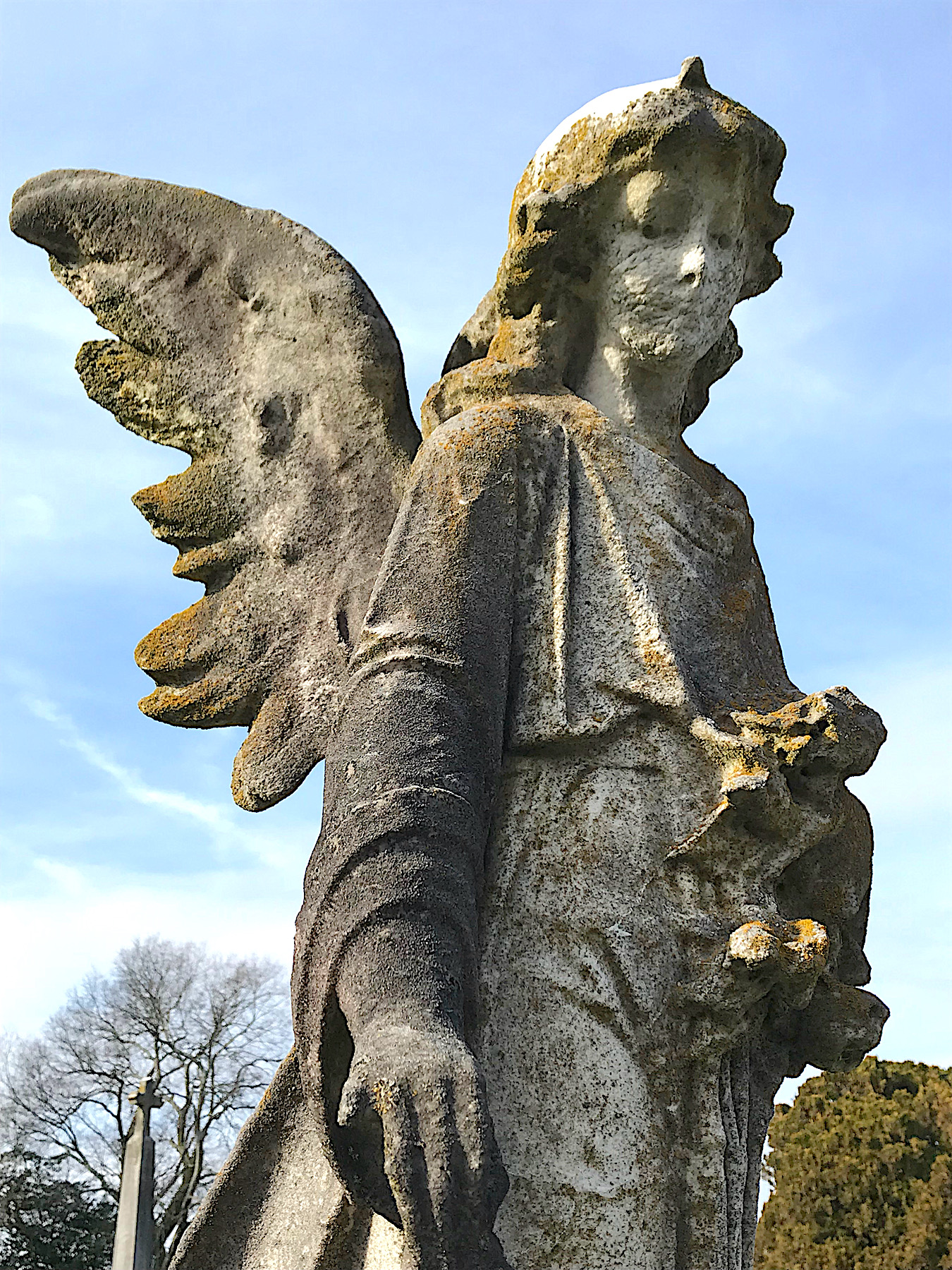
George and Carrie’s son, George Francis, was born on Dec. 29, 1899. But a bout of scarlet fever ended his life on Nov. 11, 1901. By this time, his father and Simon had retired from the monument business and brother John was in charge. I am sure it was he who placed the lovely monument for little George on behalf of the firm.

This lovely angel was likely provided by the monument firm George W. Callahan once owned with his brothers.

George continued to build his fortunes in the railroad business, expanding into banking as well. He and Carrie had another daughter, Katherine, in 1902. She eventually became a nun, dying in 1987 at age 84. Youngest daughter Alberta, born in 1904, died in 1965. George died in 1927 at age 65, spending the last five years of his life in retirement as a gentleman farmer. Wife Carrie died in 1956 at age 84. George, Carrie, and Alberta are all buried at Calvary, along with George F., Margaret, and Mary.

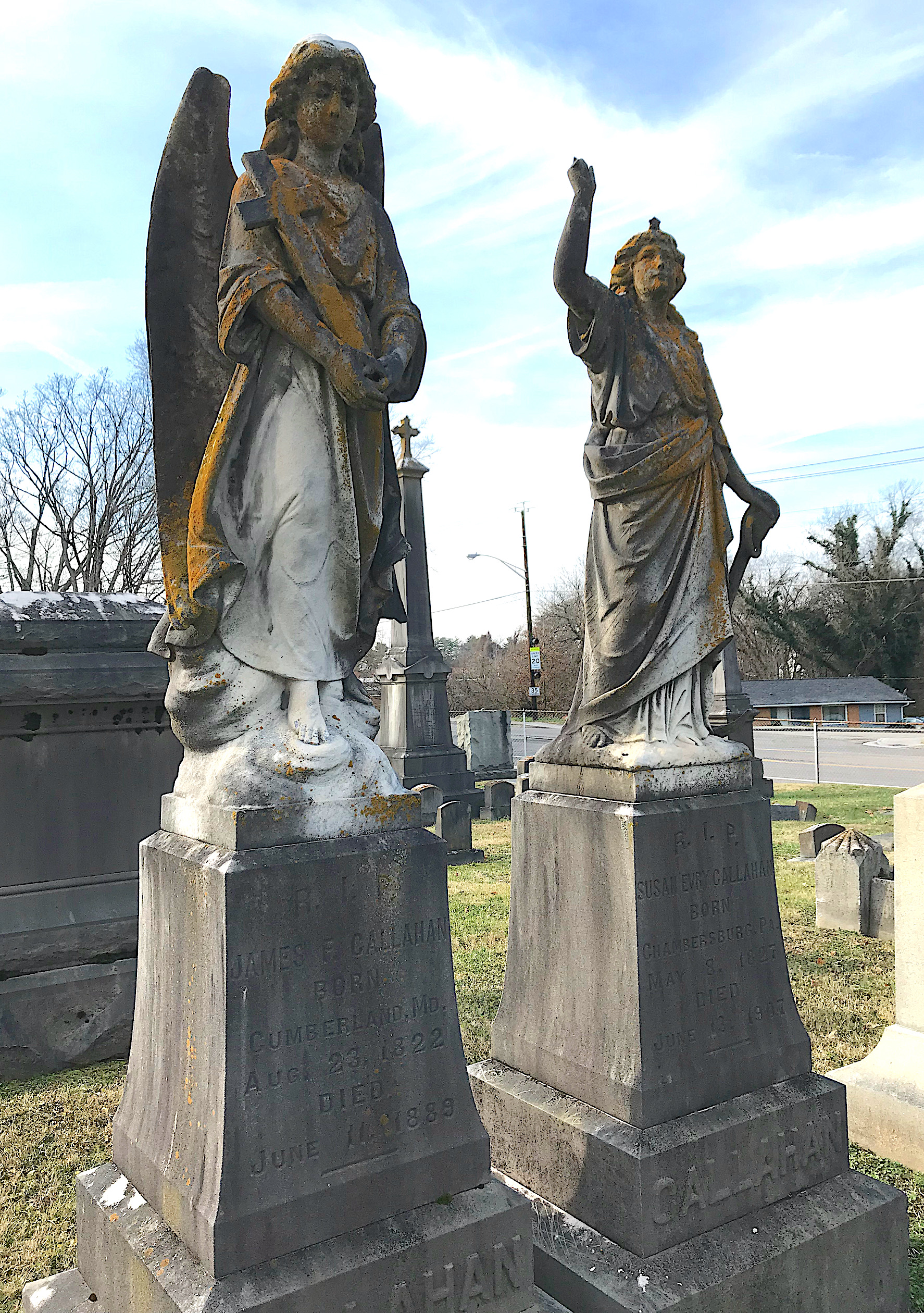
George’s parents, James and Susan Callahan, are also buried at CCC. I suspect their sons provided the two handsome monuments for them. It is curious, I noted, that the death year for James is incorrect on his monument. He died in 1890. Not 1889. Susan Callahan died in 1917.

James Callahan and Susan Evey Callahan brought George W. Callahan to Knoxville as a child with his siblings. Their sons likely honored them with these monuments.

A Soldier’s Story

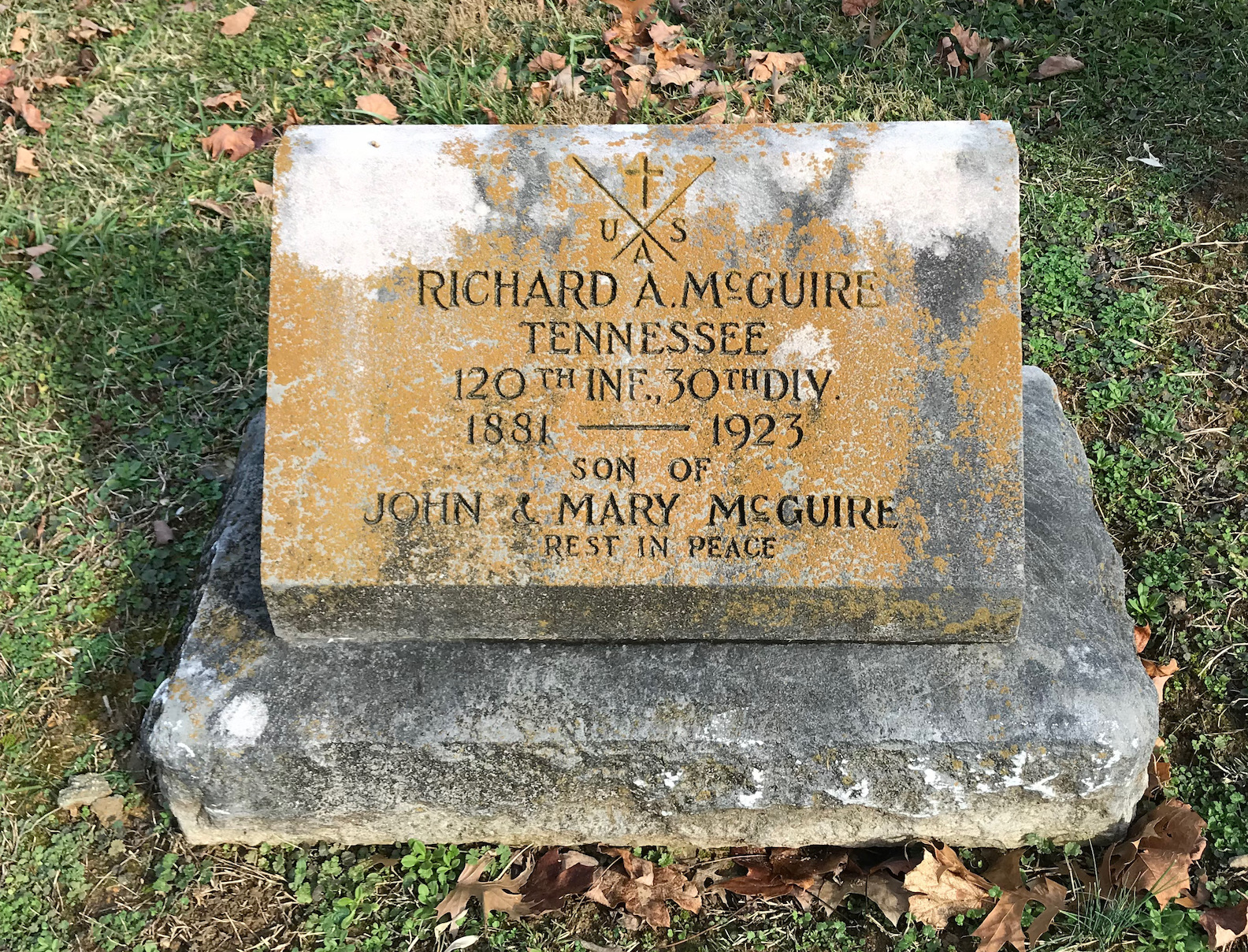
I’ll close with the story of Richard A. McGuire, a soldier who spent most of his life in Knoxville. Like the Callahans, the McGuires were a close family. But unlike many of the men I write about, Richard never married or had children. Sadly, I believe his war years injured him in a way both physically and emotionally that he never recovered from.

Born in 1881 to Irish immigrants John and Mary McGuire, Richard was one of five siblings. His father and two of his brothers were saloon keepers when he was growing up. He worked as a salesman at one point but also as a bartender, most likely for his father or one of his brothers. He must have been close with his sister, Annie McGuire Gallagher, because he always listed her as his primary contact on his military records.

Richard enlisted in the U.S. Army as a private on June 29, 1917 in Knoxville, serving with the 120th Infantry, 30th Division. With the 30th Division, the 120th fought in the Somme Offensive, the Ypres-Lys Offensive, and the Flanders campaign during the war.

An item in the Dec. 15, 1918 Journal and Tribune describes a letter that Richard sent to Annie while overseas in France:

Richard McGuire was close with his sister, Annie McGuire Gallagher. He always put her name and address as his closest contact.

Richard mustered out of service on April 21, 1919. He struggled to find his place out of the military and his health was poor. More than once, he lived at the National Home for Disabled Volunteer Soldiers in Johnson City, Tenn. called Mountain Branch. His last home was at the National Home for Disabled Volunteer Soldiers in Hampton, Va. It was there that he died on Sept. 20, 1923. His records indicated he died of bronchial pneumonia and alcoholism.

Richard McGuire died in a disabled veterans hospital in Hampton, Va. in 1923.

His remains were sent home to Knoxville and he was buried at Calvary Cemetery with his parents, and brothers John and Cornelius. His beloved sister, Annie, died in 1934 and joined him in the family plot.

Want more stories from Calvary Catholic Cemetery? I’ll have more for you soon.

Illinois Cemetery Adventure: Visiting Elgin’s Bluff City Cemetery, Part III

30 Friday Jul 2021

Posted by adventuresincemeteryhopping in General

≈ 4 Comments

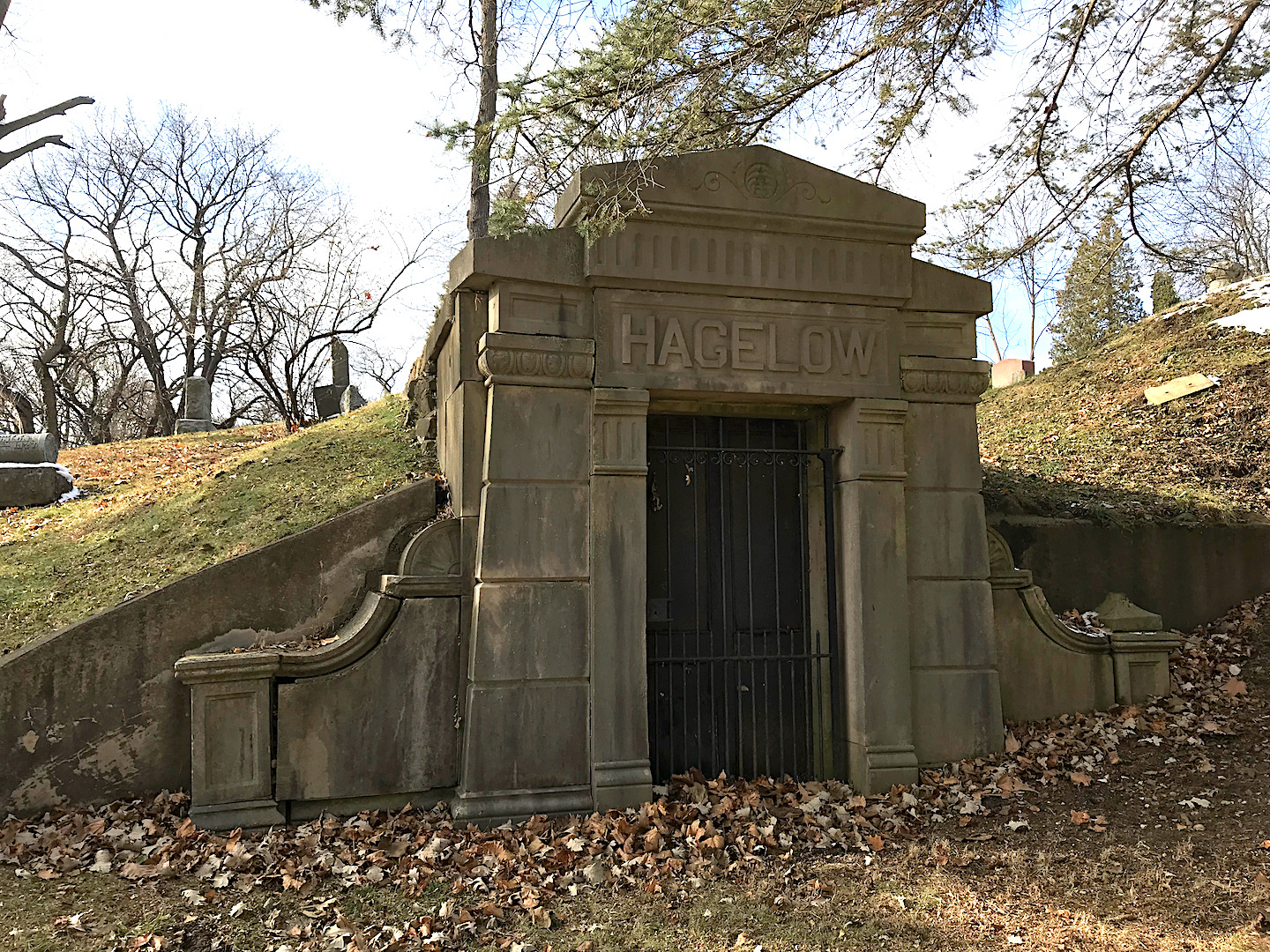
I’m not quite done at Elgin, Ill.’s Bluff City Cemetery. Last time, I shared some photos of the tree-shaped monuments and the amazing faux log cabin they have. But there’s even more. BCC has a number of partial in-ground vaults. That means the front part with the door and fancy architecture is exposed but the back is built into a hill. Some even have venting on top for air circulation. They aren’t exactly rare but I don’t see that many of them.

Bluff City Cemetery has a number of these partial in-ground vaults.

The Hagelow Family

One example is the Hagelow vault. German immigrant Bernhard Hagelow headed this prominent Elgin family, born in Hohenzollern-Simarengen in 1830. Before arriving in America in 1849, he’d learned the paper making trade. He worked in New York and Canada, marrying Marie Barbara Schlegel at Niagara Falls around 1853. Daughters Louise and Amelia followed. Twins Rose and Violet were born around 1861 in Illinois.

John Hagelow introduced tar paper roofing to Elgin in the 1870s. (Photo source: “Elgin Today, 1904”)

The family moved to Elgin sometime in the 1860s. Bernhard introduced tar paper roofing materials to Elgin and prospered as a paper mill owner. But a fire wiped him out. He started over by going into the bottling and liquor trade, constructing a building (which still stands) to house it along with a saloon. His fortunes rose yet again. Twins Rose and Violet married Albert Heideman and Albert Fehrman in a double wedding on Oct. 20, 1885.

Wife Barbara died due to a heart ailment in May 1889 at age 57 and daughter Amelia died in May 1890 of tuberculosis. Daughter Louisa, who had married John Balle in 1880, died of tuberculosis in 1892. John Hagelow remarried in 1890 to widow Mary Frey and retired in 1894. But he remained active in the community, serving on the local school board and maintaining his memberships in the Masons, Knights Templar, and the Mystic Shriners. You can see his Shriners’ pin on his lapel in the photo above.

Who exactly is in the Hagelow vault? Nobody seems to know.

John died on Jan. 24, 1907 at the age of 76. Second wife Mary died in 1915. Daughter Violet died a year after her husband in 1934 and Rose died in 1945. Both are buried in Bluff City Cemeteries with their husbands. Louisa Hagelow Balle is buried at BCC in an unmarked grave.

Who’s in the Vault?

I think it’s safe to say that at least Bernhard is in the Hagelow vault. Online records note that he was interred in a “private vault” in Section 3. I believe it was likely constructed the year he died. However, I don’t know if first wife Barbara and daughter Amelia were moved from their spots elsewhere in the cemetery (which are noted in city records) to join him. Nothing in the records indicates they were moved but there are no stones bearing their names in Bluff City Cemetery. I did call the cemetery office to ask but even they weren’t sure.

The Redeker Family

The Redeker family vault is also in Section 3. The family came to Elgin in 1849 when German immigrants Christopher and Dorothea Redeker arrived. Their sons John and William did especially well as farmers. William married Lizzie Franzen and they had two children, Walter (1882) and Amelia (1885). Walter married Mary Galeener in 1907, working as a market gardener for a truck farmer. Sadly, Walter’s health was already not very good when he contracted acute pneumonia and died on Oct. 21, 1910. He was 28.

I believe William, Lizzie, and Walter are interred within the Redeker vault.

While the name of Walter’s father, William, is at the top, the date of 1911 is above the doors. I believe Walter was the first to enter that vault. I’m not sure what happened to Walter’s wife, Mary. William died in 1930 of heart failure at age 66 and Elgin’s records indicate he was placed in the vault. Wife Lizzie died in 1937. According to Ancestry, daughter Amelia, possibly a nurse, never married and died in 1981. I don’t know where she is buried.

The top of the Redeker vault is unusual.

The style of the name of the Redeker family above the year is different than the norm. The letters are intertwined with what I believe are oak leaves. Oak trees often symbolize strength and endurance in cemetery iconography. The polished columns (perhaps granite) that flank the door are topped by Corinthian-style capitals that stand out in contrast to the roughness of the vault’s stone. Visually, it makes you stop and notice it.

A Bevy of White Bronze

In addition to a number of in-ground vaults, Bluff City Cemetery has its fair share of white bronze (zinc) monuments. I always gravitate to these novelty markers, which I don’t often see in the South where I live. Sometimes you find such a marker for just one person, like Gordon Fish.

A native of Peru, Ohio born in 1822, Gordon wed Jane Gardiner in 1846. They had three children. Jane passed away in 1863 and Gordon remarried to Elizabeth Ellenwood the following year. The couple didn’t arrive in Elgin until around 1870 when Gordon was nearly 50 but it appears he made his mark once he got there. The 1880 U.S. Census lists Gordon as a mine owner.

“Entering the Valley of Shadows”

Gordon’s death records and a newspaper item I found indicate he had suffered from poor health and spinal paralysis before he died in 1884.

Gordon Fish had been ill for two years before his death in 1884.
Gordon Fish’ white bronze (zinc) monument looks like it’s coming off of its base a bit.

Gordon Fish’ funeral notice states that one of the local Masonic lodges he belonged to handled the funeral service. If you look on the side of his marker, it’s a Knights Templar emblem there. He was a member of both fraternal organizations. At first, it struck me as odd that the Masons would handled the service but a Knights Templar emblem would be on his marker. But alert reader Janet Hall kindly reminded me (via a comment she left) that the Masons and the Knights Templar do have connective roots that link them together. So it’s not unusual at all, really.

Gordon Fish’ funeral service was conducted by the Masons but his marker features the Knights Templar emblem. He was a member of both.

Meet the Edwards/Hubbard Family

By contrast, the Edwards/Hubbard family’s white bronze marker documents a total of eight people. It reminds me of the Scofield family marker (which is much larger) that I shared in Part I. In this case, it took me a while to figure out who was whom on this marker because the earliest death date is 1857 and the latest is 1925.

The Edwards/Hubbard marker lists eight different people on it.

The central person on this marker is Callie G. Edwards Hubbard. Callie’s parents were Frederick Edwards and Eunice House Edwards. Callie was one of four children born to the couple. Frederick was a shoemaker much of his life and the family lived in the Champaign, Ill. area when Callie grew up. She married William G. Hubbard, Jr. of Elgin around 1872.

Frederick and Eunice Edwards were the parents of Callie Edwards.

Eight People, One Marker

The couple had two children in Champaign. Winifred, born in 1875, died a year later. Son William was born in March 1877 but only lived two days. Both children were originally buried in a Champaign cemetery but records indicate they were moved to Bluff City Cemetery at some point. You can see their names on the base of the marker.

Callie’s mother Eunice died in 1878 at age 51 from “congestion of the stomach”. Since Frederick and Eunice had been living in Champaign, I was curious to know if they were actually buried in BCC. But census records confirm that the couple had moved to Elgin before Eunice died. Frederick continued living there with Callie and her family until his death in 1903 at age 88 from a cerebral hemorrhage.

Infants Winifred and William Hubbard were originally buried in Champaign, Ill. where they died in the 1870s. They were later moved to Bluff City Cemetery.
Sharing another plate are Callie and her daughter, Charlotte, born in 1879. Charlotte died in 1882 of scarlet fever with meningitis. I believe it was after Charlotte’s death that this marker may have been started because the year 1882 is listed at the base beneath the names of Winifred and William. I say started because name plates could be added or removed as people died over the years.

Ethel, born in 1881, lived to adulthood and married Roy Webster in 1912. Marguerite, born in 1886, also lived to adulthood, and married Lyman Weld. The sisters are both married and buried with their spouses in BCC near this marker.

Two of Callie’s sisters, Juliette and Lucy, are listed on the base of the marker.

Two more names appear on the bottom beneath Callie and daughter Charlotte’s plate. Lucy J. Edwards, born in 1855, was Callie’s older sister who was born in Ohio. She died less than two years later. The other is Juliette Edwards Wetmore, another sister of Callie’s born in Ohio in 1843. She married Orren Wetmore and lived with him in Wisconsin, where she died in 1878 at age 34 of typhoid. I don’t know when either little Lucy or Juliette were buried at BCC, the records don’t say. But they are in the records as being buried there.

Callie died in 1925 at the age of 72 from a coronary thrombosis. It’s quite rare for me to see a white bronze plate with a death after 1920 because by that time, Monumental White Bronze’s factories were pretty silent due to the demand for metal for munitions during World War I. But some believe the company was still making plates up into the 1930s and this plate supports that assertion.

Where’s William?

You may be wondering what happened to William, Callie’s husband. Why is he not listed on the marker? While it was possible for the family to get a plate for Callie and Charlotte made in 1925, it may have been too late to get one by the time William passed away. William lived to age 88, dying in 1930 from a cardiac arrest. He is buried in Section 8 in the Edwards/Hubbard plot but I did not see a marker for him when I was there. His Find a Grave memorial does not feature a grave photograph. But he is buried there according to records.

The Short Life of Pvt. James Tuthill Jr.

My last story from Bluff City Cemetery does not include a large obelisk or fancy vault. It’s the story of a young man who only lived to be 20 because his country needed him to fight a war.

James “Jim” Pierce Tuthill Jr. was born to James Pierce Tuthill Sr. and Olive Lagen Tuthill in Elgin on Sept. 13, 1924. His father was an engineer. But Olive only lived a short time after Jim was born. She died on Feb. 27, 1926 from a pulmonary embolism following surgery. Jim’s father, James, remarried in 1935 to Mary Margaret Geister. Jim was about 9 at the time.

Pvt. James “Jim” Tutill, Jr. died from wounds suffered at the Battle of Tarawa on Jan. 8, 1944.

Jim’s draft card shows he was a student at Elgin High at the time, coming on board with the Marines in March 1943. He served as a private in the Company B, First Battalion, Sixth Marines, Second Marine Division. He took part in the Battle of Tarawa, fought on Nov. 20-12, 1943 between the United States and Japan at the Tarawa Atoll in the Gilbert Islands. It was part of Operation Galvanic, the U.S. invasion of the Gilberts. Nearly 6,400 Japanese, Koreans, and Americans died in the fighting, mostly on and around the small island of Betio, in the extreme southwest of Tarawa Atoll. Of the roughly 12,000 2nd Marine Division marines on Tarawa, 3,166 officers and men became casualties.

Wounded, James was sent to a hospital in Hololulu, Hawaii to recover. He died soon after having surgery on Jan. 8, 1944 and was buried on the island the same day. It wasn’t until Oct. 29, 1947 that Jim’s remains were returned to the U.S. for burial in Bluff City Cemetery. His father, James, died in January 1980 and his step-mother nine months later. They are also buried in BCC.

This brings my Illinois adventure to an end. But I’ll be back soon with some Knoxville, Tenn. cemeteries that I think you’ll want to see.

An angel keeps watch over the graves of Gloria and Vernon Schick, who both died in infancy in the 1920s.

Illinois Cemetery Adventure: Visiting Elgin’s Bluff City Cemetery, Part II

16 Friday Jul 2021

Posted by adventuresincemeteryhopping in General

≈ Leave a comment

Last time, I shared some stories with you about how Elgin’s Bluff City Cemetery was established and the people buried there. I’ve got even more for you this week. This first grave marker is another example of what happens when you get curious and start sniffing around for answers. I often come up with something I wasn’t expecting.

This small monument caught my eye because it was made for a child and because it looked a bit unusual. Children’s graves usually feature lambs or cherubs. But this pillar marker is for Fern Wilder Metcalf, who was born on Feb. 10, 1895 and died of scarlet fever on Feb. 13, 1898 to parents Maynard Mayo Metcalf and Ella Wilder Metcalf.

Fern Metcalf’s monument caught my attention because it was not what I usually see for a child.

Famous Witness

Fern’s zoologist father has a special place in history. Maynard Metcalf was the only scientist allowed to testify on the stand as a defense witness at the 1925 Scopes anti-evolution trial. The likes of famous orator William Jennings Bryan (who died five days after the trial ended) and attorney Clarence Darrow were part of this history-making event in Dayton, Tenn.

Fern Metcalf’s father, Maynard, testified at the infamous 1925 Scopes anti-evolution trial.

The Metcalfs did not live in Elgin, but spent much of their time in Ohio when Maynard taught at his alma mater, Oberlin College. Fern died in Baltimore, Md. when Metcalf was teaching at Goucher College there. The Metcalfs did have another daughter, Mildred, who lived to adulthood. Maynard and Ella eventually retired to Winter Park, Fla. where he died in 1940. The couple is interred there at Oaklawn Cemetery.
Fern is buried near her grandparents and other Wilder family members.

Fern is buried near Ella’s parents so it’s my guess that the Metcalfs felt it was a proper place to bury her at the time. While Fern was only three when she passed away, I have no doubt they never forgot her.

Birth of the Elgin Watch Co.

I don’t know how I stumbled upon Augusta Gronberg’s simple grave since it’s flat against the ground and not flashy in any way. But like Fern’s, it was different and made me want to know more.

Augusta was one of many Elgin residents who worked at the local watch factory.
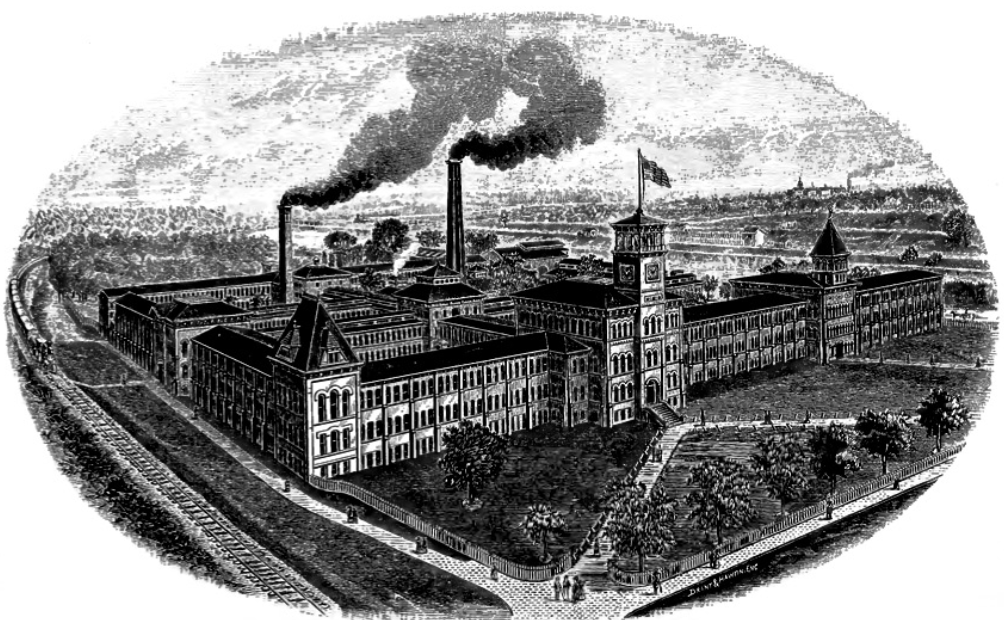
Born in Sweden in 1858, Augusta Storm emigrated to America in her early teens. She eventually went to work in the finishing room at the Elgin Watch Co., a mainstay of the community. The company was first incorporated in August 1864 as the National Watch Company.
Elgin was chosen as the factory site and the city was asked to donate 35 acres for that purpose. A derelict farm was chosen but the owners refused to sell unless the city purchased their entire 71 acres for $3,550. Four Elgin businessmen agreed and donated the required 35 acres to the watch company, which was re-organized in April 1865. The factory was completed in 1866 and the company officially changed its name to the Elgin National Watch Company in 1874.

Promotional logo for the Elgin National Watch Company featuring Father Time.

Finding Love on the Job

Augusta’s factory boss was a man named Oscar Gronberg and apparently, they hit it off. The couple wed in 1879 and would have at least six children together.

By 1888, the factory was producing about 7,500 movements per week and employed roughly 2,300 people.I learned that they were split 50/50 between men and women but not so in their pay. The women earned about $6 per week while some of the men earned as much as $3 per day and this was for a six-day workweek.

In 1896, Augusta contracted the tuberculosis that would eventually end her life at age 42 on April 25, 1900. Oscar remarried a year later to Ella Reed and they had a daughter, Grace. He died in California in 1929 but was brought back to Illinois for burial at nearby West Aurora Cemetery.

The Elgin Watch Co. factory employed hundreds in its day.

During World War I, the U.S. Army had the Elgin factory train more than 350 men to make the precision repairs required in the battlefields. During World War II, all civilian work stopped and Elgin made military watches, chronometers for the U.S. Navy, fuses for artillery shells, and altimeters/instruments for aircraft. The company was awarded 10 Army-Navy “E” awards, for fulfilling contracts ahead of schedule.

In 1964, the Elgin Watch Co. moved operations to Blaney, S.C., and the town was renamed “Elgin.” The original factory in Elgin, Ill. was demolished in 1966 and manufacturing was discontinued in Elgin, S.C. in 1968. By 1972, it was all over for Elgin. But the company had made a lasting mark on Elgin and the watch-buying world.

Seeing the Forest for the Trees

In the past, I’ve shared with you a number of tree-shaped markers in different sizes and shapes (from tiny stumps to enormous trees) at various cemeteries. Elgin has a number of them, too. The ones I’m featuring here don’t have the words “Woodmen of the World” on them, but some of the men had ties to the fraternal organization.

One of the most handsome is for New York-born dairy owner Phineas H. Smith (1811-1872) and his wife, Jane (1811-1902). Phineas was among the first Elgin residents to begin selling and shipping milk to nearby Chicago businesses in the 1850s. I’m not sure when this tree was made but I suspect it might have been after Jane died, not Phineas.

Phineas Smith started sending cans of milk to Chicago in the 1850s and many others began to do the same.

Then there’s the Henry family’s tree, which has individual log-shaped markers for the family members. I don’t know if any of the men were Woodmen members but the inclusion of an axe and mallet motif indicates at least one might have been.

The axe and mallet are symbols of Woodmen of the World so one of the Henry family may have been a member.
Catharine Leonard Henry’s marker is shaped like a log.

Tree stumps tend to indicate a life cut short but among the four Donaldsons buried at Bluff City Cemetery, none died particularly young. Steven Donaldson (1840-1904) hailed from Sweden and worked as a carpenter, so you could say he already had sawdust in his blood.

A tree stump usually indicates a life cut short.

There’s even a small twig-themed “D” marker in the family plot.

It’s hard not to love something this detailed.

The Gale monument, while it has no Woodmen seal, is (at least to me) a WOW one because of the axe in the top, along with the mallet and the dove above the inscription. All are WOW symbols. Ward Gale worked at the Elgin Watch Co. factory and I suspect he was a member of good standing in Woodmen of the World. He married Ida Keller in 1881 in Indiana, but they had no children together. Ida died in 1900 at age 42 and Ward died a year later at age 43.

Ward and Ida Gale both died in their early 40s.

Pioneer Log Cabin

Right in front of the Gale monument is a lovely rarity that I’ve yet to see before, a log cabin-shaped monument. Walter S. Arnold (the Elgin sculptor I met with before visiting this cemetery) has actually found 40 cabin-style monuments, mostly located in Illinois, Iowa, Ohio, and Michigan. He mentioned it to me as a “must see” at Bluff City Cemetery and he was right.

This is a replica of pioneer Benjamin Burritt’s 1837 cabin. Note the stone “stump” on the left.

I don’t know who created this amazing monument but it was built as a replica of pioneer Benjamin Burritt’s 1837 cabin located in Hanover Township (now Hanover Park). That’s about 10 miles east of Elgin. Benjamin was born in 1796 and died in 1880. So the cabin and its individual logs with initials on them were moved from the old Channing Street Cemetery to Bluff City Cemetery.

Benjamin and his wife Katy’s names and birth/death dates are on the side.

Benjamn Burritt held several civic positions in Elgin and acquired a good bit of land during his life. He and his wife, Katy, married in 1814 and had six children. Son Peter’s second wife, Rebecca McBride, was later known as the wealthiest woman in Elgin. At the time of their marriage, he was much older than she was. At the time of his death in 1892, she was only in her 30s and inherited his considerable real estate holdings. Peter is buried in Bluff City Cemetery.
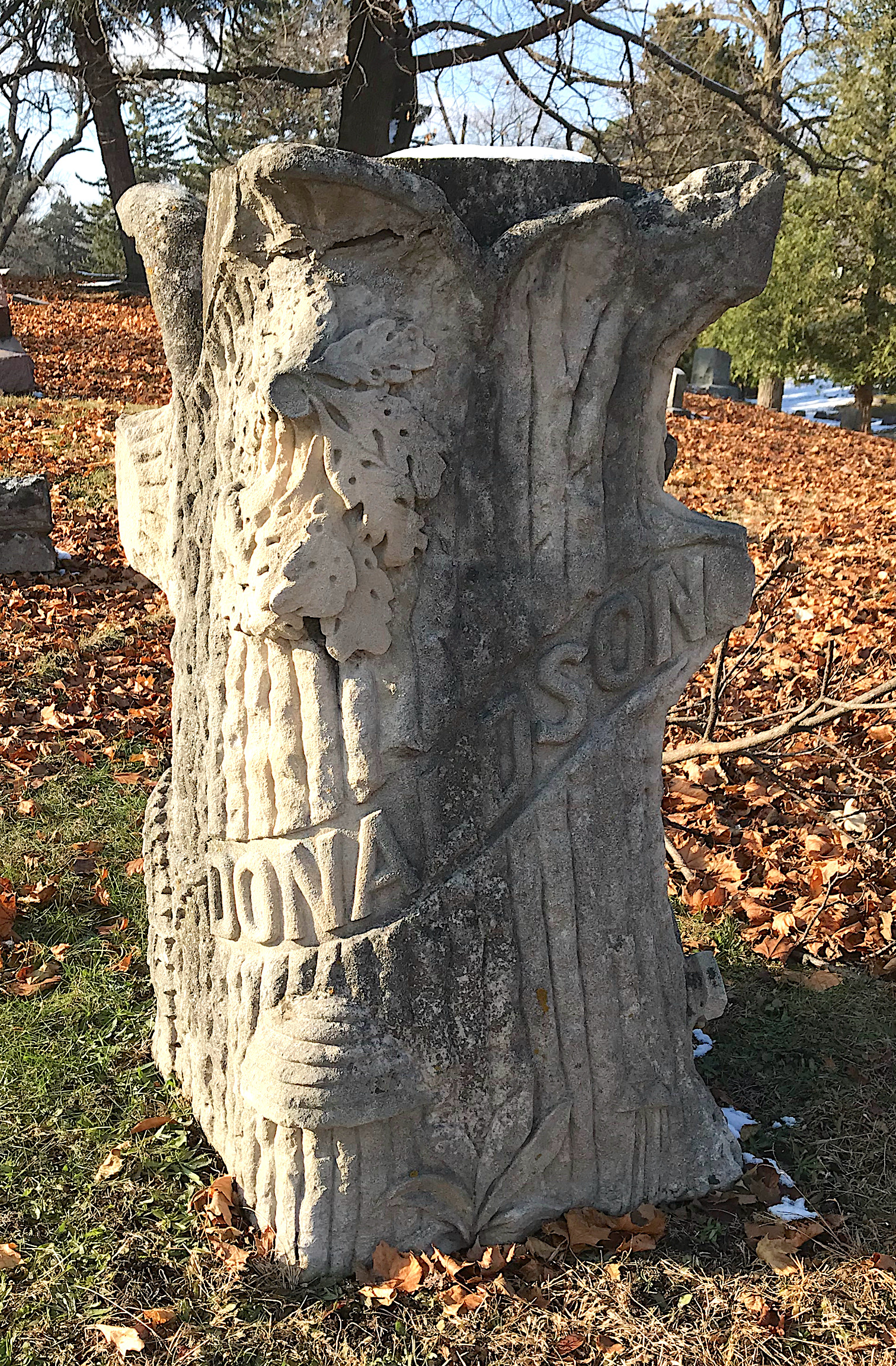
Although she remarried to William Gilbert in 1894, Rebecca started construction of a downtown Elgin building as a tribute to her first husband in 1914. However, except for the street level, the upper floors of the Burritt remained unfinished for over 75 years. It wasn’t completed until the 1990s.

Rebecca McBride Burritt Gilbert started construction of this building in 1914 but it wasn’t completed until the 1990s, many years after she died in Miami, Fla. in 1944. (Photo source: HistoricElgin.com)
Benjamin Burritt’s individual grave marker bears his initials.

Another of Benjamin and Katy’s children was Josiah, born in 1820. He became a doctor and married Ellen Whitney in his 40s. Together, they had three children that lived to adulthood. A towering tree monument marks the graves of Josiah and Ellen.

Dr. Josiah Burritt and his wife, Ellen, have a towering tree monument near his parents’ cabin monument.

I still have one more installment coming in my Bluff City Cemetery series. I hope you’ll return to learn more about this special burial ground.

Vincent Lovell (1845-1892) married Englishwoman Eliza Hadwen (1844-1928) in 1876. He served one term as mayor of Elgin, Ill. They share this tree-like cross marker.

Illinois Cemetery Adventure: Visiting Elgin’s Bluff City Cemetery, Part I

02 Friday Jul 2021

Posted by adventuresincemeteryhopping in General

≈ 2 Comments

After I finished visiting Walter at his studio, I was ready to head to nearby Bluff City Cemetery. It was a cold day with occasional flurries but the roads were in great shape for a driver like me not used to icy conditions.

Located about 40 miles west of Chicago, Elgin’s Bluff City Cemetery (BCC) has an interesting background because it is the third municipal cemetery in Elgin’s history. Before that, the Channing Street Cemetery located nearby had been the site of local burials. The land for BCC was formerly owned by the Gifford family and then the Whitcomb Family. Albert Marckhofff, the first sextant, laid out the first 12 sections, planted the trees and improved the land. I should add that the city of Elgin itself is located in adjacent Kane County while BCC is located in Cook County, Ill.

This picture of the Bluff City Cemetery gates was taken by the Elgin History Museum, when weather conditions were much more pleasant than the day I visited.

Because the Channing Street Cemetery was reaching capacity, they moved the graves from there to the new Bluff City Cemetery, which currently covers 108 acres and contains more than 72,000 burials (according to Elgin’s web site). I think that 72,000 burials figure is a capacity number since Find a Grave lists about 32,000 actual memorials. The new cemetery was dedicated on Sept. 8, 1889. So when you see a grave marker with a date before that, be aware that they used to be at the Channing Street Cemetery.
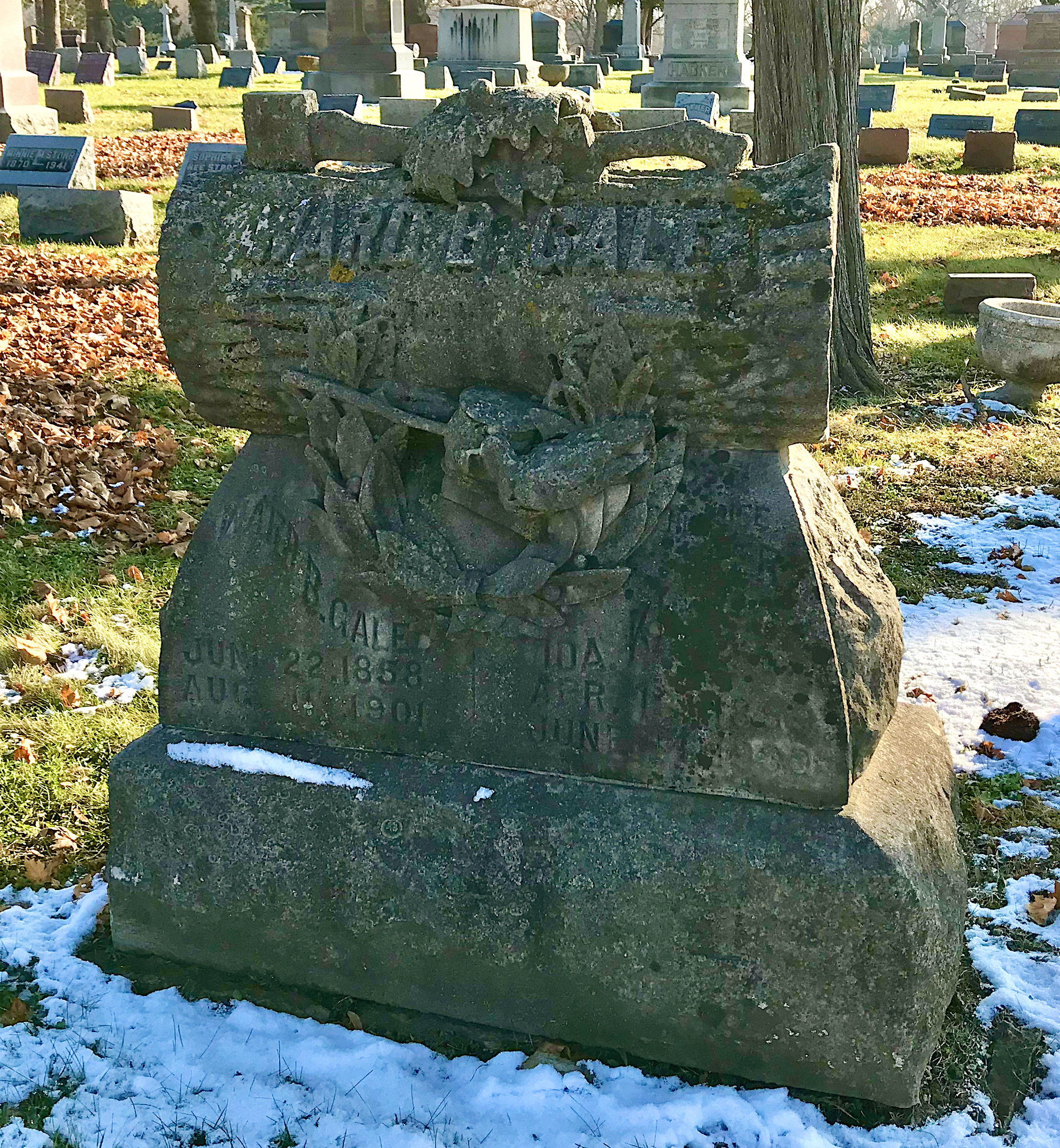
I learned that if there were no family members to pay the cost of moving the graves back in the 1880s, the remains stayed at Channing. That cemetery was officially closed in 1945 and two years later, the city declared all remains had been removed. But when the foundation for Channing School was dug in 1968, many remains surfaced during the digging and were brought to Bluff City for re-burial in a common grave.

A black granite marker now memorializes those souls that were once left behind. It was a project undertaken by author/historian Steven Stroud, who died in April 2019.

A Grand Receiving Vault

BCC’s large receiving tomb was built in 1903, that date is at the top. It was used to temporarily store bodies in the winter months when the ground was frozen so hard it was difficult to dig. From some postings on Reddit, I learned that they’ve opened it up during tours for people to look inside. You can find pictures here. From what I can see, it could hold at least 50 bodies at a time.

Bluff City Cemetery has a handsome receiving vault.

I have a soft spot for receiving tombs since I don’t see many of them in the South. It doesn’t usually get cold enough to warrant their construction. They served a useful purpose then that is now taken care of by refrigeration.

Gates of Bluff City Cemetery’s receiving tomb.

Death of a Mortician

Located not far from the BCC’s receiving tomb is a mausoleum that I noticed had some lovely stained glass inside. While the deceased passed away in 1950, I thought the stained glass was fairly classic in nature.

Born in Wisconsin in 1873, Fred Norris worked as a mortician in Elgin, Ill. for about 50 years. According to the book Elgin: Days Gone By (written by Elgin’s then-mayor E.C. Alft), Fred initially partnered with local mortician James Palmer. In 1915, Norris purchased a limousine hearse, the first in the city, and erected Elgin’s first “funeral parlor” at 226 East Chicago Street. When expanded and remodeled in 1926, it was said to be the largest in Illinois. Later known as Norris Mortuary, in 1935 it was the first building in Elgin to be air conditioned.

The bodies prepared by Elgin undertakers like Fred were often interred in Elgin-made caskets. Elgin Silver Plate Company, a casket hardware producer, was founded in Elgin around 1892. In 1926, the company was acquired by the Western Casket Hardware Company (founded in 1903) . Around 1928, the company’s production line was expanded to metal caskets, which more and more became the main product of the firm. For that reason, the company’s name was changed to Elgin Metal Casket Company.

After World War II, the company concentrated on manufacturing metal casket shells which it distributed through an organization known as Elgin Associates, which completed the casket shells with handles and/or interiors. In peak years, the company shipped up to 70,000 throughout the country. President Calvin Coolidge is buried in one and in 1963, Elgin provided the casket in which President Kennedy’s body was taken from Dallas to Washington, DC.

Fred Norris served the Elgin community as a mortician for about 50 years.

Fred married Blanche Crank in 1906 and they had two children, Russell and Dorothy. Fred and Blanche had divorced by 1930. Fred and the children lived at the funeral home according to the 1930 U.S. Census, a common practice in those days. Russell followed in his father’s footsteps and was a funeral director in the Elgin area for many years.

It’s possible that Frank was cremated and his ashes are inside the urn but I don’t know for sure.

Mystery of the Angel

Not far from the Norris mausoleum is a monument of an angel bearing a cross known as the Hendee-Brown monument. Vermont native Huldah Standish Washburn Hendee came to Illinois from Vermont sometime after 1850 with her husband, Homer, who was a farmer. Homer died in 1865 and is buried in New York. Huldah died at the age of 80 in 1874. Because of that date, I’m guessing she was initially buried in the Channing Street Cemetery and moved when BCC opened.

The Hendees and Browns were of modest means as far as I know. How could they afford such a grand monument?

Huldah’s daughter, Annette, married Samuel Brown in 1842. The only information I could find about Samuel was that (according to the 1880 U.S. Census), he traveled for a grocery store. The couple had one daughter, Hattie, who was a school teacher who married Arthur Curtis. Arthur is listed in the census once as a tinsmith and later as a radiator repairman.

What puzzles me is that I’m not sure how a family that appears to be of humble means paid for such a grand monument, which I believe was likely placed after Annette or her husband Samuel died. Annette died in 1903 and Samuel in 1896.

The book Elgin: Days Gone By notes that it was made of Italian marble and that “after it was placed on the Hendee-Brown plot, it was shipped to Paris for an exhibition at the expense of the Italian government.” A 1993 Chicago Tribune article stated that it’s made of pink granite and weighs 10,000 lbs.

A History in White Bronze

I am a huge fan of white bronze monuments (actually zinc) and I found one at Bluff City that I fell in love with. The Scofield family did what they could to record their history on one large white bronze monument. On it are the names of several Scofields, yet only three are buried at Bluff City.

There many names on the Scofield monument but not all of them are buried beside it.

A native of South Westerlo in Albany County, N.Y., David Chicester Scofield was born in 1803. He married Sally King in 1826 and they had seven children together (including a set of twins) before she died at the age of 33 in 1842. While her name is on the monument, she is buried in Mexicoville, N.Y. Their son, Reuben, who died in 1847 at the age of 7 is buried beside her. His name is also on the BCC monument. Their daughter, Louise Scofield Herbert, who died in 1866, buried in Roseburg, Oreg., is memorialized on the BCC monument.

David moved from New York after Reuben’s death and settled in Elgin, hoping to purchase land to start a tree nursery. At age 50 in 1854, he married 27-year-old Emily Larkin. He and Emily had one son, Frank, in 1855 but he died at the age of 9 in 1865. I suspect his grave was moved from Channing Street to BCC after it opened. Emily was active in church and missionary causes, especially the Christian Temperance Union.

The roots of the Scofield family history is summed up on one of the many panels.

The Scofield family’s history is detailed on their white bronze monument.

Other names on the Scofield monument are granddaughter Flora Scofield, the daughter of David Scofield’s son Lewis, who died in infancy. Emily Scofield, David’s second wife, died in 1884 at the age of 57. David would die in 1891 at the ripe old age of 87 having outlived both wives and a number of his children. Son Lewis died in 1905 and is buried in the BCC plot while daughter Charlotte died in 1905. She is buried in Florida with her family.

The doves on the Scofield monument are still intact.

The Scofields lived in a Romanesque Revival-style mansion on 50 N. Spring St. for several years. It was eventually purchased in 1892 for $12,000 by Samuel and Alfred Church, stepsons of Gail Borden (who was a man despite the feminine-sounding first name). The Church brothers wanted to memorialize their stepfather, who invented condensed milk. They donated the mansion to Elgin with the stipulation that it would always be known as the Gail Borden Public Library. The library was later moved to a new larger building in 1968 but the mansion still stands today. I believe a restaurant operates out of it now.

Undated postcard of the Scofield mansion, which became the Gail Borden Public Library in 1894.

A Curious Footnote

In doing research on the Scofields, I tried to find an obituary for David that might sum up his professional achievements. The only article I could find was this one, which while noting his nursery-owning history, ended by questioning the deceased man’s sanity. I have no idea if the issues regarding Scofield’s will were ever satisfactorily settled. The fact that Emily was deeply involved in missionary causes suggests his bequests were in keeping with her wishes when she was still alive. I’m wondering if adult children Charlotte and Lewis were unhappy about that.

This article from the Dec. 2, 1891 Belvidere Standard suggests that D.C. Scofield’s sanity may have been in question at the time he wrote his will.

There’s a lot more ground to cover at Bluff City Cemetery so I’ll be back with more soon.

On Sept. 22, 1877, Fredericka Geister accidentally fell into an uncovered cistern at her home. She was found much later, deceased. Her name is the only one on this family Geister monument. Fredericka was only 50, and the wife of successful entrepreneur and local alderman C.H. Geister. The couple had no children.

From the Studio to the Cemetery: Visiting Sculptor/Stone Carver Walter S. Arnold

21 Friday May 2021

Posted by adventuresincemeteryhopping in General

≈ 7 Comments

(Note: Many of the pictures here are borrowed from Walter S. Arnold’s Instagram and Facebook pages, along with his web site. Some were photos I took during my visit to his studio.)

Today’s post is a bit different because I’m not featuring a cemetery. I want to share with you a visit I made to sculptor/stone carver Walter S. Arnold’s studio back in November 2018 when he was working on a double tree grave monument. Such monuments were quite popular from the 1880s to the 1930s but faded from the modern cemetery after that. I’ve seen my fair share of single tree monuments over the years, especially those done from Woodmen of the World patterns. But double trees like the one pictured below are a lot less common.

George and Martha Edmonds are memorialized by this lovely double tree monument at Graceland Cemetery in Blencoe, Iowa. A carver in Council Bluffs, Iowa completed it sometime in the 1890s.

I stumbled across Walter’s work on Facebook and was intrigued that a modern-day sculptor would take on such a project. So I was excited when I learned that because my husband’s grandmother would be celebrating her 90th birthday in November that year, we were going to Chicago to celebrate it with her. Walter’s studio isn’t far from the western suburbs where Chris’ family lives.

I reached out to Walter via Facebook and asked if I could visit his studio. I was thrilled when he agreed. I’m not sure most artists would be open to some strange cemetery junkie from Atlanta barging in on their work space, but he kindly did.

From Chicago to Italy to D.C.

Growing up on the South Side of Chicago, Walter started carving when he was 12. He spent a lot of his free time as a preteen and a teenager looking at details of the city’s old architecture and hanging out in museums. He knew he wanted to learn more about the craft from people who’d been doing it for generations.

Not knowing anyone there, at age 20, he headed for Pietrasanta, Italy to do just that. The carvers who took him under their wings told him if he wanted to see what was possible in this medium, he had to visit the monumental cemetery of Staglieno, two hours north in Genoa. So even in his early days, Walter’s work was influenced by cemeteries.

I asked Walter if he could speak any Italian before he got there and he said no. But it wasn’t really necessary. He learned by watching and doing. As a result, he got a hands-on education that’s impossible to receive in a college classroom.

By 1980, Walter was back in the United States and had earned a place on the team doing work on Washington, D.C.’s National Cathedral. Although construction began in 1907, work had started and stopped several times due two World Wars and other events. New elements were being added. Walter became especially adept at working on gargoyles and grotesques then, as this fun photo from his web site below shows.

Walter used a pneumatic hammer and a hand-forged tempered steel chisel to carve this chameleon for the National Cathedral. This was one of a series of pairs animals of Noah’s Ark, carved for the west front towers. (Photo courtesy of Walter S. Arnold’s web site.)

After his work in D.C., Walter returned to the Chicago area and opened his own studio. He’s not a sculptor you can put in a box and his work shows that when you scan his web site. Sculptures, architectural elements, fountains, and yes, memorials and monuments are among just some of the works he’s created.

Getting to the Root of the Matter

Walter had done one other double tree tombstone and a short double stump marker before this one, so it wasn’t a totally new world for him. I don’t know all the details but this is the basic story. Holly Parker approached Walter about creating a monument for her and her husband, Stephen, who died unexpectedly in 2015 at age 59. They both admired tree stump tombstones, and she wanted Walter to create one that told the story of their many years together.

The old tree markers featured traditional symbols like ferns, acorns, flowers, and ivy. Once in a while a dove or a squirrel might be included. Holly wanted some special features that were more modern. A picnic basket, books they loved, a violin, a tabby cat balanced on the shared branches. Stephen was blind and used a cane so Walter included that as well.

In October 2018, the 10,000-lb. block of Indiana limestone arrived at Walter’s studio. He soon had it pared down to 6,000 lbs. to work with in the coming months as the trees took shape. At completion, the monument would weigh around 3,300 lbs.

What started as a 10,000-lb. hunk of Indiana limestone was reduced to 6,000 lbs. before Walter began the detail work. (Photo courtesy of Walter S. Arnold, Instagram.)

Walter showed me the small clay model he made to work from in the early stages of the project.

This was the clay model Walter worked from in his studio.

He also had a sketch to guide him as well.

A small cat perches between the entwined branches.

Scenes From a Marriage

When I visited his studio in November 2018, Walter was in the early stages. The element he’d begun to work on was the Chicago Cubs baseball hat perched on the left-hand tree. Stephen was a huge Cubs fan and the couple attended many games together. Because Stephen was blind, he liked to follow the game’s progress on a radio he brought with him. That, too, was put into the design.

Walter had only had the stone about a month or so when I came to visit. You can see on the left tree that he’d begun working on the baseball hat.

On the finished piece, the Cubs hat looks like this. I’m using one of Walter’s Instagram photos to show you.

Stephen Parker was an avid Chicago Cubs fan and attended many games. He brought his radio to help him follow the action, which you can see perched above the hat. (Photo courtesy of Walter S. Arnold, Instagram.)

I think one of my favorite elements is the picnic basket with the teapot. Walter even included a sandwich! He posted these photos to Instagram while he was still working on the trees in the studio.

The detail on the weave of the picnic basket is mind blowing to me. Walter posted a video of that process on his Facebook page. (Photo courtesy Walter S. Arnold, Instagram.)

There are several animals included in the monument: a cat, a squirrel, lovebirds, and a crow. The picture below was taken after the monument was installed at Chicago’s Bohemian National Cemetery where Stephen is buried. This memorializes a couple who were life long lovebirds, and her favorite curious tabby is observing the birds.

A very alert cat has its eye on the lovebirds. (Photo courtesy Walter S. Arnold, Instagram.)

Here’s a side view of the cat.

I love this cat! (Photo courtesy Walter S. Arnold, Instagram.)

Then there’s that squirrel.

I’m sure the real squirrels at the cemetery probably thought this one was just one of their own at first. (Photo courtesy Walter S. Arnold, Instagram.)

Walter included a bunch of poppies as well.

These are poppies are nestled up against one of the trees. (Photo courtesy Walter S. Arnold, Instagram.)

Walter points out in his photos on Instagram that in the past, many such monuments had very little in the way of a foundation underneath them. Sometimes it was only a few pieces of flagstone buried in the ground. Over time, settlement, softening of the soil after heavy rains, and shifting, a number of them have fallen. Sometimes people mistakenly think it’s from vandalism, but more often than not it is for the reasons Walter mentions. I’ve included an example below.

This is an example of a single tree monument that has fallen off of its foundation. I saw it at Laurel Hill Cemetery in Omaha, Neb. in 2020.

To make sure that doesn’t happen to the Parker monument, two cubic yards of reinforced concrete base were poured for a four-feet deep foundation, extending well below the frost line to ensure long-term stability. The base of the stone is 4’6″ x 2’6″, and the concrete extends one inches larger on each side. A stainless steel stabilizing pin is also holding it in place.

This is how J&S Services delivered the double trees tombstone to Chicago’s Bohemian National Cemetery. Starting at his studio, they loaded the crate, weighing around 3,300 lbs., on a truck, and Joe Kowalski carefully drove it into the city. (Photo courtesy of Walter S. Arnold, Instagram)

The Finished Work

The double trees tombstone was finished and installed in September 2019 at Bohemian National Cemetery, located fittingly near the “Beyond the Vines” Chicago Cubs fans columbarium. I’ve visited BNC before but that was back in 2015. Hopefully, some day I can return to Chicago and see the Parker monument in person. But I can tell from the pictures that Walter did exactly what Holly hoped he would: tell the story of their marriage through a collection of elements in a beautiful way.

The Parker double tree monument was installed at Bohemian National Cemetery in September 2019. (Photo courtesy of Walter S. Arnold, Instagram)

You might be wondering how Walter carved this. Was it all done with hand tools? He does use pneumatic carving devices attached to hand tools at times, something the old masters did not have. But much of the detail work was done by hand with chisels, points, and hammers that he’s acquired over the years from different people in different places. Some even have the names of the former owner’s on them, people who once held them to make beautiful objects like Walter does today.

These are just a few of the tools Walter has acquired over the years.

An Art Form Worth Saving

Walter hasn’t forgotten his days in Italy and the Staglieno cemetery. He became increasingly concerned about the neglect and deterioration he encountered at the cemetery. In 2010, he and his wife Fely formed a non-profit organization American Friends of Italian Monumental Sculpture (AFIMS) to work with the city of Genoa, and find donors to help save these irreplaceable works of art.

In recognition of this work, in April 2019 the City of Genoa presented Walter with their highest award for those who help support and promote their ancient city, the Grifo d’Oro. Previous recipients include architect Renzo Piano, musician Peter Gabriel, Shimon Peres, actress Vanessa Redgrave, and Mikhail Gorbachev.

Walter is on the quiet side, but I feel like I got to know him a little better after spending time with him in his studio. He’s serious about his work but he also gets a great deal of joy from facing the challenges it can present. He’s aware that he’s one of a rapidly shrinking group of craftsmen in the world doing what he does.

In the end, Walter is leaving behind art that will endure long after he’s gone. Years after someone else is handling the chisels and hammers that he held, his skill in stone will continue to tell stories many people can see and treasure.

Thank you, Walter.

← Older posts
Newer posts →

Recent Posts

  • More Pensacola, Fla. Cemetery Hopping: Taking a Ramble Through Saint John’s Cemetery, Part III
  • More Pensacola, Fla. Cemetery Hopping: Taking a Ramble Through Saint John’s Cemetery, Part II
  • More Pensacola, Fla. Cemetery Hopping: Taking a Ramble Through Saint John’s Cemetery, Part I
  • The City of Five Flags: Stepping back in time at Pensacola, Fla.’s Saint Michael’s Cemetery, Part V
  • The City of Five Flags: Stepping back in time at Pensacola, Fla.’s Saint Michael’s Cemetery, Part IV

Archives

  • December 2025
  • November 2025
  • August 2025
  • July 2025
  • June 2025
  • May 2025
  • April 2025
  • March 2025
  • February 2025
  • January 2025
  • October 2024
  • August 2024
  • July 2024
  • June 2024
  • May 2024
  • April 2024
  • March 2024
  • February 2024
  • January 2024
  • December 2023
  • November 2023
  • October 2023
  • September 2023
  • August 2023
  • July 2023
  • June 2023
  • May 2023
  • April 2023
  • March 2023
  • February 2023
  • January 2023
  • December 2022
  • November 2022
  • October 2022
  • September 2022
  • August 2022
  • July 2022
  • June 2022
  • May 2022
  • April 2022
  • March 2022
  • February 2022
  • January 2022
  • December 2021
  • November 2021
  • October 2021
  • September 2021
  • August 2021
  • July 2021
  • May 2021
  • April 2021
  • March 2021
  • February 2021
  • January 2021
  • December 2020
  • November 2020
  • October 2020
  • September 2020
  • August 2020
  • July 2020
  • June 2020
  • May 2020
  • April 2020
  • March 2020
  • February 2020
  • January 2020
  • December 2019
  • November 2019
  • October 2019
  • September 2019
  • August 2019
  • July 2019
  • June 2019
  • May 2019
  • April 2019
  • March 2019
  • February 2019
  • January 2019
  • December 2018
  • November 2018
  • October 2018
  • September 2018
  • August 2018
  • May 2018
  • April 2018
  • March 2018
  • February 2018
  • January 2018
  • December 2017
  • November 2017
  • October 2017
  • September 2017
  • August 2017
  • July 2017
  • June 2017
  • May 2017
  • April 2017
  • March 2017
  • February 2017
  • January 2017
  • December 2016
  • November 2016
  • October 2016
  • September 2016
  • August 2016
  • July 2016
  • June 2016
  • May 2016
  • April 2016
  • March 2016
  • February 2016
  • January 2016
  • December 2015
  • November 2015
  • October 2015
  • September 2015
  • August 2015
  • July 2015
  • May 2015
  • April 2015
  • March 2015
  • February 2015
  • January 2015
  • December 2014
  • November 2014
  • October 2014
  • September 2014
  • August 2014
  • July 2014
  • June 2014
  • May 2014
  • April 2014
  • March 2014
  • February 2014
  • January 2014
  • December 2013
  • November 2013
  • October 2013
  • September 2013
  • August 2013
  • July 2013
  • June 2013
  • May 2013
  • April 2013
  • March 2013
  • February 2013
  • January 2013

Categories

  • General

Blogroll

  • A Grave Interest
  • Cemetery Photography by Chantal Larochelle
  • Cemetery Tours of Berlin by Matti
  • Confessions of a Funeral Director (Caleb Wilde)
  • Find a Grave
  • Hunting and Gathering (cool photography site)
  • Save Our Cemeteries (New Orleans, La.)
  • The Cemetery Club
  • The Graveyard Detective
  • The Rambling Muser
  • Westminster Abbey Tours by Grace

Meta

  • Create account
  • Log in
  • Entries feed
  • Comments feed
  • WordPress.com

Blog at WordPress.com.

  • Subscribe Subscribed
    • Adventures in Cemetery Hopping
    • Join 402 other subscribers
    • Already have a WordPress.com account? Log in now.
    • Adventures in Cemetery Hopping
    • Subscribe Subscribed
    • Sign up
    • Log in
    • Report this content
    • View site in Reader
    • Manage subscriptions
    • Collapse this bar
 

Loading Comments...