• About Me
  • Cemeteries I Have Visited
  • Have questions?
  • Photos

Adventures in Cemetery Hopping

~ A blog by Traci Rylands

Adventures in Cemetery Hopping

Author Archives: adventuresincemeteryhopping

Oklahoma Road Trip 2019: Making the Last Stop at Selma, Ala.’s Old Live Oak Cemetery, Part I

21 Friday Jul 2023

Posted by adventuresincemeteryhopping in General

≈ Leave a comment

All good things must come to and end. Today starts the beginning of the end of the Oklahoma 2019 Road Trip.

When I looked back this week, I was surprised to see that this series began on May 26, 2022. It took me a little over a year to write about what we encountered over a seven-day period (May 22-May 28, 2019). That’s a bit mind blowing! In all, we stopped by 14 cemeteries in six states (Alabama, Mississippi, Arkansas, Oklahoma, Texas, and Louisiana).

Our last stop on the Oklahoma Road Trip 2019 was Selma’s Ala.’s Live Oak Cemetery. It’s about an hour and 45 minutes east of Meridian, Miss. After that, we would head back to Atlanta where Sarah was going to drop me off at the airport so I could catch a flight to join my family in Folly Beach, S.C.

Old Live Oak Cemetery, Selma, Ala.

Founded in 1829, Old Live Oak Cemetery was expanded in 1877. The newer portion is sometimes called New Live Oak Cemetery and the cemetery is collectively known as Live Oak Cemetery. We were on a tight time schedule so we decided to focus on Old Live Oak. As a result, there are some well-known graves I did not photograph because I simply didn’t have time to look for them and it was very hot outside.

Jeff Davis Chair Stolen and Recovered

As you can imagine, there are several Confederate graves and monuments at Old Live Oak. There’s a monument to controversial Confederate Lt. General Nathan Bedford Forrest (who is not buried there), a large Confederate monument, a Jefferson Davis chair, and two mass graves of Confederate soldiers (similar to the burial mound at Meridian, Miss.’s Rose Hill Cemetery). The mass graves combined hold the remains of about 156 soldiers that were later moved from other burial sites to Old Live Oak Cemetery.

This is the second of two mass graves of Confederate soldiers who were died in Selma hospitals during the Civil War but were first buried elsewhere before being moved to Old Live Oak Cemetery.

I thought I’d share the story of the Jefferson Davis chair for its novelty and because it made headlines in 2021, after I’d photographed it.

The 500-lb. limestone chair was donated by the Ladies of Selma in May of 1893 as a way of honoring the president of the Confederacy Jefferson Davis Davis for his previous visits to Selma in 1863 and 1871. You can see the words “Here We Rest” on it.

The Jefferson Davis chair, made of limestone, was stolen in March 2021, found in New Orleans, and returned to the United Daughters of the Confederacy (UDC) a few weeks later.

I didn’t photograph the chair because I’m a fan of Jefferson Davis (or the Confederacy). But the style of this chair caught my eye for other reasons. The wood themes and fern accents reminded me of other chairs I have seen in cemeteries with no connection to the Confederacy whatsoever. The 1893 date fits right in with the Arts & Craft movement in which this style thrived. The Woodmen of the World (WOW) tree-shaped grave monuments were also starting to appear in cemeteries across America.

Months after we saw it, the Jefferson Davis chair was stolen. On March 20, 2021 the Selma chapter of the United Daughters of the Confederacy (UDC) reported to local police that the carved limestone monument shaped like a chair was missing.

It was eventually recovered intact a few weeks later in New Orleans, La. and returned to the Selma UDC. Three people were arrested and charged by New Orleans police for illegal possession of an item valued at more than $1,000. I was unable to find out the resolution of their cases. I don’t know if the UDC decided to keep the chair under wraps or returned it to Old Live Oak Cemetery.

Tomb of a Vice President

One of the reasons I wanted to visit Old Live Oak was to see the mausoleum of U.S. Vice President William Rufus Devane King. Never heard of him? Neither had I.

Portrait of U.S. President William Rufus Devane King (1786-1853) by George Esten Cooke.

King’s main distinction is for holding the record as the shortest term of office for any U.S. vice president, having held the position for almost five weeks. He never presided over any legislative session as vice president.

Born in Sampson County, N.C. to William King and Margaret Devane King, his family was wealthy and well-connected. He graduated from the University of North Carolina at Chapel Hill in 1803. Admitted to the bar in 1806 after reading the law with judge William Duffy of Fayetteville, N.C., he began practice in Clinton, N.C. He was elected to the North Carolina House of Commons and then the U.S. House of Representatives.

After serving in diplomatic posts overseas, King followed his brother, Thomas Devane King, to the Alabama territory in 1818. King bought 750 acres of land on the Alabama River in Dallas County where he built a plantation named Chestnut Hill that operated mainly on slave labor.

Sign detailing the life of U.S. Vice President William Rufus Devane King.

After Alabama became a state in 1819, King helped draft the state’s constitution. He was then elected to the U.S. Senate, serving four terms representing Alabama. King served as president pro tempore of the Senate from 1836-1841 before being appointed by President John Tyler as U.S. Minister to France. He came back to the Senate upon his return, serving until 1852.

Mausoleum of U.S. Vice President William R. King.

In 1852, Alabama Democrats made a big effort for King to be nominated for the vice presidency on the same ticket as New Hampshire’s Franklin Pierce. It came at a bad time for King, who was suffering from tuberculosis. He traveled to Cuba in an effort to regain his health. Unable to return to Washington, D.C. to take the oath of office, King received special Congressional permission to take his oath outside the U.S. He was sworn in as America’s 13th vice president on March 24, 1853.

King returned to Chestnut Hill where he died one day later on April 18, 1853 at age 67. He was buried there first. In 1882, Selma built a mausoleum for him and his remains were re-interred at Old Live Oak Cemetery.

If you look to the bottom right of the inscription over the door of King’s mausoleum, you can glimpse the name of J.T. Allen. Born in 1814, Josiah Tingley “J.T.” Allen hailed from Attleboro, Mass. but moved to Cahaba, Ala. where he married Barbara Somers in 1839. He owned and operated Cahaba Marble Works.

King’s mausoleum was signed by Josiah Tingley “J.T.” Allen (1814-1855)

Because Allen died in November 1855, I don’t think Allen himself was involved in the creation of the King mausoleum. However, it could be that the stone with the inscription bearing his name was taken from the stone of King’s original grave. Or the mausoleum was produced by whomever took over Allen’s firm after he died. Census records don’t indicate any of his sons were stone carvers, but perhaps one of them was.

On Sept. 23, 2022, the King mausoleum was defaced when someone poured black paint on it. Fortunately, the damage was not difficult to remove. I don’t think the culprits were ever caught.

Waxahatchee Train Accident

Sometimes a monument can share an event that history has forgotten. That’s the case of the monument to judge William McKendree Byrd.

Born in Perry County, Miss., Byrd attended Mississippi College and later graduated from LaGrange College in 1838. After reading law in Holly Springs, Miss., he moved to Alabama and was admitted to the bar in 1841. He began practicing law in Linden and was elected in 1851 to represent Marengo County in the state legislature. Two years later, he moved to Selma to continue his law practice.

Judge William M. Byrd died in a train accident on Waxahatchie Creek on Sept. 24, 1874.

Byrd’s judicial career began in 1863, when he was elected chancellor of the middle division of Alabama. Two years later, the legislature elected him associate justice of the Supreme Court, and he assumed
the office on Jan. 2, 1866. He was removed from that post in 1868 as a result of Reconstruction legislation passed by Congress. Byrd then returned to Selma to practice law. He wed Mariah H. Massie, of Tennessee.

In the early hours of Sept. 24, 1874, Byrd was traveling home to Selma on the Selma, Rome, and Dalton Railroad near Columbiana, Ala. when the train plunged through the Waxahatchie (also spelled Waxahachee and Waxahatchee) bridge. He and three members of the train’s crew were killed. While many were injured, the rest of the passengers and crew survived. Judge Byrd was 56 at the time of his death.

“The Waxahatchie disaster” of 1874 is lost to time and other events. The only information I found was from
newspaper articles.

“With Large Brain and Iron Will…”

The only information I could find about the train accident was from newspaper reports. Some surmised that because the bridge was of fairly new construction, it had been tampered with. But no reasons as to why it would have been were given.

I did not get a good photo of the other inscription on Judge Byrd’s monument but the one on Find a Grave got my attention. I can’t say I’ve ever seen the words “large brain” in an epitaph before. It reads:

A genuine Saxon, he was. Always faithful to his people. A just judge. And an honest man. A loving husband and a father kind, yet just he governed his household with large brain and iron will, he was a rule of men. A humble Christian, he feared God, and only Him.

Judge Byrd’s wife, Maria, lived on for another 20 years. After she died in 1907, she was buried beside him at Old Live Oak.

“Enshrined in Their Hearts”

The grave of John Mitchell Purnell is not close to Judge Byrd’s monument, but they are connected. Judge Byrd’s daughter, Martha Elizabeth Byrd, married Purnell on April 20, 1859 in Dallas County, Alabama. She was 21 at the time, Purnell was also 21.

John Mitchell Purnell was only 23 when he died.

Born in 1838, Purnell was the son of Dr. John Robbins Purnell and Mary Mitchell Purnell. Dr. Purnell had died in 1854. John and Martha lived with Mary. Martha gave birth to a daughter, Mattie, on June 6, 1860.

For reasons unknown, John died on April 11, 1861 at age 23. Martha gave birth to their son, Jean, on Dec. 10, 1861. He died at age four on August 11, 1866. Martha remarried to Thomas Henry Price in 1872. She died in 1914 and is buried in Magnolia Cemetery in Mobile, Ala. Her daughter, Mattie, married Franklin Glass in 1884. She died in 1933 and is buried in Oakwood Cemetery in Montgomery, Ala.

I’ll have more stories from Selma’s Old Live Oak Cemetery soon.

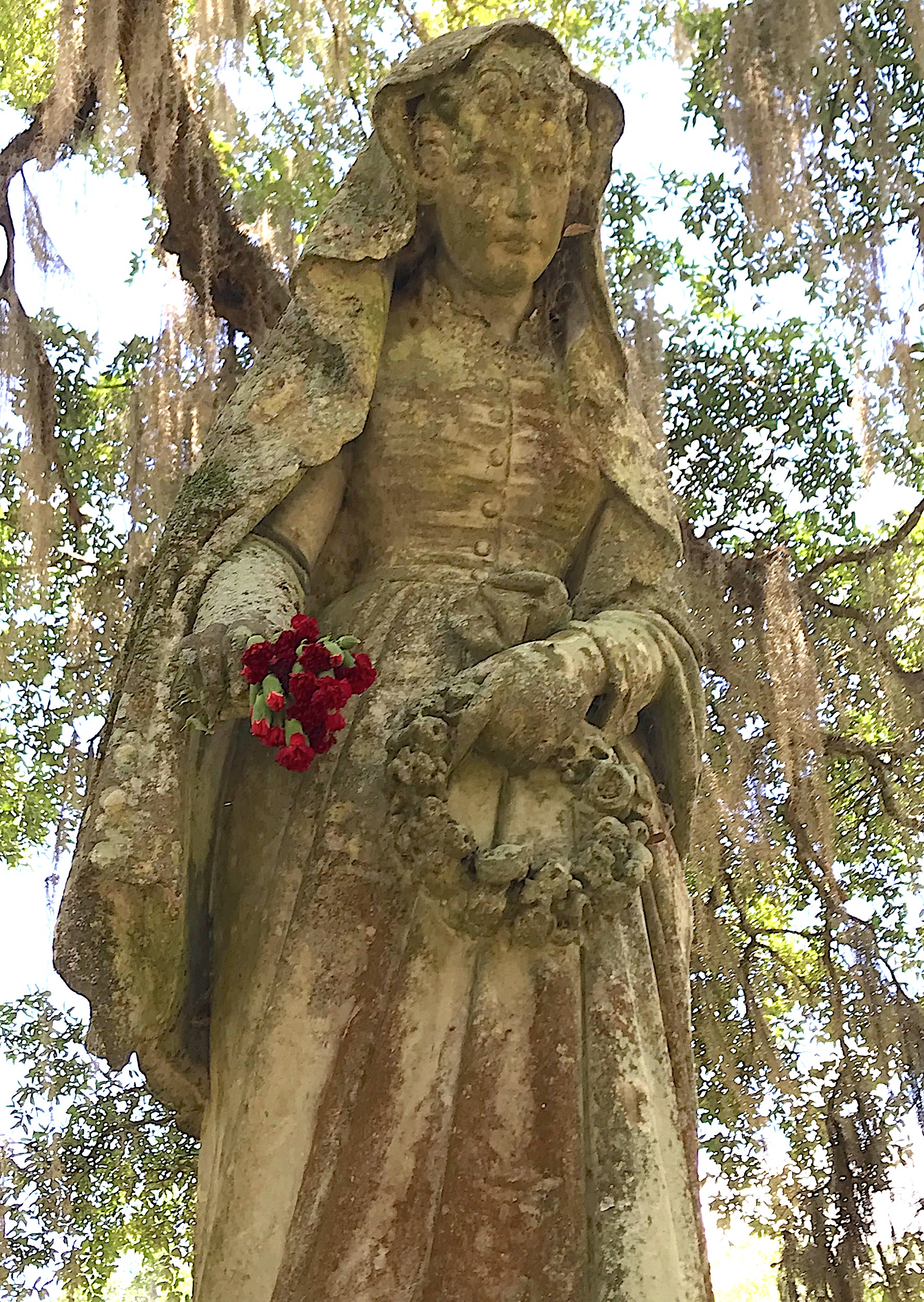
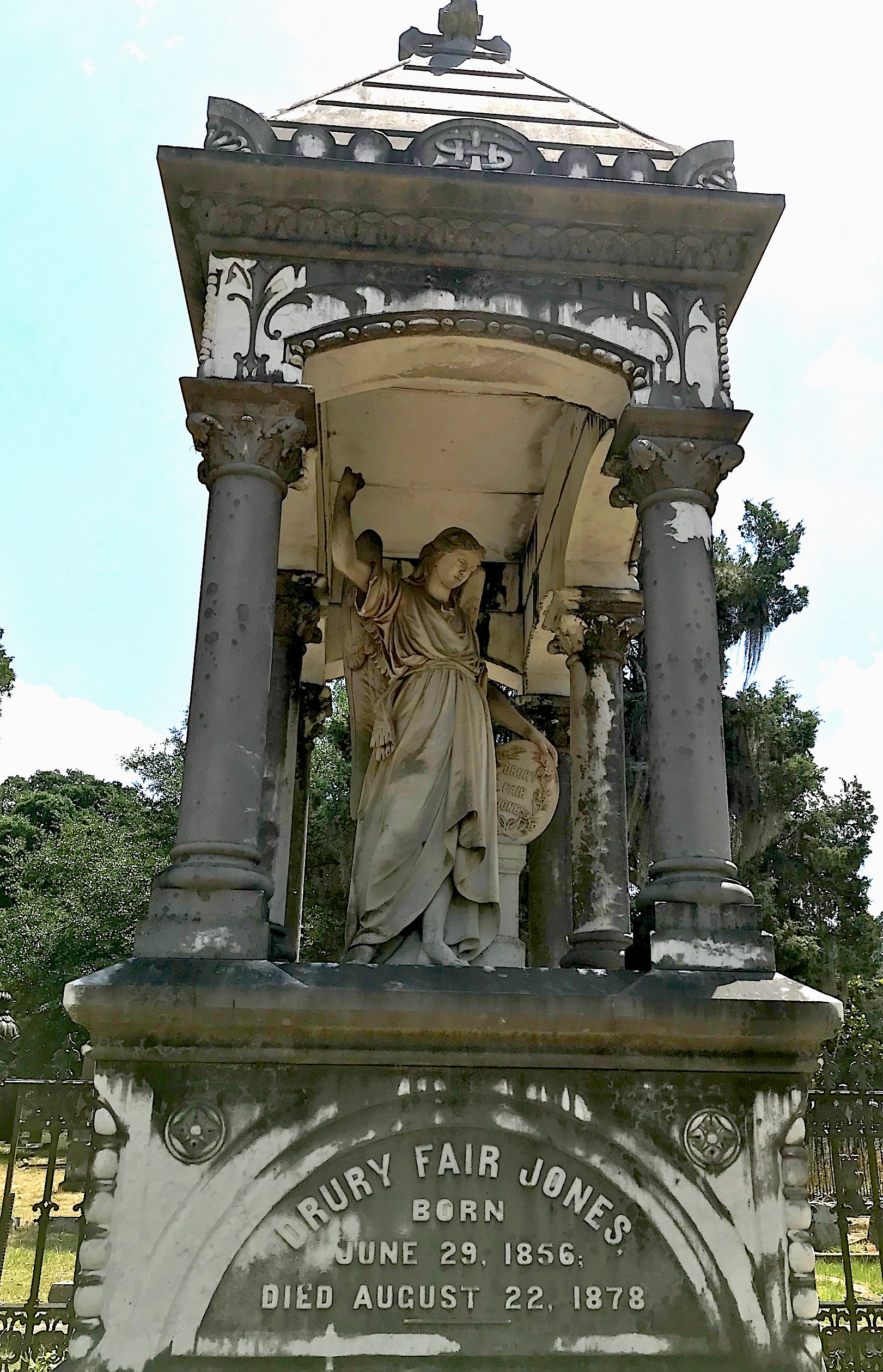
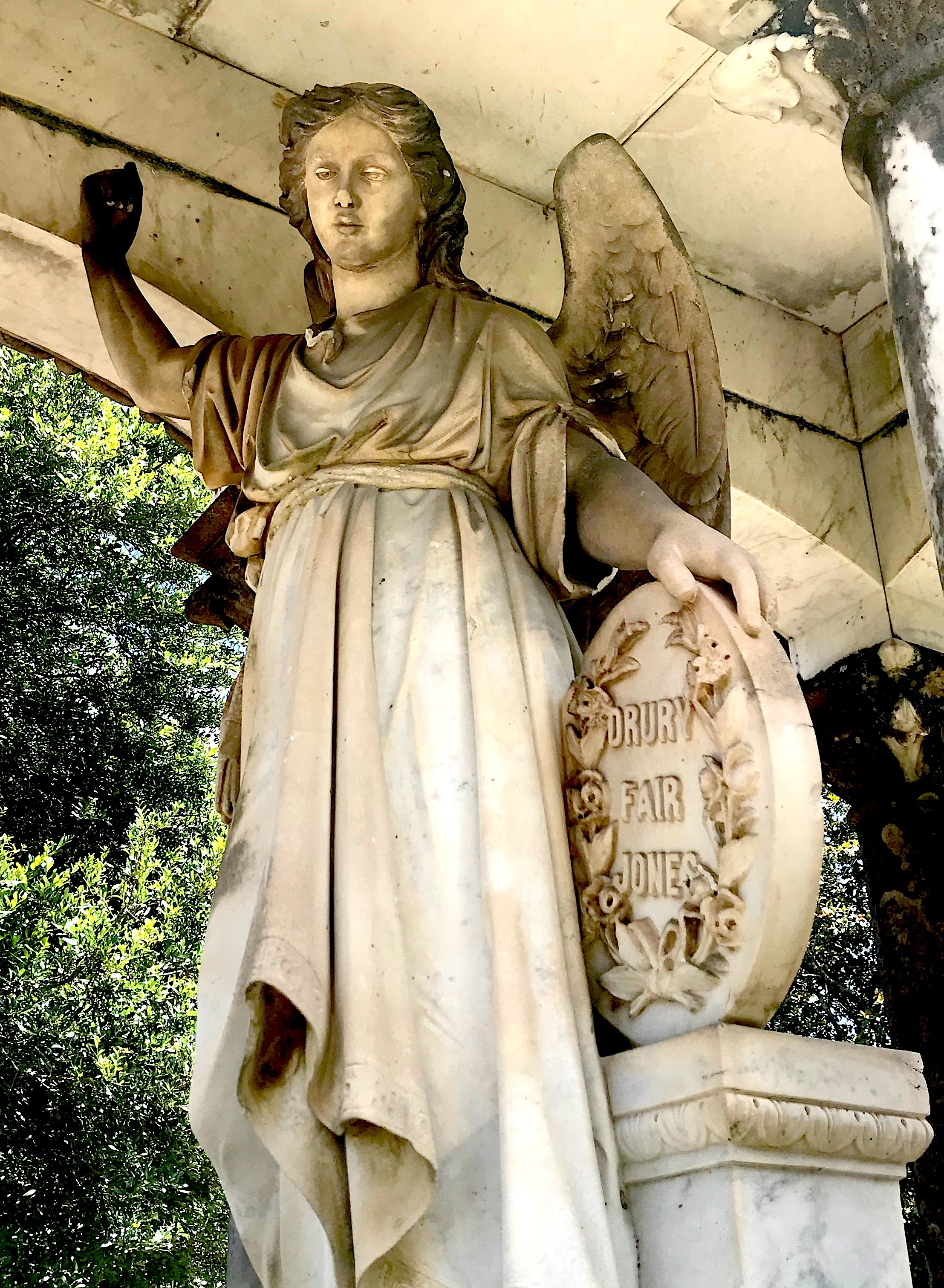
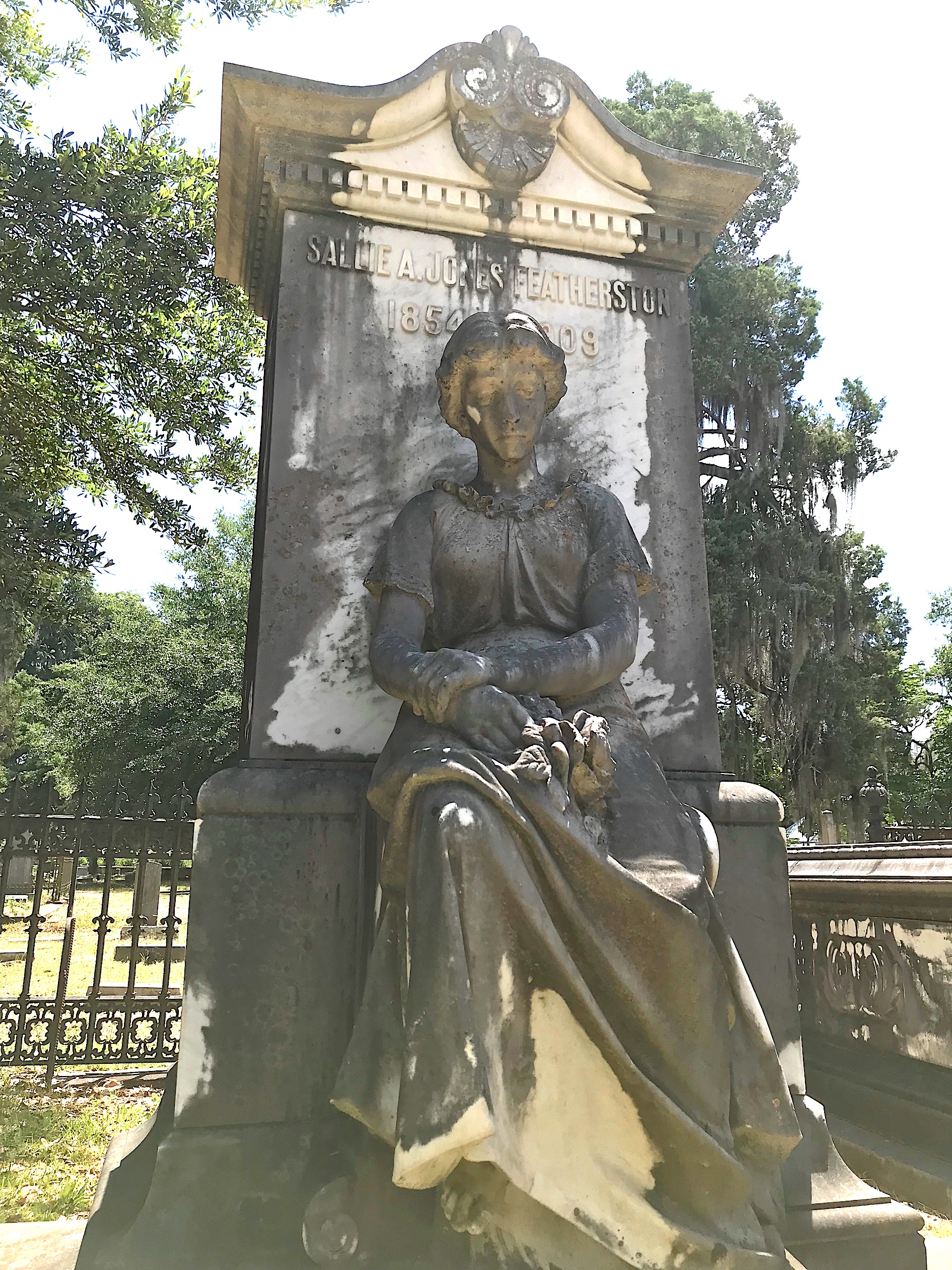
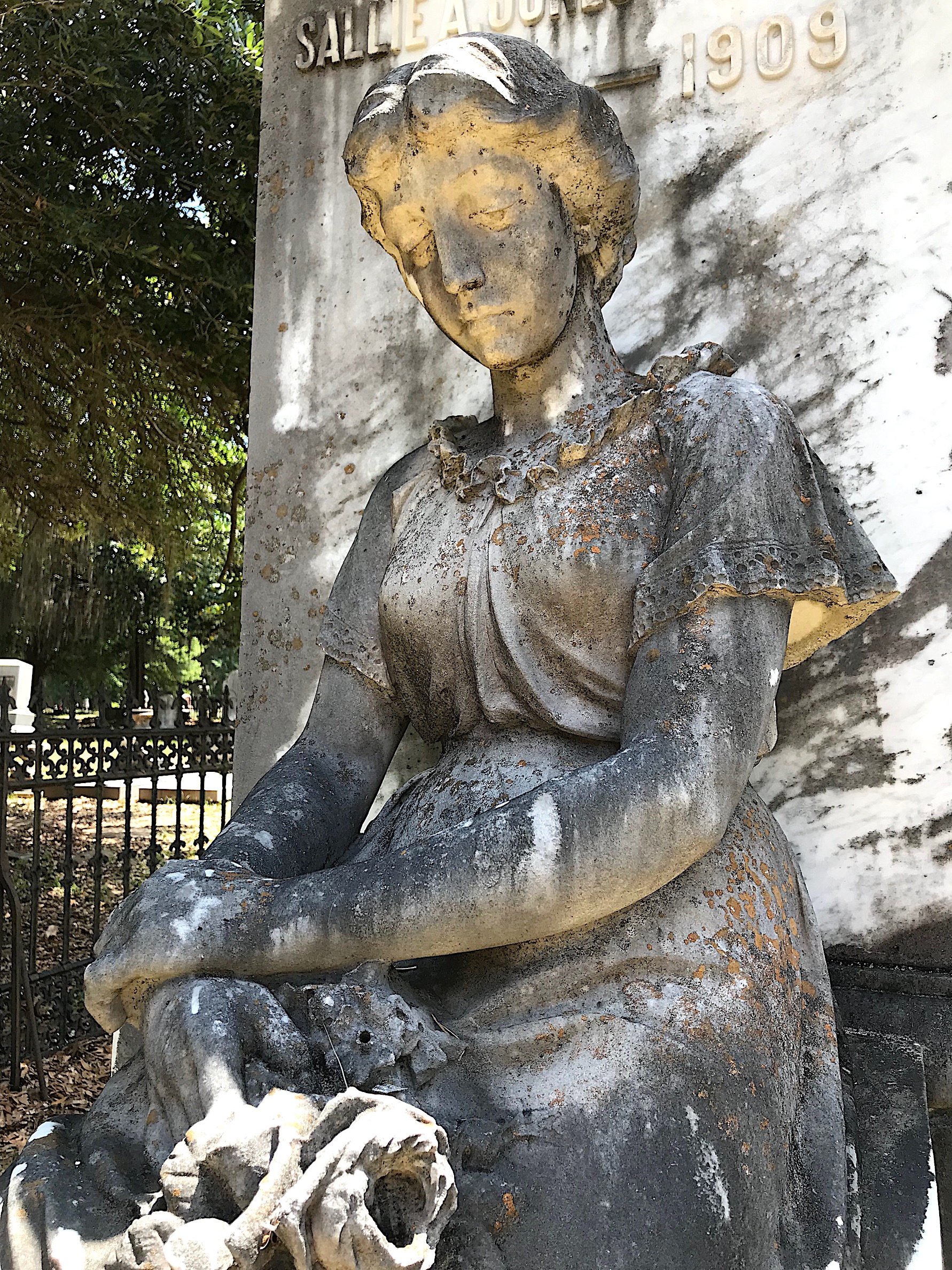
Oak leaves decorate this wood-themed iron archway of the Jones family plot.

Oklahoma Road Trip 2019: Paying a Call at Meridian, Miss.’s Rose Hill Cemetery, Part II

14 Friday Jul 2023

Posted by adventuresincemeteryhopping in General

≈ 2 Comments

Over the years, I’ve been asked if I’ve ever visited a particular “queen or king of the gypsies” grave. The problem with that question, likely unbeknownst to the person who asked it, is that there are several such graves across the country and around the world. This is no ONE queen or king that represents them all.

I’ve visited one such plot in Dayton, Ohio’s Woodland Cemetery for Owen and Harriet (also known as Matilda) Stanley. According to new reports, crowds came from several states to witness her elaborate funeral procession when she died in 1878. You can read about the Stanleys here.

Truth be told, there are many different groups of “travelers” as they are sometimes known, often of Romani and Irish descent. Rose Hill Cemetery happens to have a gypsy queen buried there that draws many people to visit.

Kelly Mitchell, Gypsy Queen

Born around 1868, Kelly Mitchell is thought to be the descendant of a group of Romani people who, expelled from Europe, had migrated to South America. From there, they made their way into the U.S. A document found in the Lauderdale (Miss.) County Department of Archives and History notes that Kelly was born in Brazil, and that her mother was a native Brazilian who married into a Romani family.

Kelly left for America and married Emil Mitchell, who in 1909 became a king of the Gypsies after the death of his father.

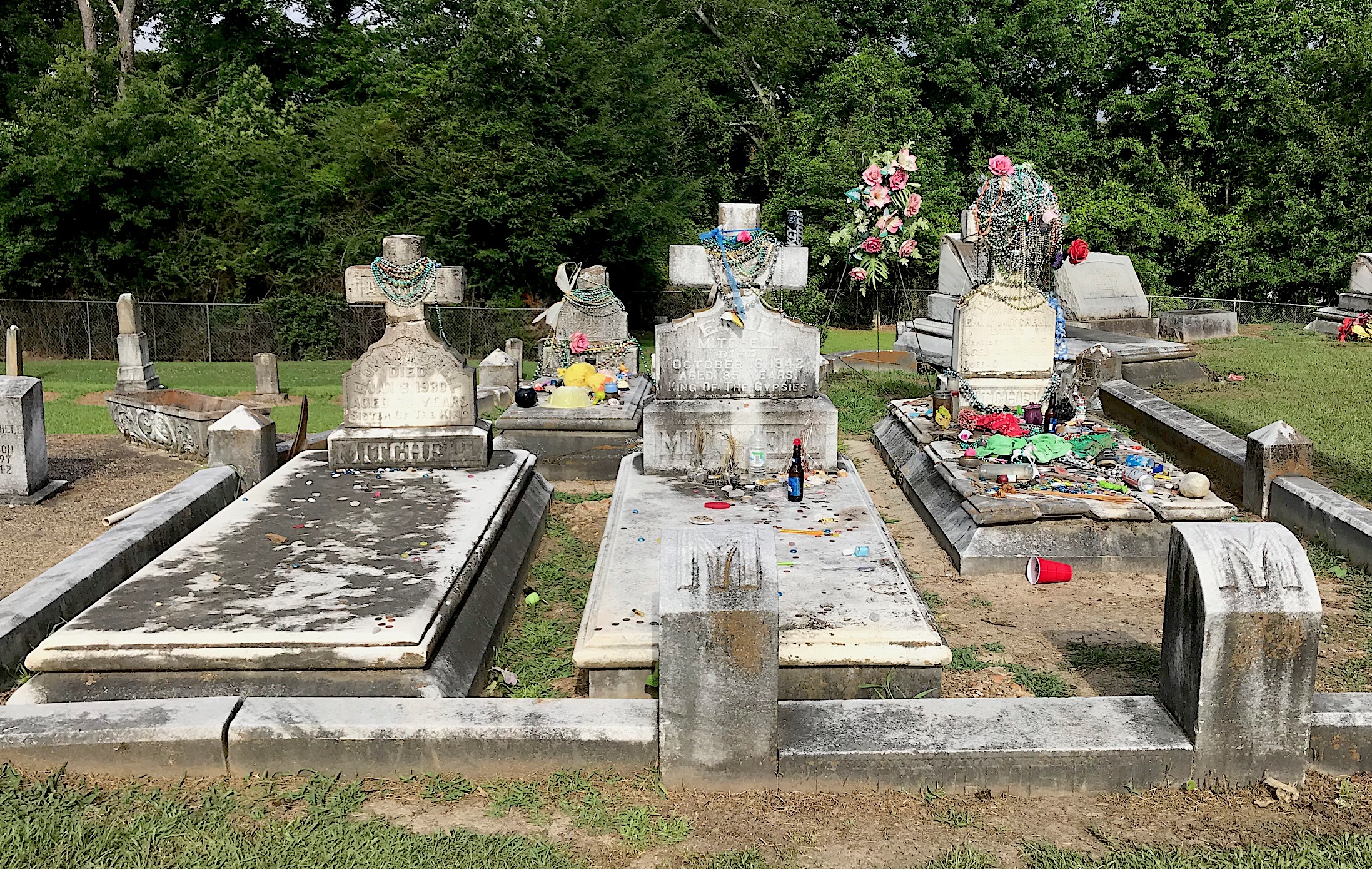
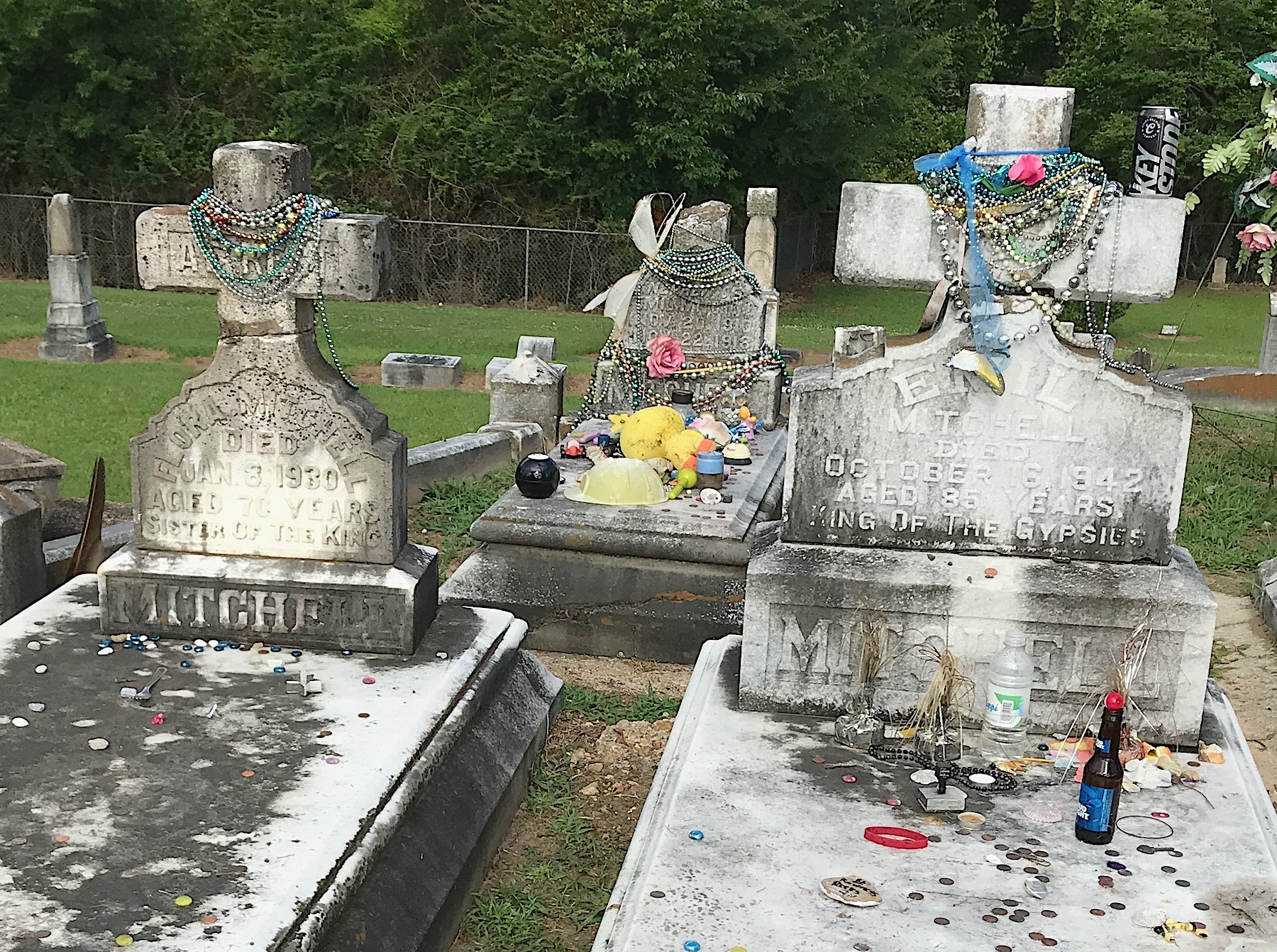
One of the Mitchell plots. Emil Mitchell, a king of the gypsies, is located in the center. His wife and queen, Kelly Mitchell, is to his right. His sister, Flora, is to the left.

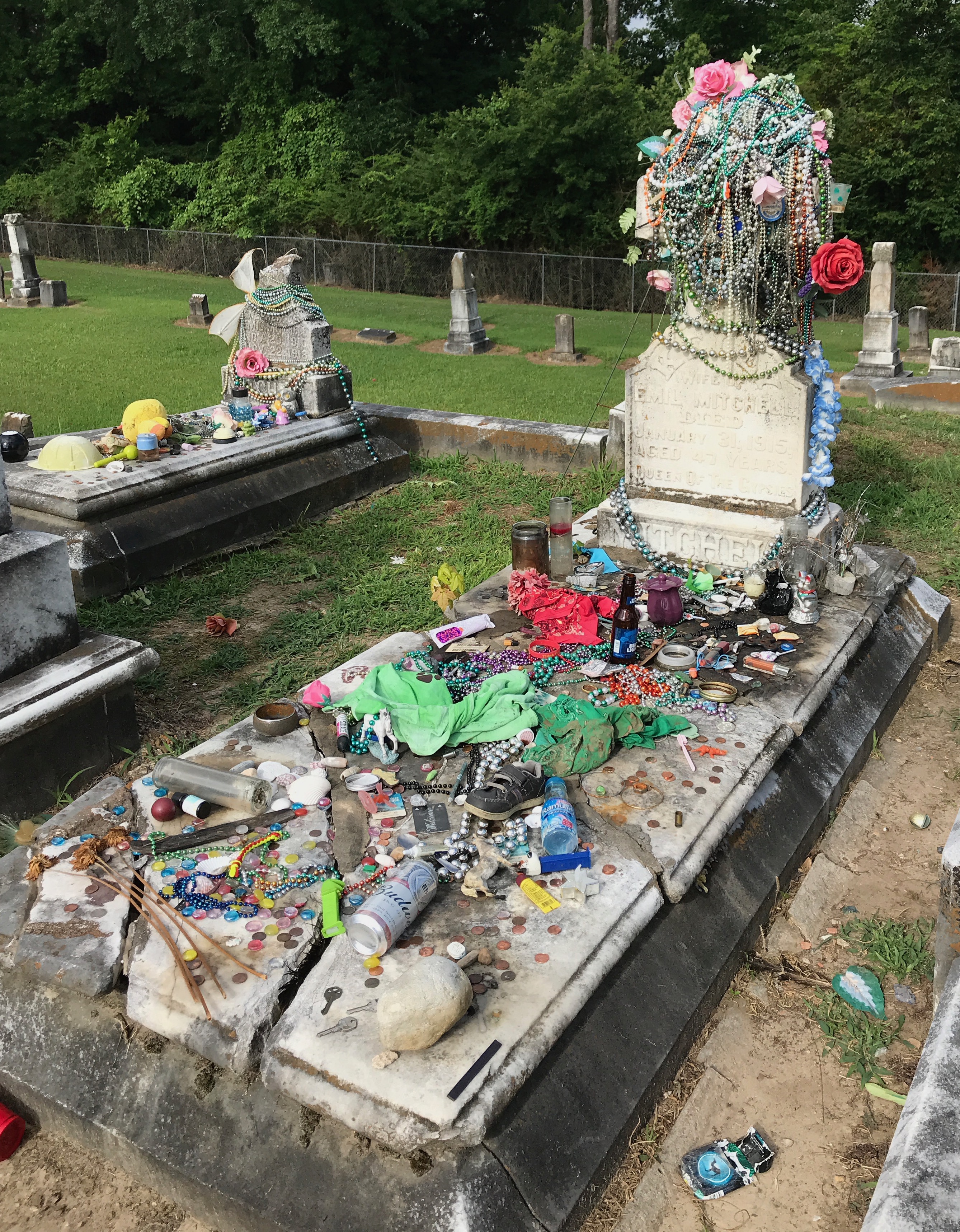
On Jan. 31, 1915, Kelly died due to complications during the birth of her 14th or 15th child. At the time, the tribe was camped near the Mississippi-Alabama state line in Coatopa, Ala. I’ve read that her body was kept on ice for about six weeks, to allow for the news to be disseminated to various groups of Romani in the Southeast and give them time to come to Meridian for her burial. That sounds about right because when Matilda Stanley died, the funeral was delayed for some time for the same reason.

Kelly Mitchell’s grave is decorated with everything from beaded necklaces to flowers to empty beer cans.

A service was held in Meridian’s St. Paul’s Episcopal Church, and an estimated 20,000 people attended her funeral. More than 5,000 followed the body to the cemetery to witness last rites. She was said to have been buried with many jewels and personal valuables, and her grave was heavily concreted to discourage vandals. Descriptions of the colorfully costumed mourners were written about in the newspapers. I don’t think Meridian had ever seen anything like it before.

To the back left of Kelly’s grave is the one for Mehill Mitchell, her eight-year-old nephew who died in 1918. It was possibly due to Spanish Flu. He was the second burial in the Mitchell plot.

Flora Mitchell and her brother, Emil Mitchell, who was king of the gypsies.

Emil’s sister, Flora Mitchell, took over the role of queen after Kelly’s demise. Flora died in Yazoo City, Miss. on Jan. 8, 1930 at age 70. She is buried to Emil’s left. Emil remarried to a woman named Lapa. I’m not sure where she is buried.

Emil Mitchell died on Oct. 16, 1942 in Albertville, Ala. at age 85. His nephew, Slatcho, died the following day (he was 45). Also known as Mike Wilson, Slatcho was the leader of a small tribe of gypsies in Mississippi. It’s possible he died en route to his uncle’s funeral. They were buried on the same day at Rose Hill.

Gypsy Princess

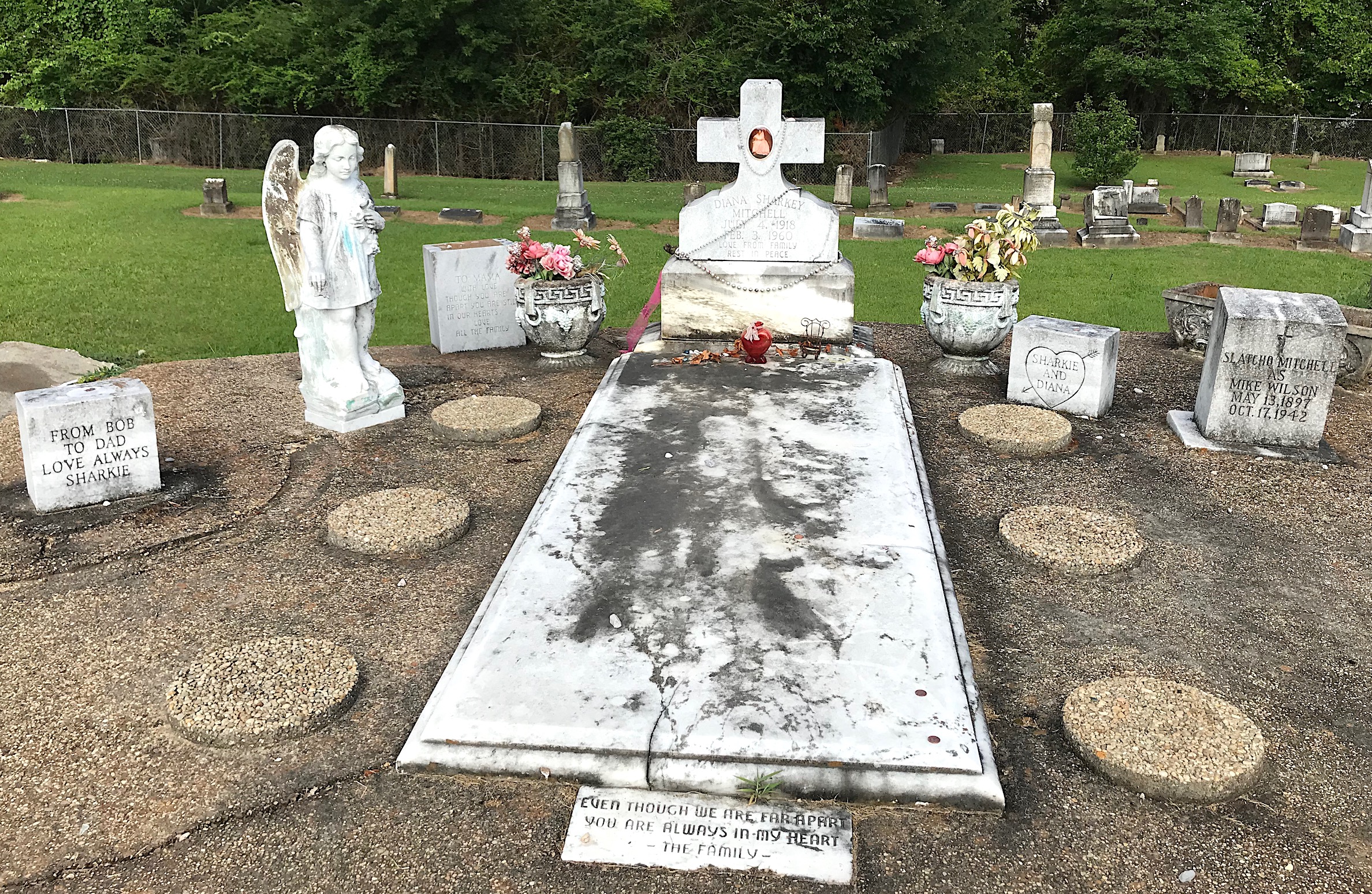
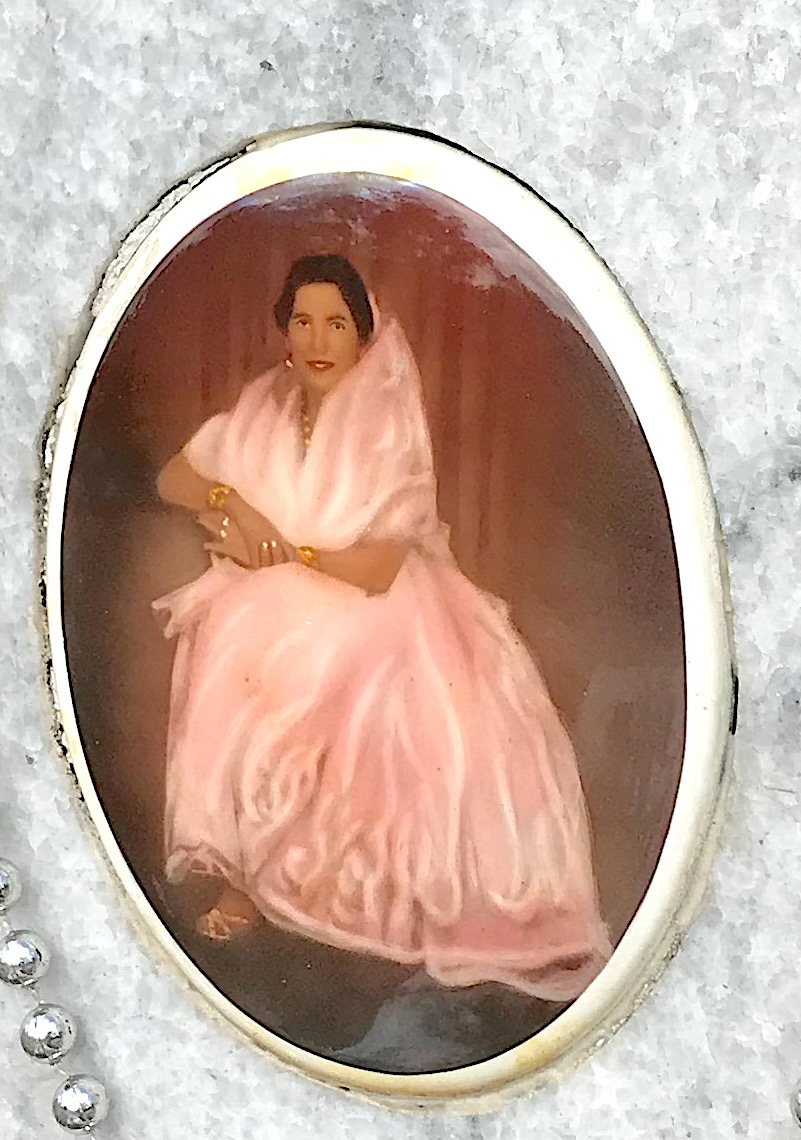
I’m not exactly sure where Diana Sharkey Mitchell fits into the family, but she is regarded as a gypsy princess. Born on July 4, 1918, she was married to Joseph “Joe” Sharkie Mitchell. I somehow missed getting a photo of his grave. He died in 1993. Diana’s grave is also decorated with beads and flowers.

Grave of Diana Sharkey Mitchell, a gypsy princess. She died in 1960 at age 41. You can see Slatcho Mitchell’s grave to her right.
Ceramic portrait of Diana Sharkey Mitchell, gypsy princess.

There are several other gypsies buried at Rose Hill that are connected to the Michells. I read that some practiced fortunetelling in Meridian at one time. I don’t know how many descendants of Emil and Kelly might still be living in the area today.

Sea Wolf of the Confederate Navy

When you think about the American Civil War (1861-1865), the thought of both sides having a navy is not something most of us consider. Especially the Confederates, who didn’t have nearly the resources that the Union Army did.

But over the years, I have encountered the graves of Confederate sailors. One of the best known is buried at Meridian and his name is Charles William “Savez” Read. He became known as the Sea Wolf of the Confederate Navy.

Charles William “Savez” Read when he was a cadet at the U.S. Naval Academy.

Born in 1840 in Mississippi, Read was not exactly who you’d envision as a dashing Navy man when you looked at him. He was short, spoke with a lisp, and graduated last among the 25 members of his 1861 U.S. Naval Academy class.

Read hated to study. Among difficult academic subjects, he found French the hardest to comprehend. The only word he could pronounce correctly was “savez,” a form of the verb “to know,” which he repeated frequently. He even ended sentences with it. For the rest of his life, Read would answer to the nickname “Savez.”

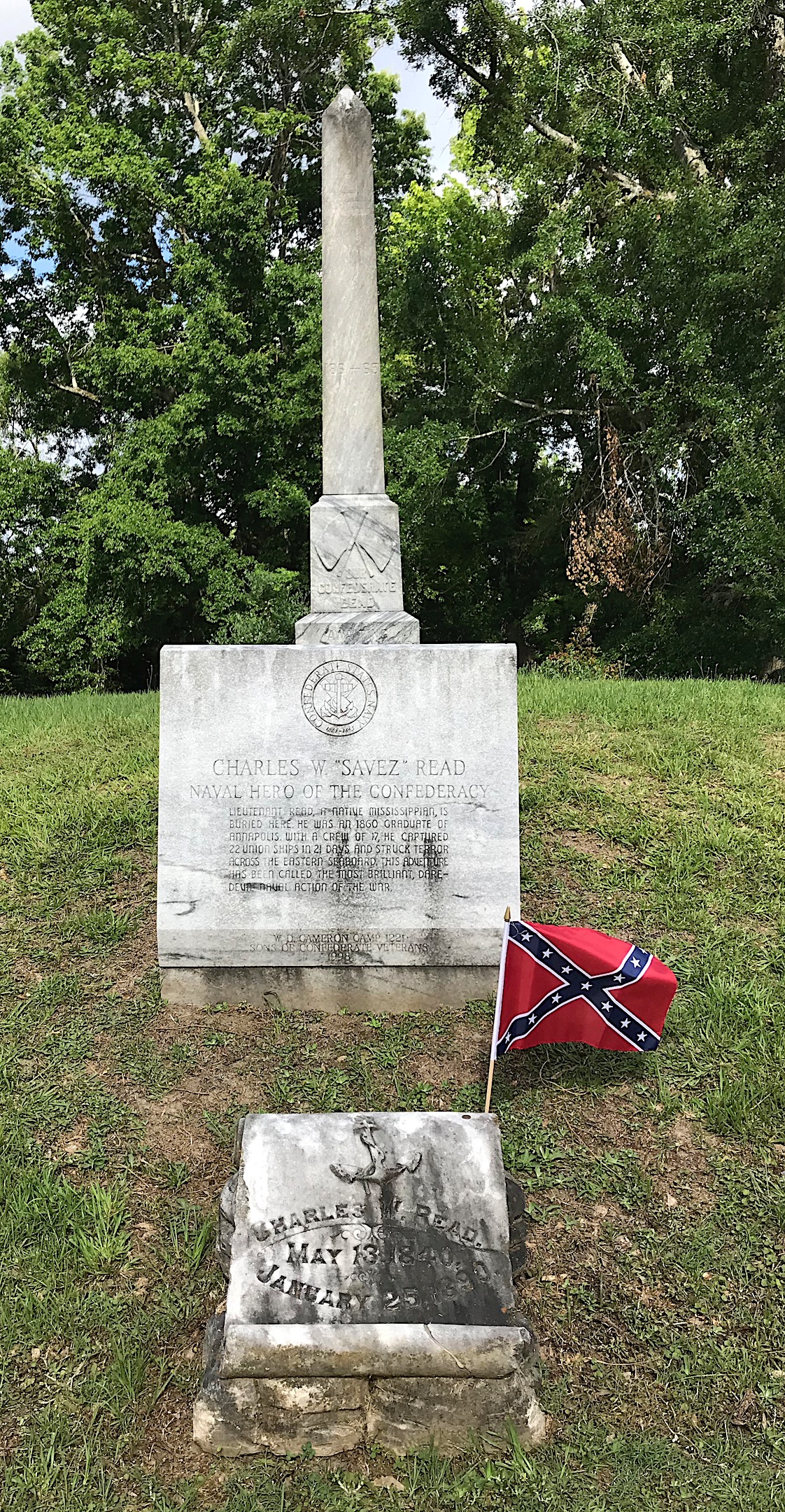
Read’s grave marker is on the hillside of a mass grave of about 100 Confederate soldiers.

In 1861, Read resigned his Union commission and joined the Confederate Navy. His first naval victory he participated in was on the CSS McRae at New Orleans. He commanded the ironclad CSS Arkansas during the battle near Vicksburg on July 13, 1862 and Baton Rouge on August 6, 1862. He also served on the CSS Florida from in 1863. Savez received the Confederate Medal of Honor during a raiding mission that lasted from June 6 to June 27, 1863.

On June 27, 1863, Read and his crew were captured in Portland, Maine and sent to Fort Warren, in Boston Harbor, Mass. He was released in October 18, 1864 but would be captured again, with release in June 1865. As a Confederate raider, he helped capture or destroy 22 Union ships in 21 days.

A historical marker detailing “Savez” Read’s exploits.

In 1867, Read was second officer aboard a ship involved in an effort to help Cuban rebels overthrow the Spanish government of the island. He and others were arrested by the U.S. government but were quickly released.

Read married Rosa Hall in December 1867 and together they had six children. Rosa died in 1878 at age 36 and is buried in Mississippi’s Biloxi City Cemetery. Read remarried in 1884 to Nebraska Carter, and they had one daughter, Mary, in 1885.

Confederate Burial Mound

About a hundred soldiers who died at Meridian’s Confederate hospital are buried in a large mound at Rose Hill. This was not their original resting place. They were moved here when their graves were discovered during the construction of Meridian’s first high school.

Charles Read was added to the burial mound after he died on Jan. 25, 1890. His wife, Nebraska, who wanted to be buried beside her husband, is the only woman in the mound. She died in 1928 at age 73.

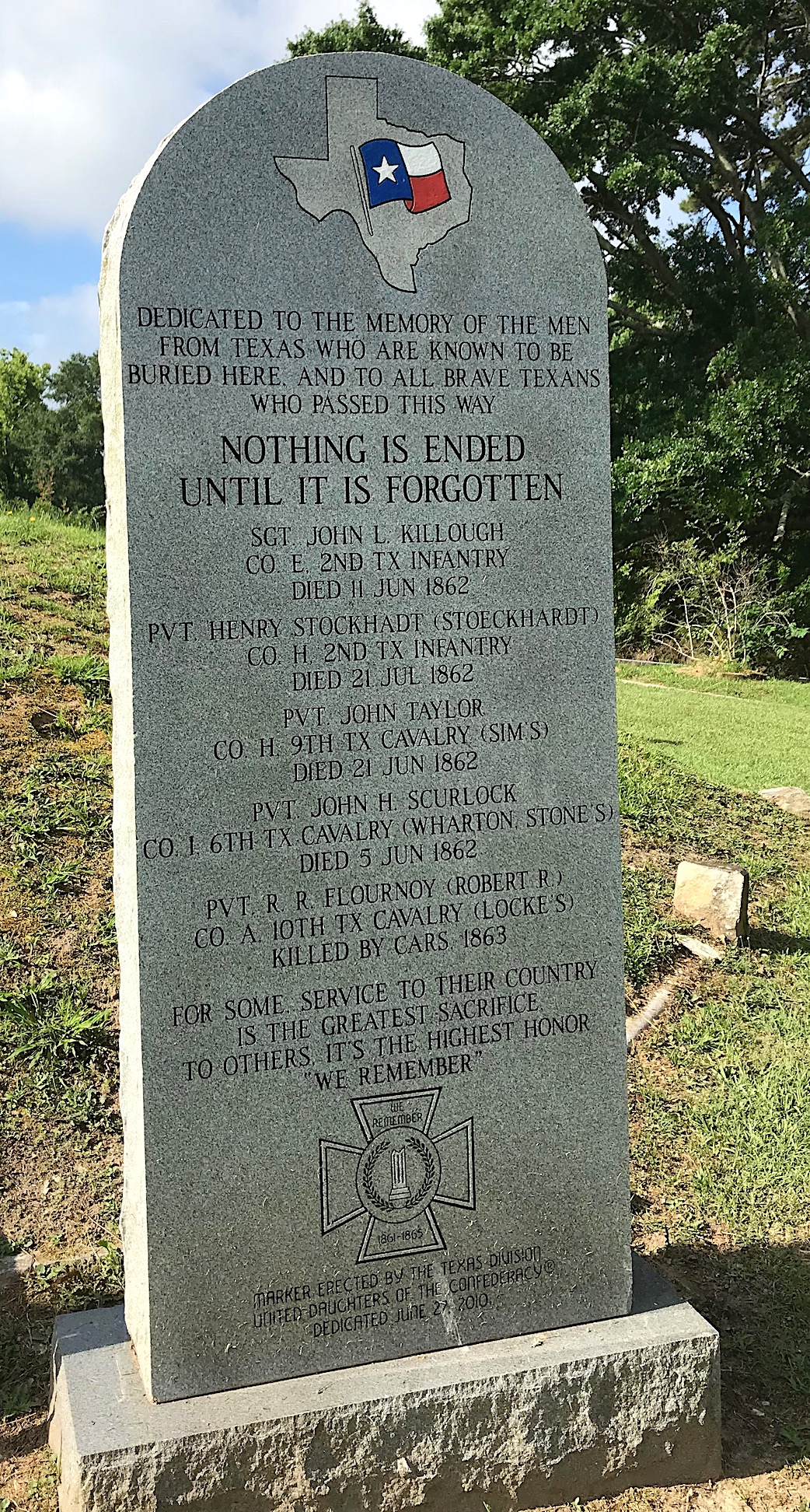
Memorial to six of the Confederate soldiers who are inside Rose Hill’s burial mound who were from Texas.

“Murdered By Tramps”

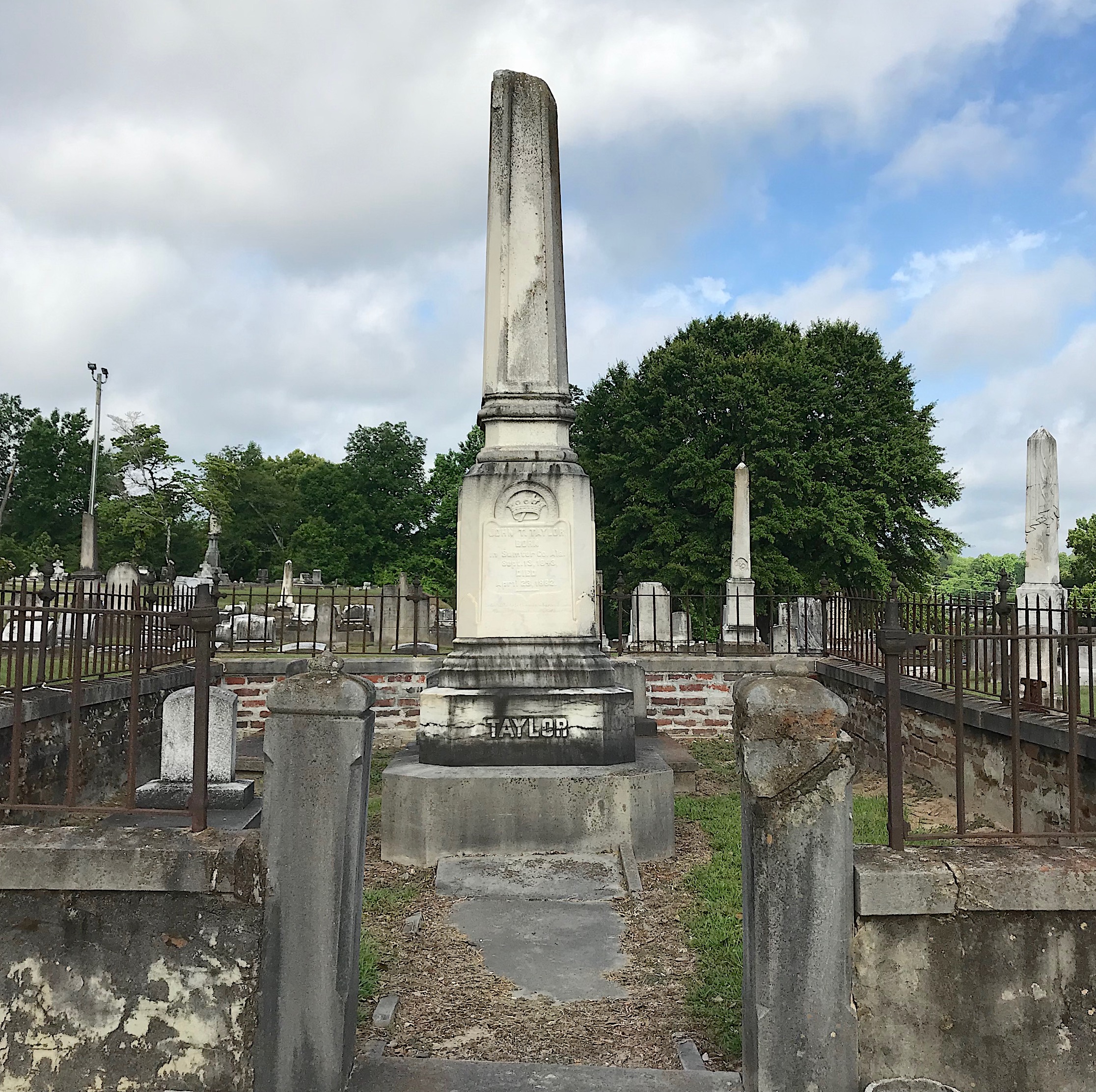
This last story came about by chance. I was perusing my photos and saw this one for the Taylor family plot. Railroad conductor/agent John Taylor has a large obelisk in the center. Her served as mayor of Meridian from April 1878 until his death in 1882 at age 38, leaving behind a wife (Annie) and three children.

The Taylor family plot at Rose Hill Cemetery.

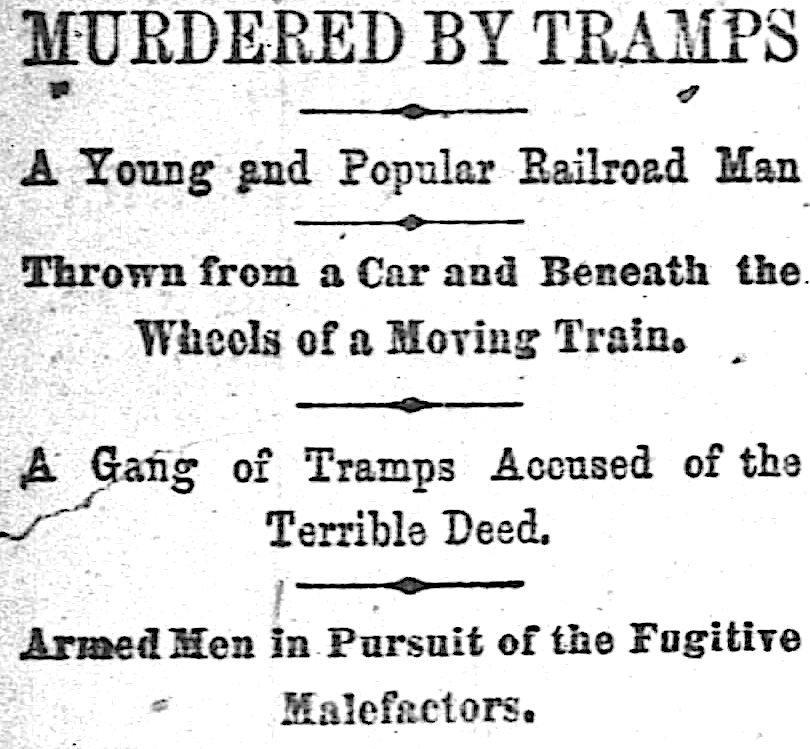
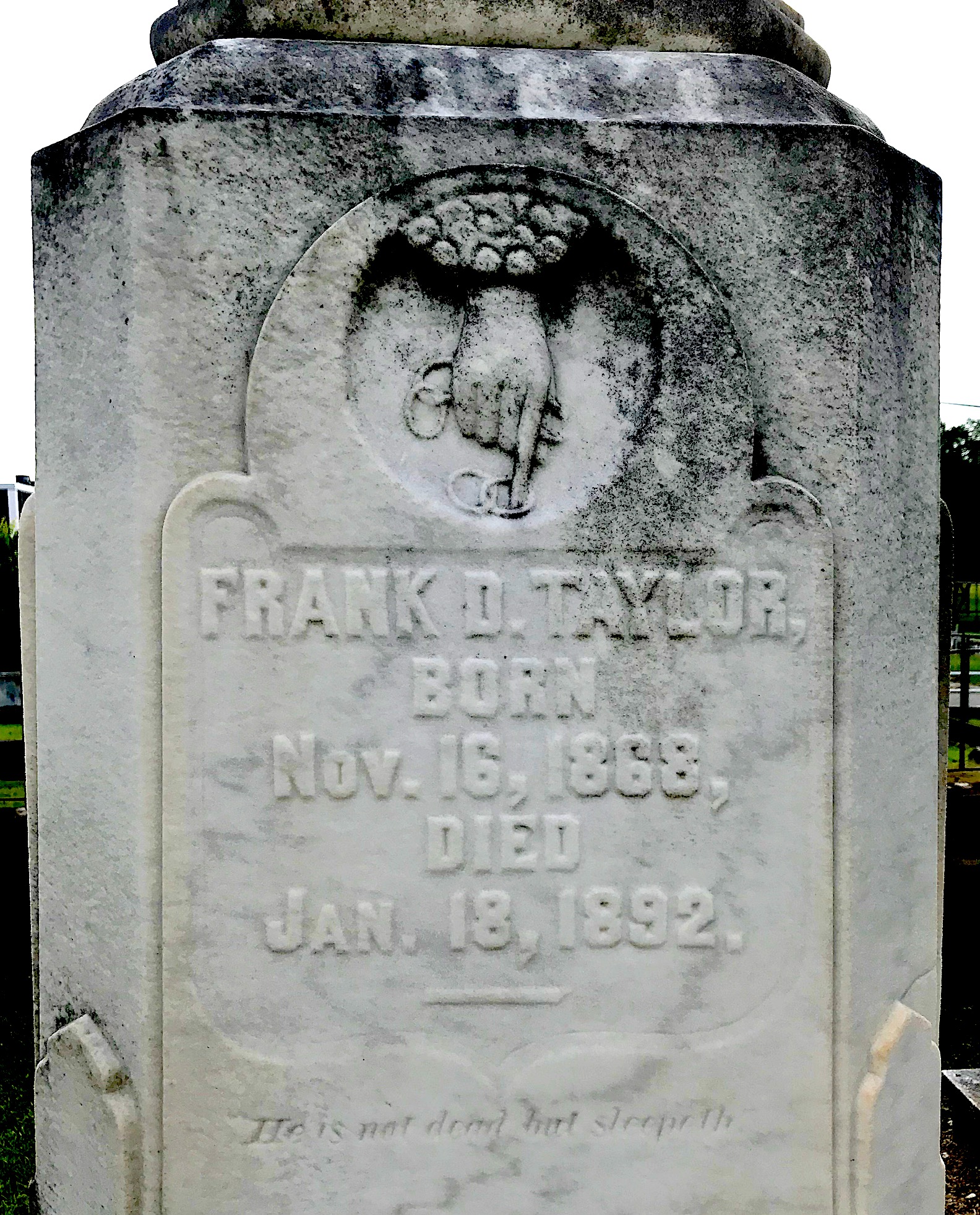
One of his children was Frank D. Taylor, who died in 1898 at age 23. The image of a hand reaching from Heaven to remove a link in a chain is one I had seen before, but it is not a common one. It signifies that someone important in the family chain has been taken too soon. Find a Grave had nothing about him but Newspapers.com yielded a sad tale.

The Taylor family was financially comfortable, but Frank wanted to follow in his father’s footsteps. He found employment with the Mississippi Valley Railroad, working as a brakeman.

Frank D. Taylor died a terrible death. His murderers were never caught.

On the evening of Jan. 18, 1892, Frank was assisting with the journey of a shortened train that was traveling slowly to Meridian via Southport and Kenner, La. A number of tramps had stolen passage onto the train in Southport. As the train neared Kenner, Frank encountered a group of them on top of one of the rail cars. He got into a scuffle with them (as evidenced by muddy footprints found later) and was pushed between the cars, resulting in Frank being crushed to death beneath the train’s wheels.

“He is not dead but sleepeth.”

Frank’s body was brought back to Meridian for burial at Rose Hill Cemetery. His mother, Annie, must have been devastated by the news. She died at age 74 in 1924, and is buried with her husband, son, and daughter, Mamie.

It was time for our last stop (and hop) on the Oklahoma Road Trip 2019: Live Oak Cemetery in Selma, Ala.

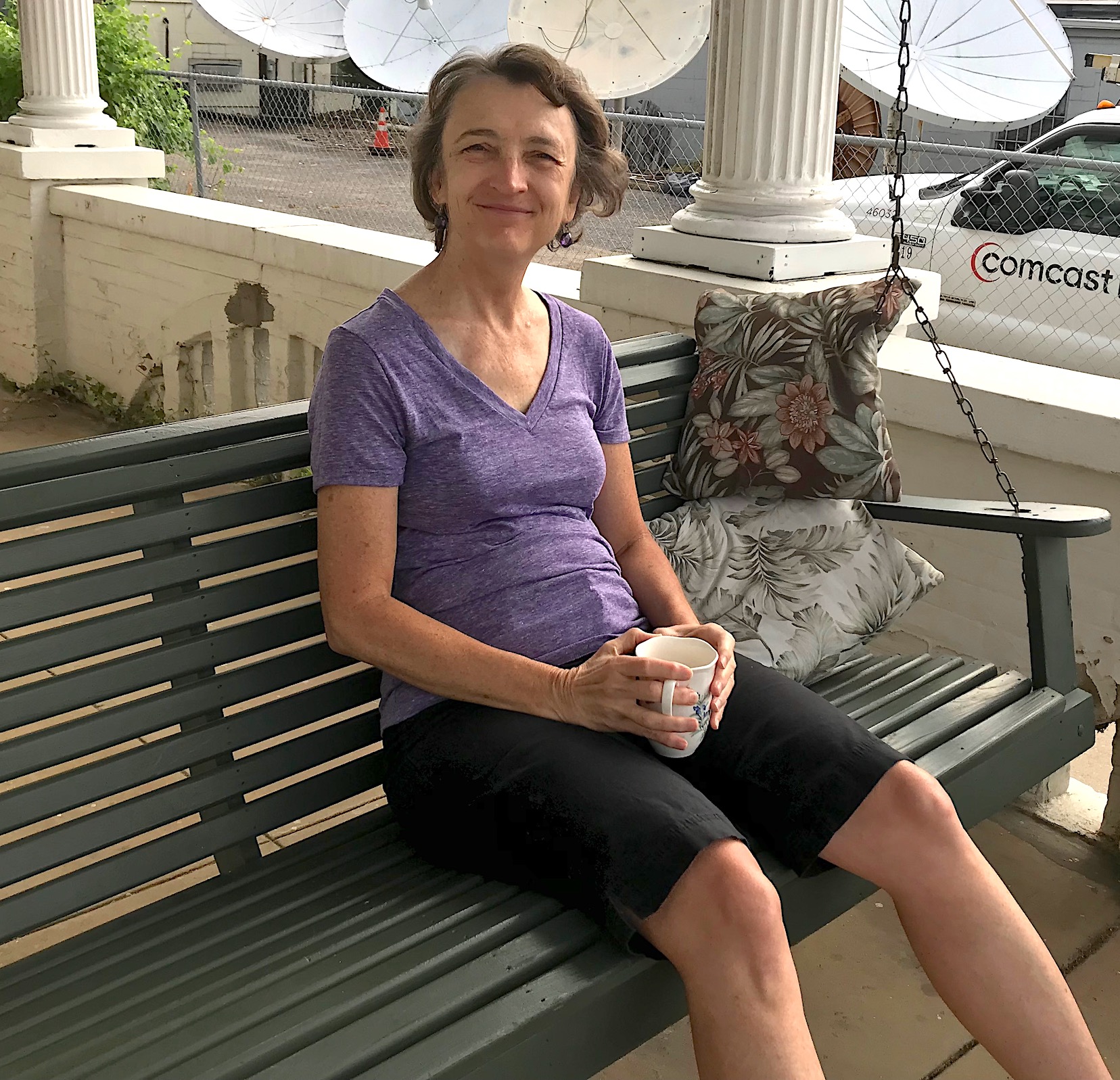
My travel buddy Sarah enjoys a morning cup of coffee (or tea) at the lovely Century House bed and breakfast we stayed at in Meridian, Miss.

Oklahoma Road Trip 2019: Paying a Call at Meridian, Miss.’s Rose Hill Cemetery, Part I

30 Friday Jun 2023

Posted by adventuresincemeteryhopping in General

≈ 1 Comment

After leaving Jackson’s Greenwood Cemetery, we wearily headed for Meridian to spend the night. That’s about an hour and a half drive. The plan was to get a good night’s sleep, stop at Rose Hill Cemetery in Meridian, see Live Oak Cemetery in Selma, Ala., and then head to Atlanta where she would drop me off at Hartsfield-Jackson International Airport. I would then join my family at Folly Beach, S.C. to enjoy the last few days of our annual beach vacation with my husband’s family.

The entrance to Meridian’s Rose Hill Cemetery.

The next morning, we headed to Meridian’s Rose Hill Cemetery for our next to last “hop” before driving east to Selma. The oldest recorded marker has a death date of 1853 but as with many old burial grounds, there are likely folk that were interred there earlier. Find a Grave lists about 3,525 memorials for Rose Hill.

The cemetery was being mowed when we arrived. I owe one of the gentleman mowing a debt of gratitude. He saw me wandering around, turned off his mower, and came over to ask if I was looking for someone in particular. I explained my strange hobby and he offered to lead me to a grave worth seeing. A cemetery hopper doesn’t turn down a kindness like that. I’m also sure I wouldn’t have noticed it on my own.

The Competing Founders of Meridian

Buried off to the side with his wife in a humble grave is John T. Ball, born in New York in 1821. He married Virginia native Sarah Elizabeth Page Smith in 1848 and by 1850, they were living in Mississippi.

Ball was keen to get in on the railroad construction going on and so was Alabaman (and lawyer) Lewis A. Ragsdale. Both men sought to make a profit from the planned crossing of the Mobile and Ohio Railroad with the Vicksburg and Montgomery Railroad, but Ragsdale is said to have beat Ball to the area by a few days.

I’m not sure I would have noticed John T. Ball’s grave it someone had not kindly pointed it out to me.

Ragsdale bought area settler Richard McLemore’s farm, east of present-day 27th Avenue. It included much of what would become the central business district. Ball purchased only 80 acres west of 27th Avenue. McLemore and his family moved north out of the city, and Ragsdale moved into McLemore’s log home, turning it into a tavern.

Ragsdale and Ball had differing views on the city name, too. Ball believed the word “meridian” was synonymous to “junction”. He and the more industrial-minded residents preferred that name. Meanwhile, the more agrarian population liked “Sowashee,” which means “mad river” in a Native American language and is the name of a nearby creek. Ragsdale wanted to name the new settlement Ragsdale City after himself. Clearly, Meridian won out. The town was officially incorporated as Meridian on Feb. 10, 1860.

Ball operated a dry goods business and his family remained in Meridian until his death in 1890 at age 69. Sarah died in 1877. The few articles I found about his death were brief and said little beyond the fact he was one of the city’s oldest settlers and considered a founder.

By comparison, Lewis A. Ragsdale has a much larger monument that I photographed before I even knew who he was.

The Ragsdale family monument is one of the tallest in the cemetery.

Unlike John T. Ball, Lewis Ragsdale had a lengthy obituary that detailed his life. I won’t go into all those details, but he had his fair share of failures before his success in Meridian. He married Sarah Ann McCoy around 1855 in Mississippi and they had several children, many dying in childhood.

If Lewis Ragsdale’s wishes had been fulfilled, Meridian would have been called Ragsdale City.

Ragsdale was a prosperous merchant and landowner. Interestingly, his obituary in the Jackson, Miss. Clarion (Dec. 16, 1886) dryly noted, “He was a man of great public spirit, and was very wealthy, notwithstanding his investments in a number of unprofitable projects.” He died on Dec. 10, 1886 in Memphis, Tenn. Wife Sarah died three years later.

Sarah and Lewis Ragsdale died about three years apart.

“Erected By His Lady Friends“

It’s not every day you pass by a monument that has the words “Erected By His Lady Friends” inscribed on it. But such is the case of Dr. Leonidas Shackelford.

A native of Greensboro, Ala., Lee (as he was called) grew up and married Virginia Newman in 1867, having served as a surgeon in the Confederate Army during the Civil War. I’m not sure where he attended medical school. He and Virginia had three children together: Thomas (who died as a toddler in 1871), Lee, and Mary.

Dr. Shackelford’s monument has a curious inscription.

According to what I could find at the time, a yellow fever epidemic hit Meridian in 1878, much like the one that hit Shreveport, La. in 1873. It affected almost 500 residents, leaving at least 86 dead. In fear of the lives of his wife and two children, Dr. Shackelford quickly sent them out of town before a city quarantine was imposed.

Dr. Shackelford died while tending the sick during a yellow fever epidemic.

Dr. Shackelford died on May 19, 1878 while tending to the sick. His family did not find out about it until they returned to Meridian. Some have said Dr. Shackelford’s marker was already up when the family came home. It is suggested that the inscription was from the nurses with whom he tended the sick, but nobody knows for sure. I have no doubt that had it meant anything but something of that nature, his wife would not have let it remains standing.

Virginia, who outlived her husband by 45 years, did not remarry. She died in 1923 and is buried beside him. Their son, also named Lee, grew up to become a bookkeeper. He married and settled in Meridian, passing away in 1942. Daughter Mary did not wed but shared a home with her mother, brother, and sister-in-law for a time, becoming a teacher. She died in 1954 at age 81. Both Lee and Mary are buried with their parents in the Shackelford plot at Rose Hill.

“None Knew Thee But To Love Thee”

The grave of Janie M. Akin doesn’t tell us much in terms of facts but the symbolism it provides speaks without words. A Heavenly hand reaches down from the clouds and grasps three flowers, signifying a young life taken too soon from the mortal world.

Janie McCormick Akin died about two years after her marriage to Charles V. Akin.

I could find very little about Janie McCormick, who married Meridian resident Charles Vivian Akin on July 3, 1889. She would have been 23 and Charles 29. Janie gave birth to a son, Charles Jr., on May 23, 1890. For reasons unknown, she died on Sept. 6, 1891. Below her birth and death dates are inscribed the words, “None Knew Thee But To Love Thee.”

Charles, who owned a local dry goods store, remarried to Alice Trudchen Hyer in 1893. The couple had two daughters, Gladys and Lois. Alice died on Dec. 31, 1900 at age 29. Charles died at age 66 in 1927. They are both buried at Rose Hill Cemetery.

In Part 2, I’ll share the story of the Gyspy Queen buried at Rose Hill and the Confederate burial mound containing the remains of over 100 soldiers.

Monument to John T. Quarles, who died on Jan. 21, 1889 at the age of 31. I could find no information about him.

Oklahoma Road Trip 2019: Visiting the Old and the Young at Jackson, Miss.’ Greenwood Cemetery, Part II

23 Friday Jun 2023

Posted by adventuresincemeteryhopping in General

≈ Leave a comment

I told you in Part I that Jackson, Miss.’s Greenwood Cemetery has a number of stirring monuments. I’m going to start with this one and when I first saw this image, I immediately wanted to know more.

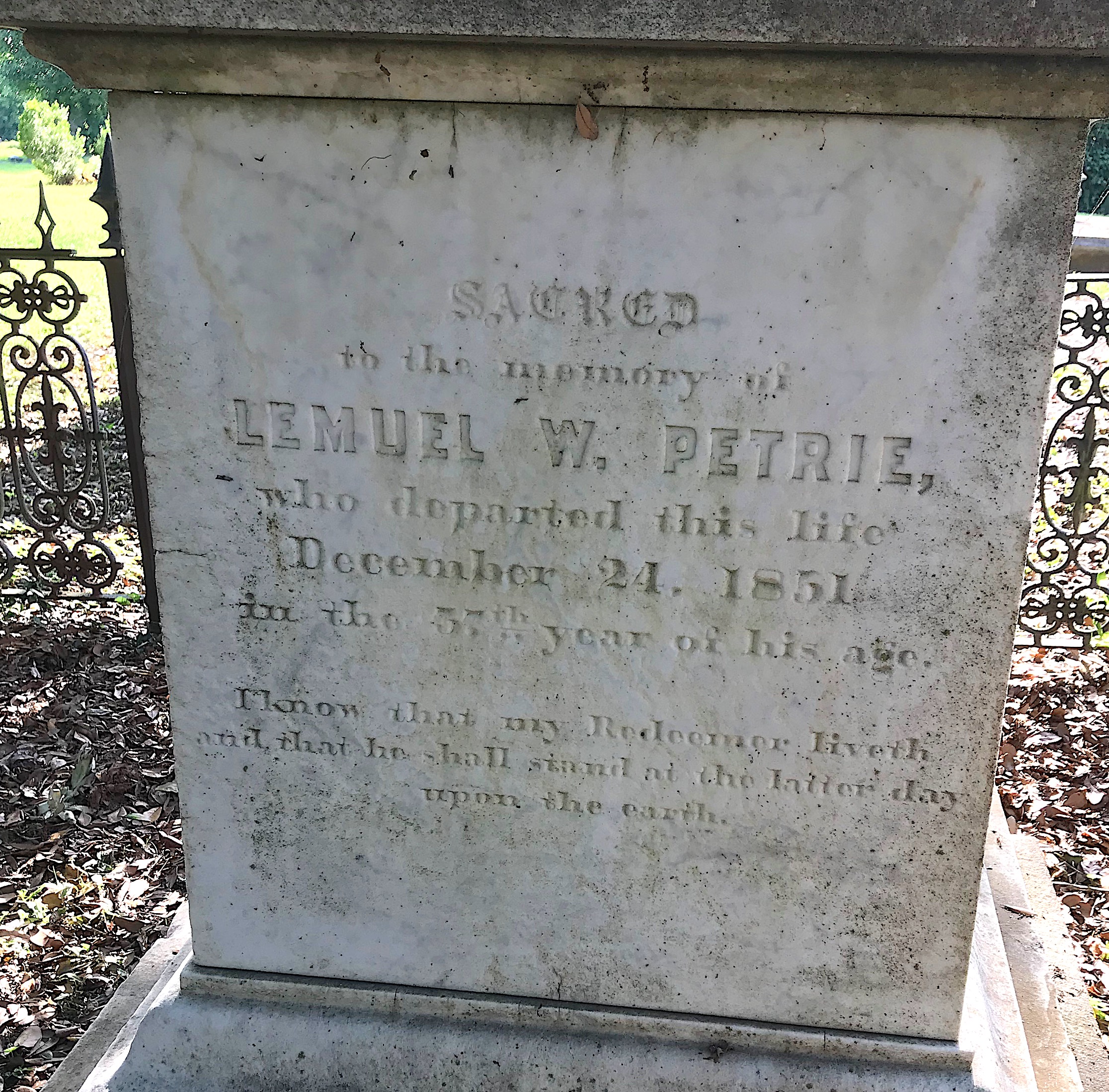
Rosa Farrar Petrie was left with her five children to mourn the loss of her husband, Lemuel.

Born around 1813 in Portland, Maine, Lemuel Weeks Petrie married Virginia native Rosa Mahalah Farrar in Rankin County, Miss. in 1842. He was from a fairly well to do family and a successful planter. In 1842, Lemuel owned over 2,500 acres worth over $17,500 plus a brick home worth $2,000. It appears that a substantial amount of his wealth was inherited and he was a slave owner.

The Petrie/Hunter family plot at Greenwood Cemetery.

Lemuel and Rosa had five children together. For reasons unknown, he died on Christmas Eve 1851 at the age of 37. At the time of his death, his property included two large plantations located a few miles from Edwards, Miss., and a smaller one in the same general area. The total appraised value of the three plantations was a little over $143,000.

Lemuel Petrie died at age 37 in 1851.

Lemuel’s monument is a testament to his family’s grief. Sitting beneath a large weeping willow (a symbol of mourning in cemetery iconography), a mother bent over in dejected sadness is surrounded by her children. The scale is a little off in that the mother looks rather like a giant compared to the children. But the sentiment comes through quite strongly.

“I know that my Redeemer liveth”

Rosa eventually remarried to Irish-born Presbyterian minister, the Rev. John Hunter, in 1858. Together, they would have five children of their own.

Two of Lemuel and Rosa’s children are buried in the plot with them. Their firstborn (1843), Herbert, attended the University of Mississippi and became a doctor. He died in 1875 at age 25 from “malarial fever and heart disease”. Beside him is his brother, Henry, born in 1844. His marker states he died on Aug. 10, 1861 in Culpepper, Va.

Brothers Herbert (left) and Henry are buried next to each other at Greenwood Cemetery.

Henry served in the Confederate Army during the Civil War, he would have been around 17 at the time. There is a record for a Henry F. Petrie enlisting in Corinth, Miss. on May 24, 1861 and serving in the 18th Infantry, Co. K. The 18th did fight at the First Battle of Manassas (Bull Run) on July 21, 1861. It’s possible Henry was wounded there and died later in Culpepper. Disease, however, may have claimed him as well.

The Gardner Held His Peace

Rosa gave birth to a daughter, Rosabell on Oct. 8, 1861. Her splendid wedding to George Yates Freeman on Feb. 28, 1883 in Jackson was reported in more than one Southern newspapers. Rev. Hunter united the couple in holy wedlock that day. Rosabell and George had one daughter, Yates, in 1885 but she only lived seven months. Son Edward, born in September 1886, was their only child who lived to adulthood.

Many times a tree marker signifies a life cut short. Rosabell Hunter Freeman, who died at 28, is such a case.

Rosabell died on Sept. 21, 1890 at age 28. Her husband, George, died on April 20, 1895 at age 44. They are buried together in the Petrie/Hunter family plot.

Rosa died on Jan. 31, 1895 at age 80. Her obituary noted, “Her life was sweet and peaceful, filled with good deeds and kind words, and her death was in keeping with that life.” Rev. Hunter died at age 74 in 1899.

Rosa Farrar Petrie Hunter is buried between her first and second husbands.

“Cotton King”

In almost every cemetery, there is one monument that tends to dominate the landscape. In the case of Greenwood, that would be the one for “Cotton King” Edmund Richardson. When we were there, it was nearing dusk so the quality of these photos is not the greatest.

The monument for Edmund Richardson and his wife, Margaret, is the tallest in the cemetery.

Born in North Carolina in 1818, Edmund settled in Jackson, Miss. where he formed a mercantile partnership with branch stores in neighboring communities. In 1848, Richardson married Margaret Elizabeth Patton of Huntsville, Ala. with whom he had seven children. Several are buried in the Richardson plot at Greenwood.

Five of the seven Richardson children are buried at Greenwood. Two are interred at Metairie Cemetery in New Orleans, La. Most of them lived to adulthood.

Despite the hardships most merchants faced during the Civil War, Richardson rebounded within a year after it ended and held onto the five plantations owned. In 1868, Richardson exploited the abundance of ex-slave prison labor by making a deal with Federal authorities in Mississippi (still under the rule of postwar Reconstruction) to use inmates to work his farms in the Mississippi-Yazoo Delta.

Convict Labor

Richardson agreed to provide supervisory guards and treat the prisoners well by providing food and clothing. The state paid Richardson $18,000 per year for maintenance, plus the cost of transporting prisoners to and from his plantation camps.

The Richardson monument features two crossed and lit torches. If the inverted torch has a flame, it symbolizes the flame of eternal life and the Christian belief in resurrection.

Richardson used prison laborers to build levees, clear trees from swamps, and plow fields. Production of cotton using the convict lease system enabled Richardson to amass a fortune. By the 1880s, he had a mansion in New Orleans and another in Jackson. He also acquired the Griffin-Spragins mansion in Refuge, Miss.

Edmund Richardson earned the moniker of “Cotton King”.

When the World’s Industrial and Cotton Centennial Exposition came to New Orleans in 1884–1885, Richardson served as chairman of the board of management, donating $25,000 to the event. In the mid-1880s, Richardson was one of the largest cotton growers in the world with 25,000 acres in cultivation. This earned him the nickname “Cotton King”.

These are flower bouquets adorning the side columns.
Here’s another glimpse of the downcast flower bouquets.

On Jan. 11, 1886, Richardson died at age 67 after an attack of apoplexy. His obituary described him as “the richest man in the South and the largest cotton planter in the world, second only to the Khedive of Egypt”. At the time of his death, his estate was estimated to be worth $10,000,000 to $15,000,000. I don’t know who carved his impressive monument, but it was imported from Italy.

His wife, Margaret, died almost a year later on Dec. 17, 1887.

Headless angel with a lit, inverted torch on the side of the Richardson monument.

Man (And Woman’s) Best Friend

I’m going to finish up at Greenwood with this story, and as is common in such things, there are not many facts to support it. But the sweet sentiment behind it remains for those who encounter it while wandering through Greenwood Cemetery as we did.

Located near the graves of Mary Hill “Mamie” Simms and her mother is a statue of a dog. If you look behind it to the left in the photo below, you can get a glimpse of Mamie’s marker.

The unnamed faithful companion of Mary Hill “Mamie” Simms waits for her still.

Mamie was the daughter of Anne Tapley Simms and J.T. Simms. Her maternal grandfather was Judge Colin S. Tarpley. Mamie died of typhoid fever at age 15 on June 21, 1877 in Oxford, Miss. Anne died in 1913.

According to local legend, Mamie’s beloved dog is said to have spent every day lying on the grave of his young mistress from when she died until his own death. I don’t know what the precious pup’s name was or when he died. But his memory lives on in this marker made in his honor.

There’s two more stops left on the Oklahoma Road Trip 2019. I hope you’ll hang on for the last chapters of this memorable adventure.

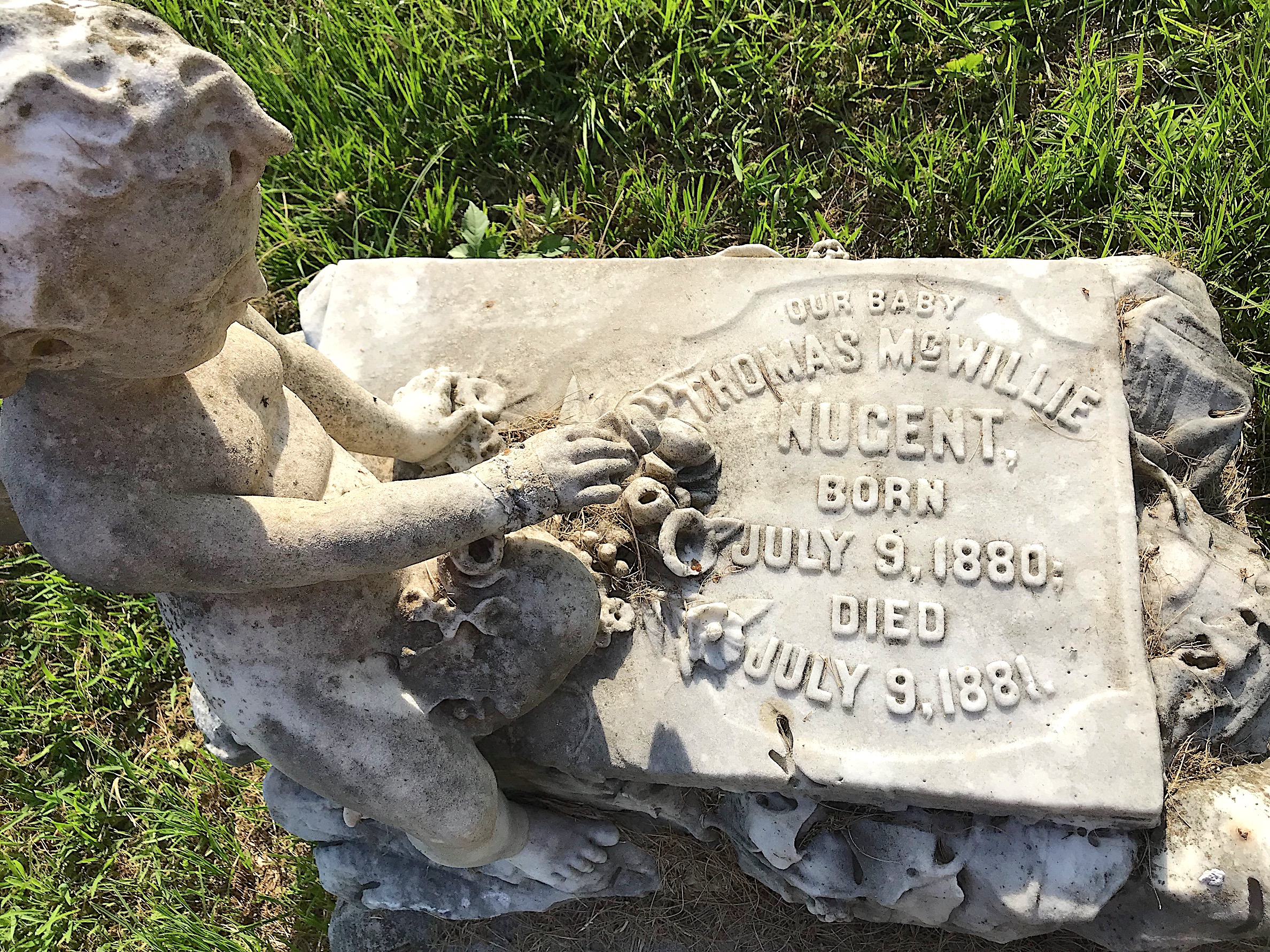
Born on July 9, 1880 to attorney William Lewis Nugent and Aimee Webb Nugent, Thomas McWillie Nugent died exactly a year later. His younger sister, Aimee, born on May 18, 1882, died on Sept. 29, 1883. She has an exact replica of this marker for her grave near Thomas at Greenwood.

Oklahoma Road Trip 2019: Visiting the Old and the Young at Jackson, Miss.’ Greenwood Cemetery, Part I

09 Friday Jun 2023

Posted by adventuresincemeteryhopping in General

≈ Leave a comment

After leaving Vicksburg, we headed east for our next destination of Greenwood Cemetery in Jackson, Miss. It’s about 45 minutes away. The main reason was to visit the grave of one of my favorite authors as a girl, Eudora Welty.

Growing up in the South is different than growing up any place else in the world. It has its unique weather, landscapes, and ways of expressing oneself. I was not born in the South but I’m as close to a native as it gets. They’ve kindly taken me in.

When I read Eudora Welty, I felt like she was speaking from my “place” and spoke my language. The first thing I ever read by her was the short story “Why I Live at the P.O.” and I’ve been a fan ever since.

Greenwood Cemetery is located in Jackson, Miss.

The Graveyard

The information I found about Greenwood was somewhat conflicting. A sign there says Greenwood Cemetery was established by a federal land grant on Nov. 21, 1821. The Greenwood Cemetery Association web page states that it was established by an act of the Mississippi State Legislature, which was approved Jan. 1, 1823. It also notes that Greenwood has grown from the original six acres to its current 22 acres.

Something in me likes knowing that it was originally known simply as “The Graveyard”. Later, people called it City Cemetery.

In 1899, the Ladies Auxiliary Cemetery Association submitted the name Greenwood Cemetery to city leaders and the name was adopted in 1900. In 1909, the city declared Greenwood Cemetery “full” and stopped selling plots. But burials are still taking place there today.

Eudora Welty

I’m not going to write a long bio about Welty, much has been written about her already. She was born and raised in Jackson, Miss. by her parents Christian Webb Welty and Mary Chestina Andrews Welty. Her mother, a teacher, encouraged her children to not only read but embrace it in their home. I was raised the same way.

Welty not only wrote, but took many photographs for the Works Progress Administration (WPA) during the 1930s.

Photo taken in 1962 of Eudora Welty from Wikipedia.

Her first publication in 1936 was a short story, “Death of a Traveling Salesman”. Her first book was published five years later and it was called A Curtain of Green, containing 17 stories. Welty’s debut novel, The Robber Bridegroom, came in 1942. Her recognition as a talented Southern author began to build and she was able to travel to Europe. In 1960, she returned home to Jackson to care for her elderly mother and two brothers.

In 1972, Welty’s novel The Optimist’s Daughter won a Pulitzer Prize. In 1980, she was awarded the Presidential Medal of Freedom by fellow Southerner President Jimmy Carter. Welty was a charter member of the Fellowship of Southern Writers, founded in 1987. She also taught creative writing at colleges and in workshops. She lived near Jackson’s Belhaven College and was a common sight among the people of her hometown.

Welty died on July 23, 2001 at age 92 in Jackson. I am just one of many who have come to visit her grave over the last 22 years.

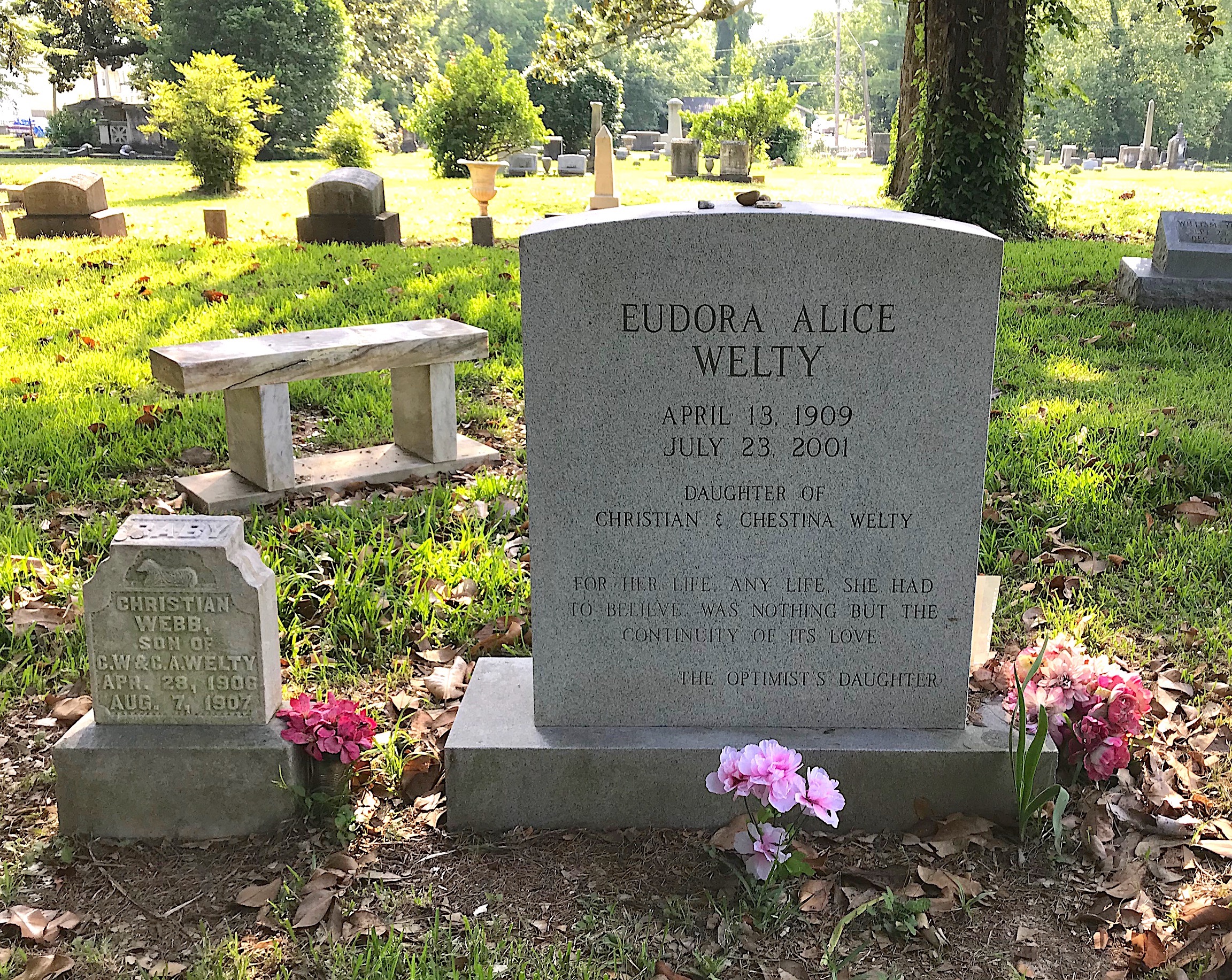
Eudora Welty is buried beside her brother, Christian Webb Welty, who died before she was born.

The epitaph on the front of Welty’s simple marker comes from her novel, The Optimist’s Daughter:

For her life, any life, she had to believe, was nothing but the continuity of its love.

I sometimes forget to photograph the back of markers but thankfully, this time I did not. There is another quote on the back of Welty’s gravestone, which I am writing out because my photo has sun splotches on the last words. It comes from her three-part memoir called One Writer’s Beginnings.

The memory of a living thing. It too is in transit, but during its moment. All that is remembered joins. And lives — the old and the young. The past and the present. The living and the dead.

As you have seen, I am a writer who came of a sheltered life. A sheltered life can be a daring life as well. For all serious daring comes from within.

The back of Eudora Welty’s marker has a quote from her memoir, One Writer’s Beginnings.

Yonder, Up Yonder

Greenwood has a few of the most gripping grave markers I’ve seen. One of them is for Louisa “Lula” Lemly Hines and the other is for two of her sons.

Born in 1841, Lula was the daughter of Samuel and Elizabeth Furr Lemly. Samuel was a master carpenter, contractor, and planter in Rowan County, N.C. He was responsible for several building projects, including a major bridge over the South Yadkin River (1825) and the first eight buildings at Davidson College. He and Elizabeth moved to Jackson, Miss. around the time of Lula’s birth. They had at least 10 children together. Samuel died in 1848.

The Hines family plot is a testament to love and loss.

Lula married bookkeeper and Confederate veteran Henry Hunter Hines in May 1867. Their son, Hallie, was born 10 months later on March 15, 1868. His brother, Willie, was born on May 15, 1870. Sadly, Hallie died of measles on May 24, 1870 at age two. Willie died seven months later on Dec. 28, 1870. Lula and Samuel must have been heartbroken. The two boys share this marker.

Brothers Willie and Hallie Hines share this poignant marker.

Lula gave birth to another son, Claude, on Nov. 21, 1871. He lived a long life, becoming a dentist. He died in 1945 and is buried in Forest Hill Cemetery Midtown in Memphis, Tenn.

Home, Heaven, Happiness

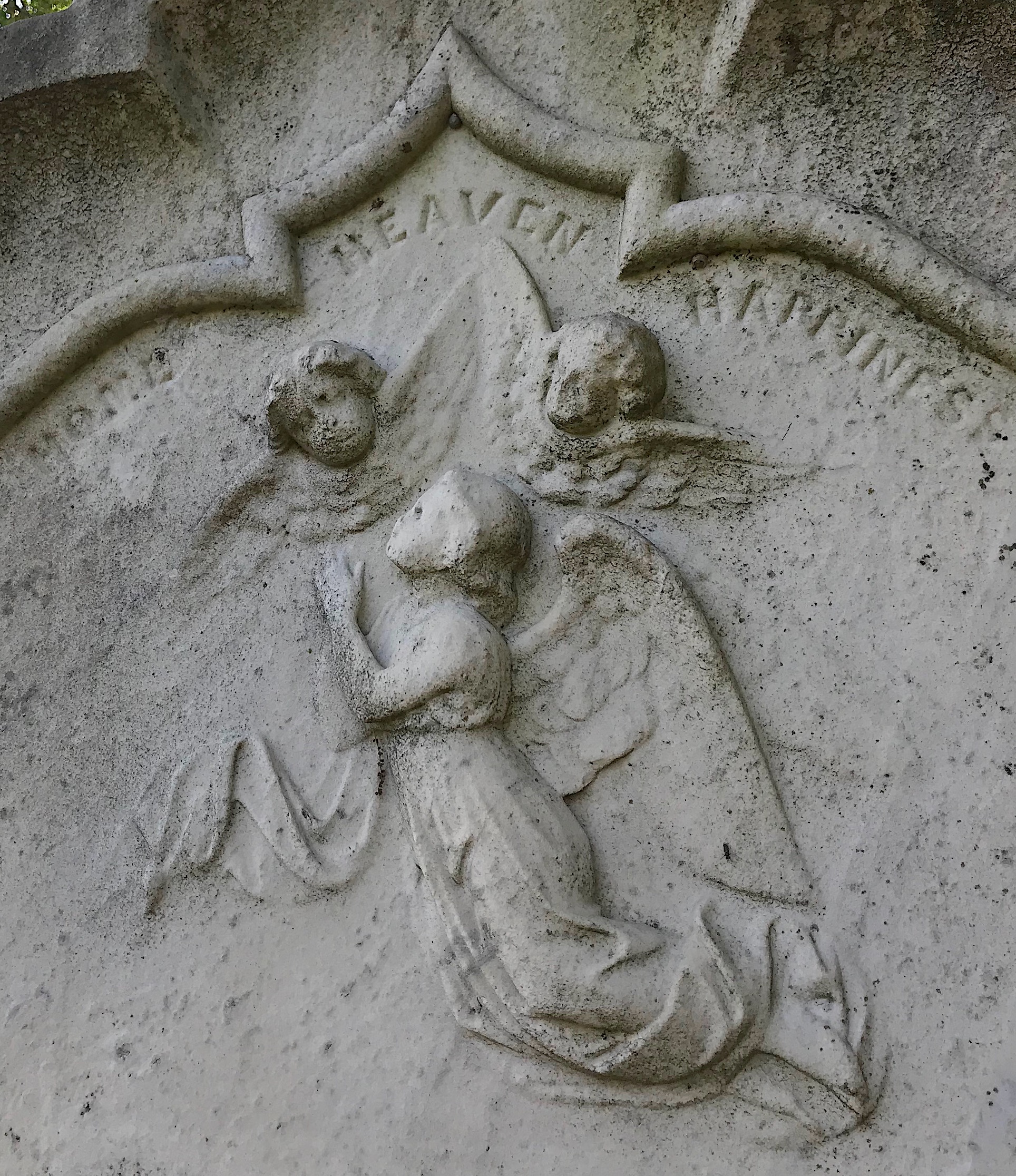
Lula died of typhoid fever on June 16, 1872 at age 30. Her marker shows an angel with two little faces, those of her boys, flying above her.

Did Lula look forward to the day she would join her beloved boys? It came much sooner than anyone dreamed.
Home, Heaven, Happiness

Henry Hines remarried to Myrtle Windley in 1886. He died in 1890 at age 64. Myrtle died in 1917 at age 61. Henry and Myrtle are buried to the left of Willie and Hallie in the Hines plot at Greenwood.

“But An All-wise Providence Otherwise Decreed“

I’ll close for now with this marker for Mollie Sullivan Bussey and her son, Edwin. I see these mother/son gravestones from time to time, and they never cease to give me pause.

Born around 1850, Mollie Sullivan married Nathan J. Bussey, Jr. on Dec. 9 or 10, 1874 in Mississippi. Their son, Edwin Virden was born about a year later. The exact date is not known. According to her obituary, Mollie died on Dec. 3, 1875 after a short illness. Edwin died on April 29, 1876 and their shared marker states he was five months old. I can only conclude that Mollie died shortly after he was born.

Mollie Sullivan Bussey died soon after her son, Edwin, was born.

Little Edwin is not mentioned in Mollie’s obituary. But it states that:

Deceased was a native of Missouri, was in her twenty-fifth year, and bid fair to see many years of earthly joy and happiness. But an all-wise Providence otherwise decreed. To its orderings, we must submit.

Mother and son reunited in Heaven.

I’m not sure what happened to Nathan after Mollie died. He is not buried at Greenwood Cemetery as far as I can tell.

I’ll have more stories behind the stones next time in Part II.

Amanda Stewart Yerger was the wife of James D. Stewart. They had at least 9 children together. She died at age 41 in 1873.

Oklahoma Road Trip 2019: Stopping by Mississippi’s Vicksburg City Cemetery and Vicksburg National Cemetery

26 Friday May 2023

Posted by adventuresincemeteryhopping in General

≈ Leave a comment

Note: There are a TON of great sources about the Siege of Vicksburg, which took place from May 18 to July 4, 1863. I’m not going to even attempt to write about it here. I barely scratched the surface. If you want to know more, I encourage you to seek out information about it.

Vicksburg, Miss. is about 2.5 hours from Shreveport, La. Vicksburg National Cemetery (VNC) went on my road trip list as an important stop. But there was one grave nearby that I wanted to visit first for the sheer novelty of it.

I’m sure a number of people who visit Vicksburg do so to visit the Civil War battlefield and VNC, which is a Union burial ground. But nearby is Vicksburg City Cemetery (also known as Cedar Hill Cemetery), which is the home to approximately 5,000 Confederates that have been re-interred there from other places, of which 1,600 are identified.

Vicksburg City Cemetery has more than 38,000 burials recorded on FindaGrave.com

I had heard about Old Douglas from different web sites over the years, and his story intrigued me a great deal. It’s not often you hear about a camel being part of a war on American soil. But in this case, it’s true.

The U.S. Camel Corps

As the story goes, Jefferson Davis got the idea for putting dromedary camels into use by the military in the 1850s. He admired their stamina and ability to go without water. As U.S. Secretary of War in 1852, Davis helped to establish the U.S. Camel Corps and about 33 of them were brought over from the Middle East.

By the late 1850s, about a hundred camels were stationed in Texas. They performed better than horses and mules on rocky slopes. Their feet needed no shoeing, they didn’t need much water, and they were very hardy.

In the case of Douglas, he was a gift to Confederate Col. W. H. Moore by First Lt. William Hargrove. Moore assigned Douglas to carry the instruments and supplies of the 43rd Mississippi Volunteer Infantry Regimental Band. You can read more about that here.

It’s highly unlikely that Douglas’ actual remains are buried here but I think it’s important to tell his story.

Douglas’s first active service commenced under General Sterling Price in the Iuka Campaign near Corinth. Douglas quickly attained legendary status by causing a stampede among the horses. However, Douglas endeared himself as a camp favorite, befriending young soldiers who proudly carried their new title, “The Camel Regiment.”

The1862 Battle of Corinth was a tragic day that ended with 12,000 casualties. He also served at the Central Mississippi Railroad engagement and the Siege of Vicksburg.

This photo was taken by Beverly Vaughn on Find a Grave. I didn’t get a good photo of it myself.

From May 18 to July 4, 1863, Vicksburg was the sight of an estimated 35,825 casualties. During one of the skirmishes, a Union sharpshooter intentionally shot and killed Douglas on June 27, 1863. As the back of Douglas’ cenotaph states, it is highly possible the starving Confederates ate their camel comrade. So I’m betting his remains are not actually there. Still, Douglas is honored like other veterans with a marked grave in Vicksburg City Cemetery.

Vicksburg National Military Park Monuments

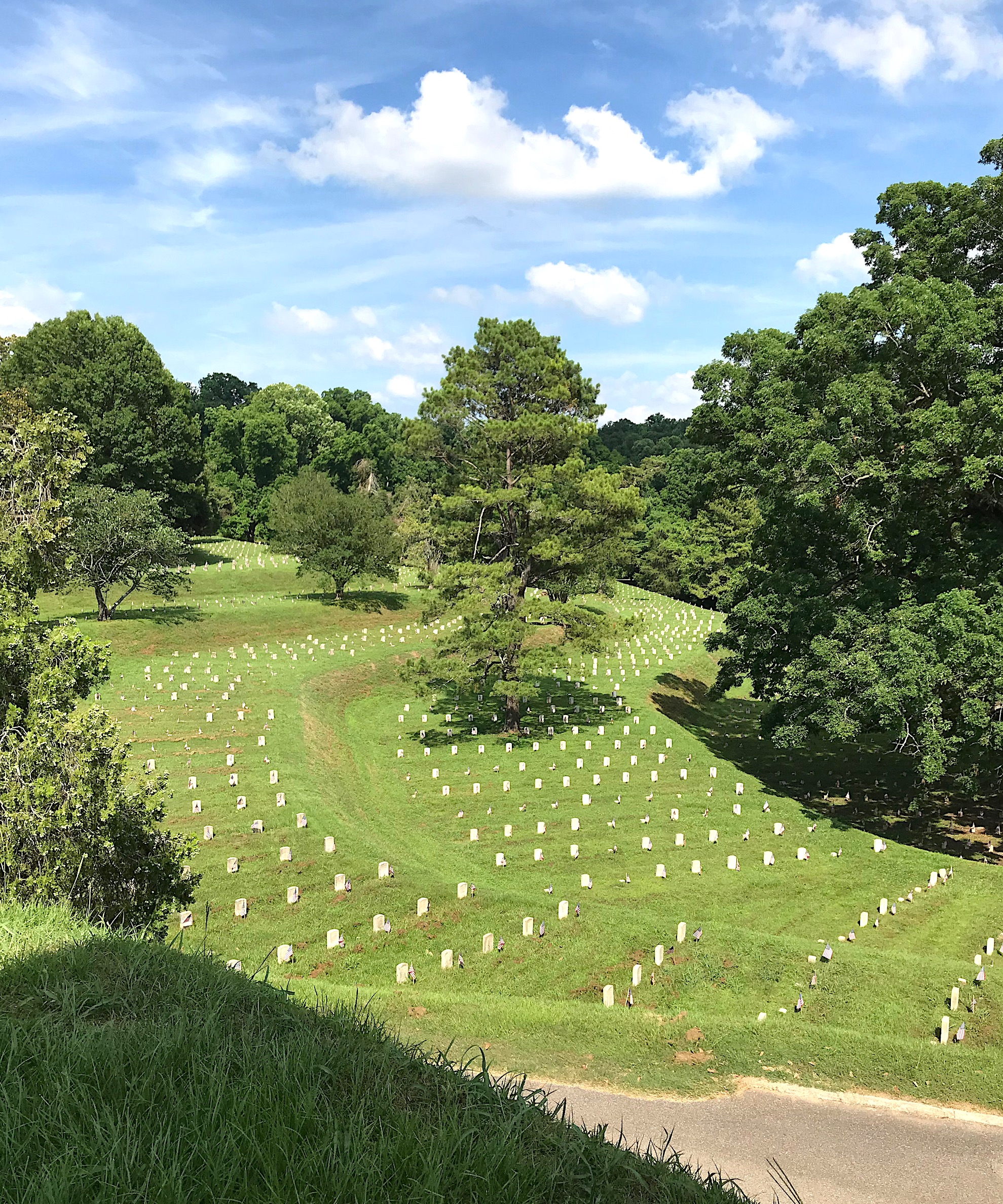
After saying goodbye to Douglas, we headed over to nearby VNC. The cemetery is located within the Vicksburg National Military Park. Covering about 40 acres, it holds the remains of 17,000 Civil War Union soldiers, the largest number of Civil War interments of any national cemetery in the country. Of that 17,000, only 5,000 have been identified. Covering ground once manned by the extreme right of Maj. Gen. William T. Sherman’s XV Army Corps during the Siege of Vicksburg, it was established by an act of Congress in 1866.

Entrance to Vicksburg National Military Park.

VNC also contains the remains of veterans of the Mexican-American War, Spanish-American War, the First and Second World Wars, and the Korean War. Vicksburg National Cemetery was closed to burials in 1961.

Vicksburg National Military Park was established in 1899. America’s leading architects and sculptors were commissioned to honor the soldiers and sailors that fought throughout the Vicksburg campaign. The park’s earliest state memorial was dedicated in 1903, and more than 95 percent of the monuments that followed were erected prior to 1917. Today, more than 1,400 monuments, tablets, and markers dot the landscape.

Some of the monuments are for specific state’s regiments that fought in the war. Others are large ones representing each state. I’ve included photos of some of them below.

The Michigan monument is quite impressive. The memorial is a 37-foot tall obelisk made of White Bethel Granite. The lower third was cut from a single piece of granite weighing 40 tons. The cost was $10,000 and it was dedicated on Nov. 10, 1916.

“The Spirit of Michigan” stands as a silent tribute to the seven infantry regiments and two artillery batteries that participated in the campaign and siege of Vicksburg.

Wisconsin’s monument is made from Winnsboro, S.C. granite and stands 122 feet tall. A bronze statue of “Old Abe” the war eagle, mascot of the 8th Wisconsin Infantry, sits atop the monument. It was erected at a cost of $90,644 and dedicated on May 22, 1911.

The Wisconsin state monument at Vicksburg was done by sculptor Julius Loester.

The Missouri monument is one of two state memorials at Vicksburg National Military Park dedicated to soldiers of both armies. The height is symbolic of the 42 Missouri units, 27 Union and 15 Confederate. It stands where two opposing Missouri regiments clashed in battle.

Missouri’s monument is dedicated to both Union and Confederate armies.

The monument features a bronze figure which represents “The Spirit of the Republic,” as well as bronze reliefs depicting both Union and Confederate soldiers. The sculptor was Victor S. Holm. The memorial was erected at a cost of $40,000 and dedicated on Oct. 17, 1917, during the National Peace Jubilee.

I was personally interested in seeing the Illinois state monument. My husband, Chris, has an ancestor from Illinois who fought at Vicksburg and I was hoping to see if his name was inscribed inside of it.

The Illinois memorial at Vicksburg’s stone comes from Georgia.

Illinois’ memorial was erected by the firm of Culver Construction Company with William B. Mundie contracting the designers and sculptors. The design was by W. L. B. Jenney and the sculptor was Charles J. Mulligan. Ironically, granite from Stone Mountain, Ga. forms the base and stairway. Above the base is Georgia white marble. The 47 steps in the long stairway are for each day of the Siege of Vicksburg.

Modeled after the Roman Pantheon, the monument has 60 unique bronze tablets lining its interior walls, naming all 36,325 Illinois soldiers who participated in the Vicksburg Campaign. The monument stands 62 feet in height and originally cost $194,423.00 paid by the state of Illinois.

Abraham Newland survived the Civil War and returned to his family in Illinois.

I walked up the steps and entered the coolness of the memorial. It didn’t take me long to find Abraham Newland’s name. A native of Durham, England, Abraham arrived in America as a teenager. Before the Civil War, he was a coal miner. He served as an orderly sergeant with the 124th Illinois Infantry, Company D. He is not buried at Vicksburg because he survived the war and went home to his family in McDonough County, Ill. He died in 1919 at age 81 and is buried in Illinois.

U.S. Colored Troops (USCT)

Nearly 175 regiments of over 178,000 free men and former slaves served during the last two years of the Civil War. Following months of training and physical labor, black troops were finally allowed to prove themselves in a major battle.

By spring 1863, Port Hudson, La. and Vicksburg, Miss. were the only remaining Confederate strongholds on the Mississippi River. On May 27, 1863 the First and Third Louisiana Native Guards were ordered to take a section of the Rebel earthworks at Port Hudson. They charged across 600 yards of open ground, only to be cut down by canister and musket fire. Despite their attempts, the assault failed. Nearly 200 black troops were killed or wounded.

Just one of the sections of U.S. Colored Troops buried at Vicksburg National Cemetery.

At Milliken’s Bend, La., three regiments of black troops were tasked with guarding a supply depot and nearby military hospital. On June 7, approximately 1,500 Confederate troops attacked the post with hopes of distracting Union forces besieging Vicksburg. As the Rebels attacked, the hastily trained and ill-equipped black troops resorted to fighting with bayonets and clubs in hand-to-hand combat. After the arrival of Union reinforcements, the outnumbered Confederates retreated, leaving the depot and hospital in Union hands.

About 40 percent of the burials at Vicksburg National Cemetery were soldiers in the U.S. Colored Troops (USCT). Until my visit to VNC, I had never seen so many USCT graves in one place before.

For much of the USCT, little information is available. But thanks to the hard work of others, I was able to find out about a few of the soldiers whose graves I photographed while at VNC.

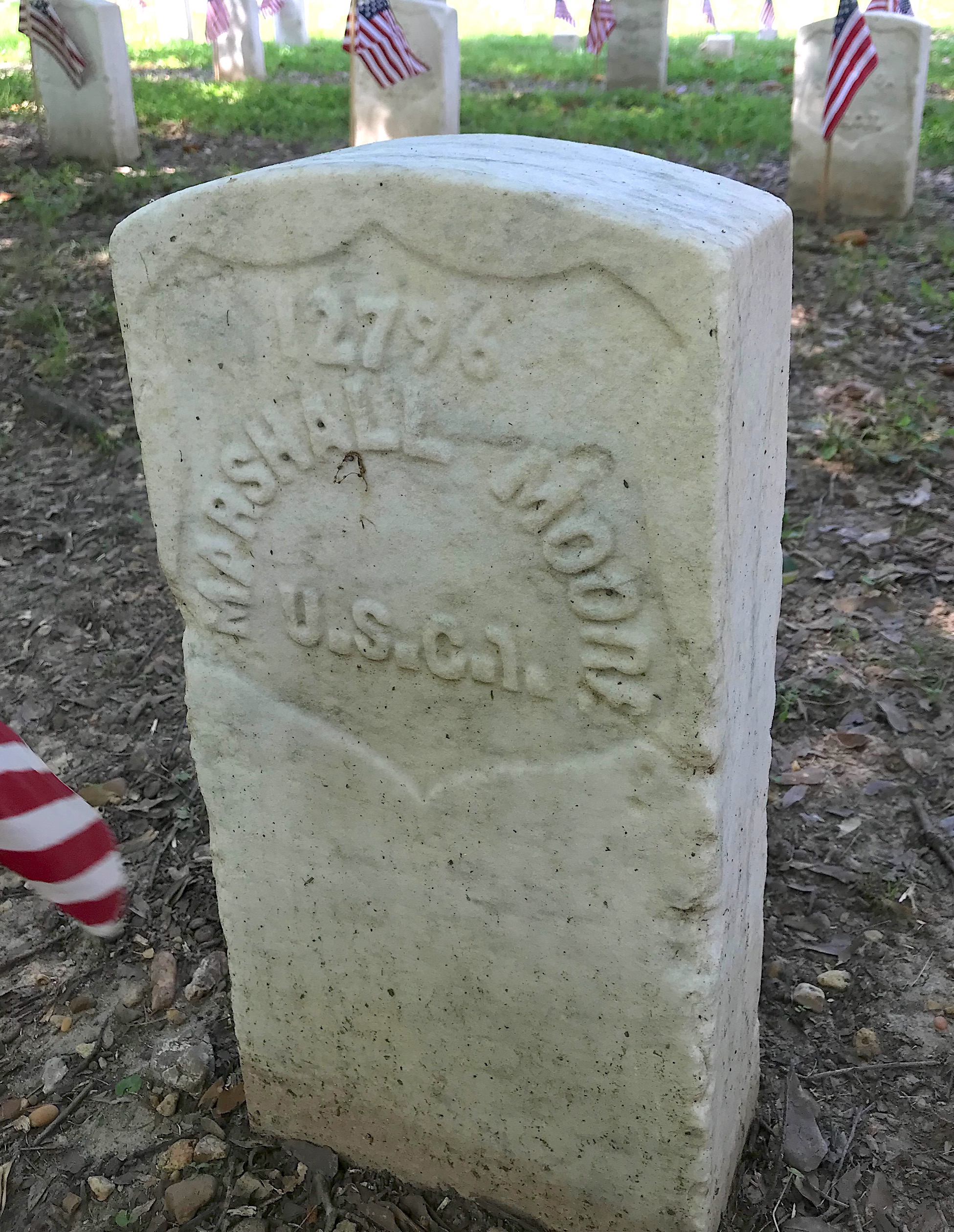
Private Marshall Moore died of disease on Feb. 6, 1866.

Private Marshall Moore enlisted at Louisville, Ky., on June 27, 1864. He gave his age as 19, his occupation as farmer, and his birthplace as Anderson, Ky. Private Moore served in the 108th U.S. Colored Infantry. He died of disease on Feb. 6, 1866 at Vicksburg.

Pvt. Andy Treadwell witnessed several battles as part of the 55th Regiment of the USCT.

Andrew “Andy” Treadwell was a private in the 55th Regiment, Co. K. of the U.S. Colored Infantry. He is listed on the African-American Civil War Memorial in Washington, D.C. His FindaGrave.com memorial lists his activities during the war in great detail. He died on Jan. 7, 1866.

According to the U.S. Burial Registers, Military Posts and National Cemeteries, 1862-1960, King Vance enlisted in the 64th Infantry, Co. H in December 1863. According to U.S. Freedmen’s Bureau Records of Field Offices, 1863-1878, he was a farmer and stood 5 feet, 5 inches tall. He died in Vicksburg on Oct. 14, 1865. The cause of death was dysentery.

Remembering Soldiers

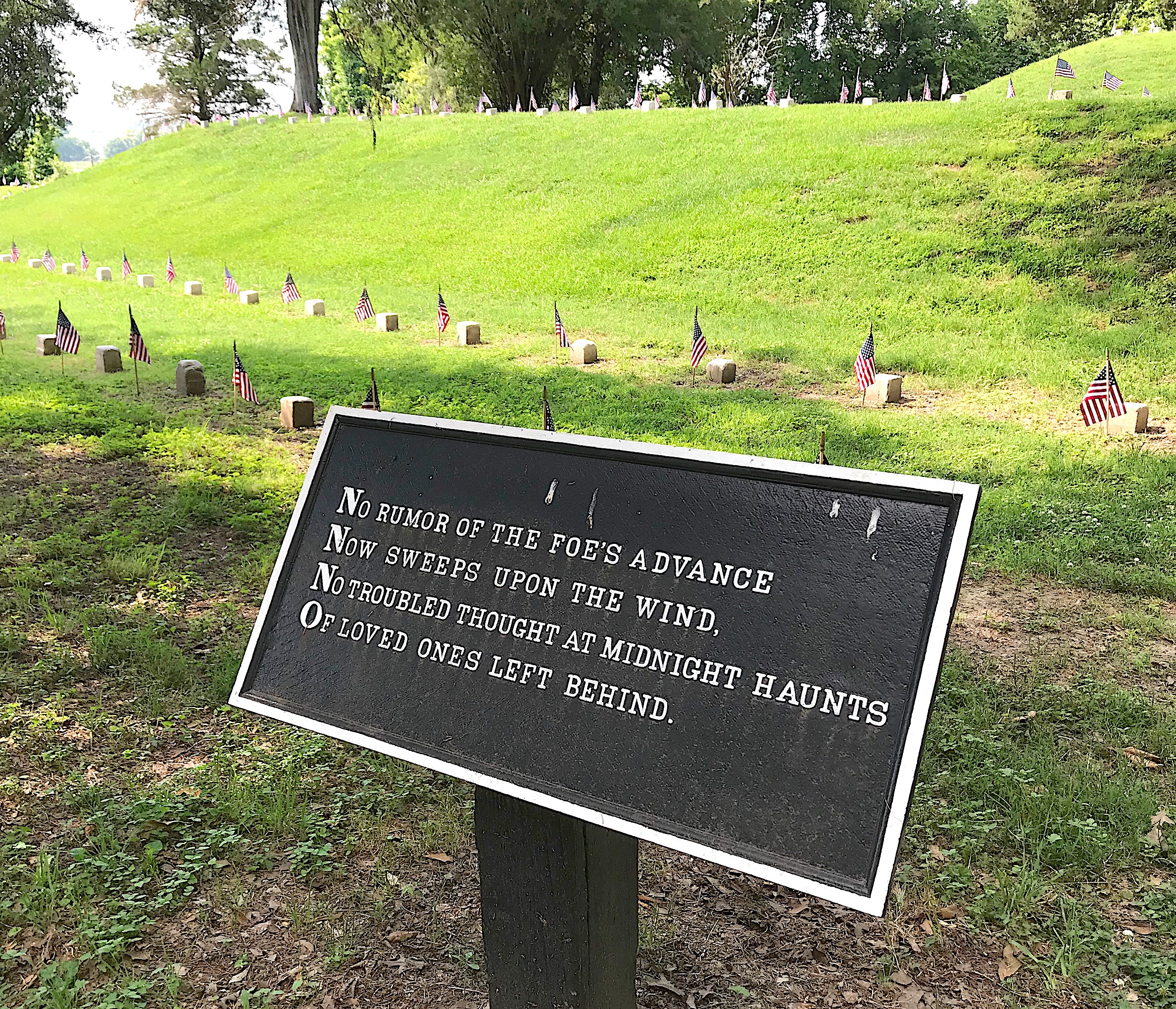
Some areas are marked with plaques explaining what state and units the soldiers buried there belonged to. Below are soldiers who belonged to Iowa’s 31st Infantry, 2nd Brigade, First Division, 15th Corps, Sharpshooters Line.

Iowa’s 31st Infantry is represented at VNC.

Others did not have signs that I could see.

View from above at VNC.

Vicksburg National Cemetery undoubtedly deserves more time than we had to explore and learn about it than we did. I think by this point in our road trip, we were both a bit worn and weary. I would like to go back and spend some more time under less hot and humid conditions when I can wander the hills a bit.

Our next stop was Greenwood Cemetery in Jackson, Miss. I’ll have a new post ready for you about that in a few weeks.

Oklahoma Road Trip 2019: Paying a call at Shreveport, La.’s Oakland Cemetery, Part III

19 Friday May 2023

Posted by adventuresincemeteryhopping in General

≈ 2 Comments

It’s time to finish up at Shreveport, La.’s Oakland Cemetery. Today I’d I like to focus more on the actual monuments and markers, and their epitaphs, to let them speak for themselves. I think the monument for Harriett Hotchkiss does that well.

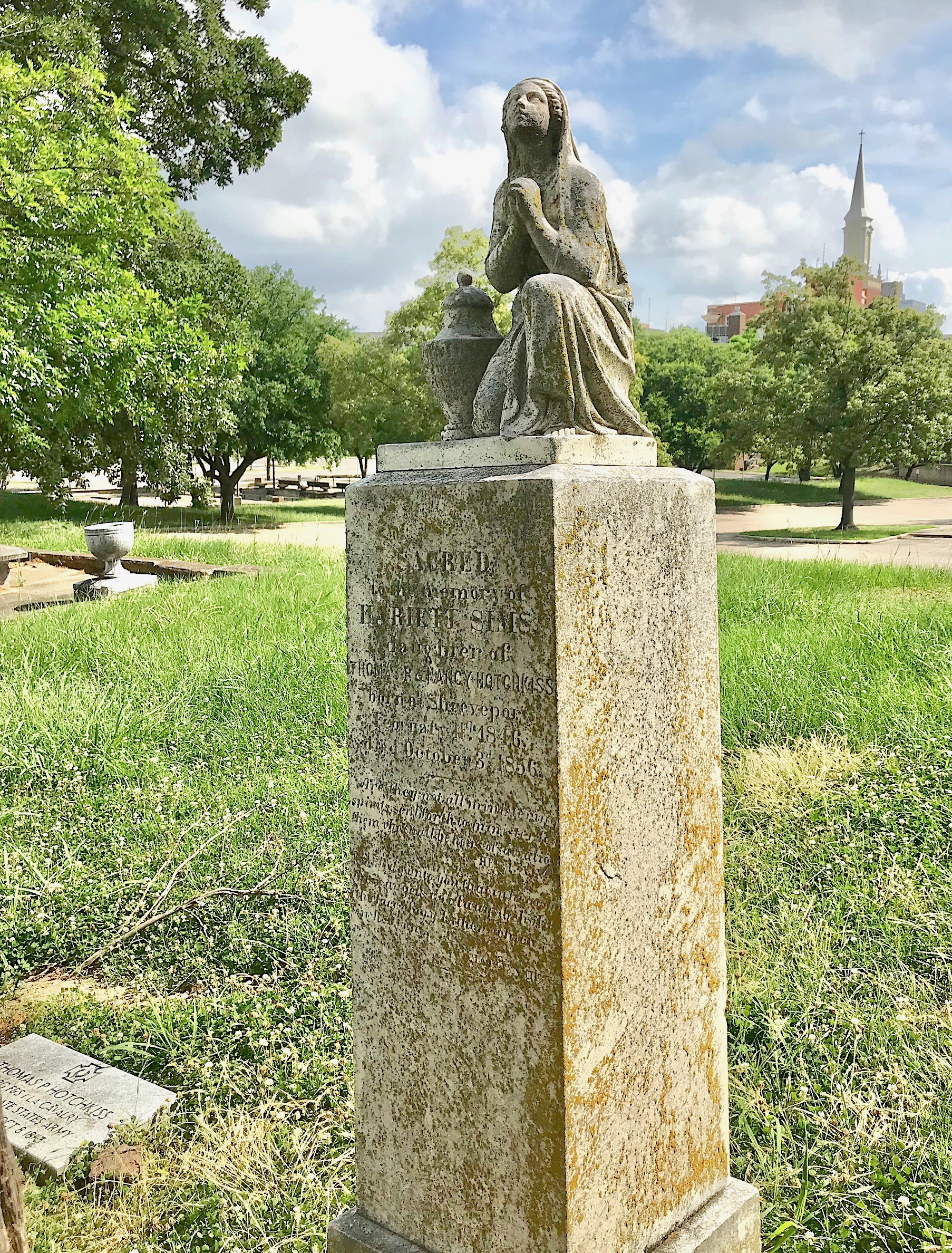
Monument of Harriett Sims Hotchkiss. A mourning woman looks skyward, perhaps beseeching God for comfort.

Born in 1846 in Shreveport, Harriett Sims Hotchkiss was the daughter of Dr. Thomas P. Hotchkiss and Nancy Hampton Gill Hotchkiss. She was their second child, the couple had several over their marriage. Dr. Hotchkiss was elected on March 20, 1839 to the first municipal government of Shreveport as one of five trustees. He served as a surgeon in the Confederate Army during the Civil War.

For reasons unknown, Harriett died on Oct. 3, 1856. She was only 10. Her death must have been a blow to her parents. The praying figure on top of Harriett’s monument suggests it surely was.

Harriett Sims Hotchkiss was only 10 when she died in 1856.

Nancy Hotchkiss died on Feb. 25, 1869 and there appears to be no marker for her. She was 43 at the time. Harriett’s brother, William, died in October of the same year at age 21. Dr. Hotchkiss did not remarry.

When the 1873 yellow fever epidemic struck Shreveport, Dr. Hotchkiss was mostly retired. But he sprang into action to tend the sick, many who had no way of paying him. He succumbed to the illness himself on Oct. 8, 1873. You can see his marker to the left of Harriett’s, I did not get a better photo of it than the one above dominated by Harriett’s monument. He was 59 at the time of his death.

“Mama’s Darling”

Not far from the Hotchkiss graves is this one for James Elmore Atkins. He was the son of James W. Atkins and Lucy Elmore Atkins. Elmore was the name he went by. James W. was a planter who owned a plantation in Knox Point, La. and operated a mercantile in Shreveport with his brother.

Elmore’s monument has Lucy’s named spelled “Lucie”. He had an older sister, Maude. A praying angel kneeling on a pillow tops it. Above Elmore’s name and dates are the words “Mama’s Darling”. I am certain Elmore was dear to Lucy’s heart.

Elmore Atkins died of bronchitis, according to his obituary.
Monument for James Elmore Atkins.

Elmore was only three when he died of bronchitis on March 6, 1892. An article in The Times of Shreveport reported:

For nearly two long weeks, little Elmore endured with more than childish fortitude the pain and suffering and then He gaveth his beloved sleep and the little one has been gathered to into the flock of the Good Shepherd. It is to the stricken parents that the sympathy of friends and relatives is extended; they that need consolation; for it is surely well with their child. No present words can assuage the bitter grief that sweeps across their heart strings right now.

“Mama’s Darling”

Inscribed on one side is the following epitaph:

Fold him, o Father, in thine arms, and let him henceforth be

a messenger of love between our human hearts and thee.

It must have been heartbreaking to lose Elmore at such a young age. Lucy did give birth to another child, Herbert, in January 1893. He lived a long life, dying in 1973. Maude died in 1910 at age 24 of emphysema. Lucy died in 1922 at age 67. She and Maude are buried together at Shreveport’s Greenwood Cemetery. James W. Atkins remarried to Ethel Colgate. He died in 1930 and is buried with her at Greenwood Cemetery.

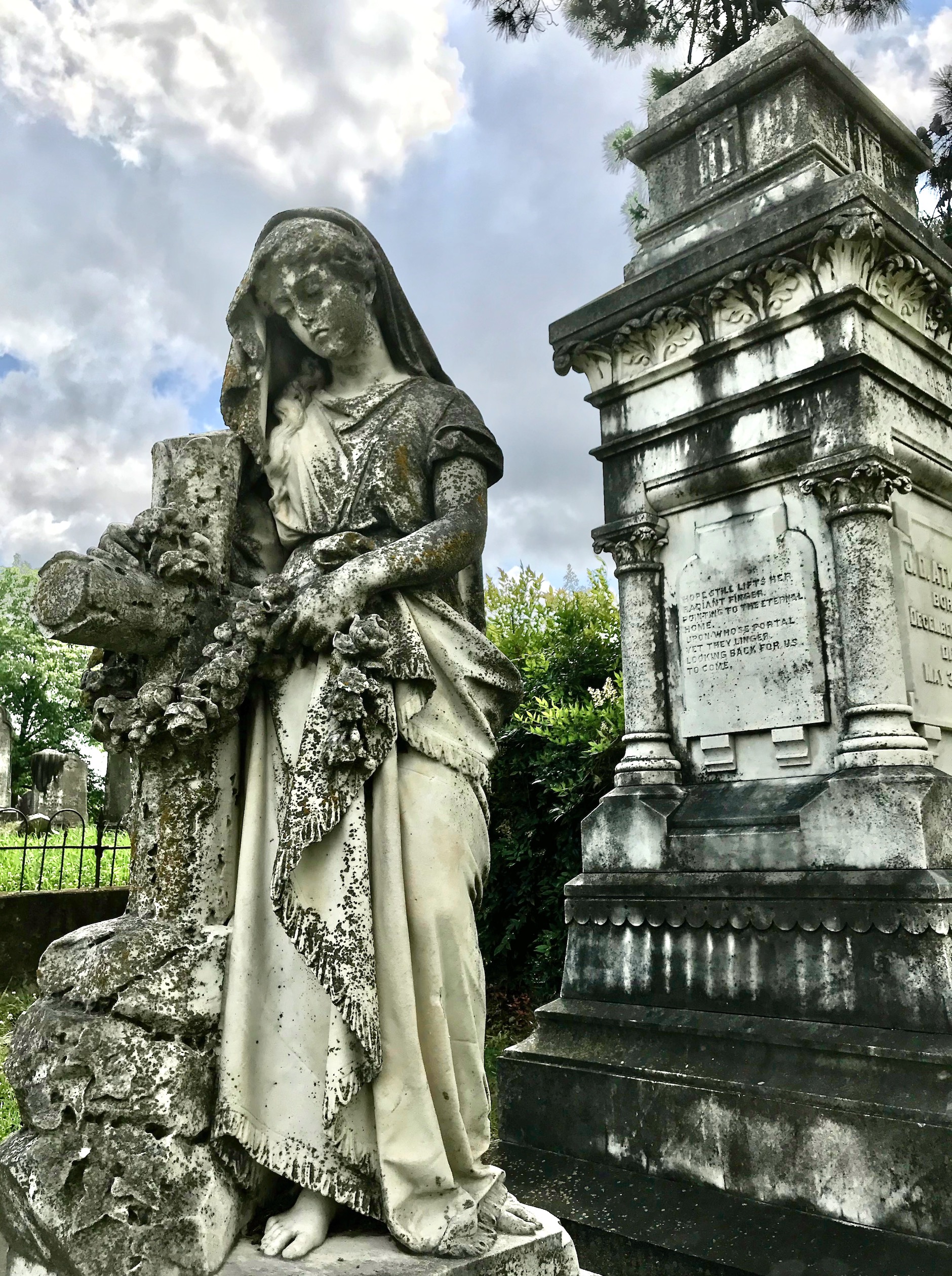
“Hope Still Lifts Her Radiant Finger”

Nearby are the monuments for James W. Atkins’ older brother, Joseph Davis Atkins, and his wife, Ophelia Lucille Poole Atkins. The pair married in 1879. They had no children together that I am aware of. Joseph was in business with his brother at the mercantile and in operating their Knox Point plantation.

“I watch over thee, my husband”

Joseph died on May 30, 1891 in Shreveport. His obituary states he “had been indisposed for several days from the effects of la grippe, died at this home at Knox Point last Saturday night from paralysis of the brain.” In those days “la grippe” was a form of influenza. He was only 39.

Ophelia was left to carry on without him, which could not have been easy. Joseph’s monument is a testament to her grief. Above his name, it says: “I watch over thee, dear husband.”

On the side is the following inscription, which you can see in the photo below:

Hope still lifts her radiant finger

Pointing to the eternal home

Upon whose portal yet they linger

Looking back for us to come.

Ophelia lived another 35 years, remaining in Shreveport. With no children to comfort her, it had to have been hard. She was close with one of her sisters, who lived in nearby Belcher. Her obituary noted that she was active in her church and Shreveport social circles.

Ophelia had a stroke and died several weeks later in Belcher, La. at age 72 on Nov 18, 1929. She is buried beside Joseph.

Ophelia Lucille Poole Atkins outlived her husband, Joseph, by 35 years.

“No Ostentation Marked Tranquil Way”

Born in 1878, Leon Rutherford Smith was a Shreveport native. He obtained his law degree from the University of Virginia in 1900 and married Ethel Blanchard the following year. She was the only daughter of Louisiana governor Newton C. Blanchard (serving from 1904 to 1908) and Mary Emmett Barret Blanchard.

After serving on the Caddo Parish school board, Leon decided to run for office and was elected to the Louisiana House of Representatives in 1904. He became a state senator in 1912.

Leon and Ethel had one child together, Newton Blanchard Smith, born in 1904. Sadly, Leon died after contracting the Spanish Flu on Oct 19, 1918. He was only 43 years old. Ethel did not remarry. She died in 1945 after having a heart attack. She is buried beside Leon.

Blanchard, who had moved to Poughkeepsie, N.Y. in the 1930s, died there in 1954 at age 50. He is buried with his parents in Oakland.

Senator Leon R. Smith was only 43 when he died from the Spanish Flu in 1918.

Leon’s monument has the following inscription:

No ostentation marked his tranquil way, his duties all discharged without display

And Heaven lifts its everlasting portals high

To bid the pure in heart behold his god.

I did a search to see if there was an author, but did not find a name. Apparently, it was a rather popular epitaph because it appears in various forms on a number of grave markers I saw online.

“One Pure Bright Eternal Day”

Finally, let’s turn to the marker for Lillie Wilkinson Sims Starling. Born in 1842, Lillie was the daughter of Ross Wilkinson and Hannah Folwell Wilkinson. She and her family moved to Minnesota before settling in Caddo Parish sometime after 1860.

Lillie married J.T. Sims sometime after 1870. J.T. died of pneumonia on Feb. 5, 1873 at age 27. Lillie gave birth to their son, Thomas Ross Starling, at some point soon after that. Lillie remarried to Joseph Starling in 1881. A native of New York, Starling was employed by the Texas & Pacific Railroad for 25 years. He and Lillie had one son, Joseph, in 1883 but he only lived five months.

Lillie Wilkinson Sims Starling died in Texas but her remains were returned to Shreveport for burial beside her first husband.

Lillie and Joseph were living just over the Texas border in Waskom when she died on Oct. 22, 1885. I don’t know what her cause of death was. Her remains were returned to Shreveport and she was buried beside her first husband, J.T. Sims, and her infant son, Joseph, who had died just two years before. She was 43. Her marker features an elaborate profusion of flowers at the top.

Joseph Staring remarried in 1891 to Maria Stephens. He died in 1927 and is buried with her in Greenwood Memorial Park and Mausoleum in Fort Worth, Texas.

A sad footnote to this story. Remember Lillie’s son Thomas? He moved to Philadelphia, Pa. where some of Lillie’s Wilkinson relatives lived. I found an article that stated due to being despondent over being unable to find work, Thomas ingested acontie. It’s also known as wolfsbane. Ingested in a large enough quantity it can cause death. Thomas died on Sept. 30, 1901 at age 26 in a Philadelphia hospital.

Thomas’ uncle, H.C. Wilkinson, handled his funeral arrangements. Thomas is buried at Laurel Hill Cemetery in Philadelphia, Pa.

Next time, join me at Vicksburg National Cemetery in Mississippi for the next part of Oklahoma Road Trip 2019.

A large plot of Jewish graves at Oakland Cemetery.

Oklahoma Road Trip 2019: Paying a call at Shreveport, La.’s Oakland Cemetery, Part II

12 Friday May 2023

Posted by adventuresincemeteryhopping in General

≈ Leave a comment

Last week, I introduced you to Shreveport, La.’s Oakland Cemetery. I’ve got more stories to share with you about some of its more notable residents.

Oakland Cemetery in Shreveport, La.

A Wife and Her Two Husbands (Again)

I found yet another “wife and two husbands” set of markers. But this time, the wife is joined by her mother. Take a look at the four monument below. We have, from left to right, Mary Jane DeCarteret Howell Furman, her second husband, Samuel Furman, her first husband, John Howell, and at the end, Mary’s mother, Eliza Scott Davis.

Note that the two markers on the left are made of stone, while the two on the right are made of white bronze, better known as zinc.

How did these four people end up together?

The common denominator of this foursome is Mary Jane DeCarteret Howell Furman. Born in 1822 to Eliza Scott DeCarteret (later to become Davis) and Francis DeCarteret in Louisiana, Mary Jane married John Nelson Howell in May 1837 at age 15. Howell was twice her age and served as mayor of Shreveport in 1844. They had only one child that I am aware of, Francis, in 1841 who appears only on the 1850 U.S. Census then vanishes.

Mary’s mother, Eliza, married Michael Edward Davis sometime after 1822. I’m not sure what became of Francis DeCarteret. Eliza and Michael Davis must have divorced at some point because he remarried to someone else in 1853 in Texas.

John Howell was a landowner who operated a successful grocery business in Shreveport for several years, retiring in the 1870s. He was also president of the board of trustees for Shreveport University, established in 1867.

Photo dating from the 1880s of Mary Jane Furman. (Photo Source: FindaGrave.com, contributed by Gary Collins)
Photo of John N. Howell, mayor of Shreveport and first husband of Mary Jane Furman. (Photo Source: From a Shreveport Times pictorial called “The Mayors of Shreveport” originally published in “The Chronicles of Shreveport” in 1928.)

“We Shall Meet Again”

John Howell died on June 24, 1882 at age 75. His obituary was very short, noting he was one of Shreveport’s oldest residents and one of its wealthiest. His marker is the tallest of the four and made of white bronze. I hope you don’t mind if I indulge my examination of it because what it shares gives you an idea of what Mary Jane, his widow, wanted people to remember about him. I think she certainly wanted his piety to be the focus.

“Deacon” John N. Howell died on June 24, 1882. I have not seen the term “deacon” on any other white bronze marker I’ve seen. He was born in North Carolina and died in Shreveport at age 76. Some typographical gymnastics had to be done to get all this information on the plate.

The great thing about white bronze markers is that you could get quite detailed with what you put on the plates. The possibilities were endless.

“My Hope In Christ Is Strong” The anchor was a common theme seen on grave markers during the 1800s, signifying hope in the Lord.

Then there’s this Bible verse, Psalm 37:23, further highlighting Howell’s faith.

This comes from Psalm 37:23.

“A Friend to the Friendless”

Mary Jane’s mother, Eliza, died on Aug. 10, 1886 at age 83. She had lived next door to her daughter and son-in-law during the 1870s and with them in the 1880s. Her marker, also of white bronze, is on the far right of the four. While it is smaller than John Howell’s, it also conveys religious themes.

Eliza Scott Davis’ white bronze marker also highlights hope.

But on the side, we get a glimpse of one of my favorite motifs, the hand of God’s emerging from a cloud and pointing upward. We’re also informed that Eliza was “A Friend To The Friendless” and that she is now facing “A Happier Lot Than Ours”.

Eliza’s charitable character and eternal home is emphasized here.

Mary Jane married local physician Dr. Samuel Kirkwhite Furman on May 19, 1887. Mary Jane would be Dr. Furman’s fourth wife since the previous three had all passed away. Dr. Furman was the grandson of the Rev. Richard Furman, who founded Furman University in Greenville, S.C.

I found an article about their wedding, which was held at Mary Jane’s Shreveport home. Apparently, the couple had known each other long ago and “had not met for 17 years” before they crossed paths again. The article indicates they would reside in Kentucky, where Dr. Furman was living.

Dr. Samuel Furman was the grandson of the Rev. Richard Furman, who founded Furman University.

Dr. Furman died on June 13, 1896 in Shreveport after a “long and painful illness” at age 77. His marker is made of stone, not white bronze.

Dr. Furman’s monument is made of stone instead of white bronze.

Mary Jane died four years later on Feb. 2, 1900 at age 77. Her marker is probably the least ornate of the four but has some nice draping on the left side. Her obituary reveals what I had already suspected. Mary Jane was a faithful member of Shreveport’s Baptist church and had done a great deal of work to help the community.

Mary Jane DeCarteret Howell Furman died in 1900 at age 77.

The Levy Brothers

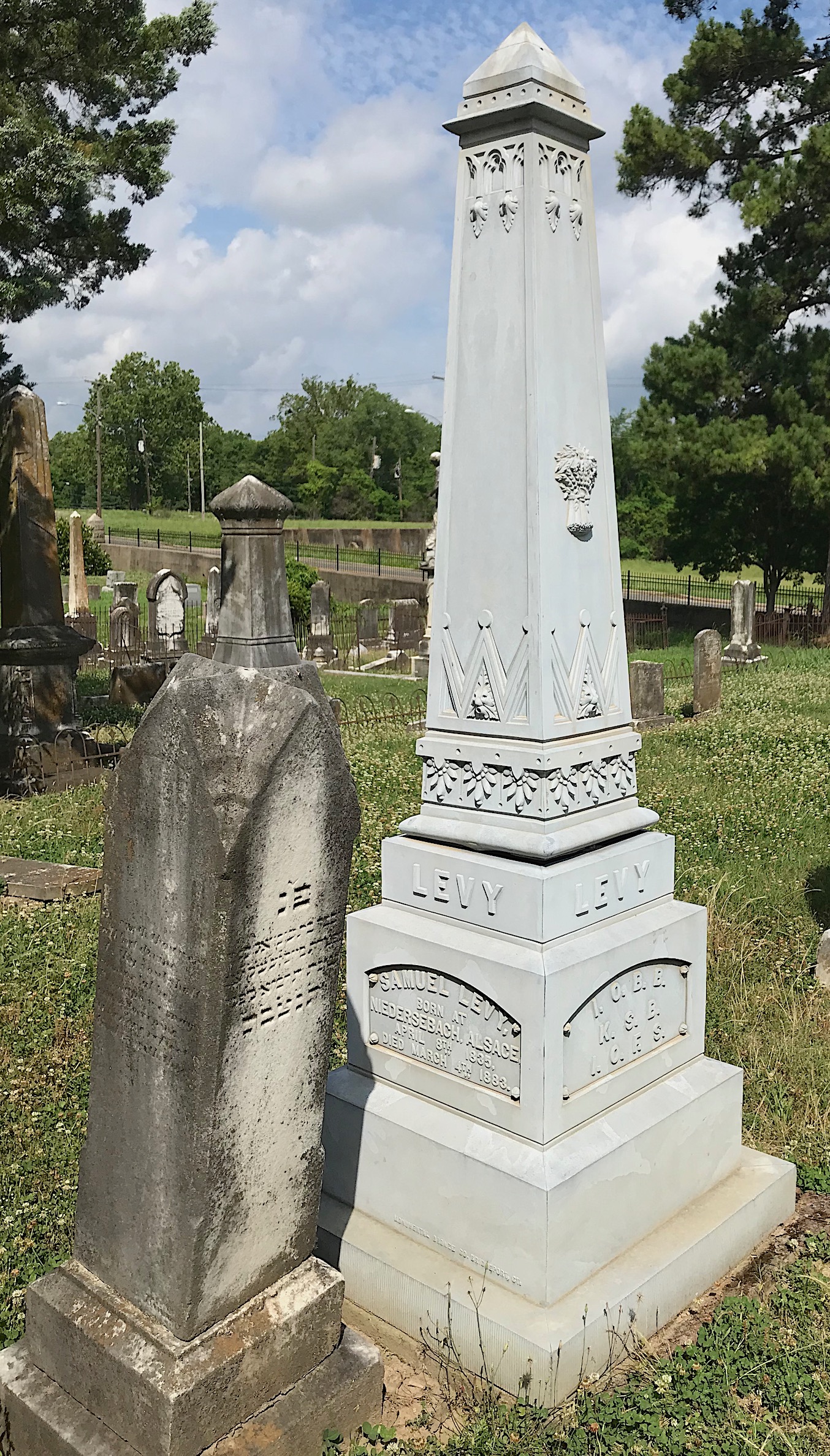
As I noted last week, Oakland Cemetery has a Jewish section. It isn’t set apart but blends seemlessly with the other graves. There are 24 Levy memorials for Oakland on Find a Grave. One of them belongs to Capt. Simon Levy, Jr., a native of Niedersbach, Alsace in France born in 1839. He came to America sometime before the 1860s because Simon served in the Confederate Army during the Civil War. I don’t know if he actually attained the rank of captain but he was regarded as “Captain Levy” in the community. Such honorary titles (especially “colonel”) were common back in the day.
Simon’s brother, Samuel, was five years older than him. He arrived in Shreveport in 1853 before Simon, and he eventually became mayor. But I’ll get to him shortly.

Simon married Harriette Bodenheimer in 1866 and they settled in Shreveport. They would have three children together. Simon did well. He served as co-founder and president of the Commercial National Bank. He helped found the Shreveport and Gulf divisions of the Kansas City Railroad. In Shreveport, he was proprietor of a liquor distributorship. He was active in civic affairs, holding the rank of president of the Columbia Club and serving as a city trustee.

Capt. Simon Levy was Jewish, but it clearly did not hold him back in rising to the top in Shreveport’s business and social spheres.

Simon’s success got my attention because he was of the Jewish faith, something not always welcomed in large cities in those days. But I learned that Shreveport had an established community of 50 to 60 Jewish families by the time the Civil War began. Many owned successful businesses and were active in community affairs like the Levys were. Shreveport would have four Jewish mayors in its history.

“The Grim Reaper Crept In…”

Harriette Levy died suddenly in 1878, only 27 at the time. Simon was left to raise his little ones on his own and did not remarry. He died on March 27, 1898 at age 59. His lengthy obituary, which spoke of him in glowing terms, described how after an illness of several weeks “the grim reaper crept in during the dark hours of night and claimed his own”.

Capt. Simon Levy, Jr. was a successful businessman but also much loved by the community.

Mayor Samuel Levy

Samuel Levy arrived in Shreveport some years before his brother. He, too, fought in the Confederate Army. His main profession was that of butcher. He and his wife, Louisa, had seven children together.

Like his brother, Samuel had a way with people and belonged to many fraternal organizations. He belonged to the Masons, the Odd Fellows, the A.O.U.W. (Ancient Order of United Workmen), I.O.B.B. (Independent Order of B’nai B’rith), K.S.B. (Kesher Shel Barzel), and the I.O.F.S. (Independent Order of the Free Sons of Judah). It’s a wonder Louisa ever saw him, he was so busy.

Samuel Levy operated a butcher shop and steamboat operation in Shreveport. (Photo Source: The Times, Sept. 6, 1874.)

In the early 1870s, Samuel was serving Shreveport as the administrator of finance. I’m going to share this bit of history about how he became mayor from the Encyclopedia of Southern Jewish Communities:

When the “carpetbagger” Louisiana governor William Pitt Kellogg appointed Dr. Joseph Taylor to the position of Mayor. Levy was allowed to continue in his same position under the new leadership. Taylor and his self appointed leaders of other city departments commenced to operate a notoriously corrupt administration that siphoned funds from city services and left the city in dire financial straits. Local resentment simmered, and reached a breaking point in the summer of 1873.

In August, a controversy erupted over the arrest of a local citizen on dubious charges. Following a violent courtroom debacle in which a friend of the accused threw a large Bible at the mayor’s head, citizens openly demanded Taylor’s resignation, which he tendered on August 8. Governor Kellogg decided to appoint Samuel Levy as the Mayor Pro Tempore until the time of the next election.

Samuel Levy’s white bronze marker is much smaller than his brother’s, but his impact on Shreveport was just as great.

The yellow fever epidemic of 1873 descended on the city in the fall of that year. Shreveport would lose 25 percent of its population as over 800 people died from the disease while others left, never to be seen again. Since the Taylor administration had drained Shreveport’s funds, Samuel Levy took the extraordinary step of paying municipal bills out of his own pocket. He held onto his post through December, when elections brought a new mayor to power.

Samuel died on March 4, 1883 at age 47. His obituary was not as long as his younger brother’s but it was effusive with praise for his generosity and kindness to the poor. I’m sure many Shreveport residents remembered his efforts to help the city survive during the 1873 epidemic.

Stay with me for more stories from Shreveport’s Oakland Cemetery in Part III.

A cross tied to a broken column (meaning a life cut short) and an anchor (meaning hope) are motifs on the monument to Thomas L. Morris. He died on Dec. 22, 1887 in California after journeying there in hopes of improving his poor health. He was only 28 when he died. His remains were returned to Shreveport for burial at Oakland Cemetery.

Oklahoma Road Trip 2019: Paying a call at Shreveport, La.’s Oakland Cemetery, Part I

05 Friday May 2023

Posted by adventuresincemeteryhopping in General

≈ Leave a comment

Oakland Cemetery is my first Louisiana cemetery hop, which excited me. I’d never traveled through the Pelican State before.

Located in what is called the original city of Shreveport, Oakland Cemetery is made up of about 10 acres with a sandstone fence around it. Find a Grave.com has about 2,530 memorials recorded for Oakland. According to the city’s web site, it was founded in 1847. The original name was City Cemetery, then it became Oakland around 1905.

The open gates to Shreveport’s Oakland Cemetery.

The cemetery contains Jewish, Masonic, and Odd Fellows sections. Also, a mound containing approximately 800 victims of a yellow fever epidemic in 1873 is there. That’s not uncommon in large Southern cemeteries. About 85 percent of burials pre-date 1900 and very few burials have taken place in the last 70 years.

Oakland has had its fair share of vandalism in recent years, with several monuments knocked over. Some of the plot fences were in rough shape and the landscaping was rather scruffy. But that’s a common thing I see in big, older burial grounds. There is an Oakland Cemetery Preservation Society but I’m not sure how active they are. The last posted newsletter is from spring 2019, which was about the time we were there. I do know they’ve been doing what they can with that funds they have.

I do sympathize with this kind of thing. Cemetery restoration is very expensive, and most people are not prone to spend their own money to pay for the repair of markers for people not related to them. Still, it made me sad to see it.

Just a few of the monuments knocked over at Oakland Cemetery.

Between Two Husbands

One reason I had to visit Oakland was because they had at least two Abrams cast iron grave covers and as you know, I’m fairly obsessed with them. I didn’t know when I photographed them that there was a bit of a saga concerning this family plot. The events that transpired would sound a little scandalous now, but back in the day, it wasn’t that unusual.

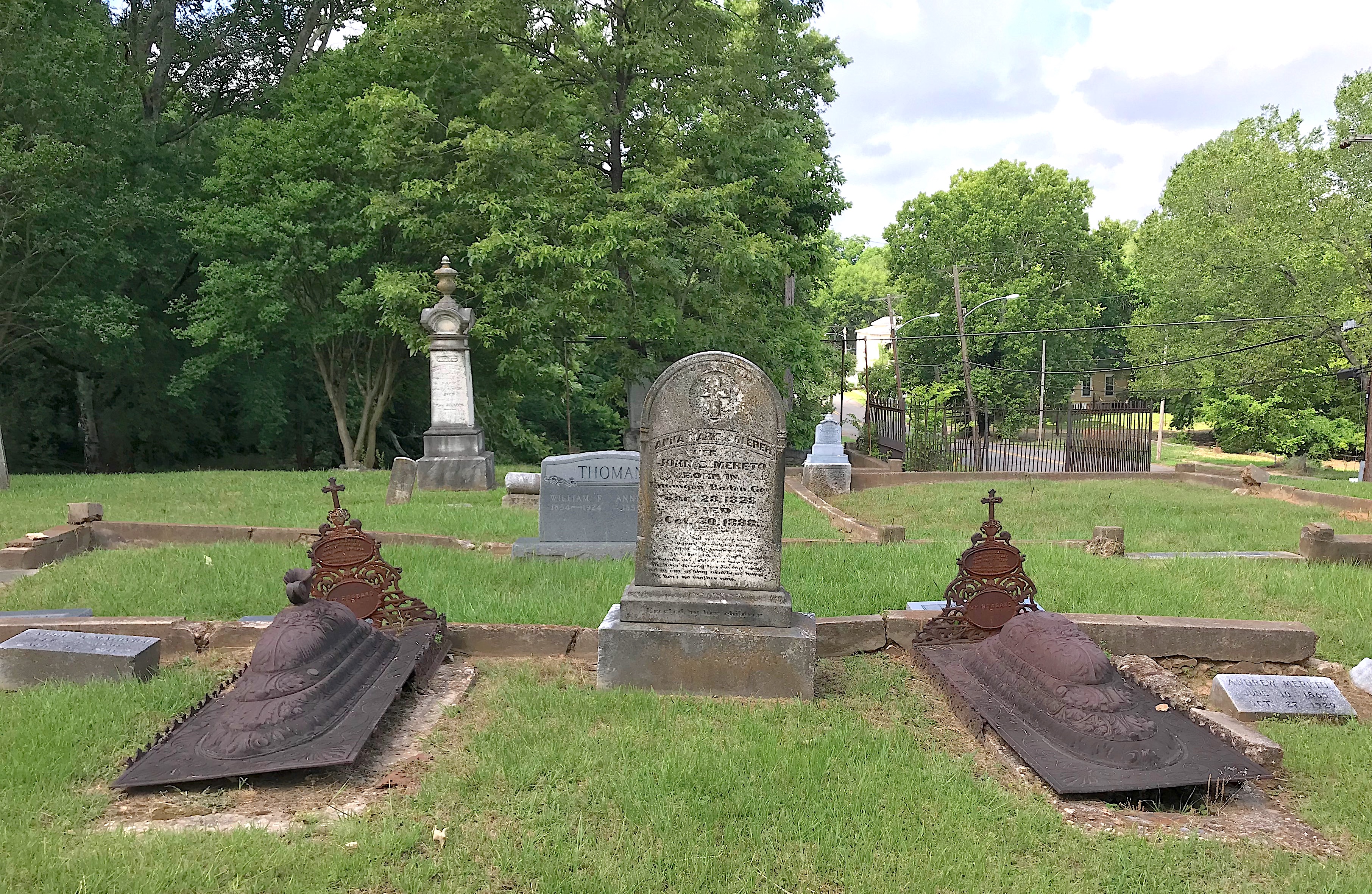
Anna Marie Kurrus Soleder Mereto is buried between her two husbands.

One of three brothers, Carl Wilhelm Soleder (or Solleder, I have seen it spelled both ways) was a native of Germany. His father died when he was a baby. Carl arrived in America around 1848. He married fellow German immigrant Anna Marie Kurrus in around 1854, not long after she had arrived. The couple were both in their early 30s. They did not have any children that I am aware of.

Carl entered into business with Italian immigrant John B. Mereto, opening a grocery stand in Shreveport. In 1856, they moved into a two-story brick building on Texas Street. They advertised in the local newspaper frequently.

John Mereto and Carl Soleder owned a grocery store on Texas Street in Shreveport. (Photo Source: Dec. 10, 1856, The South-Western)

Carl died on Oct. 17, 1857 at age 32. On May 5, 1858, Anna married Carl’s business partner, John Mereto. It was around the same time that they sold the grocery business to W. M. Gurney. A daughter, Rose, was born on Dec. 11, 1858. Son Andrew arrived in 1865 and daughter Carrie in 1867.

It might seem rather shocking now for a wife to marry her dead husband’s business partner so quickly. But I’ve seen it happen before. When I wrote about the Jacobs family back in 2016, wife Lillian was married to an Omaha undertaker. She married one of his business partners not too long after he died. While it may seem suspicious, it was more likely a practical solution to a tricky problem. The widowed wife is left without anyone to take care of the business and the partner is already likely legally tied to the family. In this case, it also appears that Anna was pregnant with Rose when she married John.

The 1860 U.S. Census lists John as a farmer, so I’m not sure if he got out of the grocery business altogether. Daughter Carrie’s census records indicate she was born in Italy, so the family may have gone there in the 1860s to escape the Civil War and live with John’s relatives.

Carl Soleder is buried to the right of his wife. The foundation of most Abrams cast iron grave covers is a solid rectangle of concrete. This one was simply placed on an open granite border.

John Mereto died on June 10, 1873 at age 55. I don’t know what his cause of death was. It is my belief that Anna purchased the two cast iron grave covers at the same time. Abrams’ patent, which you can see in the corner, was established in both November 1873 and May 1874.

Although it’s hard to make out, this is proof that this is an Abrams cast iron grave cover.

Most Abrams cast iron grave covers are placed on top of some kind of solid rectangular foundation, be in granite or some other stone. The deceased is buried several feet beneath it. In the case of John Mereto’s, it looks like his cover follows this pattern, with the foundation a rough poured concrete. In the case of Carl Soleder, by contrast, his foundation is a rectangular stone border with an empty center. It’s possible he had no marker until these two were bought after John Mereto died.

Carl’s grave cover is missing the finial on top, but John’s shell finial is still intact. Amazingly, both still have their metal identifying information plates still intact. It’s fairly rare to find these attached. There’s another Abrams cast iron grave cover at Oakland that has suffered that fate.

Anna and John were married 13 years.
John Mereto is buried to the left of Anna. To his left are the graves of his brother Antonio and his daughter, Carrie.

Rose, the eldest daughter, married Frenchman Henry Martin Rougagnac in 1881. They moved to Houston, Texas where Henry opened a saloon. They had a son, John. Rose died at age 38 in 1897. She is buried with Henry in Glenwood Cemetery in Houston.

Anna died on Oct. 30, 1888 at age 65. She was buried between her husbands. By this time, the short era in the 1870s in which one could purchase an Abrams cast iron grave cover had closed, so the family purchased this upright stone for her.

Anna Marie Kurrus Soleder Mereto is buried between her husbands.

Andrew Mereto, the middle child, never married. He was close to his sister Carrie, and either lived next door to her or with her, often. Carrie’s first husband, Bernard Duffau, died in 1902. He is buried elsewhere in Oakland. Her second husband, John Matovich, died in 1941. Carrie died in 1911 and is buried to the right of her father, John. Andrew died in 1929 and is buried to the right of Carl Soleder.

“Called Suddenly From Earth”

The death of a child is always painful. But when the cause of death is something that is today easily treatable, it is doubly hard to take.

Born in 1879, James Franklin Elliott was the son of Robert Sidney Elliott and Mattie Gardner Elliott. His obituary explains how he “stuck a piece of glass in his foot”. A few days later on Sept. 13, 1885, he died due to lockjaw, what we now call tetanus. Today, the tetanus vaccine and boosters can prevent such a tragedy.

Robert and Mattie Elliott must have been in agony. Their daughter, Pearl, born in 1885 a few months after James died, passed away in 1908 at the age of 22. She is buried in Oakwood but her grave is unmarked.

Little James Elliott died of lockjaw (tetanus) at the age of six. (Photo source: The Shreveport Times, Sept. 15, 1885)

James Elliott’s marker is made of white bronze, a zinc blend. It looks like whatever ornament topped it has broken off.

James Elliott’s grave is made of white bronze (zinc) and it looks like the decoration on top has broken off.

“I Have Finished”

To end this post, let’s take a look at the lovely monument for a young lady who died young. Born in Texas in 1882, Marie Epps Ross was the daughter of John Ross and Celestia “Lessie” Ross. We don’t know Marie’s exact day of birth. Since Lessie died the same year that Marie was born, it’s possible she died giving birth to her.

Marie died on March 24, 1898 after a “lingering illness” at the age of 16. Her marker says that her last words were “I Have Finished”. She is buried beside her aunt, Keziah Epps Wharton, who died in 1910.

Marie Ross was only 16 when she died in 1898.

Marie’s father, John Ross, never remarried. He served in the Spanish American War. He died in 1931 at age 80 and is buried at Greenwood Cemetery in Shreveport.

Join me next time for Part II of my visit to Oakland Cemetery.

Carving of a mourning woman leaning on an urn from the grave marker of Anna Greene. Little is known about Anna, wife of W.J. Greene. She was born in Holly Springs, Miss. and died at age 26 in 1858.

Oklahoma Road Trip 2019: Paying my respects to Cpl. Otis Henry At Texarkana, Texas’ Rose Hill Cemetery

28 Friday Apr 2023

Posted by adventuresincemeteryhopping in General

≈ 2 Comments

Today I’m going to do something I rarely do and focus on just one monument instead of covering a cemetery. I think in this case, it’s the right thing to do.

Somewhere along the line, I had seen photos of the monument to Otis Henry. When I realized we’d be in Texarkana, Otis’ monument immediately went on the list. It’s located in Rose Hill Cemetery in Texarkana, Texas. Mind you, there’s also a Texarkana, Ark. The border between Texas and Arkansas runs vertically down the middle of Texarkana.

I normally would have lingered at Rose Hill Cemetery to photograph the rest of it, but we simply didn’t have time. Established in 1874, the cemetery has about 4,250 memorials recorded on Find a Grave.

We drove in the front entrance that morning and headed for the back where I knew Otis’ monument was located. It’s pretty hard to miss.

The story of Otis Henry is almost more about his mother than her son.

Mother and Son

I get a little choked up when I think about Susan Tate, Otis’ mother, because I’m a mother of a son, too. I know that special bond between a mother and her boy. Sean and I have that. I have no doubt that Susan and Otis had it, too. So that’s where I’ll start. With Susan.

Born in Upshur County, Texas in 1859, Susan Tate was the daughter of Thomas Tate and Martha Barnes Tate. Thomas was a farmer. Susan was one of several children the couple had. I noticed that Thomas was from Georgia and Martha was from Alabama, so they grew up in my neck of the woods (so to speak).

In 1885, at age 25, Susan married Jack Henry in Longview, Texas. By the 1890s, the couple was living in Denison, Texas near the Oklahoma border. Their only son, Otis, was born there on June 22, 1894. Jack was working as a brakeman for the railroad, according to the 1900 U.S. Census. By this time, they were living in Johnson County, which is south of Fort Worth.

There is no trace of him after that 1900 census record so I’m fairly sure he died. Susan raised Otis in Denison. She married Stewart Wilder in March 1910 in Arkansas. He also worked for the railroad. I noted that the 1910 U.S. Census reported the fact that Susan had given birth to five children before that time but only one had survived. That would be Otis, making him quite precious indeed. But he was not living with them at that time.

This is what I imagine Otis looked like before he left Texas for France.

Off to France

Otis’ World War I draft card gives us some clues as to what came next. I noticed he listed his home address as 1002 S. Leila in Texarkana. It was a bit of a jolt to discover that Rose Hill Cemetery is located at 104 S. Leila. He apparently had lived very close to his final resting place.

At that time, however, Otis was working as a “soda dispenser” (often called soda jerks back in the day) at a drugstore in Shreveport, La. But in 1917, he was putting on an Army uniform along with thousands of other young men. He served in the 359th Infantry, 90th Division, Company H.

Doughboys of Company M, 359th Infantry, 90th Division, going in on the Argonne sector, Dombasle-en-Argonne, Meuse, France. This photo was taken on October 22, 1918, about two weeks after Otis Henry died.

After completing individual and collective training, the regiment served in France during World War I, including duty in the Villers-en-Haye, Battle of Saint-Mihiel, duty in the Puvenelle Sector of Lorraine, and the Meuse–Argonne offensive. It must have seemed like a totally different world to Otis.

A Mother’s Grief

We don’t know exactly how events transpired, but Corp. Otis Henry died on Oct. 6, 1918. His monument says he was “gassed one kilometer southeast of Vincey (Lorraine)”. Otis would be noted as the first man from Bowie County, Texas to be killed in World War I. His death came only a few weeks later when Germany signed an armistice agreement with the allies on Nov. 11, 1918. Otis was only 24 at the time.

The details of Otis’ death are inscribed on the back of his monument.

I could not locate an obituary for Otis but I’m sure his death made headlines in Texarkana. I’m also sure Susan was devastated. By 1920, she and Stewart were living in Texarkana. Otis’ remains were returned to her in 1921.

Susan made it her goal to provide a monument that expressed her love for her son and recognized his sacrifice on the battlefield. But she and Stewart were of modest means. It would take a lot of scrimping and saving until 1931 until it would be erected. The Henry plot is surrounded by an handsome iron fence.

This is what the Henry family plot looks like when you first approach it.

I learned that according to the Smithsonian Institute, the monument was designed by Morris U. Allen, Sr. and built by his company, Allen Monuments (located in Texarkana). However, according to Ancestry.com, the statue of the doughboy at the top was probably fabricated by McNeel Marble of Marietta, Ga. It seems appropriate that it came from there considering his father was from Georgia. This is one of five known stone designs similar to American sculptor Ernest Moore Viquesney’s “Spirit of the American Doughboy” but which lack the full battle gear.

In one hand, Otis is holding aloft a grenade while in the other, he is holding a rifle that rests on a tree stump. As you know from my past posts, a tree trunk symbolizes signifies a life cut short. On the ground below, we see the statue of “suited Otis” as he likely appeared before he left Texas. I think there’s some kind of symbol on his belt buckle, but I cannot make out what it is now.

The statue of the doughboy is thought to have been produced by McNeel Marble of Marietta, Ga.

Two angels flank the “suited Otis” on the ground below. One is looking down with her arms folded across her waist, holding onto the end of an inverted torch by her side. The other hand holds a flower wreath that contains roses, which can mean valor rewarded. The inverted torch usually signifies death or a life snuffed out.

The smaller angel has one hand resting stop an inverted torch, which often means death or a life snuffed out.

On the other side is a larger angel. She is in a typical pose of mourning and her tunic is covered with stars, representing the five wounds of Christ. One of her hands, unfortunately, has broken off.

The larger angel has five stars on her gown, signifying the five wounds of Jesus Christ.

Stewart died of a heart ailment in January 1937 at age 69. He has a memorial on Find a Grave and is listed as being buried at Rose Hill Cemetery. He may be in the Henry family plot, but I noticed he does not have a stone there. As it was 1937 and the depths of the Great Depression, perhaps Susan couldn’t afford a marker for him. She died on April 9, 1941 at age 81. She and Otis share a small marker at the foot of his monument. Finally, she and her boy were together again.

Susan Tate Henry Wilder died in 1941. She was finally reunited with her beloved Otis.

As I told you, this one hit me hard. I thought of Susan, mourning for her Otis. How the memories of him as a baby in her arms, the shouts of laughter as he chased a butterfly, the day he got his first job must have haunted her. The agony of knowing he had been killed in France. At times, they must have washed over her like a flood. Perhaps planning, saving, then seeing his monument erected gave her some degree of comfort.

I have seen quite a few doughboy statues in cemeteries, but they are almost always located in the Midwest or in other parts of the country. We just don’t have that many in the South. I don’t know why but we don’t. So this one was special to me for that reason as well.

It was time to head on for Shreverport, La. next. But as I got into Sarah’s car, I thought of one of the last pictures I took of the larger angel. Inscribed twice below the folds of the gown were the words “Remember, Remember”.

I will remember Otis and Susan. I hope by telling their story here that you will, too.

← Older posts
Newer posts →

Recent Posts

  • More Pensacola, Fla. Cemetery Hopping: Taking a Ramble Through Saint John’s Cemetery, Part III
  • More Pensacola, Fla. Cemetery Hopping: Taking a Ramble Through Saint John’s Cemetery, Part II
  • More Pensacola, Fla. Cemetery Hopping: Taking a Ramble Through Saint John’s Cemetery, Part I
  • The City of Five Flags: Stepping back in time at Pensacola, Fla.’s Saint Michael’s Cemetery, Part V
  • The City of Five Flags: Stepping back in time at Pensacola, Fla.’s Saint Michael’s Cemetery, Part IV

Archives

  • December 2025
  • November 2025
  • August 2025
  • July 2025
  • June 2025
  • May 2025
  • April 2025
  • March 2025
  • February 2025
  • January 2025
  • October 2024
  • August 2024
  • July 2024
  • June 2024
  • May 2024
  • April 2024
  • March 2024
  • February 2024
  • January 2024
  • December 2023
  • November 2023
  • October 2023
  • September 2023
  • August 2023
  • July 2023
  • June 2023
  • May 2023
  • April 2023
  • March 2023
  • February 2023
  • January 2023
  • December 2022
  • November 2022
  • October 2022
  • September 2022
  • August 2022
  • July 2022
  • June 2022
  • May 2022
  • April 2022
  • March 2022
  • February 2022
  • January 2022
  • December 2021
  • November 2021
  • October 2021
  • September 2021
  • August 2021
  • July 2021
  • May 2021
  • April 2021
  • March 2021
  • February 2021
  • January 2021
  • December 2020
  • November 2020
  • October 2020
  • September 2020
  • August 2020
  • July 2020
  • June 2020
  • May 2020
  • April 2020
  • March 2020
  • February 2020
  • January 2020
  • December 2019
  • November 2019
  • October 2019
  • September 2019
  • August 2019
  • July 2019
  • June 2019
  • May 2019
  • April 2019
  • March 2019
  • February 2019
  • January 2019
  • December 2018
  • November 2018
  • October 2018
  • September 2018
  • August 2018
  • May 2018
  • April 2018
  • March 2018
  • February 2018
  • January 2018
  • December 2017
  • November 2017
  • October 2017
  • September 2017
  • August 2017
  • July 2017
  • June 2017
  • May 2017
  • April 2017
  • March 2017
  • February 2017
  • January 2017
  • December 2016
  • November 2016
  • October 2016
  • September 2016
  • August 2016
  • July 2016
  • June 2016
  • May 2016
  • April 2016
  • March 2016
  • February 2016
  • January 2016
  • December 2015
  • November 2015
  • October 2015
  • September 2015
  • August 2015
  • July 2015
  • May 2015
  • April 2015
  • March 2015
  • February 2015
  • January 2015
  • December 2014
  • November 2014
  • October 2014
  • September 2014
  • August 2014
  • July 2014
  • June 2014
  • May 2014
  • April 2014
  • March 2014
  • February 2014
  • January 2014
  • December 2013
  • November 2013
  • October 2013
  • September 2013
  • August 2013
  • July 2013
  • June 2013
  • May 2013
  • April 2013
  • March 2013
  • February 2013
  • January 2013

Categories

  • General

Blogroll

  • A Grave Interest
  • Cemetery Photography by Chantal Larochelle
  • Cemetery Tours of Berlin by Matti
  • Confessions of a Funeral Director (Caleb Wilde)
  • Find a Grave
  • Hunting and Gathering (cool photography site)
  • Save Our Cemeteries (New Orleans, La.)
  • The Cemetery Club
  • The Graveyard Detective
  • The Rambling Muser
  • Westminster Abbey Tours by Grace

Meta

  • Create account
  • Log in
  • Entries feed
  • Comments feed
  • WordPress.com

Blog at WordPress.com.

  • Subscribe Subscribed
    • Adventures in Cemetery Hopping
    • Join 402 other subscribers
    • Already have a WordPress.com account? Log in now.
    • Adventures in Cemetery Hopping
    • Subscribe Subscribed
    • Sign up
    • Log in
    • Report this content
    • View site in Reader
    • Manage subscriptions
    • Collapse this bar
 

Loading Comments...