• About Me
  • Cemeteries I Have Visited
  • Have questions?
  • Photos

Adventures in Cemetery Hopping

~ A blog by Traci Rylands

Adventures in Cemetery Hopping

Author Archives: adventuresincemeteryhopping

Oklahoma Road Trip 2019: Deep in the Heart of (Dekalb) Texas, Visiting Dan “Hoss” Blocker at Woodmen Cemetery

21 Friday Apr 2023

Posted by adventuresincemeteryhopping in General

≈ 3 Comments

The Oklahoma portion of our trip was now over as we started heading east for our return to Georgia. I knew there was one place I wanted to try to get to. Not for historic reasons, really. More for nostalgia. The grave of actor Dan Blocker, best known for his role as Hoss Cartwright on the TV show Bonanza, is located in Dekalb, Texas. That seemed like a worthy reason to stop.

Located about an hour and a half east of Hugo, Okla. in the upper corner of northeast Texas, Dekalb’s population is close to 1,500. The last time Dekalb made major headlines was on Dec 31, 1985 when another TV star (and musician) Ricky Nelson died in a plane crash close to Dekalb. He was on his way to Dallas for a New Year’s Eve performance. All seven passengers were killed in the accident when the plane caught fire. The pilot and co-pilot were able to escape and survived.

Dan Blocker is buried in Woodmen Cemetery, as in Woodmen of the World. You’ve read blog posts about them here before. I was looking forward to seeing the many WOW markers they might have.

Woodmen Cemetery has about 3,450 burials recorded on Find a Grave.

But first, we stopped at a nearby Mexican restaurant for something to eat. I promise this plays a part in our cemetery visit, so stay with me. We ended up dining at a place called Maggie’s Mexican Grill. I’ve been eating Mexican food most of my life, but the food I had there was incredibly spicy and a bit salty. To me, it was good. The service was also top notch so I had no complaints at the time.

I would have a memorable meal at Maggie’s Mexican Grill.

Woodmen Cemetery isn’t far from Maggie’s. With close to 3,500 recorded memorials on Find a Grave, it is a decent sized burial ground. The earliest recorded death date is 1896 and its for an unmarked grave. So most of the graves are from after 1900s. It is an active cemetery so burials are still taking place there today. I don’t know if it is associated with a specific WOW camp or chapter.

I zeroed in on Dan’s grave first. I didn’t watch a ton of Bonanza, but many people did back in the day. It ran from 1959 to 1973, so it had quite a run. It was also the first western that was broadcast in color.

On Bonanza, the character of Hoss was the middle son of Ben Cartwright and his second wife, Inger. Each of the Cartwright sons had a different mother, apparently. Poor Ben was widowed three times! Eric “Hoss” Cartwright was the lovable gentle giant of the show, his nickname coming from his large size. It was implied that Hoss wasn’t as quick on the uptake as his brothers. But in real life, Dan Blocker was anything but intellectually slow.

A Memorable Birth

Bobby Dan Davis Blocker was born on Dec. 10, 1928 in Dekalb, Texas to Ora (or Orren) Shackleford “Shack” Blocker and Mary Arizona Davis Blocker. Dan reportedly weighed 14 lbs. at birth, foreshadowing the size he would eventually become. That is one big baby! Shack was a farmer and the family struggled to stay afloat during the Great Depression.

Dan’s father Shack only got to see a few years of his son’s success on Bonanza before he died in 1960.
Dan’s mother Mary lived much longer than her husband and her son.

When he was six, Dan and his family moved to O’Donnell in West Texas where Shack operated a grocery store. At age 12, Dan entered the Texas Military Institute in San Antonio, Texas. It’s now known as TMI Episcopal. That’s why he’s wearing a military-type uniform in the photo below. In 1946, he enrolled in Hardin-Simmons University in Abilene, Texas. He played football there and later at Sul Ross State University, where he completed his degree. Some sites say it was in drama, others say English or speech.

Dan Blocker attended the Texas Military Institute in San Antonio, Texas.

Teacher and Family Man

After serving in the Korean War as an infantry sergeant, Dan returned to Sul Ross and obtained a master’s degree in drama in 1952. That same year, he married classmate Dolphia Lee Parker. Dan worked as a teacher in Sonora, Tex., and Carlsbad, N.M., before moving to California in 1956 to work on his Ph.D. at the University of California at Los Angeles. He also worked as a substitute teacher at Glendale, and began his career as a professional actor in Los Angeles.

Two of Dan Blocker’s children would end up working in the entertainment industry. (Photo source: Wikimedia Commons)

Dan and Dolphia had four children together: Dirk, David, Debra Lee, and Danna Lynn. Dirk would go on to become an actor like his father, while David became a Hollywood producer. Dan was definitely a family man and preferred being at home with his wife and kids than attending Hollywood galas.

Meet Hoss Cartwright

Dan played a few minor roles in 1957 and 1958 on shows like Gunsmoke and Wagon Train. But lightning struck in 1959 when he was cast as Hoss on Bonanza. As a bit of trivia, I learned that Hoss’ trademark hat happened as a joke. He wore it to the audition as a gag, but when the casting team and other actors saw him wear it, they knew it was perfect for Hoss. So he wore it throughout the series.

Dan Blocker played the role of Hoss Cartwright until his unexpected death in 1972. (Source: Getty Images)

One thing I didn’t know was that Dan Blocker started the Bonanza Steakhouse chain. The first Bonanza (called Bonanza Sirloin Pit) opened in Westport, Conn. in 1963. Sam Wyly and his brother Charles Wyly bought the small Bonanza restaurant chain three years later. The company grew to approximately 600 restaurants by 1989, when the Wylys sold it to Metromedia. The company bought the Ponderosa chain of steakhouses in the 1980s and the two merged. The chain went bankrupt in 2008, but there are supposedly a few Bonanzas still hanging on out there.

By 1970, Bonanza had made the top five in Nielsen ratings nine years in a row — a record that wouldn’t be broken for years to come. Dan became a wealthy man as a result and was also a savvy businessman. But from all accounts, Dan liked to live simply and was not showy with his wealth.

A Sudden Death

In May 1972, Dan went into the hospital for routine gallbladder surgery. He suffered an unexpected pulmonary embolism and died on May 13, 1972 at age 43. It was a complete shock for his family and his many fans.

Bonanza writers took the unusual step of referencing a major character’s death in the show’s storyline that fall. It is thought to be the first time in TV history that a show actually addressed the death of a character. Specifics were not revealed in the series, but some years later, in a subsequent series, Bonanza: The Next Generation, one character stated that “Hoss drowned trying to save another’s life”. Bonanza ended after that 13th season.

Dan is buried with his parents and his sister, Ora, who died in childhood. I don’t know if he or his father were members of Woodmen of the World.

Dan is buried with his parents and his sister. That’s his mother’s grave on the left.
Dan Blocker died at age 43, much too soon.

I have no idea what became of Dan’s widow, Dolphia. She worked to keep her family’s life private when Dan was alive. She may have remarried. She may still be alive today.

WOW Markers

I found this WOW marker for T.H. Russell and it’s one of the more unique ones I’ve seen. On the top is a stone “log” with the WOW seal on the front. On the base, you can see the crossed axe and mallet. That’s not a motif I see as often.

Who was T.H. Russell?

I had a hard time finding any information about T.H. Russel. His epitaph indicates he was married. On Find a Grave, it has him connected to John W. Russell and Debbie Weaver Russell, who had an estimated 10 children together. But I cannot find T.H. listed on their census records.

Killed in Action

This one for John Hartwell Moore made me stop. A native of Dekalb, John was killed in action on July 18, 1918 while serving his country in World War I. He was only 25.

Second Lieut. Moore was awarded the Distinguished Service Cross for his heroism:

The President of the United States of America, authorized by Act of Congress, takes pride in presenting the Distinguished Service Cross (Posthumously) to Second Lieutenant (Infantry) John H. Moore, United States Army, for extraordinary heroism in action while serving with Company D, 3d Machine-Gun Battalion, 1st Division, A.E.F., near Cutry, France, on 18 July 1918. While courageously leading his section in the face of intense fire, Second Lieutenant Moore was knocked down by a shell explosion, but continued his leadership as soon as he regained consciousness and personally reconnoitered the area in advance to find a less dangerous route. He succeeded and thereby made it possible for his men to go forward, but he himself was killed in the undertaking.

John H. Moore was only 25 when he died in France.

I do find it interesting that John’s family chose a WOW marker instead of a military one. I could find no obituary for him online that describes his funeral at Woodmen Cemetery, but his fellow WOW members may have served as pallbearers.

A True Woodman of the World

But I found a true Woodman of the World when I photographed the grave of William Wiley “Willie” Loven. When I looked up his memorial on Find a Grave, I saw that one of his relatives had posted a photo of Willie with his fellow WOW members. They are all dressed in their Woodmen uniforms and are holding axes! This is indeed a rare find and I was thrilled to see it.

Willie Loven is on the far left side, standing in full WOW uniform with his axe. (Photo source: Dwight Needens, Find a Grave.com)

Willie was a native of Dekalb, born in 1884. He married Callie Hogland in 1907 when he was 23. They had two children together, Willie and Ovies. He was a farmer. He died at age 35 on Jan. 7, 1919. I could not find an obituary for him, so I don’t know what caused his death. But Spanish Flu would have been a likely cause. Callie, who died in 1964, is buried beside him.

Willie Loven left behind a wife and two children when he died in 1919.

Heart Trouble

I had noticed soon after I’d photographed Dan Blocker’s grave that I was experiencing a tightness in my chest, something I’d never felt before. It got worse as I walked around the cemetery. Sarah had set up a camp chair near her car and was reading. I went over to her and told her, “Something is wrong.” She thought at the time I mean something was wrong with Dan’s grave but that wasn’t the problem. It flashed through my mind that I might be having a heart attack. While I love cemeteries, I really didn’t want to die in one.

Thankfully, Sarah is a level-headed person and she calmly asked me a few questions. I could breathe fine, and I could talk. But I needed to get off my feet and out of the cemetery. The pain was not sharp but it wasn’t pleasant. We started heading toward Texarkana, where our hotel was. I felt better sitting down.

She offered to take me to the hospital but I began to suspect it was heartburn. I’d only had heartburn once or twice when I was pregnant with my son, and that was very minor. I thought perhaps my incredibly spicy meal might have been the culprit, not any coronary issue.

We checked into our hotel and Sarah drove off to get me some Tums. When she returned, I gratefully munched on a few. Within about 15 minutes, the discomfort was totally gone. WHEW! While I had Maggie’s Mexican Grill to thank for my scare but I don’t hold it against them. I realized I just can’t handle a combo of super spicy/salty food. That isn’t there fault. Lesson learned!

I do wish I’d been able to linger a bit longer at Woodmen Cemetery but that wasn’t meant to be. We had a stop to make in the morning before we continued west.

Alex Durden’s Woodmen of the World tree marker tells us he was a member of Denver, Col. Camp #1. The Durdens only lived in Colorado a few years. Alex was 45 when he died in Texas on Oct. 13, 1903, leaving behind a wife and children,

Oklahoma Road Trip 2019: The Sooner the Better at Hugo’s Showmen’s Rest Cemetery, Part III

14 Friday Apr 2023

Posted by adventuresincemeteryhopping in General

≈ 1 Comment

It’s time to wrap up my visit to Showmen’s Rest in Mount Olivet Cemetery. There are still plenty of tales to tell from this enchanting place.

The Great Huberto

Herbert “Herbie” Weber (1914-1991) and his wife, Chatita Elodia “Chata” Escalante, were known as Los Latinos, a dancing act. But Herbie was better known for his high wire walking over the years, and headlined as the Great Huberto that practiced his “slide for life”. This involved Herbie walking up an incline wire to the top of the circus tent and then sliding backwards to the bottom.

Herbie’s resume is quite impressive because it crosses over entertainment genres, not just the circus world. He appeared on Broadway in Orson Welles’ adaptation of Jules Verne’s “Around the World in 80 Days” and “The Big Circus”. He also performed in the movie “Until the Clouds Roll By” with Judy Garland. He appeared on TV’s Ed Sullivan Show as well. In addition, he served as actor/dancer Donald O’Connor’s stunt double for several years.

Herbie wore baskets on his feet when he walked the high wire.

Herbie was a creature of habit when it came to his own act, I’m told. He would walk, run, jump, and dance across the wire wearing baskets on his feet. To excite the crowd, Herbie would attempt a jump and dramatically fall from the wire. Audiences would gasp, then the ringmaster and Chata would run to his side and beg him not to try it again. Herbie would insist and complete the jump on the second try, bringing the audience to their feet cheering.

Herbie performed with many circuses over the years, including Ringling Brothers, Clyde Beatty-Cole Brothers, and A.B. Barnes. Herbie also produced his own show, Circus Flamante, for several years. Chata died in 1985 and Herbie remarried to Maricela Sanchez Hernandez in 1988.

While better known for his highwire act, Herbie Weber and his wife, Chata, performed as a dance act called Los Latinos.

Herbie died on Dec. 8, 1991 in Texas. He was 77. As far as I know, Maricela is still alive.

Queen of the Bareback Riders

The grave of Zefta Loyal includes a picture of her wearing her circus finery. She was one in a long line of Loyals that worked in the circus world over the decades. The Loyal-Repensky Troupe is regarded as one of the best equestrian acts in circus history. They have a memorial “wheel” at the Circus Ring of Fame in Sarasota, Fla.

Zefta’s name is spelled “Zelta” on this photo that is attached to her grave marker.

Zefta was born in Italy on Sept. 23, 1916. She performed with her family in Europe before they came over to America in the 1930s, occasionally returning to tour the Continent. She was a tiny woman but performed her bareback riding with skill and style alongside her family members.

Poster for the Loyal-Repensky (spelled Repenski here) circus act when it performed for Ringling Bros. and Barnum & Bailey Circus.

The Loyal-Repensky family came to America for the Ringling show and subsequently performed in many American circuses. The Repensky name came from Jules Loyal’s mother’s maiden name, and was used for its impressiveness. There were never any performing Repenskys — only Loyals. Jules was Zefta’s father. The Loyal family’s Ringling act was marked by an unusual seven-man pyramid based on five horses, with four Roman post riders and three top-mounters.

Zefta came from a long line of celebrated circus performers.

Zefta married twice and had two children. She died on April 26, 1996 in Longview, Texas at age 79.

Popcorn the Clown

You can’t have a circus without a clown and there’s at least one buried at Showmen’s Rest. That would be Thomas Edward Sink, better known as “Popcorn” on the front of his grave marker. He entertained circus goers for over 30 years. While his initial dream was to be a magician, he ended up becoming a clown. He said he just had a knack for it.

Thomas Edward Sink performed as Popcorn the Clown for decades across the United States. You can see a few clown noses at the base of his marker.

Popcorn entertained people, young and old, throughout the Midwest for more than 30 years. You can listen to an interview he did with the American Works podcast series before he died. He said he stole his name from someone he knew that wasn’t a clown.

This photo of Thomas “Popcorn” Sink is from a June 27, 1997 article in the New Herald of Port Clinton, Ohio when he was performing with the Kelly Miller Circus.

Popcorn settled in Hugo after he retired. He died on June 30, 2012 at age 72.

Mister Circus

The inscription on the base of Ted Bowman’s grave is reflective of his life as a man of the circus.

“There’s nothing left but empty popcorn sacks and wagon tracks— the circus is gone.”

Ted Bowman spent more time in the office than the center ring but he loved collecting materials about the history of the circus.

Ted didn’t fly on the trapeze or train elephants. He was in management. But he loved the circus.

According to Find a Grave, Ted Bowman started his circus career with the Terrell Jacobs Wild Animal Circus in 1949. He also worked for Royal American Shows, Fairyland Circus, Gil Gray Circus, and the Al G. Kelly – Miller Bros. Circus. Ted usually held treasurer and management level positions. He was general manager of the Carson & Barnes Circus for 17 years.

Ted was also a circus historian who specialized in collecting circus routes. He verified complete and partial routes for thousands of circuses using route cards, route books, diaries, and newspapers. He was known by many as Mister Circus because of that.

Ted died on July 30, 1999 at age 72 in Hugo, Okla.

Wheel of Death

Thank to Kathleen Maca, I learned that Samuel Perez was a member of the famous Perez Family from Mexico City, who perform with the Kelly Miller Circus.

Samuel Perez jumped rope atop a spinning wheel known as the “Wheel of Death”.

He was a talented trapeze and acrobatic performer whose act included jumping rope on top of a spinning wheel known as the “Wheel of Death”, shown on the back of his marker.

The term “wheel of death” is bound to get anybody who is on the fence about attending a circus to purchase a ticket. According to Wikipedia:

The “wheel” is actually a large space frame beam with hooped tracks at either end, within which the performers can stand. As the performers run around on either the inside or outside of the hoops, the whole apparatus rotates. Performers also perform balancing skills with the wheel in a stationary position.

Someone has placed a piece of acrobatic equipment on top of Samuel Perez’ marker beneath the floral arrangement.

Samuel died on Feb. 21, 2001 at age 31 from an illness.

The Showman

The last marker I’d like to share is for a man whose love for the circus started from an early age. His marker includes a quote that I’m sure reverberates with many circus folk.

“We actually live the life that most people only dream of.”

James “Jim” Zajicek was born on Oct. 31, 1961, in Chicago Heights, Ill.

Jim Zajicek had an abiding love of the circus, which you can see in his smile.

Jim joined the Franzen Bros. circus in the summer of 1979 and returned immediately following his high school graduation. There he perfected his juggling skills, performed Rolla-Bolla. Although he had a fear of heights, Jim learned to walk the high wire.

He later joined the Culpepper-Merriweather Show, where he trained and performed with an elephant and was featured on National Geographic magazine in March 1987. He moved on to Hawthorn Farms, where he cared for, trained, and performed with four elephants.

He started operating his Big Circus Side Show and was curator of this unusual show for almost 10 years. Jim’s career took him to all 48 continental states as well as Canada, Mexico, and Puerto Rico.

Jim died at age 52 on July 3, 2014. I believe he died of cancer.

It was hard to say goodbye to this special cemetery. So many wonderful stones to walk among. But it was time to leave Oklahoma and start heading east to get back to Georgia. But there were still many stops to make before we got there.

Herb Walters was the owner of a number of circuses over the years, including part ownership of the Cole-Walters Circus.

Oklahoma Road Trip 2019: The Sooner the Better at Hugo’s Showmen’s Rest Cemetery, Part II

31 Friday Mar 2023

Posted by adventuresincemeteryhopping in General

≈ Leave a comment

Are you ready for more stories from Showmen’s Rest? I hope so because I’ve got plenty of them.

It’s been fun to look at these pictures again. When I took them, I was not inclined to linger because we had a schedule to keep and another cemetery to visit in Dekalb, Texas before we made it to Texarkana that evening. I knew I could look at them later. I just didn’t reckon on it being four years later.

Hippo Trainer

One marker I’d forgotten about is for John “Dutch” Narfski. Unlike many of the stones I saw that featured elephants, Dutch’s small marker was different. His features a hippo!

John “Dutch” Narfski died far from his native Poland in 1966.

Dutch Narfski was born in Poland in 1888, far from the American circus ring. I found a 1948 Daily Oklahoman newspaper article that filled in some of the blanks about his life. Dutch got into the circus world when he left Poland for Mexico in 1902 (which would have made him about 14) with the Hagenback Animal Show, headquartered in Hamburg, Germany at the time.

The article detailed the different diets of the animals Dutch cared for and his theories on training. He said, “There’s no such thing as a trained wild animal. You can train them, but you can never be certain that they stay tamed. That’s why they are caged.” He was said to have the scars to prove that experience.

Dutch worked for various circuses and shows over the years, and spent time with trainer Leo Blondin at Chicago’s Lincoln Park Zoo. By 1948, he’d made his home with the Al G. Kelly and Miller Bros. Circus. The article noted that “lions, tigers, leopards, and the hippo” were his favorites. The Miller circus had just added the hippo that I believe is on Dutch’s grave marker, who was called Miss Oklahoma.

Dutch retired shortly before he died. He passed away on Jan. 29, 1966 in Hugo at the age of 77.

Heart of Showmen’s Rest

Last week, I mentioned that John Carroll was truly instrumental in making Showmen’s Rest at Mount Olivet Cemetery possible because of his love for the circus and the people whom he worked with for many years. I thought I’d missed photographing his marker but it turns out I was wrong. Here it is.

John Carroll made it possible for many circus folk to be buried at Showmen’s Rest.

From what I’ve read, it was John who worked to make sure any circus person who needed a final resting place would have one at Showmen’s Rest. You can see an indication of that on some of the markers.

Swain and Snooks

Missouri native Kennedy Swain is reported to have been a child of show business. He performed in vaudeville and the stage, and he was a comedian in Plunkett’s Variety Show.

The World War II U.S. Air Force veteran worked as a sideshow manager for the Al G. Kelly and Miller Brothers Circus He was also an announcer for the Carson and Barnes Circus. In later years, he worked for the Daily Brothers Circus of Gonzalez, Texas.

Kennedy died of cancer in Texas on Aug. 16, 1974. His stone was paid for by John Carroll’s Fund.

Kennedy Swain lived his life in the spotlight.

Kennedy’s wife Zenda “Snooks” Plunkett Swain was a member of the Plunkett family, and a drummer in the circus band. Their son, Bill, followed them into the business as well. He became part owner of the Daily Brothers Circus.

Zenda died on May 28, 1990. She is buried beside Kennedy.

Zenda’s stone features a drum kit. She was in the circus band.

The Elephant Men

Born in 1940 in Zincville, Okla., Donnie Charles Carr worked for Carson and Barnes Circus from his teens. He worked with various animals but he became known as the “Elephant Man”. His large marker is a testament to that work.

Donnie Carr was known as the “Elephant Man”.

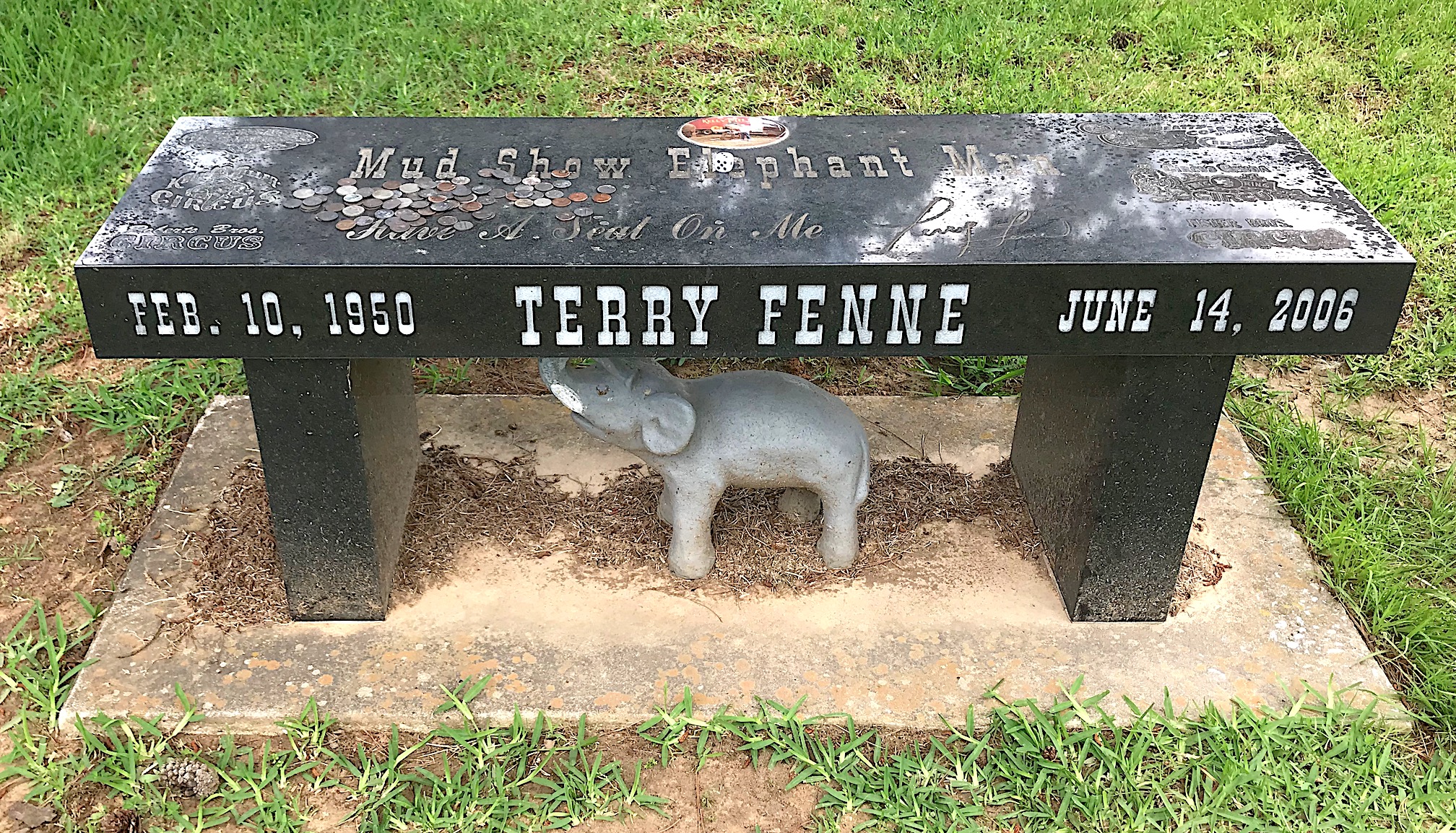
Then there’s Terry Fenne, who has a bench to mark his grave that invites guest to “Have A Seat On Me”. Not only does if feature Terry with one of his elephants, it is embossed with the emblems of the circuses he worked for. Beneath the bench is a little elephant statue. He was known as the “Mud Show Elephant Man”.

Terry Fenne’s bench invites guests to “Have A Seat On Me”.

Kathleen Maca, a fellow taphophile, wrote some detailed posts about Showmen’s Rest. Her site included the following information about Terry. I encourage you to visit her site because it’s a great resource.

Fenne literally ran away from his home in Madison, Wisc. to join the circus at age 14. He worked for six different circuses including: Fisher Brothers Circus, Circus Genoa, Clyde Beatty-Cole Brothers Circus, Roberts Brothers Circus, Kelly-Miller Circus and Carson & Barnes Circus.

Known as the “Mud Show Elephant Man”, he trained elephants and drove the elephant truck across the country for many years. The last few years of his life, he operated an umbrella hot dog pushcart in downtown Paris, Texas, and became a fixture of the town.

Terry Fenne worked with six different circuses over the years.

Terry died at age 56 on June 14, 2006.

Theodore “Ted” Svertesky loved elephants from boyhood. Born in Connecticut in 1954, he ran away to join the circus at age 14 but was returned to his parents. Yet Ted would not be deterred. He returned to the circus at age 17 and never left.

Ted knew he had a prime opportunity to learn from the best and did all he could to do just that, looking to Buckles Woodcock and Fred Logan for their wisdom. His career soared and by 1994, Ted was presenting the Ringling Bros. and Barnum & Bailey Circus elephant act in the show.

Ted Svertesky died doing what he loved, living the circus life.

On Jan. 13, 1994, the Ringling show opened in Tampa, Fla. before heading to St Peterburg, then leaving for Orlando. At 9:08 a.m, due to a broken wheel, 16 cars of their train derailed of which five cars turned on their side. Two people were killed that day, Ceslee Conkling, a 28-year-old circus clown, and 39-year-old Ted Svertesky.

Lastly, let’s visit the grave of Kenneth Ray “Turtle” Benson. Ken wasn’t one for the spotlight. He was thorough and some said, not exactly a fast mover around the big top until showtime. Thus, he earned the nickname of Turtle. Born in Chippewa County, Minn in 1945, he had no interest in being a star. For Ken, it was all about the elephants.

Ken”Turtle” Benson was not known for his speed but he knew how to take care of his elephants.

The poem on his marker was written by a friend, John Herriott. You can read the entire poem in the photo below. I especially liked these lines:

He didn’t have a fancy wardrobe

And never pretended to be a Knave.

In fact, he always looked like he needed a shave.

But a Showman he is for season after season

Because it was the way of life he loved

That had to be the reason.

I love the elephant belt buckle Kenny is wearing in this picture.

Kenny died on Nov. 16, 2001 at age 56. Kathleen Maca’s site says he spent his last years with Roberts Bros. Circus.

Still hungry for some circus stories? Don’t worry, I’ve got more coming in Part III.

Box tomb for Jesse A. Jessen (1922-1987) and his wife, Lorraine Kramer Jessen (1923-2010). The Jessens didn’t get involved in circus life until the early 70s when Jesse became the PR man for the Al G. Kelly and Miller Bros. Circus.

Oklahoma Road Trip 2019: The Sooner the Better at Hugo’s Showmen’s Rest Cemetery, Part I

24 Friday Mar 2023

Posted by adventuresincemeteryhopping in General

≈ 2 Comments

I’ve been eagerly awaiting the day when I would write about Showmen’s Rest, which is part of Mount Olivet Cemetery in Hugo, Okla. It was my goal to wait until I got to this point in the 2019 road trip to do so. There’s so much history to this special place that I want to give it the time and attention it deserves.
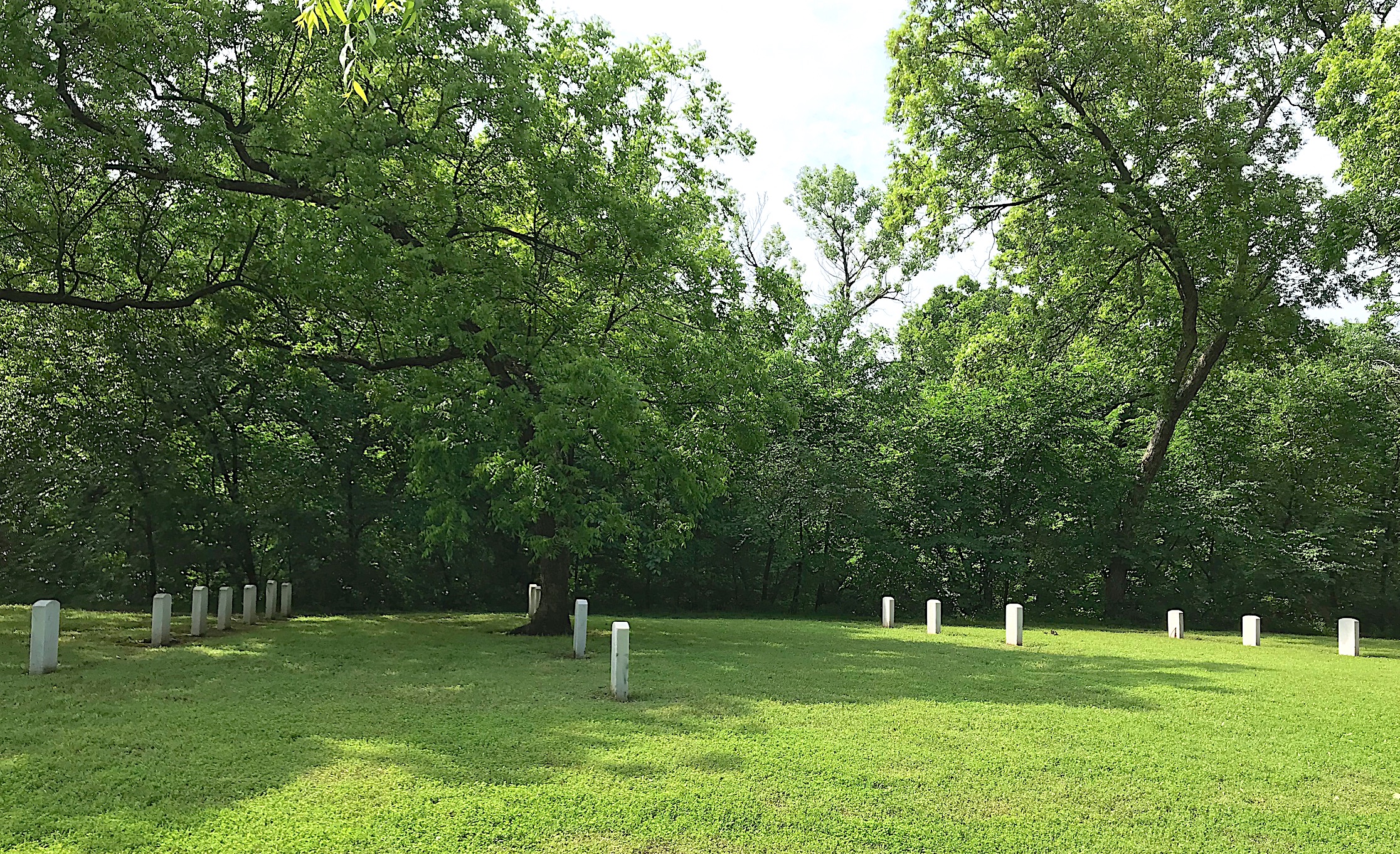
For those following along on a map, Hugo is about 3.5 hours southeast of Lawton.

First, I want to point out that there are other cemeteries where circus folk are buried. There’s a Showmen’s Rest within Forest Park, Ill.’s Woodlawn Cemetery. I visited that one in 2015 when we were in Chicago for the 200th anniversary of the S.S. Eastland disaster. One of Chris’ cousins is buried at Woodlawn. There’s also a Showmen’s Rest in Tampa, Fla.

Showmen’s Rest is located within Mount Olivet Cemetery in Hugo, Okla.

The Showmen’s League of America was formed in 1913 with Buffalo Bill Cody as its first president. The organization purchased the land at Woodlawn in part because of a 1918 circus train wreck that killed an estimated 60 people. Other circus performers have been buried there over the years since then.

Circus City, USA

Hugo became known as Circus City, USA around the 1930s. Many circuses chose to settle in Hugo during the off season and later, many circus folk chose to retire there because they felt at home. Many circus people still live there today. Carson and Barnes Circus is still performing today and winters in Hugo.

Showmen’s Rest in Hugo became a burial place for circus folk around 1960.

Several people have written about how Hugo’s Showmen’s Rest got started. The best explanation I could find came from a Library of Congress blog’s 2018 article by Stephen Winick called “Everybody Works: Documenting Circus Life in Hugo, Oklahoma”.

Since 1960, showmen and women from around the country, not just Hugo, are memorialized at Showmen’s Rest at the Mount Olivet Cemetery. While Hugo circus legend D.R. Miller was responsible for purchasing a large section of plots for the purposes of developing Showmen’s Rest, a man by the name of John Carroll who worked for Carson and Barnes Circus his entire adult life, is also to thank for it. A drifter, he joined the circus as a teenager and remained with the Hugo-based show until his death in 1960. According to D.R. Miller’s daughter, Barbara Miller Byrd, Carroll left a sum of money to Miller, and Miller then developed the idea of Showmen’s Rest.

Undated poster for the Al G. Kelly & Miller Bros. Circus. (Photo Source: Redlandscommunitynews.com)

Dores R. Miller (mentioned above as D.R.) and Kelly Miller were the sons of Obert Miller (1886-1969), who started the family circus in 1937. The brothers’ mother, Jennie Williams Miller, died in 1929. Obert had been a vaudeville and circus performer before that. D.R. and Kelly were his partners in running Al G. Miller and Miller Brothers Circus. D.R. actually performed as a tight rope walker in his younger days.

Eventually, Kelly sold his share of the business to D.R. in 1958, just two years before he died in 1960 at age 46. At the top of his marker are two pouncing tigers with the words “Dun Rovin” between them.

Kelly Miller died in 1960 at age 46. His wife, Dale, lived another 24 years.

Obert Miller died in 1969 at age 83. His marker has the entrance of a theater on it with drama masks.

Obert Keller started in vaudeville in the 1920s before becoming a circus owner in the 1930s.

D.R. Miller lived to the age of 83, dying in 1999. On the front, his grave looks much like his brother Kelly’s.

D.R. Miller’s wife, Isla, preceded him in death by less than a year.

On the back, you can see elephants and a circus tent. D.R. and Jack B. Moore formed a partnership in 1953. Moore had operated the Tex Carson Circus. D.R. leased from Moore tents, equipment and an elephant named Mabel to the show, which later became the Carson and Barnes Circus. You can see the words “Carson and Barnes” on the back of one of the elephants on the marker.

The back side of D.R. and Isla Miller’s marker features elephants.

On the Flying Trapeze

One of my favorite markers is for Grace McFarland, who spent much of her career flying high on the trapeze. She worked with several circuses over the course of her career.

Grace McFarland was also a bareback rider.

Grace Lillian Sykes was born July 25, 1915 in Canada. She was a trapeze artist, aerialist, and bareback rider traveling with Ringling Brothers, Clyde Beatty, James M. Cole, Shine Circus and Tom Mix. She was also the producer of her own show, which was M&M International Circus. Grace’s first husband was Davey McIntosh. After he died, she married Walter “Mac” McFarland.

Grace spent the last 30 years of her life in Hugo, Okla. and died there on Oct. 28, 2016 at age 101.

Grace McFarland lived her last 30 years in Hugo, Okla.

“To Each His Own”

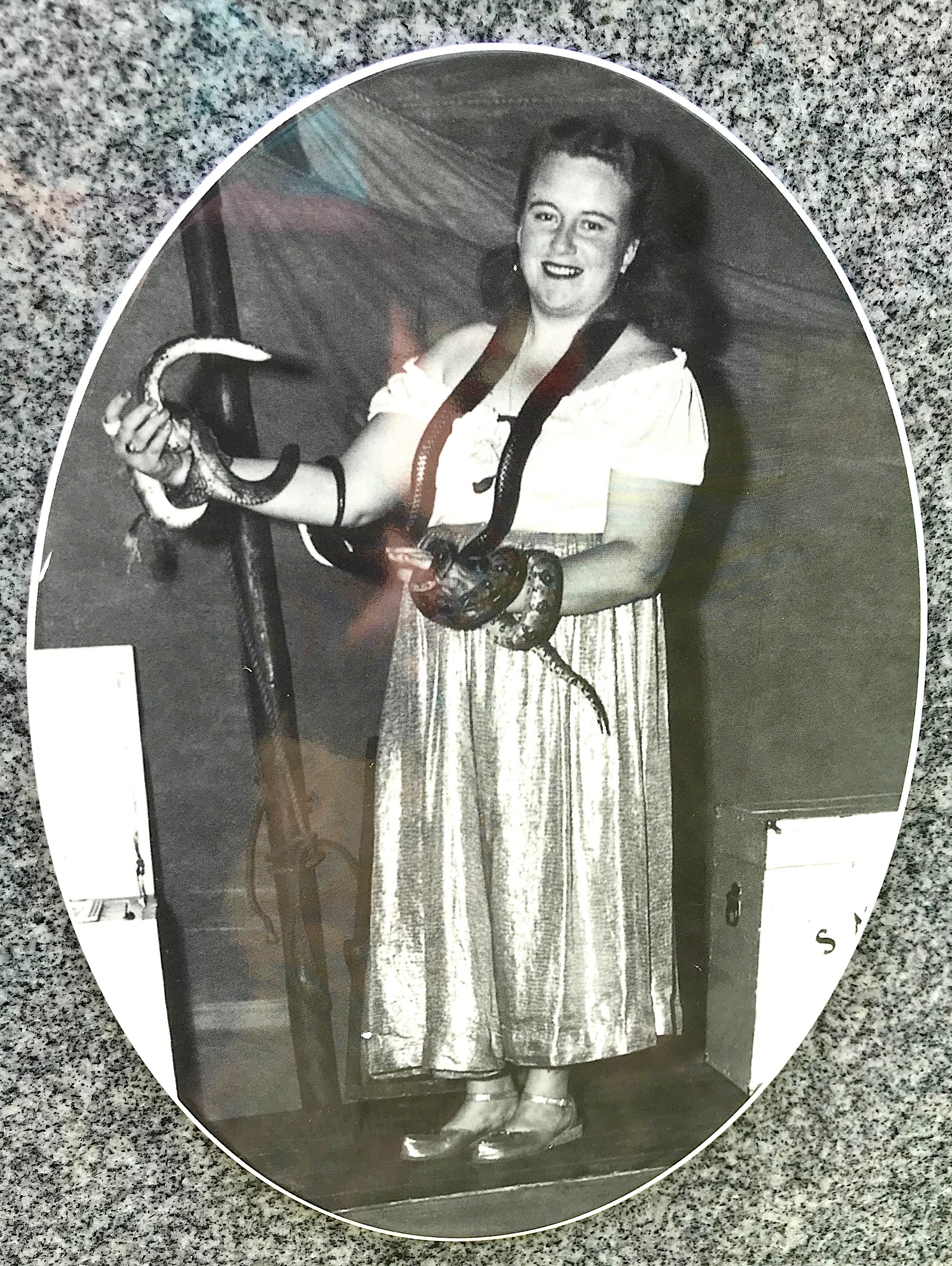
Another one of my favorite markers is for Frances Stokes Loter Padilla. Her marker includes a picture of her handling snakes, one of her many talents. As a girl, she learned fancy rope spinning and practiced doing a contortion routine while balancing a glass of water on her head. WOW!

Frances Loter Padilla is pictured with her many snakes.

After marrying Dick Loter, Frances had seven children who learned to work the shows at young ages. Five of them dropped out of the business, reappearing in tents once in a while to sell novelties and concessions. They worked primarily for the Tex Carson Circus.

The names of Frances’ children, grandchildren, great-grandchildren, and great-great-grandchildren are on the back of her marker.

Frances died in 2003 at age 78.

Chimp Trainer

Bonnie “Jean” Warner’s stone features a photo of her with a chimpanzee. A native of Terra Haunte, Ind., she worked with a number of circuses over the years, including James M. Cole and the Kelly and Miller Circuses. I found a number of pictures of her on Ancestry with her chimps, but she also like to ride a unicycle with the clowns.

Jean is pictured with chimps (right to left) Mitzi, Mr. Mike, and Memo. (Photo Source: Ancestry.com)

I don’t know what year Jean decided to retire, but her last years were spent in Myrtle Beach, S.C. with her husband, Norman. They owned a locksmith shop there. She died on Nov. 6, 1998. Her marker indicates she was born in 1923, making her 75. But her obituary has her birth year as 1933.

Bonnie “Jean” Warner loved working with her chimps.

One Dog and One Pony

One of the tallest markers at Showmen’s Rest is for John “Big John” Strong, founder and owner of the Big John Circus. John started it in Hollywood, Calif. 1948 with his wife, Ruth. “He always wanted to have a circus,” she said. “It was, I think, in his blood.”

“It started with one dog and one pony,” Ruth’s son John Jr. said. Ruth trained the animals, and the young couple took their show on the road. At their winter quarters, elephants grazed under oak trees and Ruth continued to train about 50 animals.

Big John Strong loved the circus life but he also loved people, his family says. (Photo Source: thecircusblog.com)

“It was love and discipline in equal measure,” said daughter Linda, who began riding elephants when she was four.

Ruth knew she wanted to raise her children in the circus. “It was a healthy life,” she said. “Traveling was good for them and meeting different people was very good for them.

John “Big John” Strong was truly larger than life.

John’s marker says a lot about him. At 6′ 5″, he loved stepping into to the circus ring, donning tails and a top hat that made him appear even taller. But he also loved people, Linda said.

“He knew so many people all over the country and he never forgot anybody’s name,” she said. “That’s kind of how he became known as ‘The man with more friends than Santa Claus,’ which he had printed on the sides of his trucks. It became his motto.”

John died on Jan. 6, 1992 at age 71.

There are more stories to share from Showmen’s Rest in Part II.

Jack B. Moore (1919-1969) established the Tex Carson Circus with his wife, Angela. Later, he would partner with D.R. Miller to form the Carson and Miller Circus.

Oklahoma Road Trip 2019: The Sooner the Better at Lawton’s Pecan Cemetery

17 Friday Mar 2023

Posted by adventuresincemeteryhopping in General

≈ 1 Comment

Pecan Cemetery would be my next to last cemetery stop in Lawton. I did visit one more but it was a very brief one and I didn’t take enough photos to make it “blog worthy”, so to speak.

The gates of Pecan Cemetery let you know at once that it was established in 1906 when the land was still called Oklahoma Territory. Statehood would come a year later.

Pecan Cemetery was established in 1906.

According to Find a Grave, Pecan Cemetery has a little over 500 memorials recorded. It’s not a very big cemetery but it appears to be well cared for by the locals. The gates look fairly new. That’s the extend of my knowledge about it.

Mother and Son

Seeing a grave marker for a mother and son is not unheard of, I’ve seen several. But I’m always curious to know what the story is behind one.

Born in 1876 in Wisconsin, Emma married German immigrant Frank Penskofer around 1896. I have seen her maiden name listed as both Tank and Faulk/Fauk. By 1910, the couple was farming in Painter, Okla. with their seven children. The township wasn’t far from Lawton.

On July 14, 1910, Frank and Emma’s oldest son, Warren, died at the age of 13. Try as I might, I could not find out what his cause of death was. I couldn’t find an obit for him.

Walter Penskofer was only 13 when he died in 1910.

In 1912, at age, 36, Emma gave birth to her eighth child, also named Emma, on Jan. 21, 1912. Emma (the mother) died two weeks later on Feb. 6, 1912. Her obituary said it was from blood poisoning but today it would be called postpartum sepsis. It still happens today. According to the CDC, sepsis is the second leading cause of pregnancy-related deaths.

According to her obituary, Emma’s funeral was conducted by Rev. E. C. Deyo, who founded the Deyo Mission Chapel I talked about a few weeks ago.

Frank remarried in 1913 to Annie McDonald, who passed away in 1915. He waited several years to remarry to twice-widowed Allie Amanda Thurman Smith Lockhart in 1931. Frank was about 20 years older than Allie. He died in 1954 and Allie die in 1976. They are buried together at Pecan Cemetery.

“Dropped Dead”

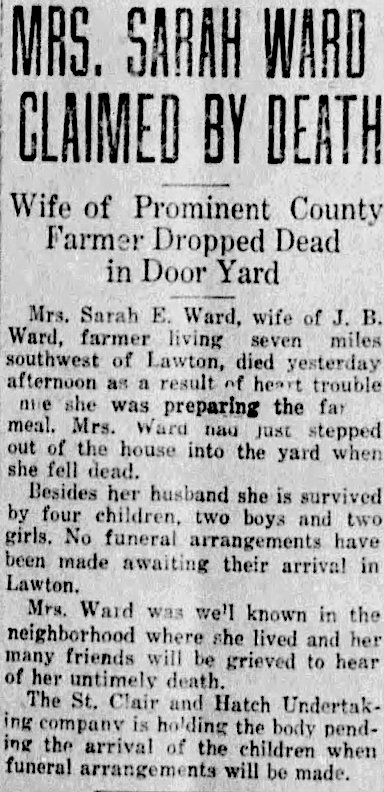
In researching the grave of Sarah Ward, I encountered a phrase that I continue to find in obituaries from this era: “dropped dead”. I have yet to discern why newspapers used these words when they could have simply said “died”. Maybe they thought more people would buy the newspaper to find out why with a headline like that.

Born in Tennessee, Sarah Elizabeth McKrackin married Missouri native James Ward in 1888. Contrary to what her initial obituary said, the couple had nine children together. I’ll let you read how the newspaper described her last hours. She was 57 when she died on Nov. 19, 1925.

According to this newspaper article, Sarah Ward was preparing a meal and after walking outside, suddenly fell down and died.
Sarah’s husband, James, moved from Oklahoma to New Mexico not long after she died.

At the time of Sarah’s death, her children were grown and many had moved away. Her husband, James, moved to Roswell, N.M. to be near his daughter Beulah. He died there in 1946. His obituary states that many of his children moved there to be near him. He is buried in Roswell at South Park Cemetery.

Homemade Stones

Pecan Cemetery has some interesting homemade markers. I’m always intrigued by the anonymous individuals who take this kind of task on, adding their unique style. It can’t be easy.

The marker for Josephine “Josie” Wilson Crook features a large star and even has a footstone behind it with her initials “JMC”.

Who carved Josie Crook’s grave marker?

Josie married Richard Crook about 1913 in Oklahoma. They were the parents of three children, Marvin, Leroy, and Francis. She was only 42 when she died on March 4, 1929. Her youngest child, Francis, was only 10. I’m not sure where her husband is buried but her parents are buried in Pecan Cemetery in unmarked graves.

I could find no information at all about poor William A. Carter, who only lived one day. He died on April 18, 1918. His marker says he is the “son of Mrs. Ollie Hough” but there are no other Houghs in the cemetery. The other Carter buried there does not appear to be related to him.

Little William Carter only lived one day.

If you were looking only at the stone of Vilas Mitchell, you would find out nothing beyond his name. Fortunately, his Find a Grave memorial included an obituary from the Lawton Constitution that said he died 12 miles south of Lawton on Nov. 15, 1919 at the age of 16. I learned he was the son of Frank and Nora Mitchell, and was one of their several children. I think he’s the only one of the Mitchell family buried at Pecan Cemetery.

Villas Mitchell came from a large family.

There are two Harris markers at Pecan Cemetery. One simply says “Harris” and the other “Bobbie Ray Harris”. Again, I am thankful to the Lawton Constitution for reporting that Bobbie Ray was the six-week-old son of Mr. and Mrs. Dan Harris. He died on June 28, 1932. It’s my guess that the other Harris grave marker is for a sibling.

Bobbie Ray Harris died in 1932.

A Double Murder

Up to this point, my research about those buried at Pecan Cemetery had been pretty tame. Then I looked up Howard Owen Reynolds and that abruptly changed.

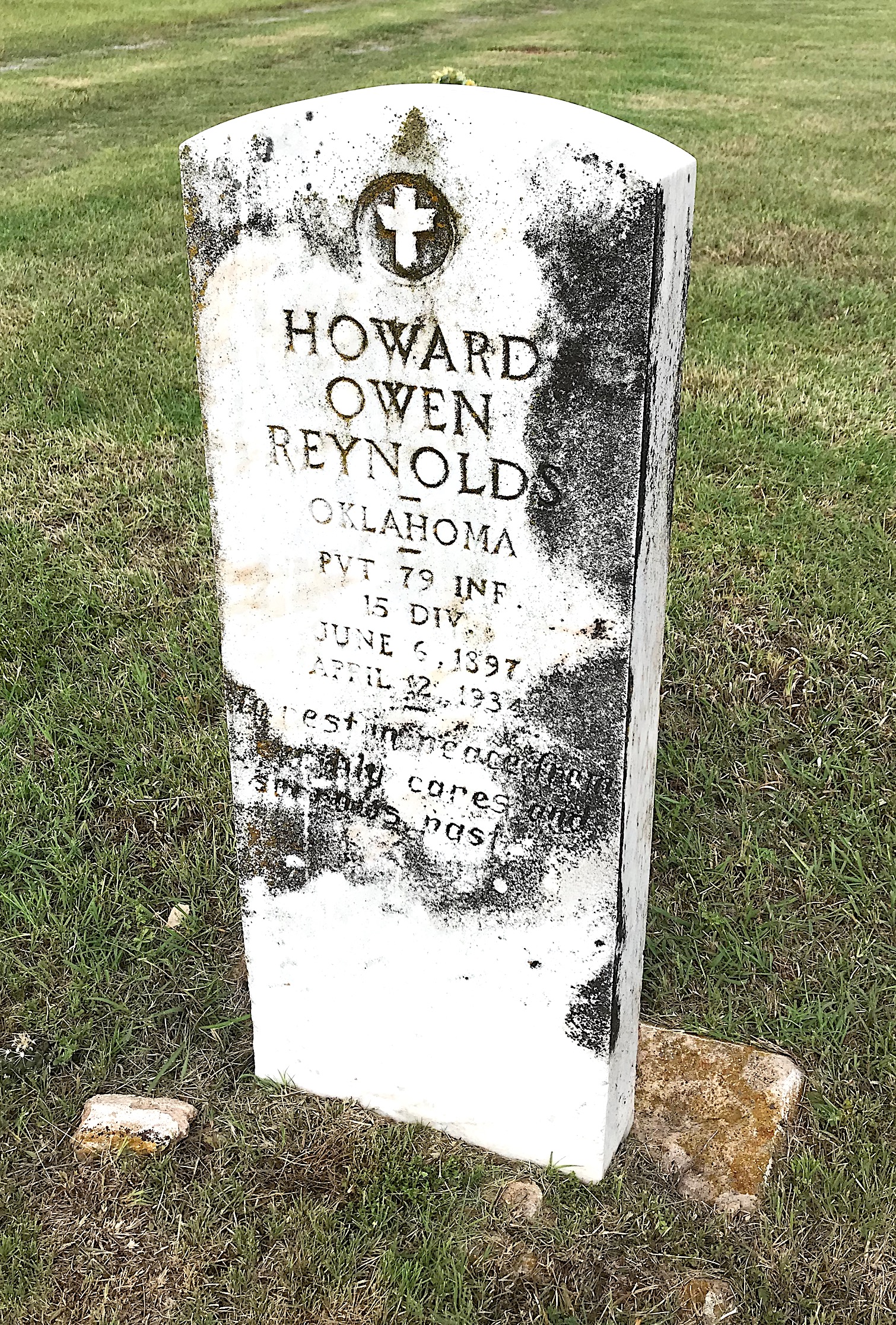
Born in 1897, Howard and his family moved from Illinois to Lawton when he was about six. He was one of several siblings. Howard served in the 79th Infantry, 15th Division during World War I. In 1925, he married Augusta Littlepage. He was 28, she was 18.

It may have already begun but after that, his life began to unravel. According to a family tree on Ancestry.com, someone had written that by 1928, “His profession when not committing crimes and engaging in adultery was barbering.” The 1928 Lawton business directory confirms he was a barber. The 1930 U.S. Census has him residing in the Comanche County Jail. Howard and Augusta divorced that year and she went to live with her parents. They had no children that I know of. Perhaps it was for the best considering what happened later.

A love triangle exploded in murder on April 12, 1934, ending in the death of Howard Reynolds and Faye Hennessee.

Howard was keeping company with Faye Hennessee, the estranged wife of 58-year-old Jim “Peck” Hennessee in March 1934. She was Jim’s third wife and they had five children together, two others dying in infancy. Her situation must have been dire because she was living in a tent on the edge of town with the children. Howard was out on bail, awaiting action on a burglary charge.

Sometime on April 12, 1934, Howard and Jim Hennessee got into a physical fight at the tent where Faye and the children lived. Later that day, Jim returned with a gun and found Howard sitting in a car with Faye and Howard’s brother, Hughey. Howard and Faye jumped out of the car and ran, and Jim shot at them. Hughey remained in the car but was also injured. Howard and Faye lay dead in the road. Hughey survived and went on to later testify against Jim. Fortunately, none of the Hennessee children were injured.

At first, Jim denied he’d had anything to do with the murders. Hughey said otherwise. Eventually, Jim confessed but claimed he had shot at Howard in self defense and had not realized he was also firing his gun toward his estranged wife. Jim was charged with murder.

Howard Reynolds was 36 when he was killed by a jealous husband.

Jim was first tried for Faye’s murder and the jury lowered the charge to voluntary manslaughter, with a sentence of 10 years. He was due to stand trial for Howard’s death after that. I do know he appealed the sentence for Faye’s murder but it was upheld.

I believe Jim was sentenced to an additional 10 years for Howard’s murder because the next news article I found reported that after serving 13 months of his 20-year sentence, Jim was paroled in May 1937 due to illness. He had served his time at McAlester Penitentiary, now known as Oklahoma State Penitentiary. That made me very curious as to where Jim Hennessee landed after his parole.

Jim Hennessee spent the last eight years of his life in the Central State Hospital Annex in Alderson, Okla. (Photo source: Lawton News-Review, May 6, 1937)

According to Ancestry, Jim was an inmate at the Central State Hospital Annex in Alderson, Okla. in 1940. That’s not far from the McAlester Penitentiary but about three hours east of Lawton. In 1953, it became Griffin Memorial Hospital, a 120-bed acute psychiatric hospital that’s still in operation today. I did learn that Central was where the criminally insane were housed so I’m guessing Jim Hennessee was found mentally ill.

Jim Hennessee died on March 10, 1945 and is buried in an unmarked grave in the Central State Hospital Annex Cemetery in McAlester. Faye Hennessee, his estranged wife and victim, is buried at Pecan Cemetery with two of her adult children.

Having read all this, I felt for the families destroyed and the lives lost, regardless of their actions. This took place during the Great Depression, in the throes of the Dustbowl days when life was especially hard in the Sooner State. When living in a tent wasn’t out of the ordinary and trying to survive on the edges of society was the norm for many.

On the Road to Hugo

I went to pick up Sarah after that. The next day, we headed east to begin our trek back to Georgia. Our next stop was Showman’s Rest at Mount Olivet Cemetery in Hugo, Okla. You won’t want to miss that.

Farewell to Lawton.

Oklahoma Road Trip 2019: The Sooner the Better at Lawton’s Deyo Mission Cemetery, Part II

10 Friday Mar 2023

Posted by adventuresincemeteryhopping in General

≈ 3 Comments

Last week, I shared the origins of Lawton, Okla.’s Deyo Mission Church and Deyo Mission Cemetery, along with stories about some of those buried here. I’ve got a few more I wanted to pass along today. So let’s get started.

Chief Paddyaker

Doing research for the graves I photographed at DMC was a bit of a challenge sometimes because of the Native American names. Many had more than one and sometimes they were spelled differently on their marker. That was the case for Par-Ri-Eck-I-Vit, who has an above ground tomb with a larger monument in front of it.

When I looked up his memorial on Find a Grave, I realized that Par-Ri-Eck-I-Vit was more commonly known as Chief Paddyaker. This was the uncle of Wickkie, who I told you about last week. She was the wife of John Tabbytite, a member of Troop L of the Seventh Cavalry of the U.S. Army.

Chief Paddyaker, or Par-Ri-Eck-I-Vit, was a Comanche leader. He died in 1927.

Chief Paddyaker was a Comanche, and his birth year appears as either 1843 or 1853. His 1927 obituary states that: “Paddy Aker [I have seen it spelled different ways] was one of the old-time Indians, was here when Lawton was founded, has always proved himself a friend of the white race. He professed conversion and united with the Deyo Missionary Baptist Church about 20 years ago.”

It’s not easy to read the front of Chief Paddyaker’s monument because of the grain of the stone.

The grave of Iolene Paddyaker is nearby, a child who only lived six years and died in 1924. She was the daughter of Benton Dudley Paddyaker, who was related in some way to Chief Paddyaker.

Iolene Paddyaker was only six years old when she died.

Kosepeah

I always enjoy seeing gravestones with portraits on them, and the one for Kosepeah is no exception. She looks like a wise woman who saw much in her life. I could find little about her but she is related to the Red Elk family. If her marker is any indication, she was born around 1867.

Little is known about Kosepeah.
Kosepeah’s stone indicates she was 80 when she died.

On Find a Grave, I saw that Kosepeah had two husbands, Kiowa George Ate-Te-Wuth-Take-Wa (who died in 1901) and Po-Ah-Way (who died in 1914). Both are buried at DMC. Beside Kosepeah is her grandson Clifford Red Elk. Clifford, born in 1918 (I think) was the son of Walter Red Elk and Charlotte Tah-Hah-Wah.

According to his obituary, Clifford attended the Fort Sill Indian School later switched to the Chilocco Indian School near the Kansas border. He drew a lot of attention for his boxing abilities. One article I found said he was “rated as one of the best 118-lb. Golden Glove prospects in Oklahoma” at the time of his death.

Why does Clifford Red Elk’s grave marker have a death date that is nine months after his actual death?

According to several articles I found, he died of tuberculosis in late February 1938. Yet his grave marker has a death date of Dec. 27, 1938 for him. That makes no sense to me. Was there some kind of mix up with the carver? I honestly don’t know. Regardless, Clifford’s life ended much too soon.

Mystery Graves

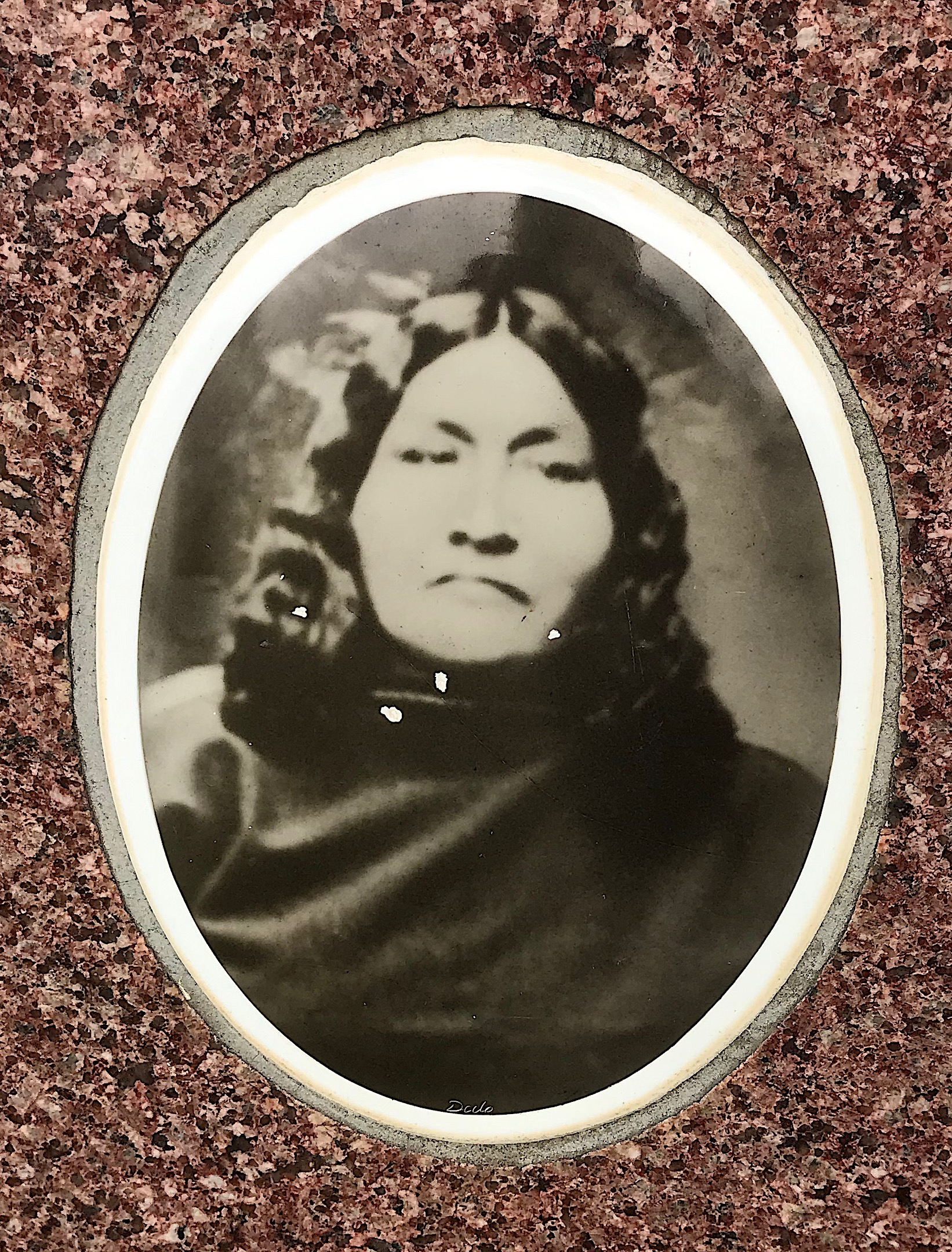
In some cases, I could find absolutely nothing about the deceased. Cooseronah is a good example of this. She has a beautiful stone with a portrait. But there was no information about her that I could use to shed light on her past.

Cooseronah would have been born around 1870.
Who was Cooseronah?

The grave for this baby was another mystery. She only lived four months, dying in April 1901. Who were her parents?

This is the only remaining record of this child.

I saw four different flat squares that are all marked “Tosee Baby” with no date. This is just one of them.

One for “Tosee Baby” markers at DMC.

The Maddox Sisters

I found two sisters buried beside each other at DMC. Of Comanche heritage, Lucele and Matilda Maddox were close in age and attended the Fort Sill Indian School on the reservation. Their parents were George Maddox and Eck-Ah-Sy (Grace) Maddox. They had several siblings. Two of their brothers served in the military.

I learned from the Encyclopedia of Oklahoma History & Culture:

First established as a Quaker boarding school in 1871, the Fort Sill Indian School became a nonsectarian institution in 1891 and remained so until closing in 1980. During its long history the school expanded from one building to 30. Its enrollment increased from 24 in its first year to more than 300 in the 1970s, and the number of employees on its payroll went from two in 1871 to more than 75 a decade later. Because the school was located near Lawton, before World War II Fort Sill’s student body was made up largely of Indians from western Oklahoma — Comanche, Apache, Caddo, Kiowa, Delaware, and Wichita.

The Fort Sill Indian School buildings were abandoned but still exist. You can read more about there here.

Undated picture of the Fort Sill Indian School.

Born in 1890, Lucele Maddox would have been 17 or 18 when she died on Oct. 4, 1908. I don’t know her cause of death.

Lucele Maddox was attending school when she died in 1908.

Mathilda Maddox, born in 1891, would have also been around 17 or 18 when she died on July 17, 1909.

Matilda Maddox died about eight months after her sister.

It was terrible blow for their parents. Just a few months before Lucele died, their infant daughter Daisy had passed away.

Daisy Maddox only lived a year and four days.

George Maddox died in 1920 at age 56. He is buried near his daughters. I did not see Grace Maddox’s grave but she is likely buried there as well.

Missionary to the Comanches

Mabel Moon Gilbert was not a Comanche. She was a white woman. But she had a heart for the Comanche and it appears they loved her back.

Born in Fairfield, Ill. in 1885, Mabel graduated from Shurtleff College in Alton, Ill. in 1904. It was later absorbed by Southern Illinois University. After that, she taught for three years in American mission colleges. She married Hervey F. Gilbert in 1911 and the pair both attended the Rochester Theological Seminary. They served as missionaries to Africa in 1913 but returned in 1916 due to Mabel’s health. Mabel and Hervey moved to the Lawton area in 1920. They had three children together, one dying in infancy.

Hervey and Mary Gilbert moved to Oklahoma to minister to the Comanche in 1920. (Photo Source: Ancestry.com)

I don’t know her cause of death but Mabel died at home on Jan. 17, 1929. She was 43. Her funeral service included both whites and Native Americans. Below is a newspaper account of that unique event that I found very interesting. Mabel had clearly made an impact among both whites and Native Americans in the four years she lived in Oklahoma.

Mabel Moon Glibert’s funeral was quite unique but reflective of those whose lives she touched. (Photo source: The Walters (Okla.) Herald, Jan. 24, 1929.

Note that in the article, it says Mabel was buried at the IOOF (Independent Order of Odd Fellows) Cemetery. Yet she is buried at the Deyo Mission Cemetery. It would make sense for her to be at DMC due to her love of the Comanche. Is it possible she was buried there first but later moved to DMC so she was closer to the people she loved?

Rev. Hervey Gilbert remarried to Ruth Long. He died in 1963 and is buried at Pomona Valley Memorial Park in Los Angeles, Calif.

It was time to start heading back to pick up Sarah. But I wanted to stop at nearby Pecan Cemetery on the way there. Please meet me there for my next adventure.

Oklahoma Road Trip 2019: The Sooner the Better at Lawton’s Deyo Mission Cemetery, Part I

03 Friday Mar 2023

Posted by adventuresincemeteryhopping in General

≈ 3 Comments

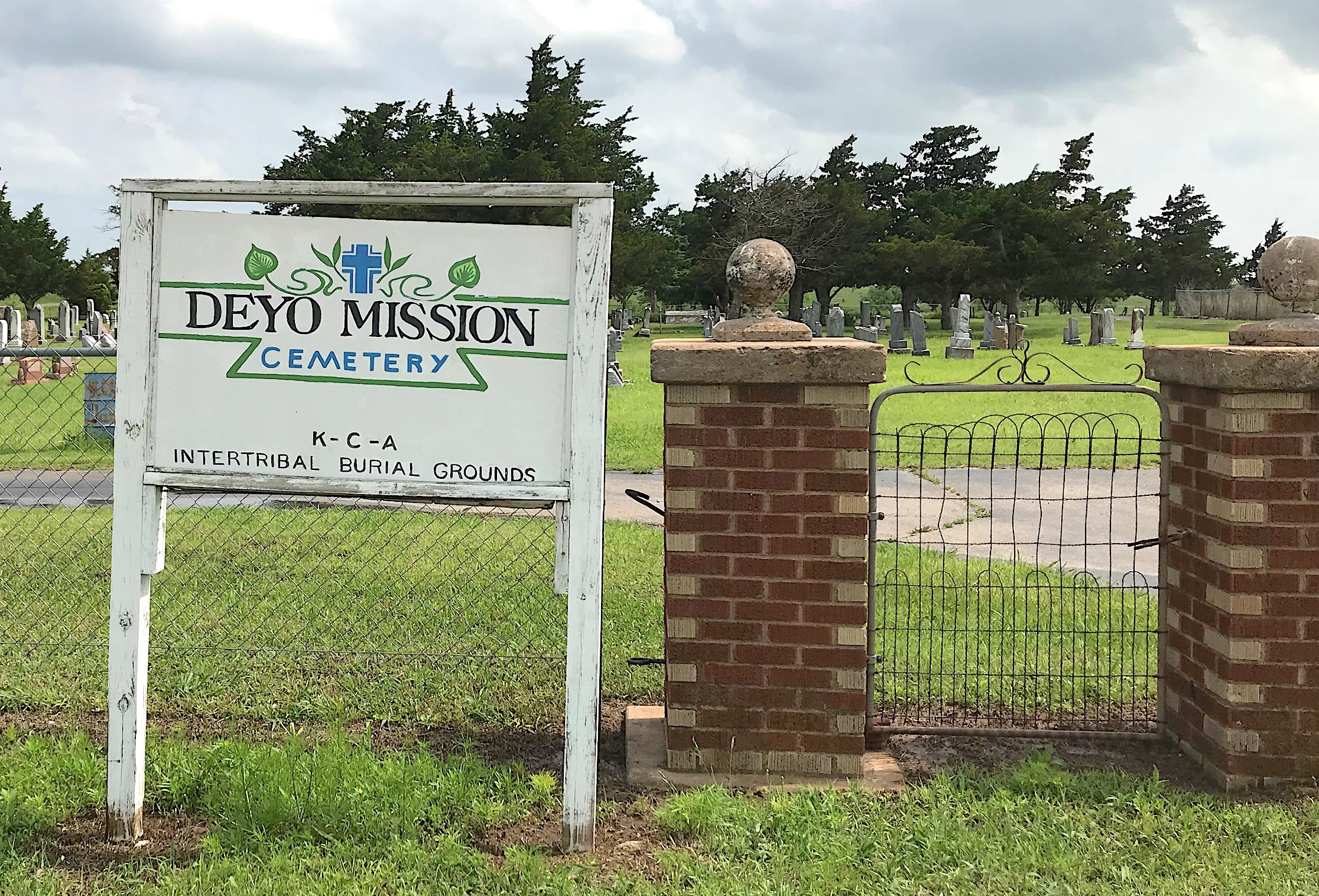
Sarah wanted to visit some of her Lawton relatives so I dropped her off so she could do that. I decided to head over to the Deyo Mission Cemetery (DMC) that wasn’t far away. DMC is located a bit west of town. It’s another one of the KCA Intertribal Burial Grounds cemeteries.

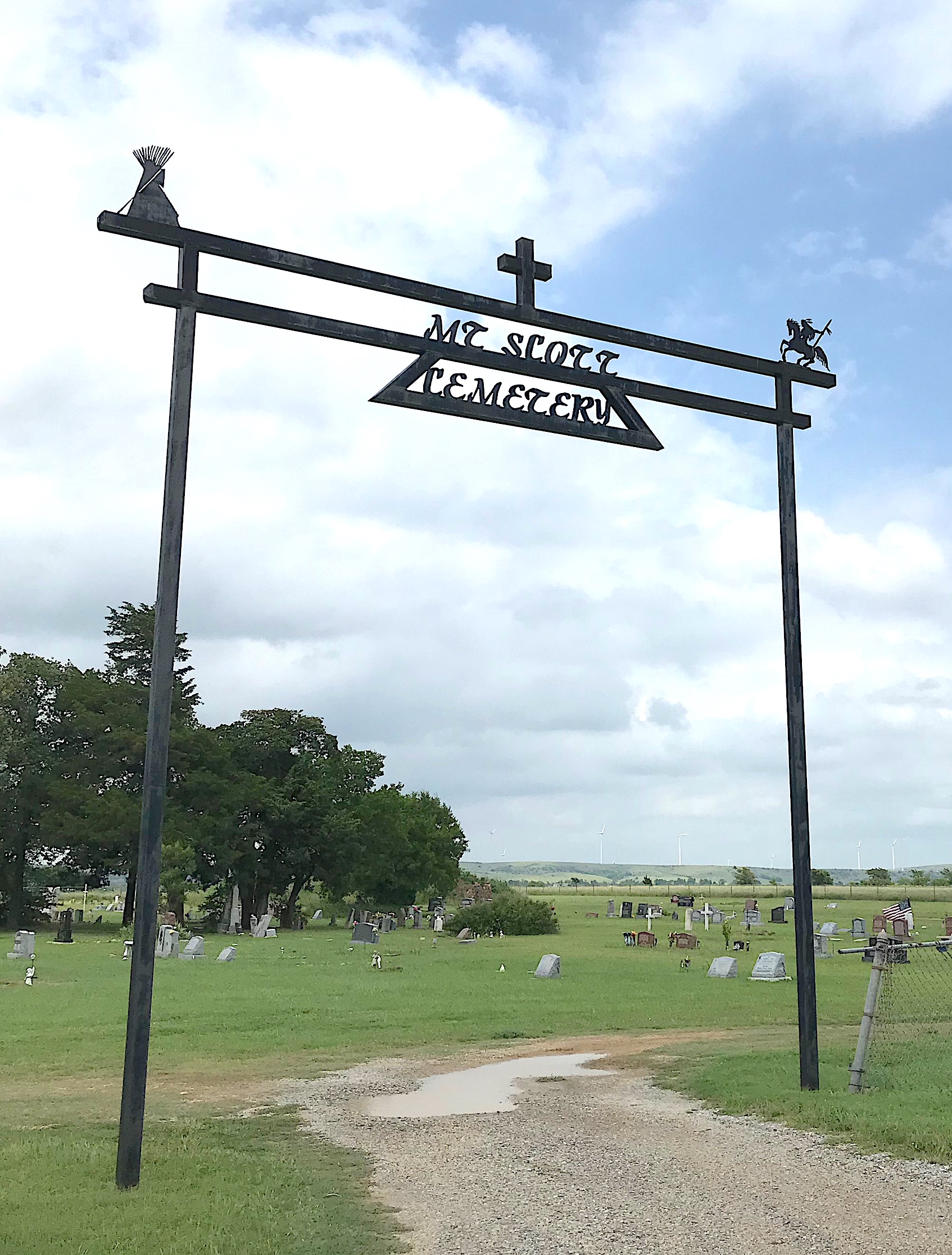
The style of the Deyo Mission Cemetery sign is similar to the one for Mount Scott Cemetery, which I did not photograph.

The Deyo Baptist Church is to the right of the church’s parking lot. Because they were having an activity that day and members were present outside, I didn’t photograph it. So I headed over to the cemetery, which is on the far left side of the parking lot.

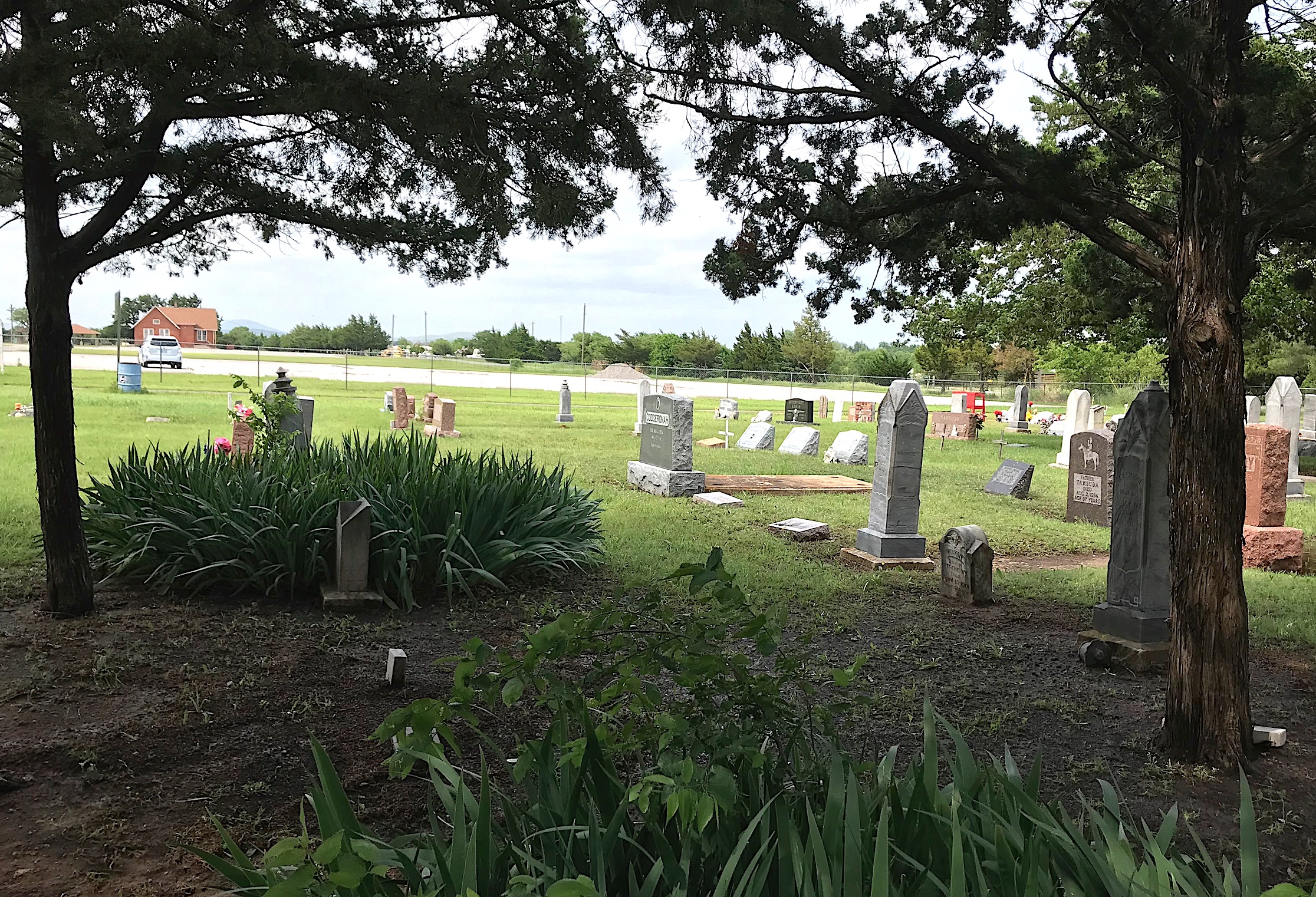
As you can see, it was a wet afternoon when I stopped by.

Deyo Mission History

The Deyo Mission’s history was documented online, thankfully. I don’t always get that lucky. Here’s what I found in The Encyclopedia of Oklahoma History and Culture (EOHC):

The Deyo Mission, also called the First Comanche Mission, was established by Elton Cyrus Deyo in late winter 1893 near Cache. Deyo, a Baptist and 1893 graduate of the Colgate Theological Seminary, arrived at the Kiowa-Comanche-Apache Reservation in October 1893 with his wife, Anna. The Comanche gave them a cool reception. Indeed, church construction began at three or four different sites before the Deyos finally found one that was acceptable to the Comanche (five miles east and two miles south of Cache). Formally organized in November 1895, the congregation struggled in its first years, and the Deyos claimed only 13 Comanche converts by 1901. Between 1902 and 1911, however, Deyo converted 150, with 36 in 1903 alone.

E. C. Deyo was also an outspoken promoter of development in the region, and he gained a reputation for supporting the opening of reservation lands to non-Indians on the grounds that it would hasten the conversion of the Comanche. He reported his own efforts “to prepare the Comanche to meet his God, and dwell with him in heaven forever,” and he looked forward to the time when “these broad prairies may be settled by industrious Christian whites, who will help to roll onward the Grand Old Gospel Car.”

The Deyo Mission, now the Deyo Baptist Church, has been in continuous use since its founding and since the middle of the twentieth century has had a succession of Comanche pastors. Like many other Indian churches, it has often provided Comanche a way to maintain elements of their traditional culture through the use, for example, of native hymns.

Deyo Mission Chapel photo from 1938. (Photo source: EOHC website, Grant Foreman Collection, OHS)

I’m not sure how most people, Native American or white, would feel today about E.C. Deyo’s philosophy on converting Native Americans. Regardless, the church seems to be thriving and is an integral part of the community. Pictured above is the first building of the Deyo Mission, borrowed from the EOHC website. Today, it is a brick building.

Find a Grave reports about 770 memorials for Deyo Mission Cemetery. It looks like it has more than that there. But what I did see was fascinating. In the picture below, on the left behind Sarah’s car, you can get a glimpse of the side of the church with Mount Scott in the background.

If you look to the left, behind Sara’s car, you can see the side of Deyo Baptsit Church and Mount Scott just to the right of it.

“Sun Rays Shining Through the Clouds”

If you go looking for information on John Tabbytite, you won’t find much. There’s an article about him on JSTOR.org about him but you have to pay money to read it. Fortunately, I found a 1960 newspaper article about him in The Lawton Chronicle that helped me. His Comanche name means “Sun Rays Shining Through the Clouds”.

Born on August 2, 1872 in Texas, John Tabbytite belonged to the Seventh Cavalry, Troop L. You might remember that group from my post a few weeks back about Fort Sill’s Apache South Cemetery. Clarence Bailsto was a member, along with many Apache and Kiowa. The article says John’s father, Hoawah, was a Spaniard captured by the Comanche in the 1840s, and his mother was half Comanche, half Crow. His family ended up in Oklahoma on the reservation and John worked on a nearby ranch. But he longed for a better life.

In December 1960, the Lawton Chronicle featured John Tabbytite. He is pictured here with his wife, Wickkie. (Photo source: The Lawton Chronicle, Dec. 11, 1960)

When he was 18, John and one of his cousins joined the all-Native American Troop L of the Seventh Cavalry, led by Lt. Hugh Scott. Scott was well respected by Native Americans. John and the soldiers drilled and learned marksmanship.

According to John, he was among the soldiers when Geronimo and the Apaches moved from Mount Vernon Barracks in Alabama to Fort Sill. In fact, John was the first soldier among Troop L to ride up to Geronimo to welcome him to Fort Sill. It was not a task he was happy about due to Geronimo’s reputation. He described him as a “tough, mean looking old man.”

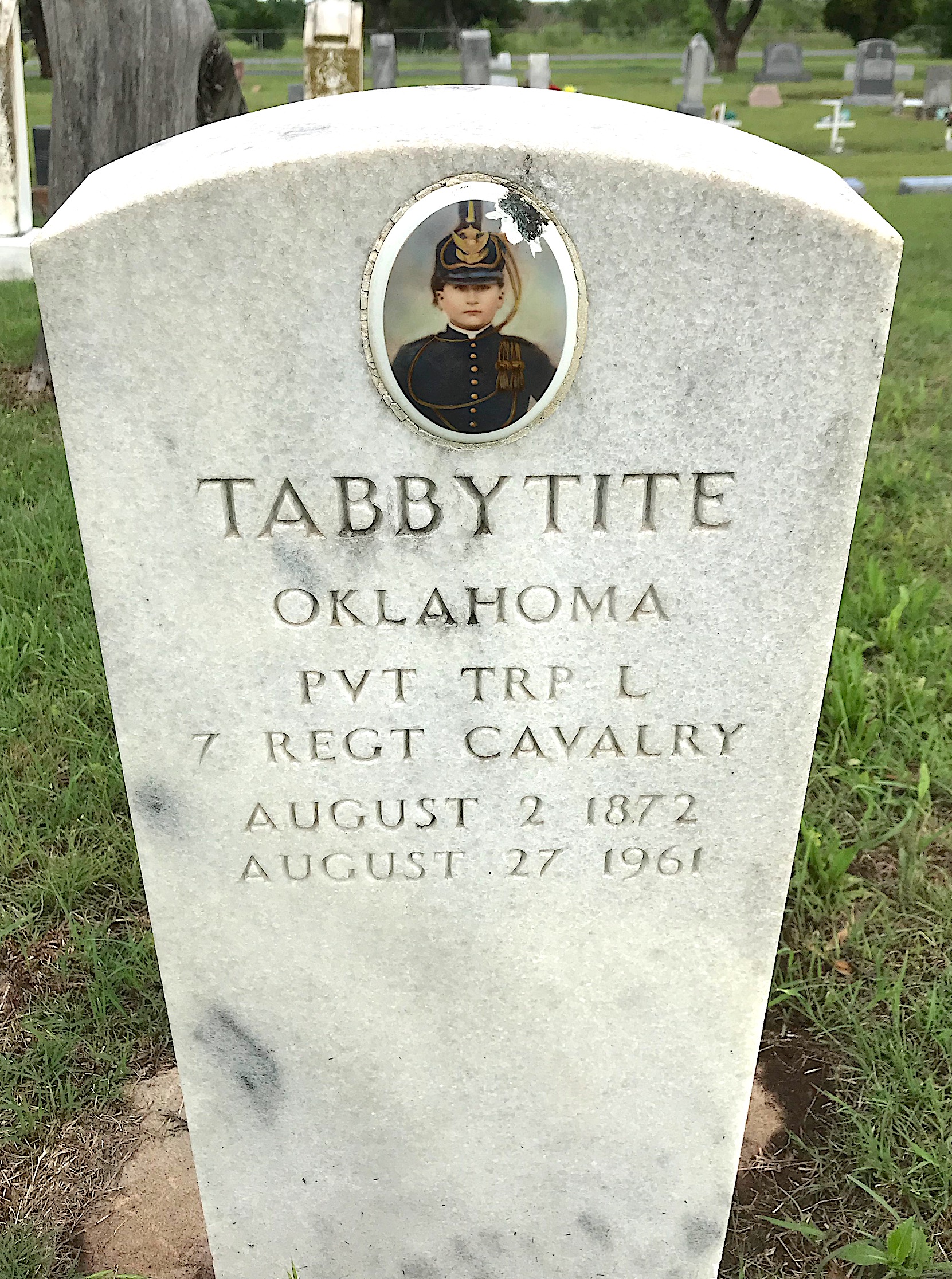
John Tabbytite was proud to wear the blue and gold uniform of Troop L of the Seventh Cavalry. I believe this photograph has had paint added to it to highlight the colors.

John enjoyed his days in Troop L, living in the barracks as a single man. Married soldiers lived with their families on the reservation. The Troop disbanded in 1897. John would eventually marry his wife Wickkie, at the Deyo Mission Chapel (as it was called then). She was living with an uncle when he met her, Comanche Chief Paddyaker. John became a farmer, working the land alotments he acquired over the years, and eventually farmed over 1,000 acres in the Cache Creek area. The Depression nearly wiped him out but he and Wickkie survived.

When John died on Aug. 27, 1961, he was 89. He was also the last surviving member of Troop L.

Grave marker of John Tabbytite, who was a private in Troop L of the Seventh Cavalry Regiment.

Buried beside John is his and Wickkie’s son, Lester Tabbytite. Born in 1929, Lester served in the 97the Signal Battalion during World War II. He returned home to Lawton after the war. Sadly, he died on Feb. 4, 1947 from injuries sustained in a car accident. He was only 20 years old.

Lester Tabbytite survived World War II only to die in a car accident after he returned home.

Wickkie Tabbytite died in 1977 at age 93. I found an article that said she traveled to Washington, D.C. in 1965 to visit her granddaughter, Ladonna Crawford, who was then the wife of Oklahoma state senator Fred Harris. It was Wickkie’s first plane ride. President Lyndon Johnson’s wife, Lady Bird Johnson, whom Wickkie had met the year before during a campaign stop in Oklahoma, gave her a tour of the White House. Wickkie is buried at DMC but I didn’t get a photo of her grave.

Wife of Quanah Parker

Quanah Parker, whose grave is at the Fort Sill Post Cemetery, had several wives. I was surprised to find one of them buried at DMC.

I could find little information about To-Nar-Cy. There was a HistoryNet.com article I tried to access but again, payment was required (sigh) so I skipped it. All I could see was that the article alleged that she was “considered “the “show wife” who often traveled with him”. Certainly she was much more than that. I believe she may have been sixth out of the seven wives he married. She and his last wife, To-pay, were living with him when he died in 1911.

To-Nar-Cy died at age 66 in 1931. Her birth year is not exact.

Undated photo of Quanaha Parker and one of his wives, To-Nar-Cy.

I was able to find out more about her monument thanks to a June 14, 1953 article in the Daily Oklahoman. A woman who knew her as a child, Lena Banks, was already concerned about the fact Quanah only had a wooden cross to mark his grave at the Fort Sill Post Cemetery. I didn’t know until I read this article that Lena wrote to four senators asking for help. Thanks to her efforts, the senators gave $1,500 to pay for the obelisk that now marks his grave.

Lena wasn’t aware that To-Nar-Cy’s grave at DMC was also unmarked for many years. When she did, she contacted her friend’s family members to ask what might be done. The wheels were set in motion and the marker, which is pictured below, was placed on Memorial Day 1953.

To-Nar-Cy died on June 27, 1931 after a long illness.
To-Nar-Cy did not have an easy life after the death of Quanah Parker in 1911.

Wookvitty Lucio

Another Native American grave marker got my attention. Wookvitty Lusio’s marker has her last name spelled “Lusio” but when I went to find information on her, I came up empty. I found her listed as Wookvitty Lucio instead. I think that’s the correct spelling.

Wookvitty Lusio’s last name is spelled Lucio in her obituary.

Born in 1864, she married Tomas Lucio in 1919 at age 50. I don’t believe she had any children. She was an active member of the Deyo Mission Chapel for many years. According to her obituary, she took part in Lawton’s anniversary celebrations ever year, wearing her buckskin attire.

(November 2024: A kind reader named Anna sent me this note:

Wookvitty Lucio was the mother of Emma Coathty, the only child that survived to adulthood. Emma Coathty Hoawah had 7 children. One of them was Linn Hoawah Mihesuah who is my grandmother’s mom.)

Wookvitty Lucio in her younger days.

Join me next time for Part II of my visit to Deyo Mission Cemetery.

Oklahoma Road Trip 2019: The Sooner the Better at Meers’ Mount Scott Cemetery

24 Friday Feb 2023

Posted by adventuresincemeteryhopping in General

≈ Leave a comment

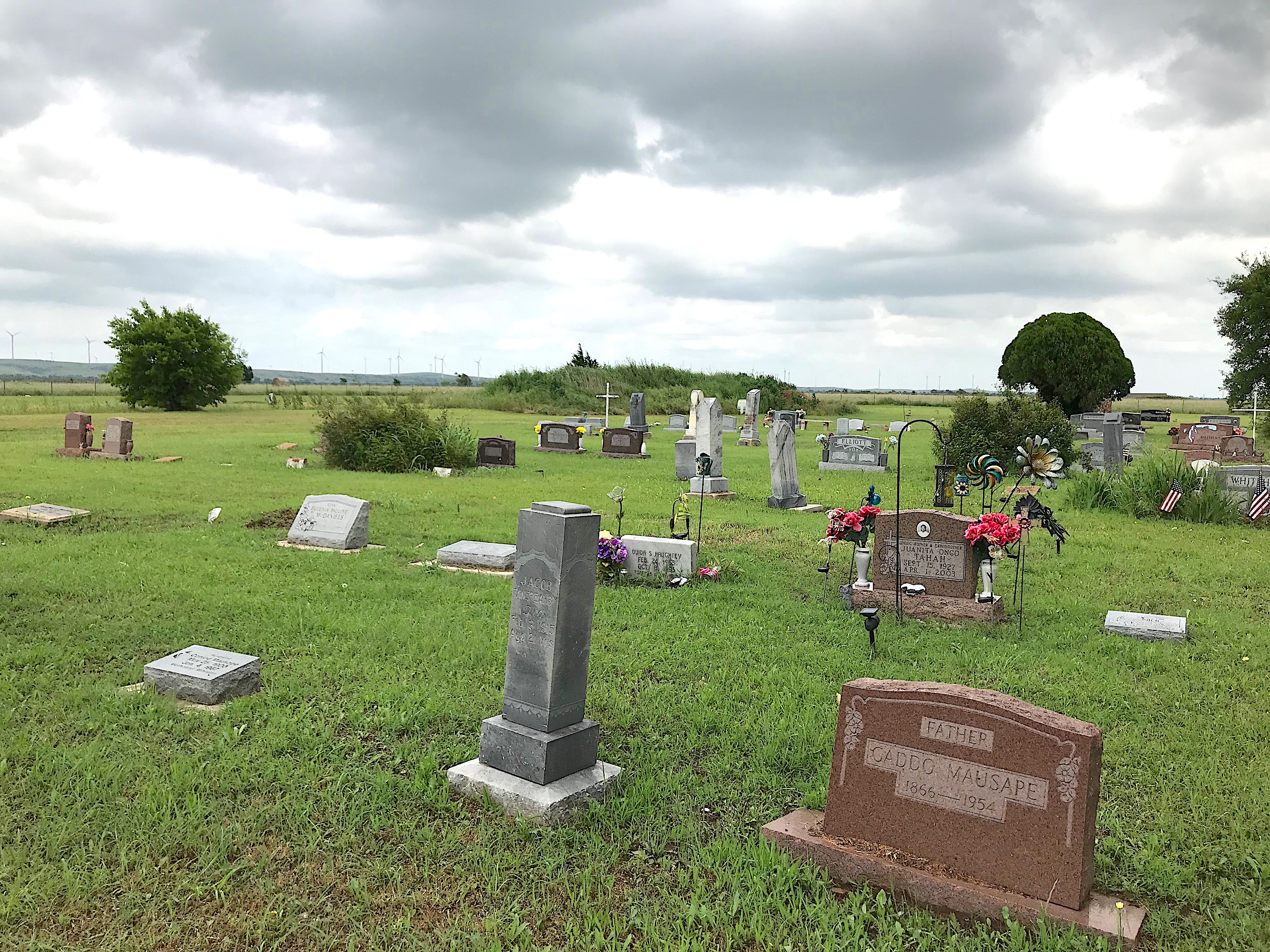
After polishing off a tasty meal at the Meers Store and Restaurant, Sarah and I stopped by nearby Mount Scott Cemetery. It was a short stop because both of us were tired and ready to put our feet up.

Mount Scott Cemetery has about 550 burials listed on Find a Grave. It’s a member of the KCA Intertribal Burial Grounds. The KCA stands for Kiowa-Comanche-Apache, but there are folks who belong to other tribal groups buried here. I would visit a few more of these KCA designated cemeteries over the next few days before we headed back to Georgia.

Mount Scott Cemetery is a mix of old and new graves.

As we walked among the graves, I was intrigued by what I saw. This was different than the POW cemeteries I had passed through earlier in the days with their white government-issues markers. There was more personality, more expression. A number of those buried here are Native Americans who are proud of their culture. But some have also adopted the Christian faith, melding the two.

Daughter of Chief Standing Bear

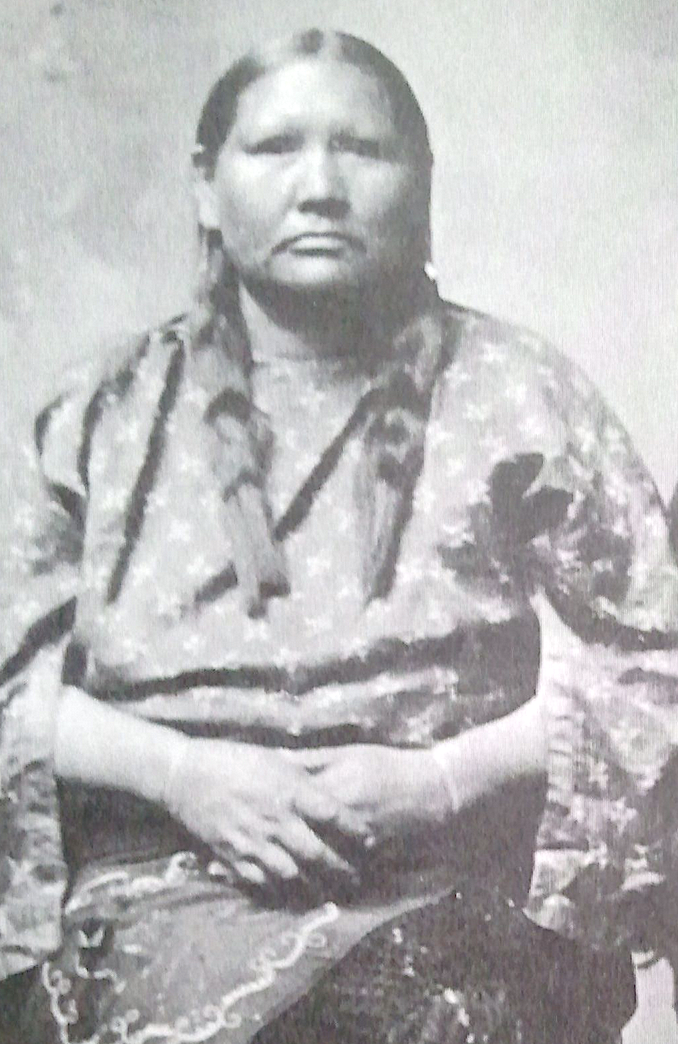
I discovered ties between some buried here and those at Fort Sill. One was Virginia “Au-Quo-Yah” Stumbling Bear Sahmaunt. She was the daughter of Kiowa Chief Stumbling Bear and To-Ye-Mah. Her name is thought to mean “To Turn Back”.

In November 1864, Chief Stumbling Bear fought U.S. military forces led by Kit Carson at the Battle of Adobe Wells. Soon after, both Chief Stumbling Bear and Chief Kicking Bird became advocates of peace with the whites. As a result of his peace efforts, the federal government built him a home in 1878 on the Kiowa Reservation in the Indian Territory. He died in 1903 and is buried in the Fort Still Post Cemetery.

Photo of Virginia “Au-Quo-Yah” Sahmaunt, daughter of Kiowa Chief Stumbling Bear.

Virginia’s marker indicates she was born in 1861. But at age 15, she arrived at the Carlisle Indian Industrial School in Pennsylvania in April 1880. That would mean she was likely born in 1866. She stayed there for three years, returning to Oklahoma in 1883. She kept in touch with the Carlisle administrators, letting them know in a letter she had married Luther Sahmaunt. They were living in Lawton, Okla. in 1914.

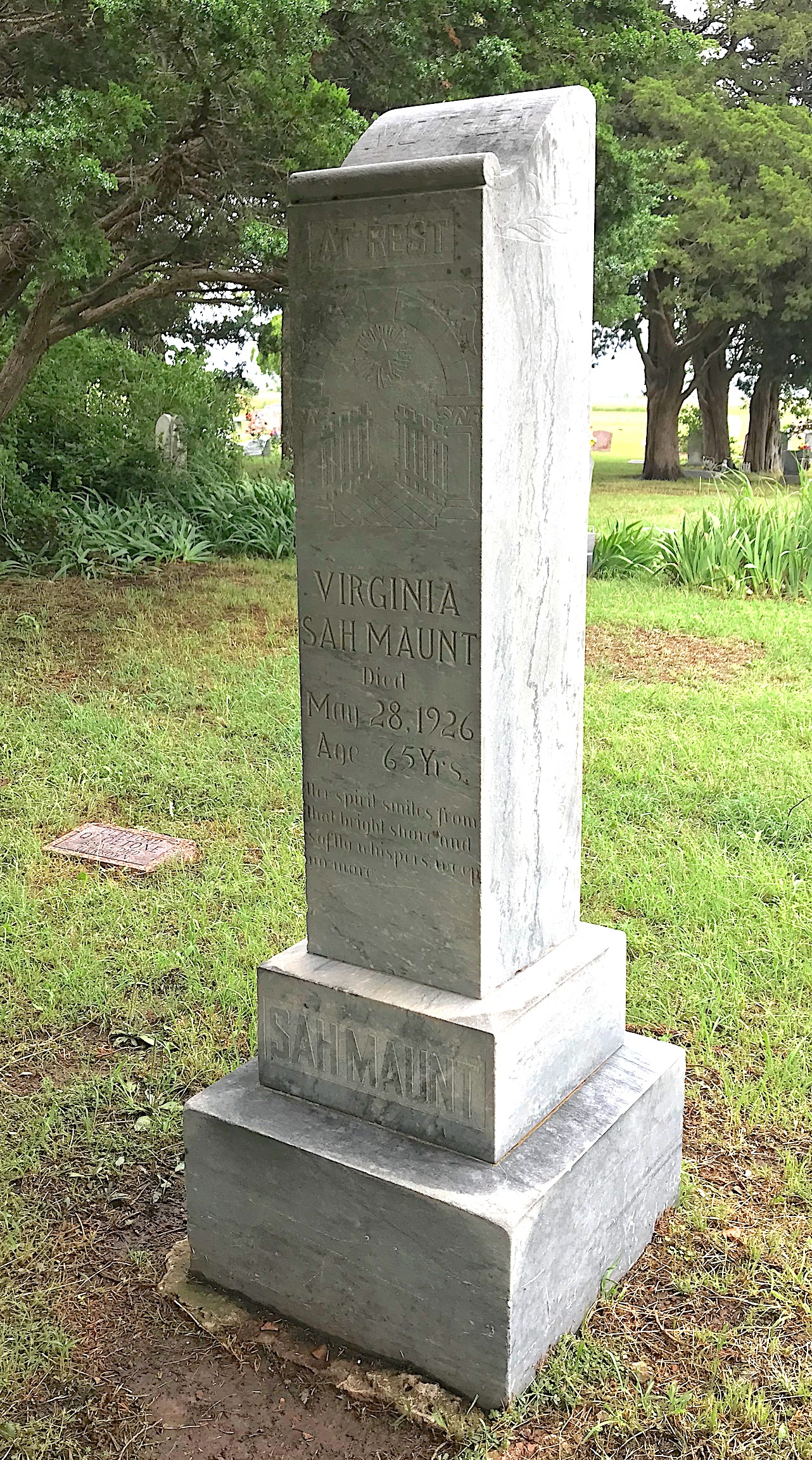
Virginia and Luther had at least two sons and one daughter, according to her obituary. She died on May 28, 1926, suffering from heat stroke on her return from traveling with her family. It caused a heart attack that hastened her death.

Virginia Sahmaunt died in her 60s in 1926 after a bout of heat stroke brought on a heart attack.

Virginia’s obituary mentions that she spoke English fluently, which she may have learned at Carlisle. She had many friends among the white population and was a member of the Mount Scott Church where her funeral was held. The epitaph on her marker reads: “Her spirit smiles from that bright shore, and softly whispers weep no more.” Luther, her husband, remarried to a daughter of Santata and died in 1958.

One of Virginia’s grandchildren is buried near her. Annetta Quoetone, born in 1919, was the daughter of Nannie Susan Sahmaunt Quoetone. Annetta died on Valentine’s Day in 1920, only eight months old.

Annetta Quoetone was the great-granddaughter of Chief Stumbling Bear.

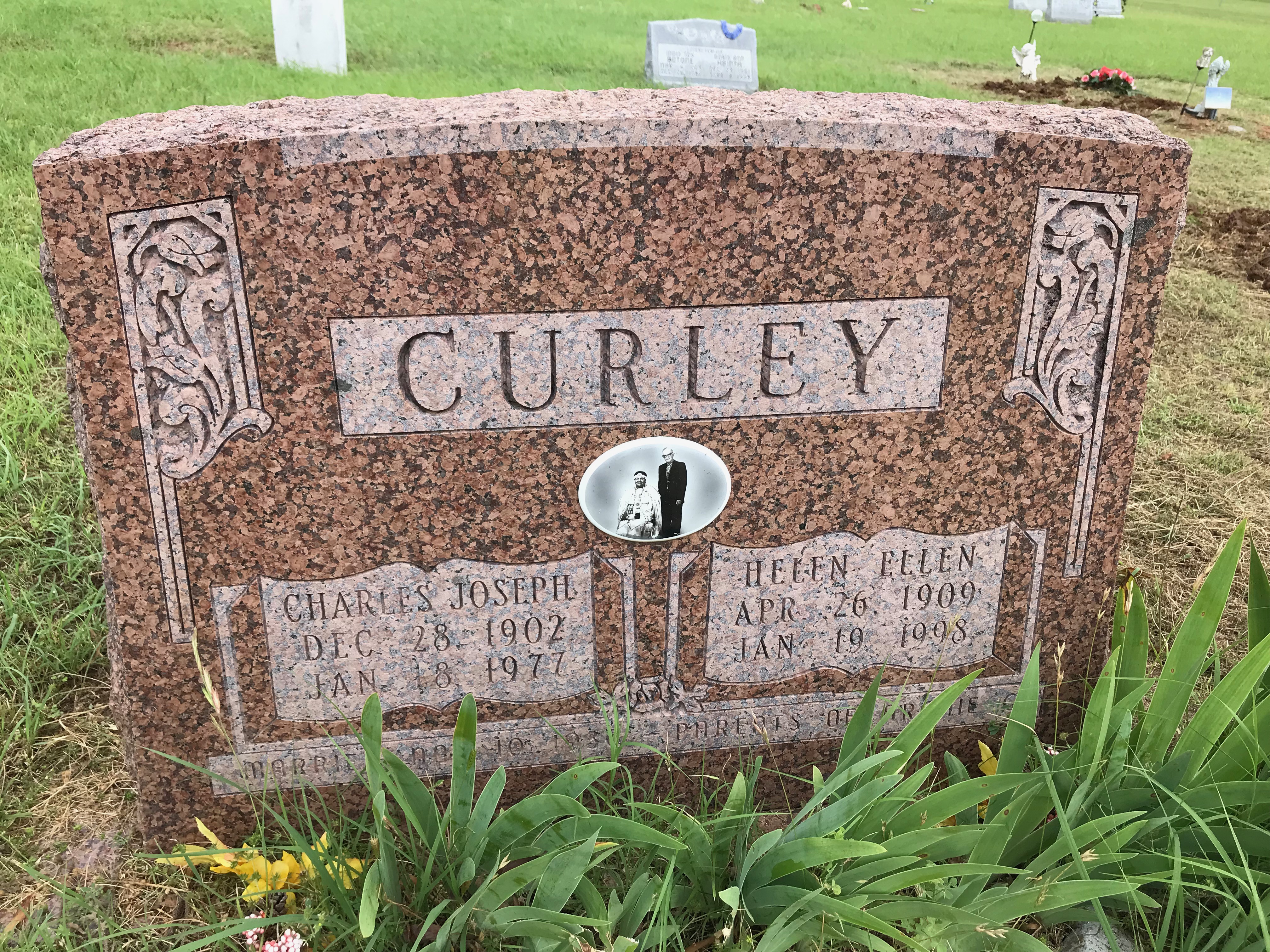
Another of Virginia’s grandchildren is buried at Mount Scott Cemetery, but Helen lived a long and happy life. Helen Ellen Quoetone, born in 1909, married Charles Curley. Charles served in the U.S. Army during World War II. They had one son named Archie. Charles worked in a meat packing plant while Helen was a hospital worker. Charles died in 1977 and Helen passed away in 1998 at age 88. They share this lovely marker.

Charles and Helen Quoetone Curley were married over 40 years.

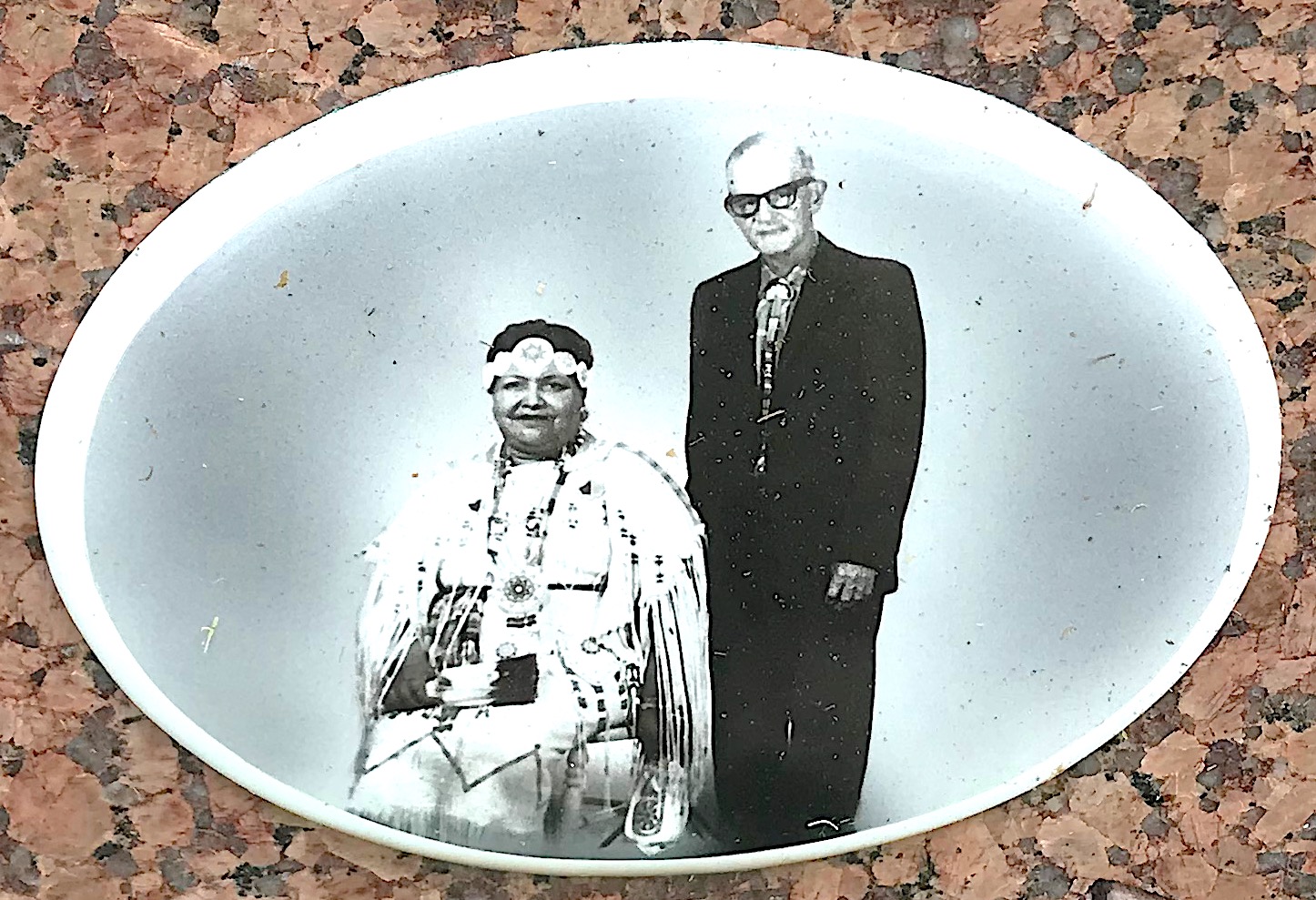
I especially like the portrait of the couple with Helen in her traditional Native American garb. It was clearly an important part of who she was.

Portrait of Helen Quoetone Curley and Charles Curley.

Captain Scott Emauha

The marker for Captain Scott Emauah intrigues me. Born in 1894, he is the child of E-Mau-Ah and Gap-Kau-Go, and the nephew of Virginia Sahmaunt. Scott died at age 14 on June 26, 1909. I’m not sure how he was a Captain at such a young age or if that was simply part of his given name.

I suspect E-Mau-Ah may have been a Native American chief but I could find nothing about him. He is buried at Mount Scott Cemetery but I did not photograph his grave marker. He and Gap-Kau-Go had at least seven children together and none of them lived past their teen years.

Captain Scott Emauah is buried to the right of his sister Vida, who died in 1907.

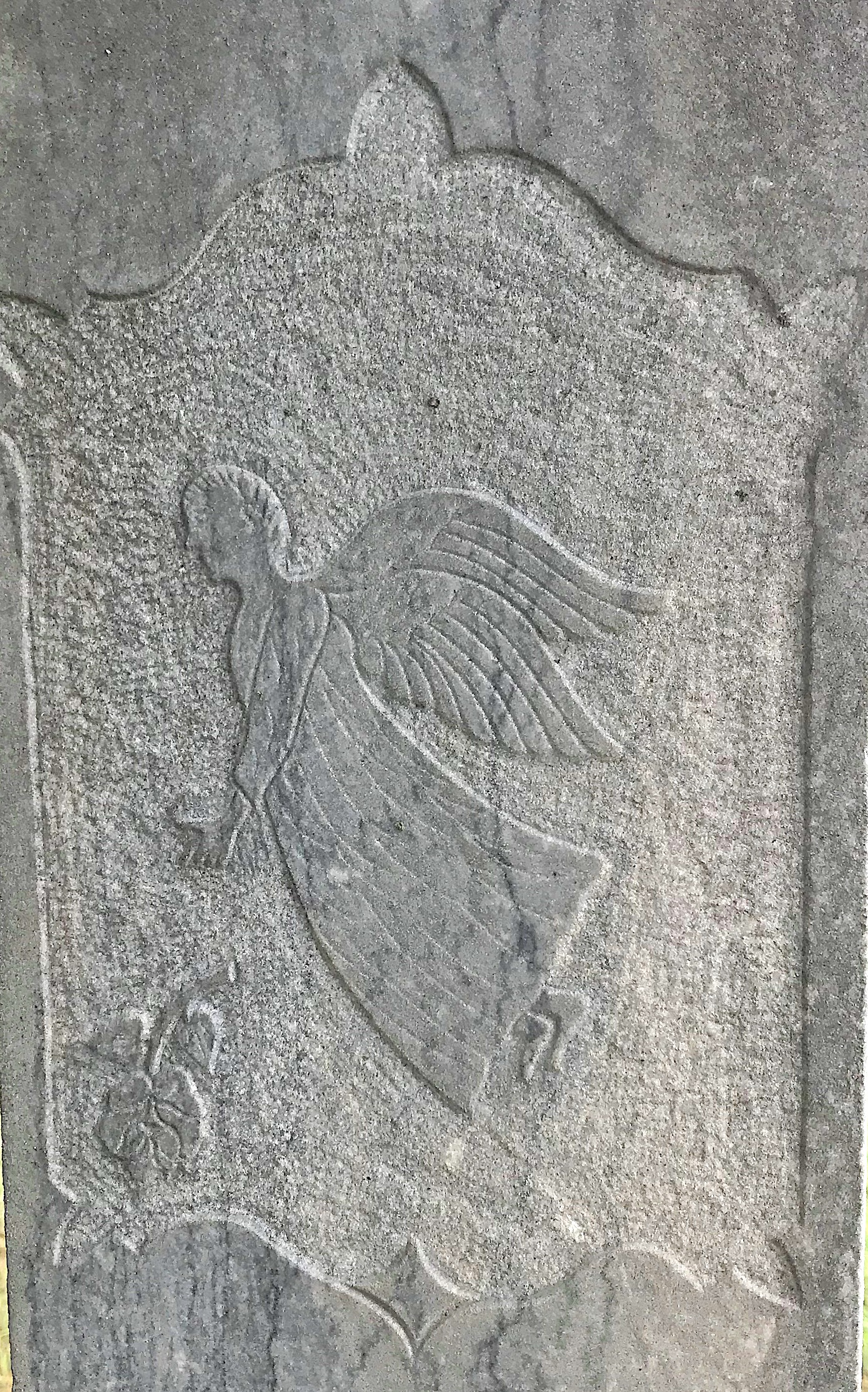
Scott is buried beside his sister Vida, who died in 1907 at age 15. The angel at the top of his monument has an Arts and Crafts style to it that I love.

An angel drops a flower from her open hand.

Pah-do-Pony

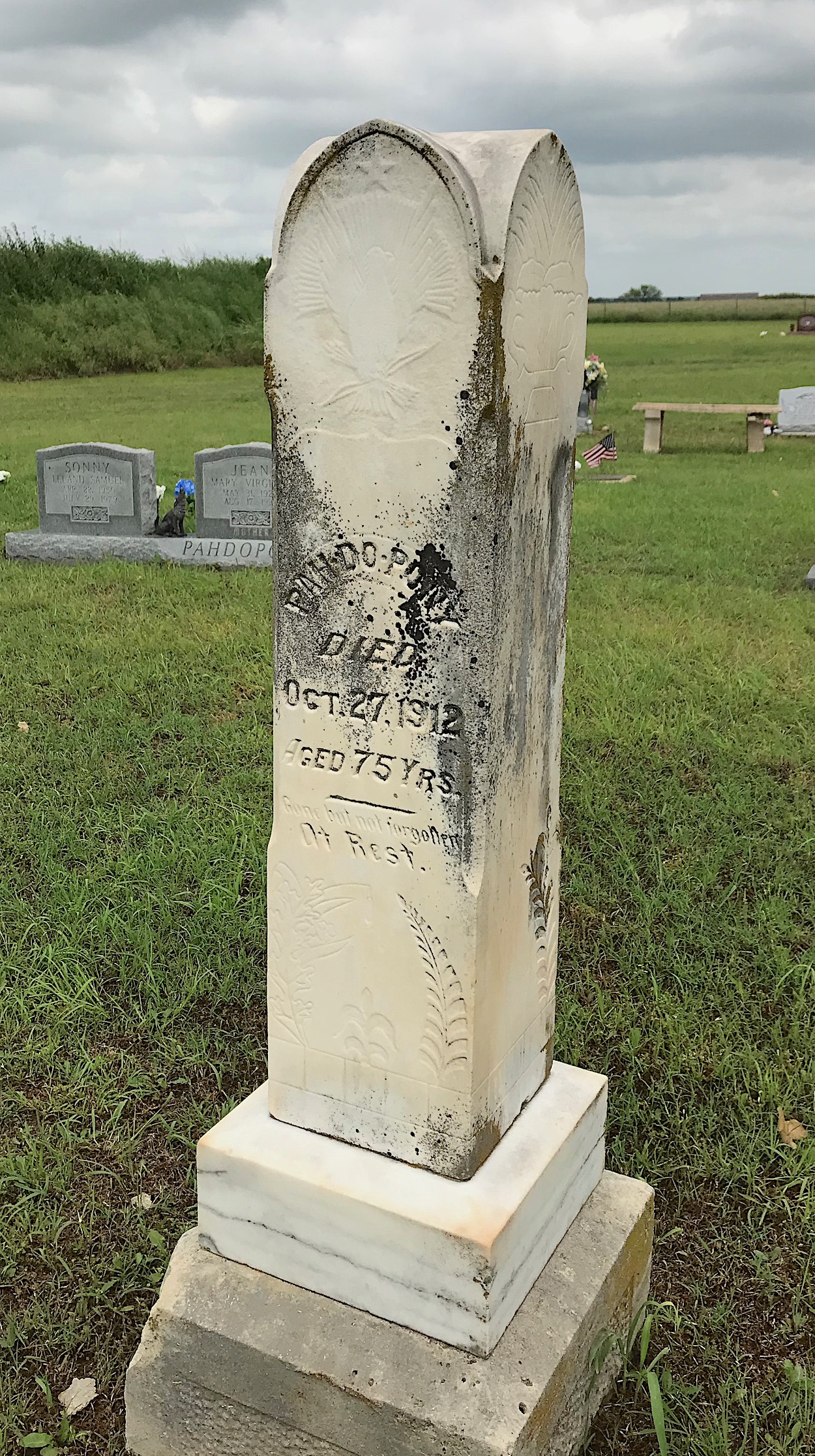
The grave marker of Pah-do-Pony posed a bit of a mystery for me. I found little about him online but I did find some information regarding his son, Oliver, that helped. I believe the family is of Comanche origin.

Born in 1838, it is likely Pah-do-Pony was a medicine man. His son, Oliver, would follow in his footsteps many decades later, which you can read about here. The following generations went by the surname Pahdopony and many of them are buried at Mount Scott Cemetery. Pah-do-Pony died on Oct. 27, 1912 at age 75. Oliver, who died in 1988, is also buried at Mount Scott.

Pah-Do-Pony was likely a member of the Comanche tribe.

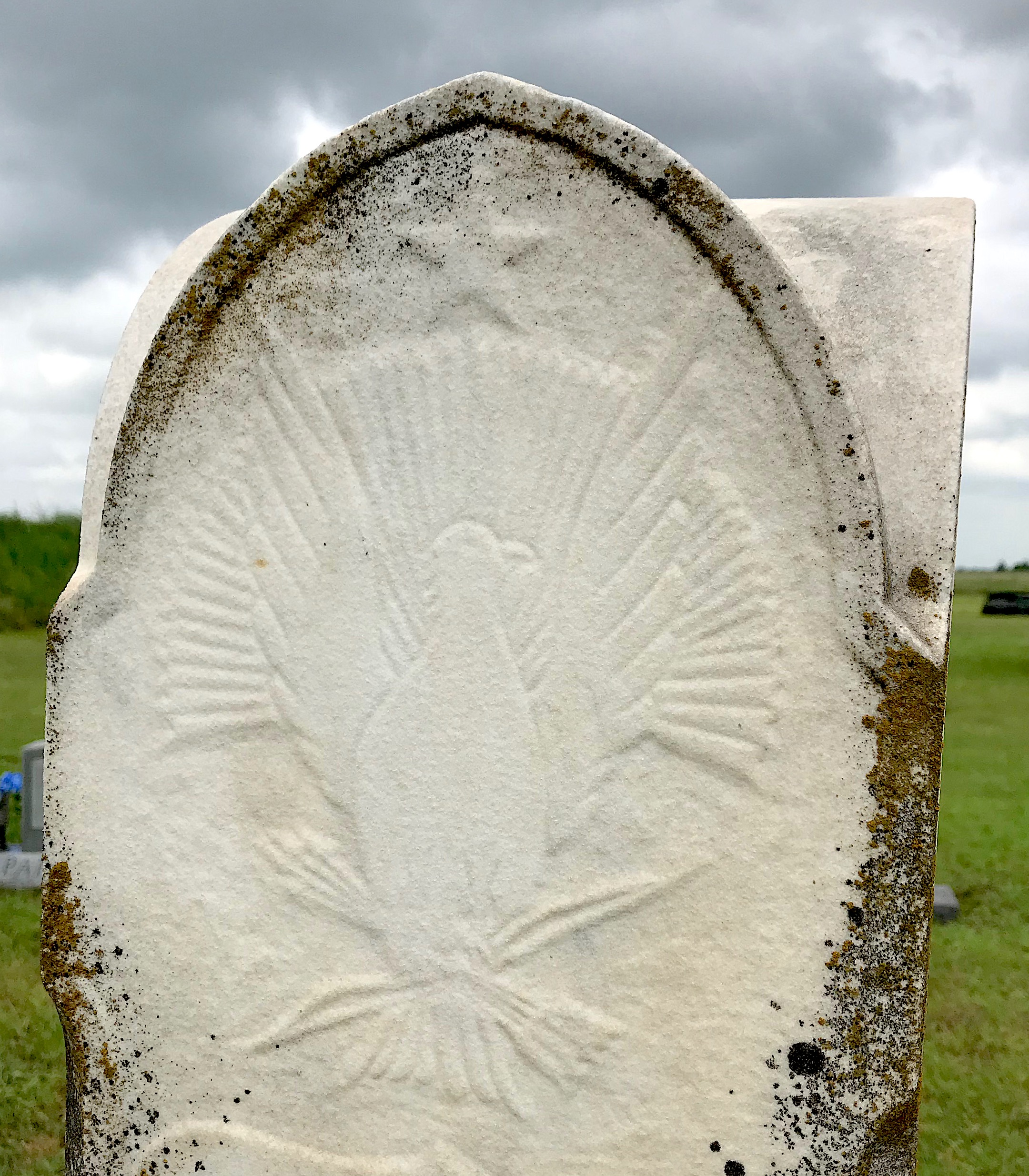
The top of the grave marker features a bird clutching a quiver and arrows in its talons. I’m not sure if it a tribal symbol.

Is this a Comanche symbol?

Alexander and Lorraine Mathews

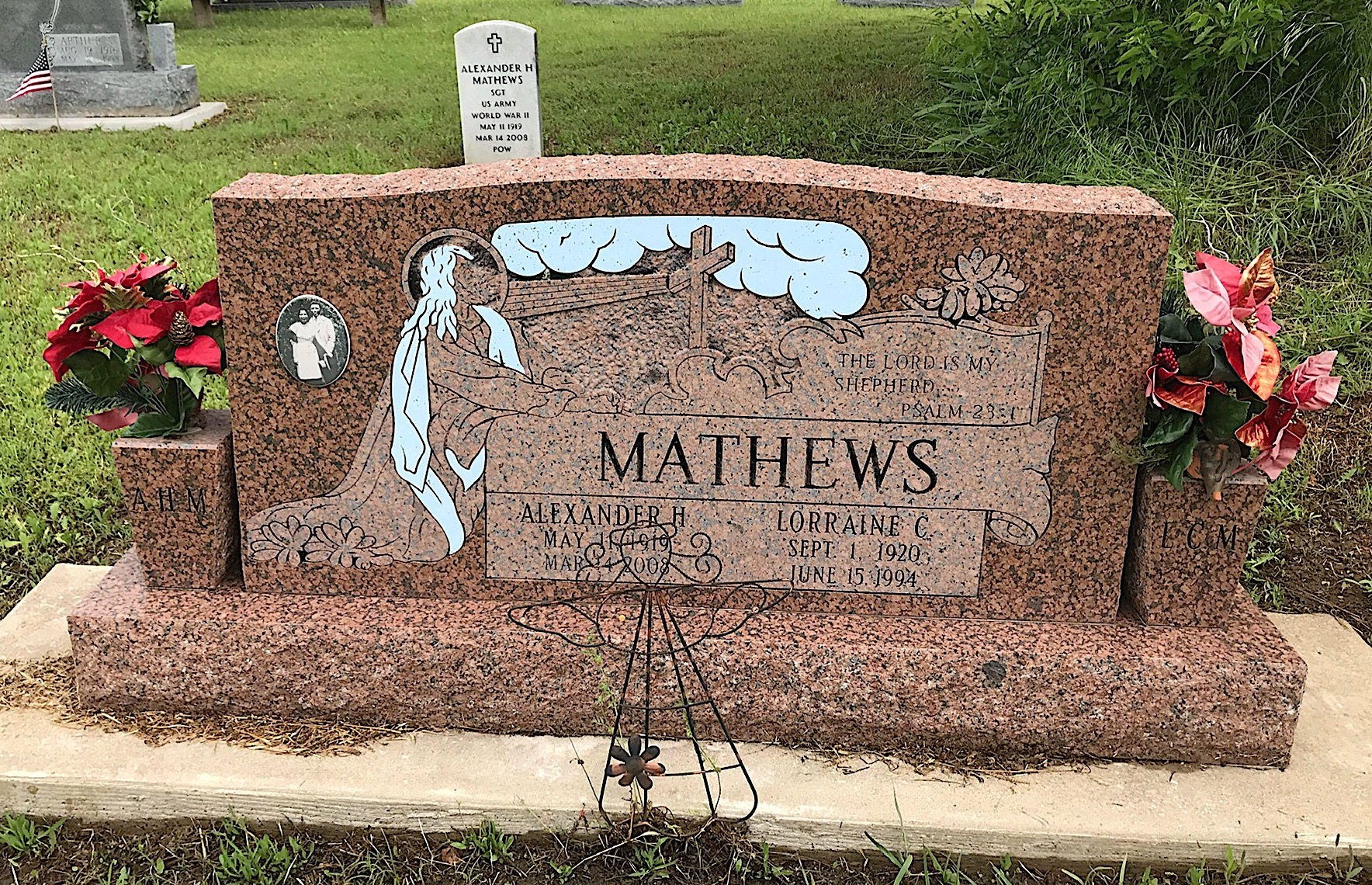
I am especially fond of the grave of Alexander Mathews (1919-2008) and his wife, Lorraine Coosewoon Mathews (1920-1994). He and Lorraine were married for 47 years.

Alexander Mathews and his bride, Lorraine, in their younger days.

Alexander’s Pawnee name was “Koot-ooks-Tah-Kah” meaning “White Bear”. He was a full-blood member of the Pawnee Nation of Oklahoma. In 1941, he joined the U.S. Army and fought in the Pacific during World War II. He was captured in April 1942, and was a prisoner of war until September 1945. He was part of the Bataan Death March, and was forced into slave labor conditions in Japanese prison concentration camps. As a result, he returned to America after the war a much-decorated veteran.

You can see Alexander Mathews’ military marker in the background.

He and Lorraine had two sons and two daughters together. Alexander was Pawnee Nation President from 1993 to 1995, and a Traditional Chief of the Chaui Band of Pawnee. A graduate of the Haskell Institute in Kansas, he used his accounting skills to help others through various tribal agency organizations. After Lorraine died in 1994, Alexander remarried to Darlene Joyce Codopony in 1999. Alexander died on March 4, 2008 at age 88.

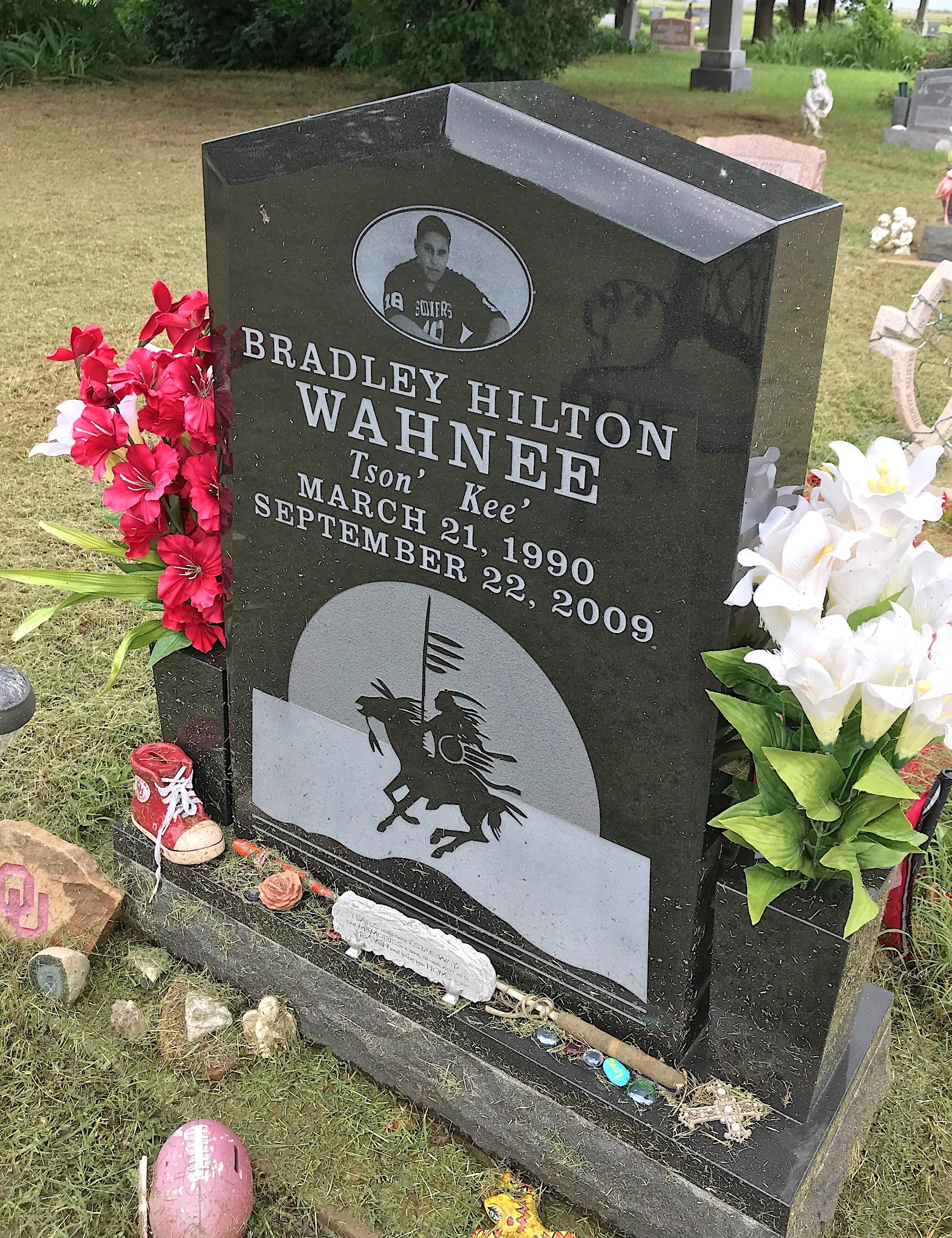
A Song for Bradley

It’s always difficult to see a grave for a young person. But the one for Bradley Hilton Wahnee is especially painful.

Bradley Wahnee’s life ended much too soon.

Born in Oklahoma City in 1990, Bradley was the son of Kari and Ernest Wahnee. His grandmother, Geneva, was a Sahmaunt. He attended Norman High School and graduated from Elgin High School in 2008. He was the 2008 Comanche Nation High School Graduate of the Year. He attended Oklahoma City University, where he was majoring in biology and pursuing a pre-med course.

Bradley Wahnee’s grave marker reflects his Native American heritage.

From newspaper articles I found, Bradley was doing well in college and was a popular student. On the night of Sept. 22, 2009, he was standing outside a friend’s home with him when a group of men wearing hoodies and bandanas drove up in a truck. Both Bradley and his friend were shot. The friend survived but Bradley died of his wounds. Police hunted for the truck’s driver but he was later found shot to death. I don’t know if any of the others involved were ever apprehended.

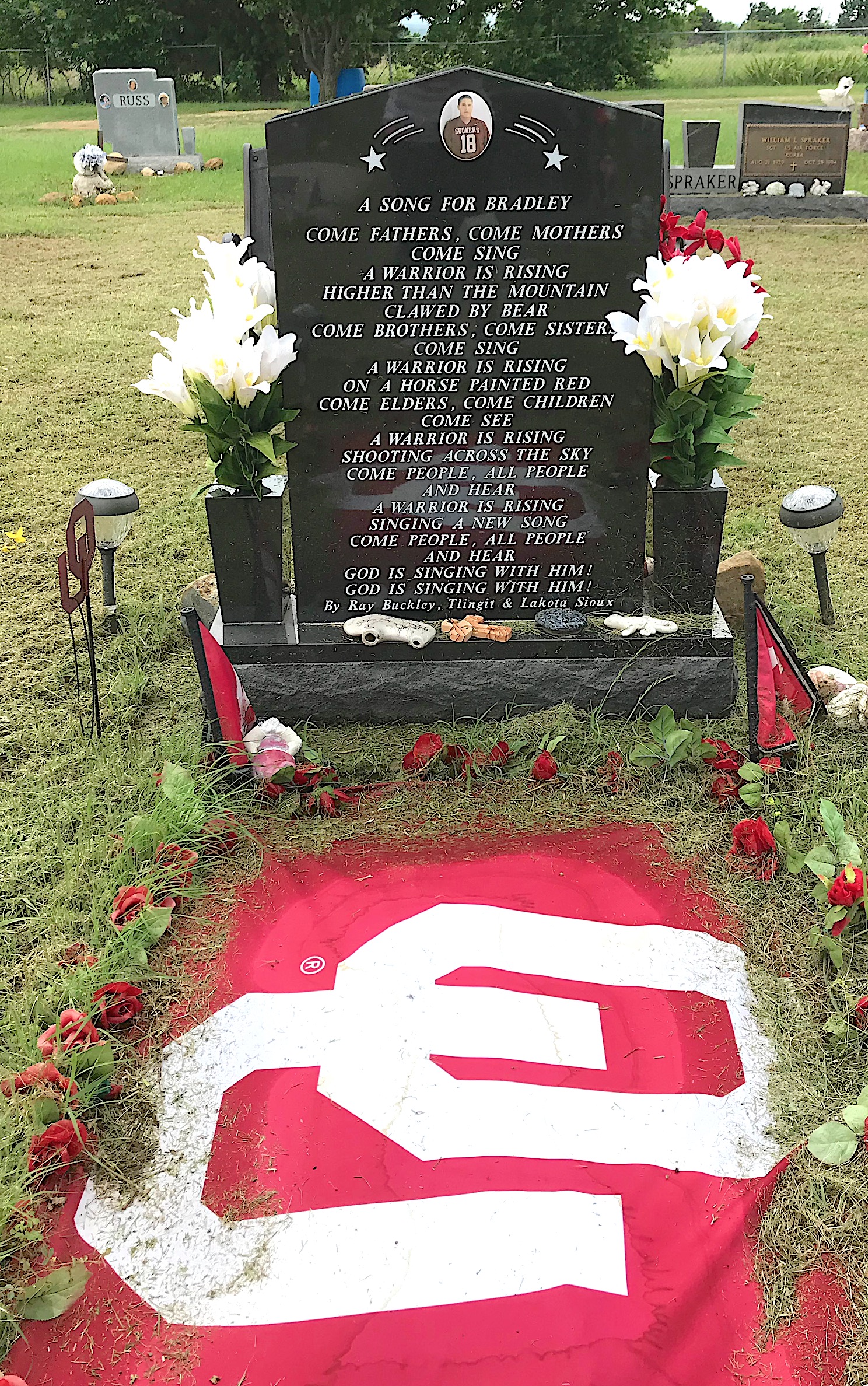
On the back of Bradley’s marker is a powerful poem called “A Song for Bradley”. He will never be forgotten.

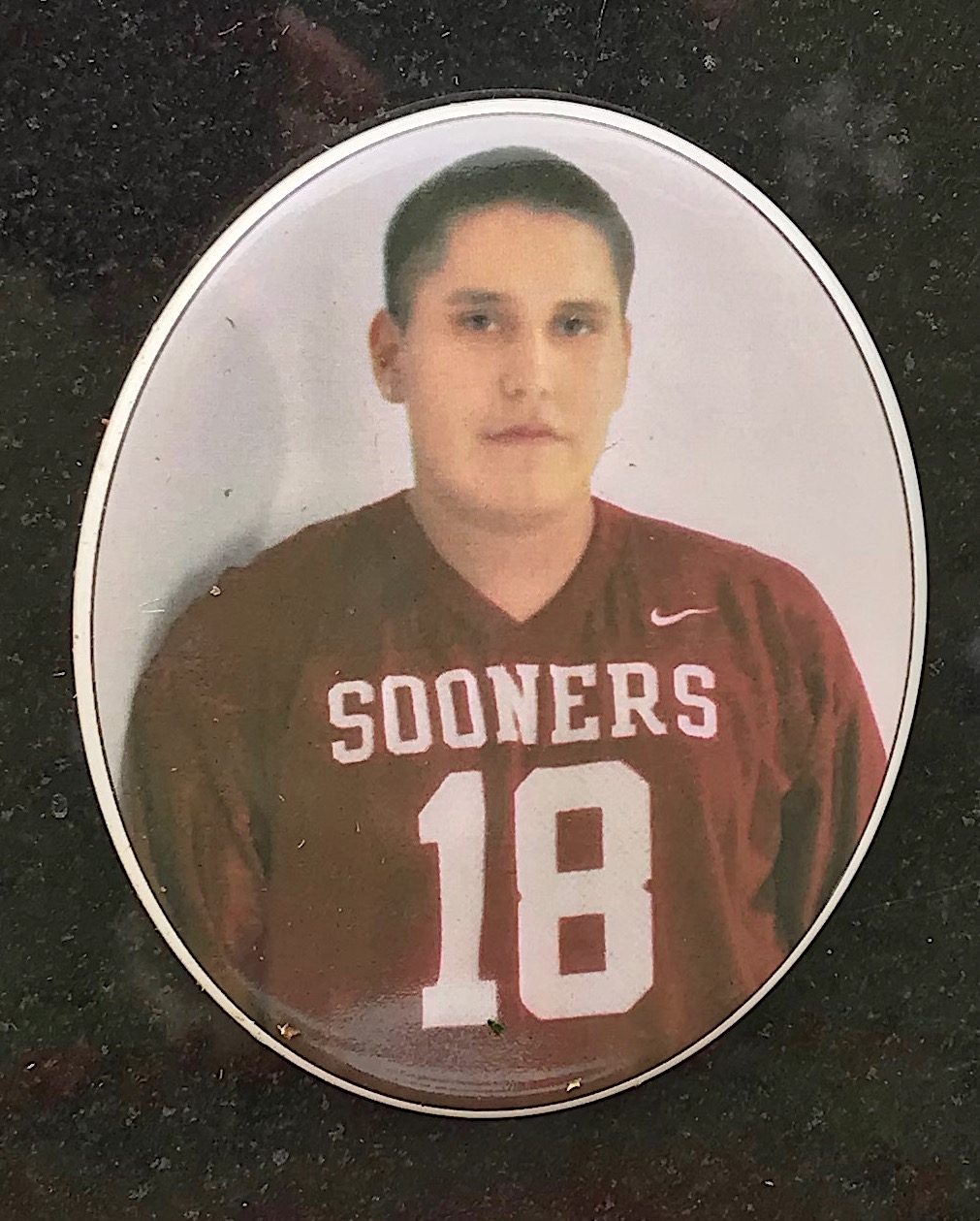
Bradley was an avid Oklahoma University Sooners fan.

Join me next time when I visit Deyo Mission Cemetery.

Oklahoma Road Trip 2019: The Sooner the Better at Fort Sill’s Apache North Cemetery

15 Wednesday Feb 2023

Posted by adventuresincemeteryhopping in General

≈ Leave a comment

My visit to Fort Sill’s cemeteries ends here at Apache North Cemetery. It also goes by the name Chief Chihuahua Apache North POW Cemetery. With 28 recorded burials, there are 26 marked graves here. It looks much like its sister cemeteries nearby, Beef Creek Apache Cemetery and Apache South Cemetery.

Apache North Cemetery looks much like the other two Apache POW cemeteries at Fort Sill.

There is one Native American chief buried at Apache North and that is Chief Chihuahua. He was chief of the Chokonen local group of the Tsokanende Band of Chiricahua Apache. This group is different than the Warm Spring Apache that we’ve talked about up to this point. But Chief Chihuahua lived among and fought alongside Geronimo and other Native American warriors.

Birth of a Chief

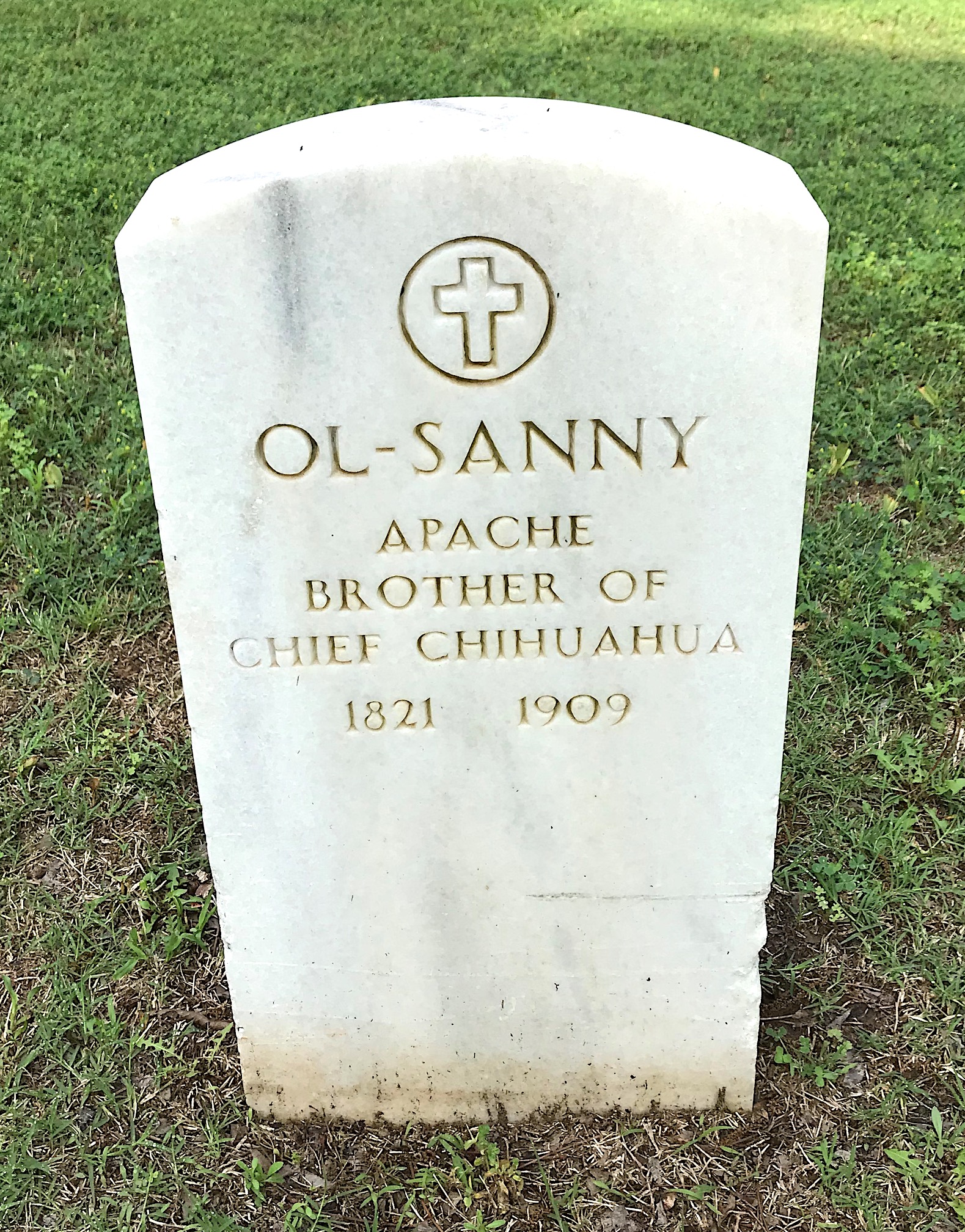
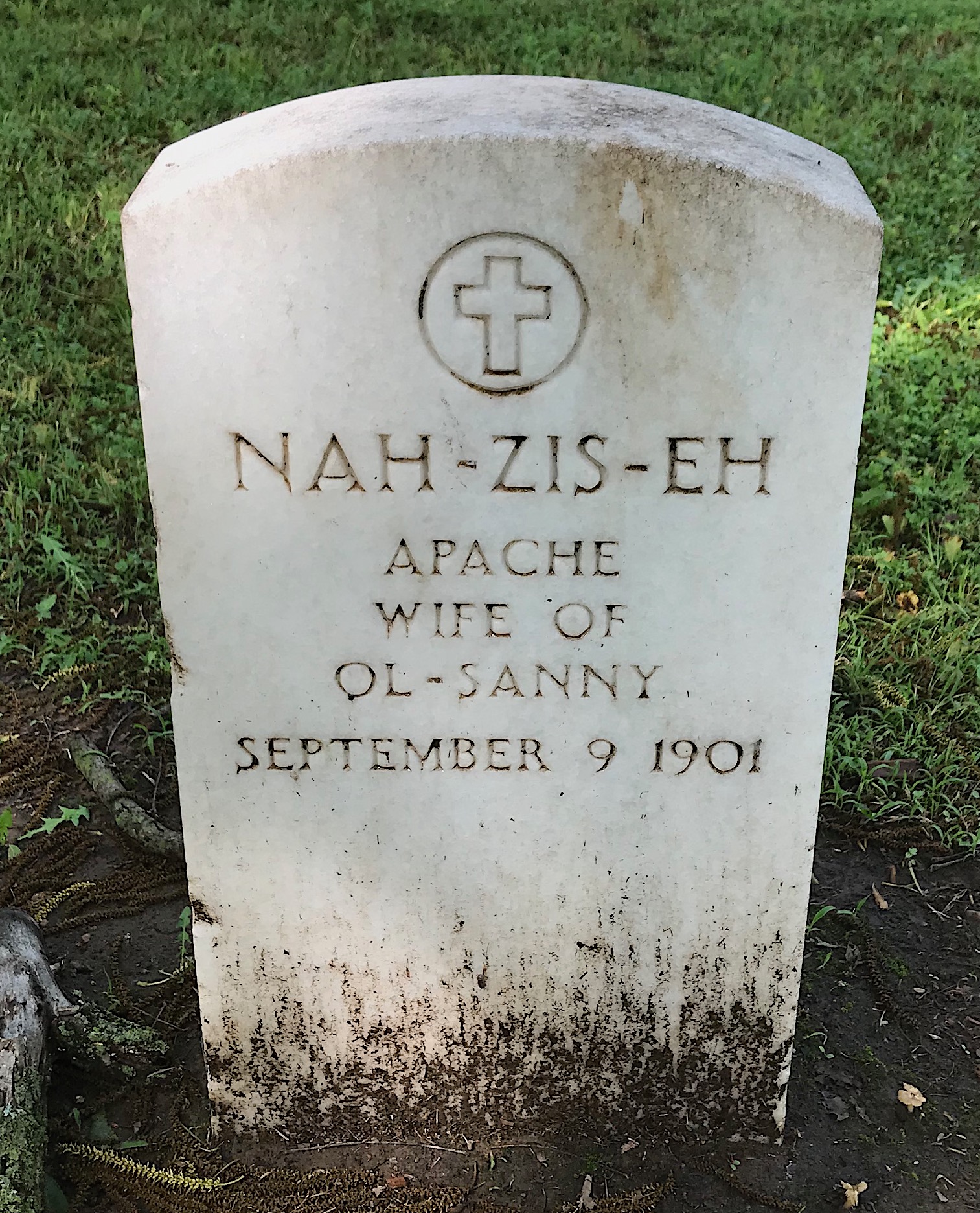
Born around 1825, Chief Chihuahua was also known as Kla-esh or Tłá’í’ez, meaning “”To push something under something else with your foot”. Chief Chihuahua carried out several raids on Arizona settlers in the 1870s and 1880s. His brother Ulzana (ca. 1821–1909), also called Ol-Sanny, who led a famous raid through New Mexico and Arizona in 1885, was his war chief. I’ll talk more about him later.

Chief Chihuahua was a protege of Cochise, surrendering with Cochise in 1872 and going to live on the San Carlos Reservation in Arizona. Once there, he became first sergeant of a company of Apache Scouts in 1880 under U.S. Army Lieutenant James A. Maney.

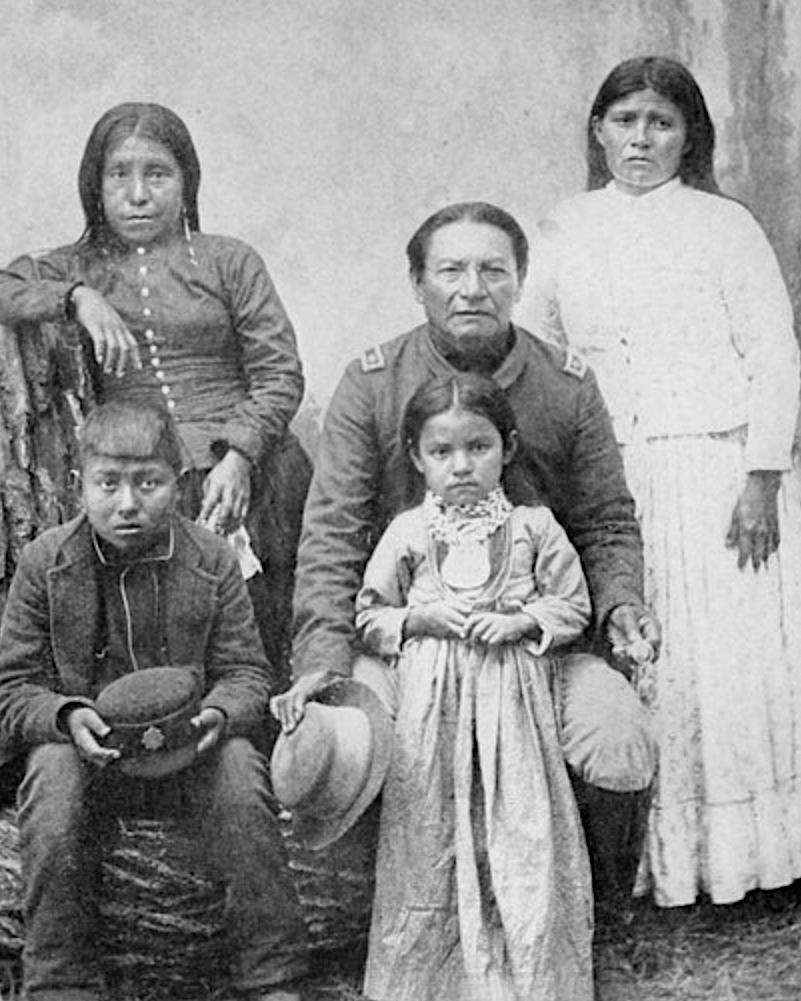
Chief Chihuahua and his family. His wife, Ilth-Gozey, stands to his right. Son Eugene is on the far left, sitting. (Photo source: From the 1906 book “Geronimo’s Story of His Life”)

After Cochise’s death in 1874, Chief Chihuahua and Ol-Sanny didn’t recognize Cochise’s sons’ leadership. Chief Chihuahua later fled the reservation to lead a war party into Mexico, but surrendered to General George Crook in 1883. He left the reservation in San Carlos again with Geronimo and other chiefs in 1885, and led raids into Mexico, finally surrendering again to Crook in 1886.

On April 7, 1886, Chihuahua was shipped along with other Apaches to Fort Marion, Fla. In May 1888, he was transferred to Mount Vernon Barracks, Ala. While at Mount Vernon Barracks, Chief Chihuahua carried himself with such dignity and became so respected by his captors, the soldiers called him “Chesterfield”. In October 1894, the remaining Apaches were transferred to Fort Sill.

Thanks to Alicia Delgadillo, I found a little information about Ilth-Gozey. Her Apache name means “Twisted”. She was the daughter of Tzegojuni and a full sister of Tahdaste. I don’t know what year she married Chief Chihuahua. They had at least six children together. Four of them are buried at Apache North Cemetery with their father.

Their first child, Ramona, was born in 1875 and attended the Carlisle Indian Industrial School in Pennsylvania like Clarence Bailtso, whom I talked about last week. It was there she met Asa Daklugie, whom she married in 1898. Asa was close with Geronimo and was with him when he died in 1909.

Chief Chihuahua’s Children

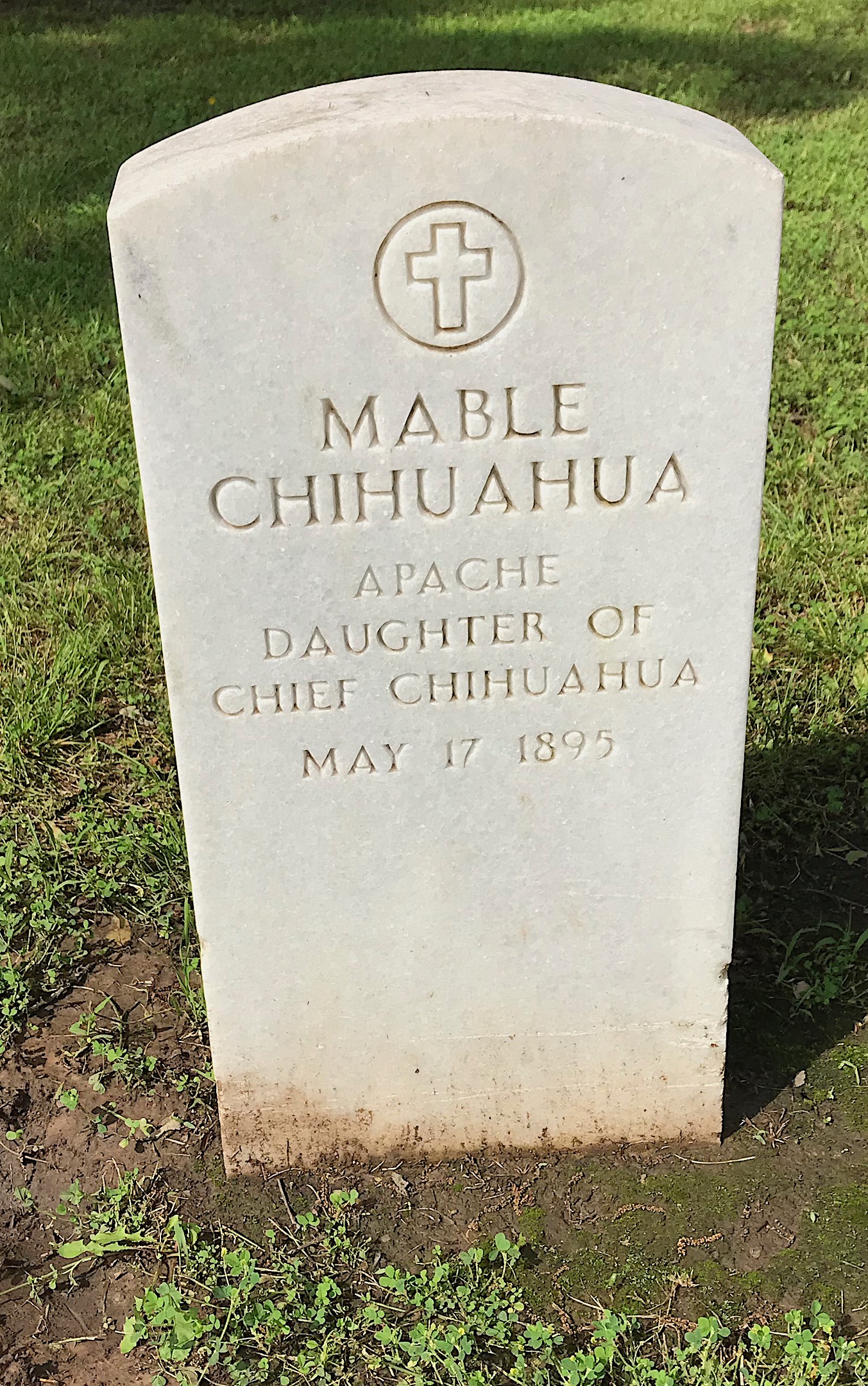
The date on Mable Chihuahua’s marker is May 17, 1895. This would have been about seven months after the Apaches were sent from Mount Vernon Barracks to Fort Sill. This probably means Mable died at birth.

Mable Chihuahua probably died at birth.

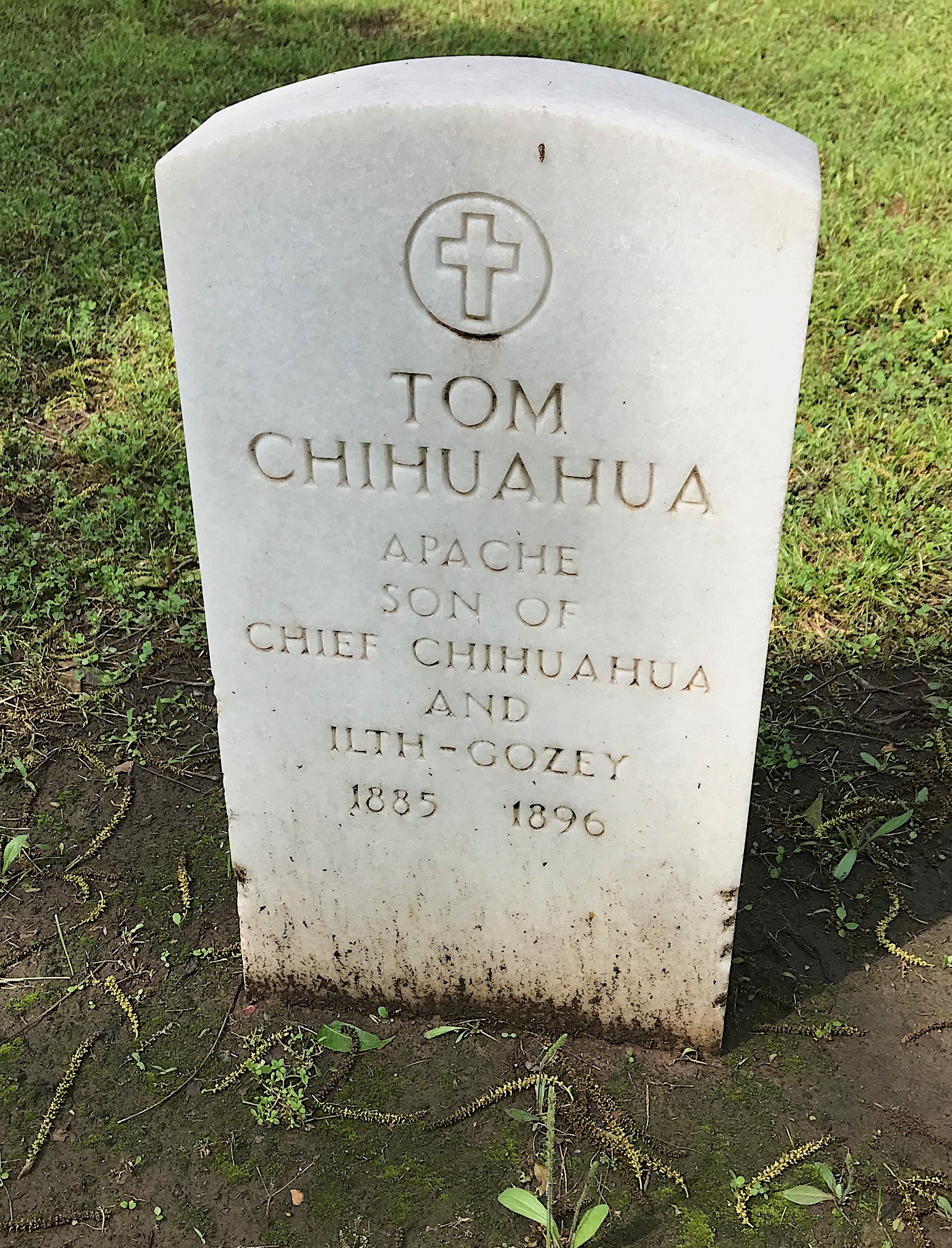
Chief Chihuahua and Ilth-Goley’s son, Tom, was born on in 1885. He died in 1896. I don’t know what his cause of death was.

Tom Chihuahua was about 11 when he died at Fort Sill.

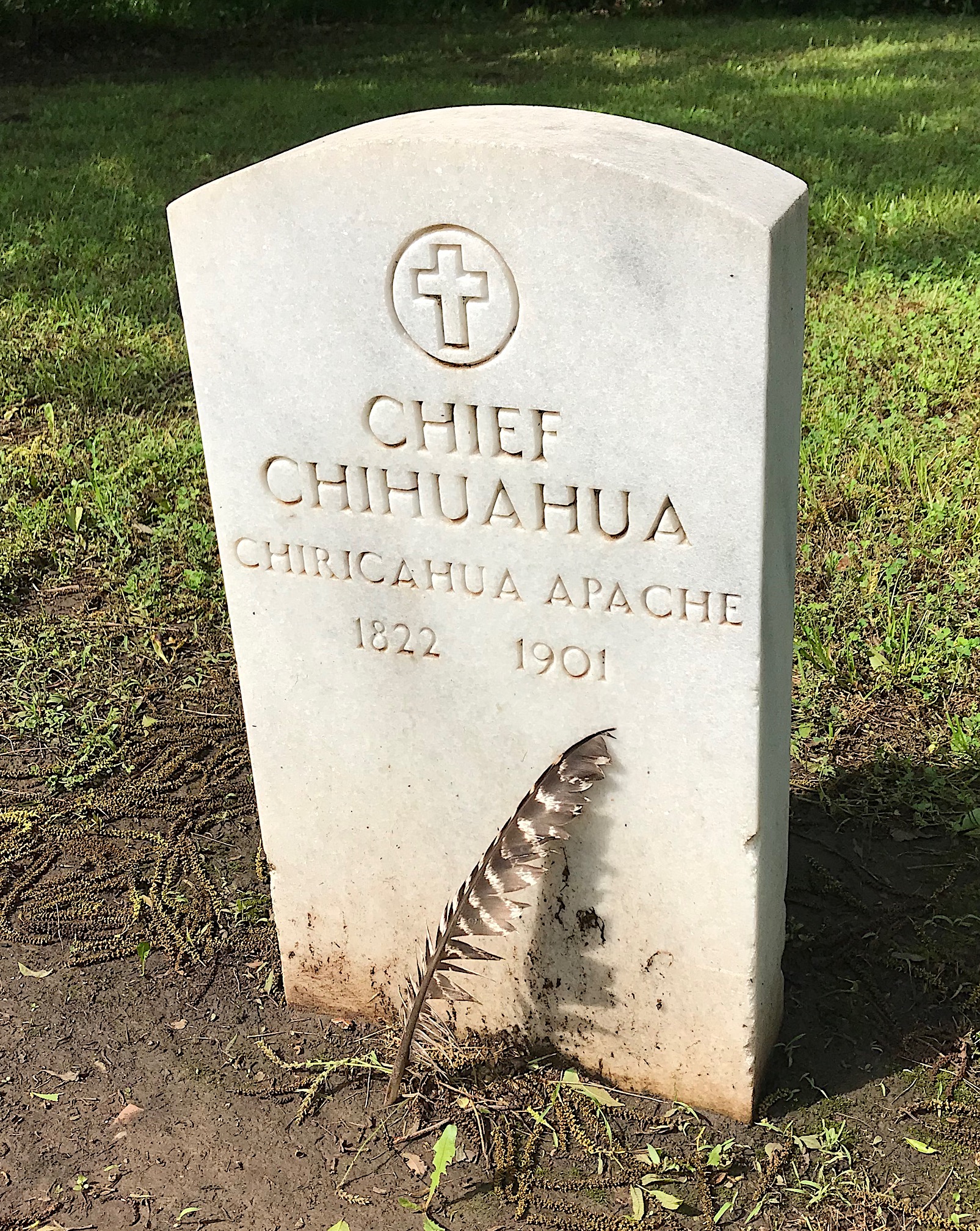
Chief Chihuahua died in 1901 at Fort Sill. He was close to 80 at the time.

Chief Chihuahua was about 80 when he died.

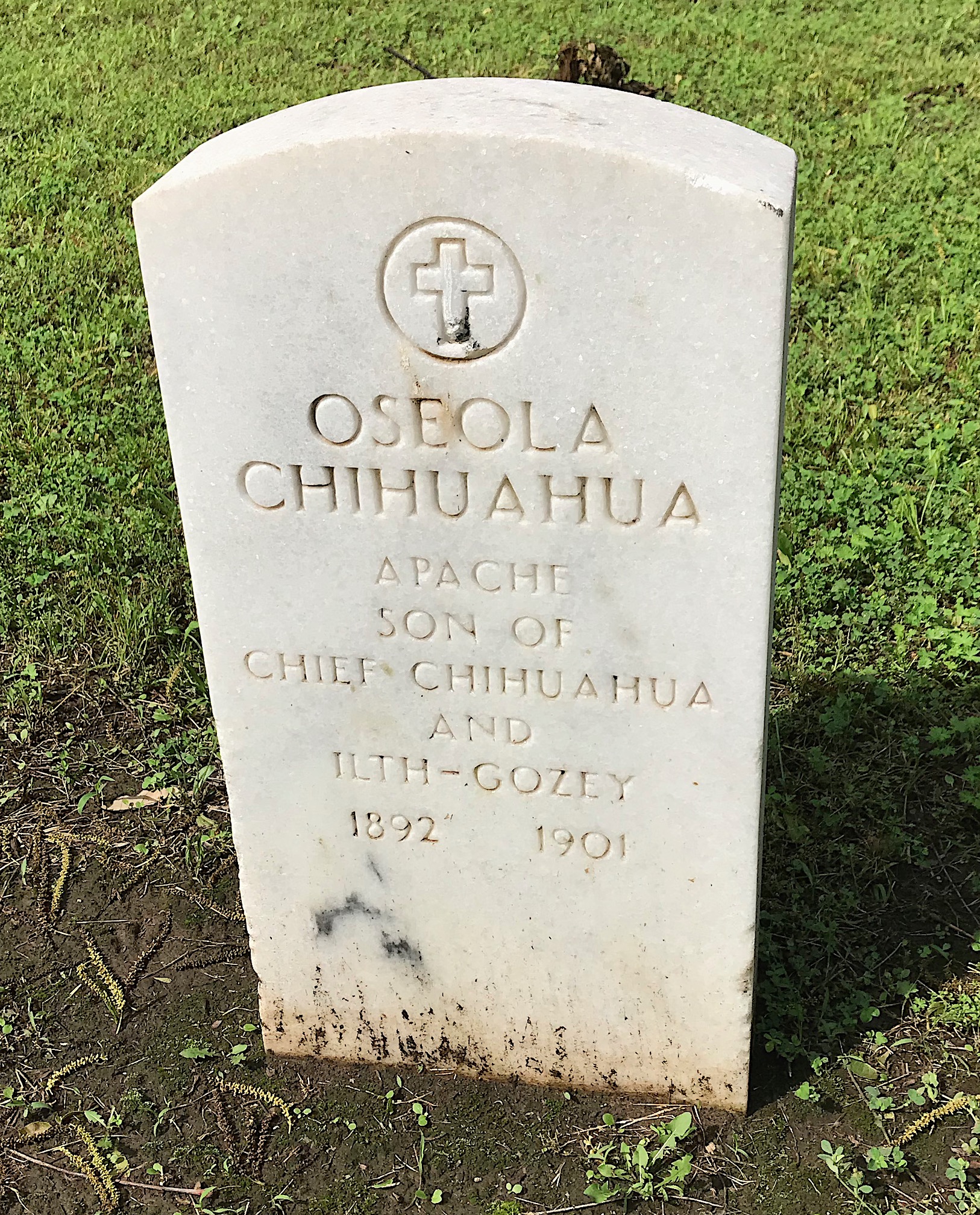
Oseola Chihuahua, born in 1892 at Fort Sill, died in 1901.

Osceoloa Chihuahua died the same year his father passed away.

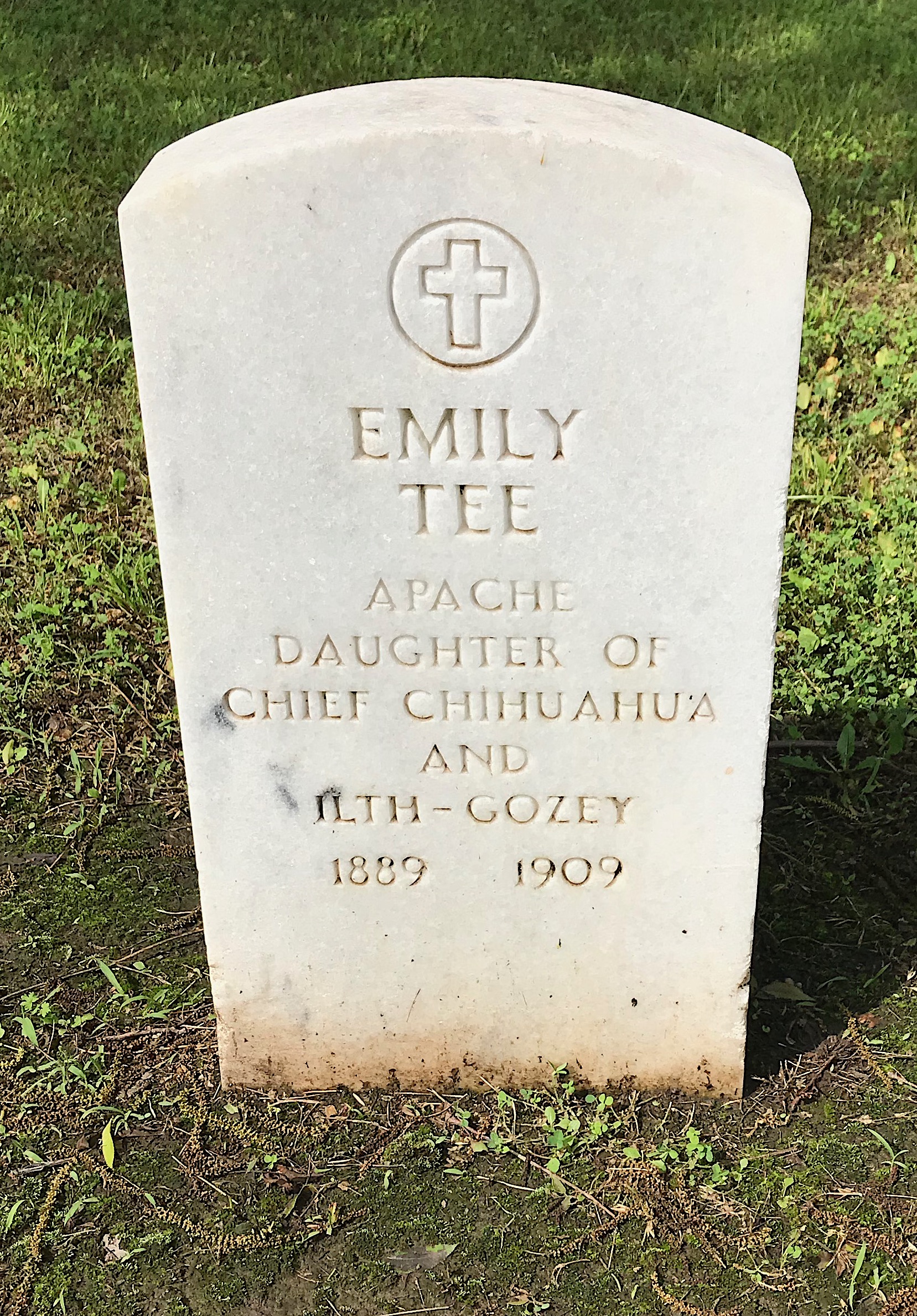
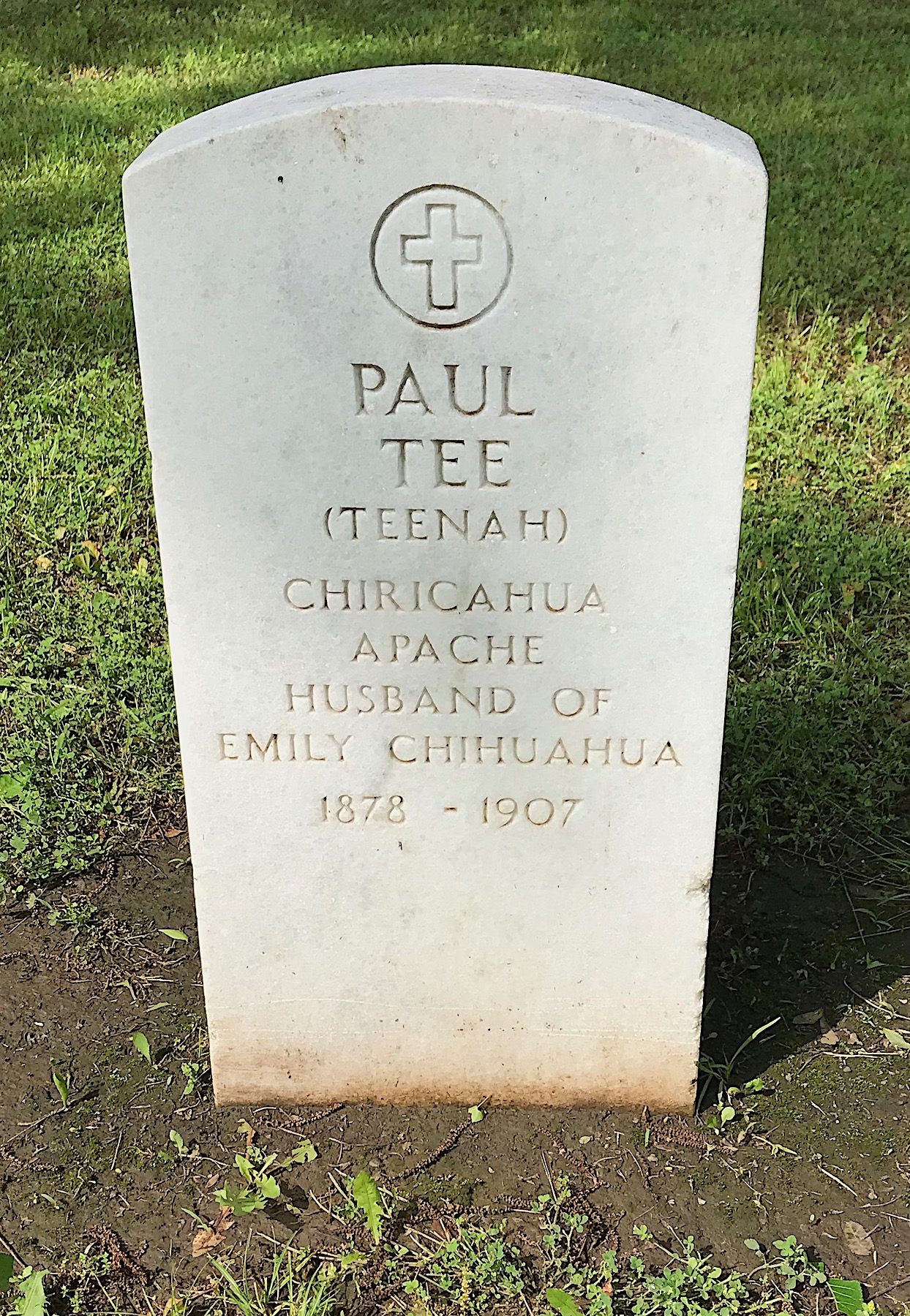
Emily Chihuahua was born in 1889 and attended the Carlisle School. She married Paul Tee (“Teenah”), another Chirichua Apache. She died in 1907 and was probably 19 or 20. Their child, Edna Teenah Commanche, was born in 1906. She died at the age of 93 in 1999 and is buried at Mescalero Indian Cemetery in New Mexico. Paul died in 1907 and is buried with Emily at Apache North.

Emily Chihuahua married Paul Tee sometime around 1905 and gave birth to their child, Edna in 1906.
Paul Tee was nearly 30 when he died in 1907, just a year after his wife.

Eugene Chihuahua

Eugene Chihuahua was born after Ramona in 1878. Chief Chihuahua was allowed to keep Eugene with him and he was not sent to Carlisle as Ramona was. His father wanted to train him up to be a leader of his people. According to Michael Farmer, Chief Chihuahua asked George Wratten to employ Eugene in his store and teach him how to read. Wratten, an interpreter, ran a trading post for the Chiricahuas at San Carlos before moving with them to Florida, and later Mount Vernon and Fort Sill.

Undated photo of Chief Chihuahua and Eugene. (Photo source: Lynda Sánchez Collection)

Eugene learned to read from looking at the labels on cans and learned to do the arithmetic needed to run the store. Wratten also taught Eugene English. When he was older, Chief Chihuhua chose Viola Massai to be Eugene’s bride. She had been educated at Carlisle with his sister Ramona and was from a respected family.

Although the couple only knew each other four days, they married. They would have six children together and all would die young. The children are all buried at Apache North Cemetery.

Three of the children of Eugene Chihuahua and Viola Massai. None of their children survived.

In 1913, Viola and Eugene went to live on the Mescalero Reservation in New Mexico when the Chiricahuas were released as POWs. I’m not sure when Viola died. Her parents, Chino and Nah-Go-Tsi-Eh, are both buried at Apache North.

At Mescalero, Eugene became a powerful medicine man and joined the Dutch Reformed Church where he sang in the choir. He remained unmarried for several years until he returned to Oklahoma and married the Comanche widow of Hostosovit. He returned to Mescalero with his new wife and her three children. Unfortunately, the marriage ended in divorce. He later remarried to Jennie Pena and they had a happy marriage. Eugene passed way at age 84 on Dec. 16, 1965 and is buried in the Mescalero Indiana Cemetery.

So what became of Ilth-Gozey? After Chief Chihuahua died in 1901, she remarried to Victor Biete. He was 20 years her junior. He died in 1911 and is buried over at Beef Creek Apache Cemetery. She is thought to have settled at Mescalero after the Apache were freed in 1913. I don’t know where she’s buried.

Chief Chihuahua’s Brother, Ol-Sanny

Also buried at Apache North is Ulzana, the brother of Chief Chihuahua. His name is Ol-Sanny on his grave marker so that is how I will refer to him here. Ol-Sanny made a name for himself when he led a raid in 1885 through Arizona and New Mexico with only 11 Mogollon warriors, riding 1,200 miles, killing 36 Pindah and Mexicans. Later, he would surrender with his brother to General George Crook in 1886 and went with the other Apaches to Fort Marion, Fla.

Ulzana’s Raid, a revisionist Western based on the 1885 raid of Chief Chihuahua’s brother Ulzana, was released in 1972.

A revisionist Western film based very loosely on the 1885 raid called “Ulzana’s Raid” was released in 1972 starring Burt Lancaster, Richard Jaeckel, Bruce Davison, and Joaquin Martinez. Some think it was meant to be an allegory of the Vietnam War taking place at that time.

Ol-Sanny (Ulzana) died eight years after his brother, Chief Chihuahua.

Ol-Sanny stayed with the Apaches through their moves from Fort Marion to Mount Vernon Barracks to Fort Sill. He remained there until his death in 1909. He was in his 80s.

Several of Ol-Sanny’s children with his wives, Nah-Zis-Eh and Nahn-Ish-Klah, are buried at Apache North. They all died young. His wives are also buried at Apache North.

The age of Nah-Zis-Eh at her time of death is unknown.

Time to Go

I glanced at my watch and realized it was time to pick up Sarah, who was finishing up her bike ride. We were both hungry so we headed to the Meers Store and Restaurant. We’d eaten there back in 2000 and I was looking forward to going back for their legendary burgers. The line was long but thanks to another couple who didn’t mind eating with us, we were able to get a table faster as a foursome. They took the photo of us below.

Cheers! Sarah and I enjoyed a Meers burger after my cemetery hopping and her bike ride.

My time at the Fort Sill cemeteries gave me a lot to think about. In researching for these posts, I can only conclude that this chapter of American history is something our children need to know more about. It is rarely, if ever, spoken about. It should be remembered and never repeated. Because what we did was wrong. So wrong.

I’ll be at Mount Scott Cemetery next time.

Oklahoma Road Trip 2019: The Sooner the Better at Fort Sill’s Apache South Cemetery

10 Friday Feb 2023

Posted by adventuresincemeteryhopping in General

≈ Leave a comment

By comparison, Apache South Cemetery is much smaller than Beef Creek Apache Cemetery. It’s also known as Bailtso Apache Cemetery. It’s very close to Beef Creek but there are only 14 recorded graves, and one of them is unmarked.

Apache South Cemetery is small but well taken care of.

Apache South Cemetery has only 14 recorded burials.

The oldest burial at Apache South is Clarence Bailtso. Most of the folks buried here are related to him. Clarence was not a Native American chief or a warrior. Instead, he served in the U.S. Army as a scout. So his story is a bit different than the ones I’ve shared up to this point.

Sent to School

I could not locate a photo of Clarence, but he is thought to have been born in 1875. He was the son of Bashdelihi and Mohtsos. I believe that he was living on the San Carlos Apache Indian Reservation in Arizona until April 1887 when he was sent to the Carlisle Indian Industrial School in Pennsylvania. It was the flagship Indian boarding school in the United States from 1879 through 1918. The school took over the historic Carlisle Barracks, which was transferred to the Department of Interior from the War Department. Clarence was 12 at the time.

Established by Lieutenant Richard Henry Pratt, he wrote that he believed that Native Americans were equal to European-Americans, and that the school was meant to immerse students into mainstream Euro-American culture, believing they might be able to advance and thrive in the dominant society, and be leaders to their people. Pratt is also known for using the phrase “kill the Indian, save the man.”

From 1879 until 1918, over 10,000 Native American children from 140 tribes attended Carlisle Indian Industrial School.

So did Clarence’s parents voluntarily send him to Carlisle? It’s possible. From what I read, reservation life was understandably miserable for many Native American families. Parents hoping to give their children an education and a path to a better future were told that sending their children to such schools could help them to do that. But many children, especially those at Mount Vernon Barracks in Alabama, were sent to Carlisle without their parents’ permission.

There’s plenty written about Carlisle that I won’t go into here but the school’s goal, in a militaristic environment, was to assimilate Native American children by (among other things) teaching them English and making them wear Anglo clothing. As Pratt’s phrase reflects, Carlisle’s aim was to literally remove their Native American culture from them.

Mount Vernon Barracks

I don’t know how Clarence fared at Carlisle but he was there for a little over five years. Immediately before leaving in August 1892, Clarence enlisted in Company I of the 12th Infantry and went to the Mount Vernon Barracks in South Alabama. Mount Vernon Barracks was where in 1886, the U.S. Army imprisoned nearly 400 Chiricahua and Warm Springs Apache men, women, and children. I believe Clarence’s mother was probably there at the time. Conditions were reportedly very poor. Geronimo was held there at one point.

Clarence Bailtso was only 27 when he died of turberculosis.

Clarence joined L Troop of the U.S. Army’s Seventh Cavalry and served as a scout. A number of the young Apache men did. From 1895 until 1899, the regiment served in New Mexico (Fort Bayard) and Oklahoma (Ft. Sill), then overseas in Cuba (Camp Columbia) from 1899 to 1902. The Apaches held at Mount Vernon, including Clarence, were moved to Fort Sill in October 1894.

Moved to Fort Sill

Thanks to author W. Michael Farmer, I learned that after the Apache soldiers moved to Fort Sill with their families, they were tasked with maintaining order in the Apache camps, and to keep illegal Anglo cattlemen and traders off the reservation. However, much of their time was spent learning various trade crafts. In May 1897, the Indian company at Fort Sill held its last drill. Twelve of the Apaches were able to re-enlist as scouts. Few of the others were able to find work near the post and were soon starving. The Army neither helped them to find work or leave Fort Sill.

Clarence married Helen Chinney, the daughter of Nah-Kay Godekonne. She was a Warm Springs Apache who had been at Mount Vernon Barracks in Alabama. Their first child, also named Helen, was born in 1894. She died in 1900. Their second child Martha’s grave marker has a date of Dec. 26, 1895. She may have died shortly after birth.

Helen Bailtso was Clarence and Helen Bailtso’s first child. She died in 1900.
Martha Bailtso may have died shortly after her birth.

Helen and Clarence had a third child in 1903, a son. His name is unknown. But he has a plot and a stone at Apache South Cemetery that may look familiar to you. His plot is surrounded by the same fencing that I shared with you last week at Beef Creek Apache Cemetery for Grace Rose Sunday and for the Carter family at Old Elgin Cemetery.

The first name of Clarence and Helen Bailtso’s son is unknown. He died at the age of seven in 1910.

As I did with Grace, I have questions about this plot. Who provided the stone and fencing? Was it missionary Mary McMillan, who provided both for Grace Rose Sunday? While Clarence died shortly before his son’s birth, his mother Helen was still alive and living at Fort Sill. The child was not in the orphanage. But he may have attended the school. His death on May 22, 1910 was close to the date of Grace’s death on April 25, 11. I suspect the person who supplied her stone/fence also supplied the stone and fence for this Bailtso child.

Clarence Bailtso had already died when his last son was born.

You know what I’m going to bring up next, right? Again, it bears the insignia from the Valley Forge Iron Fence Co. A company that supposedly went out of business in 1903.

I did not get a very good picture of the Valley Forge Iron Fence Co. insignia this time.

Clarence Bailtso died on March 21, 1902 of tuberculosis. He would have been 26 or 27.

So what became of Clarence’s wife, Helen? Part of the answer is something I haven’t shared up to this point regarding the Native American POWs at Fort Sill. Through an act of Congress in 1913, the tribe was released as prisoners of war and given a choice of remaining in the Fort Sill area or moving to the Mescalero Reservation in New Mexico. A total of 183 people moved to New Mexico and 81 (about 20 families) remained in Oklahoma and were given allotments. The land was purchased with money from the Kiowa and Comanche with the sale of the Apache cattle herd.

Helen Chinney Bailtso lived into her 80s.

Helen Bailtso stayed at Fort Still for the rest of her life. She remarried two more times and had more children. But after she died on April 29, 1965, she was laid to rest with Clarence, her first three children, and her mother, who had died shortly after they came to Fort Sill from Alabama.

Son of Chief Chatto

As I scanned the named of the others buried at Apache South Cemetery, the name of Blake Chatto got my attention. He was born in 1894 not long after the Apache arrived at Fort Sill from Alabama. I have Farmer’s research to thank for what I learned about Blake and Chief Chatto.

Chiricahua Chief Chatto’s son Blake is buried at Apache South Cemetery.

Blake Chatto was the second child of Chiricahua Chief Chatto and his wife, Helen, whom he had met and married at Fort Marion, Fla. Chief Chatto has quite a history of his own worth reading about that I won’t get into here. Their first child, Maurice, was born after they were moved to Mount Vernon Barracks. Born in 1894 right after they arrived at Fort Sill, Blake died of tuberculosis in 1908. He would have been about 14.

Blake Chatto would have been about 14 when he died in 1908.

Chief Chatto served as a scout while at Fort Sill, as Clarence had. When the Apaches at Fort Sill were freed in 1913, Chief Chatto chose to go to the Mescalero Reservation. He died from complications following a car accident on August 13, 1934. He is buried at Mescalero Indian Cemetery in Otero County, N.M.

Next time, I’ll finish up my Fort Sill visit at Apache North Cemetery.

← Older posts
Newer posts →

Recent Posts

  • More Pensacola, Fla. Cemetery Hopping: Taking a Ramble Through Saint John’s Cemetery, Part III
  • More Pensacola, Fla. Cemetery Hopping: Taking a Ramble Through Saint John’s Cemetery, Part II
  • More Pensacola, Fla. Cemetery Hopping: Taking a Ramble Through Saint John’s Cemetery, Part I
  • The City of Five Flags: Stepping back in time at Pensacola, Fla.’s Saint Michael’s Cemetery, Part V
  • The City of Five Flags: Stepping back in time at Pensacola, Fla.’s Saint Michael’s Cemetery, Part IV

Archives

  • December 2025
  • November 2025
  • August 2025
  • July 2025
  • June 2025
  • May 2025
  • April 2025
  • March 2025
  • February 2025
  • January 2025
  • October 2024
  • August 2024
  • July 2024
  • June 2024
  • May 2024
  • April 2024
  • March 2024
  • February 2024
  • January 2024
  • December 2023
  • November 2023
  • October 2023
  • September 2023
  • August 2023
  • July 2023
  • June 2023
  • May 2023
  • April 2023
  • March 2023
  • February 2023
  • January 2023
  • December 2022
  • November 2022
  • October 2022
  • September 2022
  • August 2022
  • July 2022
  • June 2022
  • May 2022
  • April 2022
  • March 2022
  • February 2022
  • January 2022
  • December 2021
  • November 2021
  • October 2021
  • September 2021
  • August 2021
  • July 2021
  • May 2021
  • April 2021
  • March 2021
  • February 2021
  • January 2021
  • December 2020
  • November 2020
  • October 2020
  • September 2020
  • August 2020
  • July 2020
  • June 2020
  • May 2020
  • April 2020
  • March 2020
  • February 2020
  • January 2020
  • December 2019
  • November 2019
  • October 2019
  • September 2019
  • August 2019
  • July 2019
  • June 2019
  • May 2019
  • April 2019
  • March 2019
  • February 2019
  • January 2019
  • December 2018
  • November 2018
  • October 2018
  • September 2018
  • August 2018
  • May 2018
  • April 2018
  • March 2018
  • February 2018
  • January 2018
  • December 2017
  • November 2017
  • October 2017
  • September 2017
  • August 2017
  • July 2017
  • June 2017
  • May 2017
  • April 2017
  • March 2017
  • February 2017
  • January 2017
  • December 2016
  • November 2016
  • October 2016
  • September 2016
  • August 2016
  • July 2016
  • June 2016
  • May 2016
  • April 2016
  • March 2016
  • February 2016
  • January 2016
  • December 2015
  • November 2015
  • October 2015
  • September 2015
  • August 2015
  • July 2015
  • May 2015
  • April 2015
  • March 2015
  • February 2015
  • January 2015
  • December 2014
  • November 2014
  • October 2014
  • September 2014
  • August 2014
  • July 2014
  • June 2014
  • May 2014
  • April 2014
  • March 2014
  • February 2014
  • January 2014
  • December 2013
  • November 2013
  • October 2013
  • September 2013
  • August 2013
  • July 2013
  • June 2013
  • May 2013
  • April 2013
  • March 2013
  • February 2013
  • January 2013

Categories

  • General

Blogroll

  • A Grave Interest
  • Cemetery Photography by Chantal Larochelle
  • Cemetery Tours of Berlin by Matti
  • Confessions of a Funeral Director (Caleb Wilde)
  • Find a Grave
  • Hunting and Gathering (cool photography site)
  • Save Our Cemeteries (New Orleans, La.)
  • The Cemetery Club
  • The Graveyard Detective
  • The Rambling Muser
  • Westminster Abbey Tours by Grace

Meta

  • Create account
  • Log in
  • Entries feed
  • Comments feed
  • WordPress.com

Blog at WordPress.com.

  • Subscribe Subscribed
    • Adventures in Cemetery Hopping
    • Join 403 other subscribers
    • Already have a WordPress.com account? Log in now.
    • Adventures in Cemetery Hopping
    • Subscribe Subscribed
    • Sign up
    • Log in
    • Report this content
    • View site in Reader
    • Manage subscriptions
    • Collapse this bar
 

Loading Comments...