Nineteen Years is Not Enough: The Short Life of Joshua Stulick

Last year, I wrote about Adeline Bagley Buice, a brave woman who was sent north by the Union Army during the Civil War (along with many other Roswell woolen mill workers) and spent five years walking home. She’s buried in Sharon Baptist Church Cemetery in Forsyth County, Ga.

At some point during the two occasions I visited that cemetery last spring, I took a lot of random photos. I looked to see if any were already posted on Find a Grave. For those without a memorial, I created one and posted the photo.

Sharon Baptist Church Cemetery is in Forsyth County, Ga. I didn't know I would end up solving a minor mystery when I photographed graves there.

Sharon Baptist Church Cemetery is in Forsyth County, Ga. I didn’t know I would end up solving a minor mystery when I photographed graves there last spring.

Most of the time after I do this, nothing happens. Once in a blue moon, I get an e-mail from someone thanking me for helping them locate a family member they’d been looking for. The amazing story of Carrie Turner is one of those occasions.

A few weeks ago I got an e-mail from a woman named Jenn. She wanted to thank me for photographing a grave and creating a memorial for a young man named Joshua Stulick.

The name was not familiar to me so I looked him up. He had died in 1992 at the age of 19 for reasons I didn’t know at the time. I do remember his tender age had stood out to me.

Jenn wrote:

Thank you so very much for your post of a grave for Joshua Stulick. I have looked for so very long to find him. At last I have it because of you. There was no goodbye when he was tragically killed. Now at least I can visit. Thank you! It means a lot.

Whoa.

I took a moment to Google Joshua’s name to find out what happened. Tragically, he was murdered late at night in a park in Staten Island, N.Y. in April 1992. His murder remained unsolved for many years.

According to an article in The Staten Island Advance, Joshua went to a friend’s house for drinks after finishing his shift in the hospital cafeteria where he worked. From there, he and some other people went to Ingram Woods (a nearby park) to continue drinking.

Joshua Stulick worked in the cafeteria at Staten Island University Hospital.

Joshua Stulick worked in the cafeteria at Staten Island University Hospital.

On April 28, 1992, Joshua’s body was found by a man walking his dog. It was covered in the park’s underbrush. He had a fatal stab wound to the throat and was wrapped in the interior lining of a car trunk.

Suspicion quickly fell on James Russell, a co-worker Joshua knew from the hospital. Russell was on probation for a felony assault conviction when Joshua was killed. In that case, Russell had plead guilty to a 1989 attack.

The trunk lining Joshua was found wrapped in was thought to have belonged to Russell’s 1986 Pontiac Grand Am, which was impounded. But no other evidence was found. Russell claimed he knew nothing about what had happened, was released and the case froze up. Russell went on to become an oncology radiologist at the hospital and he got married.

James Russell worked with Joshua Stulick at Staten Island University Hospital in 1992. Photo courtesy of The Staten Island Advance.

James Russell worked with Joshua Stulick at Staten Island University Hospital in 1992. Photo courtesy of The Staten Island Advance.

In 2005, after 13 years, an anonymous female witness came forward. Based on what she said, Russell was arrested and later charged with second degree murder. He initially plead not guilty.

In December 2007, after spending several months in jail, Russell changed his story. He claimed that he and Stulick were drinking and doing drugs that April day before they took their party to Ingram Park. There, he said, the two of them started to “fool around with knives that we each had, playing karate moves and lunging and sparring with each other.”

“Joshua lunged at me as I was swinging my arm with the knife, and I cut him,” Russell admitted. “To my horror, the knife cut into Joshua Stulick’s throat.”

He said he covered the body in Ingram Woods and left after realizing that “everyone would blame me no matter what I said.”

Justice Stephen J. Rooney sent Russell to prison for a minimum of three and a half years up to a maximum seven years under an agreement by which Russell pleaded guilty to second-degree manslaughter. Had he been found guilty of second-degree murder, he might have faced a lifetime jail sentence. As part of the deal, he was not allowed to appeal his sentence.

Joshua’s mother, Kathleen Melchers, was justifiably outraged and said so at James Russell’s sentencing:

Your actions of cold violence not only took my son’s life, but to drag his body onto a car trunk liner and lay him on the ground behind a rock for two days until being found by someone walking a dog, is an act of sensitivity coming from a wicked heart and extreme lack of respect for the human body and soul.

As a mother of a son myself, I felt disbelief and anger when I read about James Russell’s plea deal. Yes, he was finally brought to justice but it is bittersweet. His sentencing took place in 2007 so he’s probably out walking the streets again as I write this.

There are few articles about Joshua online. I think Kathleen lives in North Georgia, which explains why he’s buried in Forsyth County. I emailed Jenn back to ask her if she would like to share some of her memories of Joshua. She said she might be able to do so at a later time. The memories are still very painful.

By reading the comments following an article about the trial, I learned that Joshua was in a band called Section 8. One of his friends left this comment:

I can’t stop thinking of his father waiting for Josh to come home from work and not knowing his son was dead. How could James Russell just leave his FRIEND there? If he was afraid, how about an anonymous call to the police and save Josh’s family and friends 15 years of wondering why?

Nothing will ever bring Josh back, will never pay for the life that was taken-so much potential wasted-what he could have become, and he would have grown up to be. I hope his family finds peace and takes some comfort that some justice was finally served.

There’s a lot about Joshua Stulick I will never know. I do know that he deserved more time on this earth than he got.

Nineteen years is not enough.

Joshua Stulick's grave is in Sharon Baptist Church Cemetery in Cumming, Ga.

Rest in peace, Joshua. You are greatly missed.

Shalom, Y’all!: Jewish Cemeteries in Savannah

I am blessed with friends. Even more so because one of them lives in Savannah, which is a cemetery hopper’s paradise.

Frank and I have been friends since junior high. We were in church youth group together (along with our pal Steve Reagin) and our fathers were both deacons. He was in his senior year and editor of the school newspaper when I came on board as a staff writer. Thanks to Facebook, we got caught up last year and met for lunch at the Colonnade (one of the best places in Atlanta for fried chicken!).

I've known Frank since junior high. A lot of time has gone by but we still get along like two peas in a pod.

A lot of time has gone by but we still get along like two peas in a pod.

I found out about Savannah’s Jewish roots when I visited with my husband some years back. We toured the Temple Mikve Israel, the only Gothic Revival-style synagogue (consecrated in 1878) in the country. Our tour guide, a Holocaust survivor, filled us in on Savannah’s history of having an active Jewish community.

The current building of the Congregation Mikve Israel was built in 1878. Photo courtesy of Congregation Mikve Israel.

The current building of the Congregation Mikve Israel was built in 1878. It’s the only Gothic Revival-style synagogue in the U.S. Photo courtesy of Congregation Mikve Israel.

On July 11, 1733, 43 Jewish immigrants from Europe arrived in Savannah on the ship the William and Sarah. Their trip was paid for by members of a London synagogue. Of the 43, 34 were Sephardic Jews, of Spanish and Portuguese heritage. The rest were of Ashkenazic (German) German descent. Europe was a difficult place for Jews to practice their faith, so while setting sail for an untamed land was a bit scarey, it had to be better than their current situation.

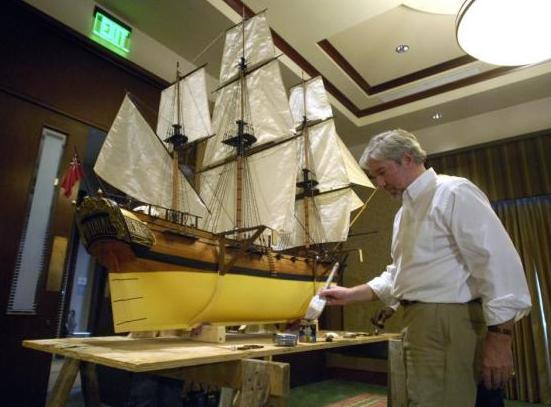
This is a replica of the ship the William and Sarah, which brought 42 Jews to Savannah from London. Photo courtesy of Hunter McRae/Savannah Morning News.

This is a replica of the ship the William and Sarah, which brought 43 Jews to Savannah from London. Photo courtesy of Hunter McRae/Savannah Morning News.

Only five months before this, on orders from England’s King George II, James Oglethorpe founded Savannah as a garrison and military buffer between the English settlements farther north and Spanish Florida. Although some protested their arrival, the Jewish immigrants’ timing proved to be perfect.

One of the group was a Portuguese doctor named Samuel Nunez (I’ve also seen it spelled Nunes). The colony’s only doctor had died recently and a yellow fever epidemic was taking its toll on the city. Oglethorpe allowed Dr. Nunez to begin caring for patients and when the number of deaths dropped dramatically soon after, local protests against the Jews staying in Savannah subsided.

When my niece and I went to visit Frank recently, he told me that his friend, Alice, who is a cemetery enthusiast like me, knew of two very old Jewish cemeteries on the outskirts of town. The only problem was that Alice couldn’t remember exactly where they were. Trailing her in Frank’s car, we took a circuitous route through some rough parts of town and pulled several illegal traffic maneuvers in the process. It was one wild ride.

You have to be a little eccentric to like cemeteries. I think Alice and I fit the bill.

You have to be a little eccentric to like cemeteries. I think Alice and I fit the bill.

Situated beside a school and the remains of a decrepit railroad building are the Levi Sheftall Family Cemetery and the Mordecai Sheftall Cemetery (Jewish Burial Grounds). Both are enclosed by high walls and locked so you can’t go inside.

Levi Sheftall was the eldest son of Benjamin Sheftall, one of the original group that came to Savannah from London in 1733. A merchant, Levi became an influential leader in the congregation like his father.

Levi Sheftall was the eldest son of Benjamin Sheftall, one of the original group that came to Savannah from London in 1733. A merchant, Levi became an influential leader in the congregation like his father.

Cared for by the Congregation Temple Mikve, the cemetery is locked up. I do NOT go to illegal lengths to get inside a cemetery. But we did get a little creative.

Cared for by the Congregation Temple Mikve, the cemetery is locked up. I do NOT go to illegal lengths to get inside a cemetery. But we did get a little creative.

Established in 1773. the Levi Sheftall Family Cemetery was used for about 80 years. There aren’t many graves inside but there are several square stone-bordered graves and a few gravestones still standing. The walls are made out of rough stone bricks and because a few on the top have come loose over the years, Frank and I temporarily removed a few from the top and he took a few pictures for me.

A closeup of the few upright gravestones still visible in the cemetery.

A closeup of the few upright gravestones still visible in the cemetery. You can see an interstate overpass in the background.

I took this picture through the bars of the iron door.

I took this picture through the bars of the iron door.

Across the way is the Old Jewish Burial Ground established in 1773 by Levi’s brother, Mordecai Sheftall. This cemetery contains many more graves because it was a community cemetery and not a family one. The land parcel was granted to Mordecai by King George III in 1762. Its walls are thicker because the cemetery was involved in battle during an ill-fated French attempt to take control of Savannah from the British in 1779.

According

According to Captain Antoine-Francoise Terance O’Conner, a military engineer serving with the French forces, on October 9, 1779, “The Reserve Corps, commanded by M. le Vicomte de Noailles, advanced as far as an old Jewish cemetery, and we placed on its right and a little to the rear the four 4-pounders.”

The Old Jewish Burial Grounds are impossible to see from outside. So again, we had to get creative.

The Old Jewish Burial Grounds are impossible to see from outside. So again, we had to get creative.

Unfortunately, seeing inside the cemetery was impossible. I don’t hop fences or trespass to get pictures. But when Alice suggested standing on top of her car to see over into the cemetery, I was only momentarily deterred. With Frank’s help, after Alice pulled her car up beside a wall, I climbed up and took some pictures.

What I won't do to see a cemetery! Thanks, Alice.

What I won’t do to see a cemetery. Thanks, Alice!

Most of the graves are of the above the ground brick box-style variety. There’s one large monument surrounded by a fence. An estimated 80 or so people are buried here, but many graves are unmarked. Several metal plaques list names from the various families with members probably buried there.

One of those names is Andre Daniel Nunez, son of Dr. Samuel Nunez (whose burial site is unknown). I found this out thanks to a Savannah Find a Grave volunteer who got to go inside the cemetery when Congregation Temple Mikve led a tour there.

It's not possible to know exactly who is buried here but as it was the only consecrated ground Jews could be buried in at the time, it is the most likely place.

It’s not possible to know exactly who is buried here but as it was the only consecrated ground Jews could be buried in at the time, it is the most likely place.

If  you look at the back wall and to the right, you can see one of the memorial plaques listing the names of those thought to be buried there.

If you look at the back wall and to the right, you can see one of the memorial plaques listing the names of those thought to be buried there.

Life for Jews in Savannah was not smooth sailing. In 1742, the Spanish invaded and many Jews who had hidden under the guise of Catholicism back in Europe feared persecution. Most fled the city but some eventually returned after the Spanish were defeated at the Battle of Bloody Marsh.

Despite many setbacks, the Jewish community in Savannah began to expand and thrive. In 1895, Herman Myers became the city’s first Jewish mayor. Today, there are three Jewish congregations in Savannah, with Congregation Mikve Israel (Reform) being one of them.

Next week, I’ll share stories about the other cemeteries in Savannah I visited, including the one made famous by “The Book” from 1994 that turned the city into a tourist mecca. It’s also known as Midnight in the Garden of Good and Evil.

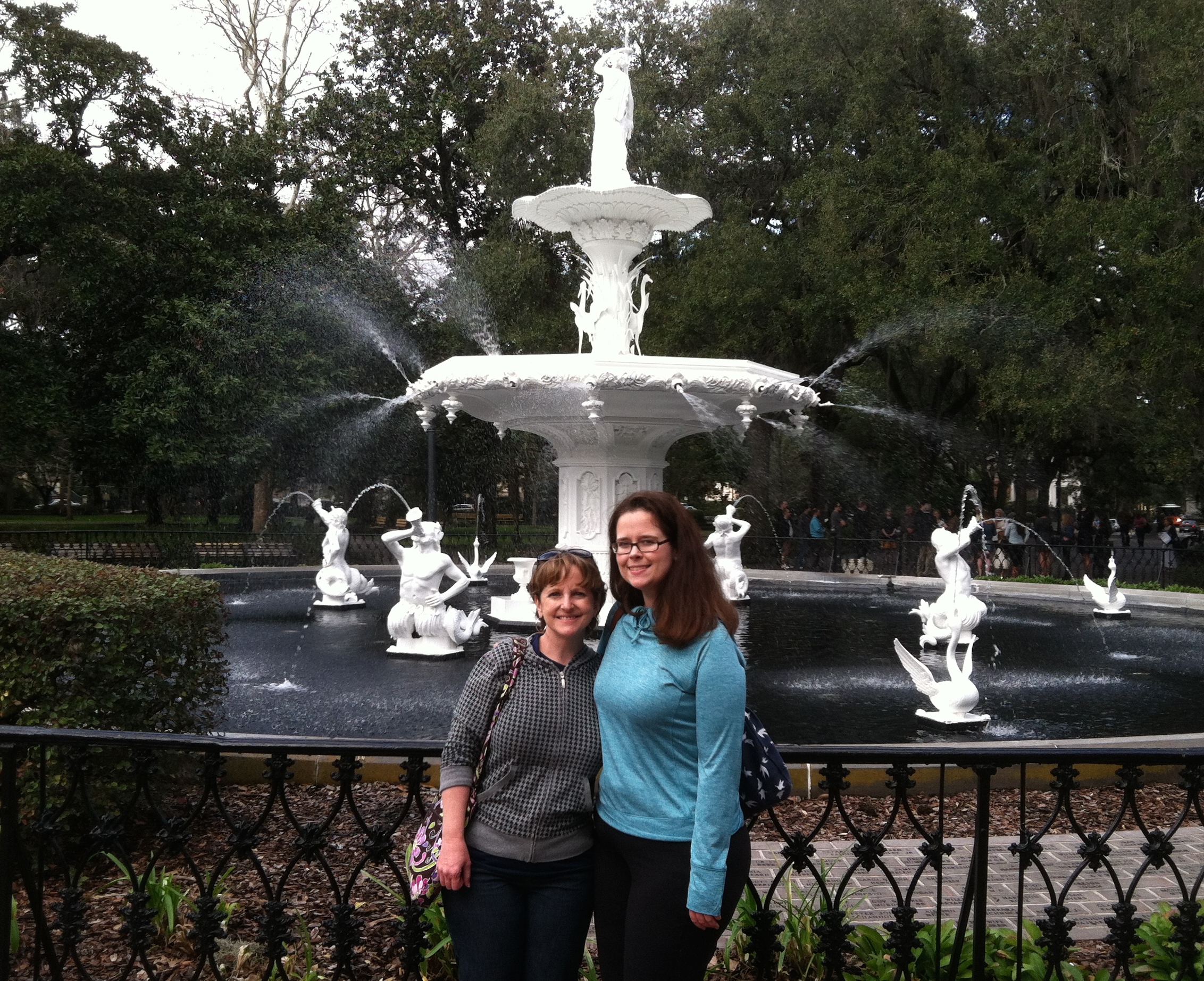
Me and my awesome niece, Hannah, who came along to make sure I didn't get into trouble while cemetery hopping.

Me and my awesome niece, Hannah, who came along to make sure I didn’t get into trouble while cemetery hopping.

Guest Post: Unusual Ways to Honor the Deceased

Now that I’ve been blogging for over a year, I’ve begun to hear from some readers overseas. So when I recently received an e-mail from a British copywriter named Dean Ronnie, I was intrigued.

Among other clients, Dean works for a funeral director (Laurel Funerals) in the U.K. He asked if I’d like to share an article he’d written about unique funerals. Because I truly enjoy sharing the writing of others, I gave an almost immediate yes. Here it is.

The times are changing and with changing times come changing traditions. One place this is becoming more and more apparent is in tributes to dead. The past has shown us some very spectacular ways of honoring and remembering the dead.

From China’s Terracotta Army to the Great Pyramids of Giza in Egypt and the Taj Mahal in India, people have always found spectacular ways to honor those who have passed on.

Today, this hasn’t changed. Memorials and funeral planning are still about being personal to the deceased. Let’s take a look at some of the more unusual ways that the deceased have been honored.
The Guitar-Shaped Forest

After the love of Pedro Ureta’s life, Graciela, unexpectedly died in 1977 at the age of 25, the Argentine rancher decided to plant trees in her honor. But not just any trees. Ureta decided to create an entire guitar-shaped forest on his farmland.

Made out of Cypress and Eucalyptus trees, the guitar is about two-thirds of a mile long. Photo courtesy of Maria Emilia Perez.

Made out of Cypress and Eucalyptus trees, the guitar is about two-thirds of a mile long. Photo courtesy of Maria Emilia Perez.

Cultivated because of her love for the instrument, Pedro Ureta worked tirelessly to plant the forest, crafting the perfect guitar shape complete with a star-shaped hole in the middle. Using cypress trees to form the outline, Ureta used blue eucalyptus trees to accent the trees and make his dedication to his deceased wife visible to all who fly over it.

According to a Wall Street Journal article, Ureta has never seen the guitar from the sky himself. He’s afraid of flying.

Launching Gene Roddenberry’s Ashes into Outer Space

As the creator of the highly successful and internationally recognized television and film franchise Star Trek, what better way would there be to honor Gene Roddenberry than to send his ashes into outer space? The answer is no other way.

Placed on the Hollywood Walk of Fame in 1985, Gene Rodenberry's star was the first ever presented to a television writer. Photo courtesy of Wikimedia Commons.

Placed on the Hollywood Walk of Fame in 1985, Gene Rodenberry’s star was the first ever presented to a television writer. Photo courtesy of Wikimedia Commons.

After being sent on a flight on the Space Shuttle Columbia mission STS-52 in 1992 and an unsuccessful previous attempt to have them sent into space permanently in 1997, the ashes of Gene Roddenberry and his wife Majel (who died in 2008) are set to be launched into space in 2014. A fitting tribute to an advocate of space exploration.

Jim Henson’s Muppet Memorial Service

Following the death of the Muppet’s creator Jim Henson in 1990, two incredibly distinct memorial services were held. Held in London and New York, both events were open to the public. Both services were held in famous cathedrals, both services were attended by no one wearing black, and both services featured a solo by Sesame Street character, Big Bird.

Jim Henson and producer George Lucas were working on the film Labyrinth in 1986. Film courtesy of Wikimedia Commons.

Jim Henson and producer George Lucas were working on the film Labyrinth in 1986. Film courtesy of Wikimedia Commons.

Following this was a gathered team of Muppets including Elmo, Gonzo, Scooter, Mokey Fraggle, Gobo Fraggle and Oscar the Grouch, who sang a medley of Henson’s favorite songs before ending with “Just One Person”.

Firing Hunter S. Thompson’s Ashes From a Cannon

In 2005, the father of gonzo journalism Hunter S. Thompson received a memorial that was equally fitting of his lifestyle, a memorial that saw his ashes fired from a cannon into the night’s sky.

Fireworks carrying the ashes of the late Hunter S. Thompson explode over the top of his memorial on the Owl Farm in Woody Creek, Colo. Photo courtesy of Ed Andrieski/Associated Press/

Fireworks carrying the ashes of the late Hunter S. Thompson explode over the top of his memorial on the Owl Farm in Woody Creek, Colo. Photo courtesy of Ed Andrieski/Associated Press/

The memorial which took place in Aspen, Colorado, saw Hunter S. Thompson’s ashes fired from a 150-foot tower, which was topped with a red fist with two thumbs — the symbol of Thompson’s first-person style of gonzo journalism. The tower was paid for by Johnny Depp, who played Thompson in the film adaptation of his book Fear and Loathing in Las Vegas.

Following fireworks, friends at the memorial were then encouraged to remember him with the clink of ice in whiskey.

In Your Own Backyard: Hidden Cemeteries of North DeKalb

One of the enticements of cemetery hopping is discovering the ones I’ve never seen before. Especially those off the beaten path.

I recently purchased a copy of Cemetery Records of Tucker, Georgia and Environs by Ted O. Brooke. As I thumbed through it, I found some smaller cemeteries I’d never even heard of before.

My photographer friend, Jennifer (who wrote a guest post a while ago), also loves these hidden gems. We finally found time to venture out together to see some of them. She’d already seen most of them but like me, enjoys revisiting certain cemeteries over and over.

Nesbit Family Cemetery

Nesbit Family Cemetery sits on the edge of the Gwinnett County line near the busy intersection of Lawrenceville Highway and Jimmy Carter Boulevard. I must have passed by it several times (like many people) without even seeing it.

Located in the woods beside a Georgia Power building, Nesbit Cemetery is a collection of almost 20 graves surrounded by a low metal fence. There are a mix of grave styles, from the table variety to the box type. Although many of the tombstones are broken or off of their bases, it looks like someone is looking after the place.

This iron gate is the entrance to Nesbit Family Cemetery. It's worn around the edges but worth seeing.

This iron gate is the entrance to Nesbit Family Cemetery. It’s worn around the edges but worth seeing.

The contrast of this quiet little cemetery with the frenetic energy on the road behind it is remarkable. Few know it's there.

The contrast of this quiet little cemetery with the frenetic energy on the road behind it is remarkable. Few know it’s there.

William Nesbit’s grave is the oldest (1789-1863) and he has quite a history. A native of South Carolina, Nesbit fought in the war of 1812 and was one of the founding settlers of Gwinnett County. He was its first elected sheriff. Nesbit also served Gwinnett County in the Georgia State Senate for two sessions, first in 1829 and later in 1833. His 650-acre plantation was located near the Gwinnett/DeKalb County line. He and his wife, Mary Lawless Nesbit, had 12 children together. Some are buried near him.

Little Nellie Nesbit only lived for two years but her tombstone still speaks today.

Little Nellie Nesbit only lived for two years but her tombstone still speaks today.

Alvin Craig Nesbit's grave is broken but still beautiful with the clasped hands motif. He was one of William Nesbit's 12 children.

Alvin Craig Nesbit’s grave is broken but still beautiful with the clasped hands motif. He was one of William Nesbit’s 12 children.

Pounds Cemetery

It's hard to believe anyone would know that Pounds Cemetery is located in an industrial park but someone is taking care of it.

It’s hard to believe anyone would know that Pounds Cemetery is located in an industrial park but someone is taking care of it.

Our next stop was a cemetery neither one of us had visited before. Pounds Cemetery is located down a pine-straw covered drive deep inside an industrial park off Mountain Industrial Boulevard. While only about 25 graves are marked, there are many more unmarked simple fieldstones scattered about to indicate others are buried there.

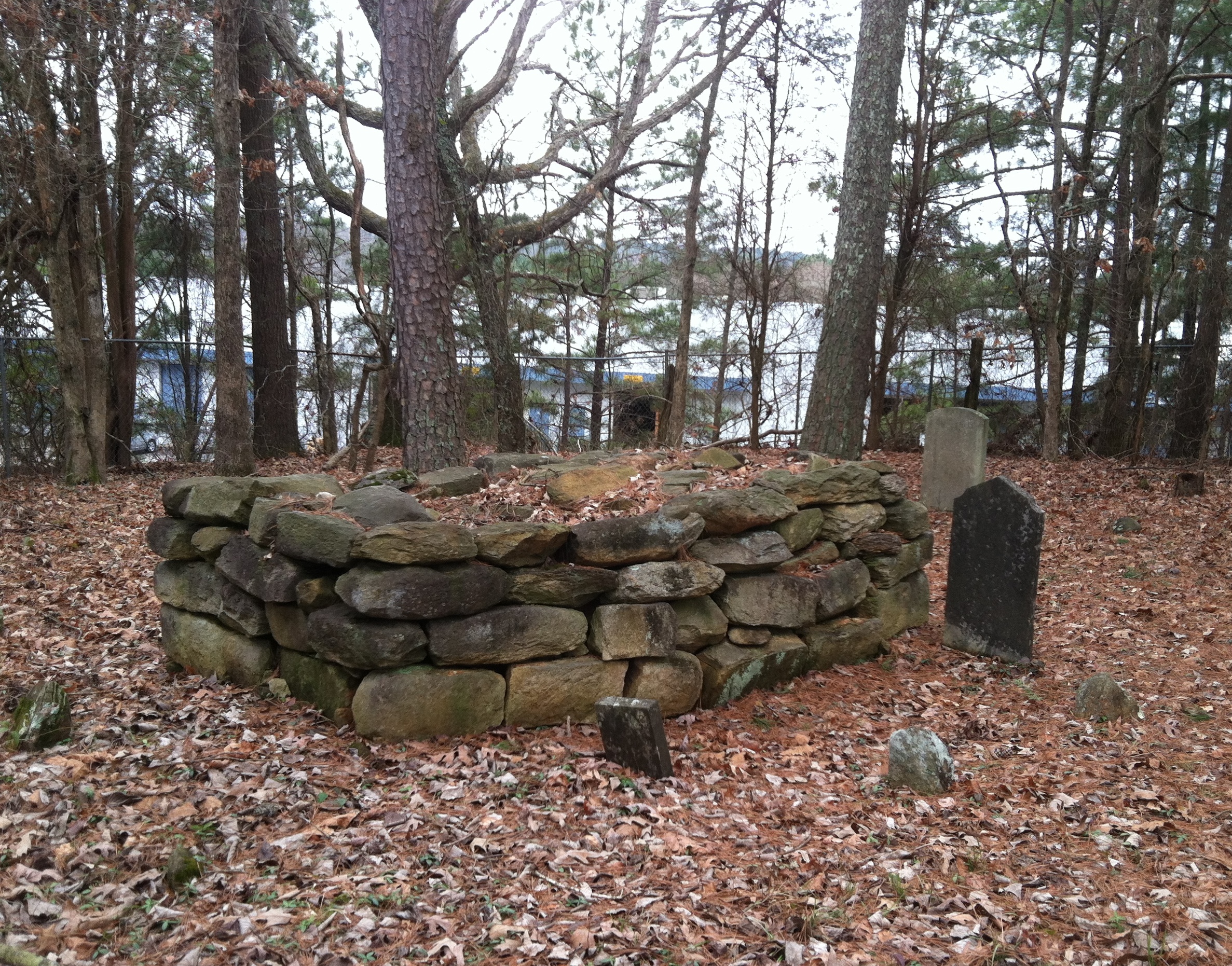
I don’t know anything about this particular cemetery. Members of the Pounds, Lankford, and Thompson families are represented. But the most stunning of the graves are the trio of unmarked cairn-style graves. Two are in rather sad shape but the third is in better condition.

I am guessing because of the proximity of these two cairn graves that it was a married couple. Their names are unknown.

I am guessing because of the proximity of these two graves that it was a married couple. Their names are unknown.

The identity of the person buried in this cairn grave is also unknown.

The identity of the person buried in this cairn grave is also unknown.

The rest of the cemetery is a collection of fieldstones, table-style graves and upright tombstones. You can clearly see warehouses surrounding it. However, it’s not that difficult to picture what it might have been like a hundred years ago before most of the forest around it was cut down.

The fieldstones scattered about the marked graves tells me there are many more people buried here than meets the eye.

The fieldstones scattered about the marked graves tells me there are many more people buried here than meets the eye.

Double Springs Church Cemetery

Remember my writing about risking life and limb when I visited Old Greencastle Cemetery in Dayton, Ohio? When we went to Double Springs Church Cemetery in a Smokerise neighborhood, not far from Stone Mountain, it felt like deja vu.

This small cemetery is located behind two houses. Fortunately, there is a public easement between the two that enables visitors to see it without having to ask permission. I am sure most people haven’t due to the uneven terrain and difficulty in keeping one’s footing.

Driving down the neighborhood street, you'd never know there was a cemetery behind this house.

Driving down the neighborhood street, you’d never know there was a cemetery behind this house.

Atlanta’s foremost cemetery hopper, Franklin Garrett, surveyed this cemetery in 1932. His books are invaluable to researchers. In his survey, he noted that a non-denominational church adjoined the cemetery once, but had been torn down many years before.

Only nine marked graves seem to have survived and they are almost all from the Seay family. A number of unmarked stones are scattered about. Most were hidden under the leaves the day we visited. Jennifer knows more about the Seays than I do so I’ll have to pick her brain for more details.

Samantha Seay almost made it to the ripe age of 70.

Samantha Seay almost made it to the ripe age of 70. The broken flower motif on her tombstone is touching.

This might give you an idea of the condition the cemetery is in and how difficult it was to walk around in.

This might give you an idea of the condition the cemetery is in and how difficult it was to walk around in.

Braden Family Cemetery

Our last stop was just down the road at Braden Family Cemetery. It consists of only four marked graves. However, unlike Double Springs Cemetery, this one is on the edge of a very upscale neighborhood and is well tended.

Three box graves contain a mother and two sons. Robert Mansfield Braden, was the husband and father but his grave has not been found.

Three box graves contain a mother and two sons. Robert Mansfield Braden, was the husband and father but his grave has not been found.

Four members of the Braden family are buried here. Mother Rhoda is buried between her sons, Minor and Rufus. On the far left end is a monument to Minor’s wife, Mary Jane Milligan Braden. The whereabouts of Robert Mansfield Braden’s grave, the husband of Rhoda and father of the Braden sons, is unknown. Rhoda was born a Lankford, many of whom are buried over in Pounds Cemetery.

The monument for Mary Jane Milligan Braden is damaged but has been repaired.

The monument for Mary Jane Milligan Braden is damaged but has been repaired.

By the end of our tour, I’d seen parts of Tucker I’d never seen before. But it made me eager to find more of these hidden gems tucked away in the neighborhoods around me. To glimpse the forgotten history of the place I now call home.

Because you never know what’s waiting in your own backyard.

Photo Finish: Pictures That Stay With Me

This week, I decided to look through my growing collection of photos and choose some that have caught my imagination but that I have not shared with you yet. Some I know about and others remain a total mystery.

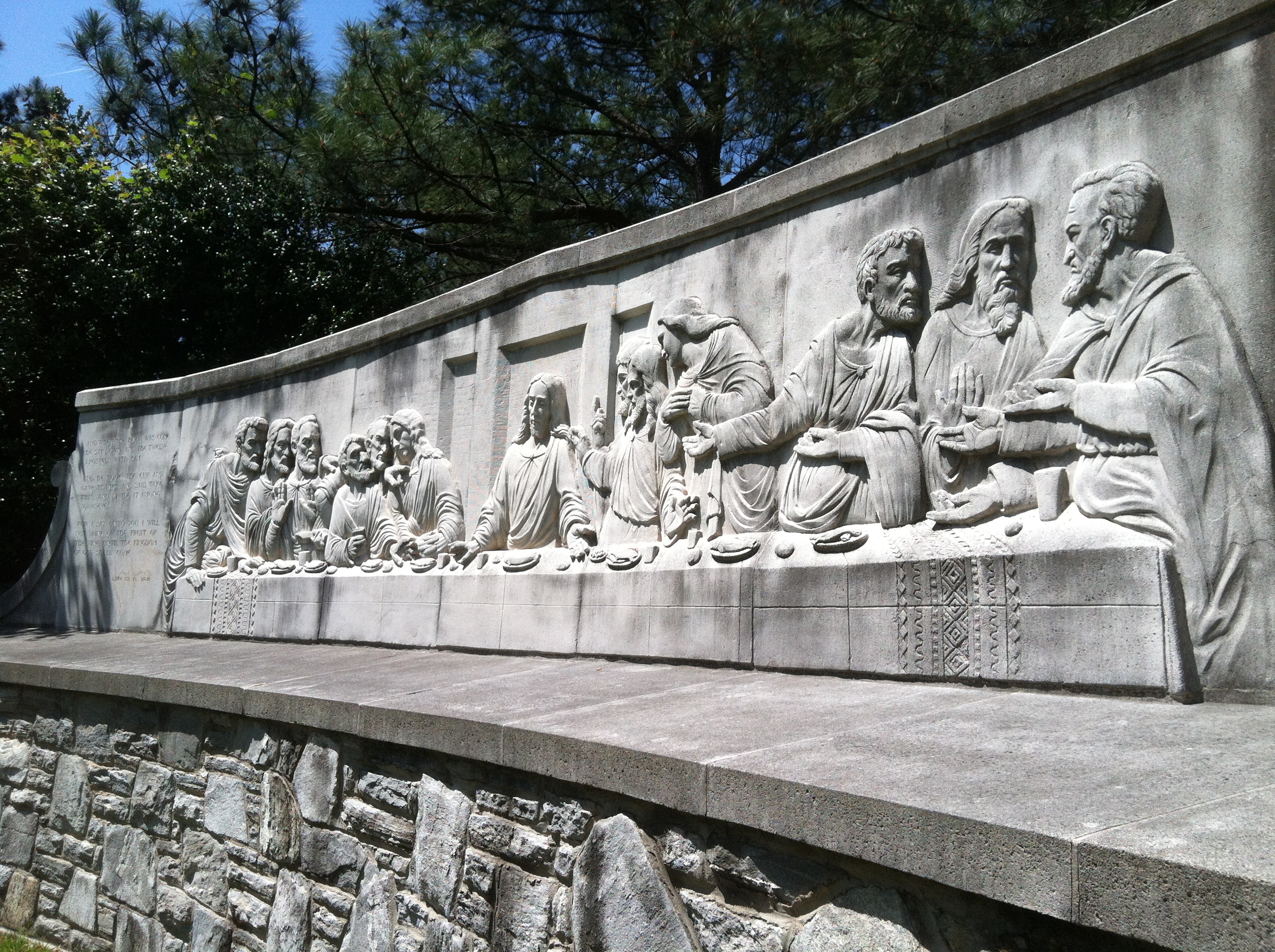
Near the entrance of Westview is a large panoramic sculpture of the Last Supper. It’s quite elaborate and detailed. German-born Fritz Paul Zimmer made Atlanta his home. He operated his own art school and was a professor at Oglethorpe University.

This sculpture of the Last Supper by German artist Fritz Paul Zimmer is eye catching.

This sculpture of the Last Supper by German artist Fritz Paul Zimmer is eye catching.

I don’t know anything about Walter Andrews (besides the fact he was a big wig in the Elks Lodge). But I really like the art deco style of his monument, from the font of the words to the clean lines. It’s something I don’t see often.

The art deco style isn't something I often see on a monument but it always makes me stop to look.

The art deco style isn’t something I often see on a monument but it always makes me stop to look.

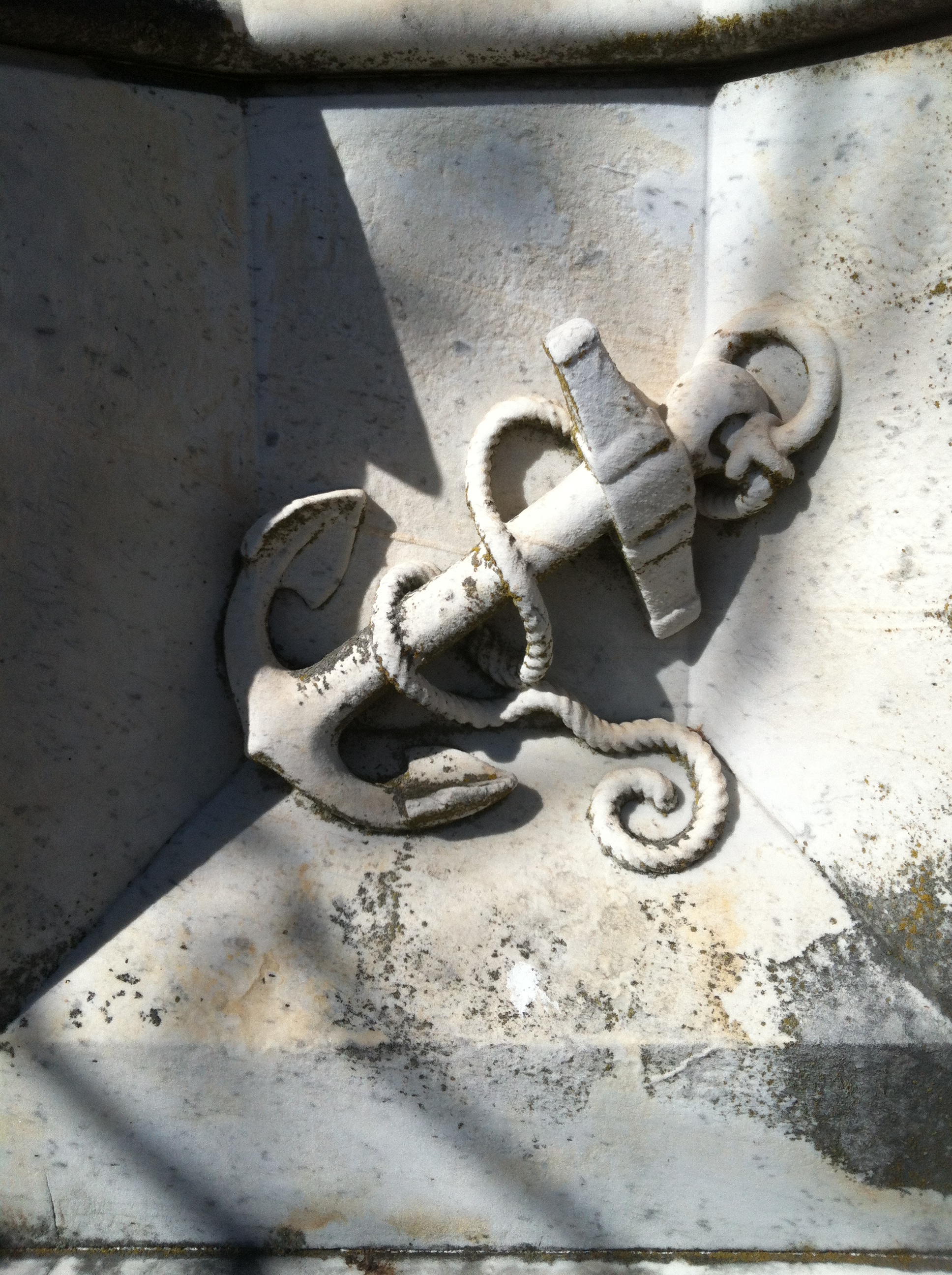
I don’t remember whose monument this anchor was on. But I was clearly taken with the detail on it. The authentic look of the rope and the iron makes it look almost real.

The detail in the carving of this anchor is amazing.

The detail in the carving of this anchor is amazing.

The day I took this picture the sky was a vivid white. From the angle I took it, the eyes look pensive and full of thought. It really stands out for me.

The sculpture of St. John the Baptist against the plain white sky gives it a stark, bare look.

The sculpture of St. John the Baptist against the plain white sky gives it a stark, bare look.

I could share a hundred photos from Oakland Cemetery, the grand dame of cemeteries in Atlanta, and still not get to them all. There are just too many interesting images to limit to a blog post.

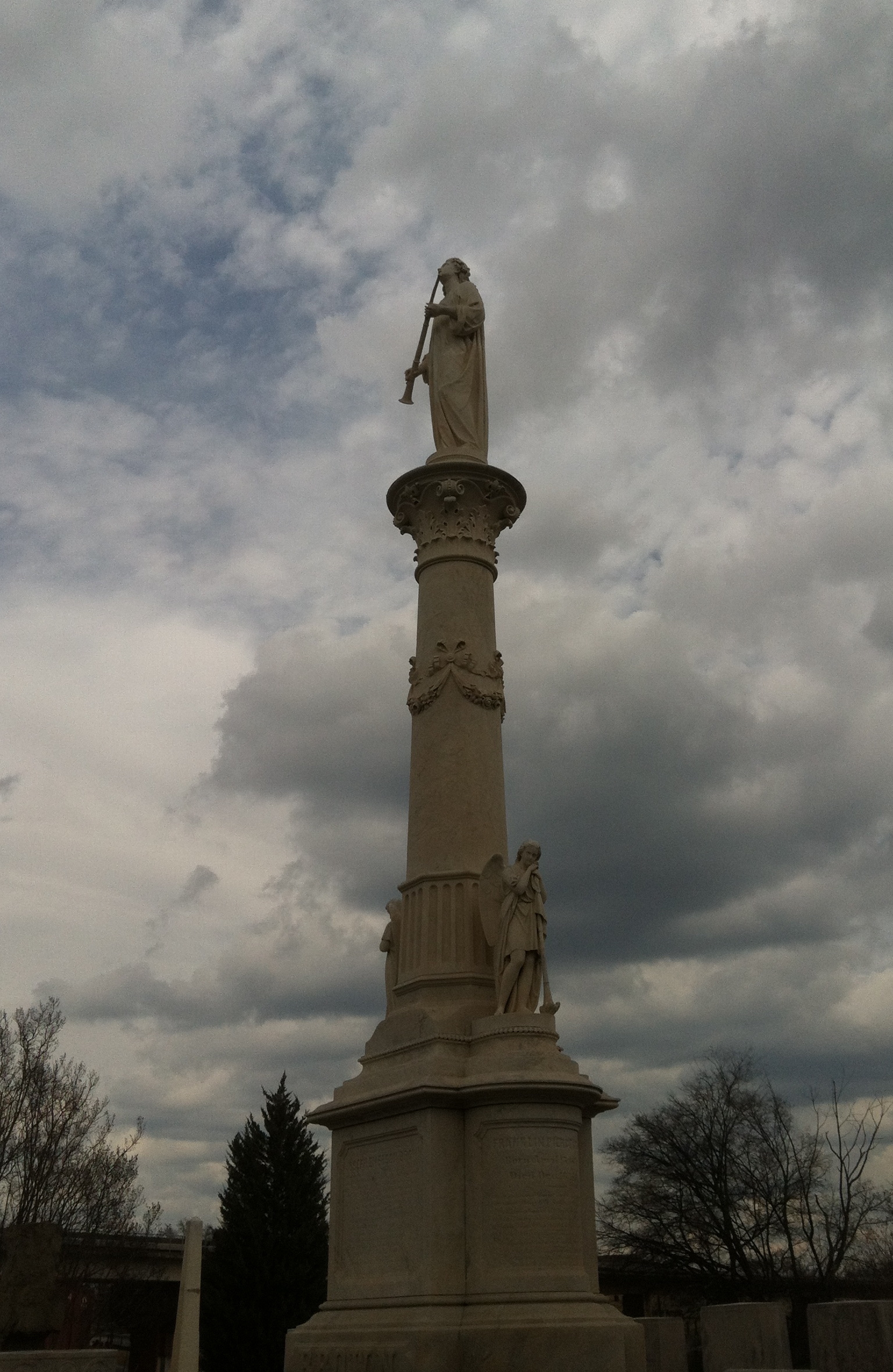
When I took a tour of Oakland last spring, the guide told us that during the awful tornado of 2008, the monument pictured below sustained damage. The tall spire literally crashed to the ground. But with loving care, it was restored. The angel leaning on his trumpet is beautifully detailed.

This monument at Oakland Cemetery was damaged during the a tornado but has been restored.

This monument at Oakland Cemetery was damaged during the a tornado but has been restored.

An angel leans against his trumpet at the base of the monument.

An angel leans against his trumpet at the base of the monument.

Last spring, I spent several days photographing Sugar Hill Baptist Church Cemetery up in northern Gwinnett County. This grave is a modern one and I’ve seen a few other examples of it but it still grabs at my heart when I see it.

SugarHillDomingue

The image of the weeping angel, face hidden in grief, is stunning.

Joseph “Jody” Paul Domingue wasn’t even 20 when he died. He was on a construction site digging a deep trench that wasn’t properly braced. It collapsed on him and he was killed. The angel crying over his grave seems very fitting for this young man’s short life.

Over the summer, I spent a few days photographing Fellowship Primitive Baptist Church Cemetery in Tucker (near my home). While nosing around in the wooded edge of the property, I found this little plaque.

Cooter the dog was clearly a well loved pet, although I'm not sure his burial was approved beforehand.

Cooter the dog was clearly a well loved pet, although I’m not sure his burial was approved beforehand.

I don’t find pet graves in human cemeteries very often. There are a few at Oakland. I think Cooter was probably buried in secret without anyone seeking permission. But even if they had, I don’t think anyone would have said no. Having lived a long life, Cooter was clearly loved.

I’ve seen hundreds of monuments for little children who have died far too young. But the one of six-year-old Mary Ruth Britt sticks with me. The downcast face of the angel, her folded hands. It’s one of the most interesting in the cemetery.

The monument for little ? Britt is memorable.

The monument for little Mary Ruth Britt is memorable.

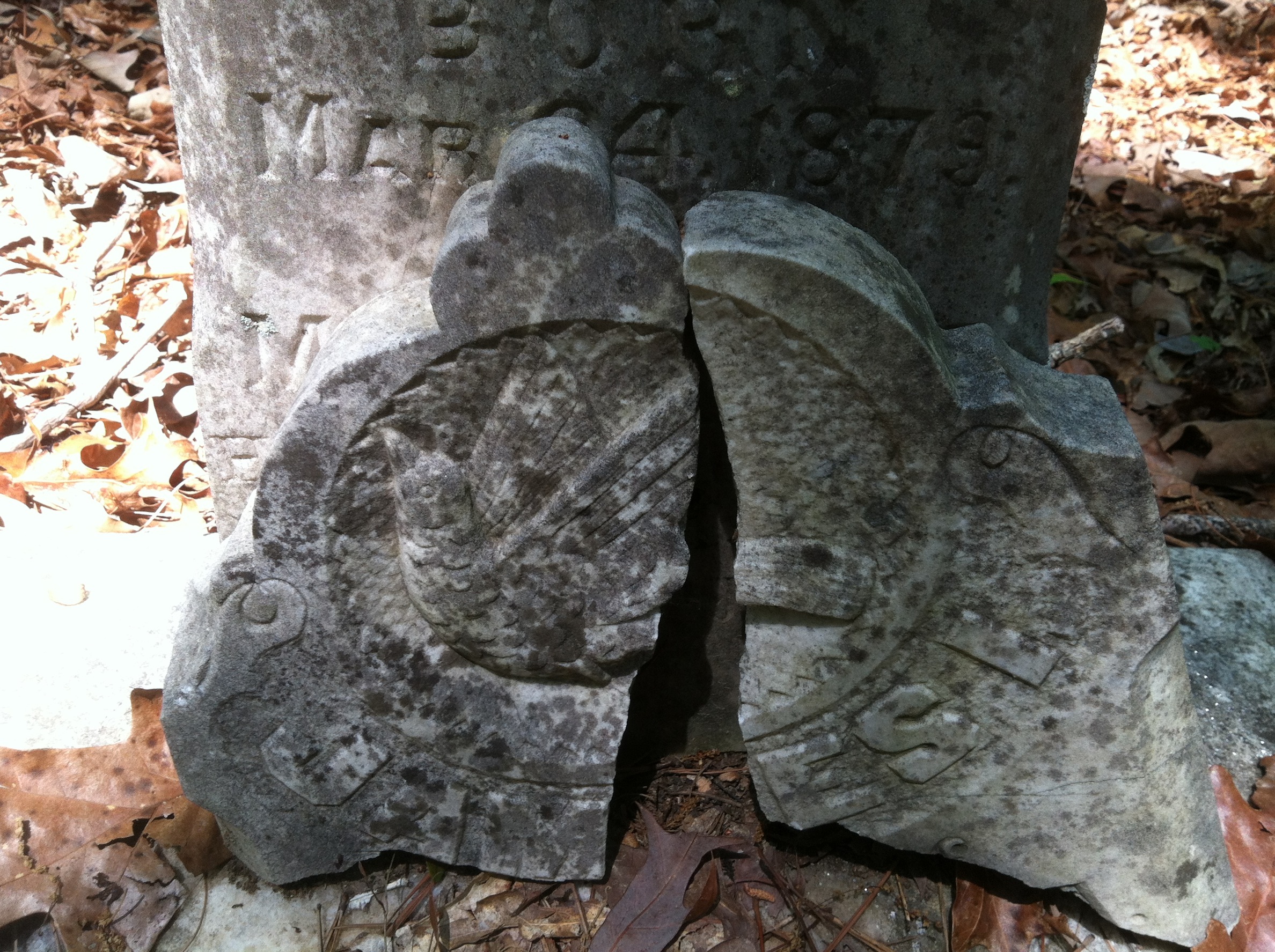
The symbol of the dove is quite common in grave symbolism. But I still find the differing styles very interesting. This one is at Phillips Cemetery in rural Fayette County.

This broken monument features a dove motif, a symbol of peace. It was carved for a child.

This broken monument features a dove motif, a symbol of peace.

Lucy Pharr is buried at Decatur Cemetery. Her grave has no dates on it. But the carving of a delicate dove clutching an olive branch in its beak speaks volumes.

Lucy Pharr's grave has no dates on it.

Lucy Pharr’s grave has no dates on it.

imageMilitary-themed monuments can be many styles. But this one from World War I is unlike any I have seen before or since.

I found this one at Fayetteville City Cemetery. It says "America Over the Top."

I found this one at Fayetteville City Cemetery. It says “Liberty: America Over the Top.”

I see monuments with the image of clasped hands on them a lot. But this one from a church cemetery in North Georgia is especially well done. The detail on the lady’s dress cuff and the gentleman’s sleeve is unique.

I'm not sure why, but of all the "clasped hamds" carving I have seen, this is my favorite.

I’m not sure why, but of all the “clasped hands” carvings I have seen, this is my favorite.

I love visiting cemeteries in other states because I get to observe monument styles and cultural differences that I don’t find in Georgia. This was evident at St. Mary’s Mount Cemetery in Kansas City, Mo. A Catholic cemetery dominated by Italian and Irish families, there’s a lot to look at.

I'd never seen a grave like this with a sort of window box on it before.

I’d never seen a grave like this with a sort of shadow box on it before.

There were a few examples of this temple-shadow box type of headstone at St. Mary’s. I don’t know what the cultural significance of it is. I don’t know if it’s Italian or of Hispanic origin. But it got my attention.

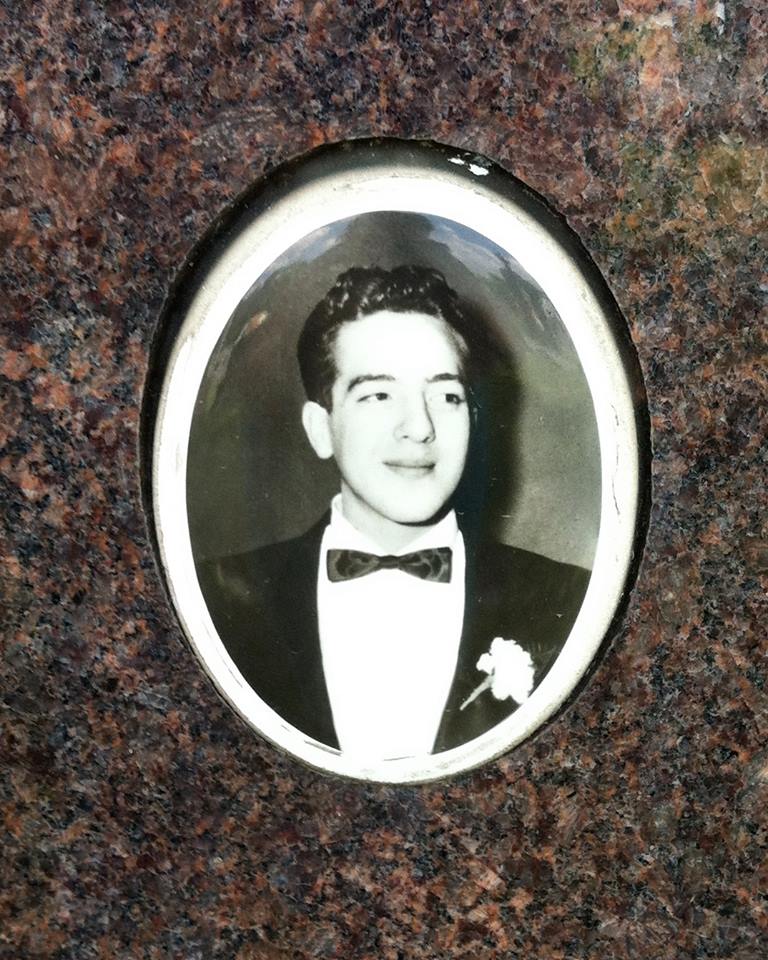
St. Mary’s also has many Italian graves that feature portraits of the deceased. Some of the faces are dour and serious. Others are more lighthearted. But it’s a wonderful way to get a better sense of who the person was. Here are two of an Italian couple.

The woman's expression is rather enigmatic. Regal, perhaps?

The woman’s expression is rather enigmatic. Regal, perhaps?

Her husband looks much happier than she does.

Her husband looks happier than she does.

Charleston, frankly, blew me away. There’s enough for a cemetery hopper like me to absorb to last for years. I could visit often and never see it all. Still, there are some other images I want to share. Magnolia Cemetery is especially interesting.

The decaying iron fencing around this family plot is common around Magnolia Cemetery.

The decaying iron fencing around this family plot is common around Magnolia Cemetery.

As you can see, the intricate wrought iron fencing around this plot is falling to pieces. The elements and lack of care are part of it. Magnolia is a large, old cemetery with not many people to care for it. Or money to restore parts of it.

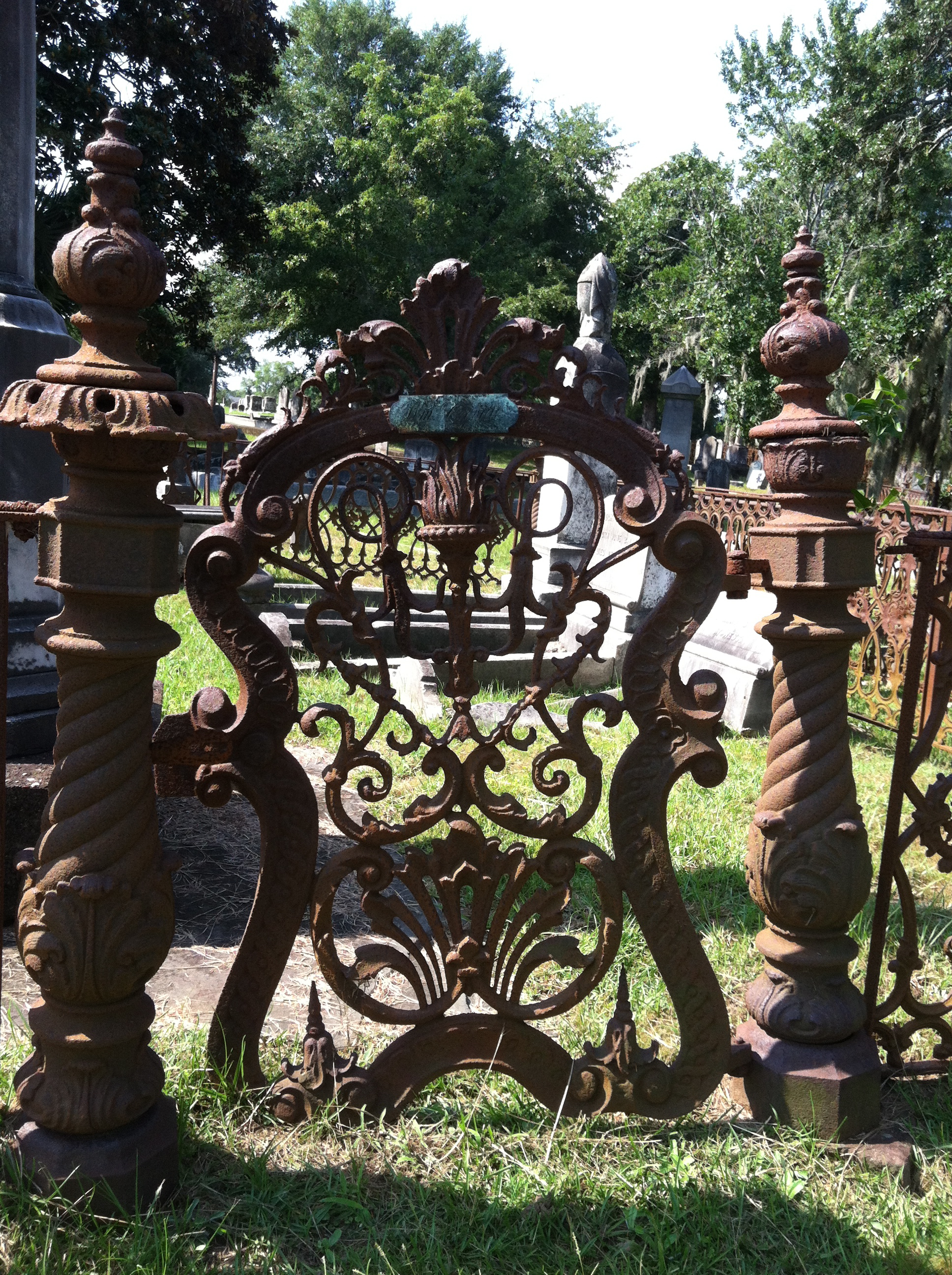
This rusted gate stands sentry over loved ones from the past.

This rusted gate stands sentry over loved ones from the past.

The detail that was put into this mental work was astounding. It’s sad to know that it’s slowly falling into disrepair, never to be restored.

At Decatur Cemetery here in Atlanta, they did something about a much loved grave whose surrounding iron fence was falling apart. With support from the Friends of Decatur Cemetery, a local blacksmith restored the beautiful iron work.

What could have been lost forever has been restored at Decatur Cemetery.

What could have been lost forever has been restored at Decatur Cemetery. This is the grave of Emily Pittman, who died in 1853 at the age of 21.

I could keep on sharing photos for hours but I’ll end here. I hope you’ve enjoyed this pictorial journey of different monuments, unique styles.

I’ll do it again (with new photos) another time.

The Minister’s Wives: When a Widower Marries His Sister(s)-in-Law

A few weeks ago, I visited Decatur City Cemetery for the first time. It is probably one of the oldest cemeteries of its size in Atlanta, even older than Oakland Cemetery.

Decatur Cemetery's Old Section is well worth a visit on a sunny day.

Decatur Cemetery’s Old Section is well worth a visit on a sunny day.

I stopped by the office to find the location of a few graves and met Wilbur, who was more than happy to help me. He and his co-worker, Demetrius, were a welcome surprise to a hopper like me. The reception I get at cemetery offices is not always friendly. When the computer database didn’t yield what I was looking for, Wilbur went through the old paper card files. Still no luck.

That’s when he got out the old cemetery books from the 1800s. I carefully handled the worn pages, scanning the faded handwritten names and dates from another age. Together, we found the information. After thanking them both, I was on my way. If you are ever looking for a grave, visit Wilbur and Demetrius. They are top notch fellows who will go the extra mile to help you.

The grave of Anne Reynolds, who died in 1827, is one of the oldest at Decatur Cemetery.

The grave of Anne Reynolds, who died in 1827, is one of the oldest at Decatur Cemetery.

It didn’t take long to find the graves. While meandering through what is referred to as the Old Section, I came upon the monument for the family of the Rev. William Henry Clarke. His name was on one side of the base, his wife, Alice, on another, and their teenage son was on another. Rev. Clarke was born in 1804 and died in 1872. I didn’t think much of it until I got home and started digging into his past.

The Three Wives of the Rev. William Clarke

Alice was the second of the three wives of Rev. Clarke. What was especially unusual about Rev. Clarke’s wives is that they were all sisters. He married the oldest sister, Melinda Kirby, on Nov. 21, 1828 in Morgan County. She was 19 at the time. Their son, the Rev. Elijah Henry Clark, served with distinction in the Confederate Army in the Civil War, and was a representative for DeKalb County in the Georgia House of Representatives.

Tintype of the Rev. Elijah Henry Clarke in his Confederate uniform. He was the firstborn son of Rev. William Henry Clarke and his first wife, Melinda.

Tintype of the Rev. Elijah Henry Clarke in his Confederate uniform. He is buried in Wesley Chapel United Methodist Church Cemetery.

After Melinda died on February 23, 1837, Rev. Clarke married the next oldest Kirby sister, Alice, a mere two months later on April 29, 1837. Alice died in August 1863. Rev. Clarke waited a little longer to marry younger sister, Julia Anne Kirby, in March 1865. He died seven years later, but Julia Anne is recorded to have died in 1905.

One of my friends commented that Rev. Clarke must have had a good relationship with his in-laws.

A widower marrying not just one but two of his first wife’s sisters is rare. But one sister-in-law? Not so much. In an era when healthcare was just emerging from the Dark Ages, women died much earlier than they do now, often in childbirth. As a result, a man might be left with several young children and no one to help him care for them.

Lack of sanitary conditions and other factors made childbirth a risky proposition in earlier centuries.

Lack of sanitary conditions and other factors made childbirth a risky proposition for women in earlier centuries.

The 1850 U.S. Census lists Alice and Rev. Clarke as having four children ranging in age from an infant to 14-year-old Elijah. Julia Ann was living with them at the time. Unmarried, she probably helped Alice care for the children and was well acquainted with her brother-in-law.

This is the Clarke family's monument. The son of the Rev. Clark and his wife, Alice, died a few years after his mother.

This is the Clarke family’s monument. Robert, the son of Rev. Clark and Alice, died a few years after his mother.

Today, one might look at such marriages with a raised eyebrow, thinking perhaps some adulterous affair was brewing before the death of the wife. But most of the time, it was a matter of practicality, not romance. A man with several children to look after might turn to the nearest single female he knew he could trust with rearing them and running his household: his sister-in-law.

Whe  I first wrote this piece, I assumed that because Rev. Clarke was probably not a wealthy man due to his religious occupation, he might not have been able to pay for childcare. One of his descendants wrote me later to correct me. Rev. Clarke (whose nickname was “Big Henry”) was one of Decatur’s wealthier residents (and owned quite a bit of land) could well afford to hire a nanny for his children. But not every widower had that luxury.

When Alice died, there were still three children under the age of 16 in the house. It was only natural that Rev. Clarke might turn to Julia Anne to take their mother’s place.

The identity of this group is unknown but they represent the typical family of a Victorian-era minister (or vicar in Britain) and his family. If a wife died young, who would care for her children?

The identity of this group is unknown but they represent the typical family of a Victorian-era minister (or vicar in England) and his family. If a wife died young, who would care for her children?

Marrying Your Sister-In-Law

One example of this situation is the case of British author Jane Austen’s younger brother, Charles. In 1814, his first wife, Fanny, died in childbirth. Being a naval officer, he left his surviving three daughters in the care of his wife’s older sister, Harriet, and returned to sea.

Author Jane Austen's brother, Charles, is pictured with his first wife, Fanny. She died in childbirth.

Author Jane Austen’s brother, Charles, is pictured with his first wife, Fanny. She died in childbirth.

In 1820, Charles and Harriet married and had three sons and a daughter. Charles’ career in the Navy does not appear to have faltered because of his marriage. He became a rear admiral in 1846, and was appointed Commander-in-Chief of the East India and China Station in 1850. The Austens were married for 32 years, until Charles died in 1852. Harriet died in 1869.

However, England’s Anglican Church was against most of these unions, considering it almost akin to incest. Reformer Felicia Skene’s novel, The Inheritance of Evil; Or, the Consequences of Marrying a Deceased Wife’s Sister (1849) addressed this topic in melodramatic fashion.

Author Felicia Skene was a faithful Anglican and strongly opposed the practice of a widower marrying his sister-in-law.

Author Felicia Skene was a faithful Anglican and opposed the practice of a widower marrying his sister-in-law.

The prohibition against a man marrying his brother’s wife does have religious roots. It comes from an Old Testament text: “If a man shall take his brother’s wife, it is an impurity: he hath uncovered his brother’s nakedness; they shall be childless.” (Leviticus 20:21.) Genesis 2 states that husband and wife “became one flesh,” therefore a wife’s sister was really the husband’s own sister, so he shouldn’t marry her.

The Marriage Act of 1835 made marriages between widows or widowers and their siblings in-law illegal. Any such couple that wished to marry had to go to a country with more flexible marriage laws, such as Italy or Norway. The Act DID legalize all marriages within the prohibited degrees of affinity (i.e. with deceased wife’s sister) that had taken place before August 31, 1835, such as that of Charles Austen. It’s hinted that he and Harriet may have wed in France, indicating that even before the Act was passed, they feared public opinion might go against them.

As far as I know, such a law was not in place in the U.S., so the practice was much more accepted. In fact, it cropped up in my own husband’s family tree. One of Chris’ great-great-grandfathers, after the death of his first wife, married her younger sister.

Annie Musson Newland was the second wife of Abraham Newland, Jr. His first wife was Annie's sister, Mary Jane. Photo courtesy of Marcia Farina.

Annie Musson Newland was the second wife of Abraham Newland, Jr. His first wife was Annie’s sister, Mary Jane. (Photo courtesy of Marcia Farina.)

In 1907, Parliament passed the Deceased Wife’s Sister’s Marriage Act, which repealed the section of the 1835 Marriage Act outlawing these marriages. However, it was still illegal for a man to marry his widowed sister-in-law after the death of his brother. That impediment was removed with passage of the Deceased Brother’s Widow’s Marriage Act of 1921.

Going back to Rev. Clarke, I learned that Julia (although her name is not on the monument) is buried in the family plot with Alice and the Rev. The location of first wife Melinda’s grave remains unknown. I do wonder if the Kirby sisters (as young girls) ever imagined that each one of them would become the wife of a minister one day. Perhaps.

Just not to the same one.

A towering tree provides shade for those resting in peace at Decatur Cemetery.

A towering tree provides shade for those resting in peace at Decatur Cemetery.

Update: Reviving Old Greencastle Cemetery

Back in May 2013, I wrote about my visit to Old Greencastle Cemetery in Dayton, Ohio. The title of that post was “When a Cemetery Dies” because when I was there, that’s what it looked like. The place was slowly sliding into ruin with little evidence of anything changing.

This was how Old Greencastle looked in November 2012.

This was how Old Greencastle looked in November 2012.

Old Greencastle has a special place in my heart, as I noted then, because my great-great-grandparents are buried there. They were not wealthy people so it’s possible they never had a marker placed on their graves when they died (in 1912 and 1919).

But in addition to that, Old Greencastle haunted me even after I left it because it made me sad and a little bit angry. From what I could tell, it had suffered many years of neglect with sporadic attempts to fix it. My research indicated that responsibility for the cemetery had become a “not my problem” issue. The City of Dayton wasn’t interested and the landlord for the property seemed overwhelmed by the problem.

During my visit, however, I noticed that the one section of the cemetery that was well cared for was for the Civil War veterans. That section’s grass was neatly cut and flags were placed beside each grave. I even saw some out in the rest of the cemetery. So I knew someone was trying to keep up with maintaining the veterans’ graves. But much of the rest was a disaster.

The section for Union soldiers who fought in the Civil War was the only area that looked like it got regular care in 2012.

The section for Union soldiers who fought in the Civil War was the only area that looked like it got regular care in 2012.

It didn’t help matters when I read later that there were problems at the New Greencastle Cemetery, just down the road, as well.

Imagine my surprise when the following comment was posted below that blog post last week:

Old Greencastle Cemetery is indeed in need of volunteers to help make it other than “abandoned.” That said, Dayton Sons of Union Veterans of the Civil War Maj. Gen. W.T. Sherman Camp #93 members have for three years been returning honor to CW vets there by placing veteran markers, donating a U.S. flag and lights for the flagpole, and cutting weeds and grass in the Grand Army of the Republic Post 79 section and elsewhere. They have located and registered the graves of more than 150 CW veterans in the cemetery.They’ve marked many CW vet graves that have no tombstones. They are cleaning existing military grave markers.

The SUVCW is being helped by Montgomery Co. Department of Veterans Services and others working to ensure veterans and other people buried at Old Greencastle are not forgotten. Community volunteers including several grounds maintenance professionals, workers provided by the Montgomery County Sheriff’s Department, and New Greencastle Cemetery staff donated about 400 work hours during 2013 helping restore the grounds. Volunteer clean-up and maintenance efforts will continue in the future. Come for another visit.

Well, I was floored, to put it mildly. So I hit the Internet to see what was happening. As it turns out, quite a bit.

Workers dive into the jungle of weeds and other brush at Old Greenwood Cemetery. Photo courtesy of WHIO

Workers dive into the jungle of weeds and other brush at Old Greenwood Cemetery. Photo courtesy of WHIO

A news article about the cleanup in October 2013 indicated that during the work, they had to call the sheriff. They’d discovered a shallow grave with exposed bones. The medical examiner was called out to investigate. I don’t know if that ever got resolved. It just further emphasized the need for a change.

At the same time, I was thrilled to learn how many people were stepping up to the plate alongside the General William T. Sherman Camp #93 of the Sons of Union Veterans of the Civil War (SUVCW). Workers from local landscaping company Bladecutters were volunteering their own time to help clean up Old Greencastle. That’s something a lot of people wouldn’t do.

I haven’t been back to Old Greencastle yet, but after hearing this good news, I’m eager to see it. The only evidence I have of these efforts is a picture posted by WDTN, but even that was exciting.

Old Greencastle looks a lot better in this photo than when I saw it last. Photo courtesy of WDTN.

Old Greencastle looks a lot better in this photo than when I saw it last. Photo courtesy of WDTN.

So what finally clicked to enable this group to come together? What set the wheels in motion? Did my blog post have anything to do with it? I don’t know and it doesn’t matter as long as this hard work continues. From the assurances I’ve received from the folks at the SUVCW, the odds are good that Old Greencastle is going to get the continued care and maintenance it needs and deserves. I would hate to see it go back to its old state.

Because when even one cemetery is saved, history is preserved. That may not mean a lot to some but for those seeking the secrets of their past, it means a great deal.

Count me as one of them.

Atlanta’s Other Golf Great: The Mysterious Death of J. Douglas Edgar

Golf is truly a goddess and must be wooed accordingly, with due meekness and humility, but at the same time with boldness and determination. — J. Douglas Edgar

When you think of golf and Atlanta, the first name that pops into your head is Bobby Jones. His grave at Oakland Cemetery is visited by thousands each year. Some even leave golf balls in homage to the legendary sportsman.

But Jones is not the only golfing great to spend time in Atlanta. Englishman J. Douglas Edgar was his close friend and mentor. While you’ve probably never heard of him, his name was in the headlines next to Jones’ quite often. Edgar won the Canadian Open in 1919 by a record 16 strokes (a winning margin that still stands for a PGA Tour event), while Jones came in second. Edgar won it again in 1920.

J. Douglas Edgar's new golf swing changed the world of golf forever. He discovered it by trial and error.

J. Douglas Edgar’s new golf swing changed the world of golf forever. He discovered it by trial and error.

Unfortunately, the last time Edgar’s name would appear on the front page would be in a 1921 article about how he was discovered lying in a pool of his own blood in the middle of Atlanta’s West Peachtree Street.

J. Douglas Edgar was born in Newcastle upon Tyne in England in 1884. His family was not well off. At the age of 13, he found himself caddying to make money, although he had never played himself. One day a golfer invited him to give it a try and after swinging and missing it seven times, Edgar finally hit the ball. He was hooked on the game from that day on.

Steve Eubanks wrote about the life and death of J. Douglas Edgar in his book, To Win and Die in Dixie.

Steve Eubanks wrote about the life and death of J. Douglas Edgar in his book, To Win and Die in Dixie.

Edgar worked at various golf clubs over the next few years, his golf game mediocre at best. He had an ailing hip that limited his swing, something he tried to overcome with little success. His charm, however, won him many friends and golfing companions around the area.

Finally, with little in his pockets, he stumbled upon what came to be known as the Movement. While experimenting with various swings at High Gosforth Park Race Course, he decided to give his aching hip a break and not take full swings. Randomly, he decided to take an even more abbreviated swing, locking his upper arms against the muscles in his chest. He wanted to see how well he could hit it without turning his hip on the backswing.

When the ball clicked, Edgar knew at once that the shot was solid. Not only did the ball fly exactly as he had intended, it went farther than any shot he had hit in a year. Edgar had no idea that his discovery would become a cornerstone of golf instruction for the next century.

J. Edgar Douglas in 1915 (from left): Ted Ray, Edgar, fellow pro Ivo Whitten and British golf legend Harry Vardon.

J. Edgar Douglas in 1915 (from left): Ted Ray, Edgar, fellow pro Ivo Whitten and British golf legend Harry Vardon.

As Edgar shared his new technique with his fellow golfers, he began to get noticed. He started participating in high-level tournaments and rubbing elbows with pro golfers like fellow Englishman Harry Vardon. World War I curtailed Edgar’s rise briefly. When it was over, golf was certainly not uppermost in the minds of its shellshocked survivors in Europe.

Despite having a wife and two children, Edgar decided to try his luck in America, leaving for New York City in March 1919. Thanks to the growing popularity of golf and the shortage of available pros to teach, Edgar quickly got a job at the Druid Hills Golf Club outside of Atlanta.

Shortly after arriving in Atlanta, Edgar teamed with Perry Adair (known as one of the “Dixie Whiz Kids”), in a foursomes match against Bobby Jones and Willie Ogg. The match went down to the wire with Jones and Ogg winning, one up, when Jones sank a putt on the final green. It was one of the few times Jones would beat Edgar that year or the year after.

Bobby Jones had a rather brief career but it changed golf forever. During a rough patch, he sought Edgar's help and found renewed success.

Bobby Jones had a rather brief career but made an indelible mark. During a rough patch, he sought Edgar’s help and found renewed success.

The following matches between Jones and Edgar were private and plentiful. Years later, Jones said, “We played 36 holes together every Monday at East Lake. He was a marvelous teacher.” At a critical stage in his career, Jones turned to Edgar for advice and coaching. It helped jump start his stagnating performance.

Edgar’s wife, Meg, and their children eventually joined Edgar in Atlanta but it did not go well. Mrs. Edgar did not like the hot Atlanta summers or the incessant gossip she encountered as the wife of a successful golfer. Edgar was not home much, playing in tournaments around the country or working at Druid Hills. Among his many notable Atlanta pupils was Coca-Cola magnate Asa Candler.

Edgar also enjoyed the company of women and was known to love a good drink, despite Prohibition. Left with their children in their Atlanta cottage, it wasn’t long before Meg packed her trunks and took the children home to England, never to return. She would never see Edgar again.

The daughter of a doctor, Alexa Stirling always drew attention when she competed.

The daughter of a Scottish doctor, Alexa Stirling always drew attention when she competed.

Some say that one of Edgar’s love interests was Alexa Stirling. Despite her high-class pedigree, Stirling preferred hunting and fishing to attending balls. A childhood chum of Bobby Jones, she met Edgar in 1920 and began taking lessons from him at Druid Hills. Already one of the top-ranked amateur female golfers in the country, her game improved even more under his guidance.

Edgar’s fortunes continued to rise until a sweltering night in August would change everything. A passing car of reporters came upon Edgar’s bleeding body, on the verge of death. Because he was found lying in the street, most people assumed he’d been hit by a car. But his injuries indicated otherwise.

The only mark found on Edgar’s body was a deep wound near his groin, not from a bullet. He bled out, unable to hang on until medical help could arrive. Some theorized that a wound of that nature meant only one thing. A vengeful husband had punished Edgar for trifling with his wife.

While never proven, some believe Edgar was having an affair with the stunning young wife of prominent Japanese florist, William Abbey. Owner of the Nikko Inn, he’d already been tried and acquitted of shooting someone previously. Perhaps Abbey had taken out his anger on his wife’s lover.

The mystery of J. Douglas Edgar’s murder remains unsolved. A blossoming career was cut short in its prime. His name has since faded into obscurity. However, his book, The Gift of Golf, remains a classic for all golfers seeking to improve their performance.

Edgar is buried in Atlanta’s Westview Cemetery. A beautiful, mysterious Japanese woman was spotted visiting his grave soon after his death.

Edgar’s tombstone states the simple truth: “James Douglas Edgar, Native of England, One of the Great Golfers of the Age”.

And he was.

image

Simon Says: Make a Difference

Last year, I wrote about a grave I found in Sugar Hill, Ga. It turned out to be the final resting place of a victim of an infamous police murder in 1964. It was incredibly random, but this is the kind of experience I’m getting used to.

It happened again this week when I visited Arlington Memorial Park in Sandy Springs, Ga. It’s a huge cemetery with many different sections. Find a Grave lists 120 photo requests for Arlington but I was hoping to find just one.

Arlington's Menhorah Garden section is fairly new and has a modern look. Photo courtesy of Arlington Memorial Park's website.

Arlington’s Menorah Garden section is fairly new and has a modern look. Photo courtesy of Arlington Memorial Park’s website.

The grave I was hunting for was in the Menorah Garden, a Jewish section. I haven’t visited many Jewish cemeteries but this one was different than ones I’m used to seeing. Colorful painted rocks left by family and friends edge many of the graves. It dispells a lot of gloom some cemeteries have. There’s even have a bowl of unpainted rocks that guests are invited to use to leave at the grave they have come to visit.

Visitors to Arlington's Menorah Garden are encouraged to take a stone to place on the grave they are visiting.

Visitors to Arlington’s Menorah Garden are encouraged to take a stone to place on the grave they are visiting.

After finding the grave I was looking for, I took some photos of the graves around it to upload to Find a Grave. When I got home, I started uploading the photos. One person didn’t have a memorial page yet so I created one and uploaded the photo. The name Simon Kornblit meant nothing to me. The words “He Made a Difference” caught my attention.

When I did a Google search on his name, immediately a lengthy bio came up for him. Much of what I learned about him is from a profile in the Atlanta Jewish Times.

Simon Kornblit's name meant nothing to me. Turns out, he lived quite a life.

Simon Kornblit’s name meant nothing to me. Turns out, he lived quite a life.

Simon “Si” Kornblit was born to Jewish parents in Antwerp, Belgium in 1933. His father was a diamond cutter from Poland and his mother came from Russia. Belgium was not exempt from Nazi Germany’s oppressive edicts. In 1940, Si and his family fled Antwerp for America in a freighter ship that was blown up on its way back to Europe. The Kornblits settled in New York City and Si eventually graduated from Stuyvesant High School.

A summer job Si got in the mail room at advertising agency Doyle Dane Bernbach (DDB) turned into a 35-year career. While at DDB, Kornblit attended the School of Commerce and Management at New York University. He took a break from work to serve in the U.S. Army during the Korean War. Ultimately, he became executive vice-president, general manager of the Los Angeles branch of DDB.

One of Si’s most famous ad campaigns was known as the 1970 “Angry Gorilla” ad for American Tourister luggage. It involved a real-life king chimpanzee (not a gorilla) named Oofie trying to destroy one of their suitcases. It proved to be extremely popular and American Tourister sales jumped. The story behind the filming of that first ad is pretty funny.

That's Si in the middle, waiting for Oofie the king chimpanzee  to get mad at the suitcase. Photo courtesy of DDB News.

That’s Si in the middle, waiting for Oofie the king chimpanzee to get mad at the suitcase. Photo courtesy of DDB News.

Si’s wife, Bobbi, said that although her husband was gentle in nature, he was “an original ‘Madman from Madison Avenue.’”

Si and Bobbi moved to Los Angeles to be closer to his movie-making clients, 20th Century Fox and Universal Pictures. He helped oversee the advertising campaign for Fox’s Star Wars. Later, he left DDB and joined Universal. From 1987-1993, Si marketed over 100 films. They include Jurassic Park, Field of Dreams, Fried Green Tomatoes, and Back to the Future. He was also named a voting member of the Academy of Motion Picture Arts and Sciences for the Academy Awards for his work.

In 1994, after the Northridge earthquake in California, Si retired and he and Bobbi moved to Atlanta. He helped establish a film institute for continuing education at Kennesaw State University and served as its director from 2001-2003. He lectured on movie marketing to students at the Goizueta School of Business at Emory University, Georgia State, and other colleges. He never stopped sharing his wisdom with those just entering the industry.

Si lectures students at Augusta State University in 2004. Photo courtesy of the Augusta Chronicle.

Si lectures students at Augusta State University in 2004. Photo courtesy of the Augusta Chronicle.

Si also served on the Board of Governors for the Atlanta Chapter of the National Academy of Television Arts and Sciences as well as the Georgia Film, Video & Music Advisory Commission; co-chaired the Photo Forum at the Atlanta High Museum of Art; and was a member of the executive committee of the Atlanta Jewish Film Festival. In Atlanta, he also continued his three-decade involvement with the March of Dimes. On top of that, he was named a torch bearer for the 1996 Atlanta Olympic Games.

You would think after an incredible career like that, Si would have been happy to rest on his laurels but he didn’t. At age 70, he decided to pursue a long-held dream. Become an actor! And he did just that. After just six weeks of classes, Si secured a talent agent. He landed roles in local community theater productions, independent films and television pilots.

“He had warmth and was real,” said Steve Coulter, an actor, writer and director, who coached him. “Simon was good,” he added. “People asked to work with him.”

Actor Doug Mason was in Days of Vengeance with Si. He said,”We had no idea of the accomplished life that Simon had…until we got to know him visiting at his home for a rehearsal. There we saw a glimpse of how much of a big wig he really was.”

“When you read his bio, which is amazing, I still can’t believe we had the honor to have him in our little no-budget movie. But it was Simon who led us to believe that the honor was all his.”

At the bottom of Si’s gravestone are the words “He Made A Difference”. That’s what really drew me to take a picture of his grave in the first place. Because that’s what I hope to do with my life. That’s what I want people to say about me when I’m gone.

Most of us will never be world-famous film executives. But we can make a difference in the world around us, even in small, daily gestures. As 2014 gets off the ground, I hope we can all work toward that goal. It’s a New year’s resolution worth trying.

Thanks, Si, for the difference you made.

Si and his wife, Bobbi, who is an award-winning author.

Si and his wife, Bobbi, who is an award-winning author.

Goodbye, 2013: How Cemetery Hopping Has Changed Me

In November, I wrote a post about fulfilling my hundredth Find a Grave photo request. That was a big milestone for me! But since I started cemetery hopping in earnest last December, it’s resulted in so much more than that. It’s changed me in ways I was not expecting.

Telling Their Stories

I’m not into the paranormal. My faith is in Jesus Christ, not Ouija boards. Some people visit cemeteries in hopes of making contact with the “other side”. And that’s fine. But it’s not my goal.

However, I have become more willing to believe in the unexplained. I do think some individuals whose graves I have discovered wanted me to find them. They almost tug on my sleeve to get my attention. It isn’t a coincidence that I found slain police officer Ralph K. Davis’ grave amid hundreds of others at Sugar Hill Baptist Church Cemetery. Something about it urged me to find out more.

Slain Gwinnett officers Jessie Gravitt, Ralph King Davis and Jerry Everett. Photos courtesy of Mackie Carson.

Slain Gwinnett officers Jessie Gravitt, Ralph King Davis and Jerry Everett. Photos courtesy of Mackie Carson.

When I discovered Ralph was at the center of one of the biggest murder cases in Gwinnet County history, I knew I had to write about it. By sharing the story of Ralph and his brother officers Marvin Jesse Gravitt and Jerry Everett, I educated a new generation about a forgotten slice of history. It’s hard not to feel a jolt when you realize that you frequently, unknowingly, travel a road that was once a murder scene.

The same goes for Adeline Bagley Buice, who while pregnant not only survived arrest by the Union Army and transportation to the North, she spent five years making her way to the only home she had ever known. That kind of spirit is stunning. I’m glad I was able to share her story to a fresh audience.

But my favorite so far has to be children’s author Madge Bigham. I literally had to dig up her gravestone because it was so covered by sod and grass clippings. She was waiting patiently for someone to uncover it.

Madge Bigham's simple, flat grave marker lay hidden under grass and dirt until I found it.

Madge Bigham’s simple, flat grave marker lay hidden under grass and dirt until I found it.

In discovering Madge, I found a kindred spirit who loved writing as much as I do. Her love for children and her desire to improve their lives in an era when women were supposed to get married and stay quietly at home is impressive.

Since then, I’ve swapped emails with some of Madge’s relatives and learned more about her. When I visit Westview Cemetery, I always stop by her grave (and those of her three siblings) to make sure it’s not getting covered up again. To say hello and assure her she’s not forgotten.

Making New Friends and Reconnecting With Old Ones

I’m an introvert by nature. Talking to people I don’t know is a struggle. By getting into cemetery hopping and writing this blog, I have met or reconnected with some great people.

Sharon Smith Patterson is a perfect example. I didn’t know her well in high school but we met up again this year when she started reading my blog. By accepting her invitation to visit an almost hidden Davis Cemetery, I discovered a wealth of history I’d never known. Thanks to my new hobby, I got to spend some time with Sharon and get to know her better.

Sharon Smith Patterson and I reconnected among the graves of a small rural cemetery.

Sharon Smith Patterson and I reconnected among the graves of a small rural cemetery.

The same goes for helping my buddy Steve Reagin find his ancestors in Lithonia. We hadn’t seen each other in years but once we started talking, it felt like it had only been a few months.

Steve discovered many of his relatives' final resting places at Lithonia City Cemetery.

Steve discovered many of his relatives’ final resting places at Lithonia City Cemetery.

I’ve also made new friends in my community who read my blog. One of them is Jennifer Graham, a fellow “hopper” and talented photographer. It’s great fun to sit and talk with someone else who shares my passion for history and cemeteries.

Jennifer Graham's picture of little Grace Watson at Bonaventure Cemetery in Savannah, Ga. serves as the logo of her business, White Rabbit Creative Photography.

Jennifer Graham’s picture of little Grace Watson at Bonaventure Cemetery in Savannah, Ga. serves as the logo of her business, White Rabbit Creative Photography.

One thing that’s surprised me is how many people want to talk to me about their own affinity for cemeteries. Martin, the friend who helped me find Westivew Cemetery, is one of them. He and I have talked about how he finds comfort by visiting his mother’s grave. How visiting cemeteries is a positive experience for him. I like knowing that I’m not the only one.

The Sweet Sound of Silence

I’m not outdoorsy. At. All. I have gone real tent camping exactly twice in my life. A cabin is more my comfort zone than a sleeping bag on the ground.

However, now that I spend a good bit of my time under the open sky of a cemetery, my comfort level with the great outdoors has shifted.

I spent a beautiful, sunny day at Greenwood Cemetery this year.

I spent a beautiful, sunny day at Greenwood Cemetery this year.

When I’m in a cemetery, especially one out in the country, I enter a different world. No cars honking, no music blaring, nobody talking on cell phones. It’s just me, nature and the dead. The only background noises are the squirrels and birds going on about their business.

With the lack of distractions, I can let myself relax. My anxiety level drops and I find a peace that’s beyond words. I can appreciate God’s handiwork and the lives of those He created, all of them unique.

Finding My Voice

A few years ago when I first considered blogging, I knew I didn’t want to write a “mommy blog.” Many other talented ladies have that covered and do it well. I wanted to write about something unique and quirky. Something different.

With Adventures in Cemetery Hopping, I’ve found my true voice. A platform for my writing, which is something for which I’ve sought for quite a while. It releases something in my soul that makes me feel heard. Not necessarily understood, but heard.

As 2013 ends, I issue you an invitation. If there’s a cemetery you would like me to visit, please let me know. I already have a long list but I’m always happy to add to it. Just contact me at traci.rylands@gmail.com.

So many cemeteries. So little time!

BrokenDove