
I visited Arlington National Cemetery (ANC) twice during the D.C. portion of our trip. Once with my family, and again by myself on the morning of the day we left.
ANC is not in Washington, D.C. proper but is located in Arlington, Va. across the Potomac River from D.C. It was quite easy for us to get to because our hotel was near the Pentagon and one easy Metro stop away.
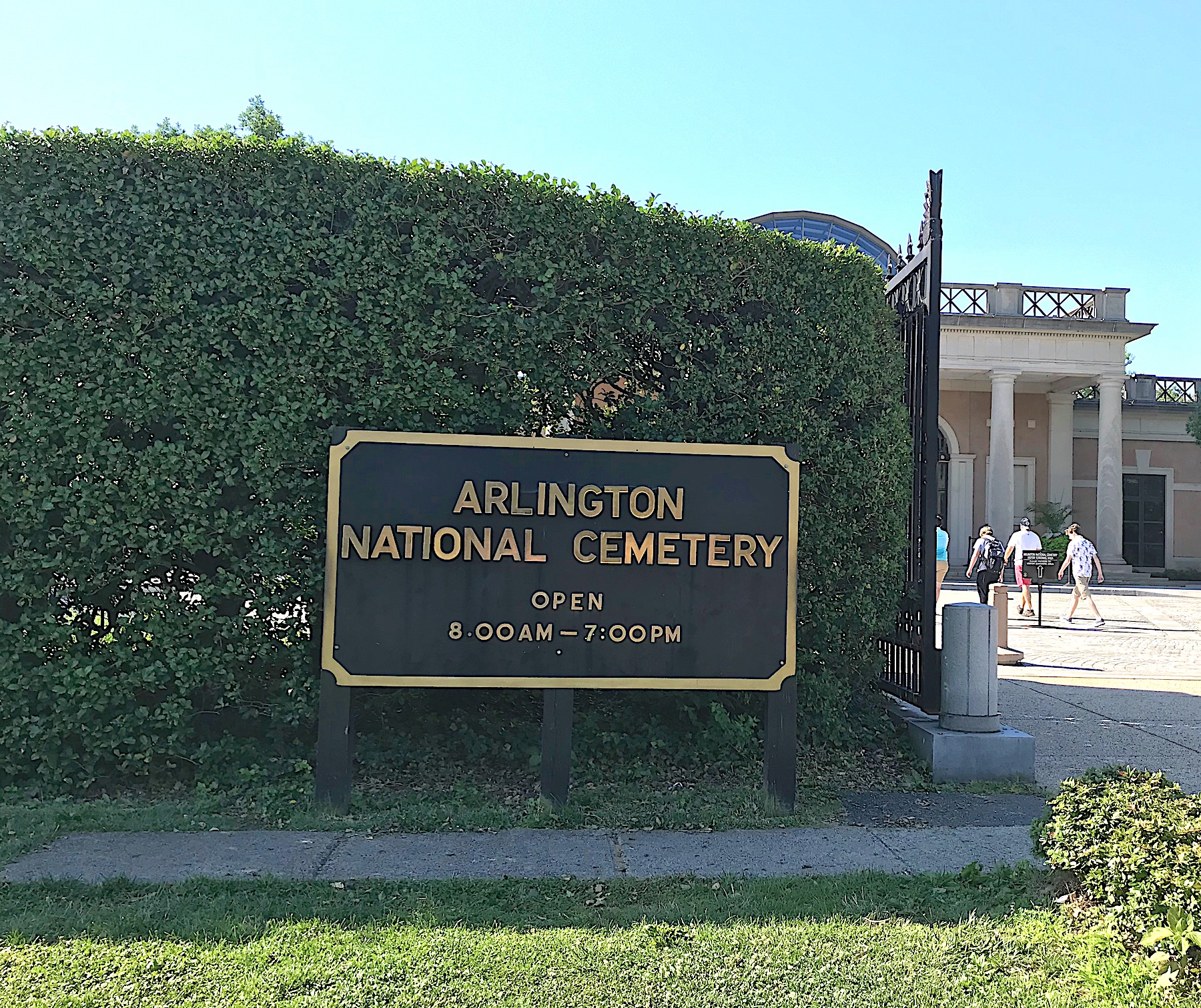
Instead of taking the tour provided at ANC, I decided we’d take a tour with Free Tours by Foot. The premise is that you sign up, show up, take the tour, and then give your guide what you thought it was worth. We met our guide (along with about 10 other people) and headed off. It was a HOT day so we were all guzzling water.
One of the reasons I had opted for the Free Tours by Foot was because it is indeed “on foot” and not on the trams that Arlington uses. There’s nothing wrong with taking a tram but I wanted to be able to stop at anything I wanted to along the way. You can only drive a car into ANC if you have permission ahead of time to visit the grave of a loved one.
Origins of Arlington National Cemetery
Long before it was a cemetery, the land that is now ANC was Arlington Estate. It was established by President George Washington’s adopted grandson, George Washington Parke Custis, to be a living memorial to the first president.

Custis’s daughter, Mary, married U.S. Army 1st Lieutenant Robert E. Lee in 1831. Yes, THAT Robert E. Lee who later became overall commander of the Confederate Army. When he died, Custis left the estate to Mary Custis Lee for the duration of her life. Upon her death, her eldest son would inherit the property. Robert E. Lee served as executor of his father-in-law’s will and never owned the property.
After the Lees abandoned the property at the start of the Civil War, the U.S. Army seized Arlington Estate on May 24, 1861 to defend Washington, D.C. From the property’s heights, rifled artillery could range every federal building in the nation’s capital.
According to ANC’s web site, the estate was seized not to punish the Custis-Lee family, but rather for its strategic value. Three forts were built on the property during the Civil War: Fort Cass/Rosslyn, Fort Whipple/Fort Myer, and Fort McPherson (currently Section 11). Beginning in June 1863, a large Freedman’s Village, established for freed and escaped slaves, was established in what today are Sections 3, 4, 8, 18, and 20.

Our guide said the Lees were told they had to pay taxes in person to get their property back from the government but that every time Mrs. Lee attempted to do so in Washington, D.C., nobody would allow them to get an audience with an official to do so. So the taxes were never paid.
On May 13, 1864, the first military burial was conducted for Private William Christman. Brigadier General Montgomery Meigs, quartermaster general of the U.S. Army, who was responsible for the burial of soldiers, ordered Arlington Estate be used for a cemetery. The two existing D.C.-area national cemeteries (Soldiers’ Home and Alexandria National Cemeteries) were running out of space — both closed on the day that burials began at ANC.
ANC officially became a national cemetery on June 15, 1864, by order of Secretary of War Edwin Stanton. The original cemetery was 200 acres, and has since grown to 639 acres (as of early 2020).

In 1874, Lee’s eldest son, George Washington Custis Lee, sued the U.S. government for the return of the Arlington property, claiming it was illegally confiscated. In December 1882, the Supreme Court ruled in Lee’s favor. A few months later, in March 1883, the federal government purchased the property from Lee for $150,000 (over $4 million today). Arlington House is still there today but it was under renovations so we could not tour it when we were there.
Arlington became a segregated cemetery, just like all national cemeteries at the time, and remained segregated by race and rank until 1948, when President Harry S. Truman desegregated the military. The primary burial ground for white Civil War soldiers became Section 13. Meanwhile, Section 27 became the area for African American soldiers and freed people; more than 3,800 freed African Americans are buried in Section 27.

take plenty of water.
Today, approximately 400,000 veterans and their eligible dependents are buried at ANC. Service members from every one of America’s major wars, from the Revolutionary War to today’s conflicts, are interred at ANC.
President William Howard Taft
ANC is the final resting place for two U.S. Presidents. One served in the military and the other did not.
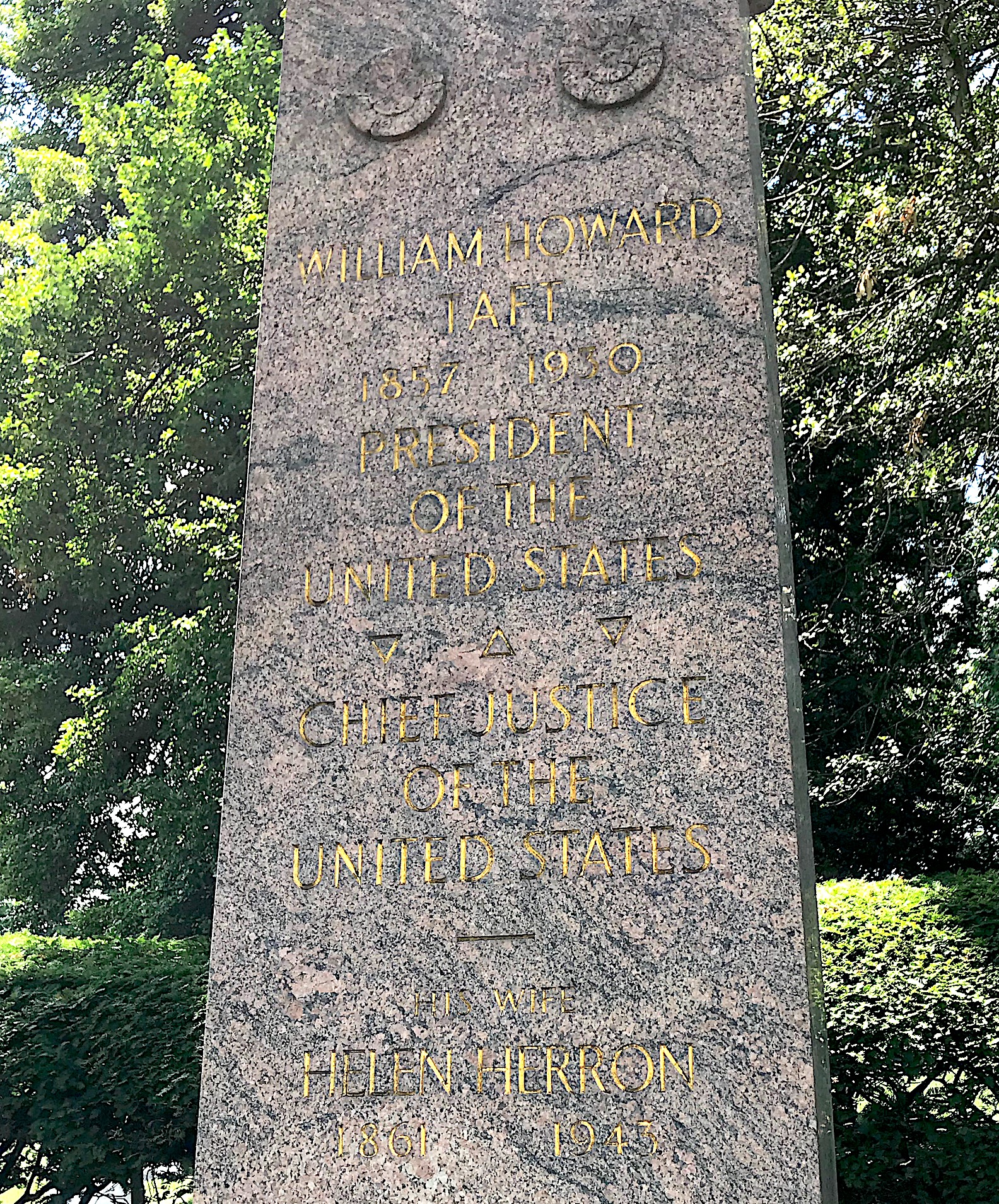
The first president buried at ANC was the 27th president, William Howard Taft, who died in 1930. He served from 1909-1913. He had the distinction of being the only U.S. president to go on to be the chief justice of the U.S. Supreme Court. Not too shabby! While he never served in the U.S. military, Taft was Secretary of War from 1904 to 1908 under President Theodore Roosevelt.
We did not see Taft’s grave as part of our tour, so we visited him on our own afterward.

After his death on March 8, 1930, Taft lay in state at the U.S. Capitol Rotunda for three days. The Taft family chose a large plot in Section 30 of ANC, which was relatively undeveloped then. Taft requested a simple ceremony with no eulogies, insisting instead upon poetry by Wordsworth and Tennyson. His burial service, too, was simple, although an elaborate procession from the Capitol preceded it, with a funeral escort provided by the 3rd Infantry Regiment.

Taft’s widow, Helen Herron Taft (buried beside him on May 25, 1943), commissioned American sculptor James Earle Fraser to design the headstone. It was finished in 1932 at a cost of $10,000, paid for by the Tafts. Made from dark mahogany granite from Stony Creek, Conn., the 14-foot-tall monument resembles classical Greek designs, and features gold-leafed inscriptions and a carved apex. Two granite benches flank the sides of the monument, and the cemetery later added a brick plaza and walkway to the site.
Civil Rights Leader
Civil rights leader Medgar Evers is buried right across the street from Taft in Section 36. I was unaware of this on our first visit but found out later. I made sure to stop by on my visit on our last day.

I was unaware until then that Evers had served in the U.S. Army. What he experienced there was a catalyst for his future civil rights work.
In 1943, Evers dropped out of high school at 17 to get a full-time job. Later, he volunteered for service in the U.S. Army and was inducted at Camp Shelby. During World War II, the vast majority of African Americans in the segregated U.S. military were relegated to support units because white officers regarded black men as inferior combat soldiers.
Evers was assigned to an all-black port battalion in the Quartermaster Corps. Evers’ battalion was likely charged with unloading weapons, supplies, and vehicles from allied ships onto trucks that then transported them to the front lines via convoys such as the Red Ball Express.
While serving in England and France, Evers grew frustrated with the demeaning treatment that he and other black service members received. Shortly after being discharged in 1946, he and his brother led a group of black veterans to the Newton County courthouse in Decatur, Miss. to register to vote. Evers’ small group was met by armed white men who threatened the veterans with violence if they did not leave. Undeterred, Evers continued to advocate for the full citizenship rights of African Americans.

On the night of June 11, 1963, Evers was returning to the home he shared with his wife and three young children. As he made his way to the front door, he was shot in the back by a sniper concealed in a grove of trees several hundred feet away. Evers died less than one hour later on June 12 at the University of Mississippi Medical Center. He was only 37 years old.
Evers was laid to rest with full military honors at ANC on June 19. An estimated 3,000 people attended the ceremony. On June 28, the cover of Life magazine bore the image of Evers’ wife Myrlie comforting their son at the funeral.
President John F. Kennedy
Unlike Taft, President John F. Kennedy’s grave was included in our tour. Unlike Taft, Kennedy did serve in the military. Despite poor healthy, Kennedy was assigned as an ensign in the Naval Reserves serving in intelligence. Ensign Kennedy’s next big break came when he was able to attend officers training school in the late summer of 1942. You can read all about his military history here, including his command of the Patrol Torpedo (PT) boat 109.

After Kennedy’s assassination in Dallas, Texas, on Nov. 22, 1963, a decision had to be made. At the time, many believed that he would be buried in Brookline, Mass. where he was born and raised. However, first lady Jacqueline Kennedy wanted her husband’s grave site to be widely accessible to the American public.
In selecting a location, she consulted with the president’s brother, Robert F. Kennedy, and secretary of defense Robert S. McNamara — both of whom are now also buried at Arlington. The original grave site was located on a sloping hillside along an axis line between Arlington House and the Lincoln Memorial.
The initial plot was 20 feet by 30 feet, and surrounded by a white picket fence. During the first year after Kennedy’s death, up to 3,000 people per hour visited his gravesite. Onn weekends, an estimated 50,000 people visited. Three years after Kennedy’s death, more than 16 million people had visited the grave site.

Because of the large crowds, cemetery officials and members of the Kennedy family decided that a more suitable site should be constructed. Construction began in 1965 and was completed on July 20, 1967. An eternal flame, lit by Mrs. Kennedy, burns from the center of a five-foot circular granite stone at the head of the grave.

The Kennedy family paid actual costs in the immediate grave area, while the federal government funded improvements in the surrounding area that accommodated the visiting public. The 1965 public works appropriation included $1,770,000 for this purpose.
John F. Kennedy’s younger brother, Joseph Jr., was killed in action on Aug. 12, 1944 during World War II. His remains were never recovered. There is a cenotaph (memorial marker) for him at ANC in the Kennedy plot.

When John F. Kennedy’s brother, senator Robert F. Kennedy, died in Los Angeles, Calif. on June 6, 1968 after being shot the previous evening, he was buried at ANC in the Kennedy plot. Like John and Joseph Jr., Robert served in the U.S. Navy during World War II.
Robert Kennedy’s burial turned out to be rather unusual due to unforeseen circumstances.
Robert F. Kennedy’s Unique Burial
Robert Kennedy’s funeral took place on June 8, 1968 at St. Patrick’s Cathedral in New York City and his body was then taken by train to Washington, D.C. for burial at ANC. However, the number of mourners getting close to the tracks along the journey caused lengthy delays. The train finally arrived at Union Station just after 9 p.m.
The procession stopped at the Lincoln Memorial, where the U.S. Marine Corps Band played “The Battle Hymn of the Republic”.

When the motorcade finally arrived at Arlington, it was 10:24 pm. The burial ceremony, due to begin at 5:30 pm, actually began at 10:30 pm in the dark. Although this was not part of the original plan, organizers quickly adapted and handed out candles to mourners. The candlelight helped illuminate the graveside and mourners in a beautiful display.
Years later, John, Joseph and Robert Kennedy’s brother senator Edward “Ted” Kennedy died of brain cancer on Aug. 25, 2009 in Hyannis Port, Mass. Ted served in the U.S. Army from 1951 to 1953. He was buried beside near his brothers at ANC.

There’s much more ground to cover at ANC. I’ll have more for you next time.

 Adventures in Cemetery Hopping
Thank you for this very informative walk. I’ve been there a couple of times and now I want to go back. Jill