
In contrast to Calvary Catholic Cemetery’s 300-something burials, Oak Hill Cemetery (OHC) in Cedar Rapids boasts close to 11,000 memorials on Find a Grave. That’s quite a difference!
Cedar Rapids is the second-most populous city in Iowa. The 2020 United States Census notes that the city population was 137,710. Cedar Rapids is 100 miles northeast of Des Moines, the state’s capital and largest city.
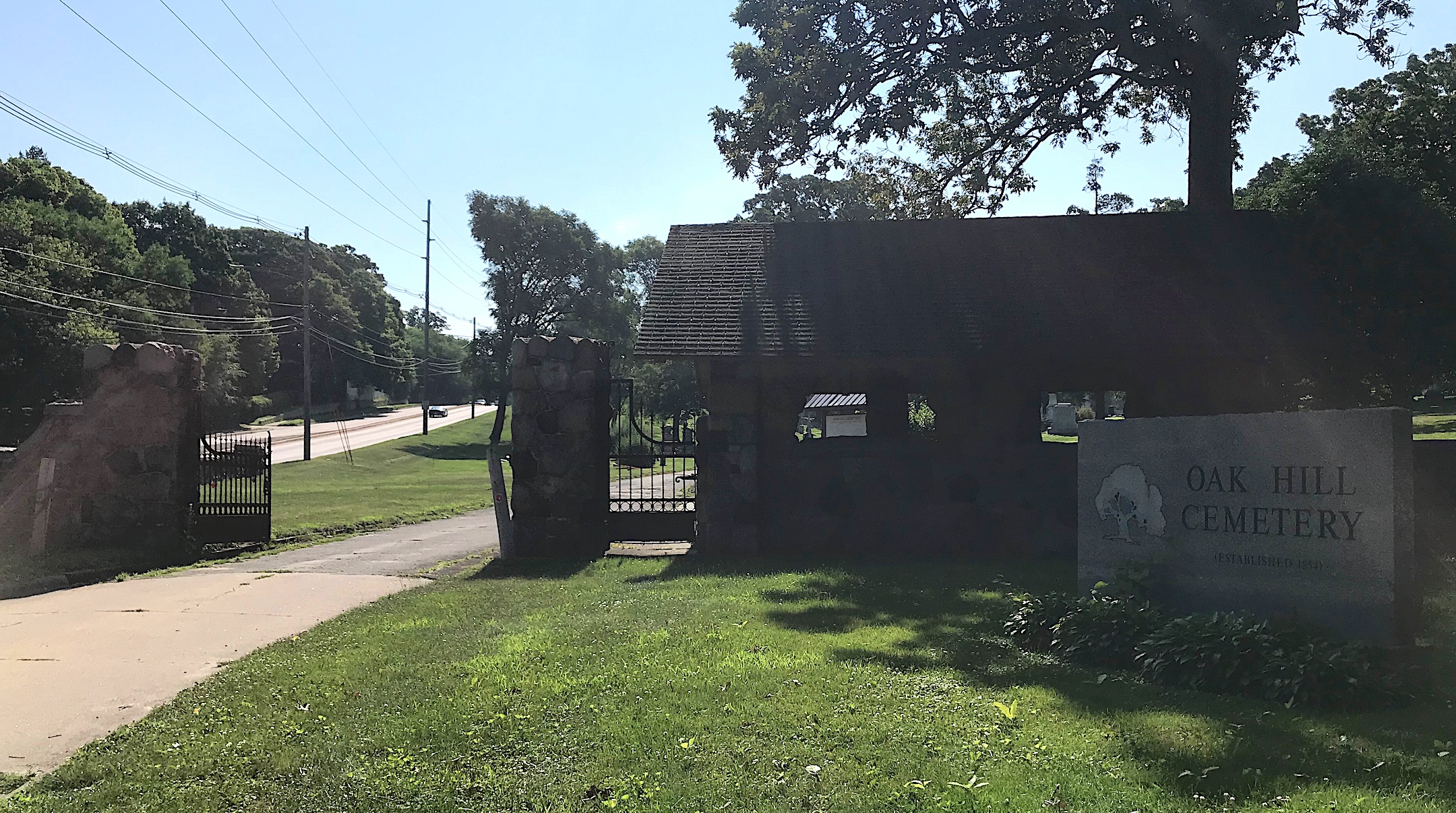
After Cedar Rapids was incorporated in 1849, land development to the east threatened to overtake the small Village (or Washington) Cemetery. In 1856, those graves were moved to the new Oak Hill Cemetery on a tract of land then considered to be outside the city. The new cemetery included a potter’s field, which is now City Cemetery owned by the City of Cedar Rapids Parks Department.
Chicago landscape architect Horace William Shaler Cleveland was hired in 1869 and again in 1880 to prepare a plan for cemetery improvement, giving it a rural picturesque landscape design. Initially operated as a for-profit cemetery, OHC was reorganized (with additional land) as Oak Hill Cemetery Association, a non-profit organization.
Titanic Victim
One of the reasons I wanted to visit OHC was to visit the mausoleum of Walter Donald Douglas, a successful Iowa businessman who perished on the Titanic on April 15, 1912. You might recall I featured another Titanic victim, Nebraska’s Emil Brandeis, in a past blog post.
Walter was the second son of Scottish immigrant George Douglas (1817-1884) and Margaret Boyd Douglas. George was a partner in a cereal mill in Cedar Rapids, which later merged with several other oat mills in 1901 to form the Quaker Oats Company. When he died in 1884 at age 67, George was the first to be interred in the Douglas mausoleum at OHC. Margaret, who died in 1905 at age 77, joined him in the mausoleum.
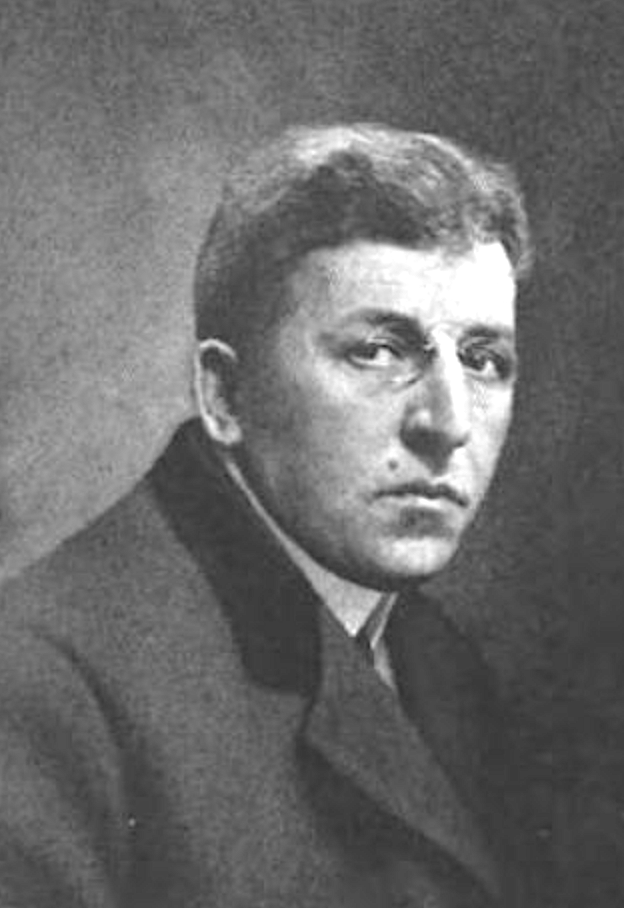
Born in Waterloo, Iowa in 1861, Walter wed Lulu Eliza Camp in 1884 and they had two sons, George Camp and Edward Bruce. Lulu died of typhoid fever in 1899 at age 37, and is interred in the Douglas mausoleum. Walter remarried in 1906 to Mahala Dutton Benedict, a divorcee originally from Cedar Rapids.
Douglas amassed a fortune of at least $4 million in various Cedar Rapids industries and expanded into the linseed oil business in Minneapolis, Minn. With his elder brother George, he formed the Douglas and Company Starchworks (later Penick & Ford) in 1903. Associated with several prominent businesses, Walter was also an executive in the Quaker Oats Co.
With Mahala, Walter built a mansion overlooking Lake Minnetonka near Minneapolis that they called Waldon. Douglas retired in January 1912 and the couple embarked on a three-month tour of Europe to find furnishings for their palatial retreat.
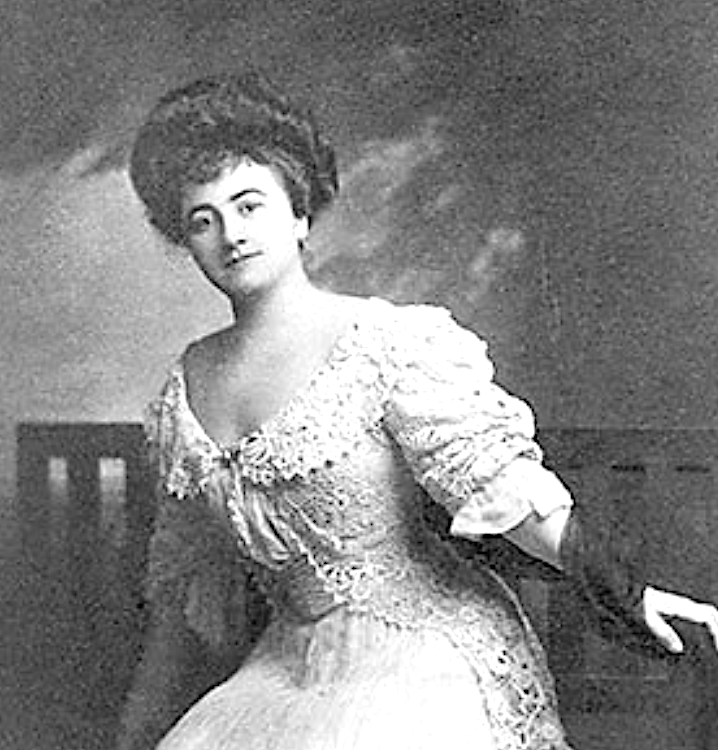
Walter purchased first-class tickets for he and Mahala, and Mahala’s French maid, Berthe Leroy, on the Titanic in hopes of being home in time to celebrate Walter’s birthday. According to the Encyclopedia Titanica:
On the night of the sinking Mr. and Mrs. Douglas had been in their cabin at the time of the collision, the shock of which was so slight that they paid little heed to it. Receiving no instructions to go topside, the couple waited in their cabin, he reassuring his wife that there was no danger. Only the sight of other passengers gathering in the corridors dressed in lifebelts prompted to couple to do the same and they dressed and headed to the boat deck where they waited for some time.
Mr Douglas saw his wife and maid off in lifeboat #2 but refused to go himself until all women and children were accounted for, saying it would make him ‘less than a man’ or ‘No, I must be a gentleman.’ According to later reports Walter Douglas, dressed in his finest, helped lower the last lifeboat of survivors off the Titanic.
Walter died in the sinking and his body was recovered by the cable ship MacKay Bennett.
Meanwhile, Mahala and Berthe, passengers in lifeboat #2, were among the first to board the Carpathia, which had come to rescue survivors. Walter’s brother George Douglas and his wife made their way to New York from Iowa to meet her, along with her stepson Edward, and she recuperated at the Waldorf-Astoria Hotel. Mahala later returned to Waldon with her family.
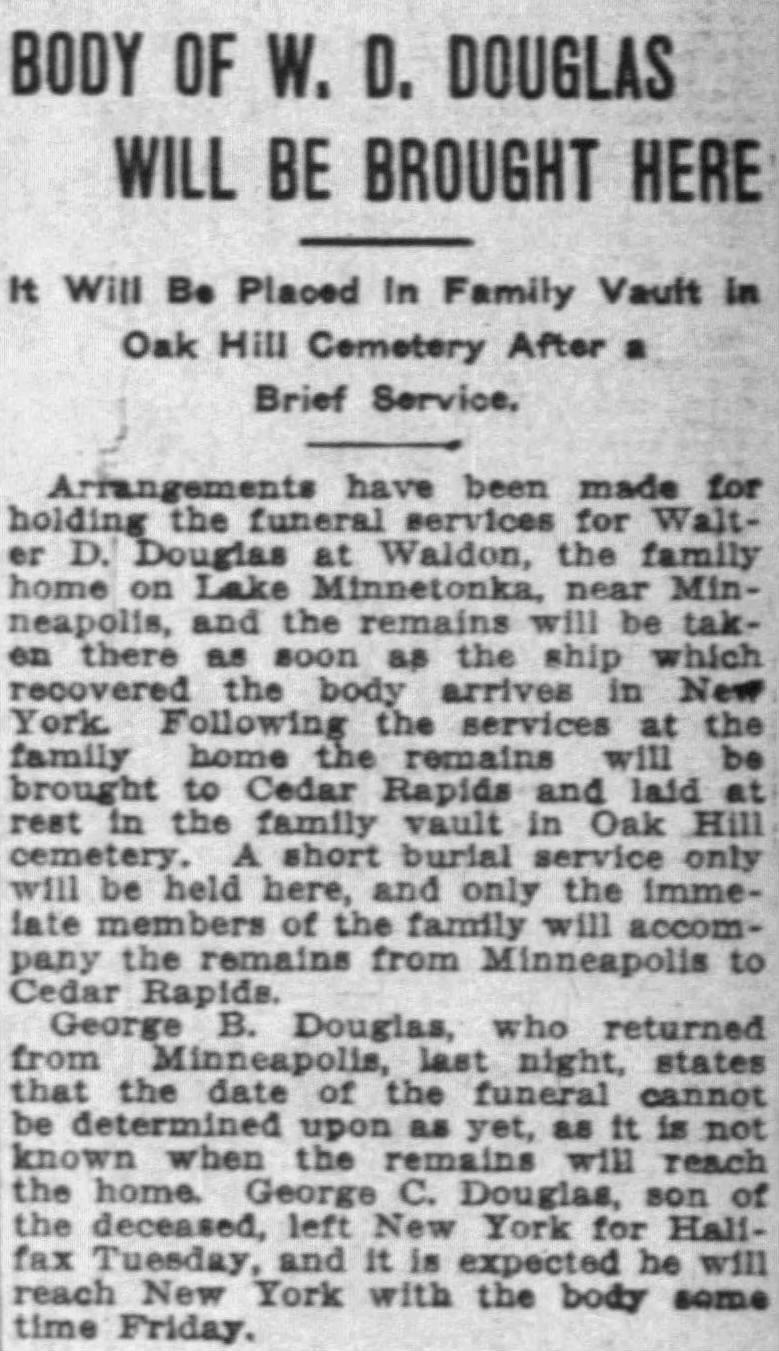
Walter’s remains were sent first to Minnesota, and the family had a service at Waldon for him. After that, he was moved to Cedar Rapids for another private service at Oak Hill Cemetery before interment in the Douglas mausoleum.

Mahala Moves On
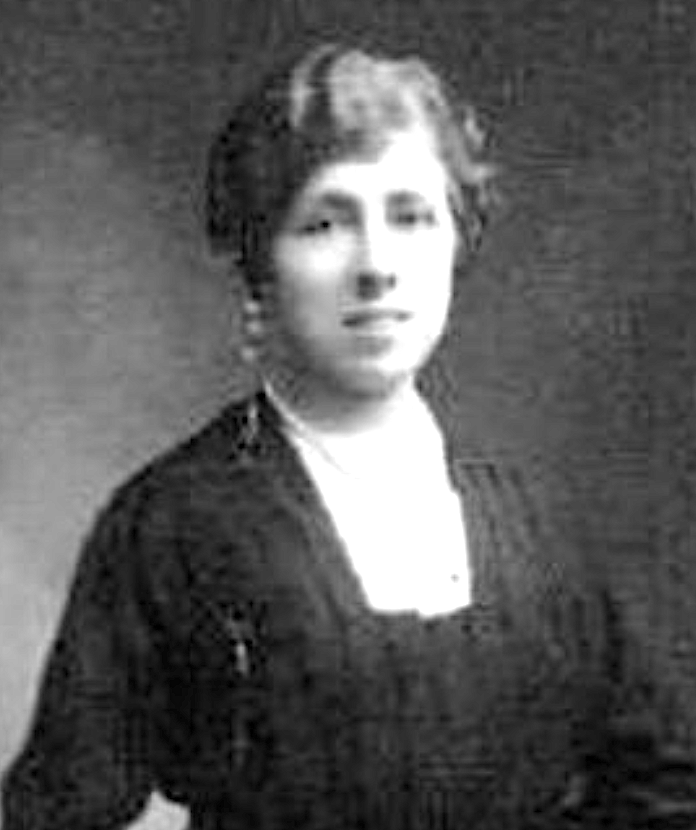
Spending much time abroad, Mahala divided her time living in Minnesota at different locations. She made frequent trips to a holiday home in Pasadena, Calif. She remained close with her maid ,Berthe Leroy, who was still listed with her on the 1930 U.S. Census.
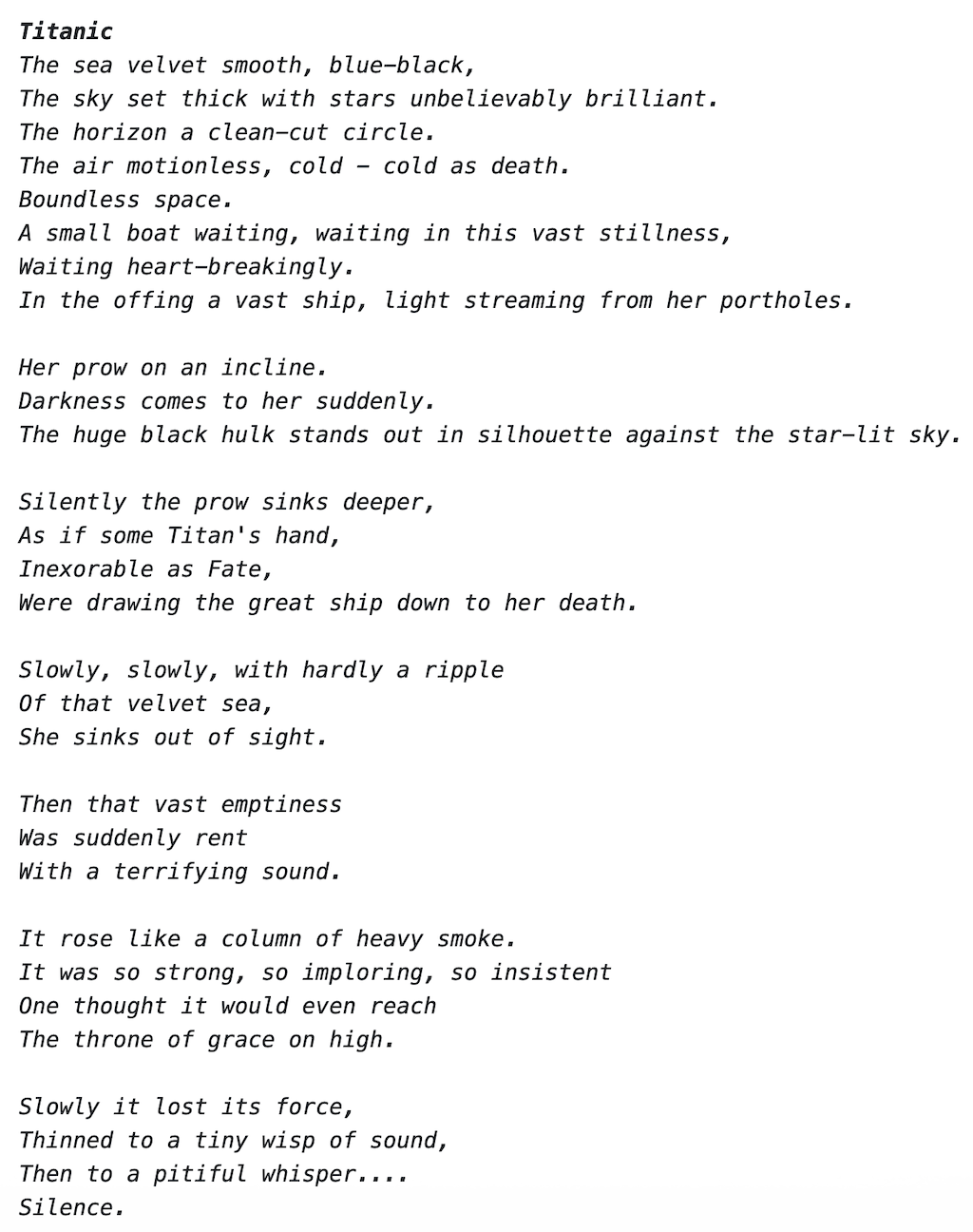
An advocate of arts and culture, Mahala turned Waldon into a showplace for extravagant gardens and furnishings collected from around the world. Also a talented writer, Mahala Douglas published a collection of stories and poems in 1932. The last poem in the book is a haunting account of the Titanic disaster.
Mahala died on April 22, 1945 at age 81 in Los Angeles, Calif. She is interred with Walter and her step-sons in the Douglas mausoleum. Berthe Leroy died on July 1972 at age 88 and is buried in Hersin Coupigny Cemetery, Pas-de-Calais, France.
“Gone to His Last Long Sleep”
There’s an interesting postscript to the Douglas family story. When Walter Douglas died, his will stipulated that his sons and heirs should for 10 years earn at least $2,500 a year. After that time, half a million dollars left by their father should be divided equally between them. Mahala got her own portion of his fortune.
Son Edward fulfilled his requirement to earn his part of the inheritance, which included serving in the U.S. Army during World War I. George worked at the family-owned starch works until 1915 when he enlisted as a private in the British Army as World War I was starting there. Apparently, he earned less than his brother. He also remained in the British Army, being stationed in Arabia after the war. While on furlough, he returned to America in 1922 to plead his case with the executors of his father’s will to receive his inheritance and they agreed he had “paid his dues”.
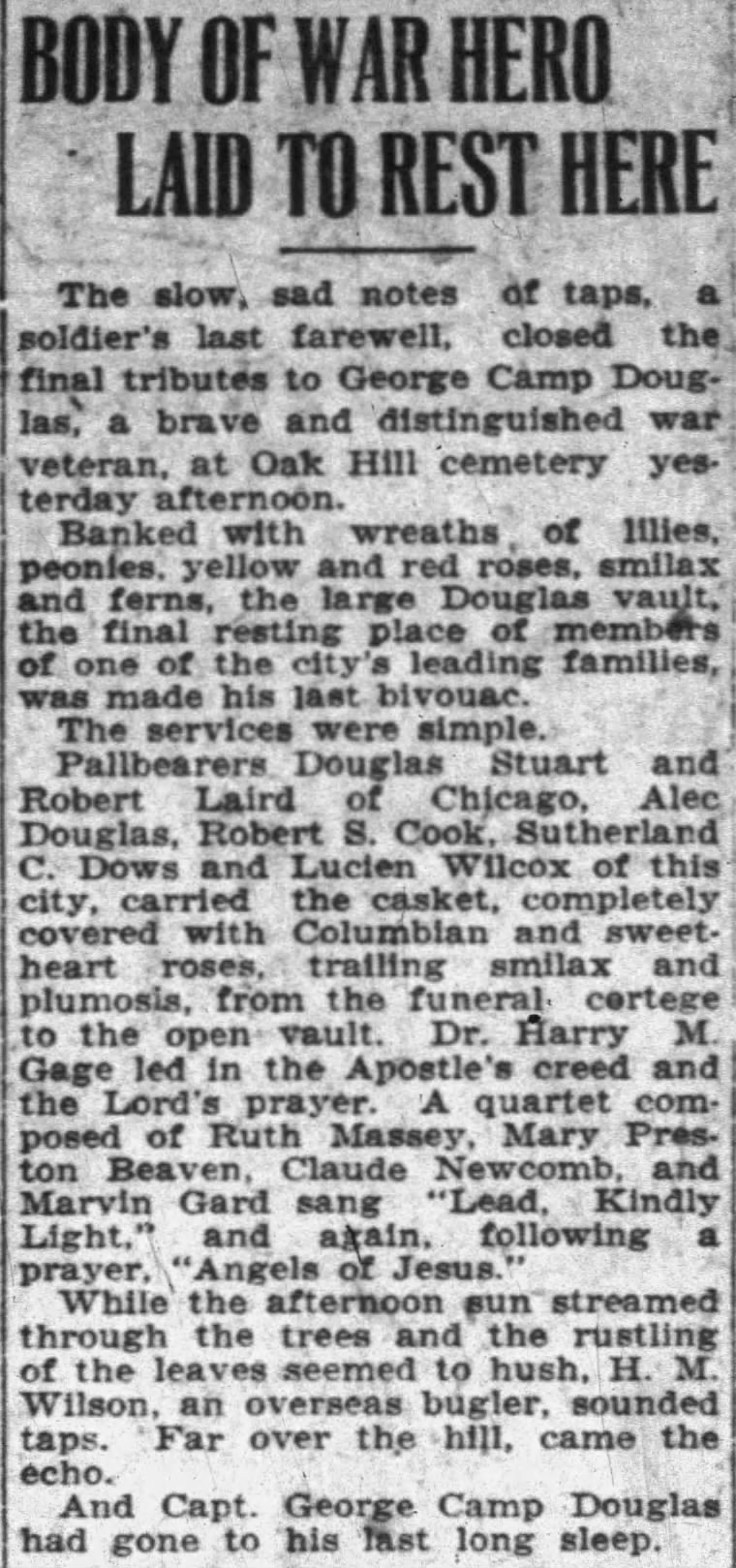
Sadly, George died in 1925 at age 39 in Chantilly, France. George had not only been gassed but wounded more than once during the war and later contracted beri beri while serving in Arabia. Some articles I found said he died in an accident, others as a result of his poor health. Regardless, his body was brought back to Cedar Rapids for interment in the Douglas mausoleum.
After World War I, Edward Douglas came home to Minnesota to try his hand in the banking business. But he later enrolled at the New York Central School of Arts where he became the student of Danish-American sculptor George J. Lober. He married and divorced three times.
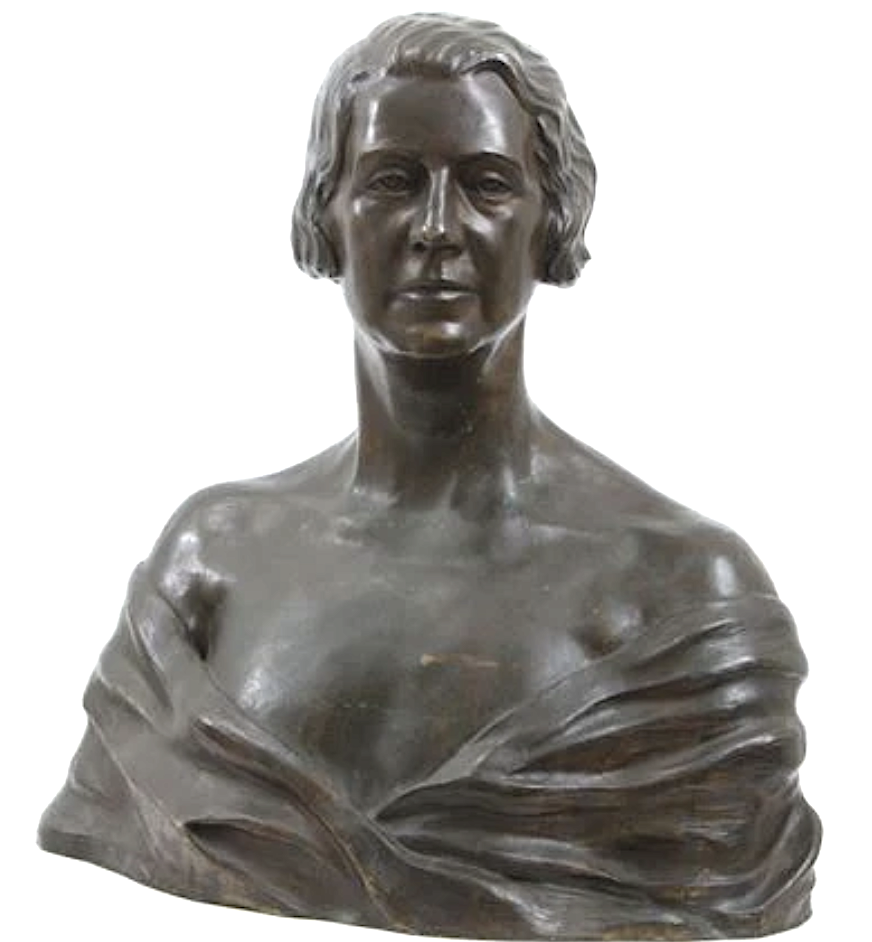
Edward became a noted sculptor, moving to Rome in 1927. He married Marthe Legret and they moved to France. They had one daughter, Beatrice. His work was part of the sculpture event in the art competition at the 1936 Summer Olympics. The picture below is of a bronze called “Busto di Donna” he completed in 1930.
Edward died of a heart attack at age 57 in San Francisco, Calif. on Feb. 6, 1946. He was the last member of the family to be interred in the Douglas mausoleum.
“Laid Beneath the Flowers”
OHC has two “woodsy” themed markers that I plan to highlight. The first is especially tragic because it tells a tale in names and dates of the four Hager children who died in the 1880s.
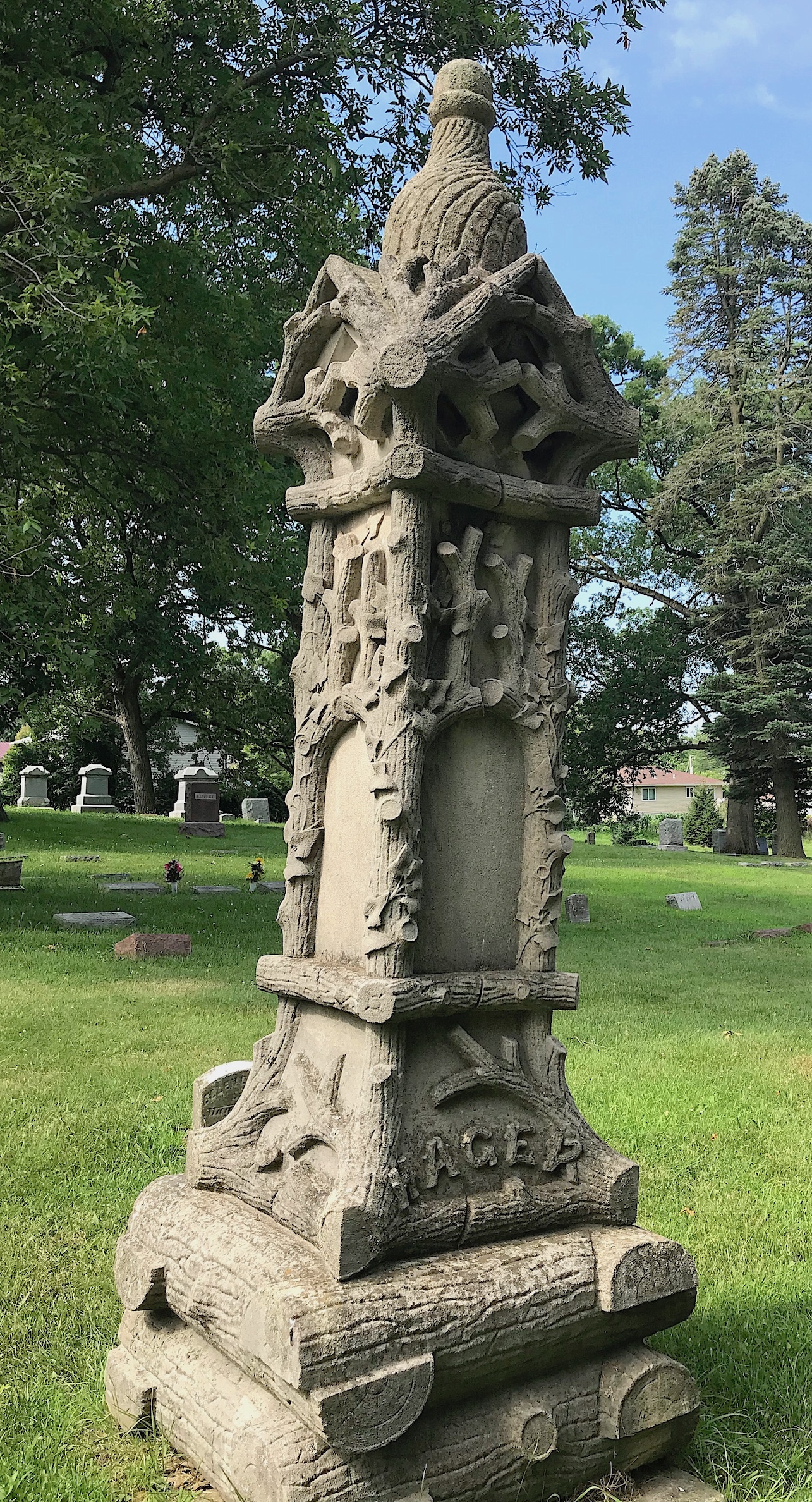
Born in Maryland in 1849, Richard Hager came to Iowa as a boy. He married Lottie Hergesheimer in 1874 and worked as a railroad foreman. The couple would have three children over the next few years: Charlie, Samuel, and Lizzie.
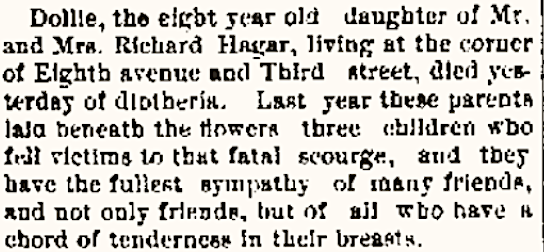
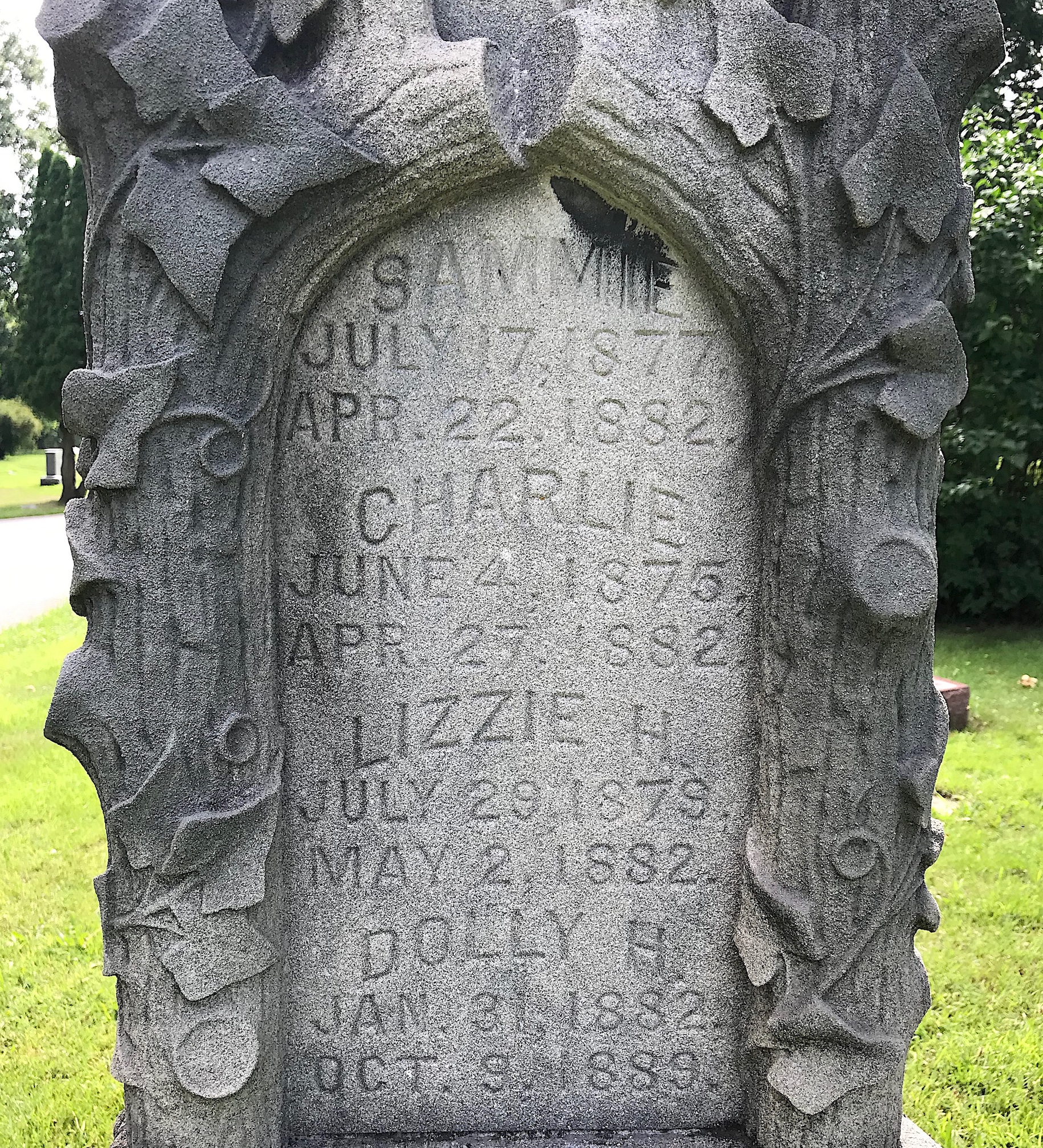
Diphtheria hovered over the Hager home in late April 1882. Sammie, age, four, died on April 22. Charlie, age six, died on April 27. Lizzie, only two, followed on May 2. Three children gone over the passage of only 12 days.
Dolly, born on Jan. 31, 1882, died of diphtheria on Oct. 9, 1889 at age seven.
Youngest son Archie, born in 1885, is the only Hager child who escaped an early death. He grew up and became a blacksmith for the railroad. As far as I can tell, he never married. The last record of him I could find was a World War II draft card that reported he was working as a fisherman in Peoria, Ill.
Richard Hager died at age 71 in 1921. Lottie died at 81 in 1930. They are buried with their children but their names are not inscribed on the “tree”.
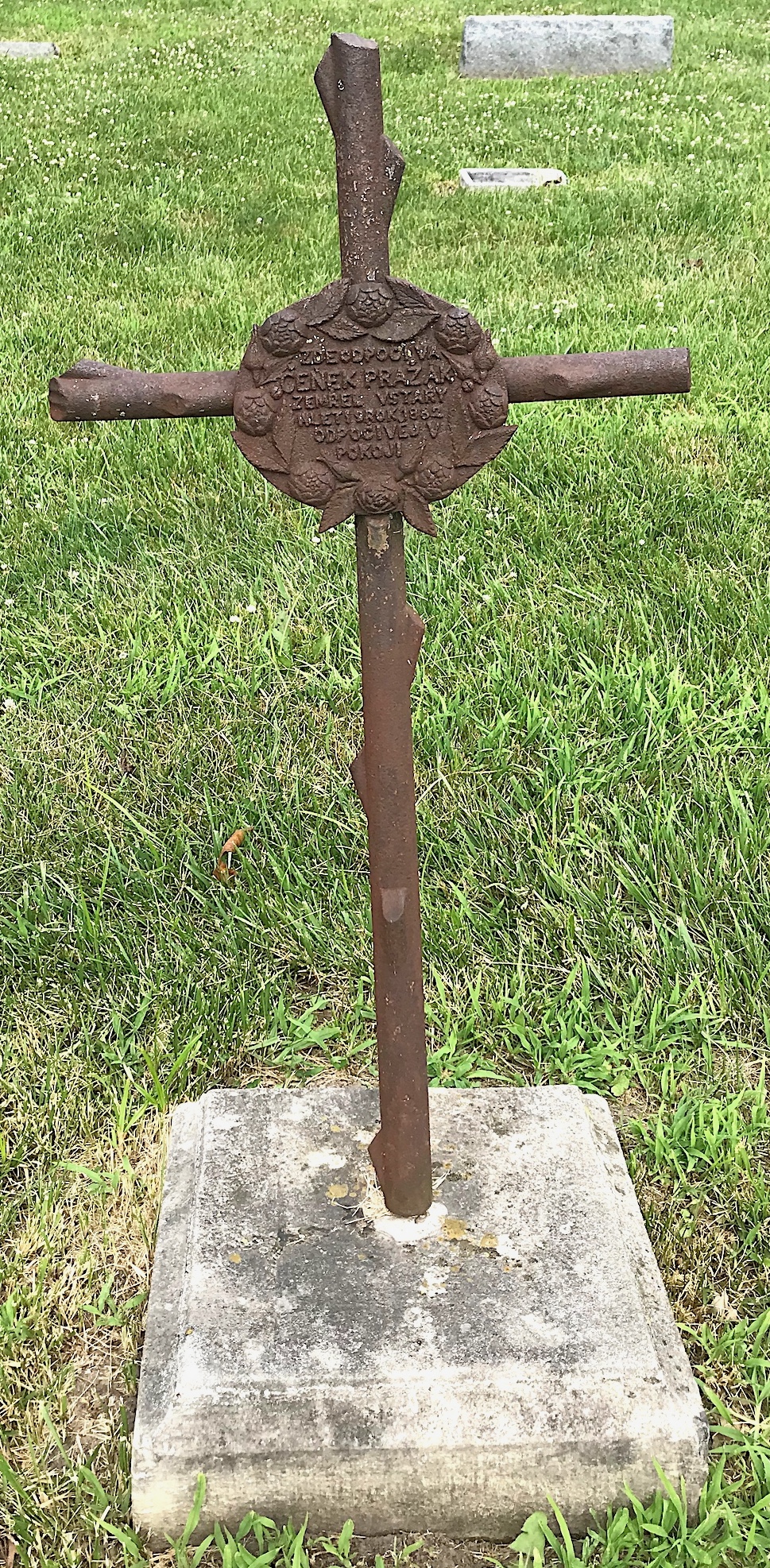
In Part II, I’ll share the story behind another tree-themed Novak monument that involves a man who tried to fake his own death.
 Adventures in Cemetery Hopping