
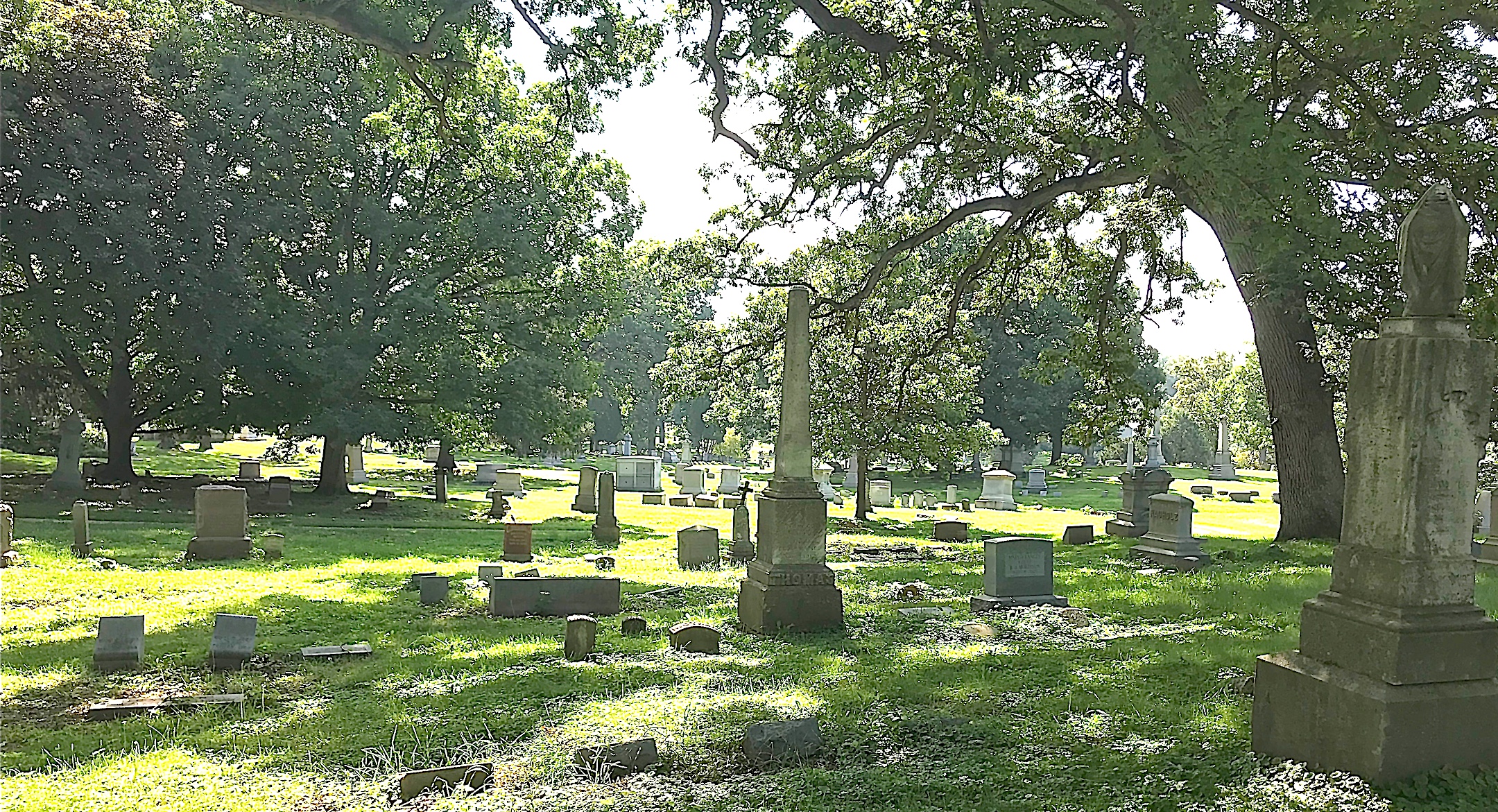
Last week, I introduced you to Oak Hill Cemetery (OHC) in Cedar Rapids, Iowa. It’s a lovely place to wander around in and there was plenty to divert me.
What I found was the story of a fellow who tried to fake his own death and start a new life, and the grave of a Cedar Rapids dentist who posed for one of America’s most famous paintings.
Later in our trip, we visited the museum at Anamosa Penitentiary and its cemetery. However, I had no idea that when I was photographing graves earlier at OHC that I’d photographed the grave of an infamous former Anamosa prisoner named Frank Novak.
Faked His Own Death
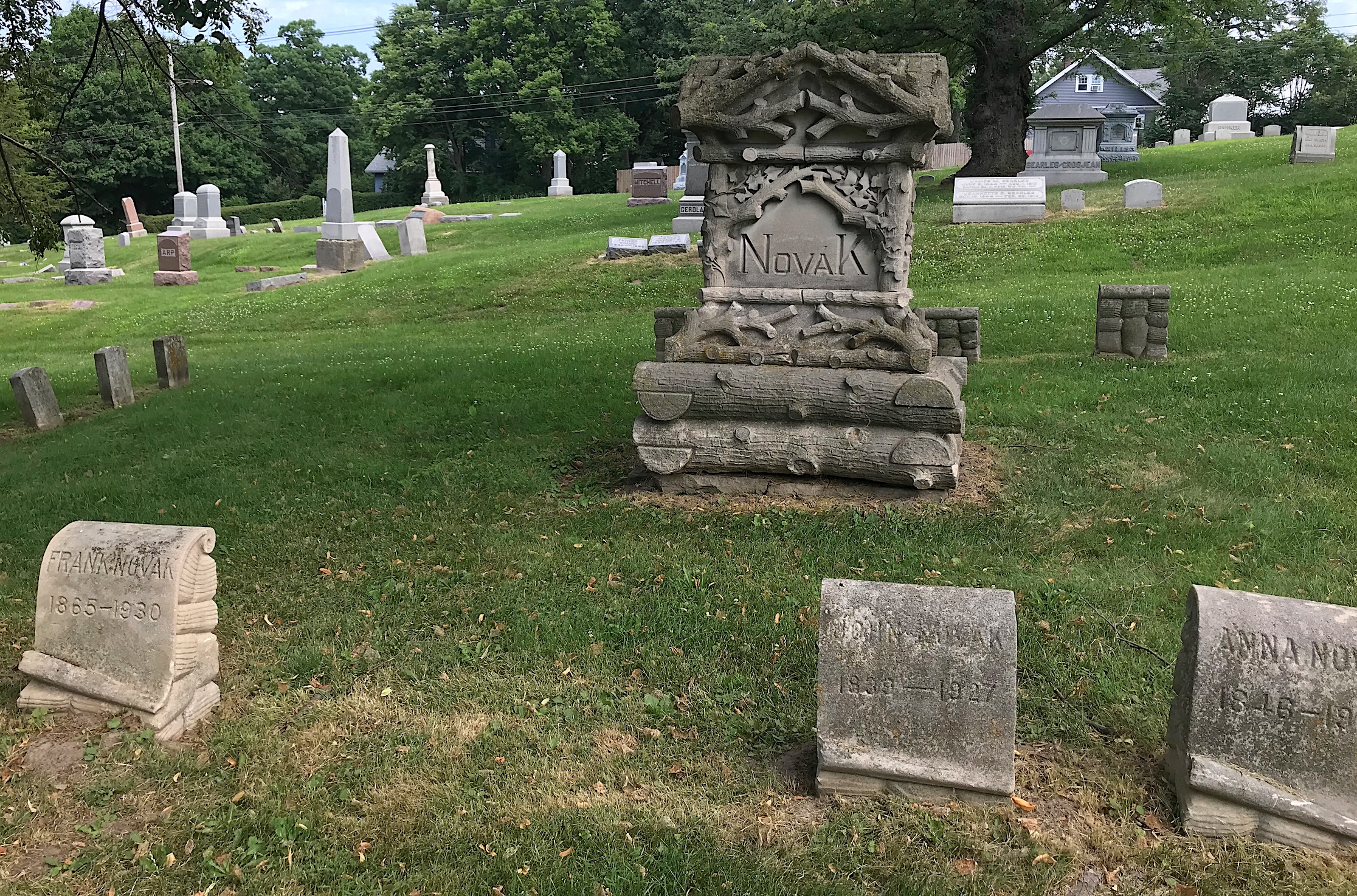
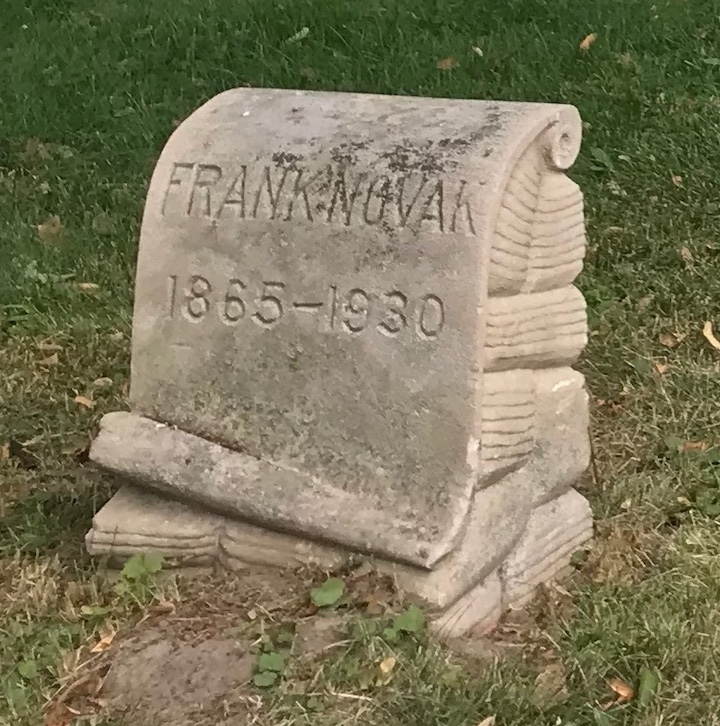
Below, you can see the Novak family plot at OHC. I photographed it because of the beautiful wood/tree-themed style of the surname monument and the individual stones that accompany it. Not because I ever thought there would be notoriety attached to it.
It all began with a mysterious 1:30 a.m. fire on Feb. 3, 1897 in a store called Novak & Jilek that awoke the residents of Walford, Iowa, about 12 miles southwest of Cedar Rapids. Missing was Frank Novak, the store’s owner.
Frank Novak, 32, was the son of German immigrants John and Anna Novak. John emigrated from Bohemia in the 1860s and married Anna Cerveny in 1864. They had four children together and Frank was the oldest. John did well in his business/farming efforts and the family prospered.
Frank was very charming, intelligent, and played the violin beautifully. Farm work was not to his taste, being of a less than robust constitution. Gambling was more his style. He was keen on starting new business ventures with his father’s help but none of them seemed to ever pan out.
The store he opened with his sister Blanche’s husband, Vaclav Jilek, however, seemed to succeed. But while Frank and Vaclav were on a train headed for the World’s Fair in Chicago, Ill. on July 23, 1893, Vaclav fell off on his way to another car on the train and was seriously injured, dying soon after. He is buried in the Novak plot at OHC.
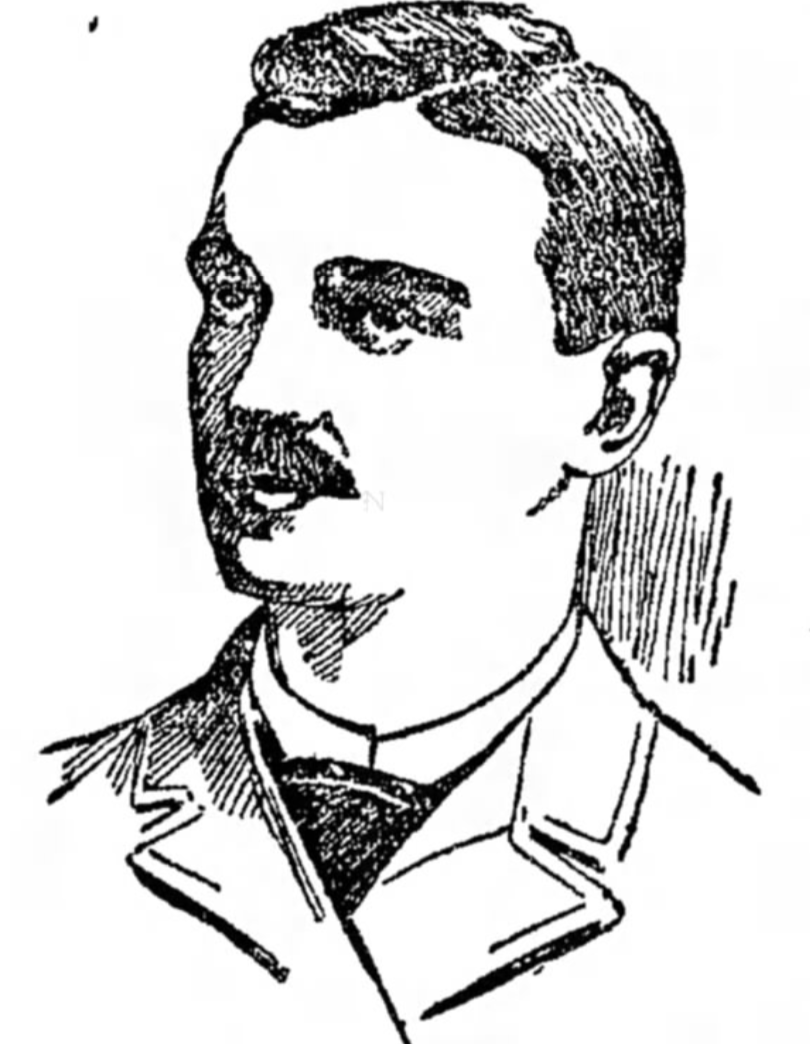
Frank rebuilt the store in 1896 and opened a small bank next door. That spring, burglars blew open the bank’s safe, making off with the contents. Frank swore it would never happen again and despite being married with children, would often sleep on a cot at the store next door to keep an eye on things.
On the night of Feb. 2, 1897 around 9 p.m. Frank and his other brother-in-law locked up the bank and store, then headed to Martin Loder’s tavern to have a beer. Among the patrons was drifter Edward Murray, an alcoholic often in and out of jail. Later, Frank and his brother-in-law were seen back at the store selling tobacco to two men who couldn’t get it at Loder’s along with Edward Murray.
Once the fire was out, the debris revealed a dead body. Everyone was sure it was Frank Novak since he was nowhere to be found. But examination of the man’s teeth soon revealed it wasn’t him. He’d recently had extensive dental work that was not present in the corpse’s mouth. Further exploration of the remains confirmed it was Edward Murray, whose skull had been bashed in. His sister, Nellie, confirmed it by an item found on his body.
A Musical Murderer
Frank had purchased several insurance policies on his own life totaling around $27,000 not long before he died. His plan was to leave his wife Mary (who knew nothing about it) financially settled while he pursued a new life with a new name elsewhere.
Newly elected Benton County attorney M.J. Tobin was keen to track down Novak and detective C.C. Perrin took up the challenge. Thus began a pursuit covered in newspapers that was followed with interest by many across the country.
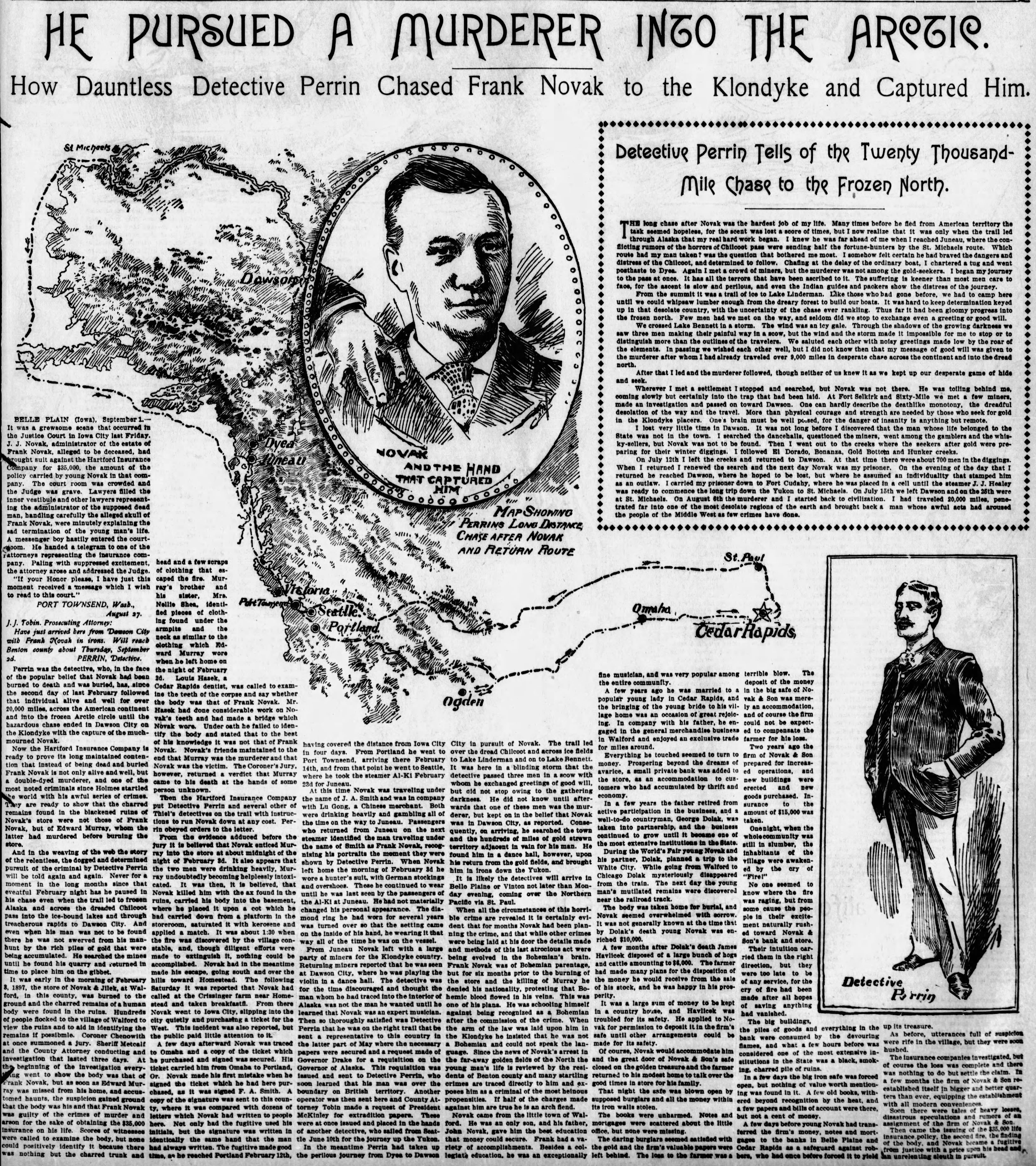
In a nutshell, Frank fled to Omaha, Neb. and purchased a train ticket to Portland, Ore. From there, he traveled by steamer to Alaska and ended up in the town of Dawson. Frank was captured in August 1897 by Perrin while playing violin in a dance hall. He was escorted back to Iowa for trial, where he received a life sentence from judge George W. Burnham for insurance fraud and murdering poor Edward Murray.
By now, Frank’s wife had divorced him, and was supporting herself and their sons Milo and Leo by running a boarding house.
“Life” in Prison
But similar to today, “life” in prison didn’t always mean just that. At first, Frank served his time in Anamosa Penitentiary and behaved himself. By 1903, he was involved in photography and part of the prison band. His non-incarcerated friends petitioned Iowa’s governor for clemency. In 1908, Frank was transferred to a rougher prison in Fort Madison, where he started another prison orchestra.
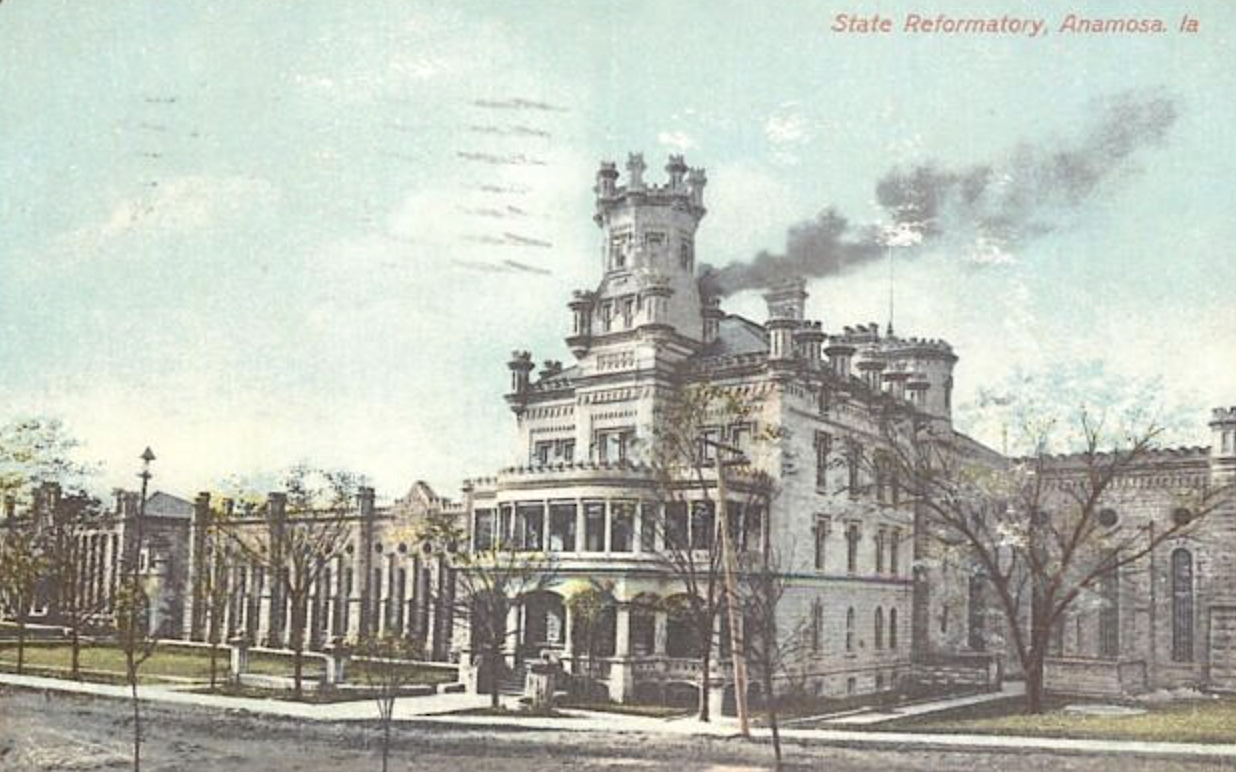
In 1911, Frank was released when his life sentence was commuted by the governor because of having served 13 years already. He married Ella Johnson in 1913 and the couple moved to Chicago where he became a real estate broker, living a quiet life. Ella died in 1918.
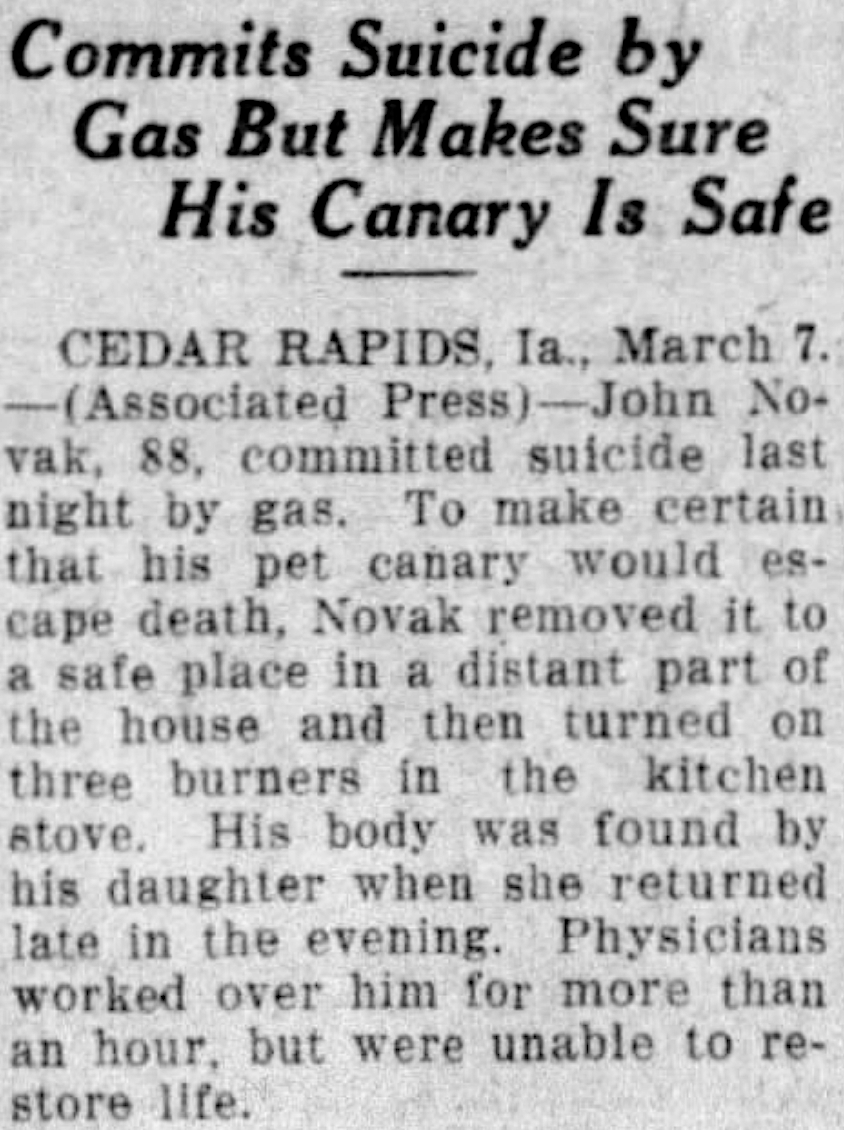
Frank’s mother, Anna, died in 1907 and was buried at OHC. Sadly, his father committed suicide on March 6, 1927 at age 88 when he turned up the gas on his home’s oven. The article below describes how John Novak made sure his pet canary was not harmed. He was buried beside Anna at OHC.
Frank died on July 12, 1930 in Chicago. A few days later, his remains were sent to Oak Hill Cemetery in Cedar Rapids. He is buried in a corner of the family plot. Mary Novak never remarried and died in 1964. She and her sons (both lived long lives) are buried at Cedar Memorial Park in Cedar Rapids.
American Gothic Dentist
OHC is also the final resting place of someone whose face you’ve likely seen, but you never knew who he actually was.
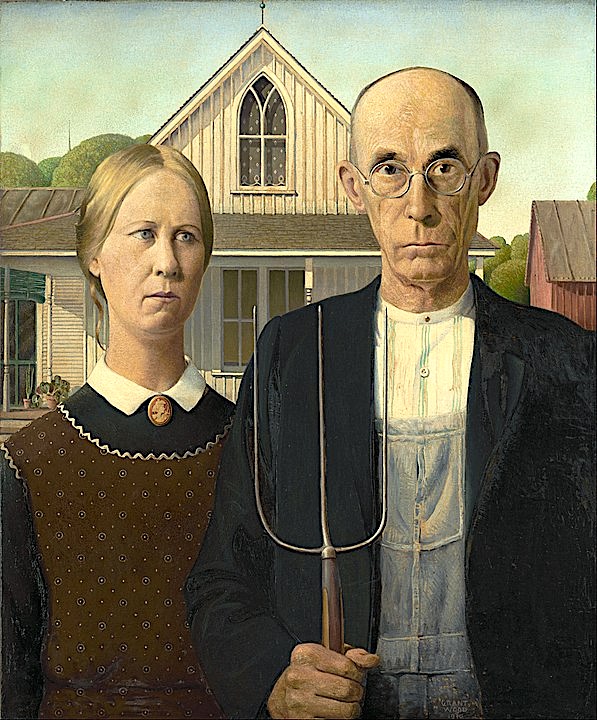
Born in 1891 in Anamosa, Iowa, artist Grant DeVolson Wood is noted for his paintings depicting the rural American Midwest. Most know him for his popular painting American Gothic. Earlier, we stopped at Iowa State University’s library in Ames to see some of Wood’s murals.
Wood took inspiration for the painting from what is now known as the American Gothic House in Eldon, Iowa, along with “the kind of people [he] fancied should live in that house”. It depicts a farmer standing beside his daughter – often mistakenly assumed to be his wife. The painting’s name is a word play on the house’s architectural style, Carpenter Gothic.
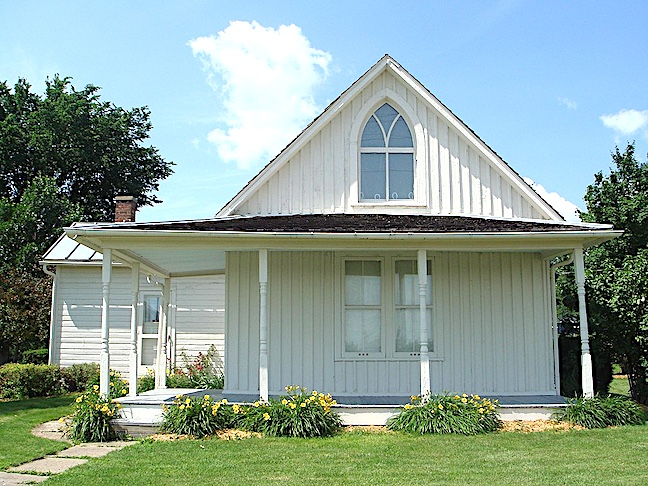
Wood asked his sister, Nan Wood Graham, to be the model for the daughter, dressing her in a colonial-print apron mimicking 20th-century rural Americana.
The model for the father was the Wood family’s dentist and Gran’s friend, Dr. Byron McKeeby. Nan told others that Grant had envisioned the pair as father and daughter, not husband and wife, which Wood himself confirmed in his letter to Nellie Sudduth in 1941: “The prim lady with him is his grown-up daughter.”
Wood painted Dr. McKeeby in his dental office. Dr. McKeeby, then 62, put on overalls and held a prop pitchfork. The rest of the painting, including Nan, was completed nearby in Woods’ studio. Nan and McKeeby never posed together in front of the Eldon house.
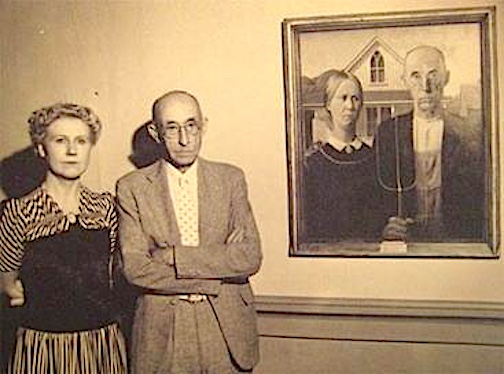
Dr. McKeeby studied dentistry at the University of Iowa, graduating in 1894 and founded his first practice in Winthrop, Iowa. He moved to Cedar Rapids in 1901 where he established an office which he maintained almost until his death.
Denial Then Acceptance
At first, Dr. McKeeby distanced himself from the painting’s popularity. Friends thought it was him and even joked about the pitchfork’s role in his dental procedures. But Dr. McKeeby stood firm in his denials. Because the dentist was known around town for his dapper style and affable sense of humor, the real Dr. McKeeby was nothing like the dour farmer in the painting.
In 1935, Dr. McKeeby admitted he was the farmer. Cy Douglass, an Associated Press news bureau chief, helped coax his confession. Dr. McKeeby’s oldest son was married to Douglass’ sister.
Dr. McKeeby eventually embraced his part in the painting, appreciating the fact that he looked more like the rustic farmer as he got older.
In 1943, Dr. McKeeby was interviewed about his unexpected fame. He said, “‘It made it (the friendship) a little bumpy, but nobody could really be mad at Grant Wood. He painted a beautiful picture of a bridge for my new house and when he gave it to me he said, ‘Doctor, you made me a bridge once, now I’ve made you one!’ ”
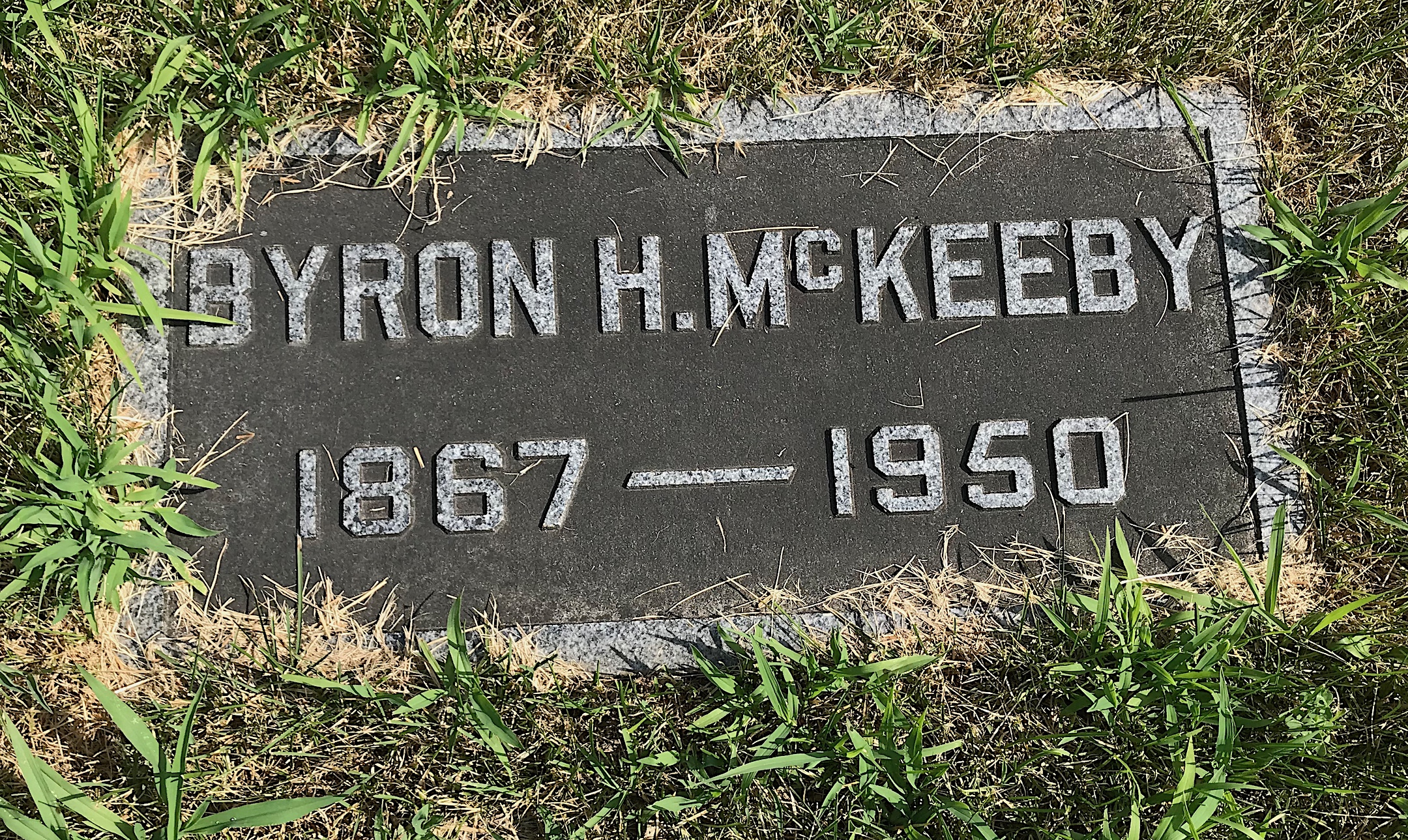
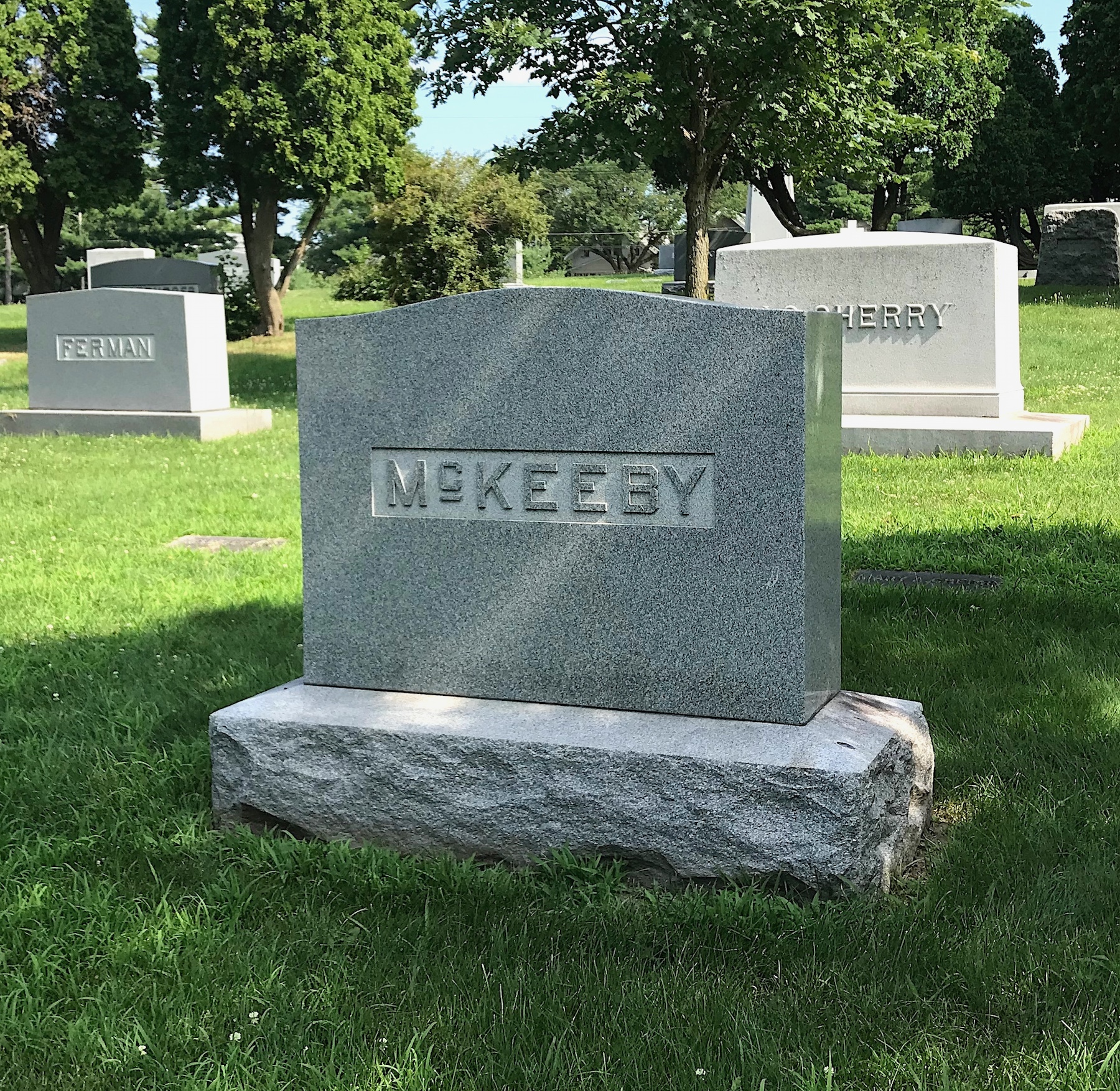
Dr. McKEeeby died on Jan. 6, 1950 at age 82. He is buried at OHC beside his first wife, Belle Metcalf McKeeby, who died in 1917.
Nan Wood Graham is buried in Riverside Cemetery in Anamosa with her brother, Grant. We visited that cemetery, too. I’ll share more about them in an upcoming blog post.
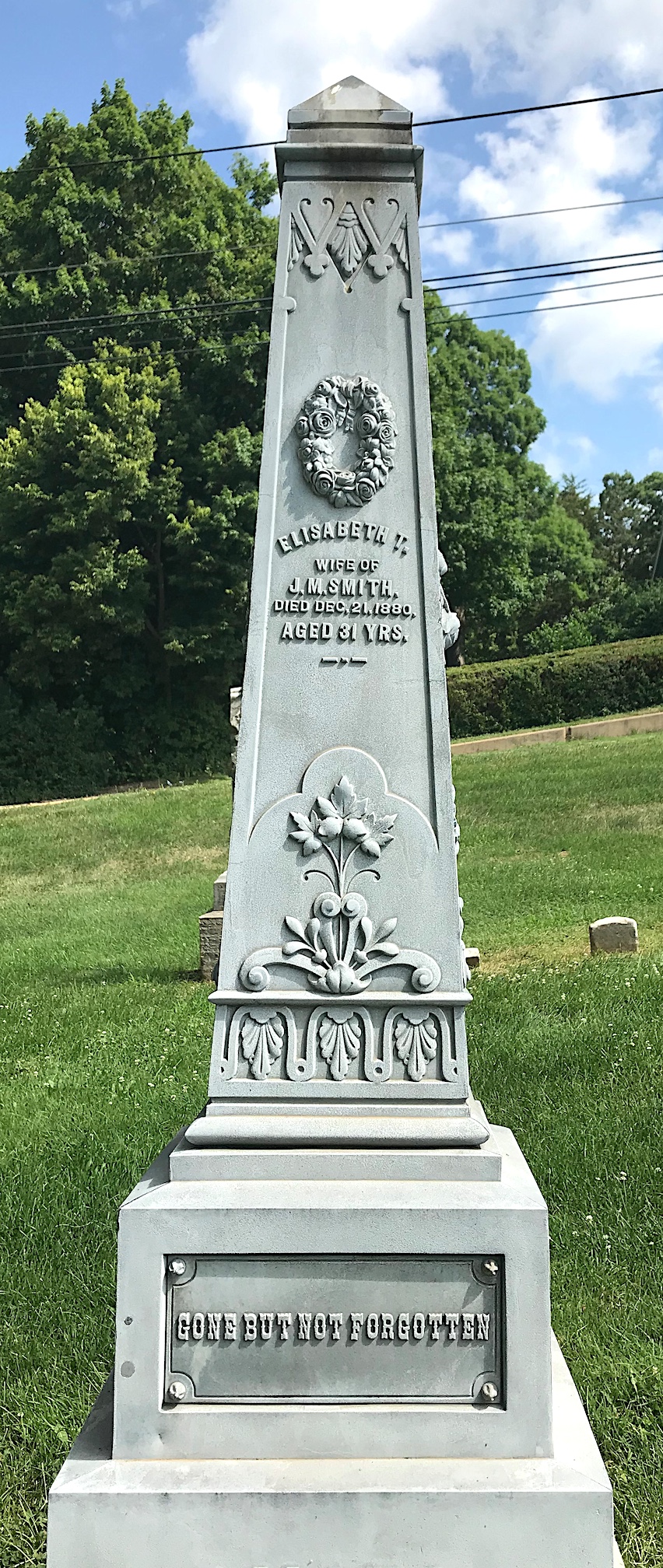
Next time, I’ll be featuring some of the white bronze (zinc) markers of Oak Hill Cemetery.
 Adventures in Cemetery Hopping
Pingback: Beyond Bars: Visiting Iowa’s Anamosa State Penitentiary Cemetery, Part I | Adventures in Cemetery Hopping
Pingback: Saying Hi to Grant Wood: A Quick Stop at Anamosa, Iowa’s Riverside Cemetery | Adventures in Cemetery Hopping