
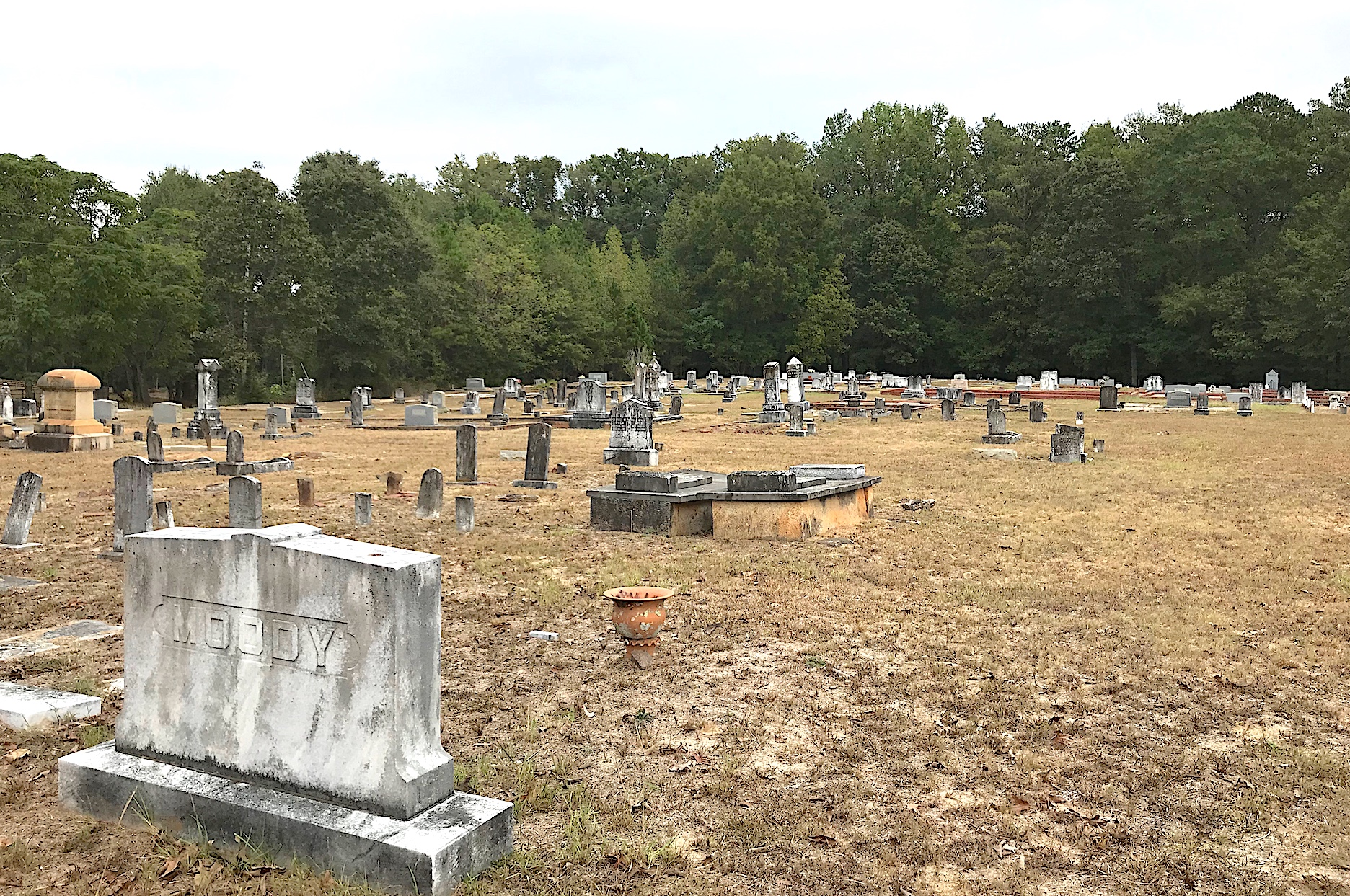
Our next stop before a well-earned lunch was the cemetery at County Line Christian Church just below Brooks.
What little I found about this cemetery comes from a August 25, 2015 article in The Citizen newspaper:
The church is considered the second oldest Christian church in Georgia, its founding members among the earliest pioneers in Fayette County. Some of those pioneer founders included James W. Lynch, George Lynch, Isham Moody, Kirkland Leach, and J.W. Westmoreland. It is said the church was organized about 1828 in the shop of a Dr. Westmoreland and met there until 1843 when J. W. Westmoreland gave five acres of land (the present site) upon which to build a church. The first building was built of logs and was destroyed by fire in 1845.
The church was rebuilt in 1848 and remodeled in 1875. The structure has remained in the same site since that time.

The oldest marked grave here is for John Westmoreland, who lived from 1756 to 1816. He may have been the father of J.W. Westmoreland (mentioned above). I suspect that this marker was added at some later date because it looks too new to be that old.

Find a Grave shows that there are nearly 700 graves here. While I did not find the graves of the founders listed above, I did see their last names on several stones. You can see Moody in the bottom left of the photo below.
Wooden Grave Markers
If you’ve read my blog for a while, you know that encountering a wooden grave marker is almost unheard of these days. While wooden markers were often used back in the day, they didn’t usually stand the test of time. So when I see one intact, I’m genuinely surprised.
For whatever reason, the two wooden grave markers for George Washington Jefferson Lynch and his wife, Sallie Warner Lynch, have stone markers in front of them. My guess is that family didn’t want their graves to end up being lost to time and eternity so they had new ones made. That’s the kind of decision I admire because it means we get to see something that rarely survives.

Born in 1848, George was the son of George W. Lynch. It’s possible that this George Lynch is the son of the man who helped found the church back in 1843. He married Sallie in 1874. The couple had seven children together.
George died at age 74 on Sept. 14, 1921. Oddly enough, his death certificate lists no cause of death at all. Sallie died almost five years later on Aug. 6, 1926 at age 66.
Buried between them is their unnamed infant grandson, the child of Joe and Clara Lynch. The child died on Dec. 14, 1933.
Anonymous Graves
It’s fortunate that the Lynches knew who was buried beneath those wooden markers. Many times, the identity of the deceased is lost forever. It’s something I see if many cemeteries. Here are a few examples.
I’ve shared photos of shell graves before. Many folks assume shell graves are usually located near the beach, but I’ve seen them hundreds of miles inland. The reasons why people used shells to decorate graves are many, the most common (and logical) reason being that it’s what they had. Simple as that.
In this case, these two were possibly a mother and child since one grave is larger than the other. There is a marker for the larger one, but it’s now impossible to read. It may have never had any inscription.

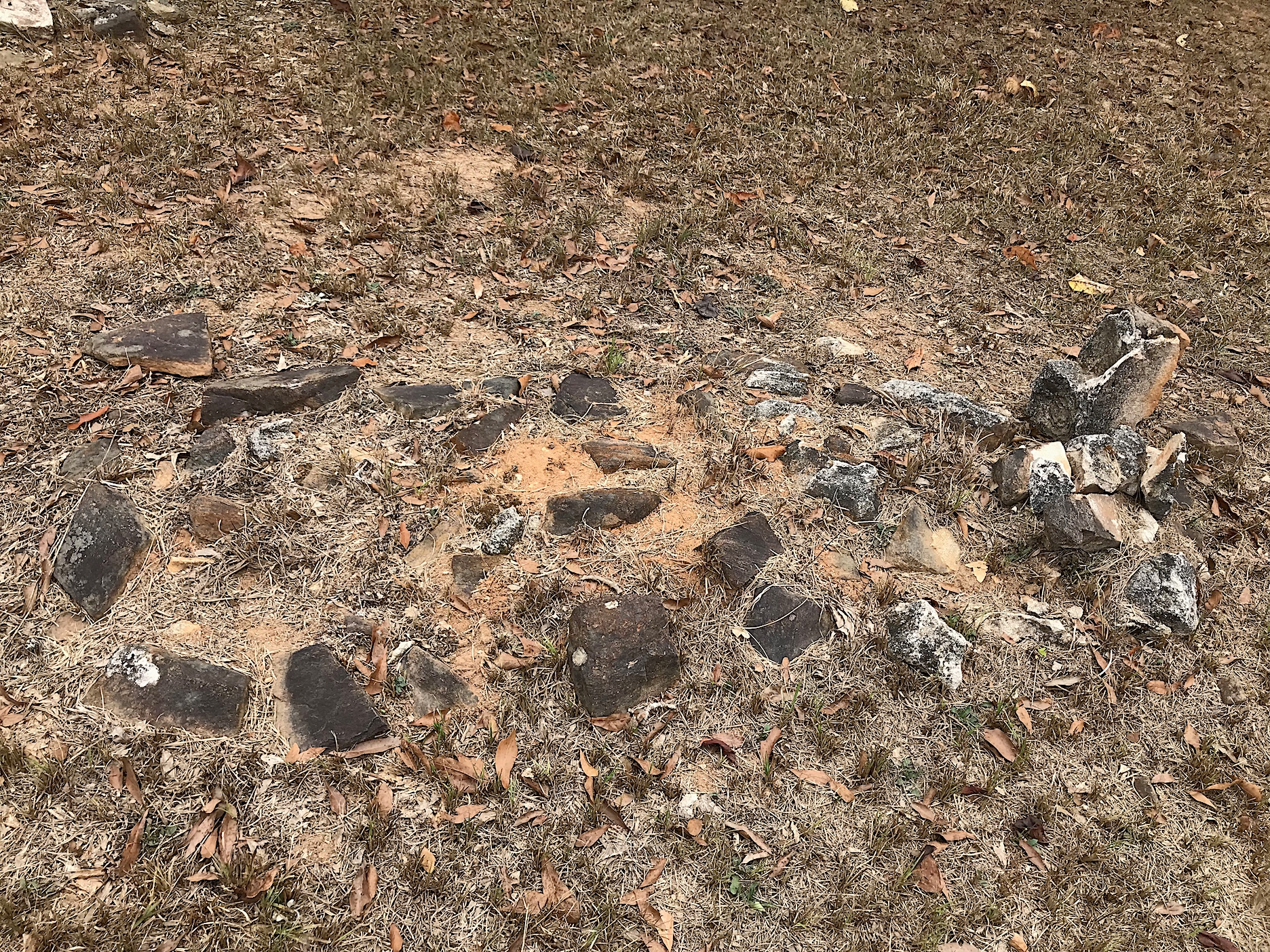
Then there’s this type of grave, which is fairly common, a circle of stones grouped together. This could be a child’s grave due to the size, but I don’t know for sure. This is not a Southern phenomenon, either. I’ve seen them in Ohio and Oklahoma as well. Again, people were using what they had. Purchasing a marker may have been beyond their means at the time.
Two Brothers Marry Two Sisters
It’s not unusual for two brothers from one family to marry two sisters from another. It happened in my own family more than once. That was the case for South Carolina-born brothers Hosea (1817) and Benjamin Gray, Jr. (1819). The Gray family moved to Coweta County sometime in the 1840s.
Hosea married Sarah Freeman in 1843 and the couple had two children, Nancy (who died in 1854) and Benjamin (who died in 1892). Sarah died in 1855. Hosea then married Susan Elizabeth Kempson in 1856. They would have at least 10 children together.
Benjamin married Susan’s sister, Martha Catherine “Mary” Kempson, in 1862. They had two children, Nancy (1863) and Benjamin Jr. (1865). I’m not sure when Benjamin enlisted in the Confederate Army but he did so. He was attached to the Second Battalion of the Georgia Cavalry, Company C, also known as the “Sidney Johnston Avengers”. By this point, older men like Benjamin (who was 45) and young teens were enlisting in the Confederate Army to help the cause.
“Harvest of Death”
I could find few details about Benjamin’s war record, but I do know he died on Dec. 13, 1864. He either died in Grisworldville, Ga. (in Jones County) or in a military hospital near Macon. The Battle of Griswoldville took place on Nov. 22, 1864, which was the first battle of Sherman’s infamous March to the Sea. I had never heard of it before doing this research about Benjamin.

It was a devastating encounter for the Confederate soldiers, as described in Ryan Quint’s article on the “Emerging Civil War” web site:
As the Union soldiers policed the battlefield, they were horrified at the results. These men were veterans of many of Sherman’s campaigns, and they had seen their fair share of battlegrounds, but Griswoldville was different. One account wrote, “Old grey-haired and weakly looking men and little boys not over fifteen years old, lay dead or writhing in pain.” In front of the 100th Indiana, Theodore Upson wrote that “It was a terrible sight…We moved a few bodies, and there was a boy with a broken arm and leg—just a boy 14 years old; and beside him, cold in death, lay his Father, two brothers, and an Uncle. It was a harvest of death.”

Benjamin was wounded at Griswoldville (an estimated 500 or so were wounded and 600 captured, with 51 dead). According to his wife’s obituary, he died in a military hospital in Macon but it also lists that he was a captain. So that may not be true. His body was brought back for burial in the CLCC Cemetery. Mary, his wife, gave birth to son Benjamin Jr. a few weeks later on Jan. 9, 1865.

Benjamin Gray Jr. died of typhoid fever in 1892. He is buried at Senioa Cemetery in neighboring Coweta County. Mary died in 1929 at age 93 at the home of her daughter, Nancy Gray Couch Wilkes. Mary is buried with Benjamin Jr. in Senoia Cemetery. Nancy died in 1948 and is buried in Atlanta’s Westview Cemetery.
Benjamin’s brother, Hosea, also served in the Confederacy but returned home alive. I’m not sure what unit he served in. Hosea and Susan’s daughter, Villular, was born in February 1864, just a month after her cousin Benjamin Jr.
According to Ancestry, on Oct. 5, 1866: “Villular was accidentally shot when someone left a gun on the bed. The covers got caught in the trigger and when the baby pulled on the covers, the gun went off and she was killed.”
Villular was originally buried on the property where the Grays lived but was later moved to CLCC Cemetery.

Hosea died on Dec. 14, 1902 at age 85. Wife Susan died on April 4, 1923. They are buried together at CLCC Cemetery.


A Father and Son Killed
When I saw the grave of little Floyd Freeman, I wondered if perhaps he had died of Spanish Flu. He died in 1919, so it’s not an off-the-wall theory. However, when I scanned the local newspaper to find out if that was so, I found a story that broke my heart.
Floyd died a few hours after he and his father, James, were hit by a passenger train while they were in their buggy crossing the tracks. James was killed instantly.

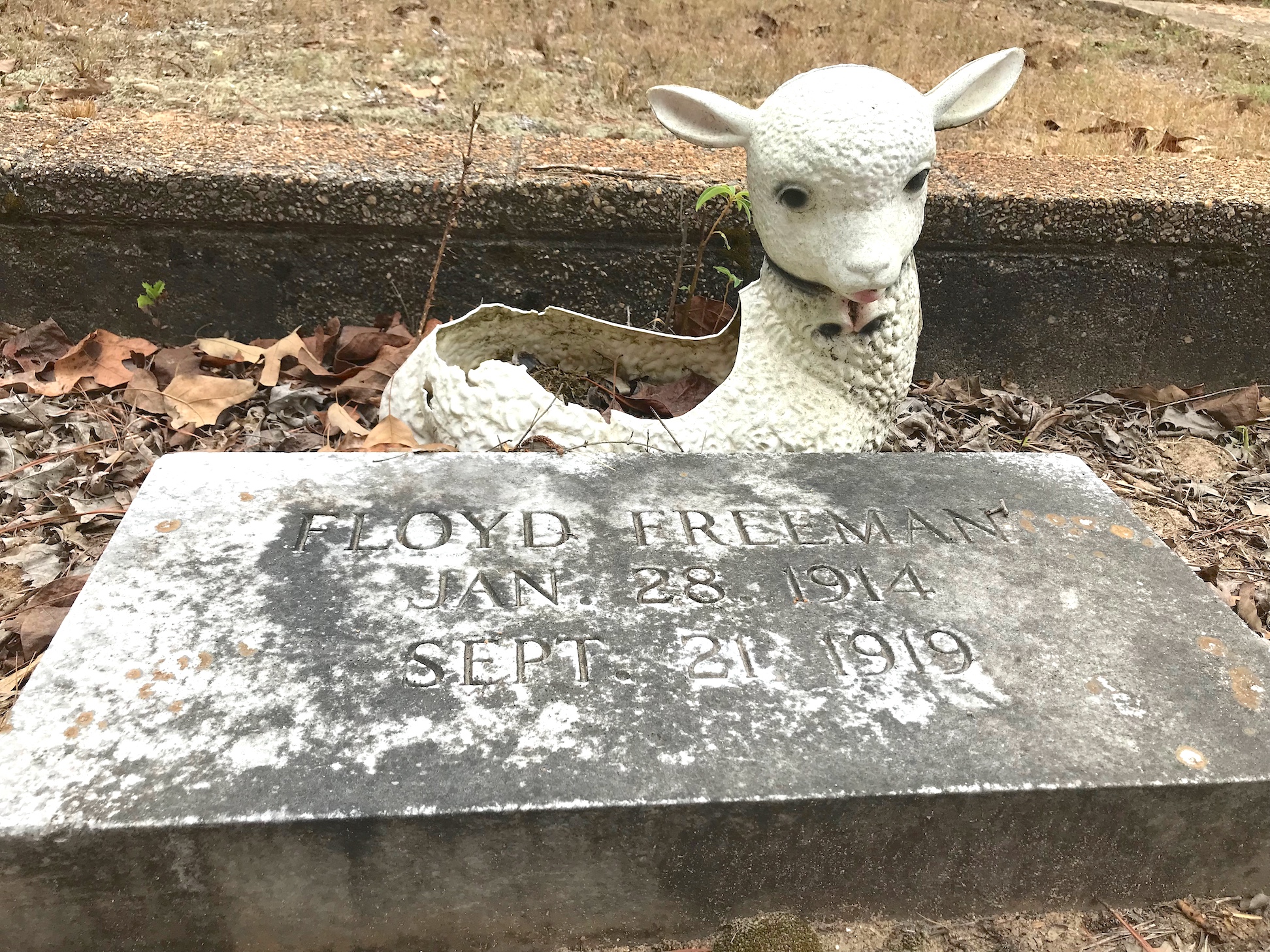
James is buried near Floyd with his wife, Alice Reeves Freeman. She died in 1942 at age 71.
I’ve got more to share from County Line Christian Church Cemetery. I hope you’ll join me for Part II.

 Adventures in Cemetery Hopping
Such a poignant sight of the little lamb guarding young Floyd Freeman’s gravesite. I believe that Turin, where he and his father met their fate, is in the vicinity of Sharpsburg. The railroad is still there…now CSX. Hope the crossing has been much improved.
I thought I had pretty good knowledge of GA. Civil War History…but Griswaldville escapes me. Throughout the history of warfare, older men and young boys have been pitched into the heat of battle to try and stop the inevitable…with tragic results. Traci, we look forward to the next installment of County Line Church cemetery history.
Fayette County has been part of my family’s history over the years…a grandmother was born (1902) there and also married (1922) there. (Camp Memorial cemetery on E. Lanier Ave. was named for her father.) An uncle of mine practiced law at the old courthouse until in his eighties. A childhood playmate and her husband are now retired in Brooks. And a plate of Melears’s Barbeque and Brunswick Stew with the giant sweet, iced tea always hit the spot…now just a memory.
Greg H.
Hi, Greg!
I had never, ever heard of Griswaldsville before doing the research for this post. That one took me by surprise. I’m willing to to bet most people have never heard of it either.
I think you’re going to find the next installment interesting! Found a few surprises just as I was wrapping up Part I.
Thanks for your comment!