
When I look back at my visit to Florida in February 2020, I have mixed emotions. While I didn’t know it then, it would be the last time I visited Blue Mountain Beach with my best friend. She ended our friendship for reasons I still don’t understand a year and a half later. I miss her a lot.
Second, the “hop” I took in two Pensacola cemeteries then would be the last before the Covid-19 pandemic took hold. It didn’t keep me out of the cemetery but things did change.
A few weeks later, I was sitting in my car waiting for my son to get out of school when I listened to a news report about this strange new illness. I had just booked a bed and breakfast in New Orleans for spring break and was wondering if I was going to have to cancel.
I wouldn’t make it to New Orleans for another three years.
At the same time, I’m very glad I did make it to Pensacola! Although it was a two-hour drive one way from Blue Mountain Beach through construction traffic, to me it was well worth the effort. In addition, cemetery hopping in NW Florida in February means a comfortable temperature!

St. Michael’s Cemetery (SMC) is wedged in next to Interstate 110 and the roar of cars going by is ever present. But as you walk amid the graves, you can step back a few hundred years as you read the markers. Today, primary stewardship for the cemetery is provided by St. Michael’s Cemetery Foundation of Pensacola, Inc., a nonprofit.
The history of SMC alone makes it a stand out, but the fact that it’s documented so well by interpretive signs throughout makes it even better. Quite an effort has been made to help visitors learn more about Pensacola’s rich history and the people that helped create it.

SMC’s self-guided walking tour is documented with this helpful map. It certainly helped me find some of the more notable graves.

The City of Five Flags
Pensacola is often referred to as the City of Five Flags due to the five governments that have ruled it during its history: Spain (Castile), France, Great Britain, the United States, and the Confederate States of America. So when you glance at the names on the grave markers at SMC, that heritage is reflected in them.
Pensacola was the first multi-year European settlement in the continental United States, established at by conquistador Don Tristán de Luna y Arellano in 1559. Two years later, in 1561, the settlement and its fleet were destroyed by a hurricane and the site was abandoned. Pensacola was permanently reestablished by the Spanish in 1698 and became the largest city in Florida, and the capital of the colony of West Florida.

Since Pensacola was destroyed and abandoned only two years after it was first founded, many people regard St. Augustine, Fla. as the first permanent European settlement in what would become the United States. The City of Pensacola, however, still occasionally refers to the area as “America’s First Settlement” in advertisements, signs, and travel brochures.
The city and its bay were named after the Panzacola Indians, a tribe that lived near the bay when the Spanish arrived. They spoke a Muskogean language. The name was changed to Pensacola to make it easier to pronounce. Later, both the French and the British would wrest it away but the Spanish had three different periods of possession until 1821. It was later under Confederate control during the Civil War until 1865.
St. Michael’s Cemetery Established
According to the cemetery web site:
Historical research and early maps indicate that the land in and around the modern cemetery was in use as a burying ground beginning in the mid to late 18th century. The earliest surviving above ground markers in St. Michael’s Cemetery, however, are associated with Pensacola’s Second Spanish Period (1781-1821).
Pensacola drew immigrants from around the world. There are approximately 3,200 marked graves in the cemetery, and with subsurface anomalies, possibly several thousand unmarked graves. Tombstones in the cemetery reflect not only status and ethnicity of individuals but also reflect society as a whole on the Florida Gulf Coast frontier.
Looking on Find a Grave, I see that the oldest marked grave is for George Oseola Commyns, an infant who died on May 2, 1812. We only know this due to a 1938 book of transcriptions of the cemetery, the inscription on George’s grave is now impossible to read.
The Sullivan Brothers
The largest monument at SMC is for Irishman Daniel Francis Sullivan (1833-1884). The plot is surrounded by a well-maintained fence. Daniel is the only occupant as far as I know. Perhaps plans were originally for his wife and daughters (along with their spouses) to be buried with him later.

Born in Ireland in 1833, Daniel moved to Pensacola with his younger brother Martin when they were young. He married Alabaman Emily S. Cropp in 1868. The brothers were very successful in the lumber business, purchasing several mills and wharves on Pensacola Bay, and large areas of timber in other parts of Escambia County. Later, Daniel was president of Pensacola’s First National Bank.

The town of Century was founded around the lumber industry the Sullivan brothers brought to the area. A colorful personality, Daniel also built the Pensacola Opera House that opened in 1883. Two hurricanes in 1916 and another the next year caused so much damage that it was demolished in 1917.

According to a 2019 article in the Pensacola News Journal:
Sullivan’s life was like Horatio Alger, for he had begun with a modest career, then extended into insurance investing and beyond the lumber industry itself. There, by the 1880s, he had become a millionaire, a true first for that time and within Pensacola itself. Observers of those years labeled Sullivan as flamboyant, perhaps because he set a standard in bringing “the unusual” to the community. With capital to invest, Sullivan focused his eyes upon the arts, then in 1883 he began establishment of the Pensacola Opera House.

Daniel and Emily had two daughters, Mary and Katie. His lumber business, operated with his brother, was thriving and his wealth increased by the year.

So it came as a shock when on the morning of June 14, 1884 that (according to his obituary) Daniel Sullivan was found “dead in his bed”. His family and the community were shocked. He was only 50 years old.
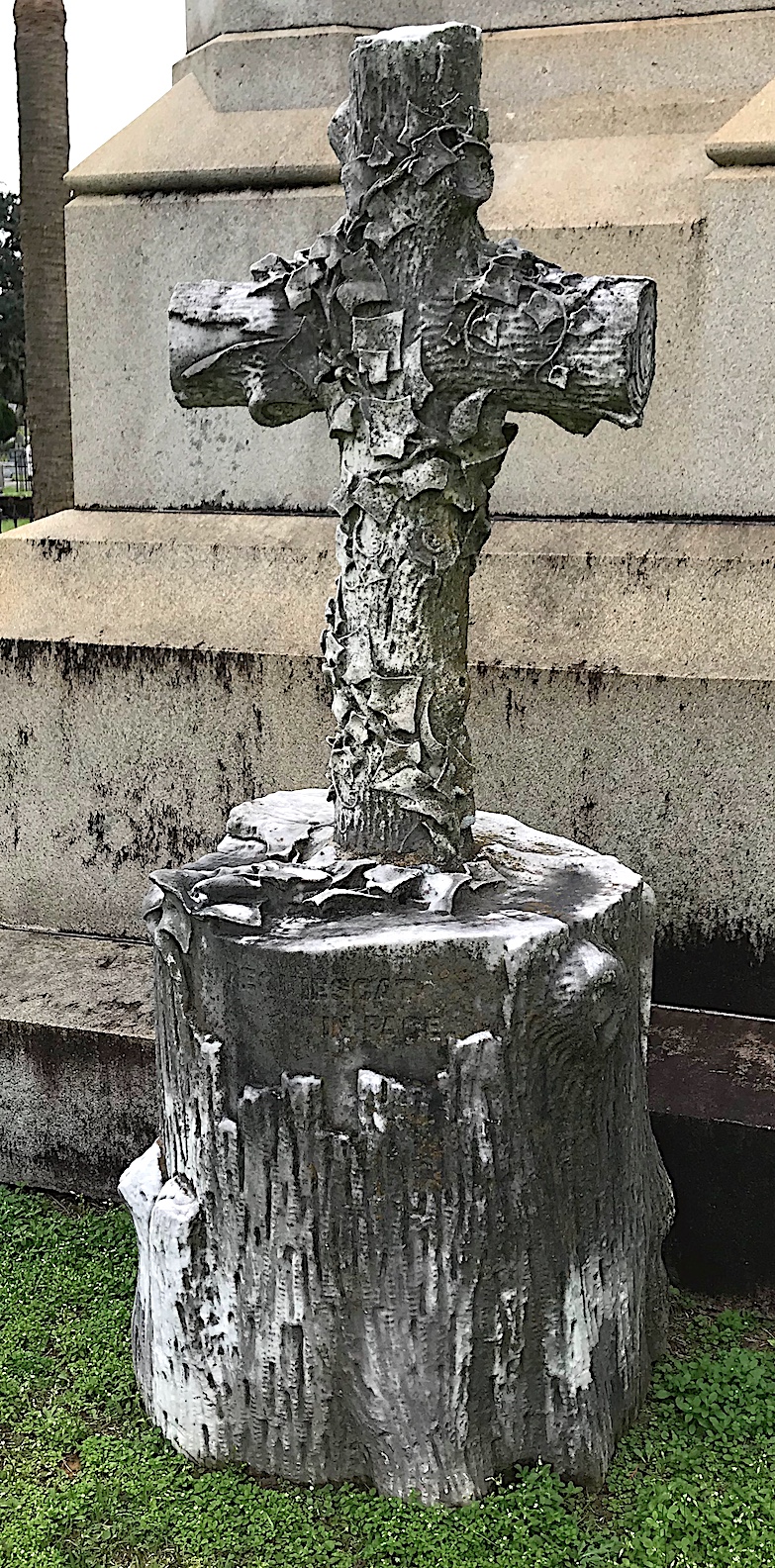
I don’t know how long Emily and her daughters remained in Pensacola. But by 1910, census records show they were all living comfortably in the same Manhattan household in New York City. Katie married promoter Malcolm Anderson and had three children, while Mary remained unwed.

When Emily died in 1919, she was buried in River Bend Cemetery in Westerly, R.I. Mary and Katie are buried in the same cemetery.
Daniel’s brother Martin continued with the lumber and banking business in the years that followed. He and his wife, Kate, had five children together. Martin, who had recently traveled back to Ireland, felt his health beginning to decline in 1911. He traveled to Baltimore, Md. for medical treatment in the fall of that year. He died on Oct. 15, 1911 at age 73. Katie made it to his side only a few hours before his death, one article said.
Martin is also interred in SMC, but not in the Sullivan plot. He and his family have their own handsome mausoleum.

Tragedy was not done with the Sullivan family. Son Charles Russell, 25, died in Colorado Springs, Colo. only a month later on Nov. 16, 1911. A cashier in his father’s bank, he had traveled west in hopes of improving his health.
Daughter Marie Sullivan Read, only 37, died during or after giving birth on Jan. 1, 1912. Her infant daughter, Marie Ellen, died the next day.
Martin, Russell, Marie, and the baby were the first four interments in the mausoleum. Katie died at age 86 in 1937. She is interred in the mausoleum along with the other adult children (Julia, Martin, and John).
There’s so much more I have to show you at St. Michael’s Cemetery. Part II is coming soon.

 Adventures in Cemetery Hopping
That a non-profit organization could maintain this very old cemetery in such a top-notch condition with interpretive signage is really something. Hats off to them. Far too many burial grounds of a similar age have been left to succumb to time and the elements. Especially along the gulf coast the weather elements can take its toll. Years ago, I was transferred to N. Orleans from Atlanta and was able to explore the magnificent cemeteries of that city…many of which feature elaborate above ground crypts due the area’s high-water table. Thanks for guiding us through St Michael’s, Traci.
Thank you! I’ve been to New Orleans twice now and they have the best cemeteries! I can’t wait to go back!