
Yes, we’re still in Pensacola, Fla.! Today I’m going to share a bit about vaults/mausoleums.
Saint Michael’s Cemetery (SMC) is reflective of the geography in which it is situated. Being a coastal cemetery, the depth of the soil and height of the water table is something to be considered. So while it’s not like New Orleans where most interments are above ground in vaults, there is some of that going on at SMC.

Saint Michael’s Cemetery is a mix of above ground vaults/mausoleums and in-ground burials.
In New Orleans, after someone dies, the body is often placed inside a temporary “holding” or “receiving” tomb while a space is being prepared in a permanent vault. After placement in the vault, the body remains for exactly a year and a day before the vault is opened again. In most cases, the body has fully decomposed by this time and only the bones are left.
These bones are then placed in a bag, tagged with the decedent’s name and placed at the bottom of the vault. This makes room for the next person who dies. That’s why you can often see 20 names on a vault that seemingly would only have room for say, four people.
Of course, you may be asking yourself the same question I had. What if the body isn’t fully decomposed yet? I encountered a woman in Greenville, Ala. on my way to New Orleans recently who had encountered this very situation in her family. She told me they waited another few months and by that time, they were able to proceed with the entombment.
The Tarvalan/Pons Vault
Here’s an example of what I THINK is a New Orleans-style vault, having pieced together a few clues. Because of some variation in family names, I couldn’t get a complete picture of exactly how these folks were related to each other.

The next to oldest occupant of the vault is an A.F. Tarvalan, born in New Orleans around 1820 and died in Pensacola on Aug. 30, 1895. I believe this may be Adolph Francois Tervalan (note the spelling variation), and that he may have been black or of mixed race parentage. He was married to Louise Mandas Tarvalan (I’ve seen her last name as Mendez, too). She was also born in New Orleans and died in Pensacola on Aug. 22, 1892.
But the first name at the top is Lydia Deffilo, daughter of T.A. and Hortense Pons. Lydia died on April 2, 1910 at the age of 20. I believe Hortense was A.F. Tarvalan’s sister and that Lydia was his niece. The last name at the bottom is Theo Pons, born in 1870 and died on Feb. 2, 1919. This may be the “T.A. Pons” who was Lydia Deffilo’s father.
Could you get five complete bodies in this small vault? I don’t think so. Being that several of this vault’s occupants were born in New Orleans, I believe they followed the method I’ve mentioned of bagging the bones after a year and a day so more occupants can be interred within.
Family Tomb of E.T. Dunn
Then we have the E.T. Dunn family tomb (you can barely make out the words above the door), which is much more like what I’m used to seeing. A bonus is that it is open (with a gate) so you can see who is interred within. Each body is entombed within its own niche in the walls.

Born in Vermont in 1840, Edward “Ned” Thomas Dunn married Mary Frances Connolly in 1863 in Quebec, Canada. By 1870, the couple had moved to Pensacola and started a family. Eventually, they would have several children together.
Known as Capt. Dunn, Ned worked as a stevedore. That’s another term for a dockworker that usually loaded and unloaded cargo from ships.

Mary died on Nov. 9, 1895 at age 49. She may have been the first interment in the family tomb. The facing of her space looks like it was damaged at some point.
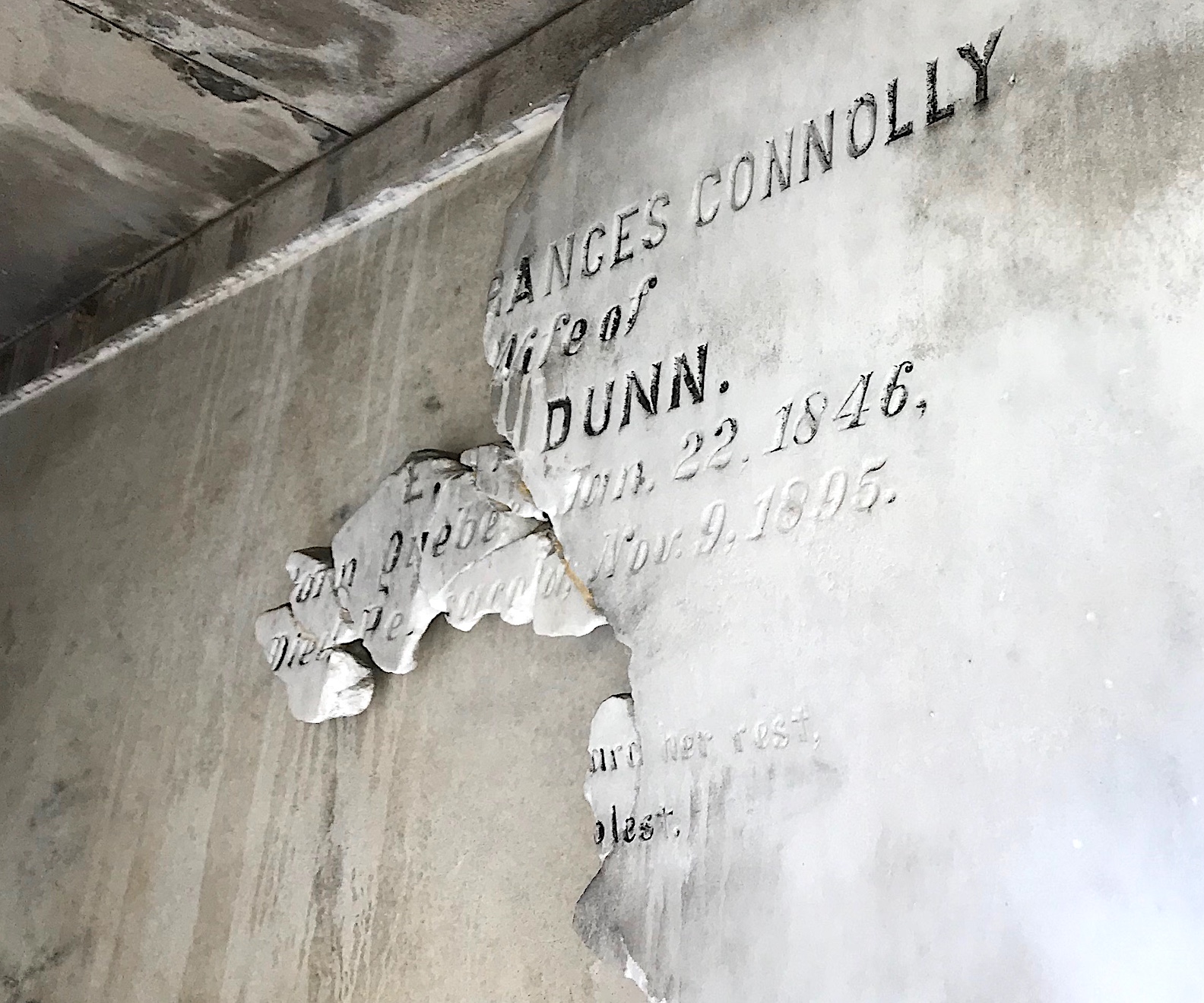
Ned remarried on Aug. 17, 1896 to widow Ada Quigly. She was 41, he was 47. Her husband, John, had died of consumption in 1893. Ned died at age 64 on Dec. 22, 1904. No cause of death was listed in his obituary.

Sadly, Ada Quigley Dunn died a horrible death. Living in a Pensacola boarding house, Ada accidentally knocked over an oil stove that exploded and her clothes caught on fire. She died from her burns on Dec. 23, 1915. She is buried with her first husband, John Quigley, at SMC.
Son of a Sailor
Born in 1872, one of Ned and Mary Dunn’s sons was Capt. Frank Mark Dunn. Like his father, he spent his life working on and around ships. Known as a “bar pilot”, he gained a stellar reputation steering ships through difficult waters and was well thought of around Pensacola.

His obituary noted: “The deceased had been commander of the dredge Caucus since that vessel was constructed and placed in commission. Prior to that he was a bar pilot, and during the Spanish-American war commanded the dispatch boat Summers N. Smith, then owned by the pilots.”
Frank married Laura Marsh in 1902 and they had several children together. When Frank died on Jan. 15, 1911, his youngest child (Frank) was only a few weeks old. Frank, only 39, died suddenly of “paralysis of the bowels”. Laura did not remarry and died in 1954 in California.

Little Frank grew up and served in World War II. He eventually moved to Oregon in the 1950s where he spent the rest of his life, owning a steam cleaning business. When he died on June 1, 1995 at age 84, he was cremated and his remains were interred in the Dunn tomb at SMC.

“Our Children”
On the lowest level on the left side, the facing of one of the plates has the words “Our children” written on it with several names inscribed. I’m not exactly sure whose children they are but I have a guess.
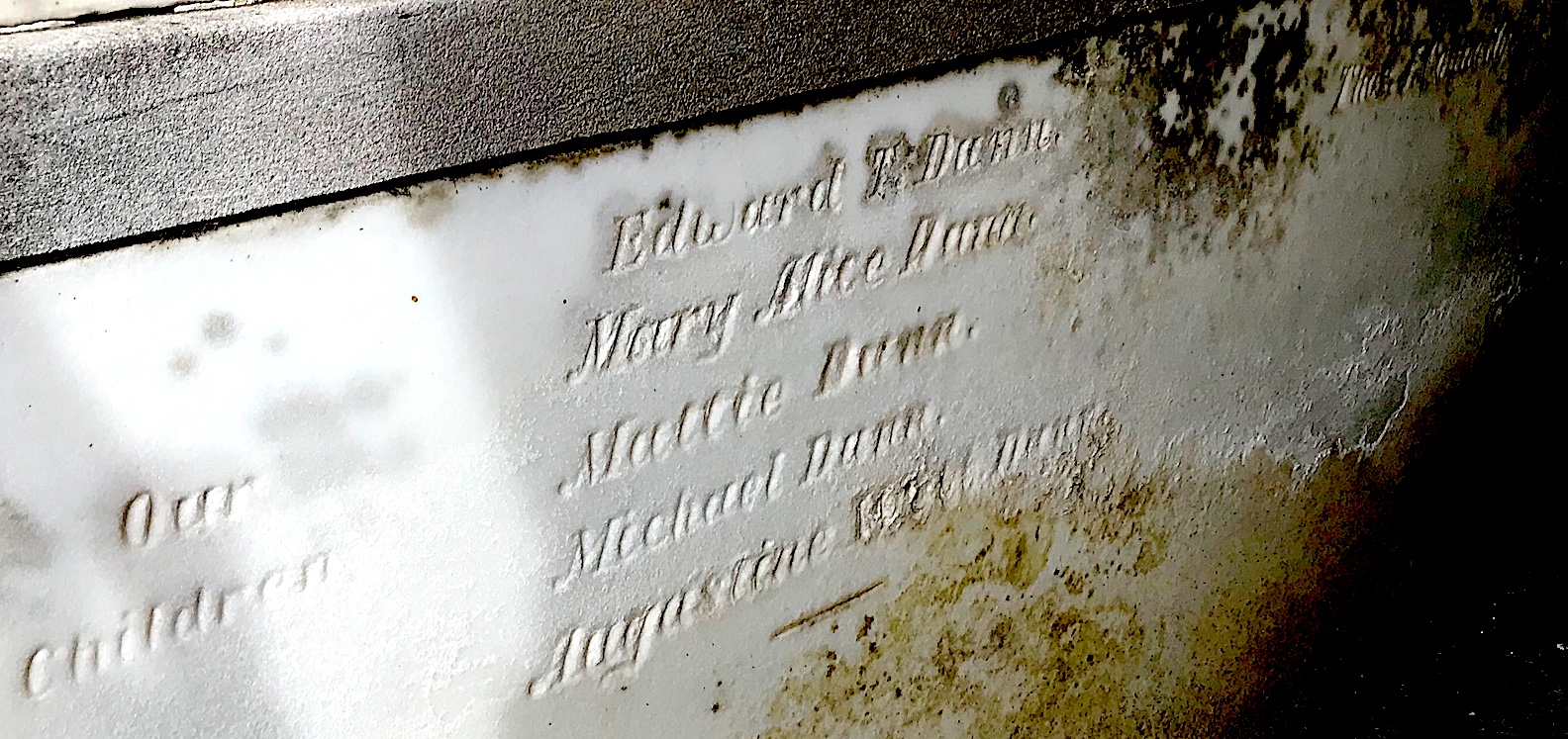
I could only trace two of the names via Ancestry. They were Edward T. Dunn, who is listed as a child born to Edward T. and Mary Dunn in Quebec, Canada on May 23, 1868 and died on Nov. 9, 1869 in the same city. Augustine Webb Dunn was born on March 10, 1885 and died sometime in 1886 in Pensacola.
Are the remains of all these children contained within? I don’t think so. I believe it’s more of a memorial to them.
One last little thing I wanted to mention is that the gate on this tomb got my attention.

I looked it up back in 2020 and could find absolutely nothing about the Industrial Architectural Works of Cincinnati. The same thing happened this week. Cincinnati is also home to Stewart Iron Works, which is still going strong today. I’m hopeful I can find out more about this firm eventually.
Love Story of Bartolo and Carmelitta Borras
I’ve got another small vault for you that contains two people, and I think it is traditional in nature. When I saw that the husband was from Spain, I felt compelled to share it because so many residents of Pensacola were Spanish immigrants in the early days.
It’s always great when you find that someone else has done all the research for you. The folks who manage the Facebook page for SMC posted this in 2019.
Bartolome Borras was born in Spain in either 1808 or 1815 (records differ). Nevertheless, he was living in Pensacola by at least 1850. In 1856 he bought what is now called the Julee Cottage (located in the Historic Pensacola Village today), where he lived with his Creole family.
After he bought the cottage he was charged with living with and being in a relationship with a “mulatto” (a person with both African and European ancestry) female named Carmelitta Ann Mingaro. During this time, “free people of color” faced increased racial discrimination from laws passed by the state meant to restrict interracial relationships.

Despite these racist laws, in 1860 he was living with Carmelitta and several of their children. Carmelita died in 1864 at the age of 33 and was buried in St. Michael’s Cemetery. Bartolome continued to live in the cottage with his children for the next several decades where he was listed as a merchant and grocer.
While we don’t know if he was ever officially married to Carmelitta, there is no doubt about his commitment to her both in life and in death. When Bartolome died in 1894, he was buried in St. Michael’s with her. This was 30 years after Carmelita passed away.
There’s still a great deal to see at Saint Michael’s Cemetery. Part IV is coming soon.

 Adventures in Cemetery Hopping
As always, quite interesting……enjoy the ‘back stories’ about some of the individuals that you describe. Yes, in the ‘low country’ New Orleans style funeral and burial practices can be common to a number of areas.