
Last week, I shared a number of white bronze (zinc) monuments at Springville Cemetery in Linn County, Iowa. Today I’m going to share some additional monuments that got my attention (made of other materials).
In reviewing my photos, I came across one that caught my eye because it has a Georgia connection. A native of Iowa, Isaac E. Robinson was only 21 when he died far from home in Rome, Ga. during the Civil War.
An estimated 76,242 Iowa men (out of a total population of 674,913 in 1860) served in the military during the Civil War, many in combat units attached to the Western armies. About 13,000 died of wounds or disease (two-thirds of whom were of the latter).
Far From Home
Isaac was born in Iowa around 1843 to George H. Robinson and Sarah Butler Robinson. His father died in 1847 and his mother remarried to Samuel Starry around 1850.
Isaac was living in Onion Grove, Iowa (now called Clarence), which is about 33 miles east of Springville. He enlisted in the Union Army on Aug. 30,1861 and was assigned to the Ninth Iowa Infantry, Company B. Issac was 18 at the time.

According to his military records, Isaac’s service included battles of Pea Ridge, Ark. (March 1862), Chickasaw Bayou (December 1862), Fort Hindman (January 1863), assault and siege of Vicksburg (May – Apr 1863), siege of Jackson, Miss. (July 1863), Chattanooga, Lookout Mountain, Missionary Ridge, Ringgold Gap (November 1863), and Resaca and Dallas, Ga. (May-June 1864).

Isaac received a severe wound in his thigh on May 27, 1864 in Dallas, Ga. He died on Aug. 28, 1864 in Rome, Ga, most likely of sepsis. His remains were eventually sent back to Iowa for burial in Springville Cemetery. I don’t think he was married. Unfortunately, his inscription is very worn and faded.

Isaac is buried beside his father, George, and his mother, Sarah, who died in 1872. She shares a marker with her second husband, Samuel, who died in 1880.
Rock of Ages
It’s hard to not be drawn to the Jordan monument with its combination of stone and mosaic tile. I’m always curious by how these were made and who made them.
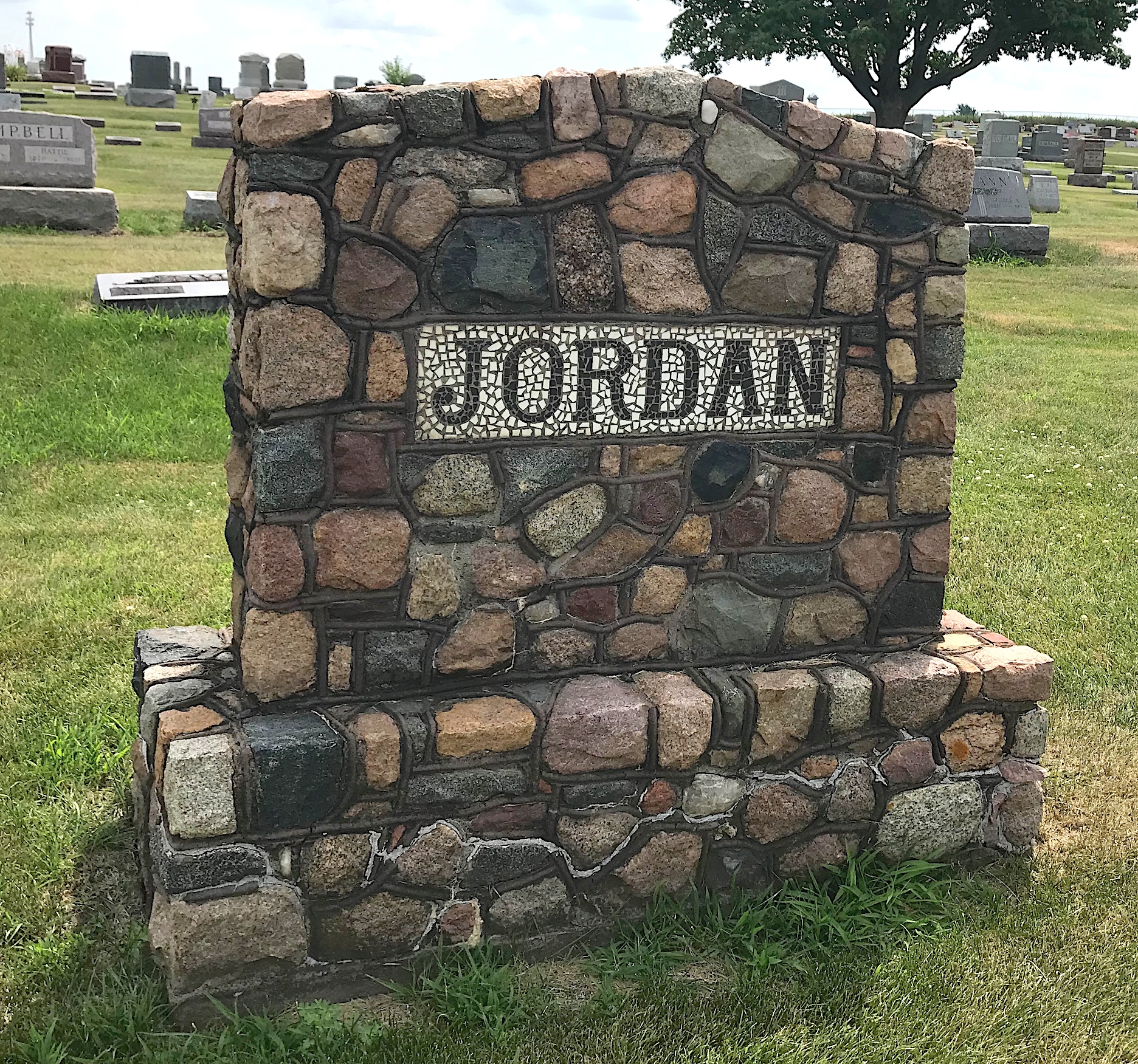
Lemuel Dyer Jordan and his wife, Nancy, came to Iowa sometime in the 1840s from Maine. Their eldest son, George, was born in 1846. He worked as a stock buyer (cattle) and married Emily Alice Gilliland around 1865. The couple had several children.
George died in Springville on March 24, 1921 at age 75. Emily died on Dec. 16, 1926 at age 77 but she does not have a marker.

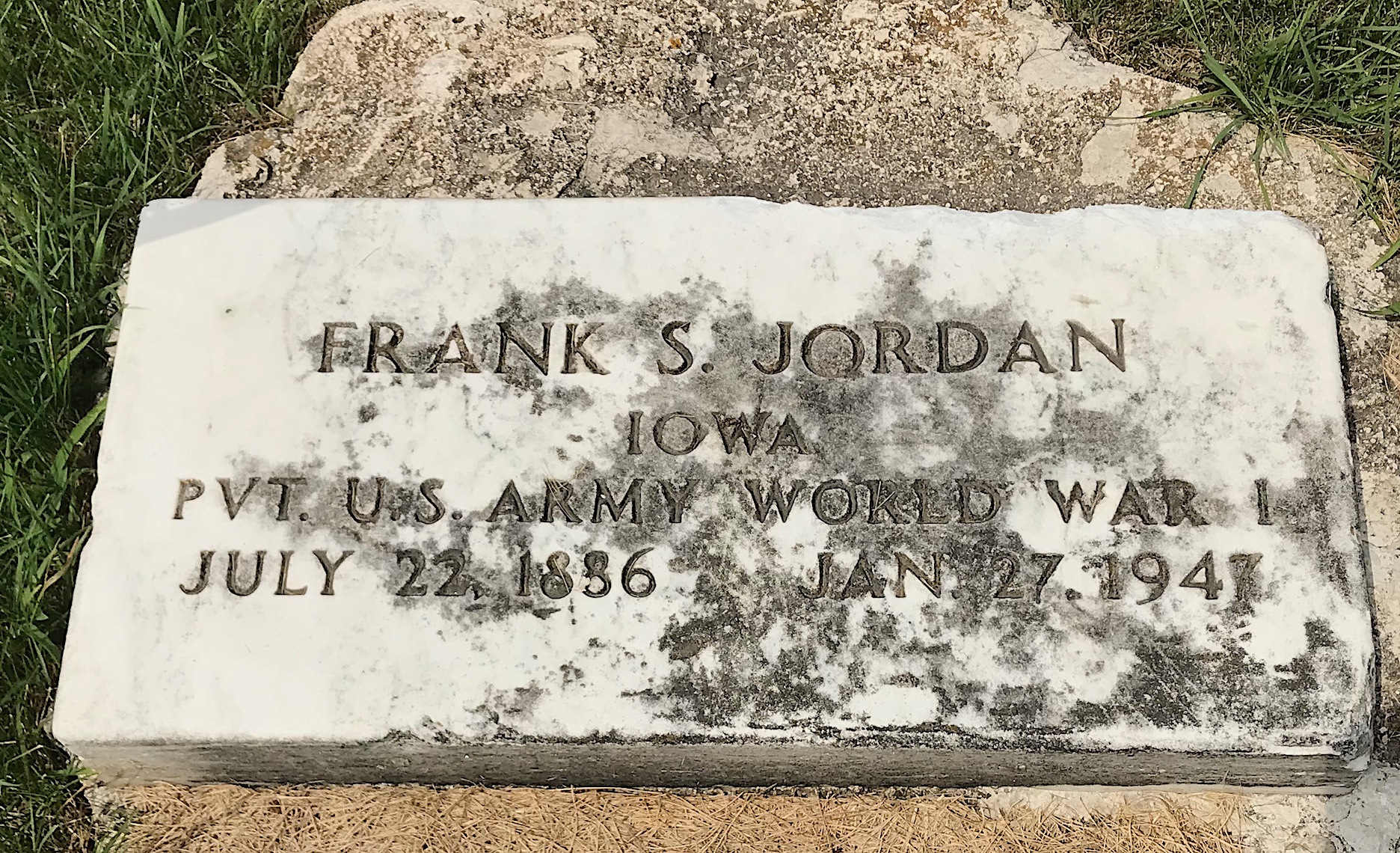
George and Emily’s youngest son, Frank, was born in 1886. He, too, was a stock buyer. He married twice and served in World War I as a private. In later years, he operated a drug store in Springville. He spent the last three years of his life at the Veterans Administration Hospital in Knoxville, Tenn. where he died on Jan. 27, 1947.
Danish Blacksmith
Probably the most unique grave marker at Springville Cemetery is this one for Danish immigrant Christian “Chris” Nielsen. In 1887, he married Inger Marie Nielsen (not related). They emigrated to Iowa from Denmark around 1890. Together, they had three daughters. One of them, Tevvedora, died in infancy but the other two lived long lives.

As you can see, Chris was employed as a blacksmith. The anvil and hammer make that apparent. I have no idea who made it for him, but it’s very cleverly done.
Chris died on Thursday, Oct. 15, 1936 after a long illness. He was 78. Marie died in 1945. She has her own marker and a shared one with Chris and Tevvedora.
Fort Dearborn Massacre Survivor
When I photographed Susan Millhouse Simmons’ grave, I knew nothing about her. Frankly, I was stunned when I began reading what happened to her before she ever arrived in Iowa.
Born in 1777 in Pennsylvania, Susan married John Simmons in Ohio in 1808. In 1810, John enlisted in the First United States Infantry and was assigned for duty to Fort Dearborn in Illinois. He was soon made a non-commissioned officer. The couple’s son, David, was born that same year. A daughter, also named Susan, was born Feb. 12, 1812 at Fort Dearborn.
Fort Dearborn was located on the south bank of the main stem of the Chicago River in what is now the Loop community area of downtown Chicago. At the time, the area was basically wilderness.
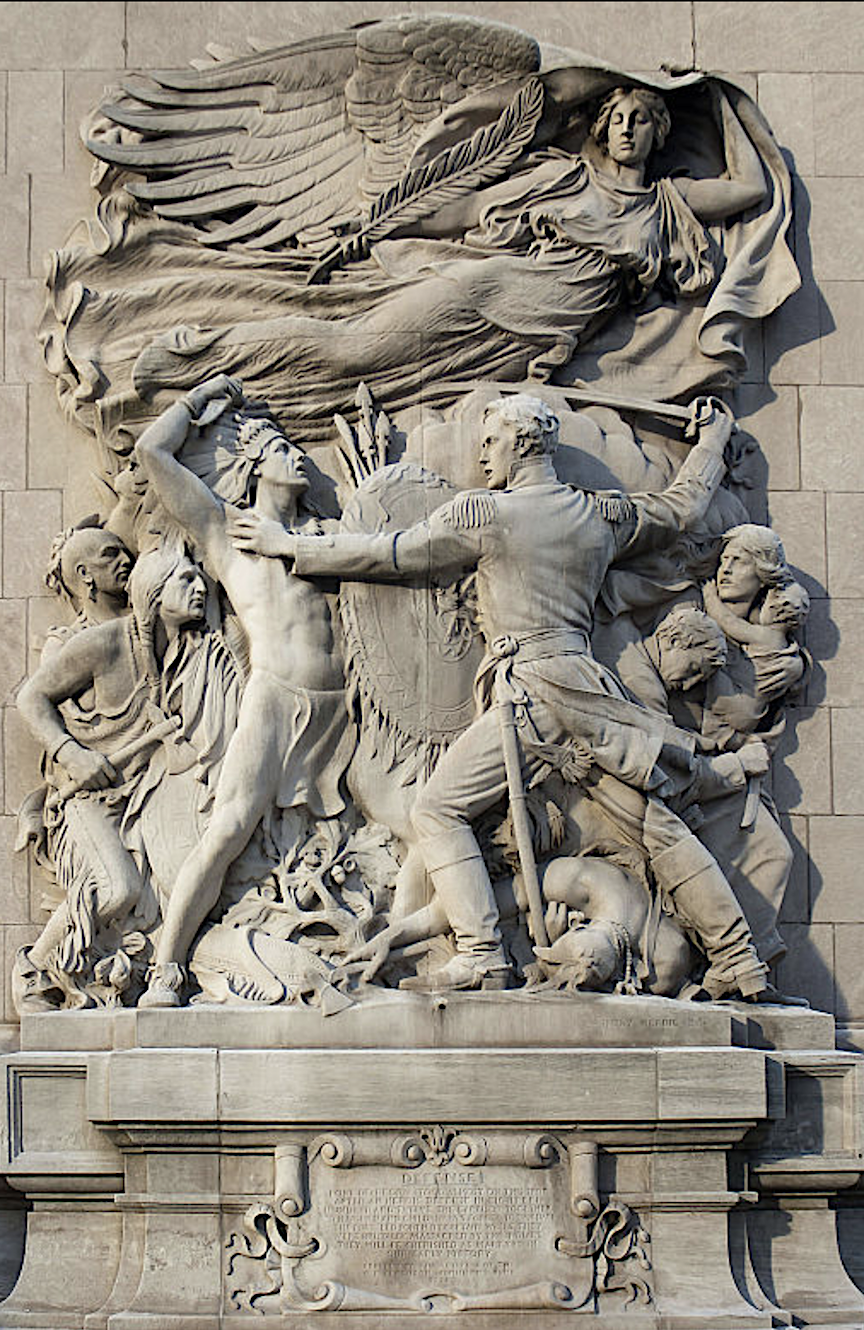
On Aug. 15, 1812, soldiers and settlers evacuating Fort Dearborn were massacred by Pottawatomie Indians in a surprise attack, killing 53 soldiers, women, and children. Among them were John Simmons and his little son, David. John died defending the wagon his wife and children were in. He was buried much later in a mass grave on the battle site.
Survivors were taken prisoner by the Pottawatomie and were held captive as long as two years before making their way to freedom. Susan and her daughter were taken to Green Bay, Wisc. On the march, she walked and carried her baby, the entire distance being over two hundred miles. She was a captive for eight months. One narrative I read stated that many times, she was told to hand over little Susan to them but she adamantly refused.

In fall 1812, the Pottawatomie, with their prisoners, left Green Bay, and marched to the ruins of Fort Dearborn, then around the end of Lake Michigan and up to Mackinas, to Fort Meigs. In April 1813, negotiations for the prisoners were opened. Susan and little Susan were set free and returned to Ohio.
Susan married widower John Redenbaugh in 1820. Daughter Susan married Moses Winans in 1828. They had nine children. John Redenbaugh died in 1847. When Moses and Susan Winans moved with their family to Springville, Iowa in 1853, her mother went with them.

Susan Millhouse Simmons Redenbaugh died in Springville on Feb. 27, 1857 at age 79.
Moses Winans died on Aug. 24, 1871 at age 63. Susan Winans moved to California with some of her adult children after 1885. She died in Santa Ana, Calif. at age 88 on April 27, 1900. She is buried in Santa Ana Cemetery along with her adult children Lewis, William, and Amy. Some of her other adult children (Hiram, John, Esther, David) who remained in Iowa are buried in Springville Cemetery with their father.
Our next stop was Anamosa, Iowa, where we visited the Anamosa State Penitentiary museum and the prisoner cemetery located nearby. You won’t want to miss that!

 Adventures in Cemetery Hopping
The Jordan Family monument of color stones…that’s an “eye catcher” for cemetery exploration, Traci. And, how unique is the anvil design? Like the Woodsmen Monuments found in various places in many cemeteries your travels have come upon.
I hope the Fort Dearborn Massacre sculpture will not be taken off due to some radical-cancel culture dummies who get “offended” by it. It IS American history.
As always…neat exploration stories come from you, Traci! Stay safe and healthy, my friend.
Thank you, Tom! I hope you and your lovely bride are doing well and staying warm!
I, too, hope that the Fort Dearborn Massacre sculpture stays intact. If poor Thomas Jefferson isn’t safe, who is?
As usual, Traci, great sleuthing, and great photos. The Saga of Susan Simmons (later Redenbaugh) is a story of great courage and perseverance.
I recall learning about Ft. Dearborn many years ago but knew nothing of the fateful events there in August of 1812.
It would be hard to miss Chris Nielsen’s “tombstone” in any cemetery. Such work-related memorials may not be all that uncommon…I recall coming across a monument partially sculpted into a locomotive in a small-town cemetery here in Virginia. The fellow interred beneath it had been a railroad engineer.
Thank you for the tour of Springville cemetery.
Greg
Thank you, Greg! Glad you enjoyed it. 🙂