• About Me
  • Cemeteries I Have Visited
  • Have questions?
  • Photos

Adventures in Cemetery Hopping

~ A blog by Traci Rylands

Adventures in Cemetery Hopping

Author Archives: adventuresincemeteryhopping

Beyond Bars: Visiting Iowa’s Anamosa State Penitentiary Cemetery, Part II

09 Friday Feb 2024

Posted by adventuresincemeteryhopping in General

≈ 1 Comment

Last week, I introduced you to the Anamosa State Penitentiary (ASP) Cemetery and shared some of the stories I uncovered while researching the graves. I hope you’re ready for a few more!

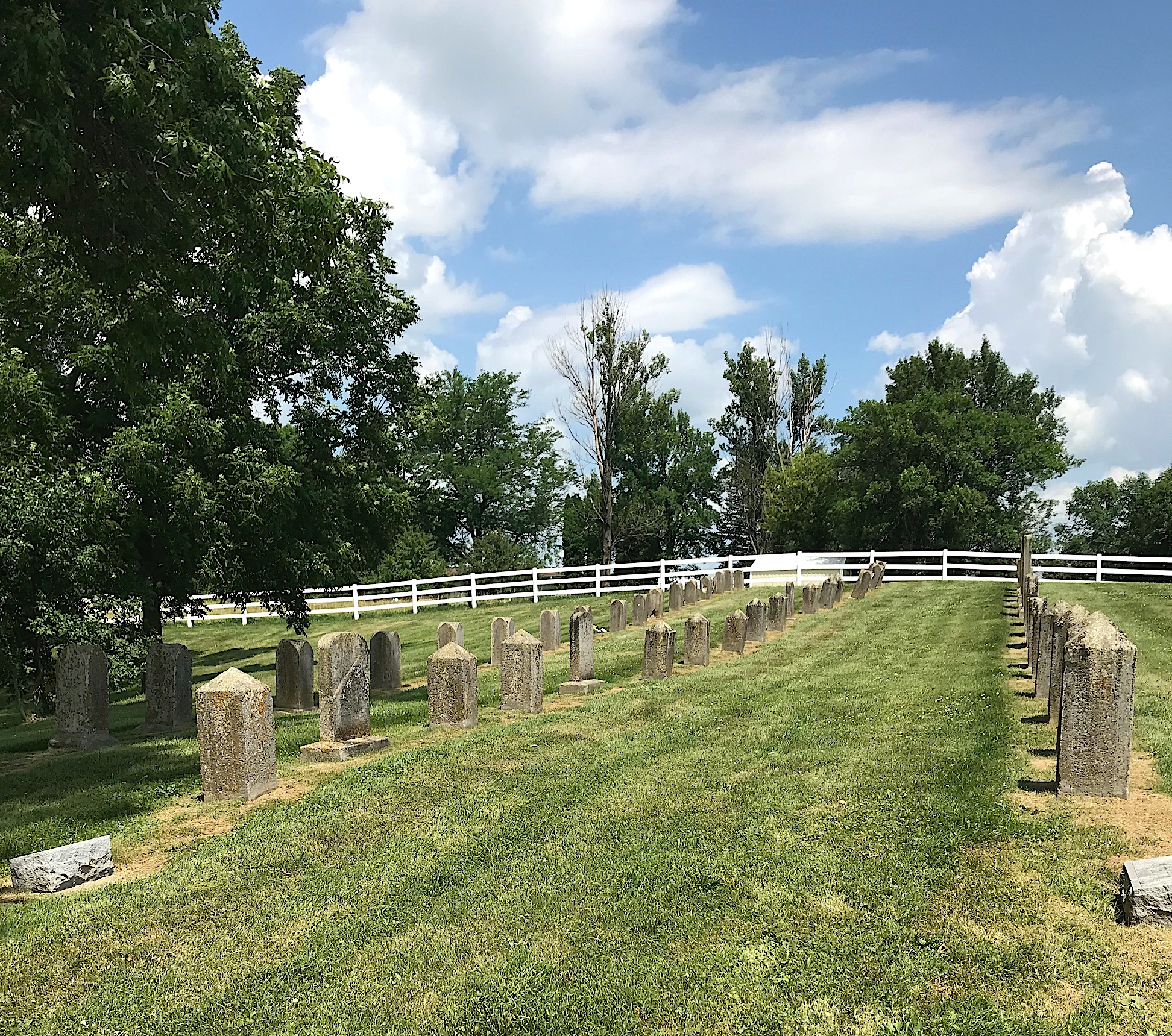
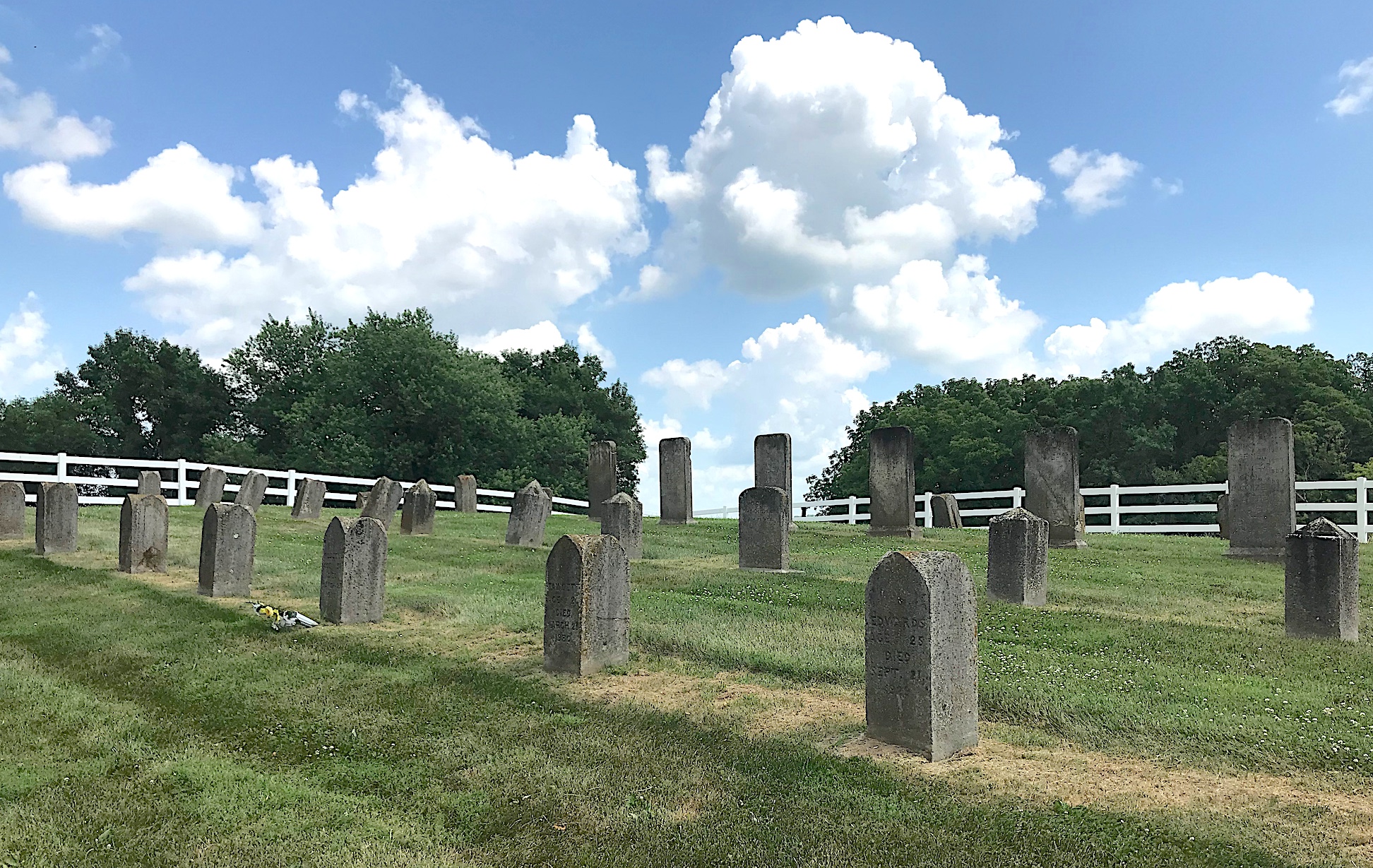
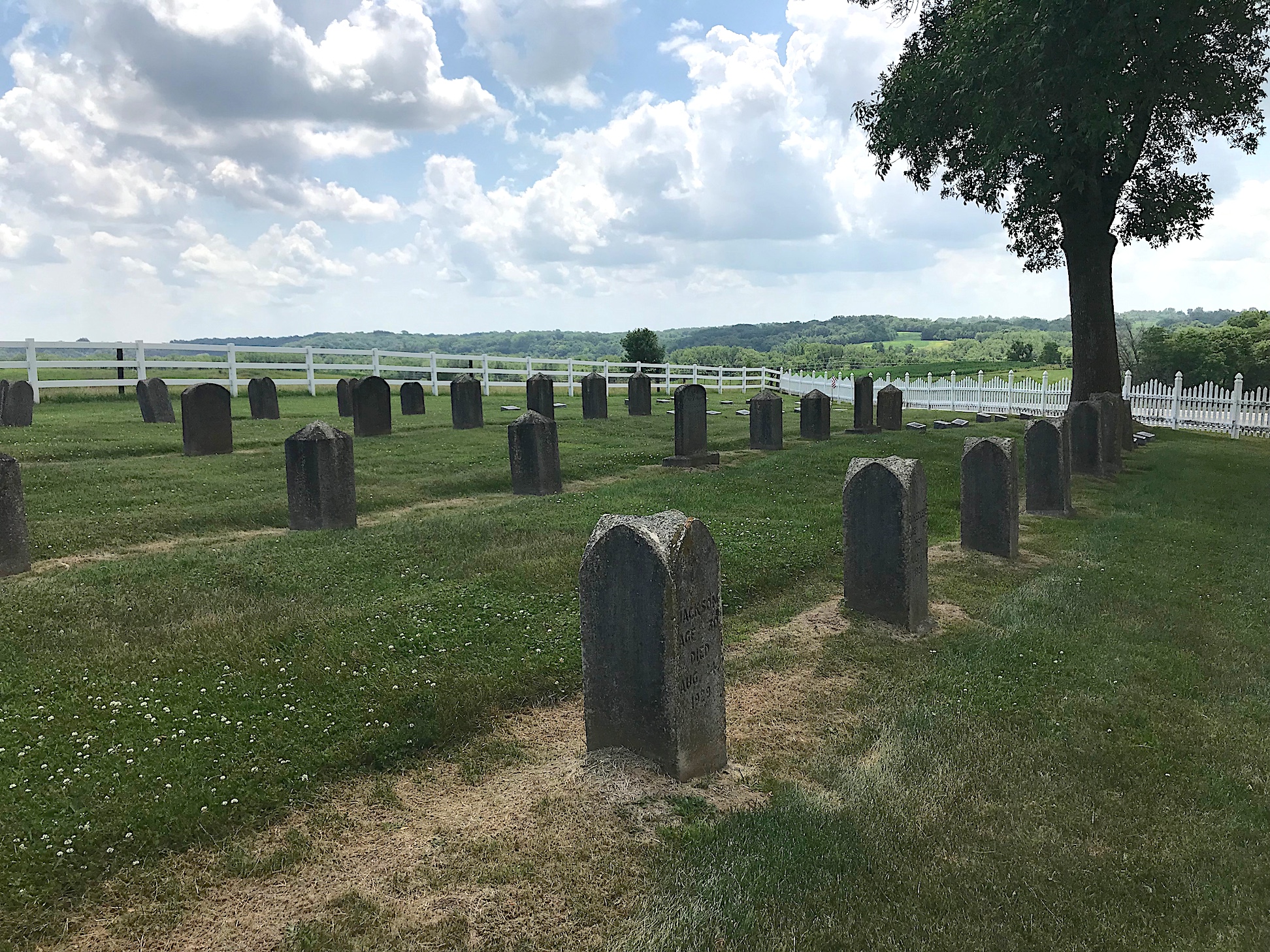
ASP Cemetery was neatly mowed the day we visited in July 2019.

“Until Sane”

One of the more bizarre stories I came across at the ASP Cemetery was about Truman J. Gilchrist. His last name was misspelled on his grave marker. Then I saw on his Find a grave memorial was that he had been committed to ASP for safekeeping “until sane”.

If that doesn’t make you want to dig deeper, I don’t know what would.

Born in 1865 in Iowa to Joseph Gilchrist and Sarah Bushyager Gilchrist, Truman grew up on a farm in Franklin County, Iowa. At age 34, he married Tena Albertena Howard in 1901. They settled in the Hampton area (about 130 miles from ASP) and had two children together.

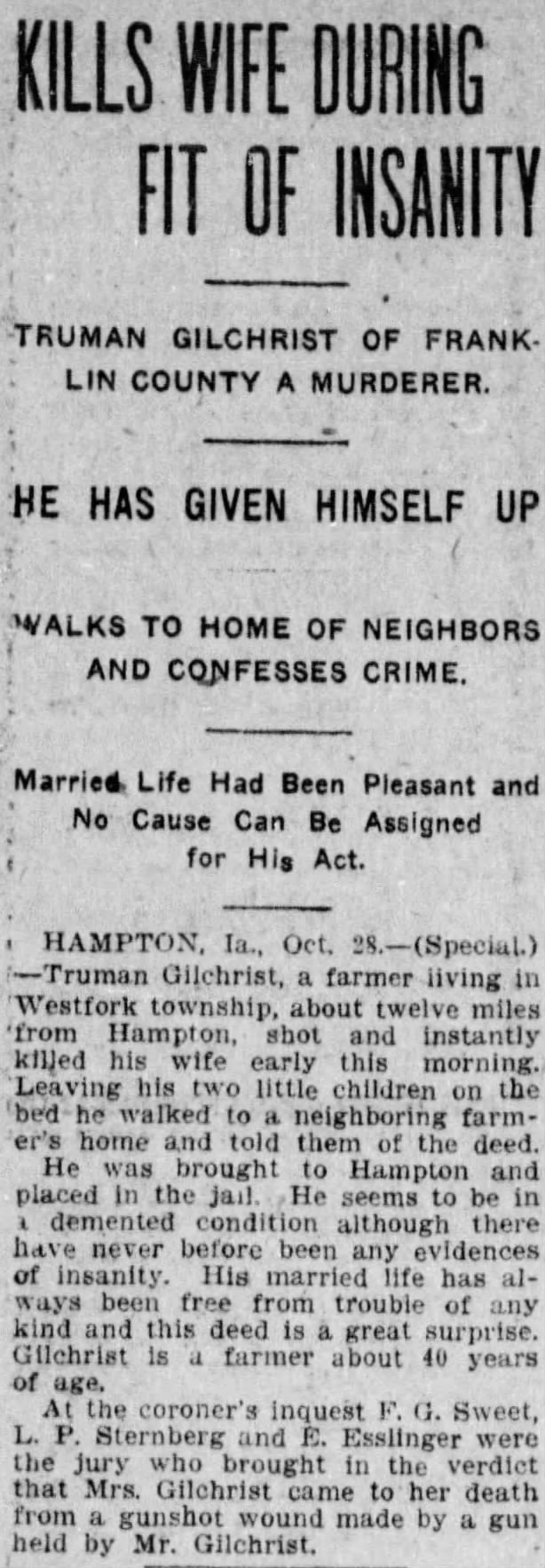
On the morning of Oct. 28, 1904, Truman showed up at a neighboring farm belonging to the Bushyagers (possibly his mother-in-law’s family) nearly naked and told them he had killed Tena. They rushed to the Gilchrist home to find Tena laying dead in the bedroom, her two little ones alive and well nearby. She had been shot with a double-barreled shotgun.

What caused Truman Gilchrist to murder his wife? (Photo Source: Des Moines Register, Oct. 29, 1904)

At first, everyone was stunned. There had been no indication that Truman ever had a beef with his wife. He’d not appeared to be insane. Rumors swirled that Truman suspected in the weeks leading up to the murder that Tena was poisoning him (she was not). He’d supposedly sought help from a doctor. Truman was put in the county jail to await the court’s decision. In the meantime, one article said, the Gilchrist children were being adopted by the Fred Paullus family in Hampton.

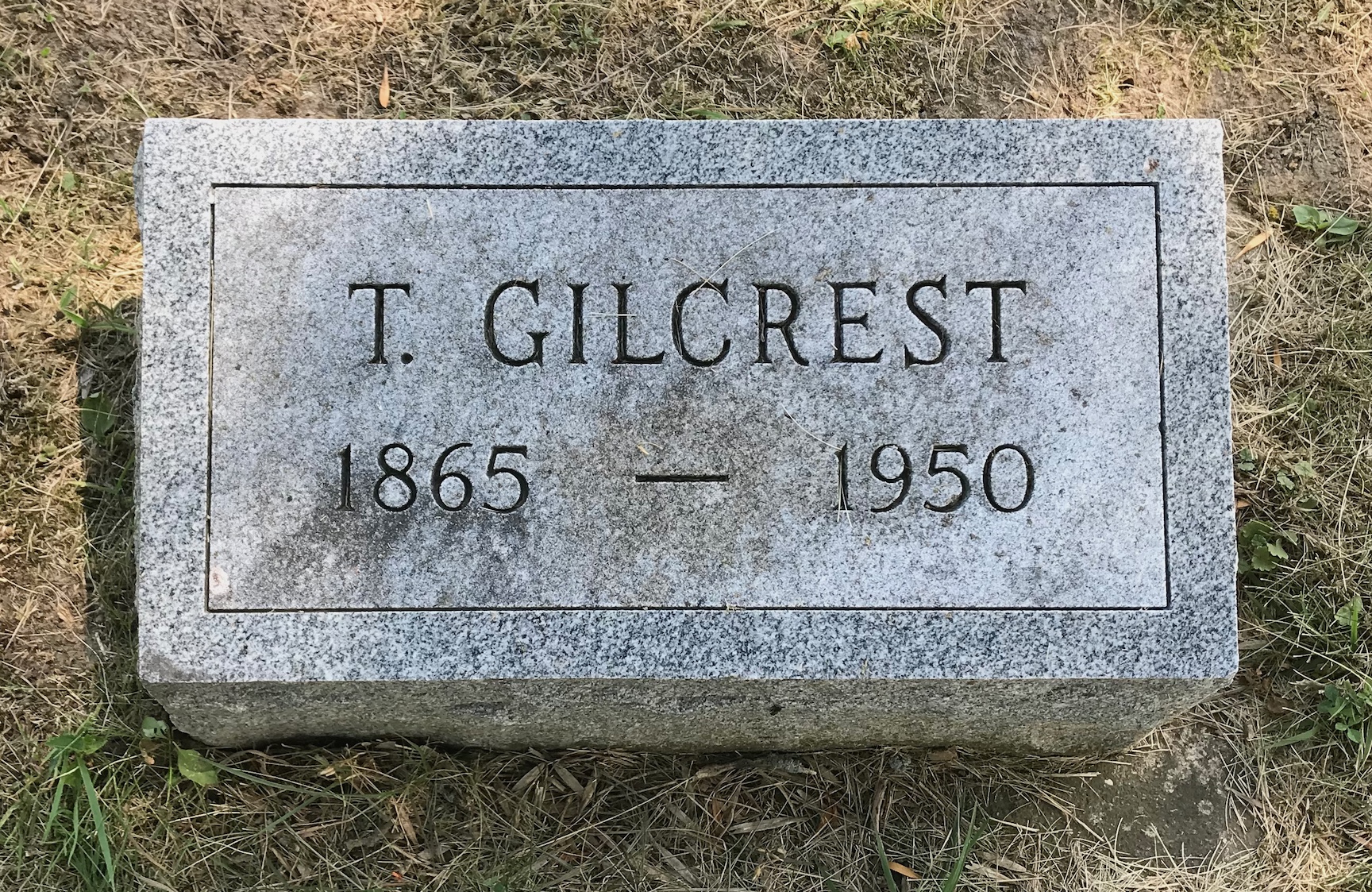
Truman J. Gilchrist (his name is misspelled on his marker) spent the rest of his life at ASP.

In early February, a judge declared Truman insane and he was sent to ASP’s Insanity Unit where he was to stay until he “became sane”. If and when he did , he could be tried for the murder. Truman would remain at ASP for 45 years, never leaving the Insanity Unit. He died there on Aug. 30, 1950 at the age of 85.

Tena is buried in Union Cemetery in Lockridge Township, Iowa. She was 40 when she died. I don’t know what became of their children.

“Recovered”

In the case of Elias Lyons, prison officials deemed him “recovered” from his insanity but he was back at ASP not long after his release.

Born in 1890, Elias Lyons was convicted of larceny in 1911 and sentenced to serve his time at Iowa State Penitentiary in Fort Madison (which closed in 2015). He was later sent to ASP to spend some time in the Insanity Unit. But in 1914, he was deemed “recovered” and sent back to Fort Madison along with 19 other prisoners. He was released from prison on Nov. 22, 1914.

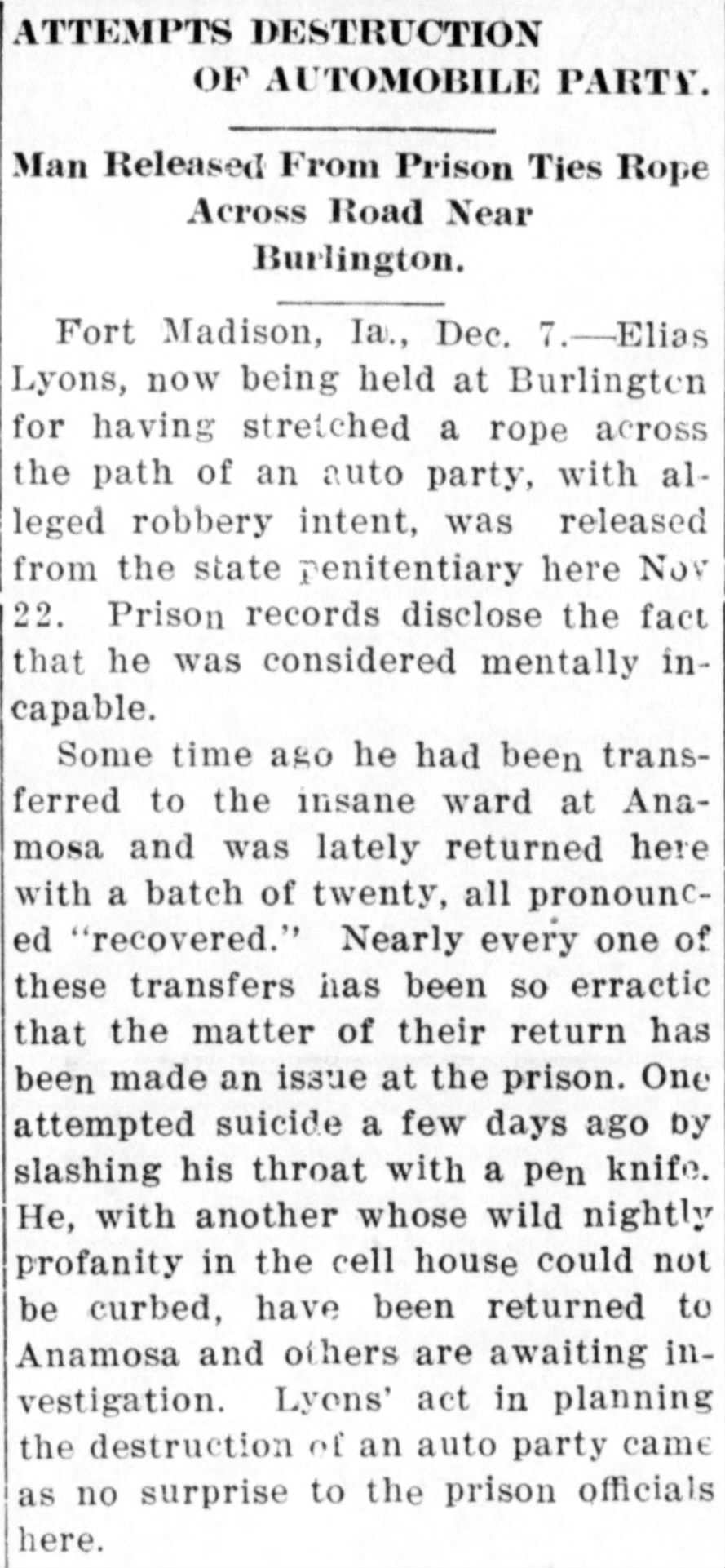
Elias Lyons’ sanity was on shaky ground. (Photo Cource: Decorah Public Opinion, Dec. 9, 1914)

On Dec. 7, 1914, Elias attempted to stop a car to rob its passengers by placing a rope across a bridge road in Burlington, Iowa.

Elias was sent back to ASP where he died on May 19, 1925. He was 34. I don’t know what his cause of death was.

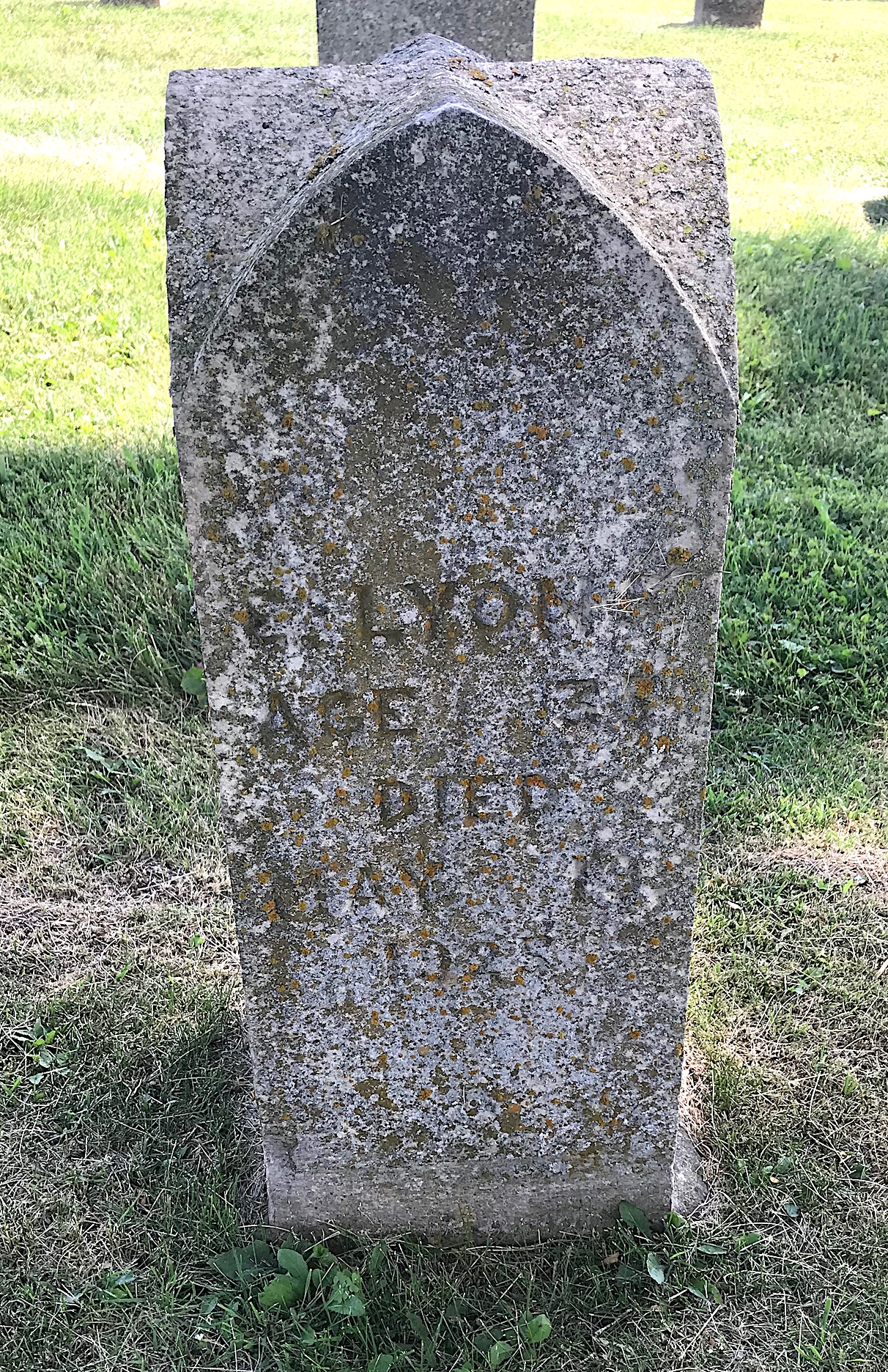
Elias Lyons died at the age of 34.

“Interior Decorator Before Prison”

Charles DeForrest Ives only spent the last few months of his life at ASP. But he’d already spent the previous 15 years at another prison. However, from what I can tell, Charles hadn’t always led a life of crime.

Born in Elkhart, Ind. in 1901, Charles was the son of Joseph G. and Helen Van Doren Ives. Charles wed teacher Florence Lake in Des Moines, Iowa in 1923. They settled there and Charles worked various jobs over the next several years, from engineer to painter/wallpaper hanger. The couple had two sons together.

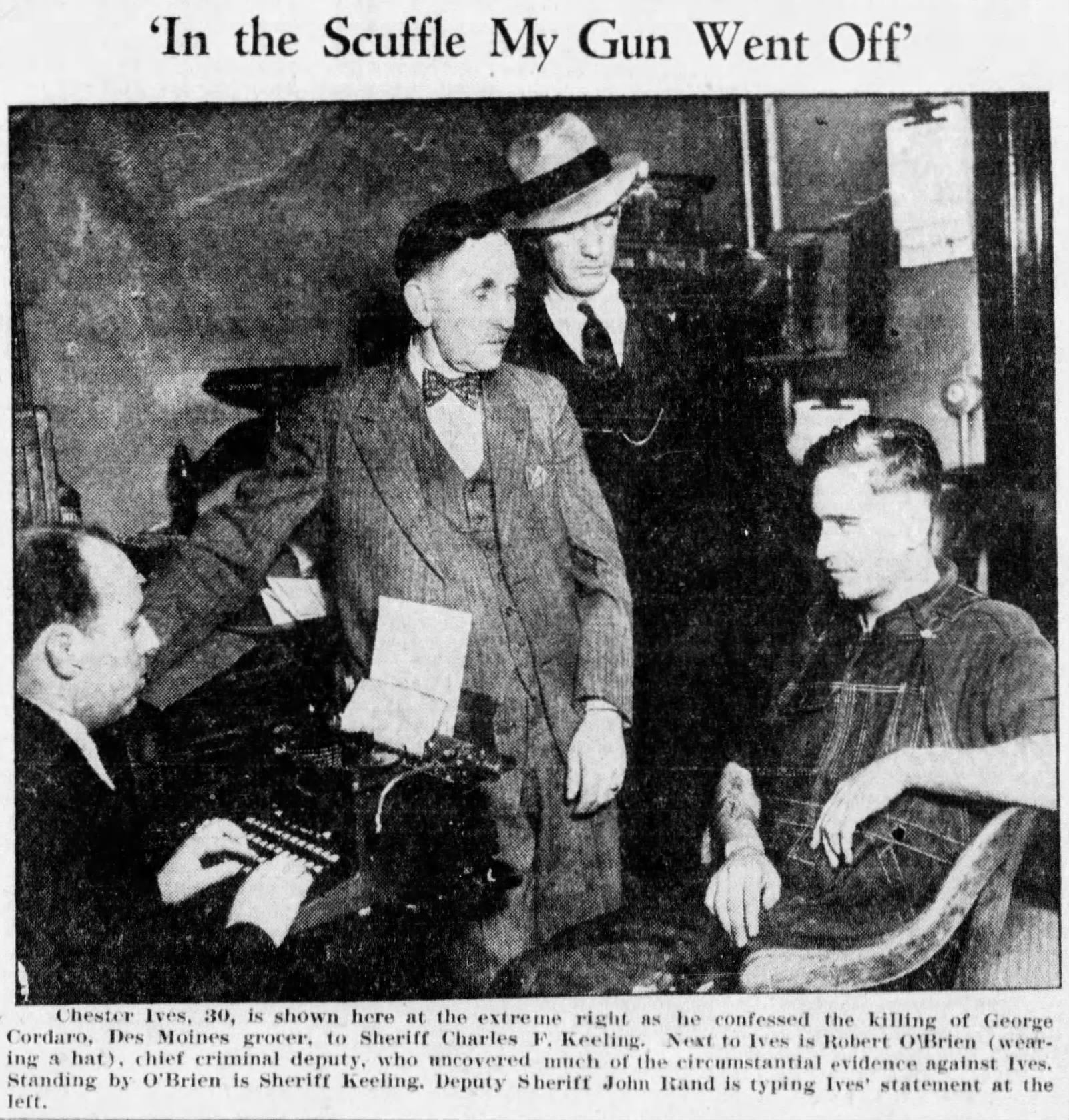
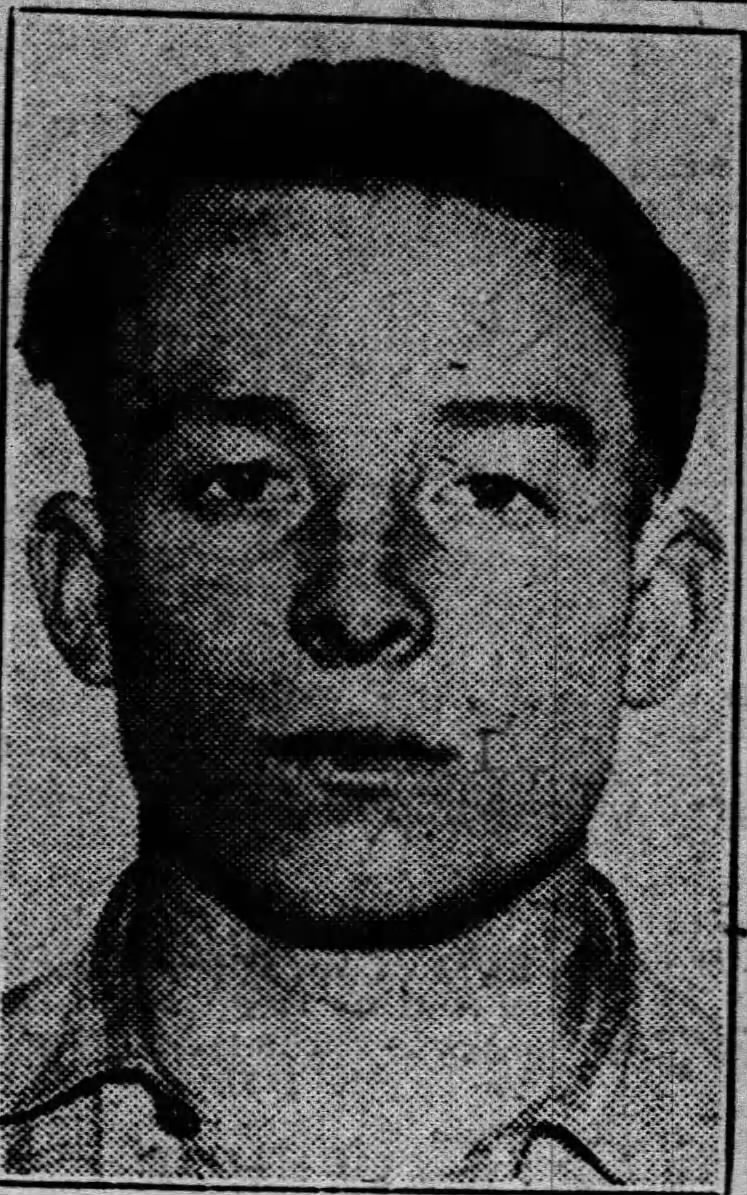
Unfortunately, Charles slid into criminal activity. On Jan. 10, 1931, he attempted to rob a grocery store owned by George Cordaro. He had an accomplice, whose wife was thought to be the lookout. Later, Charles would confess to sheriff Charles Keeling that he and Cordaro had struggled over the gun and “In the scuffle, my gun went off.”

Charles also is noted to have felt bad about what he’d done and said, “Tell them to get the clean sheets ready at Fort Madison,” referring to the Iowa State Penitentiary.

Des Moines Register photo of Charles Ives (far right) confessing to the killing of grocer George Cordaro in January 1931.

Charles was in a truth-telling frame of mind and went on to confess to six street car robberies and two holdups. He claimed he had only done it because he needed the money. When he went to trial, he plead not guilty to the murder, but was convicted and sentenced to life in prison.

However, many suspected there was more to it than that. The lookout, Lela Wiggins, was thought to be the reason Ives had held up the store. The two were thought to be lovers and some felt Ives confessed to protect her from serving time. Her husband, Hoyt, had assisted Ives in several robberies. He was convicted of a different robbery and sentenced to 10 years at Fort Madison. Lela divorced Hoyt while he was in prison.

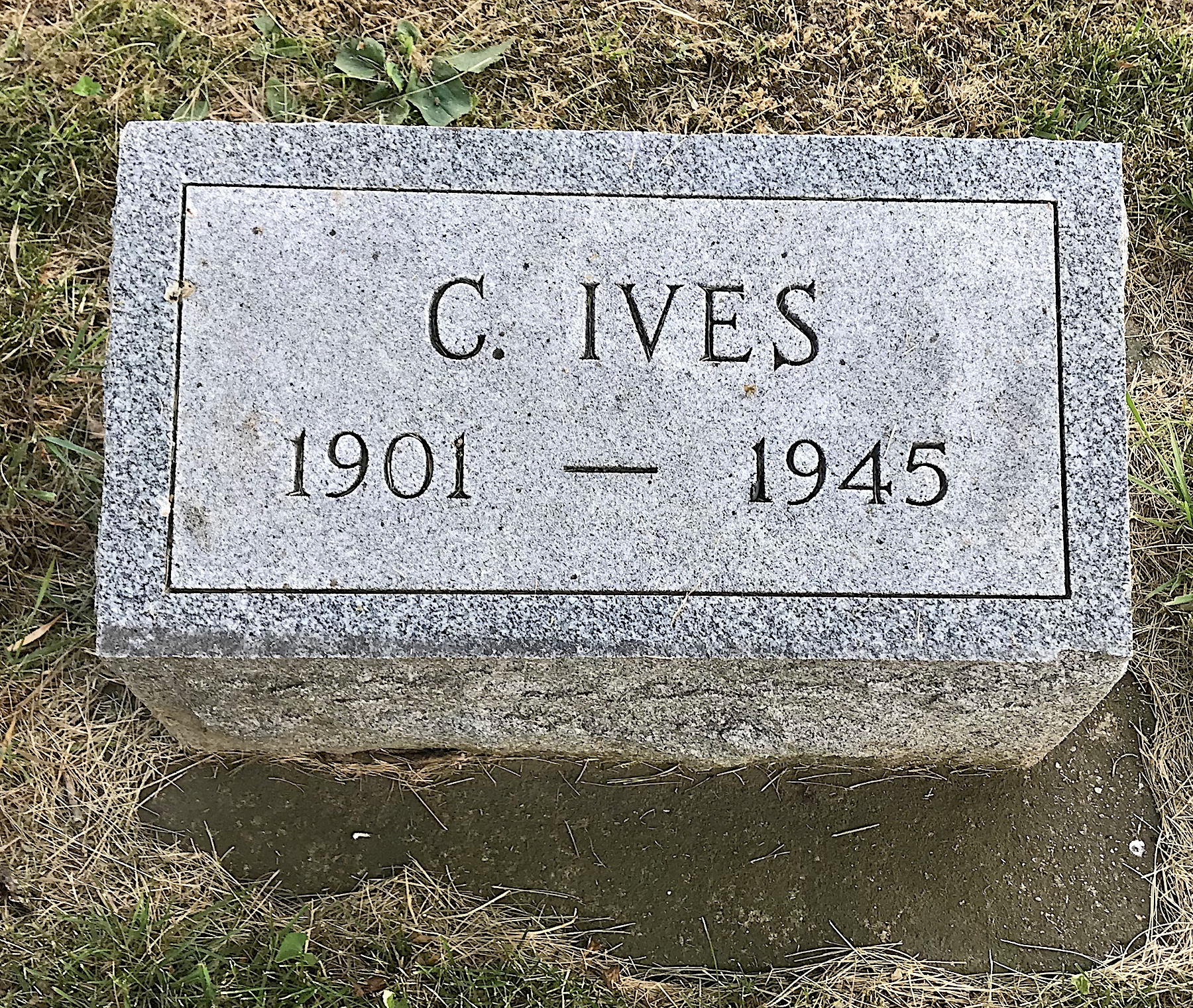
Charles Ives died at age 44 from tuberculosis.

Charles’ Find a Grave memorial claims he served time at San Quentin in California but I found no record of that. He did his time at Fort Madison. I wonder if he ran into Hoyt Wiggins while he was there. Charles contracted tuberculosis and was transferred to ASP’s hospital unit. He died there on Dec. 20, 1945 at age 44.

His death certificate listed his profession as “interior decorator before prison”.

Charles’ wife, Florence, divorced him and went on with her life. She continued to teach and moved with her sons to Clinton, Iowa. She died in 1985 in Durango, Colo. One of her sons became a doctor and moved to Louisiana.

Misspent Youth

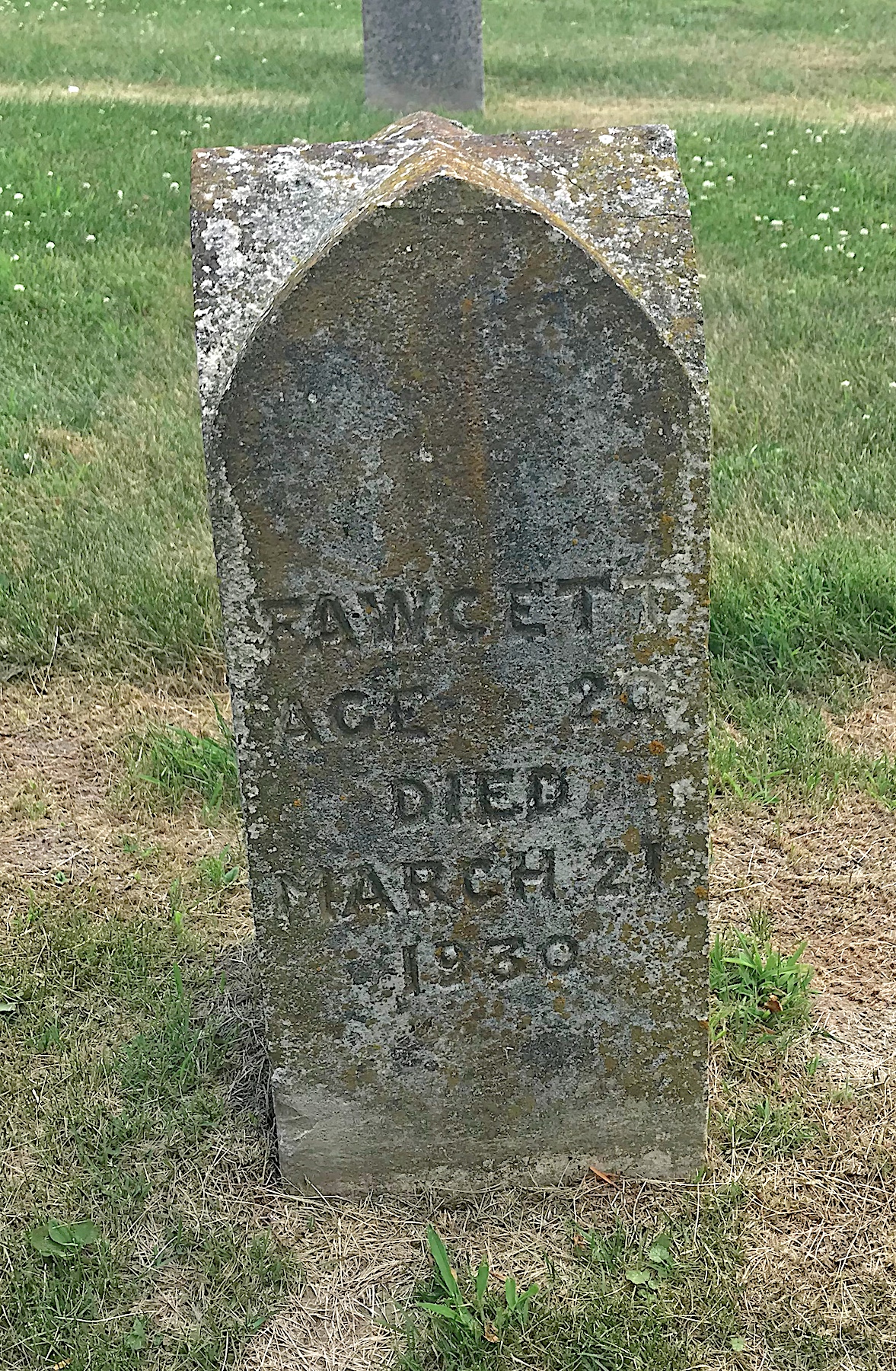
I have more questions than answers concerning my final story. Arthur Fawcett was still a boy when he died, having gone down the wrong path.

Born in England in 1909, Arthur was the son of Thomas Lester Fawcett and Jennie Smith Fawcett. The Fawcetts emigrated to Canada in 1910 then to America in 1911. According to the 1920 U.S. Census, Thomas was working as a miner in Polk County north of Des Moines. Later, he worked laying linoleum.

British-born youth Arthur Fawcett was a car thief. (Photo Source: Sioux City Journal, Dec. 15, 1927)

Sadly, Thomas died on Feb. 25, 1927 from a brain abcess. He was 41. He is buried in Floyd Cemetery in Sioux City, Iowa.

It wasn’t long after that when Arthur’s name started appearing in the Sioux City Journal as the culprit in various car thefts/joy riding incidents. On Nov. 22, 1297 he got fined for a traffic violation. On Dec. 13, 2017, Arthur and a friend were arrested for the theft of seven cars (with which they went joy riding) and charged with larceny of a vehicle. As a result, they went to jail.

Arthur somehow got paroled a few months later. In February 1928, he was arrested again for having tried to sell tires off of a stolen car. Back to jail he went. In May 1928, his sentence was reduced by three months.

Arthur Fawcett’s death certificate indicates he actually died on March 20, 1930.

I’m not exactly sure what happened after that, but Arthur died at ASP on March 20, 1930. He was only 20 at the time. His death certificate lists his cause of death as cirrhosis of the liver. That’s not something I’ve ever seen in a fellow that young.

We had a brief stop to make in Anamosa before we began out trek back west. Join me next time at Riverside Cemetery.

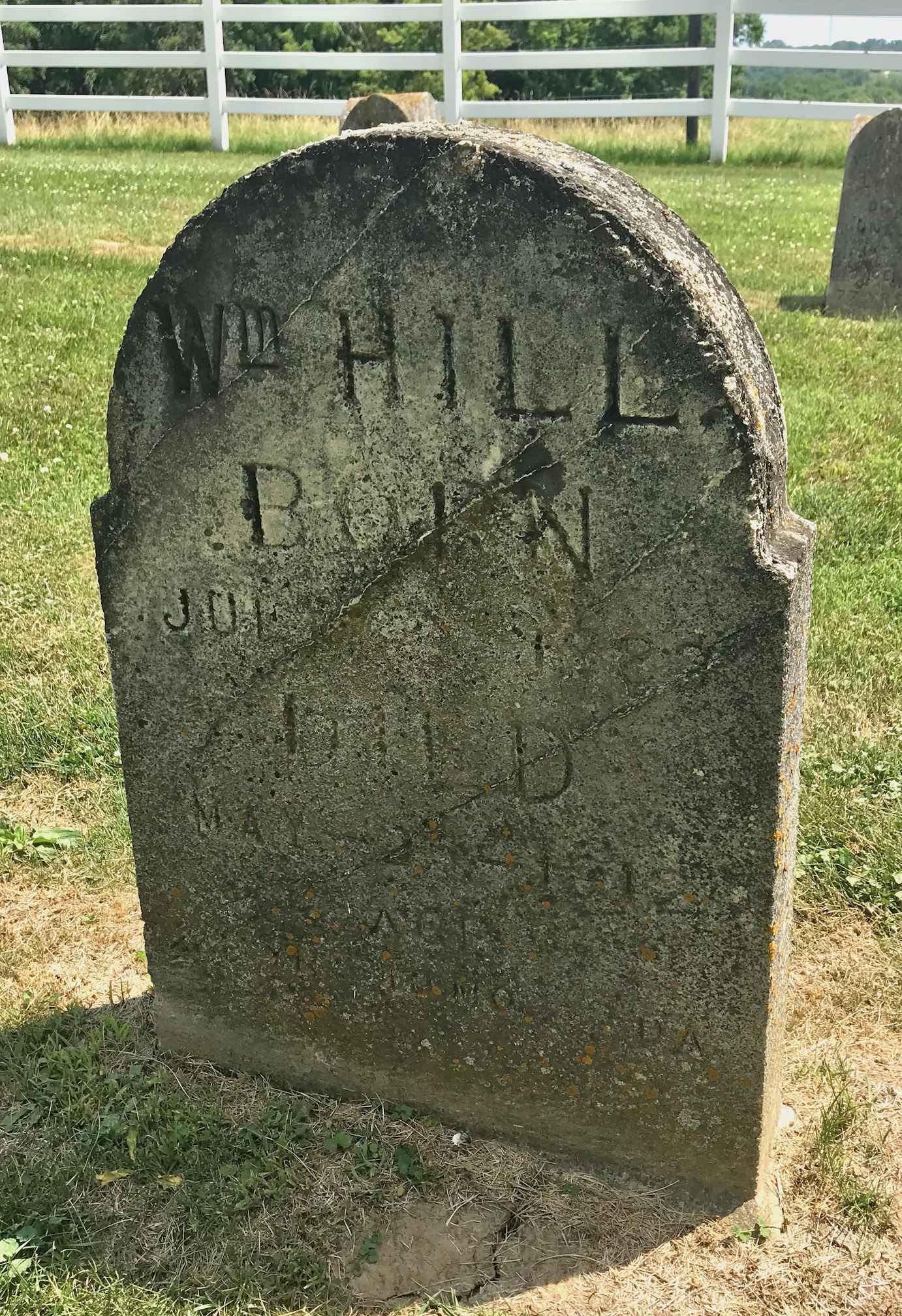
William Hill came to ASP as an inmate in 1908 for reasons unknown. He died on May 26, 1912 at age 28. His death notice said he had been “a sufferer for many years”. What that was is unknown.

Beyond Bars: Visiting Iowa’s Anamosa State Penitentiary Cemetery, Part I

02 Friday Feb 2024

Posted by adventuresincemeteryhopping in General

≈ 7 Comments

Since cemeteries are viewed by many as outdoor museums, it isn’t a stretch for me to say that I’m a bit of a museum junkie. It doesn’t take much to get me to visit one, the more obscure the topic the better. I love learning about anything and everything!

When I was doing research for this road trip, I discovered that Iowa’s Anamosa State Penitentiary (ASP) not only had a museum, it had a cemetery that’s open to the public. There was no way I was going to miss out on that!

So we headed east from Springville to Anamosa, a brief 10 mile ride. I was also interested in visiting Anamosa to visit the cemetery where artist Grant Wood was buried. I talked about him during my visited to Cedar Rapids’ Oak Hill Cemetery. Wood spent his last years in the Anamosa area. I’ll be writing about that in a few weeks.

Approved in 1872

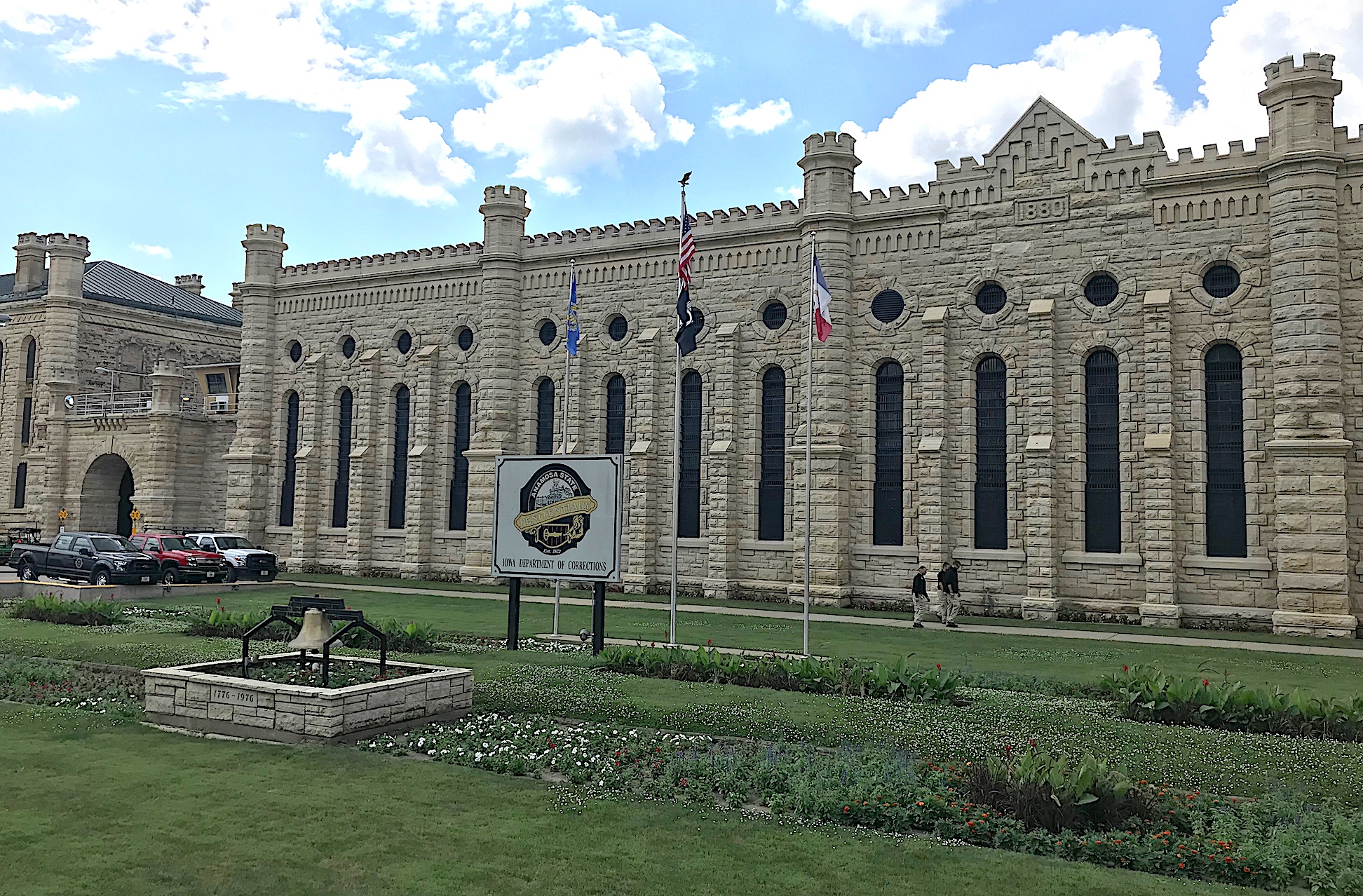
First approved in 1872 by the Iowa Legislature because the prison in Fort Madison was full, the Anamosa State Penitentiary was first known as the Additional Penitentiary, then the Anamosa Penitentiary before it was a Reformatory. Then it became a Penitentiary once again. Inmates did much of the labor on the stone walls and buildings, some of them dying in the process.

Made of limestone, ASP’s construction began in the 1870s and it s still houses prisoners today.

ASP’s walls, which are about 12 feet thick at the base and four feet thick at the top, enclose about 12 acres. It had a Female Department and an Insane Unit for decades.

One of Anamosa’s most infamous prisoners was 11-year-old Wesley Elkins, convicted of killing two people. Sentenced to life, Elkins ended up only serving a nine-year sentence. You might also remember Frank Novak, who I wrote about a few weeks ago. He tried to fake his own death for the insurance money, committed murder, and fled Cedar Rapids to Alaska. He was eventually caught and spent some years at Anamosa.

ASP’s most infamous inmate was serial killer John Wayne Gacy, who served time there for 18 months on a sodomy charge. He was released in 1970 and returned to the Chicago area where he began to commit his many murders.

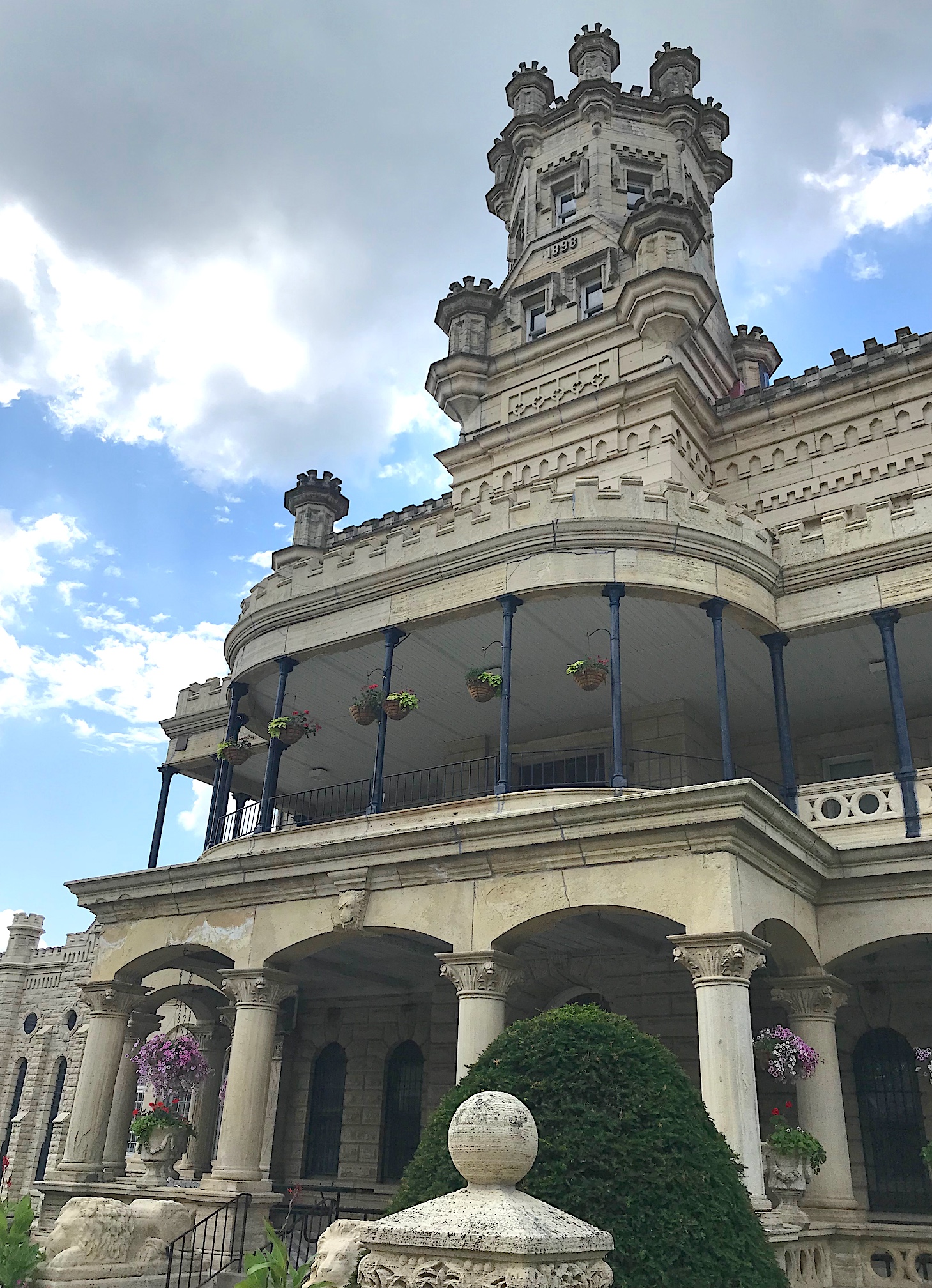
The Gothic looking intake office entry may seem elegant but ASP is still very much a prison.

As of March 2021, there were about 945 inmates serving time at ASP. That same year, corrections officer Robert McFarland and nurse Lorena Schulte were murdered by prisoners during a botched escape attempt. Inmates have been killed during escape attempts at ASP before, but 2021’s incident was the first time staff members working at the prison were killed by prisoners.

Prison Museum & Gift Shop

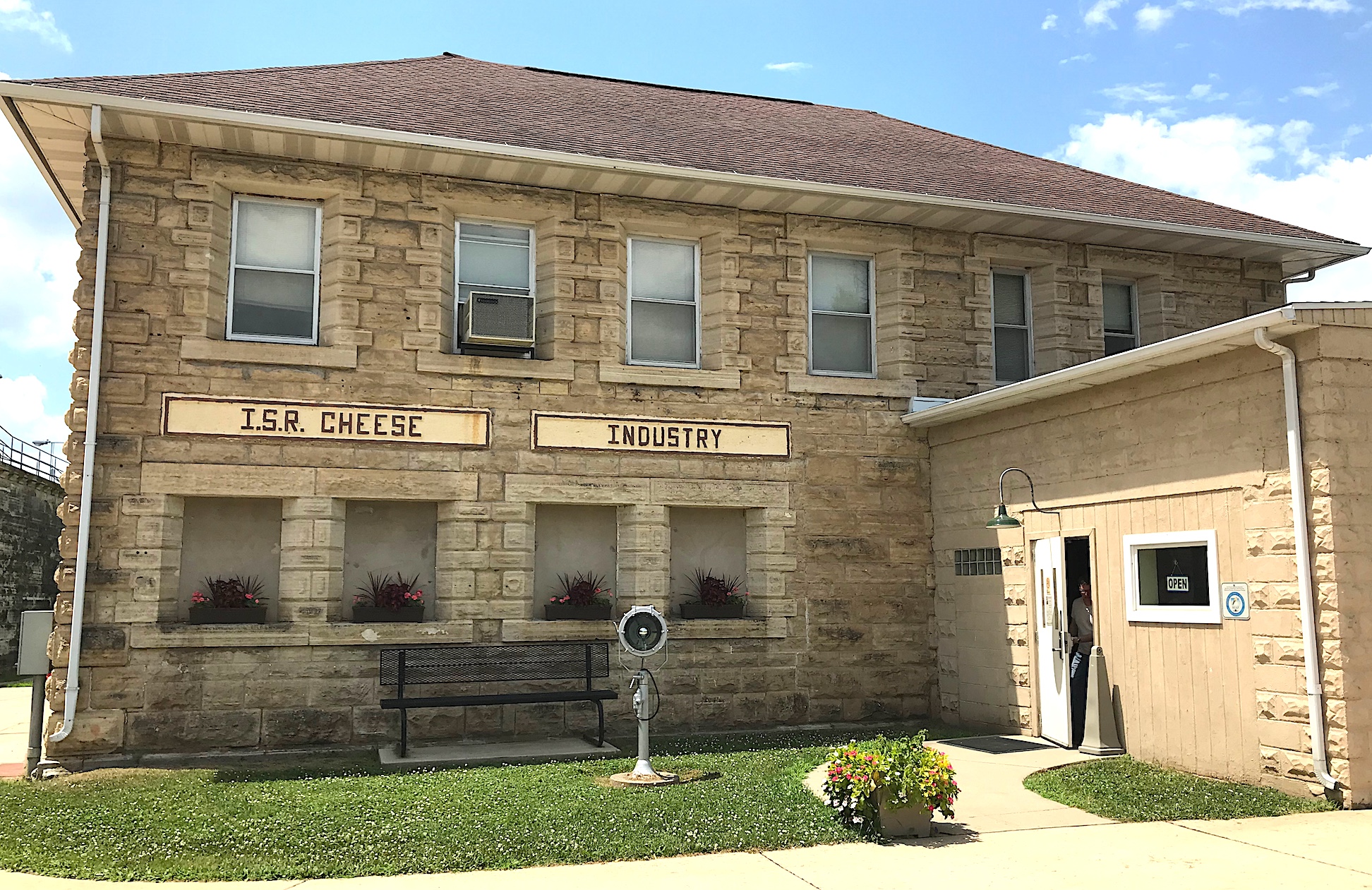
It may seem hard to believe that a working prison might have a museum and a gift shop, but Anamosa does. It’s housed in the building that used to be a cheese factory. The penitentiary once produced large amounts of food for prison consumption, from beef and milk to fresh vegetables.

ASP’s museum is housed in the former cheese factory. Admission is only $3.

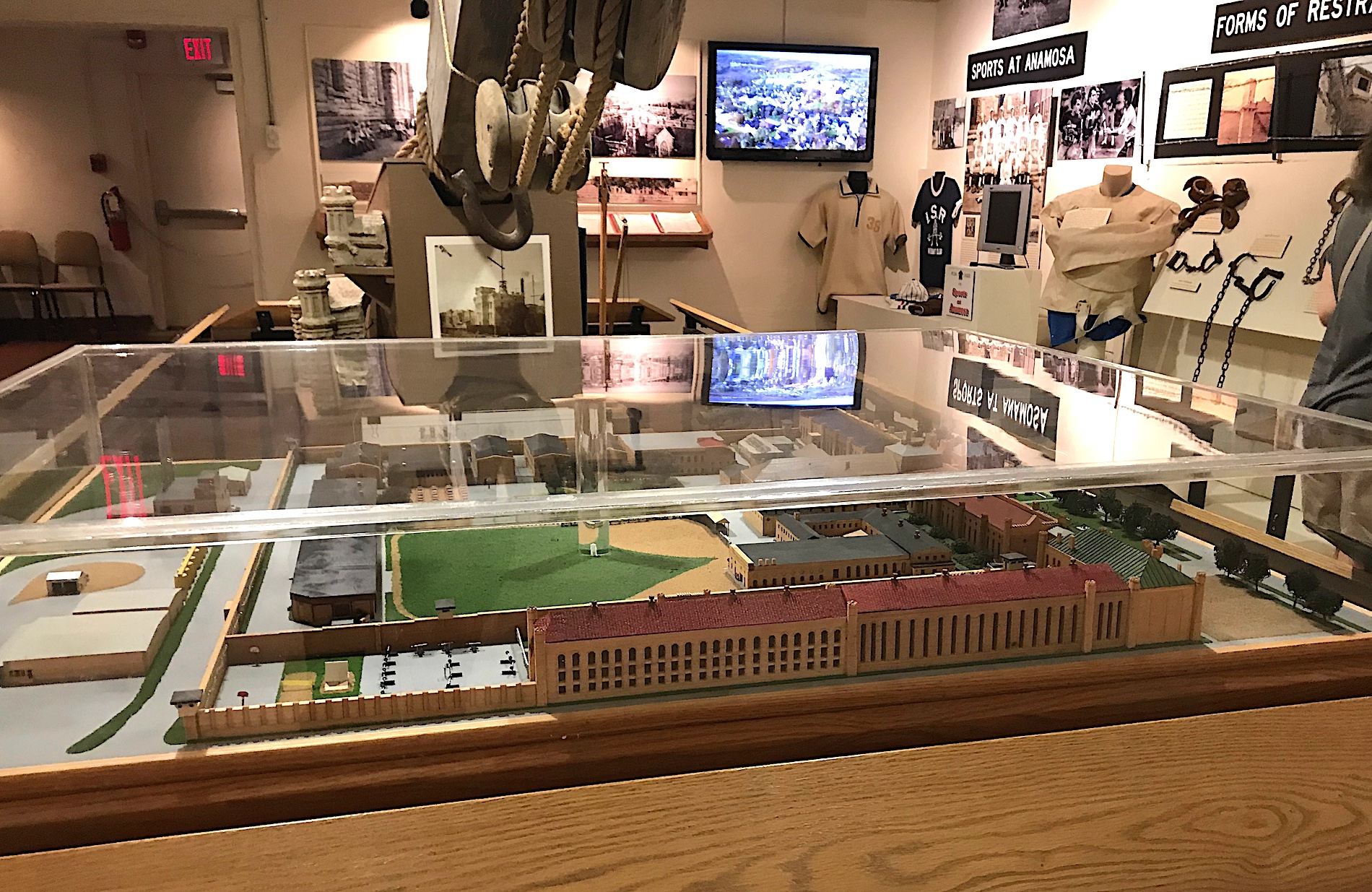
The museum has a recreation of a typical historic cell (it’s understandably small) and records of past inmates, photos of construction, and examples of prison products. Prison sports teams, stories of famous inmates, and the evolution of correctional policies and prison administrators are all included. I was quite impressed at the amount of information and the number of artifacts they had.

ASP’s museum includes many artifacts from the past.

One thing I learned while I was there was that during his stay, John Wayne Gacy was a model prisoner. He worked in the bakery and helped build a miniature golf course that is still in use today. I looked for a picture of it at the museum but never saw one.

We spent a good amount of time talking to the museum staff, who told us that many of their family members currently worked at ASP or had worked there in the past. While not exactly a pleasant place to work, ASP continues to provide jobs for many in the community.

I want to note that I don’t know if this museum is still open. Apparently, it closed during Covid and I don’t know if it ever reopened. If that’s true, I’m glad we had the opportunity to see it.

Also Called Boot Hill Cemetery

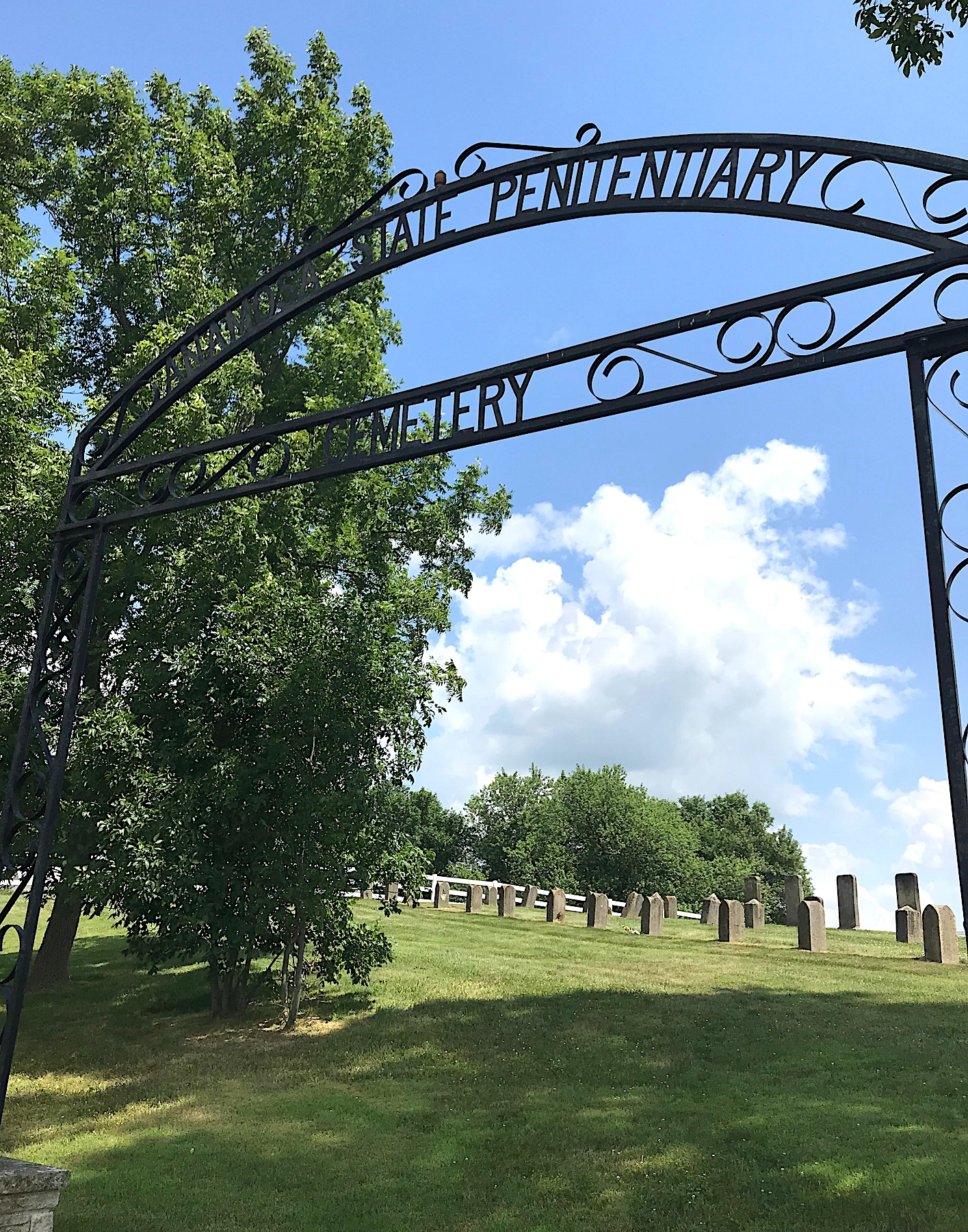
Located about a mile and a half from the prison is the ASP Cemetery, also known as the Iowa Men’s Reformatory Cemetery and Boot Hill Cemetery.

The ASP Cemetery has about 180 memorials listed on Find a Grave.com. Not all are marked.

I was a bit surprised that ASP’s cemetery is open to the public like it is. Most prison cemeteries, even the ones as old as ASP, are close to the facility and off limits. But I’m certainly glad we were able to see it.

The first cemetery associated with ASP was established in 1876 at Prison Farm No. 1 or possibly at Farm No. 5. Its exact location is unknown. The graves are of those prisoners whose bodies were left unclaimed or were not taken to one of the state’s medical colleges. They were buried in common graves that contained up to eight bodies. Tall limestone markers were placed at each grave and contained the prisoner’s name and death date.

They were moved here when the current cemetery was established in 1914. Subsequent graves hold individual bodies, and are marked with shorter limestone markers with the prisoner’s name, age, date of death, and sometimes their prison number. According to Find a Grave, the most recent burial took place in 2021. So it is still an active burial ground. Most of the time, prisoners who die at ASP are now claimed by family members and taken elsewhere for burial.

This is not the first cemetery at ASP.

They are in three different styles. Two styles are upright stones, one with a triangular top and the other with a rounded top. They were used from 1914 to the 1940s. The third style of stone is a flat, horizontal marker that was used from the 1940s to the present.

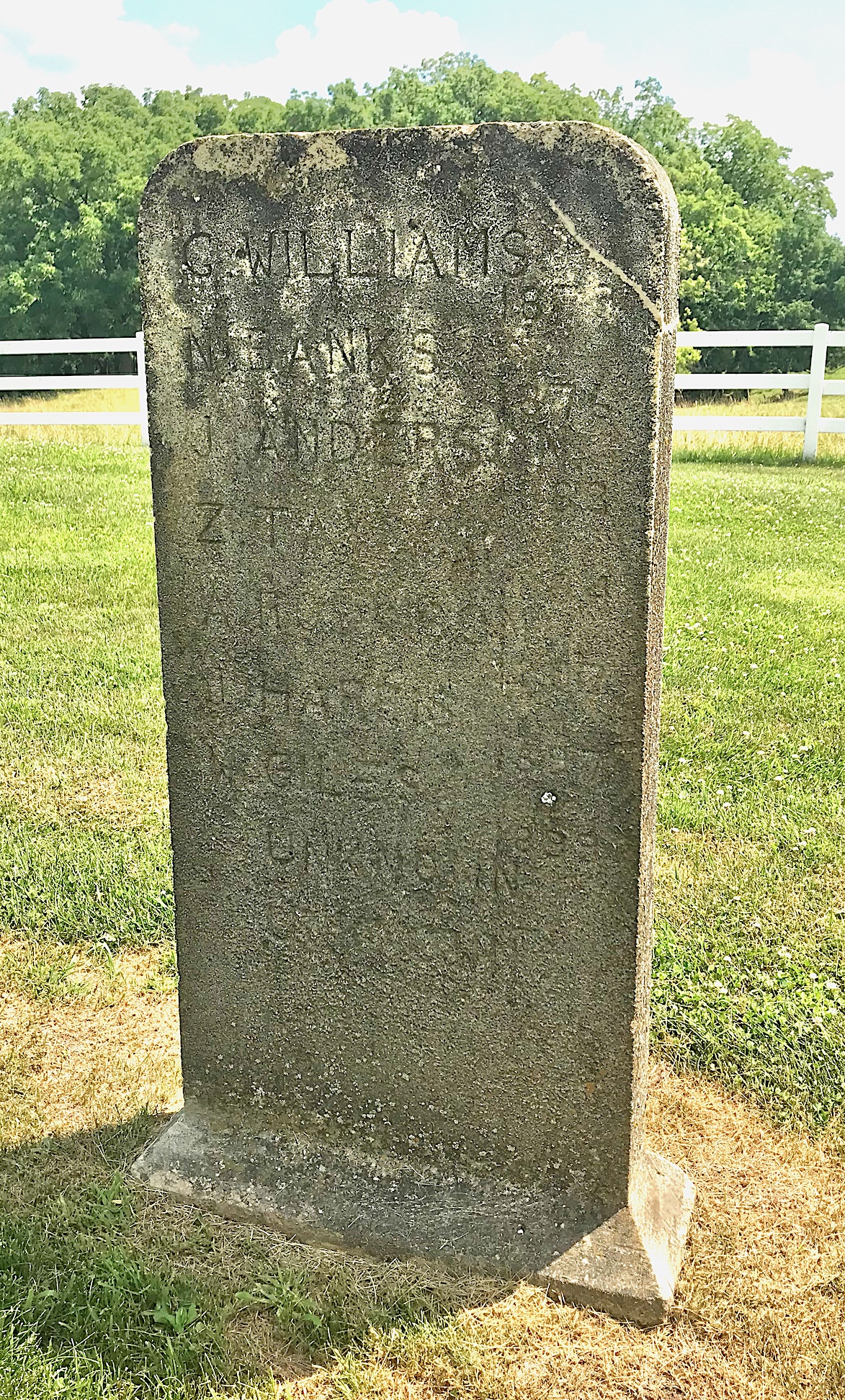
Find a Grave lists about 180 graves here. There don’t look to be that many markers. Then I realized that some of the larger stones had multiple names on them, like this one.

This multi-name grave represents nine prisoners that died at ASP.

One of the earliest burials listed on the above marker is for George Williams, who died on Dec. 11, 1873. That was when construction began at ASP.

Listed right below Williams’ name is that of Noah Banks. Born in 1828 in Arkansas, Banks was convicted of more than one bank robbery in 1874 and was sent to ASP for five years. The Waterloo Courier reported that:

Upon receiving his sentence he [Banks] swore the direst vengeance on all who had been instrumental, in any way, in securing that result, and more especially did he call down curses upon the devoted heads of our citizens, who may now draw a long breath of relief, resting secure.

Banks escaped prison twice before he died. Once in Independence, Mo. and another at ASP. But he was captured both times. Banks died at ASP of kidney disease on June 18, 1876 at age 47.

Dying the same day was African-American prisoner Edwin Smith, who died of tuberculosis at age 26. He was serving a two-year term for larceny.

ASP Escape Attempts

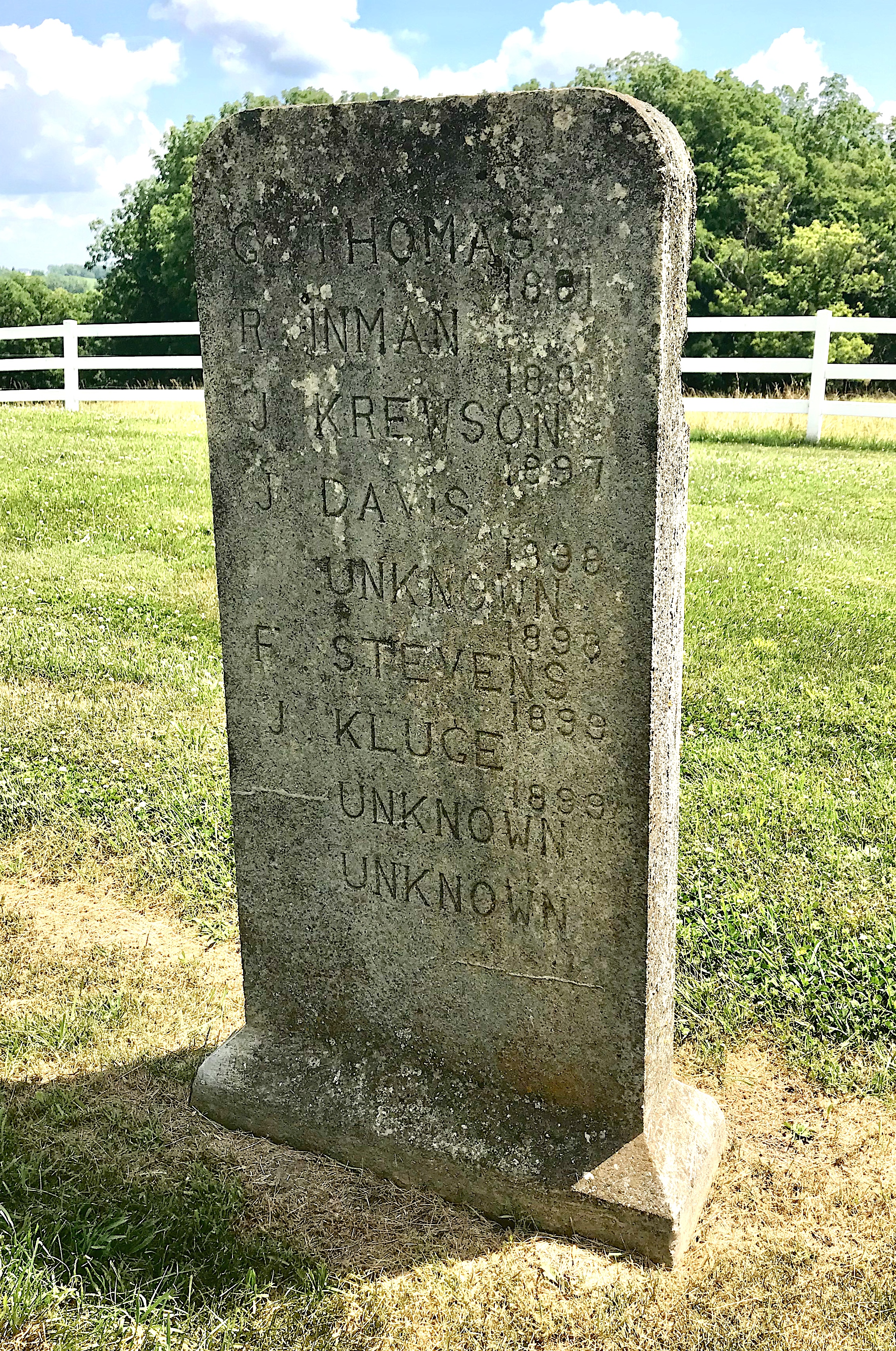
On July 14, 1881, 11 prisoners on their way to the dining hall made an attempt to escape. Charles Thomas, 23, was shot by a guard and brought back inside. A few others were also caught while four managed to get away. I don’t know if they were ever caught but rewards were offered for their capture/return.

Thomas had been at ASP for about a year, sentenced to a six-year term for larceny and robbery.

Charles Thomas (listed at the top) died at age 23 in 1881.

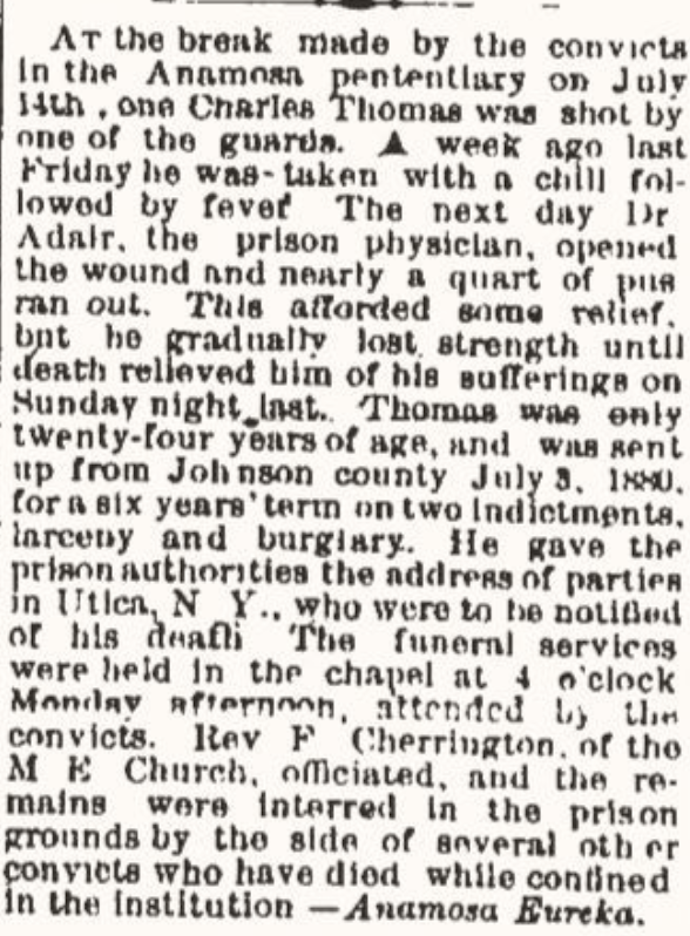
Charles died from his wound about a month later on Aug. 21, 1881. The article I found below gives us a glimpse into what a prison funeral might have been like. Warning, it’s a little medically graphic in detail.

Charles Thomas’ fellow inmates were allowed to attend his funeral in the ASP chapel.

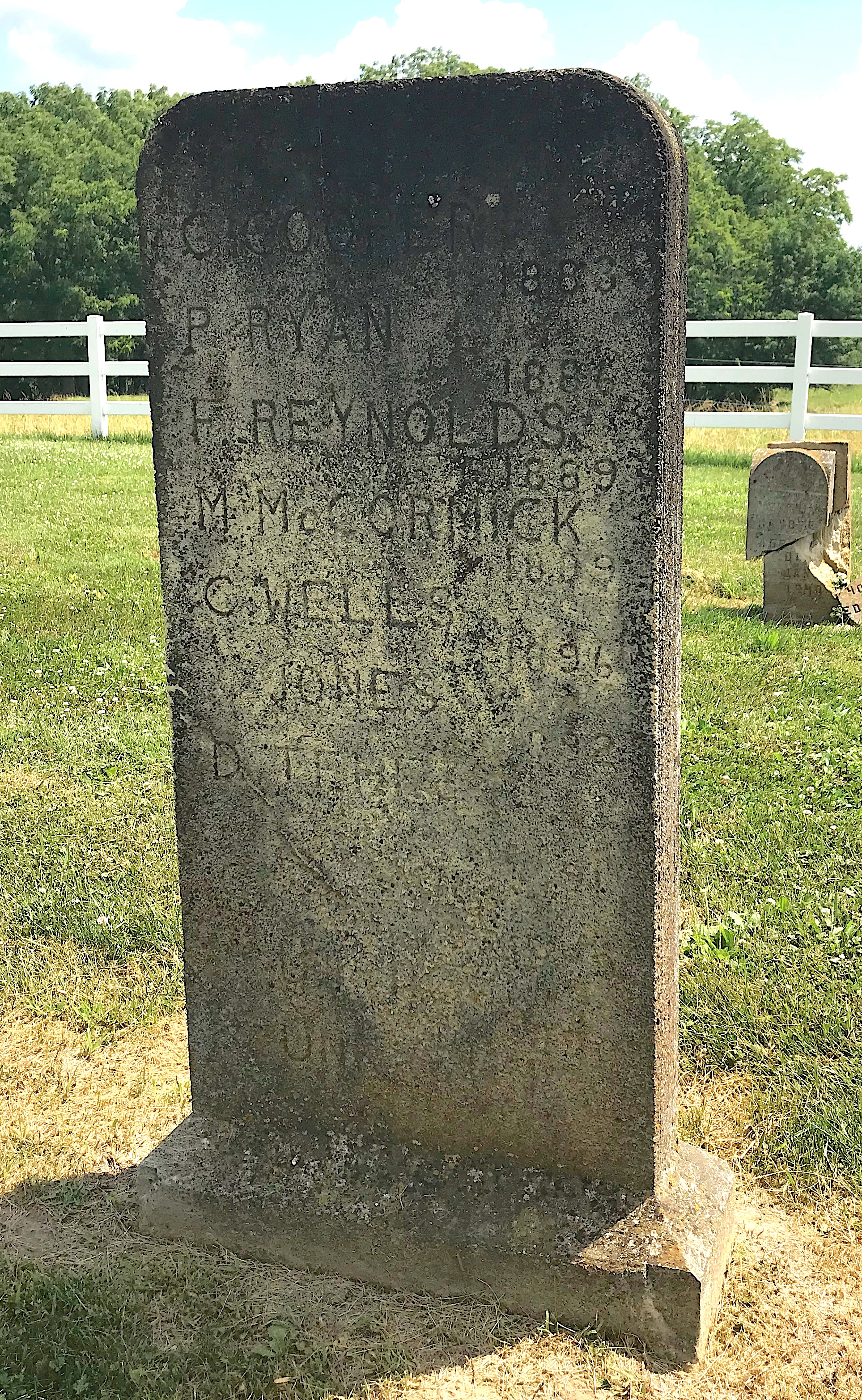
Two more inmates died as a result of another attempted prison escape on Aug. 10, 1886. Patrick “Paddy” Ryan (30) and Albert Mitchell (27) were both shot. One died instantly and the other the next day.

Patrick “Paddy” Ryan (listed second) was killed when he attempted to escape ASP in 1886.

Death of a Tramp

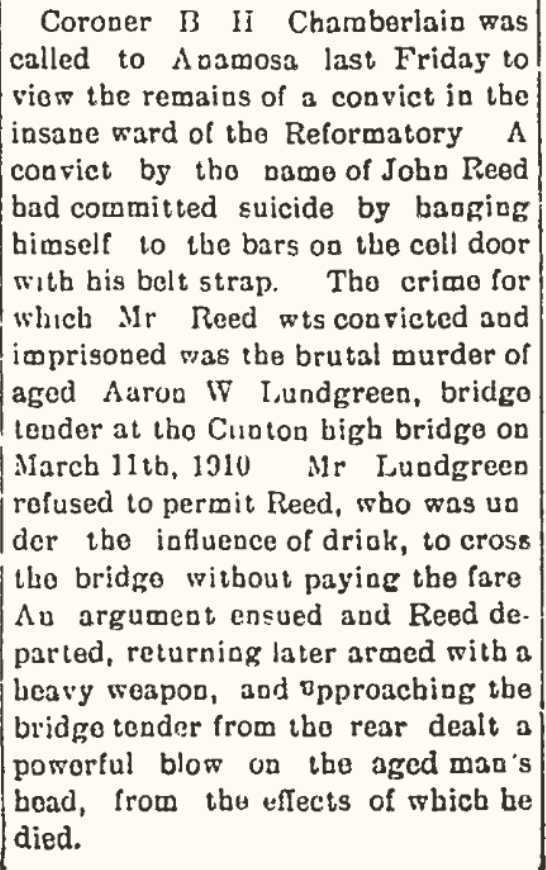
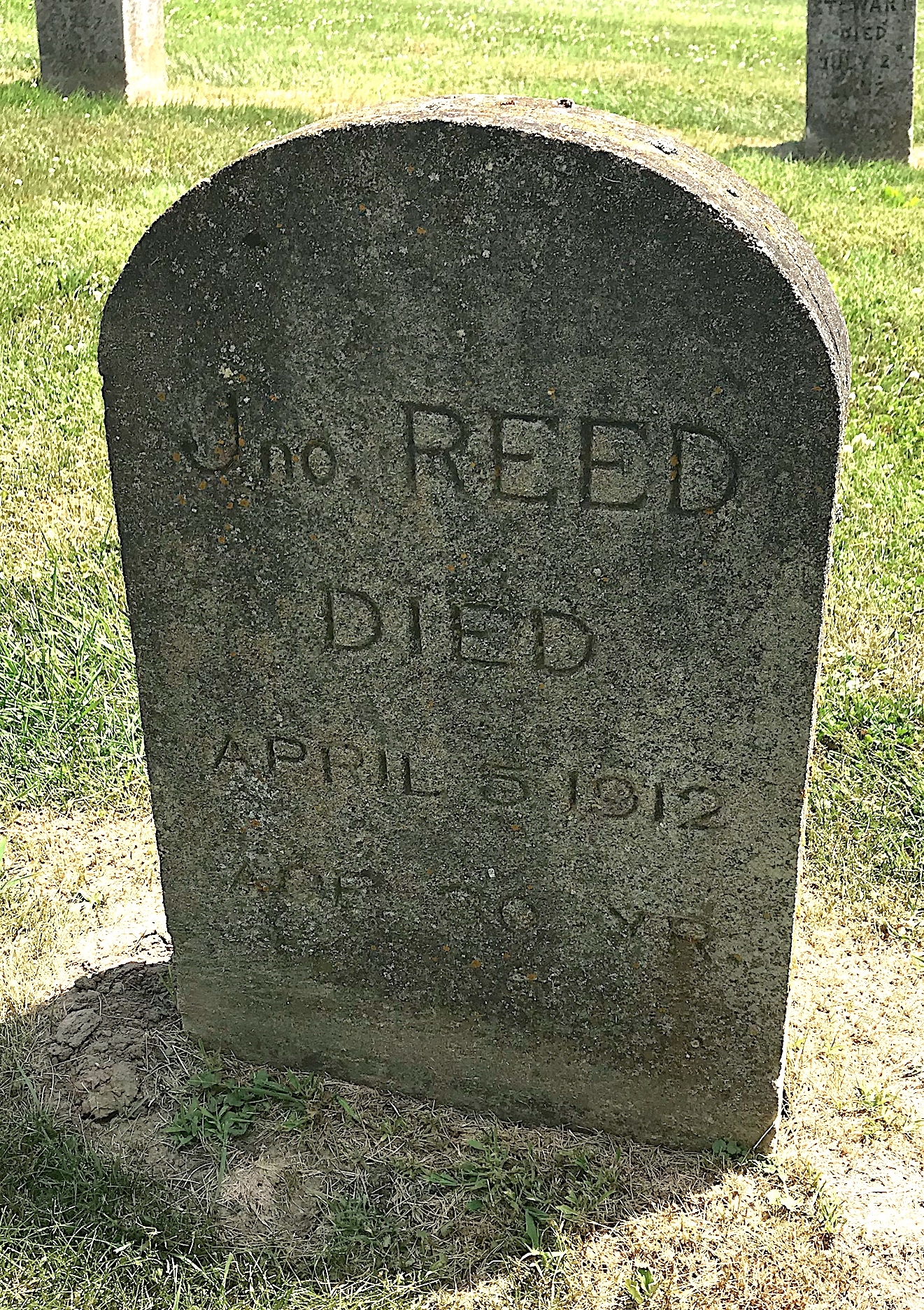
Some of those resting at the ASP Cemetery were housed in what was termed the Insane Unit. John Reed was one of them.

I could find out little about him. In the articles I read, Reed is described as a tramp who suffered from alcoholism. He would not disclose who his parents were, he said, because they were poor and he didn’t want to bring shame to them.

Born in 1882, he was convicted of murdering a bridge tender in 1910. What happened to bring that about and how he died in 1912 are in the article below.

John Reed killed himself while serving time for a murder charge. (Photo Source: Wyoming Journal, April 11, 1912)

It’s doubtful John’s parents knew whatever became of him. He was about 30 when he died.

John Reed’s family probably never knew what became of him.

A Terrible End

Then there are those stories that just leave you shaking your head, such as the one for Cain Russell.

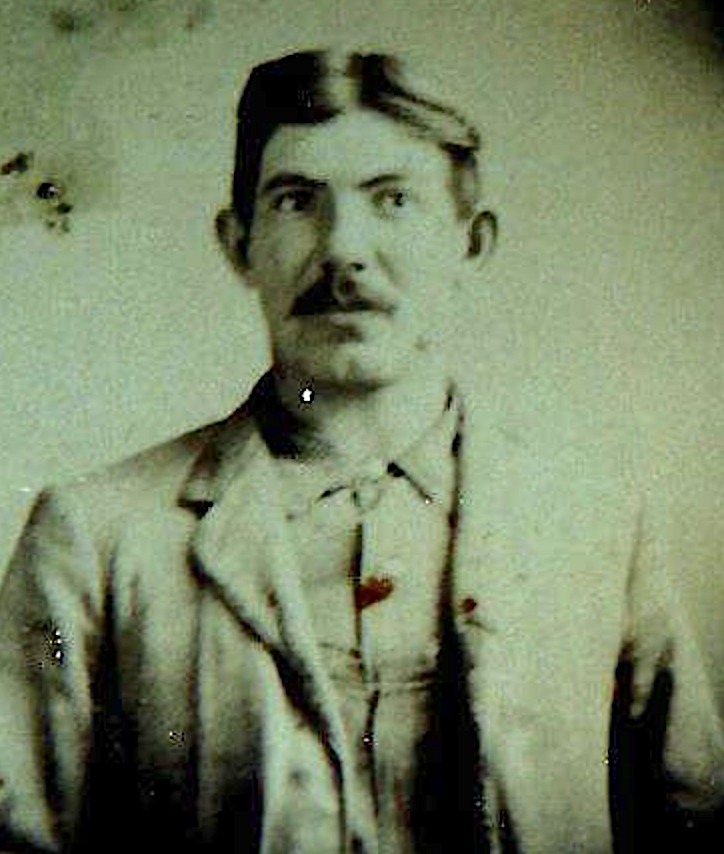
Cain Russell was a farmer in Birmingham, Iowa, married to Etta Jane Marriott Russell. Together, they had several children over the years.

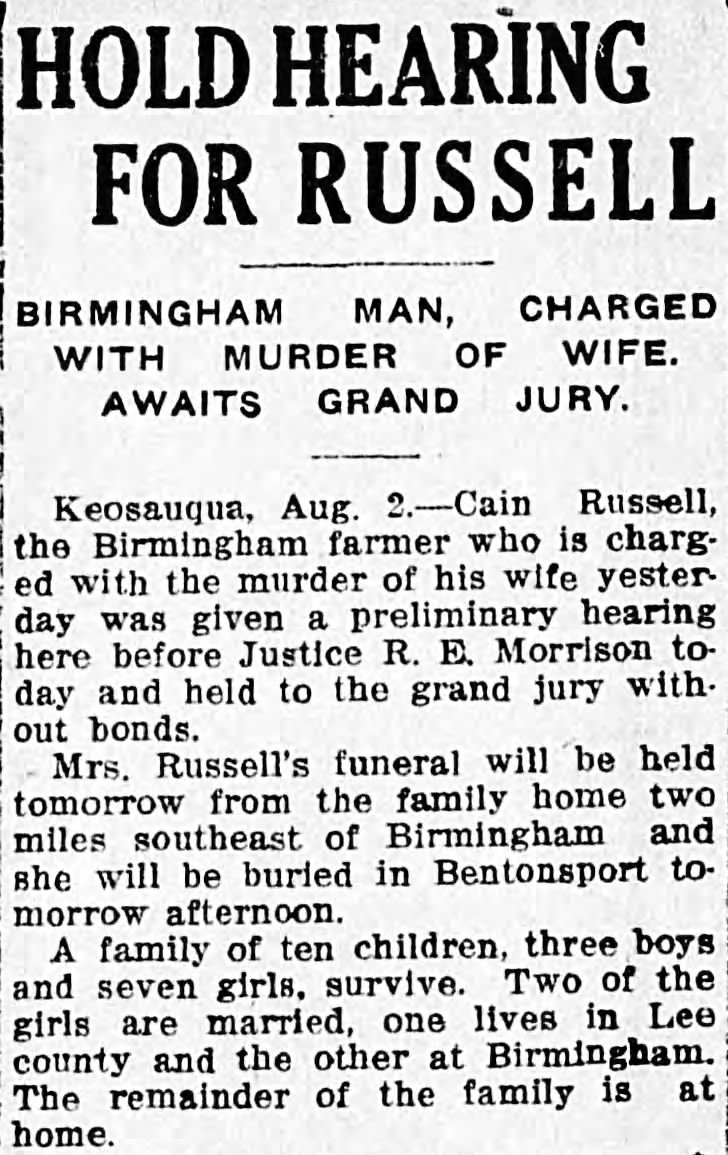
On the morning of Aug. 1, 1917, Cain shot and killed his wife with a shotgun blast to the back of her head.

Undated photo of Cain Russell from Find a Grave.com.

According to bits and pieces I’ve read, 18 months before this, Cain had come before an “insanity board” to determine his soundness of mind but had escaped being sent to an asylum. He was described as increasingly short-tempered and irritable. One account of the murder read as follows:

The morning of the tragedy the mother had nursed her 11-months old baby boy and laid him on the bed asleep. As she went to the kitchen she noticed her husband prowling around in a closet and asked him what he wanted, and he replied nothing, but was evidently getting his gun. She then went to the garden for a pan of beans for dinner, brought them to the kitchen and placed them on the table.

It is supposed she was going out of doors again, as the husband came behind and shot her at close range with the one-barreled shotgun, the full load striking her behind the left ear, making a frightful wound, but did not disfigure her face. She dropped to the floor and was partly in a reclining position in the kitchen, her head resting on a chair. The husband apparently realized what he had done and was filled with remorse, as he had tried to kiss her after the deed, and his face and hands were covered with blood.

(Photo Source: Ottumwa Semi-Weekly Courier, Aug. 3, 1917)

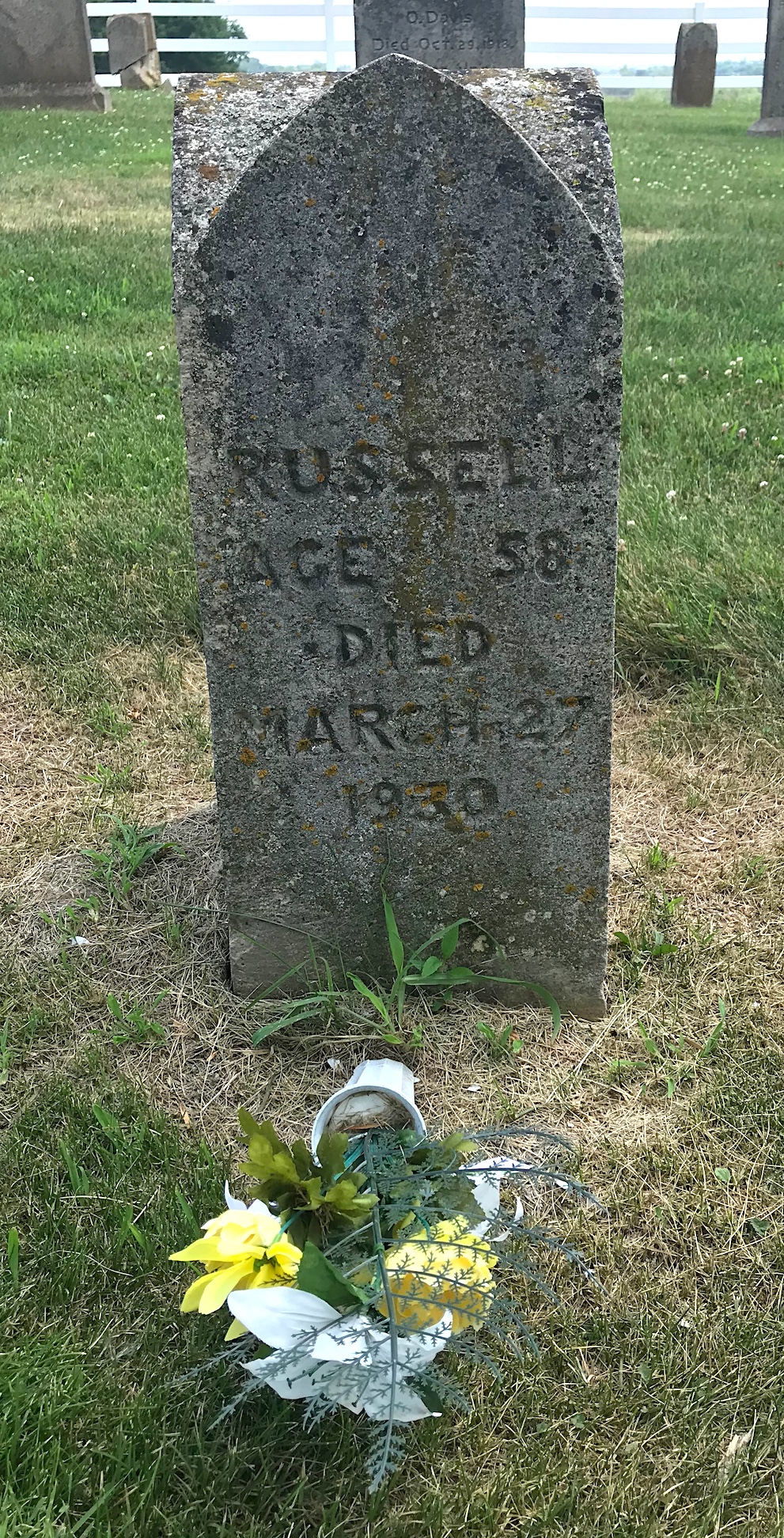
Cain was sent to ASP and placed in the Insane Unit. He died there on March 27, 1930 at age 58. His brother, Samuel Russell, supposedly died at the asylum in Mount Pleasant, Iowa in 1911.

Cain’s Find a Grave memorial notes that he suffered from Huntington’s Disease., a genetic disorder with no cure. I’m doubtful anyone knew much about it at that time. Cain’s deterioration over the years leading up to the murder sound similar in some ways to what Huntington’s Disease sufferers go through.

Cain Russell suffered from Huntington’s Disease.

While some of the Russell children were grown and married, several were quite young and one was an infant. They went to live with their siblings or other relatives. Etta is buried at Iowa’s Van Buren Cemetery. She was 43 at the time of her death.

Cain and Etta’s youngest daughter, Leoma, had Huntington’s Disease. Born in 1914, she was only three years old when her mother died. She married Llewellyn Mallinger in 1932 and the couple had three children. Her death certificate states that when she died of pneumonia on March 24, 1959, she was living at the mental health institute in Mt. Pleasant, Iowa. It also noted she had suffered from Huntington’s Disease for 12 to 15 years. She was 45 when she died. She is buried at Highland Cemetery in Richland, Iowa.

I’ll have more stories from Anamosa State Penitentiary Cemetery next week.

Anamosa State Penitentiary Cemetery is just outside of town.

Getting A Final Glimpse: A Visit to Iowa’s Springville Cemetery, Part II

26 Friday Jan 2024

Posted by adventuresincemeteryhopping in General

≈ 4 Comments

Last week, I shared a number of white bronze (zinc) monuments at Springville Cemetery in Linn County, Iowa. Today I’m going to share some additional monuments that got my attention (made of other materials).

In reviewing my photos, I came across one that caught my eye because it has a Georgia connection. A native of Iowa, Isaac E. Robinson was only 21 when he died far from home in Rome, Ga. during the Civil War.

An estimated 76,242 Iowa men (out of a total population of 674,913 in 1860) served in the military during the Civil War, many in combat units attached to the Western armies. About 13,000 died of wounds or disease (two-thirds of whom were of the latter).

Far From Home

Isaac was born in Iowa around 1843 to George H. Robinson and Sarah Butler Robinson. His father died in 1847 and his mother remarried to Samuel Starry around 1850.

Isaac was living in Onion Grove, Iowa (now called Clarence), which is about 33 miles east of Springville. He enlisted in the Union Army on Aug. 30,1861 and was assigned to the Ninth Iowa Infantry, Company B. Issac was 18 at the time.

Private Isaac Robinson was only 21 when he died from a thigh wound on Aug. 28, 1864.

According to his military records, Isaac’s service included battles of Pea Ridge, Ark. (March 1862), Chickasaw Bayou (December 1862), Fort Hindman (January 1863), assault and siege of Vicksburg (May – Apr 1863), siege of Jackson, Miss. (July 1863), Chattanooga, Lookout Mountain, Missionary Ridge, Ringgold Gap (November 1863), and Resaca and Dallas, Ga. (May-June 1864).

Like many young soldiers, Private Robinson died from his wounds weeks after he was injured.

Isaac received a severe wound in his thigh on May 27, 1864 in Dallas, Ga. He died on Aug. 28, 1864 in Rome, Ga, most likely of sepsis. His remains were eventually sent back to Iowa for burial in Springville Cemetery. I don’t think he was married. Unfortunately, his inscription is very worn and faded.

Isaac’s mother, Sarah, remarried in 1850 to Samuel Starry. He is buried beside them.

Isaac is buried beside his father, George, and his mother, Sarah, who died in 1872. She shares a marker with her second husband, Samuel, who died in 1880.

Rock of Ages

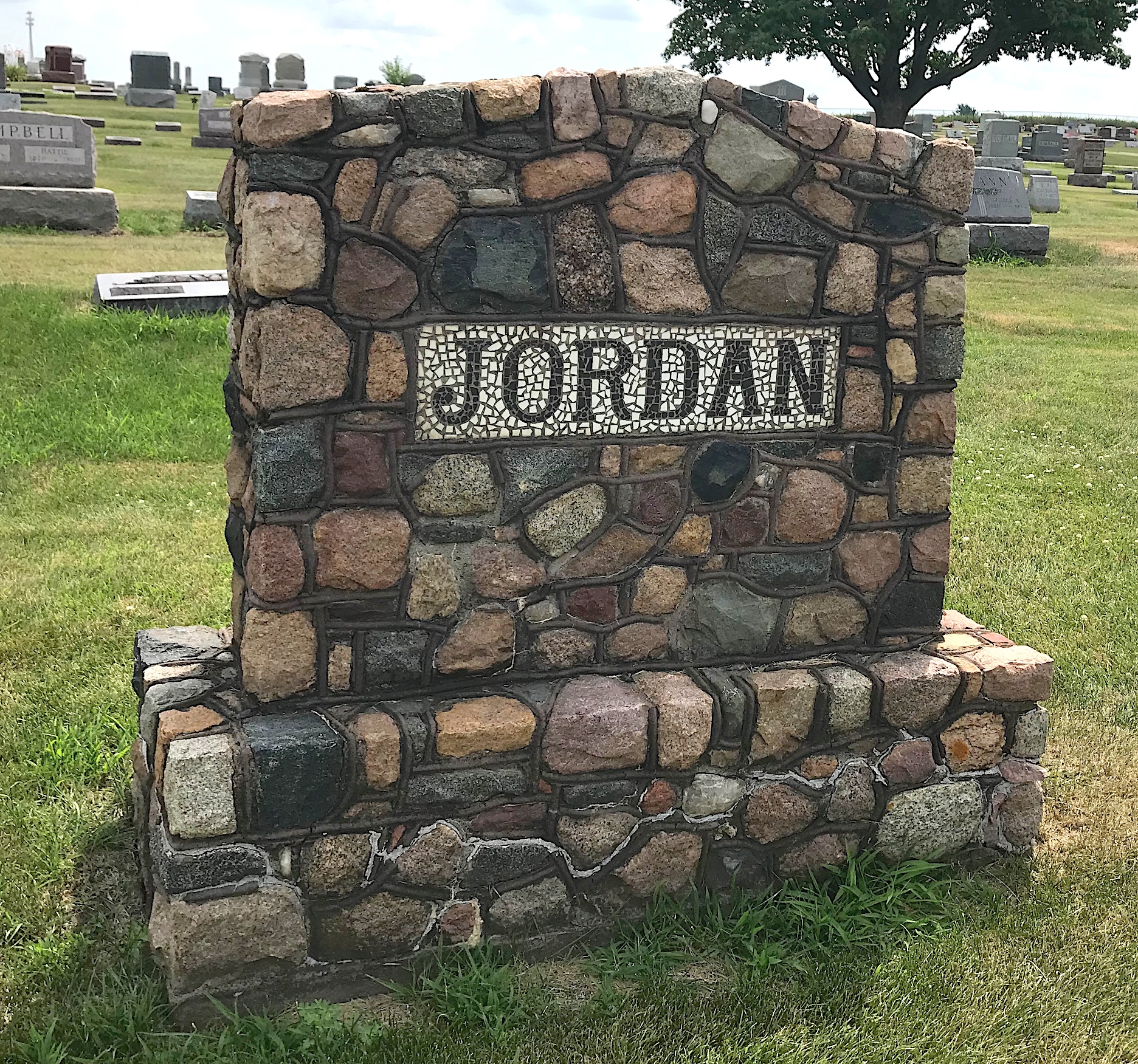
It’s hard to not be drawn to the Jordan monument with its combination of stone and mosaic tile. I’m always curious by how these were made and who made them.

The Jordan family monument is definitely different.

Lemuel Dyer Jordan and his wife, Nancy, came to Iowa sometime in the 1840s from Maine. Their eldest son, George, was born in 1846. He worked as a stock buyer (cattle) and married Emily Alice Gilliland around 1865. The couple had several children.

George died in Springville on March 24, 1921 at age 75. Emily died on Dec. 16, 1926 at age 77 but she does not have a marker.

George Jordan died in Springville on March 24, 1921.

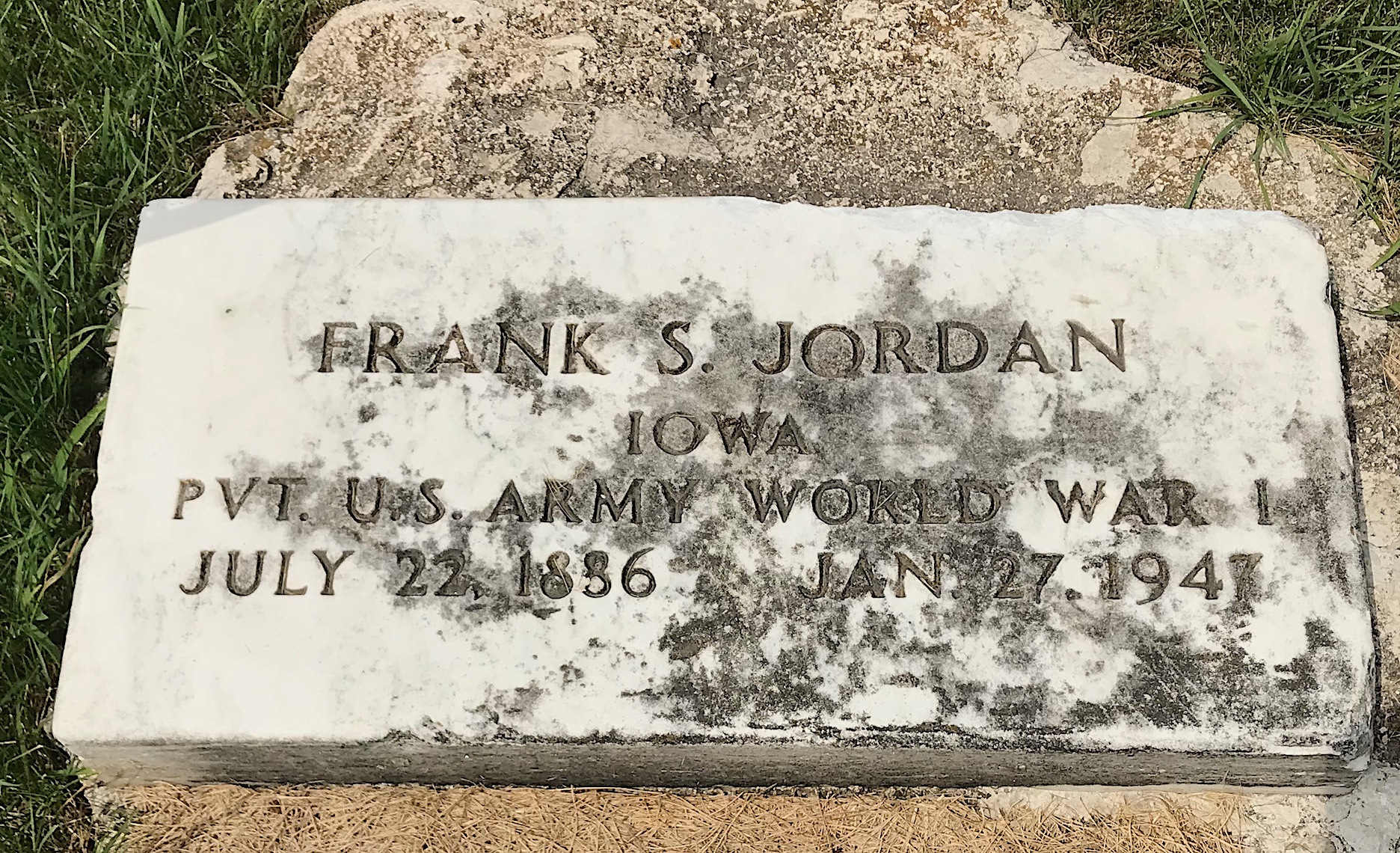
George and Emily’s youngest son, Frank, was born in 1886. He, too, was a stock buyer. He married twice and served in World War I as a private. In later years, he operated a drug store in Springville. He spent the last three years of his life at the Veterans Administration Hospital in Knoxville, Tenn. where he died on Jan. 27, 1947.

WW I veteran Frank Jordan died on Jan. 27, 1947.

Danish Blacksmith

Probably the most unique grave marker at Springville Cemetery is this one for Danish immigrant Christian “Chris” Nielsen. In 1887, he married Inger Marie Nielsen (not related). They emigrated to Iowa from Denmark around 1890. Together, they had three daughters. One of them, Tevvedora, died in infancy but the other two lived long lives.

It’s easy to see what Chris Nielsen’s profession was.

As you can see, Chris was employed as a blacksmith. The anvil and hammer make that apparent. I have no idea who made it for him, but it’s very cleverly done.

Chris died on Thursday, Oct. 15, 1936 after a long illness. He was 78. Marie died in 1945. She has her own marker and a shared one with Chris and Tevvedora.

Fort Dearborn Massacre Survivor

When I photographed Susan Millhouse Simmons’ grave, I knew nothing about her. Frankly, I was stunned when I began reading what happened to her before she ever arrived in Iowa.

Born in 1777 in Pennsylvania, Susan married John Simmons in Ohio in 1808. In 1810, John enlisted in the First United States Infantry and was assigned for duty to Fort Dearborn in Illinois. He was soon made a non-commissioned officer. The couple’s son, David, was born that same year. A daughter, also named Susan, was born Feb. 12, 1812 at Fort Dearborn.

Fort Dearborn was located on the south bank of the main stem of the Chicago River in what is now the Loop community area of downtown Chicago. At the time, the area was basically wilderness.

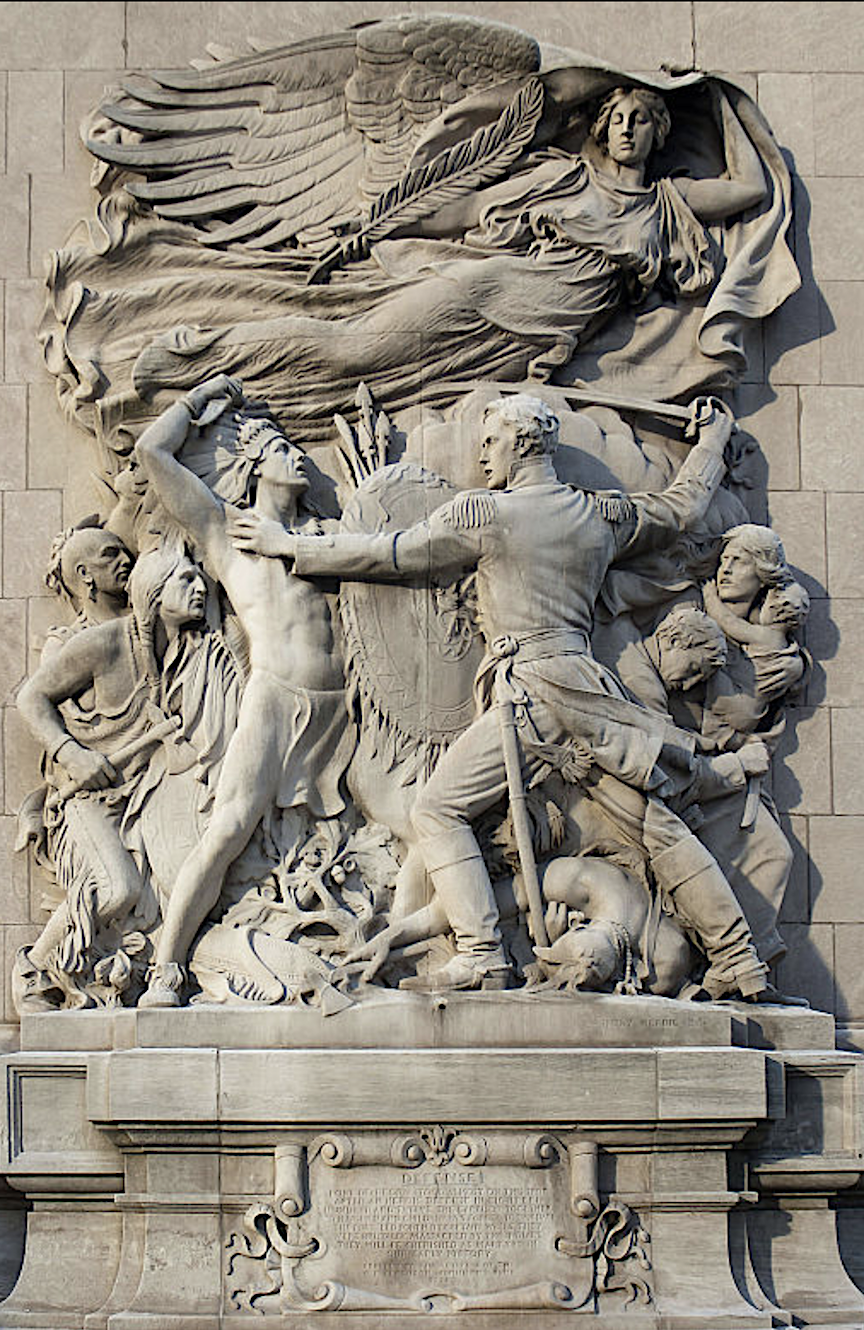
The Fort Dearborn Massacre is depicted in Defense by Henry Herring, 1928. The sculpture adorns the wall of the southwestern bridge tender’s house on Michigan Avenue Bridge in Chicago, Ill.

On Aug. 15, 1812, soldiers and settlers evacuating Fort Dearborn were massacred by Pottawatomie Indians in a surprise attack, killing 53 soldiers, women, and children. Among them were John Simmons and his little son, David. John died defending the wagon his wife and children were in. He was buried much later in a mass grave on the battle site.

Survivors were taken prisoner by the Pottawatomie and were held captive as long as two years before making their way to freedom. Susan and her daughter were taken to Green Bay, Wisc. On the march, she walked and carried her baby, the entire distance being over two hundred miles. She was a captive for eight months. One narrative I read stated that many times, she was told to hand over little Susan to them but she adamantly refused.

Drawing of Susan Millhouse Simmons in later years.

In fall 1812, the Pottawatomie, with their prisoners, left Green Bay, and marched to the ruins of Fort Dearborn, then around the end of Lake Michigan and up to Mackinas, to Fort Meigs. In April 1813, negotiations for the prisoners were opened. Susan and little Susan were set free and returned to Ohio.

Susan married widower John Redenbaugh in 1820. Daughter Susan married Moses Winans in 1828. They had nine children. John Redenbaugh died in 1847. When Moses and Susan Winans moved with their family to Springville, Iowa in 1853, her mother went with them.

Susan Millhouse Simmons Redenbaugh spent the last four years of her life in Springville.

Susan Millhouse Simmons Redenbaugh died in Springville on Feb. 27, 1857 at age 79.

Moses Winans died on Aug. 24, 1871 at age 63. Susan Winans moved to California with some of her adult children after 1885. She died in Santa Ana, Calif. at age 88 on April 27, 1900. She is buried in Santa Ana Cemetery along with her adult children Lewis, William, and Amy. Some of her other adult children (Hiram, John, Esther, David) who remained in Iowa are buried in Springville Cemetery with their father.

Our next stop was Anamosa, Iowa, where we visited the Anamosa State Penitentiary museum and the prisoner cemetery located nearby. You won’t want to miss that!

(Right) Bethel Smith (born and died in 1915) and (left) Theone Smith (born 1919, died 1921) were the children of Eva Hart Smith and Sharon Stanley Smith.

Restoring a White Bronze Wonder: A Visit to Iowa’s Springville Cemetery, Part I

19 Friday Jan 2024

Posted by adventuresincemeteryhopping in General

≈ Leave a comment

After leaving Cedar Rapids, we headed northeast 30 miles to Springville Cemetery. Springville Cemetery has an estimated 2,350 memorials on Find a Grave. Adjoining St. Isidore Cemetery seems to have between 50 to 100 graves.

Springville Cemetery is located about 30 miles northeast of Cedar Rapids.

Springville’s earliest graves date from the 1840s, before Iowa became the 29th state in 1846. But one of the reasons I put Springville on our itinerary was to see for myself one of the largest white bronze (zinc) monuments I’d ever come across online. It has quite a story of the family it represents and how it was brought back to its former glory after our visit.

The Brown Family

The Brown monument was erected in 1886 to honor Revolutionary War veteran Nathan Brown (1761-1842) and his family. It was commissioned by Brown’s son, Horace Nathan Brown (1822-1893). The base was made of granite but the majority of the monument is white bronze (zinc). In many articles I read, it was incorrectly reported that it was made of granite and marble.

This is how the Brown monument looked in July 2019. Note that the base is in need of repair.

One of the panels lists a lengthy history of Nathan Brown that I’ve included here:

Nathan Brown was born at White Plains, N.Y., July 22, 1761. At the age of 14, he began to drill in preparation to joining the American Army, and at 16 he entered the service in the Revolutionary War. His first battle was at Harlem Flats and his second one on the present site of Greenwood Cemetery. He was wounded but not seriously in some of the many battles in which he participated.

Seven brothers served in the same army and his captain was an uncle. After the war he removed to South Hallow and afterwards to Buffalo, N.Y., where he remained a short time and then removed to Pennsylvania. April 1, 1838, removed to Geneva, Kane County, Ill. Afterwards settled one mile southwest of Springville, Ia. May 17, 1839. Died Nov. 25, 1842.

After the Revolutionary War, Nathan married his first wife, Sarah Bailey, in in 1781. Their son, John, stayed behind when Nathan moved to Onondaga County, N.Y. After Sarah died, he married second wife Tamar Sammons in 1807. They had four daughters, Maria, Betsey, Amanda, and Harriet. The family moved to Erie County, Pa. It was there that their son, Horace, was born in 1822.

The Browns continued their journey west in 1838, settling in Kane County, Ill., where Nathan’s married daughters, Maria and Betsey remained, before the rest of the family moved to Linn County in Iowa Territory. Nathan died in 1842.

Nathan Brown was buried in Paralta Cemetery before Horace moved his father´s grave to Springville, probably when his mother Tamar died in 1868.

Horace Brown was 20 when his father Nathan died in1842.

Horace expanded the 1839 Brown farm to more than 600 acres. He wed Julia Chapman in 1853. He served the county as its third treasurer and held several offices in the township, including justice of the peace.

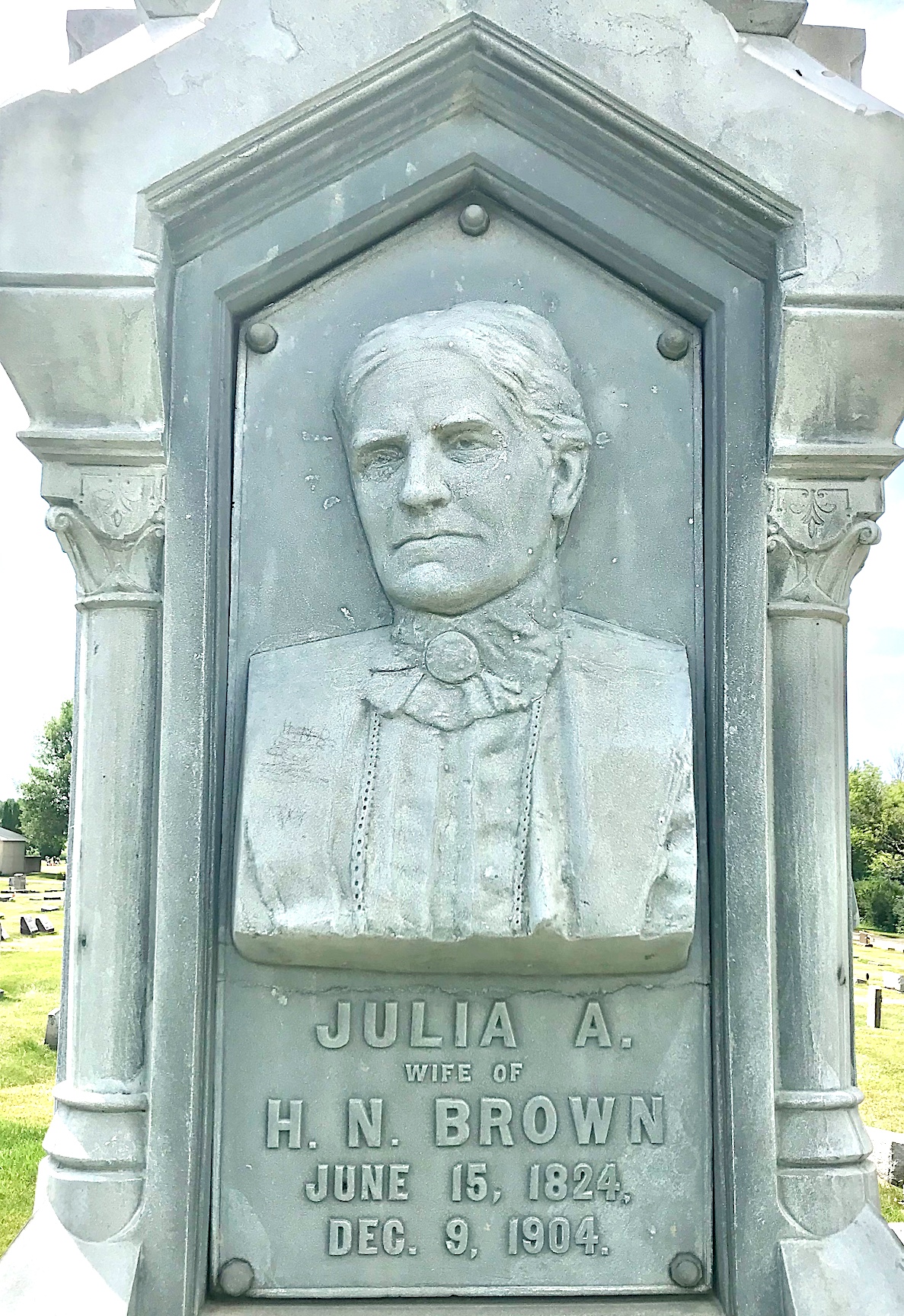
After Horace died from tuberculosis at age 71 in 1893, Julia continued running the Brown farm until her death in 1904. She was 80. The plot now holds Nathan, Tamar, Horace, and Julia Brown.

Julia Brown continued to run the family farm after Horace passed away.

History of a Monument

When I started researching the Brown monument, I got some surprises. All I really knew when I saw it in 2019 was that it was in desperate need of repair and that the local chapters of the Daughters of the American Revolution and Sons of the American Revolution were raising funds to do so. They had reached a little over half their goal of $40,000 then.

When Horace Brown contacted Cedar Rapids’ Krebs Bros. in 1886 to obtain the monument, the dealer was well known for its white bronze monuments. I’ve written about these before but Iowa has more than most. That’s because the Western White Bronze factory was located in Des Moines and produced many of them.

This ad in the Cedar Rapids Gazette from April 7, 1886 was part of a full spread paid for by Krebs Bros. touting the long-lasting qualities of white bronze monuments.

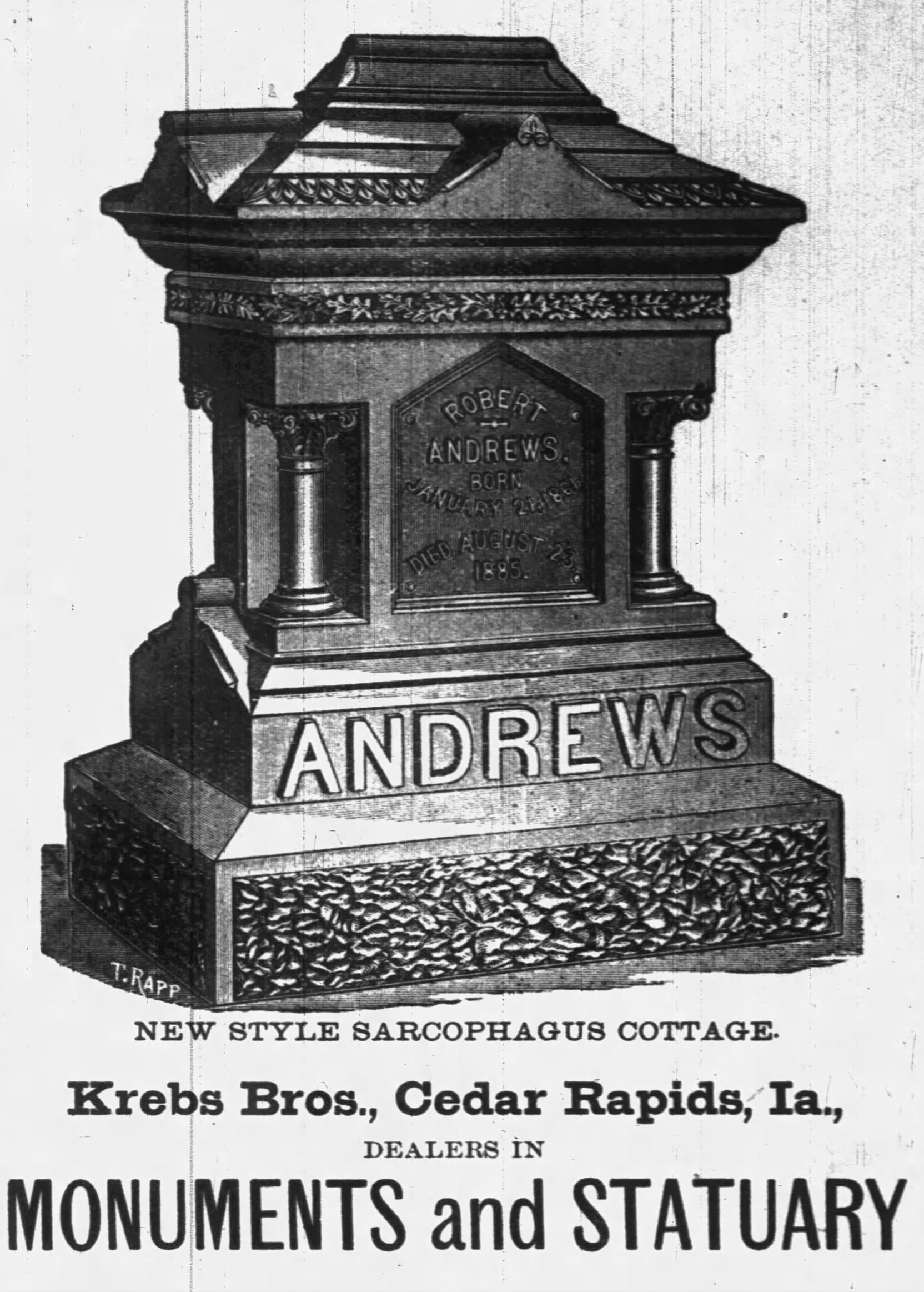
In looking for newspaper clippings for Krebs Bros., I was stunned to find one of their ads that included a drawing of the Bever monument at Oak Hill Cemetery in Cedar Rapids that I featured a few weeks ago. I learned that the 24 ft. tall Bever monument cost $5,000. In contrast, the 16 ft. tall Brown monument cost about $1,000 when it was erected.

Oak Hill Cemetery’s Bever monument was installed around the same time the Brown monument was at Springville Cemetery. (Photo source: Cedar Rapids Gazette, June 17, 1887)

The plates featuring bas relief busts of Horace and Julia Brown’s faces and birth/death dates were likely added after Julia died in 1904. I’ve only seen one other monument with a portrait on it and that was in New Orleans, La.

A storm in 1977 damaged the monument when a structure blew across the road into the cemetery and broke the spire into several pieces. Three local men worked to repair it and realized it wasn’t made of stone but metal. They poured a concrete base and bolted the metal together.

Individual white bronze marker for Horace Brown.

The monument was restored beginning in August 2020 after a several-year fundraising campaign by area Daughters of the American Revolution groups (the Mayflower Chapter, the Ashley Chapter, and the Marion Linn Chapter) and local donations. Memorials by Michel in Solon, Iowa completed the restoration work, which included replacing the fractured base.

The Brown monument was rededicated at a ceremony May 22, 2021. While it is shorter now because of the new base, I think it looks wonderful. This photo is a screenshot from a video I found on YouTube.

Repaired Brown monument at Springville Cemetery.

The Pherrin Family

Since we’re already on the white bronze track, let’s keep going. Springville Cemetery has several great examples. But one of them puzzled me at first.

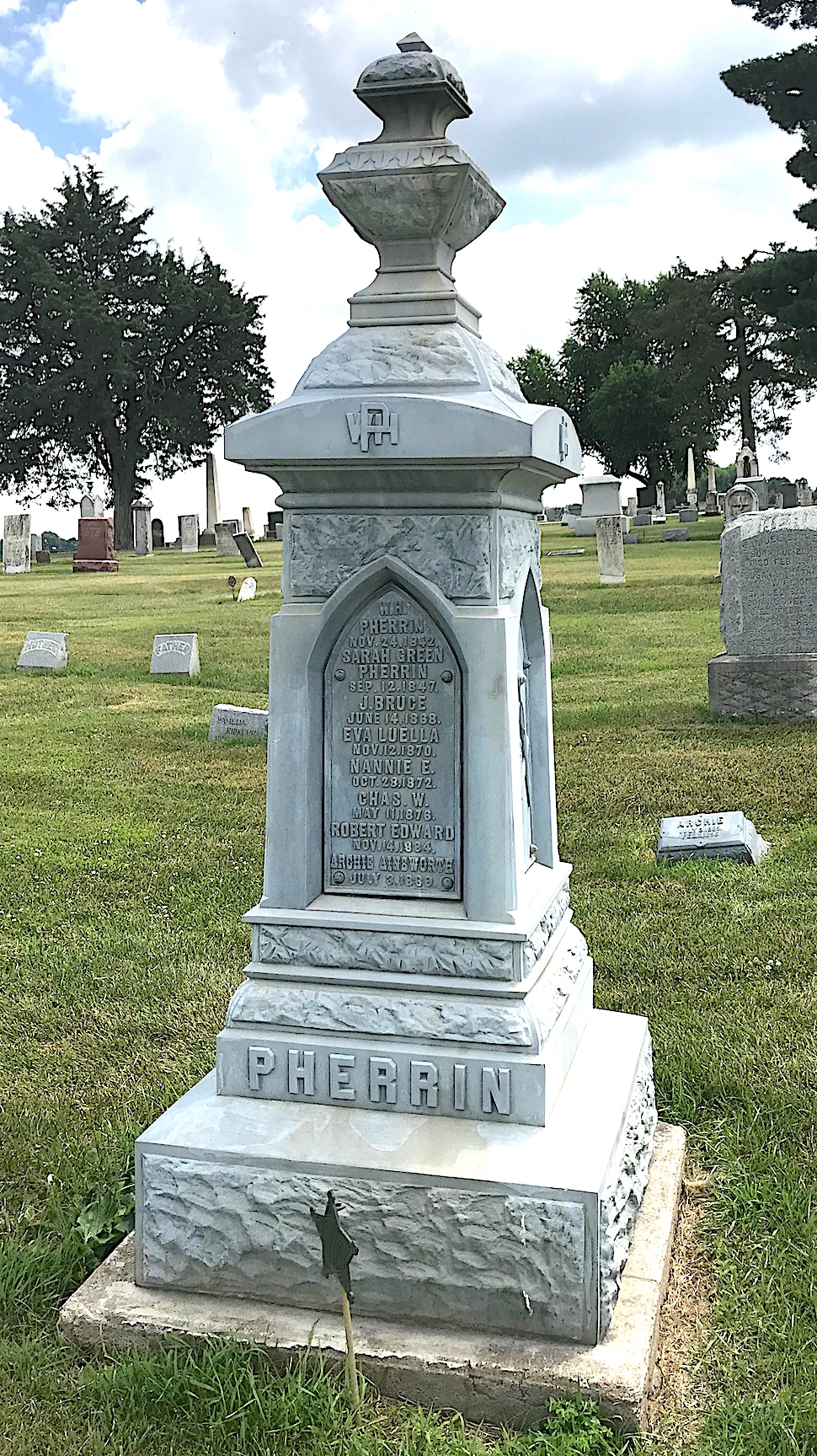
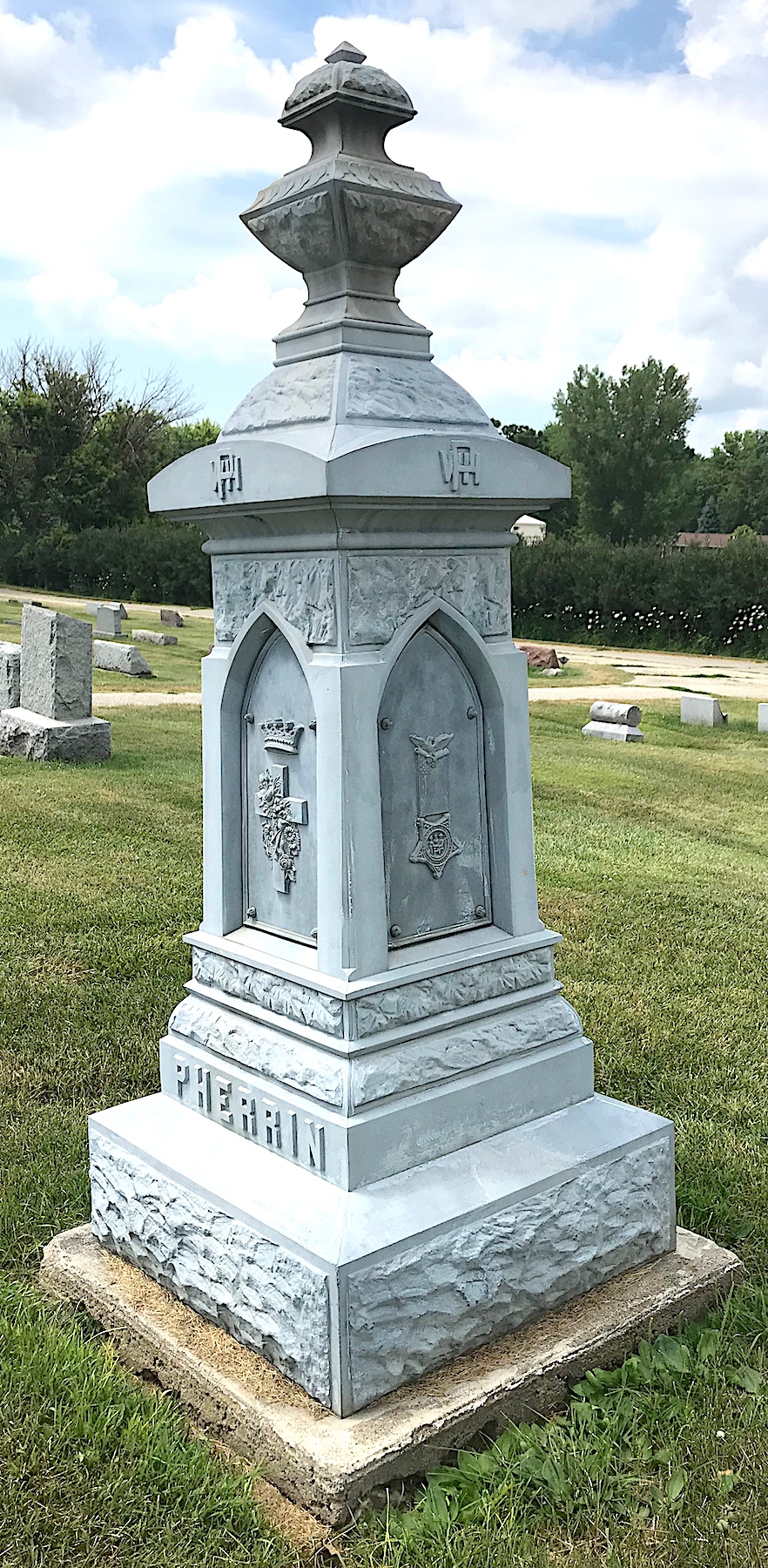
The Pherrin white bronze monument has eight names with only birth dates, no death dates.

The Pherrin monument has eight names on it. That’s a long list but not strange. What’s different is that all the dates are birth dates with no death dates.

The Pherrin family was headed by William Harrison Pherrin (born in Erie, Pa. in 1842) and his wife, Sarah Green Pherrin (born in 1847). William’s family moved from Pennsylvania to Iowa sometime in the 1850s. He served in the 24th Iowa Infantry, Co. H., during the Civil War. He wed Sarah in 1867 and they started a family with the birth of John Bruce Perrin in 1868.

More children would follow with the births of Luella (1870), Nancy “Nannie” (1872), Charles (1876), Edward (1884) and Archie (1896). All of them, except for Archie, would live well into adulthood.

William and Sarah Pherrin had six children together.

You might be asking yourself why it was done this way. I have some theories.

The first Pherrin family member to die, sadly, was little Archie. Born on July 3, 1889, he died on Feb. 11 1896 at the age of 6. Death records indicate he died from “inflammation of the bowels”. He is also the only Pherrin family member to have an individual white bronze marker.

Archie Pherrin was only six when he died from “inflammation of the bowels” in 1896.

The Western White Bronze Co. in Des Moines was in full operation from 1886 to 1908. The government took over the plant in 1914 for manufacturing munitions during World War I. After the war, demand for the monuments faded. However, they continued to make individual panels for family members who died after the monuments were ordered. The company turned to making castings for automobiles and radios until it closed in 1939.

I think when Archie died in 1896, someone in the family consulted with a monument company (probably Krebs. Bros.) who advised them on creating a monument not just for Archie but for the entire family. They would only put the birth dates to save space, adding individual markers later as family members died. What they didn’t know at the time was that Western White Bronze would end up closing.

Notice the interlocking “WHP” initials for William Harrison Pherrin and a panel featuring a war medallion honoring his Civil War service.

You’ll notice that one of the panels features a war medallion on a ribbon, a symbol of William’s Civil War service. Also, you can see the interlocking initials “WHP”.

Eldest Pherrin son, Dr. John B. Pherrin (he was a dentist), died in 1937. He has his own individual stone marker.

There wasn’t another death in the Pherrin family until Nancy “Nannie” Pherrin Smith died in 1917 at age 45. William H. Pherrin died in 1924 at age 81 and Sarah Pherrin died in 1938. John died in 1937, he has an individual stone marker. Eva Luella died in 1943, Charles died in 1946, and Robert died in 1975.

Now a good question to ask is are all of the Perrin children actually buried at Springville? The answer is no.

I can safely say that John, Luella, and Archie are really there. Robert is definitely not because I found his Find a Grave memorial at Woodlawn Memorial Park in Gotha, Fla. He moved to Florida 49 years before his death. I suspect Charles is buried in the Seattle, Wash. area because he died there in 1946. I could not find an obituary for him. Nor could I find an obituary for Nannie, who had married Charles Wesley Smith and moved to North Dakota. Like Robert and Charles, it’s possible she is buried there as well.

The Chapman Siblings

I always think it’s special when I find a brother/sister pair of markers. That’s the case for Daniel T. Chapman and Ellen Chapman. You might remember that last name. Horace Brown’s wife was their sister, Julia Chapman Brown.

Daniel and Ellen Chapman died 57 years apart.

Daniel, born in 1818, was the son of Lemuel Chapman and Betsy Smouse. He died on Jan. 9, 1846 at age 27. I don’t know what his cause of death was. Ellen was the daughter of Lemuel and his second wife, Ruth Hardinger. She was born in 1837. So she was only nine when Daniel died. She never married. She lived with her mother, Ruth, in Indiana.

The back of the Chapman markers feature a wreath and an anchor (which often signifies faith).

I learned that when Ruth died in 1872, Ellen moved to Springville and moved in with her half-sister Julia and her husband, Horace. She remained there until her death at age 64 on April 13, 1903.

It’s my guess that Julia, having already perhaps been involved in the ordering of the Brown monument years before, ordered these two markers to honor her siblings. It’s the exact same style as the individual ones that she and Horace have.

“Earth Has No Sorrows That Heaven Cannot Heal”

Finally, I want to include this marker for Myrtle May Dennis McAtee. Born in 1882 to James Dennis and Axie Hahn Dennis, May was one of several children. She married Dwight Asa McAtee on Feb. 9, 1902 in Springville. They had a daughter named Ruby on April 4, 1903.

Myrtle May Dennis McAtee died at age 21 of tuberculosis.

But their happiness was short lived. May died on Feb. 37, 1904 at age 21 of consumption, today known as tuberculosis. Ruby was not even a year old at the time.

“Earth Has No Sorrows That Heaven Cannot Heal”.

Dwight remarried to Edythe Gertrude Carr in 1926. Ruby grew up and became a teacher, marrying Fordis Clifton in 1935. She died in 1962 of ovarian cancer. Dwight died in 1951 at age 73. The marker he shares with Edythe, who died in 1950, is beside May’s white bronze marker.

I’ll be back with more stories from Springville Cemetery next time.

White bronze marker for Dora Gibson, who died on July 3, 1885 at age four.

A Doctor and Two Lion Hearts: Lingering at Cedar Rapids, Iowa’s Oak Hill Cemetery, Part IV

12 Friday Jan 2024

Posted by adventuresincemeteryhopping in General

≈ Leave a comment

Happy New Year! Let’s start 2024 right by getting a last look around Cedar Rapids, Iowa’s Oak Hill Cemetery. There are a few stories left to tell at this venerable burial ground.

Cedar Rapids’ First Doctor

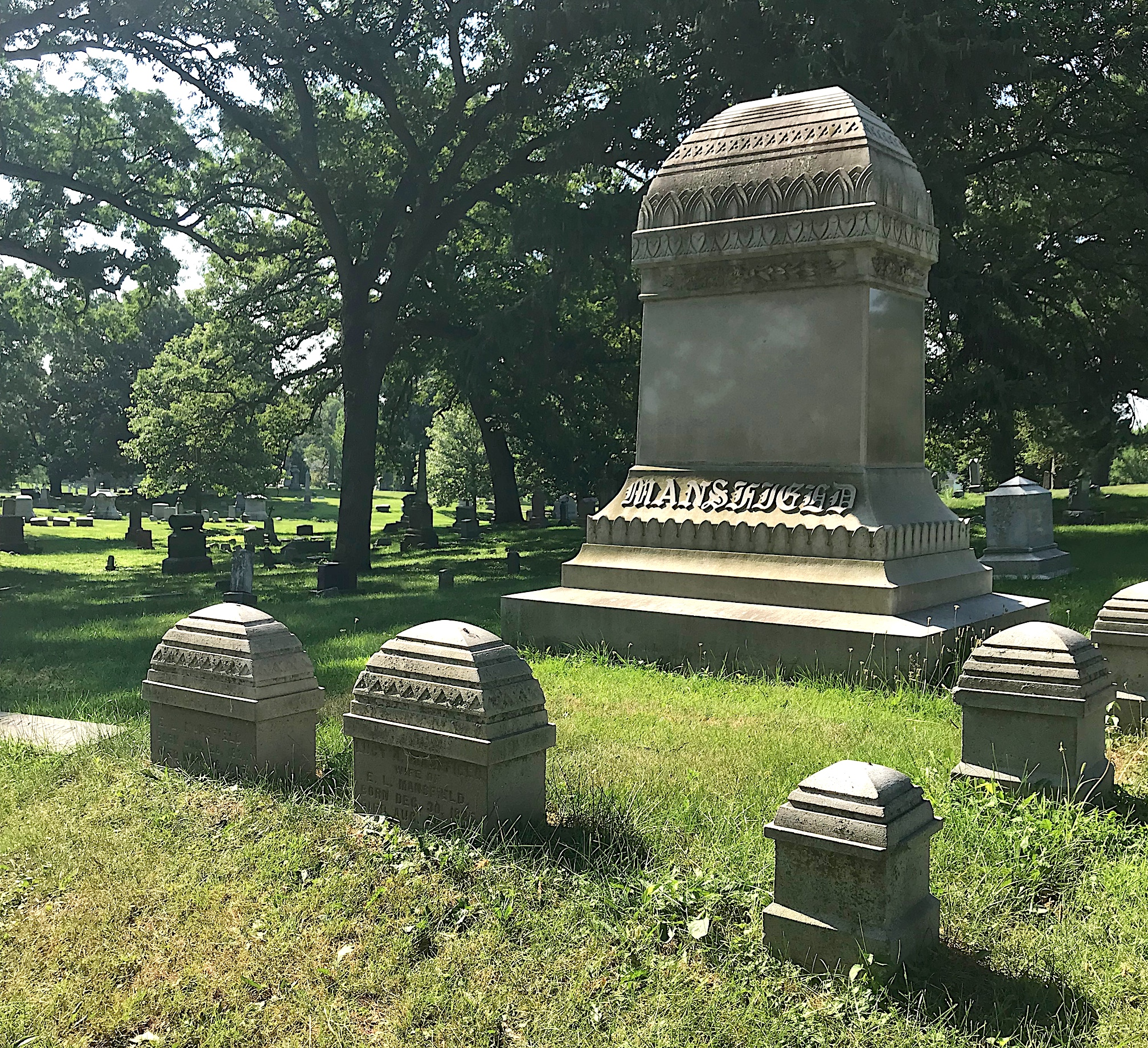
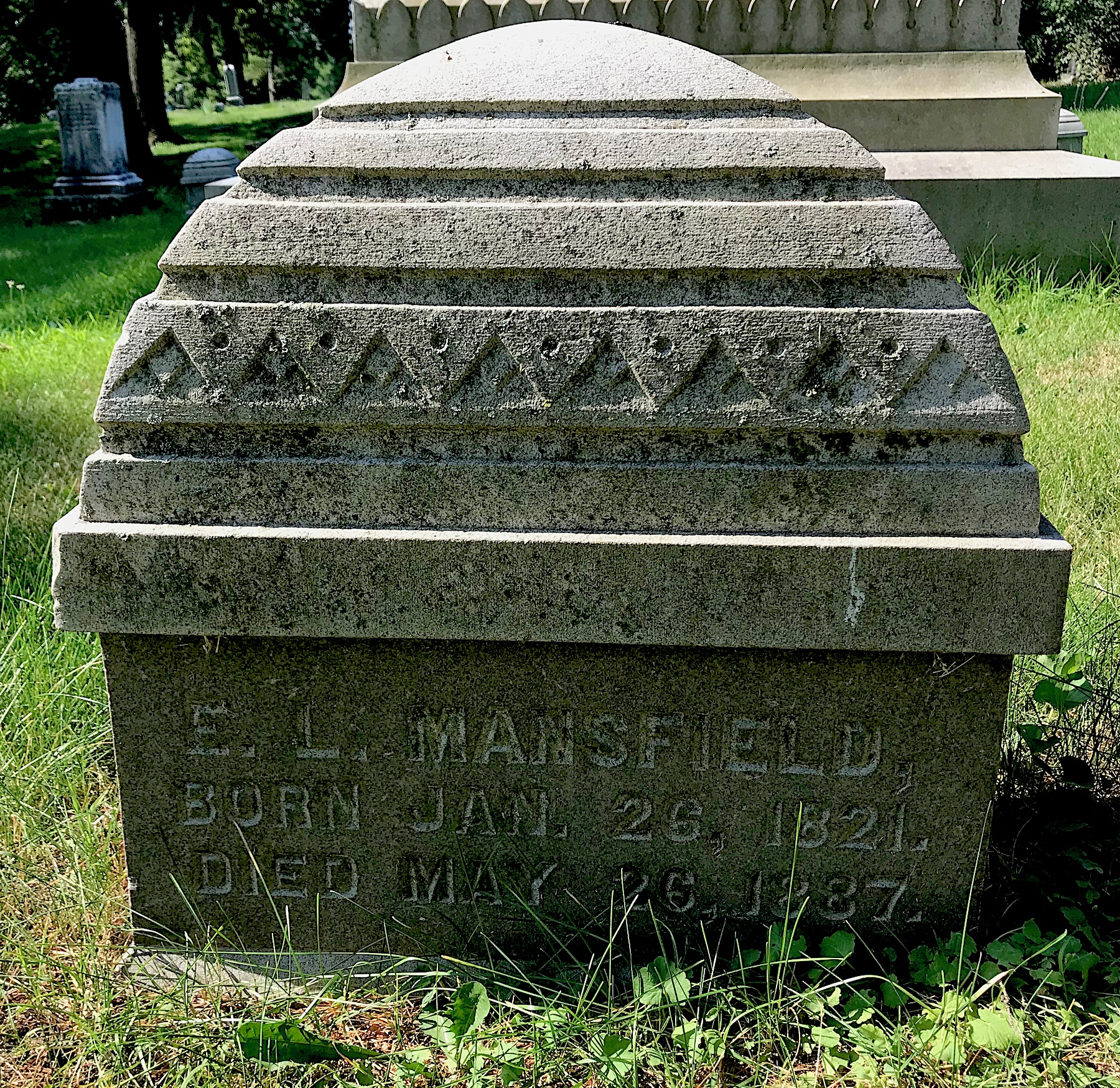
One family plot that got my attention was this one for the Mansfields. The surname monument and individual markers were of an unusual design I hadn’t seen before. I was curious to know more about them.

The individual Mansfield markers are of a style that intrigues me.

The head of the family was Dr. Eber Lewis Mansifled, originally of Athens, Ohio. Born in 1821, Eber’s education was of a hit or miss nature. I’ve found this to be the case for many doctors back in the day who came from hardscrabble backgrounds. He got his medical education when and where he could find it, learning from other physicians, and finishing up at Western Reserve Medical College in Cleveland, Ohio.

Dr. Mansfield arrived in Cedar Rapids around 1847, becoming the town’s first physician. He left temporarily in 1850 to travel to California during the Gold Rush, combining medicine and mining. But he returned in 1851 to settle permanently in Cedar Rapids.

Photo of Dr. Eber L. Mansifled from Pioneer Days In Cedar Rapids, by Charles A. Laurance, Laurance Press Co., Cedar Rapids, Iowa, 1936.

At 26, Dr. Mansfield wed Indiana native Lucy Ann Warriner in 1852. They had several children over the next years. Daughters Lizzie (born in 1854) and Irene (born in 1859) would die in infancy. But Sylvia (born in 1853), Lura (born in 1857) and Lewis (born in 1861) lived long lives.

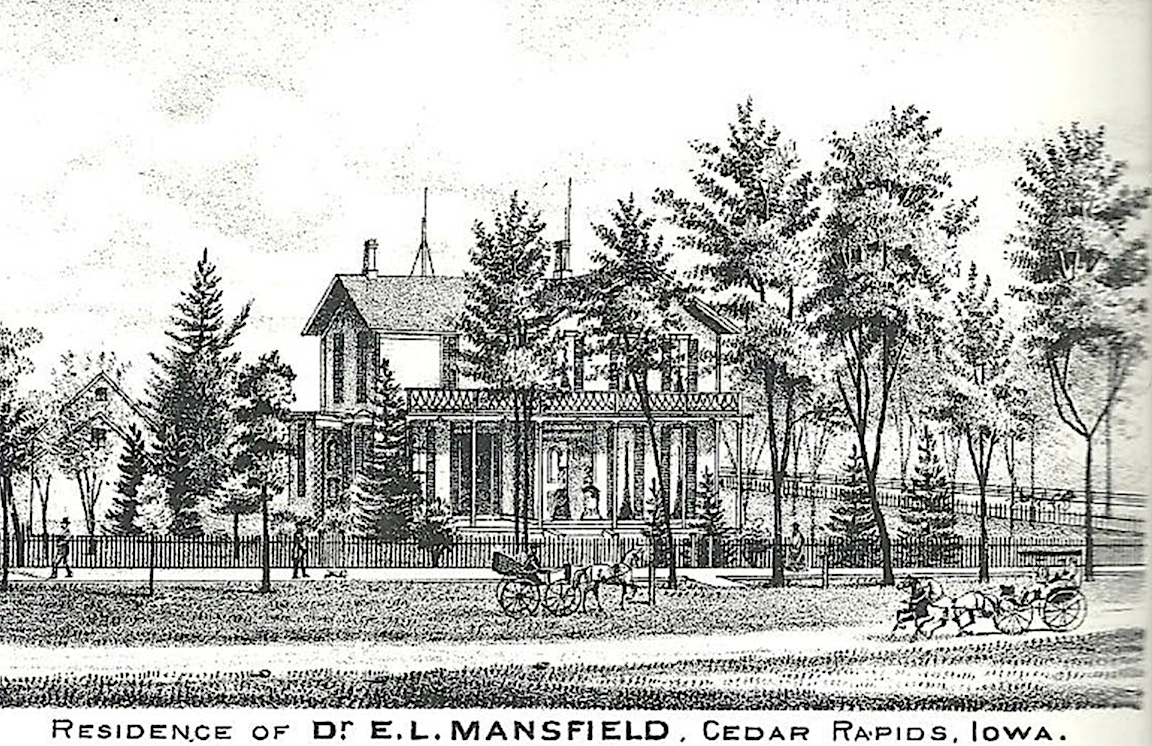
The family prospered and Dr. Mansfield’s practice flourished. They owned this fine home (see illustration below).

An illustration of the Mansfield home from A. T. Andreas’ “Illustrated Historical Atlas of the State of Iowa 1875”.

Lucy died on Aug. 26, 1868 at age 42 after a long illness, according to her death notice. She was buried at OHC with her infant daughters.

Dr. Mansfield remarried to Mary Elizabeth Warriner in 1870. She was Lucy’s second cousin.

Lucy Warriner Mansfield died in 1868 after a long illness. She was buried with her two daughters that died in infancy.

Died in His Buggy

When Dr. Mansfield died on May 26, 1877, his manner of death was reported on because of how it transpired. He was on his way to visit his farm out of town, according to the Cedar Rapids Gazette article:

He left the city this morning to go to his farm, which is 19 miles from this city and three miles from Urbana, a short distance from the Benton county line. It had been his custom to visit his farm once every week or two. When at Hunter’s corner his horse stopped in the road and remained there several minutes, the doctor sitting upright with the lines in his hands without moving.

Mr. Hunter and his daughter were sitting on their porch and saw the doctor’s horse stop. As he made no movement, one of them went down to the buggy to see what might be wrong, if anything, and found him dead. There was no sign of life whatever except that as when they first approached him they noticed a slight groan. He was holding the lines in his hands and appeared as if he were alive and sitting upright. His face had not changed color and his head was slightly inclined forward.

Dr. Eber Mansfield died while going to his farm from a fit of apoplexy. He was 66.

The same article reported that, “He had recently had an attack of neuralgia of the stomach, but had fully recovered from that. He had frequently told a physician here that he expected to died from apoplexy.” Today, apoplexy would mostly likely be considered some kind of stroke.

Dr. Mansfield is buried with his first wife and three of his children.

Dr. Mansfield was buried at OHC with Lucy and his infant daughters.

Wife Mary died of pleurisy at age 58 on Feb. 3, 1889. While her Find a Grave memorial says she is buried at OHC, the cemetery online records do not have record of her being buried there. According to Iowa death records, she was placed in the Oak Hill vault. The articles I found about her death reported her funeral but none mention where exactly she was buried. There is no marker for her in the plot as far as I could tell. So I cannot say for sure exactly where Mary ended up!

The only other Mansfield child in the plot, besides Irene and Lizzie, was son Lewis and his wife, Margaret. Lewis died in 1933 at age 71. Daughter Sylvia, who married Charles Deacon, is buried with him in another area of OHC. Daughter Lura, who married twice, is buried with her second husband in Elmwood Cemetery in Kansas City, Mo.

Mayor of Cedar Rapids

The reason I photographed the Carmody plot is also because I thought it looked different. John T. Carmody’s signature is on the surname monument, which is held up by what appear to be lion’s feet.

That might tell you a bit about the character of John T. Carmody.

John and Mary Carmody had no children. Ellen Buckingham was Mary’s mother.

Born in 1859, Irishman John T. Carmody left Lima, Ohio and arrived in Cedar Rapids around 1885. He started working for Whiting Bros. foundry as a foreman and became the sole owner of the factory in 1889, renaming it J.T. Carmody Foundry & Machine Co. In 30 years, the company would become Iowa Steel & Iron Works.

John wed local Irish girl Mary Buckingham in 1887. They had no children.

The main building of Carmody’s company caught fire on April 22, 1902, totally destroying it. Despite the setback, Carmody was determined to start over and his new building, with all new equipment, was completed in 1904.

Carmody’s success led to his election as Cedar Rapids mayor on March 30, 1908. Unfortunately, his tenure as mayor would not last long.

The death of Cedar Rapids’ mayor John Carmody shook the town.

Death of a Lion Heart

On May 23, Mary Carmody was awakened by the sound of a burglar in the bedroom. She called out to her husband, and the intruder struck her in the neck. She called out again and Carmody awoke. He sprang up and wrestled the intruder into the hallway. When the intruder managed to get free on the stairs, he turned, firing two shots, one of which hit Carmody.

Police ran to the Carmody home, where they found Carmody shot in the stomach. Carmody was taken to St. Luke’s Hospital. Although his doctor expected him to recover, Carmody never left the hospital. He contracted typhoid fever and died Aug. 7, 1909. He was 49.

On Dec. 24, Arthur Johnson, alias J.A. Harris, a career criminal from Chillicothe, Mo., was given a life sentence for the murder of John Carmody.

Mayor John T. Carmody fought like a lion to protect his wife from a burglar.

Carmody’s death weighed greatly on his wife, Mary. She continued to live with her mother, Ellen. She died four years later on Aug. 13, 1913. She was only 37. Ellen Buckingham died on Jan. 22, 1920. John, Mary, and Ellen are buried together at OHC.

Medal of Honor Recipient

I’d like to end my visit to Oak Hill Cemetery with the story of another lion-hearted fellow buried there.

Charles Amory Clark, right, with his brothers James William Clark, left, and Whiting Stevens Clark, center, sat for their portrait in Mathew Brady’s Washington, D.C., studio on April 27, 1863.

Born in Sangerville, Maine on Jan. 26, 1841, Charles Amory Clark enlisted with the 6th Maine Infantry in July 1861, and was commissioned as a lieutenant in February 1862. He later served as captain and assistant adjutant general of volunteers from May to October 1864.

Three of Charles’ brothers (see photo above) also served in the Civil War. While Whiting Steven Clark and Frank A. Clark (not pictured) would survive, their brother James William Clark died on July 31, 1864 from wounds he suffered at Petersburg, Va.

Lt. Col. Clark received the Medal of Honor for his actions at Brooks Ford, Va. on May 4, 1863 during the Battle of Salem Church in the Chancellorsville Campaign. He was honored with the award on May 13, 1896:

Having voluntarily taken command of his regiment in the absence of its commander, at great personal risk and with remarkable presence of mind and fertility of resource led the command down an exceedingly precipitous embankment to the Rappahannock River and by his gallantry, coolness, and good judgment in the face of the enemy saved the command from capture or destruction.

Lt. Col. Charles Clark practiced law in Cedar Rapids after the Civil War. (Photo Source: History of Iowa From the Earliest Times to the Beginning of the Twentieth Century, Volume IV, 1903)

Lt. Col. Charles Clark was awarded in the Medal of Honor in 1896.

After the war, Clark worked as a lawyer in Cedar Rapids. He was active in the Grand Army of the Republic (GAR), and was elected its national judge advocate general in 1905 and the department commander of Iowa in 1906. He was also a companion of the Iowa Commandery of the Military Order of the Loyal Legion of the United States. He was named a regent of the University of Iowa in 1907.

If you’re interested in Clark’s friendship with fellow soldier Solomon Russell, read this.

Clark died at age 72 on Dec. 22, 1913. He is buried with his wife, Helen Brockway Clark, who died in 1929.

It wasn’t easy to leave Oak Hill Cemetery. But now it was time to head east for Springville Cemetery.

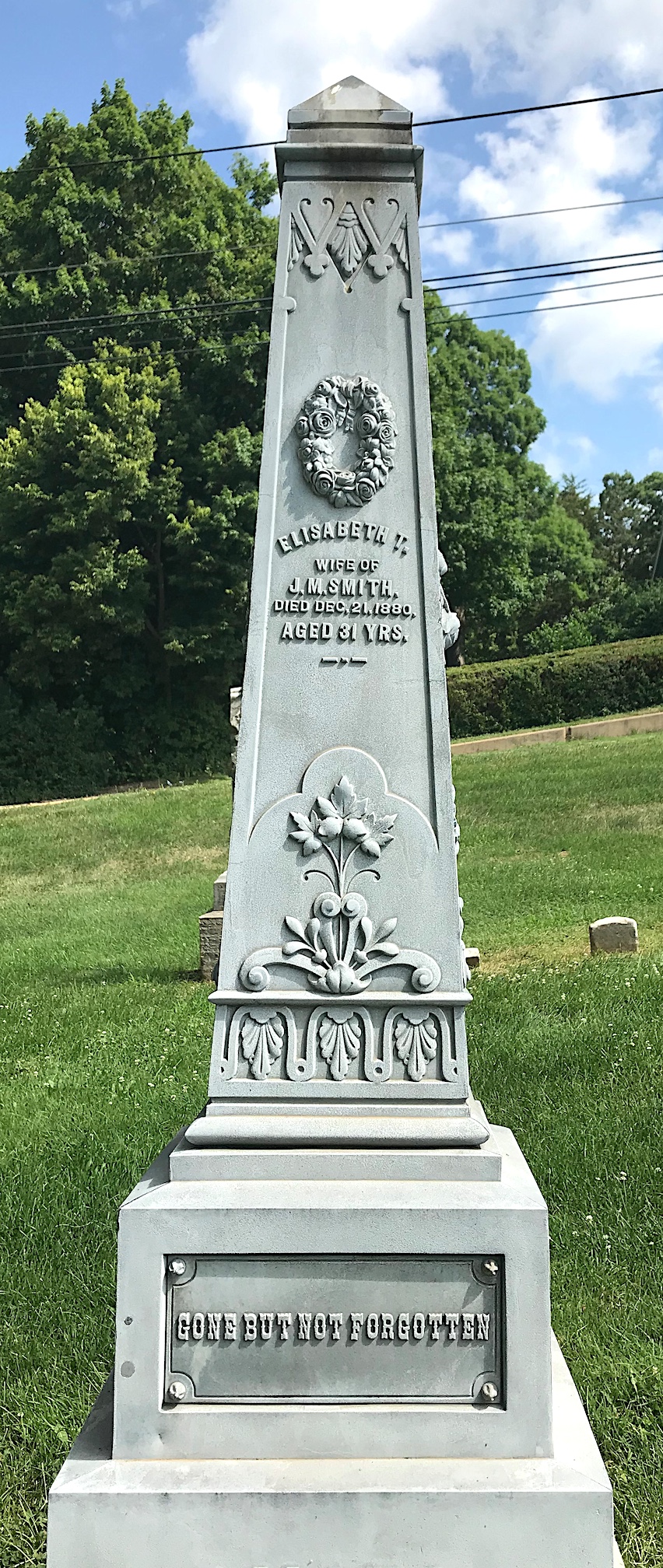
White bronze (zinc) marker for Elisabeth Smith, wife of J.M. Smith. She died on Dec. 21, 1880 of typhoid pneumonia. She was 31.

White Bronze Beauty: Lingering at Cedar Rapids’ Oak Hill Cemetery, Part III

22 Friday Dec 2023

Posted by adventuresincemeteryhopping in General

≈ 1 Comment

This week, I’m going to spend some time sharing the lovely white bronze (zinc) monuments at Oak Hill Cemetery.

One of the reasons I always looked forward to our trips to Iowa was that I knew we’d encounter at least a few white bronze monuments/markers. Since the Western White Bronze Company had a factory in Des Moines, there are tons of their markers scattered throughout the state. I don’t see them that often here in the South.

At OHC, white bronze monuments come in all shapes and sizes. But the largest one I could find was for the Bever family. There is one large monument for to represent all the Bevers, with individual markers for family members made of stone and white bronze. Find a Grave shows there are 23 Bever memorials listed at OHC.

The Bever family plot at OHC.

The Bever Family

If you’re driving around Cedar Rapids, you can still find the name “Bever” on a handful of streets. There’s a Bever Woods historic district and a Bever Park. At one time in the early 1900s, there was even a Bever Park Zoo.

Born in 1808 in Ohio, Sampson Cicero Bever was already a wealthy man when he and his wife, Mary, moved with their family to Cedar Rapids in 1852. He opened the city’s first bank and was involved in bringing the first railroad to Cedar Rapids.

Sampson Bever came to Cedar Rapids with his family from Ohio in 1852.

At some point, Sampson had the remains of his parents John Bever and Euphemia “Effie” Imbrie Bever Flack moved from Ohio to Cedar Rapids. John Bever died young at 32 in 1811. Effie remarried to Frances Flack in 1815 and died in 1869.

James Bever and Euphemia “Effie” Imbrie Bever Flack’s remains were moved to OHC at some point. I’m guessing their white bronze markers were purchased later.

Sampson and Mary had a large family over the years. At least, Mary and Mirtilla, died in their teens in 1860. Their mother, Mary, died in 1885 at age 72. Five of her adult children were still living at the time.

Mary Bever died in 1885 at age 72.

When Sampson died in 1892 at age 84, the local newspaper published a lengthy obituary about him that included this tribute:

Mr. Bever was a man of exceptional if not extraordinary business sagacity and acumen. His judgment seemed to be unerring and every business enterprise that enlisted his personal co-operation, attention and encouragement succeeded. In this long career of continuous commercial and financial success he acquired vast wealth and was rated as a millionaire. He was intimately known by all the old settlers of central and eastern Iowa, many of whom have had business transactions with him for the past forty years. Financially he was one of the most important and potential factors in the city.

Bever Park was established in 1893 on wooded land owned by the Bever family to honor Sampson Bever.

“Whisky Killed Him”

Henry Bever was one of Sampson and Mary’s sons. I did not photograph all of the Bever markers but I did get a photo of his. It is made of stone, not white bronze.

Born in 1846, Henry lived at home with his parents until he served in the 46th Iowa Volunteer Infantry, Co. E, during the Civil War. He came home and worked as a dry good merchant for a time, then as a coal dealer, and later in his father’s bank.

Henry died at the age of 36 on Christmas Day 1882, which must have been quite a blow to the family. I found a few brief death notices but this one from the Dec. 29, 1882 Muscatine (Iowa) Weekly Journal got my attention.

Henry Bever’s death notice in the Dec. 29, 1882 Muscatine Weekly Journal.

This kind of thing always gets to me because frankly, it wasn’t necessary. No other funeral notice about Henry Bever said anything about whiskey. Even he did have a problem with alcohol, printing it in the newspaper did nothing but bring his family pain. Part of me wonders if someone at the Muscatine Weekly Journal had a beef with the Bever family to include it.

Henry Bever was fairly young when he died in 1882.

When a Husband Dies

I was only partially successful at solving the mystery behind the Downing white bronze marker. But it’s rather typical of the kind of thing that may happen when a women loses her husband at a fairly young age.

Robert Downing’s whereabouts are unknown.

Born in Ireland around 1831, Margaret Cooper married Robert Downing in 1854. I don’t know if they wed in America or in Ireland. They had at least four children together.

By 1870, Robert was out of the picture. There is no record of his burial at OHC. Margaret and the children (Anna, Caroline, Addah, and Emma) were living in Grinnell, Iowa. That’s about 80 miles west of Cedar Rapids.

On June 18, 1873, Anna died at age 18. I don’t know her cause of death. On June 1, 1878, Addah died at age 16. Again, I don’t know the cause of death. They were both buried at OHC.

Anna Downing was only 18 when she died in 1873.

According to the 1885 Iowa Census, Margaret and youngest daughter Emma were still living in Grinnell. Daughter Carrie had married a Mr. Smyth and moved to Tacoma, Wash. Margaret and Emma would move there sometime before 1892. Emma would marry a Mr. Merritt. Eventually, Margaret moved in with Carrie and her family.

Margaret died on March 30, 1909 in Tacoma. Her body was taken back to Cedar Rapids for burial with Anna and Addah at OHC. I am wondering if the monument for all three of them was made when she died because white bronze markers were not being made in Des Moines until 1886. The factory closed around 1908 so it was likely one of the last ones made.

Margaret Cooper was 78 when she died in 1909.

Died from a Cut on His Knee

I couldn’t find out a great deal about the Stein family but what I did discover made me sad.

German immigrant John Stein married Irish native Sarah Jane Johnson at some point before settling in Pennsylvania. The couple would have eight children together, eventually moving to Cedar Rapids.

William Stein was only 23 when he died.
William Stein was one of eight children.

Born in 1861, William Robert Stein was their fourth child. He died on March 15, 1885 at age 23. I was curious to know how he died so young and found the following obituary (below). A cut evidently turned septic and it caused his death. Something that could have been easily treated today with antibiotics, mostly likely.

He was buried at OHC with a large white bronze monument.

William R. Stein likely died of sepsis of some kind caused by an untreated cut on his knee. (Photo source: The Gazette (Cedar Rapids, Iowa), March 16, 1885)

Sarah Jane, his mother, died on Dec. 5, 1905 at age 78. Her death certificate notes that she died from “a broken leg and shock”. Her obituary had no further details. William’s father, John, died four years later on May 27, 1909 at age 82. Sarah Jane and John are buried in the plot with William but don’t have markers.

Mystery of the Mills

The white bronze marker for Marie Mills Dickerson, Bessie Mills, and Jimmie Mills left me with more questions than answers.

Siblings Jimmie and Bessie Mills died within 12 days of each other in 1890 of “diphtheritic croup”.

James “Jimmie” Mills, born sometime in March 1887, and Bessie Mills, born in 1888, were the children of Robert D. Mills and Cornelia “Cora” Dickinson (or Dickerson). Finding information on them was tricky because Cora’s last name was spelled different ways. But I did learn the two were married in Cedar Rapids in 1883.

Name plates for Jimmie and Bessie Mills.

Jimmie died on Jan. 4, 1890 and Bessie died on Jan. 12. 1890, both from “diphtheritic croup” or rather, diphtheria.

On the other side of the marker is a plate for Marie Mills Dickerson, wife of G.A. Dickerson. Born in 1842, Marie died of “anasarca dropsy” which is another term for edema. According to burial records, she had suffered from it for 8 years. Interesting to note is that her marker says she died on April 5, 1890 but death records indicate it was actually April 5, 1889. She was 47.

Was Marie Mills Dickerson an aunt to Jimmie and Bessie Mills?

I could only find one mention of a G.A. Dickerson in the newspapers and it was that he had a watch repair business in Cedar Rapids. That was it. I have no record of his burial at OHC or elsewhere. My guess is that he was Cora’s brother, and the uncle of little Jimmie and Bessie.

Fatal Accident

Then you find one of those stories that just break your heart.

Born around 1845 in Maryland, John J. Mathias enlisted in the Union Army. He was assigned to the Third Maryland Volunteer Infantry, Company E, which was known as the Potomac Home Brigade. He married Nannie “Nancy” Stone (also of Maryland) in Ogle, Illinois in 1869. By 1860, they were living in Lisbon, Iowa with their infant son, John. That’s about 19 miles from Cedar Rapids.

John J. Mathias was a hard-working husband and father when he died in 1887 in a tragic accident.

By the 1880s, the Mathias family had moved to Cedar Rapids and John had gotten a job working in the fertilizer department of a packing house. On Feb. 17, 1887, John was killed in an accident that is detailed in the article below.

Such accidents were not unusual in an era when industrial safety measures were not in place. (Photo source: Cedar Rapids Times, Feb. 24, 1887)

Nancy was left with their son, John, to fend for herself. A note published in the local newspaper a few days later expressed her thanks. This was a common practice back then. It sounds like John’s employer may have assisted her and John financially. They may have even provided his white bronze marker.

Did John’s employer help Nancy after he died? (Cedar Rapids Evening Gazette, Feb. 23, 1887)

Sadly, Nancy died almost a year to the day of her husband’s death. There was no newspaper notice I could find but death records note she died on Feb. 17, 1888 of “disease of the liver and bowels”. Perhaps she also died of a broken heart.

Nannie E. “Nancy” Stone Mathias died almost a year after her husband, John, in 1887.

I could not find any trace of John W. Mathias, John and Nancy’s son, after she died. He would have been around 18 at the time, so hopefully he managed alright on his own. There is no record of him being buried at OHC.

I’ll wrap things up next week in Part IV.

Grave of Caroline Metcalf, who died on Aug. 22, 1881 at the age of eight months.

Trail of a Killer/American Gothic: Lingering at Cedar Rapids’ Oak Hill Cemetery, Part II

15 Friday Dec 2023

Posted by adventuresincemeteryhopping in General

≈ 2 Comments

Last week, I introduced you to Oak Hill Cemetery (OHC) in Cedar Rapids, Iowa. It’s a lovely place to wander around in and there was plenty to divert me.

What I found was the story of a fellow who tried to fake his own death and start a new life, and the grave of a Cedar Rapids dentist who posed for one of America’s most famous paintings.

I can think of few pleasures greater than wandering through a cemetery like OHC.

Later in our trip, we visited the museum at Anamosa Penitentiary and its cemetery. However, I had no idea that when I was photographing graves earlier at OHC that I’d photographed the grave of an infamous former Anamosa prisoner named Frank Novak.

Faked His Own Death

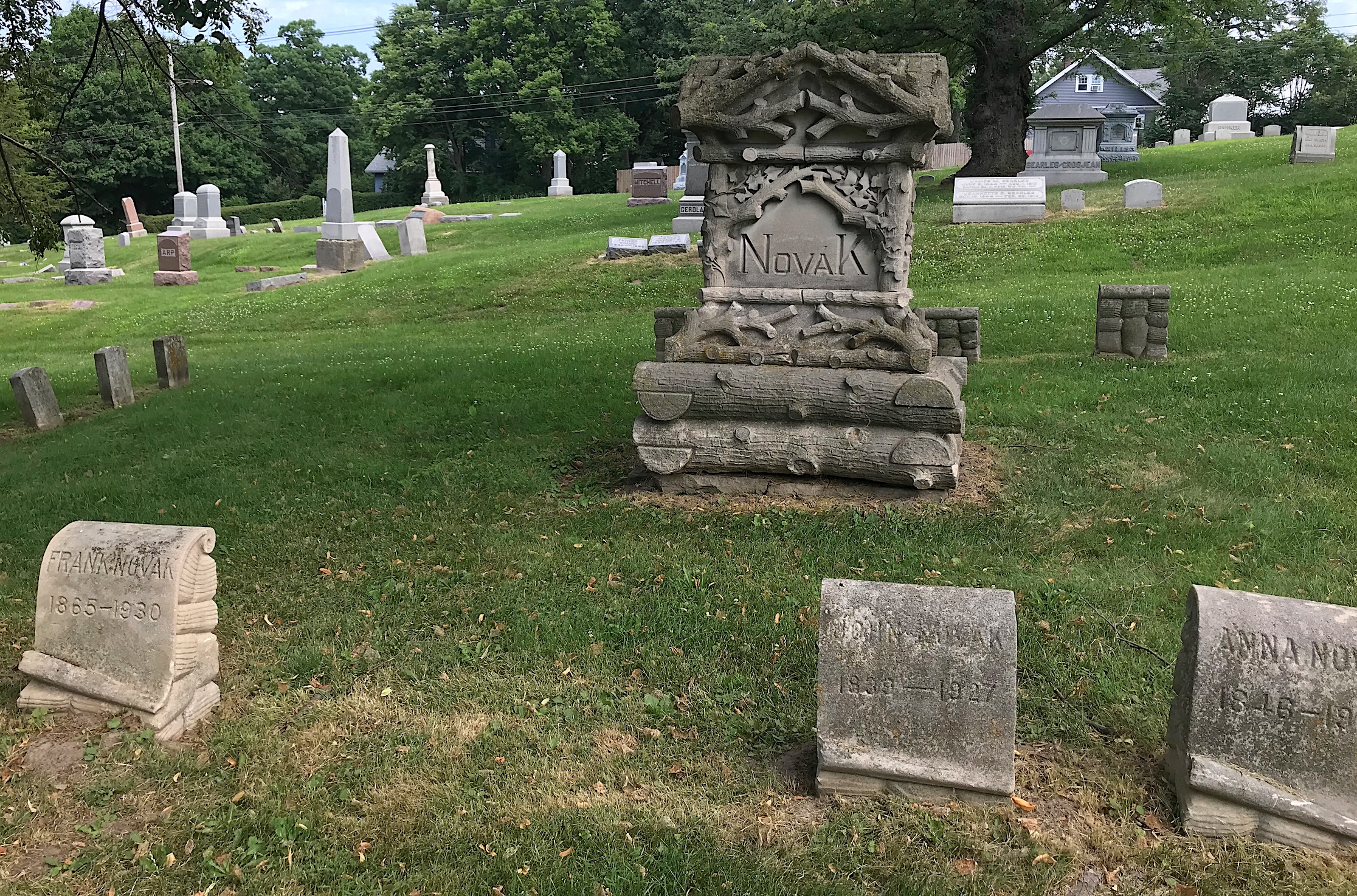
Below, you can see the Novak family plot at OHC. I photographed it because of the beautiful wood/tree-themed style of the surname monument and the individual stones that accompany it. Not because I ever thought there would be notoriety attached to it.

John and Anna Novak had high hopes for their son, Frank.

It all began with a mysterious 1:30 a.m. fire on Feb. 3, 1897 in a store called Novak & Jilek that awoke the residents of Walford, Iowa, about 12 miles southwest of Cedar Rapids. Missing was Frank Novak, the store’s owner.

Frank Novak, 32, was the son of German immigrants John and Anna Novak. John emigrated from Bohemia in the 1860s and married Anna Cerveny in 1864. They had four children together and Frank was the oldest. John did well in his business/farming efforts and the family prospered.

Frank was very charming, intelligent, and played the violin beautifully. Farm work was not to his taste, being of a less than robust constitution. Gambling was more his style. He was keen on starting new business ventures with his father’s help but none of them seemed to ever pan out.

The store he opened with his sister Blanche’s husband, Vaclav Jilek, however, seemed to succeed. But while Frank and Vaclav were on a train headed for the World’s Fair in Chicago, Ill. on July 23, 1893, Vaclav fell off on his way to another car on the train and was seriously injured, dying soon after. He is buried in the Novak plot at OHC.

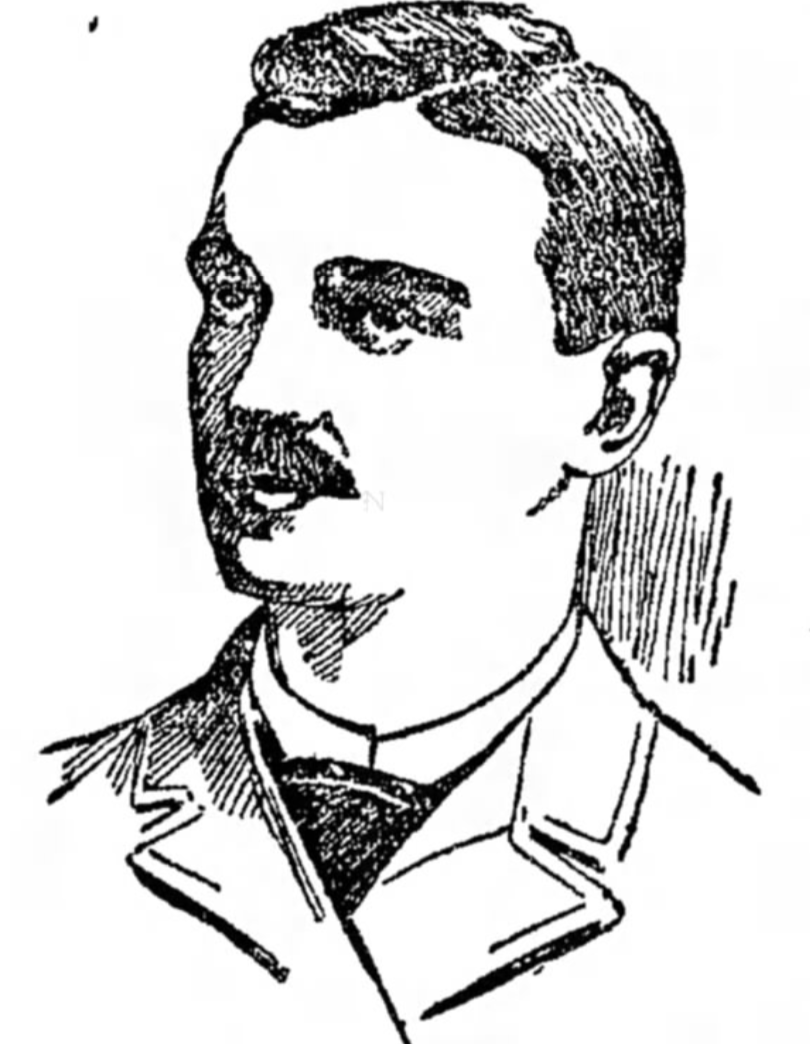
Illustration of the enterprising Frank Novak from the from the Sept. 25, 1897 edition of The Decatur (Illinois) Daily Republican.

Frank rebuilt the store in 1896 and opened a small bank next door. That spring, burglars blew open the bank’s safe, making off with the contents. Frank swore it would never happen again and despite being married with children, would often sleep on a cot at the store next door to keep an eye on things.

On the night of Feb. 2, 1897 around 9 p.m. Frank and his other brother-in-law locked up the bank and store, then headed to Martin Loder’s tavern to have a beer. Among the patrons was drifter Edward Murray, an alcoholic often in and out of jail. Later, Frank and his brother-in-law were seen back at the store selling tobacco to two men who couldn’t get it at Loder’s along with Edward Murray.

Once the fire was out, the debris revealed a dead body. Everyone was sure it was Frank Novak since he was nowhere to be found. But examination of the man’s teeth soon revealed it wasn’t him. He’d recently had extensive dental work that was not present in the corpse’s mouth. Further exploration of the remains confirmed it was Edward Murray, whose skull had been bashed in. His sister, Nellie, confirmed it by an item found on his body.

A Musical Murderer

Frank had purchased several insurance policies on his own life totaling around $27,000 not long before he died. His plan was to leave his wife Mary (who knew nothing about it) financially settled while he pursued a new life with a new name elsewhere.

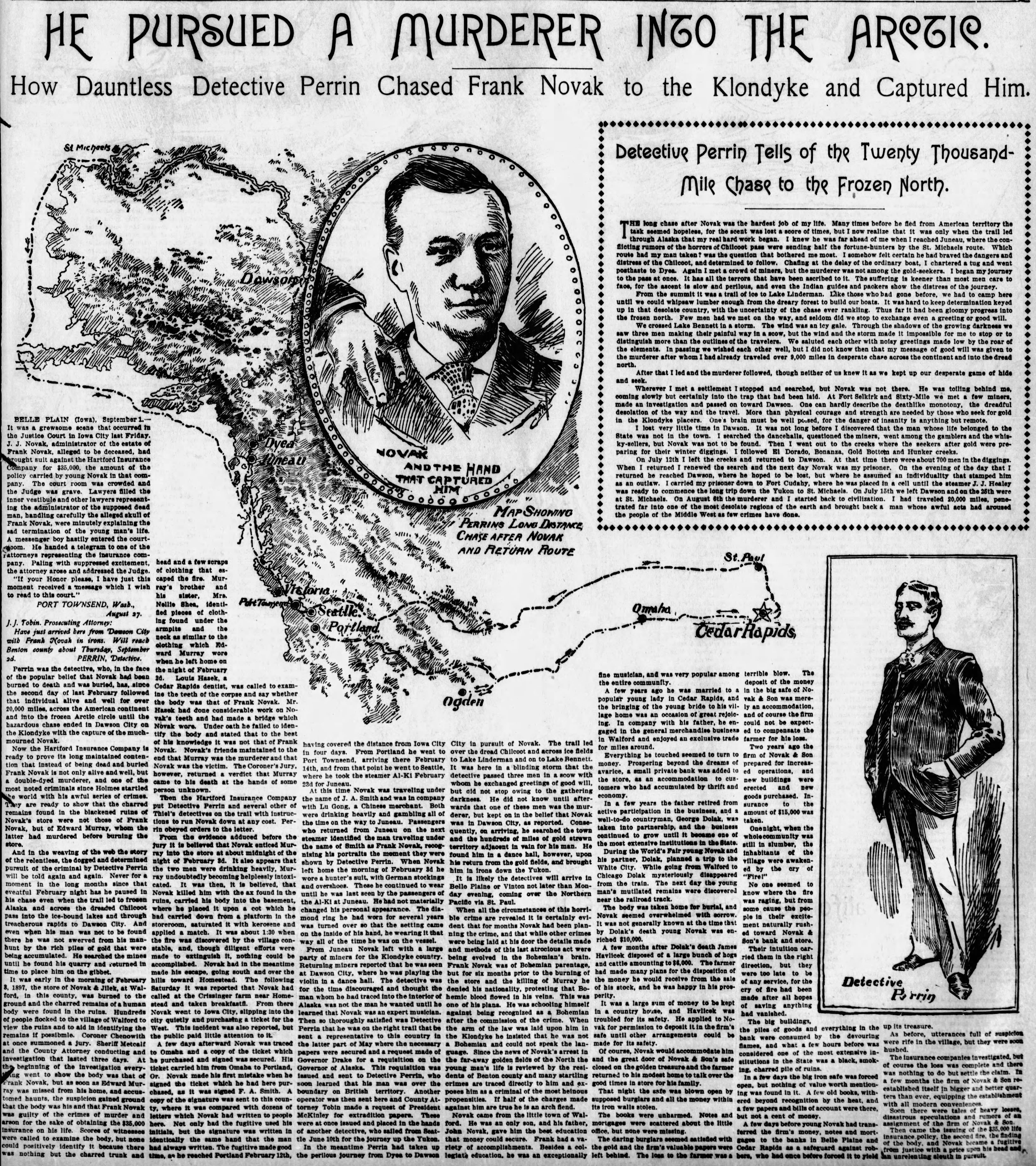
Newly elected Benton County attorney M.J. Tobin was keen to track down Novak and detective C.C. Perrin took up the challenge. Thus began a pursuit covered in newspapers that was followed with interest by many across the country.

The capture of Frank Novak in Alaska by detective C.C. Perrin made headlines in this Sept. 5, 1897 San Francisco Sunday Examiner Magazine.

In a nutshell, Frank fled to Omaha, Neb. and purchased a train ticket to Portland, Ore. From there, he traveled by steamer to Alaska and ended up in the town of Dawson. Frank was captured in August 1897 by Perrin while playing violin in a dance hall. He was escorted back to Iowa for trial, where he received a life sentence from judge George W. Burnham for insurance fraud and murdering poor Edward Murray.

By now, Frank’s wife had divorced him, and was supporting herself and their sons Milo and Leo by running a boarding house.

“Life” in Prison

But similar to today, “life” in prison didn’t always mean just that. At first, Frank served his time in Anamosa Penitentiary and behaved himself. By 1903, he was involved in photography and part of the prison band. His non-incarcerated friends petitioned Iowa’s governor for clemency. In 1908, Frank was transferred to a rougher prison in Fort Madison, where he started another prison orchestra.

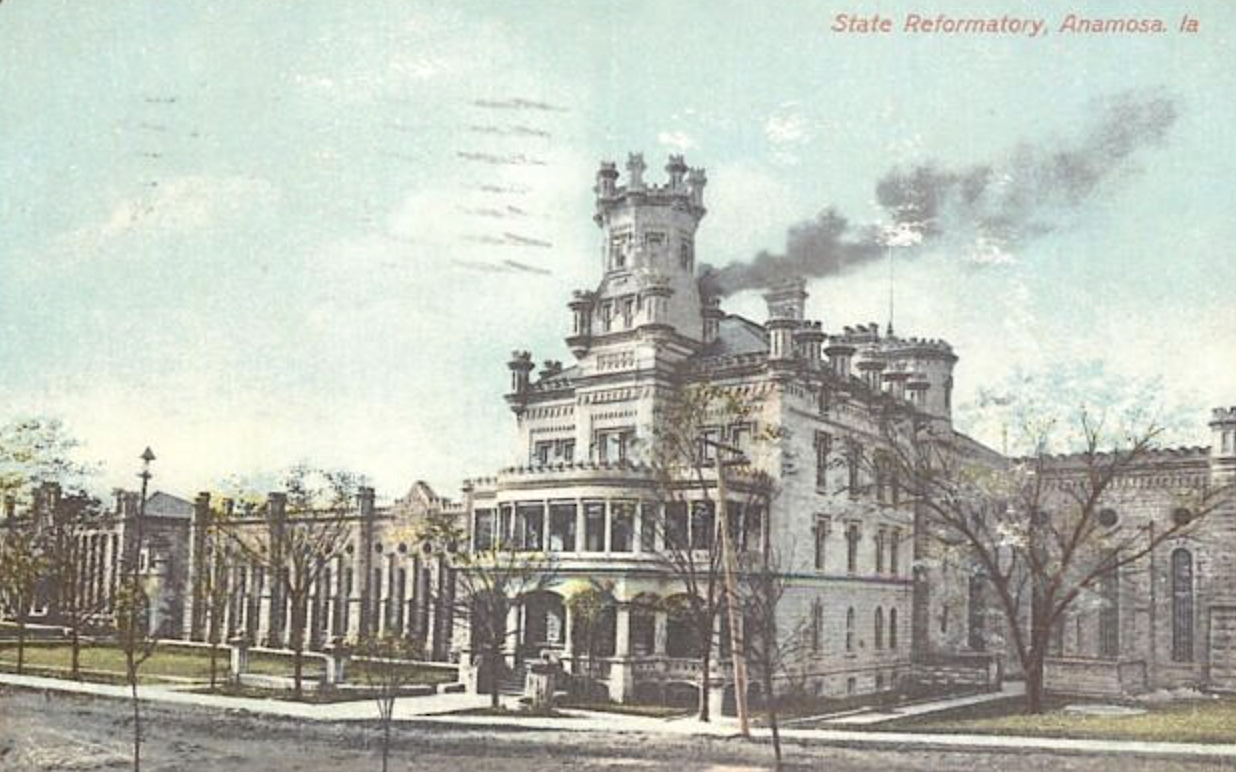
A 1907 postcard of Anamosa Penitentiary. This section looks very much like this today.

In 1911, Frank was released when his life sentence was commuted by the governor because of having served 13 years already. He married Ella Johnson in 1913 and the couple moved to Chicago where he became a real estate broker, living a quiet life. Ella died in 1918.

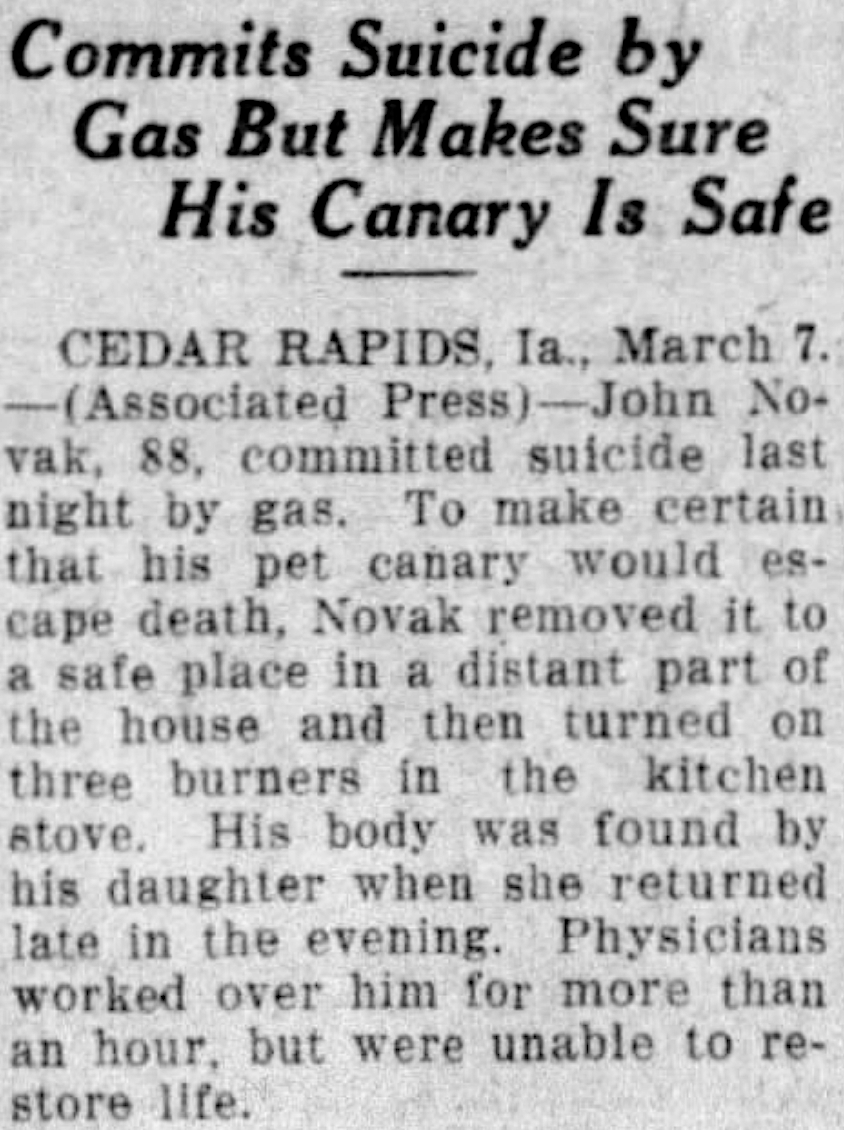
Frank’s mother, Anna, died in 1907 and was buried at OHC. Sadly, his father committed suicide on March 6, 1927 at age 88 when he turned up the gas on his home’s oven. The article below describes how John Novak made sure his pet canary was not harmed. He was buried beside Anna at OHC.

John Novak made sure his canary was safe before turning on the gas that would kill him.

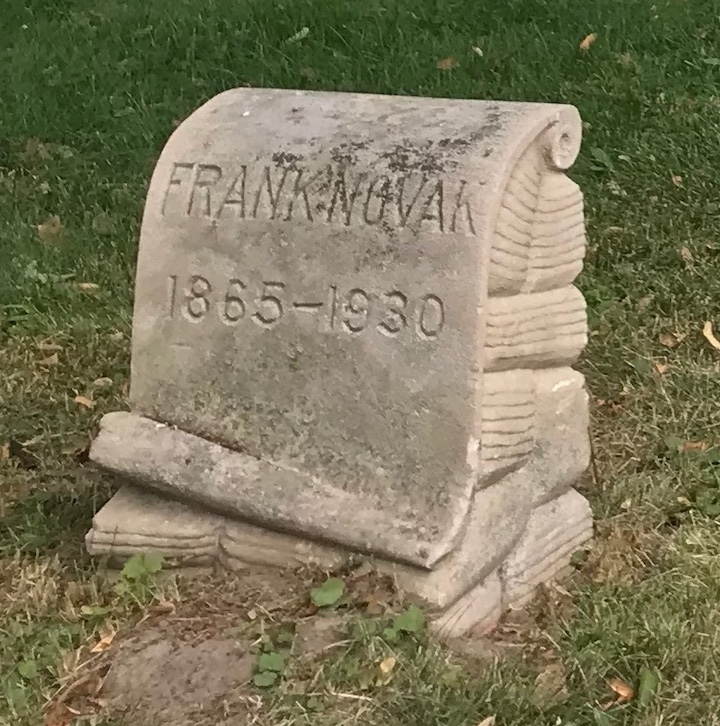
Frank died on July 12, 1930 in Chicago. A few days later, his remains were sent to Oak Hill Cemetery in Cedar Rapids. He is buried in a corner of the family plot. Mary Novak never remarried and died in 1964. She and her sons (both lived long lives) are buried at Cedar Memorial Park in Cedar Rapids.

Frank Novak died in Chicago, Ill. at age 65 and his remains were brought back to Iowa for burial at Oak Hill Cemetery.

American Gothic Dentist

OHC is also the final resting place of someone whose face you’ve likely seen, but you never knew who he actually was.

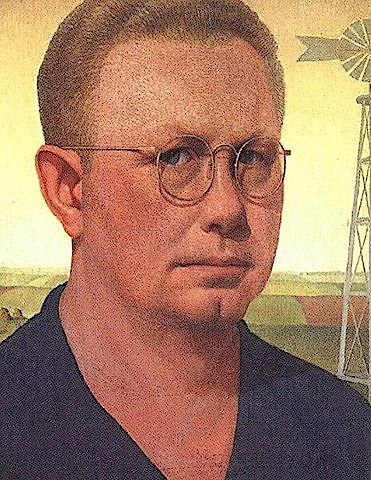
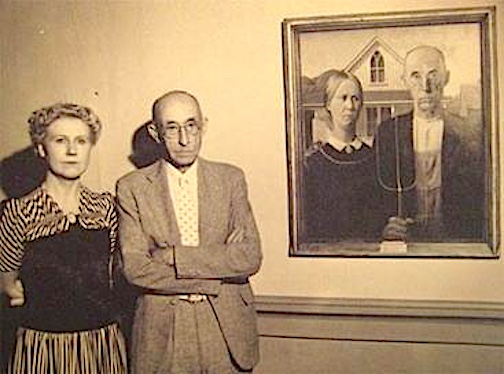
American Gothic (1930) by artist Grant Wood was modeled after his sister, Nan Wood Graham, and Cedar Rapids dentist Dr. Byron H. McKeeby.

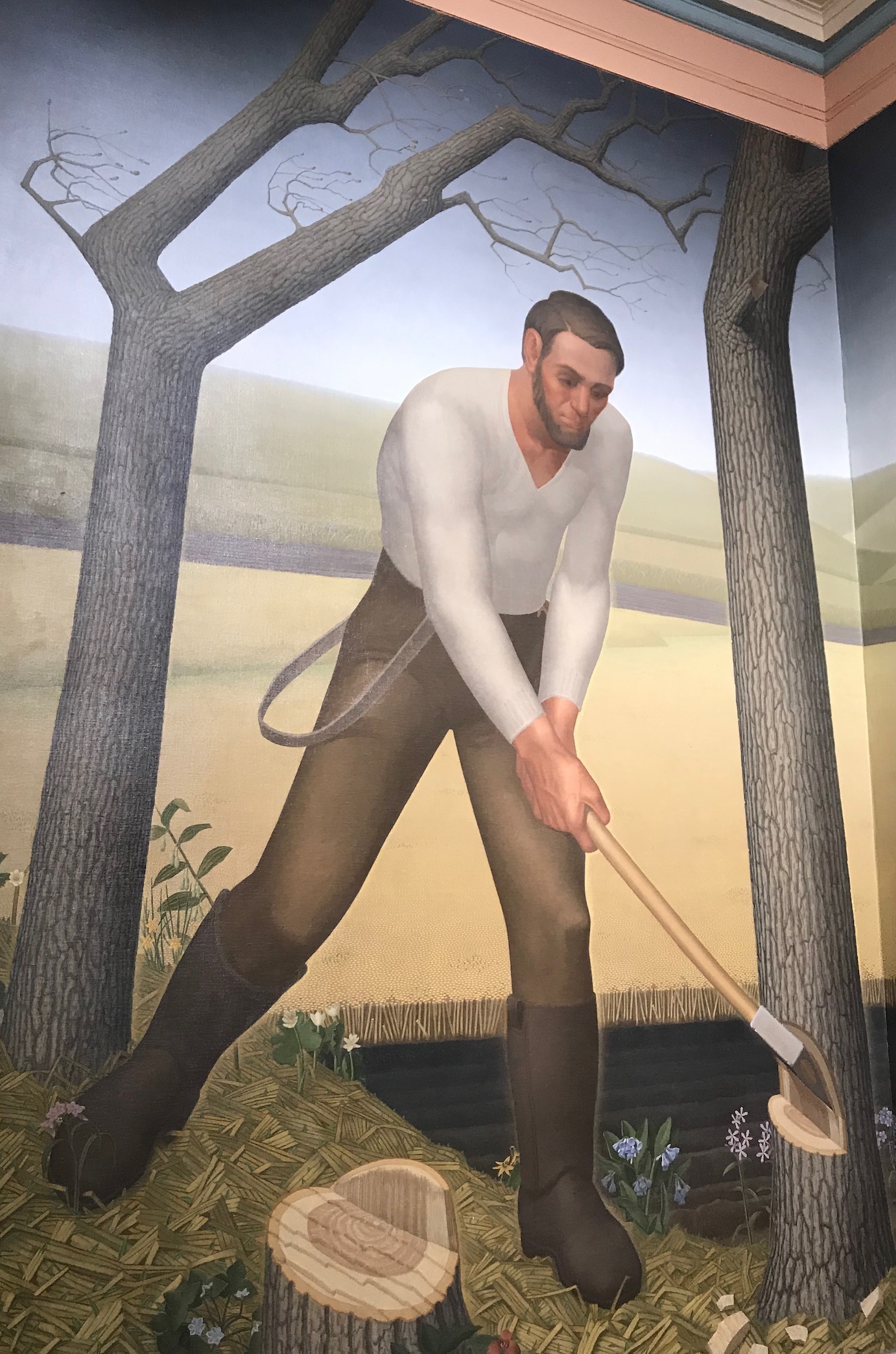
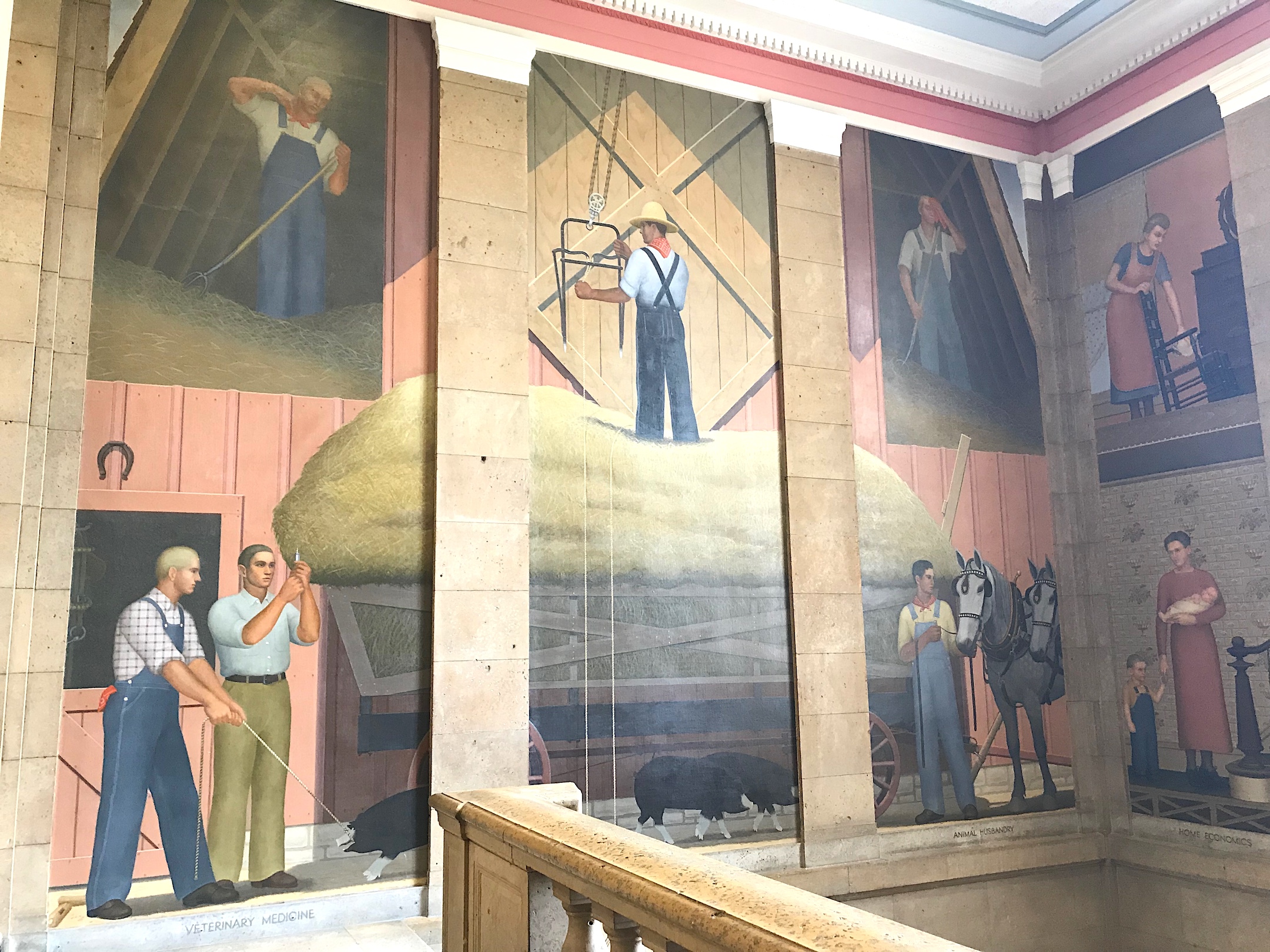
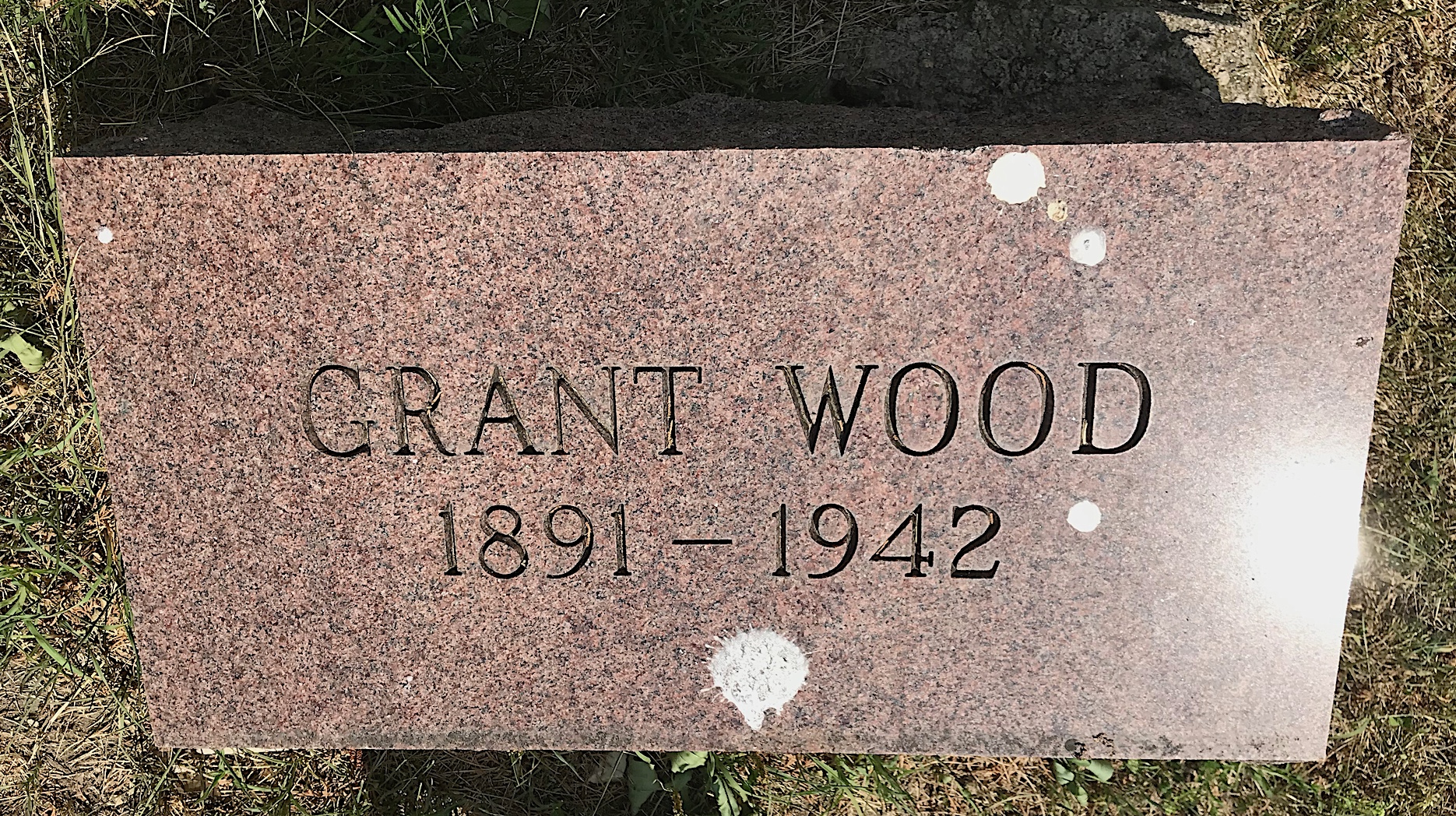
Born in 1891 in Anamosa, Iowa, artist Grant DeVolson Wood is noted for his paintings depicting the rural American Midwest. Most know him for his popular painting American Gothic. Earlier, we stopped at Iowa State University’s library in Ames to see some of Wood’s murals.

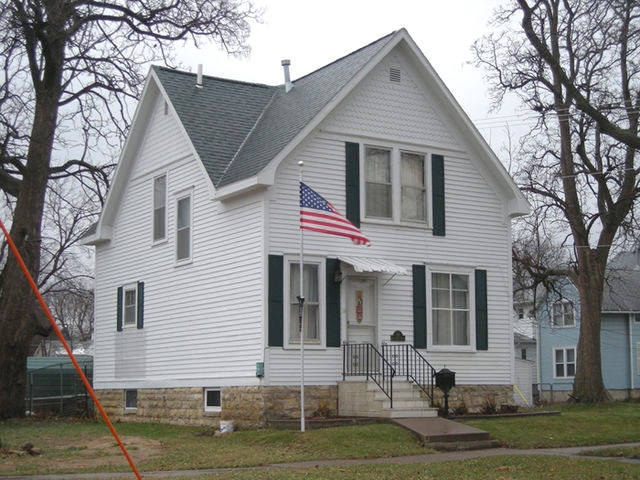
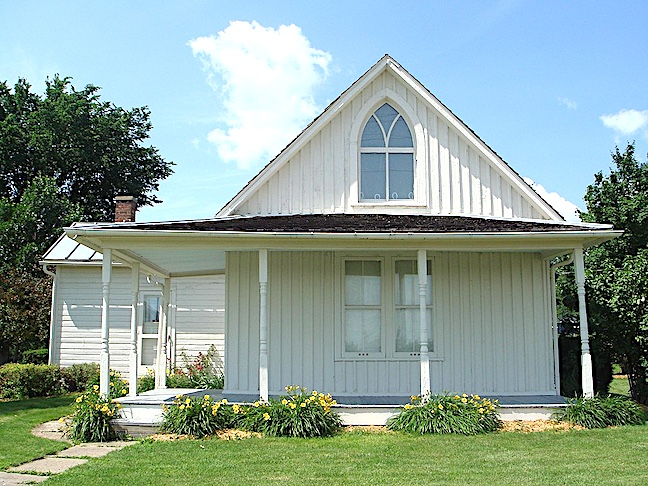
Wood took inspiration for the painting from what is now known as the American Gothic House in Eldon, Iowa, along with “the kind of people [he] fancied should live in that house”. It depicts a farmer standing beside his daughter – often mistakenly assumed to be his wife. The painting’s name is a word play on the house’s architectural style, Carpenter Gothic.

Located in Eldon, Iowa, the Dibble House is now known as the American Gothic House.

Wood asked his sister, Nan Wood Graham, to be the model for the daughter, dressing her in a colonial-print apron mimicking 20th-century rural Americana.

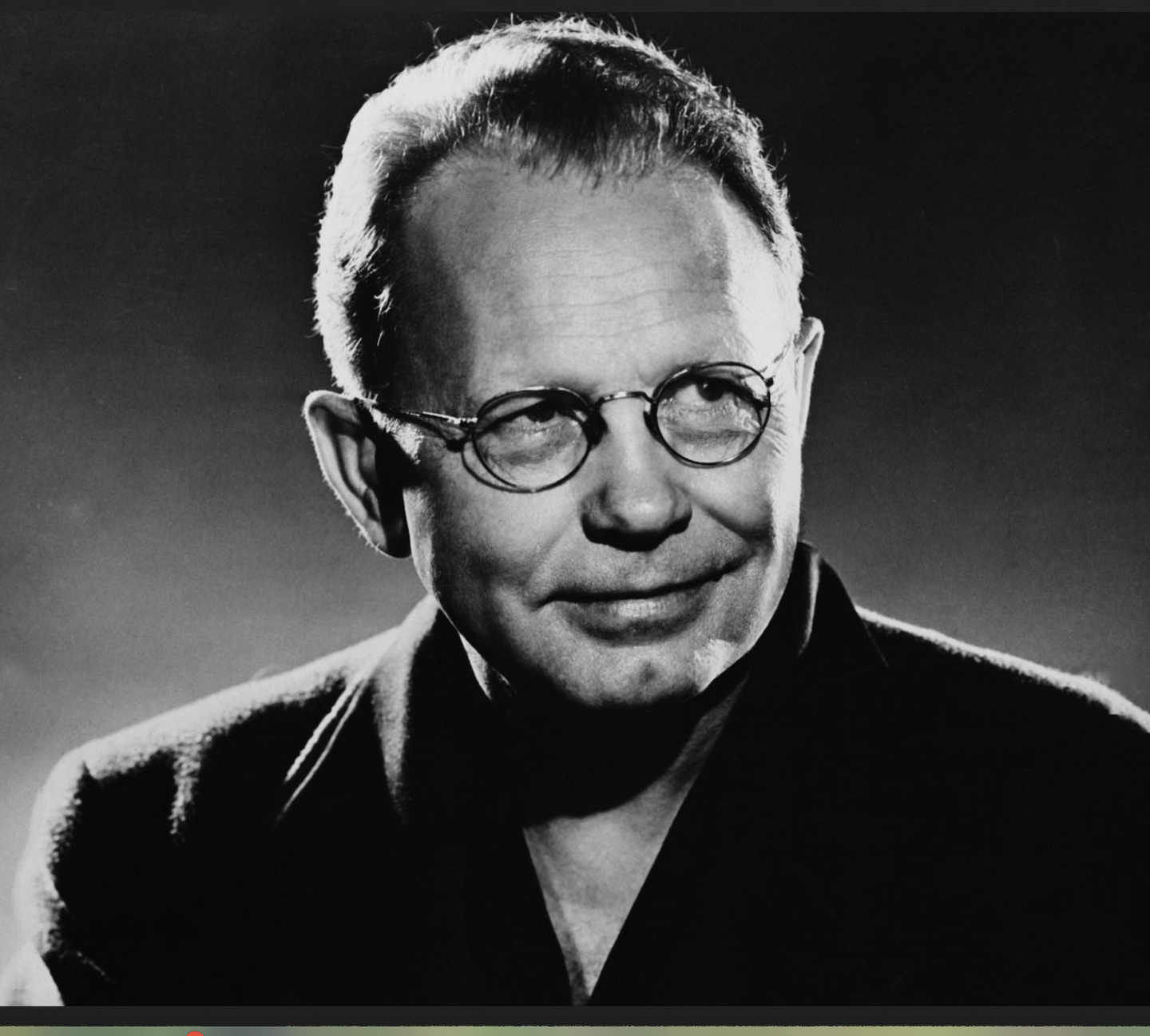
The model for the father was the Wood family’s dentist and Gran’s friend, Dr. Byron McKeeby. Nan told others that Grant had envisioned the pair as father and daughter, not husband and wife, which Wood himself confirmed in his letter to Nellie Sudduth in 1941: “The prim lady with him is his grown-up daughter.”

Wood painted Dr. McKeeby in his dental office. Dr. McKeeby, then 62, put on overalls and held a prop pitchfork. The rest of the painting, including Nan, was completed nearby in Woods’ studio. Nan and McKeeby never posed together in front of the Eldon house.

Nan Wood Graham and Dr. Byron McKeeby in the gallery at the Cedar Rapids Public Library, September 1942.

Dr. McKeeby studied dentistry at the University of Iowa, graduating in 1894 and founded his first practice in Winthrop, Iowa. He moved to Cedar Rapids in 1901 where he established an office which he maintained almost until his death.

Denial Then Acceptance

At first, Dr. McKeeby distanced himself from the painting’s popularity. Friends thought it was him and even joked about the pitchfork’s role in his dental procedures. But Dr. McKeeby stood firm in his denials. Because the dentist was known around town for his dapper style and affable sense of humor, the real Dr. McKeeby was nothing like the dour farmer in the painting.

In 1935, Dr. McKeeby admitted he was the farmer. Cy Douglass, an Associated Press news bureau chief, helped coax his confession. Dr. McKeeby’s oldest son was married to Douglass’ sister.

Dr. McKeeby eventually embraced his part in the painting, appreciating the fact that he looked more like the rustic farmer as he got older.

Dr. McKeeby eventually embraced his notoriety as the American Gothic farmer.

In 1943, Dr. McKeeby was interviewed about his unexpected fame. He said, “‘It made it (the friendship) a little bumpy, but nobody could really be mad at Grant Wood. He painted a beautiful picture of a bridge for my new house and when he gave it to me he said, ‘Doctor, you made me a bridge once, now I’ve made you one!’ ”

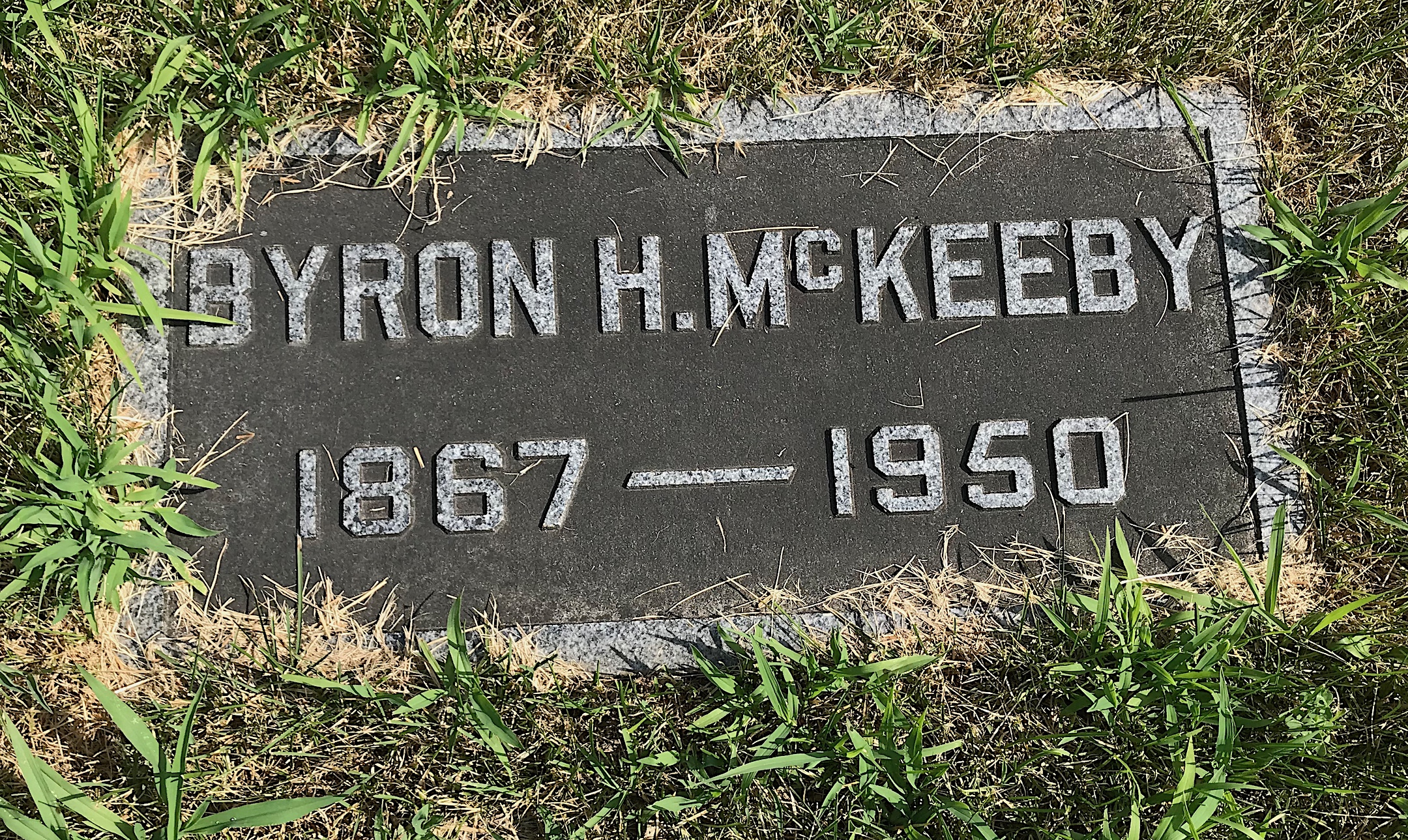
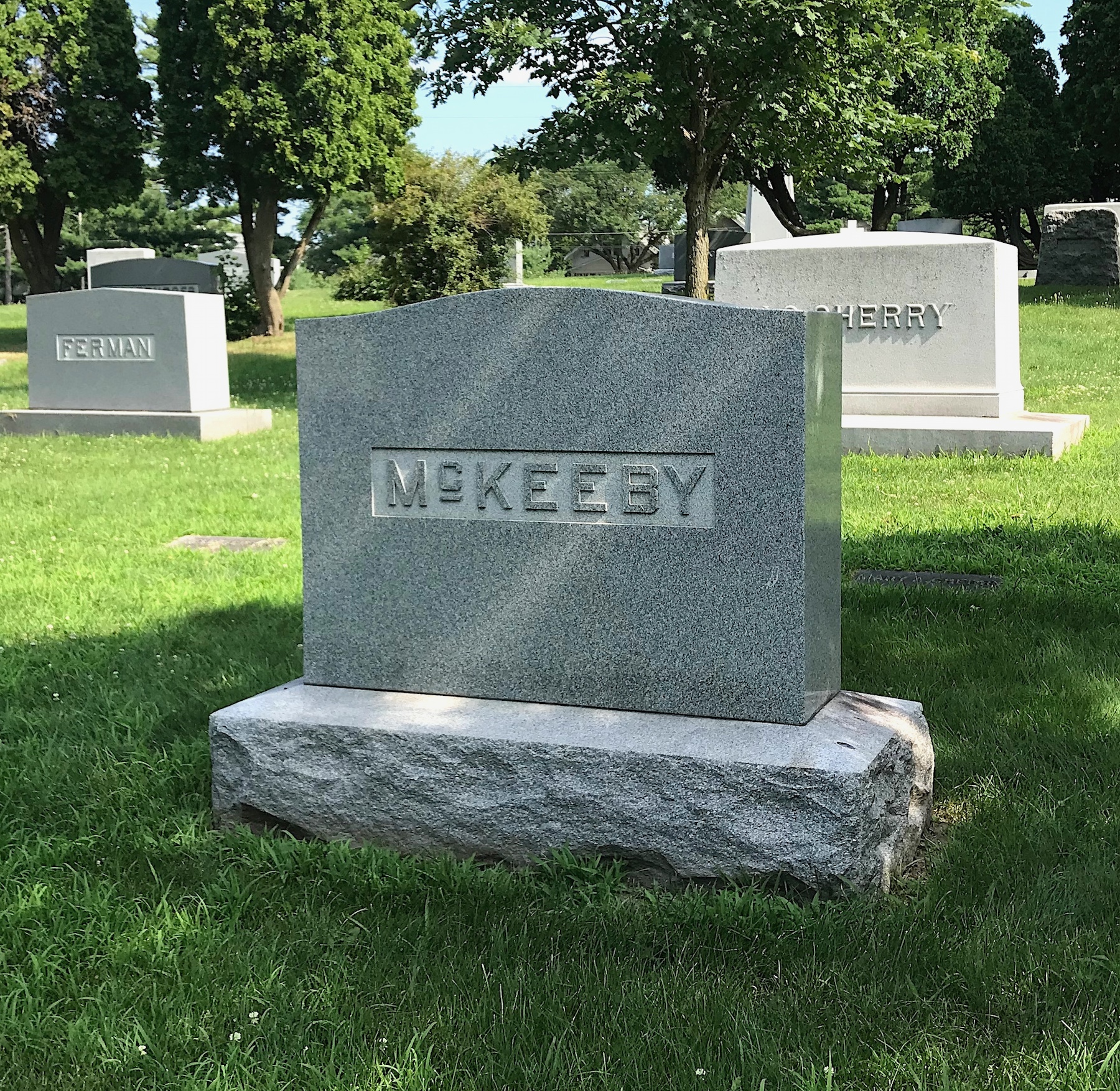
Dr. McKEeeby died on Jan. 6, 1950 at age 82. He is buried at OHC beside his first wife, Belle Metcalf McKeeby, who died in 1917.

Dr. Byron McKeeby died at age 82 in 1950.

Nan Wood Graham is buried in Riverside Cemetery in Anamosa with her brother, Grant. We visited that cemetery, too. I’ll share more about them in an upcoming blog post.

Next time, I’ll be featuring some of the white bronze (zinc) markers of Oak Hill Cemetery.

Elizabeth “Libbie” Ellis Smith, wife of John M. Smith, died at age 31 of typhoid pneumonia on Dec. 21, 1880. The couple had four sons together.

Return to the Hawkeye State: Lingering at Cedar Rapids’ Oak Hill Cemetery, Part I

08 Friday Dec 2023

Posted by adventuresincemeteryhopping in General

≈ Leave a comment

In contrast to Calvary Catholic Cemetery’s 300-something burials, Oak Hill Cemetery (OHC) in Cedar Rapids boasts close to 11,000 memorials on Find a Grave. That’s quite a difference!

Cedar Rapids is the second-most populous city in Iowa. The 2020 United States Census notes that the city population was 137,710. Cedar Rapids is 100 miles northeast of Des Moines, the state’s capital and largest city.

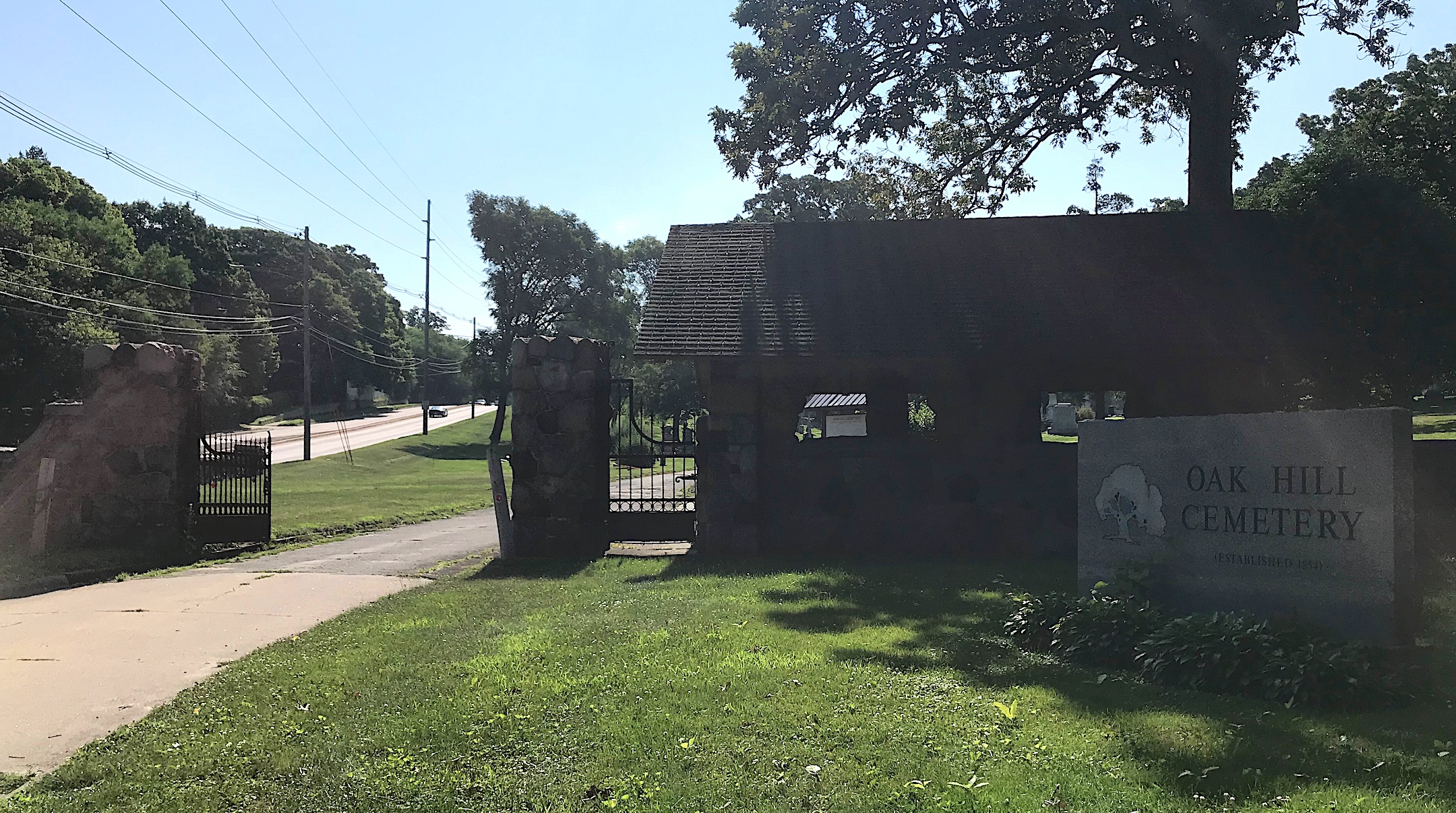
Oak Hill Cemetery was established around 1856.

After Cedar Rapids was incorporated in 1849, land development to the east threatened to overtake the small Village (or Washington) Cemetery. In 1856, those graves were moved to the new Oak Hill Cemetery on a tract of land then considered to be outside the city. The new cemetery included a potter’s field, which is now City Cemetery owned by the City of Cedar Rapids Parks Department.

Chicago landscape architect Horace William Shaler Cleveland was hired in 1869 and again in 1880 to prepare a plan for cemetery improvement, giving it a rural picturesque landscape design. Initially operated as a for-profit cemetery, OHC was reorganized (with additional land) as Oak Hill Cemetery Association, a non-profit organization.

Titanic Victim

One of the reasons I wanted to visit OHC was to visit the mausoleum of Walter Donald Douglas, a successful Iowa businessman who perished on the Titanic on April 15, 1912. You might recall I featured another Titanic victim, Nebraska’s Emil Brandeis, in a past blog post.

Walter was the second son of Scottish immigrant George Douglas (1817-1884) and Margaret Boyd Douglas. George was a partner in a cereal mill in Cedar Rapids, which later merged with several other oat mills in 1901 to form the Quaker Oats Company. When he died in 1884 at age 67, George was the first to be interred in the Douglas mausoleum at OHC. Margaret, who died in 1905 at age 77, joined him in the mausoleum.

A savvy businessman, Walter D. Douglas inherited his father’s business acumen.

Born in Waterloo, Iowa in 1861, Walter wed Lulu Eliza Camp in 1884 and they had two sons, George Camp and Edward Bruce. Lulu died of typhoid fever in 1899 at age 37, and is interred in the Douglas mausoleum. Walter remarried in 1906 to Mahala Dutton Benedict, a divorcee originally from Cedar Rapids.

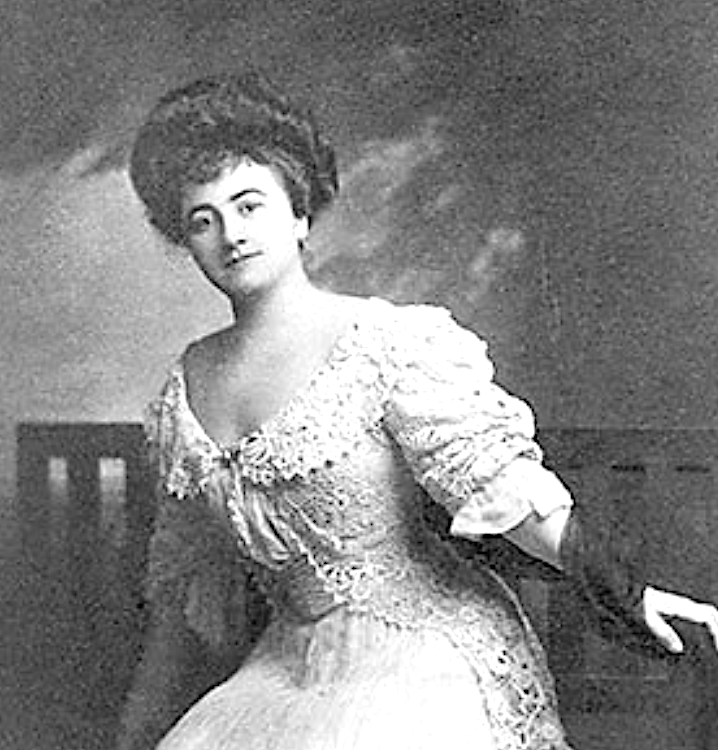
Mahala Dutton Benedict married Walter Douglas in 1906 in New York. She was an advocate of the arts. (Photo source: Encyclopedia Titanica)

Douglas amassed a fortune of at least $4 million in various Cedar Rapids industries and expanded into the linseed oil business in Minneapolis, Minn. With his elder brother George, he formed the Douglas and Company Starchworks (later Penick & Ford) in 1903. Associated with several prominent businesses, Walter was also an executive in the Quaker Oats Co.

With Mahala, Walter built a mansion overlooking Lake Minnetonka near Minneapolis that they called Waldon. Douglas retired in January 1912 and the couple embarked on a three-month tour of Europe to find furnishings for their palatial retreat.

A native of Compiegne, France, Berthe Leroy had no idea what awaited her as she boarded the Titanic with the Douglases.(Photo source: Encyclopedia Titanica)

Walter purchased first-class tickets for he and Mahala, and Mahala’s French maid, Berthe Leroy, on the Titanic in hopes of being home in time to celebrate Walter’s birthday. According to the Encyclopedia Titanica:

On the night of the sinking Mr. and Mrs. Douglas had been in their cabin at the time of the collision, the shock of which was so slight that they paid little heed to it. Receiving no instructions to go topside, the couple waited in their cabin, he reassuring his wife that there was no danger. Only the sight of other passengers gathering in the corridors dressed in lifebelts prompted to couple to do the same and they dressed and headed to the boat deck where they waited for some time.

Mr Douglas saw his wife and maid off in lifeboat #2 but refused to go himself until all women and children were accounted for, saying it would make him ‘less than a man’ or ‘No, I must be a gentleman.’ According to later reports Walter Douglas, dressed in his finest, helped lower the last lifeboat of survivors off the Titanic.

Walter died in the sinking and his body was recovered by the cable ship MacKay Bennett.

Article in the April 25, 1912 edition of The Gazette (Cedar Rapids, Iowa).

Meanwhile, Mahala and Berthe, passengers in lifeboat #2, were among the first to board the Carpathia, which had come to rescue survivors. Walter’s brother George Douglas and his wife made their way to New York from Iowa to meet her, along with her stepson Edward, and she recuperated at the Waldorf-Astoria Hotel. Mahala later returned to Waldon with her family.

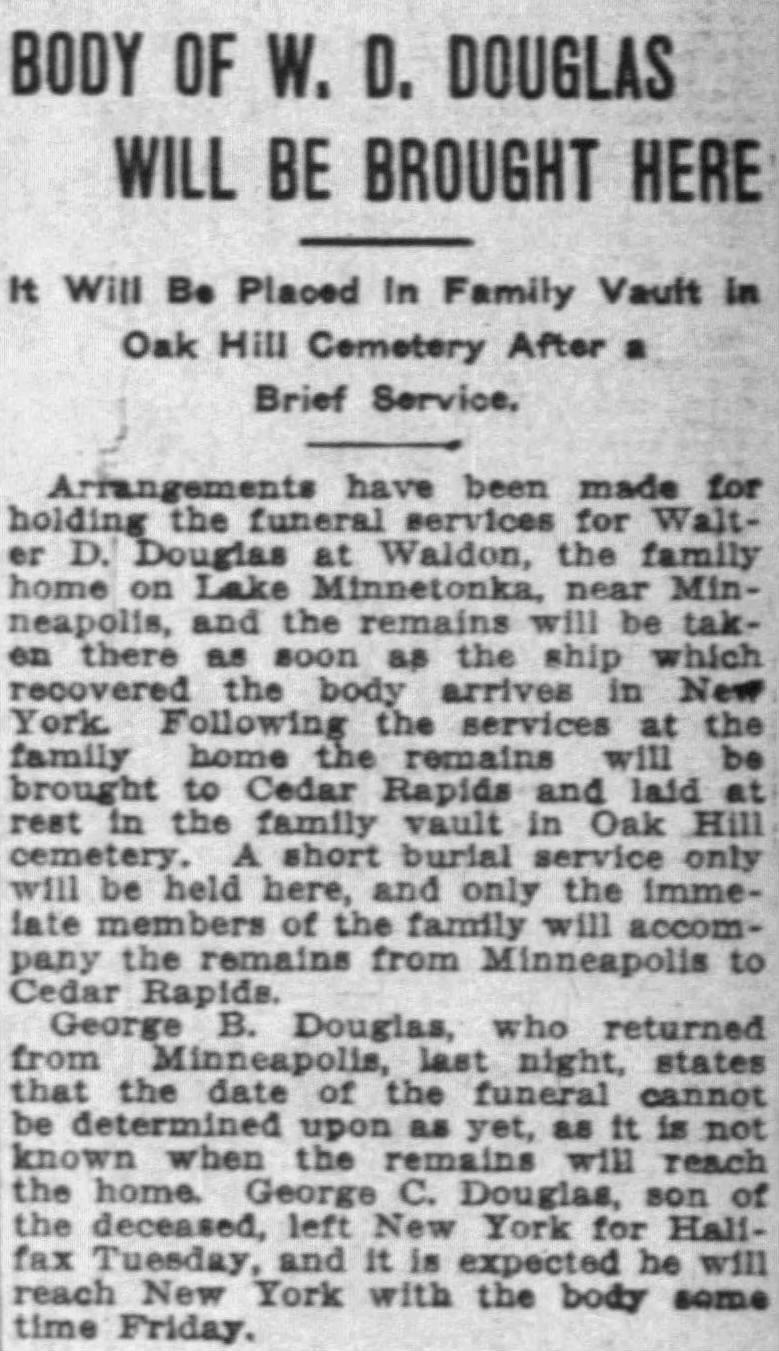
Walter’s remains were sent first to Minnesota, and the family had a service at Waldon for him. After that, he was moved to Cedar Rapids for another private service at Oak Hill Cemetery before interment in the Douglas mausoleum.

Walter Douglas would join his parents and his first wife, Lulu, in the Douglas mausoleum after his death in 1912.

Mahala Moves On

Spending much time abroad, Mahala divided her time living in Minnesota at different locations. She made frequent trips to a holiday home in Pasadena, Calif. She remained close with her maid ,Berthe Leroy, who was still listed with her on the 1930 U.S. Census.

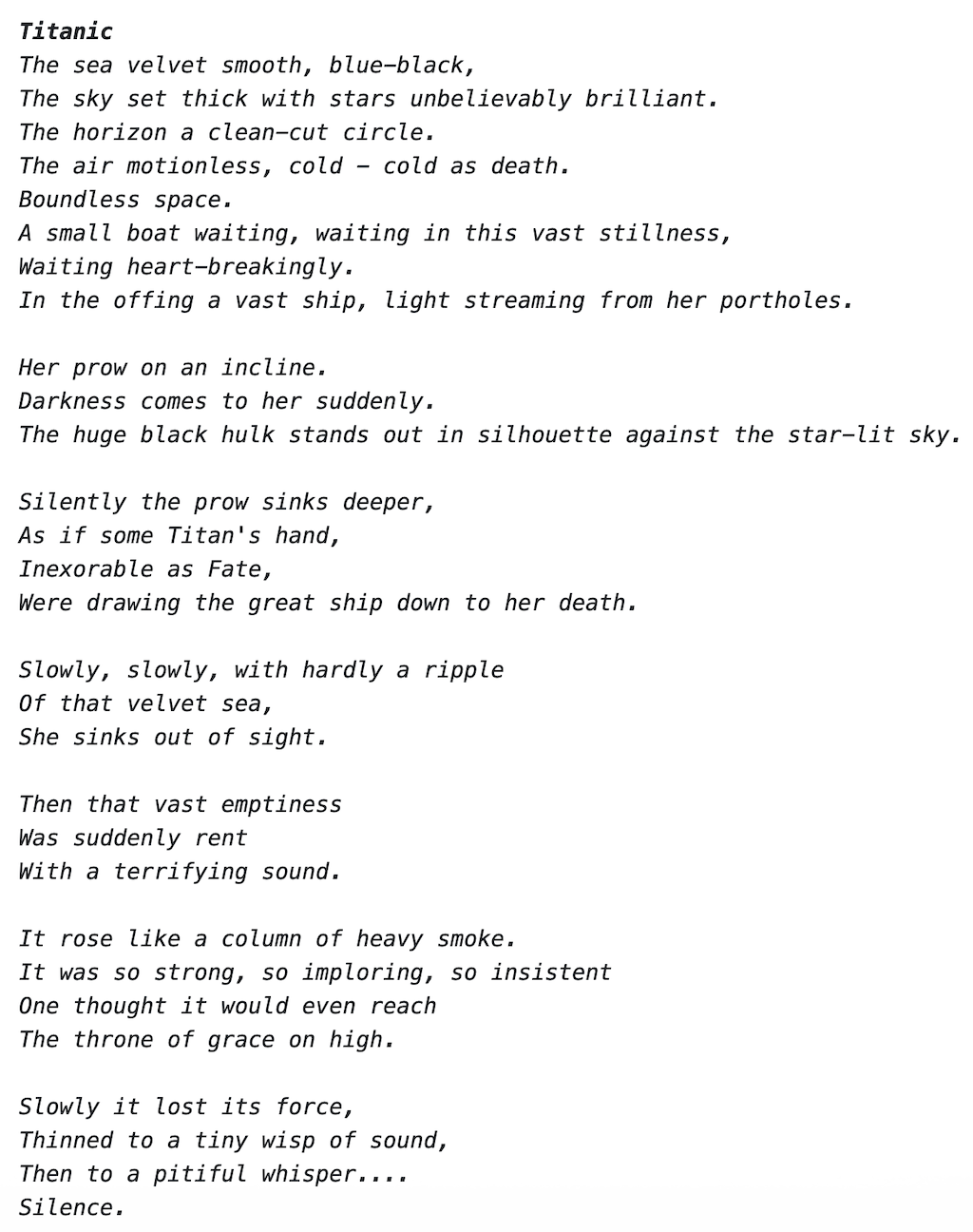
An advocate of arts and culture, Mahala turned Waldon into a showplace for extravagant gardens and furnishings collected from around the world. Also a talented writer, Mahala Douglas published a collection of stories and poems in 1932. The last poem in the book is a haunting account of the Titanic disaster.

Mahala died on April 22, 1945 at age 81 in Los Angeles, Calif. She is interred with Walter and her step-sons in the Douglas mausoleum. Berthe Leroy died on July 1972 at age 88 and is buried in Hersin Coupigny Cemetery, Pas-de-Calais, France.

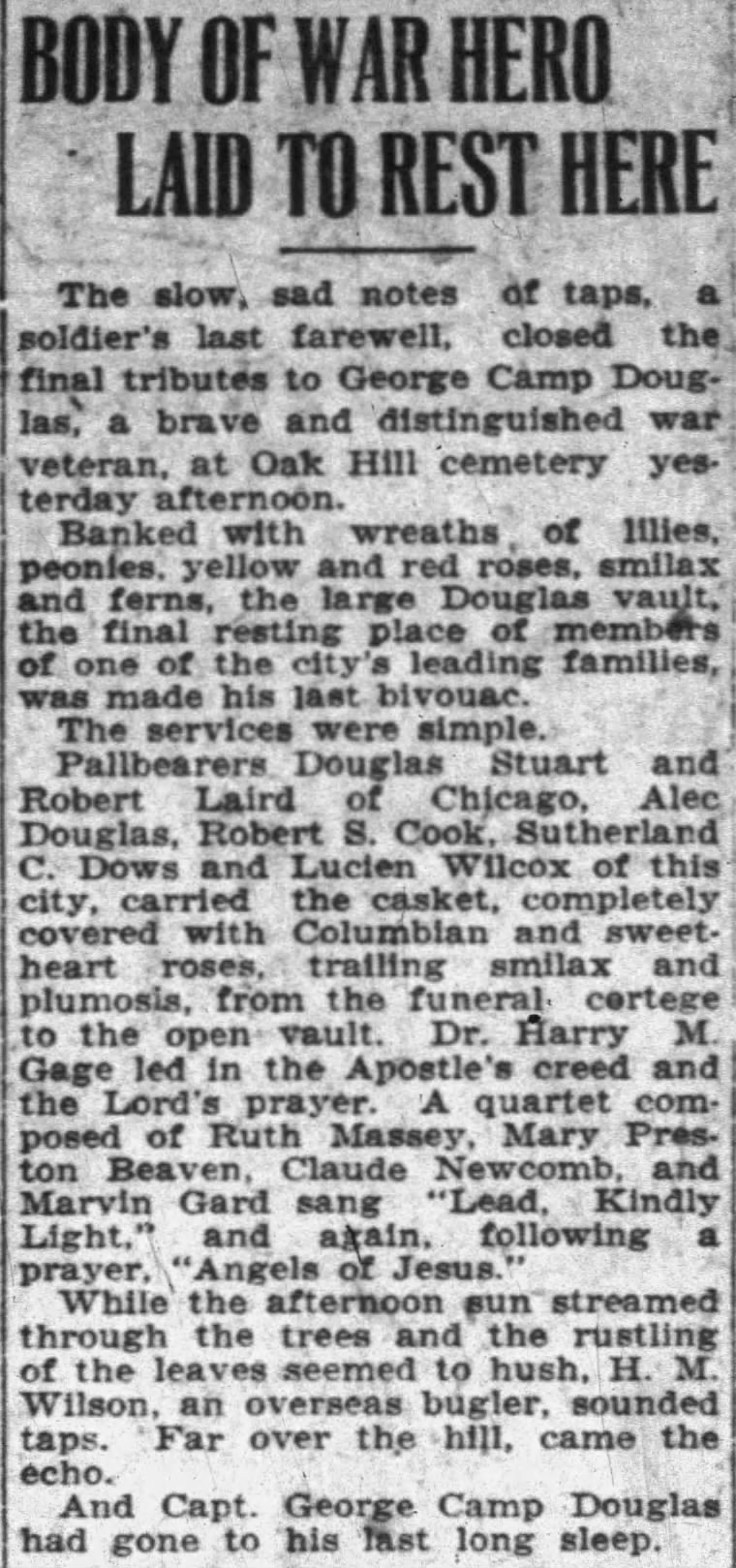
“Gone to His Last Long Sleep”

There’s an interesting postscript to the Douglas family story. When Walter Douglas died, his will stipulated that his sons and heirs should for 10 years earn at least $2,500 a year. After that time, half a million dollars left by their father should be divided equally between them. Mahala got her own portion of his fortune.

Son Edward fulfilled his requirement to earn his part of the inheritance, which included serving in the U.S. Army during World War I. George worked at the family-owned starch works until 1915 when he enlisted as a private in the British Army as World War I was starting there. Apparently, he earned less than his brother. He also remained in the British Army, being stationed in Arabia after the war. While on furlough, he returned to America in 1922 to plead his case with the executors of his father’s will to receive his inheritance and they agreed he had “paid his dues”.

Capt. George Camp Douglas died at age 39 in Chantilly, France.

Sadly, George died in 1925 at age 39 in Chantilly, France. George had not only been gassed but wounded more than once during the war and later contracted beri beri while serving in Arabia. Some articles I found said he died in an accident, others as a result of his poor health. Regardless, his body was brought back to Cedar Rapids for interment in the Douglas mausoleum.

After World War I, Edward Douglas came home to Minnesota to try his hand in the banking business. But he later enrolled at the New York Central School of Arts where he became the student of Danish-American sculptor George J. Lober. He married and divorced three times.

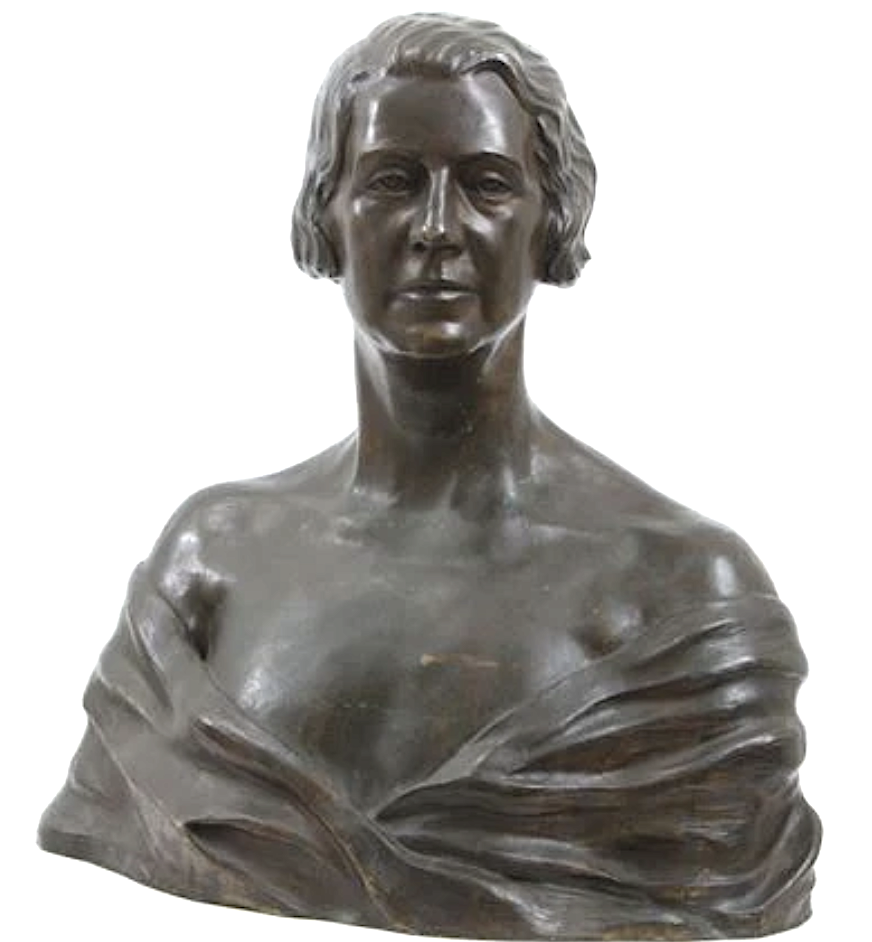
Edward became a noted sculptor, moving to Rome in 1927. He married Marthe Legret and they moved to France. They had one daughter, Beatrice. His work was part of the sculpture event in the art competition at the 1936 Summer Olympics. The picture below is of a bronze called “Busto di Donna” he completed in 1930.

Bronze entitled “Busto de Donna” completed by Edward Bruce Douglas in 1930.

Edward died of a heart attack at age 57 in San Francisco, Calif. on Feb. 6, 1946. He was the last member of the family to be interred in the Douglas mausoleum.

“Laid Beneath the Flowers”

OHC has two “woodsy” themed markers that I plan to highlight. The first is especially tragic because it tells a tale in names and dates of the four Hager children who died in the 1880s.

Richard and Lottie Hager lost four of their five children to diphtheria.

Born in Maryland in 1849, Richard Hager came to Iowa as a boy. He married Lottie Hergesheimer in 1874 and worked as a railroad foreman. The couple would have three children over the next few years: Charlie, Samuel, and Lizzie.

The Hagers would lose four of their five children to diphtheria.

Diphtheria hovered over the Hager home in late April 1882. Sammie, age, four, died on April 22. Charlie, age six, died on April 27. Lizzie, only two, followed on May 2. Three children gone over the passage of only 12 days.

Dolly, born on Jan. 31, 1882, died of diphtheria on Oct. 9, 1889 at age seven.

Sammie, Charlie, Lizzie, and Dolly share a tree-shaped monument.

Youngest son Archie, born in 1885, is the only Hager child who escaped an early death. He grew up and became a blacksmith for the railroad. As far as I can tell, he never married. The last record of him I could find was a World War II draft card that reported he was working as a fisherman in Peoria, Ill.

Richard Hager died at age 71 in 1921. Lottie died at 81 in 1930. They are buried with their children but their names are not inscribed on the “tree”.

In Part II, I’ll share the story behind another tree-themed Novak monument that involves a man who tried to fake his own death.

A native of Germany, Wencil Prazak died as a result of an accident while working in a wagon factory on Jan. 28, 1882. He was 18.

Return to the Hawkeye State: Stopping By Calvary Catholic Cemetery, Van Horne, Iowa

01 Friday Dec 2023

Posted by adventuresincemeteryhopping in General

≈ Leave a comment

Our Iowa 2019 roadtrip technically began in Marshalltown when we stopped for a few minutes at one of my favorite cemeteries, Riverside Cemetery. But I’ve already written about them so let’s start with the one we went to after that.

Calvary Catholic Cemetery (CCC) is right on busy Lincoln Highway between Marshalltown and Cedar Rapids. The closest town is Van Horne. There was no rhyme or reason in how I chose it. It was on the way and it seemed convenient to stop. The graves we discovered reflect the lives of a humble but hard working, Irish Catholic community that made its mark in America’s heartland.

Busy Lincoln Highway passes right by quiet Calvary Catholic Cemetery.

I wish I could say I found a lot of information about this cemetery but I didn’t. The oldest marker is from around 1855. Iowa officially became a state in 1846. According to Find a Grave, there are about 352 memorials recorded. It looked well tended when we visited and I saw a burial from the year of our visit. So it appears to still be an active cemetery.

I don’t know if it is affiliated with a Calvary Catholic Church in the area or if the congregation still exists today. There are five Catholic churches in Benton County known as the Queen of Saints cluster but none are called Calvary.

I did see that it also goes by the name Kelly Cemetery. There are 65 Kellys buried there with the earliest dying in 1863. It’s possible the Kellys originally owned the land and donated it for the purpose of a cemetery.

CCC has a beautiful cross bearing the figure of Christ, symbolizing the importance of Calvary where He was crucified. I don’t know what year it was installed.

The crucifixion tableau at Calvary Catholic Cemetery.

The Kirby Family

The first marked burial belongs to the Kirby brothers, sons of John and Catharine Kirby of Ireland. Mathews Kirby, born in May 1847, died at age eight on Sept. 27, 1855. Brother P.T. Kirby, born on May 2, 1857, died 10 days later.

The Kirby brothers died less than two years apart.

The boys’ father, John Kirby, was a farmer in Benton County. He died at age Sept. 4, 1871.

Irishman John Kirby died on Sept. 4, 1871.

Wife Catharine died in 1887. Her brief obituary noted that she spent her last years traveling to visit her children. John and Catharine’s daughter Carrie, who died in 1895, is buried in Calvary Catholic Cemetery in Chicago, Ill. She is buried there with her second husband, John “Judge” Shane. Her Find a Grave memorial shows an illustration of a “dress fitting apparatus” that she patented in 1891.

Catharine Kirby outlived her husband by 16 years.

1911 Car Accident

While the Kellys dominate this cemetery, there are more than 40 Nolans buried at CCC. One of them was William John Nolan, born in 1876 to Irish immigrants Tom Nolan and Ann Hanley Nolan. He was a young man who showed great promise but his life was tragically cut short.

William lived and worked on his family’s farm. Mother Ann died in 1907 at age 71. William wed Lena Agnes Woestemeir on Oct. 12, 1909. The couple worked and lived on the Woestemeir farm in St. Clair. William’s father, Tom, died on Aug. 16, 1911 at age 74. He was buried beside Anna.

Thomas Nolan died only a few months before his son William.

Although William mourned his father, he and Lena celebrated the upcoming birth of their second child. Their fortunes were increasing and life on their farm was good.

On Sept. 1, 1911, William was in the back of an automobile with Oscar Tow near Fairfax, Iowa while his friend, James Harrington, was driving. As they crossed a bridge, two men on horseback were riding behind and got spooked by the car. Once on the other side of the bridge, Harrington attempted to pull over to give the two riders a wider berth and the car tumbled down an embankment.

Article from the Vinton (Iowa) Review, Sept. 6, 1911.

Harrington suffered a broken arm and Tow escaped unharmed. But because William was in the rear right seat, he was killed instantly. He was only 34 years old.

William Harrington died in a car accident in 1911.

His wife, Lena, only 21, was left a pregnant widow. She gave birth to Mary Magdalene Nolan on Dec. 27, 1911. She would remarry in 1915 to Leo Ament. The couple lived in Linn County, Iowa and had nine children together. Lena is buried at Mount Calvary Cemetery in Cedar Rapids, Iowa.

The Kellys

Irish immigrants Michael Kelly and Bridget Ryan Kelly were one of Benton County’s founding families.

Arriving in America as a child around 1855, Michael’s family settled in Kane County, Ill. but later moved to Iowa. Michael wed Bridget Ryan in 1868.

Michael and Bridget Kelly were like many Van Horne residents in that they were Irish born and Catholic. (Photo source: Find a Grave.com)

Michael was a farmer but he also was a canny businessman. He founded the Van Horne Savings Bank and at the time of his death, he was its vice president.

But regardless of wealth, the Kellys knew tragedy as their neighbors did. They would have nine children over their marriage. Only five still lived when Michael died in 1930.

Daughter Ellen, born in November 1873, died on Aug. 20, 1874 at eight months old. Daughter Margaret, born in October 1878, died on Sept. 23, 1879 at 10 months old. They share a monument at CCC. In the photo below, you can see that Michael Kelly is buried directly behind them in the shadows with Bridget to the left.

Sisters Margaret and Ellen Kelly were less than a year old when they died. The shadow of the cross that tops their brothers’ monument is falling on theirs.

Son Michael, born in October 1881, died on Dec. 26, 1886 of diphtheria. Brother James, born in November 1871 was 15 when he died on Aug. 31, 1887. He was thrown from his horse on the family farm and the horse then stepped on his neck, killing him. He and Michael share a monument.

Brothers James and Michael Kelly share a monument. They died only eight months apart.

Matriarch Bridget Kelly died at age 81 in 1927. Michael died on Sept. 11, 1930 at age 84.

As we prepared to head onward, I was reminded that while large cemeteries are always a pleasure to visit, the small, rural ones are just as interesting. They offer a unique look into the history of the farming families that built America’s Midwest into what it is today. One life at a time.

I’ll see you next time at Oak Hill Cemetery in Cedar Rapids, Iowa.

Nebraska Pioneers: Visiting Omaha’s Prospect Hill Cemetery, Part II

17 Friday Nov 2023

Posted by adventuresincemeteryhopping in General

≈ Leave a comment

I’m still at Omaha’s Prospect Hill Cemetery. This week, the folks I’m writing about are not necessarily prominent pioneers like the people in Part 1. But their stories are still worth telling, and I think you’ll agree after you’ve read them.

Prospect Hill Cemetery has a lovely tree-lined road running down the center.

From time to time, I feature photos of children’s graves on my Facebook page. It is not uncommon for them to be buried without with one or both of their parents. Inevitably, I will get someone who comments, “I could NEVER be buried away from my babies!” or something similar.

I understand where this sentiment comes from. However, sometimes life presents us with circumstances we cannot control or did not plan for. Such is the case with the Benson family, as I discovered when I started researching a single small monument I photographed.

The Benson Family

A small white bronze (zinc) monument represents the lives of four children that died in the 1880s. But they were all cousins, the children of two brothers who were born in states that were not Nebraska.

For reasons unknown, the Benson family came to Omaha for about 20 years and then moved to Oregon.

Born of British parents who emigrated to America, William V. Benson (born in Illinois) and Edwin Benson (born in Minnesota) were from a rather nomadic family who lived in a number of states. The brothers were five years apart in age. The Benson family moved to Omaha at some point in the 1870s.

William married Mary Abold, working as a carpenter. Their daughter, Ella, was born in June 1877 and William followed in March 1880. Sadly, William died on Dec. 17, 1880 and Ella died on Nov. 3, 1881. I do not know their causes of death. Mary gave birth to three more daughters in the following years, who all lived to adulthood.

Siblings William and Ella Benson died about a year apart.

Edwin married Emma Louise Schmick in 1882, employed as a painter/paper hanger. Son Edwin was born 10 months later. Lulu Ellen followed in September 1884 and Mabel in May 1886. On Nov. 7, 1887, Lulu died and only three days later, Mabel died. I do not know their causes of death. The couple would have four more children who all lived to adulthood.

Sisters Lulu and Mabel Benson died within three days of each other.

I can’t pinpoint exactly when the Bensons decided to pull up stakes and move to the Portland, Oreg. area. But by that time, William and Edwin’s youngest sister Effie had been living there since 1892 when she wed Edward Laughlin. By 1900, most of the Bensons (including their parents) had moved to Oregon to start new lives there.

William Benson died tragically on Nov. 7, 1910 at age 56. After attending a union meeting that ended late, he tried to catch a ride on the streetcar but fell. At first, foul play was suspected because his brother (likely Edwin) believed he was robbed of $60 and a pocketwatch. A subsequent article solved that mystery when William’s wife Mary reported that the hospital where William was taken had given the money and watch to her. William is buried with Mary at Portland’s Riverview Cemetery.

At first, William Benson’s death was thought to be the result of foul play.

Edwin died on Oct. 28, 1925 at age 67 of heart disease. He is also buried at Riverview Cemetery with his wife, Emma Louise (who died in 1940).

I have little doubt that none of the Bensons ever forgot the four little ones buried back in Omaha. Had they been able to be buried with them, I’m sure they would have done so.

The Gambler and The Madam

This next story is one of the more unique I’ve run across. I would start it with “Once upon a time” but this tale is real.

In 1867, a young woman named Anna Wilson came to Omaha and nobody knew where she was came. Rumor had it she was from the South but it was never confirmed. She established a brothel, and became the city’s most noted madam. Some called her the “Queen of the Underground”.

Anna met riverboat gambler Daniel “Dan” Allen and became his common law wife. They became a sort of Omaha “power couple”. Anna continued to operate her business and reportedly assumed the role of a parent if one of the prostitutes that worked for her got married, including paying the wedding expenses. Dan operated a gambling house in Omaha for 13 years. Together, Anna and Dan’s fortunes grew, and the couple was devoted to each other.

Monument erected by Anna Wilson to honor her beloved companion Dan Allen.

Dan died of pneumonia at age 54 in 1884 and according to his funeral notice, his burial was very well attended. Even his expensive casket was described in detail. Anna reportedly supplied his monument. Dan left his entire estate to Anna, which was considerable.

After Dan died, Anna began investing in real estate. She amassed a large amount of money, and according to one account, half of her fortune was made in the last ten years of her life from the purchase and sale of real estate.

By 1886, she had enough money to build a 25-room mansion at 912 Douglas Street. It was a three-story, 25-room building with reportedly racy artwork. In 1906, she closed the brothel and moved to Wirt Street where she lived out the rest of her life.

Anna Wilson’s brothel would live a second life as Omaha’s

Anna proposed that her mansion be used as a hospital and tried to give it to the city of Omaha. Despite hesitation on the city’s part due to the building’s prior purpose, they agreed to rent it from her for $125 a month beginning in about 1910. The hospital finally became a reality in 1911, used as an emergency hospital for contagious diseases. Having suffered from poor health in her last years, Wilson died six months later of a stroke on October 27, 1911. She was 76. The building was razed in the 1940s.

Anna’s philanthropy before her death had been notable, but it took on jaw dropping proportions after she passed. The equivalent of her estate would be worth about a million dollars today. She left almost all of it to Omaha institutions, much of it being to the Creche Home for Children, the Old People’s Home, and the City Mission. She even left $10,000 to Prospect Hill Cemetery.

Anna’s last wish was to be buried with her beloved Dan. The monument statue of Nebraska senator John Paulsen (1837-1889) over on the right watches over them nearby.

I read that in Anna’s will, she instructed that she should be buried under nine feet of concrete so that the “respectable” society women of the town didn’t disinter her body from her resting place by Allen and move it out of Prospect Hill. Did her donation to Prospect Hill ease the way for her wishes to be carried out?

Following Anna’s death, on each Memorial Day, a wreath was laid on Wilson’s grave by Mrs. Thomas L. Kimball because of Anna’s generosity over the years toward the Creche Home for Children. Mrs. Kimball’s son, Thomas Rogers Kimball, continued the tradition after her death. He was the architect who designed the Megeath mausoleum at Propsect Hill that I told you about in Part I. You can see it in the above photo next to Sen. Paulsen’s monument.

Dan and Anna were reunited at last.

I found a sad little footnote in this newspaper article. In Anna’s last lonely years, she was comforted by the presence of her pets. She had a dog and a bird to keep her company, whom she taught tricks. Her dog is reported to have died the day after she did.

From the Evening World-Herald (Omaha), Oct. 30, 1911.

“At Rest With Her Soldier Boy”

Finally, I want to end with a monument whose epitaph was what drew me to it first. I wanted to know the story behind this mother and son.

Sarah Forby died only a few years after her son. I’m not sure why there’s an indentation where her death year it located.

Born in Indiana in 1871, Lee Forby came to Omaha in 1885 with his parents, trunk maker Charles and Sarah Forby. He was among the first to join the Thurston Flambeau Club. It later merged with the Thurston Rifles, a volunteer militia organization named after senator John Thurston.

After the outbreak of the Spanish-American War in 1898, Lee was mustered in as adjutant of the First Regiment, Nebraska Volunteers. When called to active duty, the former Company L was redesignated as Company G of the First Regiment, Nebraska Volunteers. That December, at age 27, Lee was
promoted to captain, commanding Company G.

This Find a Grave.com photo is the only image I could find of Capt. Lee Forby.

Sent into combat in the Philippines, Lee earned a reputation as a fearless fighter and popular officer, a man of high character and ability. His parents missed him and worried about his fate.

The Forby monument used to have an eagle on top of it.

Leading Company G in the battle of San Francisco del Monte against the Moros outside of Manila, Lee was wounded in hand-to-hand combat on March 25, 1899. He died the following day, and his body was
returned to Omaha for burial in the family plot at Prospect Hill Cemetery.

This monument was erected to honor Capt. Forby and the other Omaha soldiers who fought in the Spanish-American War.

In 1900, veterans of the Thurston Rifles arranged with the cemetery to provide a special section for members of Company G, pledging to erect a granite monument costing not less than $600 by May 1 of that year. While the Lee Forby Encampment #1 of the Spanish-American War Veterans officially presented the statue on the west side of the circle, Nebraska senator John T. Paulsen (also buried at Prospect Hill) is said to have actually paid for it.

Several of Lee Forby’s comrades are buried at the base of this monument. Unfortunately, the statue of a soldier that once topped it was stolen in 2005 and never recovered.

Lee’s parents took the news of his death hard. Sarah died on Oct. 9, 1902. His father, Charles, died three months later from typhoid pneumonia. They were indeed reunited with their “soldier boy”.

Next time, I’ll be writing about Calvary Cemetery in Van Horne, Iowa.

The statue topping Nebraska state senator Johannes Theodore “John” Paulsen’s grave monument looks out over Prospect Hill Cemetery. Born in 1837 in Germany, he was a tinsmith in Wisconsin before coming to Omaha in 1857. He died in 1889.

← Older posts
Newer posts →

Recent Posts

  • More Pensacola, Fla. Cemetery Hopping: Taking a Ramble Through Saint John’s Cemetery, Part III
  • More Pensacola, Fla. Cemetery Hopping: Taking a Ramble Through Saint John’s Cemetery, Part II
  • More Pensacola, Fla. Cemetery Hopping: Taking a Ramble Through Saint John’s Cemetery, Part I
  • The City of Five Flags: Stepping back in time at Pensacola, Fla.’s Saint Michael’s Cemetery, Part V
  • The City of Five Flags: Stepping back in time at Pensacola, Fla.’s Saint Michael’s Cemetery, Part IV

Archives

  • December 2025
  • November 2025
  • August 2025
  • July 2025
  • June 2025
  • May 2025
  • April 2025
  • March 2025
  • February 2025
  • January 2025
  • October 2024
  • August 2024
  • July 2024
  • June 2024
  • May 2024
  • April 2024
  • March 2024
  • February 2024
  • January 2024
  • December 2023
  • November 2023
  • October 2023
  • September 2023
  • August 2023
  • July 2023
  • June 2023
  • May 2023
  • April 2023
  • March 2023
  • February 2023
  • January 2023
  • December 2022
  • November 2022
  • October 2022
  • September 2022
  • August 2022
  • July 2022
  • June 2022
  • May 2022
  • April 2022
  • March 2022
  • February 2022
  • January 2022
  • December 2021
  • November 2021
  • October 2021
  • September 2021
  • August 2021
  • July 2021
  • May 2021
  • April 2021
  • March 2021
  • February 2021
  • January 2021
  • December 2020
  • November 2020
  • October 2020
  • September 2020
  • August 2020
  • July 2020
  • June 2020
  • May 2020
  • April 2020
  • March 2020
  • February 2020
  • January 2020
  • December 2019
  • November 2019
  • October 2019
  • September 2019
  • August 2019
  • July 2019
  • June 2019
  • May 2019
  • April 2019
  • March 2019
  • February 2019
  • January 2019
  • December 2018
  • November 2018
  • October 2018
  • September 2018
  • August 2018
  • May 2018
  • April 2018
  • March 2018
  • February 2018
  • January 2018
  • December 2017
  • November 2017
  • October 2017
  • September 2017
  • August 2017
  • July 2017
  • June 2017
  • May 2017
  • April 2017
  • March 2017
  • February 2017
  • January 2017
  • December 2016
  • November 2016
  • October 2016
  • September 2016
  • August 2016
  • July 2016
  • June 2016
  • May 2016
  • April 2016
  • March 2016
  • February 2016
  • January 2016
  • December 2015
  • November 2015
  • October 2015
  • September 2015
  • August 2015
  • July 2015
  • May 2015
  • April 2015
  • March 2015
  • February 2015
  • January 2015
  • December 2014
  • November 2014
  • October 2014
  • September 2014
  • August 2014
  • July 2014
  • June 2014
  • May 2014
  • April 2014
  • March 2014
  • February 2014
  • January 2014
  • December 2013
  • November 2013
  • October 2013
  • September 2013
  • August 2013
  • July 2013
  • June 2013
  • May 2013
  • April 2013
  • March 2013
  • February 2013
  • January 2013

Categories

  • General

Blogroll

  • A Grave Interest
  • Cemetery Photography by Chantal Larochelle
  • Cemetery Tours of Berlin by Matti
  • Confessions of a Funeral Director (Caleb Wilde)
  • Find a Grave
  • Hunting and Gathering (cool photography site)
  • Save Our Cemeteries (New Orleans, La.)
  • The Cemetery Club
  • The Graveyard Detective
  • The Rambling Muser
  • Westminster Abbey Tours by Grace

Meta

  • Create account
  • Log in
  • Entries feed
  • Comments feed
  • WordPress.com

Blog at WordPress.com.

  • Subscribe Subscribed
    • Adventures in Cemetery Hopping
    • Join 402 other subscribers
    • Already have a WordPress.com account? Log in now.
    • Adventures in Cemetery Hopping
    • Subscribe Subscribed
    • Sign up
    • Log in
    • Report this content
    • View site in Reader
    • Manage subscriptions
    • Collapse this bar
 

Loading Comments...