• About Me
  • Cemeteries I Have Visited
  • Have questions?
  • Photos

Adventures in Cemetery Hopping

~ A blog by Traci Rylands

Adventures in Cemetery Hopping

Category Archives: General

Say Not Goodnight: Discovering Knoxville’s Old Gray Cemetery, Part IV

03 Friday May 2019

Posted by adventuresincemeteryhopping in General

≈ Leave a comment

Say not Good night, but in some brighter clime
Bid me Good morning.

— From the poem “Life” by Anna Laetitia Barbauld

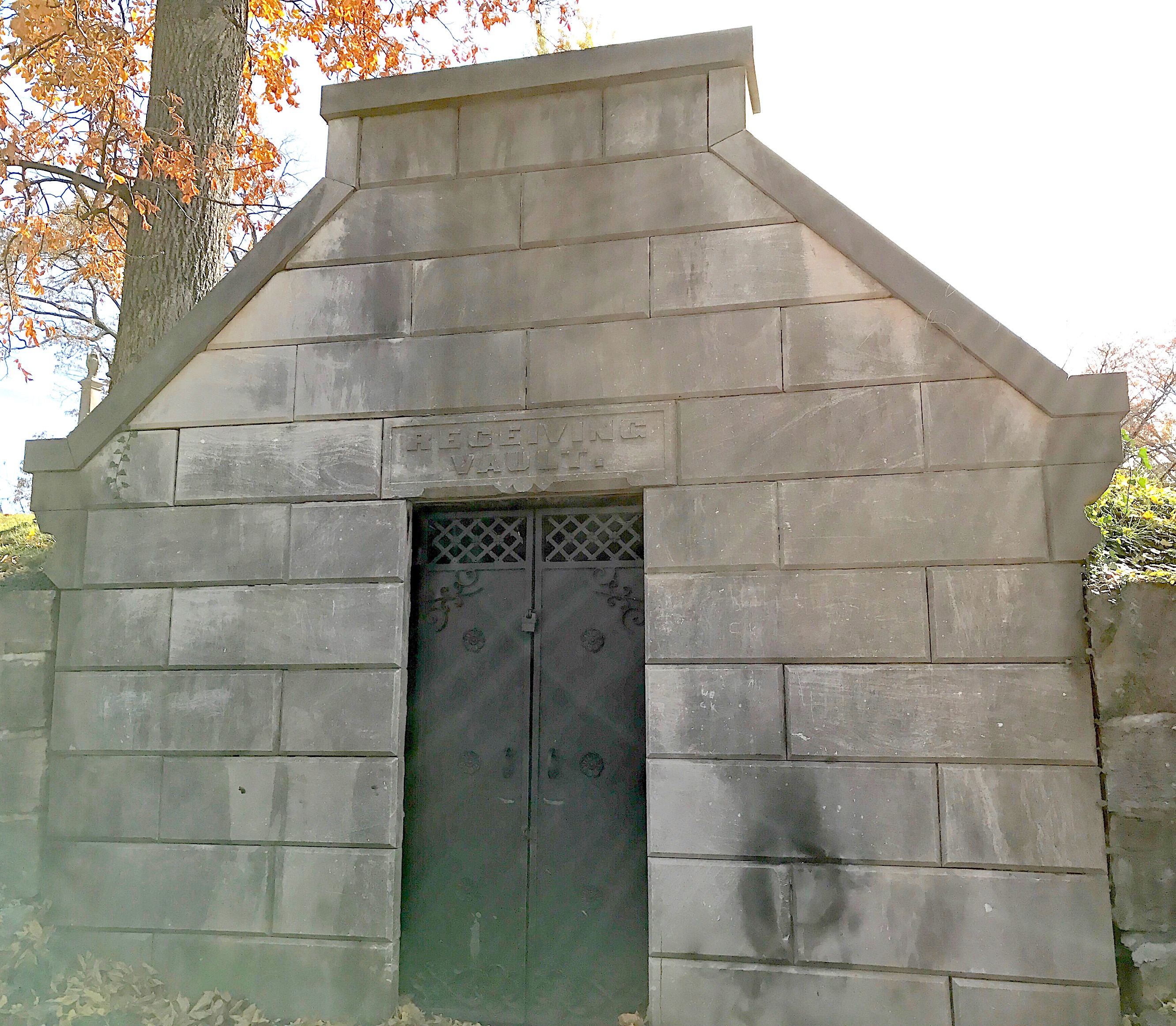
One thing I neglected to mention earlier is that Old Gray Cemetery has a receiving vault. These storage areas were used to hold human remains before the advent of refrigeration. In the event there was a cold winter and the ground was too hard to dig, cemetery sextons would put coffins in a receiving vault until the weather improved. They’re much more common up North where winters are harsher. Nearby Greenwood Cemetery, however, has one as well.

I don’t know when the receiving tomb was built at Old Gray Cemetery. Many have the year inscribed on them, but this one does not.

Tennessee Governor William “Parson” Gannaway Brownlow’s family plot features a large obelisk. Born in Virginia in 1805, William Brownlow’s parents died when he was 11.  Brownlow spent the rest of his childhood on his uncle John Gannaway’s farm. At 18, he learned carpentry from another uncle, George Winniford.

From Carpenter to Fighting Parson

After attending a camp meeting, Brownlow gave up carpentry and studied to become a Methodist minister. He spent the next 10 years traveling Southern Appalachia on horseback competing for converts with ministers from the Baptist, Presbyterian, and other Methodist churches.

Brownlow could be combative with his fellow circuit preachers if they didn’t see eye to eye. In 1831, Brownlow was sued for libel by a Baptist preacher, and ordered to pay his accuser $5. He was well on his way to earning the moniker “The Fighting Parson.”

William Brownlow started out as a traveling Methodist minister but went on to become governor of Tennessee.

Brownlow quit the circuit shortly after marrying Eliza Ann O’Brien in 1836 in Carter County, Tenn. It was at this time he began getting involved in journalism and politics. In 1845, Brownlow ran against Andrew Johnson for the state’s First District seat in the U.S. House of Representatives. He accused Johnson of being illegitimate, suggested Johnson’s relatives were murderers and thieves, and stated that Johnson was an atheist. Johnson won the election by 1,300 votes, out of just over 10,000 votes cast.

Freed Tennessee’s Slaves

Brownlow was appointed by President Millard Fillmore to carry out congressional provisions in 1850 and as a journalist he established The Whig newspaper in Knoxville. He also became an agent for the U.S. Treasury. As the Civil War was ending in early 1865, he (with Tennessee Unionists ) created their own Constitutional Convention and proceeded to free the state’s slaves.

William Brownlow and his wife, Eliza, had seven children together.

In April 1865, Brownlow was elected the 17th Governor of Tennessee. While in office, he worked on the state’s reconstruction, ruling with a stern hand. The emerging Ku Klux Klan marked him as one of their greatest enemies but Brownlow brushed off their threats.

Running For Senate

Following re-election in 1867, Brownlow chose not to seek a third term but successfully sought the U.S. Senate seat being vacated by David T. Patterson, Andrew Johnson’s son-in-law, in 1869. By the time he was sworn in on March 4, 1869, a persistent nervous disease had weakened him considerably, and the Senate clerk had to read his speeches.

After finishing his term in the Senate in 1875, Brownlow returned to Knoxville and was a partner in establishing the Weekly Whig and Chronicle newspaper. He died at age 71, cause of death being listed as “paralysis of the bowels”. Eliza lived until the age of 96, dying in 1914.

Lady With a Rifle

Their daughter, Susan Brownlow Sawyers (1837-1913), caused a stir thanks to a story in an 1861 issue of Harper’s Weekly. Susan was a young widow, her husband Dr. James Sawyers having died only four months before the death of their daughter, Lillie, in 1858. Susan and Lillie were living with her parents when the incident took place.

A depiction of Susan Brownlow, daughter of pro-Union newspaper editor William G. Brownlow. In 1861, Confederate soldiers threatened to take down the American flag flying over the Brownlow home on East Cumberland Avenue in Knoxville.

According to the story in Harper’s:

When a mob of secessionists attacked her father’s house in his absence and insisted on the Union flag being hauled down from where it floated, this young lady seized a rifle and told them she would defend it with her life. The first who approached would be shot. They threatened her for some time, and tried in every way to frighten her. But she was firm, and after a time the ruffians withdrew, leaving the flag still flying.

Susan remarried to Dr. Daniel Boynton in 1865 and they had several children. She died in 1913. Both she and Dr. Boynton are buried in the Brownlow plot at Old Gray.

Henry Marshall Ashby’s marker got my attention because it looked like he had died in his 30s. The cause of it was not a lingering war wound but the explosive end to a simmering feud.

Col. Henry Ashby did not die in battle but he did meet his end at the hand of an enemy.

Born in Virginia in 1836, Ashby attended the College of William and Mary but never graduated. He worked as a trader in Chattanooga but was visiting his uncle in Knoxville when the war began.

Elected Colonel of the Regiment

After enlisting in the Confederate Army, Ashby’s company was assigned to the 4th Tennessee Cavalry Battalion which became part of the 2nd Tennessee Cavalry Regiment. Ashby was elected colonel of the regiment on May 24, 1862. The 2nd Tennessee Cavalry operated in East Tennessee in 1862 and 1863, usually in the brigade of Brigadier General John Pegram. Ashby was wounded during one of three raids into Kentucky made by his regiment during 1862.

Ashby was present at many strategic battles during the war, including Stones River (Tenn.), Brown’s Mill and Chickamauga (Ga.), and Monroe’s Crossroads (N.C.). Ashby actually had his horse shot out from under him at Monroe’s Crossroads. Although sometimes referred to as an acting brigadier general, Ashby ended the war as a colonel. After a visit to New York, he returned to Knoxville.

Bitter Enemies Clash

Union Major Eldad Camp had a score to settle with Ashby. During the war, a number of Camp’s men were held as prisoners of war under Ashby. Camp felt they had been treated abominably in atrocious conditions and held Ashby personally responsible. After the war, Camp pressed charges of war crimes and treason against him. Ashby fled Knoxville but returned when the charges were eventually dropped in June 1868.

Attorney E.C. Camp was determined to make Col. Henry pay for how he treated Camp’s men.

On July 9, 1868, Ashby encountered Camp on the street. Ashby hit Camp with his cane while Camp fought back with an umbrella. The following day, Ashby appeared at Camp’s law office near the corner of Walnut and Main Streets. The two went outside where Camp drew his revolver and fired. Henry Ashby was hit in the chest and killed.

Col. Henry Ashby was in his early 30s when he was killed by E.C. Camp.

While Camp was arrested and charged with murder, all charges were dropped. In examining the various newspaper accounts, the spin put on the event depending on the affiliation of the owner/editor is telling. As you can imagine, Confederate papers tended to support Ashby while those with Union leanings proclaimed Camp an innocent victim acting in self defense.

E.C. Camp went on to a successful business career, building Greystone Mansion. It still stands today as the studios of TV station WATE-TV. He died in his 80s and is buried within sight of Ashby’s grave at Old Gray Cemetery.

There’s one last stone that I wanted to share for a man that’s not even buried at Old Gray. His marker is a cenotaph. But the story of his life is worth reading.

From Knoxville to Korea

Born in Derbyshire, England in 1856, Heron was the son of the Rev. E. S. Heron, a minister of the Congregational Church, and Elizabeth Ayrton Heron. The Herons came to America in 1870 when John was 14. In 1881, he was admitted to the University of Tennessee Medical School and graduated in 1883.

After training at New York University Hospital, he refused the offer of a professorship from the University of Tennessee but instead became a medical missionary (sponsored by the U.S. Presbyterian Church) to Korea. He married Harriet “Hattie” Gibson shortly before he left and she accompanied him.

Dr. John W. Heron turned down a professorship at the University of Tennessee Medical School to serve as a missionary to Korea.

The Herons arrived in Seoul on June 1885 and John started work in Royal Government Hospital, Chejungwon. In 1887, he became the superintendent of the hospital. He also worked for the royal family while still traveling to rural areas to care for patients. He started Chejungwon Church, which later became Namdaemoon Presbyterian Church. He and Harriet had two daughters in Korea, Sarah and Jessie.

Dr. John Heron is not buried at Old Gray Cemetery but in Seoul, Korea where he died in 1890.

In the summer of 1890, Dr. Heron treated the sick and suffering amid epidemic dysentery and became infected himself. He died on July 26, 1890. Dr. Heron is thought to be the first medical missionary sent to Korea by the U.S. Presbyterian Church and was buried at Yanghwajin Foreign Missionary Center in Seoul.

Hattie married Canadian missionary James Gale in Korea in 1892. She died in 1908 and is buried with her first husband in Seoul.

The Rev. E.S. Heron died of cancer in 1888 in Knoxville and I found a record of Elizabeth’s death in September 1898. I’m not sure who erected this cenotaph to Dr. Heron but it was probably Elizabeth or one of Dr. Heron’s siblings. Neither of his parents have a stone at Old Gray Cemetery but their graves may be unmarked.

I could have written much more, but I’ll leave those nuggets of history for others to write about. Old Gray Cemetery has many of them and I’m happy to have shared just a few.

Epitaph to Helen Gibson Brownlee (1862-1949) at the foot of the Gibson obelisk. It is from the poem “Life” by Anna Laetitia Barbauld.

More Tales From The Marble City: Discovering Knoxville’s Old Gray Cemetery, Part III

26 Friday Apr 2019

Posted by adventuresincemeteryhopping in General

≈ 2 Comments

Are you back for more stories from Old Gray Cemetery?

Let’s start with Lazarus Clark (L.C.) Shepard, who is thought to have been Knoxville’s first embalmer and undertaker. With a name like Lazarus (whom Jesus brought back to life from the dead in the Bible), perhaps it was inevitable that he ended up with that career.

A native of Connecticut born in 1816, Shepard spent the first 30 or so years of his life in that state. L.C. learned woodworking from his father. He married Emily Strong in 1837 in Bridgeport, Conn. It wasn’t until around 1854, after the Shepards had their four children (the last one died in childhood), that they moved to Knoxville.

Once in Tennessee, L.C. opened a furniture store but it burned four years later. For the next nine years, he worked as foreman of the rail car building department for the East Tennessee, Virginia and Georgia (E.T.V. & G) Railway, which had just extended its lines to Knoxville.

Conducted a President’s Funeral

In 1867, L.C. went back into the furniture business, adding to this a plant for the manufacture of coffins. Furniture stores often sold coffins in this era before funeral homes. At some point, L.C. trained to be an embalmer. This training became popular during and shortly during the Civil War when preserving the bodies of dead soldiers for shipment home became critical.

L.C. became Knoxville’s first resident undertaker and conducted the funeral of President Andrew Johnson in Greeneville, Tenn, in 1875. I don’t know how he was bestowed with the honor but it was probably because Knoxville, 70 miles away, was the nearest city with an embalmer/undertaker.

An 1871 Knoxville Chronicle advertisement for L.C. Shepard’s business. The ad extols his use of Taylor’s Patent Corpse Preserver.

In 1884, L.C. joined Edward Mann and Thomas Johnson to form Knoxville’s first formal undertaking establishment, Mann & Johnson. In 1892, the firm became known as E.B. Mann Undertaking Company. Today, it’s known as Rose Mortuary. L.C. was also a charter member of the first IOOF (Independent Order of Odd Fellows) lodge instituted in Knoxville, was three times an alderman of the seventh ward, and a trustee of the Tennessee School for the Deaf and Dumb.

The Shepard monument is the only white bronze (zinc) marker in Old Gray Cemetery.

Emily Shepard was active in Knoxville society, and had a heart for the down and out. She helped establish the Industrial Home for Youths, which three years after her death became St. John’s Orphanage. Emily died of cancer in 1882 at the age of 68. The Rev. Thomas W. Humes, whom I wrote about in Part I, was one of her pallbearers.

Clients could custom order what they wanted on the plates of their white bronze monument from a catalog.

The story behind the decline of L.C. Shepard is unclear but his obituary states that in later life, he made a bad business investment and never engaged in business after that. Ads for the business were still appearing in newspapers in the 1880s, however. Notice of his death in The Tennessean said he died a pauper. After a fall in 1900, L.C.’s last few years were spent at Knoxville City Hospital, where he received many visitors. He died on Feb. 15, 1902 at the age of 85.

A Secret Hiding Place?

I’m not surprised that the Shepards have a white bronze (zinc) marker, the only one at Old Gray Cemetery. They were much cheaper than granite or marble markers. As a funeral director, L.C. would have been very familiar with them and possibly ordered it himself when Emily died in 1882. All that had to be done after his death was to add a panel with his own birth and death dates.

Did bootleggers hide illegal booze in Shepard’s monument?

Legend has it that the hollow monument (all of them were) was a drop-off point for bootleg liquor during Prohibition. The panel shown here supposedly served as the entry point to a secret compartment for alcohol and monetary exchanges. Rust over the decades has permanently sealed the metal door.

Mind you, this kind of thing has been said about many white bronze monuments over the years, but has rarely been proven. However, the rusting of the panel suggests is just might have been tampered with over the years. This kind of rust is something I’ve rarely seen on these markers. So maybe the rumor is true in this case.

I could not write a complete story about Old Gray without telling the story of the Horne brothers, who were Confederate soldiers during the Civil War. You can’t pass their nearly life-size monument without stopping.

Brothers in Arms

Born in 1843 in Tennessee, John Fletcher Horne was the middle of the three children of the Rev. George Horne and Amanda Luttrell Horne. His sister, Margaret, was born in 1836. Younger brother, William, was born in 1845.

It is unknown who paid for the monument for the Horne brothers as both parents died before they did.

John served as a sergeant with the Kain’s Battery Tennessee Light Artillery. Younger brother, William, was an assistant quartermaster with the 42nd Georgia Infantry. Both brothers returned to Knoxville after the war. John never married and worked as a merchant for the rest of his life. William married Catherine Kelso in 1872 and they had four children. Both brothers worked together as J.F. Horne & Son Liquor Distributors in later years.

William died in 1891 at the age of 46 from typhoid fever. His wife, Catherine, died in 1897 of a “uterine hemorrhage” died at 51. Their son, Henry, had died at age 12 in 1889. All three are buried together at Old Gray Cemetery.

It is unknown if either Horne brother resembled the soldier that marks their graves.

John Fletcher Horne never married and died in 1906 of cancer.

John died in 1906 of cancer. From what I can tell, he was popular among his fellow veterans and was instrumental in organizing Confederate reunions. It was perhaps his fellow brothers in arms that helped in getting the monument made and placed at the cemetery. It is not something I see often on an individual soldier’s, or in this case soldiers’, grave site.

There’s an interesting footnote to this one. The Horne statue stands with his back to the massive Union Soldiers Tower next door at Knoxville National Cemetery. A few articles I read stated that family of the Horne brothers or the Horne brothers themselves insisted that any monument erected in their honor must have its back to the Union Soldiers Tower. Since it wasn’t constructed until 1901 and he died in 1891, I doubt William had a say in the matter. John, who died in 1906, might have but the truth is unknown.

The Marble City

I didn’t know until researching Old Gray that Knoxville was known as the Marble City in the 1800s. Its quarries provided an ample supply of Tennessee Marble, a highly polishable pinkish gray stone. You can find Tennessee Marble in famous buildings such as the J.P. Morgan Library in New York and the National Gallery of Art in Washington, D.C.

Frank S. Mead is on the left. He was the first president of the Ross Marble Company.
(Photo source: McClung Historical Collection)

According to an article by Paul James, the Ross Marble Company paid for land next to what would become the Ijams Bird Sanctuary and opened up a quarry to extract Tennessee Marble. The site later became locally known as Mead’s Quarry in honor of Frank S. Mead, the company’s first president. He was also owned the Republic Marble Company (at times known as Ross and Republic Marble Co.), which produced grave markers and monuments.

A Quarry Transformed

By the Great Depression, however, demand for the Tennessee Marble plunged and quarrying operations everywhere felt the pinch. Switching to gravel and limestone production, both Ross and Mead’s quarries survived for several decades. By 1978, both were defunct and, particularly Mead’s Quarry, became illegal dump sites.

Arthur Mead worked closely with his brother, Frank, at the Republic Marble Company. He died from injuries he sustained in February 1895 when the sled he and his friends were riding struck a tree.

After thousands of volunteer cleanup hours and the dedication of Ijams park staff, the Ross and Mead quarries have expanded Ijams and jumpstarted Knoxville’s Urban Wilderness, created by Legacy Parks Foundation. The Foundation has over 40 miles of trails within South Knoxville alone. Apparently there are also two cemeteries within the area that I need to explore.

Many of the markers at Old Gray came from stone mined out of Frank S. Mead’s quarry.

Mead’s Quarry was the source for grave markers and monuments in Knoxville cemeteries. The Mead family monument, a large Celtic cross, was sculpted by Knoxville’s David H. Geddes, who owned the Knoxville Monument Works.

It was erected when Frank Mead’s older brother, Arthur, died in a tragic sledding accident on Feb. 6, 1895. He was only 33. He and Frank had worked together in managing the Republic Marble Company. Frank S. Mead was 71 when he died in 1936 of a cerebral hemorrhage.

We’re not quite done at Old Gray. Stay tuned for more in Part IV.

Twas the Dreamer Who Knew God’s Face: Discovering Knoxville’s Old Gray Cemetery, Part II

19 Friday Apr 2019

Posted by adventuresincemeteryhopping in General

≈ 2 Comments

Last week, we spent some time at Knoxville’s Old Gray Cemetery. But there are too many stories worth sharing to limit to just one post. So let’s move on to Part II.

If you spend any time reading my blog, you’ll find many stories about women who died young. It was simply how it was before the advent of antibiotics, nutritional awareness and sanitary conditions. As I started looking into the lives of some of the ladies buried at Old Gray, the sad stories accumulated all too quickly.

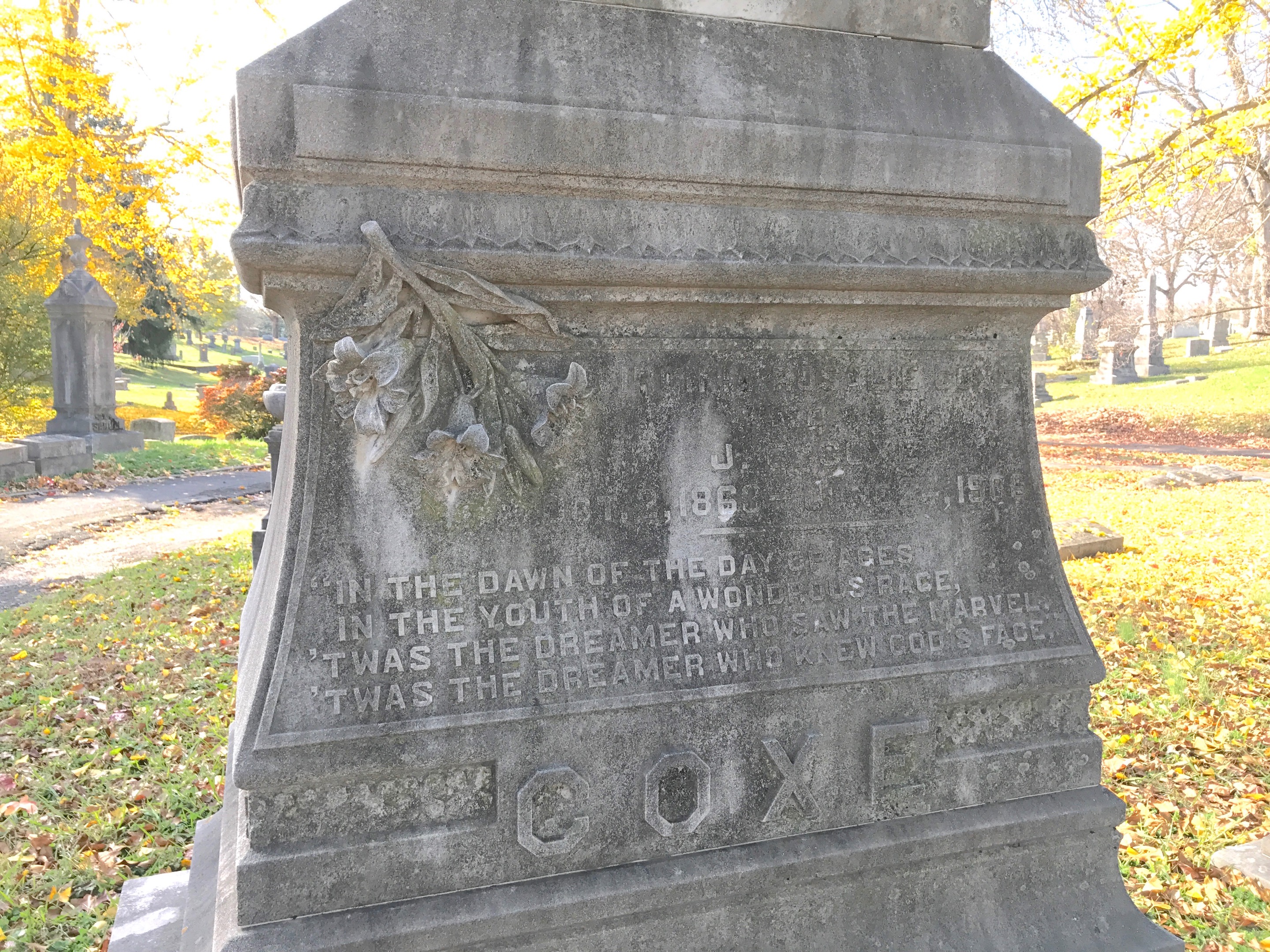
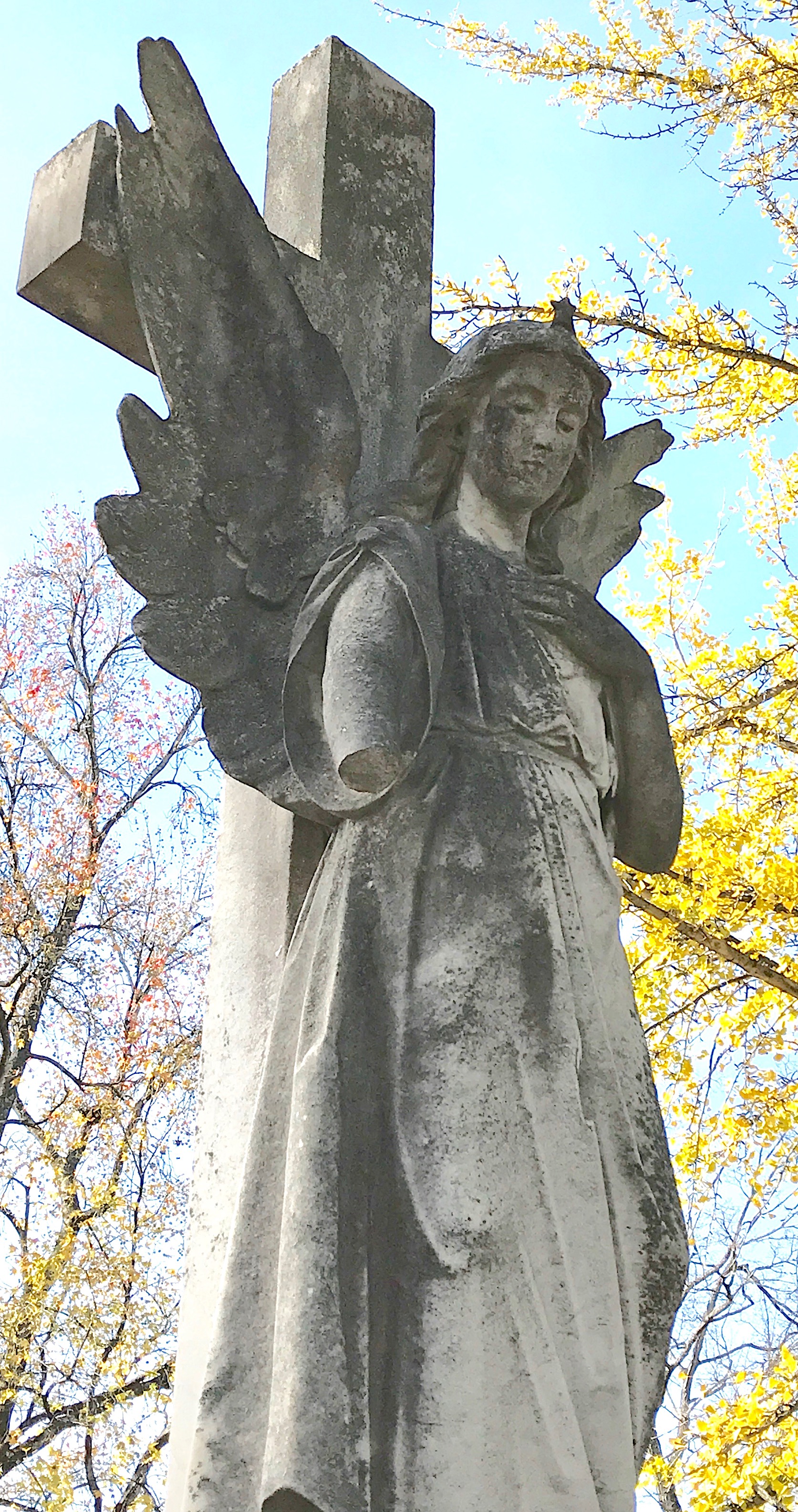
It’s hard to miss the monument for Virginia Rosalie Coxe. The angel standing in front of the cross is missing part of her arm, but is relatively intact. As you can see, her name is almost worn off of the base. But the lines below it are still there:

In the dawn of the day of ages
in the youth of a wondrous race,
’twas the dreamer who saw the marvel,
‘Twas the dreamer who knew God’s face.

It’s possible Virginia’s epitaph is from one of her own poems.

Born in Virginia in 1863, Virginia “Jennie” Rosalie Michie was supposedly educated at Atlanta’s Gate City High School. However, it’s an institution I can find no information about. I think the reporter meant Girls’ High School, which was known for its academic excellence. It was in Atlanta where I believe Jennie met her future husband, Joseph Coxe. They married there in 1882. Coxe is described in one newspaper as “an eccentric coal baron” from North Carolina. Nevertheless, the couple was quite wealthy.

Virginia Rosalie Coxe was best known for her romantic novel, The Embassy Ball.

Joseph and Jennie lived in New Jersey and Philadelphia before moving to Knoxville. They had two children, Annie and Rosalie. Annie died in childhood but Rosalie would live well into adulthood, marrying and having children.

The Danielle Steele of the 1890s

The Coxes traveled a great deal and moved in society circles, even living in Spain for some time. But Jennie’s greatest pleasure came from authoring romantic stories under nommes de plume such as Percy Thorpe and Virginia Jerome. It was under the latter that she published the novel Princess Beelzebub. She also enjoyed writing poems, short stories, and songs.

Joseph may have initially balked at the idea of having a popular author for a wife, but eventually Jennie wrote under her own name. It was her book The Embassy Ball, published in 1898, that she is most remembered for. From the articles I read, reporters considered her a good interview and women enjoyed settling down with one of her novels. I’d compare her to a Danielle Steele or a Nora Roberts for the 1890s.

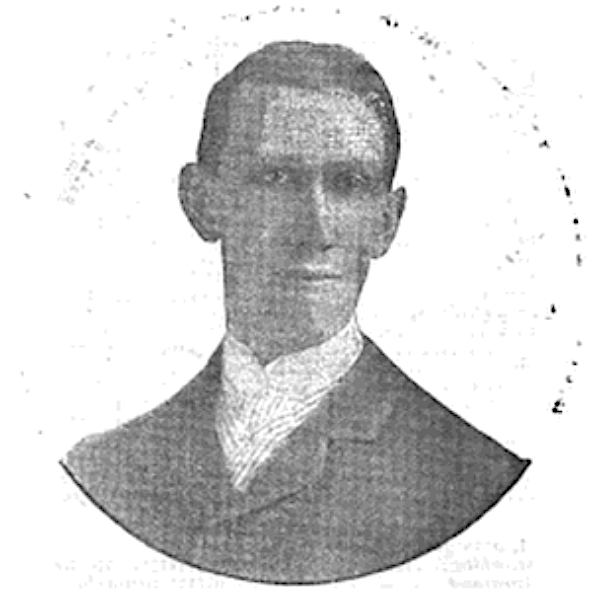
Artist’s drawing of Virginia “Jennie” Rosalie Coxe that appeared in the Atlanta Constitution.

A 1901 article in the Nashville-based Tennesseean newspaper describes her elegant Knoxville home Crescent Bluff as having an Italian rose garden overlooking a river. The Coxes hosted many parties there. I also found an advertisement in a Knoxville-based gardening magazine touting a new hybrid tea rose from the Dingee & Conrad Co. that was named after her.

Virginia Rosalie Coxe was only 44 when she died in 1906.

Jennie and Joseph saw their daughter, Rosalie, married to Daniel Hull in 1904 in a lavish wedding at Crescent Bluff. Sadly, Jennie died of Bright’s disease on June 24, 1908 at Crescent Bluff. She was 44 years old.

What Was Bright’s Disease?

Bright’s disease was a catch-all term for several kidney-related disorders, most often what we now call nephritis. The symptoms and signs of Bright’s disease were first described in 1827 by the English physician Richard Bright, for whom the disease was named. Today, nephritis is much easier to treat and not always fatal as it could be in the 1800s. President Woodrow Wilson’s first wife, Ellen Axson Wilson, died in 1914 of Bright’s disease when she was 54.

In 1911, Crescent Bluff, the home where Jennie entertained and lovingly tended her garden, was totally destroyed by fire.

Joseph did not remarry but traveled, spending much of his final years in Italy. He died of pneumonia in 1923 while in Lucerne, Switzerland. Records indicate his body was embalmed and placed in a vault awaiting burial instructions. I haven’t found anything to indicate what happened to him after that. Daughter Rosalie died in 1978 and is buried at Laurel Grove Cemetery in Savannah, Ga.

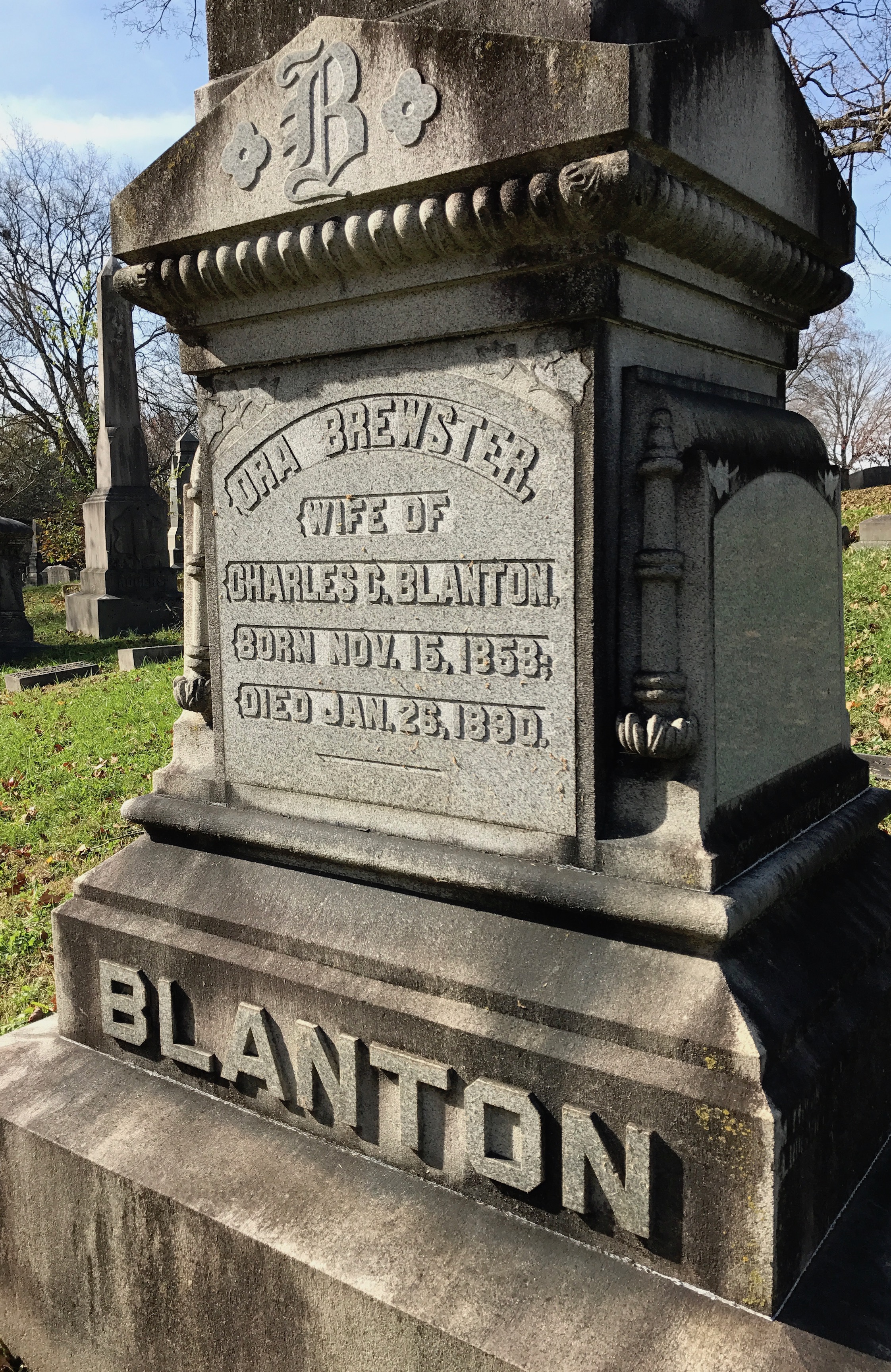
Much less is known about a woman buried near Jennie. But the monument for Ora Brewster Blanton got me looking into what her story might be.

The upside down torches on the base of Ora Brewster Blanton’s monument signifies death or a life extinguished.

Ora Brewater was born in 1858 in Sweetwater, Tenn. It appears her father died when she was a child, leaving her mother to raise her and her two sisters (one died in childhood and the other at age 30). Ora likely had to work to support her family. Ora eventually moved to Shelby, N.C. to teach music at the Shelby Female Academy.

Death After Surgery

It was in Sheby that Ora met Charles Coleman Blanton, a hardware/dry goods merchant from a prominent family. They married in Monroe, Tenn. in 1885 and moved to Meridian, Texas where Charles worked in the banking business. There are no records indicating they had any children.

Ora died only five years later in 1890 shortly after undergoing an operation. I don’t know what it was for. Her body was sent back to Knoxville for burial at Old Gray Cemetery, where her mother and her sister, Vallie, are also buried.

The statue for Ora Blanton’s monument stands next to a cross on a rock.

In 1895, Charles returned to North Carolina to work with his father and brother at the First National Bank of Shelby. Charles never remarried, becoming a prominent business leader in Shelby and active community member until his death in 1944. He is buried in Shelby’s Sunset Cemetery, where over 100 Blantons are listed.

Joe DePriest’s book about the Banker’s House in Shelby, where Charles Blanton grew up and I believe returned to after Ora’s death, had the only information I could find on Ora’s life. It’s included on the Banker’s House website. Joe and I have swapped emails and I appreciated his help very much.

The Death of Two Wives

Next to Ora Blanton is the monument to Frank Atkin and his two wives, Rosa and Lida. Frank’s brother, Clay Brown “C.B.” Atkin, was a major mover and shaker in Knoxville’s downtown development. He owned and operated several hotels, the jewel in the crown being Hotel Atkin. He was also instrumental in the Tennessee Theater’s establishment. Frank helped his brother in his many business ventures in a less public role.

Rosa was only 33 when she died on tuberculosis.

Born in 1863 to Samuel and Nancy Ault Atkin, Frank married Rosa Estelle Ault (I am guessing they were cousins) in 1884 in Knoxville. They had one son, Frank Jr., in 1885, and a daughter, Lillian, in 1889. Rose died on Nov. 1, 1890 of consumption, now known as tuberculosis.

In today’s world, tuberculosis is preventable and very treatable, with a death rate of only 10 percent. People with compromised immune systems who contract it are most at risk of death. But at the start of the 19th century, tuberculosis was a serious threat to life. It took the discovery of the tuberculosis bacteria by Robert Koch in 1882 for that to start to change. Even then, developing effective treatment would not come for another 50 years.

Frank remarried in 1893 to stenographer Lida Coffin in Hamilton County, Ohio. Lida died on June 1, 1895 of “puerperal peritonitis” or “childbed fever” shortly after giving birth. She was only 27 years old.

“Childbed Fever” Strikes

“Puerperal peritonitis” haunted women for centuries, often striking a few days after childbirth. Unsanitary conditions played a large role in causing these infections and there were no antibiotics yet to treat them after it occurred. It’s surprising to think that once upon a time, a doctor might drag on the same dirty clothes he wore the night before to deliver another child with unclean instruments, but it happened.

In 1903, Frank married a third time to a woman named Lucille. She was 22 and he was 42, making her only a few years older than his daughter, Lillian. I could not find a record of their marriage but they are listed as such on the 1910 Census. Frank died in October 1910 and records state the cause of death was “general breakdown”. He is buried at Old Gray with Rosa and Lida.

The Atkin statue was holding a colorful bouquet of poinsettias along with her wreath when we were there.

Both of Frank’s children, Frank Jr. and Lillian, lived long lives. Lillian is buried at Old Gray with her parents while Frank Jr. is buried with his wife, Robbie Atkin, at Berry Highland Memorial Cemetery in Knoxville. I don’t know what happened to third wife, Lillian Atkin, but I suspect she remarried.

I have more tales from Old Gray yet to share, so come back for Part III.

The Passing Tribute of a Sigh: Discovering Knoxville’s Old Gray Cemetery, Part I

12 Friday Apr 2019

Posted by adventuresincemeteryhopping in General

≈ 1 Comment

Yet ev’n these bones from insult to protect,
         Some frail memorial still erected nigh,
With uncouth rhymes and shapeless sculpture deck’d,
         Implores the passing tribute of a sigh.

— Thomas Gray, “Elegy Written in a Country Churchyard”, 1750

Last week, I visited Tennessee’s Knoxville National Cemetery and shared the story of the Union Soldiers Tower. Next door is Old Gray Cemetery which is a little older and a bit bigger than KNC.

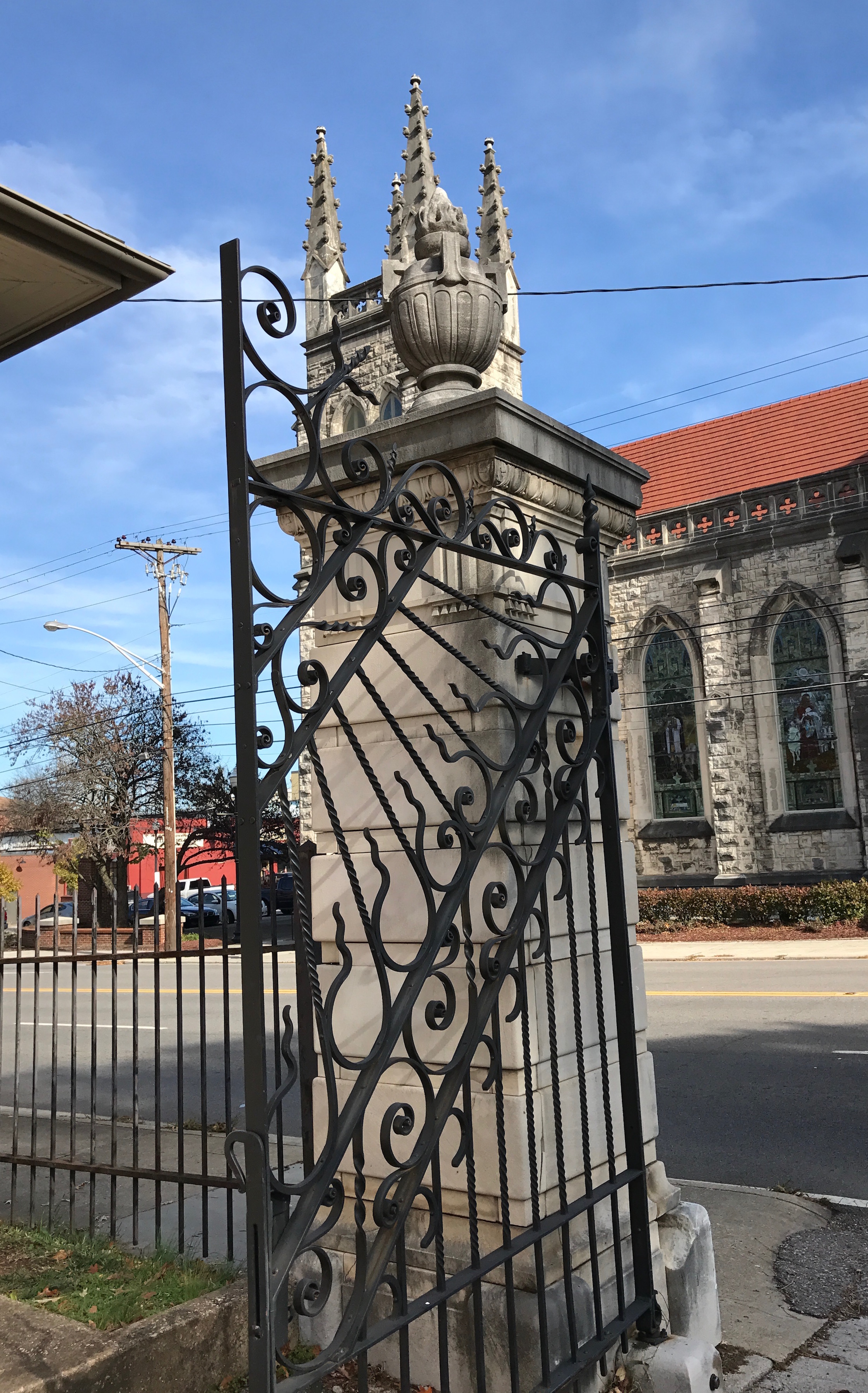
One of the gates at Old Gray Cemetery. Across the street is St. John’s Lutheran Church.

Once used as pastureland just outside Knoxville’s city limits, the land that became Old Gray Cemetery was considered ideal for a suburban cemetery. The first parcel was purchased in December 1849, and landscape architect Frederick Douglass was hired to come up with a ground plan. Founded in 1850 and dedicated in 1852, it was called Gray Cemetery until 1892 when New Gray Cemetery opened about a mile away. Old Gray now covers almost 14 acres.

Named After a Famous Poem

Old Gray Cemetery got its name from Thomas Gray (1716-1771), the English poet who wrote the poem “Elegy Written in a Country Churchyard” in 1750. It was suggested by Henrietta Brown Reese, wife of Judge William B. Reese. He was Old Gray’s first board of trustees president.

Historical marker at Old Gray Cemetery, founded in 1850. It’s the second oldest cemetery in Knoxville.

Many of Old Gray’s first burials were victims of Knoxville’s 1854 cholera epidemic. The cemetery also contains several victims of the New Market train wreck of 1904. The tragedy occurred when two Southern Railway passenger trains collided head on near New Market, Tenn. on Sat., Sept. 24, 1904, killing at least 56 passengers and crew and injuring 106.

The area around Old Gray (and KNC) is home to a large homeless population, many of whom come to the Salvation Army Center nearby. A number were living under the Broadway overpass in 2017 but a 2018 article detailed the city’s plan to turn that area into a “day park” for the homeless so that may have changed things.

Road into Old Gray Cemetery from front gates.

When Sean and I were there, we saw a few homeless men quietly eating their lunch in the cemetery. Elsewhere, some college students were sunning themselves on blankets, enjoying the unusually warm weather for November and what was left of the colorful autumn leaves.

One of the first graves inside the cemetery gates is a slab gravestone for the Rev. Thomas William Humes, first president of the University of Tennessee (under that name). First known as Blount College, it opened in 1794 with the Rev. Samuel Carrick as president.

A Journalist, Lawyer, and Minister

Humes graduated from East Tennessee College (what the University of Tennessee was called at that time) in 1831, and obtained his master’s degree there two years later. He entered Princeton Theological Seminary to become a Presbyterian minister, but left after deciding he could not take the Westminster Confession of Faith.

During the late 1830s and early 1840s, Thomas William Humes worked as editor of the Knoxville Times, the Knoxville Register, and a Whig Party paper, The Watch Tower.

Back in Knoxville in the mid-1840s, Humes  studied under Tennessee’s Episcopal Bishop James Otey. In July 1845, Humes was ordained a priest by Bishop Otey, and in September 1846, Knoxville’s St. John’s Episcopal Church congregation elected him rector.

Although Rev. Humes had owned slaves, he helped several slaves in Knoxville purchase their freedom during the late 1840s and 1850s. He also opened a school for Knoxville’s free blacks and freed slaves. During the secession crisis of 1860 and 1861, Humes stayed loyal to the Union, despite the fact many relatives and most of his congregation supported secession. After he refused to acknowledge Confederate president Jefferson Davis’s National Day of Prayer in 1861, Rev. Humes resigned as rector.

When General Ambrose Burnside’s Union forces occupied Knoxville in September 1863, Burnside asked Rev. Humes to resume his position at St. John’s and he agreed. St. John’s member and Confederate diarist Ellen Renshaw House boycotted Rev. Humes’s opening sermon, calling Humes “the grandest old rascal that ever was.”

In 1865, Rev. Humes became president of then-East Tennessee University and secured an $18,500 federal grant to help restore the school’s deteriorated campus, occupied by both Union and Confederate armies during the war. In 1869, Tennessee’s state government designated the school the recipient of the state’s Morrill Act (land grant) funds. This amounted to $400,000, which generated for the school $24,000 in annual interest.

The Rev. Thomas William Humes was president of East Tennessee University, which became the University of Tennessee in 1879.

In 1879, East Tennessee University changed its name a final time to the University of Tennessee. Rev. Humes resigned as president in 1883, and was succeeded by Charles Dabney in 1884. In later years, Rev. Humes helped raise funds for educational and economic development in East Tennessee. He died on January 16, 1892.

Avowed Unionist with Shifting Loyalties

Across the drive, you can see monuments and a bench for the Maynard family. Horace Maynard was another East Tennessean loyal to the Union, despite the fact his views seemed to flip flop depending on the times.

Born in 1814 in Westboro, Mass., Maynard graduated from Amherst College in 1838 and came to East Tennessee College to teach. Maynard also studied law. Admitted to the Bar, he began practicing in 1844.

Maynard also involved himself in politics. Unsuccessful in his first bid for national office in 1853, he was elected to the U. S. House of Representatives in 1857. He was re-elected twice and served until Tennessee seceded from the Union. He went on to serve as the Attorney General of Tennessee (1863-1865) and as a delegate to the Southern Loyalist Convention in Philadelphia (1866).

Elected to the House of Representatives from Tennessee’s 2nd Congressional District in 1857, Maynard became one of the few Southern congressmen to maintain his seat in the House during the Civil War.

Maynard’s views on slavery reflected shifting sentiments common among East Tennessee Unionists. During the 1830s, Maynard, the son of an abolitionist, called slavery “a curse to the country.” But by 1850, Maynard was defending the practice of slavery in letters to his father. In 1860, Maynard owned four slaves, and while he opposed secession as a congressman, he still defended slavery. Toward the end of the Civil War, Maynard again adopted an abolitionist viewpoint, and supported Lincoln’s Emancipation Proclamation.

Horace Maynard successfully defended the creation of Union County, Tenn. from a challenge from Knox County. Grateful residents renamed the Liberty community Maynardsville to show their appreciation.

After Tennessee was readmitted to the Union, Maynard was again elected to the U. S. House of Representatives and served until 1875. He then campaigned unsuccessfully for the governorship of Tennessee. President Ulysses S. Grant appointed him U. S. Ambassador to Turkey in 1875, where he remained until May 1880. President Rutherford B. Hayes appointed him Postmaster General in June 1880 and he served until 1881. Horace Maynard died in Knoxville on May 3, 1882.
Horace Maynard’s son, James, is buried to his left of his father.

Horace Maynard and his wife, Laura Ann, had seven children together. During the Spanish–American War, the USS Nashville, commanded by their son, Washburn, fired the war’s first American shot. Eldest son Edward, who is buried near his parents at Old Gray, has a tragic story worth mentioning.

Tintype of Edward Maynard, who survived the Civil War but died in 1868 of yellow fever.

Death in the Caribbean

Born in Knoxville in 1843, Edward Maynard was attending Eastern Tennessee University when the Civil War broke out. His studies were abruptly curtailed, as he and his fellow students chose up sides and left to enlist.

Soon after joining the Union’s 6th Tennessee Volunteer Infantry, Edward was promoted to lieutenant colonel and attached to the 23rd Army Corps. Maynard’s regiment was at the Battle of Murfreesboro, engaged the enemy near Lost Mountain, Ga. in June 1864 and took part in the Battle of Nashville. He escaped unscathed and mustered out in March 1865.

After the war, Edward held a minor position in the secretary of state’s office in Nashville. In May 1866, he became consul to the Turks Island, at the time a British-held island north of Cuba and Hispaniola. Unfortunately, his two years in the tropics ended tragically.

Edward Maynard’s monument is a shortened column, indicating a life cut short.

On January 10, 1868, Edward Maynard died of Yellow Fever. His family did not receive news of his death until Feb. 7, 1868.

The Short Life of Lillien Gaines

Finally, I’d like to share the story of a monument that I saw from some distance and made certain I got a look at soon after we arrived.

Born in Savannah in 1868, Lillien Gaines was the daughter of Confederate Col. James L. Gaines and Belle Porter Gaines. A native of Knoxville, Col. Gaines was wounded at the Battle of Five Forks and lost his arm in the last days of the Civil War. He was already engaged to Missouri native Belle Porter. According to one account I read, Col. Gaines offered to release her from their engagement due to his “mutilation and poverty” but that she married him anyway.

Lillien Gaines was only seven years old when she died in 1876.

After marrying on Nov. 22, 1865, Col. Gaines and Belle moved to New York where son Ambrose was born in 1866. They then moved to Savannah, where Lillien was born. They later moved to Knoxville where Col. Gaines was elected comptroller in 1875 and the family moved yet again to Nashville.

Lillien spent most of her short life in Knoxville.

The Gaines’ had only been in Nashville a short time when Lillien became ill. She died on April 29, 1876. While a Memphis newspaper reported she died of meningitis, Tennessee death records indicate she died of “paralysis of the lungs.” Her grieving parents brought her body back to Knoxville, where her father was born and Lillien had spent most of her short life.

Col. Gaines and Belle returned to Nashville where they had a third child, James, in 1878. Col. Gaines died in 1910 and Belle died in 1913. Both of them are buried next to Lillien.

There are many stories yet to share from Old Gray Cemetery in Part II.


Visiting Knoxville National Cemetery: The Story of the Union Soldiers Monument

05 Friday Apr 2019

Posted by adventuresincemeteryhopping in General

≈ 1 Comment

I’m leaving Nebraska behind for now and heading closer to home with a visit to Knoxville National Cemetery (KNC).

Would it surprise you to know that KNC is home to a 60-foot monument dedicated to Tennessee’s Union soldiers?

Before I dive into that, let me set the scene. My in-laws live in Knoxville and we visit them often. During Thanksgiving week of 2017, I knew I wanted to get over to KNC and Old Gray Cemetery, which are conveniently located right next to each other and share a stone wall border. So on a sunny fall day, I grabbed my son and we headed downtown.

Because we were visiting Old Gray as well, we spent less time at KNC than I would have liked. There were also some visitors at KNC that day that appeared to be sharing a quiet moment at a loved one’s grave and I did not want to disturb them with our presence.

According to Find a Grave.com, Knoxville National Cemetery has close to 9,000 recorded burials.

While Tennessee is a Southern state, it did not secede from the Union quickly or easily. In fact, it was the last state in the Union to leave it on June 8, 1861. In the state’s mountainous eastern section, few people owned slaves and voters opposed secession by more than 2-to-1.

As it turns out, Tennessee furnished more soldiers for the Confederate Army than any other state and more soldiers for the Union Army than any other Southern state. According to the Tennessee Encyclopedia, while Tennessee did send over 120,000 soldiers to fight for the Confederacy, over 31,000 men fought for the Union. While there’s quite a difference in those two numbers, it makes a Union monument in Knoxville not so unusual after all.

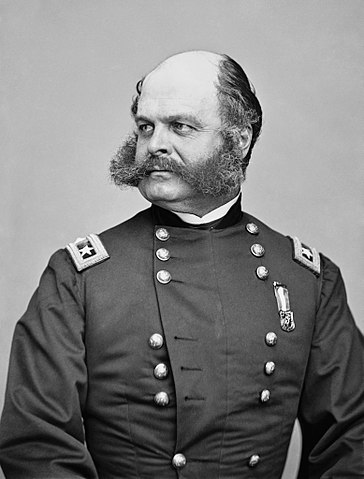
According to the cemetery web site, Union Major Gen. Ambrose E. Burnside established Knoxville National Cemetery during the Civil War after the siege of Knoxville and subsequent Battle of Fort Sanders on November 29, 1863. Unlike most Union commanders, while Burnside was an Indiana native, he had close ties to the South because his father grew up in South Carolina.

While he had a notable military career and was elected governor of Rhode Island, Ambrose Burnside’s facial hair is what he is now better known for and the term “side burns” that it coined.

Burnside was known for his distinctive facial hair and because of it we can thank him for the term “side burns”. After the Civil War, he was elected to three one-year terms as Governor of Rhode Island, serving from May 29, 1866, to May 25, 1869.

The land Burnside acquired for the new federal cemetery amounted to almost 10 acres. After the war in March 1867, legal judgment in the U.S. District Court in Knoxville, when it was already the site of more than 2,000 burials, affirmed the U.S. government’s purchase of the land.

A native of Ohio, Captain H.S. Chamberlain is thought to have designed Knoxville National Cemetery.

Burnside is thought to have given the task of laying out the cemetery to his assistant quartermaster, Captain Hilton Sanborn (H.S.) Chamberlain. There’s a little uncertainty about that. The cemetery’s first burials were Union dead exhumed and moved from Cumberland Gap and other parts of the region. By 1874, there were 3,135 interments in the 10-acre tract. Approximately a third were unknown.

The cemetery’s plan was so effective that KNC was one of the few in the nation that required no alterations upon being designated a national cemetery after the war.

I don’t usually take my son with me on cemetery hops but the promise of chicken fingers afterward was a strong inducement.

After the war, Tennessee adopted a constitutional amendment forbidding human property on February 22, 1865 and ratified the Fourteenth Amendment to the United States Constitution on July 18, 1866. It became the first state readmitted to the Union on July 24, 1866.

The graves at Knoxville National Cemetery are arranged in a circular pattern, with each burial section separated by walkways. The burial sections each form one quarter of the circle, with the headstones converging toward the middle, where there is a flagpole and cloth canopy.

That leads me to the Union Soldiers Monument at KNC. I learned that its grand size was no accident.

In 1892, Knoxville’s Confederate veterans installed a 48-foot monument topped by a statue of a Confederate soldier at Bethel Cemetery near the Mabry-Hazen House in East Knoxville. There are over 1,000 Confederate soldiers buried there. I saw that monument in January this year, but it was through the cemetery fence because Bethel Cemetery is only open on Saturdays for a few hours. I imagine the fear of vandalism is what is behind that.

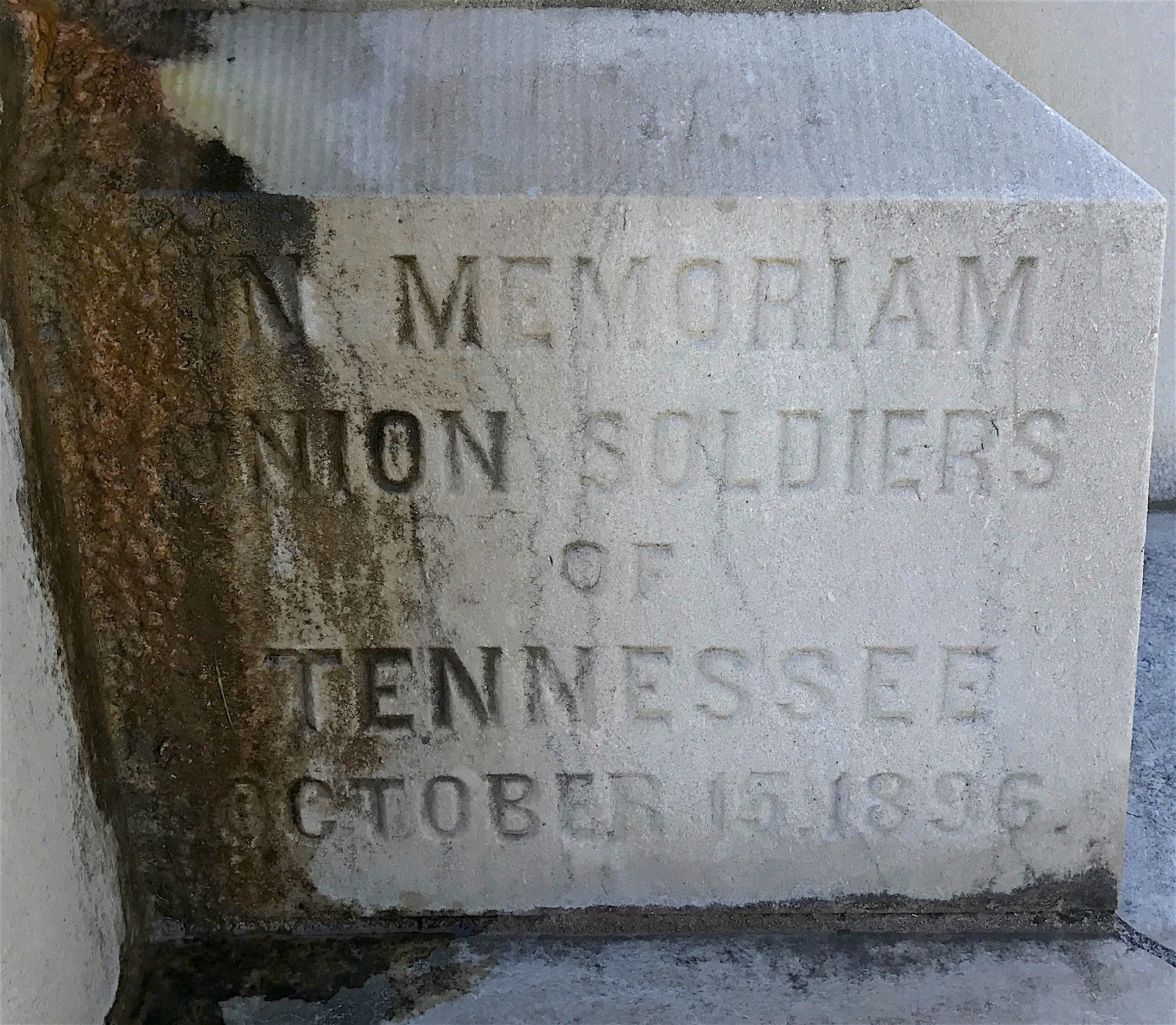
The cornerstone of the Union Soldiers Tower was laid in 1896.

In response, the local chapter of the Grand Army of the Republic (GAR) formed a commission, headed by former Union Army officer and Knoxville Journal publisher William Rule, to raise money to build a bigger monument at KNC. The commission signed a contract with William B. McMullen, presi­dent of the Tennessee Producers Marble Company and the Southern Monument Company, for material and construction, and with Colonel William A. Gage for engineering consultation.

The cornerstone was laid in 1896 but fundraising went slowly. The Spanish American War also intruded but perhaps spurred Knoxvillians to begin to see KNC in a new light. During the Civil War, it was the resting place of men mostly from far away who died in or near East Tennessee and had to be buried here. Now it was to be the resting place of men from East Tennessee who died far away and whose families requested them to be buried at KNC.

In the end, the monument cost $11,300. Of the estimated 7,000 donations, most came as one-dollar offerings from Union pensioners. The 50-foot-tall marble tower, topped by a bronze eagle with outspread wings, was unveiled on Oct. 24, 1901. Some were surprised because the original plans had featured a Union Soldier on top, not an eagle.

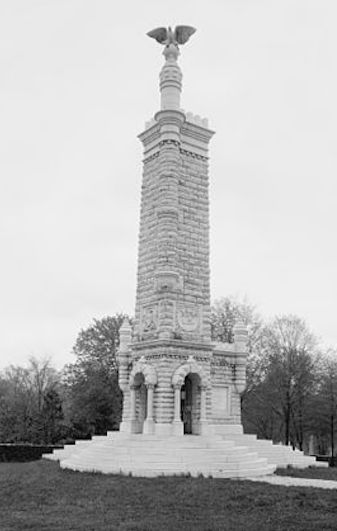
The original Union Soldiers Monument at KNC featured an eagle on the top. It was struck by lightning in 1904. This Library of Congress photo is from a few years prior to that.

On August 22, 1904, the Union Soldiers Monument was struck by a bolt of lightning during a storm. The castle-like foundation was a ruin and the strike sent chunks of stone into houses across the street. The bronze eagle and the cannonball it was perched upon were missing from the monument’s top. The eagle was found on the ground in four pieces, its head and wings severed.

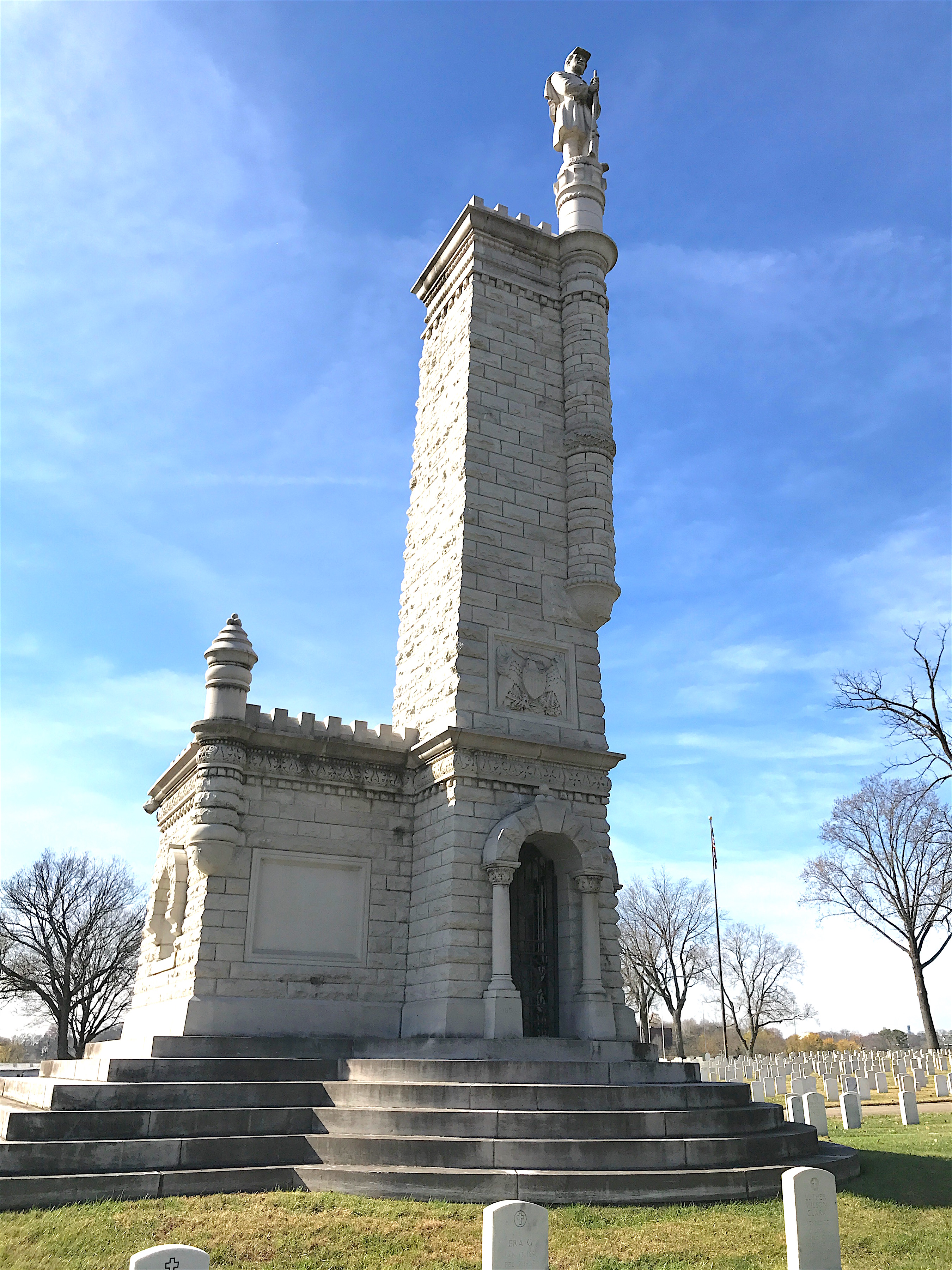
Unfazed, the GAR commissioners planned a quick rebuild, this time using federal funds secured by Congressman Henry R. Gibson. Designed by the local architectural firm Baumann Brothers, the new monument largely followed the original design. The main difference was that the bronze eagle was replaced by an eight-foot statue of a Union soldier. The new monument was completed on October 15, 1906.

This is what it looks like today.

The Union Soldiers Monument is sometimes referred to as the Wilder Monument because of the soldier’s alleged resemblance to Union General John T. Wilder.

Some people refer to it as the Wilder Monument because the soldier is said to resemble Union general and East Tennessee businessman John T. Wilder, who was the only ranking general on the memorial tower committee. There’s actually a Wilder Monument at Georgia’s Chickamauga Battlefield that was built to honor him. It features a castellated tower with an interior staircase, but with no statue on top.

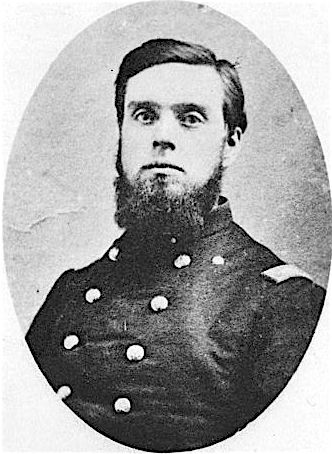
Here’s General Wilder as a soldier.

A native of New York, General John Thomas Wilder came from a long line of military men. Wilder was also an engineer who operated the first two blast furnaces in the South.

Here’s as good of a close up as I could get of the monument soldier.

This marble statue of a Union soldier replaced the bronze eagle destroyed by a lightning strike in 1904.

When the tower was built the first time in 1901, it stood 50-feet tall. But when the rebuild was completed in 1906, it topped out at 60 feet.

In 2009, Evergreen Architectural Arts was hired to make repairs and conserve the Union Soldiers Monument.

You can’t enter the tower but you can look through the door and see the stained glass American eagle inside.

A stained glass American eagle resides within the Union Soldiers Monument.

One Civil War Medal of Honor recipient is buried at KNC. Private Timothy Spillane of the 16th Pennsylvania Cavalry received the commendation for gallantry at the Battle of Hatcher’s Run in Virginia. He died in Knoxville in 1901 and was buried at KNC around the time the first tower was erected. World War II Medal of Honor recipient Sgt. Troy A. McGill, killed in action in 1944, was originally kept in a military mausoleum in the Philippines, but his remains were re-interred at KNC 1951.

I didn’t know these markers were there so I did not get photos of them during our visit.

Soldiers from all wars, from the Civil War to recent times, are buried at KNC. One of them was Tennessee native Patrick Belmont Northern Earle, born at Three Springs about 40 miles east of Knoxville. He was a graduate of Knoxville High School and at the time of his enlistment was a student of the University of Tennessee.

First Lieutenant Belmont Earle was only 23 when he was killed in action near Bellicourt, France in World War I. (Photo source: ETVMA.org)

First Lieut. Earle left Knoxville in September 1917 as an officer of Company D, 117th Infantry. At Camp Sevier, S.C., he became an aide-de-camp of Brig. Gen. William S. Scott, and when the latter was succeeded by Brig. General Tyson in command of the 59th Brigade, First Lieut. Earle remained on staff duty.

First Lieut. Belmont Earle was on staff duty but asked to be sent to the front line once he arrived in France.

However, after reaching France, First Lieut. Earle asked to be assigned to line duty and was ordered to Company M, 118th Infantry. He took part in all engagements up to October 5, 1918, when he was fatally wounded near Bellicourt. He died October 7, 1918. He was only 23 years old.

Before I close, there is a wonderful four-part article by the Knoxville History Project that proved to be a great source for what I wrote. If you want to know more about the origins of Knoxville National Cemetery and its history, you can find it here.

Next time, I’ll be next door at Knoxville’s Old Gray Cemetery.

Lest We Forget: Walking Through Omaha’s Potter’s Field

22 Friday Mar 2019

Posted by adventuresincemeteryhopping in General

≈ 7 Comments

For the past two weeks, I’ve shared stories from Omaha’s Temple Israel Cemetery. Most graves there are marked, even if it’s a small stone, because their loved ones could afford to purchase one.

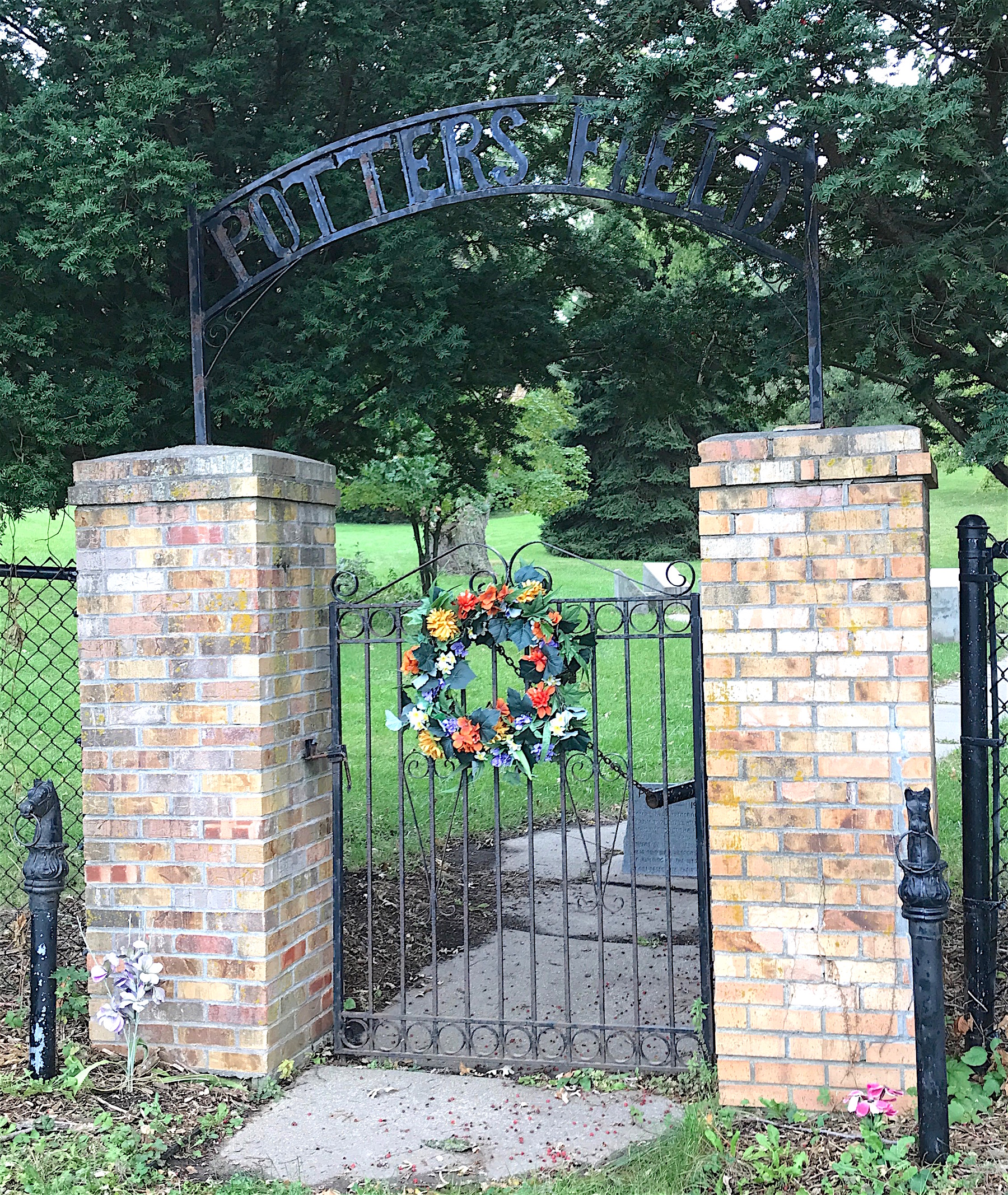
The story is quite different at Omaha’s Potter’s Field, located at 5000 Young Street near the intersection of Mormon Bridge Road. It’s five and a half acres are surrounded on three sides by Forest Lawn Memorial Park, where some of Omaha’s wealthiest residents are buried. The contrast between the two is what drew me there.

Near the end of my September 2017 trip, we went over to see it. There is no parking lot but you can easily pull off the side of the road.

The gate and sign to Omaha’s Potter’s Field came long after the last burial in the 1950s.

What is a Potter’s Field?

The first mention of a potter’s field is thought to have come from the Bible in Matthew 27. The chief priests received 30 silver pieces from a repentant Judas, who was paid that amount by the priests to betray Jesus. In anguish over what he had done, he returned the money to them then killed himself. Stating they could not keep “blood money” (even though they were the very ones who paid him), the priests used the money to buy the potter’s field as a place to bury foreigners. In other words, the “undesirables” who died in their town.

It was called “potter’s field” then because the land wasn’t good enough to grow crops and was only worth using to dig up clay for pottery. In later years, such places were often referred to as a county-owned graveyard or the “poor farm” cemetery. Atlanta’s Oakland Cemetery has a potter’s field.

The thing you’ll notice right off the bat is that there are very few markers at Omaha’s Potter’s Field and that’s true for most of them. The people buried there had family would could not easily afford a funeral, much less a gravestone. Or the deceased had no family or friends to even ask.

3,912 Souls

Circumstances also did not encourage those connected to the deceased to do so. According to a 1988 newspaper article, Douglas County discouraged families from putting up grave markers because, as they put it, “If you can pay for the stone, you can pay for the funeral.” In some cases, families were asked for reimbursement of funeral costs if they tried to improve the plot. In recent years, some surviving family members have purchased and placed gravestones for their loved ones.

Nearly 4,000 people are buried at Omaha’s Potter’s Field. But only a handful have markers.

The stone pictured above is the first thing you see after you enter the cemetery gate. It briefly explains that Potter’s Field was used from 1887-1957. Nearly 4,000 people are buried there. During the 1950s, society began to frown upon the idea of poor farms and potter’s fields. Douglas County started paying for indigent and unknown persons to be buried in cemeteries throughout town. They were still kept in separate sections, however, supposedly to avoid offending those who’d paid to be buried there. Other cities across the country follow a similar practice.

This plaque lists some details concerning those buried at Omaha’s Potter’s Field.

Burying the Unknown

I learned that nearly half the burials at Omaha’s Potter’s Field were for infants and toddlers under the age of two. Almost all of them were unknown and abandoned. Many entries on the interment list say “unknown baby.” Brutal information such as “found in garbage,” “found on riverbank,” “murdered,” or “strangled,” jump out painfully.

For the adults buried at Potter’s Field, they were often the destitute, the homeless, abused women and children, the mentally ill, the disabled or sometimes those who drifted from town to town without roots who had met an unfortunate end.

You can find the names listed on stones that encircle a sundial.

Many of the people buried at Potter’s Field are unnamed infants.

After Omaha’s Potter’s Field closed, despite being owned by Douglas County, the grounds fell into disrepair. During summers, weeds grew waist high. Teens hung out there to drink and party, leading to the desecration of what few gravestones were there. The cemetery was often littered with trash after such gatherings.

A view of Potter’s Field looking back about midway up the hill.

In the 1970s, local Boy Scout troops cleared the grounds to make the cemetery look better. They worked hard for a while to keep it up but over time the cemetery fell into disrepair yet again. This is not uncommon with such cemetery revitalization projects when many in a volunteer group (not just the Scouts) who took care of a abandoned cemetery moved, grew too old to do it, or simply lost interest.

Restoring Potter’s Field

In 1985, former Douglas County Sheriff Richard Collins headed a volunteer effort to again restore the old cemetery. With help from others, Collins raised the $22,000 needed to properly restore the grounds. In September 1986, Potter’s Field was re-consecrated and the memorial erected. This included the tablets of the names they could find from government and neighboring Forest Lawn Cemetery records.

The name on this stone is no longer readable.

Some historians have tried to find ancestors of the interred with little success. Many have no traceable connection to families of present-day Omaha.Unlike today, with the Internet collecting information about everyone, it was quite easy to make little of a footprint back then. If you didn’t have any true home and were going where circumstances placed you, encountering a census worker would be unusual.

Victims of a Flu Epidemic

This stone for the Clark sisters does leave a few clues. Iva and Sadie Clark were 13 and 11, respectively, when they died in 1890 within a few days of each other. One of the articles I found said a world-wide influenza epidemic (not the Spanish Flu) that raged from 1889-1891 may have been the cause.

Their parents were Frank and A.M. Clark. That’s all that’s known about them.

Iva and Sadie Clark probably died during a flu epidemic that caused many deaths between 1889-1891.

The Chapman children likely suffered a similar fate. Nothing is known about their parents, J.L. and E. Chapman. Stella and John, ages three years and ten months, died within days of each other in 1891. They’re among the few whose parents were able to provide them with a marker.

Stella and John Chapman also died within a few days of each other.

The marker for Henning O. Koll (1857-1898) looks like it may have come in recent years. I found him in the 1895 Omaha City Directory listed as a fireman.

Henning Koll is listed as a fireman in the 1895 Omaha City Directory. Notice the large feather beside his marker.

The newer look of David A. Jones’ marker also leads me to believe it was more recently placed.

With a surname like Jones, it’s hard to find out very much about him.

There is one person buried at Omaha’s Potter’s Field who didn’t have a marker until recently. But he was at the center of an event in Omaha history that changed it forever. That man was William “Will” Brown.

The Lynching of Will Brown

The story of how 40-year-old African-American Will Brown was lynched on Sept. 28, 1919 and the riot that surrounded it has many layers. There’s a long back story that led up to what created the atmosphere in which it culminated. This article does a great job at explaining the events of that day far better than I can in this post.

Omaha Morning World-Journal headline from the day after Will Brown’s lynching in Omaha.

You probably know I live in Georgia, a state with a dark history of lynchings. When I was growing up, this history was rarely mentioned in schools. According to the Tuskegee Institute, more than 73 percent of lynchings in the post-Civil War period occurred in Southern states. That’s a damning statistic. But that leaves 27 percent that occurred in other parts of the U.S. The sad fact is racism exists everywhere.

Will Brown’s grave had no marker until Californian Chris Hebert found out about it and paid for one to be made.

California resident Chris Hebert learned about the 1919 Omaha Race Riot and Brown’s lynching from a TV program he saw about Henry Fonda. The actor was 14 at the time and witnessed the riot from his father’s office in Omaha. As a result, Hebert paid to have a marker made to honor Will Brown.

Lest We Forget

Hebert has no ties to Omaha and simply asked that “Lest we forget” be engraved on the stone. He said, “It’s too bad it took deaths like these to pave the way for the freedoms we have today. I got the headstone thinking that if I could reach just one person, it was well worth the money spent.”

I am thankful to Chris Hebert for doing this to keep Will Brown’s memory alive. In turn, none of those buried at Omaha’s Potter’s Field should be forgotten. While we don’t know much about their histories, their lives mattered. Be it a newborn baby or an impoverished drifter making his way west, they were here among us. If just for a short time.

Lest we forget…

Broken Hearts and Tragic Endings in Omaha: Visiting Temple Israel Cemetery, Part II

15 Friday Mar 2019

Posted by adventuresincemeteryhopping in General

≈ 3 Comments

Last week, I introduced you to Temple Israel Cemetery and the story of Emil Brandeis’ tragic death on the Titanic. He was one of three brothers who made the J.L. Brandeis & Sons Department a household name in Omaha.

There are more buried at Temple Israel that knew tragedy. Two families, the Rosewaters and the Heyns, are the subjects of my post today.

I photographed this simple yet handsome monument having never heard of the surname “Rosewater”. But they were once as well known in Omaha as the Brandeis family.

The Rosewater name was originally Rosenwasser.

Originally the Rosenwassers, Herman Rosenwasser (1807-1878) and his wife, Rosemary Kohn Rosenwasser, emigrated from the Austria/Czechoslovakia (known as Bohemia) area in the 1850s with their large family. They settled in Cleveland, Ohio before they had two more children.

The Oldest and the Youngest

The first and last Rosewater children, Edward and Charles, both made a splash in Omaha. One of Edward’s claims to fame before moving west was being the telegraph operator who transmitted President Abraham Lincoln’s Emancipation Proclamation for the first time.

Already active in Republican politics, Edward Rosewater arrived in Omaha in 1863. In 1870, he was elected to the Nebraska House of Representatives and the following year, he started the newspaper The Omaha Bee. His aggressive style won him both a number of friends and enemies. In 1876, he was nearly clubbed to death by an irate reader but survived. Omaha’s Rosewater School, built in 1910, was named after him and was converted to apartments in 1985.

Immediately before his death, Edward helped found the American Jewish Committee (AJC). He died of a heart attack in 1906 at the age of 65 and is buried in Omaha’s Forest Lawn Cemetery. His son, Victor, carried on his father’s pursuits in the years to follow, including joining the AJC.

Dr. Charles Rosewater’s heart broke after the death of his only daughter.

Born in Cleveland, Ohio in 1859, Charles Rosewater traveled to Europe to get his medical degree. Dr. Rosewater came to Omaha in the 1880s and began practicing medicine. For 15 years, he occupied the chair of obstetrics in the Creighton Medical College and later focused on general medicine. In 1893, he married Clara Schlesinger.

Death from a Broken Heart

Dr. Rosewater and Clara had only one child, Irene, in 1895. But she was the apple of her father’s eye and they were quite proud of her. After graduating from Omaha’s Central High School in 1914, Irene went to Northhampton, Mass. to attend Smith College. She graduated in 1918 and worked as a chemist for Armour (the meat packing company) in Omaha until her health took a turn. After taking a prescribed vacation, she returned to her parents’ home, supposedly much improved.

Irene Rosewater’s obituary suggests she predicted her own death.

Her obituary notes that as a chemist she “diagnosed her own case”. After feeling pains, she reportedly said, “I’m going to have an abscess on the brain, Father.” Soon after, Irene was admitted to the hospital and died on May 25, 1920 of “brain fever”, which may have been meningoencephalitis.

Dr. Charles Rosewater was never the same after the death of his only child.

Dr. Rosewater never got over Irene’s death and his own health faltered. He died on Nov. 23, 1921 at the age of 62 and was buried beside Irene. His wife, Clara, did not remarry and died in 1945 in Los Angeles, Calif. Her body was brought back to Omaha for burial with Charles and Irene.

The Nov. 24, 1921 edition of The Lincoln Star included this article about Dr. Rosewater’s death.

Tragedy and The Photographers Heyn

Two generations of three brothers would make their mark in the photography world. But if there was a family that knew tragedy, it was the Heyns.

A native of Germany, George Heyn emigrated to Detroit in his teens and moved to Omaha to open a photography studio in the early 1880s. He returned to Detroit to marry Sabina Hirschman in 1883 and they settled into married life in Omaha. Son Lester Heyn was born in 1884, Jerome in 1886, and Frederick (Fred) in 1890.

Photographer George Heyn (or brother Herman) took this photo of a Native American Alfred Afraid of Hawk in 1898. (Photo source: Library of Congress)

George’s younger brother, Herman, also a photographer, came to Omaha shortly after George and Sabina’s marriage. Many photographs of Native Americans attributed to George are now thought to have been done by Herman. Herman also created portraits of President William Howard Taft and presidential candidate/orator William Jennings Bryan (the latter was involved in a court case). He moved to Chicago in the late 1920s and died there in 1949. Herman is buried in Rosehill Cemetery.

An ad for George or Herman Heyn’s studio on South 15th Street. (Photo source: https://picclick.com)

Louis Heyn, George and Herman’s brother, was also a photographer. He may have briefly worked in Omaha with George before heading to Great Falls, Mont. where he married and had a family. They moved to California in the 1930s where Louis died in 1940.

Portrait of a young woman attributed to Herman Heyn. (Photo source: http://www.chairish.com)

Sabina and George were were often reported about in newspapers attending parties and events around Omaha. One costume party they hosted in late January 1889 was written up in which George was dressed as Adonis, Sarah Brandeis came gowned as a Grecian lady, and the future Clara Rosewater attended costumed as a school girl.

Unfortunately, their happiness did not last. On May 26, 1892, while on a ferry going from Detroit to Canada, George Heyn committed suicide by jumping into the Detroit River. His obituary says he suffered from two incidents of “la grippe” (the flu) over the winter that affected his mind. After his remains were recovered, George was buried at Woodmere Cemetery in Detroit, Mich.

Sabina remarried in 1899 to photographer Henry Unverzagt. All three Heyn sons tried their hand at photography and were well known in Omaha’s Jewish social circles and civic organizations.

Was it Suicide?

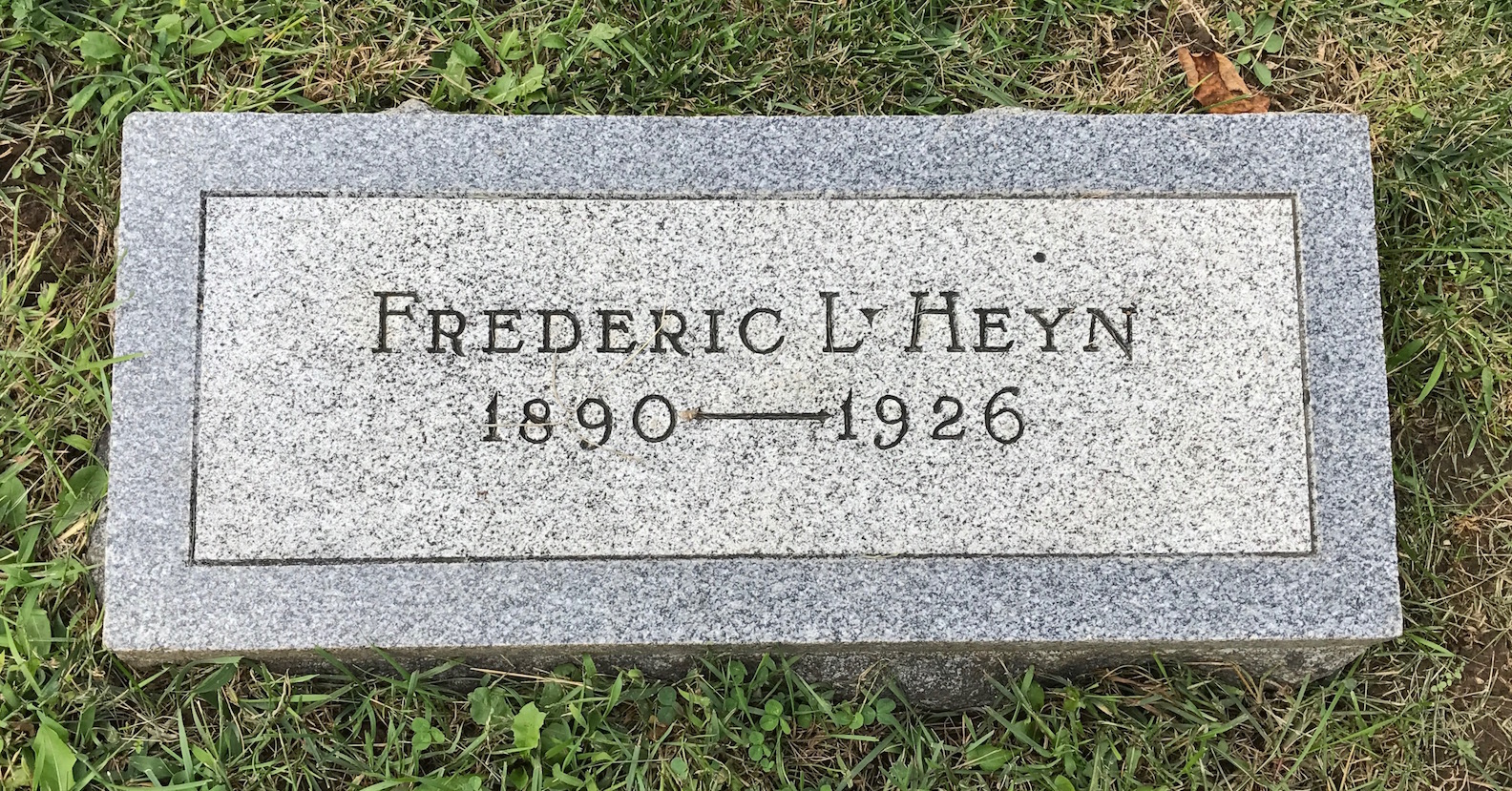
Youngest brother Fred served in World War I, reaching the rank of captain. After the war, he gave real estate a try. In August 1926, he went to Lake Marion near Fergus Falls, Minn. with Sabina and one of his brothers (which one was not specified). His obituary states he’d recently suffered a breakdown but was doing better. He went out bass fishing by himself and the boat was later found empty.

Fred Heyn lost his life in the water as his father had years before.

On August 7, his body was recovered. Suicide was suspected as the cause of death. Fred’s remains were brought back to Omaha and he was buried at Temple Israel Cemetery. He had no wife or children. Sabina died in 1938 and was buried beside him.

Fred was the youngest of Sabina’s sons and the first to die at the age of 36.

Older brothers Jerome and Lester continued with their successful photography business. Their names appear often in the society pages attending parties and traveling. Like his brother Fred, Jerome never married. The Heyn brothers were especially talented at photographing children.

Undated photograph of unknown child attributed to Jerome Heyn, possibly 1919.

A Gunshot at Union Station

In December 1939, Jerome suffered a 25-foot fall over a stairway railing in a downtown building that fractured his skull. On Jan. 23, 1940, Jerome locked himself in the men’s restroom of Union Station in Omaha and shot himself with a .38 Colt pistol. His obituary claims he had been in a “nervous condition” in the days leading up to his death. He was 54 at the time, and was buried beside his mother and brother at Temple Israel Cemetery.

Jerome Heyn shot himself in the men’s restroom at Union Station in Omaha.

Death in the Doctor’s Office

The last Heyn brother, Lester, married Beatrice “Bebe” Nies Morris in 1918 in Chicago when he was 34. She had one child, Eugene, from a previous marriage. Lester and Beatrice had a daughter, Adelaide. But the marriage soured a few years later. In 1922, Beatrice filed for divorce and requested a restraining order against him. Their divorce proceedings played out in the newspapers. Beatrice remarried to James Pray and moved to California with the children.

UPDATE: I was recently contacted by Adelaide’s daughter, who knew little of her grandfather’s past and was delighted to learn more. She told me Bebe married a few more times before her death in California.

A picture of photographer Lester Heyn from a newspaper ad. I don’t have a photo of his grave site.

The tragedies took their toll. Not long after Jerome’s death, he retired and closed the studio. Lester died on Sept. 11, 1941 in his doctor’s office of a heart attack. He was buried at Temple Israel beside his mother and brothers. I didn’t get a picture of his grave, unfortunately. But I did find a photo of him in a newspaper ad. I could not trace his children after 1930.

There are probably thousands of people in Nebraska who own old photographs with the Heyn name on them. Few know the story behind that name and the heartache attached to it over the years.

I did encounter a guest while I was at Temple Israel Cemetery that I wasn’t expecting. But I’m sure he was hoping I’d just pretend he wasn’t there. It’s not often I encounter a groundhog during my cemetery hopping.

Closeup of the animal I saw at Temple Israel Cemetery.

Stopping by Temple Israel Cemetery was definitely worth it, despite the sad stories I found there. You never known until you start looking behind the name and date on a stone what you might turn up.


Omaha’s Only Titanic Victim: Visiting Temple Israel Cemetery, Part I

08 Friday Mar 2019

Posted by adventuresincemeteryhopping in General

≈ 5 Comments

Today I’m starting a series on Omaha, Nebraska’s Temple Israel Cemetery. When I was visiting Christi in fall 2017, I was hopeful I could visit because it’s there that the ashes of Emil Brandies, Omaha’s only Titanic disaster victim, are buried.

What Younker’s was to Des Moines, Brandeis was to Omaha. Emil was part of the Brandeis family who established a much-beloved chain of department stores in Nebraska in the 1880s. Ask anybody over 50 who grew up in Omaha what they remember about J.L. Brandeis & Sons Department Stores and the stories will start pouring out. Purchasing a first party gown, working at the jewelry counter, marveling at the window displays, and meeting friends in the Tea Room are just a few glimpses of its history.

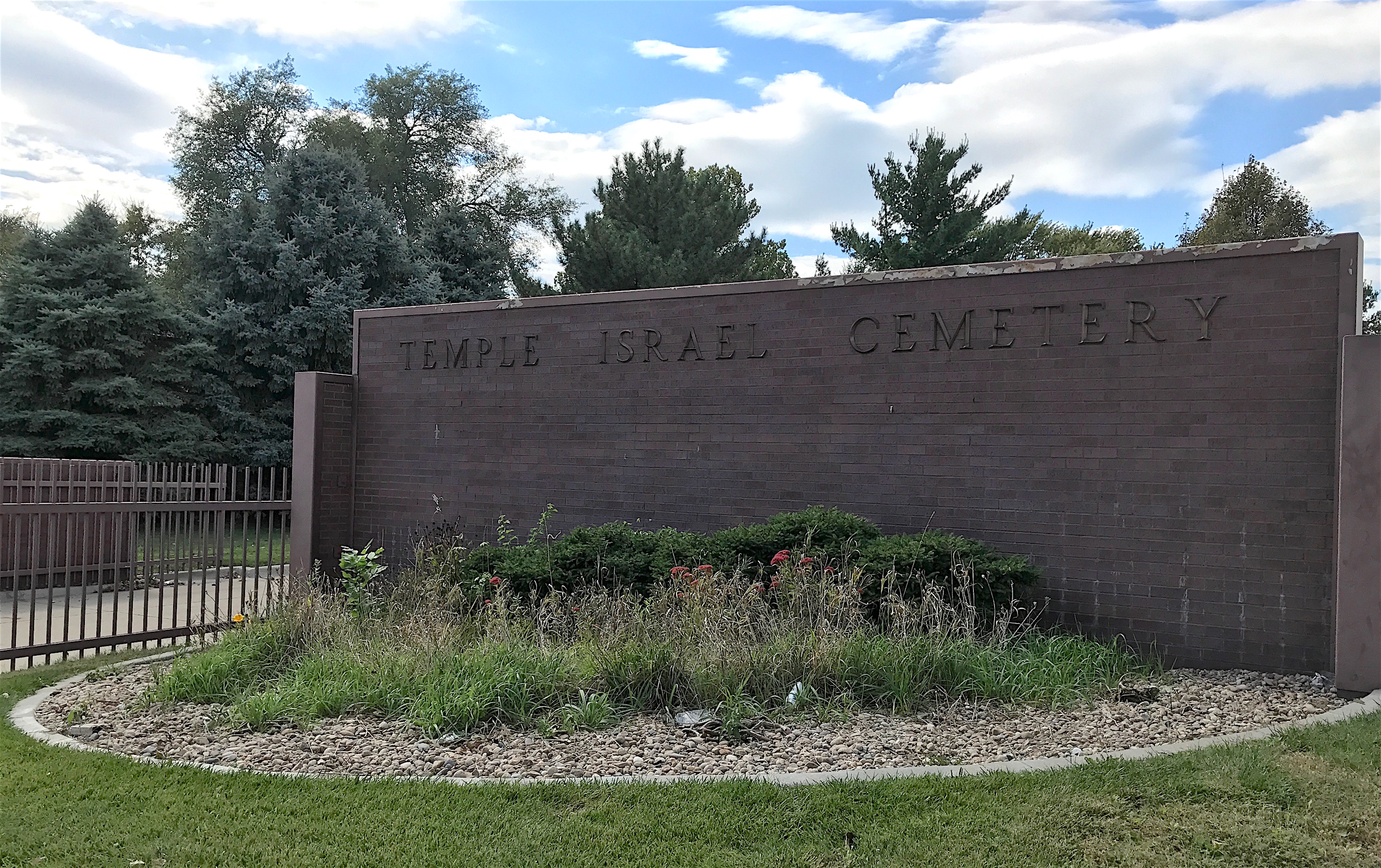
Located in North Omaha, Temple Israel Cemetery is also known as Pleasant Hill Cemetery but there’s another Pleasant Hill Cemetery in Omaha. I’m going to stick to Temple Israel Cemetery, as that’s the name on the entrance sign I photographed below.

Temple Israel Cemetery is also known as Pleasant Hill Cemetery but there’s another cemetery by that name in Omaha as well.

Established in 1871, Temple Israel Cemetery (a Reform congregation) is the oldest Jewish cemetery in Omaha but not the only one. There are several others that came later.

According to Temple Israel’s website, Max Meyer, Emmanuel Simon, and Meyer Hellman formed the B’nail Israel Society in March 1871 when they recognized the need for a sanctified Jewish burial ground. In August 1871, they bought five acres for a cemetery at 42nd Street and Redick Ave. The B’nai Israel Society deeded the cemetery property to the Congregation of Israel, which later became Temple Israel.

Within the Temple Israel Cemetery are separate sections for B’nai Jacob and B’nai Shalom Cemeteries. Find a Grave notes there are about 800 graves recorded for Temple Israel but I think there are many more that just haven’t been photographed or had memorials made for them yet.

J.L. Brandeis and his sons created a memorable shopping experience for their customers.

According to a detailed two-part article by journalist/blogger Leo Adam Biga, the Brandeis family has roots in Prague in what is now the Czech Republic. Born in 1837, Jonas Leopold (J.L.) Brandeis was an Austrian-Jewish immigrant who arrived in America in his late teens. He started as a merchant in Wisconsin, where he did business with Indians. Francesca “Fannie” Teweles of Milwaukee married him in 1862 and the couple started their family in Manitowoc, Wisc. They had four children that lived to adulthood, three boys (Arthur, Hugo, and Emil) and one girl (Sarah).

After moving the family to Omaha in the 1880s, J.L. started building his first venture, The Fair, on South 13th Street. By 1888, he and his sons were full partners when they rented a new site at 114 South 16th Street, calling it The Boston Store. The J.L. Brandeis & Sons name first appeared over the door there and would appear on building plates on all future Brandeis stores. An 1894 fire that destroyed a second store didn’t keep J.L. down and he built a bigger, better store on the same site at the northwest corner of 16th and Douglas.

Undated postcard of J.L. Brandeis & Sons Department Store in downtown Omaha. (Photo source: Hippostcard.com)

J.L. and Fanny got active in local organizations right away, with J.L. helping establish one of Nebraska’s first synagogues. He and relative Carl Brandeis (who is also buried at Temple Israel) worked together to create a chapter of the Independent Order of B’nai B’rith. An Omaha chapter was founded by Carl.

Jonas Leopold Brandeis died in 1903 at the age of 68.

Emil became a member of the firm in 1885 at the age 21, where he eventually directed the planning, building, and maintenance of the Brandeis buildings. He was also responsible for the general oversight of the men’s goods department.

After J.L.’s death in 1903, Arthur became president. Emil continued to supervise construction and maintenance of the company’s building projects. Hugo sent buyers to foreign markets and managed the store’s sales policies. Cousin George Brandeis was brought in and his skills would prove timely later.

A bachelor, Emil enjoyed working with his brothers and traveled a great deal. In late January 1912, he went to Europe to visit his niece, Mrs. Irving Stern (Ruth, the daughter of his brother Arthur) and her husband in Italy. The trio traveled through Spain, Egypt, and Rome to Vevey, Switzerland, where they visited his sister, Sarah Brandeis Cohn. Sarah had been widowed less than a year.

Portrait of Emil Brandeis as a young man, who was only 48 when he died in 1912 when the Titanic sank.

Emil arranged to return home on the Titanic, which had received much press for its elegance and speed. Much of his time on the ship was spent with old friends, Mr. and Mrs. Henry B. Harris. After the ship hit the iceberg and and evacuation started, Mrs. Harris was placed in a full lifeboat. She later said and as it pulled away that she saw Emil and her husband standing among the men on deck, awaiting their fate, she reported, “without fear.”

One rumor spread at the time was that Emil put on women’s clothing in order to try to get a place in a lifeboat but that was quashed by other survivors who saw him as Mrs. Harris did among the men on deck that night.

Emil’s body was recovered by the crew of the cable repair ship, the CS MacKay Bennett. Among his effects were diamond cuff links, a gold knife, a gold pocket watch, a platinum and diamond watch chain, a gold pencil case, a gold ring, a gold cigarette case and match box, a pearl tie-pin and a 500 franc note. His pocket watch was part of an exhibit a few years ago at Omaha’s Durham Museum.

The main Brandeis family marker at Temple Israel Cemetery.

Many books and articles claim that Emil’s body was brought back from Halifax, Nova Scotia to Omaha for burial at Temple Israel Cemetery. But according to a May 4 article in the Omaha Bee, his body was sent from Canada to Chicago first. An Omaha funeral director hired by the Brandeis family traveled to Chicago to receive Emil’s body, oversee his cremation, then bring his ashes home. The Chicago crematory is not named in the article, but I suspect it was the one at Graceland Cemetery. Many well-known wealthy Chicagoans are buried there and it was one of three cemeteries in the city that had a crematory at that time.

From the May 4 edition of the Omaha Daily Bee, I learned that Emil Brandeis was cremated before his ashes were buried at Temple Israel Cemetery.

At first, I wondered why a Jewish family would have a family member cremated because in the Jewish faith, a body is traditionally buried within 48 hours of death. Then it occurred to me that the tragic circumstances surrounding Emil’s death prevented that. By the time his remains were brought to Chicago several days after the tragedy, they were in poor condition. The Brandeis family were also Reform Jews, whose congregations tend to have less conservative religious beliefs. So cremation made a lot of sense.

A large memorial service held on April 21 at the Brandeis Theater was attended by many Omahans. Emil’s graveside funeral at Temple Israel Cemetery was private. His ashes were buried beside his parents’ graves (Fanny died in 1905) on a Sunday in early May.

Emil’s brother, Hugo, would die only a few months later.

Sadly, brother Hugo died in July of that same year after an operation. He is also buried at Temple Israel. That left Arthur to run the business and cousin George Brandeis proved invaluable with his leadership. In 1914, Arthur handed the store’s leadership to George and become vice president of Stern Brothers dry goods store in New York.

When Arthur died in 1916, his will left in excess of $1 million in personal property and real estate in a trust to his young son, E. John Brandeis. George would mentor E. John and eventually Arthur’s son would take over the reins from George.

At its zenith in the early 1970s, the family-owned retail chain grew to 15 stores, 3,000 employees, and $100 million in sales. But as more shoppers headed to suburban malls, the flagship store became an albatross. When it closed in 1980 as part of a general downsizing, it marked the end of an era. Younker’s bought Brandeis’ remaining stores in 1987.

A few days before I started writing this post, I saw an article in the Omaha World-Herald that the Brandeis Mansion, built in 1904 for Arthur Brandeis and his wife, Zerlina, has been fully restored and is enjoying a comeback with new owners. Christi has attended parties there in recent years. Omahans are pleased to see a happy piece of their past is still alive and well.

I’ll be back next week with more stories from Temple Israel Cemetery.

Now known as the Brandeis-Millard Mansion, the 1904 home has been fully restored. (Photo source. brandeismansion.com)

Memorable Monumental Ladies: Stopping by Nebraska City’s Wyuka Cemetery, Part III

01 Friday Mar 2019

Posted by adventuresincemeteryhopping in General

≈ Leave a comment

To wrap up my series on Nebraska City’s Wyuka Cemetery, I’m featuring some of the lovely ladies standing atop the monuments I saw. There were too many for me to cram into the first two parts so I waited until the end to give them their due.

The Black family monument is one of the tallest in the cemetery and features one of the most beautiful figures I’ve seen, holding a bouquet of flowers. She’s missing half of the other arm but it doesn’t detract from her beauty.

The Black monument is one of the tallest in the cemetery.

The Black family story was missing a number of pieces until I found an obituary for Robert A. Black in the Nebraska City News.

Irish immigrant Robert Andrew Black arrived in America as a young man, coming to Nebraska City around 1867 as a carpenter. He hired on with the Burlington & Missouri River Railroad Company (known as the B & M). He married Indiana native Sarah Catherine Brenton on March 5, 1871 in Montgomery, Iowa. By 1880, they were living in Nebraska City and had a son, James, born in 1874.

The monument tells us about the three children the Blacks lost. Emma Luvida Black was born in 1871 and died in 1872. William Emmet Black was born in 1872 and died in 1877. Robert Andrew Black, Jr. was born in 1881 and died in 1882. James died on May 13, 1895. His obituary mentions that he became ill a few days after injuring himself while jumping onto a horse.

By 1900, Robert was working as a foreman for the B & M. In late August 1904, he went to Rulo, Neb. to check on some work his men were doing. Sarah took the opportunity to visit her younger sister, Elvina Brenton Kulp, in Iowa. Elvina’s husband, Frank Kulp, was a bridge superintendent with the B & M. On the evening of Thursday, August 26, after the day’s work, Robert was giving instructions to a few of his men when he was struck and killed by an engine.

Robert A. Black purchased the monument from the Nebraska City firm of Niedhart & Forbes in 1900. The Reporter deemed it “the handsomest monument in Wyuka Cemetery.”

Robert’s remains were brought back to Nebraska and he was buried at Wyuka Cemetery. According to his obituary, his Masonic lodge, Western Star Lodge #2 A.F. and A.M. took care of the funeral.

The Black monument was erected in 1900, purchased by Robert A. Black to honor his children. It was carved by the Nebraska City firm of Neidhart & Forbes at his direction. By 1908, the gentleman had split up the business with Neidhart moving to Beatrice and Forbes staying in Nebraska City.

Volume 33 of The Reporter, a magazine for monument dealers, reported the sale of the Black family monument in 1900.

Sarah’s sister, Elvina, died in 1907 at the age of 42, leaving Frank Kulp a widower with three grown children. They were living in Gage County, Neb. according to the 1910 U.S. Census.

Sometime between 1910 and 1920, Sarah married her former brother-in-law, Frank Kulp. Soon after, they moved to Los Angeles, Calif., although they would return to Nebraska City to visit often.

Sarah died in California in 1931 at the age of 79. Her remains were brought back to Nebraska City for burial at Wyuka beside Robert and their children. Her will caused a great legal stir because she had sold a number of properties shortly before her death. One of her bequests was to the Masonic Home in Plattsmouth, Neb. The case wound its way through court even past the death of her second husband, Frank, in 1940. Frank is buried with first wife, Sarah’s sister, Elvina Brenton Kulp, in Wymore Cemetery in Gage, Neb.

The Tipton monument features a woman holding a wreath. It’s located not too far from the Black monument.

Ohio native Absalom Tipton was as interested in planting trees as his neighbor, J. Morton Sterling.

Born in Holmes County, Ohio in 1829, Absalom Tipton was the fifth of Luke and Mary Young Tipton’s 11 children. In 1854, he married Martha Ann Norris in Atchison County, Mo. Soon after, the couple arrived in Nebraska Territory and started their family.

Absalom was especially good at cultivating fruit trees, much like his neighbor J. Sterling Morton. His obituary notes that “on his home place, two miles northwest of the city, he had an apple orchard of 500 trees, 700 cherry trees, and raspberry, blackberry and blueberry plants without number.”

Absalom Tipton’s obituary notes that he was one of the leading horticulturists in the state.

Absalom and Martha had seven children together, four of whom lived to adulthood. Martha died in November 1875 at the age of 41 and was buried at Wyuka. Absalom remarried again sometime around 1892 to Loantha Judkins, who was 24 years his junior. They had no children.

When Absalom died from stomach cancer in 1914 at the age of 85, he was buried beside Martha at Wyuka. Second wife Loantha died in 1928 and is also buried with him at Wyuka.

Another towering female caught my attention at Wyuka. The Rottman monument features yet another pensive lady holding a wreath.

F.W. “Fritz” Rottmann and his wife, Maggie, were both German immigrants.

Born in Westphalia, Germany in 1834, F.W. “Fritz” Rottman grew up with few advantages. He emigrated to America when he was 21 and spent a few months in St. Louis, Mo. before making his way to Nebraska City. He worked on a farm for several months before becoming a clerk, assisting his employer in his business ventures.

In 1865, Fritz married fellow German immigrant Margaret “Maggie” Arends, who had come to America with her parents as a little girl. Fritz not only owned a grocery store, he also became a builder, putting up many of Nebraska City’s businesses. He was at one point president of the Nebraska City Canning Company.

Fritz and Maggie had six children together, but only eldest son Frederick lived to adulthood. Fritz died in February 1888 at the age of 53 of “brain fever.” Maggie lived with Fred until her death from Bright’s Disease (kidney failure) in November 1906.

The Rottmann monument’s statue has a pensive look on her face.

Born in 1872, Fred married Elma Petring in 1904 and they had two children. The pair were traveling to Omaha with their daughter (whose name varies in different newspapers) when their train crashed in Fort Crook, Neb. in 1911. Both Elma and the child were killed, and Fred was seriously injured. He remarried in 1913 to Clara Lilydale Koser and they had two children, one living to adulthood. Clara died in 1940 and Fred died in 1945, both buried at Wyuka.

The Mason girls never had a chance to grow up.

Finally, there are two other females I wanted to include but they never had a chance to become young ladies.

Sisters Ellen and Jennie Mason were born to Oliver Perry (known as “O.P.”) Mason and Mary Turner Mason. The Masons married in New York before moving to Nebraska City in 1856. Oliver served as Chief Justice of the Nebraska State Supreme Court from 1866 to 1873. He also served as a member of the Nebraska Constitutional Convention of 1871. Mason City, Neb. was named after him.

Jennie, born in January 1859, died at the age of four on April 24, 1863. Her sister, Ellen, was born June 1862 and died at the age of 2 on Aug. 24, 1864. While the Masons had a daughter before Jennie and Ellen, and would have several more children, the loss of these two little ones must have been difficult to bear. Their sweet marker with twin lambs is especially bittersweet.

It was time to head to Omaha and put up our feet for a bit. But I was a little sad to leave as I looked back to see the sun setting over the old stones. How many stories had I missed?

It’s a place I won’t soon forget.

More Trees, a Rolltop Desk and a Boulder: Stopping by Nebraska City’s Wyuka Cemetery, Part II

22 Friday Feb 2019

Posted by adventuresincemeteryhopping in General

≈ 3 Comments

Last week, I devoted my blog post to the most famous person buried at Nebraska City’s Wyuka Cemetery, J. Sterling Morton and his family. But there are other monuments and people worth talking about at this historic cemetery.

If you were wowed by Morton’s tree monument, there are a few more worth sharing. The “tree” for the Hill family is located in front of the Morton family plot. While they are both trees, the Hill monument feels more rustic to me.

The Hill tree monument is stunning to look at with all its detail.

The story on William Edward (W.E.) Hill is a bit sketchy. I’ve seen him listed as a native of Virginia, but U.S. Census records almost always list him as being born in Ohio. I don’t know when he met and married his wife, Mary, nor do I know her maiden name. At some point, they came to Nebraska City where W.E. was a grain merchant and active in local agricultural groups.

W.E. was also a mover and shaker in the Masons. Some articles indicate he may have been a Grand Master. I didn’t take a picture of the other side of the monument with his inscription but someone named “SarahD” on Find a Grave did so I want you to see that as well.

A double-headed eagle is an emblem of the Scottish Rite, a Masonic organization which continues a Master Mason’s education of the first three degrees. It is believed to have been founded in Europe in the 1700s. (Photo source: SaraD, Find a Grave)

Mary died in Nebraska City in 1890 after an illness of many years. At some point, W.E. moved out to California where he died in 1917. His obituary states that his body was accompanied by his wife back to Nebraska City by train, so he must have remarried. I don’t believe W.E. and Mary had any children together.

There’s one more tree monument I want you to see and I think it’s possible that F.O. Cross (the stone mason who did the Morton tree) may have carved this one as well because the style is very similar.

The Potts tree looks quite similar to the Morton tree but isn’t as tall. The tablet on the bottom is not inscribed.

A native of Missouri, Charles Potts was born in 1848 and arrived in Nebraska City in 1865.  In 1873, he married 20-year-old Elfleda “Fleda” Russell. He worked various jobs, from clerk to cashier to finally partnership in a wholesale grocery business called Lorton & Potts. Like W.E. Hill, he was active in the Masons. The couple had one daughter, Mary Ellen, in 1877.

Charles Potts was only 33 at the time of his death.

I don’t know the cause of death, but Charles passed away on August 4, 1882. He was only 33. Tragedy struck again a few months later on Dec. 1, 1883 when Mary Ellen died.

Fleda, I learned, led a rather tumultuous early life. Born shortly before her parents moved to Nebraska, her mother passed away in 1857. Fleda was sent back east to New Jersey to live with relatives while her father, James Russell, headed to Colorado. Tragically, he was murdered there in 1863 when Fleda was only 10. She moved back to Nebraska City to live with her grandfather, later meeting and marrying Charles Potts.

In 1889, Fleda married Charles E. Swift in Iowa City. The marriage announcement describes it as a “complete surprise” to her neighbors, but a happy one. By 1900, they were living in Omaha and Charles was working as a salesman in a dry goods store. They had one son, Russell. The 1910 U.S. Census lists the three living near Sioux City, Iowa and that Charles was supported by his “own income”.

This detailed carving of a dove with an olive branch in its beak is still intact.

Charles Swift died in 1911 and was buried at Wyuka Cemetery. His name is not inscribed on the tree but he has a small stone beside it. In 1914, Russell moved to Vermillion, S.D. with plans for Fleda to join him as soon as he had finished building a home for them. But Fleda died in Sioux City in 1916 and was buried beside her two husbands. I have no idea where the money came from to pay for such a grand monument.

Russell, who served as as an aviator in World War I, was a mechanic who married not long after his return. He died of a heart attack in 1933 and is buried in South Dakota.

This next marker is unlike any you are likely to see anywhere else. Shaped like a desk, the Harding family monument is quite remarkable.

Like the Morton family plot, the Harding plot has a tree-themed border with individual “log” markers for each family member and “stumps” in the back.

The Harding plot has the same tree-themed border as the Mortons, but doesn’t have the planters. I do like the “stumps” in the back and the “logs” in the front.

Born in Marion, Ohio in 1831, Nehemiah Story Harding operated a mercantile business in Cincinnati. He married Mary Ann “Mamie” King Baldwin in 1852. They moved to Nebraska City in 1855. His obituary notes that he wrote the first insurance policy in the Nebraska Territory in 1857. Harding also served as deputy clerk of the federal court while running a mercantile business. He was active in local politics and probably a Mason.

The Harding “desk” is a record of many of the lives and deaths of the family over the years.

Nehemiah and Mamie had 10 children over the course of their marriage. Eldest Cora was born in Ohio before the move to Nebraska. Bennett, Frederick, and Alice all died in childhood. Bennett and Frederick actually share a “book” with their names and dates inscribed on it to the left side of the desk. Alice, who died in 1872, has her own book on the right side of the desk.

Three of the Harding children who died in childhood have their names inscribed on “books” on the desk.

Because of my height, my photo of the top of the desk is not the best. But you can see the pages for Grace (1863-1937), Mamie (1833-1900), Nehemiah (1831-1915) and Mary Rachel (1872-1955). Cora, Nellie, Edyth and Willard are buried elsewhere in Wyuka with their spouses. Daughter Winona “Winnie” Hill is buried in Nebraska with her husband.

The top of the desk features pages for Nehemiah, Mamie, and two of their daughters, Grace and Mary.

Mamie died in 1900 after a long illness with daughter Winnie at her side. Nehemiah suffered a stroke in 1910 and died of apoplexy at the age of 84 in 1915. His obituary notes he spent the winter in California and had just returned to Nebraska City.

It also notes that Harding was instrumental in getting the home for the blind located in Nebraska City, which opened in 1877. He was an original member of the school’s board of trustees. Now known as the Nebraska Center for the Education of Children who are Blind of Visually Impaired (NCECBVI), it is still in operation today.

When I saw this next marker, I thought it resembled a ripe tomato resting on a stump because of the shape. But I think it’s mean to be a boulder.

The Gerhard marker holds a sad story.

The Gerhard marker is for two children, Enolia and Herbert. Enolia was born on Oct. 31, 1865 and Herbert was born Oct. 6, 1867. Enolia died on April 1, 1870 and Herbert died on April 8, 1870. They both died of the measles, according to a mortality schedule. They are the only two Gerhards buried at Wyuka Cemetery.

On the bottom is the Bible verse Matthew 19:14: “Suffer [the] little children to come until me: and forbid them not for of such is the Kingdom of God.”

The back of the Gerhard monument features a Masonic emblem and an Oddfellows chain.

The back of the monument, with a Masonic symbol and Odd Fellows chain, leads me to believe a space was left for the parents but never used. The only Gerhards I could track down in Nebraska City were Augustus and Mary Gerhard. A native of Pennsylvania, Augustus was a carpenter who operated a furniture store in Nebraska City for many years and was a Mason.

Augustus and Mary had recently moved to Los Angeles, Calif. to be near their married daughter, Harriet Hunter, when he died there in 1911. So it’s possible he and Mary are both buried in California.

It makes me a bit sad to think of Enolia and Herbert alone there. But this happened quite often when families moved further west in later years, leaving the graves of little ones behind.

I’m not quite done at Wyuka Cemetery yet. Come back next time for stories of the ladies of Wyuka.

← Older posts
Newer posts →

Recent Posts

  • More Pensacola, Fla. Cemetery Hopping: Taking a Ramble Through Saint John’s Cemetery, Part III
  • More Pensacola, Fla. Cemetery Hopping: Taking a Ramble Through Saint John’s Cemetery, Part II
  • More Pensacola, Fla. Cemetery Hopping: Taking a Ramble Through Saint John’s Cemetery, Part I
  • The City of Five Flags: Stepping back in time at Pensacola, Fla.’s Saint Michael’s Cemetery, Part V
  • The City of Five Flags: Stepping back in time at Pensacola, Fla.’s Saint Michael’s Cemetery, Part IV

Archives

  • December 2025
  • November 2025
  • August 2025
  • July 2025
  • June 2025
  • May 2025
  • April 2025
  • March 2025
  • February 2025
  • January 2025
  • October 2024
  • August 2024
  • July 2024
  • June 2024
  • May 2024
  • April 2024
  • March 2024
  • February 2024
  • January 2024
  • December 2023
  • November 2023
  • October 2023
  • September 2023
  • August 2023
  • July 2023
  • June 2023
  • May 2023
  • April 2023
  • March 2023
  • February 2023
  • January 2023
  • December 2022
  • November 2022
  • October 2022
  • September 2022
  • August 2022
  • July 2022
  • June 2022
  • May 2022
  • April 2022
  • March 2022
  • February 2022
  • January 2022
  • December 2021
  • November 2021
  • October 2021
  • September 2021
  • August 2021
  • July 2021
  • May 2021
  • April 2021
  • March 2021
  • February 2021
  • January 2021
  • December 2020
  • November 2020
  • October 2020
  • September 2020
  • August 2020
  • July 2020
  • June 2020
  • May 2020
  • April 2020
  • March 2020
  • February 2020
  • January 2020
  • December 2019
  • November 2019
  • October 2019
  • September 2019
  • August 2019
  • July 2019
  • June 2019
  • May 2019
  • April 2019
  • March 2019
  • February 2019
  • January 2019
  • December 2018
  • November 2018
  • October 2018
  • September 2018
  • August 2018
  • May 2018
  • April 2018
  • March 2018
  • February 2018
  • January 2018
  • December 2017
  • November 2017
  • October 2017
  • September 2017
  • August 2017
  • July 2017
  • June 2017
  • May 2017
  • April 2017
  • March 2017
  • February 2017
  • January 2017
  • December 2016
  • November 2016
  • October 2016
  • September 2016
  • August 2016
  • July 2016
  • June 2016
  • May 2016
  • April 2016
  • March 2016
  • February 2016
  • January 2016
  • December 2015
  • November 2015
  • October 2015
  • September 2015
  • August 2015
  • July 2015
  • May 2015
  • April 2015
  • March 2015
  • February 2015
  • January 2015
  • December 2014
  • November 2014
  • October 2014
  • September 2014
  • August 2014
  • July 2014
  • June 2014
  • May 2014
  • April 2014
  • March 2014
  • February 2014
  • January 2014
  • December 2013
  • November 2013
  • October 2013
  • September 2013
  • August 2013
  • July 2013
  • June 2013
  • May 2013
  • April 2013
  • March 2013
  • February 2013
  • January 2013

Categories

  • General

Blogroll

  • A Grave Interest
  • Cemetery Photography by Chantal Larochelle
  • Cemetery Tours of Berlin by Matti
  • Confessions of a Funeral Director (Caleb Wilde)
  • Find a Grave
  • Hunting and Gathering (cool photography site)
  • Save Our Cemeteries (New Orleans, La.)
  • The Cemetery Club
  • The Graveyard Detective
  • The Rambling Muser
  • Westminster Abbey Tours by Grace

Meta

  • Create account
  • Log in
  • Entries feed
  • Comments feed
  • WordPress.com

Blog at WordPress.com.

  • Subscribe Subscribed
    • Adventures in Cemetery Hopping
    • Join 402 other subscribers
    • Already have a WordPress.com account? Log in now.
    • Adventures in Cemetery Hopping
    • Subscribe Subscribed
    • Sign up
    • Log in
    • Report this content
    • View site in Reader
    • Manage subscriptions
    • Collapse this bar
 

Loading Comments...