Back to the Heartland: Exploring Nebraska’s Greenwood Memorial Cemetery

Nebraska is where I began catching the cemetery bug. I went on my first true “hop” with my best friend, Christi, in Blair. It’s a small town not far from Omaha, where a number of my Claar ancestors once farmed and are now buried. That was in 2009.

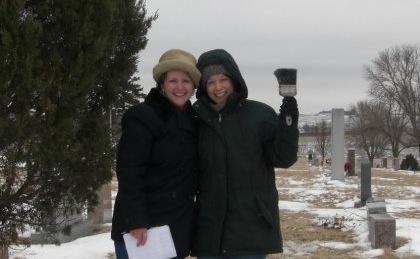
The paintbrush is for sweeping snow/ice off the gravestones. We mean business!

A 2009 photo from our “hop” at Kennard Cemetery in Blair, Nebraska. The paintbrush was for removing snow off the grave stones. My ancestor, Rufus Claar, came from Ohio to farm and breed prize-winning pigs.

When I went out to Omaha this past September, I already had a list of “must see” cemeteries. But since we’d also planned a road trip to Lincoln, I hoped to visit a few I knew nothing about.

Christi wanted to make a stop in Greenwood (population of about 550) to visit the Bakers Candies store. Founded in 1987, Bakers makes mouths water with their famous meltaways. After sampling a few, I could see why.

Greenwood's Bakers Candies produces more than 2,000 lbs. of their famous meltaways a day. That's the Greenwood Farmers' Cooperative (Co-Op) in the background.

Greenwood’s Bakers Candies produces more than 2,000 lbs. of their famous meltaways a day. That’s the Greenwood Farmers’ Cooperative (Co-Op) in the background.

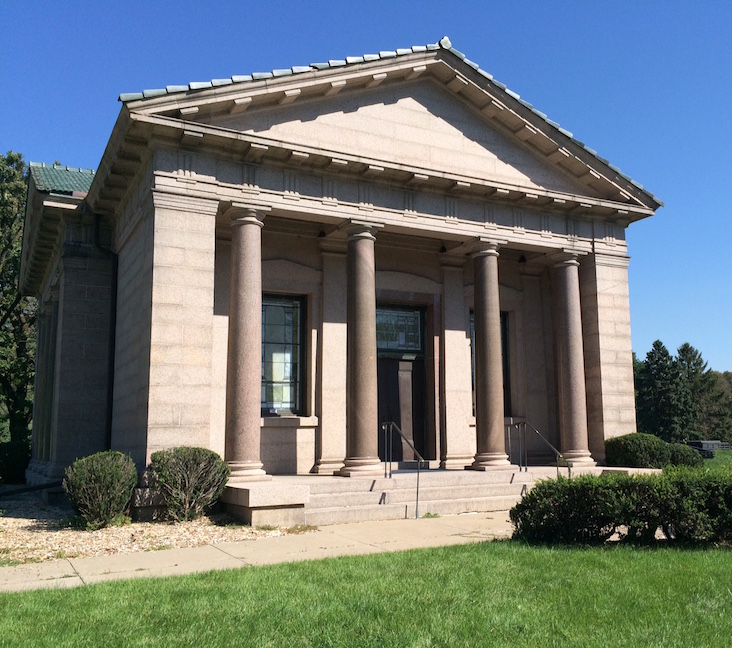
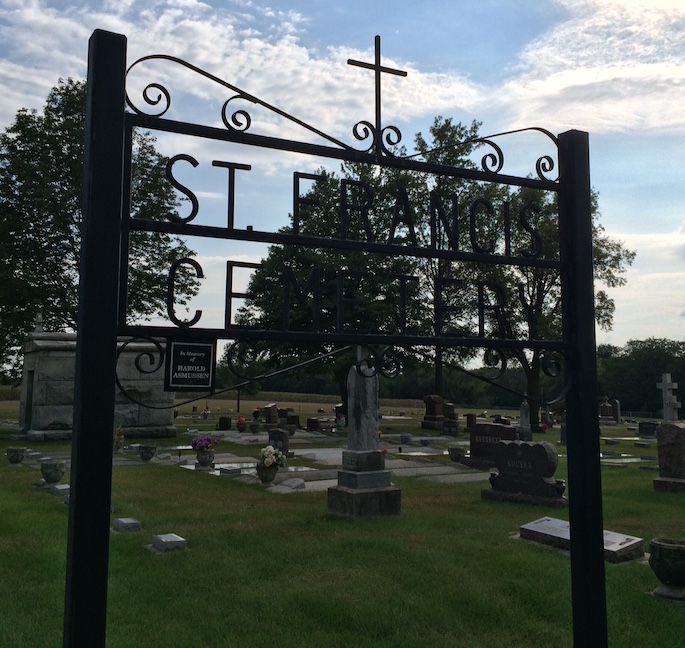
Greenwood Memorial Cemetery is less than a mile from Bakers Candies, so it wasn’t hard to find. Like many Nebraska cemeteries, Greenwood is located amid cornfields. This one, however, is fairly large with around 1,500 burials and is well maintained.

Greenwood Memorial Cemetery has grave stones dating back to the 1860s. It is still an active cemetery, with burials as recent as this year.

Greenwood Memorial Cemetery has grave stones dating back to the 1860s. It is still an active cemetery, with burials as recent as this year.

I couldn’t find out much about the history of Greenwood Memorial Cemetery. I saw burials dating back to the 1860s to just a few months ago.

There’s something quite different about walking through a Nebraska Cemetery from a Georgia one. The landscape is mostly flat, with open sky that seems to last forever. And it feels like you can see for miles.

Looks like we were about to get some rain but thankfully, it held off.

You also don’t often see grasshoppers this size lurking about.

These large grasshoppers reminded me of the swarms of locusts mentioned in the Old Testament.

One of the first markers I noticed was for Margie Armstrong, who died at the age of 20. I’m not sure what kind of material it’s made out of or how it was made.

Margie only lived a few decades but she had an impact on the person who created this unique marker.

Margie only lived a few decades but she had an impact on the person who created this unique marker.

MargieArmstronginscription

Neither Margie’s husband or son are buried at Greenwood Cemetery. “She Has Awakened From The Dream Of Life” are haunting words.

I was intrigued by the design of the top because it looked like it had been damaged. Upon consulting Margie’s memorial on Find a Grave, I saw what it originally looked like. I don’t know if it was vandalized or if the harsh Nebraska winters had damaged it over time.

This is what Margie Armstrong's marker looked like in 2006.

This is what Margie Armstrong’s marker looked like in 2006.

I couldn’t find out anything about Margie at all. But there was a marker for another Armstrong that might be related to her. Ralph Armstrong died over 25 years before Margie, but his stone also made me look twice.

Ralph Armstrong's grave highlights a little-known chapter in American military history.

Ralph Armstrong’s grave highlights a little-known chapter in American military history.

I’d never heard of the U.S. military having a Balloon Air Service, although I was aware that they had experimented with balloons for observation during the Civil War. After I got back home, I did a little research and discovered Omaha’s brief history as a site for the U.S. Army Balloon Corps.

Fort Omaha’s Signal Corps Balloon School operated in the years before World War I, experimenting with the new Baldwin Airship Signal Corps-1 (SC-1), which became the first powered aircraft purchased by the Army. This happened just months before the Army purchased the now-proven Wright Flyer (pioneered Orville and Wilbur Wright).

The Baldwin Airship SC-1 was the U.S. Army's first purchase of a genuine aircraft, even before the ground-breaking Wright Flyer. Photo source: Richard DesChenes.

The Baldwin Airship SC-1 was the U.S. Army’s first purchase of a genuine aircraft, even before the ground-breaking Wright Flyer. Photo source: Richard DesChenes.

The Fort Omaha Balloon School flew the SC-1 until around 1911, when it was no longer serviceable. Officers and enlisted men continued to train until the school was abandoned in October 1913. It was turned into a government weather station until the outbreak of World War I.

OmahaAirServiceSince the English, French and Germans had been using “kite”, or captive balloons for battlefield observations for years, the U.S. Army again set up its balloon training operations at Fort Omaha and tried to play catch-up. About 16,000 young men received training and balloonist skills that they would use on the battlefield in France.

Duty was dangerous not only because balloons were favorite targets, but due to the fact they were filled with highly flammable hydrogen gas. Observers were forced to jump from the basket more than 100 times but had few mishaps partially due to their excellent training. Seventeen U.S. balloon companies sent to Europe saw action on the front, 13 of them having been organized at Fort Omaha.

An airship being taken out of its hangar in 1919 at Fort Omaha.

An balloon being taken out of its hangar in 1919 at Fort Omaha.

At 27, Ralph Armstrong enlisted in the Army on July 29, 1918 and was assigned as a private to the 53rd Balloon Company, stationed at Fort Omaha. A few days before the signing of the Armistice on November 11, 1918, the 53rd was moved to Camp Morrison, Va. About a month later, Ralph was honorably discharged and returned to Nebraska. He died in 1944.

As is often the case, there were several graves of young children. Some even died at birth. This was likely the situation for the Leesley twins, Teddie and Eddie. They died in infancy in 1916.

Teddie and Eddie were the children of William H. and Margaret Leesley.

Teddie and Eddie were the children of William H. and Margaret Leesley.

Nearby is the grave of their brother, Francis, born a few years later in 1922. He died soon after birth but his twin sister, Alice, survived. She married and had children, spending much of her life in Greenwood. She died in 2009 and is also buried at Greenwood Memorial Cemetery.

Francis Leesley died as an infant but his twin, Alice, lived to the age of 87.

Francis Leesley died as an infant but his twin, Alice, lived to the age of 87.

The children of James and Laura Elliott also died at young ages. A native of Wisconsin, James served for three years in the Union Army as part of the 25th Wisconsin Volunteer Infantry, Company I. They participated in the siege and capture of Vicksburg, serving under Sherman in his campaigns against Meridian, Atlanta, Savannah, and the Carolinas. The 25th lost more men than any other Wisconsin regiment, but mostly due to disease.

According to the Nebraska State Census taken in 1879, James and Laura were farming in Tipton, Nebraska (just south of Greenwood) with their children, Edwin “Eddie” and Mary “Mamie”. In December, Mamie died just a few days short of 1880. Brother Eddie died only a few months later. In the 1885 Nebraska State Census, Laura is listed as a widow with two children, Ford (born in November 1880), and Blanche (born in 1883). Both James and Laura (who eventually remarried) are buried in Greenwood Memorial Cemetery.

Little Mamie and Eddie Elliott would die within months of each other for reasons unknown.

Mamie and Eddie Elliott would die within months of each other for reasons unknown.

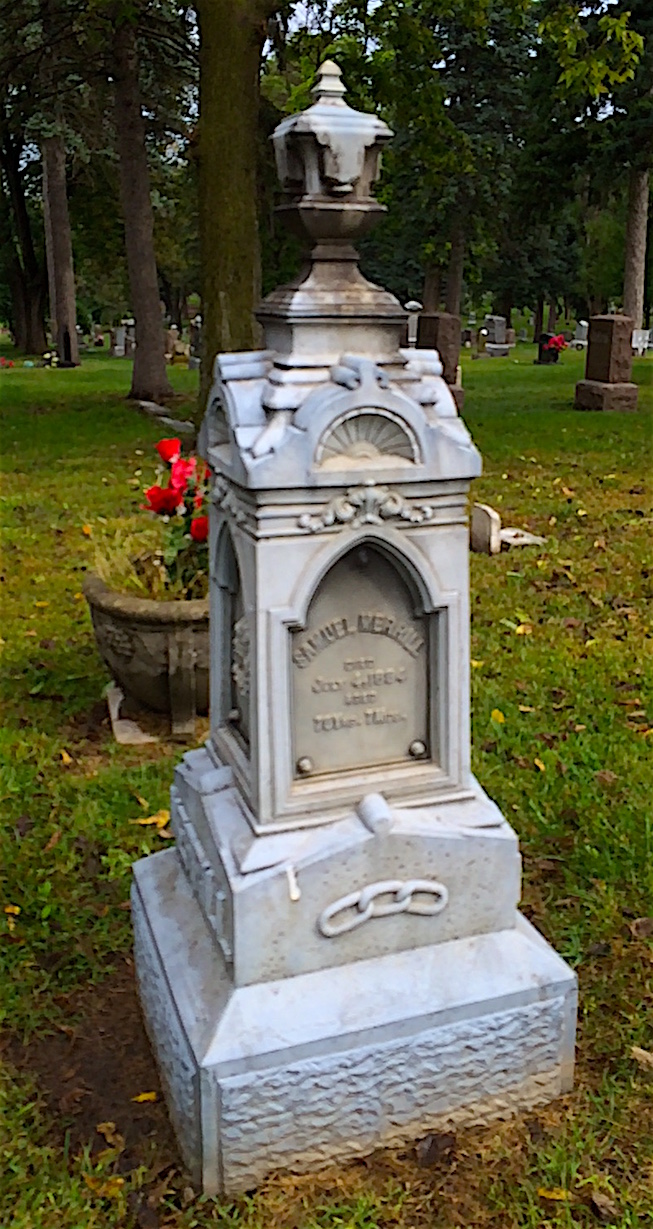
The last grave stone I’m going to feature was one I spotted on our way out. The wording on it was too surprising to breeze past.

The words "killed by an explosion" are ones I don't often see on a grave stone.

The words “killed by an explosion” are ones I don’t often see on a grave stone.

Thanks to a 2012 newspaper article, it wasn’t hard to find out what happened to poor George.

A wagon maker from Massachusetts, George Cutler moved to Greenwood and eventually purchased an old church. After turning it into an opera house, he acted as a promoter and brought in entertainment acts to perform there.

Because electricity had not yet come to Greenwood, the structure was lit with gas lights. One night during a storm, George went to the opera house while carrying a lantern. Due to a gas leak, the flame from the lantern caused an explosion that killed him.

Another interesting bit of trivia, George Cutler was the cousin of Luke Cutler, Hollywood silent movie icon Buster Keaton’s great-grandfather. This gravestone appears to be a replacement and is located far from the other Cutlers in the cemetery, locals have pointed out.

My visit to Greenwood Memorial Cemetery was just one of many “hops”  during my visit to Nebraska. But it was the beginning of many discoveries that I’ll be sharing in the weeks to come.

image


Nineteen Years is Not Enough: Revisiting the Short Life of Joshua Stulick

In January, it will be two years since I started this blog. I’ve written a lot of posts but one from March 2014 that continues to stick with me was about the short life of Joshua Stulick. Today I’d like to revisit his story and share some of the results of that post.

I also now have a face to go with his name.

JoshuaStulick

This is a picture of a paper copy of a photograph of Joshua, so the quality is not great. But I was happy to finally see Joshua’s face. Photo courtesy of Kathy Melchers.

In the spring of 2013, I visited Sharon Baptist Church Cemetery in Forsyth County, Ga. to photograph someone’s grave for Find a Grave. As usual, I took pictures of other graves there with the intention of checking to see if I might post them on Find a Grave as well. And there were indeed some that had not been documented. This is something I do at almost every cemetery I visit.

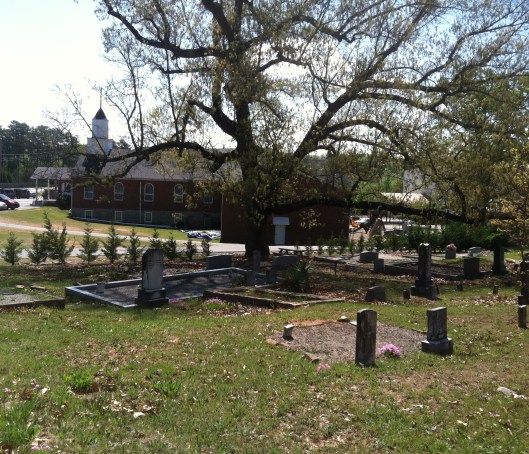
sharonbaptistchurchcemetery1

Sharon Baptist Church Cemetery is in Forsyth County, Ga.

Several months later, I got an e-mail from a woman named Jenn thanking me for photographing a grave and creating a memorial for Joshua Stulick. His name didn’t ring a bell, so I looked up his memorial and learned that he’d died in 1992 at the age of 19.

Jenn wrote:

Thank you so very much for your post of a grave for Joshua Stulick. I have looked for so very long to find him. At last I have it because of you. There was no goodbye when he was tragically killed. Now at least I can visit. Thank you! It means a lot.

Whoa.

I soon learned that Joshua was murdered in a park in Staten Island, N.Y. in April 1992. His murder remained unsolved for many years.

StatenIslandUnivHospital

Joshua Stulick worked in the cafeteria at Staten Island University Hospital.

According to The Staten Island Advance, one night Joshua went to a friend’s house for drinks after finishing his shift in the hospital cafeteria where he worked. Later, he and some other people went to Ingram Woods (a nearby park).

On April 28, 1992, Joshua’s body was found, covered in the park’s underbrush. He’d been fatally stabbed in the throat and wrapped in the interior lining of a car trunk.

Suspicion fell on Joshua’s co-worker, James Russell, already on probation for a felony assault conviction. In that case, Russell had plead guilty to a 1989 attack.

Police suspected that the trunk lining Joshua was found wrapped in belonged to Russell’s car, but no other evidence was found. Russell swore he knew nothing about what happened, was released and the case froze up.

Russellpic

James Russell worked with Joshua Stulick at Staten Island University Hospital in 1992. Photo source: The Staten Island Advance.

In 2005, an anonymous witness came forward. Based on what she said, Russell was arrested and eventually charged with second degree murder. He initially plead not guilty.

In December 2007, Russell changed his story, claiming he and Stulick were drinking and doing drugs that day before heading for Ingram Park. He said they started to “fool around with knives that we each had, playing karate moves and lunging and sparring with each other.”

“Joshua lunged at me as I was swinging my arm with the knife, and I cut him,” Russell admitted. “To my horror, the knife cut into Joshua Stulick’s throat.”

He said he covered the body in Ingram Woods and fled, thinking “everyone would blame me no matter what I said.”

Staten Island Supreme Court Justice Stephen J. Rooney sent Russell to prison for a minimum of three and a half years up to a maximum seven years under an agreement by which Russell pleaded guilty to second-degree manslaughter. Had he been found guilty of second-degree murder, he might have faced a lifetime jail sentence. As part of the deal, he was not allowed to appeal his sentence.

Staten Island Supreme Court Justice Stephen Rooney sent Russell to prison for a minimum of three and a half years up to a maximum seven years. Photo cource. SIAlive.com

Staten Island Supreme Court Justice Stephen Rooney sent Russell to prison for a minimum of three and a half years up to a maximum seven years. Photo source: SIAlive.com

Joshua’s mother, Kathleen Melchers, spoke at James Russell’s sentencing:

Your actions of cold violence not only took my son’s life, but to drag his body onto a car trunk liner and lay him on the ground behind a rock for two days until being found by someone walking a dog, is an act of sensitivity coming from a wicked heart and extreme lack of respect for the human body and soul.

As a mother of a son myself, I felt disbelief and anger when I read about Russell’s plea deal. Russell’s sentencing took place in 2007 so he’s probably out walking the streets again now.

While I didn’t know if anyone would contact me after I published the original blog post, that didn’t matter to me. I felt that I was meant to photograph Joshua’s grave for a reason and writing about him was simply something I had to do.

Joshua Stulick's grave is in Sharon Baptist Church Cemetery in Cumming, Ga.

Joshua Stulick’s grave is in Sharon Baptist Church Cemetery in Cumming, Ga.

A few months later, I was surprised to find that Joshua’s mother, Kathleen (who goes by the name Kathy), had left a comment on the blog.

The longsuffering was a walk no person should have to go through but God had his hand on many people and assigned a God appointed team in Staten island, which I still count them all dear to my heart. The Team was truly assigned to Joshua’s case. The God I serve took care of the judgement, hurting hearts, and the ability to forgive. I will see him in heaven; no tears or hurts every again. I have learned to love others in a special way as I know that is what Joshua would want me to do.

I had worried about Kathleen in light of Russell’s incredibly light sentence. Enduring the violent death of your own child is something no parent should have to go through. But her words showed me that while her journey had been difficult, she had turned to God for healing and understanding. And found it.

Joshua’s godmother, Bonnie, left a comment this past August:

I came across this article today and could not believe someone cared that he did die so young. He was my godson and very precious little boy. Have been thinking of him because his birthday is coming up on September 10th, he would have been 42 this year. My only peace is that he is with our Lord and hopefully singing for the angels.

Joshua’s friend and fellow bandmate, Mike Arguelles, left a comment just a few months ago:

I went to Curtis High School with Josh and briefly played in a band with him, ( “Section 8” ) He was a good guy and his own person. I last spoke with him over the phone shortly before he was to move down South. The move never got to happen. I often think about Josh, ( he was a good friend to me ) how he got cheated his due time and my heart goes out to his family and fellow friends. May you rest in peace, Josh. See you on the other side, Brother.

Joshua attended Curtis High School in Staten Island, New York but was preparing to move back to the South.

Joshua attended Curtis High School in Staten Island, N.Y., and was preparing to move back to the South at the time of his death.

Jenn, who originally contacted me about Joshua, recently sent me an email to share some of her memories of him. While it had been many years since his death, she continues to try to come to terms with it.

When I finally saw a photo of his grave…it hit me like a brick. It’s not that I didn’t know he was dead, but I suppose finally a more tangible look at it hit me very hard, for a very long time after that. I have never stopped grieving. And all I will ever have of him is that photo on your site. Not even of him, but of his grave.

He was beautiful. And despite his pitfalls (I know he was not a saint), he was kind. He cared more about what was best for me than what he wanted. That jacket they found at the park was one he used to give to me when I was cold.

I have to say that I have a wonderful family of my own. A husband and tree precious children, but this loss has never ceased to ache. To say my heart was broken is a gross understatement; it was shattered and that cannot be mended.

Kathy left another comment this past October and I responded by telling her I was planning on writing an update to my original blog post. I asked if she might send me a picture of Joshua. She doesn’t have a scanner but was able to photograph a paper picture of Joshua that she had. I was thrilled to finally see his face, to get a glimpse of the young man I’d written about.

Joshua’s story points me to a truth I’ve known for a while. A name and a date on a gravestone is just the tip of the iceberg of the life of the person it represents. Each person has their own unique story, has impacted the lives of others in some special way. Every life is special.

Even if it ends long before it should have.

Postscript 4/28/2022: Today marks the 30th anniversary of Joshua’s death. Since I wrote the update above, I have talked to Kathy on the phone about Joshua’s memory. People still leave messages with memories of Joshua and I treasure each one.

Free At Last: Visiting Atlanta’s South-View Cemetery (Postscript)

Over the past weeks, I’ve highlighted a variety of people buried at South-View Cemetery. Civil rights pioneers, a famous Vaudeville sister act, a Tuskegee airman, outspoken clergymen and many more.

But there’s another side to South-View that is impossible to escape. The graves of ordinary men and women who did not have towering monuments and illustrious pasts. Some whose graves are not even marked. When you wander over to the older section of the cemetery that is not within the perpetual care area, you’ll find a more untamed, rugged beauty.

Non-perpetual care section is a designation I often see at old cemeteries. Years ago, the concept of putting aside funds for the upkeep and maintenance of graves did not exist as it does now.

Non-perpetual care is a designation I often see at old cemeteries. Years ago, the concept of putting aside funds for the permanent upkeep and maintenance of graves did not exist. As a result, they are sometimes in need of repair or restoration but the funds don’t exist to do it.

While John and I meandered around, I took pictures of whatever caught my eye. This rather crude inlay of the letter “H” for the Hardin family’s plot was one of them.

I know nothing about the Hardin family but this inlay initial at the entrance looked special.

I know nothing about the Hardin family but this inlay initial at the entrance looked unique.

I saw a number of markers with the words “Mother at Rest” on them, which I found particularly touching.

This one is a bit worn and not easy to read.

This one is a bit worn and not easy to read but the spirit behind the words is still there. There was no name on it.

The wood motif in this plot was rather unusal as the border was entirely made of stone made to look like logs. There was nothing to indicate the name of the person buried here. But it is beautiful nonetheless.

I’ve seen wood-style markers before. But the motif used in this plot was unusual in that the entire border is entirely made of stone made to look like logs. There was nothing to indicate the name of the person buried here.

On the far east side of the cemetery, the landscape is less manicured but it remains a peaceful sanctuary of reflection.

There are a number of enormous old trees like this one on the grounds of South-View.

There are a number of enormous old trees like this one on the grounds of South-View.

An old bench awaits visitors to pause and sit beneath the towering trees.

A solitary bench awaits visitors to pause and sit beneath the towering trees.

These are more of the temporary markers that became the only indication of a grave since permanent ones were never purchased.

These are temporary markers that became the only indication of a grave since permanent ones were never purchased. They were created by African-American funeral homes.

I noticed a few monuments standing alone in large stretches of grass nearby. These were plots purchased by black churches as part of burial societies decades ago. The one below was erected by the Daughters of Israel of the Reed (misspelled as Reid on the stone) Street Baptist Church, organized in 1867.

SVReidStreetBaptist African-Americans were not allowed to be buried with whites before the Civil War and long into the years after it. Though some freed slaves preferred to remain on the plantation or settle in the countryside, many relocated to urban areas and established communities. They needed somewhere to bury their dead in an inexpensive way.

I could find no specific information about Atlanta’s black burial societies. But in Charleston after the Civil War, whites encouraged freed blacks to form benevolent societies so they might collect dues and purchase land for cemeteries. About nine of these have been identified but there were likely more. Such societies also existed in Northeastern Jewish communities and a few still exist today.

Arranging burial was only one part of some of these societies. They sometimes paid for the education of orphaned children, found work and supported families, provided financial support to the sick and dying, and offered widows an annuity or modest monthly stipend to help with living expenses.

Ellen Shaw's grave is the only one marked in the plot established by the Daughters of Israel. It's unknown how many are actually buried there.

Ellen Shaw’s grave is the only one marked in the plot established by the Daughters of Israel. It’s unknown how many people are actually buried there.

Reed Street Baptist Church (misspelled as Reid Street on the monument) is now Paradise Baptist Church. Dinah Watts Pace, a former slave, began a Sunday School for poor and orphaned children in the Summerhill area of Atlanta. She also opened a children’s home later. The original Sunday School was the core of what would later become Reed Street Baptist Church.

The only marked grave in the Daughters of Israel’s plot is that of Ellen Shaw, who was born in 1837 and died in 1899 at the age of 64 years. According to census records, by 1870 she was widowed and working as a domestic servant with her daughter, Tempy, who was also a servant. Ellen is listed as a laundress in the 1877 Atlanta City Directory. It’s likely that she or her daughter was a member of Reed Street Baptist Church.

Big Bethel AME Church’s neon “Jesus Saves” sign became a well-known landmark when the church was rebuilt after a fire in 1920.

Another burial society monument I found was for the Independent Daughters and Sons of Bethel Society, Inc., formerly the Independent Daughters of Bethel Society, Inc. This society was affiliated with the Big Bethel AME Church.

Founded in 1847, Big Bethel is the oldest African-American congregation in the Atlanta area. The church is still active today and its “Jesus Saves” sign has been a city landmark since 1922 when the church was rebuilt after a fire.

The Independent Daughters of Bethel, Inc. has an incorporation date of 1909, according to my research.

The Independent Daughters of Bethel, Inc. has an incorporation date of 1909, which is the only information I could find about it.

Big Bethel AME Church was a church home of the Independent Daughters of Bethel, Inc.

Big Bethel AME Church was the church home of the Independent Daughters of Bethel, Inc.

The last burial society monument I found was for two different groups. The first was the Sisters of Love Society, organized in 1875, and the Rising Stars Society of the Wheat Street Baptist Church, organized in 1879. Perhaps the Sisters of Love Society was also part of this church since the two share one marker. I could find absolutely no information on either group and there were no grave markers within these plots.

SVWheatStreetMonument

SVRisingStarsSocietySVSistersofLoveWheat Street Baptist, on the other hand, has a long and much-documented history. Established in 1869, parishioners from Friendship Baptist Church who wanted to attend a church closer to their homes organized into a mission known as Mt. Pleasant Baptist, with Rev. Andrew Jackson as their pastor. Their first place of worship was Jackson’s yard on Howell Street. After a fire in 1917, they moved into its current building on Auburn Avenue in the 1920s. It is still active today.

Wheat Street Baptist Church is located on Auburn Avenue near the Martin Luther King, Jr. National Historic Site.

Wheat Street Baptist Church is located on Auburn Avenue near the Martin Luther King, Jr. National Historic Site.

There are a few other graves that I paused at for their unique appeal. This one was definitely worth a second look.

Andrew Mozley and his family are a mystery to me but their monument is a work of art.

Andrew Mozley and his family are a mystery to me but their monument is a work of art.

I could find nothing about Andrew Mozley or his family. But the cross erected in their honor is lovely to look at. It’s also an interesting collection of Christian cemetery symbols.

In ancient times, the anchor was regarded as a symbol of safety. It was later adopted by Christians as a symbol of hope and steadfastness. Doves are a symbol for love and peace, as well as the Holy Spirit. A Lily of the Valley signifies innocence, humility and renewal.

Not very far from the Mozley monument is this one for Richard Kelsey. I could not locate him in any census records but his name appears several times in the Atlanta City Directory.

In the 1870s, he worked as a gardener for Alfred H. Colquitt, a lawyer and Civil War major general before becoming the 49th Governor of Georgia. Colquitt was elected U.S. Senator after that. In later years, Kelsey worked as a driver and a laborer.

SVKelsey1

Richard Kelsey worked as a gardener at one point in his life so it’s not surprising there’s a calla lily on his monument.

SVKelsey2The calla lily represents marriage and fidelity. But I can find no record of Richard Kelsey being married so that may not be the case in this example.

This last marker has no names at all but rested alone in a large plot. One was a wife, the other her daughter. Their identities are lost to time but this one last memento of them remains.

SVMotherandDaughterI hope you’ve enjoyed this journey through South-View Cemetery. It’s a hidden gem in Atlanta so if you ever have the chance to go there, don’t put it off like I did. You won’t regret it.


Free At Last: Visiting Atlanta’s South-View Cemetery (Part III)

No tour of South-View Cemetery would be complete without talking about the legacy of Dr. Martin Luther King, Jr. He was initially buried at South-View after his untimely death. Several of his family members are buried there that greatly influenced his path in life.

The Rev. Adam Daniel (A.D.) Williams was the grandfather of Martin Luther King, Jr. As the son of slaves Willis and Lucretia Williams in Greene County, Ga., he was probably born in 1861 but celebrated his birthday on January 2, 1863, the day after the Emancipation Proclamation went into effect. His hopes of following his father into preaching were evident from an early age. Taught by several ministers in the community, Rev. Williams earned his license to preach in April 1888.

The Rev. A.D. Williams had ambitions of being a preacher like his father, even conducting funerals for animals when he was a child.

The Rev. A.D. Williams had ambitions of being a preacher like his father, even conducting funerals for animals when he was a child.

In January 1893, he was called to the pastorate of Atlanta’s Ebenezer Baptist Church. Although Ebenezer had only 13 members when he arrived, the congregation grew to 400 members by 1903. Williams enrolled at Atlanta Baptist College (later named Morehouse College) and in May 1898, received his certificate from the ministerial program. Rev. Williams married Jennie Celeste Parks in 1899. In 1903, they welcomed their only surviving daughter, Alberta, who later became the mother of Martin Luther King, Jr.

Rev. Williams became pastor of Ebenezer Baptist Church in

Rev. Williams became pastor of Ebenezer Baptist Church in 1893. Located on Auburn Avenue, the church is still going strong today. (Photo source: Francisco Collazo.)

In September 1895, Rev. Williams joined 2,000 other delegates and visitors at Friendship Baptist Church to organize the National Baptist Convention, the largest black organization in the U.S. By 1904, Rev. Williams was president of the Atlanta Baptist Ministers’ Union, and chairman of both the executive board and finance committee of the General State Baptist Convention.

In 1906, Rev. Williams helped organize the Georgia Equal Rights League to protest the white primary system. Twelve years later, Williams became branch president of the NAACP chapter he helped found. During his tenure, the branch grew to 1,400 members within five months and spearheaded a major effort to register black voters.

SVRevWilliamssteps

Rev. Williams is buried beside his wife,

Rev. Williams is buried beside his wife, Jennie Parks Williams. Two children who died in infancy are buried with them.

Daughter Alberta married Martin Luther King, Sr. (known as “Daddy King”) in 1926. Rev. Williams’ son-in-law succeeded him as pastor of Ebenezer in 1931 after his death.

Near the front gates of South-View is the tomb of Rev. King Sr. and Alberta. After Martin Luther King, Jr. was assassinated in Memphis, Tenn. in 1968 by James Earl Ray, his body was placed in this tomb until the Martin Luther King, Jr. Center for Nonviolent Social Change (known as The King Center) opened in the 1970s when his remains were moved to a new tomb there. His wife, Coretta Scott King, joined him there when she died in 2006.

The tomb of Dr. Martin Luther King, Sr. and his wife, Alberta Williams, King, is located near the front gates of South-View.

The tomb of Dr. Martin Luther King, Sr. and his wife, Alberta Williams,King, is located near the front gates of South-View.

The remains of Dr. Martin Luther King, Jr. were moved to the King Center in the 1970s.

The remains of Dr. Martin Luther King, Jr. were moved to the King Center in the 1970s. The tomb is faced with Georgia marble.

The son of sharecroppers Delia (Linsey) and James Albert King, Dr. Martin Luther King Sr. was born Michael King in Stockbridge, Ga. in 1899. As a young man, he moved to Atlanta, where his sister Woodie was boarding with Rev. A.D. Williams. After Dr. King Sr. started courting Alberta, her family encouraged him to finish his education and become a preacher.

The Rev. Martin Luther King Sr. in Macon, Georgia at the State Sunday School and Baptist Congress on July 20, 1977. Photo source: Associated Press.

The Rev. Martin Luther King Sr. in Macon, Ga. at the State Sunday School and Baptist Congress on July 20, 1977. (Photo source: Associated Press.)

In 1926, Dr. King Sr. started his ministerial degree at the Morehouse School of Religion and married Alberta at Ebenezer Baptist Church. The couple had three children: Willie Christine King (Farris), Martin Luther King, Jr. (born Michael King, Jr.), and Alfred Daniel Williams King.

Dr. King Sr. became leader of Ebenezer Baptist Church in March 1931 after the death of his father-in-law. By 1934, he’d become a much respected leader of the local church. He changed his name (and that of his eldest son) from Michael King to Martin Luther King after becoming inspired during a trip to Germany by the life of theologian Martin Luther, although he never changed his name legally.

Dr. King Sr. was the pastor of the Ebenezer Baptist Church for 40 years. In 1948, his son, Martin Jr., joined him at Ebenezer as an associate pastor. Despite theological differences, father and son would later serve together as joint pastors at the church.

Three generations of Kings: Martin Luther Sr., Jr. and III.

Three generations of Kings: Martin Luther Sr., Jr. and III.

Dr. King Sr. headed Atlanta’s Civic and Political League, and NAACP branch. After his son’s assassination in 1968, he lent his support to former Georgia governor Jimmy Carter during his 1976 Presidential campaign.

Dr. King Sr. endured more than one family tragedy. On June 30, 1974, while Dr. King Sr. was out of town, Alberta was playing the organ at Ebenezer Baptist Church during a service when she was shot and killed. The gunman, 21-year-old Marcus Wayne Chenault, claimed he planned to shoot Dr. King Sr. because of his hatred for Christians but in his absence, had shot his wife instead. Cheanualt was given a life sentence and died of a stroke in prison in 1995.

Alberta Williams King

Alberta Williams King was shot and killed while playing “The Lord’s Prayer” on the organ at Ebenezer Baptist Church in 1974.

Dr. King Sr.’s younger son, Rev. Alfred Daniel Williams King. Jr., died in 1969 at the age of 39 when he drowned in the swimming pool at his home. After suffering a stroke in 1984, Dr. King Sr. died and was buried at South-View beside his wife.

Dr. King Sr.'s younger son, the Rev. A.D. Williams King, Jr., died in 1969 after drowning in his swimming pool. He is also buried at South-View. Photo source: Warrick L. Barrett.

Dr. King Sr.’s younger son, Rev. A.D. Williams King, Jr., died in 1969 after drowning in his swimmers ng pool. He is also buried at South-View. (Photo source: Warrick L. Barrett.)

There are two other graves I’d like to mention. The first is Carrie Cunningham and her son, McAllister “Red” Riggins. Had it not been for Red’s outrageous behavior, Atlanta’s famed Royal Peacock club might never have opened in 1949.

“Mama” Cunningham already owned and managed the Royal Hotel on Auburn Avenue. Hoping to keep her wayward musician son out of trouble, she opened the Royal Peacock (formerly the Top Hat, where the Whitman sisters performed). Cunningham already had experience in the entertainment world, having worked in large traveling vaudeville troupes as a girl.

The Royal Peacock was considered an

The Royal Peacock was considered an incubator for unknown talent. Little Richard, Nat King Cole, Ray Charles and James Brown are only a few that played there early in their careers. (Photo source: Skip Mason Archives.)

Thanks to Cunningham’s business skills, the Royal Peacock became the hot spot for up and coming talent. Artists like James Brown, Ray Charles and Nat King Cole played there as relative unknowns who went on to become stars.

Otis Redding made an appearance at the Royal Peacock in the early 1960s. Photo source: Zelma Redding

Otis Redding made an appearance at the Royal Peacock in the early 1960s. (Photo source: Zelma Redding)

Cunningham was also a confidante and adviser to Martin Luther King, Jr. and newspaper columnist Ralph McGill. She also enjoyed the company of Joe Louis, Jackie Robinson, Mohammed Ali and other African-American celebrities.

Carrie Cunningham died in 1973 and the Royal Peacock’s fortunes have ebbed and flowed since that time. Currently, it’s a hip hop club but the Royal Peacock has yet to recapture the status it had once up on a time.

Carrie Cunningham is buried at South-View with her son and his wife.

Carrie Cunningham is buried at South-View with her son and his wife.

The last person I’d like to talk about is a man most known for an iconic picture in a magazine. In it, he’s weeping as he plays the accordion, mourning for his lost friend. But there was much more to Graham Jackson, Sr. than a photo.

Graham Jackson is known best as the man in this Life magazine photo. But he was also a well-known entertainer in Atlanta. Photo source: Ed Clark.

Graham Washington Jackson, Sr. is known best as the man in this Life magazine photo. But he was also a talented entertainer. (Photo source: Ed Clark.)

A native of Portsmouth, Va., Jackson could master almost any instrument, giving piano and organ concerts at high school age. Sponsored by a wealthy patron, Jackson studied at the college level but when the patron died, Jackson stopped his formal training until he moved to Georgia.

During his early days in Atlanta, Jackson attended Morehouse College and Atlanta University. In 1928, he joined the faculty at Washington High School and served as its music director until 1940.

Jackson became a personal friend of Eleanor and President Franklin D. Roosevelt, having played command performances in Washington, D.C. He was present in Warm Springs, Ga., when Roosevelt died on April 12, 1945. The two had been collaborating on a version of Antonin Dvorak’s “Goin’ Home” the day before.

A friend of President Roosevelt and his wife, Jackson built a replica of the Little White House across from Washington High School where Jackson taught for many years. Photo source: Special Collections Dept., Pullen Library, Georgia State University.

Jackson built a replica of the Little White Housew across from Washington High School where Jackson taught for many years. It still stands today. (Photo source: Special Collections Dept., Pullen Library, Georgia State University.)

Jackson became a national icon when Life photographer Ed Clark took a photo of Jackson playing “Goin’ Home” as Roosevelt’s funeral train left Warm Springs.

Jackson served in the Navy from 1942 to 1945, receiving six honorary citations for his war bond fundraising (yielding more than $3,000,000 in sales) and Navy recruitment work.

Jackson went on to appear on Ed Sullivan’s Toast of the Town and formed the Graham Jackson Choir, which toured extensively. He also made guest appearances playing the huge Moller organ at Atlanta’s Fox Theater (nicknamed the “Mighty Mo”).

A 1968 ad for Pittypat's Porch, a restaurant that still exists today. Photo source: Atlanta Time Machine.

A 1968 ad for Pittypat’s Porch, a restaurant that still exists today. (Photo source: Atlanta Time Machine.)

In later years, Jackson entertained with a combo and as a solo Hammond organ artist at Atlanta’s Johnny Reb’s Restaurant and Pittypat’s Porch. He was named Official Musician of the State of Georgia by then-Governor Jimmy Carter in 1971 and was inducted posthumously into the Georgia Music Hall of Fame in 1985.

SVJacksongraveThere’s so much more to South-View Cemetery than what I’ve written in these three installments, so I’m returning next week to wrap things up in Part IV.