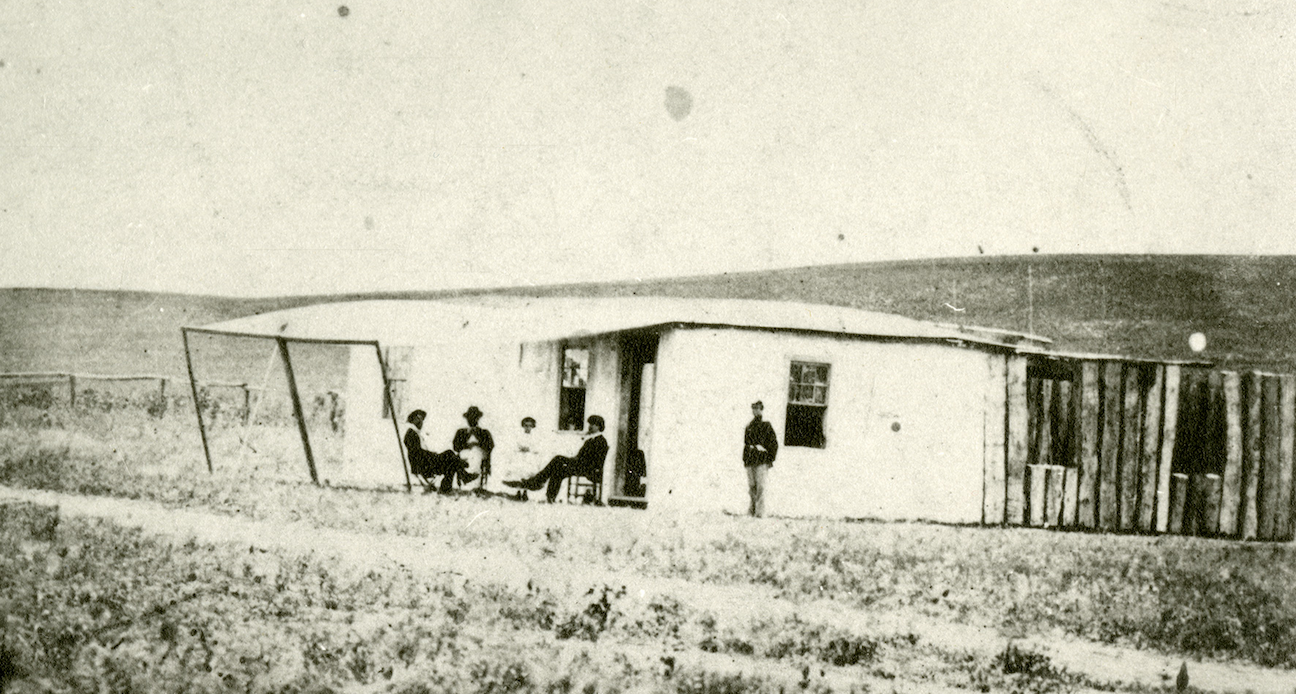
Yellowstone National Park Adventures: Exploring Montana’s Gardiner Cemetery, Part II

I’m still at Gardiner Cemetery, after a two-week break. As I said, it’s a smallish cemetery but still has plenty of stories to offer. I was saddened to learn that just this week, a fire that began in a business on Main Street in Gardiner swept through a number of stores. Fortunately, nobody was injured but it will take time for those businesses to recover.
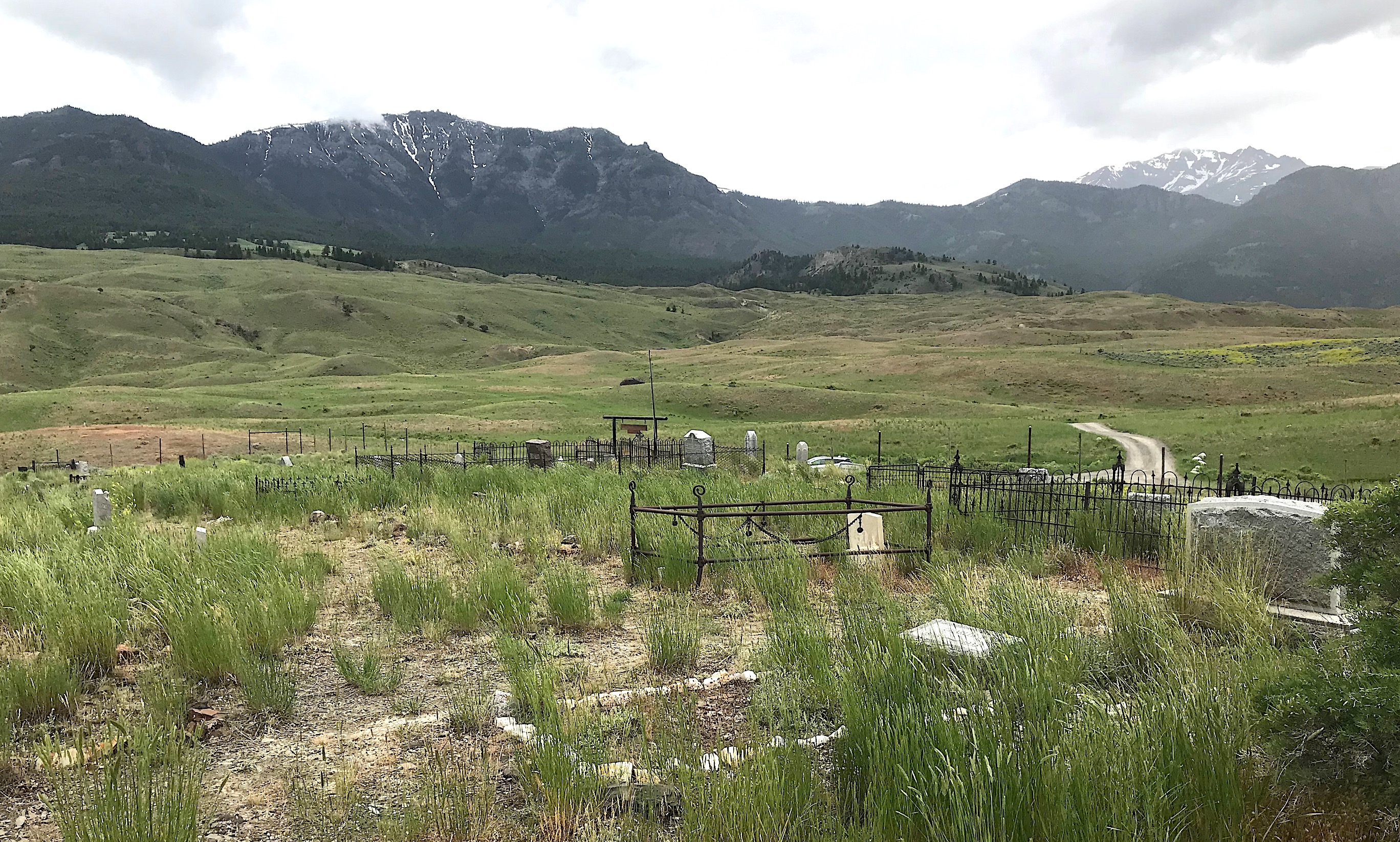
The mountains are a beautiful backdrop behind Gardiner Cemetery.

Montana was definitely the wild frontier for many years, even up through the early 1900s. Unfamiliar landscapes and drastic weather changes could catch many unawares, leading to an untimely demise.

Death of “Mormon” Brown

Alexander “Mormon” Brown probably got his nickname from having lived in Ogden, Utah much of his life. But by 1886, the 35-year-old was living in the Gardiner area. According to Lee Whittlesey’s book, Death in Yellowstone, the winter of 1886-1887 was brutally cold. Brown left Gardiner with a friend, Thomas Garfield, to stay in Thomas’ cabin some five miles away for a few days.

An article in the Billings Gazette (Wyo.) describes Brown’s last days.

Unfortunately, because Brown struggled with alcoholism, he suffered from DTs (delirium tremors) while at the cabin. While Thomas slept, Brown left the cabin on the night of January 4, 1887 and disappeared. Brown was found the next day by a search party, his body nearly frozen halfway in the water of the Yellowstone River.
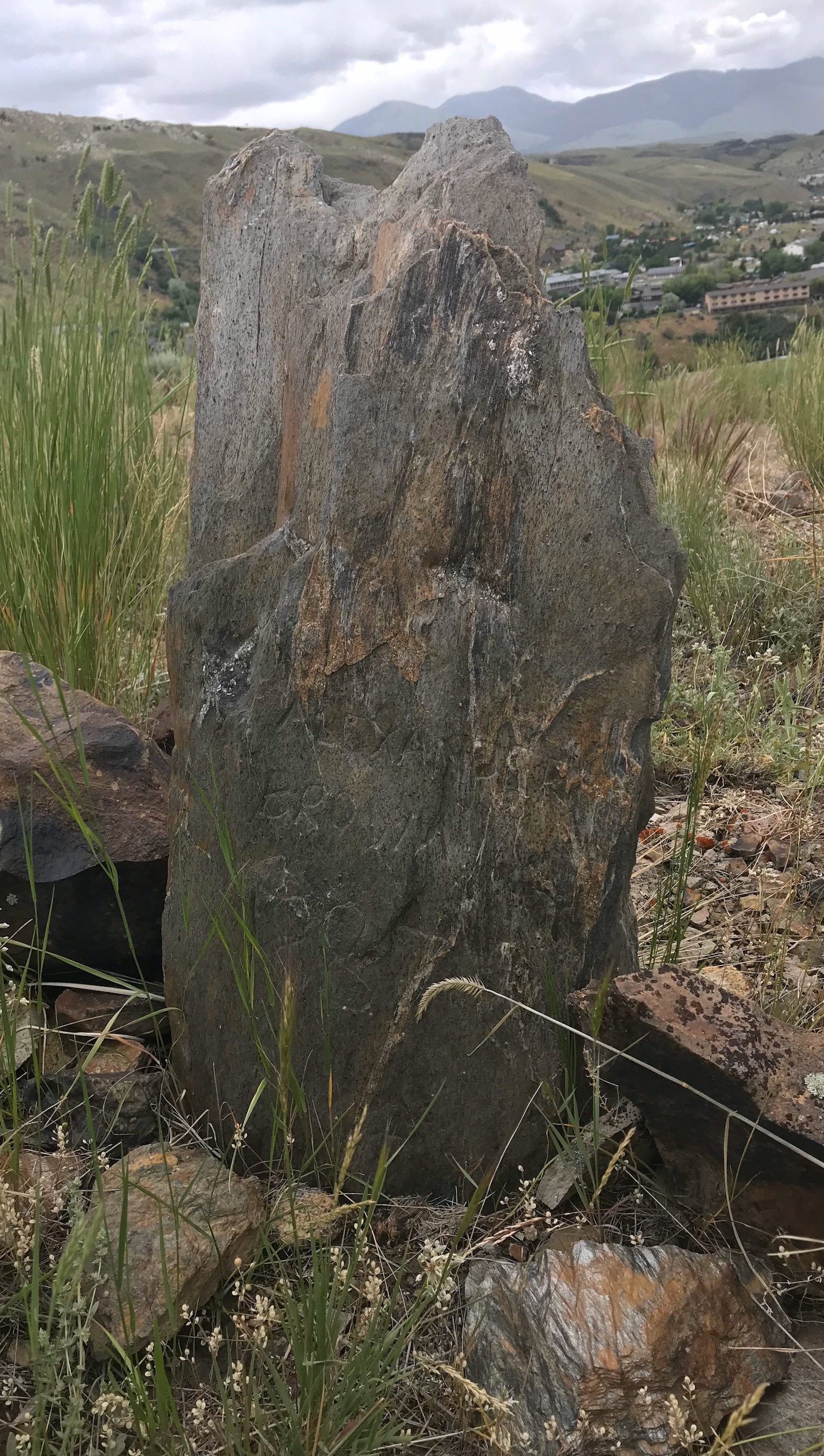
Alexander “Mormon” Brown froze to death in January 1887, one of the coldest winters on record.

You can barely make out Brown’s name and dates on what looks to me to be a wooden marker. I suppose it could be petrified rock. Regardless, it’s rather amazing that it still exists at all.

Struck by Lighting

Mormon Brown’s demise was certainly an agonizing death but in the case of Robert Wright, he had no warning whatsoever of what was coming.

Although a native of Montana, Robert S. Wright was the son of Scottish immigrants. His father, Edward, arrived in America around 1895 and married Sibel Somerville around 1897. Robert was born in 1908.

According to Whittlesey, Robert was working for the Yellowstone Park Transportation Company. On July 18, 1929, he was driving a company truck on the Mammoth-Tower Road. The truck broke down near Oxbow Creek. It began to rain, so he sat down under a large tree. Lighting struck the tree, killing him instantly. According to a newspaper report, his body was found leaning against the split tree. He was only 21.
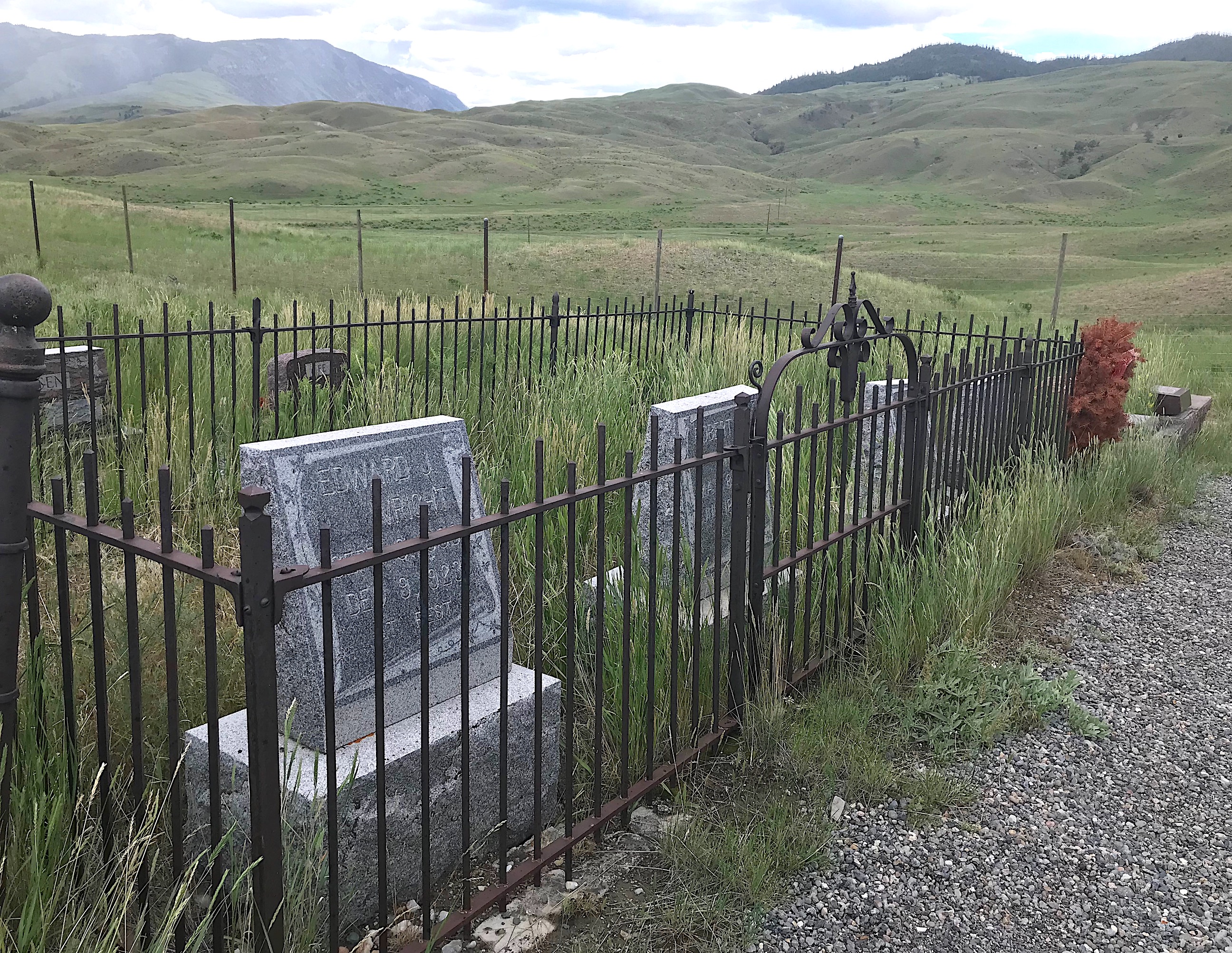
Robert S. Wright is buried with his parents and an uncle in the Wright plot at Gardiner Cemetery. His marker is the one directly behind the gate.

Another article I read said that Robert’s funeral reunited the extended Wright family for the first time since they had left Scotland, a group of about 35 of them attending. Robert is buried between his parents in the Wright family plot. Sibel died in 1937 and Edward died in 1938.

Two Markers, Two Cemeteries?

There’s a marker that looks fairly new for a child named Marie L. Douglass. It states that she was traveling with her parents, Nebraskans Volney and Florence Douglass, through Yellowstone Park in a covered wagon (along with grandparents and a sister named Ruth) when she died of a sudden illness on Aug. 13, 1906.
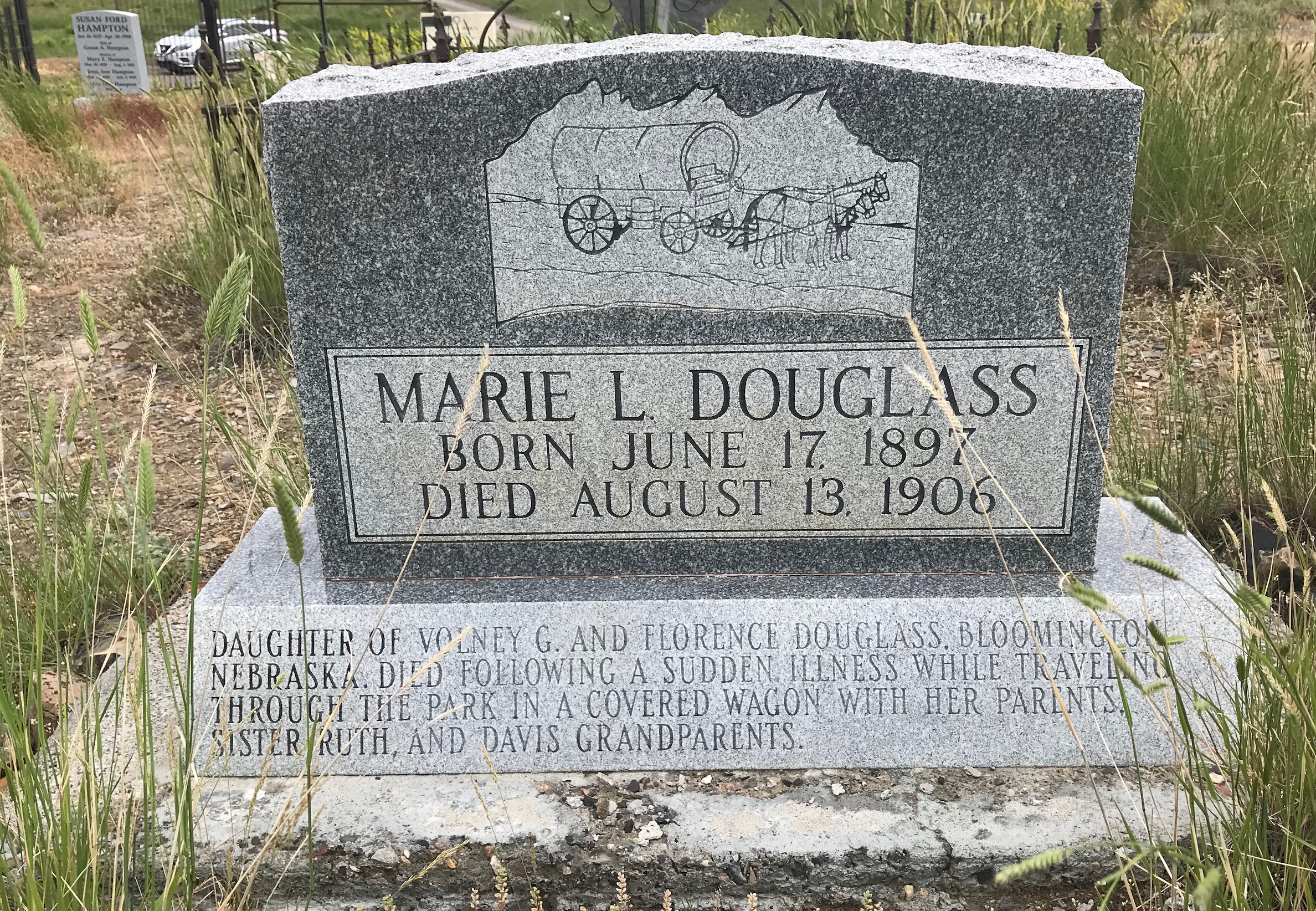
Why does Marie Douglass have two different markers in two different cemeteries? I didn’t learn the full answer until 2021.

From what I could discover, the Douglass family lived in Bloomington, Neb. most of their lives. Volney was a native of New York but had lived in Nebraska from the time he was a boy. Sadly, Florence Douglass died the following year in 1907. Volney remarried and died in Bloomington in 1946.

The puzzling thing about all this is that there is also a marker for Marie in Maple Grove Cemetery in Bloomington, Neb. beside those of her parents. Is Marie buried in Gardiner Cemetery or in Maple Grove Cemetery? Which one is a cenotaph? I can understand why the family would choose to bury Marie in Montana while remembering her with a marker at home. But I still wonder exactly where Marie is buried.

UPDATE: In June 2021, I received an e-mail from Ruth Marie Steinkruger, whose mother was the half-sister of Marie Douglass. The stone in Maple Grove Cemetery in Bloomington, Neb. is indeed a cenotaph. Here’s what Ruth wrote: “Marie is buried at Gardiner. The stone at Bloomington, NE was placed by her parents when they returned from the trip to Yellowstone. My dad designed the stone that is in Gardiner on the 1980s to replace a very small marker that was originally there.”

“Little Gus” Smitzer and “Morphine Charley” Reeb

I photographed one grave marker for its unusual name than the look of it, since it appeared to be fairly new. “Little Gus” Smitzer, as it turns out, had a colorful past his stone did not hint at in any way.

Born in 1849, “Little Gus” Smitzer got his nickname for his short stature. I don’t know what his family background was but he was born in New York. By the 1890s, he was living in the Yellowstone area and had become friends with German immigrant George “Charley” Reeb. Like Gus, Charley was a bit of a drifter. Charley, who had an addiction to drugs, went by the moniker “Morphine Charley”. Together, the pair hatched a plan to rob a stagecoach to finance their itinerant lifestyle.

Lying in Wait

On August 14, 1897, Gus and Charley stationed themselves on Solfatara Plateau about four miles from the Canyon Hotel in Yellowstone Park. Each had a pistol and rifle, and wore a mask. They awaited the line of stagecoaches traveling from the Canyon Hotel to Norris Geyser Basin. Six stages filled with tourists and an army ambulance carrying two officers, their wives, and a doctor, rounded a bend to face the two armed bandits.

One by one, the robbers halted the coaches at gunpoint and relieved the passengers of their cash and coin. Nobody was injured and when it was all said and done, Gus and Charley netted about $650. But they were careless and left evidence of their misdeed on the trail of their escape, so arrests soon followed.

Charley and Gus were later sent to Cheyenne, Wy., where in May 1898 they were tried in U.S. Federal court, convicted of highway robbery, and sentenced to 2.5 years in the federal penitentiary by Judge Riner.

“Little Gus” Smitzer and “Morphine Charley” Reeb’s career as stagecoach robbers was brief.

A Fresh Start

When the ex-thieves emerged from their incarceration, both were determined to stick to the straight and narrow. Charley was actually released four months early on good behavior. Upon his return home, Reeb personally stopped at Fort Yellowstone to thank Judge Meldrum for helping him to break his morphine habit. He went on to marry (and divorce) twice, fathering several children. But he never broke the law again.

Judge Meldrum assisted Gus as well, helping the former drifter get hired on at the buffalo ranch in Lamar Valley as an irrigation worker. Gus proved to be a good employee for a number of years. He died in 1931 at the age of 81.

The Short Life of a Young Wife

The last story I’m going to share is that of a young wife who died at the age of 19. She is alone in her plot but it is surrounded by a handsome wrought-iron fence that still retains decorative chains on each side. I find it somewhat amazing that they are still there.

Myrtie Johnson Scott was a bride only a short time before her death in 1893.

Myrtle “Myrtie” Johnson was born on March 10, 1873 in Enterprise, Mo. to Noah Johnson (a Canadian) and Catherine Bechtel Johnson. She was one of several Johnson children who moved with her parents to North Dakota in her childhood.

On Nov. 17, 1890, at the age of 17, Myrtie married F.M. Scott in Pembina, N.D., just a few miles from the Canadian border. Her new husband was 33. I don’t know if they had any children. Myrtie Scott died on Feb. 27, 1893 for reasons unknown. It may have been childbirth or diphtheria or typhoid.

I could not definitively trace F.M. Scott after Myrtie’s death but there was a Frank Scott living in Gardiner in 1900 who was married in 1895 and had two young children. That may have been him.

I like to think that F.M. must have loved his young wife a great deal by providing such a pretty fence and marker for her. A single finger points to Heaven where surely she must now reside after her brief life.
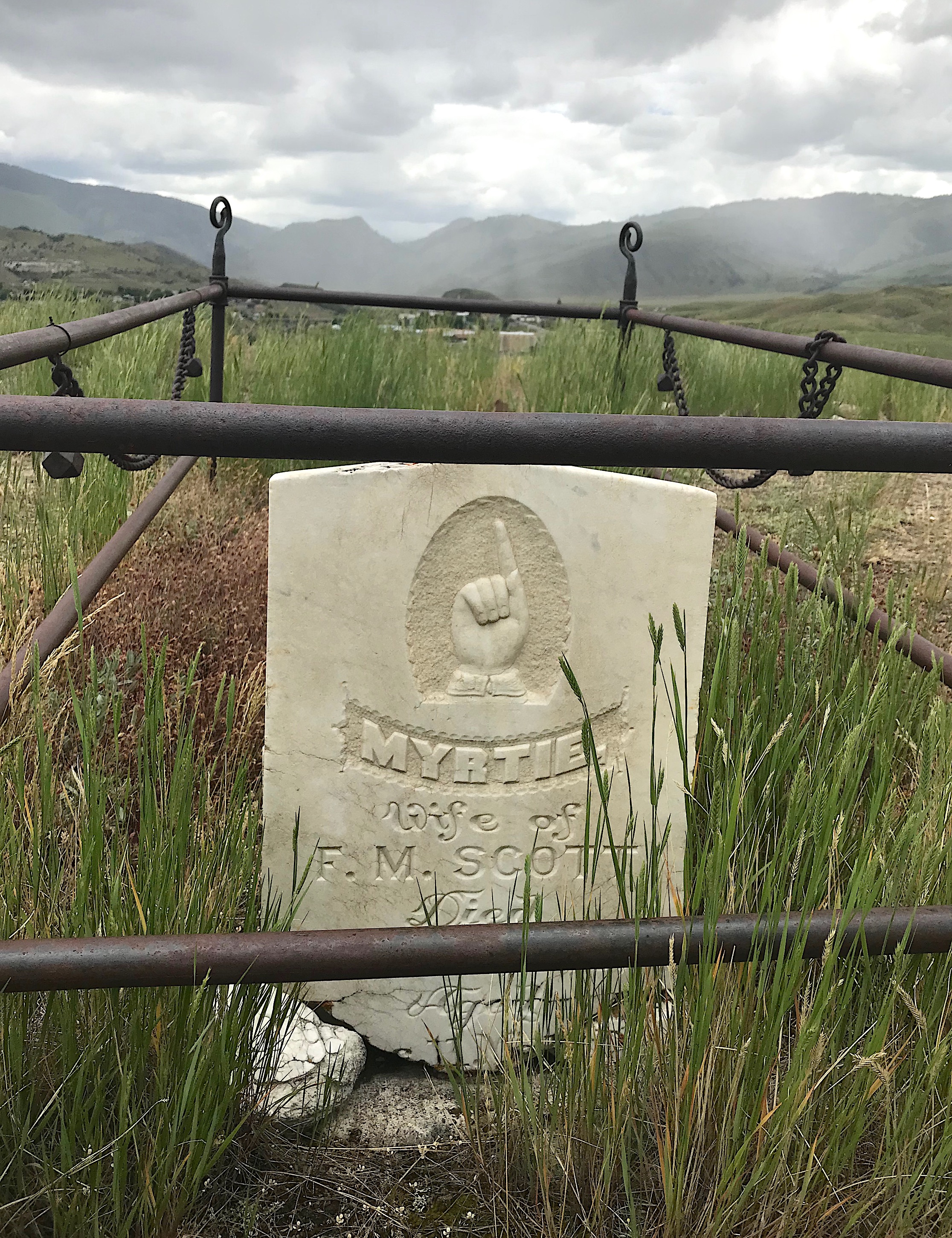
A single finger points up into the gray, threatening clouds on the marker for Myrtie Scott.

Next time, I’ll be within the borders of Yellowstone National Park as I share stories from Fort Yellowstone Army Cemetery.

Yellowstone National Park Adventures: Exploring Montana’s Gardiner Cemetery, Part I

About 10 days after returning to Atlanta from my Iowa/South Dakota 2018 adventure, I got on a plane with my family to Jackson Hole, Wy. for a much-awaited vacation to Yellowstone National Park and Grand Tetons National Park.

We only visited two cemeteries for a number of reasons. In fact, we didn’t stop at any cemeteries in Grand Tetons. I couldn’t find one that was close to our route. Yellowstone does have a few cemeteries. One of them, Kite Hill Cemetery, involves a hike and only has one marker so we skipped it. We did visit Fort Yellowstone Cemetery in Mammoth Hot Springs, but I’ll get to that one in a few weeks.

The other cemetery we visited was Gardiner Cemetery in Gardiner, Montana, which is just outside the North Entrance of Yellowstone National Park. Truth be told, the food (in my opinion) offered in the Xanterra-operated facilities inside the park leaves a lot to be desired. So we ate a number of meals in the town of Gardiner. The cemetery is very close to “downtown” so it was an easy trip to make. The day we stopped at the cemetery was drizzly and overcast, as the pictures show.

One great resource I had for research is “Death in Yellowstone: Accidents and Foolhardiness in the First National Park” by Lee H. Whittlesey. With a title like that, I was easily persuaded to purchase it.

The Roosevelt Arch is located at the North Entrance to Yellowstone National Park. The cornerstone was laid by President Theodore Roosevelt on April 24, 1903 and covered a time capsule.

Gateway to Yellowstone National Park

Before we exited Yellowstone at the North Entrance, we stopped to take photos of the towering Roosevelt Arch. It has a connection with Gardiner Cemetery that I’ll get to later.

The idea of the arch is attributed to Hiram Chittenden, who thought the area around Gardiner was not sufficiently grand. Before 1903, trains brought visitors to Cinnabar, Mt. Cinnabar was a few miles northwest of Gardiner and travelers would transfer to horse-drawn coaches to enter the park. In 1903, the railroad finally came to Gardiner. With development of the Gardiner train station, the arch was proposed as part of the station ensemble.

Construction of the arch started on February 19, 1903, and was completed on August 15, 1903, at a cost of around $10,000. President Roosevelt was visiting Yellowstone during construction and was asked to place the cornerstone for the arch, which then took his name. The cornerstone laid on April 24, 1903 covered a time capsule that contains a Bible, a picture of Roosevelt, local newspapers, and other items. Several thousand people came to Gardiner for the event.

Chris pulled into a parking lot by Gardiner High School’s scoreboard so I could snap a picture of this grazing elk.

Soon after we passed through the arch and into Gardiner, we were not greeted by people but by elk lounging around Gardiner High School’s track. I later learned that the school is located on the former grounds of the Northern Pacific Railway Gardiner train station. The contrast between the school and the wildlife made me wonder how peacefully the two manage to coexist.

Gardiner High School’s mascot is a bear. I wonder what this elk thinks about that.

Getting to the cemetery wasn’t difficult. At first, it looked like the gates were locked but the chain was only secured with a wire you could unwind.

Death of a Tinker

Not much is known about how Gardiner Cemetery began but it’s also known as Tinker’s Hill Cemetery. That’s probably because the first “official” burial there is thought to be of a 60-year-old tinsmith (also called a “tinker”) named John Hartz.

While on a horse that reared up on its hind legs, Hartz tried to keep from being crushed beneath the animal. In the process, Hartz hit his head on a rock and died without regaining consciousness. This took place on Oct. 3, 1886. I didn’t see a marker for Hartz at the cemetery and there’s no photo of one on Find a Grave.

Gardiner Cemetery is also known as Tinker’s Hill Cemetery.

According to Whittlesey, at the time of the cemetery’s establishment, it was outside of park boundaries. Today, it is privately owned by the Eagles’ Club of Gardiner, which recently disbanded. Its representatives are working to get Yellowstone National Park to accept the cemetery. I don’t know if they’ve been successful, but it looked to be in good shape when we were there.

Whittlesey goes on to point out that almost all of the 1880s and many 1890s graves are now unmarked because the stones have long ago fallen from years of neglect. There are at least 50, maybe 77, unmarked graves, he says. Find a Grave lists about 200 memorials for Gardiner Cemetery.

This is the Fitzgerald family plot at Gardiner Cemetery.

The earliest marked graves at Gardiner Cemetery belong to Fannie Fitzgerald and her baby, who both died in 1888. I didn’t know that they were the earliest marked graves when I photographed them that day.

Before I talk about Fannie, let me back up a little. Selleck Fitzgerald, Fannie’s father-in-law, was a native Iowan who married Mary Ann Brown in 1863 in Wyoming. After living in several Western states, the couple settled in Montana in 1873. Henry was one of their eight children, born in 1866.

Death Following Childbirth

Henry married Fannie Roche on Sept. 30, 1885 in Gallatin, Mt. A son, Roy, was born the next year. Another son, David, was born on July 5, 1888. Sadly, Fannie died of what was then called “puerperal fever”, a common bacterial infection following childbirth often caused by poor hygiene during delivery. It was a common cause of death for new mothers.

Fannie Fitzgerald died six days after giving birth to her second child, David.

Little David died 15 days later on July 26, 1888. He is buried near Fannie.

David Gardiner only lived 21 days.

Henry remarried in 1897 to Estella Alderton. Oddly enough, Roy is not listed as living with them on the 1900 Census. I could not find Henry in the 1910 Census but he is listed as living in Stillwater County, Mt. in the 1920 Census. He is listed there as a widow. Roy’s name does appear in Henry’s obituary after he died in 1932. He is buried in Nye Cemetery in Nye, Mt. I don’t know where Estella is buried.

Tragedy in the Fitzgerald family was not limited to Henry. His older brother Ambrose’s wife, Laura, knew her fair share. Ambrose was born in 1864 and in 1891, he married Wisconsin native Laura Hansen. On March 19, 1893, son Willie was born. Hazel was born on March 29, 1895. For reasons his obituary does not note, Ambrose died six months after Hazel’s birth on June 9, 1895. He was only 30.

Henry Fitzgerald’s older brother, Ambrose, died at the age of 30. His marker is on the left of the gate beside his children.

Laura remained in Gardiner with Willie and Hazel, possibly supported by her in-laws and husband’s siblings. By the time of the 1900 Census, she was managing a hotel in Gardiner. But her grief was not over. Willie died on February 21, 1900 at the age of six from spinal meningitis, according to a local newspaper.

Willie and his sister, Hazel, died eight years apart. Willie has a separate marker of his own to the right and behind the one he shares with Hazel.

“These Little Flowers of Love”

For reasons I could not uncover, Hazel died at the age of 13 on Jan. 9, 1908. The 1910 Census lists Fannie as living in Bozeman, Mt., working as a servant. She died at the age of 53 on April 21, 1912. I don’t now if she was still living in Montana but she is buried in Newport Lutheran Church Cemetery in Wisconsin, and shares a marker with her brother, John.

As it turns out, Henry and Ambrose’s father, Selleck, outlived his two wives and three of his children. He died in Fishtail, Mt. on March 22, 1932 at the age of 92. His first wife, Mary, died in 1906 and is buried beside him at Gardiner Cemetery. His second wife, Emily, died in 1920 and is buried at South Street Cemetery in Portsmouth, N.H.
Pioneer “Uncle” John Yancey

Whittlesey’s book mentions a Montana pioneer named “Uncle” John Yancey that’s buried at Gardiner Cemetery so I looked through my photos. Sure enough, I had photographed his grave. It’s Yancey who has the Roosevelt Arch connection.

Born in 1826, John Yancey was a Kentucky native. In the 1870s, shortly after the creation of Yellowstone National Park, he turned up as a prospector in the area of the Crevice Creek gold strike on the northern boundary of the park. With the money he made, he established a way station on the Gardiner to Cooke City road inside the park in 1882. Someone who met Yancey during a visit in 1896 described him as a “goat-bearded, shrewd-eyed, lank, Uncle Sam type.”

Undated portrait of “Uncle” John Yancey, a colorful character who ran the Pleasant Valley Hotel for many years.

In April 1884, the Department of the Interior granted Yancey a 10-acre lease in nearby Pleasant Valley to establish a hotel. Soon thereafter, Yancey constructed a five-room hotel he named Yancey’s Pleasant Valley Hotel. While the housekeeping left something to be desired, the hotel was a success and many travelers stayed there.

“Uncle” John Yancey died soon after he attended the April 1903 dedication of the Roosevelt Arch.

Yancey was 77 when he traveled to Gardiner to witness the dedication of the Roosevelt Arch by President Theodore Roosevelt on April 24, 1903. Yancey not only witnessed the dedication, he apparently met President Roosevelt that day. Unfortunately, Yancey caught a cold soon after and died in Gardiner of pneumonia on May 7, 1903.

While Gardiner Cemetery is small, there are many more stories to share from this picturesque burial ground. I’ll have more in Part II.


Iowa/South Dakota Cemetery Hopping: Finishing Up at Voss-Mohr Cemetery in…Nebraska?

My Iowa/South Dakota 2018 cemetery adventure actually ended in Nebraska! That doesn’t tie up my “Iowa/South Dakota” trip in a tidy package but it was a part of my visit so it doesn’t feel right to leave it out.

Two Cemeteries Merge

Voss-Mohr Cemetery is located in southwest Omaha in the suburb of Millard, not far from where Christi lives. I learned that it began as two family cemeteries. The Vosses buried their loved ones in the northwest corner of their farm and the Mohrs buried their family members in the northeast corner of their farm. The burial grounds adjoined to form the basis of the Voss-Mohr Cemetery. The area was known as Chalco at the time.
At some point, graves from the Stender family’s cemetery were moved to Voss-Mohr but nobody is sure when. Today, Voss-Mohr is a private cemetery managed by the Voss-Mohr Cemetery Association and burials are still taking place today. Additional room is available for future burials. Well maintained, it is located on busy Harrison Street and easy to access.

So why stop at Voss-Mohr? We were actually driving by it when I saw this large monument from the road. It was a great excuse to pull over and take a look.

Who was Ferdinand Petersen and why did he do to merit such a large monument?

It’s not often you see a statue on top of a monument in the U.S. of a man in a German military uniform. So I was immediately curious to figure out how Ferdinand Petersen merited such a grand monument.

Born on May 4, 1828, Ferdinand Petersen was from the Schleswig-Holstein region of Germany. It’s located in the far northern part of the country bordering Denmark. That would be a key factor in his future.

Ferdinand Petersen served in the First Schleswig War from 1848 to 1850.

According to his monument, Ferdinand fought in the German Wars of 1848, 1849, and 1850. From what I could find out, the First Schelswig War or Three Years’ War was the first round of military conflict in southern Denmark and northern Germany rooted in the Schleswig-Holstein Question. It involved the issue of who should control the Duchies of Schleswig and Holstein.

It’s a safe bet that it was a desire to leave the strife of war behind him that caused Ferdinand to emigrate to America around 1850. How he ended up in Nebraska Territory is uncertain but around 1858, he married Elizabeth “Bettie” Fuellner. They only had one child, Lizzie, around 1864.

Lizzie married Adolph Voss at the age of 32 in 1897. Adolph had also emigrated from the Holstein region with his family around 1876 as a boy. That explains how the Petersens came to be buried in Voss-Mohr Cemetery. The 1900 U.S. Census shows Ferdinand and Bettie living with their daughter and son-in-law on their farm.
The inscription on Ferdinand Petersen’s “Vater” marker is in German.

Ferdinand died on March 17, 1903 at the age of 74. Fortunately, someone posted an article from the Papillion Times that described the monument and how it came to be at Voss-Mohr Cemetery.

“An Honest Soldier”

Last week at the cemetery a mile and a half south of Millard was erected one of the finest monuments in the state to the memory of Ferdinand Peterson, who was one of the oldest residents of Sarpy County. The monument was finished and erected by Hodges & Baldwin of Fremont at the cost of $500. It is of the best dark barre granite, with a granite statue of a soldier standing at parade rest, with a uniform like they wore in the German War of 1848, 1849, and 1950 of which Mr. Petersen was an honest soldier. The monument stands 15 feet high and made two train car loads from Fremont to Millard. The bottom base weights over eight tons and took ten horses to haul it from the station to the cemetery.

The inscription on Ferdinand’s marker is in German but someone on Find a Grave had a translation:

As the World’s Master sent me to the last Peace, then you all rest good night. Thy work is complete, now have a blessed sleep in Peace.

I’m intrigued by the effort and expense that went into providing this fine monument for a farmer. He must have been much loved by his family and community. I wish I knew more about what role he played in the community but was unable to do so.

Bettie Petersen died in 1912, nine years after her husband.

Bettie continued living with Lizzie, Adolph, and her grandchildren until her death in 1912. She is buried beside Ferdinand.

Lizzie and Adolph had one son, Ferdinand, in 1902. They moved to Long Beach, Calif. around 1915. Lizzie died in 1919 and her body was sent home for burial at Voss-Mohr Cemetery. Adolph remarried in 1924 to twice widowed Nebraskan Mary Jensen Reeh, who had four children of her own. Adolph died in 1947 in California but he, too, was sent back to Nebraska for burial beside first wife, Lizzie. Son Ferdinand died in 1963 and is buried in California.
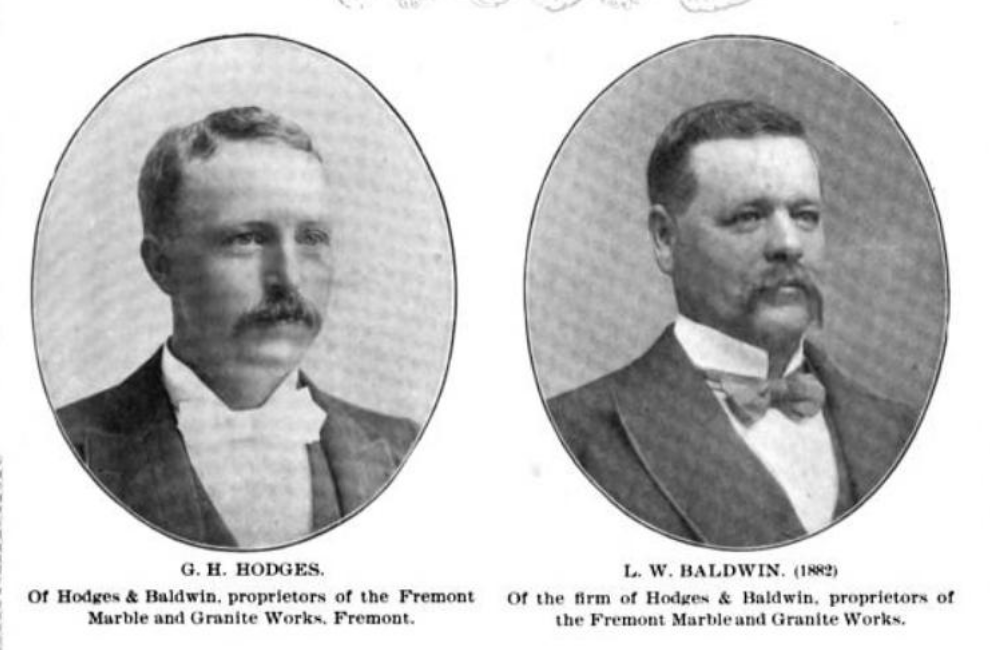
Hodges & Baldwin Fremont Marble and Granite Works (1894) were a mainstay in Nebraska for 50 years. (Photo Source:

It’s not often you get the luck of knowing who actually provided a monument. As the article points out, Ferdinand’s monument came from the Hodges & Baldwin Marble and Fremont Granite Works. Fremont is located about 30 miles northwest of Voss-Mohr Cemetery.

G.H. Hodges and L.W. Baldwin operated a prosperous monument works in Fremont, Neb. until 1936.

The History of Hodges & Baldwin

George Henry “G.H.” Hodges came to Fremont around 1881 and worked as a stonecutter. At some point, he and L.W. Baldwin forged a partnership, opening their own monument works in Fremont. Over the years, they grew and expanded their operations, always operating a store in Fremont where customers could view samples of the stone available and designs.

The business had its fair share of ups and downs. A lawsuit that resulted after the accidental death of a worker went all the way to the Supreme Court. One article I found reported the theft of a horse from the monument works’ barn. But for the most part, Hodges & Baldwin prospered.

Hodges & Baldwin stayed in business until both men retired around 1936. G.H. died in 1940 at the age of 76. He and his first wife, Lura, share a beautiful monument.

A native of Wisconsin born in 1859, Lewis William “L.W.” Baldwin came to Nebraska in 1877 in a covered wagon. He was working as a traveling salesman for the same employer as G.H. when they met. L.W. died of a stroke in 1944 at the age of 85.

Both G.H. Hodges and L.W. Baldwin are buried at Fremont’s Ridge Cemetery.

Julius Schroeder began farming in Nebraska but gave it up in 1875 due to poor health.

Millard Pioneer

The tree-shaped monument for Julius Schroeder and his wife, Wilhelmine, stands out. There’s also a bit of irony about it that I’ll share later. A native of Germany, Julius was born in 1836. He married Wilhelmine Millitz around 1857. They journeyed to America in 1868.

They landed in Louisiana, traveling through Texas to settle in Nebraska where Julius farmed until 1875 when his health declined. In 1880, Julius was operating a saloon in what was then known as McCardle, just north of the area that became Millard. Julius was part of the first board of trustees when Millard was incorporated in 1885.

Although Julius was still keeping the saloon, he also owned a 320-acre farm that prospered. He and Wilhelmine would have six children who lived to adulthood.

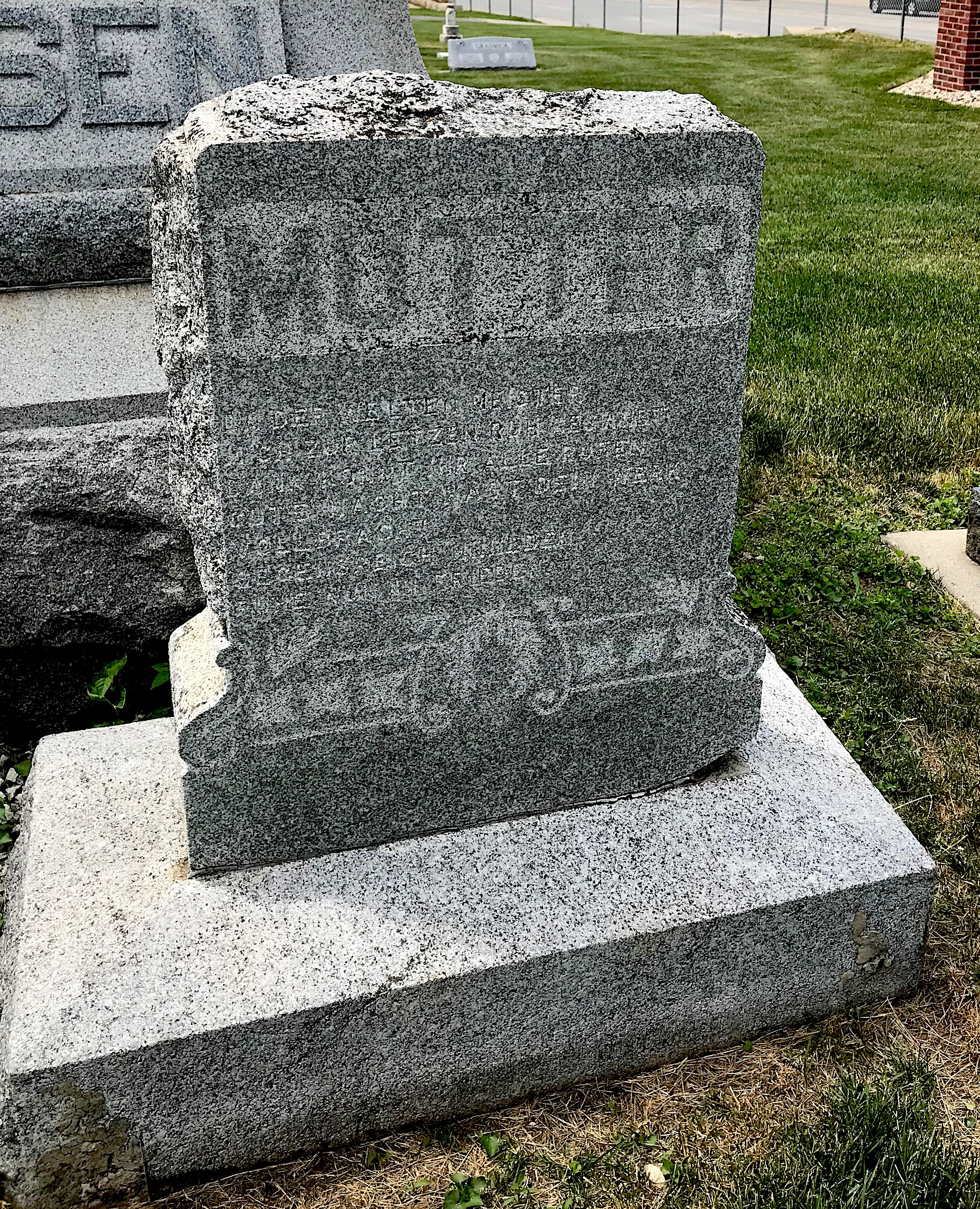
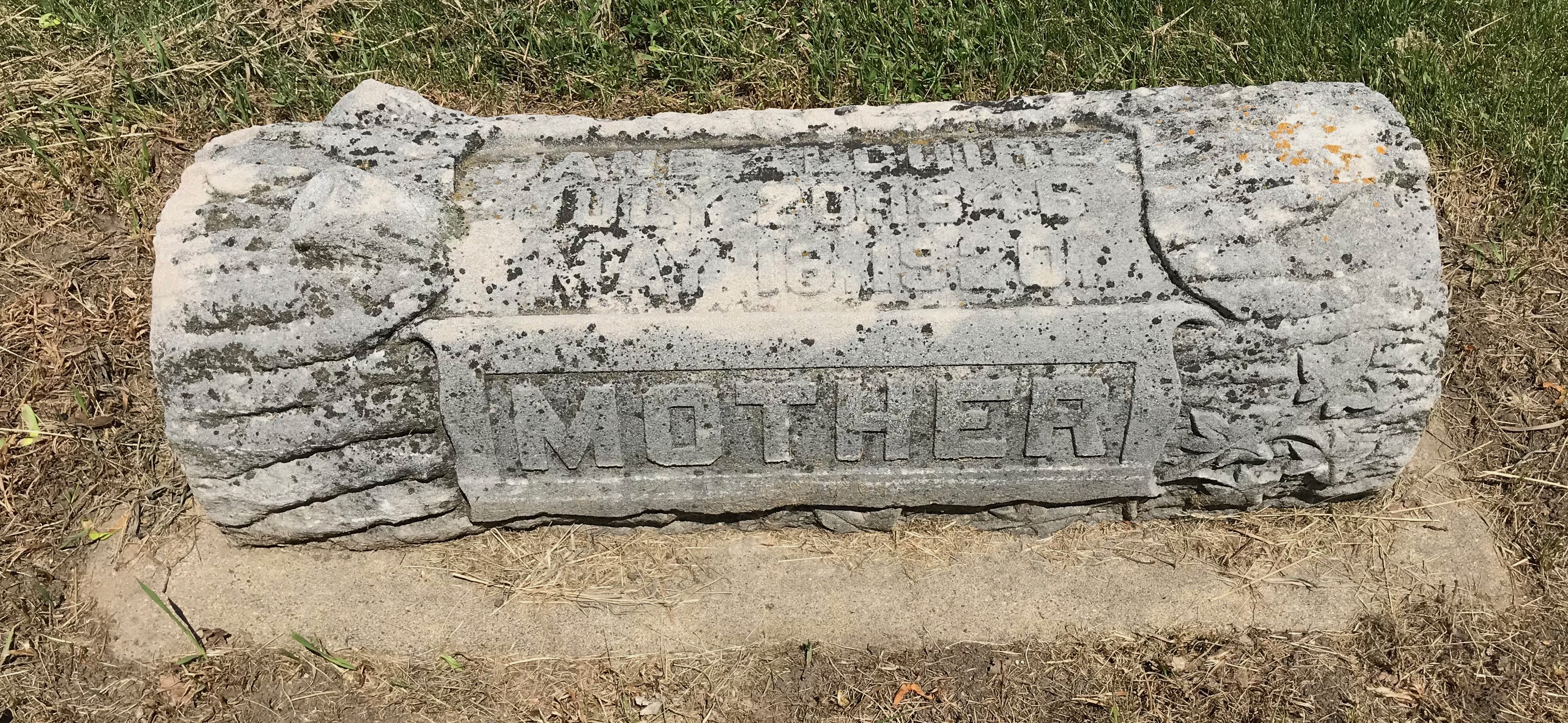
“Mutter” is German for the word “Mother”, which was appropriate for Wilhelmine Schroeder.

Wilhelmine died on Feb. 12, 1896 at the age of 59. Soon after, Julius died on April 17 of the same year. He, too, was 59.

Julius Schroeder’s “vater” marker is log-themed to fit with he and Wilhelmine’s tree monument.

Now here’s why I think the Schroeder’s tree monument is a bit ironic. In doing a Newspapers.com search for Julius, I was only able to come up with this interesting item from the Nebraska State Journal (Lincoln, Neb.) on Aug. 28, 1896. In those days, newspapers thought nothing of publishing your financial worth and that included any insurance you might have had.

Julius Schroeder’s life insurance came from his affiliation with the Knights of Pythias fraternal organization.

If you’ve followed my blog for a while, you know that tree-shaped markers are very closely tied to Woodmen of the World, a fraternal organization based in Omaha. Many people have WOW tree-shaped markers, complete with a WOW seal. While Julius and Wilhelmine’s family chose a tree-shaped marker for their parents, it was likely paid for by insurance proceeds from the Knights of Pythias. Not Woodmen of the World.

Stender Cemetery Grave

The last marker I’m going to share probably came from the old Stender Cemetery. Margaretha “Mattie” Brock married fellow German immigrant John Stender on Dec. 28, 1873 in Sarpy County, Neb. She was 17 years old. Mattie gave birth to a son, Fred, on Dec. 15, 1875. She died at the age of 22 on March 18, 1878.

Mattie Stender was only 22 when she died.

Husband John would remarry to Sophia Lupteen not long after Mattie’s death. The couple had five children, four living well into adulthood. John died in 1902 and is also buried at Voss-Mohr. Sophia died in 1891 but if she is buried at Voss-Mohr, her grave is unmarked.

With all three of these markers, German was used for the inscriptions. Even the German “mutter” for mother and “vater” for father were not considered unusual at the time. This acceptance would change in the next decade when World War I approached and anti-German sentiment began to rise. Some immigrants would even change the spelling of their names entirely to downplay their German heritage.

Visiting Voss-Mohr was a pleasant way to end my Iowa/South Dakota adventure and it’s one I’ll remember fondly. Going cemetery “hopping” with my best friend is time I always treasure.


Iowa/South Dakota Cemetery Hopping: Discovering Iowa’s Le Mars Cemetery, Part IV

How can you tell if I truly fall in love with a cemetery? Big hint is I write a four-part series about it! That’s been the case with Le Mars Cemetery. With its bevy of white bronze markers, there’s been no shortage of examples about which to do a “show and tell”. Despite the fact there are more I could talk about, I’m ending this series today.
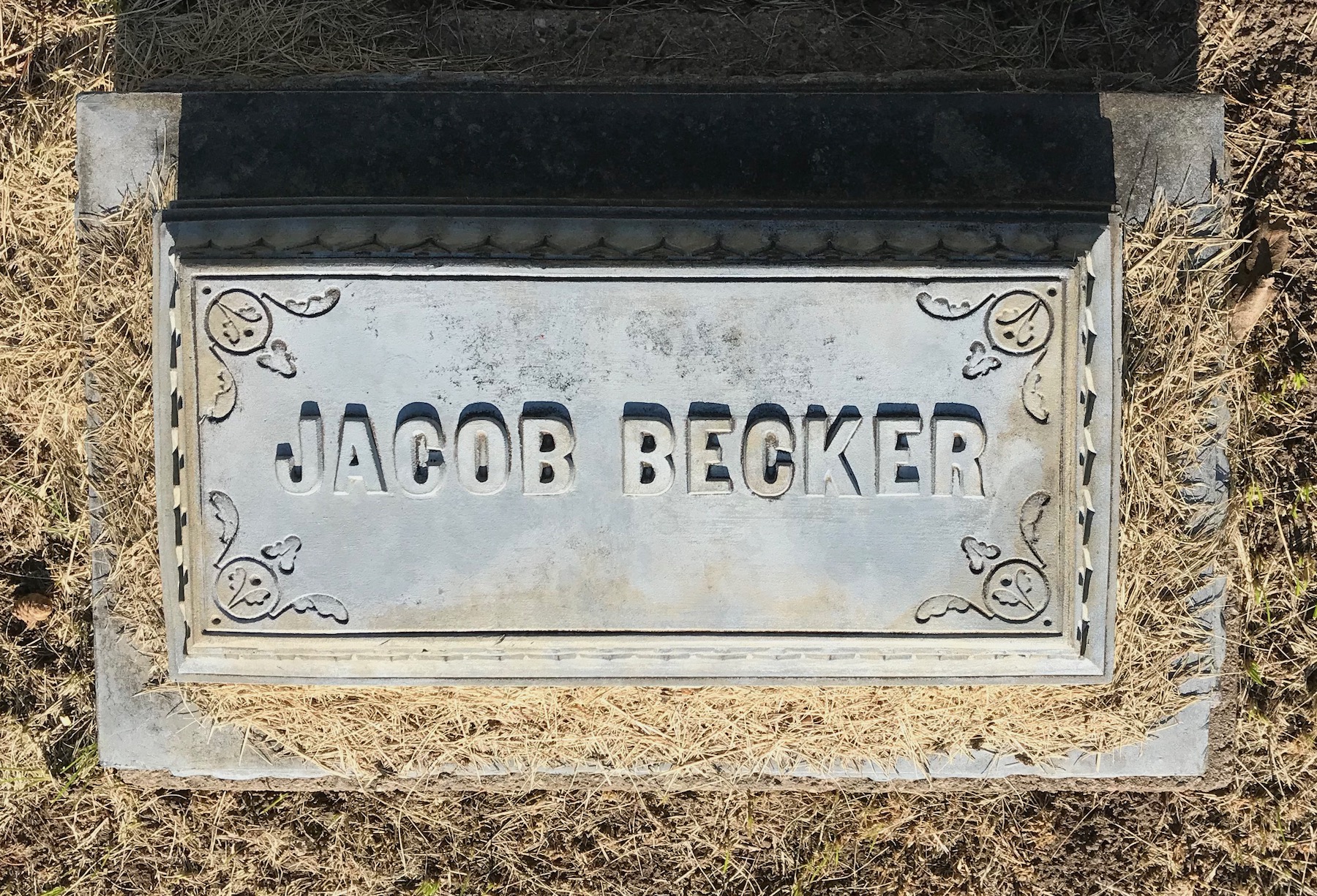
The first monument I’m going to share with you shows how one of these monuments enabled a family to share much of its history in one place, plate by plate. There are a total of 44 Beckers buried at Le Mars Cemetery. Five of them (Fred, 2 Katherinas, Jacob and Rosina) share one marker.

The Becker white bronze monument includes the names of five family members.

The Becker family story begins in 1829 in Switzerland with the birth of patriarch Fredoline “Fred” Becker. His emigration to America in 1849 interested me because unlike many Europeans, Fred made his arrival in New Orleans and not a Northeastern port like New York City or Boston. My own ancestor, John McCoy, took this same passage from Ireland in 1776.

Fred’s daughter, Celia, was married to photographer Robert Dabb. He owned the Le Mars studio where this photograph was taken. Both he and Celia are buried at Le Mars Cemetery. (Photo source: Find a Grave)

Fred married fellow Swiss immigrant Katharina Hefti in Galena, Ill., but I’ve seen two different years listed for that event. As their children were born, they moved from Illinois to Plymouth County, Iowa around 1867. I believe they had 10 children total but I’m not certain.

Grave foot marker for Rosina Hefti, who died in 1870.

The earliest date of death on the Becker marker is for a Rosina Hefti, who died at the age of 67 on May 16, 1870. Since Hefti was Katherina’s maiden name, it’s possible that it was her mother.

Rosina has a grave foot marker (an item we talked about last week) that would have cost around $4 at that time. She is also featured on a panel of the monument, which she shared with one of Katherina and Fred’s son’s Jacob.

Jacob Becker died at the age of 22 in 1885.

Jacob Becker was staying with his sister at the time of his death.

At the time of Jacob’s death on Oct. 28, 1885, he had been living with his married sister, Katherina. She married cigar store owner Nicholas Koerting in 1880 and the couple had two children. According to a newspaper article, Jacob died of malarial fever (sometimes called typhoid). This was common during the 1800s, especially during the Civil War era.

Katherina Becker Koerting died only weeks after her younger brother in 1885.

Jacob’s death ushered in a terrible time for the Becker family. His mother and married sister, Celia Becker Dabb, were also ill at the time. Sister Katherina, age 25, succumbed to malarial fever on Nov. 19, 1885. Just a few months later, Katherina Becker died of the same ailment on Feb. 6, 1886. She was only 55.

Katherina Becker died a few months after two of her children in 1886. She was only 55.

Fred remarried in 1889 to a German immigrant 30 years his junior, Kate Durst or Drest. They had two sons, William and George. By now, Fred has amassed quite a bit of property. The family moved to Leeds, a neighborhood of nearby Sioux City.

“Liked By Every Man, Woman and Child”

On August 17, 1909, Fred died at the age of 80. His life was eulogized in the local newspaper as a Le Mars pioneer. But his will resulted in a scandal that I’m sure Fred never imagined when he had it drawn up.

The rough appearance of Fred’s plate on the monument indicates it may have come near the closing of the Western White Bronze factory in Des Moines.

Born around 1853 or 1854, Rosina “Rose” Becker was the first child of Fred and Katherina Becker. She married Gabriel Freuler in 1873. Together, the couple had at least three children.

Sometime after 1900, Rose was admitted to what is now called the Cherokee Mental Health Institute. When it opened for patients on August 15, 1902, it was called the Cherokee Lunatic Asylum. Rose spent the rest of her life there, dying at the age of 91 in 1945. Her death certificate states she died of bronchial pneumonia due to a fracture in her neck and femur caused by a fall. It also explains that the reason Rose was there was due to “manic depression psychosis.”

Left Out of the Will

In November 1909, after Fred’s will had been read, the family learned that while Kate Becker and all the other children were left bequests, Rose had been left out. His second wife was named executrix. Thanks to Ancestry, I saw the will for myself. Why did Fred purposefully leave Rose out of his will? I honestly don’t know.

Fred Becker’s will left out his eldest daughter, Rose, who suffered from manic depression. (Photo source: Ancestry.com)

Rose’s husband Gabriel Freuler sued the estate (which supposedly amounted to anywhere from $50,000 to $100,000) because Rose was not included. Gabriel charged that Fred had been unduly influenced his son, Fred Jr., in shutting out his sister. The court sided with Fred’s estate and Gabriel received no money.

I traced Fred’s second wife, Kate, to the 1910 U.S. Census, living in Leeds with sons, William and George. She appears for the last time in the Iowa Census of 1915 as living in Sioux City. She would have been 54 at that time. I don’t know what happened to her after that.

The Fall of Ben Amos

This next story I’m going to share is a sad one and not typical of what I encountered in researching the folks buried at Le Mars Cemetery. Ben Amos came from a good family and showed promise in his early years. But in the end, his life took a tragic turn.

Born in 1856 in Jackson County, Iowa, Ben was the son of Franklin and Martha Amos. He spent his boyhood years in the eastern part of the state. Franklin served in the 31st Iowa Infantry and was severely injured at the Battle of Atlanta in 1864. The couple also had a daughter, Talitha.

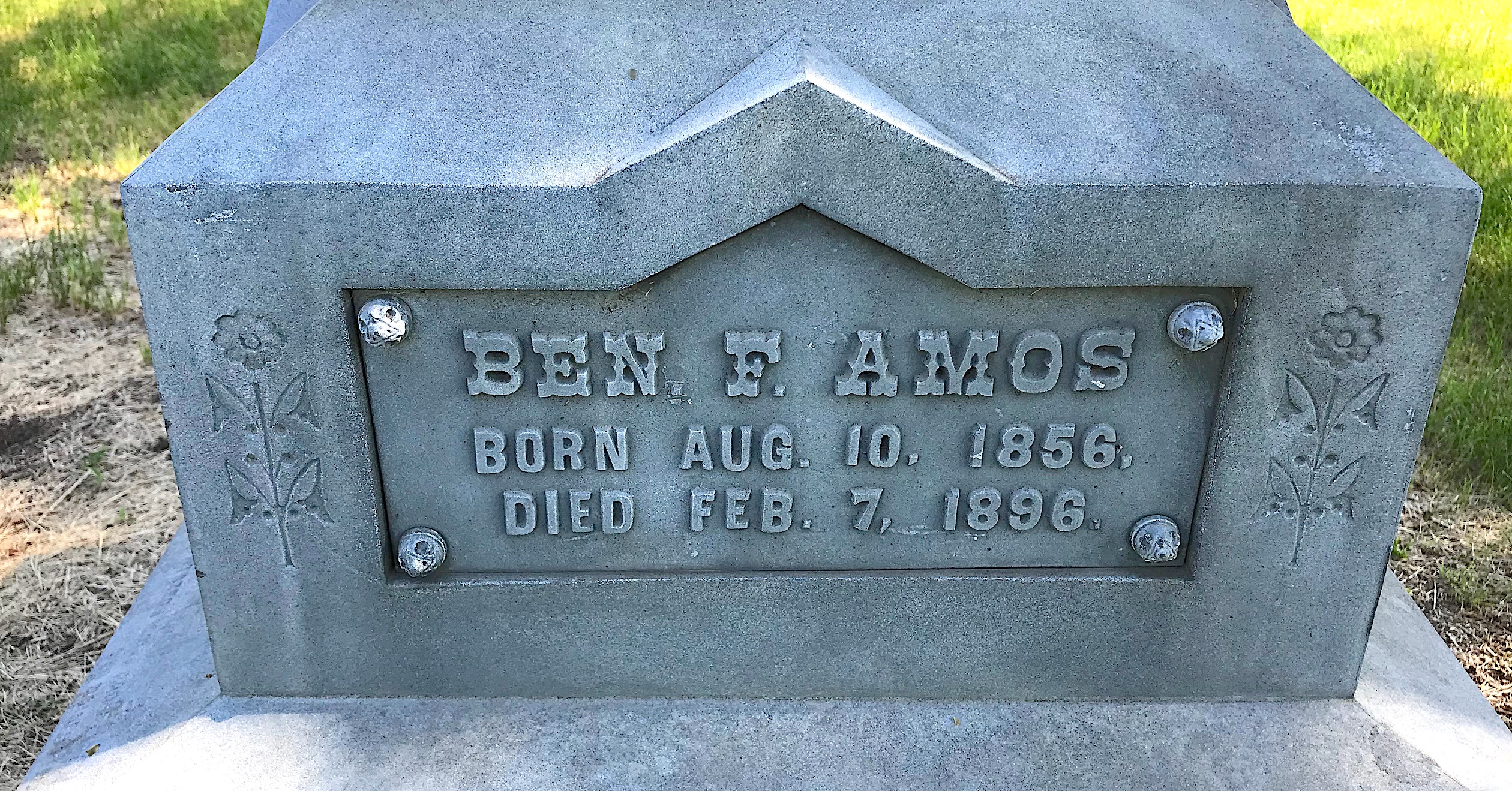
Ben Amos shares a white bronze monument with his father, Franklin, who died in 1890 six years before he did.

At some point, the Amos family moved to Le Mars. Ben married a young woman from Illinois named Victoria Nold. I’ve seen two different years listed for the marriage. In 1885, they were living with Franklin and Martha. Ben worked in real estate and seemed to be doing well. Franklin died in 1890 at the age of 60.

This is not exactly the same monument as the Amos one, but the draping near the top and general shape are the same. (Photo source: Smithsonian Libraries)

But sometime during the 1890s, Ben’s love of drink slowly took over and destroyed his marriage. Victoria left, heading for Colorado. By 1896, Ben had moved into rented rooms and according to the local newspaper, was known as the town drunk. He died on Feb. 7, 1896 after several weeks of drinking. The final blow came when he overdosed from a supply of drugs provided to him by a local man named Bill Schields, also known as “Morphine Bill.”

Ben shares a white bronze monument with his father, who also has a white veteran’s marker. Note that the top features an urn with an eternal flame coming out of it.

Ben Amos died of a morphine overdose in 1896.

Victoria did not attend her estranged husband’s funeral but his mother and sister, now married, were present. Eventually, she remarried to a man named John Murphy in 1899 and began a new life in Montana.

Talitha Amos Miller, whose husband died from stomach cancer in 1910, died in 1912 from dropsy. Ben’s mother, Martha, had gone to live with Talitha and her family after Frank died in 1890. She died at the age of 89 in 1917, having lived her last years with her granddaughter in Minnesota.

One thing I noticed in the obituaries of both Talitha and Martha was the complete absence of Ben’s existence. In fact, Martha’s death notice specifically states that she had “but one child” and that was Talitha. It’s my guess that Ben’s death was considered so scandalous that his name was not to be mentioned ever again, which is incredibly tragic.

The Detloff Family Story

My last story is an example of how something that today would merely be an irritant could end one’s life. It also shares one family’s brief history that came full circle.

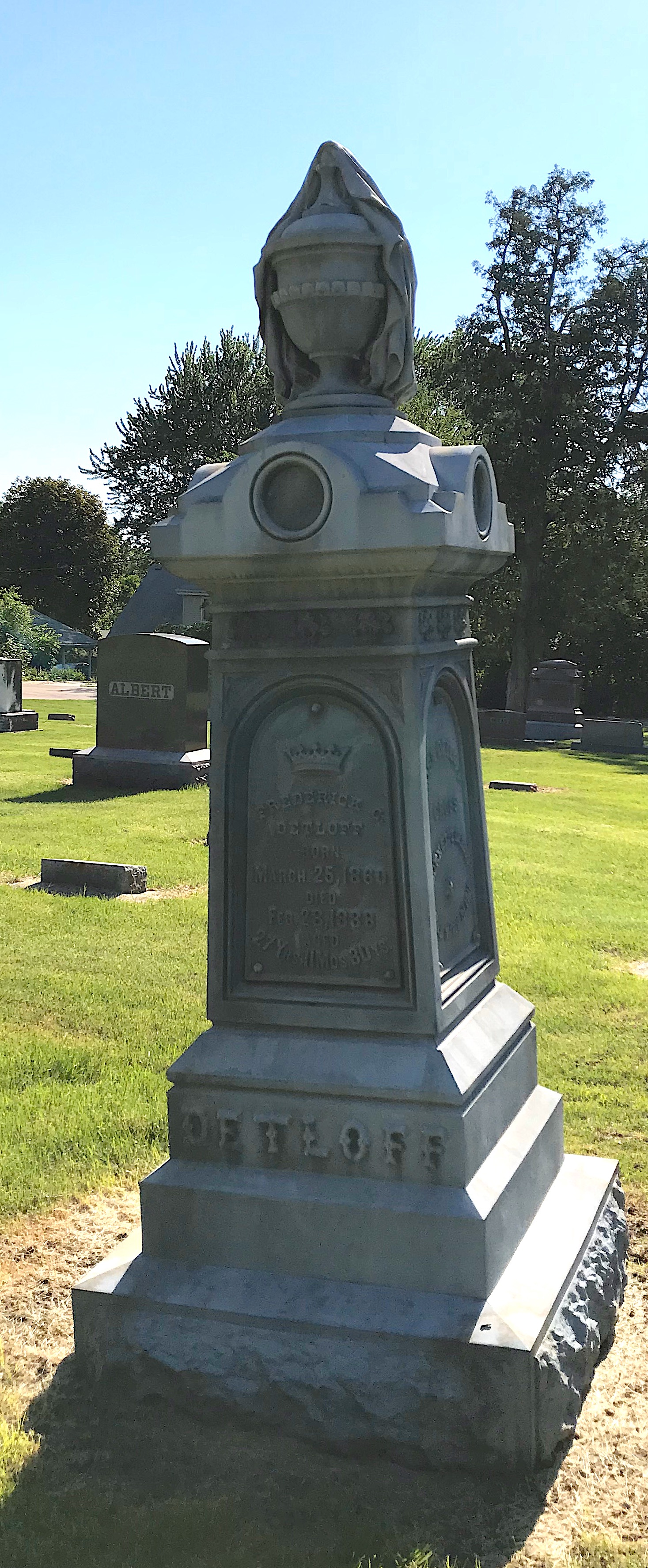
The Deltoff marker is topped by a draped urn.

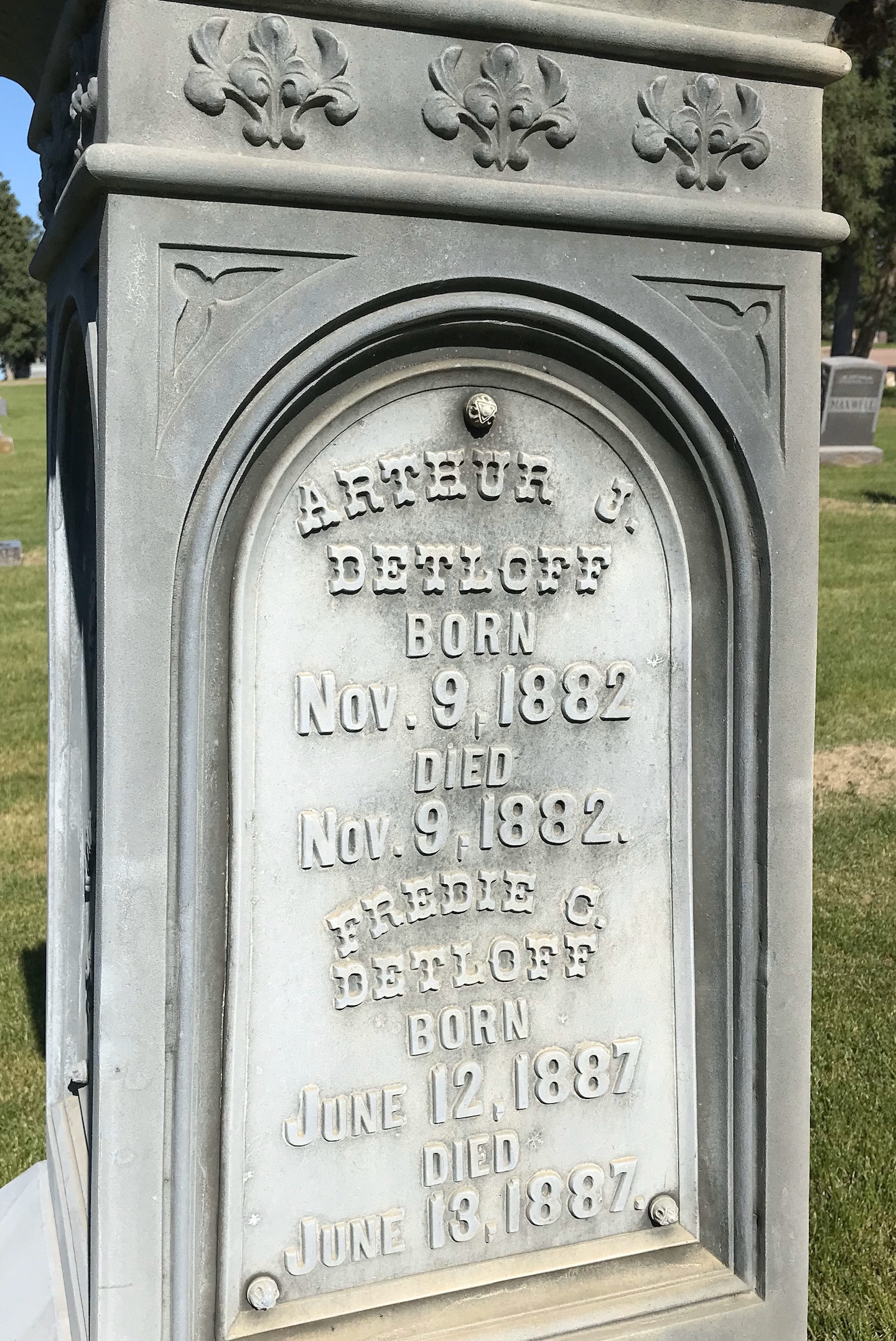
Born in Germany in 1860, Frederick Detloff arrived in America with his parents, John and Dora, when he was a child. In 1881, he married fellow German immigrant Rosa Wilde. Their son Arthur Detloff was born and died on Nov. 9, 1882. Freddie Detloff was born on June 12, 1887 and died the next day. They also had two other sons, Ernest and John, who lived to adulthood.

Arthur and Freddie did not live long but they were surely missed by their parents.

Grave footer for Arthur and Freddie Detloff.

Frederick cut his hand one day, probably doing something quite simple while working on his farm. In a world where antibiotics did not yet exist, it proved fatal. Blood poisoning was the result and he died a few days later on Feb. 18, 1888. As was the rather unsettling custom of the time, his death notice included how much life insurance he had.

Fred Detloff’s obituary explains the sad story of his demise from a simple cut. (Photo source: Le Mars Semi-Weekly Sentinel)

Farmer Fred Detloff only lived to the age of 27.

Rosa was left a young widow at the age of 24 with two sons to raise. From what I can tell, they remained in Le Mars for some time. She remarried some 14 years later to David Cross, who was a widower who had lost his wife in 1897. After living in Rock Island, Ill. for a while, they moved to Yakima, Wash. where she died of leukemia in 1911 at the age of 47.

According to her obituary, David and her two sons traveled with her body back to Le Mars for her burial beside her first husband and infant sons. She had one sister still living in Le Mars. What began with the death of her first child in 1882 ended with her own in 1911. David, who died in 1930, is buried in Yakima, Wash.

I’ve truly enjoyed putting together these blog posts this month, reliving a visit that was truly a highlight of my “hopping” career. Le Mars Cemetery remains only about 35 percent photographed on Find a Grave. It’s a goal of mine to go back and perhaps complete photographing it some day. It’s certainly a place I’ll never forget.

Iowa/South Dakota Cemetery Hopping: Discovering Iowa’s Le Mars Cemetery, Part III

We’re still at Le Mars Cemetery, admiring more of its white bronze beauty and the stories behind the lives that the markers represent.

Today I’m going to make more of an effort to show you what people saw in the Monumental Bronze catalog compared to the real thing. We’ll also look a little more at cost, another great feature of the catalog.

Let’s start with Heinrich “Henry” Koehler. Born in 1809 in Hanover, Germany, Heinrich arrived in America sometime after 1845. He married another German immigrant, Margaretha “Margaret” Strott, around 1847 in Pittsburgh, PA. His profession was that of carpenter and at times, shoemarker.

Photo of Heinrich “Henry” Koehler and Margaretha “Margaret” Strott Koehler. (Photo source: Ancestry.com)

The Koehlers moved to Ohio before settling for many years in Adams County, Illinois. Heinrich and Margaretha had several children, five living to adulthood. They didn’t come to Plymouth County, Iowa until around the 1870s when the couple were in their 60s. I suspect one or more of their children had already moved there and they wanted to be near them.

Henry died at age 77 on Jan. 25, 1887. A newspaper item noted that “No substantial reason is given for his demise excepting old age.” I did notice in another newspaper item that their son, also named Henry, moved to Le Mars with his family later that year. He may have done so to be a support to his mother. A railroad man, Henry was hit and killed by a railroad car in Illinois in 1901.

Grave marker for Henry and Margaret Koehler. Her information is most likely on the other side but I didn’t get a photo of it.

By 1900, Margaret was living with her eldest daughter, Caroline Koehler Helm, and her large family of 12 children. She died in 1903 at the age of 85. I did not get a picture of the other side of Henry’s monument (above) but I suspect her information is on the other side. I do know she is buried at Le Mars Cemetery in the same plot with him.

Here’s what Henry and Margaret’s children may have seen in the 1882 Monumental Bronze catalog. Note that the cost would have been around $49 in 1887 if they purchased it when Henry died. Adjusting for inflation, that would have cost about $1,411.57 today.

Margaret’s funeral was handled by Beely & Fissell’s, which was where John Bogen sold monuments like this around 1891. Their main function was selling furniture. It’s likely they handled Henry’s funeral arrangements as well.

While there’s more inscribed on the Koehler marker than what you see in the catalog, the basic design is the same. (Photo source: Smithsonian Libraries)

The Adams Family

I could not find a photo in the Monumental Bronze catalog for the Adams family monument, but their story captivated me enough to include it. As opposed to a number of people buried at Le Mars Cemetery, John Adams (the father) was a prominent member of the community and thus received a long write up in the local newspaper.

Born in York, Ontario, Canada in 1861, John moved with his parents J. Frank and Ada Hoggan Adams to Le Mars. After high school, he studied law and passed the bar. Setting out his shingle in town, he also dabbled in real estate. In 1887, he married a local young lady named Ida Dier.

John’s star rose higher when he was elected city attorney in 1891 and was re-elected in 1893. In 1894, he ran for county attorney and won, keeping his seat in the 1898 election as well.

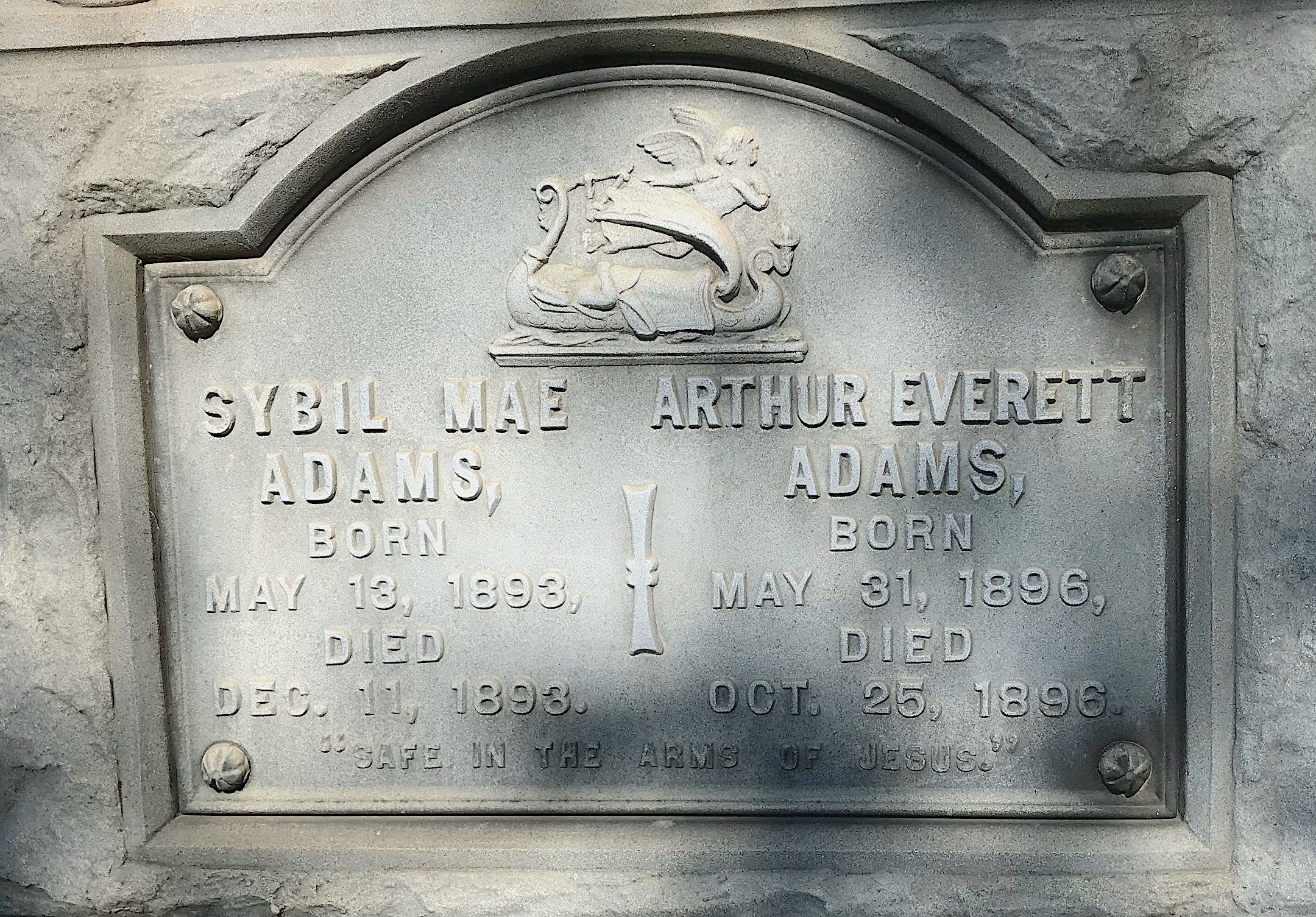
John and Ida had four children altogether. Roscoe Adams was born on March 7, 1889. Frank Adams was born on Jan. 6, 1892. Sybil Mae Adams was born on May 13, 1893 and died on Dec. 11, 1893 for reasons unknown. Arthur Everett Adams was born May 31, 1896 and died on Oct. 25, 1896. According to the newspaper, Arthur died of dropsy (a type of edema).

John and Ida Adams lost two children before they reached the age of one.

The Story Behind “The Last Voyage”

The plate with Sybil and Arthur’s names/dates features a motif known as “The Last Voyage” that was a favorite of Monumental Bronze. I’ve always wanted to know the story behind it after I saw it for the first time in a cemetery in Council Bluffs.

Thanks to another web site, I learned that this motif was taken from A Gentle Wafting to Immortal Life, a bas-relief marble sculpture by Felix M. Miller and a later engraving by William Roffe. You can find examples of Miller’s work in London’s British Museum.

“The Last Voyage” could also be made into a stand-alone plaster cast to hang on a wall. This illustration of Archibald McKellar’s model is from the 1882 Monumental Bronze catalog. (Photo source: Smithsonian Libraries)

As described in The Art Journal (1879), Miller portrayed the elder of two deceased brothers, Herbert Mellor, on the angelic mission of guiding his younger brother, Theodore, on his last voyage over the “sea of bliss.” They were the deceased children of J.J. Mellor.

The work’s title comes is from John Milton’s Paradise Lost: “A death, like sleep, A gentle wafting to immortal life.”

Sculptor Archibald McKellar modeled the image and finished it at Monumental Bronze’s art foundry (which I suspect was in Connecticut) in February 1881. They renamed it “The Last Voyage” and it was offered for the first time in the 1882 Monumental Bronze catalog.

Here’s what “The Last Voyage” looks like on the Adams monument. Perhaps the idea was that Sybil, who died first, was guiding her little brother Arthur to her Heavenly home?

Unfortunately, Ida was hit with tragedy yet again a few years later. While she was away in Colorado for health reasons, John went out for a long drive on December 1, 1899 and fell ill with pneumonia soon after. Shortly after Ida returned home, John died on December 7. He was only 38 years old.

Attorney John Adams died at the age of 38 in 1899, cut down in his prime by pneumonia.

I was curious to know the fate of Ida, Frank, and Roscoe because none of them are buried at Le Mars Cemetery. According to the 1900 U.S. Census, Ada and the children moved 50 miles east to Nokomis, Iowa to live with her sister. Ida remarried in October 1901 to a widowed carpenter and Civil War veteran from Ohio named John Pickering who was much older than she.

By 1910, Ida and her sons were living in Cedar Falls, Iowa (about 150 miles east of Nokomis). John Pickering was living his last days at the Iowa Soldiers Home in Linn, Iowa about 65 miles away. John died at the age of 72 in 1911 and is buried with a previous wife in Woodlawn Cemetery in Alta, Iowa.

Ida filed for a pension in light of John Pickering’s service in 1916 and received it. She continued to live in the Waterloo area until her death in 1924 after suffering from “pernicious anemia” for two years. I don’t know where she is buried. Both of her sons lived well into adulthood and had families of their own.

Note: Soon after I published this post, kind reader Karen Cowles Kester posted on Facebook another obit for Ida that I missed that mentioned Ida’s body was moved from Waterloo to Le Mars for burial. I looked up the information on Iowa Gen Web’s site for Le Mars Cemetery, which has each burial and location listed. Sure enough. Ida Dier Adams Pickering is listed as being buried in Block 2, Lot 2 along with first husband, John, and Sybil and Arthur. I suspect she has no marker because it’s not in the pictures I took that day.

The Bixby Family

There are 19 Bixbys buried at Le Mars Cemetery. Three of them share a white bronze marker, complete with some additions that I’ll talk about a little later.

Born in New York in 1836, Emerson Bixby married Lydia Seals in Illinois. They moved to the Waterloo, Iowa area in the 1860s and later to Le Mars in 1869 as their family grew. Eventually, they would have six children together (Charles, Elmer, Emory, Levi, Harry, and Elizabeth).

Emerson died at age 55 from influenza in April 1891. Brothers Emory and Levi were very close and stayed with their mother on the family farm in Stanton, never marrying. Lydia died in 1904.

Emerson and Lydia Bixby share this monument with their son, Levi.

Emory and Levi continued to live at the family farm and looked after the tenants who rented from them. They later moved into a home together in Le Mars. Unfortunately, it was from helping one of their tenants that Levi met his untimely death in 1912.

Levi Bixby was 46 when he died from a tragic accident in a barn.

The brothers had recently completed building a new barn on the property the Walsh family was renting from them. Levi was struck by a load of toppling hay in the loft and fell 18 feet to the ground. His back was broken and he was instantly paralyzed from the waist down.

A newspaper article explained that Levi knew his end was near and summoned an attorney to have his will written. His brothers sped to see him in his last hours and he died two days after his fall on Oct. 26, 1912. He left his estate to his siblings, naming brother Emory as his executor.

Emory decided to leave Le Mars and moved to Watertown, S.D. to be near his younger married sister, Elizabeth Bixby Bruns, who was married to foundry operator James Bruns. Emory died in 1937 and is buried at Le Mars Cemetery in the Bixby plot.

It’s possible this monument was not made until after Lydia’s death in 1904.

Head and Foot Markers

If you’re standing in front of the Bixby monument, you’ll notice some white bronze markers on the ground in front of it. The 1882 Monumental Bronze catalog refers to them as “head markers” and “foot markers” to denote the position of the grave. They came in different sizes and could feature the deceased’s initials or full name. Last week, I featured one for Annie McCurdy.

Here’s what the Bixby siblings might have seen in the catalog as options.

Page of headers and footers from the 1882 Monumental Bronze catalog. (Photo source: Smithsonian Libraries)

Here’s the foot marker for Levi Bixby. It probably cost about $4 at the time, depending on the year of purchase.

Foot marker for Levi Bixby.

Head markers were also purchased for Emerson, Lydia, and Levi. Those are not in the 1882 catalog.

Head marker for Levi Bixby’s grave.

I suspect that the Bixby monument was possibly done after the death of Lydia in 1904 but I’m not certain. One reason is because the plate for Levi on the side doesn’t seem to fit well and is missing three screws. By then, the Western White Bronze factory in Des Moines was on the verge of closing.

One final note to the Bixby family story. On the other side of the monument for Emerson, Lydia, and Levi is this one for a Baby Bruns. I believe this is for a child of Elizabeth Bixby Bruns and her husband James. But there is no burial date for this child in the cemetery records so perhaps it is a cenotaph.

Is a child buried here or is it a cenotaph?

I’m not quite done at Le Mars Cemetery. Part IV is soon to come.


Iowa/South Dakota Cemetery Hopping: Discovering Iowa’s Le Mars Cemetery, Part II

Today I’m diving deep into why I consider my visit to Le Mars Cemetery my favorite part of my Iowa/South Dakota road trip with Christi in June 2018. It really boils down to two words: white bronze.

This block for Annie McCurdy is made of metal and not stone. Zinc markers marketed as “white bronze” became a hot trend in the 1880s.

“White Bronze” Equals Zinc

White bronze is really just a fancy term for zinc, which is a metal. White bronze markers became popular starting in the 1880s. While there were a few different companies, Monumental Bronze of Bridgeport, Conn. was the largest with a number of subsidiary factories in Detroit, Chicago, Des Moines, Philadelphia, St. Thomas, Canada, and perhaps New Orleans. Around the start of World War I, all metal was needed for munitions so the factories started closing. The name/date plates continued to be manufactured into the 1930s.

This is the cover of the 1882 Monumental Bronze Co.’s catalog. Many thanks to Smithsonian Libraries for putting this online to use as a great resource.

Better Than Stone?

An agent for the company could show you a catalog of all the possibilities/costs available. The pieces were shipped by train and you put them together. At the time, they were marketed as a less expensive, longer lasting alternative to stone. But some people thought if you bought them for a loved one, you were being “cheap” so a little bit of a stigma existed.

I found this bit of marketing in the 1882 Monumental Bronze catalog:

There being no deterioration in their value, you always have in these your money’s worth; while, with marble, or even granite, what you obtained at great expense, may, in a few years, become of little or no value, as defective headstones and monuments in every cemetery bear witness. Is it not then the part of wisdom to invest where you will always feel satisfied with your purchase, and also give better satisfaction to coming generations.

Some insist that all the casting was done in Bridgeport and only finishing work was carried out by the subsidiaries. However, rail cars loaded with zinc rolled regularly into Des Moines from Kansas with material for the Western White Bronze Co., so it’s likely that casting occurred there, too.

I did find ads from the 1891 editions of the Le Mars Semi-Weekly Sentinel promoting a salesman named John Bogen who sold grave markers (both stone and white bronze) at a local furniture store, a common practice in those days. I got a kick out of how the quote used is attributed to “Science”. I did note that according to Find a Grave, Bogen is buried at Le Mars Cemetery but has a stone marker. Did he decide, in the end, not to put his faith in “Science”?

John Bogen promoted the value of white bronze markers but chose a stone one for his own grave.

This marker for Catherine Garman (they misspelled her last name as “Germen”) is a good example of a smaller white bronze. There are two more like it that I saw for other people.

White bronze marker for Catherine Garmon, although it says “Catherina Germen”. She only lived the last few years of her life in Le Mars with her married daughter and family.

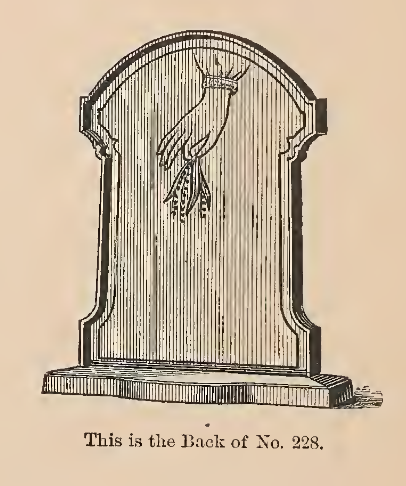
On the back is a lily of the valley suspended by a cuffed hand.

The lily of the valley usually symbolized symbolizes innocence, humility, and renewal.

Having the 1882 catalog to refer to, I found an example there that looks much like the Garman marker. Size would vary depending on need.

This is possibly what the Garman family saw in the Monumental Bronze catalog, if they were given the chance to look at one.

I did notice that Catherine’s daughter, Mary Anna Elizabeth Garman Hamm, has a large stone marker nearby.

Four Little Lambs

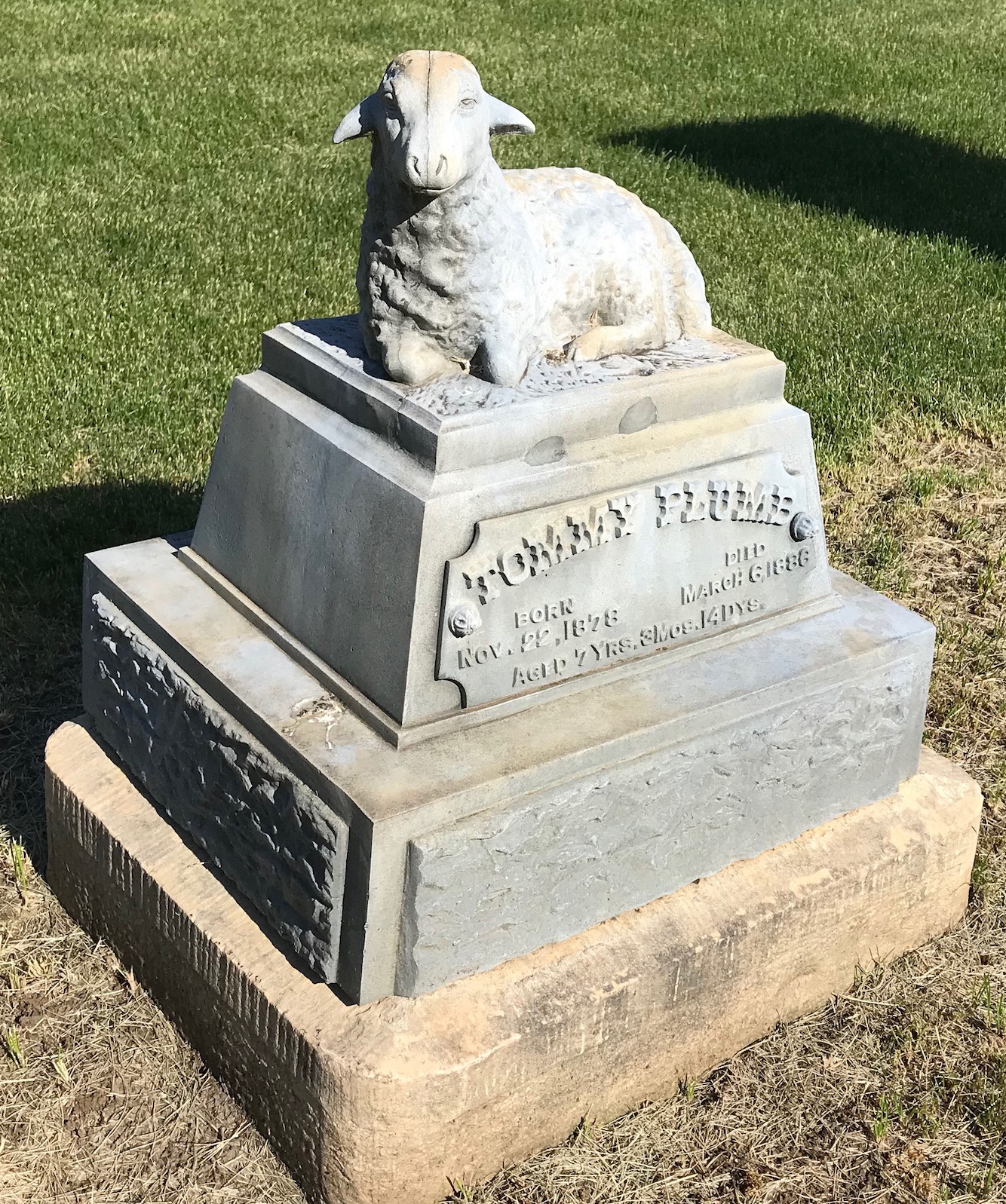
For those of us who adore “zinckies” (as we call them), finding certain examples of them in a cemetery can be very exciting. Before visiting Le Mars Cemetery, I had only seen a white bronze lamb marker online. To my amazement, Le Mars has not one but FOUR of them! I’m going to share all of them with you here.

Seven-year-old Tommy Plumb died of the croup on March 6, 1886.

Friderick Knuth was only seven months old when he died on May 30, 1891.

Theresa Caroline Utech passed away at the age of five weeks and five days on Sept. 7, 1883.

Edward Patzig died on Feb. 25, 1889. It’s possible he is the son of Louis and Maggie Patzig.

I think I may have found the answer as to why Le Mars Cemetery has so many lambs.

The final one pictured is a for a boy named Edward Patzig, who died in February 1889 at the age of 16 months. An item I found in the newspaper from November 1890 indicating Louis Patzig and his family were moving to Des Moines where he would be selling white bronze monuments and working with his wife’s relative, Joseph Clos, as an undertaker. It’s possible that Louis Patzig, already known in Le Mars, sold the other lambs to his former neighbors. Louis’ mother, Johannah Patzig, is buried nearby.

“Suffer the Children”

Sadly, white bronze was a popular choice for families mourning the loss of their children. Several examples of this can be found here. If any family knew loss, it was the Traeders.

Originally from Germany, Albert Traeder came to America with his family around 1865.

A native of Germany, Albert Traeder was born around 1849 and emigrated to American with his family in 1865. He married Bertha Woodke in 1876. Edward “Eddy” Bernhard Traeder was born in 1877. Lora Marie Traeder was born in 1878. Rudolph “Rudy” August Traeder was born on Oct. 24, 1880. Albert Jr. was born on April 27, 1884.

Eddy and Rudy died only a day apart in 1883.

Scarlet fever ravaged the Traeder home in early May 1883. Six-year-old Eddy died on May 10, 1883. Two-year-old Rudy died the next day.

Tragedy struck again on Aug. 15, 1884 when Albert Sr. died at the age of 34 from “brain fever”, as it was called. Today it might have been called encephalitis.

Only 34, carpenter Albert B. Traeder Sr. was much loved by his community.

It’s not surprising that the family chose what the Monumental Bronze catalog refers to as the “Suffer the Children” design for one of the panels.

“Suffer the Children” is a motif reflecting Matthew 19:14.

At the foot of the monument are two name plates for the boys and their father. Such plates are often damaged by mowers and end up in sad shape. But it appears the Traeder ones are holding up fairly well.

Bertha’s woes were not yet over. On May 28, 1886, Lora died from complications stemming from the croup and diphtheria. She has her own stone at Le Mars Cemetery.

Bertha didn’t let these tragedies stop her from making a life for her and Albert Jr. She became a successful businesswoman in the community. She waited until 1908 to remarry to Henry Frevert, when Albert Jr. was 24.

Albert Jr. married in 1917 to Victoria Dionne. They had one child, Patricia, in 1920 and Victoria died soon after. With the help of Bertha, Albert raised Patricia. Bertha died in 1932. When Patricia was 16, he remarried. He died 13 years later in 1949.

I found plenty of markers for older people as well. This one for the Blackwells is an example. Catharine is one one side and husband Henry’s on the other.

Catharine Blackwell died at age 66 in August 1880.

Born in 1823, Henry emigrated from Canada and settled in Le Mars. Catharine was about nine years his senior. I don’t know what year they married but four children followed.

“The Angels Took Her Home”

Catharine died in August 1880 at the age of 66, I don’t know what from. Henry must have mourned her greatly. The words at the bottom of her marker read: “She faltered by the wayside, and the angels took her home.”

The news account of his death notes that Henry was an “old man” nearing 70 when he was actually only 63. It also said he was suffering from rheumatism and “felt for some time that death would be a great release.”

Henry Blackwell committed suicide six years after his wife, Catharine, died.

On April 18, 1886, Henry was alone in his room at the home he shared with his son, William, and his family. He somehow managed to rig a shotgun against a plank at the bottom of his bed and shot himself in the chest. His family raced to help him but it was too late.

His epitaph reads: “Where immortal spirits reign, there we shall meet again.”

There are many more white bronze stories left to share from Le Mars Cemetery. Stay tuned for Part III.

Annie McCurdy, whose block you saw at the start of this post, also has a full monument at Le Mars Cemetery. She died in 1885 at the age of 28.

Iowa/South Dakota Cemetery Hopping: Discovering Iowa’s Le Mars Cemetery, Part I

So we’re nearing the end of my Iowa/South Dakota 2018 adventure back in Iowa. While I truly enjoyed all the cemeteries we visited, and seeing Sioux Falls for the first time, our excursion to Le Mars Cemetery was by far my favorite. It’s probably going to take at least three parts to cover it all.

Origins of Le Mars

According to Le Mars’ web page, the history of the town goes back as early as the 1850s when white settlers arrived to the region now known as Plymouth County. The county of Plymouth was organized in 1853 and started with 2 townships. Le Mars was platted in 1869, but no lots were sold until the Iowa Falls and Sioux City Railroad, later part of the Illinois Central Railroad, arrived in 1870.

You might think, as I did, that Le Mars was named after a Frenchman. But that’s not what happened. In 1869, Le Mars was named when railroad builder John I. Blair came by special train with a company of officials and a group of ladies. These ladies were asked to suggest a name for the town, then know as Saint Paul Junction. The ladies’ names were (and locals quibble a bit on whether or not all the names are accurate): Lucy Underhill, Elizabeth Parsons, Mary Weare, Anna Blair, Rebecca Smith and Sarah Reynolds. The result: Le Mars.

Historic postcard of Le Mars’ courthouse and jail, taken around 1890. (Photo source: Bobette Yamado)

Unlike many rural Iowa towns, Le Mars did not begin as your typical farming settlement but was pitched as an English colony of sorts. In Philadelphia in 1876, Oxford University student William B. Close and Daniel Paullin, a land agent who was promoting land sales in Illinois and Iowa, talked about the opportunities in Iowa. Inspired by Paullin’s idea, Close and his three brothers organized the Iowa Land Company.

The Close family was well connected in England and secured financing for their venture. They encouraged upper-class Englishmen to join the colony. Several Englishmen came to buy farms and ranches, and set up banks and other businesses. You might be asking yourself why, as did I.

An English Colony for “Second Sons”

Young Englishmen, especially the “second sons” of elite families were encouraged to travel to Le Mars to learn the business of farm management. Some of the older men took responsibility for the housing and training of these young pupils. In England, such young men were not known for being incredibly industrious but tended to live off the coffers of their eldest brothers who held the family money.

William Close was one of four brothers from England with a plan to turn an Iowa town into a British colony. (Photo Source: Northwest Iowa Genealogical Society)

Le Mars is not the first type of “colony” of this nature, another being Rugby, Tenn. Founded in 1880, it had similar origins but failed miserably due to many factors I won’t get into. While Le Mars fared better, I’m not sure a great many of the young men truly took to farming. I read that some were known to have unhitched plow horses for informal racing and betting, among other activities. They even played polo.

While the original experiment fizzled out around 1890 after the death of Fred Close in a polo accident in 1890, some of the Brits stayed an married Americans. By 1895, when the Prairie Club caught fire and had to be rebuilt, the new club began accepting forced  Americans as well as British members.

Birth of Blue Bunny

While few people know about Le Mars’ British connection, many are familiar with the ice cream that one of its families started producing that became a household name.

In 1913, Fred H. Wells, Jr. paid a local dairy farmer $250 for a horse, delivery wagon, a few cans and jars, and the goodwill of the business. His investment covered the milk distribution route and guaranteed Wells a source of raw milk from a herd of just 15 milk cows. Around 1925, Fred and his sons began manufacturing ice cream in Le Mars.

Undated photo of a Blue Bunny ice cream truck. (Photo Source: Wells Enterprises, Inc. web site)

In 1935, the brothers decided to run a “Name That Ice Cream” contest in the Sioux City Journal. A Sioux City man won the $25 cash prize for submitting the winning entry, “Blue Bunny,” after noticing how much his son enjoyed the blue bunnies in a department store window at Easter. The winner, an illustrator , also created the first Blue Bunny logo, used on Blue Bunny packaging for nearly 70 years.

Ice Cream Capital of the World

Le Mars reportedly earned the title of “Ice Cream Capital of the World” in 1994 after being recognized for more ice cream being made by one manufacturer in one location. Le Mars makes the most of this distinction and it’s noted on the town’s sign as you enter.

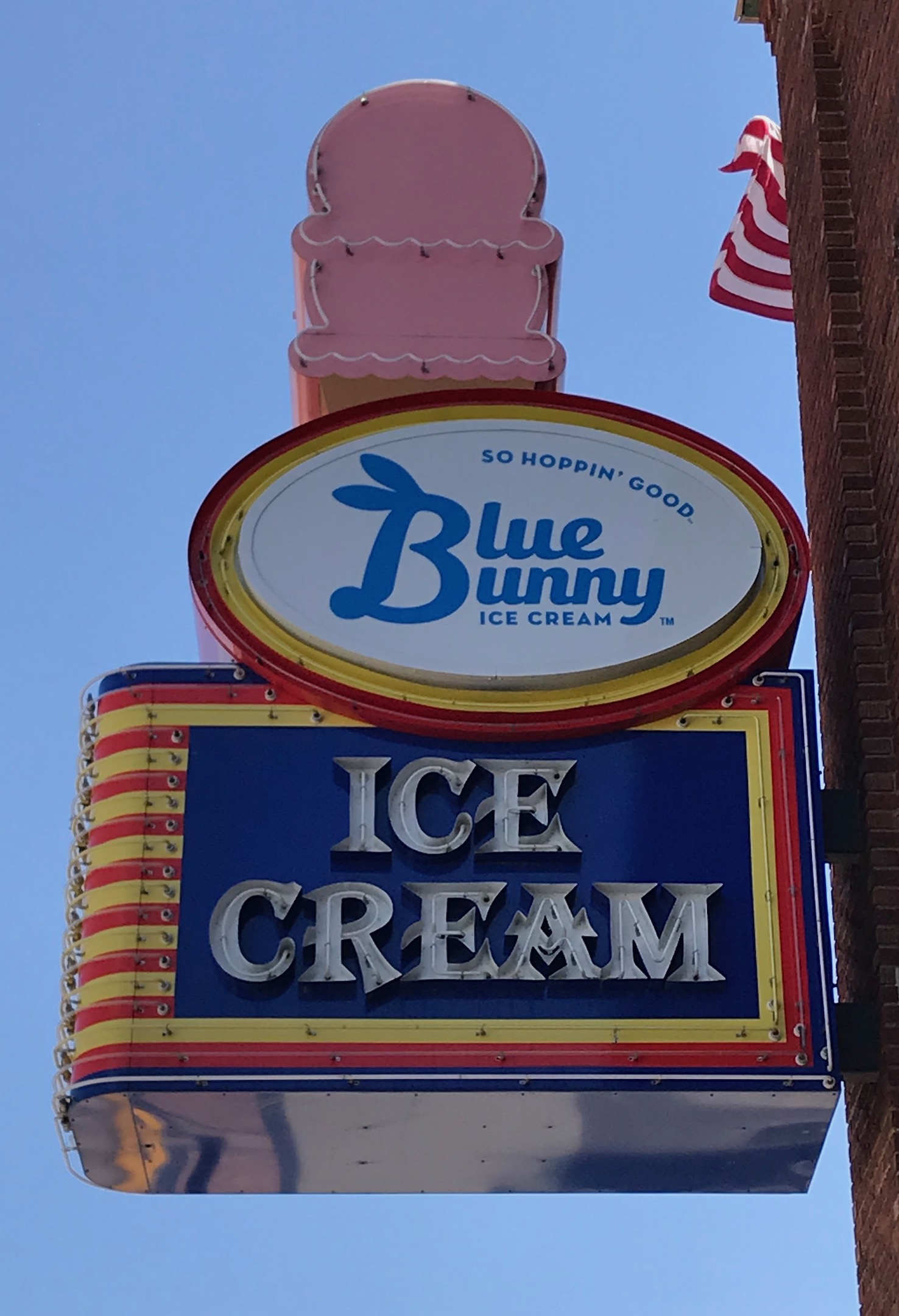
Le Mars’ Blue Bunny ice cream parlor is well worth a stop.

Christi and I visited the Blue Bunny ice cream parlor when we arrived in downtown Le Mars, which has preserved a number of those original British-built storefronts. The parlor boasts a great store of Blue Bunny merchandise (I bought a cool tie dye t-shirt) and a small museum upstairs. It’s definitely worth a stop.

If you ever make it to LeMars, you’ll notice several fiberglass ice cream cones around town uniquely designed to reflect local businesses. This one pictured below is right across from the Blue Bunny ice cream parlor and I believe it is for a church. About 55 of them can be seen around Le Mars, having been part of a local art project.

This ice cream cone is one of 55 around Le Mars that were part of a local art project.

If you’re wondering, we finally did make it to Le Mars Memorial Cemetery, although the sign says “Memorial Cemetery”. I’m going to refer to it as Le Mars Cemetery. I could find very little about the cemetery’s history. Not when it was established, who owned the land, etc. According to Find a Grave, it has close to 7,000 graves. An 1893 article states it covers 20 acres and was managed by a man named C.P. Woodward.

I don’t know what year the Le Mars Memorial Cemetery was established.

The first person I wanted to find at the cemetery was Blue Bunny’s founder, Fred Hooker Well, Jr. To my surprise, while he had a Find a Grave memorial, there was no photo of his grave. I remedied that quickly.

Grave marker for Fred Hooker Wells Jr., founder of Blue Bunny Ice Cream.

The next two markers I’m going to focus on were actually among the last I found during our visit. But I wanted to talk to them in this installment because they’re not white bronze markers and I’ll be focusing on them next week. They are unlike any other in the cemetery.

The Artistic Moon Sisters

Born in Ohio, Araminta “Mintie” Moon and her sister, Sylvia Theresa Moon, were both of a creative and artistic nature. They were the daughters of Eveline and George Moon. They had a younger brother named Willis. I don’t know when George died but by 1870, Eveline and her three children had left New York and settled in Waterloo, Iowa, which is 220 miles east of Le Mars.

The Waterloo newspapers often featured stories about the sisters’ artistic pursuits. They were popular in local society and both enjoyed participating in local plays. Mintie was the sister known for her painting. Theresa focused on supporting literary pursuits, singing, and playing the organ. Mintie took classes at the Massachusetts Normal School Art School in Boston for a few years. Willis helped support the family as a bookkeeper.

Mintie Moon’s love of art is expressed in her grave marker, which features a painter’s easel. “To live in loving hearts is not to die” is a variation on a quote from a poem by Thomas Campbell called “Hallowed Ground”

Sometime after 1880, Mintie and Theresa opened their own school in Waterloo that they called the Art Association. They hosted a number of exhibitions there and taught students. But Mintie’s health began to fail. She had contracted tuberculosis. The family moved to Le Mars around that time. Several months later, Mintie died on March 15, 1884. She was only 30 years old.

“To Live in Loving Hearts Is Not To Die”

Eveline died only three years later in 1887. Later that year, Theresa married attorney Alvin Low. He had older children from a previous marriage. By 1900, the family had moved to Los Angeles, Calif. Willis, who never married, shared their home later.

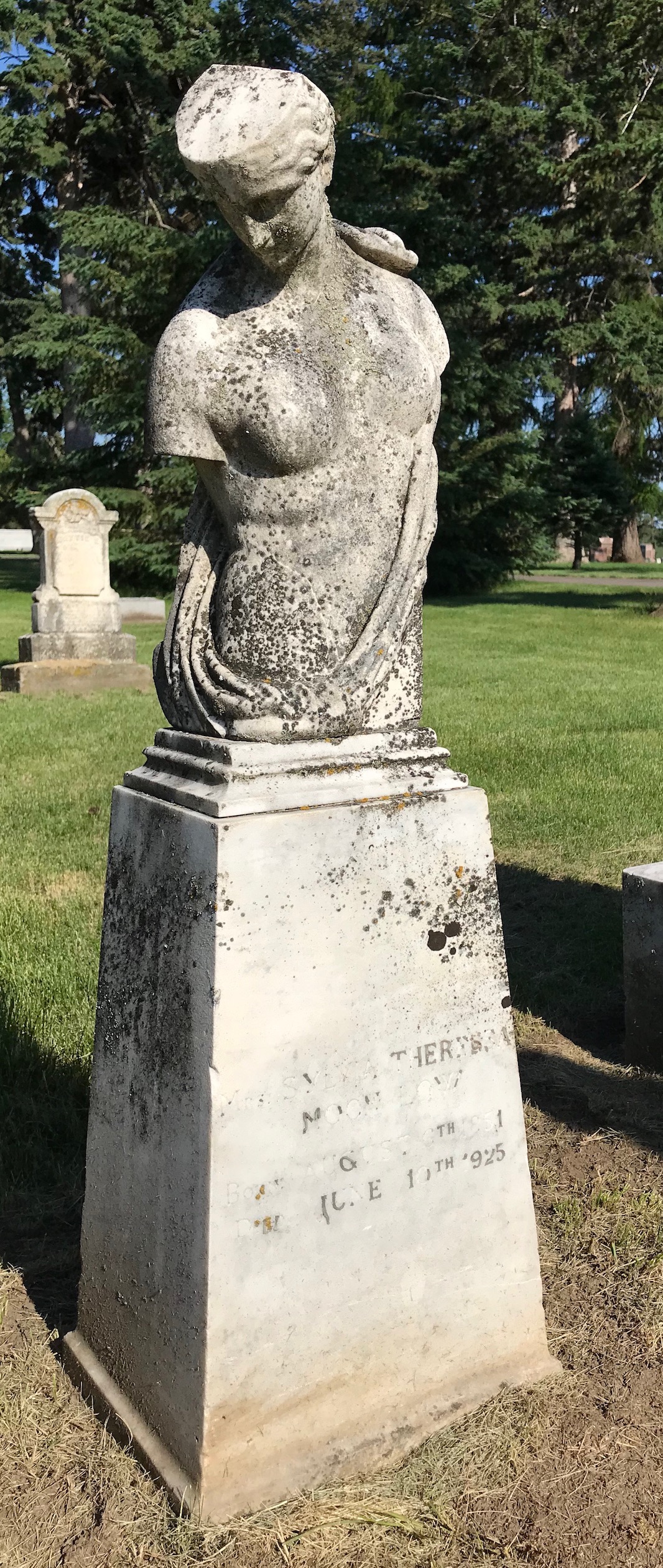
I can find no evidence that Theresa continued her artistic pursuits in California. She died at the age of 73 in 1925. Her body was brought back to Le Mars, where she was buried beside her beloved sister, Mintie, and her mother.

Sylvia Theresa Moon Low’s artistic life may have ended after she married lawyer Alvin Low.

Willis continued to live with his brother-in-law Alvin and his step-niece and nephews in California. He died in 1941 and is buried in the same lot as his sisters. There is no photo of his grave or Eveline’s on Find a Grave and I did not see any for them when I was there.

Next time, I’ll delve into the wonderful collection of white bronze markers at Le Mars Cemetery. There are more of them here than any other cemetery I’ve ever visited.


Iowa/South Dakota Cemetery Hopping: Pausing at Saint Mary’s Catholic Church Cemetery, Union County, S.D.

On our journey back to Omaha, we decided to make a stop in Le Mars, Iowa to visit the Blue Bunny Ice Cream Museum. When looking on the map to see what exit suited us best off I-29, I noticed there was a small cemetery near a tiny town called Spink. So that’s where we left the interstate.

St. Mary’s Catholic Cemetery is also known as Garryowen Cemetery by the locals. The Garryowen community was first settled by the O’Connors, the Mannings, and the Sullivans. If you go to Find A Grave and look up St. Mary’s Catholic Church Cemetery, you’ll discover that 71 of the 315 memorials recorded have the last name of O’Connor. St. Mary’s and the church building are about all that’s left of the Garryowen community.

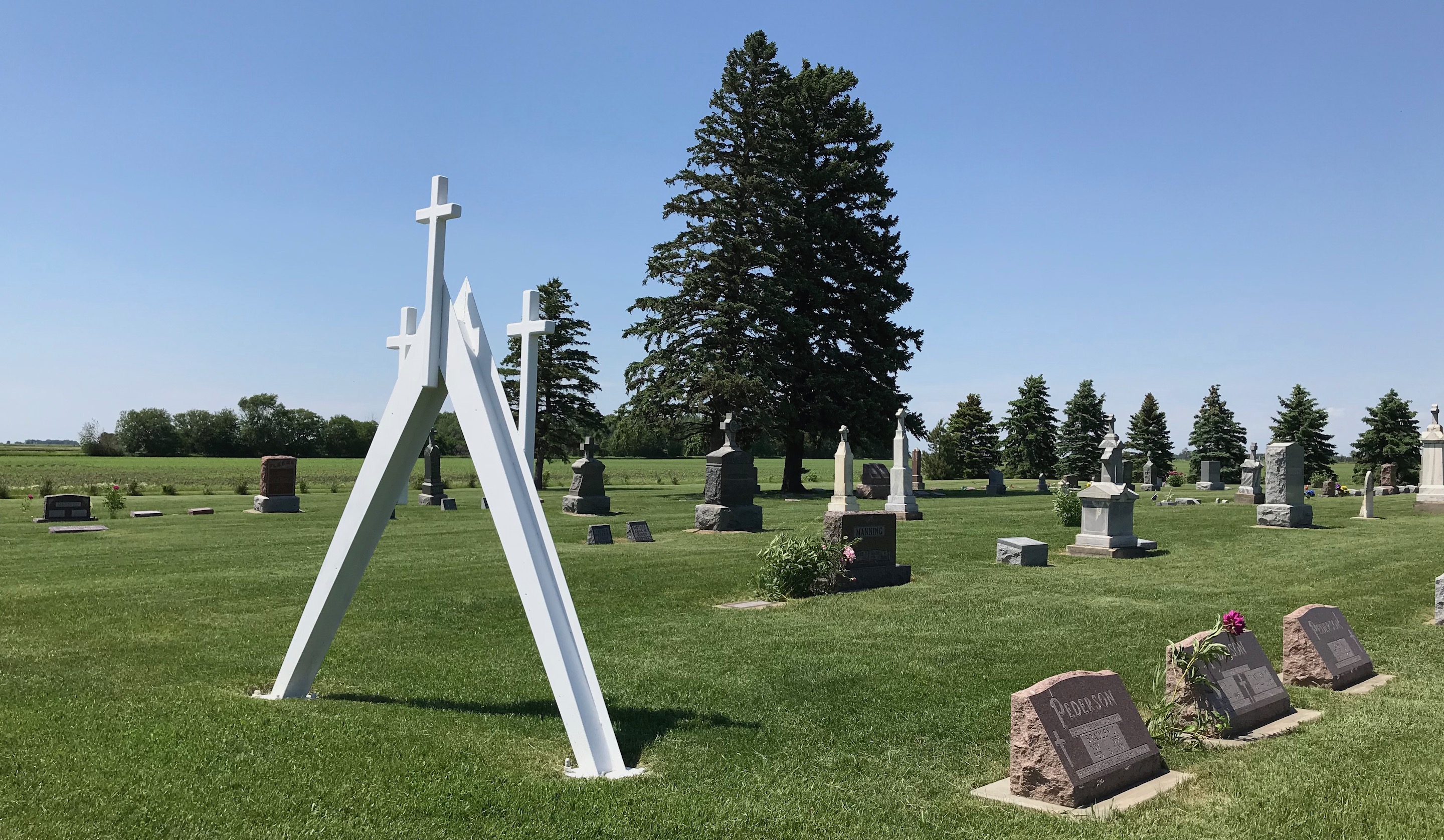
When I first saw the metal triple cross arch, I was puzzled. Later, I learned the cemetery sign used to hang under the crosses.

You’ll notice in the photo above that there’s a large metal piece with three crosses on it. I had no idea what this was supposed to signify at the time. Later, when I was doing research, I learned that it had formerly held the cemetery’s main sign.

Roots of Garryowen

The Irish families that moved to this southeastern corner of South Dakota had first lived near Dubuque in Garryowen, Iowa. These were immigrants mainly from Munster, Ireland. Garryowen is a variation of the Gaelic for “John’s Garden,” a popular parade and fairground outside Limmerick, Ireland.

In 1860, a group from Garryowen, Iowa, led by a Manning, moved west to start a new community. Between 1860 and 1879, these families attended church in nearby Fairview and their dead were buried in the Fairview Cemetery. When the Garryowen community had increased to 50 families, a parish was finally organized in 1879 to form St. Mary’s Catholic Church. Initially, the Fairview priest was responsible for this church.

The church’s new sign, made out of stone, explains the history of the community and cemetery.

This stone explains the history of St. Mary’s Catholic Church well.

St. Mary’s Catholic Church and the cemetery were first located together on five acres donated by Patrick Mahan. Eventually, the church became too small for the increasing membership so a larger one was built in 1904 at the James Casey farm. It was destroyed by fire in 1924. A third church was built in 1925 diagonally across the road from the cemetery on land donated by Tom O’Connor.

The signs also indicated that in 1993, the diocese of Sioux Falls closed the church. My thought is the community had shrunk considerably by then.

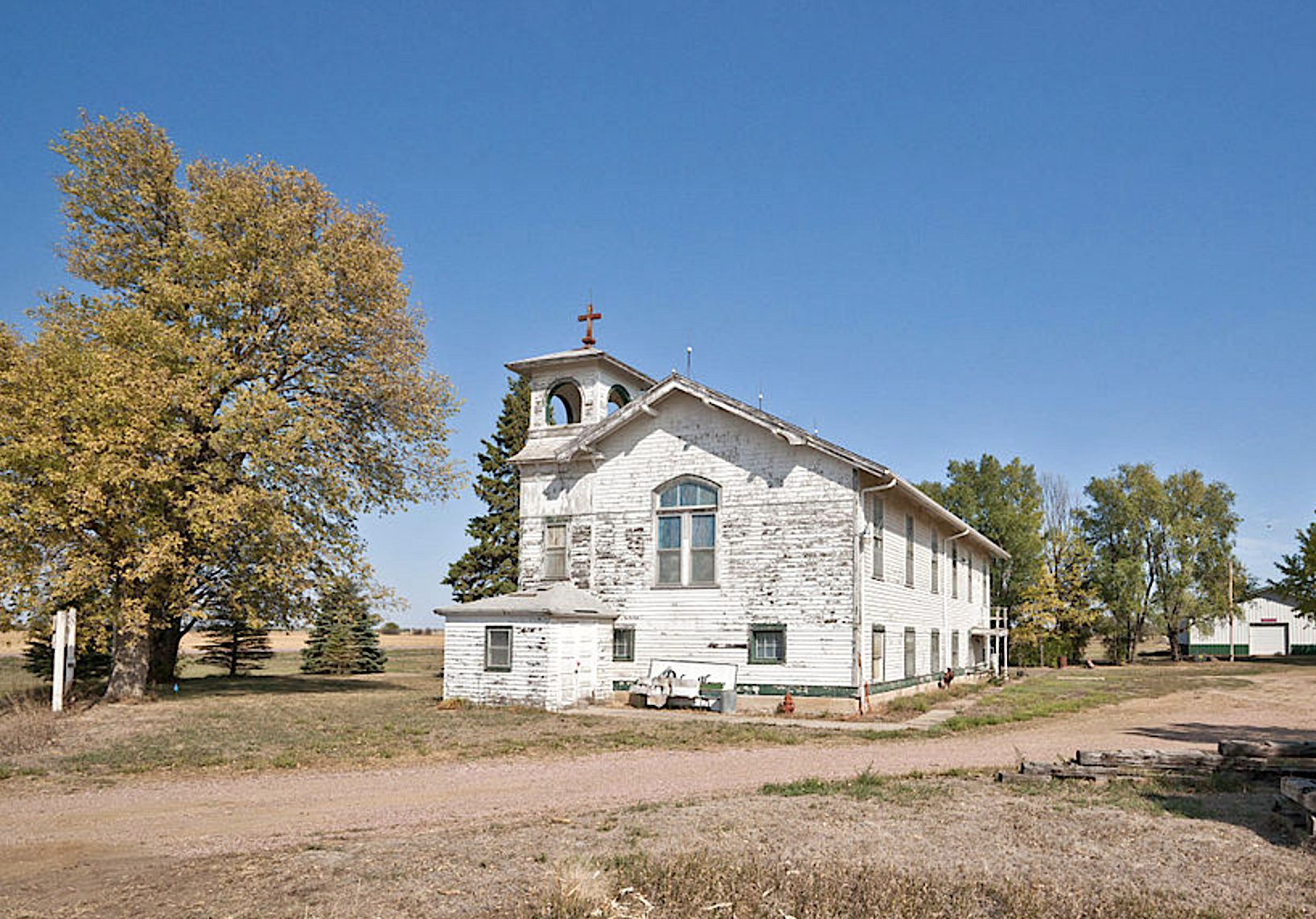
That 1924 church building, I recently learned, still exists. I didn’t notice it at the time when we stopped at the cemetery, probably because it doesn’t look much like a church any longer. I read that it was used as an antique store and as of 2016, the building and property were for sale. I have a feeling it’s not going to last too long unless it gets some TLC.

This is what St. Mary’s Catholic Church in looks like today. (Photo source: Wikimedia Commons)

A brief history of the church and cemetery that I located notes that the first burial at St. Mary’s Cemetery was that of Michael O’Connor. The grave was dug with the help of Vincent O’Connor, who was 16 at the time. There are only about 300 or so burials at St. Mary’s, so it is a small cemetery but well maintained.

It also notes that the second grave was that of Jeffery Donahoe in September 1883. Problem is, there’s no Jeffery Donahoe listed on Find a Grave but a Mary Ann Donahoe who died in September 1883 is. So I think the author is referring to her. As it turns out, Jeffery was her husband. There is no marker for him in the cemetery.

It is likely that Mary Ann Donahoe was the second burial at St. Mary’s Cemetery.

Born around 1831 in Castle Ireland, County Kerry, Ireland, Mary Ann Breshanan married Jeffrey Donahoe. I don’t know when they arrived in America but their first child, Daniel, was born in Connecticut in 1854. By 1860, they were in Table Mound, Iowa and that was about 15 miles northeast of Garryowen, Iowa. So they may have been among those that migrated over to Garryowen, S.D.

Mary Ann passed away at the age of 51 on Sept. 3, 1881. I couldn’t find out when Jeffrey died and he has no marker at St. Mary’s. Their son, Andrew, who died in 1935, is buried near Mary Ann with his wife.

The Mysterious Rev. Kennedy

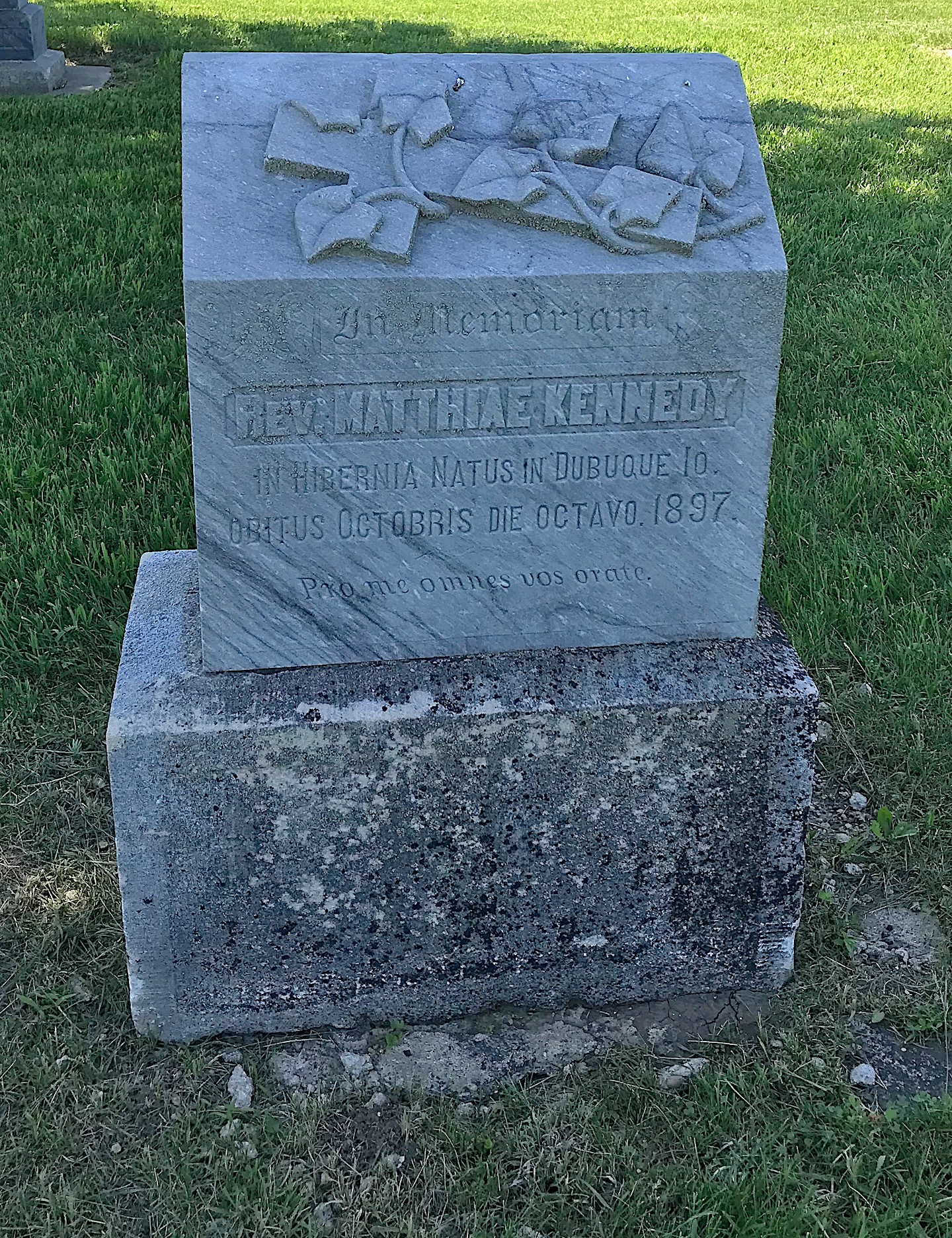
One gravestone I photographed was for the Rev. Matthiae Kennedy. I’ve never seen what I’m guessing is a form of Matthew spelled that way.

Who was the Rev. Matthiae Kennedy?

The information I was able to glean from his marker was that he was born in Ireland and died in Dubuque, Iowa on Oct. 8, 1887. At the bottom is the Latin inscription: Pro me omnes vos orate, which means I pray for you all.

If he did indeed die in Dubuque, why was he buried in Garryowen, S.D.? Did he ever pastor St. Mary’s? I Googled my heart out and could find nothing at all about him online. Perhaps someone reading this is familiar with him and will contact me.

The Dillon Children

I found a repaired marker for two children of John and Annie Dillon. Born in Camross, Ireland in 1823, John arrived in Boston, Mass. around 1848. He married Annie McCarty in Galena, Ill. sometime before 1853. By 1880, they were living in Spink, S.D. (which is next to Garryowen) and had seven children.

This marker for two of the Dillon children was repaired at some point.

Born in 1860 in Illinois, Thomas was probably the third child in the family. He died on March 16, 1878 at age 18. Anna, who was born in 1871, died in 1885 on April 26, 1883. She was 14. I don’t know their causes of death. Their parents share a marker nearby.

Mother of 13 Children

This marker got my attention because of the words “Mother of 13 Children”. It also has that homemade rustic quality that tugs at the heartstrings.

Sadly, most of Mary O’Connor’s children did not live to adulthood.

Mary Donahoe (or Donahue) was born in Iowa in 1855. She married Irishman Jeremiah “Jerry” O’Connor in 1878. He’d only been in America a few years, having emigrated from Ballyferriter, County Kerry, Ireland in 1875. He came to Iowa to join two of his brothers who were already farming in Iowa.

By 1880, the couple were living in Garryowen where they farmed. When I saw the 1900 U.S. Census, it listed them with four children (Mary, Anna, Joseph, and Luke). But it also noted that the total number of children Mary had given birth to was 13. I can only guess that nine did not live past childhood, which is incredibly tragic.

Mary died in 1905, I don’t know her cause of death. Jerry and the three younger children remained on the farm. He moved to nearby Vermillion, where he taught school and farmed there near daughter Margaret. When Margaret and her family moved to California, he went with them. He died there on Feb. 5, 1935 and is buried in Calvary Cemetery in Los Angeles, Calif.

O’Connor Brothers

This handsome marker for James O’Connor and his wife, Nora, is one of the largest ones in the cemetery. I am fairly sure that he’s the son of Michael O’Connor, the first man buried in St. Mary’s. Michael and his wife, Margaret were also from Ballyferriter, County Kerry, Ireland like Jerry O’Connor.

James and Nora O’Connor both came from County Kerry (or County Cary as their marker states) in Ireland.

Born in 1829, son James may have married Hanora “Nora” Shehan after he came to America. They were both from County Kerry and married in 1850. They settled in the Jones County area of Eastern Iowa and had all of their children there before moving over to Union County, S.D. in 1869. The U.S. Census from 1870 lists eight children in the household. Amazingly, it looks like they all lived well into adulthood.

James died in 1910 and Nora died the following year. At least four of their children were also buried at St. Mary’s when they died.

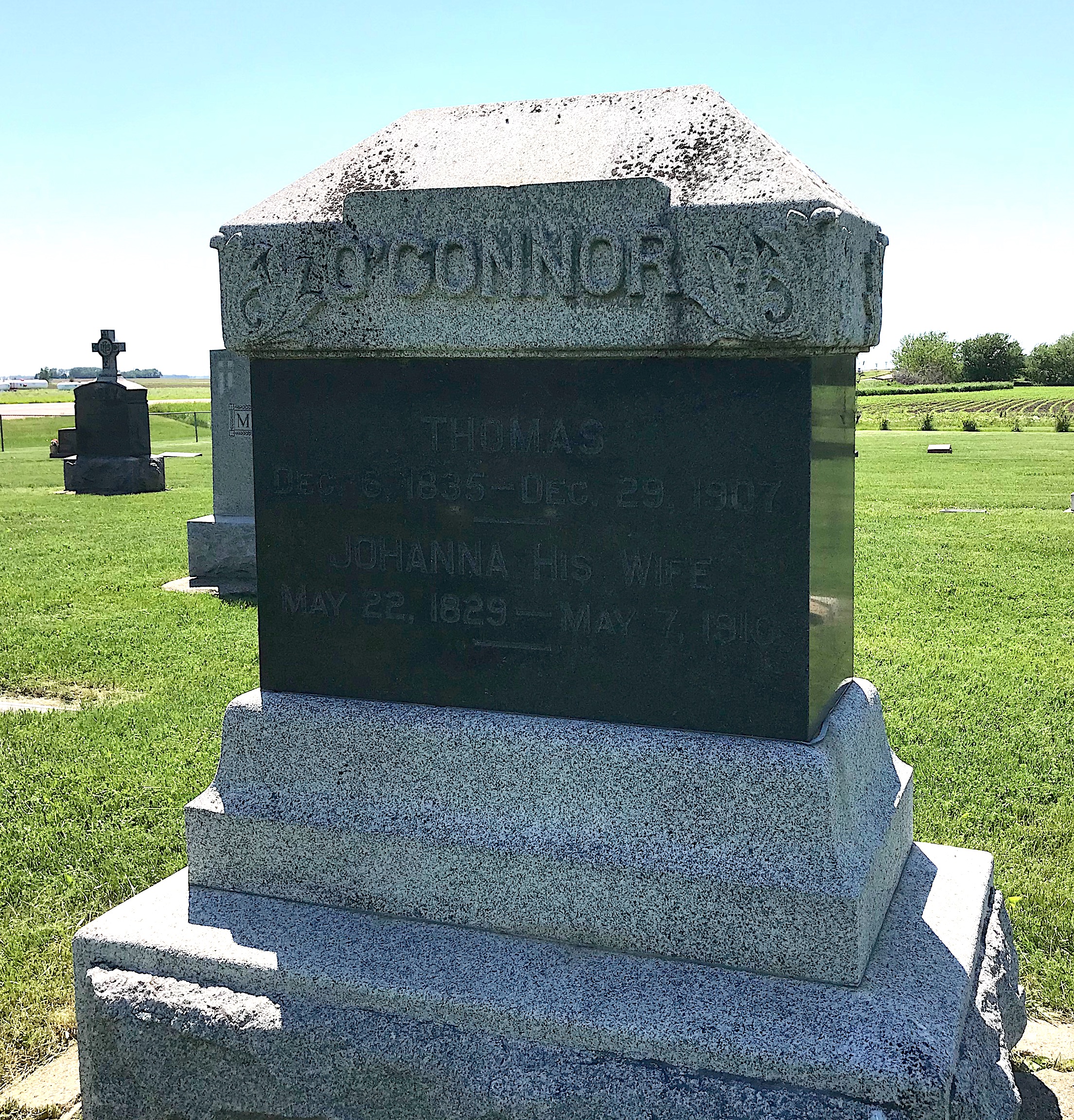
James’ brother, Thomas, also moved to Union County and raised his family there. He and his wife, Johanna, share a very similar marker next to James and Nora’s. Thomas died in 1907 and Johanna died in 1910.

Thomas and Johanna O’Connor’s monument does not have a cross on the top.

There are small cemeteries like St. Mary’s on country roads throughout states like South Dakota and Iowa. Many are the last remnant of a community whose population dwindled over time and eventually died out. Garryowen is one of them.

Fortunately, those left behind are still taking care of the final resting place of those Irish pioneers.


Iowa/South Dakota Hopping: Taking a Stroll Through Sioux Falls, South Dakota’s Woodlawn Cemetery

We’re still in Sioux Falls, South Dakota! This week, our destination is Woodlawn Cemetery. Founded in 1905, it’s a not as old as nearby Mount Pleasant Cemetery. But it has an illustrious history all its own.

This sign at the 26th Street entrance, made of stones from the petrified forests of Arizona, was provided by Woodlawn’s founder Richard F. Pettigrew.

With some cemeteries, it can be difficult for me to locate information on who the founder was or any kind of history. With Woodlawn, their website provides plenty of useful information.

The man at the center of Woodlawn’s history is Richard Franklin Pettigrew, who is (as you might imagine) interred at the cemetery he founded. There’s a lot of material written about him because he was a key player in South Dakota history.

A Dakota Pioneer

Born in Vermont in 1848, Richard and his family relocated to Wisconsin where he attended the University of Wisconsin Law School. In 1869, he moved to the Dakota Territory, where he first worked as a surveyor, then entered the Territorial Bar in 1871. After establishing a law practice in Sioux Falls, he also pursued real estate interests.

Active in politics, Pettigrew served a term in the Dakota Territorial Legislature, and two terms on the Territorial Council before being elected as a Democrat to represent the Dakota Territory in the U.S. House of Representatives in 1880. He served a single term in Congress from 1881 to 1883, and was unsuccessful in his bid for re-election.

Richard F. Pettigrew’s mausoleum is one of the few I’ve ever seen that has a photo of him on the outside.

When South Dakota was admitted to the Union in 1889, Pettigrew was elected along with Republican Gideon C. Moody as the state’s first two Senators to the U.S. Senate. He served two terms from 1889 to 1901, switching from Democrat to Republican in 1896. The party switch hurt him of politically, and he lost his re-election bid to Senator Robert J. Gamble. His post-Senate career was marked by a time of practicing law in New York City before returning to Sioux Falls.

A New Cemetery for Sioux Falls

It was during his time in New York City that Pettigrew served as an officer of the Rosehill Cemetery Association (located in New Jersey), which sparked his intent to help establish a cemetery in Sioux Falls.

When a 70-acre tract of land in the southeast corner of the city went up for sale, Pettigrew paid the $8,750 purchase price from his personal funds.The entire amount, plus interest, was repaid to him as the cemetery association’s funds slowly grew. In the winter of 1922, an adjacent 10 acres were purchased from a private owner.

Today, Woodlawn Cemetery covers 80 acres, with about half of it plotted and sold. According to Find a Grave, there are about 17,400 recorded burials.

Richard F. Pettigrew’s final years were marred by controversy.

The Pettigrew mausoleum features this lovely stained glass window of Easter lilies.

Unfortunately, the last decade of former Sen. Pettigrew’s life was colored by difficulty. In 1916, his wife, Bettie Pittard Pettigrew, died after a long illness. In 1917,  he criticized America’s involvement in World War I, and publicly urged young men to evade conscription. As a result, he was arrested and charged with sedition under the newly passed Espionage Act of 1917. He enlisted famous lawyer Clarence Darrow as his defense attorney, who delayed the case long enough for the charges to be dropped.

Today, Richard F. Pettigrew’s home in Sioux Falls is a museum. (Photo Source: Jerry F., Foursquare.com)

Before Pettigrew passed away in 1926, he donated his residence to the city of Sioux Falls and it is operate it as the Pettigrew House and Museum. He was interred in the Pettigrew mausoleum with his wife, Bessie. Also interred inside are his youngest brother, Harlan, who died in 1917 at the age of 34, and unmarried sister Alma Pettigrew, who died in 1922 at the age of 78.

Other siblings of Richard Pettigrew are also buried at Woodlawn. His older sister, Luella Belle Pettigrew, is buried near the Pettigrew mausoleum. Born in 1839, Belle was greatly influenced by her abolitionist father, Andrew. After graduating from Rockford Seminary in Illinois (now Rockford University), she devoted her life to missionary work.

This photo was on Belle Pettigrew’s monument but it was vandalized before I photographed it. This photo of it was taken by a Find a Grave member in 2006.

For 12 years, Belle represented the Woman’s Baptist Home Mission Society as a missionary among African-Americans, teaching at two historically black institutions, Shaw University and Roger Williams University. She also spent three years as a general missionary in South Dakota, living in Sioux Falls for periods of time.

A Lifetime of Service

Later, Belle lived for several years in Washington D.C., where was a member of the Columbia Chapter Daughters of the American Revolution, the Anti-Saloon League, as well as being a member of a missionary society and literary club connected with the Calvary Baptist Church. She traveled extensively in the U.S. and internationally, including visits to Europe, India, China, and the Philippines to do inspection visits for missionary organizations.

Belle died in 1912 of hardening of the arteries. Staying at a sanitarium in Chamberlain, S.D., her remains were returned to Sioux Falls for burial at Woodlawn.

Luella Belle Pettigrew died at age 73 of hardening of the arteries.

It’s hard to miss the other Woodlawn monument for a Pettigrew because it’s one of the largest in the cemetery.

Like his brother, Fred Pettigrew’s monument features a photo of him.

Born in 1850, Frederick “Fred” Pettigrew moved from Vermont to Flandreau, S.D. (about 40 miles north of Sioux Falls) around the same time as sister Belle did. He married Jennie Salome in 1879 and they had five children.

Fred did not attain the status of his brother Richard, but he made a mark in his community just the same. More comfortable in a rural setting, he was content developing and working his large farm in South Sioux Falls. He was a judge in Moody County for several years as well.

A Mysterious Accident

At the same time, Fred had a reputation for being somewhat taciturn in nature. On Dec. 8, 1901, while doing evening chores around his farm, he was found unconscious and injured in the road by two hired men near his home. Some thought he might have been accidentally run down someone in a buggy in the darkness. But others wondered if he was attacked by an enemy with a grudge.

Fred Pettigrew was only 50 when he died after being injured under mysterious circumstances.

A few days later, Fred regained consciousness for a short time but did not make a great deal of sense. When asked about the accident, he claimed a buggy driven by someone he didn’t know had struck him in the darkness, although he had tried to step back out of its way. Despite the belief he might recover, Fred passed away on Dec. 21, 1901.

Another farmer that made his mark in Sioux Falls was John Alguire, whose family has a distinctive “tree” monument at Woodland.

A native of Canada, John was born in 1842 and took a circuitous route to get to the Dakotas. He left Canada for New York in his late teen years. He later moved to Wisconsin to farm, marrying Jane Foster in 1869. The couple moved to Benton, S.D. around 1874 where their third child was born.

“Summoned to the Other Side”

After moving to Oregon for a few years, the Alguires returned to South Dakota and John continued to farm. He and Jane had a total of nine children together. John died of pneumonia at the age of 69 on Dec. 1, 1911. His obituary in the Sioux Falls newspaper had a headline that said he was “summoned to the other side.”

John must have done quite well because one article I found estimated his estate to be worth $75,000. That would be about $2.03 million dollars today.

Farmer John Alguire left an estate worth $75,000 behind.

I am especially fond of the Alguire family “tree” monument. There are no specific first names or dates on it. Those are inscribed on individual stones or “logs” around the monument. There’s a potted calla lily at the base and a sweet bird resting on a branch near the top.

This bird is most likely meant to be a dove, symbolizing peace or the Holy Spirit.

Here’s a look at the “logs” for John and Jane, his wife who died in 1920 at the age of 73.

John Alguire’s marker also says “Father” on it.

Jane Foster died in Los Angeles, Calif. in 1920.

Next time, we’ll return to Iowa for some more cemetery hopping…

Iowa/South Dakota Hopping: Exploring Sioux Falls, South Dakota’s Mount Pleasant Cemetery

Welcome to Sioux Falls, South Dakota!

I’m posting two pictures of the falls, one close up and one from the observation tower, so you can get some perspective on their size.

This is a more close up view of the falls for which Sioux Falls was named. At this angle, you can’t completely get an idea of their size.

This is photo I took from the observation tower further back. Nearly lost my hat from the strong winds. This view allows you to see the city of Sioux Falls in the background.

Christi and I stayed at a Hilton Garden Inn located right next to the Big Sioux River that feeds into the falls. There’s a wonderful park that leads there and we enjoyed exploring.

Birth of Sioux Falls

Sioux Falls is named for the Sioux Tribe of American Indians and the waterfalls of the Big Sioux River. Pioneers began staking claims on the banks of the Big Sioux River prior to the Civil War in 1856. Homesteaders continued to settle in Sioux Falls bringing the population up to 2,100 by 1880.

The village of Sioux Falls was incorporated in 1876 and became a city in March 1889. By the turn of the century, the prairie settlement had grown into a city of more than 10,000. Today, the city’s population is around 190,000. So it has definitely grown over the years.

Established in 1873, Mount Pleasant is the oldest cemetery in Sioux Falls.

Our destination that first morning was Mount Pleasant Cemetery, located just east of downtown. Mount Pleasant Cemetery has a well-written web site with a lot of details that I found helpful.

History of Mount Pleasant Cemetery

Established in November 1873, Mount Pleasant is the oldest cemetery in Sioux Falls. The incorporation group chose the name, and elected Dr. Joseph Roberts as chairman and later the board’s first president. The group found 32 people who would pay $10 for a cemetery plot, collected as much of the money from them as possible and determined they were now “in the cemetery business.”

Originally covering about 20 acres, Mount Pleasant (at one point) covered 150 acres. The present cemetery is comprised of about 52 acres, nearly 100 having been lost over the decades to development. Although present burials number around 16,000, the cemetery still retains about 40 percent of its remaining burial space.

The Glidden Chapel is just inside the front gates. We were surprised to find it unlocked.

Inside the gateway, the Glidden Memorial Chapel was built in 1924 with a $13,000 bequest of Josephine Glidden in memory of her husband Daniel, an early member of the cemetery board. We were quite surprised to find it unlocked and took a few moments to look inside.

Stained glass windows inside the Glidden Chapel.

A sign nearby explained that pioneer banker Dennis McKinney (also a friend of the Glidden family) was the first person whose funeral was held in the chapel. McKinney was also president of the Mount Pleasant Cemetery board for several years. He died on Dec. 24, 1924 and because the ground was frozen, his body was stored in the chapel’s crypt until conditions enabled him to be buried.

Daniel Glidden, in whose honor Mount Pleasant’s chapel was built, died in 1912.

Mount Pleasant’s web site explains that over time, the Glidden Memorial Chapel fell into disrepair and at one point, the doors were removed and it became a home to mowers, tractors, and grounds-keeping equipment. Fortunately, volunteer efforts to clean up and restore the chapel took place in the 1980s and it was restored to its former glory. The Glidden Memorial Chapel was listed on the National Register of Historic Places in 1989.

A stone’s throw from the Glidden Chapel is this helpful sign with information about the cemetery. I was amazed to see an actual price list for services available, including the cost of a plot, burial and columbarium niches. I also learned that green burial is available at Mount Pleasant, which is pretty rare for an older cemetery. My guess is that because it has a lot of available burial space, they can handle it.

I’ve never been to a cemetery where the prices were listed on a sign.

I did notice that the sign was part of a 2011 Eagle Scout project, so prices may have gone up since then. But I was impressed to see them just the same as an indication of the owners’ transparency about costs.

We drove around the cemetery to get an overview of the place. Truth be told, if you are looking for large obelisks and grand monuments, Mount Pleasant is going to disappoint you. But it is well maintained and a lovely setting.

View of Mount Pleasant Cemetery on a sunny June day.

The Gale obelisk is arguably the largest monument at Mount Pleasant, representing a family that made a distinct mark on Sioux Falls history.

I think the Gale obelisk may be the tallest monument in Mount Pleasant Cemetery.

The Gale family originally hailed from New Jersey but later moved to Albion, N.Y. David Gale and Elizabeth Decker Gale had several children of which Artemas was one of the most enterprising. Born in 1825, he married a woman named Louise whose maiden name I was never able to pin down. After purchasing land in St. Paul, Minn., he moved there in the 1850s and worked as a furniture/grain dealer while also dong some some land speculating.

He and Louise purchased land in Sioux Falls in the 1860s but didn’t build a homestead there until 1872. During their first years, he was active in school matters and was also director of the Dakota National Bank for much of his life. Over time, he amassed quite a fortune.

The couple had no children of their own but adopted at least two sons that show up on census records, Sidney and Ernest. Louise died in 1880 at the age of 51. According to newspapers, the disposition of her will caused Artemas a bit of a headache because of her land holdings.

Louisa Gale died at the age of 51.

Not long after Louisa’s death, two of Artemas’ siblings moved to Sioux Falls from New York. Younger bachelor brother Gabriel, born in 1837, had never married and was the last to leave the Gale family farm. Widowed sister Kathleen Gale McKennan, born in 1841, had lived in Sioux Falls for a time before she married and moved back to New York. She shared brother Artemas’ mind for business and invested well. Youngest sister Frances Gale Carpenter and her husband, Charles, moved to Sioux Falls in 1885.

This bust of Helen Gale McKennan honors her gift of land to the city of Sioux Falls to create McKennan Park. (Photo source: Ruth VanSteenwyk)

Kathleen Gale McKennan’s Legacy

Both Artemas and Kathleen especially were keen on establishing a park in Sioux Falls for its residents to enjoy. In 1906, Helen contacted her friend E.A. Sherman and discussed with him her idea to give her house and the 20 acres of adjacent land to the city for a park. She died on Sept. 29, 1906 after giving to the city of Sioux Falls what would become the jewel of the park system. She also left money for the development of a new hospital, which was named McKennan Hospital.

Helen McKennan died at the age of 65.

Brother Gabriel, who has suffered from the kidney disease then called Bright’s Disease, died on June 12, 1908. He’d been living with a married couple to whom he left his estate in his will, which his siblings contested in court. They claimed he was insane at the time he wrote it.

Living with sister Florence since 1900, Artmeas was already gravely ill when his brother Gabriel died. Artemas passed away on Jan. 17, 1909. The names of Artemas, Louise, Gabriel, and Kathleen are all inscribed on the Gale obelisk at Mount Pleasant.

William Stevens, Dakota Pioneer

Markers like those for William Stevens invite my interest because of the early date of his death, which predates the establishment of Mount Pleasant. That leads me to believe he was originally buried in the old city cemetery that predated Mount Pleasant and his remains moved there after it opened.

William Stevens died in 1869, which predates the establishment of Mount Pleasant Cemetery.

William Stevens was born in Oswego, N.Y.on Oct. 12, 1828. He’s listed as one of the early settlers of Sioux Falls when South Dakota was still a young territory, purchasing land in 1858. The 1860 U.S. Census lists him as a farmer with no wife or children.

Picture of officers’ quarters at Fort Dakota, located on the Sioux River.  (Photo source: Siouxland Heritage Museums, Sioux Falls, S.D.)

Fled His Farm

According to the Congressional Record, Stevens farmed his land until 1862 when Sioux Indians attacked the settlement and he (along with his neighbors) fled. Later, the land was part of the property upon which Fort Dakota was built in 1865. After the Army left Fort Dakota, Stevens returned to his farm in the spring of 1869, making repairs to his original home. But William was already suffering from tuberculosis and his health took a turn for the worse. In his last days, he was cared for at a neighbor’s home until his death on Nov. 16, 1869.

Apparently, Stevens did have family and in later years, his heirs tried to purchase his farm from the South Dakota government in 1876. From what I can tell, they were given permission to do so.

Modern Memorial

I don’t often include modern grave markers in the blog but this one reached out to me so I’m going to include it. I’ve never seen one quite like it before.

Kathleen “Katie” McNeill-Merrill was a successful real-estate professional in Sioux Falls.

Born in 1952, Kathleen “Katie” McNeill-Merrill was a native Nebraskan. She eventually moved to Sioux Falls, married and had two children. She was a successful real estate professional and was much loved in the community. She died on Jan. 6, 2004 at the age of 51. I don’t know the cause of her death.

The steps lead to an archway.

At the top of her monument is a laurel wreath behind which are is a stairway leading to an arch. In ancient times, the Greeks equated laurel wreaths with the god Apollo. They awarded laurel wreaths to victors in the Olympics and poetic competitions. Today, the laurel wreath stands for victory and peace.

I’m not sure what the stairway and arch are meant to signify. They could mean many things, including the steps into Heaven.

Join me next time when Christi and I visit Sioux Falls’ Woodland Cemetery.