Welcome to Westview Cemetery, Part I

“Hey, Traci, have you ever been to (fill in name of cemetery here)?”

I get asked this question a lot.

While I do write a blog about cemeteries, I’m fairly new to hopping. I only got into it a few years ago when I was researching my own family. So when you click on the tab that says “Cemeteries I Have Visited”, you can see there are quite a lot I haven’t gotten to yet.

A few months ago, someone in my Sunday School class asked me if I had ever been to Westview Cemetery before. No, and I hadn’t even heard of it.

Martin proceeded to show me pictures he had taken at Westview on his phone during a stop he made there. He just happened to be driving by one day and saw it off I-20, not far from downtown Atlanta.

Martin is my kind of guy. Not only does he like cemeteries, he just decides on the spur of the moment to pull over to check one out. After seeing his pictures, I knew I had to see it for myself.

IMG_5017

Westview's entrance is impressive and fairly indicative of the architectural style at the time.

Westview’s entrance is impressive and fairly indicative of the architectural style at the time.

Believe it or not, Westview is the largest cemetery in the Southeast. And yet many people (like me) don’t seem to know about it. When people come to Atlanta, they usually only hear about Oakland Cemetery.

Westview encompasses a whopping 582 acres (Oakland Cemetery has 48 acres). About half of it sits undeveloped. Opened in 1884, Westview was said to be the new place for burial in Atlanta since most of the lots at Oakland had already been purchased. At Oakland, you can walk the entire place easily. At Westview, a car is a must.

Unlike Oakland, Westview is situated on land where actual Civil War combat, the Battle of Ezra Church, occurred. Taking place on July 28, 1864, it was one of the most lopsided victories in the entire Civil War. Estimates are rough but Confederate forces lost from 3,500 to 4,000 soldiers while the Union only lost around 600. Some of the trenches from that bloody skirmish still exist on the eastern edge of the grounds. I didn’t know what they were when I saw them at first. You can find a monument there in honor of the lives lost that day.

A postcard depicts the Battle of Ezra Church, also known as the Battle of the Poorhouse.

A postcard depicts the Battle of Ezra Church, also known as the Battle of the Poorhouse.

Not far from those trenches, situated on top of a hill, is the Confederate Memorial. A large column is topped by a statue of a Rebel soldier. Surrounded by it are the graves of Confederate veterans who died long after the war. Two cannons also sit at the foot of the monument.

The inscription at the base of the monument is Isaiah 2:4: "They shall beat their swords into plowshares. National shall not lift up sword against nation."

The inscription at the base of the monument is Isaiah 2:4: “They shall beat their swords into plowshares. National shall not lift up sword against nation.”

One unique feature of Westview is the 1888 receiving tomb. It was built as a sort of holding area for coffins awaiting burial. At that time, some roads in the cemetery could become muddy or impassable in bad weather. The coffins would be kept there until conditions improved. It was a valuable resource during the 1917-1918 Spanish Flu pandemic when many Atlantans died. The tomb was sealed in 1945 after completion of Westview’s mausoleum, which has more than ample storage space.

Westview's receiving tomb served as a storage area when weather conditions delayed burial.

Westview’s receiving tomb served as a storage area when weather conditions delayed burial.

Westview has the distinction of having one of the largest mausoleums in the country. Built in 1943, it has enough space for nearly 11,500 entombments. The mausoleum is contained within a huge abbey that is unlike anything I’ve seen in this country. On my first visit, I was alone and not a soul was around. My car was the only one in the lot. I freely admit, I was nervous.

The abbey looks impressive even from afar. Photo courtesy of Dan Donohue.

The abbey looks impressive even from afar. Photo courtesy of Dan Donohue.

WestviewAbbeyfacade

One of several mosaics featuring the life of Christ on the outside of the building.

One of several mosaics featuring the life of Christ on the outside of the building.

Westviewabbeytower

The Abbey chapel inside is just as impressive as the outside. It looks like it was built centuries ago. The chapel features 27 stained glass panels depicting the life of Christ. Each one is breathtaking. Funeral services are held in the chapel often.

One of the 27 stained glass sections depicting the life of Christ. Each one is beautifully made.

One of the 27 stained glass sections depicting the life of Christ. Each one is beautifully made.

Here's the ceiling of the abbey chapel. The lighting was bad so I had to enhance it a bit.

Here’s the ceiling of the abbey chapel. The lighting was bad so I had to enhance it a bit.

I don’t spend much time in mausoleums and I’ll tell you why. When I was a teen, I often spent the night at my best friend’s house watching TV until the wee hours of the morning. We were both suckers for scarey movies back then and Phantasm was among many we watched over the years.

But this one was different. The movie takes place in a mausoleum run by a scarey mortician (referred to as The Tall Man). Two brothers get dragged into his evil plans and that’s when flying metal balls with blades in them start coming out of nowhere. The imagery stayed with me and still does.
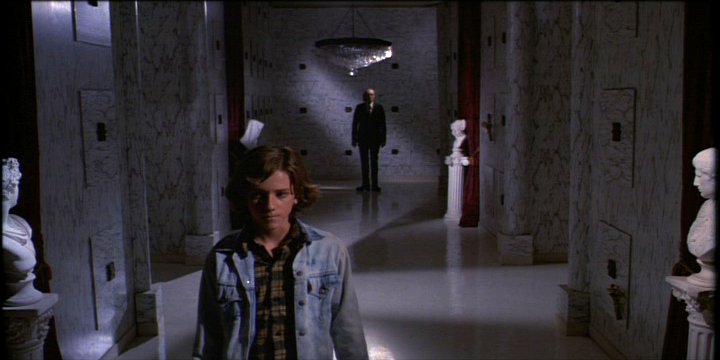
The Tall Man pursues young Mike in his haunted mausoleum in "Phantasm."

The Tall Man pursues young Mike in his haunted mausoleum in “Phantasm.”

So when it was time to take a stroll down the aisles of Westview’s cavernous mausoleum, and because the place was entirely deserted (or so it seemed), I didn’t intend to linger very long. But I ending up staying quite a while and enjoyed the beauty and quiet of the place. The stained glass alone is breathtaking.

This is what a real mausoleum looks like. I was taking the photo with my iPhone so it didn't come out very well.

This is what a real mausoleum looks like. I was taking the photo with my iPhone so it didn’t come out very well.

On my second visit, I did go downstairs to try to find a crypt for Find a Grave. But I forgot to get the niche number and it was impossible to find it without it.

This Bread of Life stained glass panel was one of my favorites.

This Bread of Life stained glass panel was one of my favorites.

This one is called The Brook.

This one is called The Brook.

I could have spent a lot more time in the Abbey. But I was ready to get back out into the fresh air. It was time to see where some of the more famous residents of Westview reside.

I’ll share their stories and a startling discovery I made next week in Part II.
image

When a Cemetery Dies

I’ve had the pleasure of sharing my experiences at some amazing cemeteries over the last six months. And yes, it’s been that long since I started the blog! It’s hard to believe that this will be my 23rd blog post since Adventures in Cemetery Hopping began on January 18.

In light of that milestone, I’d like to share a story about what happens when a cemetery is no longer cared for and becomes a shadow of itself. That’s what has happened to Old Greencastle Cemetery in Dayton, Ohio.

This photo was taken by someone a few years ago after the grass had been cut.

My first and only visit to Old Greencastle came just last year when I was back in Dayton for a funeral (ironically so). Thanks to some research on Ancestry.com, I discovered that my paternal great-great-grandparents, Samuel and Margaret Coffman Grice, were buried there.

In 1849, Simon McClure donated three acres of land in West Dayton’s small Greencastle village to Henry Shoup to build a church and burial ground. A one-storey building (Miami Chapel United Brethren Church) was erected on that plot of land the same year. Greencastle Cemetery’s name comes from the “Greencastle Circuit” of the United Brethren churches (a sect from Germany that still exists today) to which the church belonged. The Greencastle plat itself predates 1826 and is one of the oldest in Dayton.

The original Miami Chapel United Brethren Church was torn down in 1912 and replaced with the current church building that remains there, abandoned and boarded up.

OldGreencastle(churchview)

With nobody to care for it, Old Greencastle is sliding into a sorry state that I hope will change.

Old Greencastle Cemetery is probably the oldest in Dayton. The earliest dated tombstone found in the cemetery was inscribed in 1817, which leads many to believe that the land was used as a family graveyard at one time. Unfortunately, few of the cemetery’s records prior to 1913 exist as many of the cemetery’s records, graves, and gravestones were destroyed during the 1913 Dayton flood. That probably includes Samuel Grice’s grave since he died in 1912. Margaret died in 1919.

Old Greencastle was the original resting place of Otis and Ida Wright (they were twins), brother and sister of the famous Orville and Wilbur Wright. Those graves have since been moved to Woodland Cemetery where the other Wrights are buried, and where several members of my family are buried. Considering the state that Old Greencastle is in now, that was probably a wise decision.

Also within the cemetery are the graves of many Union soldiers who fought in the Civil War. An actual cannon is in the center of them, which was in the best shape among the other sections. One section was reserved for children from the Montgomery County Ohio Children’s Home, which was open from 1867-1928. I did see a few of them while I was hunting.

IMG_1790

A Civil War-era cannon is situated among the veterans’ graves. Behind it you can see the abandoned Miami Chapel United Brethren Church building.

When I told my Aunt Jo what I had in mind, she chuckled and said, “Really? That’s in a pretty bad part of town now.” She and my mother (her twin) spent their early years living close to that neighborhood before I-75 was built through the middle of it. However, I checked with a fellow Find a Grave volunteer who said while the neighborhood was iffy, nobody bothered the cemetery and the gates were usually open.

Despite her doubts, Aunt Jo was too excited at the prospect of cemetery hopping to stay away. My Mom was also game so we set off no knowing quite what to expect and thinking maybe we should have brought mace.

This can give you an idea of how high the grass was and how tricky walking in it can be.

This can give you an idea of how high the grass was and how tricky walking in it could be.

Old Greencastle is indeed in the ‘hood. But we were there on a Sunday and not much was going on. The few people that did walk or drive by were totally uninterested in us. I can’t help wondering if the residents know not to mess with the dead and give the place a wide bearth. There didn’t appear to be any signs of vandalism but that’s probably because walking the grounds is like going through an obstacle course. If you want to make a quick sprint across the lot, forget it.

This cemetery proved to be the most challenging in my short hopping career. The grass was waist high in some spots so watching where you stepped was a must. Not to mention the holes. I don’t know if they were gopher holes or what animals had created them but I didn’t want to find out. I blocked that out. Even now, I thank God that nobody broke an ankle and we didn’t have to call 911.

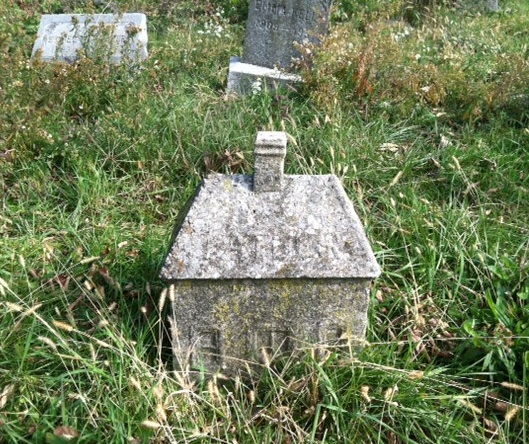
This little house stood out among the other graves and is now one of my favorites. I wonder if the person who it was made for built homes.

This little house stood out among the other graves. I wonder if the person who it was made for built homes.

Once most of the burials stopped there in the 1940s because it had no more room (I did see a few graves as recent as the 70s) and the church congregation moved on, Old Greencastle started going down hill. The church opened New Greencastle Cemetery a few streets over and it is still an active cemetery today. Any money set aside for perpetual care at the old place dried up. Nobody wanted to take responsibility for it, including the City of Dayton. The grass would be cut sporadically (a dangerous chore indeed) and American flags placed on veterans’ graves on Memorial Day. But that’s about it.

There are many cemeteries like Old Greencastle slowly sliding into decay and ruin that will never be saved. Sometimes one gets rescued if the community takes action and does something to preserve it. There are steps that can be taken to do that. But it takes time and money, two things most people do not have much of to spare.

Old Greenflag

At the time we visited, I didn’t know who was supposed to be taking care of Old Greencastle. I’ve since learned that the property does have a superintendent and he is trying to enlist support in getting it cleaned up. I hope he is successful because this one is definitely worth saving. There’s too much history there.

Despite spending quite a lot of time looking around, we never did find my great-grandparents’ graves. I did find some graves bearing Margaret’s mother’s maiden name (Olinger). This was one of the founding families of the church. They may be related to Margaret in some way. Maybe some day I will come back and try again. I want to see if improvements are being made. Maybe there’s a chance Old Greencastle will be one of the lucky ones.

I really hope it is.

Maybe this is one of my Olinger ancestors. The stone is too worn to get much information.

Maybe this is one of my Olinger ancestors. The stone is too worn to get much information.

What’s So Good About Grief?

We’ve all heard Charlie Brown’s frequently expressed shout, “Good Grief!”. We may have said it ourselves in times of frustration.

ClickHandler.ashx

Having been through it myself, there’s nothing good about grief. At least not when you’re flailing helplessly in the middle of it.

When my father died, I went through the same grieving phases everybody else does. But I think the hardest thing about it was having nobody to really talk to about it.

Oh, I had my new, wonderful husband. My friends. My family. They all loved me and were there for me. But they couldn’t understand what I was going through. None of them had lost their father. If I started talking about what I was feeling, even well-meaning friends looked at me as if I was speaking a foreign language they didn’t understand. I felt very alone.

Even my Mom, who was dealing with her own loss, was experiencing a different kind of grief than I was. There were things I was feeling and thinking she didn’t need to hear.

I pulled myself together somehow and got through the next few years, and things did get better. But I still felt like a cloud was hanging over me, that there were issues I had not worked through completely.

Grief warred with my faith in God. When I did push myself to go to church, I struggled. When it would come time to stand up and sing a praise song, I couldn’t do it. I had nothing to praise God for, in my mind. It was especially bad if it was a song I knew Dad liked. Many times, I just sat there, tears running down my face. Don’t even ask me about those first few Father’s Day Sundays.

grief

It was around that time Mom heard about Griefshare, a grief support group with chapters all over the country. One was meeting at a church in Peachtree City and she was going weekly. And it was really helping her.

Seeing how much good it was doing her, I decided to find a Griefshare group near me and I did, at Dunwoody Baptist Church. And from the first night, I knew I had come to the right place.

The most important thing I got out of Griefshare was finding a group of people, even though they were strangers, who spoke my “grief language”. When I talked about what I was feeling and thinking, I didn’t draw blank stares or uncomfortable silences. I saw nods and looks of encouragement. They didn’t mind if I cried. Sometimes they even cried with me.

For the first time, somebody truly understood what I was saying.

We’d come there for different reasons but with the same pain. One had lost a son. Another had lost a spouse. One had lost a brother when he was murdered. You would think that would make a difference but it didn’t. Not really. Someone much loved in our life was gone and we were left stumbling in the dark, looking for answers. Looking for life to get back to some new kind of normal.

I think one of the best videos they showed was of a pastor talking about the loss of his wife. He shared how one night, in his anger and frustration, he threw his Bible against the wall and shouted at God. That someone considered so spiritually mature had done something very human had an impact one me. I realized it was okay to get mad, to be angry at God. He could take it.

My mother went on to help start a Griefshare group at her church and helps facilitate it every week. It’s given her a way to minister to others from her own experience. Eventually, my husband and I started going to Dunwoody Baptist, where my Griefshare group met (they still do) and became members.

Griefshare has a strong foundation in the Christian faith, so it may not be for everyone. But the program doesn’t proselytize or force anything on anyone. There were a few folks in our group who were not Christians who said they benefitted from it.

If you’ve experienced a loss and can’t seem to get out of the funk you’re in, reach out for help. Be it Griefshare, some type of counseling or a grief support group. Finding common ground with those who are walking down the same path can bring great comfort and peace of mind.

Now that is a good thing!

For more information on Griefshare, visit their Web site.

image

The Strange Case of Dr. Thomas Holmes

When one thinks of Sherlock Holmes, it’s not hard to dwell on the eccentricities embodied in Sir Arthur Conan Doyle’s brilliant fictional detective. He was a genius but his quirks left many readers scratching their heads.

The same could be said of another Holmes, but this one was very real. The story of how Dr. Thomas Holmes became known as the father of American embalming could have come straight out of a tabloid magazine itself.

The ancient Egyptians were adept at preserving the human body after death, but not for the same reasons it’s done today. Mummification was thought to preserve the body for the next life, so wealthy Egyptians wanted no expense spared on getting that done properly. The 1922 discovery King Tutankhamun’s amazing burial crypt is evidence of that.

Tuthankamen's famous burial mask, on display in the Egyptian Museum in Cairo, Egypt. Photo courtesy of Wikimedia Commons.

King Tut’s burial mask, on display in the Egyptian Museum in Cairo, Egypt. Photo courtesy of Wikimedia Commons.

Centuries later, other motivating factors were involved. In the early 19th century, as progress in science took place in leaps and bounds, medical school enrollment in Europe and the U.S. went through the roof. Students needed cadavers to learn anatomy and practice their skills on, but a dead body decomposes quickly. So medical schools needed, ahem, fresh material regularly and paid good money for it. Thus, grave robbery became common. But that juicy topic deserves its own post.

Efforts were being made (especially in Europe) to try to preserve cadavers, but the use of certain potent chemicals such as mercury were harmful to the students making the dissections. That’s where Dr. Thomas Holmes comes in.

A native of Brooklyn, N.Y., Thomas Holmes was frustrated by the ineffective means available to preserve bodies for dissection at medical schools.

A native of Brooklyn, N.Y., Thomas Holmes was frustrated by the ineffective means available to preserve bodies for dissection at medical schools.

Born in Brooklyn, N.Y. in 1817, Holmes was familiar with this dilemma. As a medical student at the College of Physicians and Surgeons at Columbia University, he eventually studied with a phrenologist. Phrenology was a pseudo-science that advocated that the size of certain areas of the brain indicated strengths and weaknesses. Most of this was based on outside brain measurements since studies of the inner neurological workings of the brain were barely begun. For instance, if you had a large forehead, you were supposed to be very intelligent. I must be a genius if that’s true, by the way.

A phrenology diagram from 1883. Phrenologists thought the human mind has a set of different mental faculties, with each particular one represented in a different area of the brain. Photo courtesy of People's Cyclopedia of Universal Knowledge.

A phrenology diagram from 1883. Phrenologists thought the human mind has a set of different mental faculties, with each particular one represented in a different area of the brain. Photo courtesy of People’s Cyclopedia of Universal Knowledge.

While studying the heads of Egyptian mummies, Holmes realized this ancient civilization had solved the problem of preservation without using deadly chemicals. In Europe, they were already practicing a form of arterial embalming by replacing a cadaver’s bodily fluids with alcohol as a preservative (which wasn’t working very well). So Holmes invented his own arsenic-based solution (the toxicity of arsenic was unknown at the time), along with a patented fluid pump, and started using it.

Holmes’ timing could not have been better. The Civil War loomed large and the number of casualties whose families were requesting to be shipped home for burial was staggering. You can imagine the dilemma this presented in terms of hygiene.

As a captain in the Union Army Medical Corps stationed in Washington, D.C., Holmes got his chance to show off his new technique after the death of Colonel Elmer E. Ellsworth. A friend of President Abraham Lincoln, Ellsworth was also the first officer to be a military casualty of the Civil War. On May 24, 1861, he was shot while removing a Confederate flag from the roof of a hotel in Virginia. Holmes offered his embalming services for free. Ellsworth’s body was embalmed and displayed to the public at his funeral, and people were impressed with his “lifelike” look.

As a result, Lincoln commissioned Holmes to start training “embalming surgeons” to take to the battlefields so deceased Union soldiers killed in action could be safely preserved for delivery to their families for burial. The Confederate Army never adopted the practice.

Dr. Richard Burr, an embalming surgeon in Frederick, Va. He is shown embalming a soldier recovered from the battlefield. You can see the embalming pump in his right hand, and the tubing attached to it above the chest of the soldier’s body. Embalming tables were not usually available in the field, so he used a door placed over two large barrels.

Dr. Richard Burr, an embalming surgeon in Frederick, Va., is shown embalming a soldier recovered from the battlefield. Embalming tables were not usually available in the field, so he used a door placed over two large barrels. Photo courtesy of the National Museum of Civil War Medicine.

Some people actually wanted to jump on the embalming bandwagon to make a quick buck. According to Canadian psychologist Romeo Vitelli in his article “Abraham Lincoln and the Embalmer”:

The demand for embalming services became so great that some unscrupulous embalmers actually competed for corpses on the battlefield. The Union army offered an $80 fee for the embalmed body of an officer and $30 for a soldier. By 1865, the problem had become so bad that the War Department put out General Order 39 to ensure that only properly licensed embalmers would be allowed to offer services to the families of the war dead.


Postcard of Lincoln's funeral train, the Old Nashville, that carried him across seven states and through over 400 communities.

Postcard of Lincoln’s funeral train, the Old Nashville, that carried him across seven states and through over 400 communities.

Many Civil War embalming surgeons went on to become morticians. The next few decades saw a tremendous rise in the development of the funeral industry, including the use of open-casket funerals and “wakes” (as opposed to burying the body as quickly as possible). Holmes’ embalming fluid and his patented fluid pump were in high demand as more and more people began asking that their loved ones be embalmed prior to burial.

Despite Holmes desire to provide a safe process in which to preserve a corpse, there were still health risks involved. His embalming fluid contained dangerous levels of arsenic, which continued to be used for embalming corpses until well into the 20th century when formaldehyde was eventually adopted.

Formaldehyde has its own risks, now classified as a known human carcinogen (cancer-causing substance) by the International Agency for Research on Cancer and as a probable human carcinogen by the U.S. Environmental Protection Agency (EPA). As a result, funeral directors implemented more stringent safety controls when using it, such as providing better ventilation during embalming.

Less toxic alternatives to formaldehyde are now available, but many funeral directors are quite attached to it. They claim that nothing else gives human flesh the life-like appearance they strive to produce so families can hold open-casket funerals for their loved ones. At the same time, as a growing number of people pursue their desire for a more environmentally-friendly funeral, more funeral directors are working with families to meet their needs in this area.

Students at the University of Dundee, Scotland are studying a new method of embalming medical cadavers. Invented by Walther Thiel, an Austrian, it requires far less formaldehyde than traditional embalming.

Students at the University of Dundee in Scotland are studying a new method of embalming medical cadavers. Invented by Austrian Walther Thiel, it requires far less formaldehyde than traditional embalming.

So what happened to Dr. Holmes? He retired to Brooklyn after the Civil War, where he sold root beer and embalming supplies (a curious pairing). Holmes decorated his home with samples of his Civil War era handiwork. Embalmed bodies were stored in the closets, and preserved heads sat on tables in the parlor. A few years before he died, Holmes took out ads in mortuary trade journals with his latest invention, a canvas body bag that could also double as a sleeping bag. Not surprisingly, this last innovation never really caught on with the public.

Holmes reportedly went insane, spending his final years in and out of institutions. One can’t help but wonder if it was partially due to his exposure to arsenic over the years. The ultimate irony is that Holmes specifically requested that his body NOT be embalmed after his death, which occurred on January 10, 1900.

Why he did so is a mystery even the talented Sherlock Holmes couldn’t solve.

The Long Walk Home: The Story of Adeline Bagley Buice

While Atlanta has been my home most of my life, I wasn’t born here. When we arrived, that was immediately apparent to others from the way we spoke and my ignorance about certain important historic events. To be more precise, I mean the Civil War. Also known as the War Between the States or the War of Northern Aggression. Take your pick.

Atlanta's Cyclorama depicting the Battle of Atlanta is one of a handful of panorama painting still in existence.

Atlanta’s Cyclorama depicting the Battle of Atlanta is one of a handful of panorama paintings still in existence.

At the tender age of five, I knew nothing about Sherman’s famous March to the Sea, the Stars and Bars or even Gone With the Wind. But when kids would ask me where I was from and I said Ohio, there would be a pause before they nodded and said, “Oh, you’re a Yankee.” They were kind enough to leave out the “d” word that often goes with it.

The only Yankee I knew about at the time was Yankee Doodle Dandy. But I soon learned that while the folks where I came from had moved on after the Civil War, many in the South had not. And some still haven’t.

The first time I saw Gone With the Wind at the Fox Theater in Atlanta, I was stunned when the audience booed the arrival of the Union troops.

Scarlett O’Hara being entertained by the Tarleton twins at the beginning of Gone With The Wind. My first date was with a fellow whose mother had specifically named him after one of the twins, Brent. The other twin, Stuart, was played by Superman actor George Reeves.

I can happily report that my family was warmly accepted by our Southern neighbors, despite our Yankee origins. I grew to love living here, the kindness of the people and more relaxed way of life. Now that Atlanta is made up of more transplants than natives, newcomers are not a curiosity like we were back then. But Atlanta’s Civil War history still lingers in the background.

A few weeks ago, my friend Sherri and I were hunting for graves at a Sharon Baptist Church Cemetery in Forsyth County. It was hot, humid and the bugs were driving us crazy. But when we found a small headstone tucked away on the hillside, we forgot all about that.

Adeline Bagley Buice is not a name you've probably heard. But you won't soon forget her.

Adeline Bagley Buice is not a name you’ve probably heard. But you won’t soon forget her.

The simple monument for Adeline Bagley Buice has a powerful inscription: “Roswell Mill Worker Caught and Exiled to Chicago by Yankee Army 1864 – Returned on Foot 1869”.

Needless to say, we were stunned. And the story just got better from there.

Adeline Bagley Buice was one of about 400 women working in the Roswell mills (two for cotton, one for woolens) in 1864. Her husband, Joshua Buice, was away serving in the Confederate Army. Despite the fact most of the more well-to-do residents of Roswell had fled in fear of the Union Army’s impending arrival, these women remained at their jobs. You can visit the ruins of those mills even today.

"The Bricks", as they were called, housed the women working in the Roswell mills. They were built in 1840 and consisted of 10 apartment units.

“The Bricks”, as they were called, housed the women working in the Roswell mills. Built in 1840, they have since been restored and are a historic site. Photo courtesy of the Roswell Historical Society.

On July 5, 1864, seeking a way to cross the Chattahoochee River and get access to Atlanta, Brigadier General Kenner Garrard’s cavalry began the Union’s 12-day occupation of Roswell, which was undefended. Garrard reported to Major General William T. Sherman that he had discovered the mills in full operation and proceeded to destroy them because the cloth was being used to make Confederate uniforms. Sherman replied that the destruction of the mills “meets my entire approval.”

Sherman then ordered that the mill owners and employees be arrested and charged with treason, an action that puzzles historians to this day. He said, “I repeat my orders that you arrest all people, male and female, connected with those factories, no matter what the clamor, and let them foot it, under guard, to Marietta, whence I will send them by [railroad] cars, to the North. . . . Let them [the women] take along their children and clothing, providing they have a means of hauling or you can spare them.”

The women, their children, and the few men, most either too young or too old to fight, were sent by wagon to Marietta and imprisoned in the abandoned Georgia Military Institute. Soon after, with several days’ rations, they were loaded into boxcars that proceeded through Chattanooga, Tenn., and after a stopover in Nashville, headed to Louisville, Ky., the final destination for many of the mill workers. Others were sent across the Ohio River to Indiana.

First housed and fed in a Louisville refugee hospital, the women later took what menial jobs and living arrangements they could find. Those in Indiana struggled to survive, many settling near the river, where eventually mills provided employment. Penniless, some of them resorted to prostitution. Unless husbands had been transported with the women or had been imprisoned nearby, there was little probability of a return to Roswell. Some of the remaining women began to marry and bear children.

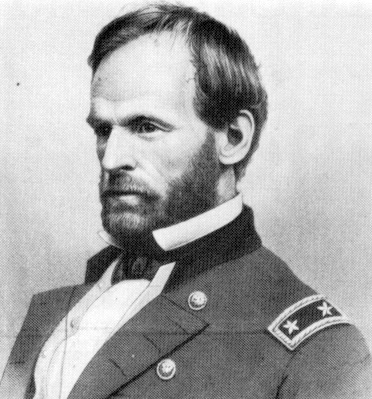
The mere mention of William Tecumseh Sherman can raise the hackles of many Southerners and for good reason.

The mere mention of William Tecumseh Sherman can raise the hackles of many Southerners and for good reason.

Adeline, who was heavily pregnant when she and her co-workers were arrested, was among those shipped North. She made her way to Chicago and in August, she gave birth to a daughter she named Mary Ann. Over the next five years, Adeline and Mary made their way home to Georgia, mostly on foot. It’s a journey I cannot fathom. Many of her fellow mill workers never made it back.

Adeline and Mary’s return was quite a shock to her husband, Joshua, who had long since come back from the battlefield. Thinking Adeline was dead, he reportedly remarried. I don’t know how that delicate situation played itself out. In 1867, Adeline had given birth to a son, John Henry. Someone wrote to me recently who said this must have happened during her journey home. While John Henry only lived to the age of 15, his tenacious sister Mary Ann lived to be 88. My guess is that Joshua accepted John Henry as his own and the reunited family went on from there.

UPDATE: In March 2018, a descendant of Adeline’s contacted me with some more information. According to her research, Joshua was taken prisoner by the Union sometime in late 1863, then paroled in March 1864 in Chattanooga, Tenn. She thinks it is possible that at that time, parolees were required to agree to stay in the North and not return home. Is it possible he wound up in Chicago and Adeline tried to connect with him there? That would explain John Henry’s presence. Did they return home together with Mary? I honestly don’t know.

This is Adeline's original tombstone, broken into two pieces.

Adeline’s original broken headstone is located behind the one created by the local chapter of the Sons of the Confederate Veterans.

In 1998, the Roswell Mills Camp No. 1547 chapter of the Sons of the Confederate Veterans began a project to honor the deported mill workers. While some descendants were found, most of their deported ancestors had settled in the North. In July 2000, the project culminated in a ceremonial event highlighted by the unveiling of a memorial monument in Roswell’s mill village park to commemorate the sacrifices of the mill workers and to honor the 400 women.

This is the monument in Roswell dedicated to the memory of the roswell mill workers who were shipped North at Sherman's orders.

The monument’s inscription reads:”Honoring the memory of the four hundred women, children and men mill workers who were charged with treason and deported by train to the north by invading Federal forces.”

It’s hard for me to reconcile the atrocity of slavery practiced by wealthy Southern plantation owners with the equally heinous treatment by Union forces of these innocent women taken from their homes, and sent North for no good reason. It serves as a lesson to us even now, both sides in a war can commit great wrongs.

I like to think Adeline’s determination to return home transcends North and South, and is a testament to what a person can do when faced with seemingly insurmountable odds.

Even a Yankee like me can salute that kind of courage.

These Famous Ladies Had Georgia on Their Minds

There are plenty of famous men buried in Georgia, but the ladies often get overlooked. This week, I am featuring a handful of those enterprising women. Some you may already know about, but a few of them may surprise you.

Rome, Georgia is home to Shorter and Berry Colleges. Class A minor league baseball team the Rome Braves draw plenty of crowds. But did you know a U.S. President’s wife is buried there?

Woodrow Wilson was not a household bame when he met Ellen Axson at her father's church.

Woodrow Wilson was not a household name when he met Ellen Axson at her father’s church.

President Woodrow Wilson’s first wife was born Ellen Louise Axson. The daughter of a Presbyterian minister, she grew up in comfortable circumstances. Her parents believed in the importance of a good education for both sexes, so Ellen became an intelligent, observant young lady who eventually studied art in New York City. She enjoyed painting throughout her life and even spent time at an artists’ colony.

Ellen met the future president at her father’s church long before he entered politics. After her father died and Wilson was offered a teaching position at Bryn Mawr College, the couple decided they were financially prepared to marry. They eventually had three daughters together.

Sadly, Ellen’s tenure as first lady was brief. Having suffered from Bright’s Disease (a deterioration of the kidneys) since the birth of her youngest child, Ellen died in 1914, only a year and a half after her husband was elected president. Her body was taken back to Rome for her funeral. She is buried at Myrtle Hill Cemetery.

First lady Ellen Wilson's body was transported through the streets of Rome after her funeral.

First lady Ellen Wilson’s body was transported through the streets of Rome, Ga. after her funeral. Photo courtesy of the Georgia Archives.

Ellen Axson Wilson is buried in Myrtle Hill Cemetery in Rome, Ga. I was finally able to visit her grave many months after I originally wrote this post.

Ellen Axson Wilson is buried in Myrtle Hill Cemetery in Rome, Ga. I was finally able to visit her grave many months after I originally wrote this post.

One acclaimed Hollywood actress buried in Georgia was tops at the box office for years. Born Edythe Marrenner in Brooklyn, N.Y., Susan Hayward arrived in Hollywood in 1937 to do a screen test for the role of Scarlett in Gone With the Wind. While she did not get the part, she went on to star in films like “With a Song in My Heart”, “I’ll Cry Tomorrow” and “I Want to Live” (for which she won her only Oscar).

Actress Susan Hayward got the nickname "Red" from the fiery color of her hair.

Actress Susan Hayward got the nickname “Red” from the fiery color of her hair.

After a failed marriage to actor Jess Barker, Susan met wealthy Southern real estate developer Floyd Eaton Chalkley in 1957. His Southern charm won her heart and they were married not long after that. They lived happily on their large ranch (which they called Chalk-Marr Farms) in Carrolton, Ga. for several years. Locals often saw them together around town.

Chalkley died in 1966 of hepatitis. Always a heavy smoker and drinker, Susan learned she had brain cancer in 1972. She died in 1975 and is buried with her husband at Our Lady of Perpetual Help Cemetery in Carrolton. On their shared memorial plaque, she is listed simply as Mrs. F.E. Chalkley. A smaller flat stone with her name is placed off to the side.

Susan Hayward's grave is simple compared to  her flamboyant Hollywood image.

Susan Hayward’s grave is simple compared to “the Broad from Brooklyn’s” flamboyant Hollywood image.

Life at the turn of the century in the Deep South was far from easy for African-American women. Gertrude Pridgett knew this first hand growing up poor in Columbus, Ga. The product of a musical family, she eventually hit the vaudeville circuit, which was a booming business in a river port city like Columbus.

In 1904, Gertrude met and married minstrel show manager William “Pa” Rainey. Together, they toured the country at various shows and with tent performers. That’s when her fame began to grow and she took on the name “Ma” Rainey that would stick with her for life.

Ma Rainey's life of poverty and hard work was reflected in songs like "Bad Luck Blues" and "Trust No Man." Photo courtesy of Wikimedia Commons.

Ma Rainey’s life of poverty and hard work was reflected in songs like “Bad Luck Blues” and “Trust No Man.” Photo courtesy of Wikimedia Commons.

Ma enjoyed a successful recording career with Paramount Records for five years. She collaborated with other well-known musicians such as Joe Smith, Coleman Hawkins and Louis Armstrong. But just as she was getting to the top of her game, Paramount dropped her, claiming that her rough around the edges kind of music had gone out of style. She retired to Columbus and died there in 1939. She is buried in Porterdale Cemetery.

I have a special appreciation for Ma because unwittingly, I crossed paths with her past in my younger days. As a member of my high school chorus, I performed on the same stage she did at Columbus’ Springer Opera House. A year later, I had the good fortune to attend a Broadway production of the play about her life, “Ma Rainey’s Black Bottom.”

Ma Rainey's music... Photo courtesy of Ronald Self.

Ma Rainey’s music earned her the nickname “Mother of the Blues”. Photo courtesy of Ronald Self.

Perhaps the most well known female Georgian is author Margaret Mitchell. A headstrong young woman, she loved hearing stories about the Civil War from Confederate veterans. She dropped out of Smith College after the death of her mother in order to run her father’s home where he and her younger brother still lived.

A bit of a rebel herself in her youth, Margaret Mitchell treasured the Southern history shared by Confederate veterans.

A bit of a rebel herself in her youth, Margaret Mitchell treasured the stories told to her by Confederate veterans.

During her first rocky marriage, Margaret began writing for the Atlanta Journal’s Sunday magazine to make ends meet. After her divorce, she married former suitor and editor John Marsh, and left her job to recover from a series of illnesses. While convalescing at home, she wrote the Pulitzer-prize winning novel Gone With the Wind in 1936. The book and eventually the movie made it financially possible for her to support a number of philanthropic interests for the remainder of her life.

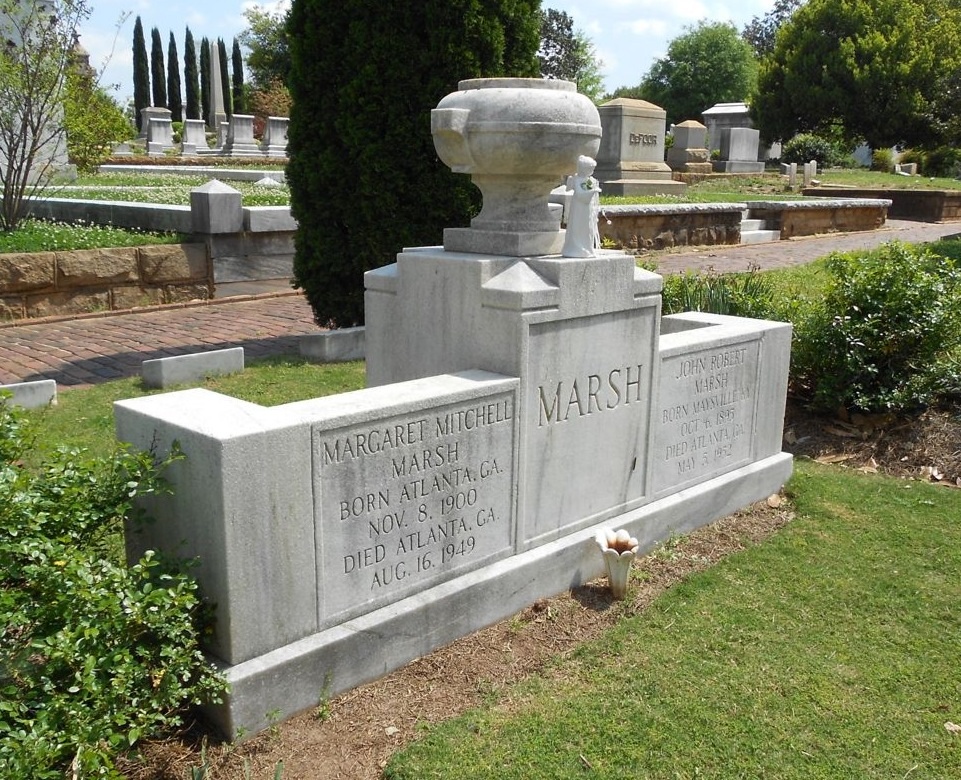
Margaret Mitchell was killed in 1949 when she was hit by a car while attempting to cross at the intersection of Peachtree and 13th Streets in what is now Midtown in Atlanta. She is buried with Marsh at Oakland Cemetery, where thousands of visitors trek to visit her grave every year.

Although she only wrote one book, Margaret Mitchell's Gone With the Wind continues to draw the adoration of readers around the world.

Although she only wrote one book, Margaret Mitchell’s Gone With the Wind continues to draw the adoration of readers around the world. Photo courtesy of Richard Earl Post.

These four women made their marks on the world in many different ways. But in the end, they all chose to make Georgia their final resting place.

While I’ll never be famous like these female icons, I hope to do the same some day.
image

Blood on the Badge: Murder in Gwinnett County

Remember the saying “like looking for a needle in a haystack”? Sometimes cemetery hopping can be like that in reverse. Something rare is sitting right under your nose and you weren’t even looking for it.

As part of my Find a Grave efforts, I took on the task of photographing many of the graves at Sugar Hill Baptist Church Cemetery in north Gwinnett County. Most of the graves are already documented because of my dedicated FG friend Wesley, who referenced the cemetery book that lists everyone who is buried there (along with the dates). However, his wife is in a nursing home now so photographing graves is not something he can do. I asked if I could take it on for him and he gave me the green light.

Homespun Restaurant is an awesome meat-n-three. Try the country chicken if you ever visit.

Home Spun Restaurant is an awesome meat-n-three. Try the country chicken if you ever visit.

Sugar Hill Baptist Church Cemetery is a large, well kept cemetery situated across from the town’s impressive city hall complex. A small park with a gazebo is across the street and a community center is next door to the cemetery (where I parked my car). Close to 1,500 graves make up the cemetery. I’ve made several trips to take pictures but I’m not quite done. Eating lunch at the nearby Home Spun Restaurant (a meat and three) after these photo sessions makes visits even more pleasant.

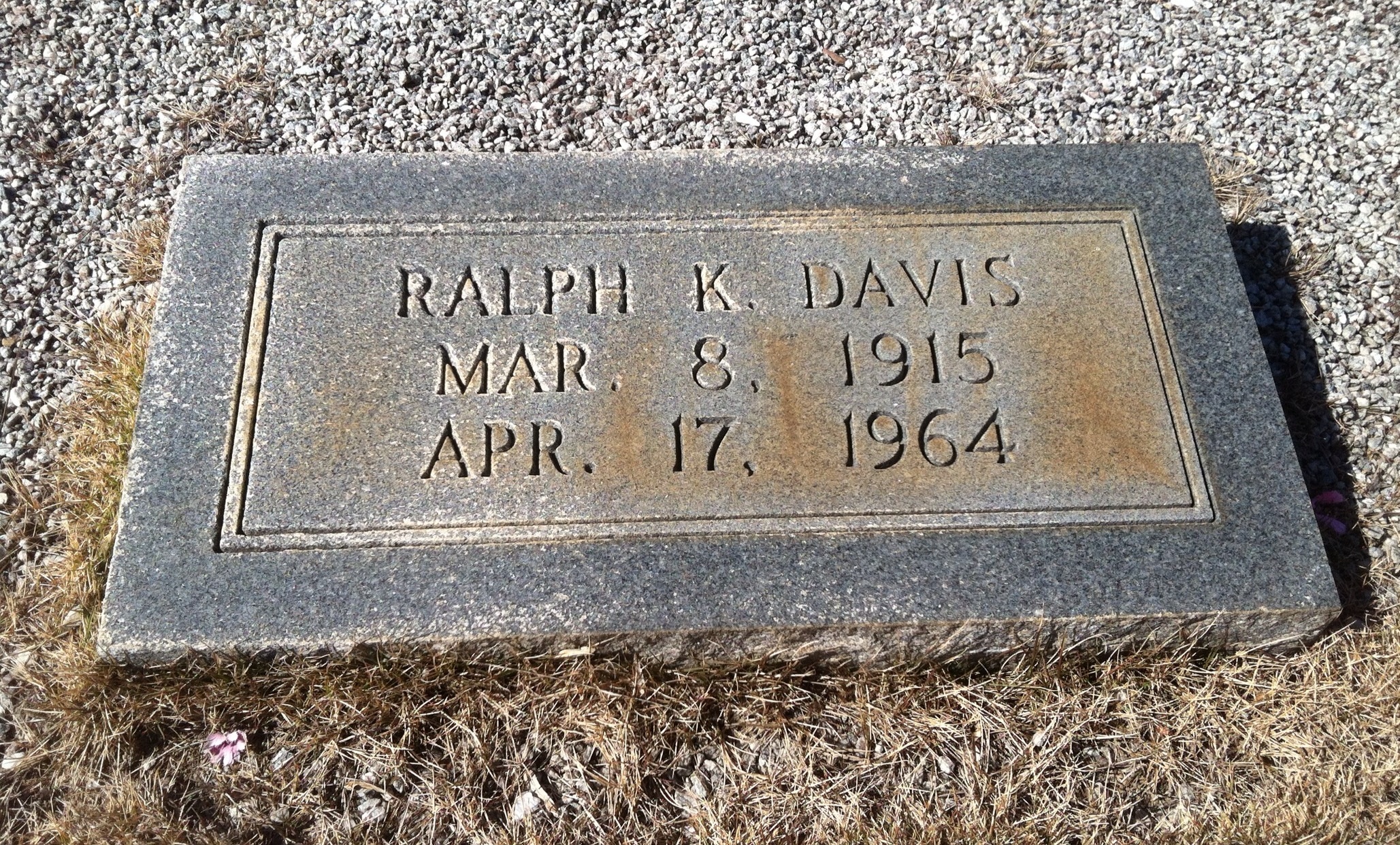
It was during one of these trips to Sugar Hill that I photographed a very simple flat stone marker with the name Ralph K. Davis on it. His death was on April 17, 1964. It was located in a decent sized gravel square with the Davis monument behind it. It is rare for me to find a family plot with only one grave in it so as usual, I got curious and began digging for information.

It didn’t take me long to feel my breath catch in my throat.

Ralph Davis' death was much more dramatic than his marker indicates.

Ralph Davis’ death was much more dramatic than his marker indicates.

Ralph King Davis was an officer for the Gwinnett County Police Department. Today, the county is a sprawling mass of homes, businesses and interstate highways. The population is incredibly diverse. But back in 1964, Gwinnett County was a rural backwater somewhat trapped in time. Catching moonshiners was still a going concern for law enforcement. To make matters worse, some lawmen were known to have gotten their hands dirty by taking part in such crimes themselves.

On the evening of April 17, Davis and his partner, Jerry Everett, were giving a ride home to an ill fellow officer, Marvin Jesse Gravitt. En route, they got a suspicious activity call at a home on Arc Way, which was a dirt road connecting Beaver Ruin and Pleasant Hill Roads at the time. What started out as a routine response quickly became something that would make headlines across the country.

Retired former Atlanta police officer Mackie Carson recently wrote a book about it called Judas Deputy. He kindly gave his consent for me to quote from it.

Gwinnett police officers Marvin Jesse Gravitt, Ralph King Davis and Jerry Everett got more than they bargained for during a routine call. Photos courtesy of Mackie Carson.

Slain Gwinnett officers Marvin Jesse Gravitt, Ralph King Davis and Jerry Everett. Photos courtesy of Mackie Carson.

People think chop shops (garages where stolen cars are “chopped up” for parts that are then resold) are a modern phenomenon but not so. In 1964, a number of car theft rings were operating in Gwinnett County for that very purpose.

Thieves would purchase a car from a salvage yard, then steal a similar car and strip the stolen car of its parts. The parts then would be put into the salvaged car — which had no “hot” vehicle ID number.

According to Carson, the “finder’s fee” for stealing a car was $25, and rose to $100 if you took it out of the county. As a result, it became a very tempting crime to commit.

It was this kind of activity the three officers stumbled upon that April night. They found three men beginning the process of stripping a stolen Oldsmobile for parts. One of the thieves, in an attempt to flee, threw the Oldsmobile in reverse and sped back down the road only to be blocked in by the police car. When Everett was examining the inside of the Oldsmobile, the other two thieves came into sight. They were armed and took fatal control of the situation.

The next morning, the bodies of all three officers were found in the nearby woods, handcuffed together with their own handcuffs. They had been shot dead execution style with their own weapons. The Oldsmobile was nearby, torched to destroy evidence.

Alec Evans, Wade Truett and Venson Williams were arrested for the triple murder. Truett got immunity for his testimony against Evans and Williams.

Alec Evans, Wade Truett and Venson Williams were arrested for the triple murder. Truett got immunity for his testimony against Evans and Williams.

The ultimate irony is that one of the killers was one of their own, a former Gwinnett County deputy sheriff named Alec Evans. He had even been an ATF agent at one time. The other two, Venson Williams and Wade Truett, owned a garage together in South Carolina and had helped Evans steal the Oldsmobile the previous day.

Gwinnett deputy sheriff Jerry Griswell was one of the first to arrive on the scene the next morning. He never forgot what he saw. “A waste of three fine men,” Mr. Griswell said in a 1989 Atlanta Journal-Constitution article.

According to many witnesses, Evans swore he would find the officers’ killers, even going so far as to visit the Everett family more than once to assure them the murderers would be caught.

Later that year, with no one yet suspecting his role in the murders, Evans was arrested for running illegal moonshine and sent for a short stint in a federal prison in Michigan. He was eating lunch with the other inmates when he was informed he would be going back to Georgia.

Evans, along with Williams and Truett, was arrested for the murders. Evans was convicted and given a death sentence that was later commuted to life in prison. At age 86, he is still incarcerated. Williams (now deceased) served 25 years and was paroled. Wade Truett, also now deceased, was given immunity for his testimony against Evans and Williams. He served no prison time. Carson says Truett was the only one of the trio who did not shoot the officers.

Jerry Everett, only 28 when he was killed, came from a strong law enforcement tradition. His brother, Kelly, was the former Norcross police chief. Another brother, George, was a Doraville police officer.

Brothers Randall and Roger Everett owned and operated Everett’s Music Barn in nearby Suwanee and the store is still a magnet for bluegrass music lovers. It has roots in the tragedy. Those paying condolences to the family would return to hold impromptu bluegrass jam sessions on the Everett family’s porch. The brothers and their friends felt the music was a form of therapy amid their grief. Randall and Roger have since passed away, but the legacy of their music continues.

While many living in Gwinnett today have no idea what took place on a dark country road in 1964, memories of the triple murder linger. Long-time residents remember three police officers being cut down by a gang of thieves, one a wolf in sheep’s clothing. They walked blindly into a crime in progress and paid with their lives.

According to Carson, Ralph Davis’ neighbor, George Kelly, remembered his last conversation with him. Davis told Kelly that he was seriously thinking of leaving law enforcement because of the danger involved.

Sadly, he never had a chance to do so.

A Little Song, A Little Dance: Humor Amid Grief

I get some bemused looks when I tell people about my cemetery hopping habit. Some people have commented that it must be so depressing going to cemeteries or that death itself is too sad to linger on.

I’ll be brutally honest. Losing a loved one is HARD. I don’t make light of that or disrespect the gravity of death. I lost my father almost 10 years ago and you never really “get over it”. Even though I knew he had accepted Jesus Christ as his personal Savior years before, even though I knew he was exactly where he wanted to be, I still had trouble moving forward. I didn’t want him to be in Heaven because I wanted him here with me.

Thankfully, the healing process helped ease that emotional struggle. It took God’s patient love and an amazing program called Griefshare to get me back on track. Part of that included laughing at some of Dad’s quirks and remembering his more irreverent moments.

One of his favorite shows was the Mary Tyler Moore Show. When I think about grief, I remember a classic episode called “Chuckles Bites the Dust.”

The staff of WJM (the TV station where Mary works) are mourning the loss of Chuckles the Clown, host of a beloved kids’ show. Chuckles met his demise while costumed as character Peter Peanut in a local parade. As Lou Grant explains, a rogue elephant tried to “deshell” Chuckles. When announcing Chuckles’ death on the air, anchorman Ted Baxter deadpans, “He died a broken man.” Mary is mortified at her co-workers’ jokes about Chuckles’ death and tells them to stop being so disrespectful. Even as Chuckles’ funeral starts, she scolds Murray for whispering jokes.

After chastising her co-workers for laughing at Chuckles manner of death, she can't stop giggling at his funeral.

After chastising her co-workers for laughing at Chuckles’ death, Mary can’t stop giggling at his funeral.

But when the minister delivers the eulogy, Mary (to her horror) gets a case of the giggles. When he recounts Chuckles’ famous line “A little song, a little dance, a little seltzer down your pants”, she’s on the verge of losing it. But when the minister encourages her to laugh as a way to celebrate Chuckles’ life, Mary bursts into tears.

Lou Grant sums it up well when he says, “We laugh at death because we know that death will have the last laugh on us.”

While it’s certainly not a good idea to bring a whoopie cushion to a funeral, humor can definitely help us through the grieving process. It can act as a release of the pressure cooker of stress a person is under. That inner turmoil breaks free and finds relief in laughter.

Dad was in his last hours when I, my sister, husband and brother-in-law went to the cemetery to purchase a plot for him. We were all in a bad way, facing a very difficult situation. The kind woman we were working with was explaining everything and casually mentioned that in the years to come we would need to maintain Dad’s grave by personally keeping the grass cut, etc.

This jolted us all out of our fog and we stared at her in stunned silence. Was she for real? She smiled and said, “It’s a joke, you guys, relax!”

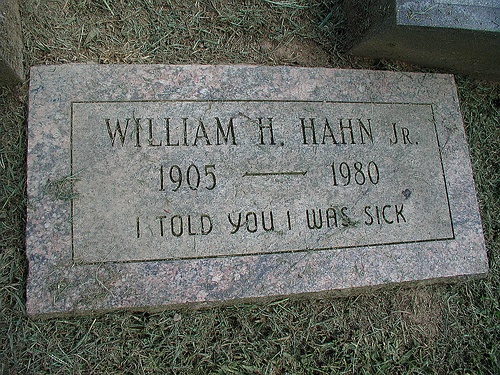
This epitaph was used first by Irish comedian/musician Spike Milligan, who said, "I Told You I Was Ill" should be his epitaph. If you look at his gravestone, it's not there.

This epitaph was used first by Irish comedian/musician Spike Milligan, who said, “I Told You I Was Ill” should be his epitaph. It shows that even in death, humor can shine through.

Now some people might have taken offense at that. But we all collapsed into laughter. We needed something to help shake us out of our gloom, and humor did the job. I think of that woman from time to time with much appreciation. She knew it was just what we needed to do at that moment.

In 1998, one of my best friends died of a sudden, fatal heart attack. John was only 30 and it was a shock to all of us who knew him. I gave one of the eulogies at his funeral, wanting to share not only how much John had meant to me but how funny he could be. So I shared the story of when, while an engineer at a small Pennsylvania radio station, he impersonated a Polish polka DJ (who didn’t show up for his shift) for an entire hour with nobody being the wiser. Later, I learned his family had not known this bit of John trivia and had gotten a lot of joy from hearing it.

John and I at a Christmas party. People used to call us Mutt and Jeff because of the disparity in our heights. He made me laugh every time we were together.

John and I at a Christmas party. People used to call us Mutt and Jeff because of the disparity in our heights. He made me laugh every time we were together.

Death is a serious business. But mourning doesn’t have to be constant pain. There is a place for laughter, for joyful remembrance amid the sadness. Ecclesiastes 3:2-8 is often quoted but I think God inspired every word in its anonymous author.

For everything there is a season, and a time for every matter under heaven:

a time to be born, and a time to die;
a time to plant, and a time to pluck up what is planted;
a time to kill, and a time to heal;
a time to break down, and a time to build up;
a time to weep, and a time to laugh;
a time to mourn, and a time to dance;
a time to cast away stones, and a time to gather stones together;
a time to embrace, and a time to refrain from embracing;
a time to seek, and a time to lose;
a time to keep, and a time to cast away;
a time to tear, and a time to sew;
a time to keep silence, and a time to speak;
a time to love, and a time to hate;
a time for war, and a time for peace.

Humor can heal. And it can bring great relief in the depths of despair.

I’ve mentioned Steel Magnolias before as one of my favorite movies. Dolly Parton, who plays sassy beautician Truvy, says, “Laughter through tears is my favorite emotion.”

It’s one of mine, too.

Welcome to Oakland Cemetery, Part Two

Last week, I talked about the history of Oakland Cemetery and its different sections. This week, I’ll share the stories behind some of the graves and highlight some of my favorites.

Neoclassic is the prominent style seen at Oakland. Many of the monuments reflect the Victorian era in which they were created. Certain symbols are featured that have special signifigance.

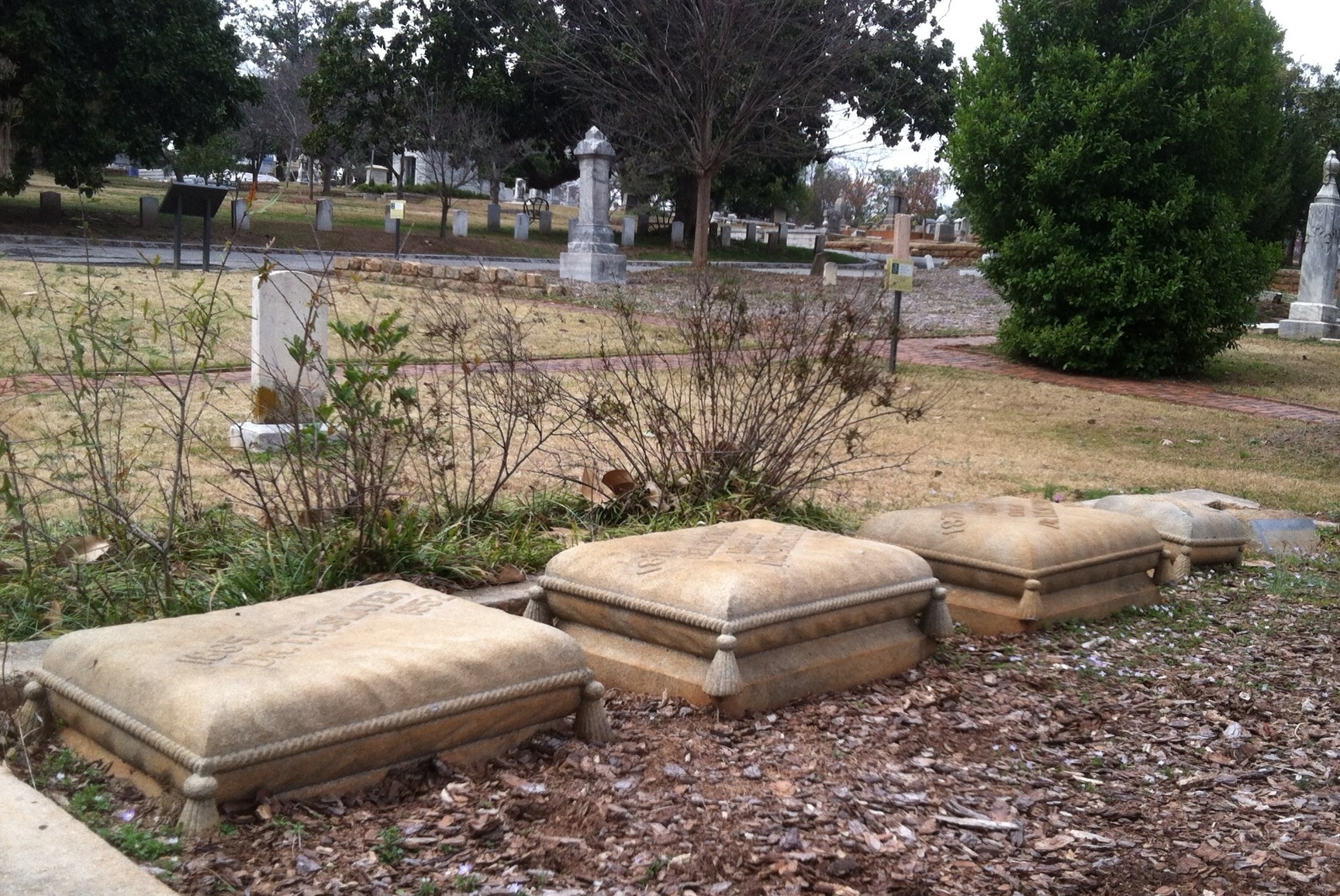
Until I visited Oakland, I had never seen stone “pillows” like these. They were meant to represent the eternal rest the deceased had entered.

These "pillow" grave markers at Oakland Cemetery are a Victorian symbol for eternal rest.

These “pillow” grave markers are quite common at Oakland.

Pillowgrave

The images of a tree trunk or a pile of cut logs are ones I’ve seen before. Some say this represents a life cut short.

This grave is for a little girl, Elizabeth Grisham Brown, who died barely past her first birthday.

This grave is for a little girl, Elizabeth Grisham Brown, who died barely past her first birthday.

The graves of Mollie Cash Neal and her daughter, Lizzie, are a much photographed stop for many (including me) who visit Oakland. Thomas Benton Neal, a Confederate Civil War veteran, had the monument made in memory of his wife and daughter. Lizzie died quite young, only 23, and her mother died only a few years later. This beautifully carved monument contains symbols commonly seen in that time.

Monument to Mollie Cash Neal (left) and her daughter, Mary Elizabeth Neal (right), in Oakland Cemetery.

Mollie, seated on the left, has a book (possibly the Bible) open on her lap. Some say this reflects her spiritual maturity in contrast with that of her youthful daughter, who has a closed book on her lap. Mollie is looking up, possibly with her eyes on Heaven.

In contrast, Lizzie, on the right, is looking down. She is holding both a wreath and a palm branch. The wreath is thought to represent eternity while the palm branch stands for spiritual victory over death. Behind the pair stands a Celtic cross. Since the Neal family had Irish roots, this makes perfect sense.

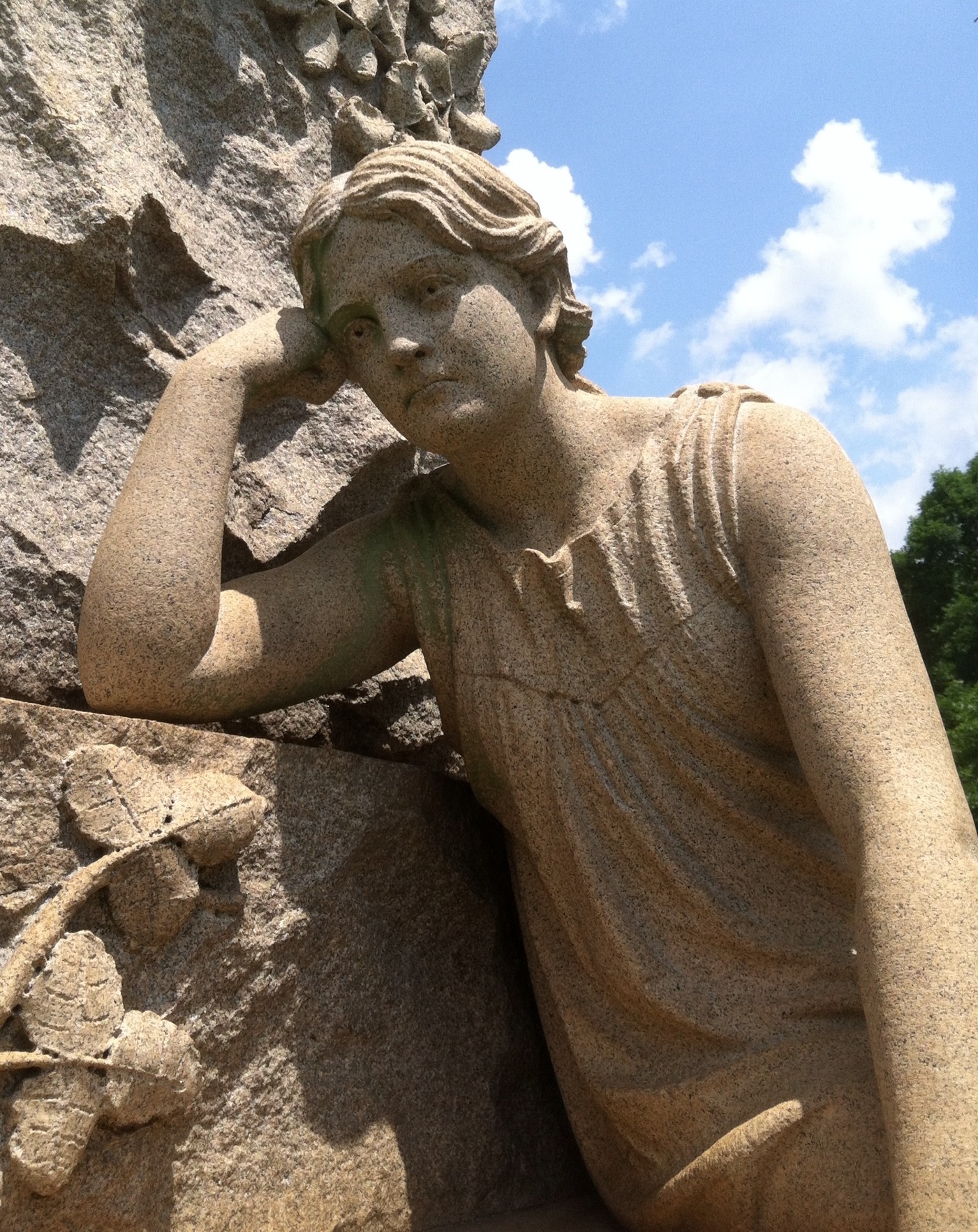
Some monuments are just stunning to look at. The one for Mary Glover Thurman is one of them. She came to Atlanta with her husband, Dr. Fendall Thruman, as a new bride in 1855 when he set up a dental practice. Together, they cultivated an amazing flower garden known throughout the city. Their lavish home was located where the Biltmore Hotel now stands.

The statue is said to be a copy of one originally done by Daniel Chester French that is in Woodlawn Cemetery,

The statue is very similar to one originally done by Daniel Chester French that is in Woodlawn Cemetery in New York.

After Dr. Thurman died, Mary started giving her beautiful flowers to neighbors and sick friends. She frequently took flowers to the sick in the local hospitals, earning herself the name of “The Angel of Atlanta”.

The statue is said to be based on a design of a very similar sculpture by Daniel Chester French, who is best known for the seated Abraham Lincoln centered in the Lincoln Memorial in Washington, D.C. French’s sculpture is part of the Angie Kinsey monument in Woodlawn Cemetery, which is located in the Bronx in New York City.

Other monuments are more humorous than solemn. Jasper Newton Smith’s mausoleum would fit that category. A statue of him reclining in a chair sits on top of it, a rather dour expression on his face. Local lore claims that Smith had a great aversion to neckties due to getting his neck caught in a vine and nearly choking to death as a child. When he commissioned sculptor Oliver W. Edwards to carve his statue, he forgot to tell him to leave off the necktie (which was a wardrobe must in those days). Upon seeing the completed sculpture, Smith supposedly refused to pay until Edwards had chipped off the offensive necktie.

Jasper Smith abhorred neckties so he insisted his statue not have one.

Jasper Smith abhorred neckties so he insisted his statue not have one.

The real story, told by Edwards’ daughter many years later in a letter to the Atlanta Constitution in 1982, is that her father created a plaster model of Smith to go by that did have a necktie as part of it. When Smith saw it, he smashed it with his cane and proceeded to sit down so Edwards could measure his features to create the final work, which was sans necktie. She claims Smith was pleased with the final result.

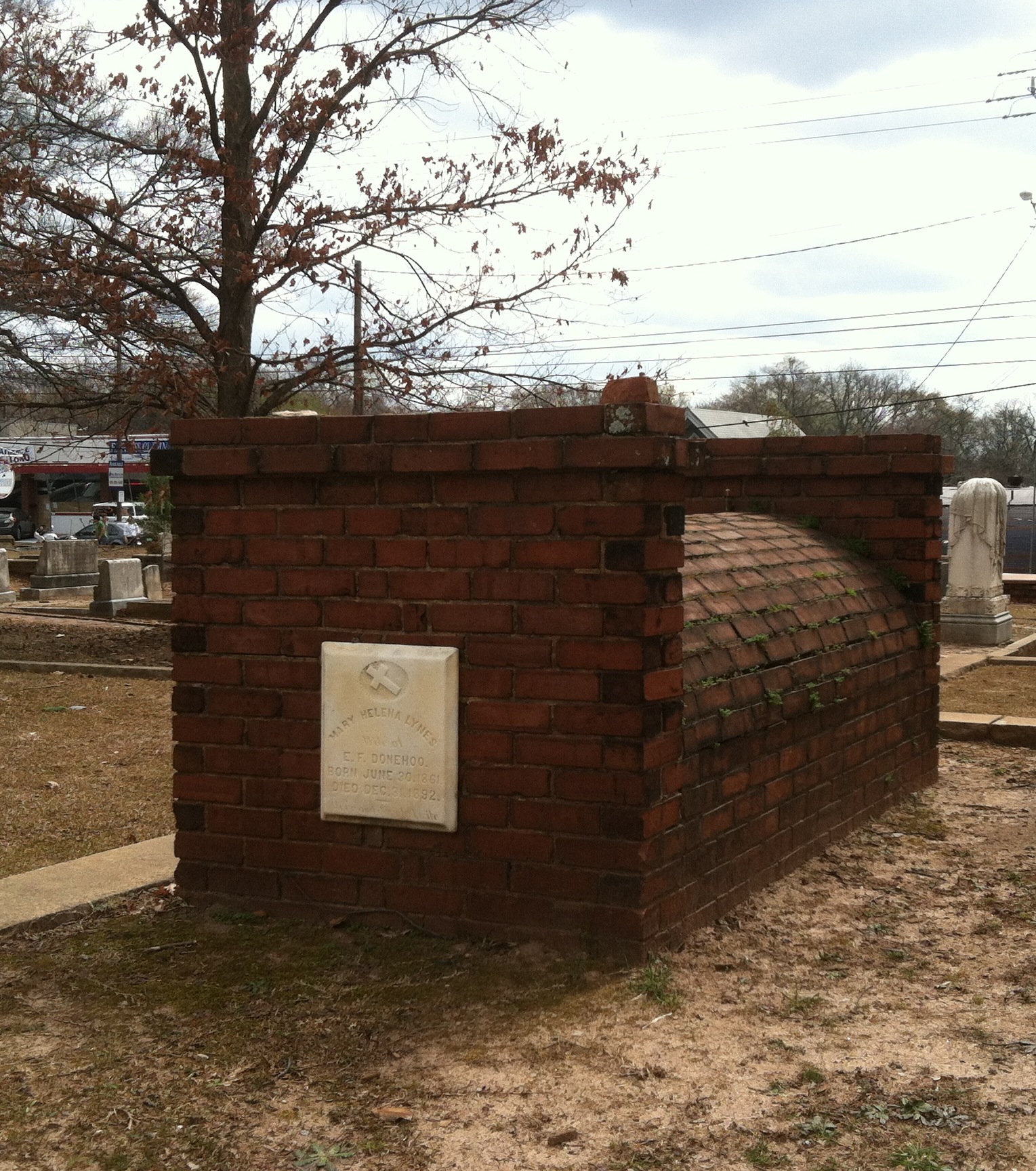
Some graves are just eye-catching in their style. The colonial brick tomb of Mary Helena Lynes Donehoo is one of them. I’ve never seen anything quite like it.

Mary Donehoo's tomb is definitely one that gets your attention.

Mary Donehoo’s tomb is definitely one that gets your attention.

The last notable gravesite I want to feature is the W.A. Rawson mausoleum. Atlanta mayor Charles Collier is interred inside. So are award-winning writers Julia Collier Harris and her husband, Julian LaRose Harris. Julian was the son of Joel Chandler Harris, famous author of the Uncle Remus tales. This couple published the Columbus (Georgia) Enquirer Sun and won the 1926 Pulitzer prize for their editorials and articles about the Scopes Monkey Trial and the Ku Klux Klan.

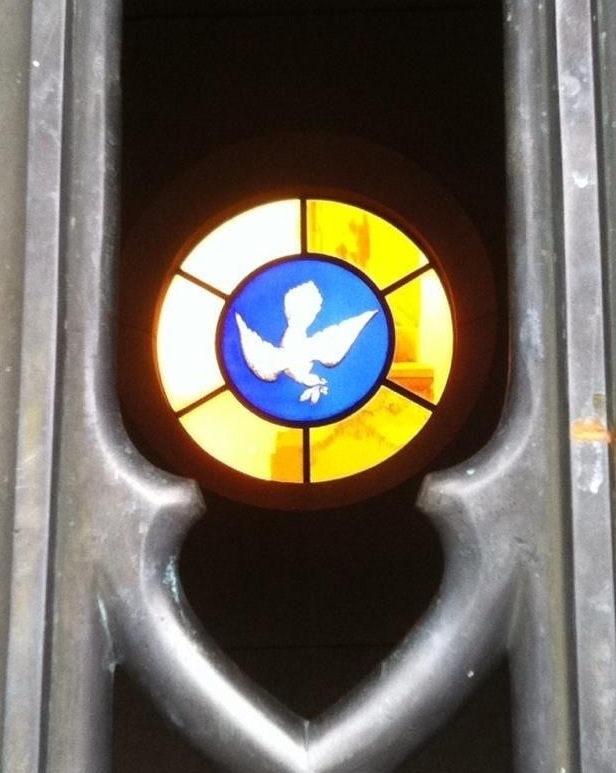
The notable people interred inside would make this mausoleum notable on its own. But the stained glass circle containing a dove with an olive branch in its beak makes it a must see.

The dove symbolizes the spirit rising to Heaven while the olive branch signifies peace.

The dove symbolizes peace and the spirit, like a bird in flight, rising to Heaven.

There are simply too many graves and too many fascinating stories for me to share in a few blog posts. That’s why I can now say, as so many others do, that you have to see and experience Oakland Cemetery for yourself.

Afterward, you can cross the street to enjoy a cold beverage at the aptly named pub, Six Feet Under. If you took the guided tour of Oakland, show them your receipt and they’ll take 20 percent off your bill.

Not a bad way to wrap up a day of hopping, is it?

Welcome to Oakland Cemetery, Part One

When I talk to people about cemetery hopping, I am almost always asked the same question.

Have you been to Oakland Cemetery yet?

In Atlanta, Oakland Cemetery is the Vegas of cemeteries for hoppers. The biggest, the most historic, the most amazing views of the city. You name it, Oakland has it all.

Oakland Cemetery is not just a cemetery for the dead. It welcomes the living to visit and enjoy the beauty of the place.

Oakland Cemetery is not just a cemetery for the dead. It welcomes the living to visit and enjoy the beauty of the place.

Until a few weeks ago, I admit that I hadn’t been there, although it wasn’t a lack of desire. I wanted to wait until spring when the place had shaken off its winter gloom and the flowers had started to blossom. And there are just some cemeteries you want to visit without having to wear long johns.

Sarah joined me that day and with my list of Find A Grave photo requests in hand, we headed out. That is one of the great qualities of Oakland. They are not only willing to help you find the location of a grave, they get as excited about it as you do! I know of no other cemetery like this and it is a real treat. Part of it is because their goal is to preserve history and share it with others. They don’t sell plots any longer and they only have a few burials there a week.

Here are some facts about Oakland Cemetery:

– It began as six-acre City Cemetery in 1850 but was renamed Oakland Cemetery in 1872.
– By 1867, it had expanded to its current size of 48 acres due to the need for burial space after the Civil War.
– More than 70,000 people are buried there, many of them Confederate soldiers.
– African-Americans were buried apart from whites and Jewish sections were separate from Christian.
– Twenty-seven Atlanta mayors and six Georgia governors are buried at Oakland.
– Two of the most visited graves are Margaret Mitchell (author of Gone With the Wind) and golf legend Bobby Jones.
– The last burial sites were sold in 1884, but occasionally one will come up for private sale/auction.

The first thing you notice about Oakland is the sheer size of the place. It is HUGE. Getting a map at the Visitor’s Center is a must. Taking a tour is also a good idea or you’ll miss some of the hidden gems the place possesses.

Part of the Jewish section of Oakland. Our guide told us that years ago, a synagogue would purchase a large plot and then sell small sections of it to members of their congregation so that they might be buried close to one another.

Part of the Jewish section of Oakland. Our guide told us that years ago, a synagogue would purchase a large plot and then sell small sections of it to members of their congregation so that they might be buried close to one another.

image

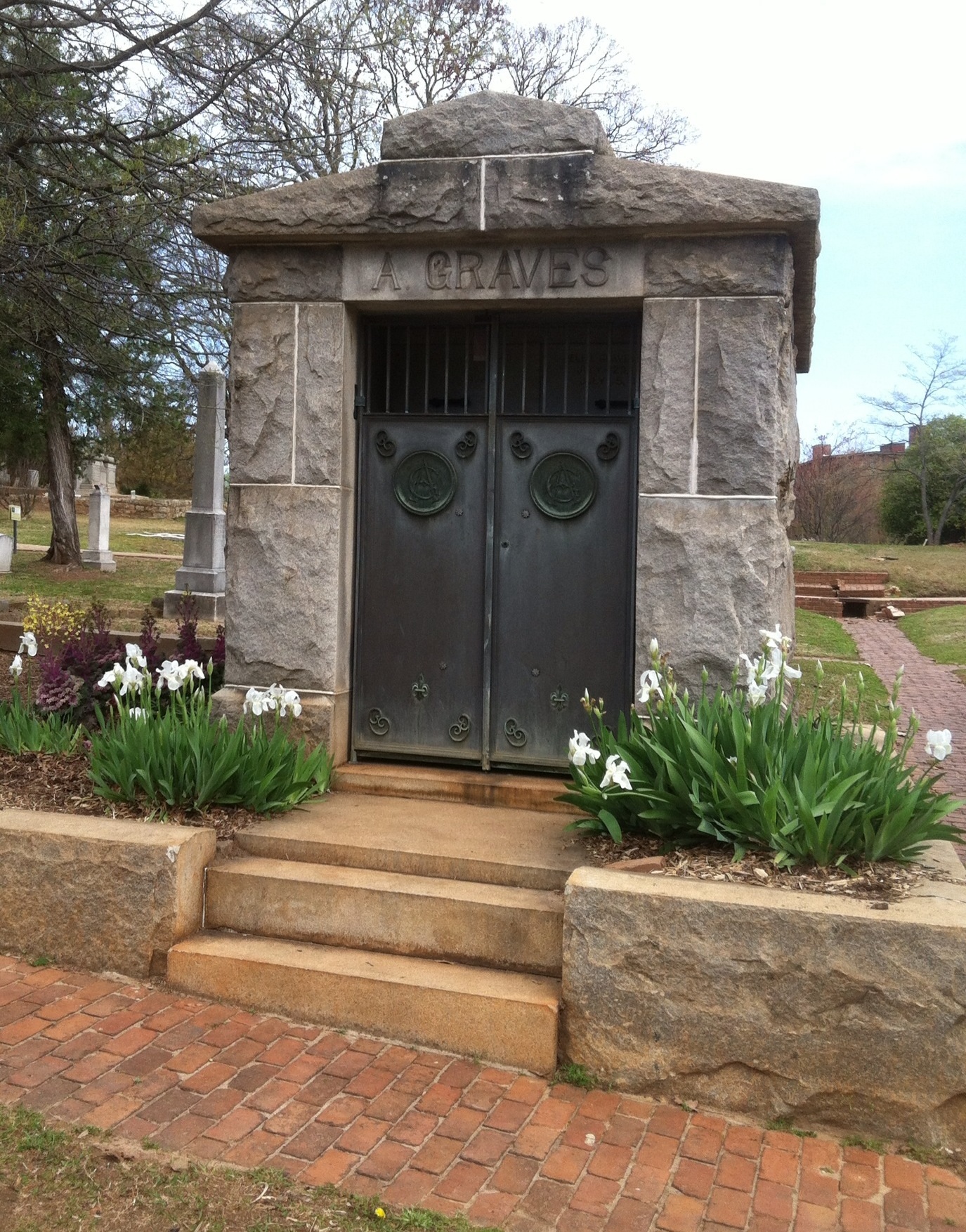
The Graves family has the only mausoleum in Oakland’s African-American section. Antoine Graves, principal of Gate City School, moved in the elite circles of Atlanta’s black community.

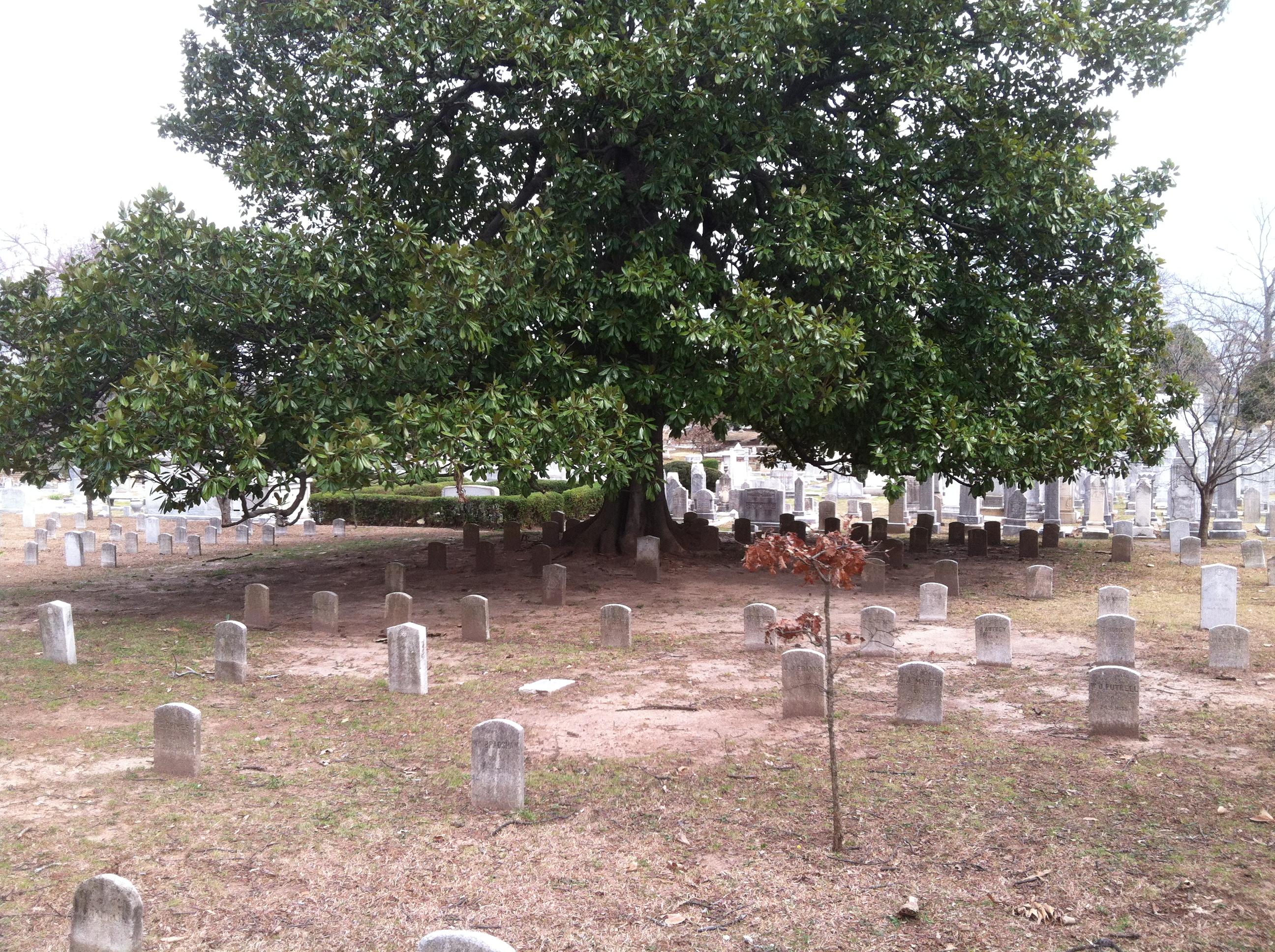
There’s also a large area strictly for Confederate Civil War dead. Some of the graves have names but many do not. This is the final resting place for about 6,900 Confederate soldiers, including 3,000 unknowns. Many soldiers had been brought straight from the battlefield to Atlanta hospitals. Those that died from their wounds were buried at Oakland.

Ourconfederatedead

This is just one of several sections of Confederate graves.

This is just one of several sections of Confederate graves.

This grave was a photo request for Find a Grave. The roots of the tree have grown around the headstone.

This grave was a photo request for Find a Grave. The roots of the tree have grown around the headstone.

You might think locating a Confederate grave would be difficult but they are actually easier to find than those of the civilians. The folks at Oakland can tell you, first, if the soldier has a marker. Some soldiers were buried without them. If the soldier you seek does indeed have a marked grave, they can tell you the exact section, row number and grave number.

In case you were curious, not everyone buried at Oakland had the money to purchase a plot. Almost six acres were set aside, mostly for the indigent. About 7,500 people are buried there. As the Oakland Web site says:

This is Potter’s Field, where no differences of religion and race ever mattered. A single monument commemorates them all. Potter’s Field is a favorite spot for Frisbee and other games—faithful to the Victorian intention that cemeteries should be enjoyed by the living.

That’s another thing about Oakland that separates it from many cemeteries. The public is not only allowed but encouraged to enter the gates and enjoy the space. In addition to Potter’s Field, there are two public areas set aside for this purpose. When Sarah and I were there, a number of people were having picnics there. We also saw a few joggers, some people were on bikes and a photography class was taking place. We even caught sight of a few couples smooching on benches.

There’s one grave located at the corner of one of the public spaces that was completely unplanned. This brings up what I consider one of the most surprising stories about Oakland: the death and burial of former Atlanta Mayor Maynard Jackson.

Atlanta Mayor Maynard Jackson's grave was beautifully decorated for Easter.

Atlanta Mayor Maynard Jackson’s grave was beautifully decorated for Easter.

Maynard Jackson was the first African-American mayor of the city of Atlanta. He served three terms (1974-82 and 1990-94). He was also a prominent face during the Atlanta Child Murders (1979-1981). There are few people my age who do not remember seeing him on the news at that time.

The former mayor seemed to be going strong in 2003 when he was on a business trip out of town. Unfortunately, he had a heart attack at Ronald Reagan Washington National Airport. While in an ambulance transporting him to a nearby hospital, Jackson suffered a second heart attack, this one fatal.

According to our guide at Oakland, Jackson (like many people) had no funeral or burial plans whatsoever. No plot had been purchased, nothing. So the city fathers had to scramble to figure out what they were going to do about it. With Oakland’s approval, they were able to have him buried there, his grave literally facing toward downtown Atlanta. It just goes to show that even someone as famous as Maynard Jackson can put off planning his funeral/burial.

Another interesting story is about the only grave marker for a pet bird at Oakland. Tweet the mockingbird was a beloved companion to Molly Weimer. When Tweet died in 1875, Molly asked if he could be buried by her plot. Oakland does not normally allow pet burials but Molly got permission. She attempted to hire a stonecutter to carve a mockingbird to grace Tweet’s grave. He was not up to the task, however, so the statue of a lamb was used. They are often placed on the graves of children.

While Tweet is the only marked grave of a pet in Oakland, there are stories about people who had their pets buried in their burial plots beside them.

Tweet’s is one of two marked graves of a pet in Oakland, but there are stories about people who had their pets secretly buried in their plot beside them.

Next week, I’ll talk about some of Oakland’s more eye-catching graves and the symbolism they represent.