Stopping by St. Lawrence Cemetery: More Adventures in Charleston, S.C., Part III
I’d like to wrap up my series on St. Lawrence Cemetery by showing you some more of the monuments and markers that got my attention while I was wandering around.

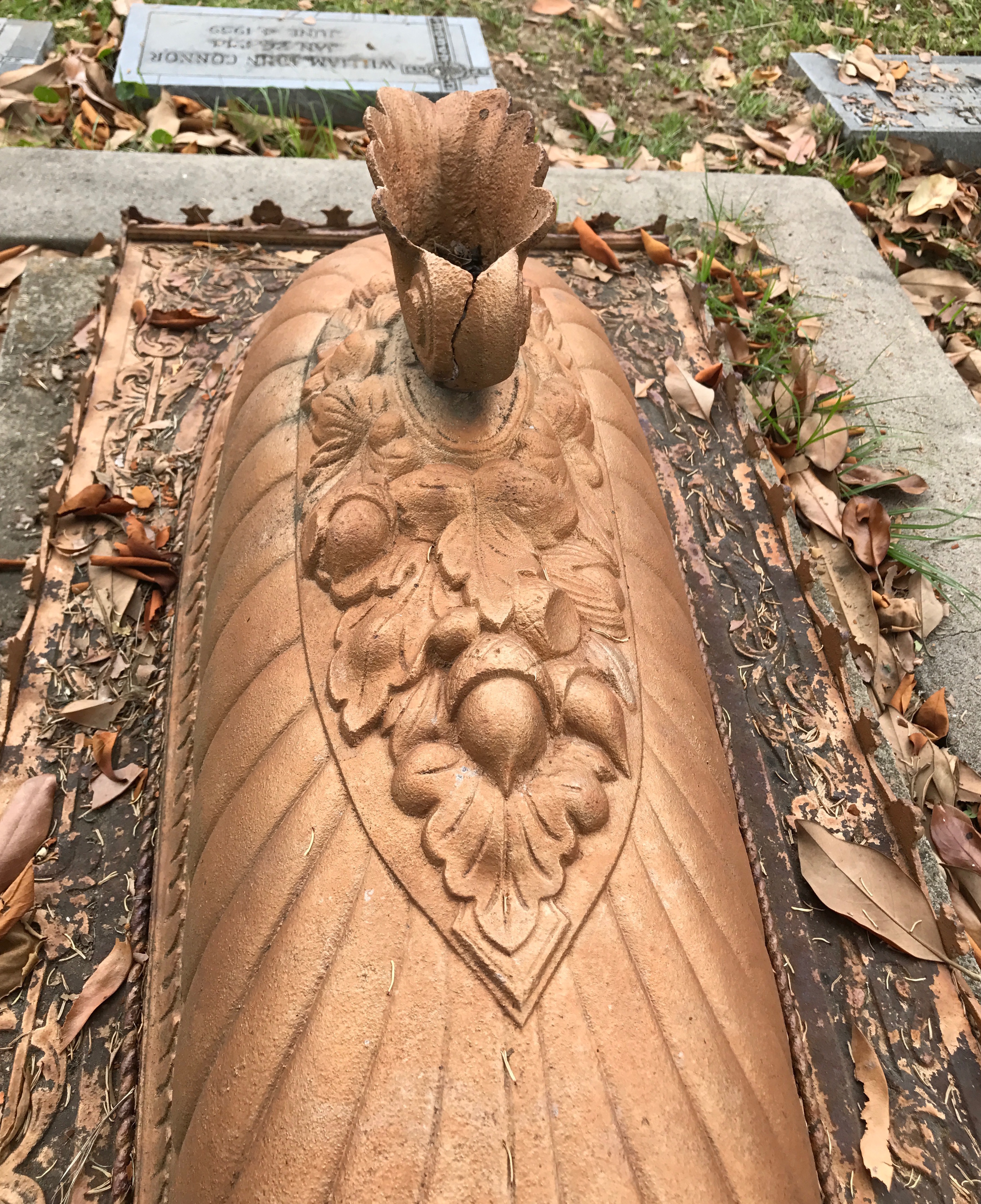
The one that got me the most excited was this one. Seeing an Abrams cast iron grave cover is like winning a lottery in my world. I let out a shriek of joy in my car when I caught sight of it.

You may remember I did a post on Joseph R. Abrams, inventor of the cast iron grave cover, a few years ago. I first saw one in Fairburn City Cemetery and have delighted in discovering them ever since.
A successful businessman, Abrams designed and received a patent for a unique cast iron grave cover in the 1870s. They’re usually found in Southeastern states but you can occasionally find one in Texas or the Midwest. Abrams spent his last years in Alabama and is buried there in Greenville Cemetery, where you can see a big collection of these markers. He died in 1880, only a few years after his patents were granted. They were made mostly for children’s graves because of their smaller size.

This is the first time I’ve seen an Abrams grave cover in this color before.

What sets this one apart is that it’s painted a coppery color, which I’ve never seen before. I don’t know if it was this way originally or if someone painted it later. It certainly made it easier to spot from my car.

If you look closely, you can see Abrams’ name and the years of his patents (November 1873 and Mary 1874) on the edge of the marker.

These graves covers, when originally made, had a name plate attached to the back. Because of the nature of the metal aging over time, most have broken off. The only identification is the name R.C. Millings on the plot border. Born in 1833, Richard Millings was a Charleston merchant who sold various items over the years, from boots/shoes to furniture.

The seashell finial on top is cracked but still intact. Other covers featured an infant underneath flowers or an open book.

I don’t believe this is the grave of Richard Millings but for one of his children. These covers were manufactured in the 1870s and early 1880s. Millings died at the age of 80 of dysentery in 1905, long after these stopped being made. His wife, Emma, died in 1913 and is buried in a different plot with her own slab marker. It’s possible he is buried beside this child in this plot, but I don’t know for sure.

One of the more unusual monuments was for Barnard Fitzsimons, erected by his sister Mary Ann. I had little idea that there was quite a story behind the settlement of his estate. There’s even a clue on the monument itself.

Upon first glance, you wouldn’t know the drama behind this monument.

Barnard Fitzsimons and his sister, Mary Ann, were natives of County Down, Ireland. They came to America as children and were living in Charleston by 1850. Barnard was a successful saddler, operating a harness store. Sometime between 1850 and 1859, Barnard (then in his 30s) married Pamela Carre (or Carrie) from Augusta, Ga. Their only daughter, Eugenia, was born in 1857.

This detailed hourglass on the Fitzsimons monument was a motif more common in the early 1800s. It was done by R.D. White, one of several Whites who were carvers that created stunning monuments throughout Charleston and the Carolinas.

The trouble started after Barnard died in 1859 at the age of 42 (according to his death records, it was from “brain compression”). His will left his entire estate to Mary Ann and Eugenia, even leaving the young child in her care. As this was on the eve of the Civil War, the timing was unfortunate. Pamela took Eugenia and headed for Augusta before settling in Savannah to live with family. Needless to say, Mary Ann was not happy with her sister-in-law.

Mary Ann filed a lawsuit against Pamela that reached the U.S. Supreme Court in 1867. Being that Confederate bonds backed the estate, who got what became even messier. After reading the case report a few times, I still don’t understand what the result was.

An inscription on Barnard Fitzsimons’ monument. I’ve not seen it on any other monument before.

From what I can gather, Eugenia remained with her mother in Savannah and never lived with Mary Ann in Charleston. Mary Ann is listed in the 1879 Charleston directory as living alone. In the 1880 U.S. Census, Eugenia is listed as living in the household of her aunt and uncle along with her mother. Pamela died in 1900 and is buried in Savannah’s Catholic Cemetery. Eugenia never married and died in 1935. She is buried beside her mother.

Mary Ann must have smarted over the loss of her brother and felt animosity toward her sister-in-law. That can be inferred from an inscription on the side of Barnard’s monument in which she claims it is erected “By the only surviving relative to mourn his loss. A most devoted sister.” She died of typhoid in 1889 in Charleston and is buried at St. Lawrence but has no marker of her own. I suspect she is buried beside her brother.

Barnard’s sister had to have the last word.

By contrast, the grave of little Alice Croak is quite humble. It is a metal enclosure with a simple battered sign on one end. She does have a stone beside it that I think came later. The child of New York natives James Croak (a pipe fitter in a shipyard) and Jenny Connor Croak, she only lived about a year before she died of “general biliary tuberculosis.” I’m thinking her father, skilled in working with metal, might have made this simple marker for his little girl.

Little Alice Croak’s father, a pipe fitter, may have made this humble marker for his daughter.

Alice’s sister, Agnes, would died five years later.

I didn’t get a picture of it, but Alice had an older sister named Agnes who is also buried at St. Lawrence. Born in 1911, she died five years after Agnes in 1920. Her cause of death is listed as “encephalitis lethargica”.

The term puzzled me until I learned that Agnes was one of about a million people around the world affected by the malady known as “sleeping sickness” between 1915 and 1926. A third died in the acute stage of the illness. It often started with an influenza‐like illness, followed by increasing drowsiness and confusion, progression to continuous sleep, stupor and finally coma. If you saw the 1990 movie “Awakenings” starring Robin Williams and Robert DeNiro, you have some idea of what it was.

This unusual mosaic-tiled obelisk marks the grave of immigrant Pietro Celotta. Born in 1861 in the Northern Italian village of Vodo Cadore, he arrived in New York in 1885 with his father, Michelangelo, and brother, Constantine. The ship’s manifest lists them as bound for Alabama.

Pietro Celotta had only been living in Charleston about 19 months when he died.

At some point, Pietro moved to Charleston and worked as a confectioner. He had only been living there for 19 months when he contracted influenza and died in 1891 at the age of 30. He never married.

It looks like various repairs have been made over the years to the mosaic-pieced monument.

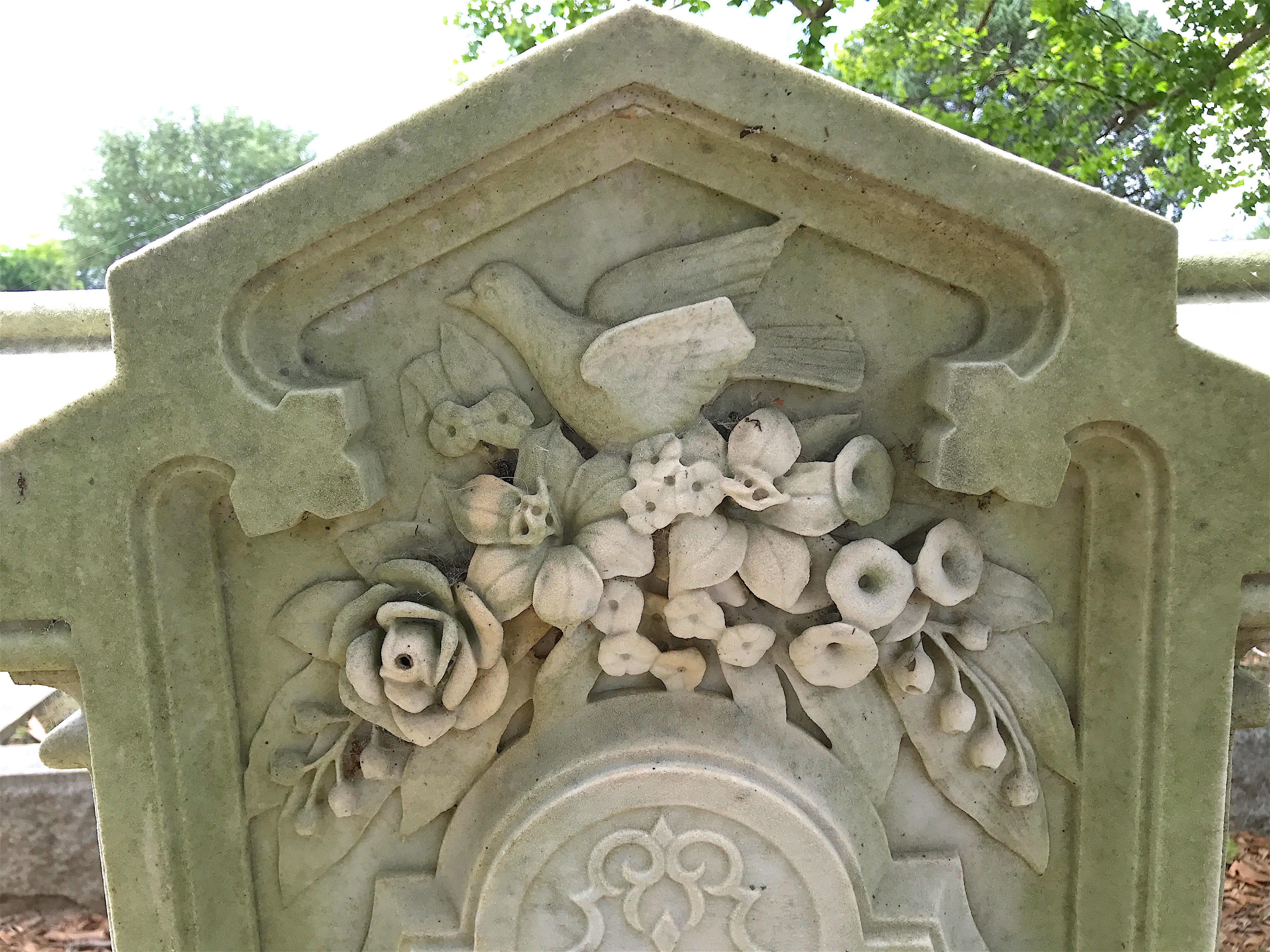
I was drawn to Fannie Moore Bickley’s grave for its beautiful profusion of blowers beneath a dove. The detail is stunning. The wife of John Bickley, Fannie died in 1895 at the age of 31. She suffered from Bright’s Disease, a kidney ailment.

A dove (one wing is chipped) sits amid a profusion of blooms.

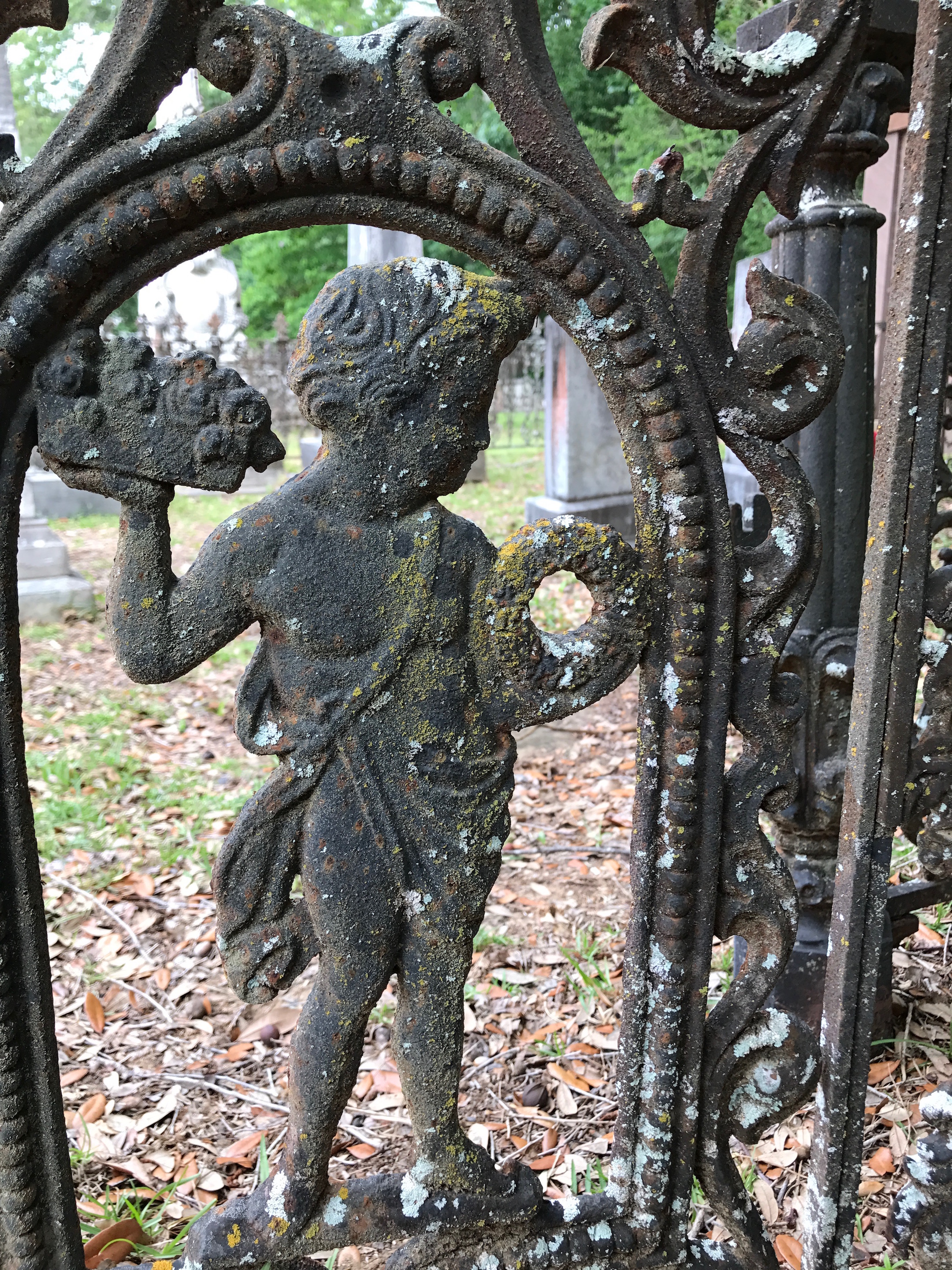
The craftsmanship of this old iron gate to the Henry Oliver plot caught my eye. Despite the fact it is 118 years old, it has aged fairly well all things considered.

Despite its age, the gate to the Henry Oliver plot is in good shape.

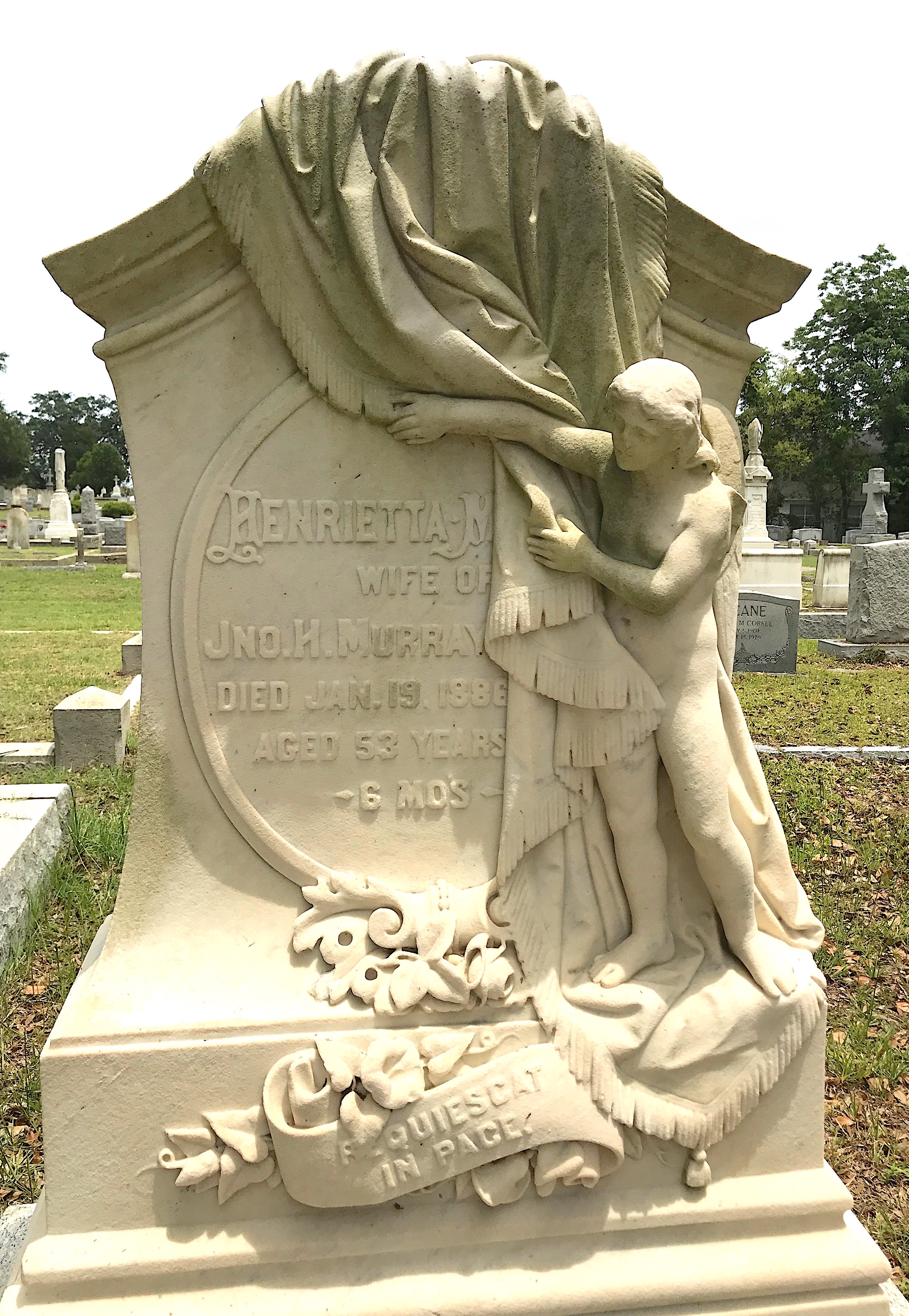
This final monument I included because I’ve seen one quite like it in Augusta, Ga. at Magnolia Cemetery (not the Magnolia Cemetery next door). They were actually carved the same year, 1888. The two women died about two months apart. The extreme draping, held by an angel, must have been a popular motif at the time.

Here’s the one I saw in Augusta. Notice that the draping covers Maude Mathewson’s last name. I had to look it up on Find a Grave to find out what it was.

Maude Mathewson’s grave marker in Augusta, Ga. looks a lot like Henrietta Murray’s.

A native of Ireland, Henrietta died of heart disease at the age of 53. She was married to steamboat captain John Murray.

In this case, because her husband John’s name is inscribed in full below hers, we know that Henrietta’s last name was Murray. That’s a lot more helpful (in my mind) than what the carver did on Maude’s monument. The intricacy of the draping is more elaborate than Maude’s as well, detailed with lots of fringe and a tassel.

So it’s farewell to St. Lawrence now and hello to Edisto Island, an hour’s drive from Charleston…

Stopping by St. Lawrence Cemetery: More Adventures in Charleston, S.C., Part II

When we were last at St. Lawrence Cemetery in Charleston, I shared stories about some of the more wealthy and successful Catholic residents of the city. This week, the pendulum swings in the other direction.

It’s not unusual to see a lot of children’s graves at an older cemetery like St. Lawrence. Child mortality rates were sky high before the advent of antibiotics. But I noticed that in more than one place, there were specific plots filled with small stone crosses. I believe they mark the graves of children whose parents probably couldn’t afford a marker for them.

The first plot I saw was near the front gates. These crosses have no names attached to them. I saw a few regular children’s markers (with names) mixed in with them. Most of the names on the markers around them appears to be of Irish origin.

The first children’s plot is near the front gates.

Closer to the middle of the cemetery to one side, I found another plot of similar crosses. I’m not 100 percent sure they are all children, but that’s my guess.

I found another children’s plot closer to the middle of the cemetery.

In this plot, I noticed a handful of metal crosses with only numbers on them. I don’t know when these were placed. Part of me wonders if these were from the local Catholic orphanage. The only other time I’ve seen numbered crosses was at a cemetery for a mental institution.

Was this child perhaps an orphan?

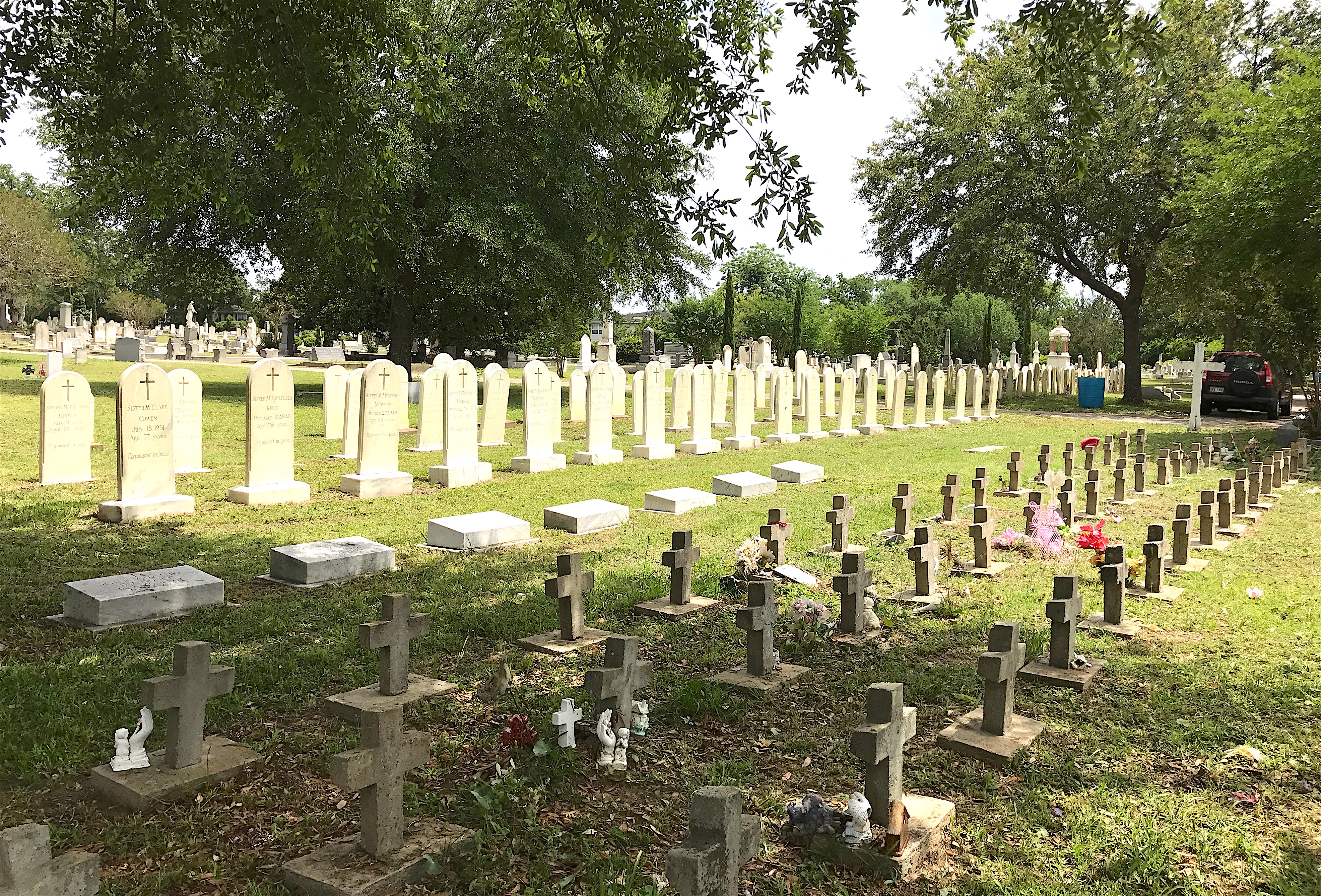
The last children’s plot is located in front on a group of nun’s graves.

This plot of children’s grave is located in front of a plot for nuns.

The tall white markers behind the little crosses represent the nuns in service of Our Lady of Mercy (OLM), once simply known as the Sisters of Mercy. They started burying the nuns at St. Lawrence in 1854, not long after it opened. This group in the photo are more recent burials. The group buried to the right of them (past my red CRV) include some of the first nuns that were part of the order.

The actual order was established years before St. Lawrence opened. The story begins in 1829, when Bishop John England traveled from Ireland to Charleston to begin a ministry for orphans. The frequent yellow fever epidemics left many children without parents. But Bishop England soon realized he needed help.

St. Lawrence Cemetery founder Bishop Ignatius Reynolds based the new order’s constitutions on those of the Sisters of Charity of Nazareth  and on the simple Rule given to the Sisters by Bishop John England, was based on the Rule of Life of St. Vincent de Paul.

While in Baltimore, Md., Bishop England met Irish nuns (and literal blood sisters) Honora and Mary Joseph O’Gorman. With them was their niece, Mary Teresa Barry, who was only 14 at the time. Bishop England invited them to join him in his work in Charleston. Their main goal was to open schools for orphans. Thus was started what is now known as the Sisters of Mercy of Our Lady of Mercy (OLM).

Photo of Sister Mary Teresa Barry seen in “Records of the American Catholic Historical Society of Philadelphia, Volume 15”. Taken from an oil painting done in Rome, Italy in 1888. She would have been around 84.

In 1830, the Sisters established the Academy of Our Lady of Mercy in Charleston, a day and boarding school that offered a basic education along with music, art, and embroidery. Students of all faiths were welcome. The Academy operated until 1929.

Children and nuns at the Our Lady of Mercy Academy in 1917.

Bishop England also wanted “to have a school for free colored girls, and the religious instruction of female slaves.” This objective was achieved in part in 1835 when he established a school for free colored children in Charleston. Two students from the Diocesan Seminary were placed in charge of the boys and two OLM Sisters were assigned to teach the girls. In a few weeks, they had over 80 children in the school. Unfortunately, pressure from outsiders forced the closing of the school within months.

In 1841, Bishop England tried again to open a school and put Sister Teresa Barry in charge. The school was initially located on Queen Street opposite the Medical College. Later, it was moved to the grounds of the OLM Motherhouse on Queen Street. In 1844, the OLM Sisters elected Sister Teresa to be their Mother Superior.

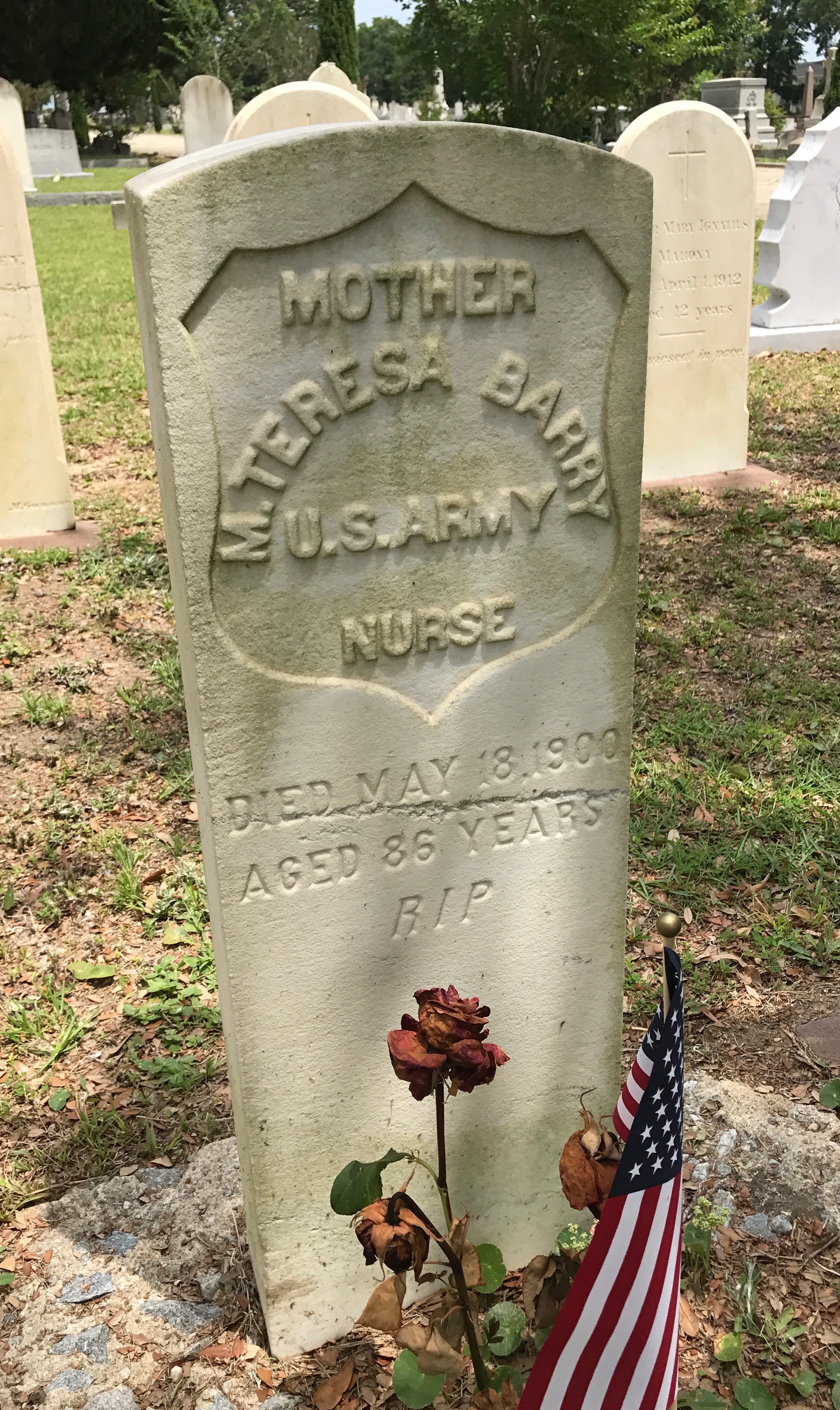
Mother Mary Teresa Barry tended to the Confederate wounded during the Civil War. She also had a love of learning, teaching both black and white children during the 1840s.

In November 1844, at the request of Bishop Ignatius Reynolds (who established St. Lawrence Cemetery), the OLMs moved the school from Queen Street to rented rooms on King Street where it remained until it was closed in 1848. However, Catholic almanacs from 1849 through 1853 show that the Sisters gave instruction to “colored persons” four evenings a week. After the the Civil War in 1867, Mother Teresa wrote to the current bishop with hopes of reopening a free school for black children but was denied.

It wasn’t until 1904 that the OLM Sisters were again able to teach black children. They taught at the  Immaculate Conception School operated from 1904 to 1917 (along with a school at St. Peter’s, a church for black Catholics). In 1917, the Oblate Sisters of Providence of Baltimore were invited to take over teaching duties at St. Peter’s and Immaculate Conception Schools.

Listed third on the crypt is Sister Mary Joseph O’ Gorman, one of the original founders of the Sisters of Mercy.

During the Civil War, Mother Teresa and five OLM Sisters traveled to Greenbrier White Sulphur Springs, Va. to staff a Confederate military hospital. As the Union Army advanced in May 1862, the hospital moved to Montgomery White Sulphur Springs. When the war ended, there were more than 300 soldiers in the hospital. Despite shortages, the Sisters stayed until the patients were discharged or died.

Sister DeChantal Clary served with Mother Teresa in nursing the Confederate wounded. When she died in 1901, a Charleston newspaper reported, “It was said of her that her touch was a balm, and her smile carried hope to many a weary and suffering soldier.”

Mother Teresa died in 1900 at the age of 86. Father Patrick Duffy, pastor of St. Joseph’s Church, called her “a valiant woman, tender mother, courageous to suffer and quick to sympathize.”

When the OLM celebrated its 100th birthday in 1929, its numbers included 86 professed sisters and four novices. Today, there are only about a dozen OLM sisters still living, all of them elderly.

However, the efforts of the OLM are still felt in Charleston. Our Lady of Mercy Sisters of Charity convent on James Island runs the Neighborhood House, which has a daily soup kitchen to feed the poor and offers education classes to help people receive their GEDs.

I’m not quite done with St. Lawrence yet, too many unique monuments to talk about and stories to share. Stay tuned for Part III.

Italian immigrant Louis Alchisio died in 1858 of yellow fever at the age of 37. This angel graces the top of his marker.