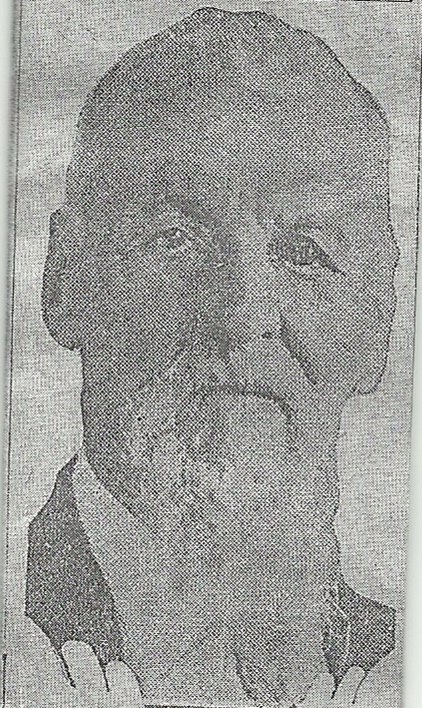
• About Me
  • Cemeteries I Have Visited
  • Have questions?
  • Photos

Adventures in Cemetery Hopping

~ A blog by Traci Rylands

Adventures in Cemetery Hopping

Category Archives: General

Only the River Remains: Remembering the S.S. Eastland

31 Friday Jul 2015

Posted by adventuresincemeteryhopping in General

≈ 4 Comments

“People were struggling in the water, clustered so thickly that they literally covered the surface of the river. A few were swimming; the rest were floundering about, some clinging to a little raft…others clutching at anything they could reach – at bits of wood, at each other, grabbing each other, pulling each other down, and screaming! The screaming was the most horrible of all.” — Helen Repa, Western Electric nurse

Everything else fades away, all of our losses and all of our gains. And only the river remains… — Eastland: A New Musical

July 24, 1915 doesn’t mean much outside the city of Chicago. Until I married Chris, it was just another date on the calendar. But I soon learned it was a tragic day in the Rylands family.

On that Saturday, 844 Chicagoans lost their lives when the excursion ship S.S. Eastland rolled onto its side. Chris’ great-grandmother, Minnie Miller Rylands, drowned in the Chicago River. Her husband, James Stephen Rylands, and their little son, John Joseph, survived. So did James’ brother, William. John Joseph Rylands was Chris’ grandfather.

This is a postcard that was re-issued by the now defunct Cicero Historical Society of the Eastland.
This is a postcard re-issued by the now defunct Cicero Historical Society of the Eastland.

The Eastland, known as the “Speed Queen of the Great Lakes,” was part of a fleet of five excursion boats scheduled to ferry Western Electric employees, families and friends across Lake Michigan to Michigan City, Ind., for a rare day of fun amid the usual six-day work week.

The daughter of German immigrants, Minnie was only 28 at the time of her death.
Minnie's husband, James, had to make a decision no husband and father should ever make. To save his wife or his son first. Photo courtesy of Joan Rylands Schroeder
Minnie’s husband, James, had to make a decision no husband and father should ever make. To save his wife or his son first.

The Eastland, docked at the Clark Street Bridge, never left the Chicago River. Picnickers laughed amid the music and dancing as they boarded. When the crowded ship began listing back and forth from port to starboard, many thought it was a joke. But when the boat listed over so far that the people began sliding across the floor, panic set in.

The Eastland’s captain, Harry Pedersen, sounded the alarm, but only after it was too late. Witnesses say he (and some lucky others) climbed over the starboard railing and walked across the exposed hull to safety, never even getting his feet wet.

Passengers on the main deck rushed to the staircases leading upstairs, which proved to be the worst single death trap for those passengers within the interior decks of the ship.

 157 The Second Regiment Armory, on Washington Boulevard, served as a temporary morgue for victims of the S.S. Eastland steamship disaster on July 24, 1915. Some people were never identified. Photo from the Chicago Tribune Archives.
The Second Regiment Armory, on Washington Boulevard, served as a temporary morgue for victims of the Eastland disaster. Some people were never identified. (Photo Source: The Chicago Tribune Archives)

More than 2,500 passengers and crew members were on board that day – and 844 people lost their lives, including 22 entire families. Why the Eastland rolled over that day is complicated but you can read about it on the Eastland Disaster Historical Society website. After the Eastland was raised in August, she was sold to the Illinois U.S. Navy Reserve and recommissioned as the U.S.S. Wilmette, then converted to a gunboat

This past July, my family spent a week in Chicago as our summer vacation. One reason was to celebrate the wedding of Chris’ cousin, Brett. But the other was to be part of the 100th anniversary events surrounding the sinking of the Eastland.

A view of the Eastland after she rolled over from the south side of the Chicago River. The Clark Street Bridge is in the background.

People still puzzle over the fact that today so few know about this maritime disaster, but the biggest reason may be the very status of the passengers.

Unlike many of the Titanic victims who were wealthy and notable, just about all of the Eastland passengers were working-class immigrants with little money to their names. Most were of Czech background and worked at the Hawthorne Works factory of Western Electric in the Berwyn/Cicero area of Chicago.

Minnie was of German background and her husband James was British born. Neither worked for Western Electric but a number of people attending that day were not either, having been invited by friends.

According to family lore, James had to decide whom to save first. His wife or his child. Because John Joseph was so young, James pulled him to the water’s edge first. When he went to save Minnie, it was too late.

Employees of the Hawthorne Works of Western Electric were ordinary people without much money so when they had a chance to have some fun, they were eager to take it. Photo courtesy of the Eastland Disaster Historical Society website.
Employees of the Hawthorne Works of Western Electric were ordinary people without much money so when they had a chance to have some fun, they were eager to take it. (Photo Source: The Eastland Disaster Historical Society website).

In 2012, Eastland: A New Musical premiered in Chicago. One of the main characters is a responder. Reggie Bowles, a young man who sped to the scene on his motorcycle, jumped in the river hoping to save lives. But all he found were dead bodies. Because of his ability to hold his breath for long periods of time, Reggie earned the nickname the Human Frog. It’s reported that he brought over 40 bodies to the surface that day.

Reggie Bowles, who became known as the Human Frog for his diving ability, brought over 40 bodies to the surface. He later contracted typhoid as a result of his time in the contaminated water.

I had the pleasure of meeting the grandson of Reggie Bowles, David Bowles, at the Saturday luncheon. Many firemen, policemen and ordinary people like Reggie risked their own lives to pull passengers to safety or to recover victims so that their families could later identify them.
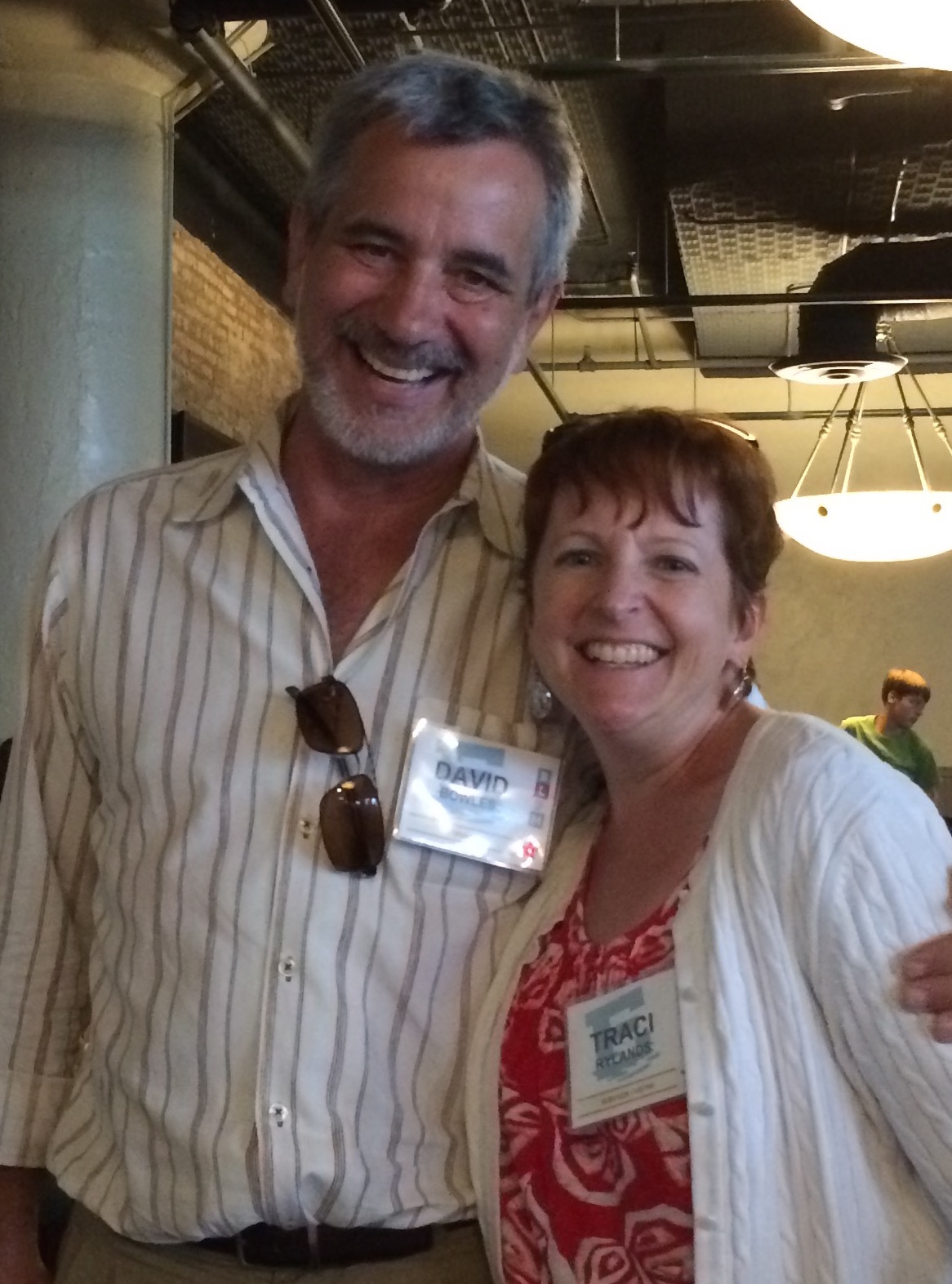
David Bowles is the grandson of Reggie Bowles, a young man who rode his motorcycle at top speed to the Eastland disaster in hopes of saving passengers. He ended up salvaging bodies instead.
David Bowles is the grandson of Reggie Bowles, a young man who rode his motorcycle at top speed to the Eastland in hopes of saving passengers. He took on the grim task of salvaging bodies instead.

A majority of Eastland victims are buried at Bohemian Cemetery (which I will write about next week). But I knew Minnie’s grave was at Forest Home Cemetery. I contacted Chris’ Aunt Joan, who is the genealogist in the family. Nobody had visited her grave before because it’s unmarked and Forest Home is huge.

Fortunately, she located a map the cemetery had sent her a few years ago showing exactly where Minnie, James and their granddaughter Paula (who died in infancy) are buried.

Forest Home Cemetery is so vast, you can see it from the Interstate.

Located off Des Plaines Avenue in the Berwyn/Cicero area, Forest Home Cemetery is actually the merging of two cemeteries (in 1969), Forest Home and Waldheim. Waldheim Cemetery opened in 1873 when the land was sold to a group of German Masonic lodges. Forest Home opened a few years later on land south of Waldheim.

Unlike other cemeteries of the time, Waldheim and Forest Home were open to all, regardless of ethnicity or religion. As a result, it became very popular with immigrants.

Commuters on Chicago's I-290 can get a view of Forest Home Cemetery. Photo from the website diversostudio.wordpress.com.
Commuters on Chicago’s I-290 (the Eisenhower Expressway) can get a view of Forest Home Cemetery. (Photo Source: website www.diversostudio.wordpress.com)

Along with Chris’ parents and his Aunt Beth, we (Chris, Sean and I) set out to find Minnie. With only 20 minutes until the gates closed, we drove through the winding roads to the back of the cemetery and found where Minnie, James and Paula were buried.

The empty space to the left of the Faber marker and in front of the Anderson marker is where Minnie, James and Paula are buried.
The empty space to the left of the Faber marker and in front of the Anderson marker is where Minnie, James and Paula are buried. (Photo Source: Chris Rylands)

So why are there no markers for Minnie, James and Paula? I don’t have a good answer for that. Although James was a plumber, he was by no means wealthy. He remarried twice after Minnie died. According to my father-in-law, Craig, his father (John Joseph) never spoke about the Eastland. The few memories shared about that day came through Craig’s mother, Florence.

UPDATE: In January 2016, Chris’ Aunt Joan arranged to have a marker placed for Minnie, her husband, John, and their granddaughter, Paula. Aunt Joan died of cancer a few years later. It was one of her dearest wishes to have their tones placed.
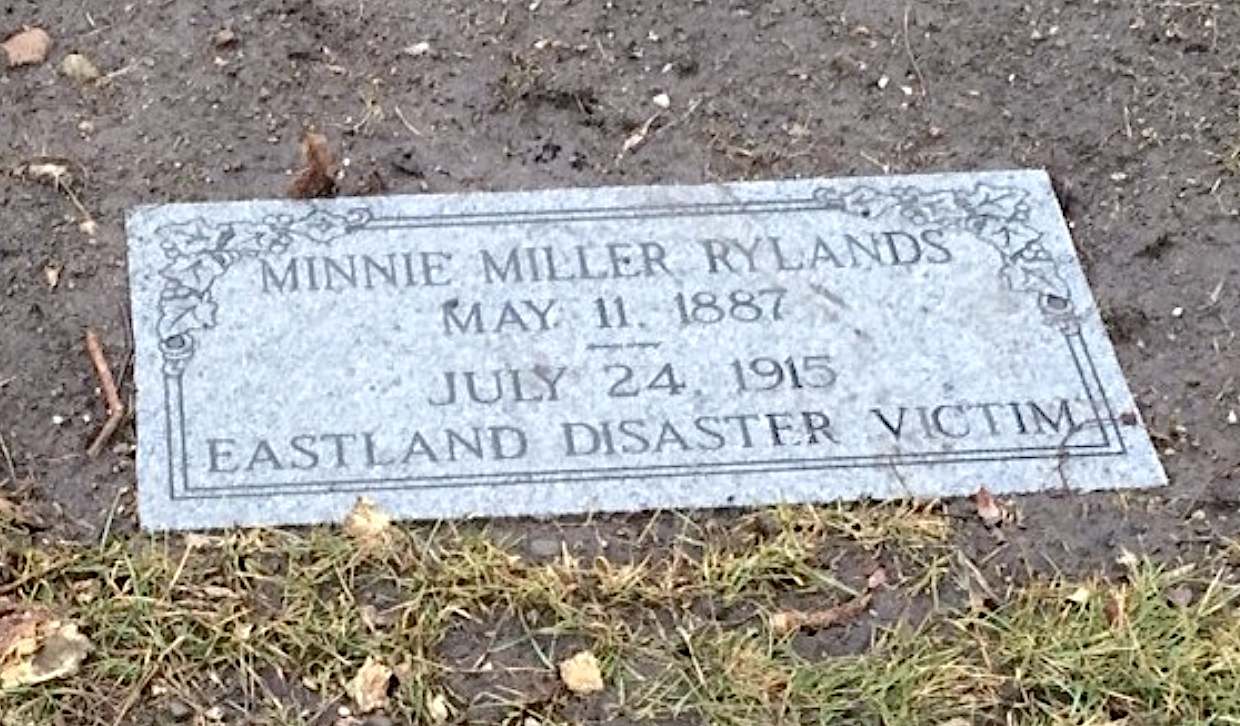
Minnie’s grave finally has a stone. It was placed by her granddaughter, Joan. (Photo Source: Joan Schroeder)
Minnie's grandson (and my father-in-law) Craig Rylands stands beside the memorial marker commemorating the 1915 Eastland disaster.
Minnie’s grandson (and my father-in-law) Craig Rylands stands beside the memorial marker commemorating the 1915 Eastland disaster.

On Saturday evening, the families of the survivors/victims/responders gathered at the edge of the Chicago River by the Clark Street Bridge. At precisely 8:44 p.m., we all turned on little battery-powered votives in memory of the 844 lives that were lost that day. Amid the bustle of the city, we observed a moment of silence.

Rest in peace, Minnie. You are not forgotten.

Separating the Sheep From the Goats: Something to Chew on at Decatur Cemetery

10 Friday Jul 2015

Posted by adventuresincemeteryhopping in General

≈ 4 Comments

First, I’d like to apologize for being absent from the blog for over a month. Due to a move into a new home across town, I had to put my cemetery hopping and blog writing activities on hold for a while. I’m still unpacking boxes but for the most part, we’re settled in.

To stay sane, I did continue my volunteer duties over at Decatur Cemetery. I’ve been helping out in their office since the fall, trying to be there at least one morning a week. As a result, I’ve grown even more affectionate toward the place and feel quite at home there.

The cemetery boasts a variety of wildlife, from birds to squirrels to rabbits. I’ve not seen a deer yet. The Canada geese leave their “deposits” here and there. But the birds that always get my attention are the large raptors that hover over the grounds. One day I witnessed a hawk almost carry off a tiny puppy but thankfully, the dog’s owner pulled it to safety in time.

This is typical of what you'll find me doing out at Decatur Cemetery on any given Tuesday. I check what's on the grave markers with what's on the old index cards and in the computer records.

This is typical of what you’ll find me doing out at Decatur Cemetery on any given Tuesday. I check what’s on the grave markers with what’s on the old index cards and in the computer records.

But it wasn’t until recently that I actually saw sheep on the premises.

Before you start thinking that Decatur Cemetery has become a farm, let me explain. They’ve been dealing with some overgrown vegetation on the far side of the cemetery that was fairly entrenched. We’re talking a mini wilderness. To hire workmen to get rid of it would have been costly and actually risky since much of it is on a steep hillside. Operating mowers on ground that’s so uneven is not a great idea.

So they decided to hire cheap labor that would work outrageous overtime and for very low pay. Dirt cheap, in fact. They tried it first in 2013 and the sheep did so well that they again contacted a company called Ewe-niversally Green to bring them back.

This may seem like a novel concept, but hiring someone with sheep or goats to clear large swaths of overgrown lots or acreage is not a new concept. Other cemeteries have been doing it for a while. Atlanta’s Hartsfield-Jackson International Airport used the same sheep to take care of brush along their fifth runway.

The most recent example that got media attention was in 2013 when Congressional Cemetery hired a flock of goats to remove the thick growth of poison ivy that was wrapped around many of its trees. According to the cemetery staff, the more ivy smothers the trees, the heavier the trees get and the more susceptible they are to crashing down, which could damage gravestones. The ivy’s leaves also can interfere with the trees’ photosynthesis, killing them.

Maryland-based company Eco-Goats brought over some hungry goats to take care of the tenacious ivy choking trees at Washington's Congressional Cemetery. Photo by Linda Davidson/the Washington Post.

Maryland-based company Eco-Goats brought over some hungry workers to take care of the tenacious ivy choking trees at Washington’s Congressional Cemetery. Photo by Linda Davidson/The Washington Post.

According to a Washington Post article, the cost of hiring the 50 or so goats to take care of the problem was around $4,000. That may seem like a lot but it’s actually a better option than using machinery. The goats require no fossil fuels and their waste provides fertilizer for the grounds. The gravestones and monuments are also left undisturbed. This graphic from USAToday does a good job at explaining it.

I was curious to find out what the difference is between sheep and goats in terms of efficiency. Which is better? Are they different in what they eat? Here’s what I found out.

Goats are natural browsers that like to eat leaves, twigs, vines, and shrubs. They are quite agile and will stand on their hind legs to reach vegetation. So they were an apt choice to eat the ivy at Congressional Cemetery. Sheep, on the other hand, are grazers. They prefer to eat short, tender grasses and clover.

These sheep are taking care of the grass at St. Patrick's Old Cathedral in SoHo. They're brought in from a farm in upstate New York. Photo by WABC-TV.

These sheep are taking care of the grass at St. Patrick’s Old Cathedral in SoHo in New York City. They’re brought in from a farm in upstate New York. Photo by WABC-TV.

In both situations, these plant-loving animals are kept within a low-current electric fence and watched over by a trained dog of some sort. Both are used as a means of protecting the animals from predators and keeping them focused on their task. Goats, I read, can be more curious than sheep and are more apt to seek an escape.

So when my partner in crime, Jenny, and I were working a few weeks ago, we decided to check up on the sheep to see what they were doing. With the heat and humidity being so instense, they weren’t really doing much of anything at the time.

This is not the first time Decatur Cemetery hired sheep to take care of overgrown acreage. They did it in 2013 with successful results.

This is not the first time Decatur Cemetery hired sheep to take care of overgrown acreage. They did it in 2013 with successful results.

On the day I visited the sheep, it was a typically hot and humid one. They seemed uninclined to do much and I can't blame them for it.

On the day I visited the sheep, it was a typically hot and humid one. They seemed disinclined to do much and I can’t blame them for it.

As you can see, the sheep are quite close to the gravestones and monuments. A graveside service took place close by that day but the sheep were respectfully quiet.

As you can see, the sheep are quite close to the gravestones and monuments. A graveside service took place nearby that day but the sheep were respectfully quiet.

A low current electric fence surrounds the sheep to protect them from predators. It looks like these two are trying to say, “Nothing to see here, folks. Move along!”

It might surprise you to learn that even you and I can affordably hire sheep or goats to clear unwanted brush from property. Someone in my old neighborhood did it earlier in the year for a few days. Just be prepared for some spectators because they seem to bring out the inner animal lover in many people, including me.

I only saw one of the dogs from a distance at Decatur during my second visit the following week. Three of the dogs are featured on Ewe-niversally Green’s website.

Pete, Big Boy Clyde and Maestro are three of Ewe-niversally Green's shepherd dogs in charge of guarding the sheep.

Pete, Big Boy Clyde and Maestro are three of Ewe-niversally Green’s shepherd dogs in charge of guarding the sheep. They are serious about their work. Photo borrowed from the Ewe-niversally Green website.

So if you happen to hear some odd sounds coming from a cemetery the next time you visit, don’t worry. It’s not zombies or ghosts. It just might be some local livestock hungrily taking care of the landscaping.

Photo by Decatur Metro.

Photo by Decatur Metro.


Memorial Day 2015: Revisiting the Life of Lance Corporal Jerry Davis

25 Monday May 2015

Posted by adventuresincemeteryhopping in General

≈ 5 Comments

Those of you who’ve followed my blog for a while may remember one of my first blog posts about a young soldier who was killed in action during the Vietnam War. In honor of Memorial Day, I want to revisit that post and add some things I have since learned about Jerry Davis since I wrote it.

I had not been a Find a Grave photo volunteer for long when I took the request to photograph his grave. Jerry is buried in Melwood Cemetery in Stone Mountain, Ga. At that time, I’d never been to Melwood before, although I have passed it many times. I was a little nervous because big cemeteries then intimidated me. That’s no longer the case but it was true then.

Melwood CemeteryFortunately, while Melwood is indeed large, it is still locally owned, not bought out by a large chain (yet). The ladies in the office were more than happy to locate Jerry’s grave for me and one of them even drove over to it (with me following in my car) so I could see exactly where it was. He is buried beside his parents.

Thanks to Facebook, I was able to reach out to the folks of Tucker and ask if they’d known Jerry in their youth. Turns out, quite a few had and remembered him well.

Stephen Smith, a Tucker resident who served for two years in Vietnam and 20 years in the U.S. Air Force, was a friend of Jerry’s for many years. He posted on Facebook: “I went to school with Jerry, Tucker Elementary and Tucker High. In elementary school, he helped me raise and lower the American Flag each day and fold it and lay it in the office.”

As a little girl, Donna England Dahlgren remembered Jerry as he helped her and her classmates cross the street every day. “He was a patrol who helped us cross the street walking to school when I was in the fourth grade,” she shared.

Donny Hammond (who has since passed away) also knew Jerry and left a comment. “I met Jerry before we moved to Tucker in about 1959, 1960 at Twin Brothers Lake . He liked to fish as much as I did. My brother and I would go just about every Saturday if we had the cash , Jerry and his brother did the same. His parents owned Davis Sheet Metal Works. He was very quiet and kept to himself. He also like most of us boys loved fast cars.”

Like most of the people whose graves I photograph, Jerry died before I was born. But his death struck a chord in me as a mother.

Like most of the people whose graves I photograph, Jerry died before I was born. But his death struck a chord in me as a mother.

According to Jerry’s Find a Grave memorial, he wasn’t even 20 yet when he enlisted in March 1966. He chose the United States Marines, a branch of the armed services noted for its toughness of character. Looking at his picture, I wonder what was going through his mind before he left everything he knew behind in a small Georgia town for an uncertain future thousands of miles away.

After he arrived in Vietnam, Jerry was assigned to Company B, 1st Battalion, 7th Marines, 1st MAR DIV (Rein) FMF. Records indicate he was an antitank assaultman. He had only been in Vietnam a few days when his life was taken by the enemy.

590px-USMC_-_7th_Marine_Regiment_New_LogoJerry’s memorial explains how he died. “Near the Hoa Ham hamlet in Dai Loc District a LP (Listening Post) inside the Company perimeter wire, [Davis] received an incoming grenade and five rounds of small arms fire resulting in LCpl Davis being killed in action by the enemy rifle fire.”

By looking on Ancestry.com, I discovered that Jerry’s older brother died in 1965. He wasn’t in the military. I didn’t know the cause of his death back then but Jerry Head solved that mystery for me with a comment he left on Facebook: “We lived across the street from Jerry, Eddie and Diane [their sister]. Eddie was killed in a car wreck, I believe it was on Frazer Road, not far from their Grandma.”

Eddie was only 23 when he died. I wonder if he and Jerry played “war” as kids in the backyard. When they got older, did they talk about enlisting together? Or was it Jerry’s dream alone to become a Marine?

Stephen Smith was rocked by the news of Jerry’s death. “We were such good friends, my parents would not tell me he had gotten killed until I got back.”

When I was single, Jerry’s story wouldn’t have touched me as deeply. Because now I have a son myself, even though he’s only eight. But motherhood changes the lens through which you view life. If I knew my son was only going to live to the age of 20 and end up being shot to death halfway around the world, it would tear me to pieces.

I think of Jerry’s mother, Martha, as she watched her sons grow from little boys into young men. What did she say when Jerry told her he wanted to enlist? I picture her at his funeral, accepting the flag of our country. Having now lost both of her sons within a two-year period, one in a car accident and another in battle, her heart had to be broken.

LCp Jerry Davis made the ultimate sacrifice for his country. But few will ever remember him.

LCp Jerry Davis made the ultimate sacrifice for his country. I discovered that many people remember him and know his story well.

I wish I could have met Martha. I would tell her, from one mother to another, that I’m sorry both of her boys died so young. That Jerry’s death in combat was not in vain, that his life did mean something. He was not just a casualty number on a blackboard.

And now, I would also tell her that Jerry is still fondly remembered by his friends from the Tucker High School Class of 1965. He lives in their hearts and memories forever. They know his story and will never forget it.

I hope you won’t either.

The Laughter of Children: Dunwoody’s New Hope Cemetery

22 Friday May 2015

Posted by adventuresincemeteryhopping in General

≈ 10 Comments

One of the first cemeteries I visited after becoming a Find a Grave volunteer was Dunwoody’s New Hope Cemetery. It’s hard to find unless you know that it’s located behind a KinderCare on Chamblee-Dunwoody Road. Like the Stephen Martin Cemetery near Perimeter Mall, New Hope Cemetery’s care is overseen by by the Dunwoody Preservation Trust (DPT).

The juxtaposition of a cemetery with a daycare center may seem a bit strange. But it’s actually not so strange when you realize that just as life is beginning for some, it’s already ended for others.

You can see the daycare center behind the sign.

You can see the daycare center behind the sign.

On that first visit (probably spring 2013), the cemetery seemed well hidden amid the trees, a pleasant retreat amid the honking cars in Dunwoody Village. It was comforting to hear the excited chatter of little kids playing just over the fence. Later in June, a tornado toppled some of those old hardy trees and made quite a mess.

image

The gates of New Hope Cemetery are locked but there’s a side gate to the right for guests to enter.

Unfortunately, the work crew hired to remove the debris used equipment that was too big for the size of the cemetery and ended up knocking over some or the markers and damaging some grave sites. Needless to say, many families with loved ones buried there were not happy. A group that included descendants, Boy Scouts, nearby residents and even employees of a neighboring real estate group gathered in May 2014 for a clean up day.

A huge tree once towered over New Hope Cemetery, close the fence between it and the daycare center. The stump is all that's left now.

One of the huge old trees that towered over New Hope Cemetery was close to the fence between graves and the daycare center. The stump is all that’s left of it now.

When I went back a few weeks ago, the feel of the place had changed a bit. The trees toppled by the tornado had been removed so it wasn’t nearly as shady. But considering the photos I saw on the DPT site showing the damage the tornado caused, it looked pretty good. The laughter of children was drifting through the air again.

I did notice that a number of monuments that were upright back in 2013 are now face down or off of their bases. I don’t know if all of it was caused by the tornado/debris removal equipment, but it is expensive work to get these kinds of old stones upright and properly reattached. You can’t just glue them back on and walk away.

NewHopebrokenNewHopeoverview1According to a Dunwoody Crier article, Providence Baptist Church was established close to this site in 1852 and members gathered in a slave-built log cabin. Some time after the Civil War, members settled on a location more central to Sandy Springs and Dunwoody so the Providence congregation moved near the intersection of Mount Vernon Road and Glenridge Drive.

While New Hope Presbyterian Church was built on the current property around 1887, burials started taking place in 1859. The cemetery’s land was formally donated to the church by the Duke family for that purpose according to an 1888 deed. Dr. Warren M. Duke was buried there in 1902. The church disbanded in 1917 but the cemetery that bears its name remains.

Dr. William M. Duke's family donated the land for New Hope Baptist Church's cemetery. He died at the age of 42 and was reportedly much loved by Dunwoody residents.

Dr. Warren M. Duke’s family donated the land for New Hope Presbyterian Church’s cemetery. He died at the age of 42 and was reportedly much loved by Dunwoody residents.

Having now visited three other Dunwoody cemeteries, I saw that the same names are evident here as well: Ball, Brown, Carpenter, Copeland, Cheek, Spruill.

Thanks to a memorial written by fellow Find a Grave volunteer Chryse Wayman, I learned that some of the graves at New Hope Cemetery bear witness to a tragedy that rocked the community. The lives of three men ended on the day before Thanksgiving in 1920 when a steam boiler at the Dunwoody Milling Company exploded.

Graham Spruill (30), John O’Shields (44), and John W. Manning (48) all left behind wives and children. Graham’s brother, Bency, was injured but survived.

John Walsey Manning left behind a wife and three children when he died due to a boiler explosion at the Dunwoody Milling Company. Photo by Find a Grave volunteer Edward Smith.

John Walsey Manning left behind a wife and three children when he died due to a boiler explosion at the Dunwoody Milling Company. Photo by Find a Grave volunteer Edward Smith.

Located on Mount Vernon Road where a car wash now sits, the plant contained a flour mill, lumber mill and a ginnery. Parts of the boiler were found a half mile from the scene. The explosion’s cause was never determined. The mill was owned by Joberry Cheek, who is also buried at New Hope Cemetery.

Joberry Cheek owned the Dunwoody Milling Company, where a 1920 boiler explosion took the lives of three men. Photo courtesy of Jan Gold.

Joberry Cheek owned the Dunwoody Milling Company, where a 1920 boiler explosion took the lives of three men. Photo by Jan Gold.

After my recent post on Ebenezer Primitive Baptist Church, a sweet lady by the name of Freda Donaldson Williams left a comment on the blog about her great-grandmother, Tavie (short for Octavia) Wade Adams. Tavie is buried at New Hope Cemetery along with her mother (Freda’s great-great-grandmother), Malissia Ellen Poss Wade.

Freda shared that Tavie died in 1920 when Freda’s grandmother was only six years old, leaving the family to fend for themselves. Malissia had only died a few months before that.

Malissia Ellen Poss Wade died only a few months before her daughter, Tavie. Unfortunately, Tavie's marker is off of its base and I could not see the front of it.

Mallisia Ellen Poss Wade died only a few months before her daughter, Tavie. Unfortunately, Tavie’s marker is off of its base and I could not see the front of it.

When I visited New Hope Cemetery, I made sure to look for both Tavie and Malissia’s graves. I did find Malissia’s but Tavie’s marker appears to have toppled from its base. I did not lift it up for fear of causing further damage.

One of the more elaborate markers at New Hope Cemetery is for Larkin E. Copeland (spelled Copland on the stone). He was a farmer and at some point owned a store. It features a broken column and a Masonic emblem. Usually, a broken column means a life cut short. But in freemasonry, it is also meant to represent both the fall of Master Hiram Abiff as well as the unfinished work of the Temple of Solomon. I know little about the Masons but you can read about it here.

A broken column usually means a life cut short, but Larkin Copeland lived to the age of 49.

A broken column usually means a life cut short, but in this case it probably has roots in Larkin Copeland’s Masonic membership.

This is an undated portrait of Larkin Copeland and his wife, Lavada Ball Copeland. Photo from Ancestry.com.

This is an undated portrait of Larkin Copeland and his wife, Lavada Ball Copeland. Lavada is buried in Southwest Atlanta at Westview Cemetery, as is their daughter, Grace Copeland Blackwell. Photo from Ancestry.com.

Finally, there is a stone for two children close to the front gates that I suspect is not where their graves are actually located. According to the stone, Lillian May Love was born and died on August 13, 1902. Her brother, Willie Love, was born Sept. 21, 1903 and died Nov. 10, 1904. Both were children of William and Mary Love, for whom there are no markers in the cemetery.

Considering the fact that children today come to this spot to laugh and play is both sad and uplifting at the same time. Even in the face of death, life does go on.

Infant Lillian May Love only lived a day while her brother, Willie, lived a little over a year. Their parents' graves are either unmarked or located in a different cemetery.

Infant Lillian May Love only lived a day while her brother, Willie, lived a little over a year. Their parents’ graves are either unmarked or located in a different cemetery.

So the next time you’re in Dunwoody Village and you need a little break from the gridlock, walk over to New Hope Cemetery and make yourself at home on a bench.

The laughter of the children will greet you at the gate.

NewHopebench

Ebenezer Primitive Baptist Church Cemetery: A Fount of Blessing Amid the Bustle

01 Friday May 2015

Posted by adventuresincemeteryhopping in General

≈ 8 Comments

Come Thou Fount of every blessing
Tune my heart to sing Thy grace;
Streams of mercy, never ceasing,
Call for songs of loudest praise
Teach me some melodious sonnet,
Sung by flaming tongues above.
Praise the mount! I’m fixed upon it,
Mount of God’s unchanging love.

Here I raise my Ebenezer;
Hither by Thy help I’m come;
And I hope, by Thy good pleasure,
Safely to arrive at home.

These words are from an old hymn called “Come Thou Fount of Every Blessing”, written by British pastor Robert Robinson in 1757. It’s one of my favorites. But there’s always been one part I didn’t understand and that was “Here I raise my Ebenezer”. What’s an Ebenezer and why would anyone raise it?

I hadn’t thought about that hymn in years until I pulled up outside Ebenezer Primitive Baptist Church at the busy intersection of Spalding Drive and Dunwoody Club Drive. Established in 1829, it’s the oldest church in Dunwoody.

This is the fourth building that's housed Ebenezer Primitive Baptist Church. As per their religion, the building is simple with no cross or steeple to draw attention to it.

This is the fourth building that’s housed Ebenezer Primitive Baptist Church. As per their religion, the building is simple with no cross or steeple to draw attention to it.

Over the years, Ebenezer has had four different church buildings. The first sat diagonally across the road from where the church stands today, which is built on the foundation of the third church. The story goes that Confederate soldiers burned a bridge over the nearby Chattahoochee River to keep Union soldiers at bay. Union soldiers took boards from that first church to build a pontoon bridge.

Ebenezer still holds Sunday services but membership has dwindled in recent years. A new pastor,  Gus Harter, recently arrived after serving over 30 years as pastor of Bethany Primitive Baptist Church in Suwanee. He’s hoping to breathe new life into the church.

This rustic cemetery sign spells out the rules. I see many of these old faded signs at cemeteries like this.

This rustic sign spells out the rules. I see many of these old faded signs at cemeteries like this, before area codes were required to make a phone call.

Unlike Stephen Martin Cemetery, Ebenezer is quite visible to the legion of cars that navigate this intersection daily. The church has a newer sign out front but I found myself drawn to the old one that’s leaning against the back of one of the old buildings behind the church.

I'm glad to see they've held onto this wonderful old sign, a special keepsake of the church's history.

I’m glad to see they’ve held onto this wonderful old sign, a keepsake of the church’s colorful past.

Some websites say that the town’s namesake, Major Charles Archibald Dunwoody, is buried here. That’s probably because a memorial marker was donated in 2003 by the Sons of Confederate Veterans to commemorate his importance. But Major Dunwoody (formerly spelled Dunwody) is actually buried over at Roswell Presbyterian Church Cemetery with his family.

While this monument commemorates the man for whom Dunwoody was named after, he's buried in a different cemetery.

While this monument commemorates the man for whom Dunwoody was named, Major Charles Archibald Dunwoody is buried in a different cemetery.

The cemetery is mostly on the side of a hill, so keeping it mowed and weeded is an onerous task.

The cemetery is mostly on the side of a hill, so keeping it mowed and weeded is not an easy task.

Ebenezer’s cemetery holds about 300 people. Names like Adams, Ball, Carpenter and Beal are common. But the one that stands out the most, with about 50 graves, is Delong (or DeLong). Several generations of the family are buried here.

As the son of South Carolina-born Benjamin and Elizabeth DeLong, James DeLong and his wife, Elizer Jane, raised 12 children in the Dunwoody area. Several are buried at Ebenezer.

James DeLong and his wife, Elizer Jane, had a dozen children during their marriage. Many are buried at Ebenezer. Photo courtesy of Ancestry.com.

DeLongJames

James and Elizer Jane were married on June 3, 1886.

Malissie Young was James and Elizer's third child. She died at the age of 30, unmarried.

Malissie DeLong was James and Elizer’s third child. She died at the age of 30, unmarried.

In the back corner of the cemetery are some of the oldest graves. Many have been broken or damaged by the ravages of time and weather. The 1998 tornado that came through didn’t help matters. The tallest marker in the cemetery is for Pacoletta Ball, who died a young wife at the age of 20. I haven’t been able to find out anything more about her.

The older section of the cemetery has a number of damaged markers. Repairing them would take much time and expense.

The older section of the cemetery has a number of damaged markers. The tall monument is for Pacoletta Ball, who died at the age of 20 as the wife of C.W. Ball.

Two graves that are off by themselves are those of Obediah Copeland and his wife, Salina.  Lee Eula Copeland, their granddaughter, remembers being told by Salina that Obediah was away fighting as a Confederate soldier in Company A, 38th Georgia Regiment (known as Wright’s Legion) when Union troops came to the family home. After gathering all the food they could find, the soldiers started to go when Salina begged them to leave something for her children. One of the soldiers returned one bag of food for the family.

This is a picture of a young Obediah Copeland, who survived his years fighting for the Confederacy. Photo courtesy of the Dunwoody Crier.

This is a picture of a young Obediah Copeland, who survived his captivity in a Union prisoner of war camp. Photo courtesy of the Dunwoody Crier.

Salina Copeland survived the Civil War while her husband was away. When he returned, he found her hair had turned pure white from all the worrying she had done over him.

Salina Copeland kept her family intact during the Civil War while her husband was away. When he returned, he found her hair had turned pure white from all the worrying she had done. Photo courtesy of Ancestry.com.

A few days before this, Obediah was taken prisoner in Rossville, Ga. and transported to a prisoner of war camp in Chicago, Ill. Salina told her granddaughter that her hair turned white from the fear that he’d died. He was released on June 16, 1865 and returned home to a very relieved wife.

The graves of Obediah and Salina Coleman sit at the edge of the cemetery. The home they shared is now the site of Dunwoody Springs Elementary School.

The graves of Obediah and Salina Coleman sit at the edge of the cemetery. The home they once shared is now the site of Dunwoody Springs Elementary School.

There are two very old graves close to Pacoletta Ball’s monument for Samuel Perryman Cheek and his wife, Martha Ann Bruce Cheek. The Cheek name is well known in Dunwoody as one of the pioneering families.

Samuel Perryman Cheek and his wife, Martha, headed one of Dunwoody's most prominent families.

Samuel Perryman Cheek and his wife, Martha, headed one of Dunwoody’s most prominent families. Photo courtesy of Ancestry.com.

Martha Bruce married Samuel Perryman Cheek on November 7, 1874 in Franklin County, Ga. Photo courtesy of Ancestry.com.

Martha Bruce married Samuel Perryman Cheek on November 7, 1874 in Franklin County, Ga. Photo courtesy of Ancestry.com.

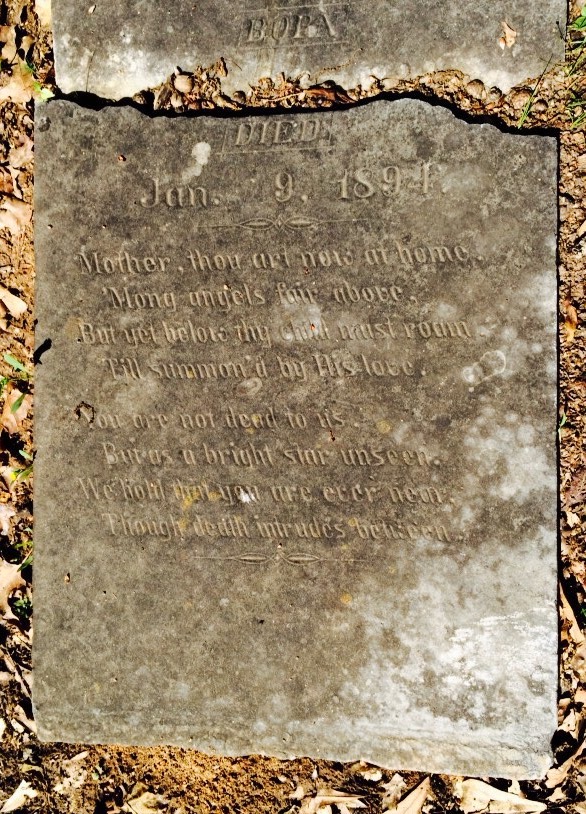
Martha Bruce Cheek's epitaph is still intact despite her marker's condition. It reads:  Holy Bible; Mother, thou art now at home, 'mong angels far above, but yet below thy child must roam, till summon'd by His love. You are not dead to us, but as a bright star unseen, we hold that you are ever near, though death intrudes between.

Martha Bruce Cheek’s epitaph is still intact despite her marker’s condition. It reads: Mother, thou art now at home, ‘mong angels far above, but yet below thy child must roam, till summon’d by His love. You are not dead to us, but as a bright star unseen, we hold that you are ever near, though death intrudes between.

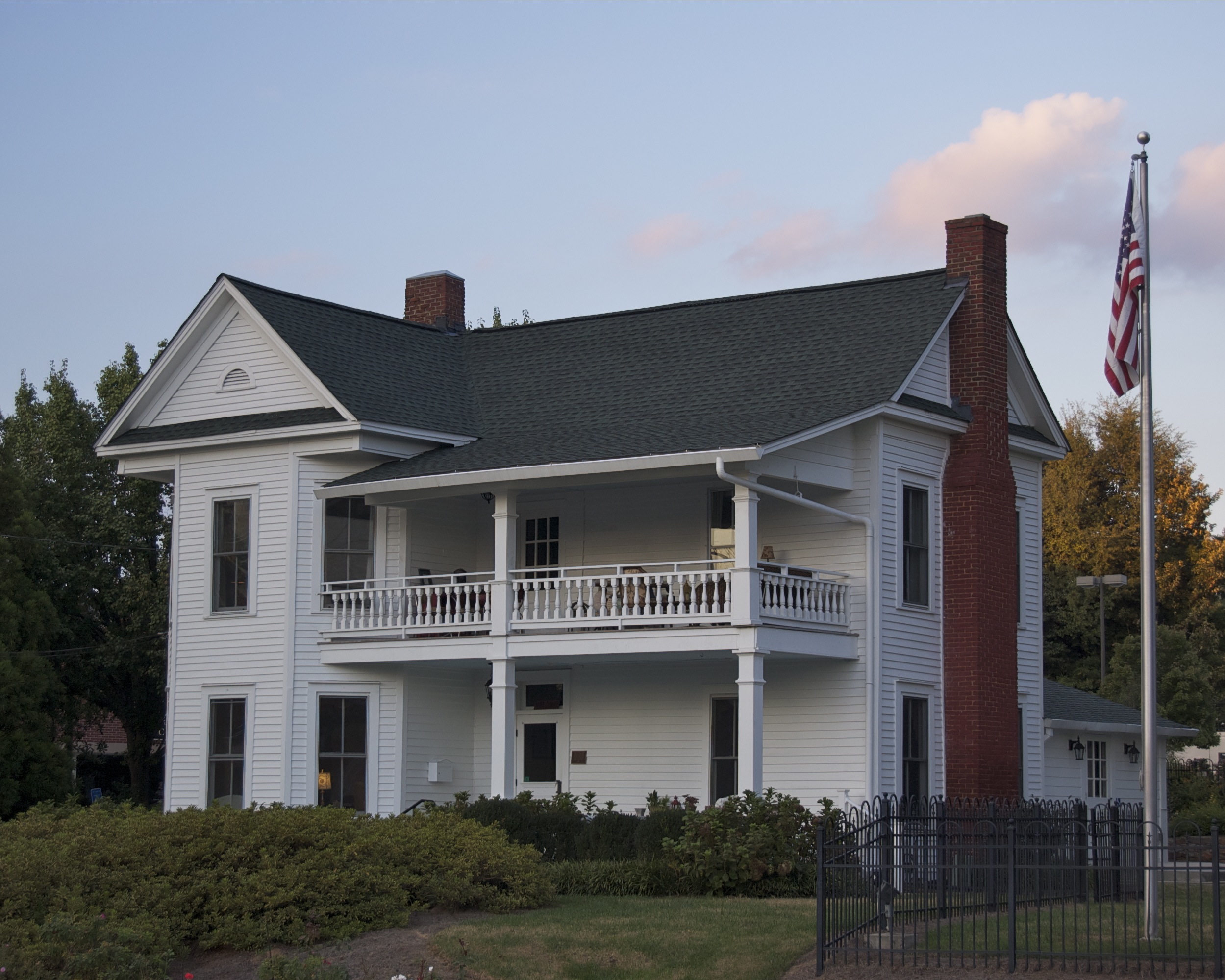
Samuel and Martha’s son, Joberry, had his own farm in Dunwoody. In 1906, he built a one-story farmhouse for his son, Bunyan Cheek. The house sat on 2.5 acres of land in the heart of Dunwood and included a pasture, cornfield, barn, smokehouse, and a chicken house. In 1945, it was purchased by Carey and Florence Spruill, and became known as the Cheek-Spruill Farmhouse. Mrs. Spruill lived in the home until her death in 1993.

Located at the busy corner of Chamblee-Dunwoody Road and Mount Vernon Road, the Cheek Spruill Farmhouse is still standing as a reminder of Dunwoody's past.

Located at the busy corner of Chamblee-Dunwoody Road and Mount Vernon Road, the Cheek-Spruill Farmhouse is still standing as a reminder of Dunwoody’s past.

The Dunwoody Preservation Trust held a campaign to “Save the Farmhouse” after Mrs. Spruill’s death and raised more than $200,000 but the amount was not enough to purchase the property from the Spruill heirs. The Farmhouse was saved when Guardian Savings and Loan (in Houston, Texas) purchased the property in 1998 and donated the home and 1.5 acre of land to the DPT. Today, it is leased by the law firm of DelCampo, Weber and Grayson.

I did eventually find out what the story was behind “Here I raise my Ebenezer.” It comes from the book of I Samuel in the Bible, when the Israelites defeated the Phillistines. Samuel raised a stone to commemorate their appreciation for God’s help in saving them and called it Ebenezer or “Stone of Hope”.

In turn, I think Ebenezer Baptist Church and its cemetery are symbols of hope to the community, reminding those that drive by how the strong roots planted by these pioneers continue to shape its present and future.

That’s a true fount of blessing, isn’t it?

Ebenezerflowers

Hidden Pioneers: Dunwoody’s Stephen Martin Cemetery

24 Friday Apr 2015

Posted by adventuresincemeteryhopping in General

≈ 11 Comments

A few weeks ago, I told you about how the Crowley Cemetery became the Crowley Mausoleum that’s located in the parking lot of the former Columbia/Avondale Mall (land now occupied by a Walmart). Today I’m going to share about another family cemetery that also ended up surrounded by commercial development. But this one has a somewhat happier ending.

I didn’t know anything about Stephen Martin Cemetery in Dunwoody until I read an offhand comment on Facebook that mentioned a cemetery at Perimeter Mall. I spend a lot of time in Dunwoody since my church is there, so I went to check it out.

This map shows where the Stephen Martin Cemetery is located in the green patch behind the shopping center. Few people know it's there.

This map shows where the Stephen Martin Cemetery is located in the rectangular tree-encircled patch behind the shopping center. Few people know it’s there. You can access it behind Marshall’s on the far left where the treeline is. Don’t do it the way I did by clambering over a guard rail.

Stephen Martin Cemetery is not in the Perimeter Mall shopping center itself. But it’s located behind a large strip shopping center across the road, almost completely hidden from view. From what I’ve read, the proximity of the cemetery forced a slight rerouting of I-285 and Ashford Dunwoody Road back in the day.

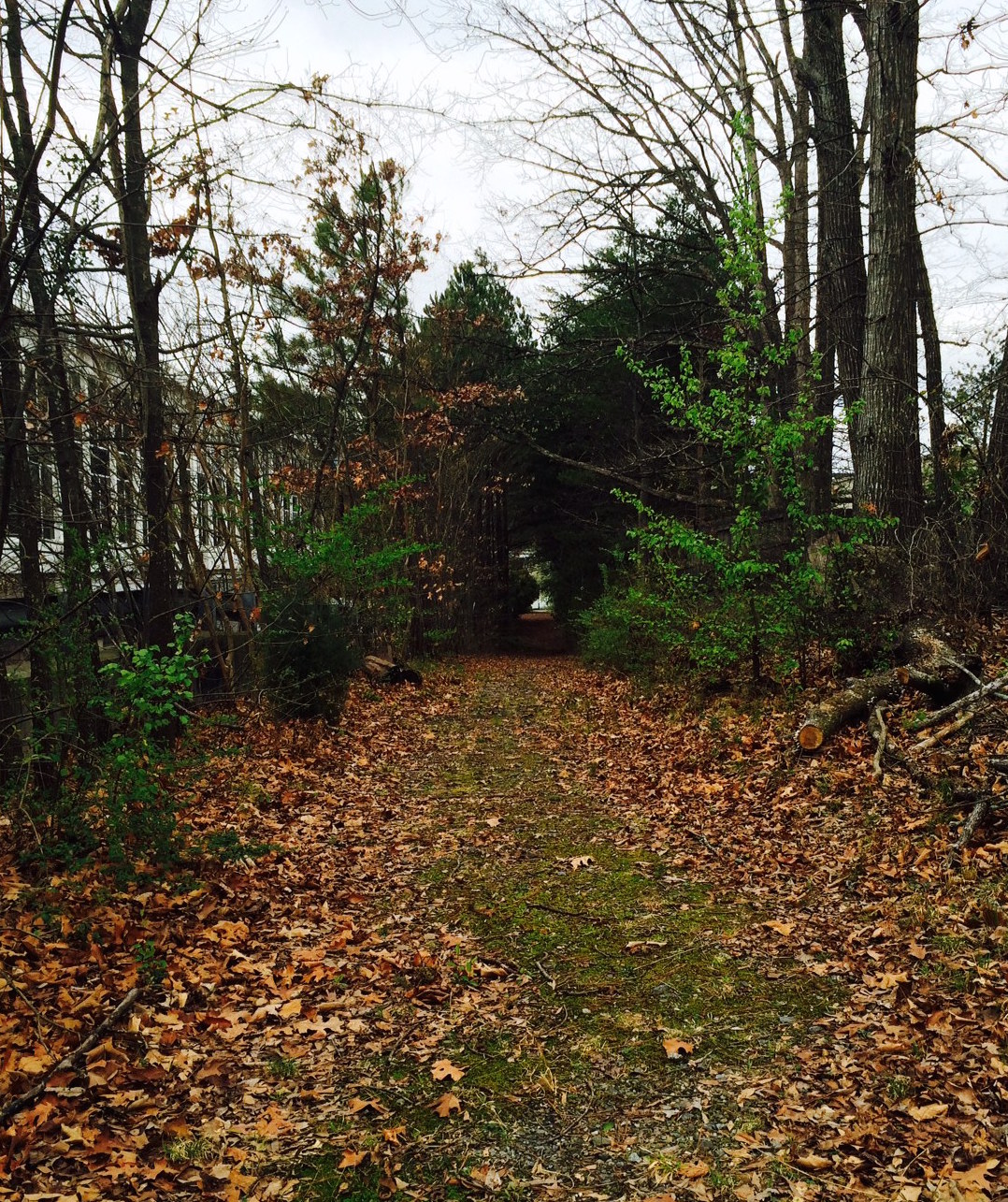
I went about finding the cemetery the wrong way. They’re doing a lot of construction on the road that this shopping center and a nearby hotel are located on. Big trucks were rumbling past the much easier tree-lined path that you can access from the Marshall’s parking lot on the side of the building. Because I missed seeing this entrance, I ended up going through the woods in the back behind the guard rail.

The Martin Cemetery is in the woods behind that guard rail. I took the picture from the parking lot of an abandoned office building. I wouldn't recommend climbing around the side like I did.

Stephen Martin Cemetery is in the woods behind that guard rail. I took the picture from the parking lot of an abandoned office building. I wouldn’t recommend climbing around the side like I did.

It’s a surreal experience to be standing in a cemetery that you know was once surrounded by farmland but has slowly shrunk down to this little patch. In front of you are the back doors to a Marshall’s and a T. Mobile store. Behind you, only a parking lot separates you from I-285, the interstate that encircles Atlanta. Past and present are keenly felt here.

As far as when the first burial took place, that is a mystery. But from what I can gather, one of the earliest was Elizabeth Francis Garrett Martin. She was the first wife of Stephen Martin and probably died in 1848. There are many graves marked only with rough fieldstones, so there may be graves even older than that.

Stephen Martin is thought to be buried between Elizabeth and his second wife, Sarah Crowley Martin. I think Sarah’s grave might be the one pictured on the left in the picture below because it looks to be made with larger pieces of stone (or slate) and not rocks. These stacked stone-style cairn graves always fascinate me because of their rough-hewn design.

You don't often see graves like these. They're usually hidden away in rural family cemeteries off the beaten trail.

You don’t often see graves like these. They’re usually hidden away in rural family cemeteries off the beaten path. That’s why I always enjoy seeing them. Stephen Martin’s is supposed to be in the middle.

This grave is thought to be that of Stephen Martin, for whom the cemetery was named. He was born in Laurens County, S.C. but moved with his family to Dunwoody sometime before 1830.

This grave is thought to be that of Stephen Martin, for whom the cemetery was named. He was born in Laurens County, S.C. but moved with his family to Dunwoody sometime before 1830.

With an ancestry based in Germany, Stephen Martin was originally from Laurens County, S.C. and moved to Georgia with his first wife and their children sometime before 1830. The area was home to the Cherokee Indian tribe of the Creek Confederation before white settlers came in. Two of his daughters (Naomi and Sophia) would marry into the influential Spruill family, who were key players in the establishment of Dunwoody.

One can easily say the Spruill family is still making their mark today. The Spruill’s original house was built in 1867 and was the center of a working farm. A large shopping center that includes a Walmart now looms large next door.

When Stephen T. Spruill married Mollie Lee Carter in 1889, that house was presented to them as a wedding gift from Stephen’s parents, Thomas F. and Naomi “Omie” Martin Spruill. In 1905, Stephen tore down the original log house and rebuilt it as the house it is known as today. The Spruill’s house and five surrounding acres were donated to the Spruill Center for the Arts to serve as a place to foster creative expression through the arts. It is now known as the Spruill Gallery.

The Spruill Gallery was once the center of a bustling family farm. Now it's an oasis of art and beauty amid the sea of development that surrounds it. Photo courtesy of www.spruillarts.org.

The Spruill Gallery was once the center of a large family farm. Now it’s an oasis of art and beauty amid the sea of development that surrounds it. Photo courtesy of http://www.spruillarts.org.

Omie Martin married Thomas Franklin Spruill in 1866. Before that, Thomas served in the Civil War, enlisting in Company C., 63rd Georgia Infantry in October 1863. His company surrendered on April 26, 1865 and he returned home in May that year.

Beside Thomas and Omie are the graves of four of their children who died before the age of 8. Many of their other children are buried at nearby Sandy Springs First Baptist Church Cemetery.

Photo of Thomas Franklin Spruill and his wife, Naomi

Photo of Thomas Franklin Spruill and his wife, Naomi “Omie” Martin Spruill. Both are buried at Stephen Martin Cemetery.

Naomi

Naomi “Omie” Martin married Thomas Spruill in 1866. Four of their children (who all died before the age of 8) are buried beside them (the smaller graves). Only a fence separates the cemetery from the shopping center that was built in front of it. On the other side lies I-285.

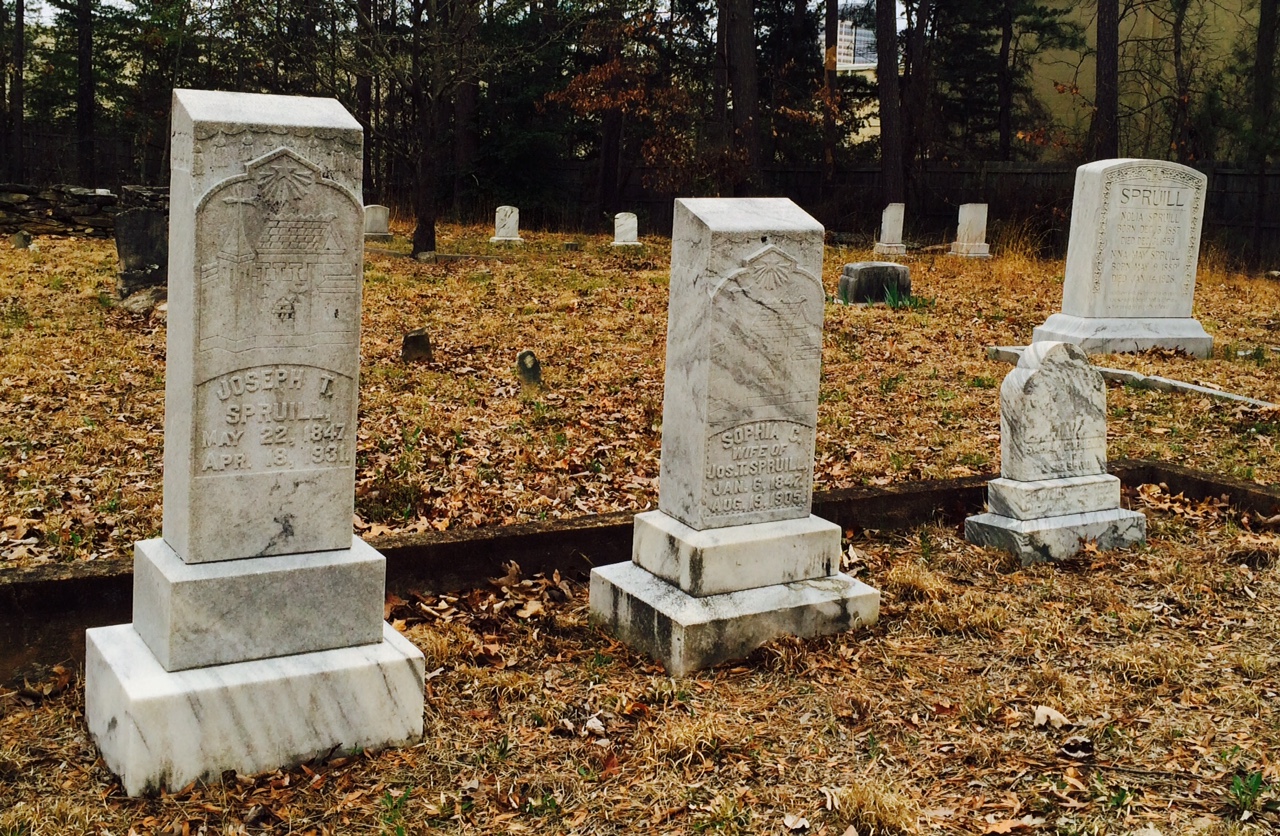
Sophia, Stephen Martin’s youngest daughter with his first wife, married Joseph T. Spruill in 1868. They had several children but only Sarah Cordelia, who lived just a short time, is buried beside them. Their son, Nolia, is buried to the right and back of their plot.

Sophia Martin Spruill was the first wife of Joseph T. Spruill. Their daughter Sarah, who died in infancy, is buried beside them. You can see their son Nolia's grave to the right and behind them.

Sophia Martin Spruill was the first wife of Joseph T. Spruill. Their daughter Sarah, who died in infancy, is buried beside them. You can see their son Nolia’s grave to the right and behind them. Joseph’s second wife is buried at Nancy Creek Cemetery.

Despite the fact it’s hidden behind a shopping center, the Martin Cemetery is in pretty good shape. The Dunwoody Preservation Trust looks after it, as far as I can tell.

One key factor in why I think the Martin Cemetery fared better than the Crowley Cemetery is the Spruill family itself. When they sold part of their land for the construction of Perimeter Mall and the development around it in 1971, they made sure that the cemetery wasn’t touched and would be protected. A number of Spruills still live in the Dunwoody area today.

Taken in the 1940s, this photo is of several of Thomas Franklin Spruill and Omie Martin Spruill's children. Daughters Eta, Naomi, Jane and Margaret are on the front row. Sons Stephen and Andrew are behind them. Only Margaret is buried at Martin Cemetery.

Taken in the 1940s, this features several of Thomas Franklin Spruill and Omie Martin Spruill’s children. Daughters (L to R) Etta, Naomi, Jane and Margaret are on the front row. Sons Andrew and Stephen are behind them. Only Margaret is buried with her husband at Stephen Martin Cemetery.

I also believe that the very fact that it’s hidden from sight has been to its advantage. I didn’t notice any vandalism or damage to the gravestones, save for a few that could use some TLC due to time and weathering.

So if you’re ever tired of shopping and want to enjoy a little Dunwoody history, stop by the Stephen Martin Cemetery and step back in time amid the chaos.

Just make sure to take the road MORE traveled to get there.

MartinRoad

View from Stephen Martin Cemetery to the entrance.

Crowley Mausoleum: How Getting “Malled” Left It in Limbo

10 Friday Apr 2015

Posted by adventuresincemeteryhopping in General

≈ 137 Comments

(Author’s Note: Since I wrote this post in 2015, I have been contacted by several Crowley descendants and others wanting to know how they can get involved in cleaning up the mausoleum. A wonderful fellow named Brenton Head has spearheaded several clean up days in recent years and the mausoleum is now getting regular attention. You can find Brenton on Facebook if you’re interested in helping out. Forest Hill passed away in 2019.)

I’m going to talk about a place I get asked about from time to time. The Crowley Mausoleum has a storied past but it currently sits forgotten. How it got that way is quite a tale. Most of what I was able to find out about it was from an account from Forest Crowley, a descendant.

James Crowley was born in 1772 in Pittsylvania County, Va. His parents, Benjamin and Sarah, brought the family to Oglethorpe County, Ga. in 1785. Benjamin died in 1817. In 1822, James received about 500 acres in Decatur from a land lottery and farmed it until his death in 1828. He later owned additional farms and did well financially, owning a number of slaves.

The family put their cemetery on a hill overlooking their land. When James died, he was buried there as was his wife, Dorcas, in 1852.

Son Allen Crowley owned the land from 1829 to 1846, when he moved his family by wagon train to Northern Mississippi. Younger brother Seaborn Crowley and his family took it over from 1846 to 1896 when it was purchased by the Hill Family (also Crowley relatives).

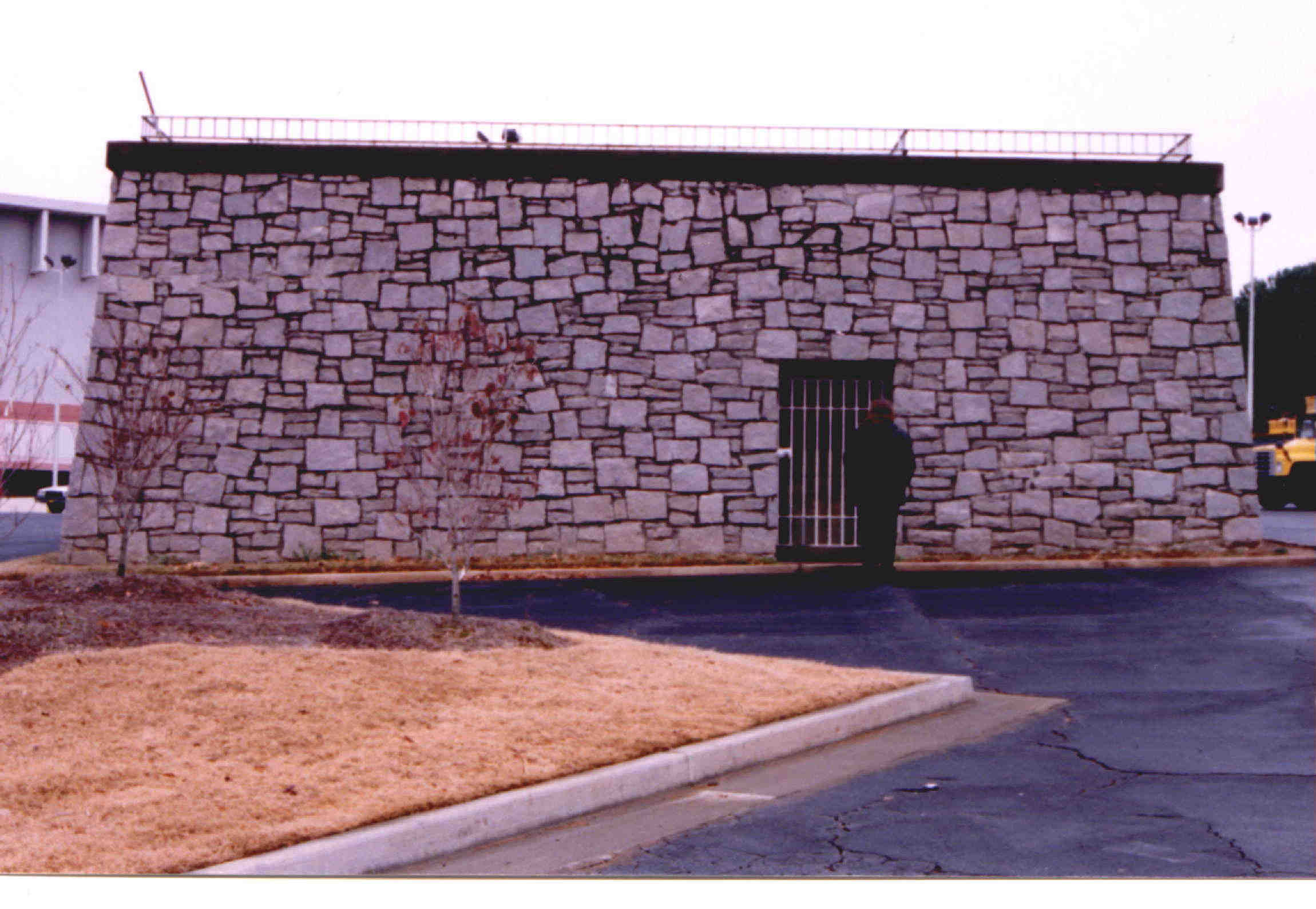
I found this picture of the Crowley Mausoleum when it was in the Avondale Mall parking lot. Many people have told me they remember it well when they lived in that area.

I found this 1997 picture of the Crowley Mausoleum when it was in the Avondale Mall parking lot. Many people have told me they remember it well when they lived in that area. The graves were accessed by going up a stairway to the top. Photo by Lois Mauk

According to Forest Crowley, the cemetery was originally in the middle of the pasture on the farm surrounded by a barbed wire fence. For a number of years in the 1950s, this fence fell into disrepair and livestock were able to enter and leave the cemetery.

In 1960, the Hills sold part of the land and leased the other part so that the Columbia Mall could be built. Completed in 1963, the mall was near the intersection of Memorial Drive and Columbia Road. The builder agreed to build a mausoleum around the cemetery, which was in the parking lot. The builder had to dig down about 20 to 25 feet on all sides of the cemetery and then build the building around the cemetery.

There were 40 or 50 slave graves buried surrounding the cemetery. Sadly, no effort was made to save those graves and they were built over. Currently, the 11 graves (nine of them of the box variety) at the top of the mausoleum are members of the Crowley, Cross and Hawkins families. Seven are adults and four are children.

These pictures appear to have been taken after Avondale Mall had closed around 2000. Most are uninscribed.

These pictures appear to have been taken after Avondale Mall had closed around 2000. I believe they originally had markers on top of them but those were later vandalized.

The name changed to Avondale Mall at some point. People visiting the mall often joked that the Mausoleum was the “Tomb of the Unknown Shoppers”. A 1994 newspaper article quoted someone as saying “When I die, bury me at the mall. That way I know you’ll come to see me every day.”

Many people I’ve talked to remember navigating around the mausoleum when going to the mall to shop. One even told me he remembered as a teen learning how to drive in that parking lot and nearly hitting it.

A bronze plaque explained the history of the site. I’m not sure where the part about the land grant being from the king of England came from. It contradicts everything else I’ve read. The plaque was later pried off the mausoleum and has vanished.

This plaque has since been pried from the mausoleum and stolen. I can't attest to it's truthfulness as the research I've done says nothing about a land grand from the king of England.

This plaque has since been pried from the mausoleum and stolen. I can’t attest to it’s truthfulness as the research I’ve done says nothing about a land grand from the king of England. Photo by Lois Mauk.

The area around the mall changed in the late 70s and 80s as white flight hit and some of the mall’s stores began to close. When Macy’s closed their clearance store there in 1995, the writing was on the wall. In 2001, it finally closed and sat empty until Walmart purchased the land and demolished the mall. After some community protests, construction for a Supercenter began and it opened in 2008.

According to Forest Crowley, there’ve been a number of break-ins at the Mausoleum over the last several years and some of the headstones on top of the box tombs were broken and thrown to the parking lot, then thrown away. Other headstones were stolen.

Due to the reconfiguration of the parking lot, the Crowley Mausoleum is now mostly hidden by trees and is behind a Napa Auto Parts store. You can’t see it from the parking lot but if you know where to look, you can glimpse it as you’re driving past the Napa on Memorial Drive.

This is an aerial view of the Crowley Mausoleum, courtesy of www.roadsideresort.com.

This is an aerial view of the Crowley Mausoleum, courtesy of http://www.roadsideresort.com.

I knew about the Crowley Mausoleum for a while but hadn’t stopped to get a good look at it. To be honest, that stretch of Memorial Drive is rather sketchy and I wasn’t keen on poking around on my own. It wasn’t until January of this year, when I had my friend and fellow cemetery hopper Jennifer with me, that I got an up close look at it.

Unfortunately, being hidden from sight hasn’t done it any favors.

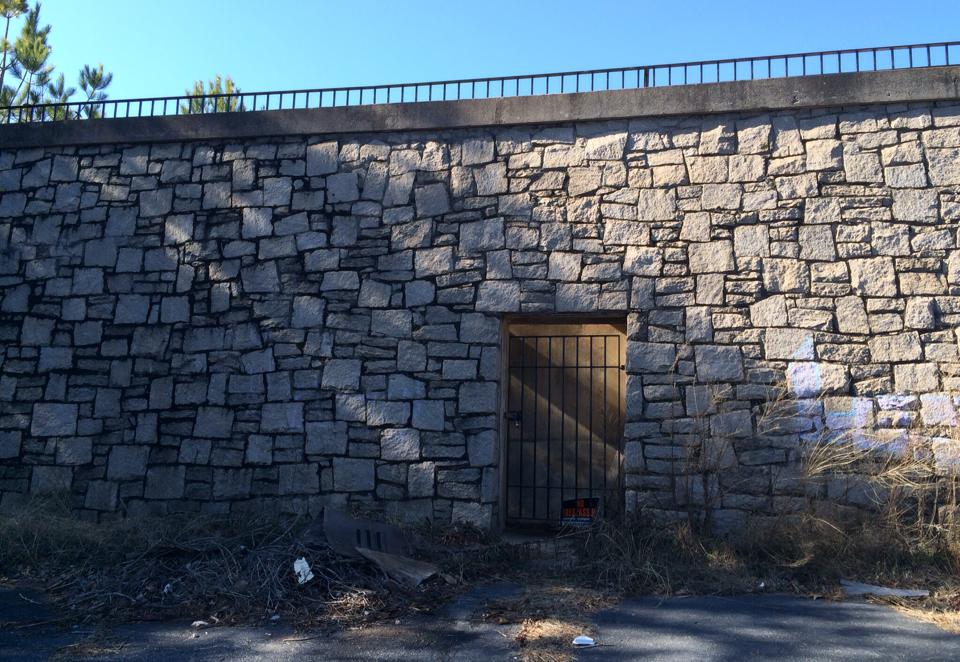
This is what the front of the Crowley Mausoleum looks like today. The door is chained and locked. Trash and debris litter the area.

This is what the front of the Crowley Mausoleum looks like today. The door is chained and locked. Trash and debris litter the area.

The mausoleum is about 20 feet high and unless you’ve got a ladder (or as I joked with Jennifer, a cherry picker), you can’t see the top of it or the graves. It looks like someone’s spray painted the area to the right of the door.

The walls of the mausoleum are about 15 feet high and unless you have a ladder, you can't see the top. I don't advise trying that.

The walls of the mausoleum are about 20 feet high and unless you have a ladder, you can’t see the top. I don’t advise trying that.

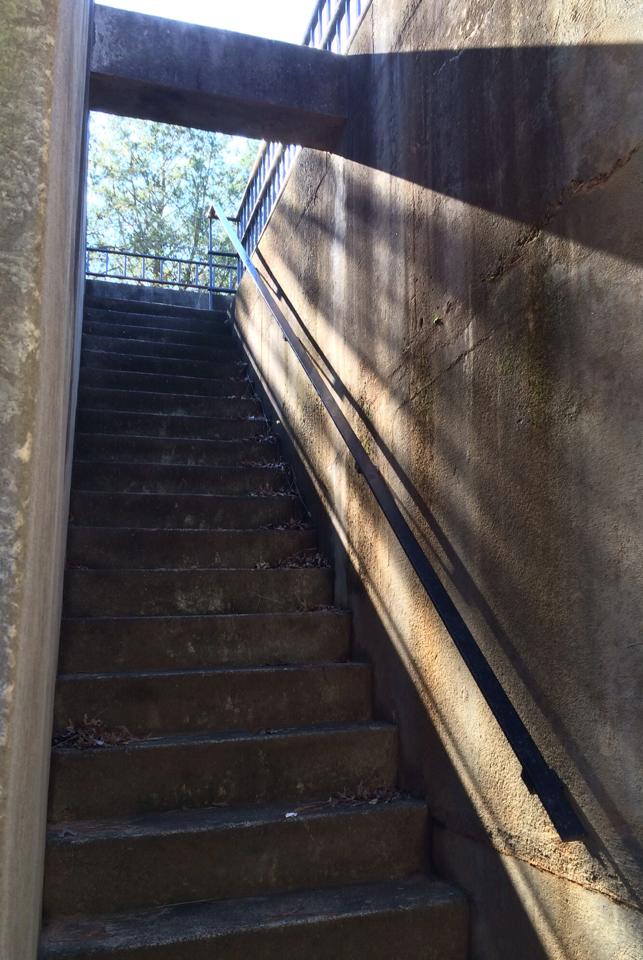
I did take a look up the stairs to try to get a glimpse of the view.

Here's the view from the stairwell. A pile of leaves and other trash sit at the foot of it.

Here’s the view from the stairwell. A pile of leaves and other trash sit at the foot of it.

I have no idea who is currently in charge of taking care of the Crowley Mausoleum now, if there is anyone doing so. I haven’t contacted the DeKalb History Center yet but I plan to. Maybe they know. I worry that if it continues to deteriorate, someone’s going to break into it and vandalize what’s left of the graves at the top. If there IS anything left of them.

Interestingly enough, the Crowley Mausoleum isn’t the only example of a cemetery in a parking lot. This site shows aerial photos of some others around the country.

Next week, I’ll visit the Stephen Martin Cemetery in Dunwoody (also in DeKalb County). It’s tucked away behind a large shopping center next to Perimeter Mall but is in better shape than the Crowley Mausoleum.

Hollywood Cemetery’s Buried Treasure: The Story of the Duke Brothers

03 Friday Apr 2015

Posted by adventuresincemeteryhopping in General

≈ 60 Comments

For some time, I’ve been aware of the dilapidated state of a cemetery in Northwest Atlanta but haven’t had the courage or companion to visit it. Located inside the I-285 Perimeter at the intersection of Hollywood and Hightower Roads is Hollywood Cemetery.

Because this area is known for its rough edges, I’d been told not to go alone. In addition, the place is so often overrun with vegetation, the best time to go is from late November through March. Not exactly prime weather time.

But last week, my friend and fellow cemetery hopper Cathy and I met up so we could visit Hollywood together. She brought her machete (for cutting away vines and our personal protection) and we headed over.

This is a view of where Hollywood Road and Hightower Road split at the Terraces. If you only saw this picture, you'd think Hollywood was in fine shape. But there are actual graves in the woods on the right across the road.

This is a view of where Hollywood Road and Hightower Road split at the terraces section. If you only saw this picture, you’d think Hollywood was in fine shape. But the majority of graves are hidden in the woods on the left and right side of it.

Hollywood Cemetery opened sometime in the early 1890s, lauded as a picturesque alternative to Oakland and Westview Cemeteries. It featured a terraced landscape and was easily accessible by streetcar. The neighborhood was considerably more well heeled at the time.

The story of how Hollywood went from a grand cemetery to a ruin is complicated and I don’t know all the facts. It’s currently owned and “maintained” by Lincoln Cemetery, who also owns the adjacent Magnolia Cemetery (in poor shape but still mowed) and Monte Vista Cemetery (which is well maintained and still sells plots). You can read more about that in this article.

To put it in a nutshell, much of Hollywood’s history is shrouded in rumors and question marks. What is clear is that it’s a big mess.

Cathy and I spent the first few hours negotiating the terraced level of Hollywood, which is easy to navigate compared to the jungle-like areas across the street. Some graves are broken, others knocked off their bases. Some are hidden from sight. This picture of a stairway can give you a glimpse of what it might have looked like in better days.

It's hard to imagine being able to negotiate this stairway even in better days.

It’s hard to imagine being able to negotiate this stairway even in better days since the steps are so narrow.

It’s not until we went over to Gun Club Road and up into the woods that we saw how truly bad things are.

GunClubRd1GunClbRd2GunClbRd3Hiking through the vines, thorns, trees and fallen branches was no easy task. I can’t imagine what it’s like during the summer when it’s hot and insects are in full throng. I’m thankful neither one of us encountered a snake or stepped in a hole (although we did see a decomposing deer carcass).

But it was when we encountered this monument amid the trees that we both stopped in stunned silence.

Sitting quietly forgotten among the vines and branches is the grave of Van Wallace Duke, an adventurous young man whose life was cut short by tragedy thousands of miles from home.

Sitting quietly forgotten among the vines and branches is the grave of Van Wallace Duke, an adventurous young man whose life was cut short by tragedy thousands of miles from home.

Inscribed on the grave of 19-year-old Van Wallace Duke are these words:

How soon fades the tender flower,
But love’s remembrance lasts forever.
Died in St. Francis Dam break Calif.

After we finished up and had lunch at nearby Hotty Hawg’s Smokin’ BBQ (which I highly recommend), I headed home and hit the Internet. Thanks to Ancestry.com, I was able to find out quite a bit about Van Wallace Duke and his older brother, J.R. (whose granddaughter gave me permission to share her photos and family stories).

A portrait of J.R. and Maxie Duke, who were about 17 years apart in age. Maxie died at the age of 31, leaving her five children without a mother. J.R. died seven years later. Photo courtesy of the Duke family.

This is a portrait of J.R. and Maxie Duke, who were 17 years apart in age. Maxie died at the age of 31, leaving behind five children. J.R. died seven years later. Photo courtesy of the Duke family.

Van was the youngest son of John (J.R.) Duke, Sr. and Maxie Isala Wallace Duke. Maxie died in 1910 when Van was still a baby. J.R. was a freight train conductor in Atlanta and died in 1917. Obituaries state that both parents were buried at Hollywood but their graves have not been found.

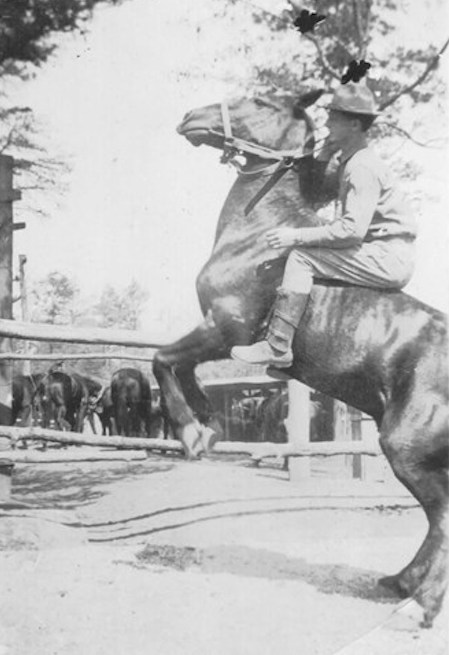
Van’s older brother J.R., Jr. lied about his age and joined the U.S. Cavalry, serving with General John J. Pershing from 1916 to 1917. Family history states they were pursuing Poncho Villa into Mexico when they were called back by the start of World War I.

Older than his brother Van by 12 years, J.R. Duke Jr. lied about his age to join the U.S. Cavalry. He told his family years later,

Older than his brother Van by 12 years, J.R. Duke Jr. lied about his age to join the U.S. Cavalry. He told his family years later, “You always took care of your horse first! Before you ate, before you got water, you fed and watered your horse.” Photo courtesy of the Duke family.

By 1928, J.R. was working as a foreman for the Southern California Edison Company. He invited his younger brother, now 19, to come out and join him. Van, in Georgia living with older sister Leona and her husband, jumped at the chance and headed to California by himself. He rode his bike or caught rides, working his way across the country alone.

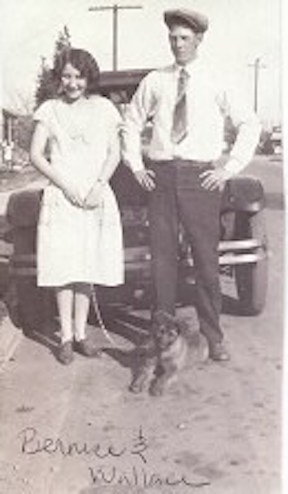
This is a picture of Van Wallace Duke with his brother's wife, Bernice, after he arrived in California from Georgia. Photo courtesy of the Duke family.

This is a picture of Van Wallace Duke with his sister-in-law, Bernice, after he arrived in California from Georgia. Photo courtesy of the Duke family.

When Van arrived in California, he must have been awed by the newly constructed St. Francis Dam. As a curved concrete gravity dam, it was built to create a large regulating and storage reservoir for the City of Los Angeles and was an integral part of the city’s Los Angeles Aqueduct water supply infrastructure. It was located in the San Francisquito Canyon of the Sierra Pelona Mountains 40 miles northwest of Los Angeles near the present city of Santa Clarita.

Built between 1924 and 1926, the St. Francis dam had issues from the start. William Mulholland, its chief engineer and general manager, was blamed for its ultimate failure.

Built between 1924 and 1926, the St. Francis Dam had issues from the start. William Mulholland, its chief engineer and general manager, was blamed for its ultimate failure.

As the Duke brothers toiled for Southern California Edison, they were quite familiar with the dam since the work they did was just below it. The dam’s chief engineer and general manager was William Mulholland, a native of Belfast, Ireland who garnered much respect for his experience. At 600 feet long and 185 feet high, the dam had a 12.5 billion-gallon capacity.

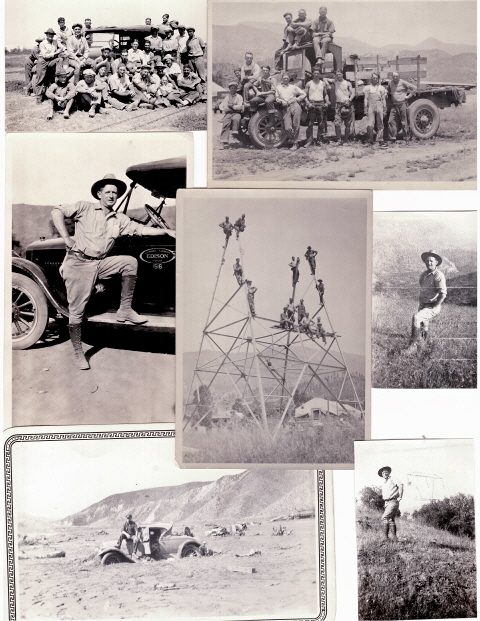
This collage of photos features Southern California Ed foreman John R. Duke during his days in the San Francisquito Mountains. The picture on the bottom left was taken after flood. Photo courtesy of the Duke family.

This collage of photos features Southern California Edison foreman J.R. Duke Jr. during his days in the San Francisquito Canyon. The picture on the bottom left was taken after flood. Photo courtesy of the Duke family.

On March 12, J.R. laid off many of his workers (including Van) because their work was almost finished. However, instead of leaving, most of the men stayed a final night to play cards and relax. Van was one of them. That decision would cost many of them their lives.

Just a few minutes before midnight, the St. Francis Dam broke. J.R. barely escaped by riding a tent above the waves, jumping to the shore and clinging to it with all his might. He told his family later that he was stripped of all his clothes and his fingernails were torn completely off his fingers.

As the dam collapsed, 12 billion gallons of water surged down San Francisquito Canyon in a dam break wave, destroying everything in its path. The water flooded parts of present-day Valencia and Newhall before turning west into the Santa Clara River bed. It continued west through Santa Paula in Ventura County, emptying victims and debris into the Pacific Ocean at Montalvo (54 miles from the reservoir and dam site).

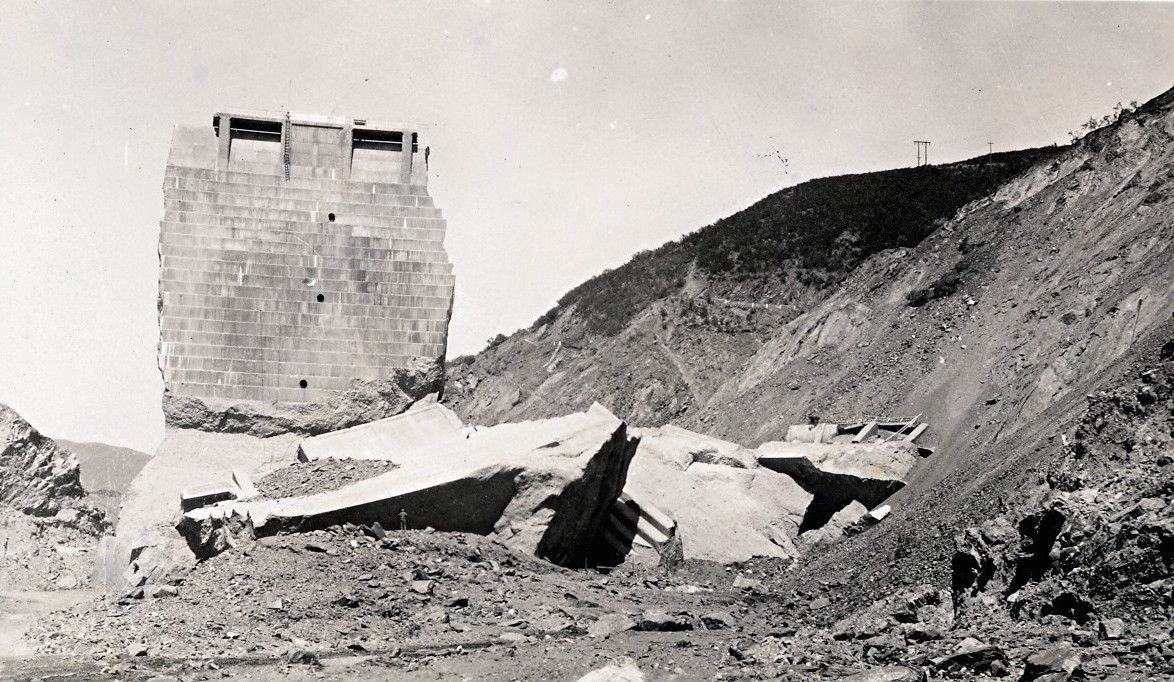
This fragment was all that remained after the St. Francis Dam broke a few minutes before midnight on March 12, 1928. Photo courtesy of Photos courtesy of Caroline and Glenn Marshall.

This fragment was all that remained after the St. Francis Dam broke a few minutes before midnight on March 12, 1928. Photo courtesy of Caroline and Glenn Marshall.

When the surge reached the ocean at 5:30 a.m., the flood was almost two miles wide, traveling at a speed of five miles per hour. Bodies of victims were recovered from the Pacific Ocean, some as far south as the Mexican border. An estimated 600 people were carried away by the flood, including Van Wallace Duke. (Note: When I wrote this post in 2015, 600 was the estimated death toll. As of 2022, the estimated death toll was closer to 450.)

According to his family, J.R. had the heart-wrenching job of identifying the dead bodies of his workers and his brother. Many bodies were never recovered.

At least 78 bodies were stacked up inside the Masonic hall at Railroad Avenue and Market Street in Newhalll, which was converted into one of several makeshift morgues along the St. Francis floodpath. Volunteers were already setting up improvised slabs inside the building at 4 a.m. on March 13, 1928, before the flood had even reached the Pacific Ocean. Photo courtesy of SCVhistory.com.

At least 78 bodies were taken to the Masonic hall at Railroad Avenue and Market Street in Newhall, which was converted into one of several makeshift morgues along the St. Francis floodpath. Photo courtesy of SCVhistory.com.

The collapse of the St. Francis Dam is considered to be one of the worst American civil engineering disasters of the 20th century and remains the second-greatest loss of life in California’s history, after the 1906 San Francisco Earthquake and fire.

Van Wallace Duke's obituary

Van Wallace Duke’s obituary

Van’s body was brought home to Atlanta and he was buried in Hollywood Cemetery. J.R. spent the rest of his life in California with his wife, Bernice, and they had one daughter. He died in 1984 and is buried in Visalia Public Cemetery in Visalia, Calif.

U.S. Rep. Howard “Buck” McKeon introduced H.R. 5357, the Saint Francis Dam Disaster National Memorial Act, in July 2014 but it failed to pass. This would have created a memorial to the estimated 600 victims of the flood. Currently, U.S. Representative Steve Knight is trying to get it passed again. You can read more about how you can help here.

As I pondered the story of the Duke brothers, I thought of my recent posts on the Bios Urn and the potential composting of human remains. Those are exciting prospects for some people.

But when you stumble upon a piece of history such as Van Duke’s grave stone, which tells about his life in a few simple words, a window to a moment in time is opened. A life ended by a dam’s collapse thousands of miles away. The fates of two brothers from Georgia, determined by a hand unseen, but whose effects were felt for decades afterward.

This is why cemeteries matter. Even if they are hidden under a mass of leaves and vines.

What other amazing stories rest unknown and unseen in Hollywood Cemetery?

Hollywoodmess

History at Risk: Saving the Heard Family Cemetery

20 Friday Mar 2015

Posted by adventuresincemeteryhopping in General

≈ 7 Comments

UPDATE:  The Heard Cemetery court case was settled privately not long ago and is safe from development or having any homes built on it. According to this article, a key to the case was the discovery of an old deed that granted the Heards’ male heirs ownership of the cemetery in perpetuity.

As you’ve learned from this blog, small but remarkable cemeteries can be tucked away in some surprising places. This week I visited one I read about last year and it’s embroiled in a legal battle that shows no sign of being resolved anytime soon.

Heard Family Cemetery is located in Fulton County at the end of Heards Drive, a narrow road lined with multi-million dollar homes. It’s a quiet haven, with about 30 or so visible grave stones with many more unmarked. Unlike some neighborhood cemeteries slowly sliding into ruin under vines and branches, this one is lovingly cared for by its neighbors.

HeardFamilyCemeteryThis area is also near the site of what was once called Isom’s Ferry. If you’ve lived in Atlanta for any length of time, you know that many of the roads are named after the pioneer-operated ferries on the Chattahoochee River during the 1800s, such as Paces, McGinnis and Johnson. Isom’s Ferry was operated by James Isom until 1868.

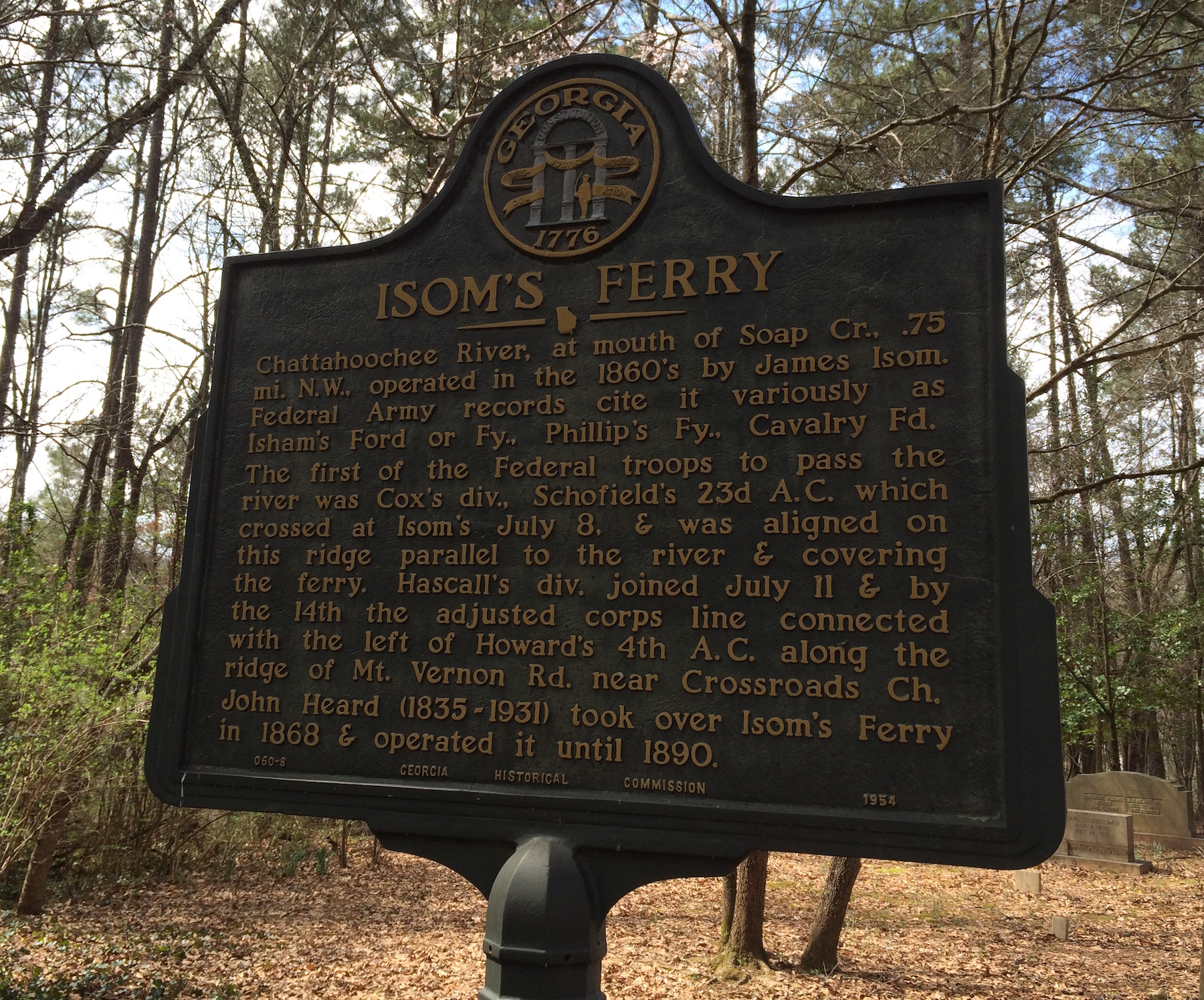
This historical marker at the Heard Family Cemetery explains the vital role of Isom's Ferry (now known as Heard's Ferry) during the Civil War.

This historical marker at the Heard Family Cemetery explains the pivotal role of Isom’s Ferry (now known as Heard’s Ferry) during the Civil War.

Located at the confluence of Sope Creek and the Chattahoochee River, this land is historically important because Union troops first crossed here on their way south to Atlanta during the Civil War. A well-written article by Kimberly Brigance, Clarke Otten and Michael Hitt describes the events that took place in July 1864.

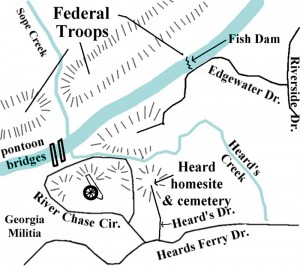
This map shows the location of the Heard Family Cemetery and where Union Troops crossed the nearby Chattahoochee River on their way south through Georgia. Map courtesy of Reporter Newspapers.

This map shows the location of the Heard Family Cemetery and where Union troops crossed the nearby Chattahoochee River via Sope Creek on their way south to Atlanta. Map courtesy of Reporter Newspapers.

During that summer, President Abraham Lincoln faced re-election and his prospects were not good. Confederate troops had racked up a high number of Union casualties at the Battle of Kennesaw Mountain. General William T. Sherman knew that for Lincoln to have any chance of being re-elected, Atlanta had to fall by November. The Chattahoochee was the last natural barrier between Union troops and Atlanta and Isom’s Ferry was thought to be the weakest point at that time.

On July 7, Sherman sent troops to the Sope Creek area with orders of little noise and no fires. On July 8, Union soldiers on ridges along the Sope Creek side of the river opened a barrage of rifle and cannon fire aimed at the Confederate position. About a hundred soldiers came out of the woods toward the river, firing across it at the water level.

Pontoon boats like this one ferried Union soldiers across Sope Creek so they could advance south to Atlanta. Photo courtesy of Newspapers.

Pontoon boats like this one ferried Union soldiers across Sope Creek so they could advance south to Atlanta. Photo courtesy of Reporter Newspapers.

From behind the ridge, 25 pontoon boats carrying soldiers went into Sope Creek and headed downstream toward the opposite bank of the river. Confederate gunners are reported to have only gotten off one shot before being overtaken. By day’s end, Federal engineers had two pontoon bridges in place shuttling more men and equipment into Sandy Springs. Union troops held three hill tops, one being the home of the Heard family and present location of the Heard Family Cemetery.

This newspaper photo of Judge John S. Heard is from his later years. His annual birthday barbecues at his farm were attended by many, including his family members.

This newspaper photo of Judge John S. Heard is from his later years. His annual birthday barbecues at his farm were attended by many, including his family members.

Judge James S. Heard was born to William “Buck” Heard (a blacksmith) and Rebecca Gill Heard in 1835. During the Civil War, Judge Heard served in the Ninth Battalion of the Georgia Artillery and is said to have been present at Appomattox when General Robert E. Lee surrendered to General Ulysses S. Grant. In 1868, Judge Heard bought Isom’s Ferry from James Isom and operated it until 1890 so it was renamed Heard’s Ferry.

Judge Heard’s first wife, Abie, was Isom’s daughter and together, they had several children. Some died in infancy but several lived to adulthood and had families of their own.

Judge John S. Heard is buried with his first wife, Abie Isom Heard, and his second wife, Athalena Dickerson Heard.

Judge John S. Heard is buried with his first wife, Abie Isom Heard, and his second wife, Athalena Dickerson Heard. Several of his children and grandchildren are buried around him.

After Abie died in 1882, Judge Heard married Athalena Dickerson. She was about 20 years his junior and they, too, had several children. Judge Heard lived to the ripe age of 96, celebrating his birthday each year on August 7 with a festive barbecue at his farm that was attended by many locals and family members.

Judge Heard sits between two of his granddaughters at the last birthday barbecue he celebrated in 1931. He wanted to be buried on his land among his family when he died.

Judge Heard sits between two of his granddaughters at the last birthday barbecue he celebrated in 1931. He wanted to be buried on his land among his family when he died.

The stones at the Heard Family Cemetery tell stories of lives short and long, especially children who died in infancy. Many of them are the grandchildren of Judge Heard and his wives.

Grady Frazier was the son of Kansas Heard Frazier and William Frazier, and grandson of Judge John Heard. She was the daughter of Judge Heard and his first wife, Abie.

Grady Frazier was the son of Kansas Heard Frazier and William Frazier, and grandson of Judge Heard and his first wife, Abie.

James “Jim” Heard was Judge Heard and Abie’s son. As a police officer, Jim made headlines when he was shot and killed during the 1906 Atlanta race riot. He and his 19-year-old bride, Stella Sowers, had been married less than a year. Originally buried at Oakland Cemetery in Atlanta, Jim was moved several months later to Heard Family Cemetery.

James "Jim" Heard was a policeman who was shot and killed during the 1906 Atlanta race riot. He was only 42 at the time.

James “Jim” Heard was a policeman who was shot and killed during the 1906 Atlanta race riot. He was only 42 at the time.

One of the more intriguing graves is that of Judge Heard and Abie’s eldest son, Newton Heard and his wife, Ellen. A tree is growing up the back of the stone and is actually notched on top of it, using it as a support. I don’t see that very often.
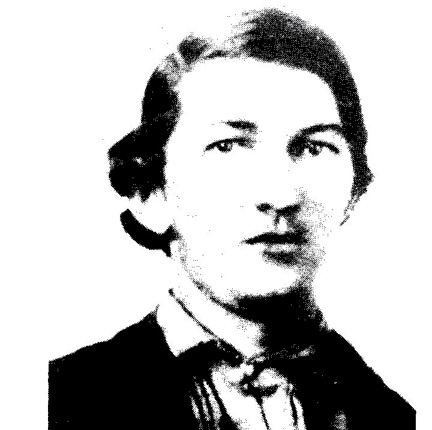
NewtonHeard1

Newton Heard was the son of Judge Heard and his first wife, Abie. A tree appears to be using his grave as a support.

Newton Heard was the eldest son of Judge Heard and his first wife, Abie. A tree appears to be using his grave as a support. Newton is buried with his wife, Ellen.

In 1900, with hopes of creating a permanent resting place for himself and his descendants, Judge Heard deeded the cemetery to his family. All went well until the mid-1990s when Fulton County, for reasons unknown, began to tax the property despite the fact cemeteries are tax exempt.

What happened next has been reported differently by various media outlets so I’ve done my best to piece things together. The property wound up on the tax assessor’s delinquent list. In December 2007, Mary Ann Elsner filed an affidavit of descent stating that she was the rightful inheritor. Elsner (listed as Mary Ellis in most of the older records) signed legal documents claiming to be the sole surviving heir of Carl Heard Jr., her brother, who was a descendant of Judge Heard.

That same month she sold the property to neighbors Henry and Wanda Cline, who paid the $38,400 tax bill and took possession. In July 2012, the Clines sold the property to attorney Christopher Mills for $1. He is also the Clines’ son-in-law.

Attorney Christopher Mills has filed a lawsuit against the city of Sandy Springs for blocking attempts to build on property where the Heard Family Cemetery is located. Photo from the website of Busch, Slipakoff & Schuh, LLP

Attorney Christopher Mills filed a lawsuit in 2012 against the City of Sandy Springs for blocking his attempt to build on property where the Heard Family Cemetery is located. Photo from the website of Busch, Slipakoff & Schuh, LLP

Mills’ attempt to build on the portion of the property not containing graves (which is in dispute since a number of unmarked graves exist) was blocked by the City of Sandy Springs, who refused to give Mills a permit to build. Mills sued the city in August 2012, arguing that the land is already zoned for residential use.

All of this has not gone unnoticed by the Heard descendants and neighbors living around the cemetery. They stand with the city in wanting the cemetery to remain as it is and don’t want Mills to build on the property.

Wright Mitchell, the attorney representing the Heard descendants, said as long as there are descendents of Judge Heard that would be eligible to be buried on the land in the future, the entire property should be considered burial grounds and restricted from being used for another purpose.

In a WSB-TV report, he said, “Mr. Mills may be building his house on top of graves that haven’t been identified yet.”

Attorney Wright Mitchell is representing the Heard family descendants.

Attorney Wright Mitchell is representing the Heard family descendants.

“I don’t think it matters how much of it is being used, there are decedents who do plan to be buried there in the future and that’s what the land was set aside for,” Heard descendant Nancy Smith said at a 2013 hearing about the lawsuit.

Georgia Court of Appeals judges John J. Ellington and Carla Wong McMillian heard the case in September 2014. After deliberating on the matter, they will send their decision to the parties’ lawyers at a date yet to be determined. It could take months before this happens so the fate of the Heard Family Cemetery remains in limbo.

Several Heard family descendants attended a hearing in 2013 to voice their opposition to a house being built on the property where the Heard Family Cemetery is located. Photo by CBS 46.

Several Heard family descendants attended a hearing in 2013 to voice their opposition to plans for a house to be built on the property where the Heard Family Cemetery is located. Photo by CBS 46.

In the meantime, Heard descendants and cemetery neighbors have created a Save the Heard Family Cemetery Facebook page here they post updates on the case. They also have a PayPal account where supporters can contribute to paying for the legal fees incurred.

It’s heartbreaking that an error that began with the taxation of a cemetery that’s exempt from it was the catalyst for what may spell the end for a historic site. Mr. Mills contends that he can build on the remaining part of the property. But having seen the property myself, I think it would be very hard to do so without disturbing the graves (including the unmarked ones you can’t see).

As I walked around the cemetery this week, a gentle breeze hinting of spring stirred the daffodils as I examined the old stones. Unlike many family cemeteries, it’s not fenced off or locked up. The Heard Family Cemetery is a lovely oasis amid a neighborhood that takes care of it and wants it to remain undisturbed, for both Judge Heard’s descendants and newcomers like me seeing it for the first time.

I think that’s something well worth saving.

Heard Cemetery angel

Soylent Green: Turning Human Remains into Compost

13 Friday Mar 2015

Posted by adventuresincemeteryhopping in General

≈ Leave a comment

Update: Since I wrote this story 10 years ago, much has changed. Human composting is now legal in 13 states, with my own state of Georgia starting July 2025. However, there are currently no facilities in Georgia that can carry out the process. So what began as kind of a pipe dream is fast becoming a reality. Whether or not many will take advantage of this option remains to be seen. — May 2025

Last week I wrote about the Bios Urn, a biodegradable container that holds a tree seed that you add human cremains (ashes) to before planting it in the ground. The symbolism this evokes is that when you die, you can become a tree.

During my research, I came across another novel (if not unsettling) concept that is getting attention: the composting of human remains. Yes, you read that right. The notion of taking a human body and turning it into compost you can use in soil is on the drawing board.

You know what that immediately made me think of, don’t you?

Richard Fliescher's 1973 film immortalized the words "Soylent Green is people!" Set in 2022, Charleton Heston plays Detective Thorn, a cop who discovers that the food chips called Soylent Green are not made of plankton but actual human beings.

Richard Fleischer’s 1973 film immortalized the cry of “Soylent Green is people!” Set in 2022, Charleton Heston plays Detective Frank Thorn, a sardonic cop who discovers that the food chips called Soylent Green are not made of plankton but actual human beings.

Soylent Green, a futuristic film set in 2022, is about how a renegade cop (played by Charleton Heston) discovers that the food provided by the government called Soylent Green is not made of the plankton it is said to contain. Soylent Green is actually made from the protein found in human bodies. By the movie’s end, a screaming Charleton (“Soylent Green is people!”) is being carried away while the crowd watching thinks he’s lost his marbles.

The kind of human composting being proposed now does not involve creating little green squares for direct mass consumption. But it does mean turning a human body into compost that can be used in real soil to grow edible plants and ornamental trees/flowers.

Katrina Spade, an architect based in Seattle, Wash., founded the Urban Death Project. I am borrowing liberally from an article by Brendan Kiley about human composting that goes into great detail about her ideas. She came up with the idea in 2011.

This illustration from Brendan Kelly's article shows how loved ones would process up a winding ramp to the "core" where their loved one's body would be placed in a bay and a ceremony would be held to honor their life. Illustration by Jeremy Sorese.

This illustration from Brendan Kiley’s article shows how loved ones would proceed up a winding ramp to the “core” where their loved one’s body (wrapped in a shroud) would be placed in a bay, followed by a ceremony held to honor their life. Illustration by Jeremy Sorese.

Spade envisions building a three-story building where mourners could bring their dead. Friends and family would go with the unembalmed departed (wrapped in a shroud) up a circular ramp to the top of the “core,” or central decomposition chamber. What follows could be a type of ceremony during which the body would be placed into a mix of wood chips, straw and other organic material.

The core where the body is placed would be divided up into 10 “bays” — similar to elevator shafts — with several bodies in various stages of decomposition in each bay, separated from the bodies above and below by several feet of wood chips. Gravity and microbial activity would time the speed of each body’s descent.

After a few weeks or months (this is still being researched), loved ones would return to the building to pick up the remains, which have become an organic substance consisting of partially or wholly decayed vegetable or animal matter (also known as humus with one “m”, not the hummus made of chick peas). They could then use it to fertilize their own garden or leave it there to be used on the gardens surrounding the facility.

Spade's concept includes as much or as little human involvement in the preparation of the body as desired. The UDP web site says loved ones are encouraged to be part of the process of preparing the body for the procession and in the placement into the bay with the wood chips. Illustration courtesy of the UDP website.

Spade’s concept includes as much or as little human involvement in the preparation of the body as desired. The UDP web site says loved ones are encouraged to be part of the process of preparing the body for the procession and placement into the bay with the wood chips/organic material. Illustration courtesy of the UDP website.

Spade refers to this process as being “cremation by carbon”.

Kiley’s article includes an interview with soil scientist Lynne Carpenter-Boggs. She states that based on the elemental composition of human bodies, the compost from a 200 lb. person could produce six pounds of nitrogen, two pounds of phosphorus, and one pound of potassium. These are  three nutrients typically listed on fertilizers.

“I know this is going to be an offensive simplification of the value of a human body,” she says. “but one could compare the fertilizer value to 100 pounds of cottonseed meal.”

Soil and crop scientist Lynne Carpenter-Boggs likens the compost created by the human body to the fertilizer value to 100 pounds of cottonseed meal. Photo courtesy of Harmony Farm Supply and Nursery.

Soil and crop scientist Lynne Carpenter-Boggs likens the compost created by the human body to the fertilizer value  of 100 pounds of cottonseed meal. Photo courtesy of Harmony Farm Supply and Nursery.

How long it takes for a human body to decompose has been studied in recent years by places like the University of Tennessee’s “Body Farm” (which inspired the popular Kay Scarpetta mysteries). Spade did travel to Western Carolina University, which has a similar facility, to see how scientists are studying the natural decomposition of human remains in the outdoors

But doesn’t this process create a foul smell?

Spade said in a recent interview, “There is no smell. And that’s going to be accomplished by a number of ways, primarily through biofilters in the system. A good compost pile really doesn’t have much of an odor, and that’s because there’s a right mix of nitrogen and carbon and moisture and oxygen.”

Raised in rural New Hampshire where her family raised animals for slaughter and grew vegetables. Each household had compost piles. "We knew where our meat was coming from, where our vegetables were coming from."

Raised in rural New Hampshire, Katrina Spade’s family raised animals for slaughter and grew vegetables. Each household had compost piles. “We knew where our meat was coming from, where our vegetables were coming from.” Photo courtesy of National Public Radio.

Having received an $80,000 grant from the global non-profit Echoing Green to further develop her ideas, Spade hopes to get the operation up and running within the next few years. While the UDP has architectural designs for a potential facility, they need funds and a site upon which to build it.

The project will also have to overcome significant legal and regulatory hurdles. State law requires that all human remains be buried, cremated, donated to science or transferred out of state. The UDP would also have to get a license to operate a funeral home, according to the Washington state Department of Licensing. Local zoning restrictions, which require composting facilities to be outside populated areas, would also come into play.

Another more esoteric issue that arises from human composting is anonymously becoming a collective part of the soil along with hundreds of other people instead of burying an individual. I fully concede it’s something I can’t personally embrace. But others seem to like the idea quite a lot.

Spade admits that this communal pile, instead of individual plots of land or a special urn, is a psychological leap. “I’m asking people to accept that we don’t all need our own space when we die.”

Using the compost that came from the body of a loved one is a topic that excites some but makes others uncomfortable. Especially if it involves edible plants rather than ornamental flowers. Spade quipped, ""People love the idea of growing trees," she said. "They get really squeamish with tomatoes."

Using compost that came from the body of a loved one interests some but makes others uncomfortable. “People love the idea of growing trees. They get really squeamish with tomatoes,” Spade quipped in a 2014 Reuters article.

I understand that the practice of placing a body full of embalming fluid in a metal container in the ground is distasteful to many people and not exactly eco-friendly. But using compost that was once my Uncle George (and other people near him) so I can produce prize-winning tomatoes that can go into my salad is not one I can stomach either.

Many people I talk to say “I’m going to be dead so what does it matter?”. That opinion has merit and I understand it. But the unique rituals of the funeral and burial (which can be “green” and impact the earth more gently) are for the living, not the dead.

After my death, I want to leave my loved ones a place and a way to remember me if they choose. I don’t want to be taken to a “core” and composted with dozens of strangers.

And since I have a “black thumb” in the garden, even compost made from Uncle George wouldn’t help any tomatoes I planted survive.

deadtomatoes

← Older posts
Newer posts →

Recent Posts

  • Pandemic Cemetery Hopping: Wandering Around Atlanta’s Crest Lawn Cemetery/Casey’s Hill, Part II
  • Pandemic Cemetery Hopping: Wandering Around Atlanta’s Crest Lawn Cemetery/Casey’s Hill, Part I
  • Few But Not Forgotten: Paying My Respects at the Houston County Poorhouse Cemetery in Dothan, Ala.
  • More Pensacola, Fla. Cemetery Hopping: Taking a Ramble Through Saint John’s Cemetery, Part III
  • More Pensacola, Fla. Cemetery Hopping: Taking a Ramble Through Saint John’s Cemetery, Part II

Archives

  • July 2026
  • June 2026
  • February 2026
  • December 2025
  • November 2025
  • August 2025
  • July 2025
  • June 2025
  • May 2025
  • April 2025
  • March 2025
  • February 2025
  • January 2025
  • October 2024
  • August 2024
  • July 2024
  • June 2024
  • May 2024
  • April 2024
  • March 2024
  • February 2024
  • January 2024
  • December 2023
  • November 2023
  • October 2023
  • September 2023
  • August 2023
  • July 2023
  • June 2023
  • May 2023
  • April 2023
  • March 2023
  • February 2023
  • January 2023
  • December 2022
  • November 2022
  • October 2022
  • September 2022
  • August 2022
  • July 2022
  • June 2022
  • May 2022
  • April 2022
  • March 2022
  • February 2022
  • January 2022
  • December 2021
  • November 2021
  • October 2021
  • September 2021
  • August 2021
  • July 2021
  • May 2021
  • April 2021
  • March 2021
  • February 2021
  • January 2021
  • December 2020
  • November 2020
  • October 2020
  • September 2020
  • August 2020
  • July 2020
  • June 2020
  • May 2020
  • April 2020
  • March 2020
  • February 2020
  • January 2020
  • December 2019
  • November 2019
  • October 2019
  • September 2019
  • August 2019
  • July 2019
  • June 2019
  • May 2019
  • April 2019
  • March 2019
  • February 2019
  • January 2019
  • December 2018
  • November 2018
  • October 2018
  • September 2018
  • August 2018
  • May 2018
  • April 2018
  • March 2018
  • February 2018
  • January 2018
  • December 2017
  • November 2017
  • October 2017
  • September 2017
  • August 2017
  • July 2017
  • June 2017
  • May 2017
  • April 2017
  • March 2017
  • February 2017
  • January 2017
  • December 2016
  • November 2016
  • October 2016
  • September 2016
  • August 2016
  • July 2016
  • June 2016
  • May 2016
  • April 2016
  • March 2016
  • February 2016
  • January 2016
  • December 2015
  • November 2015
  • October 2015
  • September 2015
  • August 2015
  • July 2015
  • May 2015
  • April 2015
  • March 2015
  • February 2015
  • January 2015
  • December 2014
  • November 2014
  • October 2014
  • September 2014
  • August 2014
  • July 2014
  • June 2014
  • May 2014
  • April 2014
  • March 2014
  • February 2014
  • January 2014
  • December 2013
  • November 2013
  • October 2013
  • September 2013
  • August 2013
  • July 2013
  • June 2013
  • May 2013
  • April 2013
  • March 2013
  • February 2013
  • January 2013

Categories

  • General

Blogroll

  • A Grave Interest
  • Cemetery Photography by Chantal Larochelle
  • Cemetery Tours of Berlin by Matti
  • Confessions of a Funeral Director (Caleb Wilde)
  • Find a Grave
  • Hunting and Gathering (cool photography site)
  • Save Our Cemeteries (New Orleans, La.)
  • The Cemetery Club
  • The Graveyard Detective
  • The Rambling Muser
  • Westminster Abbey Tours by Grace

Meta

  • Create account
  • Log in
  • Entries feed
  • Comments feed
  • WordPress.com

Blog at WordPress.com.

  • Subscribe Subscribed
    • Adventures in Cemetery Hopping
    • Join 399 other subscribers
    • Already have a WordPress.com account? Log in now.
    • Adventures in Cemetery Hopping
    • Subscribe Subscribed
    • Sign up
    • Log in
    • Report this content
    • View site in Reader
    • Manage subscriptions
    • Collapse this bar
Loading Comments...