Grieving Outside the Box: Why People Leave Things on Graves

A few weeks ago, I was fulfilling a photo request for Find a Grave at a cemetery not far from my home. I’d been there other times. But on that day, I found something I’ve never seen before. On the side of the base of a grave marker was a box of what looked like human hair.

I still don't know what the significance there is behind this. But someone does.

I still don’t know what the significance of this is but I’d like to find out.

Inside a clear plastic Caboodles makeup box was a bag containing what appeared to be two ponytails of blonde human hair. It didn’t look like fake hair.

Nothing about the grave marker indicates why it’s there. The deceased was 47 when he died in 2006. He’s buried beside his grandparents. That’s all I know. Since then, many people I’ve shown the picture of it to have puzzled over why it’s there and its meaning. But there has to be a special story behind that box.

The most common items left on graves (besides flowers) are stones and rocks. This is primarily a Jewish custom. In the Old Testament, the sons of Jacob and Rachel placed stones over their mother’s grave. This type of “cairn” grave is not common any more but you can see them from time to time.

This stacked stone or "cairn" style grave is rarely seen now. This one is for a Revolutionary War veteran who settled in Georgia after it ended.

This stacked stone or “cairn” style grave is rarely seen now. This one is of a Revolutionary War veteran who settled in Georgia after the war.

One reason people place stones on graves is that they believe it keeps the soul down. This theory, with roots in the Talmud, cites that souls con­tinue to dwell for a while in the graves in which they are placed. The grave, called a beit olam (a permanent home), was thought to retain some aspect of the departed soul.
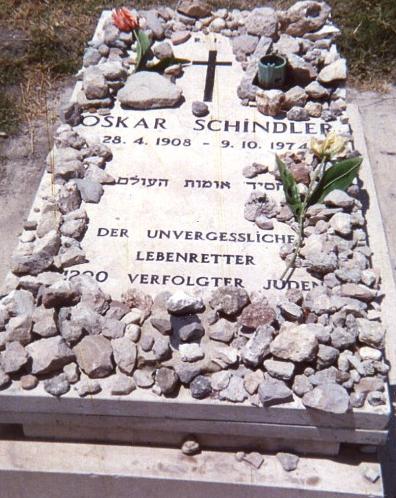
In the last scene of the film Schindler's List, the Jews saved by Oskar Schindler place stones on his grave to create the shape of a cross. His is buried in a Catholic cemetery in Jerusalem, Israel.

In the last scene of the film Schindler’s List, the Jews saved by Oskar Schindler place stones on his grave to create the shape of a cross. He is buried in a Catholic cemetery in Jerusalem.

Rocks are favored over flowers on Jewish graves because flowers were considered pagan. Mind you, Jews do use flowers on other occasions such as Shabbat and other holidays. But in general, do not leave them on graves. Also, rocks have a more permanent symbolism than flowers, which fade and eventually die.

This practice has gone beyond Jewish custom and is now embraced by people of all faiths. The reason is simple. It’s an easy way to leave a small memento that someone was there to visit the grave, to honor the deceased.

Another common item left on graves is a coin. This practice has its origins in ancient Greek mythology. Kharon (or Charon) was the ferryman of the dead, an underworld demon. He received the shades of the dead from Hermes, who gathered them from the upper world and guided them to the shores of the Akheron, one of the five rivers in Hades.

From there, Kharon took them in his boat to a final resting place in Hades, the land of the dead, on the other side. The fee was a single obolos coin, which was placed in the mouth of a corpse at burial. Those who had not received due burial and were unable to pay their fee would be left to wander the earthly side of the Akheron (some say it is the River Styx and not the Akheron), haunting the upper world as ghosts.

Artist Alexander Litovchenko painted his version of what he thought Kharon looked like crossing the River Styx. Photo courtesy of Wikimedia Commons.

Artist Alexander Litovchenko painted his version of what he thought Kharon looked like ferrying passengers in his boat. Photo courtesy of Wikimedia Commons.

In recent years, someone (whose name is unknown) wrote a primer on what certain coins mean when left on the grave of a person who served in the military. As an example, a nickel left on a grave supposedly means it was left by another serviceman who served with the deceased in boot camp. In my research, I’ve found nothing concrete to confirm these assertions yet.

It is true that military folk do sometimes leave special remembrances at the graves of deceased servicemen. They’re called challenge coins. These tokens identify their bearers as members of particular units and are prized and cherished by those to whom they’ve been given. Any challenge coins found at grave sites are almost always certainly left there by comrades-in-arms of the deceased.

This is an example of a challenge coin. President Barack Obama placed challenge coins on the memorials of the soldiers killed in the Fort Hood shooting.

This is an example of a challenge coin. President Barack Obama placed challenge coins on the memorials of the soldiers killed in the 2009 Fort Hood shooting.

After rocks and coins, what people leave on graves runs the gamut from the sad to the funny to the just plain weird (that box of hair qualifies). Statues of angels are popular. Some of you remember that on one of my first “hops”, I found some rubber snakes on a grave that made me jump about 10 feet.

At Oakland Cemetery in Atlanta, visitors leave golf balls at the grave of legendary golfer Bobby Jones. People leave Campbell soup cans on artist Andy Warhol’s grave in homage to his famous painting of…a can of soup. Fans of Elvis leave scores of teddy bears on his grave at Graceland. I wonder if someone’s ever left a peanut butter and banana sandwich there.

One famous example involves the grave of Hollywood icon Marilyn Monroe. Her ex-husband (and baseball legend) Joe DiMaggio set up an account with a local florist to put roses on Marilyn’s grave three times a week for 20 years after her death. He reportedly promised her on their wedding night that if anything were to happen to her he would honor her in some special way.

Marilyn Monroe is buried at Westwood Memorial Park in Hollywood, Ca. Last year marked the 50th anniversary of her death.

Marilyn Monroe is buried at Westwood Memorial Park in Hollywood. Last year marked the 50th anniversary of her death.

When I recently visited Kansas City, I wanted to see the grave of jazz legend Charlie Parker. It’s located far outside the city in a very out of the way cemetery. The little ceramic bird (with a real feather in it) left on his gravestone was simple but sweet.
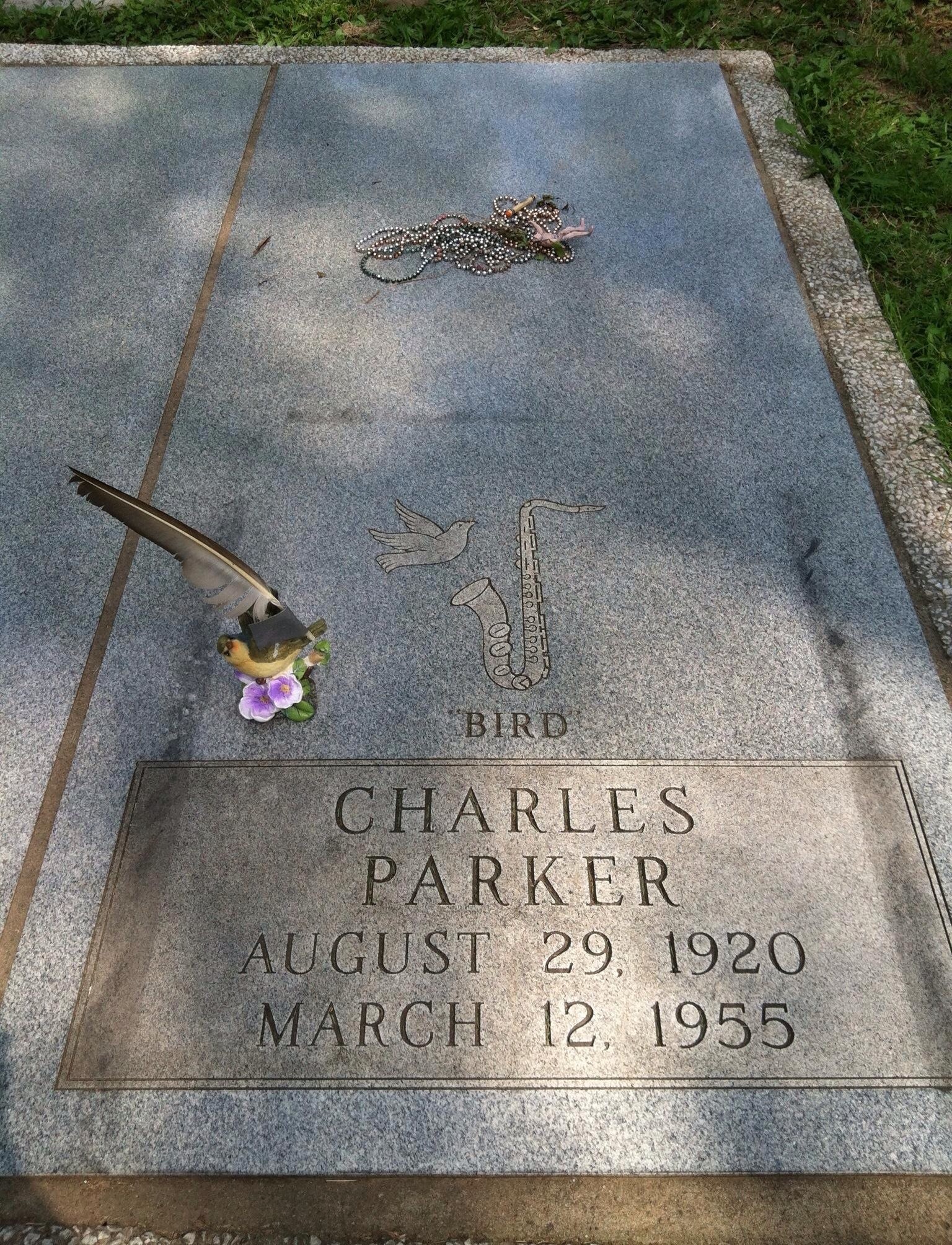
Charlie "Bird" Parker only lived 35 years but he made an indelible mark on the music world.

Charlie “Bird” Parker only lived 35 years but he made an indelible mark on the music world.

In the end, it really doesn’t matter what token you leave behind when you visit someone’s grave. If it’s something you feel best expresses how you remember that person, that’s what matters most.

Even if it’s a box of hair.

Ho Ho NO!: Tips on Surviving the Holidays

I dread the Christmas holidays.

Does that make me a bad person? Maybe. But to deny my feelings would be lying and that’s worse.

For some, the holidays are not a time of joyful celebration.

For some, the holidays are not a time of joyful celebration.

My father died five days after Christmas. This year marks the 10th anniversary of his passing. Some years are easier to handle than others. I’ve found that there’s no way to predict what each one will be like.

Christmas is also hard because my Dad really loved celebrating it. He was one of those people who put up the tree the day after Thanksgiving. He loved Christmas music. He was the narrator in some of our church’s Christmas productions. For a man who could be rather stoic, Christmas transformed him into a joyful, almost lighthearted person.

I know I’m not the only one who misses a loved one during the holidays. I’m no expert but here are some rules that help me get through it.

1. It’s Okay to Admit You Dread Christmas.

As a Christian, admitting that I struggle with feeling happy about the biggest Christian celebration of the year is difficult. For those who don’t understand, it makes no sense to feel sad when I should be happy. Why can’t I put my grief aside and celebrate that God came to the world in the form of a baby to show us His love? I can’t do that some days. That’s just a fact and I am okay with that now.

This is Mom and Dad during one of their first Christmases together.

This is Mom and Dad during one of their first Christmases together.

Give yourself permission to be honest about what you’re feeling. Your friends and family may not understand but they don’t have to. It’s not about them. It’s about taking care of yourself.

2. It’s Okay to Cry.

When I was young, the album Free to Be, You and Me came out. One of the songs was sung by former NFL great, Rosie Greer. It’s Okay to Cry was one of my favorites, especially the line “It’s okay to cry/crying gets the sad out of you.” Simplistic, yes, but easy for a child to understand.

This year, I managed to make it until this past Wednesday before I cried. On the way home from taking my son to school, I burst into tears. I was mourning the fact that Christmas just isn’t the same without Dad. You would think with time that this feeling would change, but it hasn’t. I don’t like crying because I get all snotty (ick) and feel out of control. But it’s a release I need to express the emotions I can’t handle.

Rosie was right. Crying is not a form of weakness. It is a sign of strength to admit you are dealing with personal pain. Your tears mean you feel something deeply and by letting those emotions flow out, you can find some solace.

3. It’s Okay to Go into Survival Mode Until January.

During the holidays, sometimes you have to simply do what you have to do to survive. That doesn’t mean going into a bunker until January 1. But if avoiding a holiday party or foregoing watching “Rudolph the Red Nose Reindeer” on TV helps, then that’s what you do.

If it means having an extra piece of peppermint bark, nobody is going to judge you. And if they do, they can come talk to me. If you’d rather listen to Led Zeppelin (“Immigrant Song” is one of my favorites) instead of 24 hours of Christmas music, so be it.

If getting through December means going underground for a little while, that’s alright. Don’t feel guilty and pretend to feel a joy you don’t.

4. It’s Okay to Be Angry.

Yes, anger can bubble up amid the grief. I get mad at God for taking my father at the age of 65. I’m angry that he’s not here to see my son open his presents or take him to see the Christmas lights. Dad would have loved his grandson dearly and the fact he never got to meet him seems unfair. Yes, I am lucky that I had my father as long as I did. But that doesn’t make the feelings go away.

This was my little guy at the age of two after visiting Santa.

This was my little guy at the age of two after visiting Santa.

Don’t push that anger away. Stuffing it down inside just makes it worse. Acknowledging your frustration is the first step in making peace with it. Yell at God if you want to. He can take it.

5. It’s Okay to Laugh.

For many years, we had a rather bizarre Christmas tree stand that Dad had fashioned out of an old tether ball tire and a holder he wedged into the center of it. Regardless of whether or not we got a real tree or used our fake one, getting a tree into that stand was a challenge he relished. I learned early to leave the room during this time while the stream of Yosemite Sam-like swearing took place. We still laugh about it now.

This is me with the fake tree (and the infamous stand) in 1973.

This is me with the fake tree (and the infamous stand) in 1973.

Dad loved the movie A Christmas Story . To him, it was a slice of his childhood served up on celluloid. Watching him laugh at the father’s (Darren McGavin) attempts to get the furnace to work or his pride in receiving his “major award” in the form of a naughty lamp are memories I treasure. Watching that movie makes me feel close to Dad again, if only for a few hours.

Laughing while you’re crying is good, too.

"It's a major award!"

“It’s a major award!”

6. It’s Okay to Live in the Moment.

If I look at December as one long, miserable sobfest, it’s going to be just that. Instead, I try to live hour by hour, day by day, with no expectations.

Yes, some of it’s going to stink. But some of it can be good. Singing “Holly Jolly Christmas” with my fake Burl Ives accent is funny to me (and painful to those around me). So is eating the head off a gingerbread man. Or watching Barbara Stanwyck in Christmas in Connecticut for the hundredth time.

By living in the moment, you can celebrate life for what it is. A strange but fascinating collection of unique experiences and emotions. There are flashes of joy amid the sadness.

That’s all I’ve got. Hope it helps.

Merry Christmas, Daddy. I still miss you.

This is from the early 90s when Dad met University of Georgia football legend Herschel Walker.

This is from the early 90s when Dad met University of Georgia football legend Herschel Walker.

Guest Post: Why I Love Cemeteries

As my “hopping” adventures continue, I’ve found that many people fall in love with cemeteries during their childhood. It’s always been a part of their lives. For me, it happened in just the last few years. Maybe as the speed at which I approach my own exit from this earth seems to accelerate, visiting these old cemeteries prepares me to meet those who have gone before.

Like me, Jennifer loves cemeteries and enjoys photographing the unique moments she experiences in them.

Like me, Jennifer loves cemeteries and enjoys photographing the unique discoveries she finds.

Fellow cemetery enthusiast Jennifer Graham lives near me in Tucker, Ga. She’s had a thing for cemeteries since childhood. She channels that affection into her business, White Rabbit Photography. I asked Jennifer to write about why she loves cemeteries and to share some of her favorite photos.

I’ve always been interested in cemeteries. Their history, beauty, haunting feeling and poignancy. Whether or not you’ve met those buried there, you can appreciate that a life was lived and is remembered in a simple headstone or a grand mausoleum. When you walk by a person’s grave, for that simple moment, perhaps they are remembered whether you call out their name or not.

Jennifer took this photo at Bonaventure Cemetery in Savannah, Ga.

Jennifer took this photo at Bonaventure Cemetery in Savannah, Ga.

There’s so much history in a cemetery. Yes, there are dates but you can see styles of monuments, inscriptions reflecting the times they lived in, information about the deceased and their family. Bible verses, favorite poems, quotes, cherished moments and much more are remembered.

This one was also taken at Bonaventure Cemetery.

This one was also taken at Bonaventure Cemetery.

Growing up, my family visited numerous historical sites. My father was in the military and moving states, cities and countries was a regular occurrence. Both of my parents love history, especially my dad, who taught it at different institutions. So we toured and tromped around any and every local site around our area. We visited large and small military graveyards. My fascination with cemeteries began at a young age as a result of these explorations. I couldn’t even tell you at what age because it seems like forever for me.

Aging ironwork at Stone Mountain Cemetery in Stone Mountain, Ga.

Aging ironwork at Stone Mountain Cemetery in Stone Mountain, Ga.

I’m pretty intrigued by anything tapophile [cemetery related], burial practices, rites, statuary, time periods, locations, especially those surrounded by modern growth and really most anything. I dearly love the iron work too. Even it can tell you about the period it was produced in.

This headless statue holds a mystery. Nobody at Oakland Cemetery really knows her origins and how she ended up this way. All that is known is that she is supposed to represent the Greek goddess, Hebe.

This headless statue holds a mystery. Nobody at Oakland Cemetery really knows her origins and how she ended up this way. All that is known is that she is supposed to represent the Greek goddess, Hebe.

I have to say, though, that my favorite thing of all is the silence in a cemetery. The total absence of technology. The soothing quiet. Only the dead with their rest and the sound of nature. I like the warmth of the sun and the sound of the wind when it’s chilly. There’s no one living present so no need to make conversation if you are not in the mood to do so. You can conduct your explorations in peace and honor the dead at the same time.

To see more of Jennifer’s work, you can visit her website for White Rabbit Photography.

SecondBonaventureAngel

BonaventureAngel

Locks of Love: Victorian Mourning Jewlery

In 1947, a woman named Frances Gerety coined the phrase “A Diamond is Forever” for DeBeers. She may have been right but for the Victorians, hair was more eternal (and affordable) than glittering gems.

Mourning jewelry, or jewelry worn when one is mourning the loss of a loved one, has been around for centuries. But the Victorians truly embraced it when Queen Victoria took mourning to a new level in the 1800s. In October, I wrote about how the death of her beloved Prince Albert initiated a very detailed code of dress for ladies. The Queen was partial to mourning jewelry, especially if it was made out of jet (which is not a true mineral but actually a very old form of decayed wood).

In the third season of PBS' popular "Downton Abbey", Lady Mary follows the dictates of society by wearing jet jewelry in her time of mourning.

In the third season of PBS’ popular Downton Abbey, Lady Mary follows the dictates of society by wearing jet jewelry in her time of mourning for her late husband. Photo courtesy of PBS.

The curious practice of making mourning jewelry from human hair became very popular. In other words, jewelry that literally contains hair from the deceased. This might seem incredibly bizarre (and to some, downright creepy), but the act of keeping someone’s hair as a memento of them was quite normal. The hair could be placed in a locket or even in an elaborate piece of jewelry.

It may seem like a strange way to remember someone but it’s actually quite practical since photography was not affordable for most people. Hair has chemical qualities that enable it to last for hundreds, perhaps thousands, of years. (Contrary to popular belief, hair does NOT continue to grow after someone has died.)

This 18th-century locket contains the hair of George and Martha Washington. It was sold at James D. Julia Auctions in August 5, 2009 for $7,475.00.

This 18th-century locket contains the hair of George and Martha Washington. It was sold at James D. Julia Auctions in August 5, 2009 for $7,475.00.

Of course, not everyone could afford jewel-encrusted lockets like the one pictured above. More often, it was simply a lock of hair stashed behind a painted miniature or inside of a ring. The jewelry’s owner knew it was there but didn’t necessarily flaunt it.

Since photography wasn't fully utilized at that time, Victorians took to incorporating the hair of the deceased into their mourning jewelry.

Since photography wasn’t fully utilized at that time, Victorians took to incorporating the hair of the deceased into their mourning jewelry.

However, the Victorians took hair out of the darkness and into the light. Rings, pendants, pictures, wreaths, you name it and they did it.

Located in Independence, Mo. (not far from Kansas City), Leila Cohoon operates the only hair museum in the U.S. to truly feature this art form. She says that often, a family member would collect hair from several generations of relatives and weave the hair into a wreath. More often than not, the wreath included intricate hair-woven flowers and were shaped like a horseshoe, always pointed up to keep luck in the family. Her museum features hundreds of examples of hair art. You can find them up for bid on eBay from time to time as well.

This framed wreath is made out of hair from the ladies listed inside of it. Photo courtesy of Leila' Hair Museum.

This framed wreath is made out of hair from the ladies listed inside of it. Photo courtesy of Leila’s Hair Museum.

The Northampton Historic Museum and Education Center in Massachusetts has a fantastic virtual exhibit of Victorian hair art. They do a better job at explaining the history behind it than I can.

For mourning accessories, jewelry items made from the hair of a deceased friend or loved one became hugely popular. Pamphlets featuring hairworking patterns assisted Victorians with creating their own hair jewelry, if they so desired. The jewelry designs are surprisingly complex and varied for consisting of such humble material as human hair. The pieces could incorporate jet, gold and diamonds for later stages of mourning or lockets for hair or photographs.

There was also a large market for mass-produced gold fittings that could be personalized with engraving or monograms, so the jewelry items could be commissioned as well. There was some distrust, however, of professional hairworkers; there was a widespread problem of hairworkers neglecting to use the deceased person’s hair. Instead, they would sell “custom-made” pieces actually made from purchased bulk hair.

This is a gentleman's watch chain made out of human hair. I can't imagine how many hours it took.

This is a gentleman’s watch chain made out of human hair. I can’t imagine how many hours it took.

Looking at some of these examples, I have to wonder how on earth this was done. And how long it must have taken. Then it occurred to me that during the Victorian era especially, most gently bred women did not work. And if their children were grown or away at school, they had ample time on their hands. If they truly were in early mourning, they weren’t allowed to go out except to attend church services.

This brooch features four hair acorn shapes. The acorns are tightly woven and incorporate gold components to support the acorn shape. Even though this piece has gold elements, it is understated enough for the middle stages of mourning. Photo courtesy of the Historic Northampton Museum and Education Center.

The acorn probably originated as an English hairwork motif since oak is England’s national wood. This brooch features four hair acorn shapes, which are tightly woven and incorporate gold components to support the acorn shape. Photo courtesy of the Historic Northampton Museum and Education Center.

No doubt someone spent several hours creating this intricate brooch. Photo courtesy of Leila's Hair Museum.

No doubt someone spent several hours creating this intricate brooch. Photo courtesy of Leila’s Hair Museum.

According to artist Sandra Johnson (who uses hair to make jewelry and other items), there are four main techniques involved. They are:

Palette
Palette work is the most versatile of the techniques. It can make pictures and designs both large and small. The hair is used in a “cut and paste” manner to create designs. The third picture on this page is an example of palette work.

Sepia Painting
Sepia painting uses the hair as a painting medium and spread thinly on the background. The sixth picture on this page is an example of palette work.

Tablework
Tablework is created using a table and bobbins with weights. The hair is woven around a form in order to make the shape desired. The fifth picture on the page is an eye-catching example of this style.

Hair Flowers
Hair flowers are created using much longer hair than is needed for the palette or sepia technique. The hair is wound around a rod and secured with a wire making long lengths of looped hair. The hair is then shaped into petals or leaves. When several are wired together a flower can be formed and many very large wreaths were made using the hair of many people. Sometimes a church would make one of all their members, or a family would make one of all the members of the family, these could get very large and ornate. The fourth picture on this page is an example.

Then there are those works of art that aren’t jewelry and defy explanation.

Photo courtesy of Leila's Hair Museum.

Photo courtesy of Leila’s Hair Museum.

There are actually dozens of Pinterest pages devoted to the art form. Many artists like Sandra have revived the tradition and are selling their pieces online.

In the end, while it does seem a tad freaky, the sentiment behind using hair for mourning jewelry makes sense. If you couldn’t have a photo of your loved one to put in your wallet or purse, wearing one of these pieces of jewelry could make you feel close to your deceased loved one in an intimate way. It would never fade or be destroyed by the ravages of time. As seen in the pictures featured here, many examples survive today.

So maybe the Victorians were onto something after all.

This shadow box with a picture of a girl in mourning is lined with material usually reserved for a coffin. The wreath is made with hair from the girl and the girl's mother, who had died. Photo by Richard Gwinn.

This shadow box with a picture of a girl in mourning is lined with material usually reserved for a coffin. The wreath is made with hair from the girl and the girl’s mother, who had died. Photo by Richard Gwinn.

One Hundred and One Graves: Reflecting on My First Year of Cemetery Hopping

Did you know that Adventures in Cemetery Hopping has a Facebook page? During the week, I post photos and interesting articles related to cemeteries and other related issues. Please stop by! You can visit it by clicking here.

This week marked a milestone in my cemetery hopping career. I have now fulfilled 101 photo requests for Find a Grave! To me, that’s a pretty big deal. It also marks my first anniversary as a Find a Grave photo volunteer.

In truth, I’ve taken a lot more photographs of graves than 101. That number is actually 5,153. Most are photos of graves that were either undocumented or their memorial did not have a photo.

Today I am featuring some of my more memorable photos. Not all of them are for happy reasons. Some are not even photo requests. I’ve written about a few of them earlier and there are some I’ve never forgotten but tucked away in my mind. I hope you enjoy my trip down Memory Lane.

Adeline Bagley Buice

Adeline Bagley Buice is not a name you've probably heard. But you won't soon forget her.

Adeline Bagley Buice is not a name you’ve probably heard. But you won’t soon forget her.

Adeline was not a photo request. I found her while looking for someone else at Sharon Baptist Church Cemetery in Cumming, Ga. When you read the inscription of her more recent marker (see above), you cannot help but stop in your tracks. I wrote about her earlier this year.

The story of how Adeline walked all the way from Chicago back home to Georgia with her little daughter in tow after the Civil War amazes and inspires me. I would love to know more about what her life was like after she returned and reunited with her probably utterly baffled husband (who thought she was dead).

Rebecca Lynne “Becky” Mowell Arnall

Becky was only when she died. But she touched many lives in that short time.

Becky was only 46 when she died. But she touched many lives in that short time.

Becky wasn’t a photo request either. But like Adeline, she was one of a kind. Becky was someone I knew and loved, even though we had lost contact over the years. I met her when I was 9 or 10 when we joined our church. Her father, C.J. Mowell, was the local coroner and a funeral director. She and her siblings lived with C.J. and their mother, Faye, over the funeral home.

Becky had a spark about her that few people have. She could made you laugh and she was always into something. She also had one of the kindest hearts ever. As a child, she made me feel special and loved. Her early death hit many of us hard and it’s still difficult to grasp. A few weeks ago, I finally got to visit her grave at Fayetteville City Cemetery with a friend who also knew her.

God bless you, Becky. We miss you.

Lance Corporal Jerry Vanoid Davis

LCp Jerry Davis made the ultimate sacrifice for his country. But few will ever remember him.

Lance Corporal Jerry Davis made the ultimate sacrifice for his country. But few will ever remember him.

Jerry was one of my first photo requests and I wrote about him soon after. As I read about him (there wasn’t much), I felt a surprising amount of grief for a young man I had never met. When I discovered that his mother had lost him and his brother (who was not in the military), it felt all the more tragic. To lose one child is a tragedy beyond comprehension. To lose another child in combat is even more difficult to endure.

The Vietnam War (and it was a war, not a “conflict”) was a controversial war. Daily casualty counts were the norm on the evening news. But Jerry’s life was more than a statistic. He was someone’s son and brother. And he was loved.

The KKK Grave

Yes, that IS what you think it is.

Yes, that IS what you think it is.

I stumbled upon a family monument (three names were on it) during the summer while photographing a church cemetery. I’m not going to reveal the last name of the family or location of the grave out of respect to the family (who probably wishes it had never happened). Above the first name of F. Clark is a symbol that made my blood run cold.

It is the symbol of the Ku Klux Klan.

After getting over my initial shock, I did some research and realized that yes, it WAS what I thought it was. F. Clark worked at a funeral home (of all places) and his death was from drowning in the Chattahoochee River. He was only 21 when he died. I don’t know if his parents were Klan members as well. I hope not.

I do know that many in the South, and if you aren’t aware of it, all over the country, were active in the Ku Klux Klan. Some still are. Heck, they were still having meetings on top of Stone Mountain in the early 70s. But to see a blatant symbol of hate in a cemetery shocked me. How could anyone have stood quietly by and allowed this to happen? I don’t know. I only hope I never see that symbol again.

The Little House

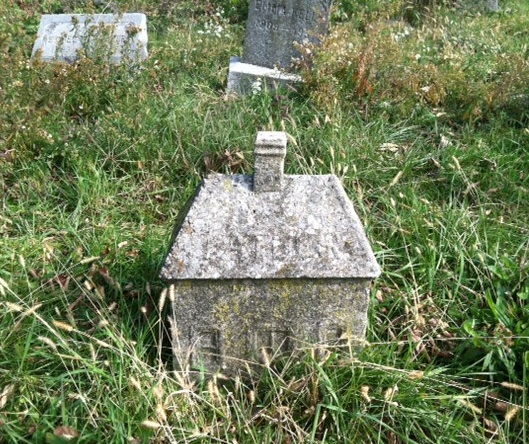
This little house stood out among the other graves. I wonder if the person who it was for was built homes.

This little house stood out among the other graves. I wonder if the person who it was for built homes.

I found the Little House (as I call it) a few months before I became a full fledged cemetery hopper but I wrote about it back in June. It was resting amid the tall grass of Old Greencastle Cemetery in Dayton, Ohio.

There’s no name on it so the identity of the deceased is unknown. It isn’t grand or ornate. But its simplicity caught my eye and it’s now one of my favorites. I’ve never seen anything quite like it before or since.

Carrie Turner

Carrie's life is still shrouded in mystery. But when I found her grave, it opened up new doors for her family, who had been searching for her for years.

Carrie’s life is still shrouded in mystery. But when I found her grave, it opened up new doors for her family, who had been searching for her for years.

Carrie was a photo request in a round about way. I had taken a picture of her grave marker in Fellowship Baptist Church Cemetery in June as part of my work to photograph as many graves there as possible. Problem was, while I added a memorial for her, I forgot to add the photo of her grave.

A few months later, I saw a photo request for Carrie on Find a Grave and realized my error. I claimed the request and in a few minutes had posted the picture.

What followed as a result I wrote about in August. By some twist of fate or a push from God (I think it was the latter), I took a photo of someone’s long-lost grandmother’s grave. Janet Turner and her family had been looking for her over many years. They still aren’t sure what happened to her grandfather after Carrie died and he was forced to place their children in Georgia Baptist Children’s Home. So a lot of mystery still remains. I hope to have an update on Carrie some day.

This first year of cemetery hopping has been a journey that took many unexpected twists and turns. I’ve learned a lot and I’ve “met” people who led some amazing lives. Some of the cemeteries I’ve explored will stay in my memory forever. Overall, the efforts I’ve put into it (and this blog) have been well worth it.

What will the next year bring?

Sunset sky over Fayetteville City Cemetery.

Sunset sky over Fayetteville City Cemetery.

What do Charlie Chaplin, Abraham Lincoln and Elvis Have in Common?

Grave robbing is nothing new. Movies have been made about it and countless scary stories told around campfires include many a corpse. At one time, in the late 1700s into the 1800s, the theft of dead bodies from cemeteries was very real and quite profitable. Medical school attendance was going through the roof and they needed cadavers for students to practice on.

Celebrity grave robbing is different. It usually involves a ransom demanded in exchange for the return of the stolen corpse. Still, those that undertake it probably already have a screw lose to begin with. Here are the stories of three infamous grave robberies: one that actually happened, one that almost did and one that is questionable to this day.

Charlie Chaplin

"A Dog's Life" was made in 1918. Charlie Chaplin wrote, director, produced and acted in the film. His brother, Sydney, had a small role.

A Dog’s Life was made in 1918. Charlie Chaplin wrote, director, produced and acted in the film. His brother, Sydney, had a small role.

Born in April 1889 in London, England, Charlie Chaplin had parents in the theatrical profession. His career as a vaudeville comedian brought him to the United States in 1910. His film career took off in 1914 when he joined Keystone Studios. He developed his trademark “Little Tramp” persona over those early years. With D.W. Griffith, Mary Pickford, and Douglas Fairbanks, he founded United Artists (which is still around today) in 1919. His eight films with UA made him a film icon, with titles like The Kid, City Lights and Modern Times.

Chaplin was living in Switzerland with his fourth wife, Oona, when he died in December 1977. He was buried in Corsier Cemetery (near Lake Geneva) in a 300-lb. oak coffin. In March 1978, it was dug up and removed from the cemetery. The two thieves contacted Oona and demanded an eye-opening ransom of 40,000 pounds (the American equivalent is about $64,500) for the return of his coffin. Oona refused to pay it, saying, “Charlie would have thought it rather ridiculous.”

Charlie Chaplin's grave is located in Corsier, Switzerland.

Charlie Chaplin’s grave is located in Corsier, Switzerland. Photo courtesy of Wikimedia Commons.

Local police set up phony pay-off meetings that proved a failure when the robbers didn’t show up. At the same time, the police and the suspects were both persistent, so the two parties continued to communicate in hopes of resolving the standoff. In May, the police tapped the Chaplins’ phone. They also assigned officers to watch as many as 200 phone booths throughout the area.

When the thieves called this time, the call was traced to two auto mechanics, Roman Wardas of Poland, and Gantscho Ganev, of Bulgaria. The two were arrested. Upon interrogation, they led police to Chaplin’s body, which they had buried in a nearby cornfield. The two were political refugees who were inspired by a similar scheme they read about in an Italian newspaper. Wardas, the brains of the two, got four and a half years of hard labor while Ganev received an 18-month suspended sentence.

The Chaplins reburied Charlie in the Corsier Cemetery. But this time, they sealed his coffin in thick concrete so any future thieves would be deterred from repeating the crime. Fortunately, his grave has remained undisturbed ever since.

Abraham Lincoln

Abraham Lincoln’s body was never stolen but there was definitely a plot afoot to do so. Lincoln’s demise was unique in many ways. Not only was he assassinated, he was the first U.S. president to be embalmed to preserve his body. The train carrying his body to his hometown of Springfield, Ill., made several stops along the way, in which Lincoln’s body lay in state. So the use of embalming was paramount to keeping Lincoln, uhm, camera ready.

Lincoln's body was conveyed by train across several states. Lincoln was observed, mourned, and honored in Washington, D.C., Maryland, Pennsylvania, New York, Ohio, Indiana, and Illinois.

Lincoln’s body was conveyed by train across several states. Lincoln was observed, mourned, and honored in Washington, D.C., Maryland, Pennsylvania, New York, Ohio, Indiana, and Illinois.

Lincoln was buried in Oak Ridge Cemetery, a rural cemetery located about two miles outside of Springfield, Ill. No night watchman patrolled the area around the president’s tomb. The only thing standing between Lincoln’s body and any would-be grave robbers was a single padlock on the tomb’s chamber door.

He lay there undisturbed until November 7, 1876. That’s when a group of four counterfeiters broke into the cemetery with the intention of stealing Abraham Lincoln’s body from his sarcophagus. They planned to take the body, hide it in the sand dunes of Northern Indiana, hold it for $200,000 ransom, and demand the release of one of their gang from prison.

Lincoln's Tomb at Oak Ridge Cemetery was not where many in Washington thought he should be buried. Mary Todd Lincoln fought hard to have her husband's wishes fulfilled and succeeded in having him buried at Oak Ridge.

Lincoln’s Tomb at Oak Ridge Cemetery was not where many in Washington thought he should be buried. Mary Todd Lincoln fought hard to have her husband’s wishes fulfilled and succeeded.

Their plans fell apart when a paid police informant who had infiltrated the crew ratted on them. When the men broke into the cemetery that night, police and Secret Service agents (who were only charged with investigating counterfeiters at the time, not guarding the body of the President) were waiting for them. Due to an errant gunshot going off before the trap was sprung, the crooks got away, but were arrested a few days later.

Jack Hughes was a sketchy character known for counterfeiting nickles.

Jack Hughes was a sketchy character known for counterfeiting nickles.

Terrence Mullen was a saloonkeeper. He and Hughes hired a man who they thought was a grave robber. It would be a decision they would soon regret.

Terrence Mullen was a saloon keeper. He and Hughes hired a man who they thought was a grave robber. It would be a decision they would soon regret.

After the attempted robbery, Lincoln’s remains were reburied in the same mausoleum at Oak Ridge. This time they were hidden in a shallow grave in the basement of the tomb. This fact was known only by a handful of people for decades. Lincoln remained there until 1901, when eldest son Robert Todd Lincoln had his father’s remains placed inside a steel cage, lowered 10 feet into the ground, and covered in concrete for safe keeping. It’s been there ever since.

Elvis Presley

This last grave robbery never really happened. In August 1977, two weeks after Elvis’ death (which some still dispute), FBI informant Ronnie Adkins told police he had infiltrated a group that planned to steal Elvis Presley’s 900-pound, steel-lined, copper-plated coffin and hold his remains for ransom.

For two months after he died, Elvis' body rested inside this crypt at Forest Lawn Cemetery. It has been empty since he and his mother were moved to Graceland. In 2012, the crypt was slated to be auctioned, but Elvis fans caused such an uproar that it never took place.

For two months after he died, Elvis’ body rested inside this crypt at Forest Lawn Cemetery. It has been empty since he and his mother were moved to Graceland. In 2012, the crypt was slated to be auctioned, but Elvis fans caused such an uproar that it never took place.

While police staked out the grave at Forest Hills Cemetery in Memphis, they caught three men (Raymond Green, Eugene Nelson, and Ronnie Adkins) snooping around Presley’s mausoleum. How the three were going to get through the two concrete slabs and a solid sheet of marble that covered the coffin is unknown. No tools or explosives were ever found. That doesn’t even take into account how they planned to remove the coffin without a forklift. Until further evidence about the plot could be uncovered, police charged the men with criminal trespassing and kept them in jail.

The story Adkins gave police turned out to be full of holes. He said the men were going to be paid $40,000 each by an unknown criminal mastermind who planned to ransom the body for $10 million. But he couldn’t tell police how the men intended to get their reward or how to contact this anonymous kingpin once the deed had been done. With no actual crime being committed (other than the men being in the cemetery after dark), and the evidence against the men being so weak, all charges were eventually dropped.

Elvis' grave is between those of his parents, Gladys and Vernon. Photo courtesy of Wikimedia Commons.

Elvis’ grave is between those of his parents, Gladys and Vernon. Photo courtesy of Wikimedia Commons.

As a result of the “almost attempted” grave robbery, the Presley estate asked to move the bodies of Elvis and his mother to Graceland where they could be monitored 24 hours a day by staff security and closed-circuit TV cameras. Their request was granted.

Former FBI agent Ivian C. Smith said that the “almost” grave robbery was concocted by Elvis’ estate as a way to get the Presleys buried on the property because before the “near theft”, the Memphis Shelby County Board of Adjustment had refused to grant them a variance to bury Elvis at Graceland. Smith, former head of the FBI’s Arkansas office, says Adkins told him years later that former Shelby County sheriff’s deputy Billy Talley set up the hoax.

But as we all know, Elvis isn’t really underground. He’s at Walmart at 2 a.m. buying peanut butter and bananas, right?

Photo courtesy of People of Walmart.

Photo courtesy of People of Walmart.

Madge Bigham: Unearthing an Atlanta Treasure

Sometimes you have to dig deep to find something special.

John Bayne, a kind reader of my blog, recently contacted me about a project he’s working on about Westview Cemetery. I wrote about Westview a few months ago. He had a list of famous people buried at Westview whose graves he hoped to photograph. As you can imagine, I was more than willing to help with that. In the course of that work this week, I discovered Madge Bigham.

You’ve probably never heard of her. I had not until John gave me her name. No picture of her has survived. But in the early years of the 1900s, Madge Alford Bigham was a famous children’s author. She also founded the West End Kindergarten, one of the first of its kind in Atlanta. Her career, for a woman, was beyond her time. But today, she is largely forgotten or unknown.

Overheard in Fairyland was one of Madge Bigham's many popular children's books.

Overheard in Fairyland was one of Madge Bigham’s many popular children’s books.

Madge’s grave was last on my list for the day and all I knew was that she was in Section 16, which contains taller stone monuments. You can even see some of the names from the road. But I couldn’t see a Bigham among them as I began to “hop” down the rows. An hour later, as I reached the front end of the section, I was tired, cranky and ready to leave. But my foot scraped an indentation in the grass. Not willing to give up on Madge, I got on my knees and began brushing and pulling away dead grass and weeds with my bare hands.

Hidden under the grass, I found the narrow, flat gravestone for Madge’s sister, Eugenia Bigham. Beside her were Madge, sister Kate, and brother James. All of them were totally covered with a mesh of grass clippings from multiple mowings that had grown over them. Had I not stopped, I would have walked right over them.

Madge Bigham's simple, flat grave marker lay hidden under grass and dirt until I found it this week.

Madge Bigham’s simple, flat grave marker lay hidden under grass and dirt until I found it this week. She and her siblings were hidden from sight.

Something told me there was much more to Madge than her simple grave marker. Later, I got on the Internet and started learning about an amazing woman who stepped outside society’s confines to teach children and share her imaginative stories with them. What I learned about her is mostly thanks to the efforts of Atlantan Tommy Jones’ blog, tomirtonics.com. What you read about Madge here came mostly from his research.

Madge was the daughter of Methodist minister Rev. Robert William Bigham. When his first wife, Charlotte, died in 1871, Rev. Bigham was left to care for his eight young children. He remarried and the Bighams had at least four more children. Rev. Bigham wrote a number of children’s books himself, the most famous being Vinny Leal’s Trip to the Golden Shore.

Madge was born in LaGrange, Ga. in 1874, and attended the Female Academy there. She continued her studies at the Lucy Cobb Institute in Athens. In 1896, she graduated from the Georgia Woman’s College (then in Covington). By 1902, she was principal of the Atlanta Free Kindergarten, located on Fort Street east of downtown.

The first kindergarten in the United States was formed in 1856. Established in 1895, the Atlanta Free Kindergarten Association was part of an international movement that began in Europe in the 1840s. The Association’s president in the early years, Nellie Peters Black, was an advocate for free kindergartens and hospitals, enforcement of child labor laws, as well as for the admission of women to the University of Georgia and the Georgia Bar.

The Bad Little Rabbit was just one of Madge Bigham's books that young children clamored to read.

The Bad Little Rabbit was just one of Madge Bigham’s books that young children clamored to have read to them.

Madge’s brother, James Whitaker Bigham, purchased a home on 124 (now 503) Peeples Street in Atlanta’s West End. James, along with his spinster sisters Kate, Madge and Eugenie, never married. The four siblings moved into the house and probably by 1911, they had added an addition in the back for Madge to open the West End Kindergarten. The house was near the Wren’s Nest, home of prominent author Joel Chandler Harris (who wrote the Brer Rabbit stories).

By that time, Madge was already following in her father’s footsteps to become a noted author. Her first book, Stories of Mother Goose Village, was published in 1906. More books were to follow, including Sonny Elephant, Fanciful Flower Tales, and The Bad Little Rabbit.

Sonny Elephant is a story about a baby elephant and his adventures. It was very popular with school children at the time and has been reprinted often.

Sonny Elephant is a story about a baby elephant and his adventures. It is probably her most remembered book and was reprinted several times.

Celestine Sibley wrote about one of Madge’s stories in her syndicated newspaper column in 1970. “The Story of How Apples Got Stars Within” comes from Overheard in Fairy Land. In the tale, a little apple tree loved the evenings when she could gaze at the canopy of stars stretched overhead. Her wish to have just one star of her own was overheard by the Fairy Queen, who promised the little tree that if she worked hard to grow straight and tall, she would get her stars one day.

The little tree did just that and grew tall, eventually blooming with beautiful pink blossoms. When the blossoms were gone, little brown seeds took their place. That’s when the Fairy Queen returned to grant that wish. The tree, now big, had forgotten about it and told the Fairy:

“That was a foolish wish of mine. But if stars you have to give, give them, I pray you, to my baby seeds.” So that is why, when you cut your apple through the center of the circle side, you find brown baby seeds nestled in a five-pointed star.

When the Great Depression hit in the 1930s, Madge was forced to close her beloved West End Kindergarten. Her other unmarried siblings died as the years went by and she found herself caring for the house with her brother Ernest’s widow, Mary, and their children. Madge died on August 11, 1957.

This is thought to be the condition the house was in when Dr. Hammonds bought it in the late 70s. He died shortly after he finished restoring it.

This is thought to be the condition the house was in when Dr. Hammonds bought it in the late 70s. He died shortly after he finished restoring it. Photo courtesy of Tommy H. Jones.

Eventually, the house (which was in such bad shape it had been condemned) was purchased by Dr. Otis Thrash Hammonds and completely renovated. After the doctor’s death from leukemia in 1983, the house sat vacant until Fulton County purchased it. Today, it is the Hammonds House Museum and features Dr. Hammonds extensive African-American art collection. The sounds of children have returned to the house where Madge taught her students.

Today, the Hammonds House Museum houses an extensive collection of African-American art. Much of it was collected by Dr. Hammonds over the course of his life. He died in 1983.

Today, the Hammonds House Museum contains an impressive collection of African-American art. Much of it was collected by Dr. Hammonds over the course of his life. He died in 1983.

Unlike Joel Chandler Harris, Madge Bigham’s name slid into obscurity. Occasionally, her books show up on eBay or in a rare book collector’s shop. Like her grave, her amazing life has become obscured in a modern era in which stories about heavily merchandised animated characters have upstaged happy little apple trees. I hope one day she gets the recognition she truly deserves.

Don’t worry, Madge. I’ll be back to make sure you keep seeing those stars at night.

Photo courtesy of Waldorf Homeschoolers.

Photo courtesy of Waldorf Homeschoolers.

Remembering the Holocaust: Greenwood Cemetery

In the mid 90s, I visited my friend (and fellow Church Chick) Megan in Washington, D.C. The U.S. Holocaust Museum had not been open very long so we went to see it. That day changed my life.

At the beginning of the tour, each guest was given a passport of a real person who lived during the Holocaust and was sent to a concentration camp. It briefly described their life and what happened to them. When I opened mine, I was stunned.

The name inside my passport was Hana Mueller. My niece’s name is Hannah. And my maiden name is Muller. That’s when the Holocaust truly became real to me.

Born in Prague (now part of the Czech Republic) in 1922, Hana was reading John Steinbeck’s The Grapes of Wrath in her apartment when she was taken by the Nazis. Despite enduring months in two different concentration camps, Hana was freed when her work crew was abandoned by the SS as liberators approached in May 1945. To watch videos from 1990 of Hana talking about her experiences, you can visit the museum’s website.

Hana Mueller was reading a book by Steinbeck when she was taken by the Nazis. Steinbeck has always been one of my favorite authors.

Hana Mueller was reading a book by Steinbeck when she was taken by the Nazis. Steinbeck has always been one of my favorite authors.

My father’s roots are in Germany. The Mullers came from the town of Konz in the Rheinland, in the Southwest. My great-great grandfather, John Henry Muller, arrived in the United States in 1866. He was a carpenter and a Catholic. But despite the fact Hana was from Prague and a Jew, I thought that girl could have been me.

This is the only photo I have of my great-great grandfather, John Henry Muller. He came to the U.S. and worked as a carpenter up until his death in 1926.

This picture from his newspaper obituary is the only photo I have of my great-great grandfather, John Henry Muller. He came to the U.S. in 1866 and worked as a carpenter up until his death in 1926.

Ever since then, my interest to learn as much as possible about the Holocaust has been almost obsessive. I’ve read countless memoirs written by Holocaust survivors and seen over a hundred hours of documentaries. I’ve read The Rise and Fall of the Third Reich all the way through. It’s a subject I never tire of learning more about.

When I heard Atlanta had a cemetery with a Holocaust Memorial, I knew I had to visit it. That’s when I discovered Greenwood Cemetery, located off Cascade Road in Southwest Atlanta.

Greenwood Cemetery opened in 1907. Its diversity is worth noting. Hundreds of graves are for Jews who made Atlanta their home. I had never seen Jewish headstones up close before, except at Oakland Cemetery. There’s also an entire section for those of the Greek Orthodox faith, complete with a small chapel. A very small area belongs to the Chinese, perhaps 20 graves in all.

image

Row upon row of Jewish graves at Greenwood Cemetery. Usually, the front inscription is written in English and the Hebrew version is written on the back.

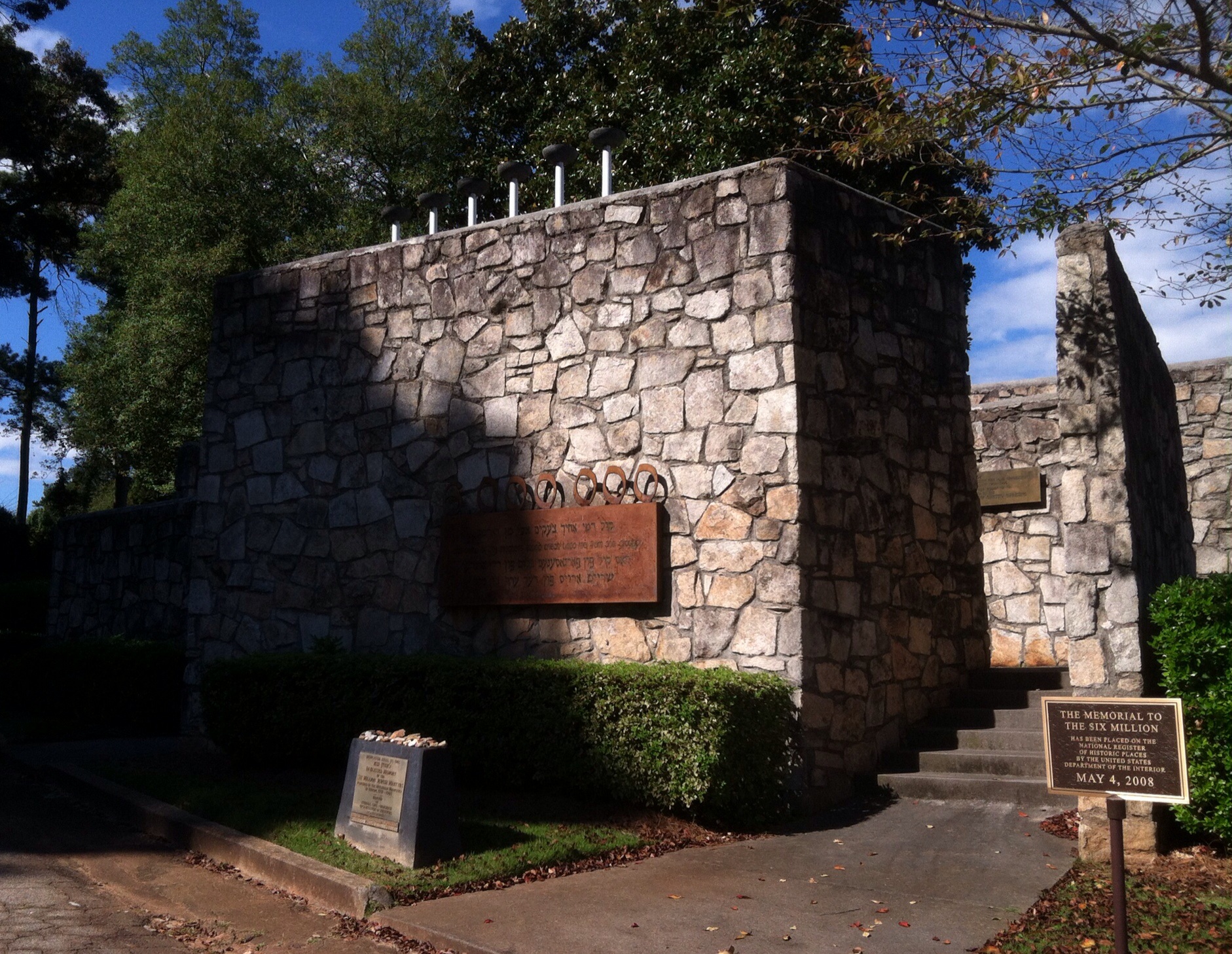
But what truly separates Greenwood Cemetery from others is its Holocaust memorial. Built in 1965, the “Memorial to The Six Million” is a small granite open-air structure. The funds to build it came from a group of 100 Holocaust survivors living in Atlanta. In 2008, the Memorial was added to the National Register of Historic Places. It is the only Holocaust memorial in Georgia to have that distinction.

The  Memorial for the Six Million is small but impressive. You can see the six white "candles" above the top edge.

The Memorial for the Six Million is small but impressive. You can see the six white “candles” above the top edge.

What catches your eye immediately are the six 19-foot tall pillars in the middle of it. They represent the estimated six million Jews who perished as a result of the atrocities of the Holocaust. During special ceremonies at the Memorial, these “candles” are lit as an act of remembrance for those who died.

Inside, on the walls, are plaques inscribed with the names of hundreds of people (with surviving family members and descendants that reside in Atlanta) who died in the concentration camps scattered across Europe. Entire families are listed, their lives snuffed out by the Nazi regime. The pillars are anchored by a large, black base that resembles a casket.

This metal plaque is inscribed in both English and Yidish. "For these I weep..." Is from Lamentations 1:16 of the Old Testament.

This metal plaque is inscribed in both English and Hebrew. “For these I weep…” is from Lamentations 1:16 of the Old Testament.

On the day I visited Greenwood and the Memorial, it was a stunningly beautiful sunny day with a hint of fall in the air. Nobody else was around as I quietly entered. It is a place of reverence and remembrance. As I scanned the names on the wall, it was like being back at the Holocaust Museum in D.C. The huge number of six million becomes much more personal when you see the actual names of people who died.

Entire families perished in the Nazi concentration camps. Many came from Poland, who surrendered to Hitler in September 1939.

Entire families perished in the Nazi concentration camps and ghettos. Many came from Poland, which surrendered to Hitler in September 1939.

Also within the memorial is an urn containing human ashes brought from the concentration camp at Dachau.

There is a bit of controversy attached to the Memorial. Outside of it are buried four bars of soap that are purported to have been made by Nazis from the fat of Jewish Holocaust victims. A Jewish soldier who was part of a U.S. force that liberated a concentration camp brought them home after the war. They were forgotten until his wife found them in their Dekalb County basement in 1970. They are stamped “RIF”.

Historians say the initials stand for Reich Industrial Fat. But when the bars were found, the “I” was widely interpreted as a “J,” and some people thought the initials stood for the German translation of Pure Jewish Fat.

After the bars were discovered, the couple called a local rabbi who consulted with Jewish scholars and planned a burial at Greenwood. The bars remain buried there, although I could not find the flat stone marker where they are located.

This is a picture of the memorial stone where four bars of soap purported to be made from the remains of Jews killed in the Holocaust are buried. Photo courtesy of Anneke Moerenhout.

This is a picture of the memorial stone where four bars of soap purported to be made from the remains of Jews killed in the Holocaust are buried. Historians do not believe that the Nazis ever did this. Photo courtesy of Anneke Moerenhout.

In 2000, a Jewish architect from Atlanta named Ben Hirsch (his parents and two siblings died in concentration camps) wrote a book that included his belief that the Nazis did indeed make soap from Jewish victims. Hirsch’s uncle’s unpublished writings describe how he was forced to work in the concentration camp crematories and saw it himself.

Most historians contend that while the atrocities enacted by the Nazis were horrific, there is no substantial proof that this soap making actually took place. Because of this sentiment, the U.S. Holocaust Museum barred a book signing for Hirsch there.

Regardless of who is right or wrong, the Memorial for the Six Million at Greenwood Cemetery is a sacred place that sends the message it creators originally hoped to get across. Such a tragedy must never be repeated. That’s why remembering it is so critical.

We must never forget.

This is the skirt Hana Mueller wore as a concentration camp prisoner. It is on display at the U.S. Holocaust Museum in  Washington, D.C.

This is the skirt Hana Mueller wore as a concentration camp prisoner. It is on display at the U.S. Holocaust Museum in Washington, D.C.

Guest Post: My Cemetery Adventure!

This week, for the first time, I am featuring a guest blogger!

Meet Steve Reagin. We became good friends in high school through the drama department and by being in the same church youth group together. I hadn’t seen or talked to him since 1987 until we made contact on Facebook last year.

This is a picture of Steve from the 80s. Photo courtesy of J. Frank Lynch.

This is a picture of Steve from the 80s. Photo courtesy of J. Frank Lynch.

This is me in the 80s in the center of my group of friends. Christi, who I went with me on my first cemetery trip in Omaha, is on the left.

This is me in the 80s with my best friends. Christi, who went with me on my first cemetery trip in Omaha, is on the left.

I think we look pretty good more than 20 years later, don't you?

I think we look pretty good more than 20 years later, don’t you?

Here’s a message he sent me in February:

“Hey Traci, If you’re ever in a cemetery around Conyers, Lithonia, or Stone Mountain, and you run across a headstone for “Marvin J. Reagin, Sr.” or some version thereof, give me a yell. That would be my grandfather. No one alive seems to know where he’s buried.”

What happened after that is what Steve has written about in his own words. I know you’ll enjoy reading about how he found many of his ancestors in just one day in a Georgia cemetery:

When my Dad died in August 2007, I began to wonder more about his family. I realized I knew close to nothing about the generations of Reagins before him. When he was a kid, his father was an alcoholic who spent time in and out of jail, and died in a car crash fleeing the police. His mother ran out on the family for a while. My Dad and his brother, Robert, were shuffled amongst his aunts and uncles, and weren’t always treated well. A few years before I was born, Robert died in a car accident as well. Because of this, Dad rarely talked about his family, not even to Mom. I had no concept of a larger family outside of my immediate family.

At Dad’s funeral, I met a cousin who was so close to Dad when they were kids, he was like another brother. He told us stories about Dad as a kid and about my grandfather whom he called “Mr. Joe”. During one of his stories (which always seemed to end with Dad keeping my grandfather out of jail or bailing him out of jail), he stopped, looked right at me, and said I “was the spittin’ image of Mr. Joe.”

This is the grave of Steve's father, Marvin J. Reagin, Jr. He is buried in Fayetteville, Ga.

This is the grave of Steve’s father, Marvin J. Reagin, Jr. He is buried in Fayetteville, Ga.

After Dad’s funeral, my sister-in-law, Kara, showed me some information she found on the Reagins through Ancestry.com. She and my parents even tried to find the family land in South Carolina where Dad’s ancestors lived before moving to Georgia. I didn’t pay much attention to this and forgot about it for the most part.

On my way back to my current home outside of Seattle, I realized I had no idea where my grandfather or uncle were buried. We never visited a graveside on a birthday, death anniversary, Memorial Day, etc. The next time I talked to Mom, I asked if she remembered where they were buried. She said no, but assumed they were at Lithonia City Cemetery. This struck me as odd, as I knew she had to have been at my uncle’s funeral. He was the best man at my parent’s wedding and had dated Mom before Dad did. I knew she must have attended his funeral. However, I decided not to push it.

Years later, through Facebook, I started reconnecting with friends I hadn’t seen since before I moved to Seattle in 1993. One of those friends was Traci. After reading some of her blog posts, I sent her a message that if she ever came across the graves of Marvin J. Reagin, Sr. or Robert Reagin to let me know. Traci zoomed into action. In a matter of moments, she was looking up census records, death records, and a website called Find A Grave.com. She didn’t have much luck, but said she would keep an eye out during her adventures.

Some months later, I found out I was going to Atlanta for a work conference. I arranged to stay a few extra days to visit with Mom and see some friends. I asked Traci if she would be interested in exploring some cemeteries with me in search of my grandfather and uncle. She was all over it.

Before we met up, Traci did some legwork to see if she could find anything. She found many of my grandfather’s brothers and sisters in the Lithonia City Cemetery and nearby Turner Hill Baptist Church Cemetery, but no sign of my grandfather and uncle. She said I should be prepared for the reality that they could be in unmarked graves. She did send me a picture of a monument in the Lithonia cemetery that said “REAGIN” that had no names etched into it or any other markers around it.

This is the Reagin monument I found at Lithonia City Cemetery. I feel strongly that although their graves were unmarked, Steve's grandfather and uncle are buried there. He agrees with me.

This is the Reagin monument I found at Lithonia City Cemetery. I feel strongly that although their graves were unmarked, Steve’s grandfather and uncle are buried there. He agrees with me.

As my trip neared, I finally remembered the information that Kara had put together and left with Mom. When I got to Mom’s house in Georgia, I searched Kara’s research for any clues. While there was nothing much about my grandfather besides the listing of his siblings and parents, the story I discovered about my family was incredible!

In contrast to the story I remember hearing about three brothers who immigrated to Georgia from Ireland during the potato famine in the mid-19th century, evidence suggests that my family came from Ireland in 1690s and settled in Maryland. Part of that original family wound up in Newberry County, S.C., where one William Reagin owned a plantation that consisted of 250 acres and many slaves.

William Reagin owned a plantation in Newberry, S.C. He is buried in the Reagin Family Cemetery in Newberry. Photo courtesy of Donna Brummett.

William Reagin owned a plantation in Newberry, S.C. He is buried in the Reagin Family Cemetery in Newberry. It reads: “There is a world above where parting is unknown, A long eternity of love formed for the good alone.” Photo courtesy of Donna Brummett.

When William died in 1830, his estate was divided up between his wife and 10 children. Sometime after that, three of his sons and one daughter left for Georgia including my great-great-great-great-grandfather, James Jones Reagin.

As I was reading this history and talking with Mom, she started to remember some things. Yes, both my grandfather and uncle were buried in Lithonia City Cemetery. She vaguely remembered where they were located and described what she remembered seeing from the graveside (and obelisk across the road, Confederate graves off to the side, a Scottish family nearby).

This enormous magnolia tree is the only tree in Lithonia City Cemetery.

This enormous magnolia tree is the only tree in Lithonia City Cemetery.

When Traci and I finally got to the Lithonia City Cemetery, a city landscaping crew had just finished mowing and trimming the entire cemetery, so it was very easy to see everything. When I stood in front of the monument Traci had found, I knew that this was where my grandfather and uncle were. It matched my Mom’s description exactly.

I was surprised at how emotional I became, not only because I found where my grandfather was buried, but as I looked around, I saw the name “Reagin” everywhere. The only time I had ever seen Reagin on a headstone was on my Dad’s that I had just seen in person for the first time a few days before. I finally had a sense of a larger family that I never had before, and I found myself crying beside my grandfather’s grave.

Steve discovered many of his relatives' final resting places at Lithonia City Cemetery.

Steve discovered many of his relatives’ final resting places at Lithonia City Cemetery.

As we walked around the cemetery, I started recognizing some of the names that were in the historic information Kara had gathered, which I neglected to bring with me. I started taking pictures of the Reagin headstones that sounded familiar. James, Jones, and Joseph are all common names through the Reagin generations. My middle name is even James. When I showed Mom what I had found, she said, “By the way, your father’s grandparents are in the same plot as his father and uncle.”

When I compared the pictures I took with the family history I had, I discover that my great-great-great grandparents are in the plot next to the one I had just visited. My great-great-grandparents are nearby across the street. In one day, I found four generations of my family that I didn’t know existed the day before.

As I looked at the family tree, I realized the next person up would be my great-great-great-great-grandfather, James Jones Reagin, one of the sons of William Reagin that moved to Georgia from South Carolina. My information didn’t show where he was buried, but it did note that one of his brothers was buried in the McClung Cemetery near Conyers, and his sister was buried in the Rock Springs Primitive Baptist Church Cemetery near Lithonia. I messaged this to Traci, and she quickly found a listing for both James and a third brother at the McClung Cemetery on Findagrave.com.

By contrast, McClung Cemetery is private so it doesn't receive the care that Lithonia City Cemetery gets. As a result, it is neglected.

By contrast, McClung Cemetery is private so it doesn’t receive the care that Lithonia City Cemetery gets. As a result, it is neglected.

On my last day before heading back to Seattle, I found myself searching for McClung Cemetery in the middle of a residential neighborhood near Conyers. I drove down a dead end road and didn’t see it. I turned around thinking I may not find it after all, but as I headed back to the main road, I noticed what looked like a vacant lot, but there were stone stairs leading up from the road. This was it.

McClung Cemetery is a neglected cemetery. The weeds are waist high. Right in front of me were granite tombstones with “REAGIN” carved or etched into them. It seems there are more Reagins than McClungs in the McClung Cemetery. Some graves are marked only by a single, huge, granite rock. Under a tree, I found a very well preserved stone that said “REAGIN” and under it the names and dates of James and Talitha, my great-great-great-great grandparents. The trees that shelter the tombstone definitely weren’t there when James and Talitha were buried, but fortunately, they protected the couple during the graveyard’s years of decline and neglect.

James and Talitha Waldrop Reagin are Steve's great-great-great-great grandparents, who came to Georgia from South Carolina.

James Jones Reagin and Talitha Waldrop Reagin are Steve’s great-great-great-great grandparents, who came to Georgia from South Carolina.

I eventually found one of James’ brothers grave, and what I think are the broken remains of the other brother’s tomb, as well as their sister later on in a nearby church graveyard. However, as I stood in front of James and Talitha’s grave, I marveled at the fact that the day before, I was unaware of my grandfather, and now I’d discovered five generations of my family.

Steve found another relative, Phoebe Reagin, at nearby Rock Springs Baptist Church Cemetery.

Steve found another relative, Phoebe Reagin, at nearby Rock Springs Baptist Church Cemetery.

James moved his family to Georgia, and as of right now, we don’t know exactly why. When his father’s estate was divided up, was there not enough money? Did the oldest brother claim the plantation house itself? Did James leave to work in the granite quarries around Lithonia, Conyers, and Stone Mountain? Did he become a stonecutter as some of his descendants did?

For whatever reason, he is why I was raised in Georgia and why I’ll always identify myself as a Georgia native. His decision five generations ago had a hand in shaping who I am today. It also makes me wonder if five generations from now, will there be someone standing at my grave wondering why I moved from Georgia to Washington State?

What will my legacy be?

This is a photo of Steve and his beautiful family today. I think he can be quite proud of the legacy he's creating.

This is a photo of Steve and his beautiful family today. I think he can be quite proud of the legacy he’s creating.

Paint it Black: Mourning Fashions in the Victorian Age

In this modern age, you don’t even have to wear black to a funeral any more. There are no rules, it seems. I’ve seen people show up in everything from sweatpants to club attire.

Back in the Victorian era, there was a very specific code for what a woman (men were pretty much off the hook) in mourning must wear and for how long. If you didn’t follow it to the letter, you risked being branded a social outcast by those around you.

In the third season of PBS' popular "Downton Abbey", Lady Mary follows the dictates of society by wearing jet jewelry in her time of mourning.

In the third season of PBS’ popular “Downton Abbey”, Lady Mary follows the dictates of society by wearing jet jewelry in her time of mourning.

The Victorian age officially began in 1837 when an 18-year-old Queen Victoria took the British throne. A few years later, Victoria married her German first cousin, Prince Albert. Their marriage resulted in nine children and was said to be a very happy one.

Franz Xaver Winterhalter's painting of Queen Victoria and Prince Albert with their children. Photo courtesy of Wikimedia Commons.

Franz Xaver Winterhalter’s painting of Queen Victoria and Prince Albert with their children. Most people do not picture her as a happy wife and mother. Photo courtesy of Wikimedia Commons.

Perhaps that’s why when Prince Albert died of typhus in 1861, the Queen went off the rails a bit when it came to grieving her loss. She remained in full mourning for three years. From that day forward, she always wore black and spent a considerable time in seclusion. This earned her the nickname, the Widow of Windsor.

This 1879 photo is of Queen Victoria mourning her daughter Princess Alice's death. She is seated with Princess Alice's widower and children.

This 1879 photo is of Queen Victoria mourning her daughter Princess Alice’s death. She is seated with Princess Alice’s widower and children.

Mourning clothes were supposed to be an outward reflection of a family’s inner feelings.The rules for who wore what and for how long were complicated, and were outlined in popular journals or household manuals which were very popular among Victorian housewives. They were filled with instructions about appropriate mourning etiquette. If your second cousin’s cousin twice removed on your father’s dad’s side died and you wanted to know what sort of mourning clothes you should wear and for how long, you consulted The Queen or other manuals.

The elaborate mourning fashion code tended to isolate a widow in her time of need just as the Queen had done. For the first year, a woman in mourning was not allowed to leave her home without full black attire and a weeping veil. When she did go out, it was supposed to be only to attend church services. Crepe was the material of choice for its dull sheen and lack of richness.

Examples of mourning fashion for widows.

Examples of mourning fashions for widows.

In other words, when you were in full mourning, there was no such thing as throwing on a pair of yoga pants to run to the grocery store for a gallon of milk. You had to send someone else to do it. So although it really mattered what you wore, few people saw it because you were stuck at home!

Middle and lower class women did not have the luxury of buying an entirely new wardrobe for mourning. But they would go to great lengths to appear fashionable in such times. Dying clothing black and then bleaching them out again was quite common. The industry of mourning became so vital to tailors that rumors were spread concerning the bad luck of recycling funeral attire.

Scarlett O'Hara broke all the rules of proper mourning by dancing with Rhett Butler at a fancy dress ball. She was supposed to be at home crying for her dead husband.

In Gone With the Wind, Scarlett O’Hara broke all the rules of proper mourning by dancing with Rhett Butler at a fancy dress ball. She was supposed to be at home crying for her dead husband.

In nineteenth-century England, a widow was expected to remain in mourning for over two years. The rules were slightly less rigid for American women.

Providing the proper mourning attire became a full-blown industry during the Victorian era.

Providing the proper mourning attire became a full-blown British industry during the Victorian era.

These stages of mourning were observed by widows:

Full mourning, a period of a year and one day, was represented with dull black clothing without ornament. The most recognizable portion of this stage was the weeping veil of black crepe. If a women had no means of income and small children to support, marriage was allowed after this period. There are cases of women returning to black clothing on the day after marrying again.

The woman on the left, from an 1855 fashion magazine, is an example of full or second mourning with her black veil, black gown and gloves.

The woman on the left, from an 1855 fashion magazine, is an example of full or second mourning with her black veil, shawl, gown and gloves.

Second mourning, a period of nine months, allowed for minor ornamentation by implementing fabric trim and mourning jewelry. The main dress was still made from a lusterless cloth. The veil was lifted and worn back over the head. Taking their cue from Queen Victoria’s example, older widows often remained in second mourning or half-mourning for the rest of their lives.

Half mourning lasted from three to six months and was represented by more elaborate fabrics used as trim. Gradually easing back into color was expected coming out of half mourning. All manor of jewelry could be worn. A woman now had a bevy of colors to choose from, by comparison. Grey, mauve, purple, lavender, lilac, and white could all be implemented. Subtle prints using any combination of these colors were also allowed. This trend was more popular in the South because of the weather. I can’t imagine wearing black crepe in 90 degree heat.

Half mourning finally saw the slow return of color to a widow's wardrobe.

Half mourning finally saw the gradual return of color to a widow’s wardrobe.

The standard mourning time for a widower was two years but it was up to his discretion when to end his single status. Men could go about their daily lives and continue to work. Typically, young unmarried men stayed in mourning for as long as the women in the household did.

Mourning for parents ranked next to that of widows, children mourning for their parents or parents for children being identical. One year was the standard length. Six months in crepe, three in second, and three in half mourning. Second mourning, without full mourning, was suitable for parents-in-law. After one month in black, lilac would follow.

Did you get all that?

Not long after the Queen’s death, the Victorian style of mourning attire faded out. Styles became more relaxed and women became more independent. Black became a fashionable color that transcended death, giving its importance in mourning fashion far less impact. The “little black dress” became a key element of a woman’s wardrobe, but not for grief.

While the pendulum may have swung almost too far back the other way, few would say they desire a return to this kind of lengthy, rule-driven form of mourning. But for the Victorians, for whom death was a large part of life, it seemed entirely natural.

mourningmother